

Submitted:
25 May 2026
Posted:
26 May 2026
You are already at the latest version
Abstract
This study developed and validated a digital twin of patient flow and waiting list dynamics in a Sleep‑Disordered Breathing Unit, based on a discrete‑event simulation (DES) model in the context of growing diagnostic demand mainly driven by obstructive sleep apnoea. The stochastic model, implemented in MATLAB, reproduces six care stages (e-Consultation, face‑to‑face consultation, overnight pulse oximetry, respiratory polygraphy, polysomnography and follow‑up consultation), using operational data from year 2024 for parameterisation and data from year 2025 for correlation and validation. Key performance indicators included mean waiting time and mean queue length per stage, with model fidelity assessed via Mean Absolute Error, Root Mean Squared Error and Relative Percent Difference (RPD), both by stage and globally across the full patient pathway. The model accurately reproduced the aggregate system workload, with a weighted RPD of 3.6% for mean queue length and 34.6% for mean waiting time. Respiratory polygraphy showed the best agreement in terms of service load (RPD 2.7%), whereas the follow‑up consultation exhibited the largest discrepancies in waiting times (RPD 73.7%), likely related to prioritisation rules and organisational variability not explicitly modelled. Overall, this digital twin provides an operationally useful representation to support “what‑if” analyses of organisational scenarios aimed at reducing diagnostic delays, representing one of the first validated applications of DES model in a dedicated Sleep-Disordered Breathing Unit and provides a basis for future applications incorporating urgency stratification and prospective analysis.
Keywords:
digital twin
; discrete-event simulation
; sleep disorders
; obstructive sleep apnoea
; waiting lists
; patient flow
1. Introduction
Sleep disorders are a significant health problem, affecting an estimated 10–30% of the global population (Chattu et al., 2019; Haba-Rubio et al., 2016; Morin et al., 2006; Song et al., 2024; Young et al., 2002). Within this group, respiratory sleep disorders are particularly relevant, with obstructive sleep apnoea (OSA) being one of the most prevalent and impactful entities. OSA is associated with marked impairment in quality of life (Chalet et al., 2024), increased cardiovascular risk (Craciun et al., 2025) and a higher likelihood of road traffic accidents (Karimi et al., 2015). Its high prevalence, together with the need for specific diagnostic tests, generates substantial care pressure, and many specialist units accumulate long waiting lists that in some settings exceed one year (Flemons et al., 2004; Santos-Jaén et al., 2022).
To address this challenge, several strategies have focused on organisational redesign and resource optimisation (Naiker et al., 2018), including improved scheduling, better coordination across care levels and enhanced management of patient flows. In parallel, growing data availability and technological advances have fostered digital solutions that combine simulation models with artificial intelligence (AI) approaches. In respiratory sleep medicine, AI-based screening and risk-stratification models have been proposed to identify patients at higher probability of OSA and prioritise their access to diagnostic tests (Casal-Guisande et al., 2025; Ferreira-Santos et al., 2022). While these tools can improve allocation of diagnostic resources, they do not capture the global dynamics of the care system, as they fail to explicitly model the interaction between arrivals, installed capacity and process-time variability, which jointly determine waiting times and resource utilisation.
In this setting, discrete-event simulation (DES) offers a particularly suitable framework for analysing and redesigning healthcare processes. DES models represent real systems through entities, events and resources, enabling computational analysis of complex dynamics that are difficult to assess using conventional approaches alone (Forbus & Berleant, 2022a). In healthcare, DES has proven useful for anticipating trends, evaluating multiple improvement scenarios and detecting bottlenecks (Van Lent et al., 2012; Vanbrabant et al., 2019), with applications mainly in emergency departments (Gartner & Padman, 2020), clinics (Hribar et al., n.d.; Sauer et al., 2016; Yakutcan et al., 2021), critical care services (Williams et al., 2020) and surgical services (Lenin et al., 2015), with aims such as optimising patient flow, resource allocation and appointment configuration. More recently, some of these DES models have been described as operational digital twins of healthcare services, providing virtual replicas that support safe testing of organisational changes before real-world implementation.
Despite the growing interest in DES in healthcare (Álvarez-Vázquez et al., 2025; Dehghani et al., 2017; Doudareva & Carter, 2022a; Forbus & Berleant, 2022b; Gjerloev et al., 2024; Günal & Pidd, 2010; Liu et al., 2020; Ouda et al., 2023; Vázquez-Serrano et al., 2021; Zhang, 2018), its use in certain specialties remains limited, and sleep units are a representative example of this gap. To our knowledge, only one prominent patient flow model has been reported for a multidisciplinary sleep centre in Calgary (Pendharkar et al., 2015), underscoring the scarcity of studies in dedicated sleep units.
Against this background, the present study aims to develop a DES model specifically tailored to the Sleep-Disordered Breathing Unit of the Pneumology Department at Álvaro Cunqueiro Hospital in Vigo, Spain. This unit is characterised by heterogeneous patient profiles, multiple coexisting care pathways and constrained diagnostic resources. During the study period, waiting time for respiratory polygraphy exceeded one year for non-urgent patients, highlighting the need for analytical tools that can describe operational dynamics and evaluate improvement options without intervening directly in clinical practice.
This work makes three main contributions:
- Propose a DES model that structurally represents patient flow, resources and operational rules in the unit, allowing analysis of system behaviour under alternative organisational scenarios.
- Identify and quantify, using real historical data, the main bottlenecks and operational inefficiencies that drive the formation and persistence of waiting lists.
- Conduct a formal validation of the model, establishing its potential as a prospective tool for evaluating improvement scenarios and supporting strategic decision making.
2. Materials and Methods
2.1. Study Design
A retrospective simulation study was conducted to model patient flow in a Sleep-Disordered Breathing Unit. The aim was to develop and validate a DES model capable of reproducing the real behaviour of the unit and providing a methodological basis for prospectively evaluating alternative organisational scenarios. Figure 1 summarises the overall simulation scheme.
The study adopted a four-stage design. First, the patient flow to be modelled was defined by in-situ mapping of the unit, identifying the main clinical stages of the care process. Second, the data required for model parametrisation were extracted and pre-processed from the hospital information system from the year 2024. Third, a computational DES model was created in MATLAB, specifying entities, resources, queues and referral logic and generating indicators such as mean waiting time and queue length at each stage. Finally, the model was calibrated and validated using pre-defined error metrics against observed queue and waiting-time data from the end of 2025, and the resulting structure was retained as the simulation model for subsequent analyses.
To ensure reproducibility and methodological transparency, model documentation was structured according to the STRESS (Strengthening the Reporting of Empirical Simulation Studies) guidelines (Monks et al., 2019), summarized in Table 1.
2.2. Patient Flow Definition
The study was conducted in the Sleep-Disordered Breathing Unit of the Pneumology Department at Álvaro Cunqueiro Hospital (Vigo, Galicia, Spain). The unit provides a dedicated diagnostic–therapeutic pathway for these conditions, with OSA as the predominant entity and an annual workload of nearly 2,000 patients assessed for suspected disease. All patients referred from Primary Care (PC) and other specialties during 2024 were included, without restrictions on age, sex or clinical profile, in order to reproduce the unit’s real case mix.
From a clinical-organisational perspective, diagnostic capacity is structured mainly around respiratory polygraphy (PLG) as the standard test, with polysomnography (PSG) reserved for complex cases and overnight pulse oximetry (POX) used as a screening tool in low-to-moderate suspicion. After PLG or PSG, results are communicated in a follow-up consultation, where treatment is decided, with CPAP as the reference therapy for moderate-to-severe OSA and alternatives such as mandibular advancement devices or conservative measures in selected cases.
For modelling purposes, the care pathway was represented using six stages: e-Consultation, face-to-face consultation, POX, PLG, PSG and follow-up consultation, as shown in Figure 2.
Once the patient flow had been defined, the central element of the simulation—a state-transition matrix describing movement probabilities between stages—was parameterised by combining analysis of historical records with direct observation and expert input from the Unit Head, including a small probability of direct discharge at each stage to reflect non-protocolised pathways, as detailed in Table 2.
2.3. Data Collection and Processing
Data for DES parametrisation and validation were obtained from a retrospective observational study spanning form 1st January through 31st December 2024. Information was extracted from the information systems of Álvaro Cunqueiro Hospital and integrated from two main sources: appointment-scheduling systems (daily capacity, arrival and discharge rates, waiting lists and unannounced no-shows) and internal operational logs (effective professional availability). Using a full calendar year allowed both seasonal variation in demand and fluctuations in service capacity to be captured.
The model relied on a set of input parameters describing the operational logic and constraints of the real system, which are summarised numerically in Table 3. To assess the model’s ability to reproduce waiting list dynamics, a retrospective validation scheme was defined using data from the end of 2025, comparing simulated values with the actual status of queues and accumulated demand.
The study complied with current data-protection regulations and the principles of the Declaration of Helsinki, using only aggregated administrative and management data without access to identifiable clinical records.
2.4. Model Construction
Once the care pathway had been defined and operational parameters estimated, the conceptual model was implemented in MATLAB R2025b using Simulink and SimEvents. A modular architecture was adopted, with each stage represented as an interconnected functional block, modelling patients as dynamic entities and clinical units as finite-capacity servers with associated queues. Routing between stages was governed by the previously parameterised state-transition matrix (Table 2).
The model incorporated four main structural components: differentiated demand generation according to referral source, dynamic capacity management based on estimated daily service rates, probabilistic modelling of no-shows as decision nodes within queues, and time-varying resource availability according to the real work calendar, including weekdays, weekends and periods of reduced activity. Figure 3 displays the high-level Simulink/SimEvents block diagram, showing entity flows, queues and resource allocation across the care pathway.
Definition of Key Performance Indicators (KPIs)
After implementing the operational logic, the model was instrumented to automatically record two quantitative performance metrics at each care stage. The first was the mean waiting time in queue, quantifying the average delay from a patient’s arrival at a stage to the start of service, computed as the mean time spent in waiting buffers by all processed entities. To ensure this metric reflected steady-state behaviour, data from the initial warm-up period, during which the system evolves from initial conditions to a stable regime, were excluded.
The second KPI was the mean queue length, representing the average occupancy of waiting lists and obtained as the time-weighted average number of entities in queue. This indicator supports continuous identification of saturation points and dynamic bottlenecks at each stage.
2.5. Validation Metrics
Model fidelity in reproducing real-world system dynamics was assessed using a retrospective validation scheme with a two-year simulation horizon, from 1st January 2024 through 31st December 2025. Ten independent replications with different random seeds were run to capture stochastic variability in the care process. Outputs were collected at 10 temporal cut-off points (the final simulation date and the preceding nine weeks), recording for each care stage the two predefined KPIs. At each cut-off, average values across replications were compared with hospital historical data for the corresponding dates.
To quantify model–data agreement, three predictive performance metrics were used: Relative Percent Difference (RPD), to characterise over- or under-estimation from a management perspective; Root Mean Squared Error (RMSE), as a global measure of accuracy sensitive to large deviations; and Mean Absolute Error (MAE), providing a direct estimate of average error in the original units of each indicator. These metrics were computed both by care stage and at global level for the full patient pathway.
3. Results
Results were analysed at three levels: individual stage, overall system and complete patient pathway. As PSG is scheduled and managed by the Neurology Department rather than Pneumology, validation results for this stage are not reported and the analysis focuses on the stages directly operated by the Sleep-Disordered Breathing Unit.
3.1. Validation of Waiting Times
Table 4 summarises the waiting-time validation results for each of the five modelled care stages.
A marked heterogeneity in model fit was observed across stages. PLG showed the best performance, with an RMSE of 5.48 days, an MAE of 4.34 days and an RPD of 2.9%, indicating high fidelity in reproducing delays in this critical diagnostic phase. e-Consultation and POX presented an intermediate error (RPD 21.1% and 28.1%, respectively), whereas face-to-face consultation and, particularly, the follow-up consultation showed larger discrepancies (RPD 44.5% and 73.7%, respectively), suggesting the influence of prioritisation decisions and organisational factors not explicitly captured by the model. At system level, the weighted mean waiting time showed a moderate fit (global weighted RPD 34.6%), and the full patient pathway yielded an RPD of 10.4%, indicating that the model reasonably approximates the overall time spent in the circuit despite local errors.
The stage-specific fit for waiting times is summarised in Figure 4. Figure4a compares observed and simulated mean waiting times at the 10-validation cut-offs for each stage; points close to the identity line indicate better agreement, which is most evident for PLG and clearly worse for the follow-up consultation. Figure 4b displays a heatmap of the three-error metrics by stage, making the contrast between the low relative error of PLG and the high discrepancies of the follow-up consultation visually apparent. Weekly time-series comparisons and replication-variability plots are provided in the Supplementary Material.
3.2. Validation of Number of Patients in Queue
Table 5 presents the validation results for the mean number of patients in queue at each care stage.
The fit was generally better than for waiting times. PLG again showed a good performance with an RMSE of 28 patients, an MAE of 24.53 patients and an RPD of 2.7%, and both the face-to-face consultation and POX exhibited very low relative discrepancies (RPD 1.9% and 3.1%, respectively), reflecting a good ability of the model to reproduce workload at these stages. In contrast, e-Consultation (RPD 16.9%) and the follow-up consultation (RPD 14.7%) showed larger errors, consistent with their higher variability and with non-explicit organisational decisions. Overall, the weighted RPD for the number of patients in queue was 3.6%, and 3.5% for the full patient pathway, indicating that the model consistently reproduces throughput and the aggregate service pressure of the unit, providing a solid basis for evaluating reorganisation scenarios.
Figure 5 provides a graphical synthesis of these results. Figure 5a compares observed and simulated numbers of patients in queue at the 10-validation cut-offs for each stage. Figure 5b shows a heatmap of the three-error metrics by stage, visually highlighting the low errors for face-to-face consultation, POX and PLG and the higher discrepancies for e-Consultation and follow-up. Weekly time-series comparisons and replication-variability plots are provided in the Supplementary Material.
4. Discussion
The Sleep-Disordered Breathing Unit at Álvaro Cunqueiro Hospital faces increasing demand for sleep studies, particularly PLG, leading to long waiting lists and clinically relevant diagnostic delays. The DES model offers a quantitative representation of current operations and estimates how queues and waiting times evolve along the care pathway.
Validation shows very good agreement for workload (number of patients in queue) and moderate agreement for waiting times: PLG exhibits low relative errors for both indicators, whereas follow-up consultation concentrate the largest discrepancies, likely reflecting prioritisation and organisational decisions not recorded in information systems. Overall, the model reproduces aggregate service pressure and mean total time in the system with limited deviation, despite local misestimation at some stages.
The model is not intended to predict the exact waiting time of individual patients, but to compare organisational scenarios consistently. Changes in PLG capacity, consultation schedules or prioritisation rules can therefore be explored to estimate the direction and approximate magnitude of their impact on waiting lists and workload, in a conservative way that avoids underestimating system pressure. In line with Box’s dictum (Box & Draper, 1987) that “all models are wrong, but some are useful”, the value of this model lies in supporting “what-if” analyses and guiding planning and reorganisation decisions in the unit.
4.1. Comparison with the Literature
Table 6 positions this DES model alongside previous applications in outpatient, diagnostic and critical care contexts, where simulation has been used to identify bottlenecks, test capacity changes and avoid unintentionally harmful interventions before real-world implementation. The only earlier model focused on a sleep centre, developed in a multidisciplinary setting, used patient flow simulation to explore access constraints and prioritisation policies, showing that intuitive changes did not always shorten time to clinically meaningful outcomes. Other DES studies have addressed intensive care bed occupancy, endoscopy throughput or chronic disease pathways such as COPD, often relying on commercial software and validation based mainly on face validity or high-level indicators.
Against this background, the present work extends the role of DES from a general decision-support tool to a quantitatively validated engine for “what-if” analyses in a monographic Sleep-Disordered Breathing Unit. It is, to our knowledge, one of the first models specifically tailored to this type of unit, implemented in MATLAB to facilitate adoption in settings where this software is already available, and subject to formal retrospective validation using MAE, RMSE and RPD. These features complement the model’s demonstrated ability to reproduce aggregate workload and support scenario comparison, helping to bridge the current gap in modelling of sleep units and offering a transferable methodological reference for centres facing similar waiting list pressures.
4.2. Study Limitations
In line with other DES studies in healthcare, the present model must be interpreted in light of several limitations that partly explain the heterogeneous validation results. A first constraint concerns the state-transition matrix: because detailed routing information could not be directly extracted from hospital information systems, transition probabilities were derived by combining administrative data with clinicians’ expert judgement, which captures uncoded operating rules but inevitably introduces subjectivity and possible bias.
Moreover, the lack of structured urgency fields in corporate systems prevented formal priority queues from being implemented, likely contributed to the greater errors observed in stages with more intense clinical triage, such as the follow up consultation. Finally, the study is single centre and reflects the specific configuration of one pneumology based sleep unit; although the modelling and validation approach is transferable, direct generalisation to other settings should be made cautiously and requires tailored reparameterization.
4.3. Practical Implications and Future Work
Despite these limitations, the model remains a useful tool for understanding the global behaviour of the unit and for analysing organisational scenarios at the aggregated level for which it was designed. Its ability to approximate overall workload and key stages such as PLG supports its use as a virtual testbed to evaluate increases in diagnostic capacity, redistribution of weekly schedules, fast-track circuits for selected profiles or changes in the role of e-Consultation in initial triage. Rather than describing individual trajectories, the model provides robust estimates of the relative impact of planning decisions on waiting lists and system pressure and, in practice, behaves as an operational digital twin that mirrors the unit’s performance under alternative configurations.
Future work will focus on “what-if” scenarios in which AI-based risk-stratification tools modulate referral and prioritisation flows, while keeping the simulation aggregated. For example, redirecting low-risk OSA cases to lower-intensity circuits or prioritising high-risk patients for PLG. It will also be important to represent urgency or clinical-severity strata as aggregated patient classes with differentiated priorities and demand patterns, and to conduct prospective validations in which model-based predictions are compared with the outcomes of real organisational interventions.
5. Conclusions
This work presents a DES model applied to the Sleep-Disordered Breathing Unit of Álvaro Cunqueiro Hospital, using real-world data to reproduce the care pathway and quantify its performance. The model developed has proved both methodologically feasible and operationally useful; despite heterogeneous accuracy across stages, it approximates the global system workload well and shows particularly strong agreement in key stages such as PLG, making it suitable for comparative “what-if” analyses of organisational scenarios. In this sense, the model functions as an operational digital twin of the unit, providing a virtual representation that can be used to explore alternative configurations without disrupting routine care.
The discrepancies observed in stages highlight structural limitations in activity recording, notably the absence of explicit clinical-urgency stratification and the lack of traceability for certain organisational decisions, which constrain both model accuracy and the ability to monitor the care process appropriately. At the same time, these limitations point to clear areas for improvement in the unit’s information systems.
Finally, this study provides one of the first documented DES applications in a dedicated sleep unit and lays the groundwork for future work aimed at incorporating urgency stratification and aggregated clinical attributes, as well as deploying the model as a decision-support tool to reduce waiting lists and improve access to diagnosis and treatment for OSA.
Supplementary Materials
The following supporting information can be downloaded at website of this paper posted on Preprints.org.
Author Contributions
J.A.-V.: Conceptualization, Formal analysis, Investigation, Methodology, Resources, Software, Validation, Visualization, Writing – original draft. M. C.-G.: Conceptualization, Formal analysis, Investigation, Supervision, Writing – review and editing. J. C.-P: Formal analysis, Investigation, Supervision. M. M.-A: Formal analysis, Investigation. A. F.-V: Formal analysis, Investigation. M. T.-D: Conceptualization, Formal analysis, Investigation, Writing – review and editing.
Funding
This study was funded by Instituto de Salud Carlos III (ISCIII) through the project PI24/00570 and co-funded by the European Union. It was also funded by Galicia Sur Health Research Institute, grant number CI24-A-03.
Data Availability Statement
The computational model data and source code are not made publicly available.
Acknowledgments
This paper is part of the research conducted in fulfilment of the requirements for the Ph.D. degree of Jaime Álvarez-Vázquez.
Conflicts of Interest
The authors declare no conflicts of interest. The funders had no role in the design of the study; in the collection, analyses, or interpretation of data; in the writing of the manuscript; or in the decision to publish the results.
Abbreviations
The following abbreviations are used in this manuscript:
| AI | Artificial Intelligence |
| CPAP | Continuous Positive Airway Pressure |
| DES | Discrete-Event Simulation |
| FIFO | First In, First Out |
| KPI | Key Performance Indicator |
| MAE | Mean Absolute Error |
| OSA | Obstructive Sleep Apnoea |
| PC | Primary Care |
| PLG | Respiratory Polygraphy |
| POX | Overnight Pulse Oximetry |
| PSG | Polysomnography |
| RPD | Relative Percent Difference |
| RMSE | Root Mean Square Error |
| STRESS | Strengthening the Reporting of Empirical Simulation Studies |
References
- Álvarez-Vázquez, J.; Casal-Guisande, M.; Fernández-García, A.; Mosteiro-Añón, M.; Torres-Durán, M.; Fernández-Villar, A. Combined Applications of Artificial Intelligence and Simulation for Healthcare Process Optimization: A Systematic Review. Healthcare 2025, 13(22), 2933. [Google Scholar] [CrossRef] [PubMed]
- Box, G. E. P.; Draper, N. R. Empirical model-building and response surfaces. In Empirical model-building and response surfaces.; John Wiley & Sons, 1987. [Google Scholar]
- Casal-Guisande, M.; Mosteiro-Añón, M.; Torres-Durán, M.; Comesaña-Campos, A.; Fernández-Villar, A. Application of artificial intelligence for the detection of obstructive sleep apnea based on clinical and demographic data: a systematic review. Expert Review of Respiratory Medicine 2025, 1–18. [Google Scholar] [CrossRef]
- Chalet, F. X.; Albanese, E.; Egea Santaolalla, C.; Ellis, J. G.; Ferini-Strambi, L.; Heidbreder, A.; Léger, D.; Modi, K.; Morin, C. M.; Olopoenia, A. Epidemiology and burden of chronic insomnia disorder in Europe: an analysis of the 2020 National Health and Wellness Survey. Journal of Medical Economics 2024, 27(1), 1308–1319. [Google Scholar] [CrossRef] [PubMed]
- Chattu, V. K.; Manzar, M. D.; Kumary, S.; Burman, D.; Spence, D. W.; Pandi-Perumal, S. R. The global problem of insufficient sleep and its serious public health implications. In Healthcare (Switzerland); MDPI, 2019; Vol. 7. [Google Scholar] [CrossRef]
- Craciun, M. L.; Avram, A. C.; Buleu, F.; Badalica-Petrescu, M.; Cotet, I. G.; Mateescu, D. M.; Iurciuc, S.; Crisan, S.; Toma, A. O.; Avram, C.; Pah, A. M. Association Between Obstructive Sleep Apnea and Cardiovascular Risk: A Systematic Review and Meta-Analysis of Prospective Cohort Studies. Medicina (Kaunas, Lithuania) 2025, 61(11). [Google Scholar] [CrossRef] [PubMed]
- Dehghani, M.; Moftian, N.; Rezaei-Hachesu, P.; Samad-Soltani, T. A Step-by-Step Framework on Discrete Events Simulation in Emergency Department; A Systematic Review. In Bull Emerg Trauma; 2017; Vol. 5, p. Number 2. Available online: www.beat-journal.com.
- Doudareva, E.; Carter, M. Discrete event simulation for emergency department modelling: A systematic review of validation methods. In Operations Research for Health Care; Elsevier B.V, 2022a; Vol. 33. [Google Scholar] [CrossRef]
- Doudareva, E.; Carter, M. Discrete event simulation for emergency department modelling: A systematic review of validation methods. In Operations Research for Health Care; Elsevier B.V, 2022b; Vol. 33. [Google Scholar] [CrossRef]
- Ferreira-Santos, D.; Amorim, P.; Silva Martins, T.; Monteiro-Soares, M.; Pereira Rodrigues, P. Enabling Early Obstructive Sleep Apnea Diagnosis With Machine Learning: Systematic Review. J Med Internet Res 2022, 24(9), e39452. [Google Scholar] [CrossRef] [PubMed]
- Flemons, W. W.; Douglas, N. J.; Kuna, S. T.; Rodenstein, D. O.; Wheatley, J. Access to Diagnosis and Treatment of Patients with Suspected Sleep Apnea. In American Journal of Respiratory and Critical Care Medicine; American Lung Association, 2004; Vol. 169, Number 6, pp. 668–672. [Google Scholar] [CrossRef]
- Forbus, J. J.; Berleant, D. Discrete-Event Simulation in Healthcare Settings: A Review. In Modelling; Multidisciplinary Digital Publishing Institute (MDPI), 2022a; Vol. 3, Number 4, pp. 417–433. [Google Scholar] [CrossRef]
- Forbus, J. J.; Berleant, D. Discrete-Event Simulation in Healthcare Settings: A Review. In Modelling; Multidisciplinary Digital Publishing Institute (MDPI), 2022b; Vol. 3, Number 4, pp. 417–433. [Google Scholar] [CrossRef]
- Gartner, D.; Padman, R. Machine learning for healthcare behavioural OR: Addressing waiting time perceptions in emergency care. Journal of the Operational Research Society 2020, 71(7), 1087–1101. [Google Scholar] [CrossRef]
- Gjerloev, A.; Crowe, S.; Pagel, C.; Jani, Y.; Grieco, L. A systematic review of simulation methods applied to cancer care services. In Health Systems; Taylor and Francis Ltd, 2024; Vol. 13, Number 4, pp. 274–294. [Google Scholar] [CrossRef]
- Günal, M. M.; Pidd, M. Discrete event simulation for performance modelling in health care: A review of the literature. In Journal of Simulation; Palgrave Macmillan Ltd, 2010; Vol. 4, Number 1, pp. 42–51. [Google Scholar] [CrossRef]
- Haba-Rubio, J.; Marti-Soler, H.; Marques-Vidal, P.; Tobback, N.; Andries, D.; Preisig, M.; Waeber, G.; Vollenweider, P.; Kutalik, Z.; Tafti, M.; Heinzer, R. Prevalence and determinants of periodic limb movements in the general population. Annals of Neurology 2016, 79(3), 464–474. [Google Scholar] [CrossRef] [PubMed]
- Hribar, M. R.; Read-Brown, S.; Reznick, L.; Chiang, M. F. Evaluating and Improving an Outpatient Clinic Scheduling Template Using Secondary Electronic Health Record Data, n.d.
- Karimi, M.; Hedner, J.; Häbel, H.; Nerman, O.; Grote, L. Sleep apnea related risk of motor vehicle accidents is reduced by continuous positive airway pressure: Swedish traffic accident registry data. Sleep 2015, 38(3), 341–349. [Google Scholar] [CrossRef] [PubMed]
- Lenin, R. B.; Lowery, C. L.; Hitt, W. C.; Manning, N. A.; Lowery, P.; Eswaran, H. Optimizing appointment template and number of staff of an OB/GYN clinic - Micro and macro simulation analyses. BMC Health Services Research 2015, 15(1). [Google Scholar] [CrossRef] [PubMed]
- Liu, S.; Li, Y.; Triantis, K. P.; Xue, H.; Wang, Y. The Diffusion of Discrete Event Simulation Approaches in Health Care Management in the Past Four Decades: A Comprehensive Review. In MDM Policy and Practice; SAGE Publications Inc, 2020; Vol. 5, p. Number 1. [Google Scholar] [CrossRef]
- Monks, T.; Currie, C. S. M.; Onggo, B. S.; Robinson, S.; Kunc, M.; Taylor, S. J. E. Strengthening the reporting of empirical simulation studies: Introducing the STRESS guidelines. Journal of Simulation 2019, 13(1), 55–67. [Google Scholar] [CrossRef]
- Morin, C. M.; LeBlanc, M.; Daley, M.; Gregoire, J. P.; Mérette, C. Epidemiology of insomnia: Prevalence, self-help treatments, consultations, and determinants of help-seeking behaviors. Sleep Medicine 2006, 7(2), 123–130. [Google Scholar] [CrossRef]
- Naiker, U.; FitzGerald, G.; Dulhunty, J. M.; Rosemann, M. Time to wait: A systematic review of strategies that affect out-patient waiting times. In Australian Health Review; CSIRO, 2018; Vol. 42, Number 3, pp. 286–293. [Google Scholar] [CrossRef]
- Ouda, E.; Sleptchenko, A.; Simsekler, M. C. E. Comprehensive review and future research agenda on discrete-event simulation and agent-based simulation of emergency departments. In Simulation Modelling Practice and Theory; Elsevier B.V, 2023; Vol. 129. [Google Scholar] [CrossRef]
- Pendharkar, S. R.; Bischak, D. P.; Rogers, P.; Flemons, W.; Noseworthy, T. W. Using patient flow simulation to improve access at a multidisciplinary sleep centre. Journal of Sleep Research 2015, 24(3), 320–327. [Google Scholar] [CrossRef] [PubMed]
- Santos-Jaén, J. M.; Valls Martínez, M. D. C.; Palacios-Manzano, M.; Grasso, M. S. Analysis of Patient Satisfaction through the Effect of Healthcare Spending on Waiting Times for Consultations and Operations. Healthcare (Switzerland) 2022, 10(7). [Google Scholar] [CrossRef]
- Sauer, B.; Singh, K.; Wagner, B.; Vanden Hoek, M.; Twilley, K.; Cohn, S.; Shami, V.; Wang, A. Efficiency of endoscopy units can be improved with use of discrete event simulation modeling. Endoscopy International Open 2016, 04(11), E1140–E1145. [Google Scholar] [CrossRef]
- Singh, A. R.; Gupta, A.; Satpathy, S.; Gowda, N. Study to assess the utility of discrete event simulation software in projection & optimization of resources in the out-patient department at an apex cancer institute in India. Health Science Reports 2022, 5(3). [Google Scholar] [CrossRef]
- Song, P.; Wu, J.; Cao, J.; Sun, W.; Li, X.; Zhou, T.; Shen, Y.; Tan, X.; Ye, X.; Yuan, C.; Zhu, Y.; Rudan, I. The global and regional prevalence of restless legs syndrome among adults: A systematic review and modelling analysis. Journal of Global Health 2024, 14. [Google Scholar] [CrossRef] [PubMed]
- Van Lent, W. A.; Vanberkel, P.; Van Harten, W. H. A review on the relation between simulation and improvement in hospitals. In BMC Medical Informatics and Decision Making; BioMed Central Ltd, 2012; Vol. 12. [Google Scholar] [CrossRef]
- Vanbrabant, L.; Braekers, K.; Ramaekers, K.; Van Nieuwenhuyse, I. Simulation of emergency department operations: A comprehensive review of KPIs and operational improvements. Computers and Industrial Engineering 2019, 131, 356–381. [Google Scholar] [CrossRef]
- Vázquez-Serrano, J. I.; Peimbert-García, R. E.; Cárdenas-Barrón, L. E. Discrete-event simulation modeling in healthcare: A comprehensive review. In International Journal of Environmental Research and Public Health; MDPI, 2021; Vol. 18. [Google Scholar] [CrossRef]
- Williams, E.; Szakmany, T.; Spernaes, I.; Muthuswamy, B.; Holborn, P. Discrete-Event Simulation Modeling of Critical Care Flow: New Hospital, Old Challenges. Critical Care Explorations 2020, 2(9), E0174. [Google Scholar] [CrossRef]
- Yakutcan, U.; Demir, E.; Hurst, J. R.; Taylor, P. C.; Ridsdale, H. A. Operational Modeling with Health Economics to Support Decision Making for COPD Patients. Health Services Research 2021, 56(6), 1271–1280. [Google Scholar] [CrossRef] [PubMed]
- Young, T.; Peppard, P. E.; Gottlieb, D. J. Epidemiology of obstructive sleep apnea: A population health perspective. In American Journal of Respiratory and Critical Care Medicine; 2002; Vol. 165, Number 9, pp. 1217–1239. [Google Scholar] [CrossRef]
- Zhang, X. Application of discrete event simulation in health care: A systematic review. BMC Health Services Research 2018, 18(1). [Google Scholar] [CrossRef] [PubMed]
Figure 1.
Conceptual framework of the study.
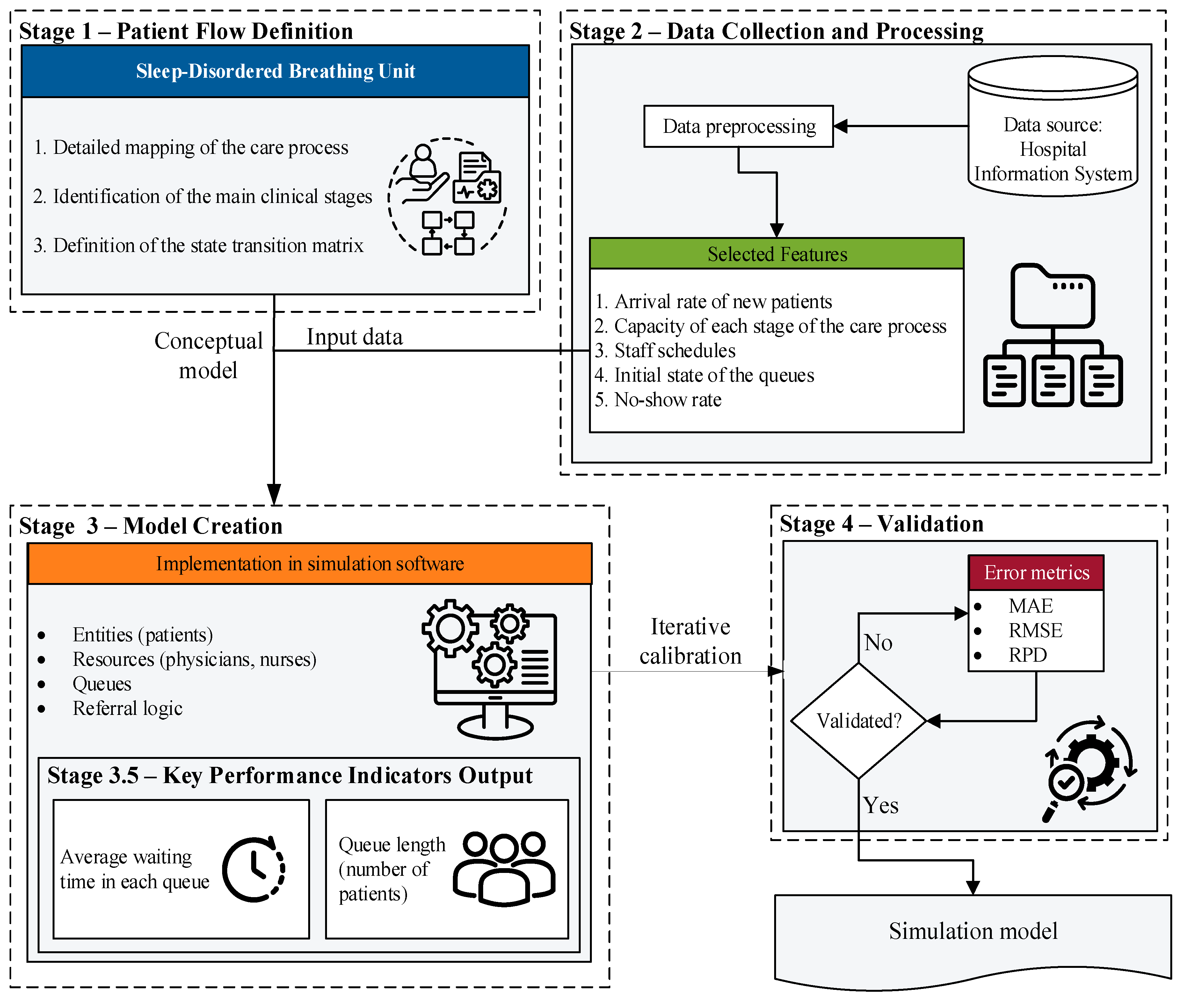
Figure 2.
Clinical care pathway in the Sleep-Disordered Breathing Unit.
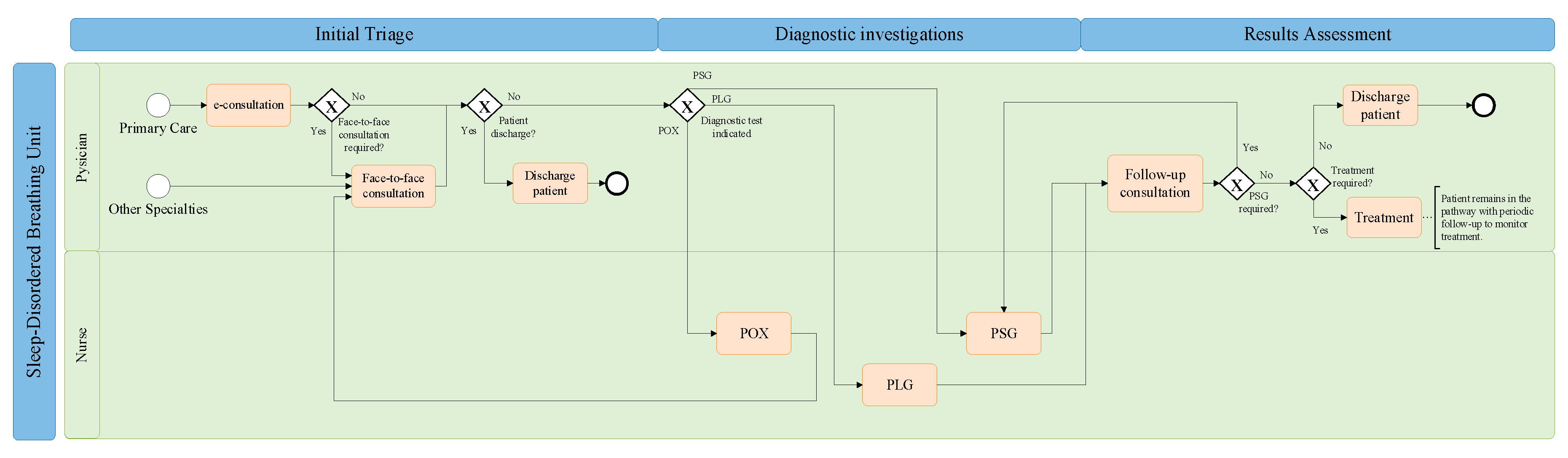
Figure 3.
Simulink/SimEvents block diagram of the model.
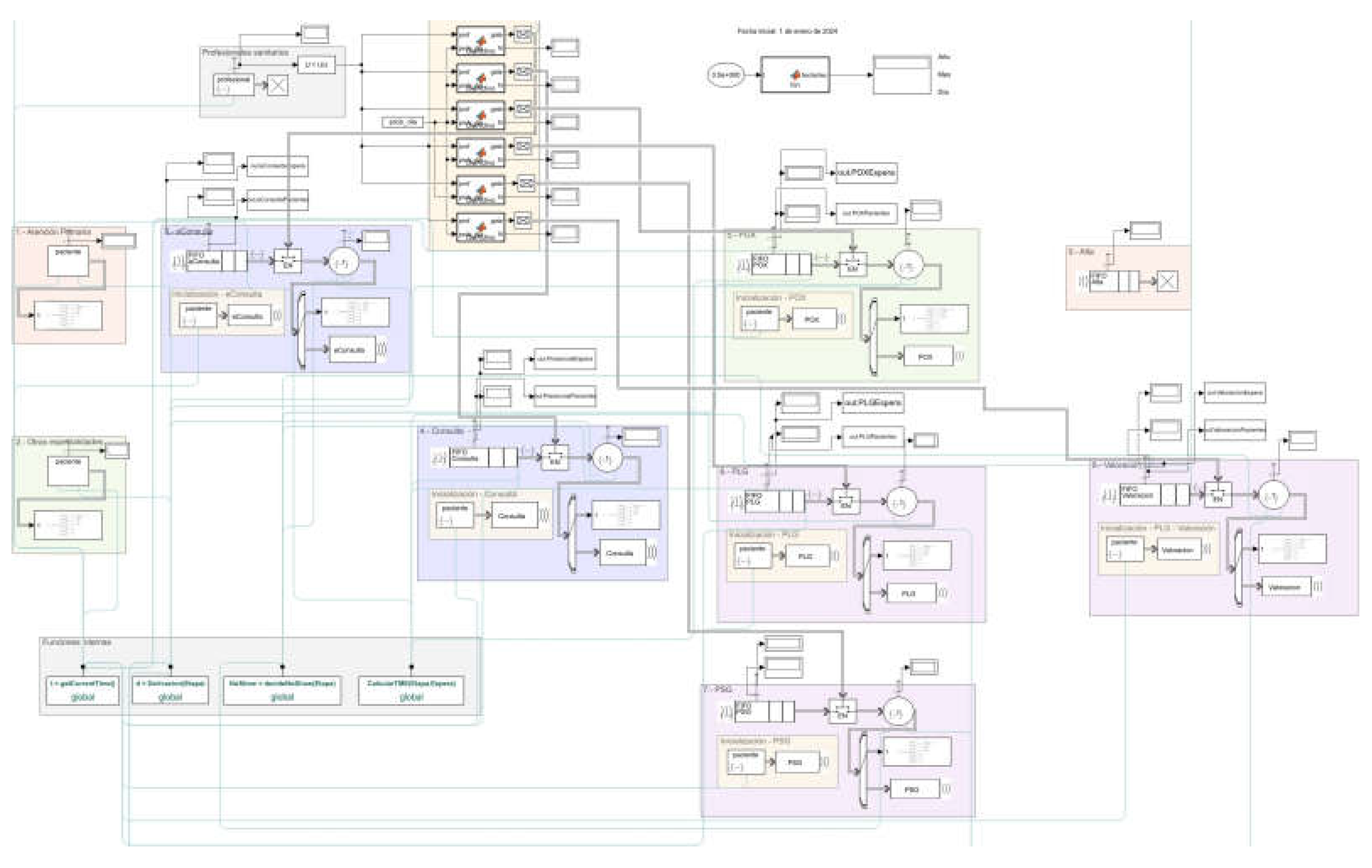
Figure 4.
Validation results of the model for mean waiting time by care stage. (a) Correlations between simulated and observed waiting times for each stage. (b) Heatmap of validation metrics by stage.
Figure 4.
Validation results of the model for mean waiting time by care stage. (a) Correlations between simulated and observed waiting times for each stage. (b) Heatmap of validation metrics by stage.
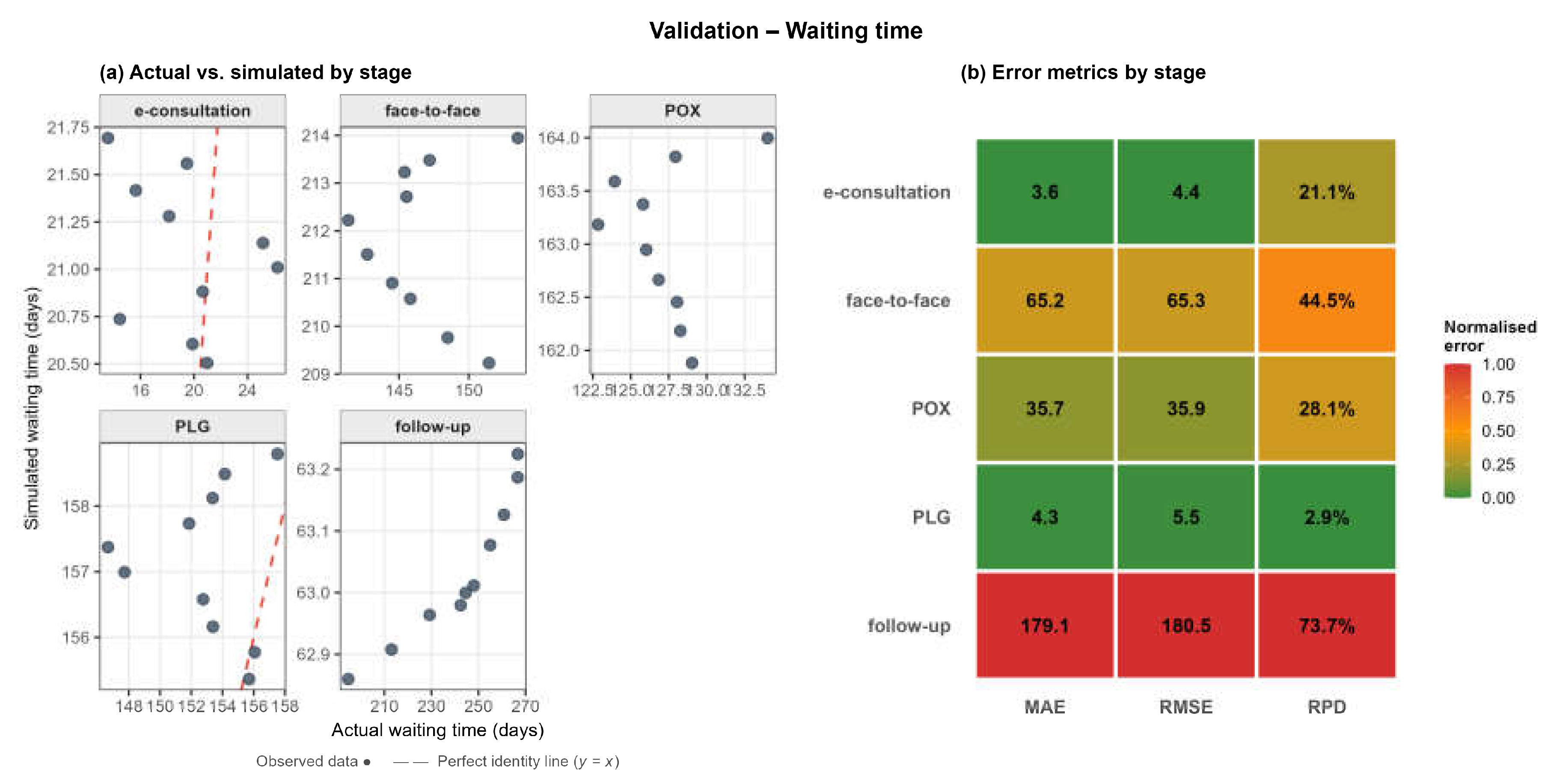
Figure 5.
Validation results of the model for the number of patients in queue by care stage. (a) Correlations between simulated and observed numbers of patients for each stage. (b) Heatmap of validation metrics for the number of patients by stage.
Figure 5.
Validation results of the model for the number of patients in queue by care stage. (a) Correlations between simulated and observed numbers of patients for each stage. (b) Heatmap of validation metrics for the number of patients by stage.
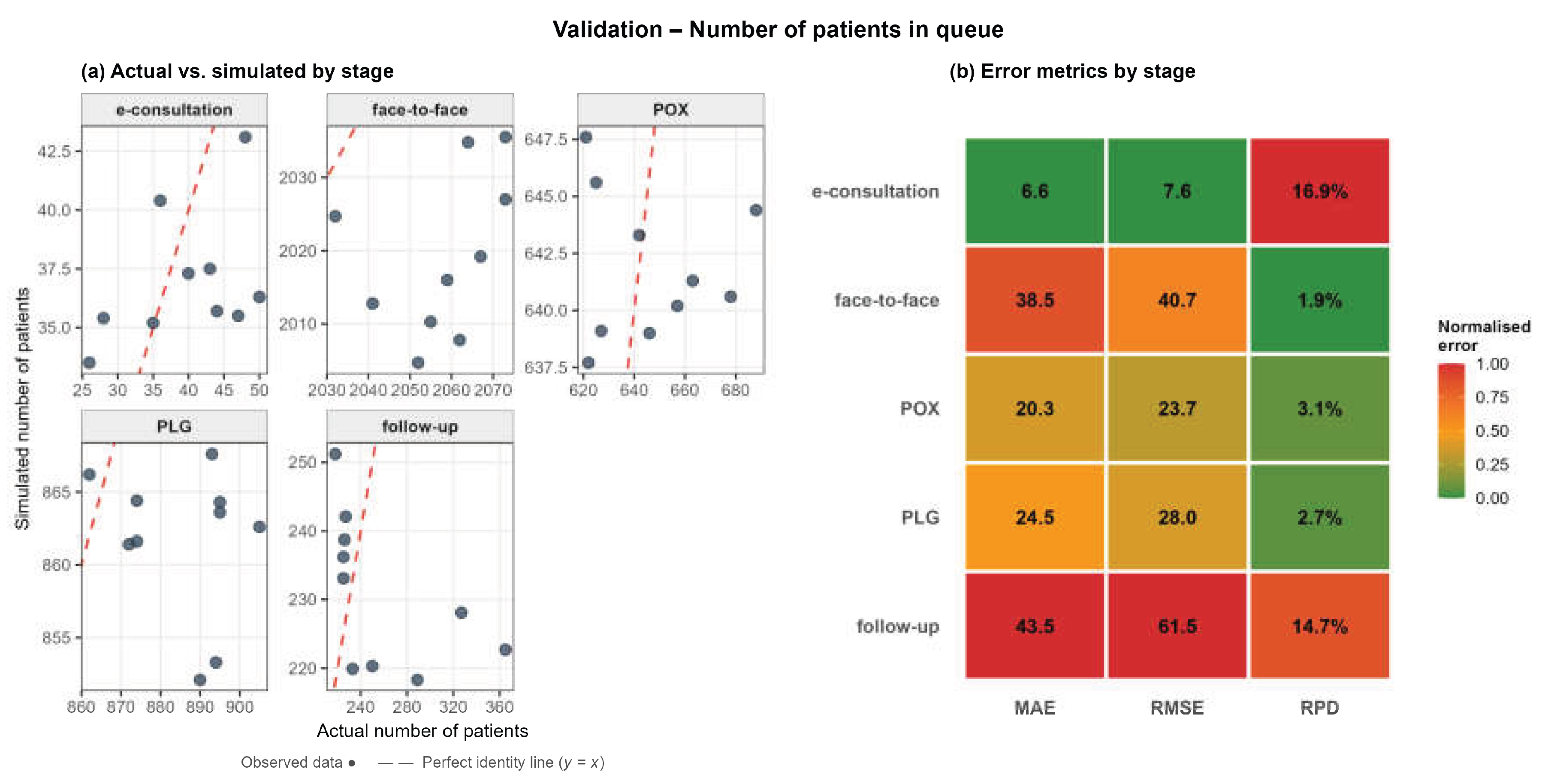

Table 1.
Application of the STRESS checklist to the present model.
| Category | Checklist item | Present simulation model |
|---|---|---|
| Objectives | ||
| 1.1 Purpose of the model | To develop and validate a DES model of patient flow in the Sleep-Disordered Breathing Unit, capable of reproducing real-world operation and serving as a basis for subsequent evaluation of organisational scenarios aimed at reducing diagnostic waiting lists. | |
| 1.2 Model Outputs | Mean waiting time and queue length at each care stage, using Relative Percent Difference (RPD), Root Mean Square Error (RMSE) and Mean Absolute Error (MAE) as validation metrics. | |
| 1.3 Experimentation Aims | To replicate the retrospective care pathway and assess model reliability. | |
| Logic | ||
| 2.1 Base model overview diagram | See Figure 2. | |
| 2.2 Base model logic | The model logic is stochastic and relies on a State-transition matrix, where the next patient state depends only on the current state, with probabilities estimated from 2024 historical data and validated by unit experts. | |
| 2.3 Scenario logic | Not applicable (N/A). | |
| 2.4 Algorithms | N/A. | |
| 2.5 Components | 2.5.1 Entities Patients progressing through the different clinical stages of the pathway. |
|
| 2.5.2 Activities e-Consultation, face-to-face consultation, diagnostic tests and follow-up consultation. | ||
| 2.5.3 Resources Healthcare professionals whose availability is constrained by work schedules: when resources are unavailable, the stage is closed and patients remain in queue. | ||
| 2.5.4 Queues FIFO waiting lists associated with each stage, monitoring queue length and mean waiting time. | ||
| 2.5.5 Entry/Exit Points Entries consist of referrals from Primary Care and other specialties, modelled as Poisson arrival processes. Exits occur after triage, diagnosis or treatment. | ||
| Data | ||
| 3.1 Data sources | See section 2.2 and 2.3. | |
| 3.2 Pre-processing | N/A. | |
| 3.3 Input parameters | See Table 2 and Table 3. | |
| 3.4 Assumptions | State-transition matrix: when specific registry data were unavailable, transition probabilities between stages were elicited from the Unit Head’s expert judgement. | |
| Experimentation | ||
| 4.1 Initialisation | The model is initialised with the actual queue state as of 1 January 2024 and excludes an initial warm-up period from the computation of outcome indicators to mitigate bias from initial conditions. | |
| 4.2 Run length | The simulation runs over a two-year horizon, until 31 December 2025. | |
| 4.3 Estimation approach |
Ten independent replications with different random seeds were executed to capture stochastic variability. Results were averaged across replications at 10 weekly cut-off points and compared with real data using RMSE, MAE and RPD. | |
| Implementation | ||
| 5.1 Software or programming language | MATLAB R2025b using the Simulink graphical environment and the SimEvents toolbox. | |
| 5.2 Random sampling | The default Mersenne Twister random-number generator in MATLAB was used, with distinct seeds for each of the 10 independent replications. | |
| 5.3 Model execution | SimEvents uses a DES engine on top of Simulink, primarily based on an event-driven/event-scheduling mechanism. No explicit priority rules were defined for resource use, so entities are processed strictly in order of arrival. | |
| 5.4 System Specification | AMD Ryzen 5 5600H with Radeon Graphics (3.30 GHz), 16 GB RAM and Windows 11 Pro 25H2 64-bit operating system. | |
| Code Access | ||
| 6.1 Computer Model Sharing Statement | The computational model and source code are not publicly available. |
Table 2.
State-transition matrix of the present model.
| Care Stages | e-Consultation | Face-to-face consultation | POX | PLG | PSG | Follow-up consultation |
Discharge |
|---|---|---|---|---|---|---|---|
| PC | 94.75 | 0 | 0 | 0 | 0 | 0 | 5.25 |
| Other specialties | 0 | 74.35 | 8.27 | 10.27 | 1 | 0 | 6.25 |
| e-Consultation | 0 | 20 | 25.81 | 44.75 | 1 | 0 | 8.44 |
| Face-to-face consultation | 0 | 0 | 27.5 | 30.72 | 1 | 0 | 40.78 |
| POX | 0 | 77.5 | 0 | 0 | 0 | 0 | 22.5 |
| PLG | 0 | 0 | 0 | 0 | 0 | 79.7 | 20.3 |
| PSG | 0 | 0 | 0 | 0 | 0 | 10.3 | 89.7 |
| Follow-up consultation | 0 | 80.16 | 0 | 0 | 1 | 0 | 18.84 |
Table 3.
Summary of operational input parameters.
| Variable | Comments |
|---|---|
| Daily capacity (patients/day) | |
| e-Consultation | Deterministic model with noise, mean 6.28 (variance 4.53). Activity present on 99.96% of working days. |
| Face-to-face consultation | Negative binomial distribution, mean 15.43 (variance 33.95), truncated between 0 and 32. Activity present on 65.2% of working days. |
| POX | Deterministic model with noise, mean 5.37 (variance 2.33). Activity present on 85.2% of working days. |
| PLG | Deterministic model with noise, mean 5.88 (variance 2.44). Activity present on 98.4% of working days. |
| PSG | Deterministic model with noise, mean 2.76 (variance 0.32). Activity present on 73.2% of working days. |
| Follow-up consultation | Negative binomial distribution, mean 10.16 (variance 15.99), truncated between 0 and 16. Activity present on 45.2% of working days. |
| Arrival rates (patients/day) | |
| From PC | Poisson distribution, mean 6.32, with daily weights to reflect weekly variation (1.48, 0.96, 0.79, 0.91, 0.85). |
| From other specialties | Poisson distribution, mean 2.68, using the same daily weights. |
| Initial queue (patients) and mean waiting time (days) | |
| e-Consultation | 112 patients (mean waiting time: 18.05 days). |
| Face-to-face consultation | 1,632 patients (mean waiting time: 149.17 days). |
| POX | 591 patients (mean waiting time: 108.31 days). |
| PLG | 644 patients (mean waiting time: 108.06 days). |
| PSG | 286 patients (mean waiting time: 99.12 days). |
| Follow-up consultation | 179 patients (mean waiting time: 68.44 days). |
| No-show rate (%) | |
| e-Consultation | 0%. |
| Face-to-face consultation | 9.13%. |
| POX | 9.71%. |
| PLG | 6.81%. |
| PSG | 3.44%. |
| Follow-up consultation | 4.50%. |
| Work calendar | Activity from Monday to Friday, with 14 public holidays per year according to the local work calendar. |
Table 4.
Validation results for waiting time.
| Care Stages | MAE (days) | RMSE (days) | RPD (%) |
|---|---|---|---|
| e-Consultation | 3.6 | 4.44 | 21.1 |
| Face-to-face consultation | 65.15 | 65.27 | 44.5 |
| POX | 35.73 | 35.86 | 28.1 |
| PLG | 4.34 | 5.48 | 2.9 |
| Follow-up consultation | 179.08 | 180.47 | 73.7 |
| Weighted overall | 55.8 | 56.28 | 34.6 |
| Full patient pathway | 72.32 | 75.29 | 10.9 |
Table 5.
Validation results for number of patients.
| Care Stages | MAE (patients) | RMSE (patients) | RPD (%) |
|---|---|---|---|
| e-Consultation | 6.61 | 7.62 | 16.9 |
| Face-to-face consultation | 38.52 | 40.66 | 1.9 |
| POX | 20.28 | 23.72 | 3.1 |
| PLG | 24.53 | 28 | 2.7 |
| Follow-up consultation | 43.5 | 61.45 | 14.7 |
| Weighted overall | 32.33 | 36.41 | 3.6 |
| Full patient pathway | 99.26 | 134.23 | 3.5 |
Table 6.
Benchmarking of the proposed model against published studies. For each study, a symbol is shown relative to the present work: “-“ indicates inferior characteristics according to the criterion and “=“ indicates comparable characteristics.
Table 6.
Benchmarking of the proposed model against published studies. For each study, a symbol is shown relative to the present work: “-“ indicates inferior characteristics according to the criterion and “=“ indicates comparable characteristics.
| Field of Application |
Objectives | Software | Validation strategy | ||
|---|---|---|---|---|---|
| (Pendharkar et al., 2015) | Multidisciplinary sleep centre | Improve access and test capacity/prioritisation configurations | Not specified | Comparison with real data. No formal metrics. | |
| = | - | - | |||
| (Williams et al., 2020) | Critical care | Determine optimal bed capacity and what-if scenarios | Simul8 | Comparison with real data. No formal metrics | |
| - | - | ||||
| (Sauer et al., 2016) | Endoscopy unit | Improve daily efficiency (room utilisation, blocked flow) | MedModel | Compare deviations between simulated and real times. No formal metrics | |
| - | - | ||||
| (Yakutcan et al., 2021) | COPD pathway | Assess cost-effectiveness of increased pulmonary rehabilitation | Simul8 | Face validity with clinical team and comparison with real data. No formal metrics | |
| - | - | ||||
| Present study | Sleep-Disordered Breathing Unit | Retrospective validation as basis for analyse waiting lists | MATLAB | Formal retrospective validation using MAE, RMSE and RPD | |
Disclaimer/Publisher’s Note: The statements, opinions and data contained in all publications are solely those of the individual author(s) and contributor(s) and not of MDPI and/or the editor(s). MDPI and/or the editor(s) disclaim responsibility for any injury to people or property resulting from any ideas, methods, instructions or products referred to in the content. |
© 2026 by the authors. Licensee MDPI, Basel, Switzerland. This article is an open access article distributed under the terms and conditions of the Creative Commons Attribution (CC BY) license (http://creativecommons.org/licenses/by/4.0/).
Copyright: This open access article is published under a Creative Commons CC BY 4.0 license, which permit the free download, distribution, and reuse, provided that the author and preprint are cited in any reuse.


