

Submitted:
25 May 2026
Posted:
26 May 2026
You are already at the latest version
Abstract
In the present study, previously-selected lactic acid bacteria (LAB) strains — Leuconostoc mesenteroides, Lacticaseibacillus paracasei, and Loigolactobacillus coryniformis — as well as kefir ferment were evaluated as adjunct and bioprotective cultures in goat’s pasteurized milk cheese, as they were intended to contribute both to antimicrobial activity against foodborne pathogens and to acidification and proteolytic potential relevant to cheese ripening. Six experimental cheese treatments were produced: one control made of raw milk (commercial benchmark) and another control made of pasteurized milk both produced at pilot scale to reflect industrial manufacturing conditions, and a control, L. mesenteroides-, LAB cocktail-, and kefir-added treatments made of pasteurized milk produced at laboratory scale under controlled conditions to assess the effects of adjunct cultures. The primary assessment of adjunct culture performance was conducted among the laboratory-produced pasteurized milk cheeses, which shared identical processing conditions. Cheeses were characterised in terms of microbiological and physicochemical attributes during the 60-day maturation period, whereas proximate composition, instrumental texture and sensory analysis were carried out in the final product. Mesophilic bacteria and LAB were the predominant microbiota in all treatments, remaining high (> 8 log CFU/g) throughout maturation, whereas the control exhibited significantly lower counts, averaging ~7 log CFU/g (p<0.001). This persistence is expected and technologically desirable in fermented cheeses, as a dominant LAB population contributes to acidification, competitive exclusion of undesirable microorganisms, and proper ripening development. Populations of Escherichia coli decreased significantly during maturation (p<0.001), with kefir and LAB cocktail cheeses achieving the highest reductions (3.96 ± 0.479, and 4.12 ± 0.479 log CFU/g respectively, at the end of maturation). For S. aureus, the most pronounced reductions occurred in kefir > L. mesenteroides > LAB cocktail, with final counts of 3.67 ± 0.241, 4.26 ± 0.241 and 4.36 ± 0.241 log CFU/g, respectively. Physicochemical parameters changed significantly during maturation (p < 0.001), and cheeses containing adjunct cultures exhibited higher proteolytic activity (up to 0.361 ± 0.0131), titratable acidity (up to 0.1971 ± 0.0180 g lactic acid equivalent/kg cheese) and lower pH ( 5.41 ± 0.0526), indicating more advanced maturation process than the three control treatments. Principal Component Analysis (PCA) clearly distinguished kefir and LAB cocktail cheeses from the pilot pasteurized milk and control cheeses, revealing strong positive correlations between microbial activity, acidification, and proteolysis. Furthermore, PCA revealed linkages between physicochemical and textural properties, namely: higher proteolysis, acidity and fat content related higher cheese brittleness; and higher pH related to higher cheese hardness. Sensory evaluation revealed statistically significant differences (p < 0.05) among treatments for several attributes, including aroma, taste, texture-related parameters, and overall acceptance. Kefir > L. mesenteroides > LAB cocktail cheeses achieved the highest overall acceptance scores (9.15 ± 0.285, 8.44 ± 0285, and 8.39 ± 0.285, respectively), being characterized by perceivable less holes, pleasant aroma, balanced acidity, and smooth, non-rubbery texture. The improved texture observed in kefir and LAB treated cheeses can be mechanistically associated with enhanced proteolytic activity and progressive acidification during maturation, which promote casein breakdown and structural softening of the cheese matrix. Likewise, aroma enhancement may be linked to the metabolic activity of LAB and kefir microbiota, contributing to the formation of organic acids, volatile compounds, and bioactive peptides. Based on the results obtained in this study, incorporation of kefir and selected LAB strains can be considered as effective bioprotective and functional adjunct cultures for artisanal goat cheese production.
Keywords:
goat milk cheese
; lactic acid bacteria
; kefir
; bioprotective cultures
; foodborne pathogens
; food safety
; cheese ripening
1. Introduction
Goat milk is one of the most promising dairy raw materials, driven by growing consumer demand for products with distinctive sensory characteristics and nutritional benefits [1]. It plays a particularly important role in the production of traditional cheese by small-scale dairies in the Mediterranean and south-eastern European regions, where goat farming remains closely tied to local breeds and artisanal practices [2,3]. Traditional cheeses are produced using specific artisanal know-how and often involve minimal or no prior milk processing; however, they may also be made from thermized or pasteurized milk inoculated with selected starter cultures, which promote the development of a characteristic maturation microbiota [4]. Nevertheless, the rich nutrient composition of raw milk provides a highly-favourable environment for the growth of both spoilage microorganisms, which negatively affect product quality and shelf life, and pathogenic microorganisms, which pose direct risks to consumer health [5]. Although starter cultures are widely used to control fermentation and enhance acidification, their antimicrobial efficacy is strain-dependent and often insufficient to ensure consistent suppression of pathogenic bacteria under the complex ecological conditions of raw milk cheeses. In these systems, variations in pH dynamics, water activity, and microbial interactions can reduce the predictability of starter-mediated antagonism. This variability highlights a key knowledge gap regarding the need for more robust or multifunctional starter systems capable of providing reliable pathogen control during cheese ripening. Pathogenic microorganisms may enter raw milk either through direct excretion from infected animals—most notably via systemic infections or mastitis—or through indirect contamination during or after milking, originating from fecal residues, the surfaces of the udder and teats, animal skin, milking equipment, or the surrounding environment [6]. These contamination pathways allow pathogens such as Escherichia coli, Listeria monocytogenes, Salmonella spp., and Staphylococcus aureus to be transmitted not only via raw milk but also through derived dairy products [7,8,9], particularly in small-scale goat production systems, where limited technological capacity and inadequate hygiene practices may predispose herds to disease and economic losses while simultaneously increasing food safety risks for consumers [10]. Although pasteurization is an effective hurdle technology that reduces microbial load, limits spoilage microorganisms, and prevents foodborne diseases, microbiological risks may still persist if (i) the initial microbial quality of raw milk is poor, (ii) heat treatments are not rigorously applied, (iii) thermostable hazards such as pre-formed S. aureus enterotoxins are present, or (iv) post-pasteurization contamination occurs during handling [4,11,12,13]. Indeed, studies have shown that almost 50% of pasteurized fluid milk exhibits evidence of post-pasteurization contamination by organisms capable of growing at refrigeration temperatures (around 6ºC) [14].
Cheese may become contaminated either from the milk itself or at any stage of production, maturation or storage through inadequate hygiene, cross-contamination, contaminated equipment, or improper handling by food workers [11,15]. Ensuring high microbiological quality of raw milk, along with good hygienic and manufacturing practices, is therefore essential for producing safe, high-quality cheese [16,17]. In this context, the use of selected lactic acid bacteria (LAB) strains as adjunct cultures has gained more attention, since LAB not only improve the nutritional, technological and sensory attributes of dairy products but also enhance microbiological safety [18,19]. Their primary role in fermentation lies in acid production, which drives the development of characteristic flavour, aroma, and texture while inhibiting spoilage and pathogenic microorganisms [20]. Their bioprotective effects are associated with nutrient competition, adhesion site exclusion, and the production of antimicrobial compounds—including bacteriocins, organic acids (mainly lactic acid), hydrogen peroxide, diacetyl, and other metabolites—that create unfavorable conditions to undesirable bacteria [1,21]. Organic acid production and the consequent pH reduction represent the main drivers of biopreservation in fermented foods [20,22]. The principle of competitive exclusion, whereby beneficial strains dominate ecological niches and outcompete spoilage and pathogenic microorganisms, further contributes to controlling unwanted microbiota in cheese [23]. In the strains selected for this study, the most relevant bioprotective mechanisms are acidification through organic acid production and the consequent pH reduction, which limit the growth of undesirable microorganisms [24]. LAB-derived metabolites also interact with the cheese matrix through physicochemical mechanisms that influence protein structure and fat distribution. Organic acids reduce pH and modify casein interactions, while peptides, free amino acids, and exopolysaccharides can affect water-holding capacity, texture, and the release of fat-associated aroma compounds during ripening [25,26,27].
Beyond the use of LAB cultures, kefir grains represent a promising natural fermentation source alternative composed of a complex microbial consortium of LAB, acetic acid bacteria, and yeasts [28]. Kefir has attracted considerable interest from both the food industry and consumers, and was even listed by the Institute of Food Technologists (IFT) among the “Nine Food Trends to Watch for in 2021”[29]. Consumption of kefir can be limited by its traditional liquid form and distinct flavor; therefore the development of alternative formats, including concentrated products and solid dairy matrices such as cheese, may improve consumer acceptability and broaden its consumption potential [30]. However, studies specifically addressing this approach remain limited [30]. In kefir, LAB are primarily responsible for converting lactose into lactic acid, thereby lowering pH and contributing to milk preservation by inhibiting the growth of spoilage and pathogenic microorganisms, meanwhile lactose-fermenting yeasts produce ethanol and CO2 ,which influence texture, aroma, and flavour development of the product [31,32]. In addition to their technological and microbiological benefits, selected LAB strains and kefir have been associated with probiotic health effects, in previous studies, including modulation of the immune system, improvement of gut health, reduction of cholesterol, alleviation of lactose intolerance, and potential anticancer activity [33]. The LAB strains used in this study were selected based on previously reported functional and technological properties [34,35]. However, no in vivo validation was performed in the present work, and any probiotic-related effects are therefore inferred from existing literature rather than experimentally demonstrated. This study was based on the hypothesis that kefir, due to its complex and diverse microbial consortium, may exhibit enhanced microbiological safety performance compared to single-strain or defined LAB cultures, particularly through stronger inhibition of pathogenic and spoilage microorganisms in goat’s milk cheese.
The objectives of the present study were therefore: (i) to evaluate the applicability of previously-characterized LAB strains, namely Leuconostoc mesenteroides, Lacticaseibacillus paracasei and Loigolactobacillus coryniformis, as well kefir ferment in goat’s pasteurized milk cheese; (ii) to assess food safety outcomes, including inhibition of relevant pathogenic and spoilage microorganisms; (iii) to evaluate tecnnological performance, including physicochemical characteristics and sensory quality; and (iv) to explore functional potential based on nutritional composition and bioactive-related properties of the resulting cheeses in comparison with goat’ milk cheeses, both from raw and pasteurized milk, currently produced at pilot scale.
2. Materials and Methods
2.1. Bacteria Strains and Cultures Preparation
The LAB strains used in this study—Leuconostoc mesenteroides, Lacticaseibacillus paracasei, and Loigolactobacillus coryniformis—were previously isolated from artisanal goat´s raw milk cheeses produced in Portugal and evaluated in vitro at both 10 ºC and 37 ºC for their antimicrobial activity, acidifying ability and proteolytic capacity, showing clear antagonism against Listeria monocytogenes, Salmonella Typhimurium, and Staphylococcus aureus [34,35]. Molecular identification of the LAB strains was performed based on 16S rRNA gene sequencing for taxonomic confirmation. The obtained sequences were compared with reference sequences strains available in public databases, including Leuconostoc mesenteroides NR_157602.1, Lacticaseibacillus paracasei NR_113337.1, and Loigolactobacillus coryniformis NR_180283.1, to ensure accurate species-level identification. The cryopreserved strains were thawed, and a loop of each culture strain was separately cultivated in MRS broth at 30 °C for 24 h. Two successive inoculations were then performed by placing 100 μL of the subcultures in 10 mL of MRS broth at 30 °C for 24 h. The following inoculation was carried out by placing 500 μL of the subculture in 200 mL of MRS broth at 30 °C for 18 h, to achieve a concentration of each strain of approximately 7 log CFU/mL, adjusted by measuring absorbance at 600 nm using a spectrophotometer (Peak Instruments Inc., Version 1701). The inoculum level was selected based on the study objectives and previously reported methodologies in dairy matrices, as well as on commonly accepted functional and probiotic benchmarks. In fermented foods, microbial populations at or above 106–107 CFU/g are generally considered necessary to ensure functional activity and, in the case of probiotic strains, to deliver potential health benefits at the time of consumption. In this context, the selected inoculum level supports rapid establishment and a competitive advantage of the protective cultures, thereby promoting effective suppression of undesirable or pathogenic microorganisms during processing, ripening, and storage[36]. Cultures were centrifuged at 10,640 × g for 5 min at 4 °C in an MPW-352R centrifuge (MPW Med. Instruments, Warsaw, Poland) to obtain bacterial pellets. For the Leuconostoc mesenteroides single-strain treatment, the pellet was resuspended in 100 mL of sterile saline solution (0.9% w/v NaCl). For the LAB cocktail, a ratio (0.33:0.33:0.33) of three bacterial pellets (L. mesenteroides, Lb. paracasei, and L. coryniformis) were combined and resuspended in 100 mL of sterile saline solution (0.9% w/v NaCl), ensuring equal representation of each strain, as commonly applied in studies using mixed-culture LAB systems, thereby allowing the assessment of their combined functional activity [37]. The fresh kefir grains used in this study were obtained from Burumart Commerce (Kefiralia, Portugal), and previous work from our research group using the same commercial kefir grains reported the presence of lactic acid bacteria, mesophilic bacteria, yeasts, and molds [38]. To produce the kefir ferment used for inoculation, the grains were first activated in pasteurized goat’s milk at a weight ratio of 1%, and the mixture was incubated under anaerobic conditions at 30 °C for 20 h. After fermentation, the kefir grains were separated from the fermented milk by gravity filtration under aseptic conditions. The kefir ferment was then transferred to sterile 50 mL Falcon tubes and centrifuged at 10,640 × g for 5 min at 4 °C (MPW-352R centrifuge, MPW Med. Instruments, Warsaw, Poland). The resulting pellet was resuspended in 100 mL of goat’s pasteurized milk. All cultures were used immediately in cheesemaking under the specific treatments (i.e., L. mesenteroides, LAB cocktail and kefir).
2.2. Inoculation of Bacterial Strains and Cheese Production
To investigate the effect of LAB and kefir ferment on microbiological, nutritional and sensory quality of goat’s pasteurized milk cheese, six experimental cheese batches were prepared, each consisting of 30 L of milk. The 30 L batch size was selected to ensure sufficient curd yield for physicochemical, microbiological, textural, and sensory analyses, while maintaining process conditions representative of pilot-scale cheesemaking. This volume also allowed the production of multiple cheese units per treatment, thereby reducing within-batch variability and allowing biological replication at the cheese-unit level. To minimize batch-to-batch variability, all treatments followed standardized cheesemaking procedures (temperature, renneting, pressing, salting, and ripening conditions). Each treatment corresponded to an independent batch and was considered an experimental unit in the statistical analysis. One batch was produced from raw milk and five were produced from pasteurized milk, according to the following treatments: (i) Pilot raw milk – cheese elaborated from raw milk without any starter culture, produced in a pilot plant and used as a benchmark for being the traditional goat’s raw milk cheese consumed in Portugal; (ii) Pilot pasteurized milk – cheese elaborated from pasteurized milk without any culture, produced in the pilot plant; (iii) Control – cheese elaborated from pasteurized milk without any adjunct culture, produced in the laboratory; (iv) Leuconostoc mesenteroides – cheese elaborated from pasteurized milk inoculated with L. mesenteroides, produced in the laboratory; (v) LAB cocktail – cheese elaborated from pasteurized milk inoculated with a cocktail of L. mesenteroides, L. paracasei, and L. coryniformis, produced in the laboratory; and (vi) Kefir – cheese elaborated from pasteurized milk inoculated with kefir ferment, produced in the laboratory. The first two treatments are referred to as “pilot” because they were fully elaborated and matured at a partner dairy factory located in Portugal, to mimic industrial conditions. On the other hand, the other four treatments were produced in the laboratory, in order to ensure strict controlled conditions of time, temperatures and relative humidity, that could facilitate comparison between the added starter cultures.
Goat raw milk was vat pasteurized at 65 °C for 30 minutes, to reduce or eliminate native microflora [39], then cooled to 34 ± 1 °C prior to inoculation. Inoculation with the selected cultures was performed immediately after reaching the target temperature. Therefore, while competitive exclusion from residual microbiota cannot be completely excluded, the dominant microbial populations during cheesemaking were primarily driven by the intentionally added starter and adjunct cultures. The respective adjunt cultures were added to achieve a final concentration of approximately 107 CFU/mL [19]. Prior to inoculation, all adjunct cultures were standardized to approximately 107 CFU/mL using OD600 measurements calibrated against plate count verification. OD600 values were converted to viable counts (log CFU/mL) using a previously established calibration curve based on a logarithmic regression model obtained from serial dilution and plate counting. The selected inoculum level was determined based on the study objectives and previously reported methodologies in dairy matrices [40,41,42]. Escherichia coli and Staphylococcus aureus were not intentionally inoculated in this study but were monitored as naturally occurring microorganisms present in the cheese samples. These microorganisms were included as indicators of hygiene and microbiological safety throughout cheese maturation. Commercial rennet (5 mL/30 L milk) was added to induce coagulation, and after 45–60 min the curd was cut into cubes, drained, and the whey was removed. Cheesemaking typically involves milk coagulation through enzymatic action, forming a gel that is separated into curds and whey [43]. The compacted curd was placed into cylindrical molds (~500 g each), weighed, and pressed for 5 h to remove excess whey. The cheeses were then dry-salted with 2% (w/w) NaCl, a step that enhances both flavour and microbial stability, primarily through a reduction in aw and the induction of osmotic stress [44]. However, at this concentration, NaCl alone is not sufficient to inhibit E. coli, and its antimicrobial effect should be considered as part of a multi-hurdle system in combination with acidification and LAB-driven competitive exclusion during ripening. Finally, the cheeses were ripened at 12 °C and 98% relative humidity in a climate-controlled chamber for 60 days, allowing fermentation and biochemical maturation to occur [45]. The cheesemaking procedure was identical across all treatments and was controlled to allow comparison of the specific effects of LAB and kefir ferment on the microbiological, physicochemical, nutritional and sensory properties of the cheese.
2.3. Microbiological Analysis Throughout Cheese Maturation
Microbiological analyses were conducted at five time points selected to represent key stages of cheeses ecological evolution: day 1 (formed curd, early fermentation and acidification), day 15 (rapid LAB-driven metabolism and early ripening), day 30 (mid-maturation with active biochemical changes), day 45 (transition to a more stable and competitive microbial ecosystem) and day 60 (end of maturation and ecological product stabilization). The analyses included enumeration of mesophilic bacteria, LAB grown on MRS and M17 agar, Escherichia coli, and Staphylococcus aureus. For each sampling point, 10 g of cheese were aseptically diluted in 90 mL sterile buffered peptone water (BPW) (Liofilchem, Roseto degli Abruzzi, Italy) and homogenized for 90 s in a stomacher (Interscience Bag Mixer 400, Saint Nom la Bretêche, France). Appropriate decimal dilutions were prepared in BPW for microbial enumeration. Total mesophilic bacteria were determined by pour-plating 1 mL aliquots onto Plate Count Agar (Liofilchem, Roseto degli Abruzzi, Italy) and incubated at 37 °C for 48 h [46]. Presumptive LAB were enumerated by pour-plating 1 mL aliquots onto MRS and M17 agar (Liofilchem, Roseto degli Abruzzi, Italy), overlaid with 10 mL of 1.2% agar (Liofilchem, Roseto degli Abruzzi, Italy) and incubated at 30 °C for 48 h. Counts obtained on MRS and M17 were interpreted independently and were not summed, as the aim was to monitor the dynamics of specific LAB groups rather than to estimate total LAB. S. aureus was enumerated from the cheese samples by spread-plating 0.1 mL aliquots onto Baird-Parker Agar supplemented with Egg Yolk Tellurite Emulsion (Liofilchem, Roseto degli Abruzzi, Italy) and incubated at 37 °C for 48 h. The quantification limit was 1.7 log CFU/g. E. coli was similarly enumerated by spread-plating 1 mL aliquots onto Mac Conkey Agar (Liofilchem, Roseto degli Abruzzi, Italy) and incubated at 37 °C for 24 h, and no additional confirmatory tests (e.g., indole production or β-glucuronidase activity) were performed. The quantification limit was 0.7 log CFU/g. All analyses were performed using two independent samples from each cheese, each plated in duplicate, thereby incorporating both biological and technical replication. Colonies according to proper morphology were counted, and results were expressed as log10 of colony-forming units per gram of cheese (log CFU/g).
2.4. Physicochemical Analysis Throughout Cheese Maturation
The physicochemical determinations during cheese maturation included measurements of pH, water activity (aw), titratable acidity and proteolytic activity carried out on Days 1, 30 and 60. Proximate composition (moisture, protein, fat, and ash contents) were determined only in the final cheese product (Day 60), as these parameters are primarily used to characterise the end-product and assess its technological and nutritional quality after maturation. pH was determined using a 10-g cheese subsample homogenised for 30 s in 90 mL of deionized water using a stomacher (Interscience Bag Mixer 400, Saint Nom la Bretêche, France), and the pH of the homogenate was measured in duplicate using a FiveGo pH meter F2 coupled with a LE438 IP67 probe (Mettler-Toledo, Greifensee, Switzerland).
To measure aw, the cheese samples were transferred into the cuvette of an Aqualab 4TE water activity meter (4TE Decagon, San Francisco, CA, USA), and the values were recorded after measurement stabilization; aw measurements were performed in duplicate for each cheese sample.
To assess the impact of acid production by LAB, titratable acidity was determined by titration with sodium hydroxide (NaOH) using alcoholic phenolphthalein as indicator. For each sample, 10 g of cheese were homogenized for 30 s in 100 mL of deionized water using the same stomacher. An aliquot of 10 mL of the homogenate, was transferred to a beaker, two drops of phenolphthalein were added, and the sample was titrated with 0.1 N NaOH (Dornic solution, equivalent to 1/9 N NaOH) until a slightly pink color persisted for 30 s, indicating the endpoint. The dilution factor was accounted for in the calculation, as the 10 g cheese sample homogenized in 100 mL resulted in a suspension containing 1 g of cheese per 10 mL, used for titration. The titratable acidity (TA), expressed as grams of lactic acid equivalent per kilogram of cheese, was calculated as
where V is the volume (mL) of NaOH used, N is the NaOH normality (0.1 N), g is the cheese mass (g), and 9,008 is the conversion factor to g lactic acid equivalent/kg cheese [47]. Each sample was titrated in duplicate, and the mean value was recorded.
Proteolytic activity was quantified using an in-house protocol previously described for dairy systems, which provides an indirect estimate of proteolysis based on the soluble nitrogen fraction [38,48]. First, the sample pH was adjusted to 4.6 with 1 M HCl to precipitate caseins at their isoeletric point and isolate the soluble nitrogen fraction. A 10 mL aliquot was centrifuged at 3000 rpm for 20 min at 4°C to obtain the whey fraction, which was subsequently filtered (240 mm diameter filter). Proteolysis was assessed as follows: (i) 1 mL of whey was diluted in 100 mL of distilled water and the absorbance was measured at 280 nm using a spectrophotometer (Peak Instruments Inc., Version 1701), with distilled water as a blank; (ii) the remaining whey was boiled in a water bath for 10 min to promote precipitation of thermolabile residual proteins, centrifuged again under the same conditions, filtered, and a second 1:100 dilution was prepared, whose absorbance at 280 nm was recorded. Proteolytic activity was expressed as the difference between absorbance values obtained before and after boiling, calculated as:
Proteolytic activity = Filtrate absorbance before boiling - Filtrate absorbance after boiling
This method provides a comparative index of soluble peptide accumulation during cheese maturation rather than a detailed molecular characterization of peptide profiles.
The proximate composition of the cheeses samples (moisture, ash, protein, and fat contents) was determined at the end of maturation (Day 60) according to AOAC methods: AOAC 926.08 for moisture, AOAC 935.42 for ash, AOAC 991.20 for protein, and AOAC 933.05 for fat [49,50,51,52]. Protein content was calculated from the total nitrogen using a conversion factor of 6.38 (Kjeldahl N × 6.38), which is the conventional factor to obtain protein content in milk and dairy products [51]. All analyses were performed in triplicate for each cheese sample. Protein, ash, and fat contents were expressed as a dry basis (db).
2.5. Texture Analysis
After 60 days of maturation, texture analysis was performed on the cheese samples using a Texturometer equipment (TA. XT Plus) to evaluate the hardness (g) and brittleness (mm). Hardness can be defined as the peak force achieved during the first compression cycle, representing the resistance of the sample to deformation under compressive load [53], whereas brittleness refers to the point at which the sample fractures under compression, often measured as the distance (mm) at which the first break occurs during compression [54]. The distance at break provides a direct measure of structural failure under compression, reflecting the integrity of the protein–fat network within the cheese matrix. Unlike force-based parameters alone, it captures the onset of structural collapses, making it particularly suitable for evaluating changes in matrix cohesion and fragility during ripening. Six cylindrical samples (30-35 mm in diameter and 15-20 mm in height) were obtained using a cookie cutter and were taken from each treatment. The samples were left at room temperature for 10 min prior to testing. The instrument was calibrated to a maximum load of 5000 g and measurements were performed in duplicate using a flat cylinder probe (P/2, 20 mm diameter). Data collection was accomplished using Texture Exponent TPA32 software. Texture analysis provided insights into the structural integrity, firmness, and texture uniformity of the cheese, which are key attributes influencing overall product quality and consumer acceptance [55].
2.6. Sensory Evaluation
To characterize the sensorial profile of the cheeses after 60 days maturation, a sensory evaluation was conducted using an internal panel of 30 participants (researchers from IPB and CIMO) aged 20–45 years, consisting of semi-trained assessors with prior experience in dairy product evaluation. Approximately 20 g of each of the six cheese samples were portioned onto plastic plates at room temperature (~20°C) 30 min before the assessment. The sensory attributes assessed were: (i) Compactness, defined as the intensity of the visual attribute of a uniform matrix; (ii) Presence of holes, defined as the intensity of the attribute of the cheese matrix with visible holes; (iii) Aroma, defined as aroma intensity of the sample; (iv) Taste, defined as taste intensity of the sample; (v) Aftertaste, defined as taste intensity remaining in the mouth after eating; (vi) Crumbliness, defined as the intensity of breakableness texture of the sample; (vii) Pastiness, defined as the intensity of a pasty and smooth mouthfeel when eating the sample; (viii) Hardness, defined as the intensity of hardness, as opposed to tenderness, of the sample; (ix) Stickiness, defined as the intensity of adhesiveness or gluiness of the sample to the teeth; (x) Cork-like texture, defined as the intensity of rubbery mouthfeel during mastication, reflecting increased firmness and reduced matrix elasticity in the cheese and (xi) Overall acceptance, defined as the final measure that encapsulates the general satisfaction towards the cheese sample. Each panellist received an individual score sheet containing separate rows for each sample and attributes; and marked their perception on 10-cm unstructured line scales. In the scales provided for all descriptors, the left end (0) corresponded to “low intensity or sensation”, and the right end (10) to “high intensity or sensation”. After evaluation, the distance (cm) from the left edge of the scale to each mark was measured and the values were compiled into a data matrix for subsequent statistical analysis.
2.7. Statistical Analysis
To obtain the most information from the data, four types of statistical analysis were carried out in the R software (version 4.4.2) [56].
- Repeated measures analysis of variance (ANOVA) of attributes measured during cheese maturation, and in the final products. For each microbiological and physicochemical attribute, a repeated measures ANOVA was carried out to assess the effect of cheese treatment and maturation time at α=0.05; and when significant, mean comparisons by Tukey’s post hoc test were performed to contrast between treatments, and between days within cheese treatment. For each proximate component and texture analysis descriptors, ANOVA was carried out to assess the effect of cheese treatment, and mean comparisons performed by Tukey's HSD test. In both cases, estimated marginal means were computed. The diagnostic visualizations of Q-Q plot and residuals versus fitted values did not raise any issue on non-normality or heterocedasticity for concern. In addition, we produce charts plotting the means and standard errors estimated directly from the observations in order to show the evolution of each attribute along maturation. R packages used were lmer, emmeans, multcomp and ggplot2.
- Principal component analysis (PCA) of attributes measured in the final products. A rotated bi-dimensional PCA was adjusted on the set of quantitative variables characterizing the final product; namely, moisture, protein db, fat db, ash db, hardness, brittleness, pH, aw, acidity and proteolysis, with the centroids of the cheese treatments projected on the two-components space. This analysis was carried out to visualize the association of cheese treatments with certain quality attributes [65]; and it was implemented using the R packages factoextra and FactoMineR.
- PCA of attributes measured during cheese maturation. Two rotated bi-dimensional PCAs were adjusted on the set of quantitative variables characterizing cheese maturation (i.e., mesophiles counts, S. aureus counts, LAB counts on MRS, LAB counts on M17, E. coli counts, pH, aw, proteolysis and acidity). In the first PCA, maturation time was added as a quantitative variable, and cheese treatment was considered as the qualitative variable for centroid placing. In the second PCA, cheese treatment was removed and maturation time was added as a qualitative variable for centroid placing. In this way, the first PCA allows the visualization of the overall differences between cheese treatments within the microbiological and physicochemical attributes’ map; whereas the second PCA allows the visualization of the changes in the same attributes as maturation takes place. R packages factoextra and FactoMineR were used.
- ANOVA of sensory attributes. For each of the 11 sensory attributes measured, an ANOVA was adjusted with cheese treatment as factor. Least-square means by cheese treatment were computed for all sensory attributes, and mean comparisons between treatments performed by Tukey’s post hoc test (α=0.05). In addition, a radar chart was built to facilitate visualization of the differences in sensory quality between cheese treatments. The R packages lsmeans, emmeans, multcomp and fmsb were used.
Figure 1 summarizes the experimental workflow, from LAB preparation and cheese manufacture to maturation, sampling, and all analyses performed
3. Results and Discussion
3.1. Evolution of Microbiological and Physicochemical Attributes in Goat’s Milk Cheese During Maturation
3.1.1. Evolution of Microbiological Attributes in Goat’s Milk Cheese During Maturation
The microbiological quality of goat’s pasteurized milk cheese during maturation showed significant differences among treatments (p<0.001). No significant differences were observed among the inoculated cheeses and the pilot cheeses (raw and pasteurized) in mesophilic bacteria and LAB (grown on MRS and M17), indicating a broadly similar level of microbial development across these treatments, all of which differed significantly from the control, as shown in Table 1 and illustrated in Figure 2 (top left and right). This pattern likely reflects the contribution and possible dominance of native microbiota, particularly in raw milk cheeses, which may outcompete with the added LAB cultures, including group such as L. mesenteroides. As a result, both native and inoculated systems may establish comparable ecological functions within the cheese matrix, leading to similar microbial dynamics during maturation.
It is noteworthy that the pilot pasteurized milk and control cheeses – overall and along maturation – did not differ significantly in mesophilic counts (Table 1). The results showed that mesophilic bacteria and LAB, which constitute the dominant cheese microflora [57], remained at high levels throughout maturation, generally exceeding 8 log CFU/g (Figure 2; Table 1) in agreement with previous studies [1,58,59]. This pattern reflects stronger microbial development in inoculated and pilot cheeses (raw and pasteurized), where added adjuct cultures, indigenous microbiota (in raw milk cheeses), and/or surviving non-starter microorganisms may contribute to the dominant flora. On the other hand, control cheeses consistently exhibited lower counts (around 7 log CFU/g), reflecting the absence of adjunct cultures and reduced microbial activity during maturation [60]. This likely resulted in delayed acidification, reduced metabolic activity, and less efficient nutrient utilization compared to the inoculated treatments. Similar trends have been reported in non-inoculated cheeses. This persistence is expected and technologically desirable in fermented cheeses, as a dominant LAB population contributes to controlled acidification, competitive exclusion of undesirable microorganisms, and proper ripening development. Although high LAB levels may theoretically lead to excessive acidification, the pH evolution observed in the present study remained within the typical range for ripened goat cheeses, and no sensory evidence of over-acidification was detected, indicating balanced metabolic activity. Similarly, Kamarinou et al. [19] reported control cheeses (without starters) with low populations at the end of storage (5.9 ± 0.14 log CFU/g). The positive impact of adjunct culture on microbial growth and metabolic activity during maturation are consistent with previous studies on traditional goat’s milk cheeses enriched with LAB, which emphasize the pivotal role of LAB in modulating cheese microbiota [1,59].
Between day 1 and day 15, all treatments exhibited a clear increase in mesophilic and LAB populations, indicating active microbial growth and effective adaptation to the cheese matrix, whereas the control exhibited slower microbial proliferation, probably due its more limited natural microbiota and absence of added LAB. The initial phase likely corresponds to the transition from lag to exponential growth, as LAB adapt to the cheese environment and activate metabolic pathways for lactose utilization. Simultaneously, the curd matrix provides favourable conditions that support microbial proliferation, including relatively permissive pH, high moisture content, residual lactose availability, and high water activity. These factors collectively enhance growth rates and metabolic activity, facilitating the rapid expansion of LAB populations during early ripening. Toward the end of maturation (day 60), a slight decrease of approximately 0.5 log CFU/g was observed in all treatments, consistent with previous reports describing a similar reduction by the 60th day of maturation [19]. Likewise, in production of Provola dei Nebrodi PDO cheese, mesophilic aerobic bacteria, LAB and lactococci showed a progressive decline during maturation, with a reduction of about 1 log unit measured at the 60th day [60]. This reduction in microbial counts can be ascribed to progressive nutrient depletion, salt addition, reduced aw and the combined effects of low pH and temperature, which together restrict microbial growth and metabolic activity [61,62]. Even so, cheeses produced with L. mesenteroides, the LAB cocktail and kefir, as well as pilot raw and pilot pasteurized milk cheeses, maintained relatively higher viable populations (8.34 to 9.10 log CFU/g), which highlight the persistence and strong adaptability of metabolically active microbial communities under maturation conditions in line with Taboada et al.[59] and Briggiler-Marcó et al. [63].
From a microbiological perspective, E. coli is commonly used as a hygiene indicator and post-processing contamination, and levels below 102–103 CFU/g are generally considered consistent with good hygienic practice depending on product classification. Regarding hygiene indicator microorganisms, significant differences (p<0.05) were observed among treatments (Figure 2, bottom left; Table 2). Kefir and LAB cocktail cheeses did not differ significantly from each other and indicated by the overall counts (5.21 ± 0.40 and 5.37 ± 0.40 log CFU/g, respectively; Table 2). Nonetheless, E. coli populations underwent a slight increase during the first half maturations (from ~5.0 on Day 1 to 5.21 ± 0.479 in kefir; and 5.38 ± 0.479 log CFU/g in LAB cocktail on Day 30), reflecting active growth under initially favorable conditions, including high nutrient availability, moisture/water activity, residual lactose, and protein buffering capacity of the fresh cheese matrix. This initial proliferation highlights a critical risk window during early maturation, where conditions may temporarily support the survival and growth of enterobacteria before inhibitory factors become dominant. As ripening progresses, the combined effects of pH decline, salt diffusion, reduced aw, nutrient depletion, and competitive interactions with LAB create increasingly restrictive conditions, leading to the observed decline in E. coli populations.
The initially high level of E. coli in cheese at the beginning of maturation likely resulted from cross-contamination during milking, as E. coli, a natural inhabitant of the intestinal microflora of humans and warm-blooded animals, is widely recognized as a key indicator of fecal contamination and hygiene status in dairy production [5,64,65]. Over time, counts declined markedly, reaching on day 60: 3.96 ± 0.479 and 4.12 ± 0.479 log CFU/g in kefir and LAB cocktail cheeses, respectively (Figure 2; Table 2), which highlights the inhibitory effect exerted during maturation. On the other hand, cheeses inoculated with L. mesenteroides showed comparatively higher counts on day 60: 6.58 ± 0.479 log CFU/g, in some cases comparable to or slightly higher than those observed in the pasteurized milk control group on day 60: 6.22 ± 0.479 log CFU/g. This can be partially explained by the higher initial contamination levels observed in this treatment, which influenced the overall microbial dynamics. Nevertheless, a reduction trend was also evident over time, indicating a moderate inhibitory effect. Furthermore, as indicated by the statistical grouping (lowercase letters) in Table 2, L. mesenteroides differed significantly from kefir and LAB cocktail treatments, which exhibited stronger inhibition. This suggests that the comparatively lower efficacy of L. mesenteroides may be associated with its performance as a single strain, whereas multi-strain systems such as kefir and LAB cocktails likely benefit from synergistic interactions that enhance pathogen suppression. Therefore, the antimicrobial effect should be interpreted considering both initial contamination levels and temporal reduction patterns, rather than endpoint comparisons alone. This reduction can be primarily attributed to acidification and the resulting decrease in pH, which create unfavourable conditions for E. coli survival and growth. The potential contribution of additional antimicrobial metabolites produced during fermentation, including organic acids, bioactive peptides, bacteriocins, may also have contributed to pathogen inhibition [1,21,66,67]. It is also noteworthy that the pilot raw milk, LAB cocktail and kefir cheeses did not differ significantly in E. coli counts (Table 2). For S. aureus the observed reductions to approximately 103–104 CFU/g are relevant in a risk-based context, as enterotoxin production is typically associated with populations exceeding ~105 CFU/g under favorable growth conditions. Therefore, the reductions observed in this study are microbiologically meaningful in terms of reducing the potential safety risks.
Cadavez et al. [5] reported overall incidence rates of E. coli (11.9%) and S. aureus (26.4%) in raw goat’s milk cheeses, in a meta-analysis of microbiological data, highlighting the hygiene deficiencies commonly associated with this food category. Similarly, cheese manufactured from cow, goat, and sheep milk have shown coliform prevalence rates of approximately 27%, 33%, and 18%, respectively, at levels exceeding 10 cfu/g, with raw milk cheese exhibiting a higher coliform prevalence (42%) compared with pasteurized milk cheese (21%) [68]. Although E. coli is primarily considered an indicator organism, certain serotypes such as O157:H7 are recognized pathogens of major public health concern [5]. Preventing faecal material from contaminating the milk is therefore a critical control point for minimizing E. coli prevalence in raw milk since contamination probably occurs mainly during milking and/or manufacturing [64,69]. The implementation of an effective cleaning and pre-milking disinfection procedures, particularly through removal of faecal residues from udders and teats, can substantially reduce the risk of contamination, although complete elimination is rarely achieved [20].
Concerning S. aureus, significant differences (p<0.05) were observed among treatments (Figure 2, bottom right; Table 2). It was observed that kefir, L. mesenteroides and LAB cocktail cheeses, overall, did not differ significantly from each other (Table 2). The lowest concentration was observed in kefir cheeses (4.75 ± 0.20 log CFU/g), followed by those produced by L. mesenteroides (5.33 ± 0.20 log CFU/g) and the LAB cocktail (5.43 ± 0.20 log CFU/g), indicating a comparable inhibitory effect of S. aureus during maturation among the three treatments. The similar reductions observed among kefir- and LAB-treated cheeses suggest a convergence toward functionally equivalent inhibitory outcomes, despite differences in microbial composition. This behaviour can be explained by shared functional mechanisms among LAB communities, including acidification, production of antimicrobial metabolites (e.g., organic acids, bacteriocins), and competitive interactions for nutrients and ecological niches. As a result, distinct LAB consortia can exert comparable antimicrobial effects against S. aureus, reflecting functional redundancy rather than strictly strain-specific activity. The marked reduction in S. aureus counts observed in the kefir and LAB treated cheeses can be attributed to the combined effects of increased acidity, decreased pH, and progressive reduction in aw during maturation (Table 2 and Table 3), which together created an environment highly unfavourable for S. aureus survival and proliferation [70]. The final aw values (kefir: 0.9471 ± 0.00245; LAB cocktail: 0.9430 ± 0.00245) represent a substantial decrease from the initial curd conditions (kefir: 0.9919 ± 0.00253; LAB cocktail: 0.9878 ± 0.00253) contributing to limitation of bacterial growth. Although these values remain above the minimum aw required for S. aureus growth (~0.865), they approach ranges where growth rates are reduced, particularly when combined with acidification and salt diffusion [71]. Furthermore, the antagonistic activity of the kefir microbiota and LAB likely enhanced this inhibitory effect, as microbial persistence in ripened cheese depends largely on the ability to tolerate reduced aw and acidic conditions [61,70]. Insufficient acidification by LAB starter cultures is considered one of the main factors enabling S. aureus growth during cheesemaking, reinforcing the importance of rapid acid development for its control [72]. All three treatments showed an initial increase in S. aureus counts up to day 30 (kefir: from 3.90 ± 0.25 to 4.66 ± 0.241; L. mesenteroides: from 4.48 ± 0.25 to 5.25± 0.241; and LAB cocktail: from 4.59 ± 0.25 to 5.35 ± 0.241 log CFU/g), likely reflecting an initial adaptation phase and growth supported by nutrient availability, relatively permissive pH, high water activity in the cheese matrix. This was followed by a pronounced decline by day 60 (kefir: 3.67 ± 0.24, L. mesenteroides: 4.26 ± 0.24, and LAB cocktail: 4.36 ± 0.24 log CFU/g), consistent with the increasing dominance of inhibitory conditions during ripening, including acidification and accumulation of LAB-derived antagonistic compounds, thereby confirming the inhibitory activity of these cultures during late maturation (Table 2; Figure 2, bottom right).
The antibacterial effect of kefir produced from a freeze-dried commercial starter culture was demonstrated in vitro against S. aureus (ATCC 29213), and E. coli (ATCC 8739), and compared with ampicillin and gentamycin [66]. Zones of inhibition were similar between kefir and antibiotics; for instance, for E. coli, the inhibition diameter was 19.5 mm, 18.6 mm, 20.2 mm, and 20.8 mm for 24 h fermented kefir, 48 h fermented kefir, ampicillin, and gentamycin, respectively, indicating that kefir’s antimicrobial activity was comparable to both antibiotics and reinforcing its potential as a natural bioprotective agent in dairy systems, with its efficacy being influenced by fermentation time, microbial composition, and the production of antimicrobial compounds [66,73]. Similarly, other studies have reported antagonistic activity of lactobacilli isolated from kefir grains against E. coli [74]. Silva et al. [75] also observed the inhibition of S. aureus and E. coli by kefir cultured in brown sugar media. Furthermore, Chifiriuc et al. [76] found that milk fermented with kefir grains consistently exhibited antimicrobial activity against both S. aureus and E. coli, confirming kefir’s strong bioprotective and antimicrobial potential. Collectively, these findings indicate that the antimicrobial activity of kefir is primarily associated with the production of organic acids, bacteriocins, CO2, H2O2, ethanol, and diacetyl [31]. In vitro studies on the antibacterial effect of kefir have demonstrated strong antibacterial activity against S. aureus, E. coli, Salmonella spp., and L. monocytogenes, mainly due to acidification and the production of antimicrobial metabolites, including bacteriocins, hydrogen peroxide, and organic acids [66].
The occurrence of S. aureus in milk and artisanal cheeses is primarily linked to inadequate milking and milk handling practices, which represent major sources of contamination in the raw material itself [72,77,78]. S. aureus is one of the most important causative agents of food poisoning worldwide, being responsible for numerous staphylococcal foodborne outbreaks, and its public health impact is exacerbated by the widespread occurrence of antibiotic resistant strains, which raises concern about its persistence along the food chain [72,77,79]. This risk is further amplified by frequent environmental presence of S. aureus, which increases the likelihood of contamination during processing and handling, and by the fact that approximately 20% of human population is permanently colonised and act as asymptomatic carriers; so food handlers may serve as an additional contamination source through direct contact or via respiratory secretions [80,81,82,83]. The persistence of S. aureus is of particular concern because of its ability to produce staphylococcal enterotoxins (SEs), thermostable toxins that can remain biologically active even after heat treatments and under low pH, thereby posing a potential hazard to consumers [13,84]. If SEs are not completely inactivated by heat, partial reactivation may occur during cooking, storage or incubation, further increasing the risk of foodborne intoxication [85].
SEs are a major cause of foodborne intoxication and are commonly linked to the consumption of foods contaminated with S. aureus, particularly dairy products processed or handled under inadequate hygienic conditions [83]. Symptoms typically present with rapid onset of nausea, vomiting, abdominal cramps, and diarrhoea, and the illness is usually self-limiting, resolving within 24–48 hours after onset [83,86]. The ability of S. aureus strains to form biofilm is well documented, and in the dairy industry these biofilms can disseminate throughout the production chain, colonising raw materials, milk storage tanks, the processing environment, and equipment surfaces, thereby enhancing the risk of cross-contamination and product spoilage [72,87]. The hygienic quality of milk at herd level should therefore be of primary concern, particularly when raw milk is used for the manufacture of fresh cheese, since foodborne outbreaks linked to artisanal cheeses pose both a public health risk for sanitary authorities and a threat to the brand identity and economic sustainability of artisanal producers [57,88]. Given the pathogenic hazards previously described, there is a clear need to implement more stringent food safety control systems in the dairy goat industry in order to safeguard both public health and product integrity [57].
The circumstances of production and storage of raw milk dairy products largely determine the behaviour of the microorganisms potentially present in the raw milk, whether they grow, survive or become inactivated, and can therefore compromise product safety and quality, underscoring the need for natural and effective microbial control strategies during cheesemaking [6]. The metabolic activity of LAB reduces the growth potential of pathogens both through competition for nutrients and by lowering the pH [6,89], and in this context the incorporation of kefir and LAB cultures represents a promising bioprotective approach, as their metabolic activity can inhibit or suppress the growth of pathogenic microorganisms, via several mechanisms, including the production of organic acids, CO2, H2O2, acetaldehyde, ethanol, bioactive peptides, exopolysaccharides and bacteriocins [6,31]. Acidification is widely recognized as one of the primary mechanisms of LAB activity, mainly driven by the production of organic acids, particularly lactic acid, which lowers the pH and creates an environment unfavourable to spoilage and pathogenic microorganisms [5,6]. Lactic acid disrupts the cytoplasmic membrane and interferes with the membrane potential of target cells, further enhancing microbial inhibition [16]. pH strongly influences cheese texture evolution by modifying casein-casein, mineral-casein, and casein-water interactions through changes in casein charge and calcium solubility, thereby affecting firmness, elasticity, and meltability. As acidification progresses, buffering capacity determines the extent and rate of pH change, while reduced water activity promotes syneresis and firmer texture development [90,91]. Marked acidification was observed in the present study, with final pH values of 4.94 ± 0.0628 for kefir, 5.31 ± 0.0628 for the LAB cocktail, and 5.76 ± 0.0628 for L. mesenteroides (Table 2). These results reflect strong acidifying capacity of the tested cultures and support their inhibitory role during cheese maturation. Intrinsic factors of the food matrix, particularly pH, are well established as a key determinant of the growth and survival of pathogenic and spoilage microorganisms during storage. This is consistent with regulatory frameworks, including those from the EFSA, which recognise pH as a critical control parameter in the safety of ready-to-eat foods. In general, lower pH values limit the growth potential of enteric pathogens and contribute to their progressive inactivation during storage, particularly when combined with other intrinsic hurdles. In agreement with previous studies, coliform-positive cheeses are typically associated with pH values above 5.0, whereas E. coli and other coliforms show reduced survival in feta-style cheeses with pH below 5.0, highlighting pH as a critical inhibitory factor for their persistence and grow [68,69,89]. For instance, staphylococcal enterotoxins have been detected in uncooked pressed cheeses with pH > 6.5 at early maturation (6 h), further highlighting the importance of rapid acidification in controlling toxin production by S. aureus [92]. The incorporation of kefir and selected LAB strains not only enhanced microbial activity during the early stages of cheese production but also maintained a metabolically active and high LAB population throughout maturation, as evidenced by culture-dependent enumeration data, thereby contributing to the microbiological safety of the final product and highlighting their technological importance in promoting acidification and suppressing spoilage and pathogenic bacteria [1,59]. Foods containing live probiotic microorganisms in adequate amounts are classified as functional foods, defined as products that confer health benefits beyond their basic nutritional value [93,94].
3.1.2. Evolution of Physicochemical Attributes in Goat’s Milk Cheese During Maturation
Both cheese treatment and maturation time affected significatively and in interaction all the physicochemical variables, e.g., pH (Table 2), aw, titratable acidity, and proteolytic activity (Table 3). Both pH and aw (Figure 3, top left and right) followed similar trend, decreasing gradually throughout maturation in all treatments (p<0.05).
Active acidity, measured as pH, provides immediate insight into the H+ concentration in the cheese matrix, whereas titratable acidity reflects the total acid content, including both free H+ and those bound to buffering agents [95]. These parameters are critical determinants of the cheese’s final quality, influencing microbial stability, texture development and flavour formation during maturation [95].
Proteolysis and peptidolysis by LAB are essential for the production of free amino acids, which are subsequently converted into aroma compounds during cheese maturation [96]. In addition, proteolysis contributes to the generation of peptides from precursor milk proteins through several mechanisms, including enzymatic hydrolysis by digestive enzymes during fermentation and ripening [97]. Many industrial dairy starter cultures are highly proteolytic, and both starter and non-starter bacteria involved in fermented dairy products can contribute to peptide release. In this context, the proteolytic system of LAB is well characterized and is recognized as a key driver of both flavour development and the generation of bioactive peptides during dairy fermentation and ripening [97]. Among inoculated cheeses, the degree of acidification (pH) followed the order kefir > LAB cocktail > L. mesenteroides (p<0.05; Table 2). A rapid pH decline was noted at mid-maturation, particularly in cheeses inoculated with kefir (5.12 ± 0.063), LAB cocktail (5.48 ± 0.063), and L. mesenteroides (5.93 ± 0.063). Such extents of pH decline were greater or at least comparable with the benchmark cheese (Pilot raw milk cheese: 5.50 ± 0.066). By the end of maturation, pH values had further decreased to 4.94 ± 0.0628, 5.31 ± 0.00628, and 5.76 ± 0.0628, 5.32 ± 0.0664, respectively, reflecting the strong fermentative metabolism of the kefir and LAB microflora, whose organic acid production does not only lower the pH but also creates an unfavourable environment for pathogenic and spoilage microorganisms [59].
The pH of control and pilot pasteurized cheese remained significantly higher (p<0.05) throughout maturation, due to the absence of an adjunct culture and consequently lower LAB activity [19]. In contrast, the higher LAB concentration in the inoculated cheeses promoted more intense fermentation, converting milk sugars into lactic acid, which increased acidity while concomitantly decreasing pH [58,63]. Similar observations have been reported for white-brined cheeses, where products manufactured with starter cultures exhibited significantly lower pH values (p<0.05) than those produced without starter culture; in that study, cheeses with starter culture had an initial pH of approximately 5.66 that decreased to 5.16–5.33, whereas cheeses without starter had an initial pH of 6.72 and only declined to 5.41–6.31 after 28 days, highlighting the pronounced acidifying effect of LAB during maturation [98].
As pH and aw declined, titratable acidity and proteolytic activity evolved in the opposite direction, showing a progressive increase over the time (p<0.05; Table 3, Figure 3). A previous study reported a similar trend, with acidity increasing and pH decreasing significantly during storage, and a more rapid acidification observed in cheeses containing added probiotic cultures [58]. Regarding overall aw, significant differences (p<0.05) were observed among treatments (Table 3). At mid-maturation, the highest aw values were observed in pilot raw milk and pilot pasteurized cheeses (0.9761 ± 0.00258 and 0.9761 ± 0.00245, respectively), which formed one statistical group, whereas kefir (0.9618 ± 0.00245), LAB cocktail (0.9577 ± 0.00245), L. mesenteroides (0.9588 ± 0.00255), and control cheeses (0.9583 ± 0.00245) exhibited lower aw values and formed a second group, with significant differences observed between these two groups. By the end of maturation, aw values had further decreased to 0.9614 ± 0.00259 (pilot raw milk), 0.9562 ± 000245 (pilot pasteurized milk), 0.9471 ± 0.00245 (kefir), 0.9430 ± 0.00245 (LAB cocktail), 0.9441 ± 0.00245 (L. mesenteroides), and 0.9436 ± 0.00245 (control), reflecting progressive dehydration during maturation, a key factor in limiting the growth of undesirable microorganisms [70]. The higher aw values in pilot cheeses compared with the lab-made cheeses can be explained by differences in the maturation conditions: pilot raw and pilot pasteurized cheeses were elaborated and ripened at a dairy factory, where the maturation chamber temperature and relative humidity oscillated more than in those strictly kept at the laboratory conditions.
The lower aw values in the lab-made cheeses, combined with the antagonistic activity of kefir microbiota and LAB, likely contributed to the greater inhibition of pathogenic bacteria, since the ability of microorganisms to persist in ripened cheese depends largely on their capacity to grow and tolerate reduced water activity [61].
Total titratable acidity, expressed as g lactic acid equivalent per kg of cheese, increased over time, with the highest mid-maturation values, observed in inoculated cheeses, as expected: kefir (from 0.1336 ± 0.022 to 0.2674 ± 0.0215 g/kg), LAB cocktail (from 0.0996 ± 0.022 to 0.2334 ± 0.0215 g/kg), and L. mesenteroides (from 0.0696 ± 0.022 to 0.2034 ± 0.0215 g/kg), with no significant differences among them. By the end of maturation, titratable acidity further increased in kefir (0.4816 ± 0.0215 g/kg), LAB cocktail (0.4476 ± 0.0215 g/kg), and L. mesenteroides (0.4176 ± 0.0215 g/kg), reflecting ongoing lactose fermentation by LAB and explaining the faster and more pronounced pH decline in these treatments [58]. Similar trends, with lower titratable acidity at beginning of maturation and higher values at the end, have been reported for other goat’s milk cheeses [99]. According to the same authors, lipolysis and the resulting fatty acid composition, also has an effect on the increase in acidity that occurs after prolonged maturation. It is noteworthy that pilot raw milk cheese did not differ from L. mesenteroides and the LAB cocktail, probably because the indigenous LAB in raw milk were not inactivated by pasteurization. On the other hand, the two pasteurized milk controls – pilot pasteurized milk and control cheeses – formed a separate group with the lowest titratable acidity, very likely to arise from the inactivation of indigenous LAB by heat and the absence of added cultures.
Proteolytic activity, a key indicator of biochemical changes during cheese maturation, differed significantly among treatments (p<0.05), and increased in a linear manner as maturation took place (Figure 3, bottom right). The proteolytic activity in recently-pressed cheese (Day 1) was highly variable among treatments, with control cheese presenting the lowest mean (0.099 ± 0.0162), followed by pilot pasteurized milk cheese (0.169 ± 0.0162). Also in this attribute, pilot raw, L. mesenteroides and LAB cocktail recently-pressed cheeses presented high proteolytic activity with no significant differences between them (0.269 ± 0.0191, 0.227 ± 0.0162 and 0.269 ± 0.0162, respectively); whereas kefir cheese yielded the highest initial proteolytic activity (0.401 ± 0.0162).
At the mid-maturation, kefir cheeses continued to exhibit the highest proteolitic values (0.566 ± 0.0156), whereas LAB cocktail (0.434 ± 0.0156), L. mesenteroides (0.392 ± 0.0156), and pilot raw milk cheeses (0.403 ± 0.0123) clustered into a second group, showing no significant differences among them. In contrast, the control and pilot pasteurized milk cheeses continue to form separate groups, with lower proteolytic activity among all treatments. A previous study on Provola dei Nebrodi PDO cheese reported a similar trend, where the volatile organic compound profiles of experimental cheeses differed significantly from the control, suggesting that the use of adjunct cultures accelerated flavour development and contributed to a distinctive sensory profile [60]. By the end of maturation, kefir cheeses exhibited the greastest proteolysis (0.719 ± 0.0156), followed by the LAB cocktail (0.587 ± 0.0156), L. mesenteroides (0.545 ± 0.015), and pilot raw milk cheeses (0.586 ± 0.0165). Proteolysis is widely recognised as one of the most important biochemical process in cheese maturation, driving the development of characteristic flavour and texture through microbial proteases activity that releases peptides and amino acids, and adjunct cultures play a crucial role in intensifying and directing these biochemical changes, thereby enhancing both the nutritional and sensory quality in ripened cheeses [100,101,102].
3.1.3. Principal Component Analysis
To better understand the relationships among microbiological and physicochemical parameters influencing the quality of goat’s pasteurized milk cheese, a principal component analysis (PCA) was performed. Supported by Kaiser’s criteria for eigenvalues (>1.0), the PCA solution considering cheese treatment as a qualitative variable accounted for 82.9% of the total variability, whereas the solution considering maturation time as a qualitative variable accounted for 84.8% of the variability (Table 4). In both solutions, the variables’ loadings (i.e., vectors) presented similar trends, and each PC accounted for similar proportions: dimension 1 between 51.5 – 51.9% and dimension 2, 31.4 – 33.0% (Figure 4).
For the PCA solution based on cheese treatment as a factor, the first and most important principal component (PC1) explained 51.5% of the total variability and was highly and positively correlated with proteolysis (R= 0.917), acidity (R= 0.846), maturation time (R= 0.753), LAB counts on MRS (R= 0.736) and M17 (R= 0.723), and mesophilic counts (R= 0.726), while showing strong negative correlations with pH (R= -0.884), and aw (R= -0.689), and weaker negative correlation with E. coli (R= -0.429) (Figure 4, top left; and Figure 4). The results represent the increase in cheese acidity and proteolysis as maturation time elapses.
On the other hand, the cluster of aw and pH opposite to maturation time is an expected outcome, as these two properties decrease during maturation (Figure 4, top left). The strong negative loadings of pH, and aw (Table 4) demonstrate that PC1 can effectively discriminate cheeses with higher biochemical activity (greater acid and protease production) from those with higher moisture content and weaker fermentation; and also reflects a secondary gradient associated with the progressive reduction of hygiene indicator E. coli during maturation (Figure 4, top left). Thus, PC1 represents a biochemical maturation gradient, clearly separating kefir and LAB cocktail cheeses, characterized by intense microbial activity and biochemical changes, from pilot pasteurized and control cheeses, which displayed higher pH and aw values. This pattern suggests that product formulation, particularly the incorporation of adjunct cultures (i.e., kefir, LAB cocktail and L.mesenteroides) strongly influenced microbial metabolism, as pH and aw are key variables associated with the inhibition of spoilage and pathogenic bacteria [59,70].
If S. aureus and E. coli contaminate the cheese matrix, they may survive throughout processing if the pH drop during the initial fermentation stage is insufficient. To limit growth, acidification should be managed to obtain pH values around or below 5.0 for E.coli and 5.8 for S. aureus at the early stage of maturation process [68,69,92]. This observation helps explain the absence of correlation of S. aureus (R = 0.013) and the weak negative correlation of E. coli (R = −0.429) with PC1, since these pathogens may either increase or decrease during processing depending on the physicochemical conditions (Table 4; Figure 4, top left).
The second principal component (PC2) explained 31.4% of the total variability and was highly correlated with S. aureus (R = 0.892), moderately correlated with mesophilic counts (R = 0.672), LAB on MRS (R=0.663) M17 (R=0.680), and E. coli (R= 0.654), while weakly associated with aw (R= 0.361) (Table 4). The quality map revealed a clear separation of cheese by treatment: kefir, LAB cocktail, L. mesenteroides, and pilot raw milk cheeses clustered on the positive side of PC1, characterized by higher acidity, proteolysis, and LAB/mesophilic counts, indicating that microbial activity was the main driver of biochemical changes during maturation, whereas pilot pasteurized and control cheeses grouped on the negative side of PC1, associated with higher E. coli counts, pH and aw values, consistent with weaker fermentation and the absence of inoculated LAB (Figure 4, bottom left).
For the PCA solution considering maturation time as a qualitative variable, the PC1 explained 51.9% of the total variability and exhibited a pattern similar to that observed in the previous PCA. PC1 was highly and positively correlated with proteolysis (R=0.867), acidity (R=0.755), LAB on MRS (R= 0.832), and M17 (R= 0.822), and mesophilic counts (R=0.820). On the other hand, it was strongly and negatively correlated with pH (R= -0.898) and aw (R= -0.588) and more weakly with E. coli (R= -0.362) (Table 4; Figure 4, top right). The variable projection (Figure 4, top right) showed acidity, proteolysis and advanced maturation times clustering together (days 45 and 60), whereas on the opposite side lay pH, aw, and E. coli and were associated with early maturation stages (days 1 and 15). This quality map allows visualizing the concurrent evolution of acidification and proteolysis, with progressive decreases in pH, aw, and E. coli counts as maturation advanced.
PC2 explained 32.9% of the variability and was highly and positively correlated with E. coli (R=0.767) and S. aureus (R=0.870), while only weakly associated with LAB on MRS (R=0.537) and M17 (R=0.555), mesophilic counts (R=0.553), pH (R= 0.208), and aw (R= 0.418). PC2 showed weak negative correlations with acidity (R=-0.585), and proteolysis (R= -0.398), capturing secondary variations related to pathogen and indicator microorganism dynamics across the maturation period (Table 4; Figure 4 top right). The quality map (Figure 4, bottom right) revealed a very clear temporal separation of samples: cheeses at 30, 45 and 60 days clustered on the positive side of PC1, characterised by higher acidity, proteolysis, and LAB/mesophilic counts, whereas samples from days 1 and 15 were grouped on the negative side, associated with higher E. coli counts, pH and aw values, likely reflecting the limited development of fermentation at early maturation stage.
Pilot raw milk cheeses were positioned closer to the inoculated treatments in the quality map (Figure 4, bottom left), reflecting the contribution of natural microbiota to acidification and proteolysis [103]. The wide range of acidification typically observed in artisanal cheese may be related to the heterogeneous bacterial populations naturally present in raw milk, particularly native LAB with proteolytic and lipolytic activities [104]. On the other hand, pilot pasteurized milk and control cheese (without adjuncts cultures) were characterized by higher pH and reduced microbial and enzymatic activity, leading to slower and less intense maturation. Overall, the incorporation of adjunct cultures markedly modulate biochemical transformations such as acidification and proteolysis, in goat’s pasteurized milk cheese, enhancing maturation intensity and improving microbiological stability through their metabolic activity and enzymatic contribution to the maturation process [102].
3.2. Proximate Composition and Instrumental Textural Attributes of the Goat’s Milk Cheeses as Final Product
The proximate composition and instrumental textural attributes of the final goat’s milk cheeses are summarized in Table 5. Significant differences (p<0.05) were observed among treatments, with moisture (25.3 – 38.2%), protein (32.6 – 43.0% db), and fat (42.8 – 53.2% db) showing the greatest variability, a pattern comparable to the wide ranges reported for traditionally produced goat cheeses, where differences in milk composition and manufacturing conditions drive batch-to-batch variation [104]. Indeed The proximate composition of cheese largely depends on the initial composition of the milk, which is influenced by a multiple factors such as animal breed, stage of lactation, climatic conditions and season, feeding regime, lactation number, individual variability and the health status of the animals [105,106,107,108,109]. Variations in milk protein and fat contents have a significant impact on final cheese composition and yield [109].
Among milk components, protein exerts the greatest influence on both nutritional value and technological functionality, consisting mainly of caseins (~80%) and, to a lesser extent, whey proteins (~20%) [110]. In artisanal goat cheeses, higher fat content in comparison with other goat cheeses may be related to the fat composition of the milk, while differences in moisture have been attributed to the intensity of whey drainage during cheesemaking [104]. The moisture and ash content obtained for the LAB cocktail cheese were similar to values reported for other goat cheeses, indicating a consistent dehydration pattern and relatively stable mineral fraction [110,111]. Regarding ash content, significant differences (p < 0.05) were observed among treatments, although variability was lower (4.99–9.31% db), in line with values typically reported for traditionally produced goat cheeses [110].
The instrumental texture analysis revealed significant differences (p<0.05) in cheese hardness, whereas brittleness values remained statistically similar across treatments (Table 5). Kefir cheese exhibited the lowest hardness (140 ± 13.8 g), followed by the pilot raw milk (214 ± 13.8 g), LAB cocktail (232 ± 13.8 g) and L. mesenteroides (310 ± 13.8 g), while the control and pilot pasteurized milk cheeses displayed the highest hardness values (591 ± 13.8 g and 567 ± 13.8 g, respectively), indicating a firmer texture, with no significant differences within this group. The lower hardness observed in kefir and LAB treated cheeses can be attributed to their higher proteolytic activity and greater acidification during maturation, since LAB are known to modulate cheese texture via hydrolysis of the protein matrix, a decrease in water activity through changes to water binding by the new carboxylic acid and amino groups liberated on hydrolysis of peptide bonds, and the synthesis of exopolysaccharides (EPS) [112,113,114]. Proteolysis in maturation cheeses is primarily catalysed by microbial proteinases and peptidases originating from the coagulant, milk, starter LAB and non-starter LAB, which progressively hydrolyse caseins into peptides and free amino acids, thereby improving texture, and contributing to the desired softness of matured cheeses [114]. Brittleness, which reflects the tendency of cheese to fracture when subjected to force [54], exhibited minor variation among treatments (8.41 - 10.0 mm). Although these differences were not statistically significant, as indicated by the same lowercase letters (Table 5).
Principal component analysis was also applied to evaluate the relationships among proximate composition and instrumental textural parameters of the final goat’s milk cheeses (Figure 5). The first two principal components (PC1 and PC2) explained 71.3% of the total variance, with PC1 accounting for 46.8% and PC2 for 24.5%. PC1 was mainly defined by positive correlation with proteolysis and acidity, fat and brittleness, and negative correlation with pH hardness and ash content. Thus, the PCA solution suggests that more brittle cheeses tended to have higher levels of fat content, acidity and proteolytic activity, whereas on the other end, harder cheeses were those of higher pH or higher ash content. Furthermore, it was also evident that the tenderer the cheese, the more brittle it is.
PC2 was characterized by positive correlations with protein, aw and moisture. Kefir, LAB cocktail, and to a lesser extent L. mesenteroides and pilot raw milk cheese, were associated with higher acidity and proteolytic activity, reflecting a more advanced maturation stage and softer texture. Conversely, pilot pasteurized milk and control cheeses plotted on the opposite side, correlated strongly with higher hardness, and pH, indicative of a less mature cheese matrix with firmer structure. Opposite to the control and pasteurized cheeses lay kefir and LAB cocktail cheeses, which can be interpreted as having higher brittleness and lower hardness, confirming their improved texture in comparison to L. mesenteroides cheeses. The cheeses elaborated at a pilot scale (pilot raw milk and pilot pasteurized milk) were the ones associated to higher moisture and aw.
Overall, the PCA clearly distinguished kefir and LAB inoculated cheeses from the L. mesenteroides, pilot pasteurized milk, raw milk and control cheeses. The projection of variables demonstrated that higher acidity and proteolysis were inversely related to hardness and pH, reinforcing that the incorporation of kefir ferment or LAB cultures promotes biochemical changes leading to softer texture and enhanced maturation.
3.3. Sensory Analysis Attributes of the Goat’s Milk Cheeses as Final Product
Sensory evaluation was conducted to assess the influence of the different treatments on the sensory properties of goat’s milk cheese as finished product. Results are shown in Table 6, and as means radar plot in Figure 6.
Likely due to the high variability between panellists’ responses, no significant differences were detected for compactness, aroma, taste, aftertaste, or pastiness. For the presence of holes, the highest scores were obtained for pilot raw and pilot pasteurized milk cheeses (5.82 ±0.407, and 4.38 ± 0.388, respectively), which clustered in the same statistical group. Kefir (3.08 ± 0.400), control (3.27 ± 0.400), L. mesenteroides (3.31 ± 0.400), and the LAB cocktail (3.61 ± 0.400) formed a second group, with significant differences (p<0.05) between these two groups, although the pilot pasteurized milk cheese did not differ significantly from the latter group. Because both pilot cheeses were manufactured at a dairy factory, the higher presence of holes observed in these treatments may be linked to hygiene conditions, consistent with the higher E. coli counts (7.72 ± 0.401) found in the pilot pasteurized cheese, a recognised hygiene indicator [5], as well as their relatively higher pH (6.51 ± 0.00526) and aw (0.9749 ± 0.00205 for pasteurized and 0.9729 ± 0.00193 for raw), which favour gas expansion within the cheese matrix. In addition to microbiological factors, technological aspects such as lower curd compaction or insufficient pressing during production may have promoted the retention of air or gas. In contrast, the control and adjunct-culture cheeses, produced at lab scale, showed minimal hole formation, reflecting tighter curd structure and better controlled fermentation conditions. Early gas defects or blowing in cheese, characterised by the appearance of small, irregular holes or fissures, are commonly caused by coliform bacteria such as E. coli, which ferment lactose to produce CO2 and H2 gases [115].
Crumbliness, defined as the tendency of cheese to break into small particles, was lowest in kefir cheese (3.81 ± 0.395), which formed a statistical distinct group from the other treatments (p < 0.05), the latter exhibiting higher crumbliness. Similarly, in a previous study, experimental cheeses produced with the addition of Lactobacillus acidophilus (EP1) were rated only as “fair” by the sensory panel, whereas all other cheeses were described as “good”; panellists noted that EP1 cheeses were more crumbly, whiter, and more acidic than the other samples, supporting the association between excessive crumbliness, increased acidity, and lower sensory perception of texture quality [116].
Hardness was lowest in kefir and LAB cocktail cheeses (2.89 ± 0.354 and 3.27 ± 0.354, respectively), which grouped together statistically and differed from the other cheeses. However, the pilot pasteurized milk cheese did not differ significantly from kefir and LAB cocktail, suggesting a comparatively softer and smoother texture in these treatments. The results showed that hardness significantly decreased (p<0.05) during cheese maturation, concurrent with the progression of proteolysis (kefir: 0.719 ± 0.0156; LAB cocktail: 0.587 ± 0.0156; Table 3) in agreement with previous studies reporting that increased proteolysis and compositional changes contribute to the softening of cheese texture during maturation, as observed in Croatian cheese ripened in a lamb skin sack (Sir iz mišine) [117].
In terms of stickiness, or the tendency of cheese to adhere to oral surfaces during chewing, the pilot raw and pasteurized milk cheeses exhibited the highest values (4.89 ± 0.345 and 3.59 ± 0.328, respectively). The pilot pasteurized cheese, however, did not differ significantly from the control, L. mesenteroides, LAB cocktail or kefir cheeses. For cork-like texture, described as a spongy or rubbery mouthfeel, significant differences were observed among treatments. Kefir cheese presented the lowest score (2.89 ± 0.416) followed by LAB cocktail (3.54 ± 0.416), L. mesenteroides (3.77 ± 0.416) and pilot raw milk cheese (4.52 ± 0.423). These treatments clustered together statistically, while the control and the pilot pasteurized milk cheeses were the only treatments statistically different from the kefir cheeses.
Regarding overall acceptance, kefir cheese achieved the highest score (9.15 ± 0.285), followed by L. mesenteroides (8.44 ± 0.285) and the LAB cocktail (8.39 ± 0.285), although statistically speaking, there were no differences between them (p<0.05). On the other hand, the control (7.48 ± 0.285) and both pilot cheeses (7.88 ± 0.289 and 7.89 ± 0.275 for raw and pasteurized, respectively) present equally lower degree of overall acceptability. It is noteworthy that the treatments with added cultures (L. mesenteroides, LAB cocktail cheeses) were at least of comparable acceptability to the raw milk cheese benchmark or of higher acceptability (kefir treated cheese). Numerically-speaking, in all cases the adjunct culture cheeses were of greater acceptability than benchmark and pasteurized milk controls.
The lower presence of holes, crumbliness, hardness, stickiness and cork-like texture and the higher overall acceptance observed in kefir cheeses indicate a softer, smoother, and more cohesive texture, likely related to higher proteolytic activity and greater acidification during maturation, processes that are directly associated with enhanced flavour and texture development in ripened cheeses. Cheese maturation is a complex set of biochemical events that involves residual lactose, lactate and citrate metabolisms, as well as lipolysis and proteolysis, resulting in characteristic flavor and texture characteristic of the different cheese varieties [118]. The superior aroma and taste of kefir cheese may also be attributed to the presence of yeasts and diverse LAB species, which contribute to the synthesis of volatile aromatic compounds and a more complex flavour profile [28,60]. Similarly, cheeses produced with L. mesenteroides, and the LAB cocktail displayed favourable flavour profiles compared with the control. A clear differentiation in terms of aromatic profile, texture and sensorial perception was observed in the experimental cheese (with the Lcb. paracasei 4321) in contrast to the control [19]. Overall, the sensory evaluation confirmed the technological and sensory advantages of kefir and LAB adjunct cultures in goat milk cheesemaking. Their incorporation improved the aroma, acidity, and textural profile, leading to greater consumer acceptance. Cheese is widely recognized as a suitable food matrix for probiotic incorporation, and numerous studies report positive impacts of probiotic or adjunct LAB on physicochemical, microbiological, and sensory characteristics during maturation [16,119,120,121].
4. Conclusions
The results demonstrated that the incorporation of kefir and selected LAB strains (Leuconostoc mesenteroides, Lacticaseibacillus paracasei, and Loigolactobacillus coryniformis) into goat pasteurized milk cheese aligns with current trends in developing innovative fermented dairy products with enhanced microbial safety, functionality, and sensory quality. Starter-inoculated cheeses maintained high LAB counts (8–9 log CFU/g) throughout maturation, confirming the persistence and metabolic activity of the added cultures and the establishment of a dominant LAB population that effectively inhibited the growth of E. coli and S. aureus, supporting their potential as natural bioprotective agents. The inhibitory effects were primarily attributed to organic acid production and the resulting acidification, together with the synthesis of antimicrobial metabolites. Furthermore, cheeses containing kefir and LAB exhibited higher proteolytic activity, indicative of an accelerated and more advanced maturation process. Sensory evaluation confirmed their technological benefits, as kefir and LAB enriched cheeses achieved higher acceptance scores, characterized by balanced acidity, pleasant aroma, and smooth texture. Overall, the incorporation of kefir or selected LAB strains improved the microbiological, physicochemical, and sensory properties of goat’s pasteurized milk cheese while reducing reliance on chemical preservatives, highlighting their potential as natural, multifunctional adjunct cultures for the production of safe, high-quality artisanal cheeses, and responding to consumer demand for minimally processed, preservative-free, and health-promoting foods. In addition to their technological and microbiological benefits, selected LAB strains and kefir can provide probiotic health effects, including modulation of the immune system, improvement of gut health, reduction of cholesterol, alleviation of lactose intolerance, and potential anticancer activity [33]. Moreover, growing consumer demand for minimally processed, preservative-free, and health-promoting products further supports the development of safe, and functional cheeses [20,119].
Author Contributions
Conceptualization, U.G.-B. and V.C.; methodology, Y.L., V.C., and U.G.-B.; software, U.G.-B.; validation, V.C. and U.G.-B.; formal analysis, Y.L. and U.G.-B.; investigation, Y.L., V.C. and U.G.-B.; resources, V.C. and U.G.-B.; data curation, Y.L. and U.G.-B; writing—original draft preparation, Y.L., and U.G.-B.; writing—review and editing, Y.L., A.M.d.A., V.C. and U.G.-B.; visualization, Y.L., A.M.d.A., V.C., and U.G.-B.; supervision, V.C., A.M.d.A. and U.G.-B.; project administration, V.C. and U.G.-B.; funding acquisition, Y.L., V.C. and U.G.-B. All authors have read and agreed to the published version of the manuscript.
Funding
This work was supported by national funds through FCT/MCTES (PIDDAC): CIMO UID/00690/2025 (10.54499/UID/00690/2025) and UID/PRR/00690/2025 (10.54499/UID/PRR/00690/2025); SusTEC, LA/P/0007/2020 (DOI: 10.54499/LA/P/0007/2020) and by the PAS-AGRO-PAS project (The Making of Fragile Agro-ecosystems Productive, Adaptive and Sustainable: Multifunctional Agro-pastoralism; PRIMA/0014/2022). Y.L. acknowledges the financial support provided by FCT through the Ph.D. grant PRT/BD/152089/2021 (https://doi.org/10.54499/PRT/BD/152089/2021; accessed on 5 November 2025). A. M. de Almeida acknowledges funding by national funds through FCT—Fundação para a Ciência e a Tecnologia, I.P., through project UID/04129/2025 (https://doi.org/10.54499/UID/04129/2025) of LEAF-Linking Landscape, Environment, Agriculture and Food and LA/P/0092/2020 of Associate Laboratory TERRA.
Institutional Review Board Statement
Not applicable.
Informed Consent Statement
Not applicable.
Data Availability Statement
Authors could share raw data under reasonable request, provided proper credits are given.
Acknowledgments
Y. Loforte acknowledges the financial support provided by FCT through the Ph.D. grant PRT/BD/152089/2021. https://doi.org/10.54499/PRT/BD/152089/2021.
Conflicts of Interest
The authors declare no conflicts of interest.
References
- Kajak-Siemaszko, K.; Zielińska, D.; Łepecka, A.; Jaworska, D.; Okoń, A.; Neffe-Skocińska, K.; Trząskowska, M.; Sionek, B.; Szymański, P.; Dolatowski, Z.J.; et al. Effect of Lactic Acid Bacteria on Nutritional and Sensory Quality of Goat Organic Acid-Rennet Cheeses. Appl. Sci. 2022, 12, 8855. [Google Scholar] [CrossRef]
- Tilocca, B.; Costanzo, N.; Morittu, V.M.; Spina, A.A.; Soggiu, A.; Britti, D.; Roncada, P.; Piras, C. Milk Microbiota: Characterization Methods and Role in Cheese Production. J. Proteom. 2020, 210, 103534. [Google Scholar] [CrossRef] [PubMed]
- Muelas, R.; Martí de Olives, A.; Romero, G.; Díaz, J.R.; Sayas-Barberá, M.E.; Sendra, E. Evaluation of Individual Lactic Acid Bacteria for the Fermentation of Goat Milk: Quality Parameters. LWT 2018, 98, 506–514. [Google Scholar] [CrossRef]
- Montel, M.-C.; Buchin, S.; Mallet, A.; Delbes-Paus, C.; Vuitton, D.A.; Desmasures, N.; Berthier, F. Traditional Cheeses: Rich and Diverse Microbiota with Associated Benefits. Int. J. Food Microbiol. 2014, 177, 136–154. [Google Scholar] [CrossRef]
- Cadavez, V.; Rodrigues, V.; Gonzales-Barron, U. Microbiological Safety of Goat Milk and Cheese: Evidences from a Meta-Analysis. Sustain. Goat Prod. Advers. Environ. 2017, 379–390. [Google Scholar]
- Verraes, C.; Vlaemynck, G.; Van Weyenberg, S.; De Zutter, L.; Daube, G.; Sindic, M.; Uyttendaele, M.; Herman, L. A Review of the Microbiological Hazards of Dairy Products Made from Raw Milk. Int. Dairy J. 2015, 50, 32–44. [Google Scholar] [CrossRef]
- Pyz-Łukasik, R.; Knysz, P.; Gondek, M. Hygiene Quality and Consumer Safety of Traditional Short- and Long-Ripened Cheeses from Poland. J. Food Qual. 2018, 2018, 8732412. [Google Scholar] [CrossRef]
- Robinson, E.; Travanut, M.; Fabre, L.; Larréché, S.; Ramelli, L.; Pascal, L.; Guinard, A.; Vincent, N.; Calba, C.; Meurice, L.; et al. Outbreak of Salmonella Newport Associated with Internationally Distributed Raw Goats’ Milk Cheese, France, 2018. Epidemiol. Infect. 2020, 148, e180. [Google Scholar] [CrossRef]
- Magalhães, R.; Almeida, G.; Ferreira, V.; Santos, I.; Silva, J.; Mendes, M.M.; Pita, J.; Mariano, G.; Mâncio, I.; Sousa, M.M.; et al. Cheese-Related Listeriosis Outbreak, Portugal, March 2009 to February 2012. Eurosurveillance 2015, 20, 21104. [Google Scholar] [CrossRef]
- Aragão, B.B.; Trajano, S.C.; Silva, J.G.; Silva, B.P.; Oliveira, R.P.; Junior, J.W.P.; Peixoto, R.M.; Mota, R.A. Short Communication: High Frequency of β-Lactam-Resistant Staphylococcus Aureus in Artisanal Coalho Cheese Made from Goat Milk Produced in Northeastern Brazil. J. Dairy Sci. 2019, 102, 6923–6927. [Google Scholar] [CrossRef]
- Gould, L.H.; Mungai, E.; Barton Behravesh, C. Outbreaks Attributed to Cheese: Differences Between Outbreaks Caused by Unpasteurized and Pasteurized Dairy Products, United States, 1998–2011. Foodborne Pathog. Dis. 2014, 11, 545–551. [Google Scholar] [CrossRef]
- Gaulin, C.; Ramsay, D.; Bekal, S. Widespread Listeriosis Outbreak Attributable to Pasteurized Cheese, Which Led to Extensive Cross-Contamination Affecting Cheese Retailers, Quebec, Canada, 2008. J. Food Prot. 2012, 75, 71–78. [Google Scholar] [CrossRef]
- Necidová, L.; Bursová, Š.; Haruštiaková, D.; Bogdanovičová, K.; Lačanin, I. Effect of Heat Treatment on Activity of Staphylococcal Enterotoxins of Type A, B, and C in Milk. J. Dairy Sci. 2019, 102, 3924–3932. [Google Scholar] [CrossRef]
- Martin, N.H.; Boor, K.J.; Wiedmann, M. Symposium Review: Effect of Post-Pasteurization Contamination on Fluid Milk Quality. J. Dairy Sci. 2018, 101, 861–870. [Google Scholar] [CrossRef]
- Lomonaco, S.; Decastelli, L.; Nucera, D.; Gallina, S.; Manila Bianchi, D.; Civera, T. Listeria Monocytogenes in Gorgonzola: Subtypes, Diversity and Persistence over Time. Int. J. Food Microbiol. 2009, 128, 516–520. [Google Scholar] [CrossRef] [PubMed]
- Singh, V.P. Recent Approaches in Food Bio-Preservation - a Review. Open Vet. J. 2018, 8, 104–111. [Google Scholar] [CrossRef]
- Lourenco, A.; Fraga-Corral, M.; De Colli, L.; Moloney, M.; Danaher, M.; Jordan, K. Determination of the Presence of Pathogens and Anthelmintic Drugs in Raw Milk and Raw Milk Cheeses from Small Scale Producers in Ireland. LWT 2020, 130, 109347. [Google Scholar] [CrossRef]
- Mantzourani, I.; Terpou, A.; Alexopoulos, A.; Chondrou, P.; Galanis, A.; Bekatorou, A.; Bezirtzoglou, E.; Koutinas, A.A.; Plessas, S. Application of A Novel Potential Probiotic Lactobacillus Paracasei Strain Isolated from Kefir Grains in the Production of Feta-Type Cheese. Microorganisms 2018, 6, 121. [Google Scholar] [CrossRef] [PubMed]
- Kamarinou, C.S.; Papadopoulou, O.S.; Doulgeraki, A.I.; Tassou, C.C.; Galanis, A.; Chorianopoulos, N.G.; Argyri, A.A. Application of Multi-Functional Lactic Acid Bacteria Strains in a Pilot Scale Feta Cheese Production. Front. Microbiol. 2023, 14. [Google Scholar] [CrossRef] [PubMed]
- Castellano, P.; Pérez Ibarreche, M.; Blanco Massani, M.; Fontana, C.; Vignolo, G.M. Strategies for Pathogen Biocontrol Using Lactic Acid Bacteria and Their Metabolites: A Focus on Meat Ecosystems and Industrial Environments. Microorganisms 2017, 5. [Google Scholar] [CrossRef]
- Vázquez-Velázquez, R.; Salvador-Figueroa, M.; Adriano-Anaya, L.; DeGyves–Córdova, G.; Vázquez-Ovando, A. Use of Starter Culture of Native Lactic Acid Bacteria for Producing an Artisanal Mexican Cheese Safe and Sensory Acceptable. CyTA-J. Food 2018, 16, 460–468. [Google Scholar] [CrossRef]
- Akpoghelie, P.O.; Edo, G.I.; Ali, A.B.M.; Yousif, E.; Zainulabdeen, K.; Owheruo, J.O.; Isoje, E.F.; Igbuku, U.A.; Essaghah, A.E.A.; Makia, R.S.; et al. Lactic Acid Bacteria: Nature, Characterization, Mode of Action, Products and Applications. Process Biochem. 2025, 152, 1–28. [Google Scholar] [CrossRef]
- Siedler, S.; Rau, M.H.; Bidstrup, S.; Vento, J.M.; Aunsbjerg, S.D.; Bosma, E.F.; McNair, L.M.; Beisel, C.L.; Neves, A.R. Competitive Exclusion Is a Major Bioprotective Mechanism of Lactobacilli against Fungal Spoilage in Fermented Milk Products. Appl. Environ. Microbiol. 2020, 86, e02312-19. [Google Scholar] [CrossRef]
- Loforte, Y.; Zanzan, M.; Cadavez, V.; Gonzales-Barron, U. Dynamic Modelling of Listeria Monocytogenes Growth in a Milk Model Medium as Affected by pH and Selected Lactic Acid Bacteria Strains. Foods 2025, 14, 3999. [Google Scholar] [CrossRef]
- Feeney, E.L.; Lamichhane, P.; Sheehan, J.J. The Cheese Matrix: Understanding the Impact of Cheese Structure on Aspects of Cardiovascular Health – A Food Science and a Human Nutrition Perspective. Int. J. Dairy Technol. 2021, 74, 656–670. [Google Scholar] [CrossRef]
- Coelho, M.C.; Malcata, F.X.; Silva, C.C.G. Lactic Acid Bacteria in Raw-Milk Cheeses: From Starter Cultures to Probiotic Functions. Foods 2022, 11, 2276. [Google Scholar] [CrossRef]
- Ziarno, M.; Bryś, J.; Kowalska, E.; Cichońska, P. Effect of Metabolic Activity of Lactic Acid Bacteria and Propionibacteria on Cheese Protein Digestibility and Fatty Acid Profile. Sci. Rep. 2023, 13, 15363. [Google Scholar] [CrossRef]
- Kurniawan; Milanda, T.; Kusuma, S.A.F. Kefir as a Functional Probiotic: Microbial Composition and Health Effects. Front. Food Sci. Technol. 2026, 5. [Google Scholar] [CrossRef]
- 9 Food Trends to Watch for in 2021. Available online: https://www.ift.org/news-and-publications/blog/2021/2021-food-tech-predictions (accessed on 16 January 2026).
- Çavuş, H.; Emirmustafaoğlu, A. Use of Kefir in Cheese Ball Production: Physicochemical, Textural, Rheological, and Sensory Properties. Food Sci. Nutr. 2025, 13, e70183. [Google Scholar] [CrossRef] [PubMed]
- de Oliveira Leite, A.M.; Miguel, M.A.L.; Peixoto, R.S.; Rosado, A.S.; Silva, J.T.; Paschoalin, V.M.F. Microbiological, Technological and Therapeutic Properties of Kefir: A Natural Probiotic Beverage. Braz. J. Microbiol. 2013, 44, 341–349. [Google Scholar] [CrossRef] [PubMed]
- Dallas, D.C.; Citerne, F.; Tian, T.; Silva, V.L.M.; Kalanetra, K.M.; Frese, S.A.; Robinson, R.C.; Mills, D.A.; Barile, D. Peptidomic Analysis Reveals Proteolytic Activity of Kefir Microorganisms on Bovine Milk Proteins. Food Chem. 2016, 197, 273–284. [Google Scholar] [CrossRef]
- VAMANU, A.; VAMANU, E.; DRUGULESCU, M.; POPA, O.; CAMPEANU, G. Identification of a Lactic Bacterium Strain Used for Obtaining a Pollen-Based Probiotic Product. Turk. J. Biol. 2006, 30, 75–80, doi:-. [Google Scholar]
- Silva, B.N.; Fernandes, N.; Carvalho, L.; Faria, A.S.; Teixeira, J.A.; Rodrigues, C.; Gonzales-Barron, U.; Cadavez, V. Lactic Acid Bacteria from Artisanal Raw Goat Milk Cheeses: Technological Properties and Antimicrobial Potential. Ital. J. Food Saf. 2023, 12, 11559. [Google Scholar] [CrossRef] [PubMed]
- Silva, B.N.; Faria, A.S.; Cadavez, V.; Teixeira, J.A.; Gonzales-Barron, U. Technological Potential of Lactic Acid Bacteria Isolated from Portuguese Goat’s Raw Milk Cheeses. Biol. Life Sci. Forum 2021, 6, 9. [Google Scholar] [CrossRef]
- Ananou, S.; Garriga, M.; Hugas, M.; Maqueda, M.; Martínez-Bueno, M.; Gálvez, A.; Valdivia, E. Control of Listeria Monocytogenes in Model Sausages by Enterocin AS-48. Int. J. Food Microbiol. 2005, 103, 179–190. [Google Scholar] [CrossRef]
- Barcenilla, C.; Puente, A.; Cobo-Díaz, J.F.; González-Raurich, M.; López, M.; Prieto, M.; Álvarez-Ordóñez, A. Evaluation of the Performance of a Three-Strains Lactic Acid Bacteria Cocktail for the Control of Listeria Monocytogenes on Marinated Lean Pork. LWT 2024, 200, 116166. [Google Scholar] [CrossRef]
- Ayed, M.; Yakoubi, S.; Cadavez, V.; Gonzales-Barron, U. Technological, Microbiological and Sensory Quality Attributes of Goat’s Milk Kefir: Comparison between Plain and Flavored Types. J. Food Nutr. Diet. Sci. 2025, 53–70. [Google Scholar] [CrossRef]
- Schvartzman, M.S.; Belessi, X.; Butler, F.; Skandamis, P.; Jordan, K. Comparison of Growth Limits of Listeria Monocytogenes in Milk, Broth and Cheese: Comparison of Growth Limits of L. Monocytogenes. J. Appl. Microbiol. 2010, no–no. [Google Scholar] [CrossRef]
- Saraoui, T.; Leroi, F.; Chevalier, F.; Cappelier, J.-M.; Passerini, D.; Pilet, M.-F. Bioprotective Effect of Lactococcus Piscium CNCM I-4031 Against Listeria Monocytogenes Growth and Virulence. Front. Microbiol. 2018, 9, 1564. [Google Scholar] [CrossRef]
- Leong, W.M.; Geier, R.; Engstrom, S.; Ingham, S.; Ingham, B.; Smukowski, M. Growth of Listeria Monocytogenes, Salmonella Spp., Escherichia Coli O157:H7, and Staphylococcus Aureus on Cheese during Extended Storage at 25°C. J. Food Prot. 2014, 77, 1275–1288. [Google Scholar] [CrossRef] [PubMed]
- Borges, D.O.; Matsuo, M.M.; Bogsan, C.S.B.; da Silva, T.F.; Casarotti, S.N.; Penna, A.L.B. Leuconostoc Mesenteroides Subsp. Mesenteroides SJRP55 Reduces Listeria Monocytogenes Growth and Impacts on Fatty Acids Profile and Conjugated Linoleic Acid Content in Fermented Cream. LWT 2019, 107, 264–271. [Google Scholar] [CrossRef]
- General Standard for Cheese (CXS 283-1978); Codex Alimentarius Commission Originally Adopted in 1978, Revised in 1999, Amended in 2006, 2008, 2010, 2013, 2018, 2021, 2022. 2022.
- M’hamed, A.C.; Ncib, K.; Merghni, A.; Migaou, M.; Lazreg, H.; Snoussi, M.; Noumi, E.; Mansour, M.B.; Maaroufi, R.M. Characterization of Probiotic Properties of Lacticaseibacillus Paracasei L2 Isolated from a Traditional Fermented Food “Lben.”. Life 2022, 13, 21. [Google Scholar] [CrossRef]
- Verdier-Metz, I.; Coulon, J.-B.; Pradel, P. Relationship between Milk Fat and Protein Contentsand Cheese Yield. Anim. Res. 2001, 50, 365–371. [Google Scholar] [CrossRef] [PubMed]
- Pramularsih, I.; Kyere, E.O.; Md Zain, S.N.; Flint, S. Testing for Total Bacteria in Dairy Powder - Comparison of Test Incubation Temperatures (a Case Study). Int. Dairy J. 2022, 134, 105452. [Google Scholar] [CrossRef]
- American Dairy Products institute. ADPI Analytical Method: Determination of Titratable Acidity.
- Sakaridis, I.; Lewis, M. Detecting a Rapid Method for Measuring the Proteolytic Activity of Raw and UHT Milk. SDRP J. Food Sci. Technol. 2016, 1. [Google Scholar]
- AOAC International Official Methods of Analysis of AOAC International: AOAC Official Method 926. 08 – Moisture in Cheese, 21st ed.; AOAC International: Gaithersburg, MD, USA, 2019. [Google Scholar]
- AOAC International Official Methods of Analysis of AOAC International: AOAC Official Method 935. 42 – Ash of Cheese (Gravimetric Method), 21st ed.; AOAC International: Gaithersburg, MD, USA, 2019. [Google Scholar]
- AOAC International Official Methods of Analysis of AOAC International: AOAC Official Method 991. 20 – Nitrogen (Total) in Milk (Kjeldahl Method), 21st ed.; AOAC International: Gaithersburg, MD, USA, 2019. [Google Scholar]
- AOAC International Official Methods of Analysis of AOAC International: AOAC Official Method 933. 05 – Fat in Cheese, 21st ed.; AOAC International: Gaithersburg, MD, USA, 2019. [Google Scholar]
- Jonkers, N.; van Dommelen, J.A.W.; Geers, M.G.D. Intrinsic Mechanical Properties of Food in Relation to Texture Parameters. Mech. Time-Depend. Mater. 2022, 26, 323–346. [Google Scholar] [CrossRef]
- Tunick, M.H. Cheese Rheology and Texture; 2023. [Google Scholar] [CrossRef]
- Zheng, Y.; Liu, Z.; Mo, B. Texture Profile Analysis of Sliced Cheese in Relation to Chemical Composition and Storage Temperature. J. Chem. 2016, 2016, 1–10. [Google Scholar] [CrossRef]
- R: The R Project for Statistical Computing. Available online: https://www.r-project.org/ (accessed on 1 October 2025).
- Dalzini, E.; Cosciani-Cunico, E.; Sfameni, C.; Monastero, P.; Daminelli, P.; Losio, M.N.; Varisco, G. Microbiological and Physico-Chemical Changes During Manufacture of an Italian Goat Cheese Made from Raw Milk. Ital. J. Food Saf. 2014, 3, 4586. [Google Scholar] [CrossRef]
- Mushtaq, M.; Gani, A.; Masoodi, F.A.; Ahmad, M. Himalayan Cheese (Kalari/Kradi) – Effect of Different Probiotic Strains on Oxidative Stability, Microbiological, Sensory and Nutraceutical Properties during Storage. LWT-Food Sci. Technol. 2016, 67, 74–81. [Google Scholar] [CrossRef]
- Taboada, N.; Medina, R.; Núñez, M.; Alzogaray, L. Biochemical and Microbiological Changes throughout the Ripening of Argentinean Fresh Goat’s Milk Cheeses Made with Native Cultures. J. Microbiol. Biotechnol. Food Sci. 2017, 6, 1174–1180. [Google Scholar] [CrossRef]
- Randazzo, C.L.; Liotta, L.; Angelis, M.D.; Celano, G.; Russo, N.; Hoorde, K.V.; Chiofalo, V.; Pino, A.; Caggia, C. Adjunct Culture of Non-Starter Lactic Acid Bacteria for the Production of Provola Dei Nebrodi PDO Cheese: In Vitro Screening and Pilot-Scale Cheese-Making. Microorganisms 2021, 9, 179. [Google Scholar] [CrossRef]
- Gatti, M.; Bottari, B.; Lazzi, C.; Neviani, E.; Mucchetti, G. Invited Review: Microbial Evolution in Raw-Milk, Long-Ripened Cheeses Produced Using Undefined Natural Whey Starters. J. Dairy Sci. 2014, 97, 573–591. [Google Scholar] [CrossRef]
- Blaya, J.; Barzideh, Z.; LaPointe, G. Symposium Review: Interaction of Starter Cultures and Nonstarter Lactic Acid Bacteria in the Cheese Environment1. J. Dairy Sci. 2018, 101, 3611–3629. [Google Scholar] [CrossRef]
- Briggiler-Marcó, M.; Capra, M.L.; Quiberoni, A.; Vinderola, G.; Reinheimer, J.A.; Hynes, E. Nonstarter Lactobacillus Strains as Adjunct Cultures for Cheese Making: In Vitro Characterization and Performance in Two Model Cheeses. J. Dairy Sci. 2007, 90, 4532–4542. [Google Scholar] [CrossRef]
- Gonzales-Barron, U.; Gonçalves-Tenório, A.; Rodrigues, V.; Cadavez, V. Foodborne Pathogens in Raw Milk and Cheese of Sheep and Goat Origin: A Meta-Analysis Approach. Curr. Opin. Food Sci. 2017, 18, 7–13. [Google Scholar] [CrossRef]
- Peng, S.; Schafroth, K.; Jakob, E.; Stephan, R.; Hummerjohann, J. Behaviour of Escherichia Coli Strains during Semi-Hard and Hard Raw Milk Cheese Production. Int. Dairy J. 2013, 31, 117–120. [Google Scholar] [CrossRef]
- Ulusoy, B.; Çolak, H.; Hampikyan, H.; Erkan, M.E. An in Vitro Study on the Antibacterial Effect of Kefir against Some Food-Borne Pathogens. 2007. [Google Scholar]
- Kim, D.-H.; Jeong, D.; Kim, H.; Kang, I.-B.; Chon, J.-W.; Song, K.-Y.; Seo, K.-H. Antimicrobial Activity of Kefir against Various Food Pathogens and Spoilage Bacteria. Korean J. Food Sci. Anim. Resour. 2016, 36, 787–790. [Google Scholar] [CrossRef] [PubMed]
- Trmčić, A.; Chauhan, K.; Kent, D.J.; Ralyea, R.D.; Martin, N.H.; Boor, K.J.; Wiedmann, M. Coliform Detection in Cheese Is Associated with Specific Cheese Characteristics, but No Association Was Found with Pathogen Detection. J. Dairy Sci. 2016, 99, 6105–6120. [Google Scholar] [CrossRef]
- Manolopoulou, E.; Sarantinopoulos, P.; Zoidou, E.; Aktypis, A.; Moschopoulou, E.; Kandarakis, I.G.; Anifantakis, E.M. Evolution of Microbial Populations during Traditional Feta Cheese Manufacture and Ripening. Int. J. Food Microbiol. 2003, 82, 153–161. [Google Scholar] [CrossRef]
- Valero, A.; Pérez-Rodríguez, F.; Carrasco, E.; Fuentes-Alventosa, J.M.; García-Gimeno, R.M.; Zurera, G. Modelling the Growth Boundaries of Staphylococcus Aureus: Effect of Temperature, pH and Water Activity. Int. J. Food Microbiol. 2009, 133, 186–194. [Google Scholar] [CrossRef]
- Medveďová, A.; Valík, Ľ.; Studeničová, A. The Effect of Temperature and Water Activity on the Growth of Staphylococcus Aureus. Czech. J. Food Sci. 2009, 27, SII28–SII35. [Google Scholar] [CrossRef]
- Gajewska, J.; Chajęcka-Wierzchowska, W.; Zadernowska, A. Occurrence and Characteristics of Staphylococcus Aureus Strains along the Production Chain of Raw Milk Cheeses in Poland. Molecules 2022, 27, 6569. [Google Scholar] [CrossRef] [PubMed]
- Kim, D.-H.; Jeong, D.; Kim, H.; Kang, I.-B.; Chon, J.-W.; Song, K.-Y.; Seo, K.-H. Antimicrobial Activity of Kefir against Various Food Pathogens and Spoilage Bacteria. Korean J. Food Sci. Anim. Resour. 2016, 36, 787–790. [Google Scholar] [CrossRef]
- Santos, A.; San Mauro, M.; Sanchez, A.; Torres, J.M.; Marquina, D. The Antimicrobial Properties of Different Strains of Lactobacillus Spp. Isolated from Kefir. Syst. Appl. Microbiol. 2003, 26, 434–437. [Google Scholar] [CrossRef] [PubMed]
- Silva, K.R.; Rodrigues, S.A.; Filho, L.X.; Lima, A.S. Antimicrobial Activity of Broth Fermented with Kefir Grains. Appl. Biochem. Biotechnol. 2009, 152, 316–325. [Google Scholar] [CrossRef]
- Chifiriuc, M.C.; Cioaca, A.B.; Lazar, V. In Vitro Assay of the Antimicrobial Activity of Kephir against Bacterial and Fungal Strains. Anaerobe 2011, 17, 433–435. [Google Scholar] [CrossRef]
- Aguiar, R.A.C.; Ferreira, F.A.; Rubio Cieza, M.Y.; Silva, N.C.C.; Miotto, M.; Carvalho, M.M.; Bazzo, B.R.; Botelho, L.A.B.; Dias, R.S.; De Dea Lindner, J. Staphylococcus Aureus Isolated From Traditional Artisanal Raw Milk Cheese from Southern Brazil: Diversity, Virulence, and Antimicrobial Resistance Profile. J. Food Prot. 2024, 87, 100285. [Google Scholar] [CrossRef]
- Rola, J.G.; Czubkowska, A.; Korpysa-Dzirba, W.; Osek, J. Occurrence of Staphylococcus Aureus on Farms with Small Scale Production of Raw Milk Cheeses in Poland. Toxins 2016, 8, 62. [Google Scholar] [CrossRef]
- Şanlıbaba, P. Prevalence, Antibiotic Resistance, and Enterotoxin Production of Staphylococcus Aureus Isolated from Retail Raw Beef, Sheep, and Lamb Meat in Turkey. Int. J. Food Microbiol. 2022, 361, 109461. [Google Scholar] [CrossRef]
- Medveďová, A.; Havlíková, A.; Lehotová, V.; Valík, Ľ. Staphylococcus Aureus 2064 Growth as Affected by Temperature and Reduced Water Activity. Ital. J. Food Saf. 2019, 8, 8287. [Google Scholar] [CrossRef] [PubMed]
- Sakr, A.; Brégeon, F.; Mège, J.-L.; Rolain, J.-M.; Blin, O. Staphylococcus Aureus Nasal Colonization: An Update on Mechanisms, Epidemiology, Risk Factors, and Subsequent Infections. Front. Microbiol. 2018, 9, 2419. [Google Scholar] [CrossRef]
- Laux, C.; Peschel, A.; Krismer, B. Staphylococcus Aureus Colonization of the Human Nose and Interaction with Other Microbiome Members. Microbiol. Spectr. 2019, 7. [Google Scholar] [CrossRef]
- Argudín, M.Á.; Mendoza, M.C.; Rodicio, M.R. Food Poisoning and Staphylococcus Aureus Enterotoxins. Toxins 2010, 2, 1751–1773. [Google Scholar] [CrossRef] [PubMed]
- Hennekinne, J.-A.; De Buyser, M.-L.; Dragacci, S. Staphylococcus Aureus and Its Food Poisoning Toxins: Characterization and Outbreak Investigation. FEMS Microbiol. Rev. 2012, 36, 815–836. [Google Scholar] [CrossRef] [PubMed]
- Tatini, S.R. Thermal Stability of Enterotoxins in Food. J. Food Prot. 1976, 39, 432–438. [Google Scholar] [CrossRef]
- Balaban, N.; Rasooly, A. Staphylococcal Enterotoxins. Int. J. Food Microbiol. 2000, 61, 1–10. [Google Scholar] [CrossRef]
- Avila-Novoa, M.G.; González-Gómez, J.-P.; Guerrero-Medina, P.J.; Cardona-López, M.A.; Ibarra-Velazquez, L.M.; Velazquez-Suarez, N.Y.; Morales-del Río, J.-A.; Gutiérrez-Lomelí, M. Staphylococcus Aureus and Methicillin-Resistant S. Aureus (MRSA) Strains Isolated from Dairy Products: Relationship of Ica-Dependent/Independent and Components of Biofilms Produced in Vitro. Int. Dairy J. 2021, 119, 105066. [Google Scholar] [CrossRef]
- Bonilla-Luque, O.M.; Possas, A.; Cabo, M.L.; Rodríguez-López, P.; Valero, A. Tracking Microbial Quality, Safety and Environmental Contamination Sources in Artisanal Goat Cheesemaking Factories. Food Microbiol. 2023, 114, 104301. [Google Scholar] [CrossRef]
- Koutsoumanis, K.; Allende, A.; Alvarez-Ordóñez, A.; Bolton, D.; Bover-Cid, S.; Chemaly, M.; Davies, R.; De Cesare, A.; Herman, L.; Nauta, M.; et al. Guidance on Date Marking and Related Food Information: Part 1 (Date Marking). EFSA J. 2020, 18, e06306. [Google Scholar] [CrossRef] [PubMed]
- Lamichhane, P.; Kelly, A.L.; Sheehan, J.J. Symposium Review: Structure-Function Relationships in Cheese. J. Dairy Sci. 2018, 101, 2692–2709. [Google Scholar] [CrossRef] [PubMed]
- Upreti, P.; Bühlmann, P.; Metzger, L.E. Influence of Calcium and Phosphorus, Lactose, and Salt-to-Moisture Ratio on Cheddar Cheese Quality: pH Buffering Properties of Cheese. J. Dairy Sci. 2006, 89, 938–950. [Google Scholar] [CrossRef]
- Delbes, C.; Alomar, J.; Chougui, N.; Martin, J.-F.; Montel, M.-C. Staphylococcus Aureus Growth and Enterotoxin Production during the Manufacture of Uncooked, Semihard Cheese from Cows’ Raw Milk. J. Food Prot. 2006, 69, 2161–2167. [Google Scholar] [CrossRef]
- Cirat, R.; Capozzi, V.; Benmechernene, Z.; Spano, G.; Grieco, F.; Fragasso, M. LAB Antagonistic Activities and Their Significance in Food Biotechnology: Molecular Mechanisms, Food Targets, and Other Related Traits of Interest. Fermentation 2024, 10, 222. [Google Scholar] [CrossRef]
- G Pavli, F.; A Argyri, A.; Papadopoulou, O.S. Probiotic Potential of Lactic Acid Bacteria from Traditional Fermented Dairy and Meat Products: Assessment by In Vitro Tests and Molecular Characterization. J. Probiotics Health 2016, 04. [Google Scholar] [CrossRef]
- Makarijoski, B.; Najdovski, B. MONITORING OF ACTIVE AND TITRATABLE ACIDITY IN WHITE BRINED CHEESE DURING RIPENNING PERIOD. J. Agric. Plant Sci. 2024, 22, 39–43. [Google Scholar] [CrossRef]
- Yvon, M. Key Enzymes for Flavour Formation by Lactic Acid Bacteria. Aust. J. Dairy Technol. 2006, 61, 88–96. [Google Scholar]
- Korhonen, H.; Pihlanto, A. Bioactive Peptides: Production and Functionality. Int. Dairy J. 2006, 16, 945–960. [Google Scholar] [CrossRef]
- Al-Nabulsi, A.A.; Osaili, T.M.; AbuNaser, R.A.; Olaimat, A.N.; Ayyash, M.; Al-Holy, M.A.; Kadora, K.M.; Holley, R.A. Factors Affecting the Viability of Staphylococcus Aureus and Production of Enterotoxin during Processing and Storage of White-Brined Cheese. J. Dairy Sci. 2020, 103, 6869–6881. [Google Scholar] [CrossRef]
- Çetin, B.; Usal, M.; Aloğlu, H.Ş.; Busch, A.; Dertli, E.; Abdulmawjood, A. Characterization and Technological Functions of Different Lactic Acid Bacteria from Traditionally Produced Kırklareli White Brined Cheese during the Ripening Period. Folia Microbiol. (Praha) 2024, 69, 1069–1081. [Google Scholar] [CrossRef]
- de Azambuja, N.C.; Moreno, I.; Gallina, D.A.; Spadoti, L.M.; Motta, E.M.P.; Pacheco, M.T.B.; de Queiroz, A.L.M.; Antunes, A.E.C. Effect of Adjunct Culture Lactobacillus Helveticus (B02) on the Composition, Proteolysis, Free Amino Acids Release and Sensory Characteristics of Prato Cheese. Food Nutr. Sci. 2017, 8, 512–525. [Google Scholar] [CrossRef]
- Dimitrellou, D.; Kandylis, P.; Mallouchos, A.; Komaitis, M.; Koutinas, A.A.; Kourkoutas, Y. Effect of Freeze–Dried Kefir Culture on Proteolysis in Feta-Type and Whey-Cheeses. Food Chem. 2010, 119, 795–800. [Google Scholar] [CrossRef]
- Garbowska, M.; Berthold-Pluta, A.; Stasiak-Różańska, L.; Pluta, A. The Impact of the Adjunct Heat-Treated Starter Culture and Lb. Helveticus LH-B01 on the Proteolysis and ACE Inhibitory Activity in Dutch-Type Cheese Model during Ripening. Anim. Open Access J. MDPI 2021, 11, 2699. [Google Scholar] [CrossRef] [PubMed]
- Coelho, M.C.; Malcata, F.X.; Silva, C.C.G. Lactic Acid Bacteria in Raw-Milk Cheeses: From Starter Cultures to Probiotic Functions. Foods 2022, 11, 2276. [Google Scholar] [CrossRef] [PubMed]
- Say, D. Physicochemical Composition, Nitrogen Fraction and Volatile Profiles of Goat Cheese Made with Artisanal Liquid Coagulant. J. Food Sci. Technol. 2022, 59, 2469–2478. [Google Scholar] [CrossRef]
- Kuczyńska, B.; NAŁĘCZ-TARWACKA, T.; Puppel, K.; Gołębiewski, M.; GRODZKI, H.; SLÓSARZ, J. THE CONTENT OF BIOACTIVE COMPONENTS IN MILK DEPENDING ON COW FEEDING MODEL in CERTIFIED ECOLOGICAL FARMS. J. Res. Appl. Agric. Eng. 2011, 56. [Google Scholar]
- Soyeurt, H.; Dardenne, P.; Gillon, A.; Croquet, C.; Vanderick, S.; Mayeres, P.; Bertozzi, C.; Gengler, N. Variation in Fatty Acid Contents of Milk and Milk Fat Within and Across Breeds. J. Dairy Sci. 2006, 89, 4858–4865. [Google Scholar] [CrossRef]
- Capuano, E.; Gravink, R.; Boerrigter-Eenling, R.; van Ruth, S.M. Fatty Acid and Triglycerides Profiling of Retail Organic, Conventional and Pasture Milk: Implications for Health and Authenticity. Int. Dairy J. 2015, 42, 58–63. [Google Scholar] [CrossRef]
- Haug, A.; Høstmark, A.T.; Harstad, O.M. Bovine Milk in Human Nutrition – a Review. Lipids Health Dis. 2007, 6, 25. [Google Scholar] [CrossRef]
- Paszczyk, B.; Polak-Śliwińska, M.; Zielak-Steciwko, A.E. Chemical Composition, Fatty Acid Profile, and Lipid Quality Indices in Commercial Ripening of Cow Cheeses from Different Seasons. Anim. Open Access J. MDPI 2022, 12, 198. [Google Scholar] [CrossRef]
- Filipczak-Fiutak, M.; Pluta-Kubica, A.; Domagała, J.; Duda, I.; Migdał, W. Nutritional Value and Organoleptic Assessment of Traditionally Smoked Cheeses Made from Goat, Sheep and Cow’s Milk. PLoS ONE 2021, 16, e0254431. [Google Scholar] [CrossRef]
- Pino, A.; Prados, F.; Galán, E.; McSweeney, P.L.H.; Fernández-Salguero, J. Proteolysis during the Ripening of Goats’ Milk Cheese Made with Plant Coagulant or Calf Rennet. Food Res. Int. 2009, 42, 324–330. [Google Scholar] [CrossRef]
- Smid, E.J.; Kleerebezem, M. Production of Aroma Compounds in Lactic Fermentations. Annu. Rev. Food Sci. Technol. 2014, 5, 313–326. [Google Scholar] [CrossRef]
- Jurášková, D.; Ribeiro, S.C.; Silva, C.C.G. Exopolysaccharides Produced by Lactic Acid Bacteria: From Biosynthesis to Health-Promoting Properties. Foods 2022, 11, 156. [Google Scholar] [CrossRef]
- Proteolysis in Cheese during Ripening - ScienceDirect. Available online: https://www.sciencedirect.com/science/chapter/bookseries/abs/pii/S1874558X04800769 (accessed on 15 January 2026).
- Tabla, R.; Gómez, A.; Rebollo, J.E.; Molina, F.; Roa, I. Effectiveness of a Bacteriophage Cocktail in Reducing Cheese Early Blowing Caused by Escherichia Coli. LWT 2022, 153, 112430. [Google Scholar] [CrossRef]
- Bergamini, C.V.; Hynes, E.R.; Quiberoni, A.; Suárez, V.B.; Zalazar, C.A. Probiotic Bacteria as Adjunct Starters: Influence of the Addition Methodology on Their Survival in a Semi-Hard Argentinean Cheese. Food Res. Int. 2005, 38, 597–604. [Google Scholar] [CrossRef]
- Tudor Kalit, M.; Petrović, D.; Kalit, S.; Rako, Z.; Rako, A. Effect of Composition and Proteolysis on Textural Characteristics of Croatian Cheese Ripen in a Lamb Skin Sack ( Sir Iz Mišine ). Mljekarstvo 2019, 69, 21–29. [Google Scholar] [CrossRef]
- Moreira, R.V.; Costa, M.P.; Frasao, B.S.; Sobral, V.S.; Cabral, C.C.; Rodrigues, B.L.; Mano, S.B.; Conte-Junior, C.A. Effect of Ripening Time on Bacteriological and Physicochemical Goat Milk Cheese Characteristics. Food Sci. Biotechnol. 2019, 29, 459–467. [Google Scholar] [CrossRef] [PubMed]
- Terpou, A.; Gialleli, A.-I.; Bosnea, L.; Kanellaki, M.; Koutinas, A.A.; Castro, G.R. Novel Cheese Production by Incorporation of Sea Buckthorn Berries (Hippophae Rhamnoides L.) Supported Probiotic Cells. LWT-Food Sci. Technol. 2017, 79, 616–624. [Google Scholar] [CrossRef]
- Schoina, V.; Terpou, A.; Bosnea, L.; Kanellaki, M.; Nigam, P.S. Entrapment of Lactobacillus Casei ATCC393 in the Viscus Matrix of Pistacia Terebinthus Resin for Functional Myzithra Cheese Manufacture. LWT 2018, 89, 441–448. [Google Scholar] [CrossRef]
- Terpou, A.; Bosnea, L.; Kanellaki, M.; Plessas, S.; Bekatorou, A.; Bezirtzoglou, E.; Koutinas, A.A. Growth Capacity of a Novel Potential Probiotic Lactobacillus Paracasei K5 Strain Incorporated in Industrial White Brined Cheese as an Adjunct Culture. J. Food Sci. 2018, 83, 723–731. [Google Scholar] [CrossRef] [PubMed]
Figure 1.
Workflow of materials and methods.
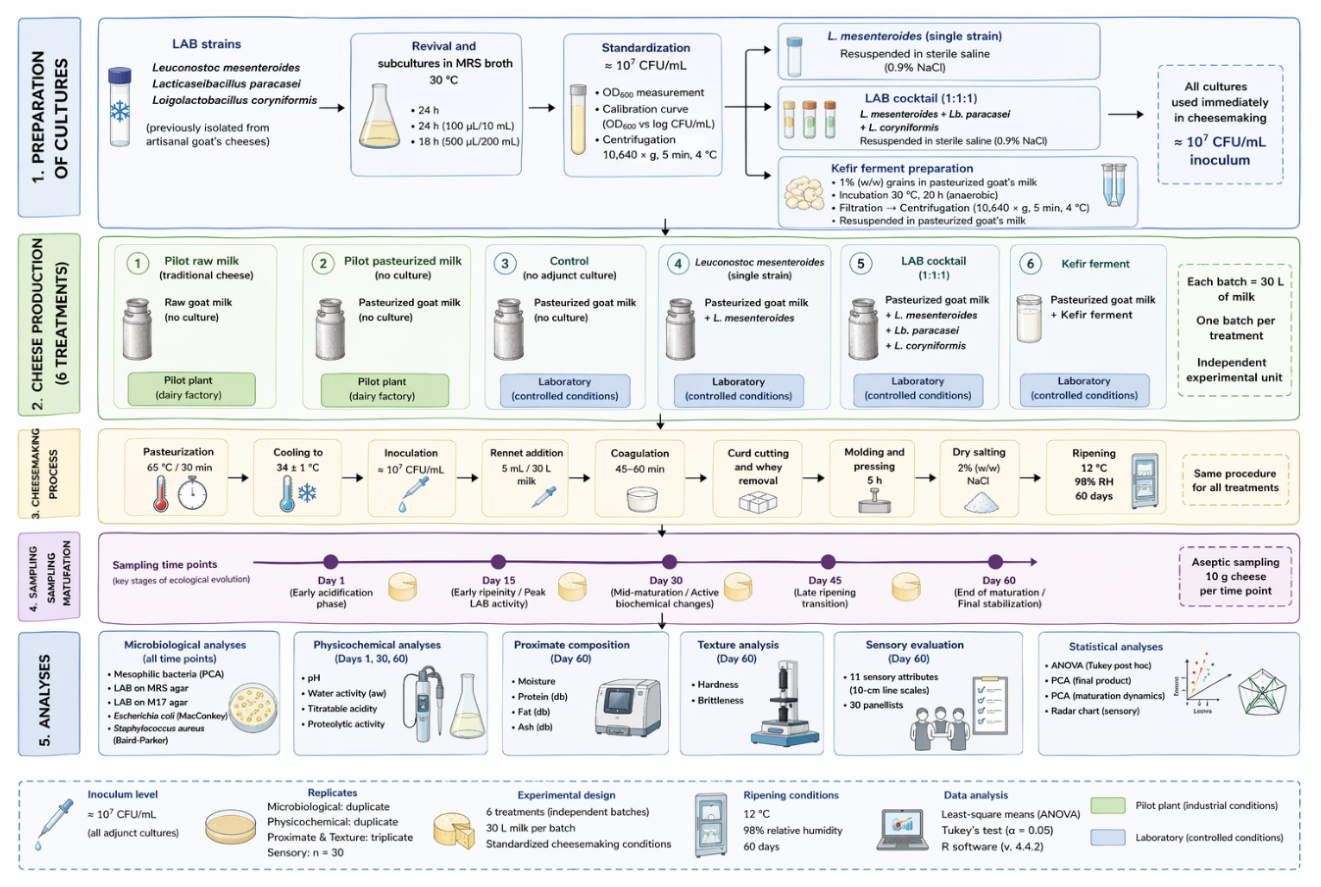
Figure 2.
Evolution of the concentration of total mesophiles (top left), MRS-grown lactic acid bacteria (top right), Escherichia coli (bottom left) and Staphylococcus aureus (bottom right) in the different types of goat’s milk cheese during maturation.
Figure 2.
Evolution of the concentration of total mesophiles (top left), MRS-grown lactic acid bacteria (top right), Escherichia coli (bottom left) and Staphylococcus aureus (bottom right) in the different types of goat’s milk cheese during maturation.
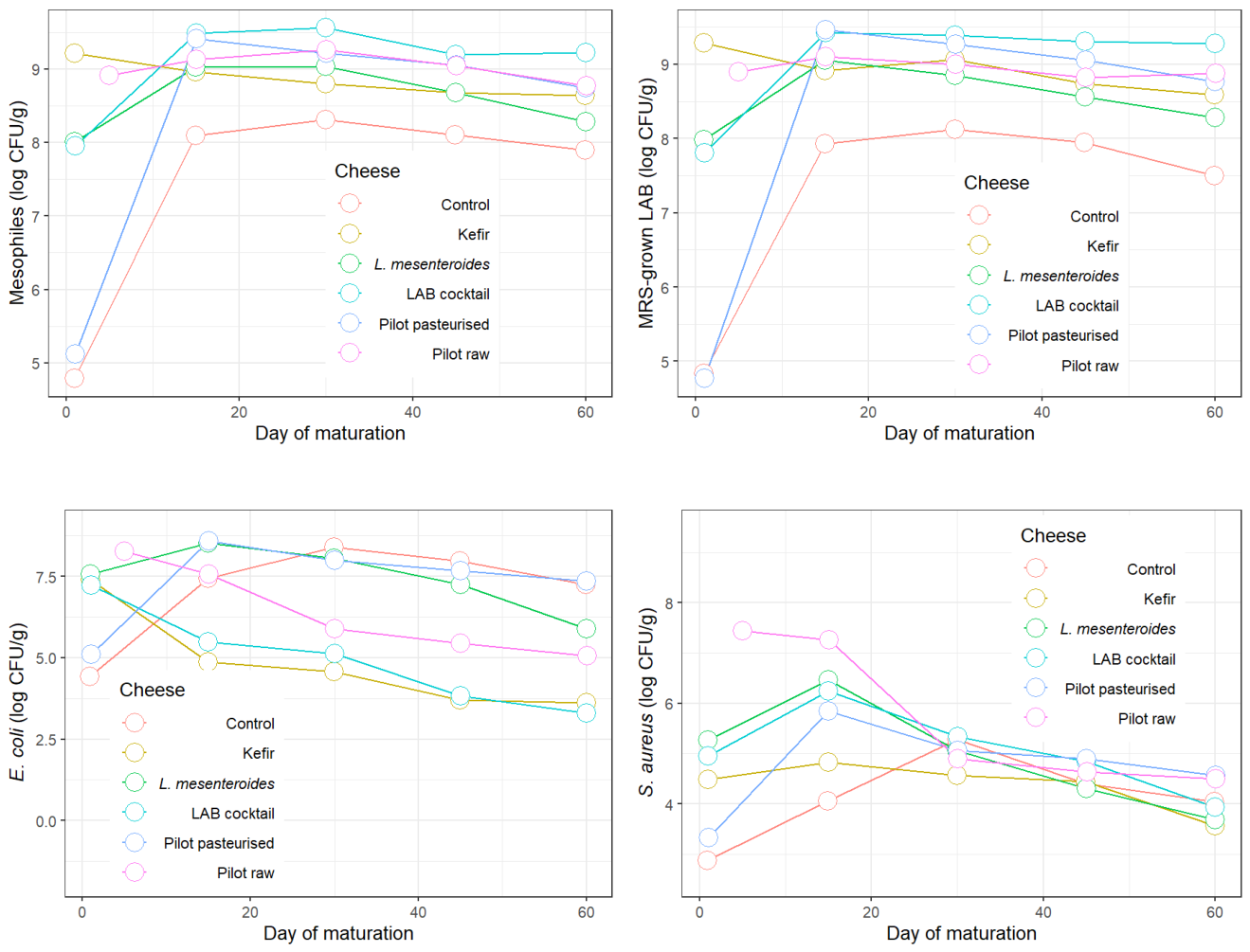
Figure 3.
Evolution of pH (top left), water activity (top right), titrable acidity (bottom left) and proteolysis (bottom right) index in the different types of goat’s milk cheese during maturation.
Figure 3.
Evolution of pH (top left), water activity (top right), titrable acidity (bottom left) and proteolysis (bottom right) index in the different types of goat’s milk cheese during maturation.
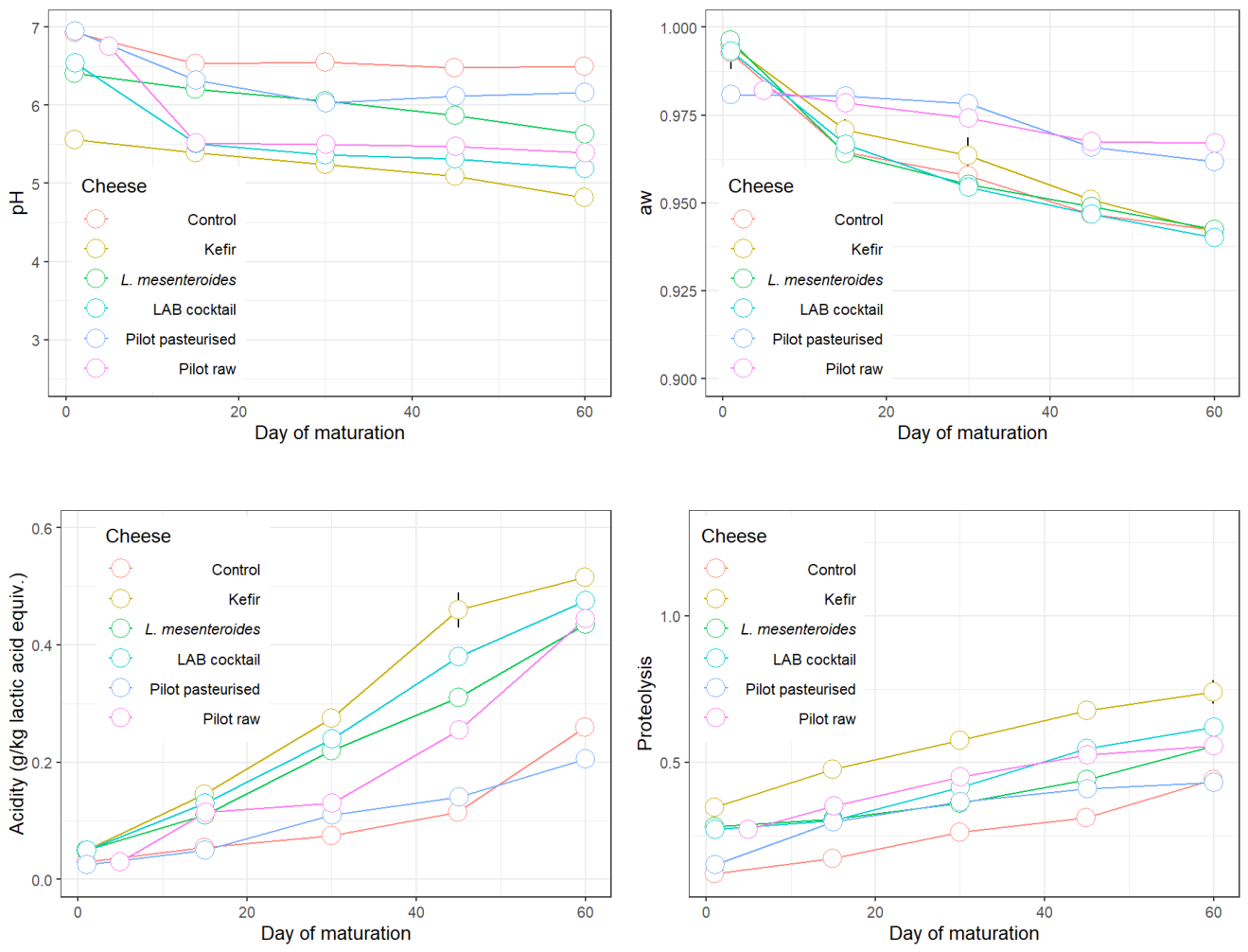
Figure 4.
Goat’s milk cheese treatments and maturation times (1, 15, 30, 45 and 60 days), as positioned within the evolving microbiological and physicochemical attributes’ map defined by principal component analysis (PCA). Left graphs denote the PCA solution with maturation time as qualitative variable; and right graphs the PCA solution with maturation time as factor. Aw: water activity; Ecoli: Escherichia coli counts; Staphy: Staphylococcus aureus counts; Mesophiles: total mesophiles counts; M17: presumptive lactic acid bacteria counts grown on M17 agar; MRS: presumptive lactic acid bacteria counts grown on MRS agar; Proteolysis: proteolytic activity; Acidity: titratable acidity; Time: maturation time.
Figure 4.
Goat’s milk cheese treatments and maturation times (1, 15, 30, 45 and 60 days), as positioned within the evolving microbiological and physicochemical attributes’ map defined by principal component analysis (PCA). Left graphs denote the PCA solution with maturation time as qualitative variable; and right graphs the PCA solution with maturation time as factor. Aw: water activity; Ecoli: Escherichia coli counts; Staphy: Staphylococcus aureus counts; Mesophiles: total mesophiles counts; M17: presumptive lactic acid bacteria counts grown on M17 agar; MRS: presumptive lactic acid bacteria counts grown on MRS agar; Proteolysis: proteolytic activity; Acidity: titratable acidity; Time: maturation time.
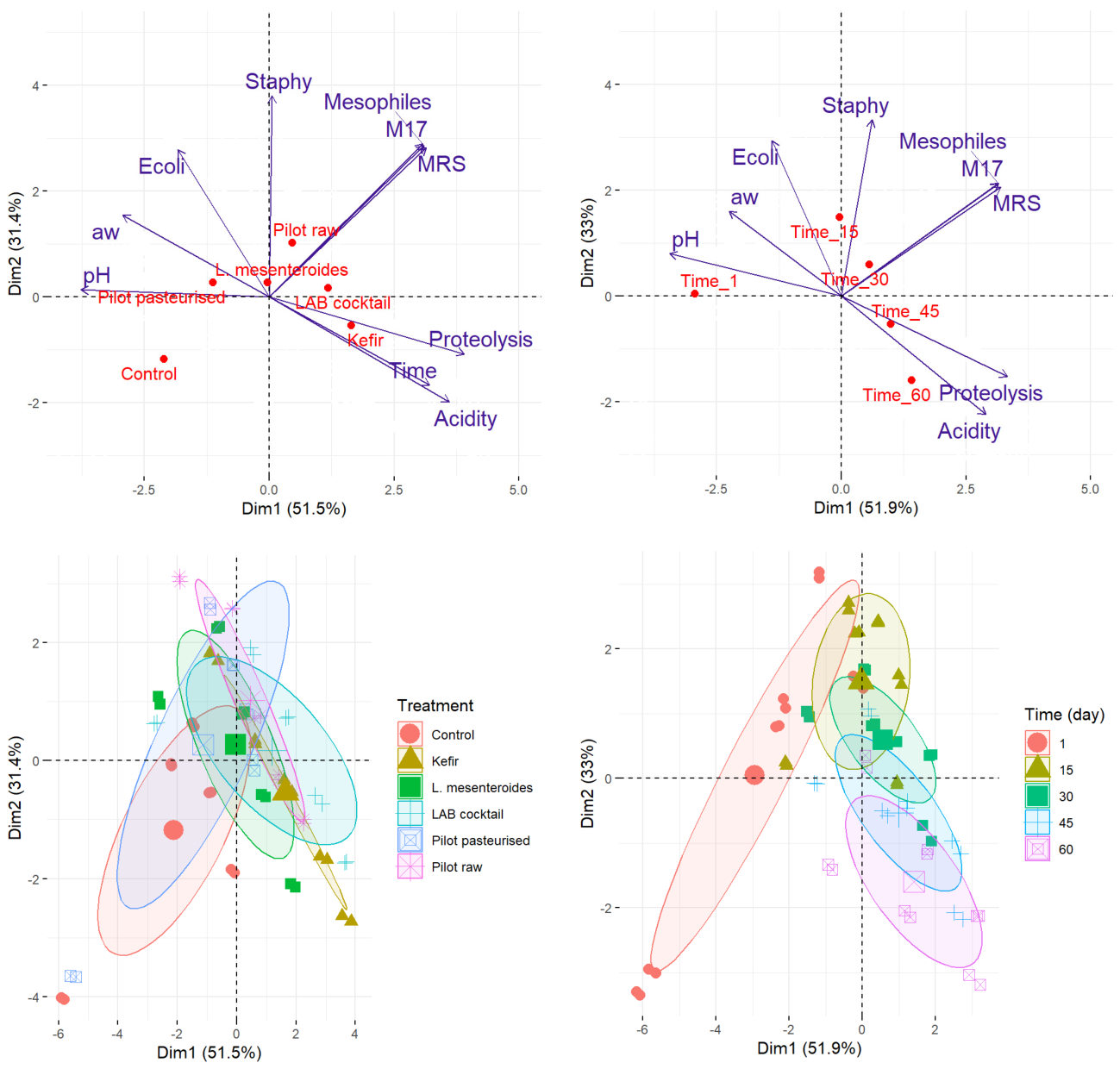
Figure 5.
Differences among the goat’s milk cheeses, as projected on a principal component analysis map defined by the proximate composition and instrumental textural attributes measured in the final product. Aw: water activity; Proteolysis: proteolytic activity; Acidity: titratable acidity; FatDM: fat content in dry matter; ProteinDM: protein content in dry matter; AshDM: ash content in dry matter.
Figure 5.
Differences among the goat’s milk cheeses, as projected on a principal component analysis map defined by the proximate composition and instrumental textural attributes measured in the final product. Aw: water activity; Proteolysis: proteolytic activity; Acidity: titratable acidity; FatDM: fat content in dry matter; ProteinDM: protein content in dry matter; AshDM: ash content in dry matter.
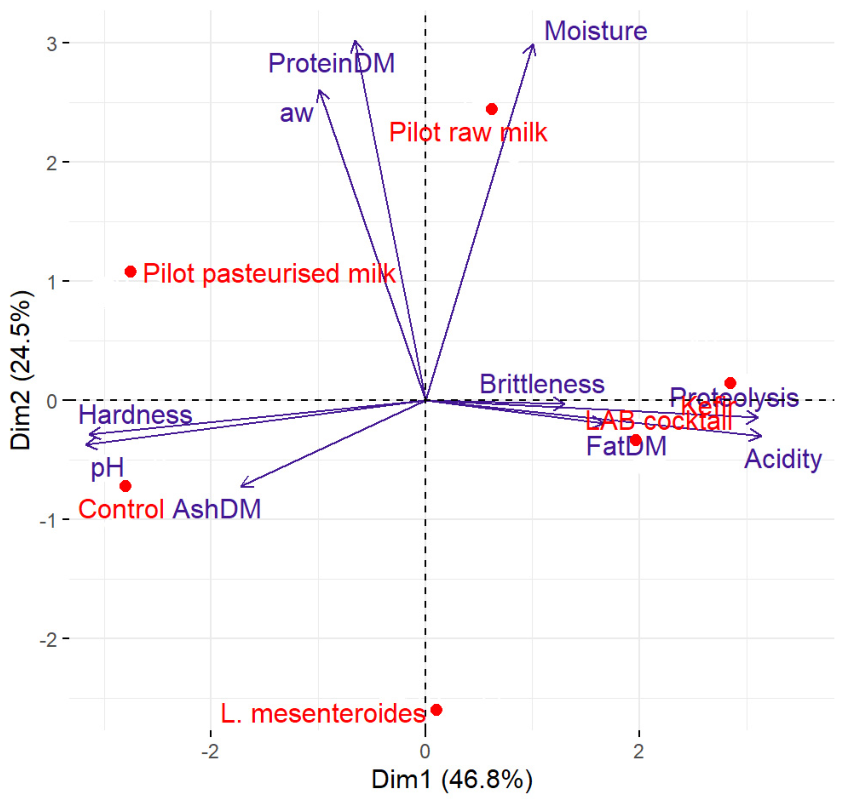
Figure 6.
Sensory analysis profile radar of the goat’s milk cheeses evaluated on a non-structured 10-point scale.
Figure 6.
Sensory analysis profile radar of the goat’s milk cheeses evaluated on a non-structured 10-point scale.
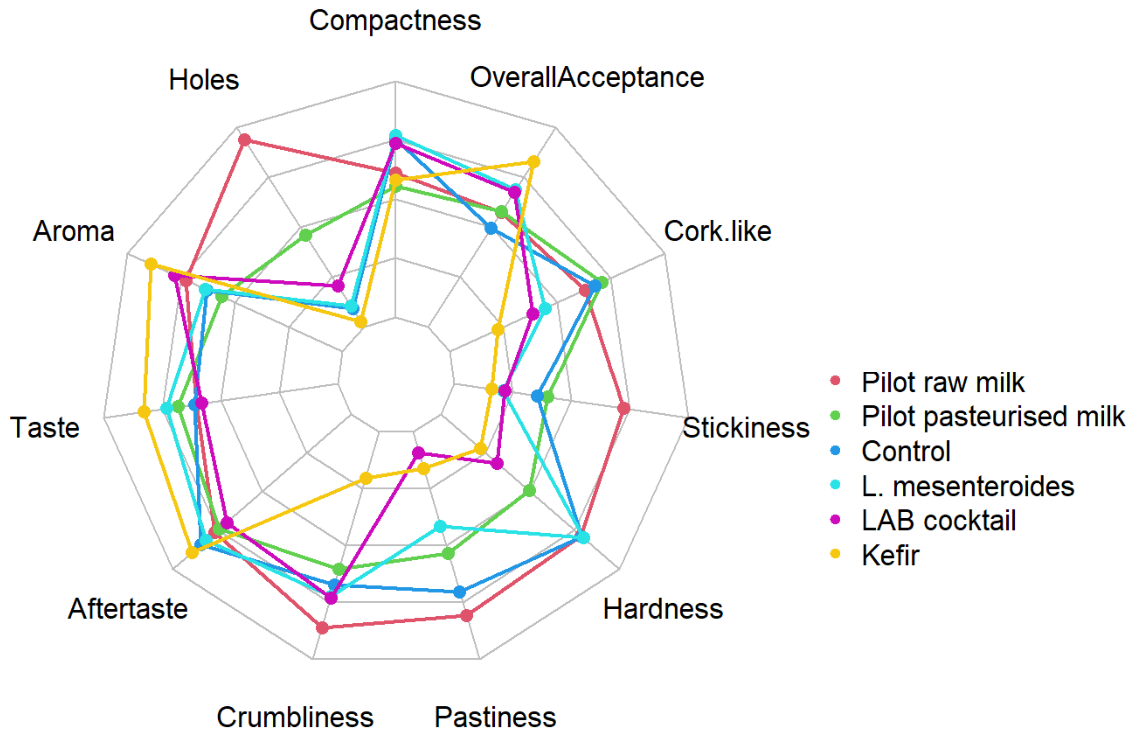

Table 1.
Repeated measures analysis of variance and estimated marginal means (± standard error) of the counts of mesophiles and lactic acid bacteria (LAB) by treatment and by treatment within maturation day of goat’s milk cheeses.
Table 1.
Repeated measures analysis of variance and estimated marginal means (± standard error) of the counts of mesophiles and lactic acid bacteria (LAB) by treatment and by treatment within maturation day of goat’s milk cheeses.
| Treatment | Mesophiles* (log CFU/g) |
MRS-grown LAB* (log CFU/g) |
M17-grown LAB* (log CFU/g) |
|---|---|---|---|
| Pilot raw milk Pilot pasteurized milk Control L. mesenteroides LAB cocktail Kefir |
8.73b ± 0.229 8.34ab ± 0.229 7.48a ± 0.229 8.64b ± 0.229 9.12b ± 0.229 8.89b ± 0.229 |
8.63b ± 0.239 8.32b ± 0.239 7.32a ± 0.239 8.60b ± 0.239 9.10b ± 0.239 8.97b ± 0.239 |
8.68b ± 0.213 8.35b ± 0.226 7.29a ± 0.226 8.61b ± 0.226 9.11b ± 0.226 8.93b ± 0.226 |
| Treatment in Day | |||
| Day 1 (formed curd) | |||
| Pilot raw milk Pilot pasteurized milk Control L. mesenteroides LAB cocktail Kefir |
7.25b ± 0.334 6.87ab ± 0.284 6.00a ± 0.284 7.16b ± 0.284 7.64b ± 0.284 7.41b ± 0.284 |
7.11b ± 0.348 6.79b ± 0.296 5.79a ± 0.296 7.08b ± 0.296 7.57b ± 0.296 7.45b ± 0.296 |
7.21b ± 0.330 6.88b ± 0.280 5.82a ± 0.280 7.14b ± 0.280 7.64b ± 0.280 7.45b ± 0.280 |
| Day 30 (mid-maturation) | |||
| Pilot raw milk Pilot pasteurized milk Control L. mesenteroides LAB cocktail Kefir |
9.22b ± 0.290 8.84ab ± 0.274 7.97a ± 0.274 9.14b ± 0.274 9.61b ± 0.274 9.39b ± 0.274 |
9.09b ± 0.302 8.78b ± 0.285 7.78a ± 0.285 9.06b ± 0.285 9.55b ± 0.285 9.43b ± 0.285 |
9.19b ± 0.286 8.86b ± 0.270 7.80a ± 0.270 9.13b ± 0.270 9.62b ± 0.270 9.44b ± 0.270 |
| Day 60 (end maturation) | |||
| Pilot raw milk Pilot pasteurized milk Control L. mesenteroides LAB cocktail Kefir |
8.79b ± 0.290 8.40ab ± 0.274 7.54a ± 0.274 8.70b ± 0.274 9.18b ± 0.274 8.95b ± 0.274 |
8.69b ± 0.302 8.38b ± 0.285 7.38a ± 0.285 8.66b ± 0.285 9.15b ± 0.285 9.03b ± 0.285 |
8.67b ± 0.286 8.34b ± 0.270 7.29a ± 0.270 8.61b ± 0.270 9.11b ± 0.270 8.92b ± 0.270 |
| ANOVA source | p-value | p-value | p-value |
| Treatment | <0.001 | <0.001 | <0.001 |
| Day | <0.001 | <0.001 | <0.001 |
| Treatment*Day | <0.001 | <0.001 | <0.001 |
(*) Different letters denote statistical differences in the mean of a given attribute, by treatment and by treatment within maturation day at α=0.05.
Table 2.
Repeated measures analysis of variance and estimated marginal means (± standard error) of the counts of Escherichia coli, Staphylococcus aureus and pH by treatment and by treatment within maturation day of goat’s milk cheeses.
Table 2.
Repeated measures analysis of variance and estimated marginal means (± standard error) of the counts of Escherichia coli, Staphylococcus aureus and pH by treatment and by treatment within maturation day of goat’s milk cheeses.
| Treatment |
E. coli* (log CFU/g) |
S. aureus* (log CFU/g) |
pH* |
|---|---|---|---|
| Pilot raw milk Pilot pasteurized milk Control L. mesenteroides LAB cocktail Kefir |
6.36ab ± 0.378 7.72b± 0.401 7.47b ± 0.401 7.83b ± 0.401 5.37a ± 0.401 5.21a ± 0.401 |
5.58b ± 0.190 5.11ab ± 0.202 4.51a ± 0.202 5.33b ± 0.202 5.43b ± 0.202 4.75ab ± 0.202 |
5.79b ± 0.0495 6.51d ± 0.0526 6.79e ± 0.0526 6.23c ± 0.0526 5.78b ± 0.0526 5.41a ± 0.0526 |
| Treatment in Day | |||
| Day 1 (formed curd) | |||
| Pilot raw milk Pilot pasteurized milk Control L. mesenteroides LAB cocktail Kefir |
5.98ab ± 0.586 7.34b ± 0.497 7.09b ± 0.497 7.45b ± 0.497 4.99a ± 0.497 4.83a ± 0.497 |
4.73b ± 0.295 4.27ab ± 0.250 3.66a ± 0.250 4.48b ± 0.250 4.59b ± 0.250 3.90ab ± 0.250 |
6.13b ± 0.0767 6.84d ± 0.0651 7.13e ± 0.0651 6.56c ± 0.0651 6.11b ± 0.0651 5.75a ± 0.0651 |
| Day 30 (mid-maturation) | |||
| Pilot raw milk Pilot pasteurized milk Control L. mesenteroides LAB cocktail Kefir |
6.37ab ± 0.507 7.72b ± 0.479 7.47b ± 0.479 7.83b ± 0.479 5.38a ± 0.479 5.21a ± 0.479 |
5.49b ± 0.256 5.03ab ± 0.241 4.42a ± 0.241 5.25b ± 0.241 5.35b ± 0.241 4.66ab ± 0.241 |
5.50b ± 0.0664 6.21d ± 0.0628 6.50e ± 0.0628 5.93c ± 0.0628 5.48b ± 0.0628 5.12a ± 0.0628 |
| Day 60 (end maturation) | |||
| Pilot raw milk Pilot pasteurized milk Control L. mesenteroides LAB cocktail Kefir |
5.11ab ± 0.507 6.47b ± 0.479 6.22b ± 0.479 6.58b ± 0.479 4.12a ± 0.479 3.96a ± 0.479 |
4.50b ± 0.256 4.04ab ± 0.241 3.43a ± 0.241 4.26b ± 0.241 4.36b ± 0.241 3.67ab ± 0.241 |
5.32b ± 0.0664 6.04d ± 0.0628 6.32e ± 0.0628 5.76c ±0.0628 5.31b ± 0.0628 4.94a ± 0.0628 |
| ANOVA source | p-value | p-value | p-value |
| Treatment | <0.001 | <0.001 | <0.001 |
| Day | 0.004 | <0.001 | <0.001 |
| Treatment*Day | <0.001 | <0.001 | 0.009 |
(*) Different letters denote statistical differences in the mean of a given attribute, by treatment and by treatment within maturation day at α=0.05.
Table 3.
Repeated measures analysis of variance and estimated marginal means (± standard error) of water activity (aw), titratable acidity and proteolytic activity by treatment and by treatment within maturation day of goat’s milk cheeses.
Table 3.
Repeated measures analysis of variance and estimated marginal means (± standard error) of water activity (aw), titratable acidity and proteolytic activity by treatment and by treatment within maturation day of goat’s milk cheeses.
| Treatment | Aw* | Acidity* (g lactic acid equiv/kg cheese) | Proteolysis* |
|---|---|---|---|
| Pilot raw milk Pilot pasteurized milk Control L. mesenteroides LAB cocktail Kefir |
0.9792b ± 0.00193 0.9749b ± 0.00205 0.9614a ± 0.00205 0.9619a ± 0.00205 0.9608a ± 0.00205 0.9649a ± 0.00205 |
0.1695b ± 0.0169 0.0781a ± 0.0180 0.0791a ± 0.0180 0.1971bc± 0.0180 0.2271bc ± 0.0180 0.2611c ± 0.0180 |
0.403c ± 0.0123 0.303b ± 0.0131 0.233a ± 0.0131 0.361c ± 0.0131 0.403c ± 0.0131 0.535d ± 0.0131 |
| Treatment in Day | |||
| Day 1 (formed curd) | |||
| Pilot raw milk Pilot pasteurized milk Control L. mesenteroides LAB cocktail Kefir |
0.9998b ± 0.00300 0.9997b ± 0.00253 0.9883a ± 0.00253 0.9889a ± 0.00253 0.9878a ± 0.00253 0.9919a ± 0.00253 |
0.0420b ± 0.0262 0.0294a ± 0.0222 0.0284a ± 0.0222 0.0696bc ± 0.0222 0.0996bc ± 0.0222 0.1336c ± 0.0222 |
0.269c ± 0.0191 0.169b ± 0.0162 0.099a ± 0.0162 0.227c ± 0.0162 0.269c ± 0.0162 0.401d ± 0.0162 |
| Day 30 (mid-maturation) | |||
| Pilot raw milk Pilot pasteurized milk Control L. mesenteroides LAB cocktail Kefir |
0.9761b ± 0.00258 0.9761b ± 0.00245 0.9583a ± 0.00245 0.9588a ± 0.00245 0.9577a ± 0.00245 0.9618a ± 0.00245 |
0.1758b ± 0.0227 0.0844a ± 0.0215 0.0854a ± 0.0215 0.2034bc ± 0.0215 0.2334bc ± 0.0215 0.2674c ± 0.0215 |
0.434c ± 0.0165 0.334b ± 0.0156 0.264a ± 0.0156 0.392c ± 0.0156 0.434c ± 0.0156 0.566d ± 0.0156 |
| Day 60 (end maturation) | |||
| Pilot raw milk Pilot pasteurized milk Control L. mesenteroides LAB cocktail Kefir |
0.9614b ± 0.00259 0.9562b ± 0.00245 0.9436a ± 0.00245 0.9441a ± 0.00245 0.9430a ± 0.00245 0.9471a ± 0.00245 |
0.3900b ± 0.0227 0.2986a ± 0.0215 0.2996a ± 0.0215 0.4176bc ± 0.0215 0.4476bc ± 0.0215 0.4816c ± 0.0215 |
0.586c ± 0.0165 0.487b ± 0.0156 0.417a ± 0.0156 0.545c ± 0.0156 0.587c ± 0.0156 0.719d ± 0.0156 |
| ANOVA source | p-value | p-value | p-value |
| Treatment | <0.001 | <0.001 | <0.001 |
| Day | <0.001 | <0.001 | <0.001 |
| Treatment*Day | <0.001 | <0.001 | 0.064 |
(*) Different letters denote statistical differences in the mean of a given attribute, by treatment and by treatment within maturation day at α=0.05.
Table 4.
Coefficients of correlation of the physicochemical and microbiological attributes of goat’s milk cheeses during maturation, as evaluated by two principal component analysis solutions, showing explained variances.
Table 4.
Coefficients of correlation of the physicochemical and microbiological attributes of goat’s milk cheeses during maturation, as evaluated by two principal component analysis solutions, showing explained variances.
| Variable | PCA1: Cheese treatment as qualitative variable | PCA2: Maturation time as qualitative variable | ||
|---|---|---|---|---|
| PC1 | PC2 | PC1 | PC2 | |
| Maturation time (day) E. coli (log CFU/g) S. aureus (log CFU/g) MRS-grown LAB (log CFU/g) M17-grown LAB (log CFU/g) Mesophiles (log CFU/g) pH aw Acidity (g lactic acid equiv/kg) Proteolysis |
0.753 -0.429 0.013 0.736 0.723 0.726 -0.884 -0.689 0.846 0.917 |
-0.392 0.654 0.892 0.663 0.680 0.672 0.030 0.361 -0.467 -0.254 |
- -0.362 0.160 0.832 0.822 0.820 -0.898 -0.588 0.755 0.867 |
- 0.767 0.870 0.537 0.555 0.553 0.208 0.418 -0.585 -0.398 |
| Variance proportion | 0.515 | 0.314 | 0.519 | 0.329 |
| Cumulative proportion | 0.515 | 0.829 | 0.519 | 0.848 |
Table 5.
Least-square means (± standard error) of the proximate composition, and instrumental texture attributes of the final goat’s milk cheeses.
Table 5.
Least-square means (± standard error) of the proximate composition, and instrumental texture attributes of the final goat’s milk cheeses.
| Treatment | Moisture* (%) | Protein* (% db) | Fat* (% db) |
| Pilot raw milk Pilot pasteurized milk Control L. mesenteroides LAB cocktail Kefir |
38.2e ± 0.205 32.5c ± 0.205 30.1b ± 0.205 25.3a ± 0.205 34.0d ± 0.205 33.7d ± 0.205 |
43.0d ± 0.471 40.6c ± 0.471 39.7bc ± 0.471 32.6a ± 0.471 37.8b ± 0.471 38.5bc ± 0.471 |
48.4b ± 0.274 43.7a ± 0.274 42.8a ± 0.274 47.9b ± 0.274 53.2c ± 0.274 43.6a ± 0.274 |
| Treatment | Ashes* (% db) | Hardness* (g) | Brittleness* (mm) |
| Pilot raw milk Pilot pasteurized milk Control L. mesenteroides LAB cocktail Kefir |
8.35d ± 0.0757 6.54b ± 0.0757 9.31e ± 0.0757 8.49d ± 0.0757 6.98c ± 0.0757 4.99a ± 0.0757 |
214b ± 13.8 567d ± 13.8 591d ± 13.8 310c ± 13.8 223b ± 13.8 140a ± 13.8 |
10.0a ± 0.425 8.41a ± 0.425 10.0a ± 0.425 9.39a ± 0.425 9.71a ± 0.425 10.0a ± 0.425 |
(*) Different letters denote statistical differences in the mean of a given attribute by treatment at α=0.05. db: dry basis.
Table 6.
Least-square means (± standard error) of the sensory attributes of the goat’s milk cheeses.
Table 6.
Least-square means (± standard error) of the sensory attributes of the goat’s milk cheeses.
| Treatment |
Visual compactness* |
Presence of holes* | Aroma* |
| Pilot raw milk Pilot pasteurized milk Control L. mesenteroides LAB cocktail Kefir |
6.95a ± 0.367 6.78a ± 0.349 7.42a ± 0.361 7.46a ± 0.361 7.36a ± 0.361 6.86a ± 0.361 |
5.82b ± 0.407 4.38ab ± 0.388 3.27a ± 0.400 3.31a ± 0.400 3.61a ± 0.400 3.08a ± 0.400 |
7.33a ± 0.339 6.80a ± 0.323 7.02a ± 0.334 7.05a ± 0.334 7.50a ± 0.334 7.85a ± 0.334 |
| Treatment | Taste* | Aftertaste* | Crumbliness* |
| Pilot raw milk Pilot pasteurized milk Control L. mesenteroides LAB cocktail Kefir |
6.93a ± 0.343 7.19a ± 0.326 6.96a ± 0.337 7.34a ± 0.337 6.86a ± 0.337 7.65a ± 0.337 |
6.53a ± 0.350 6.47a ± 0.333 6.69a ± 0.344 6.63a ± 0.344 6.40a ± 0.344 6.79a ± 0.344 |
6.45b ± 0.401 5.42b ± 0.382 5.69b ± 0.395 5.89b ± 0.395 5.92b ± 0.395 3.81a ± 0.395 |
| Treatment | Pastiness* | Hardness* | Stickiness* |
| Pilot raw milk Pilot pasteurized milk Control L. mesenteroides LAB cocktail Kefir |
4.62a ± 0.370 4.07a ± 0.352 4.41a ± 0.364 3.83a ± 0.364 3.18a ± 0.364 3.32a ± 0.364 |
5.14b ± 0.360 3.98ab ± 0.343 5.17b ± 0.354 5.20b ± 0.354 3.27a ± 0.354 2.89a ± 0.354 |
4.89b ± 0.345 3.59ab ± 0.328 3.41a ± 0.339 2.83a ± 0.339 2.86a ± 0.339 2.64a ± 0.339 |
| Treatment | Cork-like texture* | Overall acceptance* | |
| Pilot raw milk Pilot pasteurized milk Control L. mesenteroides LAB cocktail Kefir |
4.52ab ± 0.423 4.83b ± 0.403 4.70b ± 0.416 3.77ab ± 0.416 3.54ab ± 0.416 2.89a ± 0.416 |
7.88a ± 0.289 7.89a ± 0.275 7.48a ± 0.285 8.44ab ± 0.285 8.39ab ± 0.285 9.15b ± 0.285 |
(*) Different letters denote statistical differences in the mean of a given attribute by treatment at α=0.05.
Disclaimer/Publisher’s Note: The statements, opinions and data contained in all publications are solely those of the individual author(s) and contributor(s) and not of MDPI and/or the editor(s). MDPI and/or the editor(s) disclaim responsibility for any injury to people or property resulting from any ideas, methods, instructions or products referred to in the content. |
© 2026 by the authors. Licensee MDPI, Basel, Switzerland. This article is an open access article distributed under the terms and conditions of the Creative Commons Attribution (CC BY) license.
Copyright: This open access article is published under a Creative Commons CC BY 4.0 license, which permit the free download, distribution, and reuse, provided that the author and preprint are cited in any reuse.


