
Submitted:
25 May 2026
Posted:
26 May 2026
You are already at the latest version
Abstract
Software as a Service (SaaS) has become a key enabler of digital transformation and e-government modernization through scalable, flexible, and cost-effective service delivery. However, evidence of SaaS adoption in Southern African Development Community (SADC) public sectors remains limited and uneven. This study systematically reviews literature published between 2015 and 2025 on SaaS adoption, digital readiness, infrastructure, policy environments, and institutional capacity across SADC member states. Using PRISMA-guided screening, 31 studies were synthesized through narrative thematic analysis informed by the Technology–Organisation–Environment (TOE) framework and Institutional Theory. The findings reveal significant disparities in SaaS readiness across the region. South Africa is the only country with substantial empirical evidence of public-sector SaaS adoption, while most member states demonstrate only indirect indicators of readiness, including ICT maturity and e-government development. Four major barriers were identified: infrastructure deficits, policy and regulatory fragmentation, institutional capacity constraints, and uneven regional readiness. The study also identifies a “readiness paradox,” whereby stricter data sovereignty regulations co-exist with inadequate infrastructure for compliant SaaS deployment. The study contributes a contextualized framework for sustainable SaaS adoption in SADC public sectors.
Keywords:
Software as a Service (SaaS)
; digital transformation
; e-government
; public sector readiness
; cloud computing governance
; Southern African Development Community (SADC)
1. Introduction
Governments around the globe are focusing on digital transformation to deliver better services to their citizens, promote administrative efficiency and boost engagement. As e-government systems have evolved, developments in cloud computing, artificial intelligence, and distributed system architecture have been closely connected, allowing for the creation of scalable and flexible public service infrastructures [1,2]. One of these technologies that has gained significant traction as a key facilitator for contemporary e-government is Software as a Service (SaaS), as it is cost-effective, scalable, and can facilitate the deployment of digital services quickly [3,4].
Software as a Service (SaaS) is a cloud computing service model that hosts applications on the Web and requires users to pay a subscription fee, rather than installing, maintaining, and managing the application on their own infrastructure. Rather, applications are provided by service providers, who install and maintain them on a server from where they can be accessed via a thin client or Web browser. The model has many benefits, such as low initial investment, scalability, automatic updates, and access across devices and locations locations [3,4]. In government, SaaS provides a fast way to launch digital services, to maintain integrated platforms and to improve interoperability between government departments, therefore it is a major enabler for modern e-government [2,5].
SaaS benefits the public institutions by enabling them to access applications via web-based platforms and reduce the dependency on on-premise infrastructure. The model is significant in the field of mobile government (m-government) and integrated service delivery systems, where interoperability and accessibility are crucial [4,5]. Additionally, SaaS can contribute to the migration of monolithic legacy systems to microservices-based, enhancing system resilience, modularity, and scalability within government platforms [5,6].
However, the implementation of SaaS is not equal in developing regions, especially in the Southern African Development Community (SADC). While previous reviews have examined cloud computing, e-government, and digital transformation in developing countries, no known systematic literature review has specifically focused on SaaS adoption readiness in SADC public sectors. The literature reviewed reveals that the challenges of public-sector digital transformation efforts are not new, as issues such as infrastructure constraints, regulatory uncertainty, and institutional capacity limitations continue to pose significant hurdles [7,8]. Moreover, cybersecurity issues, such as data privacy risks and inadequate security awareness, are still a challenge for trust in government cloud systems [9,10,11].
Based on empirical evidence, South Africa is currently the only SADC country to have documented progress in the use of cloud computing and SaaS in the public sector, which is reflected in the studies that have been conducted on cloud readiness, digital records management, and the implementation of cloud and SaaS in specific sectors [3,12,13]. Some other SADC countries do not have indicators for digital readiness, but rather those of e-government maturity, ICT penetration, and satisfaction of citizens [14,15]. This gap underscores the uneven digital landscape across the region, with some areas advancing faster than others.
In addition, the lack of policies for the region and harmonization of cloud governance adds to the complexity of the adoption of SaaS across SADC countries. The region has a widening digital divide due to the differences in institutional readiness, policy alignment, and technological capacity [16,17]. If policymakers don't grasp these factors, they risk designing an ineffective digital transformation and innovation strategy for the public sector.
Although the concept of digital transformation and the cloud phenomenon is gaining momentum in Africa, the literature is still scattered and consists of specific case studies in individual countries, specific sectors and technology fields. There are not many studies that specifically address SaaS adoption in public sector organizations, with most studies being more general in scope, such as e-government maturity, cloud readiness, or ICT infrastructure. In addition, the evidence is strongly skewed in the southern parts of the region, with little comparative information on the region beyond South Africa. This fragmentation prevents the emergence of evidence-based regional digital transformation strategies and prevents theoretical understanding of SaaS adoption in developing public-sector contexts.
While adoption of cloud computing, maturity of e-government, and digital transformation in individual countries have been studied, empirical studies on the adoption and readiness of SaaS in the SADC region are still lacking. This gap hinders the possibility of gaining comparative knowledge and of formulating region-wide policy responses. Hence, this study aims to fill this gap by bringing together various literature sources and offering a structured analysis of SaaS adoption factors and challenges in the SADC region. The general objectives of this study are to answer the following questions:
- What is the current level of SaaS adoption and being digitally ready in SADC public sectors?
- What are the technological, organizational, environmental and institutional factors that impact on the adoption of SaaS in the governments of SADC?
- What are the infrastructure, policy and capacity constraints that affect inequitable patterns of SaaS adoption in the SADC region?
- What is a viable implementation framework for the sustainable adoption of SaaS in SADC public sector?
2. Theoretical Framework
This study will use an integrated theoretical framework that incorporates the Technology–Organisation–Environment (TOE) framework and Institutional Theory in order to analyse SaaS adoption and readiness in the SADC public sector. These frameworks offer complementary lenses to understand technological adoption in complex organisational and socio-political contexts.
Although the TOE framework has been widely adopted in technology adoption studies, in this context it mainly accounts for technology adoption considering the organizational, environmental and technological readiness. In developing regions, however, the adoption of technology in the public sector is also influenced by different institutional factors, regulatory challenges, and political expectations beyond operational preparedness. Institutional Theory complements TOE by providing an understanding of the role of coercive, normative and mimetic pressures on public-sector decision-making. The integration of these frameworks offers a more holistic understanding of SaaS adoption in SADC, where technology meets institutional and policy challenges.
2.1. Technology–Organisation–Environment (TOE) Framework
The TOE framework developed by Tornatzky & Fletcher, (1990) is an explanation of the adoption of new technology, which consists of three dimensions: technological, organisational, and environmental contexts. It has been widely used in research on cloud computing, e-government and digital innovation.
Technological Context
This dimension is related to the technology itself and aspects such as perceived benefits, complexity, compatibility and security. Scalability, cost effectiveness, interoperability, and cybersecurity risks are key factors of concern for SaaS adoption decisions [13,19]. The presence of risks related to data breaches, multi-tenancy, and service availability prevents the adoption of SaaS, especially in terms of security concerns [11,19].
Organisational Context
This dimension encompasses aspects of the internal organisation, including size, ICT capabilities, leadership support and resources. Many public sector institutions in SADC have limited technical expertise, inadequate funding capacity, and are not ready for organisational change [8,20]. Furthermore, there can be an issue of digital skills gap and a lack of strategic leadership related to implementation.
Environmental Context
The environmental dimension relates to external elements like regulations, markets and technological infrastructure. The challenges of cloud governance in SADC, weak policy frameworks, and poor broadband connectivity have a significant effect on SaaS adoption [7,15]. Other factors such as external pressures imposed by the global trend of digitalisation and regional integration will also impact the adoption process.
The TOE framework is especially appropriate for this study due to its ability to include both internal and external factors that impact SaaS adoption that are suitable for analysing the complex conditions within developing regions.
2.2. Institutional Theory
The TOE framework helps to understand technological and organisational readiness, while Institutional Theory helps to understand the social and regulatory pressures which drive organisational behaviour. Organisations implement innovations, not only to become more efficient, but also to gain legitimacy in their institutional environment DiMaggio and Powell, (1983). There are generally three types of institutional pressures:
Coercive Pressures
They are the result of official rules, policies and laws. The adoption of SaaS in e-government is enabled or inhibited by national ICT policies, data protection legislation and compliance requirements [7,9]. The decision to adopt the cloud is shrouded in uncertainty in many SADC countries due to weak and unclear regulatory structure.
NormativePressures
These are based on professional norms, standards and expectations in industries. For instance, government design and implementation of SaaS-based systems are informed by international best practices in digital governance and cybersecurity [11].
Mimetic Pressures
These arise when organisations mimic successful or legitimate organisations. In the SADC context, countries could adopt their digital transformation strategies from other more advanced countries like South Africa that have made progress in cloud and SaaS adoption [3,12].
Institutional Theory is much more relevant in the public sector where decision making may be more than just economic, and is shaped by political, regulatory and societal expectations.
2.3. Integrated Framework for SaaS Adoption in SADC
This study combines both TOE and Institutional Theory into one single framework for analysing SaaS adoption. Technological, organizational, and environmental readiness is explained by the TOE framework and regulatory, normative, and legitimacy-driven pressures are captured by the Institutional Theory.

Table 1.
TOE and Institutional theory integration matrix.
| TOE Dimension | Institutional Pressure | SaaS Adoption Challenge in SADC |
|---|---|---|
| Technological Context | Coercive Pressure | Data sovereignty requirements without supporting infrastructure |
| Organizational Context | Normative Pressure | Limited cloud expertise and weak professionalization |
| Environmental Context | Mimetic Pressure | Adoption of external policy models without contextual adaptation |
| Environmental Context | Coercive Pressure | Restrictive procurement and regulatory frameworks |
| Organizational Context | Mimetic Pressure | Selective imitation of South African digital strategies |
The synergistic approach is appropriate for the SADC context where there are technological constraints as well as institutional constraints, leading to an uneven digital transformation across the countries. It helps to identify and understand the reasons for SaaS adoption being limited to specific countries and why others are lagging.
3. Methodology
3.1. Search Strategy
Sources were identified from e-government studies, SaaS adoption research, cloud computing and digital readiness assessments, cybersecurity culture research and sector-specific cloud readiness studies within SADC. The search was conducted using bibliographic databases including Scopus, Web of Science and EBSCOhost. Google Scholar was additionally used as a supplementary academic search engine to improve the retrieval of regional and grey literature sources. The search terms included:
“Software as a Service” OR SaaS
“Cloud computing”
“Digital readiness”
“Cloud governance”
“Cloud-based e-government”
“Digital records on the cloud”
“SADC” OR “Southern African Development Community”
Boolean operators were used to structure searches across databases. Example search strings included:
(“Software as a Service” OR SaaS) AND (public sector OR government) AND (SADC OR “Southern African Development Community”)
(SaaS OR “cloud computing”) AND (“digital readiness” OR “ICT readiness”) AND (Africa OR SADC)
(“ICT infrastructure” OR “internet penetration” OR “digital access”) AND (SADC OR Africa) AND (“e-government”)
(“cybersecurity” OR “cyber security”) AND (SADC) AND (government OR public sector)
Table 2.
Sources by Database.
| Database | Records |
|---|---|
| EBSCOhost | 50 |
| Web of Science | 8 |
| Scopus | 59 |
| Google Scholar | 200 |
| Total | 317 |
Consistent with systematic review practices for managing large-scale search outputs while maintaining feasibility and relevance, the google scholar outputs were limited to the first 200 relevance-ranked records.
3.2. Inclusion Criteria
Studies were included if they:
Focused on SADC countries;
Were published between 2015 and 2025;
Discussed SaaS, cloud computing, or e-government;
Provided evidence relating to digital readiness, cybersecurity, or ICT infrastructure;
Were peer-reviewed journal articles, conference papers, theses, government reports, or white papers;
Were written in English or translated into English.
3.3. Exclusion Criteria
Studies were excluded if they:
Were unrelated to public-sector digitalisation;
Focused outside the SADC context without SaaS relevance;
Were opinion pieces without empirical or policy evidence;
Were duplicate records.
Screening Process
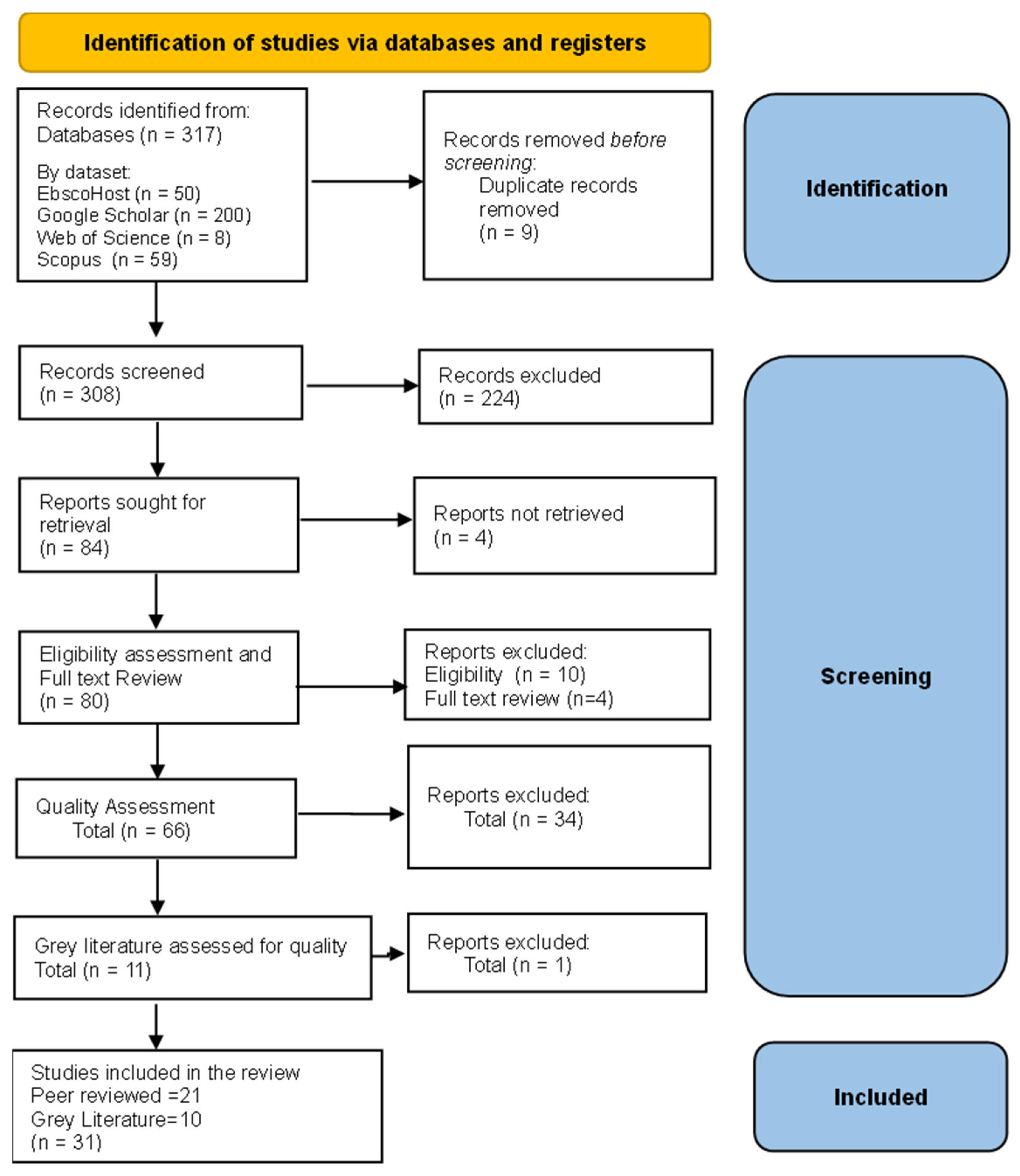
Duplicates were identified and removed, and this accounted for 9 articles.
Titles and abstracts were used for initial screening, and this removed 224 articles, leaving 84 articles for eligibility assessment. Four articles could not be accessed; thus 80 articles were accessed.
Eligibility check eliminated 10 articles thus 70 articles remained for full-text review.
Full-text review checked for relevance to SaaS or digital readiness, and 66 articles remained for quality assessment.
Screening and eligibility assessment were conducted using predefined inclusion and exclusion criteria. During full-text review, studies with ambiguous relevance were re-evaluated to ensure consistency in selection decisions. A review protocol was developed and registered on Open Science Framework, and is accessible on 10.17605/OSF.IO/5KNRG
3.4. Quality Assessment
To ensure methodological rigor and internal validity, studies were evaluated using a three-point scoring system where:
0 = criterion not met
1 = partially met
2 = fully met
The assessment criteria included:
- Relevance to SaaS/cloud adoption;
- Regional relevance to SADC;
- Research design clarity;
- Data adequacy;
- Findings clarity;
- Validity and reliability;
- Alignment with systematic review objectives;
- Transparency of reporting;
- Policy applicability;
- Contribution to SADC SaaS knowledge.
The quality thresholds were established to ensure inclusion of studies demonstrating sufficient methodological transparency, empirical relevance, and analytical contribution to SaaS adoption and digital readiness within SADC public sectors. Accepted articles are shown in Appendix A, Table A1. Following the assessment, 32 articles were retained.
3.5. Grey Literature Assessment
Grey literature was included to reduce publication bias and capture emerging regional evidence. Eleven (11) of these sources were further evaluated using the AACODS framework (Authority, Accuracy, Coverage, Objectivity, Date, and Significance). Although grey literature introduces potential risks related to methodological inconsistency, its inclusion was considered necessary due to the limited availability of peer-reviewed SaaS research within several SADC countries. Accepted articles are shown in Appendix A, Table A2.
3.6. Inclusion
A paper with an average score of 12 or higher was included for the initial quality assessment and a score of 8 and above for the AACODS assessment. Papers in this category were deemed to present a clear methodology, include empirical data, discuss the results, include a conclusion, and provide a research agenda or suggest research on a specific area. After the two reviews, a total of 31 articles were included for data extraction, and comprised 21 peer-reviewed studies and 10 grey literature sources. The PRISMA flow diagram is shown in Figure 1.
3.7. Data Extraction
The following data were extracted:
Study purpose;
Study design and methodology;
SaaS/cloud focus;
Adoption drivers and barriers;
Infrastructure readiness;
Policy and governance factors;
Capacity and cybersecurity considerations;
Findings and limitations.
3.8. Synthesis Approach
A Narrative Synthesis approach was used because it is appropriate for integrating findings from diverse qualitative, quantitative, policy, and mixed-method studies included in this review, and thematic coding was conducted iteratively to improve consistency and analytical alignment with TOE and Institutional Theory constructs.
4. Results
4.1. Overview of SaaS Adoption in SADC Public Sectors
The literature reviewed shows that there is a highly uneven picture of the adoption of SaaS in the public sectors across SADC [22,23,24]. As for direct evidence of SaaS adoption, South Africa is the only member state that has gathered such data, with the majority of countries having only indirect measures like ICT maturity, e-government development and readiness of digital infrastructure [14,25,26].
SADC SaaS Readiness Classification.
Table 3.
SaaS Readiness Classification.
| Tier | Characteristics | Countries |
|---|---|---|
| Tier 1 – High Readiness | Direct SaaS adoption evidence, stronger digital infrastructure, cloud-related policies, higher e-government maturity | South Africa, Mauritius, Seychelles |
| Tier 2 – Emerging Readiness | Partial digital readiness, developing policy frameworks, improving infrastructure | Namibia, Botswana, Tanzania |
| Tier 3 – Nascent Readiness | Limited infrastructure, low institutional readiness, minimal SaaS evidence | Malawi, Lesotho, Zimbabwe, DRC |
4.1.1. South Africa
South Africa has relatively high levels of advanced and multi-sectoral use of cloud in the public sector, but is limited by regulatory and institutional barriers [22,24]. There is broad consensus that SaaS is a tool to enhance service delivery efficiency and to alleviate infrastructure burdens [3,8,27]. But policy uncertainty, compliance obligations and concerns over cybersecurity pose challenges to adoption [24,28,29].
4.1.2. Other SADC Member States
There is a lack of empirical research on SaaS in most other SADC countries. Existing studies instead emphasize more general digital readiness measures such as ICT access, e-government maturity, and cybersecurity awareness.
Evidence suggests:
There are interoperability problems in e-government systems in Botswana [31].
The disparities in the access to ICTs, ICT infrastructure, and readiness for cloud in Namibia, Zimbabwe and Zambia have been reported by [32,33]. Malawi, Lesotho and Angola have low awareness of cybersecurity and limited readiness of the institutions [34,35]. In a regional sense, there is a wide range of penetration of the Internet and the maturity of e-government in urban and rural areas [25,36].
This absence of direct evidence highlights a gap in the studies of SaaS adoption in most of the region, especially in low-income countries and fragile countries. The results should be treated with some caution because there is not a complete uniformity of evidence across the SADC member countries and evidence is strongly skewed in South Africa. Thus the synthesis is based on regional trends, and not necessarily comparable national evidence.
4.2. Thematic Analysis of SaaS Adoption Barriers
Four major themes were identified, following the thematic analysis, that were having an impact on SaaS adoption and readiness within the public sectors in SADC.
4.2.1. Theme 1: Infrastructure Deficits as a Foundational Barrier
Infrastructure constraints were reported in studies conducted in the majority of the countries in the SADC region (Venter et al., 2019).
(a) Unreliable Connectivity
The penetration of broadband services and the stability of internet services are limiting SaaS deployment, especially in rural and decentralized public sector settings [22,25,37].
(b) The Data Centre and Power Limitations
There is a lack of local data centres, which poses technical and sovereignty issues. Some countries impose data residency regulations, but the state of the infrastructure for hosting data is still lacking, and this can lead to dependency on foreign data centres and compliance issues [38,39]. These challenges are compounded by power instability, as extended power outages impact the ability to access SaaS platforms (Gumbo, 2022; Nassima et al., 2025)
4.2.2. Theme 2: Policy and Regulatory Fragmentation.
A significant institutional hurdle was policy related constraints.
(a) The absence of Cloud-Specific Frameworks
In most countries, there are no cloud policies, only a small number have cloud policies, and most of those that have cloud policies have policies that are based on older ICT frameworks that are not specific to cloud computing. This results in procurement uncertainty as some public entities refuse to use SaaS because of the lack of clarity in the legislation [24,40,41]
(b) data protection and data sovereignty conflicts.
While there have been data protection laws in many countries, they do not always align with the SaaS models and concepts, especially when it comes to data transfer over borders [23,42,43]. This mismatch adds to uncertainty of regulation.
(c) Weak Regional Harmonization
4.2.3. Theme 3: Capacities and Skills Gaps
Limited human and organizational resources are a big challenge to SaaS adoption.
(a) Technical Capacity Deficits
Many public sector IT staff are still skilled in old systems, and have only a limited understanding of cloud technologies [26,44]. This is in part to risks of vendor lock-in and poor contract management.
(b) Change Management and Leadership Challenges
With organizational resistance, especially at the highest level, there are concerns of control, security and accountability. Effective applications are usually linked to a robust leadership and organized change management ventures (Maluleka et al., 2025; Mkhatshwa & Mawela, 2023).
4.2.4. Theme 4: Uneven Adoption and Readiness Patterns
A comparative analysis showed that there are different readiness levels within SADC.
(a) Donor Dependence
Implementation of SaaS is often donor-centred and challenging in lower readiness countries to sustain after the end of external funding resources [34,47].
(b) Cost Perceptions versus Reality
4.3. The “Readiness Paradox”
A major cross-cutting finding that has emerged from the analysis is the 'readiness paradox'. Countries with strict data sovereignty and protection policies may have lower adoption rates of SaaS because of inadequate infrastructure to support compliance with SaaS deployment [24,42,43].
In this study, the “SaaS readiness paradox” is formally defined as the situation arising when governments implement ever-tougher data protection and digital sovereignty laws without the technological means to enable a compliant SaaS environment. In such settings, the regulatory desire to control digital transformation hampers the ability of organizations to take full advantage of the opportunities offered by cloud adoption [25,29]. This creates a self-reinforcing cycle:
• Restrictive policies limit SaaS adoption;
• Limited adoption reduces demand for local infrastructure investment;
• Infrastructure deficits persist, reinforcing restrictive policies.
5. Discussion
The current study analyzed the adoption and readiness of SaaS in SADC public sectors, using a comparative approach. The overall results show some unevenness in the adoption of SaaS across the region and that the adoption is still hindered by various interlinked infrastructural, organizational, policy and institutional challenges. Most countries in SADC show only indirect evidence of digital readiness and cloud preparedness, with South Africa being the only country with significant empirical evidence of the successful implementation of SaaS.
The results also suggest that technology innovation is not just the main factor in the adoption of SaaS in the SADC, but rather the interplay between infrastructure availability, governance capacity, regulatory alignment, and institutional pressures. This indicates that the outcome of digital transformation in developing regions is not just about technology access, but also related to overall governance and institutional ecosystems.
5.1. Interpreting SaaS Adoption Through the TOE Framework
5.1.1. Technological Context: Infrastructure as a Foundational Constraint
The results indicate that the key challenges to SaaS adoption in the public sectors in SADC are infrastructure related. Poor broadband penetration, poor connectivity, poor power supply and lack of local data centre infrastructure all make it harder to implement cloud-based government systems.
In developing regions, it indicates that technological readiness should not just be availability of technology, but also the reliability of infrastructure and the capacity to deploy it in a way that is compatible with the country's sovereignty. The findings from South Africa, Namibia and the broader region confirm that unreliable infrastructure negatively impacts on the feasibility of adoption, especially in rural and decentralised public-sector settings [25,26,37].
The results are consistent with the outcomes of e-government and digital transformation studies in emerging settings, which determined that infrastructure inequality is a pivotal factor in digital governance outcomes (Abdulnabi, 2024; Mkhatshwa & Mawela, 2023). Similar results have been found in cloud adoption research conducted outside SADC, where infrastructural instability hinders scalability and service continuity in public sector cloud environments.
The findings also complement the current TOE literature, showing the significance of sovereignty compatible infrastructure. Countries with strict data sovereignty regulations tend to have less domestic infrastructure in place to put compliant SaaS environments to use, adding to their difficulties in adoption [24,38,39].
5.1.2. Organizational Context: Capacity, Skills, and Change Readiness
The review also highlighted another significant factor that was believed to be a barrier to SaaS adoption, which is institutional capacity. Many public sector entities in SADC countries are not experienced with cloud, lack procurement skills and processes, vendor relationship management, and formal digital transformation leadership.
It appears that the readiness of the organisation is not only about financial resources nor about the technology acquisition but also about institutional learning and digital leadership and professionalisation. The findings of the studies that were included in the review indicate that organizations with more robust leadership support and change-management structures have greater readiness for cloud adoption [8,40].
The results also reveal that the majority of public-sector IT professionals are still untrained in cloud-native environments, which is a sign of institutional risk aversion and low implementation capability [26,44]. The same problems have been noted in other digital governance studies conducted in developing nations, with the lack of skills and institutional resistance often presenting obstacles to technology adoption efforts.
These results suggest that SaaS adoption is a process that needs to be considered as an organizational transformation process, not just a technical migration. But to be successful, it requires leadership commitment, institutional restructuring, digital literacy and a long-term commitment to change management.
5.1.3. Environmental Context: Policy Fragmentation and Regulatory Misalignment
The TOE’s environmental dimension points to the significance of regulatory conditions, market structures and external governance environments. The results show that policy fragmentation and regulatory uncertainty are big barriers to SaaS adoption, particularly in SADC countries.
There are no governance structures (rules) that are specific to clouds in most countries, leaving countries in a state of procurement ambiguity and implementation uncertainty. This indicates that public-sector institutions tend to function in an ICT policy landscape that is not conducive to cloud subscription services or cross-border data architectures [40,41].
The results also confirm that data protection laws often clash with the operational dynamics of SaaS deployment, notably on the aspect of cross-border data transfers and hosting SaaS solutions on foreign clouds [42,43]. The issues surrounding digital sovereignty and cloud interoperability are also found in other international cloud governance research, but seem to be more acute in lower capacity settings in developing countries.
Economic factors like currency volatility, high bandwidth costs, dependency on international cloud service providers [49,50] are also magnifying environmental constraints. These factors have a disproportionate impact on lower income countries in the SADC region and further add to the inequalities of readiness in SaaS.
5.2. Explaining Adoption Patterns Through Institutional Theory
The TOE framework was used to describe the operational conditions affecting the adoption of SaaS, but Institutional Theory helps to explain the adoption patterns, despite the recognition of cloud computing benefits.
5.2.1. Coercive Pressures: Regulation and Donor Influence
The results reveal that the drivers of coercive pressures exert enormous influence on SaaS adoption in the SADC public sectors. These pressures stem from government policies, compliance and donor sponsored digital transformation initiatives.
This implies that SaaS adoption in many countries with low readiness is not institutionalized. While donor funding can be used to implement a SaaS project, sustainability is often a challenge once the funding is over [34,51].
Meanwhile, institutional caution and compliance-driven inertia are common owing to restrictive regulatory environments, such as data sovereignty and public sector procurement rules and regulations [41]. The same dynamics are found in general public sector digital transformation literature, in which policy settings that are forceful, but not careful, may paradoxically stifle innovation.
5.2.2. Normative Pressures: Professionalization and Skills Development
There are also normative pressures associated with professional norms, professional training and institutional norms that affect SaaS adoption.
The results indicate that the public sector professionalization of the cloud is still somewhat limited, leading to some inconsistencies in implementation practices and uncertainty in the institutions. Cloud expertise, cloud certification programs and cloud procurement guidelines are not generally uniform and are not available in many institutions, which adds to a conservative approach to decision making in many of these institutions [26,44].
This is consistent with previous ICT governance research, which has found that professional norms and institutional learning are important factors affecting the outcomes of ICT adoption in public sectors.
5.2.3. Mimetic Pressures: Selective Policy Imitation
The review also reveals that many of the countries in SADC have sought to emulate the digital transformation models of countries like South Africa, which are more advanced.
In the context of uncertainty, it is hypothesized that mimetic pressures shape policy-making as well as SaaS adoption strategies. But, the mimicry is frequently partial and maladaptive when it comes to the local infrastructure. The use of cutting-edge data protection systems, for instance, without the necessary technical capabilities would be a direct contributor to the readiness paradox found in this study [42,43].
The discovery aligns with institutional theory arguments that symbolic policy adoption can be the result of organizations' quest for legitimacy rather than for operational efficiency.
5.3. Integrating TOE and Institutional Perspectives: Explaining the Readiness Paradox
One of the important findings of this review is the discovery of the “SaaS readiness paradox.” The results show that countries with more stringent digital sovereignty and data protection laws often have lower levels of SaaS adoption due to the lack of infrastructure to enable compliance with cloud adoption. This indicates that the desire to regulate without [42,43] the preparedness of desired infrastructure can have the opposite effect than intended on digital transformation initiatives.
The paradox from a TOE point of view is the lack of agreement between technology readiness and environmental policy conditions. At the institutional level, it signifies pressures of coercion and mimetic processes that promote the adoption of more rigid governance models, failing to consider adaptation.
The paradox creates a self-reinforcing cycle:
• restrictive policies limit SaaS deployment;
• infrastructure deficits prevent compliant implementation;
• limited adoption reduces incentives for infrastructure investment.
This discovery builds on the TOE and Institutional Theory by showing the interplay between technological and institutional limitations and the enhancement of digital inequity in developing regions.
5.4. Implications for Theory and Practice
5.4.1. Theoretical Implications
The findings extend technology adoption literature by providing evidence that the current frameworks or theories need to be adapted in the context of public sector settings.
This review indicates that the technological readiness of low-resource environments should not be limited to technological availability but rather encompass infrastructure stability, energy reliability, and the deployment capability of the technology that is compatible with sovereignty issues.
The study also makes a contribution to Institutional Theory as it shows that some institutional pressures can hinder innovation, but not foster it, when policy models are implemented without the required infrastructure and organizational capabilities.
The results align with the existing literature on digital governance, which highlights the connectivity of infrastructure, institutional capacity and governance alignment in digital technology adoption outcomes.
5.4.2. Practical Implications
The results have several policy and practice implications for SADC.
Infrastructure investments should be made before or alongside regulatory enforcement, especially with regards to digital sovereignty and cloud governance.
Second, Governments can create clear policy and procurement guidelines for clouds, in order to clarify implementation uncertainty.
Third, cloud governance expertise, procurement capability, cyber security readiness and executive digital leadership should be emphasized as key competencies that should be developed in public sector capacity-building programs.
Fourth, regional institutions like SADC should support joint cloud governance frameworks, the development of digital infrastructure plans and cross-border interoperability approaches.
Finally, implementing SaaS strategies need to be adapted to different national readiness levels instead of the same regional approach.
6. Recommendations and SaaS Implementation Framework for SADC Public Sectors
The results show that the uptake of SaaS in the SADC is not limited to a specific barrier, but rather to a systemic misalignment that is evident at the infrastructure, policy and institutional capacity levels.
6.1. Strategic Recommendations
Infrastructure-First Digital Enablement
Governments need to focus on expanding broadband, improving power grid reliability, and building regional data centers.
Develop cloud-specific policy frameworks
Countries should set up clear policies for cloud governance and SaaS procurement that are consistent with the realities of operation.
Public Sector Capacity Building
National, cloud competency and cloud certification programmes need to be developed to help build public sector expertise.
Institutional Reform and Change Management
Governments need to create specific digital transformation offices and leadership groups and committees at the highest level for cloud adoption.
Sustainable Financing Models
Long-term SaaS budgeting models and regional pooled procurement should be considered.
Cybersecurity and Data Governance
Cloud security solutions should be adopted in accordance with international standards of cloud security frameworks.
6.2. A Contextualized SaaS Implementation Framework for SADC
The proposed implementation framework has been suggested as an analytical guide from a thematic synthesis and is not empirically validated as an implementation model and should therefore be interpreted as a proposed implementation framework.
Phase 1: Readiness Assessment
Assess the preparedness at National and organizational level on the TOE dimensions.
Phase 2: Policy alignment and institutional preparation
Develop and implement supporting policies and regulations for SaaS.
Phase 3: Pilot Implementation
Develop confidence by implementing pilot SaaS solutions to lower risk levels.
Phase 4: Capacity Development and Scaling.
Institutionalize successful SaaS implementations
Phase 5: regional integration and optimization
Promote interoperability, harmonised governance and shared digital infrastructure in the region.
The framework underscores that SaaS adoption within SADC is not a simple technological evolution but a process of systemic transformation that requires aligning technology, organizations, policy environments, and institutions.
7. Limitations and Future Research
There are a few limitations to this study that should be noted.
Firstly, existing evidence of SaaS adoption in SADC public sectors is not comprehensive and is very skewed in South Africa, which makes it difficult to extrapolate across all member states.
Secondly, the review was based on secondary literature, and, compared to the secondary literature, there are relatively few empirical research studies that directly address SaaS implementation in government institutions.
Thirdly, the presence of grey literature is essential to provide coverage of the evidence gaps, but this also adds methodological variability possibly due to the use of AACODS quality assessment criteria.
Fourth, the studies were limited to English language; relevant studies in other languages may have been excluded.
Lastly, the dynamic landscape of cloud computing and digital transformation can shift substantially over time as a result of policy changes, the condition of infrastructure, and adoption trends.
Cross-national empirical research, comparative public sector case studies and longitudinal studies on the outcomes of implementing SaaS in SADC member countries should be considered for future research.
8. Conclusion
This study investigated the adoption of SaaS in the SADC public sectors and concluded that there is uneven use of SaaS due to infrastructural challenges, lack of policy integration and institutional capacity constraints. In South Africa, connectivity is relatively well developed, regulations are satisfactory and skills are being developed, which explains advanced adoption; most member states are still in the early or nascent stages and faced with unreliable connectivity, weak regulatory alignment and skills shortage. The findings of this study indicate that infrastructural readiness, organizational capacity, regulatory alignment and institutional pressures interact to impact the adoption of SaaS in SADC public sectors. The results of digital transformation in developing regions are not complete if one considers solely technological readiness; institutional and governance contexts also play a role in influencing the trajectory of digital transformation. The ‘readiness paradox' identified points to one of the key regional challenges, where regulatory expectations often far outpace the infrastructure's capacity, affecting the overall outcomes of digital transformation in SADC. To meet this challenge, there is a need for a coordinated regional approach that will involve cloud governance, cloud infrastructure investments, institutional reforms and public-sector capacity development. Further studies are needed to go beyond readiness assessment to empirical study of the outcomes of SaaS implementation, effectiveness of governance and models of cross-national adoption in the African public sectors.
9. Ethical Considerations
The study is a Systematic Literature Review of previously published research; it did not involve direct interaction with human participants or the collection of primary data. Ethical clearance was sought and granted by the University’s College of Science, Engineering and Technology, School of Computing ERC, with reference number 11483. The researchers have adhered to the PRISMA (Preferred Reporting Items for Systematic Reviews and Meta-Analyses) guidelines to ensure transparency, objectivity, and the mitigation of selection bias throughout the review process.
Acknowledgments
During the preparation of this manuscript/study, the author used ChatGPT to shorten some of the sections. The author has reviewed and edited the output and takes full responsibility for the content of this publication.
Conflicts of Interest
The authors declare that they have no known competing financial interests or personal relationships that could have influenced the work reported in this paper. The research was conducted in the absence of any commercial or financial relationships that could be construed as a potential conflict of interest.
Abbreviations
The following abbreviations are used in this manuscript:
| SADC | Southern African Development Community |
| PRISMA | Preferred Reporting Items for Systematic Reviews and Meta-Analyses |
| AACODS | Authority, Accuracy, Coverage, Objectivity, Date, and Significance |
| SaaS | Softaware as a Service |
| TOE | Technology–Organisation–Environment Framework |
| ICT | Information and Communication Technology |
Appendix A
Appendix A.1
Table A1.
Quality Assessment results.
| Author(s) & Year | Relevance to topic | Regional/SADC relevance | Research design clarity | Data adequacy | Findings clarity | Validity/reliability | Alignment with SLR criteria | Transparency of reporting | Applicability | Contribution to SaaS knowledge | Total Score (out of 20) |
|---|---|---|---|---|---|---|---|---|---|---|---|
| Abrahams, L., Burke, M., & Hartzenberg, T. (2023). | 1 | 2 | 2 | 2 | 2 | 2 | 1 | 2 | 2 | 1 | 17 |
| Anderson, Z. A. (2025). | 1 | 2 | 1 | 1 | 1 | 1 | 1 | 1 | 1 | 1 | 11 |
| Ramtohul, A., & Soyjaudah, K. M. S. (2016). | 2 | 2 | 1 | 1 | 2 | 1 | 2 | 1 | 2 | 1 | 15 |
| Mkhatshwa, B., & Mawela, T. (2023). | 2 | 2 | 1 | 1 | 2 | 1 | 2 | 1 | 2 | 1 | 15 |
| Leigh Breda, N. (2022). | 2 | 2 | 2 | 2 | 2 | 2 | 2 | 2 | 2 | 2 | 20 |
| Bwalya, K. J. (2018). | 2 | 2 | 2 | 2 | 2 | 1 | 2 | 2 | 2 | 2 | 19 |
| Gumbo, F. (2022). | 2 | 2 | 1 | 1 | 2 | 1 | 2 | 2 | 2 | 2 | 17 |
| Hasheela-Mufeti, V., Smolander, K., & Hasheela-Mufeti, V. (2017). | 1 | 2 | 2 | 1 | 2 | 1 | 1 | 2 | 1 | 1 | 14 |
| Katuu, S. (2018). | 2 | 2 | 2 | 2 | 2 | 2 | 2 | 2 | 2 | 2 | 20 |
| Makgeledise, K. M. (2024). | 1 | 2 | 1 | 1 | 2 | 1 | 2 | 1 | 2 | 1 | 14 |
| Komna, L. (2024). | 2 | 2 | 1 | 1 | 2 | 1 | 2 | 1 | 2 | 2 | 16 |
| Kumuyi, O., et al. (2024). | 1 | 2 | 1 | 1 | 2 | 1 | 1 | 2 | 2 | 1 | 14 |
| Bagui et al. (2023) | 2 | 2 | 1 | 1 | 2 | 1 | 2 | 1 | 2 | 2 | 16 |
| Matlala, L. S. (2025). | 2 | 2 | 1 | 1 | 2 | 1 | 2 | 1 | 2 | 1 | 15 |
| Maluleka, S. M., & Ruxwana, N. (2016). | 2 | 2 | 2 | 2 | 2 | 2 | 2 | 2 | 2 | 2 | 20 |
| Maluleka, S. M., & Van Belle, J. (2025). | 1 | 2 | 2 | 2 | 2 | 2 | 1 | 2 | 2 | 1 | 17 |
| Mukumbareza, C. (2016). | 1 | 2 | 2 | 2 | 2 | 2 | 1 | 2 | 2 | 1 | 17 |
| Munyoka, W., & Maharaj, M. (2017). | 2 | 2 | 2 | 2 | 2 | 2 | 2 | 2 | 2 | 2 | 20 |
| Shibambu, A., & Ngoepe, M. (2020). | 2 | 2 | 2 | 1 | 2 | 2 | 2 | 2 | 2 | 2 | 19 |
| Mwamlangala, D. F. (2020). | 2 | 2 | 1 | 1 | 2 | 1 | 2 | 1 | 2 | 2 | 16 |
| Maluleka, S. M. (2023). | 2 | 2 | 1 | 1 | 2 | 1 | 2 | 1 | 2 | 1 | 19 |
| Solomon, L. (2017). | 2 | 2 | 2 | 2 | 2 | 1 | 2 | 2 | 2 | 2 | 18 |
| Mukonavanhu, T. (2024). | 1 | 2 | 1 | 1 | 2 | 1 | 2 | 1 | 2 | 1 | 14 |
| Mosweu, T., et al. (2014). | 2 | 2 | 1 | 2 | 2 | 1 | 2 | 1 | 2 | 2 | 17 |
| Tsukulu, S. M. (2024). | 1 | 2 | 2 | 1 | 2 | 2 | 1 | 2 | 1 | 1 | 15 |
| Tsvuura, G., Mbawuya, K. D., & Ngulube, P. (2021). | 2 | 2 | 2 | 1 | 2 | 1 | 2 | 2 | 2 | 2 | 18 |
| Uudhila, J. M. (2016). | 1 | 2 | 2 | 2 | 2 | 2 | 1 | 2 | 1 | 1 | 16 |
| Venter et al. (2020) [29] | 2 | 2 | 2 | 2 | 2 | 2 | 2 | 2 | 2 | 2 | 20 |
| Netshirando, V., et al. (2024). | 2 | 2 | 1 | 1 | 2 | 1 | 2 | 1 | 2 | 1 | 15 |
| Yavwa, Y. (2019). | 2 | 2 | 2 | 2 | 2 | 2 | 2 | 2 | 2 | 2 | 20 |
| Razzano etal | 1 | 2 | 1 | 1 | 2 | 1 | 2 | 1 | 2 | 1 | 14 |
| Microsoft. (2023). | 2 | 2 | 1 | 1 | 2 | 1 | 2 | 1 | 2 | 2 | 16 |
Appendix A.2
Table A2.
Grey literature quality assessment results.
| Author(s) & Year | Type | Org | A | A | C | O | D | S | Total | Decision |
|---|---|---|---|---|---|---|---|---|---|---|
| Abrahams et al. (2023) | Working Paper | UJ SARChI-ID | 2 | 2 | 2 | 2 | 2 | 2 | 12 | Include |
| Katuu et al. (2018) | Project Report | UNISA / InterPARES | 2 | 2 | 2 | 2 | 1 | 2 | 11 | Include |
| Venter et al. (n.d.) | Diagnostic Report | UWC / NMU | 2 | 1 | 2 | 2 | 0 | 1 | 8 | Include |
| Razzano et al. (c.2020) | Research Paper | Research ICT Africa | 2 | 2 | 2 | 2 | 2 | 2 | 12 | Include |
| Mwamalangala (2020) | PhD Thesis | Open Univ Tanzania | 2 | 2 | 2 | 2 | 2 | 2 | 12 | Include |
| Makgeledise (2023) | Dissertation | Univ Johannesburg | 2 | 2 | 2 | 2 | 2 | 2 | 12 | Include |
| Breda (2022) | Dissertation | Univ Cape Town | 2 | 2 | 2 | 2 | 2 | 2 | 12 | Include |
| Tsukulu (2023) | Dissertation | UNISA | 2 | 2 | 2 | 2 | 2 | 2 | 12 | Include |
| Solomon (2017) | Thesis | Univ in Malawi | 1 | 2 | 1 | 2 | 1 | 1 | 8 | Include |
| Yavwa (2020) | PhD Thesis | UNISA | 2 | 2 | 2 | 2 | 2 | 2 | 12 | Include |
References
- H. Jochen et al., Electronic Government. 2021.
- H. Saragih, “The role of digital transformation in enhancing performance and security of technology infrastructure in public institutions,” vol. 9, no. 6, pp. 679–686, 2025. [CrossRef]
- S. M. Maluleka, “A Systematic Literature Review on South African Government to Harness Software as a Service for Enhanced E-government,” 2023 Ninth Int. Conf. eDemocracy eGovernment, pp. 1–6, 2023. [CrossRef]
- A. Ashar, N. F. Elias, R. Jenal, and M. C. Lam, “A Comparative Review of SaaS Adoption In M-Government Apps,” 2025 Int. Conf. Electr. Eng. Informatics, pp. 1–6, 2025. [CrossRef]
- H. Chakiri, N. El, and H. Touti, “From Monolith to Microservices : Modernizing a National E-Government Platform : A Case Study of the Moroccan Civil Registry System,” 2025 IEEE 8th Congr. Inf. Sci. Technol., pp. 171–177, 2025. [CrossRef]
- N. Rasyid, P. Hutasuhut, M. G. Amri, and R. F. Aji, “Security Gap in Microservices : A Systematic Literature Review,” vol. 15, no. 12, pp. 165–171, 2024.
- S. M. Abdulnabi, “Issues and challenges of implementing e-governance in developing countries : a comprehensive analysis of civil service models,” Cogent Bus. Manag., vol. 11, no. 1, p., 2024. [CrossRef]
- B. Mkhatshwa and T. Mawela, “Cloud Computing Adoption in the South African Public Sector,” vol. 11, no. 2, 2023. [CrossRef]
- A. Djuric, “Challenges , Citizens ’ Trust and Privacy Protection Models in e-Government Systems : Security and Privacy Perspective Student paper,” 2024 23rd Int. Symp. INFOTEH-JAHORINA, no. March, pp. 1–6, 2024. [CrossRef]
- L. Bagui et al., “The impact of COVID-19 on cybersecurity awareness-raising and mindset in the southern African development community ( SADC ),” no. January, pp. 1–23, 2023. [CrossRef]
- D. Ribeiro, V. Fonte, and L. Felipe, “Assessing the information security posture of online public services worldwide : Technical insights , trends , and policy implications ☆,” vol. 42, no. March 2024, 2025. [CrossRef]
- A. Shibambu and N. S. Marutha, “A framework for management of digital records on the cloud in the public sector of South Africa,” vol. 2, no. April 2021, pp. 165–175, 2026. [CrossRef]
- D. Aghimien, D. W. M. Chan, and E. I. Aghimien, “Determinants of cloud computing deployment in South African construction organisations using structural equation modelling and machine learning technique,” vol. 31, no. 3, pp. 1037–1060, 2022. [CrossRef]
- C. Mukumbareza, “Ranking of SADC Countries E-Government Information Services Based on Citizen Satisfaction,” 2022 Int. Conf. Comput. Appl., pp. 1–6, 2016. [CrossRef]
- B. M. Nyambo, H. Marufu, C. T. Mutare, K. Dzinavatonga, and S. Mbiza, “Internet penetration and social media usage in the SADC region,” 2024 3rd Zimbabwe Conf. Inf. Commun. Technol., no. November, pp. 1–9, 2024. [CrossRef]
- L. F. Seymour, Wallace Chigona Implications of Information and Digital Technologies for Development IFIP Advances in Information. 2024. [CrossRef]
- S. Mhaka and L. Taonezvi, “Growth ? Evidence from SADC Countries,” vol. 22, pp. 201–229, 2024.
- L. G. Tornatzky and M. Fletcher, The Processes of Technological Innovation. Michigan: Lexington Books, 1990.
- M. Ángel, D. De León, V. Morales-rocha, L. Felipe, and F. Martínez, “A systematic review of security threats and countermeasures in SaaS,” vol. 28, pp. 635–653, 2020. [CrossRef]
- M. J. Mmako, A. T. Kgopa, C. Technology, and S. Africa, “A framework for assessing cloud-computing readiness in Limpopo provincial hospitals,” pp. 1–8, 2023.
- P. J. . DiMaggio and W. W. . Powell, “The Iron Cage Revisited : Institutional Isomorphism and Collective Rationality in Organizational Fields Author ( s ):,” Am. Sociol. Rev., vol. 48, no. 2, pp. 147–160, 1983.
- L. Komna and S. Mpungose, “Business Ecosystem & Strategy Enhancing digital transformation strategies : a framework for SITA,” vol. 6, no. 4, pp. 235–252, 2024.
- T. Mosweu, L. Luthuli, O. Mosweu, R. Bay, and O. Mosweu, “Implications of cloud-computing services in records management in Africa : Achilles heels of the digital era ? Research methodology,” pp. 1–12, 2014.
- A. Shibambu and M. Ngoepe, “When rain clouds gather : Digital curation of South African public records in the cloud,” no. 2017, pp. 1–9, 2020. [CrossRef]
- K. M. Makgeledise, “4IR and the Readiness of the SADC Region: A Comparative Analysis of South Africa, Botswana, Namibia and Malaw,” University of Johannesburg, 2024.
- Venter, L. Craffert, D. van Greunen, A. Veldsman, M. Candi, and H. T. Sigurdarso, “DIAGNOSIS OF THE DIGITAL LANDSCAPE IN SOUTH AFRICA – SKILLS , INFRASTRUCTURE,” 2019.
- S. M. Maluleka and N. Ruxwana, “cloud computing as an alternative solution for south african public sector : a case for department of social development,” pp. 481–482, 2016. [CrossRef]
- L. N. Breda, “Cloud Computing Benefit Realisation in a South African Public Sector: A post- adoption study,” University Of Cape Town, 2022.
- L. S. Matlala, “E-GOVERNANCE IN SOUTH AFRICA: BARRIERS AND ENABLERS OF VIRTUAL EVALUATION IN THE PUBLIC SECTOR,” Insights into Reg. Dev. 7(2), vol. 7, no. 2, pp. 84–108, 2025. [CrossRef]
- W. Munyoka and M. Maharaj, “The effect of UTAUT2 moderator factors on citizens ’ intention to adopt e-government : the case of two SADC countries,” vol. 15, no. 1, 2017. [CrossRef]
- J. Bwalya, The e-Government Development Discourse: Analysing Contemporary and Future Growth Prospects in Developing and Emerging Economies. Cape Town: AOSIS, 2018. [CrossRef]
- M. Uudhila, “Cyber Security Risk Management And Threat Control Model (Csrm-Tcm): A Study Carried Out To Enhance The Protection Of Information In The Namibian Public Service,” University of Namibia, 2016.
- G. Tsvuura, K. D. Mbawuya, and P. Ngulube, “Creation And Storage Of Records In The Cloud By Zimbabwe Open University,” J. East. South. Africa Reg. Branch Int. Counc. Arch., vol. 40, 2021.
- F. Gumbo, “A Cybersecurity Framework for Enhancing Public Sector Digital Resilience in Emerging Economies,” 2025 5th Int. Multidiscip. Inf. Technol. Eng. Conf., pp. 1–5, 2022. [CrossRef]
- S. M. Tsukulu, “Adoption And Use Of Library Services Platforms By Librarians At The National University Of Lesotho Library,” University of South Africa, 2024.
- Z. A. Anderson, “Toward a Global Roadmap : An Analysis of National Strategies Toward Digital Education Improvements Across Southeast Asia and Southern Africa,” Loyola Marymount University, 2025.
- V. Netshirando, W. Munyoka, A. Kadyamatimba, S. Africa, and V. Netshirando, “An investigation of digital transformation initiatives in South African rural local municipalities,” pp. 1–12, 2024.
- S. Katuu, “InterPARES Trust Project Report: Managing records in networked environments in South Africa’s public sector,” 2018.
- A. Ramtohul and K. M. S. Soyjaudah, “Information security governance for e-services in southern African developing countries e-Government projects,” vol. 7, no. 1, pp. 26–42, 2016. [CrossRef]
- S. M. Maluleka and J. Van Belle, “External SaaS Readiness Influences Towards Improved e-Government Implementation in the Public Sector,” 2025 Elev. Int. Conf. eDemocracy & eGovernment, no. 1, pp. 303–310, 2025. [CrossRef]
- T. Mukonavanhu, “Electronic Governance In South Africa : Challenges And Benefits,” pp. 1–30, 2024.
- O. Kumuyi, E. Uzoka, B. Akeju, and D. E. Ozowara, “Framework for Privacy-Focused Digital Identity Verification Supporting Financial Inclusion in Africa,” vol. 4, no. 6, pp. 3150–3162, 2024.
- D. F. Mwamlangala, “Privacy And Security In The Cloud: Tanzania And South Africa In Comparative Perspective,” OPEN UNIVERSITY OF TANZANIA, 2020.
- V. Hasheela-mufeti, K. Smolander, and V. Hasheela-mufeti, “What are the requirements of a successful ERP implementation in SMEs ? Special focus on Southern Africa What are the requirements of a successful ERP implementation in SMEs ? Special focus on Southern Africa,” vol. 5, no. 3, 2017. [CrossRef]
- Solomon, “Enhancing The Administration Of National Examinations Using Mobile Cloud Technologies: A Case Of Malawi National Examinations Board,” University of Zambia, 2017.
- Y. Yavwa, “The Influence Of Indigenous African Culture On Sme Adoption Of Digital Government Services In Zambia,” University of South Africa, 2019.
- W. Munyoka and M. Maharaj, “A critical analysis of Zambia ‟ s e -government adoption,” in 2016 IEEE 10th International Conference on Application of Information and Communication Technologies (AICT), 2016. [CrossRef]
- Abrahams, M. Burke, and T. Hartzenberg, Digital Customs Transformation for Effective Trade Facilitation and Revenue Collection, no. February. 2023.
- G. Razzano et al., “THE DIGITAL ECONOMY AND SOCIETY,” 2020. [Online]. Available: https://researchictafrica.net/research/sadc-pf-discussion-paper-the-digital-economy-and-society.
- A. Abraham, A. Maria, A. Bajaj, A. Kamilah, and D. Kriksciuniene, Innovations in Computing and Applications, no. Ibica. 2021.
- W. Munyoka and M. S. Maharaj, “Privacy , security , trust , risk and optimism bias in e-government use : The case of two Southern African Development Community countries National Initiative for Cybersecurity Education and Cybersecurity The National Institute of Standards,” South African J. Inf. Manag., vol. 2, no. 1, p. 983, 2019.
Figure 1.
PRISMA flow diagram documenting the study selection process.
Disclaimer/Publisher’s Note: The statements, opinions and data contained in all publications are solely those of the individual author(s) and contributor(s) and not of MDPI and/or the editor(s). MDPI and/or the editor(s) disclaim responsibility for any injury to people or property resulting from any ideas, methods, instructions or products referred to in the content. |
© 2026 by the authors. Licensee MDPI, Basel, Switzerland. This article is an open access article distributed under the terms and conditions of the Creative Commons Attribution (CC BY) license (http://creativecommons.org/licenses/by/4.0/).
Copyright: This open access article is published under a Creative Commons CC BY 4.0 license, which permit the free download, distribution, and reuse, provided that the author and preprint are cited in any reuse.


