

Submitted:
25 May 2026
Posted:
26 May 2026
You are already at the latest version
Abstract
Coastal communities dependent on marine resources face chronic and acute threats from harmful algal blooms (HABs) that demand effective institutional responses. Resilience offers a useful framework for assessing how communities monitor, respond to, and adapt to these hazards, as well as how the institutions they have developed shape those capacities. Historically, affected communities have developed institutions to mitigate these hazards, making institutional resilience a valuable analytic lens. This paper adopts a comparative perspective to examine institutional measures for preventing and mitigating HABs in coastal waters. Using a most-similar-systems design, it analyzes institutional resilience-building measures in four democracies with distinct institutional configurations: the United States, Australia, Norway, and Japan. By distinguishing between ex ante (proactive) and ex post (reactive) measures and comparing responses to tempo-rally similar HAB events, the analysis identifies institutions as key explanatory variables shaping risk assessment, monitoring uptake, and policy effectiveness. Evaluating HAB governance through a resilience lens provides planners and decision-makers with a practical basis for developing a more balanced portfolio of responses in a dynamic hazard environment. This analysis suggests that sustained investment in a balanced approach – one that incorporates proactive measures – offers the most effective strategy for strengthening long-term adaptive capacity in confronting the hazard posed by HABs.
Keywords:
harmful algal bloom
; sustainability
; resilience
; institution
; institutional resilience
; varieties of capitalism
; prevention
; mitigation
1. Introduction
For coastal communities dependent upon marine species, ecosystems, and associated natural re-sources for their sustainability, understanding a community’s vulnerabilities and how capable and ready it is to respond to external stressors can help inform planning and decision-making. In this regard, resilience has emerged as a helpful framing for coastal communities to measure, respond, and adapt to chronic and acute impacts caused by stressors such as marine heat waves, fishery collapses, hypoxia zones, and harmful algal blooms. Historically, institutions have played a key role in helping to develop and execute actions that enhance resilience to protect communities from hazard. Yet empirical studies demonstrate that similar stressors can generate divergent outcomes for public health, environmental protection, and human livelihood depending on the specific nature of a community’s institutional arrangements. Seen in this light, marine stressors represent governance-sensitive hazards that underscore the importance of institutions and the mutually reinforcing nexus between resilience and sustainability.
This paper focuses on institutional efforts to prevent or mitigate harmful algal blooms (HAB). A HAB is a proliferation of microalgae that causes ecological, human and animal health, or economic harm through toxin production or excessive biomass accumulation [1]. Although HABs occur in both freshwater and brackish environments, this analysis focuses on blooms in coastal waters. Of the roughly 5,000 known marine phytoplankton species, only about 200 taxa – approximately 0.04 percent – are recognized as HAB-forming, either through toxin production or the impacts of high-biomass accumulation [2]. HABs are primarily driven by excess nutrient enrichment (especially nitrogen and phosphorus), favorable environmental conditions (e.g., warm temperatures, light, and water column stability), and altered hydrology or circulation patterns that promote algal growth and accumulation [3,4,5]. Scientific evidence indicates that harmful algal blooms (HABs) are increasing in frequency, intensity, and geographic extent. This trend is reflected in the Harmful Algal Event Database (HAEDAT), which has recorded 14,089 bloom events across 106 countries since 1985 [5]. Controlling for observation bias, empirical studies demonstrate that the occurrence of HABs is increasing globally [7,8,9]. Moreover, evidence suggests that HABs are becoming more toxic, larger in scale, and longer in duration [10,11,12]. And other studies document the increasing spatial variegation, range expansion, and geographic redistribution of harmful blooms [13,14,15]. The message in this story is that HABs are an expanding external stressor for all those who value marine resources and ecosystems as well as a growing and shifting challenge for community leaders, which include stakeholders and rights holders.
To determine what is known – and, more importantly, what remains unknown – about the possible part played by institutional actions in enhancing community resilience to HABs, we conducted a Web of Science (WoS) search on 25 March 2026 using the query terms “harmful algal bloom” and “mitigation.” The search identified 602 papers, the overwhelming majority of which emerged, unsurprisingly, from the natural sciences. A mere eight papers emerged from the Social Sciences, the academic field in which human efforts to confront HABs would be expected to feature prominently. We then refocused the search to determine if institutional analysis has been used to explain efforts to address the hazard posed by HABs. This time we included Google Scholar in the search, which employed the following query themes: “harmful algal bloom,” “resilience,” “institution,” “prevention,” and “mitigation.” That search identified three papers from the WoS database and 2,710 papers from Google Scholar. We then screened the WoS papers and the top 100 papers from the Google Scholar search, scouring their abstracts to assess relevance to the query themes. From this we selected seven peer-reviewed papers for in-depth review. Sources deemed irrelevant or lacking in detail were excluded.
Three takeaways emerged from the literature review. First, because HABs threaten human well-being, it is expected that community leaders will take action to protect themselves, their property, and their communities from this hazard [3,16,17,18]. This leads to a second takeaway, which calls attention to the fact that disparities abound in national and subnational approaches for dealing with HABs [19]. In Australia and the United States, for example, HAB monitoring is implemented in divergent ways across state lines [18,20]. Likewise, heterogeneity was observed in efforts to operationalize the European Union’s Marine Strategy Framework, posing a challenge for aligning cross-regional outcomes [21]. Meanwhile, the increasing scale of HABs means that they often spill over existing administrative boundaries, creating coordination problems and undermining mitigation plans [22,23]. A third takeaway is that without systematic comparative analysis, it is impossible to discern which institutional configurations enhance adaptive capacity and which perpetuate vulnerability [24]. Indeed, comparative analysis is essential not only to comprehend the effects of institutional configurations on coastal waters and coastal communities, but also to understand the conditions – including, perhaps, the imposition of political will – required to someday enable the systemic transformation required to prevent HABs.
The primary purpose of this paper is to assess the role of institutional actions in creating the enabling conditions to prevent or mitigate HABs. To do so, we use institutional resilience as an analytical framing, recognizing that such measures are only one of several determinants of resilience, alongside the community’s economic resources, hazard exposure, and natural, built, and social capital. To enable systematic comparison, we employ a most similar systems design to contrast resilience-building measures categorized by their intent, be it proactive (acting before the bloom occurs) or reactive (acting after the bloom occurs). Taking this a step further, we assess responses to similarly timed HABs and follow-on events in the U.S., Australia, Japan, and Norway, four well-established capitalist democracies with distinctive institutional arrangements. Our objective is to address three knowledge gaps, which are: the insufficiently studied role of institutions in shaping country-level approaches to HAB governance; the need for systematic comparative analysis of institutional adaptation following major HAB events; and the utility of resilience as a framing for operational HAB governance.
2. Materials and Methods
In this paper we systematically compare the HAB-related governance approaches – the institutional arrangements and processes through which community leaders manage this policy domain – of four mature capitalist democracies. HAB governance is the institutional arrangement through which authoritative decisions involving HAB risk are forged and implemented. It overlaps with risk governance, which concerns the institutional arrangements through which risks are collectively understood, evaluated, managed, and communicated. Both HAB and risk governance are subsumed under natural resource governance, which is subsumed under the still broader umbrella of environmental governance. We employ the concept of institutional resilience as framing with which to illuminate the approaches taken in broadly similar countries when confronting a common stressor. Our objective is to highlight the role played by institutions as explanatory variables influencing risk assessment, monitoring uptake, and policy effectiveness, rather than treating them as mere background conditions.
2.1. Conceptual Framework
To understand what is meant by “institutional resilience,” it is first necessary to unbundle the concept. An institution is defined as a humanly devised constraint that structures human behavior. Institutions assume two forms – formal (e.g., enacted rules, laws, constitutions, regulations) and informal (e.g., behavioral norms, self-imposed codes of conduct, folk wisdom) – which together define the “rules of the game” in a society [25, pp. 3-4]. Over time, institutions and culture – the “collective programming of the mind that distinguishes the members of one group or category of people from others” [26, p. 6] – co-evolve to produce distinct national patterns of governance. In this regard, Hofstede’s cultural dimensions framework provides a set of metrics for cross-national comparison, including the extent to which societies are individualistic or collectivistic, tolerant of risk, and oriented toward the short or long term [26,27]? Meanwhile, resilience is defined as the ability of a system, community or society exposed to hazards to prevent, anticipate, absorb, adapt, or transform and recover from the effects of a hazard in a timely and efficient manner [28]. Thus, institutional resilience denotes “the degree to which human agency – as expressed in formal measures and informal practices – serves to enhance a community’s resilience capacity and ability to remain functional when exposed to hazard” [29]. Ultimately, institutional resilience contributes to a community’s sustainability, defined as the capacity to maintain essential functions and resource use over time while minimizing long-term environmental degradation and supporting human well-being under changing conditions.
By defining resilience in this manner, we can identify five types of resilience-building institutions: preventive, anticipatory, absorptive, adaptive, and transformative. Preventive and anticipatory measures seek to build ex ante resilience, while absorptive and adaptive measures aim to build ex post mitigation. In other words, absorptive and adaptive measures are proactive by intent, while absorptive and adaptive measures are reactive. Proactive measures are employed to anticipate or prevent a hazard from causing harm, while reactive measures are utilized to mitigate a hazard after it strikes or to change course in response to lessons learned from a previous event [29]. In practice, country-level resilience-building approaches tend to be an admixture almost entirely composed of proactive and reactive measures. However, when a dramatic shock occurs or the repeated failure of existing institutions casts doubt upon the governance system, calls for a paradigm shift or regime change are likely to gain momentum. In such rare instances – which, to succeed, must overcome the powerful countervailing forces of path dependency and institutional inertia – transformative measures can prompt a fundamental reconfiguration of the mission and structures of the governance system itself. If this shift from mitigation to prevention should someday materialize, the reinforcing relationship between resilience and sustainability will become evident.
Although every country is unique, those with similar institutional arrangements – configurations of formal and informal institutions – tend to embrace similar governance approaches [29]. This is a fundamental takeaway from the Varieties of Capitalism (VoC) literature, which asserts that national-level institutional arrangements among today’s mature capitalist democracies assume one of two forms [30]. Liberal market systems (LMS) are characterized by market-based coordination, short-term capital horizons (deriving from reliance on equity financing), and fragmented authority structures. Exemplars of the LMS approach include the U.S., United Kingdom, Canada, Australia, and New Zealand. In contrast, coordinated market systems (CMS) are characterized by non-market coordination, long-term capital horizons (reliance on credit-based financing), and strong governmental regulatory capacity [30]. Countries in the CMS camp include Germany, Austria, Switzerland, Sweden, Denmark, Norway, Finland, and Japan. It should be noted that while the VoC literature distinguishes between liberal market and coordinated market economies, in this paper we employ the broader term “system” to capture both economic and non-economic domains.
2.2. Comparative Method
In comparing country-level approaches to HAB governance, we employ Mill’s “method of difference,” which is the basis for a “most similar systems design” (MSSD) [31]. An MSSD seeks causal explanation by comparing cases that are similar in most respects but differ on the explanatory variable of interest and the outcome [32]. Similarity of background might include level of economic development, type of political system (e.g., democracy or autocracy, federal or unitary executive, etc.), shared cultural practices, geographic proximity, and so on. By selecting cases that resemble one another across a range of contextual and structural features, we can control for many potential explanatory variables. In an MSSD, therefore, any differences in outcomes might be attributed to a particular variable, or limited set of variables, in which the cases differ.
In this paper, we compare the HAB governance approaches of four broadly similar countries, the U.S., Australia, Japan, and Norway. Each of these countries are OECD member states, signifying their stature among the world’s wealthy, well-established capitalist democracies. Politically, the four countries share many similarities, including their classification as liberal democracies and their designation as “free” countries [33,34]. Economically, the four countries have relatively high per capita incomes, extensive social safety nets, and strong Human Development Index scores. Although they differ in population size and land area – Australia and the United States are continent-spanning, whereas Norway and Japan are more compact – all possess some of the world’s longest coastlines. Norway has the second longest coastline globally, followed by Japan (seventh), Australia (eighth), and the United States (ninth). This shared characteristic is significant when comparing national approaches to HAB governance.
Despite these similarities, the four countries differ in their institutional arrangements. The United States and Australia operate federal systems in which sovereignty is shared between national and state governments, whereas Japan and Norway are unitary systems with authority concentrated at the national level. Similarly, the U.S. and Australia favor a more limited role for government, reflected in relatively weak support for centralized planning, while Japan and Norway maintain stronger traditions of government planning and state-led coordination. These and other shared characteristics help explain why the United States and Australia are classified as liberal market systems, while Japan and Norway are considered coordinated market systems [30,35]. In the VoC literature, cross-domain institutional complementarities explain why countries with similar institutional arrangements tend to respond to policy problems in similar ways [36]. One objective of the case studies that follow is to assess whether institutional complementarity is evident in the four countries’ systems of HAB governance.
To compare resilience-building efforts across the four case study countries, we examine their responses to HAB events that occurred at similar times, along with comparably timed follow-on events. Precisely aligning these events across all four countries proved challenging. However, close temporal alignment is possible in the United States and Japan, both of which experienced major HAB events in 2015 followed by similar events six years later. Although less precisely synchronized, we also identify broadly comparable event timelines for Australia and Norway. By analyzing each country’s response to a follow-on event, we aim to assess resilience in terms of the capacity to learn from and adapt to prior experience. The comparative framework used in this analysis is presented in Table 1.
3. Results
In the case studies that follow, we compare the resilience-building approaches of the U.S., Australia, Norway, and Japan in addressing similarly timed harmful algal blooms and follow-on events. What do we expect to find by mapping the HAB governance approaches of these four countries onto the VoC framework? First and foremost, we anticipate that this will reveal systematic national differences that align closely with the institutional configurations highlighted in the VoC literature. Specifically, we expect to find that LMSs such as the U.S. and Australia will emphasize reactive measures, reflecting market-based coordination, short-term capital horizons, and fragmented authority structures. Similarly, we expect that coordinated market systems (CMSs), such as Norway and Japan – with their long-term capital horizons, nonmarket coordination, and strong centralized regulatory capacity – will adopt a more balanced approach that includes proactive measures. More broadly, we anticipate that HABs will be treated as a governance challenge, rather than merely a biophysical problem, underscoring the role of institutions as mechanisms for building resilience and highlighting the value of systematic comparative analysis. Table 2 provides details on the case study countries and the HAB events examined.
3.1. United States
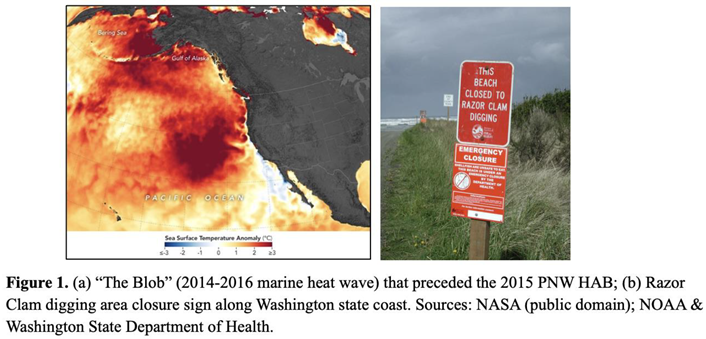
Initial event: 2015 PNW HAB. Beginning in spring 2014, a massive marine heatwave – known as “the Blob” – struck the Pacific Northwest (PNW) coast of the United States, creating conditions favorable for the development of a harmful algal bloom [37]. The 2015 PNW HAB was not recognized until early May 2015, when, after routine testing revealed elevated concentrations of domoic acid in tissues of shellfish, Washington State authorities closed beaches to razor clam harvesting [38]. Once the bloom was recognized, scientists used existing observation systems and satellite data to understand the bloom’s development and scale [39,40]. The 2015 PNW HAB event ultimately produced a Pseudo-nitzschia bloom that extended from southern California to the Aleutian Islands. This genus produces domoic acid, the toxin responsible for amnesic shellfish poisoning, which can propagate through coastal food webs [37]. In the case of the 2015 bloom, algal proliferation compressed available habitat and reduced food resources, while elevated domoic acid levels caused an unprecedented mass mortality of marine mammals and seabirds [41]. It is estimated, for example, that one million common murres died of starvation owing to the decimated fish population [42].
Federal and state authorities employed preexisting institutions to prepare for and respond to the 2015 PNW HAB. The Clean Water Act of 1972 established point-source controls over the release of nutrients such as nitrogen and phosphorous into waterways but failed to either create a nationwide limit or to address agricultural and diffuse urban and suburban nutrient runoff. That same year, a bloom of A. catenella off the northeastern U.S. coast helped spur passage of the Magnuson–Stevens Fishery Conservation and Management Act (MSA) of 1976, which established eight regional fishery management councils and became the country’s foundational fisheries management law [43]. Ten years later, the Interjurisdictional Fisheries Act (IFA) became law, empowering the U.S. Secretary of Commerce to declare a Federal Fishery Disaster (FFD) and enabling financial compensation to flow to impacted fishing communities [44]. From 1991 to 1994, the U.S. West Coast experienced a harmful algal bloom that caused the deaths of thousands of seabirds and elevated domoic acid levels in the tissues of razor clams and Dungeness crabs [45]. It was the earlier emergence of a large hypoxic zone in the Gulf of Mexico, together with fish kills and human health impacts linked to the 1997–1998 Pfiesteria piscicida blooms in Chesapeake Bay and North Carolina estuaries, that ultimately prompted passage of the Harmful Algal Bloom and Hypoxia Research and Control Act (HABHRCA) of 1998. HABHRCA established an Interagency Task Force – overseen by the Department of Commerce through NOAA – to detect, track, and predict HABs, and explicitly required that its action strategy be informed by scientific assessments [46].
Federal and state actors responded to the 2015 PNW HAB with a mix of proactive measures and predominantly reactive actions. On the proactive side, the federal government provided satellite monitoring to apprise state-level planners of the bloom’s expansion and activated NOAA’s HAB Event Response Program to bolster response capacity [47]. At the subnational level, however, preparedness varied across states. Washington benefited from the Olympic Region HAB Early Warning System – part of the state- and NOAA-funded Olympic Region Harmful Algal Bloom Partnership (ORHAB) – a science-based monitoring program established in 1999–2000 in response to recurring shellfish harvest closures [18]. In Oregon, which had no monitoring program for HABs in 2015, authorities were blindsided by the toxic bloom [18,48]. Although California possessed strong scientific research capacity, these assets had not yet been integrated into real-time decision-making by fisheries management or natural resource agencies [18].
Within the U.S. federal system, the three affected states were, by design, responsible for leading the crisis response. All three closed or delayed razor clam, Dungeness crab, and other fisheries; issued public health advisories; expanded toxin monitoring; and shared data with federal authorities. Each state also issued “evisceration orders,” allowing commercial crab harvest and sale on the condition that toxin-laden viscera were removed and the remaining edible meat met safety thresholds [49]. Meanwhile, the federal government supplied NOAA-administered satellite monitoring and funding for in situ testing of the expanding bloom. On 17 January 2017 – more than two years after the HAB was first recognized – the Department of Commerce finally declared a FFD for nine salmon and crab fisheries in the three impacted states [50]. Yet Oregon did not meet the statutory threshold in the same way as Washington and California, which meant that its fisheries were not eligible for FFD funding [51]. Six months later, Congress amended the MSA by passing the Modernizing Fisheries Management Act, which mandated the Commerce Department to facilitate “greater incorporation of data, analysis, stock assessments, and surveys from state agencies and nongovernmental sources into fisheries management decisions” [52].
Follow-on event: 2021 PNW HAB. In April 2021, in tandem with a massive marine heatwave known as the “Blob 2.0,” a harmful algal bloom was detected off the U.S. West Coast. 2021 PNW HAB event was detected by a combination of satellite remote sensing, oceanographic observing networks, and routine toxin monitoring by coastal state authorities. Eventually, the oversized HAB would stretch from the northern California coast to the Aleutian Islands [53]. The bloom was driven by elevated chlorophyll-a concentrations in warm, stratified coastal waters, along with weak winds and reduced upwelling, which together created favorable conditions for Pseudo-nitzschia growth [41]. Washington and Oregon were especially hard hit, recording high and persistent levels of domoic acid in coastal waters and shellfish, while California experienced more sporadic and lower toxin levels in localized hotspots [54,55].
On the proactive side, federal and state authorities took steps to better predict HABs and mitigate their deleterious effects. State level authorities were able to better anticipate HAB expansion thanks to world-class satellite data supplied by NASA. Shortly after the 2015 bloom abated, NOAA began funding the Pacific Northwest Harmful Algal Bloom Bulletin (PNW HAB Bulletin) which provided state shellfish monitors with advance warning of algal movements and potential toxicity levels during the 2021 event [56]. Meanwhile, the three impacted states took action to expand anticipatory sampling and forecast-guided management. Washington integrated ORHAB data streams with the PNW HAB Bulletin to create an operational decision-support system, while Oregon secured funding through NOAA’s MERHAB program to restart the Monitoring Oregon Coast Harmful Algae program as an early-warning system [48,57]. Meanwhile, California established the Harmful Algal Bloom Monitoring and Alert Program and the Freshwater and Estuarine Algal Bloom Program, tasking state agencies with coordinating HAB response, assessment, and research [55,58]. And yet the proactive measures taken between the initial and follow-on HAB events can only be described as modest.
Most actions taken by U.S. authorities in response to the 2021 PNW HAB were reactive. Through its National Centers for Coastal Ocean Science and Northwest Fisheries Science Center, NOAA intensified offshore and nearshore monitoring of algal abundance and domoic acid concentrations. The agency also funded satellite observations and ship-based sampling and, as the bloom began to subside, announced $15.3 million in grants for HAB research focused on U.S. coastal waters and the Great Lakes [59]. Meanwhile, authorities in Washington and Oregon sought to minimize risks to human health through public advisories, statewide razor clam harvest closures, and intensified biotoxin monitoring. Recognizing that razor clam stocks have no respect for state boundaries, Oregon coordinated the timing and communication of closures with Washington and California. In California, authorities issued public advisories, implemented targeted shellfish harvest closures and reopenings, and expanded shellfish sampling and seawater monitoring [60]. Finally, the United States has no uniform, legally enforceable federal standard requiring routine HAB monitoring. While federal agencies provide guidance, recommended criteria, forecasting tools, and voluntary reporting systems, responsibility for monitoring and public advisories largely falls to states, Tribes, and local authorities. As a result, HABs are tracked, interpreted, and communicated differently across the country [20].
3.2. Australia
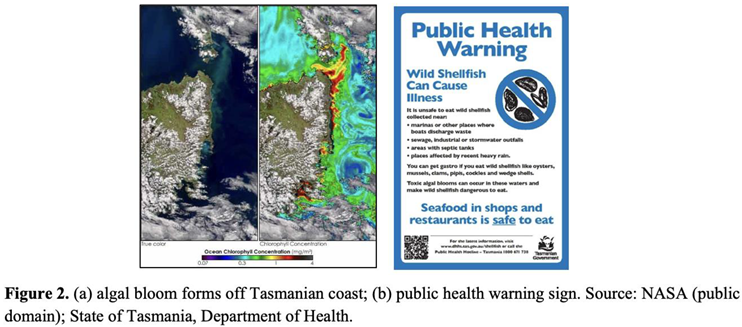
Initial Event: 2012 Tasmanian HAB. Prior to 2012, Tasmania’s east coast was considered a low-risk area for harmful algal blooms (HABs). Early surveys reported low levels of Alexandrium tamarense (now reclassified as Alexandrium catenella), and laboratory cultures of A. catenella showed no detectable toxicity to humans, fish, or shellfish [61]. However, on 30 October 2012, Japanese import authorities detected paralytic shellfish toxins (PSTs) above regulatory thresholds in tissues of Mytilus galloprovincialis from a shipment of blue mussels harvested along Tasmania’s east coast [62]. Japanese authorities filed a non-compliance report with the Australian Department of Agriculture, Fisheries, and Forestry (DAFF), triggering a recall of all Australian shellfish exports to Japan. DAFF subsequently conducted seawater and bivalve tissue testing, which confirmed the presence of PSTs [62]. The 2012 Tasmanian HAB event was driven by periods of high rainfall, low air temperatures, and low windspeeds [63]. The result was increased coastal stratification, which creates warm, nutrient-rich upper column habitats for many HAB species. Unaware of local public health warnings, four people were hospitalized after consuming contaminated shellfish [64].
Tasmania has a history of recurrent HABs dating back to 1986 [64,65]. Prior to that, there were no state policies or monitoring plans in place, as there was no record of a large-scale toxic bloom in the area. The 1986 event prompted the Department of Sea Fisheries to establish Tasmania’s first biotoxin monitoring protocol, which relied upon weekly phytoplankton monitoring in areas of concern [66]. However, this monitoring approach lacks precision and may therefore indicate multiple areas of potential deficiency [67]. In addition, the monitoring protocol was designed primarily for Gymnodinium catenatum blooms, leaving a blind spot for other algal species, such as A. catenella [65]. From 1986-2012, oversight of the monitoring protocol changed hands several times, with handoffs to the Tasmanian Shellfish Market Access Program (previously the Tasmanian Shellfish Quality Assurance Program, also known as the ShellMAP), Tasmanian Department of Health and Human Services, and Tasmanian Department of Natural Resources and Environment [68]. In 1992, Australia, in partnership with New Zealand, established the National Water Quality Management Strategy, which provides guidelines for the voluntary enforcement of nutrient discharges. With enforcement left to the states, Tasmania created its own system for regulating nutrient discharges in 1994. In 2012, Tasmania’s first formal, documented plan governing shellfish biotoxin risk went into effect and was heavily updated following that year’s HAB event [68]. The first version of the modern ShellMAP Biotoxin Management Plan was released in January 2014 and was based upon recommendations from the Australian Fisheries Research and Development Corporation, Government of Tasmania, Australian Seafood Cooperative Research Centre, and SafeFish [61]. The plan highlights the complex, collaborative approach for HAB management that is necessary in the context of Australia’s federal system, which has no nationwide biotoxin monitoring protocol.
Australian authorities responded to the 2012 Tasmanian HAB event primarily with reactive measures. These measures included the closure of many key fisheries on Tasmania’s southeastern coast, as well as a commitment to update the Biotoxin Management Plan with more rigor [61]. However, it is important to note that many of these measures were reactive by default because of the blind spot for A. catenella in the ShellMAP Biotoxin Management Plan [65]. Indeed, the proactive measures available to Tasmanian authorities at the time were not helpful in anticipating or preventing the 2012 HAB event. Although Australian authorities began experimenting with satellite data for phytoplankton and bloom research in the late 1990s, the 2012 A. catenella bloom was too small to be detectable using that technology, resulting in the recall of Tasmanian shellfish exports to Japan. Moreover, the minimalist nature of shellfish monitoring in Tasmania – which relied solely upon plankton monitoring and did not include shellfish testing – was not sufficient to provide accurate, timely results. The failure of authorities to prevent a shellfish aquaculture operation from locating in a known poorly monitored area created an unnecessary exposure to risk [61,65].
Follow-on Event: 2017 Tasmanian HAB. Following the 2012 Tasmanian HAB event on the island’s eastern coast, ShellMAP’s Biotoxin Management Plan was revised to mandate more frequent shellfish tissue testing and to emphasize the timely reporting of analytical results from agencies such as Analytical Services Tasmania [61,69]. These measures helped to quickly identify a bloom of Alexandrium catenella in 2017 [69]. In June 2017, routine ShellMAP/TSQAP biotoxin monitoring detected a toxic bloom, revealing elevated levels of paralytic shellfish toxins (PSTs) in shellfish. In response, Tasmanian public health authorities issued an alert on July 7, advising residents to avoid consuming oysters and certain other seafood from Great Oyster Bay and Great Swanport [70]. The 2017 Tasmanian HAB was a part of a series of toxic blooms that returned each winter-spring from 2012 through 2018 [71]. This HAB event originated in Great Oyster Bay and subsequently spread to Spring Bay, Moulting Bay, Mercury passage, and other areas [71]. In response, local seafood industry associations supported coordination and communication efforts for state regulators under the ShellMAP Biotoxin Management Program, administered by the Australian Shellfish Quality Assurance Program. Closures of both farmed and wild-harvest fisheries affected mussels, oysters, rock lobsters, abalone, scallops, and crabs, with the duration of closures varying by species [71]. In September 2017, the Tasmanian Department of Health published a public health alert warning citizens to not consume wild-harvested shellfish [12]. As with the 2012 HAB event, this bloom was primarily driven by coastal stratification, likely intensified by a marine heatwave that affected the region in 2016 [63,73].
The Tasmanian government responded to the 2017 Tasmanian HAB event primarily with reactive measures. Overall, monitoring of the 2017 HAB relied on largely the same approaches used during the 2012 event, but implemented with greater frequency. For example, shellfish tissue samples were collected weekly, rather than at the more limited intervals used in the earlier bloom [72]. This provided organizations such as ShellMAP and the Tasmanian Department of Health with a larger and more timely data stream to inform public health notifications and fisheries closure advisories. In addition, ShellMAP adjusted its sampling frequency and spatial coverage in line with updated risk assessments across aquaculture areas, as determined by its risk matrix [74]. The only proactive measure that proved effective in mitigating the impacts of the 2017 bloom was the increased frequency of shellfish tissue sampling, which improved early detection of PSTs and enabled more timely public health and fisheries responses. This may have contributed to the absence of hospitalizations from the consumption of PST-contaminated shellfish during this event.
3.3. Norway
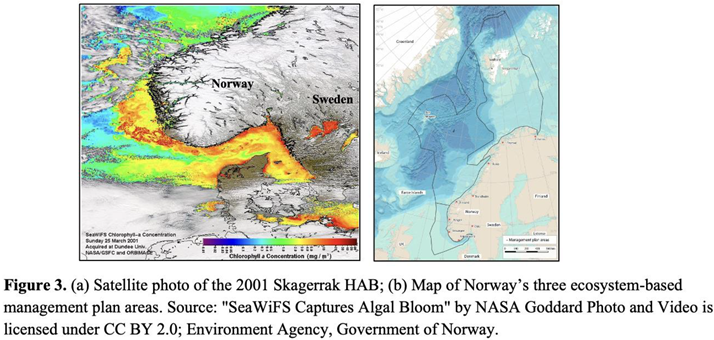
Initial event: 2001 Skagerrak HAB. Although Norway is not a member of the European Union, it is a partner in EU-funded observation and early-warning systems for detecting harmful algal blooms [4]. This relationship proved beneficial when, on 19 March 2001, EU scientists using satellite imagery from the from the Sea-viewing WideField-of-view Sensor (SeaWiFS) detected a HAB forming off Norway’s Skagerrak coast [75]. The 2001 Skagerrak HAB, first observed in Norwegian waters five days earlier, ultimately persisted for nearly two weeks, extending from Sweden’s Kattegat coast to Norway’s North Sea coast. The event was primarily driven by water column stratification and elevated nutrient inputs from anomalously high freshwater discharge, alongside increasing daylight and seasonal warming in springtime [75,77,78]. The causative alga was Pseudochattonella, a phytoflagellate that produces ichthyotoxins capable of damaging fish gill tissues and causing acute suffocation. In the Skagerrak HAB, the bloom’s biomass impact led to the mass mortality of approximately 1,100 tons of farmed salmon [79].
Norwegian authorities responded to the 2001 Skagerrak HAB with institutions shaped from lessons learned from previous blooms. Although documented instances of HABs in Norwegian waters date back to the 1970s [80], it was not until a 1981 HAB killed farmed salmon along the Skagerrak coast that authorities came to perceive such blooms as hazards requiring a systematic response [81]. The 1981 Pollution Control Act was enacted to regulate environmental activities, including the discharge of nutrients and organic matter into marine and freshwater waterways. That Act – which was heavily influenced by the EU Water Framework Directive – established an enforceable “polluter pays” principle and authorized national authorities to impose discharge permits over nutrient release. In 1987, the Norwegian Association of Fishfarmers – in cooperation with insurance companies and the State Food Hygiene Control Agency – established a nationwide network of aquafarmers for monitoring phytoplankton blooms [80,82]. The following year, a HAB in the Kattegat–Skagerrak area caused losses of approximately US$6 billion in farmed salmon, prompting the creation of Seawatch, an operational program for HAB monitoring [80,82]. Soon thereafter, the AlgeInfo system was created to provide weekly web-based updates on algal blooms based upon analysis of water samples taken at around 30 coastal monitoring stations [83]. In 1992, the Seawatch System was enhanced with the deployment of remotely operated buoys [84,85]. Finally, in 1997, the EU launched the SeaWiFS system to detect large-scale increases in chlorophyll-a and to complement routine ship-based monitoring efforts [75,76].
Norwegian authorities responded to the 2001 Skagerrak HAB with an admixture of reactive and proactive measures. Reactive measures included improved protocols for handling dead fish, along with the use of the Seawatch system to monitor potential HABs. Because of the sudden onset of the 2001 toxic bloom, certain available measures – such as early harvest advisories for farmed fish or the relocation of at-risk stock to unaffected areas – could not be implemented [83]. However, the Seawatch System played a proactive role in making possible the real-time transmission of ocean data to scientists and officials at the Institute of Marine Research, Directorate for Fisheries, and the State Food Hygiene Control Agency. And data provided by the SeaWiFS satellite played a role in detecting the 2001 Skagerrak HAB, albeit primarily as a monitoring and detection-support tool rather than a standalone detection mechanism.
Follow-on event: 2019 Nordland/Troms HAB. On 10 May 2019, a harmful algal bloom (HAB) began spreading across interconnected fjords in Nordland and Troms counties along the Norwegian Sea, persisting for approximately one month [86]. The 2019 Nordland/Troms HAB was first reported by fish farmers who witnessed a mortality spike among newly released smolt [87]. The bloom was subsequently confirmed by scientists using data from in situ sensor networks and satellite imagery collected by Sentinel 2B, a European Space Agency satellite [88]. It was primarily driven by stratified water conditions, warmer and lower-salinity seawater, restricted circulation within interconnected fjords, and moderately elevated nutrient levels [89]. The area had previously experienced an HAB in 1991 that killed 742 tons of farmed salmon, as well as a less severe bloom in 1998. During the 2019 Nordland–Troms HAB event, affected fish farmers initially notified the Norwegian Food Safety Authority – as required by law – but did not know to contact the Directorate of Fisheries, which is responsible for cleanup and response [Error! Reference source not found.]. This communication lapse led to confusion in the response effort. Ultimately, the Nordland–Troms HAB killed approximately eight million salmon (13,400 tons) across 14 fish farms, resulting in economic losses of about €84 million [Error! Reference source not found.; 91; 86]. In this HAB event, the primary algal culprit was the haptophyte Chrysochromulina leadbeateri, which suffocates fish through a biomass impact that damage their gills [92,93].
Norwegian authorities responded to the 2019 Nordland/Troms HAB with an array of reactive and proactive measures. On the reactive side, the Norway Veterinary Institute swiftly identified the culprit algae, while the Norwegian Directorate of Fisheries coordinated the crisis response and issued daily updates from its Bergen office [93,94]. The national government compensated affected fish farmers by granting a five-year exemption from maximum biomass limits, enabling recovery of up to 60% of their losses [95]. This was important because insurance only covered 10% of fish farmers’ losses [Error! Reference source not found.]. Non-governmental actors also played important roles in the disaster response. For example, the Norwegian Seafood Federation contracted Nofima, an applied research institute, to map the HAB’s spread and assess what had been learned by fish farmers, suppliers, and government authorities. In addition, Kongsberg Satellite Services (KSAT) – a company jointly owned by public and private entities – provided satellite imagery and analysis of the bloom [Error! Reference source not found.; 88]. Meanwhile, the Institute of Marine Research oversaw field sampling, real time tracking, and reporting on the toxicity of the expanding bloom [96], while fish farmers evacuated 2.5 million salmon to mitigate loss and employed risk modeling to determine how best to protect their stocks [97]. The Norwegian Coast Guard provided logistical support, while the privately owned Norwegian Gannet – the world’s largest harvesting vessel – assisted with emergency culling of dying fish and the early harvest of market-ready stock [97,98]. Despite these efforts, the response to the 2019 event exposed the limitations of the existing HAB governance system, particularly its inability to manage large volumes of dead fish effectively [Error! Reference source not found.].
The most significant proactive measure during the 2019 bloom was its confirmation by scientists using data from in situ sensor networks and satellite imagery. In its aftermath, however, a range of additional proactive measures were introduced. The Ministry of Fisheries announced steps to strengthen fish health monitoring and enhance rapid detection and response capabilities – for example, by enabling the relocation of threatened fish stocks to uncontaminated areas. It also allocated 10 million kroner to support research on strategies to mitigate HAB-related fish losses [99]. To improve algal bloom monitoring, the Institute of Marine Research deployed a system that uses a submersible microscope to photograph algae in suspected HAB areas, combined with artificial intelligence to identify species and quantify cell abundance. This approach enables rapid initial assessments without the need for immediate water sampling and laboratory analysis, which can be conducted later. It also allows the IMR to “quickly alert authorities and industries … [whenever] a bloom of the more troublesome algae” emerges [100]. Finally, Norwegian authorities strengthened long term HAB and climate risk preparedness and took steps to better integrate HAB risk into climate adaptation planning for aquaculture [101,102,103].
3.4. Japan
Initial Event: 2015 Hakodate Bay HAB. In August 2015, during routine phytoplankton monitoring, researchers at the Hakodate Research Center for Fisheries and Oceans detected cells of the dinoflagellate Karenia mikimotoi, marking the first recorded bloom of this species in Japan’s northern waters [104]. Cell densities remained low after the initial detection on August 31 until mid-October, when more favorable conditions allowed the bloom to expand into a dense, widespread HAB that persisted through late November [104]. The bloom’s primary drivers were elevated water temperatures, reduced competition from diatoms due to lower solar radiation, and possible transport via the Tsushima and Tsugaru Warm Currents [104]. Karenia mikimotoi, the culprit alga, produces potent hemolytic and cytotoxic toxins that harm fish invertebrates and gills, resulting in respiratory distress and mortality [105]. In the case of the 2015 Hakodate Bay HAB, the result was the loss of economically and ecologically important species, including chum salmon, Japanese common squid, and Pacific abalone [104].
Japanese authorities responded to the 2015 Hakodate Bay HAB using institutions and protocols created in response to previous harmful blooms. Systematic monitoring of HABs in Japan began in the 1960s as a byproduct of the rapid industrialization along coastal areas during the country’s “high-speed growth era” (kōdō seichō jidai) [106]. The Water Pollution Control Law of 1970 established a centralized regulatory model with national standards for nutrient release, with direct nutrient caps for sensitive waters. However, the Japanese government did not mandate a coordinated response to HAB-related hazards until a 1972 Chattonella bloom in the Seto Inland Sea killed approximately 14 million cultured yellowtail, valued at ¥7.1 billion [107]. The response came in the form of the 1973 Law Concerning Special Measures for the Preservation of the Environment of the Seto Inland Sea, which regulated nutrient loading and established prefectural monitoring networks [108]. Additional Chattonella blooms in the 1970s in the Harima-Nada region along the Seto Inland Sea prompted the Fisheries Agency to formalize its National Red Tide Monitoring Program. That program created a nationwide network of prefectural fisheries research stations to conduct regular sampling at hundreds of coastal sites during seasons of bloom activity [107,109]. In 2006, the Japan Aerospace Exploration Agency (JAXA) began using the Advanced Land Observing Satellite (ALOS) to enhance disaster monitoring and detect ocean discoloration. The ALOS system complemented existing ship-based surveys and observations conducted by Hokkaido’s Hakodate Fisheries Research Institute [104,110].
Japanese authorities responded to the 2015 Hakodate Bay HAB with reactive and proactive measures. Reactive measures included emergency harvest rules for valuable species such as abalone and squid and the creation of temporary net barriers by prefectural fisheries cooperatives to contain benthic mortality zones [104,111]. The northward expansion of Karenia mikimotoi algae into Hokkaido’s coastal water was not predicted because the species had previously remained confined to the coastal waters of western Japan. Consequently, measures such as early relocation of caged stocks or preventative chemical dispersant measures were not utilized [112]. However, the Hokkaido Prefectural Government’s Hakodate Fisheries Research Institute did play a proactive role by facilitating the real-time transmission of cell density data and dissolved oxygen levels to scientists and officials at the Fisheries Agency, the Japan Fisheries Resource Conservation Association, and the local fisheries cooperatives federation [104]. In addition, although JAXA’s Advanced Land Observing Satellite ALOS-2 and Himawari-8 satellites afforded the potential for remote detection of sea surface temperature anomalies and chlorophyll-a concentrations, satellite data merely confirmed the 2015 Hakodate Bay HAB after the fact.
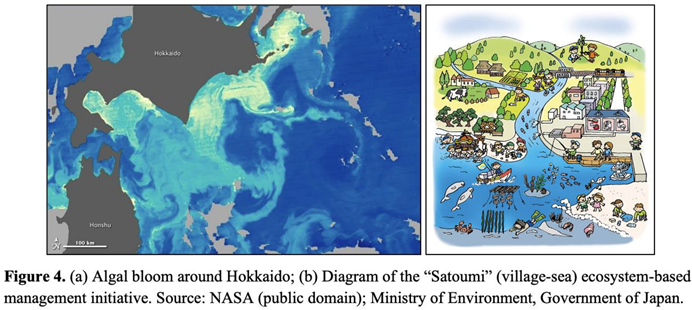
Follow-on event: 2021 Southeast Hokkaido HAB. In September 2021, a large-scale HAB began two-month-long expansion in the waters off the southeastern coast of Hokkaido. It was first detected by fisheries cooperatives and Hokkaido prefectural researchers who discovered mass mortality among benthic invertebrates and wild salmon stocks [104,113]. The bloom was subsequently confirmed by scientists using ship-based surveys, in situ sensor networks, and satellite imagery [114]. Its main causes were water-column stratification, warming associated with an intense marine heatwave (which subsided roughly one month before detection), seasonal vertical mixing that supplied nitrate from subsurface layers, and the transport of algal cells by ocean currents. [115]. Although Karenia blooms previously had been detected in eastern Japan’s coastal waters, the 2021 Southeast Hokkaido HAB signified the first documented bloom of Karenia selliformis along the Hokkaido coast [116]. Fisheries cooperatives impacted by the bloom were alerted by the Hokkaido Prefectural Government and the Fisheries Agency, which enacted emergency response protocols established following the 2015 Hakodate Bay event [104]. Unfortunately, the 2021 Southeast Hokkaido HAB inflicted severe damage on coastal fisheries, including the mass mortality of chum salmon, Japanese common squid, and diverse benthic invertebrates. Estimates of the total economic damage to coastal fisheries exceeded ¥9 billion [117]. In this case, the primary algal culprit was the dinoflagellate Karenia selliformis, that creates neurotoxic compounds which damage gill tissues and disrupt marine food webs [114,115,116].
Japanese authorities employed an admixture of reactive and proactive measures to detect and respond to the 2021 Southeast Hokkaido HAB. On the reactive side, the Hokkaido Prefectural Government’s Central Fisheries Research Institute quickly identified the culprit algae, while the Fisheries Agency provided daily updates to assist in the crisis response [118]. The national government compensated affected fishers with funds drawn from the Fisheries Disaster Compensation Program, which provides financial support for lost fishing gear, damaged stocks, and temporary income subsidies [118,119]. In addition, non-governmental entities such as the Japan Fisheries Resource Conservation Association mobilized local fisheries cooperatives to chart the HAB's spread and document mortality events, while JAXA provided satellite imagery and analyses of bloom distribution [114]. Nevertheless, the 2021 HAB event exposed the inability of the existing forecasting system to predict the northward expansion of Karenia selliformis into previously unaffected waters [115].
On the proactive side, the unanticipated 2021 bloom was confirmed by ship-based surveys, in situ sensor networks, and JAXA satellite imagery. This event prompted the introduction of a series of proactive measures. The Ministry of Agriculture, Forestry and Fisheries implemented protocols to improve phytoplankton monitoring, while strengthening rapid detection and response capacity by expanding the national red tide monitoring program to Hokkaido’s Pacific coast and introducing warning systems for aquaculture operators [120,121]. Finally, in the aftermath of this event, Japanese authorities recognized that blooms in northern waters are becoming more frequent and less predictable, underscoring the need to integrate HAB risk into fisheries-focused climate adaptation planning [120]. This ongoing effort is embodied in the Satoumi (“village–ocean”) initiative, a preventive, ecosystem-based management approach that reduces HAB risk and enhances resilience through ecological co-management [122].
4. Discussion
This paper addresses three knowledge gaps. First, it examines the underexplored role of institutions in shaping national approaches to HAB governance. To begin filling this gap, we compared the institutional arrangements of the United States, Australia, Norway, and Japan. This comparison revealed clear alignment between country-level approaches and the institutional configurations identified in the VoC literature. In particular, the liberal market systems (LMS) – the United States and Australia – relied heavily on reactive measures, reflecting market-based coordination, short-term time horizons, and fragmented governance structures. A notable exception is the United States’ strong anticipatory capacity, enabled by its world-class Earth observation and remote sensing capabilities. In contrast, the coordinated market systems (CMS) – Norway and Japan – adopted strategies that balanced reactive and proactive measures, consistent with their longer time horizons, non-market coordination, and more centralized regulatory authority. From a VoC perspective, these patterns suggest that HAB governance arrangements mirror those observed in other natural resource policy domains, where CMSs tend to favor coordinated, anticipatory, and long-term approaches, while LMSs emphasize more reactive responses [123,124,125]. The message is clear: the type of institutional arrangement matters when it comes to HAB governance. Table 3 contrasts the institutional resilience-building approaches of the case study countries, while details concerning the scoring system can be found in Appendix A.
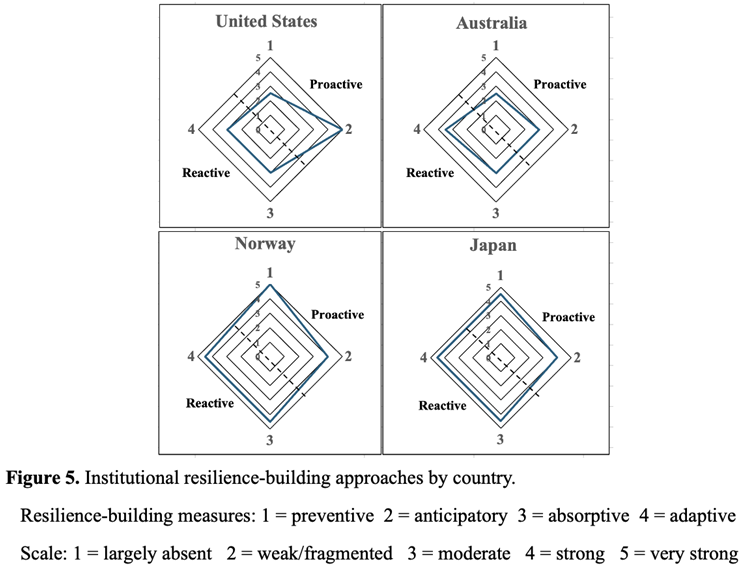
The second knowledge gap called attention the need to better understand institutional adaptation following major HAB events. To address this gap, we compared how the four case study countries responded to similarly timed HABs and subsequent developments, with the aim of assessing their adaptive resilience and whether LMSs or CMSs are better equipped to incorporate lessons learned. In the LMS cases – the United States and Australia – responses were predominantly reactive, mainly focusing on enhancing monitoring and testing capacity. The United States’ advanced remote sensing capabilities represent a notable exception to the general rule. By contrast, the CMS cases – Norway and Japan – adopted a more balanced mix of reactive and proactive measures, including the integration of HAB risk into climate adaptation strategies for fisheries and aquaculture. In effect, the U.S. and Australian approaches assume a future of perpetually recurring bloom response, whereas the Norwegian and Japanese approaches anticipate that some blooms might be prevented and their impacts mitigated. All else equal, this suggests that sustained investment in proactive measures is likely to yield greater long-term adaptive capacity and resilience than a predominantly reactive approach.
Addressing the third gap required assessing whether a resilience framing can inform operational HAB governance. We did so by classifying resilience-building institutions as preventive, anticipatory, absorptive, or adaptive, depending on whether they are proactive or reactive. This framing offers planners and decision-makers a practical way to assemble a more balanced portfolio of responses to HAB risk. However, constructing such a portfolio likely will prove more challenging in federal systems like the United States and Australia, where market-based coordination, short-term policy horizons, and fragmented authority structures prevail. Evidence from both cases shows substantial interstate variation in monitoring, closure timing, public advisories, and other mitigation measures. For instance, Washington, Oregon, and California responded differently to the 2015 and 2021 HAB events, while Australia’s responses to the 2007 and 2017 HABs likely would have produced a similar result had the blooms extended beyond Tasmania. These patterns suggest that whatever advantage, if any, federal systems have in tailoring policy actions to local conditions may be undermined by coordination failures and uneven outcomes when HABs cross state boundaries. As a result, community vulnerability in a federal system depends heavily on where an event occurs. In this regard, initiatives – such as the Olympic Region HAB Partnership between Washington and Oregon – may serve as a model for state-level actors seeking to enhance cross-jurisdictional response capacity.
A key lesson gleaned from the case studies is that decision-makers must adapt to a changing hazard environment for HABs. Using the United States as an example, the number of HAB events increased substantially between 1990 and 2019, although part of this rise reflects improvements in monitoring [126]. Moreover, the massive 2015 HAB along the U.S. West Coast produced a toxic bloom that stretched from southern California to the Aleutian Islands. Although not examined in this paper, the 2024–2026 Karenia mikimotoi bloom off the South Australian coast was the largest and longest HAB ever recorded in Australian waters [127]. Meanwhile, Norwegian authorities were not prepared for the scale and intensity of the 2019 Nordland/Troms HAB, which exposed the insufficiency of planning for an event that involved five interconnected fjords. Similarly, Japanese authorities were caught off guard by the unprecedented 2021 Southeast Hokkaido event that brought the first recorded Karenia mikimotoi bloom to those waters. And, because of a changing hazard environment, Australian authorities must now deal with an overall east-southeastward shift and redistribution of HAB risk in coastal waters. The message here is clear: planners and decision-makers around the world must prepare for a hazard environment in which HABs are commonplace, even as they become more extreme, more protracted, and more spatially and taxonomically disparate. Failure to do so is to court catastrophe.
We chose to omit substantive discussion of transformative resilience – the fifth category of resilience-building institutions – because, in our view, incremental improvements in HAB monitoring and mitigation do not constitute a governance-level paradigm shift. That said, although HABs are unlikely to disappear, some scholars argue that ecosystem-based management (EBM) – which accounts for interactions across species, sectors, and environmental processes rather than treating them in isolation – offers the most promising pathway for reducing their occurrence and deleterious effects [7,128,129,130]. But transitioning to EBM will require coordinated controls across multiple sectors, including agriculture, urban stormwater, wastewater treatment, manufacturing, land-use planning, and tourism. For EBM to take hold in the HAB domain, proponents must overcome a broad coalition of interests whose influence and resources far exceed their own. Yet all four case study countries nominally endorse EBM. Among them, Norway is furthest along in enforcing nutrient controls, while Japan employs region-specific caps while promoting the Satoumi Initiative. By contrast, the United States and Australia rely largely on state-level measures that only partially address nutrient loading. In practice, a full EBM transition is most likely in countries with a history of sustainability transitions – particularly coordinated market systems, which have demonstrated a greater capacity to decouple economic growth from environmental pressures [122; 125; Error! Reference source not found.]. In this way, should EBM come to be adopted in the HAB domain, it will firmly link resilience to sustainability by enhancing system capacity to absorb nutrient shocks and anthropogenic pressures while maintaining essential ecosystem functions [131].
There are several promising avenues for future research. One is to examine how, if at all, liberal market systems such as the United States and Australia can adapt their institutional arrangements to build proactive resilience. Another is to explore the nature and challenges of HAB-related resilience building across countries at different levels of development. Another approach is to assess how domestic institutions – such as electoral systems – shape HAB governance and to propose solutions to address resulting shortcomings. For example, the United States’ two-party system, rooted in a winner-take-all electoral structure, produces pendulum-like ideological swings in environmental policy that undermine the coherence needed for proactive and sustainable resilience. Similarly, there is need for additional studies – particularly of a comparative bent – that employ survey data to develop a more granular understanding of stakeholder perceptions and responses to HABs [e.g., 18]. Moreover, given the critical role of the science–policy interface in the HAB domain – evidenced by advances such as satellite remote sensing, hyperspectral imaging, in situ autonomous sensors, environmental DNA monitoring, and machine-learning-based early warning systems – it is imperative to align the institutions that investigate and deliver science and knowledge, with those who readily need it. Doing so is crucial for maintaining sustainable governance policies and practice. Finally, it is important to understand how to design institutions with sufficient flexibility to adapt as evidence evolves in this perpetually evolving policy domain.
5. Conclusions
Harmful algal blooms (HABs) represent an expanding external stressor for all those who value marine resources and ecosystems as well as a growing and shifting challenge for coastal community leaders. This paper adopted resilience as a framework for assessing how community leaders measure, respond to, and adapt to both the chronic and acute impacts presented by these destructive events. Here, resilience is defined as the capacity to prevent, anticipate, absorb, adapt, or transform and recover from the effects of a hazard in a timely and efficient manner. Because HABs threaten human well-being, community leaders develop institutions in the form of laws, regulations, and related measures to protect public health and livelihoods. Institutional resilience reflects to the extent to which such humanly devised measures enhance a community’s capacity to remain functional when exposed to hazard.
This paper compared the governance approaches of four broadly similar capitalist democracies – the United States, Australia, Japan, and Norway – in responding to the shared stressor of HABs in coastal waters. Using a most similar systems design, the study contrasted the institutional resilience-building approaches of the four case countries, demonstrating how particular institutional arrangements shape HAB governance in characteristic ways. By examining responses to similarly timed events, the analysis highlighted the adaptive influence of specific institutional configurations. A key finding is that HAB governance aligns closely with patterns identified in the Varieties of Capitalism literature: liberal market systems such as the United States and Australia tend to rely more on reactive measures, whereas coordinated market systems such as Norway and Japan adopt more proactive strategies. This analysis suggests that, all else equal, sustained investment in a proactive measures is likely to yield greater long-term adaptive capacity and resilience than a predominantly reactive approach.
Evaluating HAB governance through a resilience lens offers planners and decision-makers a practical way to build a balanced portfolio of preventive and mitigative responses in a dynamic hazard environment. Rather than treating institutions as background noise, it is important to appreciate their role as explanatory variables shaping risk assessment, monitoring uptake, and policy effectiveness. A key takeaway from this analysis is that institution arrangements matter when it comes to HAB governance. Going forward, additional comparative research is needed to identify which institutional arrangements most effectively build community resilience and offer the greatest potential for emulation. Although HABs are unlikely to vanish any time soon, a concerted effort to understand how best to minimize their occurrence and damaging impacts may offer the best chance for realizing coastal sustainability in a constantly evolving hazard environment.
Appendix A. HAB-related institutional resilience scores by country
Institutional resilience scoring matrix
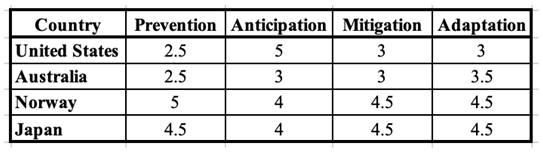
Scale: 1 = largely absent 2 = weak/fragmented 3 = moderate 4 = strong 5 = very strong
Note: Country scores reflect the authors’ judgment based upon insights gleaned through researching the country case studies.
These scores produce the following radar charts (also found in the text):
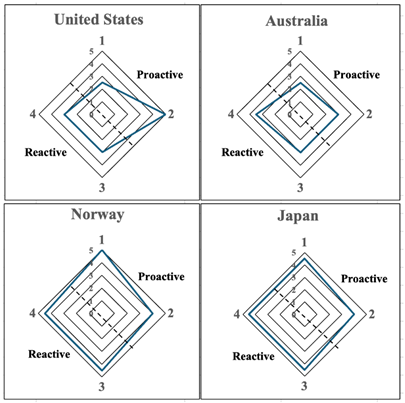
How to interpret each category of institutional resilience
- Prevention = reducing underlying drivers and exposure (nutrient controls, coastal zoning, wetland restoration)
- Anticipation = forecasting, monitoring, and early warning systems
- Mitigation = response actions to reduce impacts during events (closures, harvesting, compensation)
- Adaptation = long-term institutional learning and reform
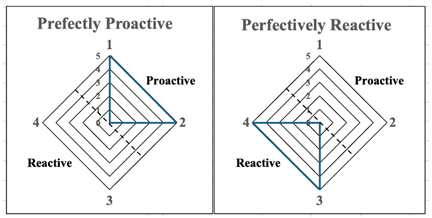
This is what would perfectly reactive and perfectly proactive institutional resilience scores look like on a radar chart:
Explanation of country scores
United States – Strong anticipatory capacity with moderate strength in other measures
- Prevention (2.5): Uneven controls across states; limited exposure reduction
- Anticipation (5): Advanced satellite-based HAB forecasting & monitoring
- Mitigation (3): Strong tools (closures, advisories); fragmented implementation
- Adaptation (3): Strong analytical capacity; uneven implementation
Assessment: Strong anticipation, weaker prevention; constrained by uneven implementation.
Australia – Moderate strength in all resilience categories
- Prevention (2.5): Partial controls; gaps in monitoring coverage, & siting decisions
- Anticipation (3): Strong satellite-based HAB forecasting & monitoring; uneven implementation
- Mitigation (3): Adequate coordination & response capacity; uneven implementation
- Adaptation (3.5): Adaptive efforts after major HAB events, but largely reactive
Assessment: Moderate+ adaptation with event-driven adaptation; constrained by uneven implementation.
Norway – Consistently strong in all resilience categories
- Prevention (5): Strict environmental controls; continuous monitoring; nutrient management
- Anticipation (4): Satellite-based HAB forecasting & monitoring; in situ early warning systems
- Mitigation (4.5): Rapid, coordinated response capacity
- Adaptation (4.5): Ongoing institutional adaptation & system-wide reform
Assessment: Fully integrated, anticipatory, & adaptive HAB governance system.
Japan – Consistently strong in all resilience categories
- Prevention (4.5): Long-term nutrient management; monitoring; fisheries controls
- Anticipation (4): Strong satellite-based HAB forecasting & monitoring; strong monitoring networks
- Mitigation (4.5): Effective cooperative-based response & fisheries management
- Adaptation (4.5): Track record of institutional learning over decades
Assessment: Time tested preventive–anticipatory system & adaptive HAB governance system.
References
- GEOHAB. Global Ecology and Oceanography of Harmful Algal Blooms; IOC–UNESCO: Paris, France, 2001. [Google Scholar]
- Hallegraeff, G.M.; Anderson, D.M.; Belin, C.; Dechraoui Bottein, M.-Y.; Bresnan, E.; Chinain, M.; Enevoldsen, H.; Iwataki, M.; Karlson, B.; McKenzie, C.H.; Sunesen, I.; Pitcher, G.C.; Provoost, P.; Richardson, A.; Schweibold, L.; Tester, P.A.; Trainer, V.L.; Yñiguez, A.T.; Zingone, A. Perceived Global Increase in Algal Blooms Is Attributable to Intensified Monitoring and Emerging Bloom Impacts. Commun. Earth Environ. 2021, 2, 117. [Google Scholar] [CrossRef]
- Bauer, M.; Hoagland, P.; Leschine, T.M.; Blount, B.G.; Pomeroy, C.M.; Lampl, L.L.; Scherer, C.W.; Ayres, D.L.; Tester, P.A.; Sengco, M.R.; Sellner, K.G.; Schumacker, J. The Importance of Human Dimensions Research in Managing Harmful Algal Blooms. Front. Ecol. Environ. 2010, 8, 75–83. [Google Scholar] [CrossRef]
- West, J.J.; Järnberg, L.; Berdalet, E.; Cusack, C. Understanding and Managing Harmful Algal Bloom Risks in a Changing Climate: Lessons from the European CoCliME Project. Front. Clim. 2021, 3, 636723. [Google Scholar] [CrossRef]
- Moore, S.K.; Broadwater, M.; Cha, C.; Dortch, Q.; Harvey, C.J.; Norman, K.C.; et al. Exploring the Human Dimensions of Harmful Algal Blooms through a Well-Being Framework to Increase Resilience in a Changing World. PLoS Clim. 2024, 3, e0000411. [Google Scholar] [CrossRef]
- IOC–UNESCO; International Oceanographic Data and Information Exchange (IODE). Harmful Algal Event Database (HAEDAT). Online at: https://haedat.iode.org (accessed on 9 May 2026).
- Anderson, D.M.; Cembella, A.D.; Hallegraeff, G.M. Progress in Understanding Harmful Algal Blooms: Paradigm Shifts and New Technologies for Research, Monitoring, and Management. Annu. Rev. Mar. Sci. 2012, 4, 143–176. [Google Scholar] [CrossRef]
- Gobler, C.J. Climate Change and Harmful Algal Blooms: Insights and Perspective. Nat. Rev. Microbiol. 2020, 18, 1–14. [Google Scholar] [CrossRef]
- Paerl, H.W.; Huisman, J. Climate Change: A Catalyst for Global Expansion of Harmful Cyanobacterial Blooms. Science 2009, 324, 57–58. [Google Scholar] [CrossRef]
- Anderson, D.M.; Hoagland, P.; Kaoru, Y.; White, A.W. Estimated Annual Economic Impacts from Harmful Algal Blooms (HABs) in the United States; WHOI Technical Report; Woods Hole Oceanographic Institution: Woods Hole, MA, USA, 2000. [Google Scholar]
- Paerl, H.W.; Paul, V.J. Climate Change: Links to Global Expansion of Harmful Cyanobacteria. Water Res. 2012, 46, 1349–1363. [Google Scholar] [CrossRef]
- Huisman, J.; Codd, G.A.; Paerl, H.W.; Ibelings, B.W.; Verspagen, J.M.H.; Visser, P.M. Cyanobacterial Blooms. Nat. Rev. Microbiol. 2018, 16, 471–483. [Google Scholar] [CrossRef]
- Moore, S.K.; Trainer, V.L.; Mantua, N.J.; Parker, M.S.; Laws, E.A.; Backer, L.C.; Fleming, L.E. Impacts of Climate Variability and Future Climate Change on Harmful Algal Blooms and Human Health. Environ. Health 2008, 7, S4. [Google Scholar] [CrossRef] [PubMed]
- Wells, M.L.; Trainer, V.L.; Smayda, T.J.; Karlson, B.S.O.; Trick, C.G.; Kudela, R.M.; Glibert, P.M. Harmful Algal Blooms and Climate Change: Learning from the Past and Present to Forecast the Future. Harmful Algae 2015, 49, 68–93. [Google Scholar] [CrossRef]
- Griffith, A.W.; Gobler, C.J. Harmful Algal Blooms: A Climate Change Co-Stressor in Marine and Freshwater Ecosystems. Harmful Algae 2020, 91, 101590. [Google Scholar] [CrossRef] [PubMed]
- Van Dolah, E.R.; Paolisso, M.; Sellner, K.; Place, A. Employing a Socio-Ecological Systems Approach to Engage Harmful Algal Bloom Stakeholders. Aquat. Ecol. 2016, 50, 577–594. [Google Scholar] [CrossRef]
- Creed, I.F.; Friedman, K.B. Enhanced Transboundary Governance Capacity Needed to Achieve Policy Goals for Harmful Algal Blooms. In Contaminants of the Great Lakes; Crossman, J., Weisener, C., Eds.; Springer: Cham, Switzerland, 2020; Vol. 101, pp. 251–265. [Google Scholar] [CrossRef]
- Ekstrom, J.A.; Moore, S.K.; Klinger, T. Examining Harmful Algal Blooms through a Disaster Risk Management Lens: A Case Study of the 2015 U.S. West Coast Domoic Acid Event. Harmful Algae 2020, 94, 101740. [Google Scholar] [CrossRef]
- Khattak, W.A.; Anas, M.; Hakki, E.E.; Avci, M.A.; Iqbal, J.; Abbasi, B.A.; Rehman, S.; Fahad, S. Future Directions in Cyanobacterial Bloom Research and Management Strategies. In Cyanobacterial Blooms: Ecology, Evolution and Biogeochemical Impacts; Fahad, S., Saud, S., Song, J., Nawaz, T., Zhou, R., Eds.; Springer: Cham, Switzerland, 2026; pp. 393–420. [Google Scholar] [CrossRef]
- Goodrich, S.; Canfield, K.N.; Mulvaney, K. Expert Insights on Managing Harmful Algal Blooms. Front. Freshw. Sci. 2024, 2, 1452344. [Google Scholar] [CrossRef]
- Sagarminaga, Y.; Garcés, E.; Francé, J.; Stern, R.; Revilla, M.; Magaletti, E.; Bresnan, E.; Tsirtsis, G.; Jakobsen, H.H.; Sampedro, N.; Reñé, A.; Camp, J.; Borja, Á.; Rodríguez, J.G.; Spada, E.; Pagou, K.; De Angelis, R.; Lanzén, A.; Ferrer, L.; Borrello, P.; Boicenco, L.; Kobos, J.; Mazaris, A.D.; Katsanevakis, S. New Tools and Recommendations for a Better Management of Harmful Algal Blooms under the European Marine Strategy Framework Directive. Front. Ocean Sustain. 2023, 1, 1298800. [Google Scholar] [CrossRef]
- Liu, J.-M.; Zhao, H.-Y.; Emmanuel, C.; Fan, T.-H.; Deng, W.; Zhang, Y.-F. Interdisciplinary Strategies for the Management of Harmful Algal Blooms: Prospects and Comprehensive Review. Discov. Environ. 2025, 3, 93. [Google Scholar] [CrossRef]
- Masoomi, S.R.; Ganji, M.; Annuk, A.; Eftekhari, M.; Mahmood, A.; Gheibi, M.; Moezzi, R. Harmful Algal Blooms as Emerging Marine Pollutants: A Review of Monitoring, Risk Assessment, and Management with a Mexican Case Study. Pollutants 2026, 6, 4. [Google Scholar] [CrossRef]
- Leschine, T. Coordinating Approaches to HAB Problems. In Harmful Algal Research and Response: A Human Dimensions Strategy; Bauer, M., Ed.; National Office for Marine Biotoxins and Harmful Algal Blooms, Woods Hole Oceanographic Institution: Woods Hole, MA, USA, 2006; pp. 39–41. [Google Scholar]
- North, D.C. Institutions, Institutional Change and Economic Performance; Cambridge University Press: Cambridge, UK, 1990. [Google Scholar] [CrossRef]
- Hofstede, G.; Hofstede, G.J.; Minkov, M. Cultures and Organizations: Software of the Mind, 3rd ed.; McGraw-Hill: New York, NY, USA, 2010. [Google Scholar]
- Hofstede, G. National Cultures in Four Dimensions: A Research-Based Theory of Cultural Differences among Nations. Int. Stud. Manag. Organ. 1983, 13, 46–74. [Google Scholar] [CrossRef]
- United Nations Office for Disaster Risk Reduction (UNDRR). Resilience. Sendai Framework Terminology on Disaster Risk Reduction; UNDRR: Geneva, Switzerland, 2017; Online at: https://www.undrr.org/terminology/resilience (accessed on 9 May 2026).
- Woodall, B.; Amekudzi-Kennedy, A.; Orthous Inchauste, M.; Sundararajan, S.; Medina, A.; Smith, S.; Popp, K. Institutional Resilience and Disaster Governance: How Countries Respond to Black Swan Events. Prog. Disaster Sci. 2024, 22, 100329. [Google Scholar] [CrossRef]
- Hall, P.A.; Soskice, D. (Eds.) Varieties of Capitalism: The Institutional Foundations of Comparative Advantage; Oxford University Press: Oxford, UK, 2001. [Google Scholar]
- Mill, J.S. A System of Logic, Ratiocinative and Inductive; Being a Connected View of the Principles of Evidence and the Methods of Scientific Investigation; Harper & Brothers: New York, NY, USA, 1848. [Google Scholar]
- Anckar, D. On the Applicability of the Most Similar Systems Design and the Most Different Systems Design in Comparative Research. Int. J. Soc. Res. Methodol. 2008, 11, 389–401. [Google Scholar] [CrossRef]
- Coppedge, M.; Gerring, J.; Knutsen, C.H.; Lindberg, S.I.; Teorell, J.; Altman, D.; Bernhard, M.; Cornell, A.; Fish, M.S.; Glynn, A.; Hicken, A.; Luhrmann, A.; Marquardt, K.L.; McMann, K.; Paxton, P.; Pemstein, D.; Seim, B.; Sigman, R.; Skaaning, S.-E.; Staton, J.; Sundström, A.; Tzelgov, E.; Wang, Y.; Wig, T.; Ziblatt, D. V-Dem Country–Year Dataset v14; Varieties of Democracy Institute: Gothenburg, Sweden, 2024; Online at: https://www.v-dem.net/data/the-v-dem-dataset/ (accessed on 9 May 2026).
- House, Freedom. Freedom in the World 2024: The Mounting Damage of Flawed Elections and Armed Conflict; Freedom House: Washington, DC, USA, 2024; Online at: https://freedomhouse.org/report/freedom-world/2024/mounting-damage-flawed-elections-and-armed-conflict (accessed on 9 May 2026).
- Mjøset, L. Introduction: The Nordic Varieties of Capitalism. In The Nordic Varieties of Capitalism; Mjøset, L., Ed.; Emerald Group Publishing Limited: Bingley, UK, 2011; pp. xi–xii. [Google Scholar] [CrossRef]
- Amable, B. Institutional Complementarity and Diversity of Social Systems of Innovation and Production. Rev. Int. Polit. Econ. 2000, 7, 645–687. [Google Scholar] [CrossRef]
- Zhu, Z.; Qu, P.; Fu, F.; Tennenbaum, N.; Tatters, A.O.; Hutchins, D.A. Understanding the blob bloom: Warming increases toxicity and abundance of the harmful bloom diatom Pseudo-nitzschia in California coastal waters. Harmful Algae 2017, 67, 36–43. [Google Scholar] [CrossRef] [PubMed]
- NOAA; National Ocean Service. West Coast harmful algal bloom. 2016. Online at: https://oceanservice.noaa.gov/news/sep15/westcoast-habs.html (accessed on 22 May 2026).
- Suddleson, M. Marine heatwaves fuel harmful algal blooms off U.S. West Coast. 2020. Online at: https://coastalscience.noaa.gov/news/marine-heatwaves-fuel-harmful-algal-blooms-off-us-west-coast/ (accessed on 22 May 2026).
- Di Liberto, T. Record-setting bloom of toxic algae in North Pacific. NOAA Climate.gov 2015. Online at: https://www.climate.gov/news-features/event-tracker/record-setting-bloom-toxic-algae-north-pacific (accessed on 22 May 2026).
- Trainer, V.L.; Kudela, R.; Hunter, M.; Adams, N.G.; McCabe, R.M. Climate extreme seeds a new domoic acid hotspot on the U.S. West Coast. Front. Clim. 2020, 571836. [Google Scholar] [CrossRef]
- Piatt, J.F.; Parrish, J.K.; Renner, H.M.; Schoen, S.K.; Jones, T.T.; Arimitsu, M.L.; Kuletz, K.J.; Bodenstein, B.; García-Reyes, M.; Duerr, R.S. Extreme mortality and reproductive failure of common murres resulting from the northeast Pacific marine heatwave of 2014–2016. PLoS ONE 2020, 15, e0226087. [Google Scholar] [CrossRef]
- Magnuson-Stevens Fishery Conservation and Management Act, 16 U.S.C. §1801 et seq. 2007.
- Upton, H.F. Commercial fishery disaster assistance; Congressional Research Service Report, 2010. [Google Scholar]
- Horner, R.A.; Garrison, D.L.; Plumley, F.G. Harmful algal blooms and red tide problems on the U.S. West Coast. Limnol. Oceanogr. 1997, 42, 1076–1088. [Google Scholar] [CrossRef]
- U.S. Environmental Protection Agency (EPA). The Harmful Algal Bloom and Hypoxia Research and Control Amendments Act (HABHRCA). 2026. Online at: https://www.epa.gov/habs/harmful-algal-bloom-and-hypoxia-research-and-control-amendments-act-habhrca (accessed on 9 May 2026).
- National Oceanic and Atmospheric Administration (NOAA); National Centers for Coastal Ocean Science. HAB event response funding. Online at: https://coastalscience.noaa.gov/science-areas/habs/hab-event-response-funding/ (accessed on 21 May 2026).
- Oregon Department of Fish; Wildlife (ODFW). Harmful algae: Shellfish and biotoxins. 2025. Online at: https://www.dfw.state.or.us/MRP/shellfish/razorclams/harmful_algae.asp. (accessed on 21 May 2026).
- Moore, S.K.; Broadwater, M.; Cha, C.; Dortch, Q.; Harvey, C.J.; Norman, K.C.; Pearce, J.; Pomeroy, C.; Samhouri, J.F. Exploring the human dimensions of harmful algal blooms through a well-being framework to increase resilience in a changing world. PLoS Clim. 2024, 3, e0000411. [Google Scholar] [CrossRef]
- NOAA Fisheries. Commerce secretary declares fisheries disasters for nine West Coast species. 2017. Online at: https://www.fisheries.noaa.gov/media-release/commerce-secretary-declares-fisheries-disasters-nine-west-coast-species (accessed on 21 May 2026).
- Minichiello, S. Feds send $26 million relief for California crab fishery disaster. Rep. Jared Huffman Official Website 2018. Online at: https://huffman.house.gov/media-center/in-the-news/feds-send-26-million-relief-for-california-crab-fishery-disaster (accessed on 21 May 2026).
- United States. Modernizing Recreational Fisheries Management Act of 2018, Pub. L. No. 115-405, 132 Stat. 3558. 2018. Online at: https://www.govinfo.gov/content/pkg/PLAW-115publ405/pdf/PLAW-115publ405.pdf (accessed on 21 May 2026).
- Di Liberto, T. Record-breaking algal bloom expands across the North Pacific. NOAA Climate.gov 2021. Online at: https://www.climate.gov/news-features/event-tracker/record-breaking-algal-bloom-expands-across-north-pacific (accessed on 21 May 2026).
- McCabe, R.M.; Hickey, B.M.; Trainer, V.L. Pacific Northwest Harmful Algal Blooms Bulletin. NOAA Pac. Mar. Environ. Lab. 2021. Online at: https://www.nanoos.org/products/habs/forecasts/bulletins (accessed on 21 May 2026).
- Southern California Coastal Ocean Observing System (SCCOOS). California HAB Bulletin: November 2021. 2021. Online at: https://sccoos.org/california-hab-bulletin/November-2021/ (accessed on 21 May 2026).
- McCabe, R.M.; Hickey, B.M.; Trainer, V.L. The Pacific Northwest Harmful Algal Blooms Bulletin. Harmful Algae 2023, 127, 102480. [Google Scholar] [CrossRef]
- Olympic Region Harmful Algal Blooms Partnership (ORHAB). Pacific Northwest Harmful Algal Bloom (PNW HAB) Bulletin; Univ. Washington; Online at: https://www.orhab.uw.edu/pnw-hab-bulletin/ (accessed on 21 May 2026).
- Freshwater and Estuarine Harmful Algal Bloom Program, AB, California State Assembly, 834 (2019).
- NOAA. NOAA awards $15.2M for harmful algal bloom research. 2024. Online at: https://oceanservice.noaa.gov/news/oct21/2021-hab-awards.html (accessed on 21 May 2026).
- Moore, S.K.; Dreyer, S.J.; Ekstrom, J.A.; Moore, K.; Norman, K.; Klinger, T.; Allison, E.H.; Jardine, S.L. Harmful algal blooms and coastal communities: Socioeconomic impacts and actions taken to cope with the 2015 U.S. West Coast domoic acid event. Harmful Algae 2020, 96, 101799. [Google Scholar] [CrossRef]
- Hallegraeff, G.; Bolch, C.; Condie, S.; Dorantes-Aranda, J.J.; Murray, S.A.; Quinlan, R.; Ruvindy, R.; Turnbull, A.; Ugalde, S.; Wilson, K. Unprecedented Alexandrium blooms in a previously low biotoxin risk area of Tasmania, Australia. In Proc. 17th Int. Conf. Harmful Algae; Hallegraeff, G., Proença, L.A., Eds.; Int. Soc. Study Harmful Algae: Hobart, Australia, 2017; pp. 38–41. Online at: https://www.researchgate.net/profile/Gustaaf-Hallegraeff/publication/322870335_Unprecedented_Alexandrium_blooms_in_a_previously_low_biotoxin_risk_area_of_Tasmania_Australia/links/5a73963ca6fdcc53fe147847/Unprecedented-Alexandrium-blooms-in-a-previously-low-biotoxin-risk-area-of-Tasmania-Australia.pdf (accessed on 22 May 2026).
- Campbell, A.; Hudson, D.; Nicholls, C.; Pointon, A. Review of the 2012–13 Paralytic Shellfish Toxin Event in Tasmania Associated with the Dinoflagellate Alga Alexandrium tamarense (FRDC Project No. 2012/060); Fisheries Research and Development Corporation: Canberra, Australia, 2013; Online at: https://www.frdc.com.au/sites/default/files/products/2012-060-DLD.pdf (accessed on 22 May 2026).
- Condie, S.A.; Oliver, E.C.J.; Hallegraeff, G.M. Environmental drivers of unprecedented Alexandrium catenella dinoflagellate blooms off eastern Tasmania, 2012–2018. Harmful Algae 2019, 87, 101628. [Google Scholar] [CrossRef]
- Hallegraeff, G.; Bolch, C. Unprecedented Toxic Algal Blooms: Impact on the Tasmanian Seafood Industry (Report MA16049); Dalcon Environmental Pty Ltd.: Hobart, Australia, 2016; Online at: https://www.dalconenvironmental.com.au/wp-content/uploads/2019/07/MA16049.pdf (accessed on 22 May 2026).
- Hallegraeff, G.M.; Schweibold, L.; Jaffrezic, E.; Rhodes, L.; MacKenzie, L. Overview of Australian and New Zealand harmful algal species occurrences and their societal impacts in the period 1985–2018, including a compilation of historic records. Harmful Algae 2020, 92, 101848. [Google Scholar] [CrossRef]
- Hallegraeff, G.M. Toxic plankton blooms affect shellfish farms. In Manual on Harmful Marine Microalgae; Monographs on Oceanographic Methodology No. 11; UNESCO: Paris, France, 2003; pp. 21–54. Online at: https://unesdoc.unesco.org/ark:/48223/pf0000131711 (accessed on 22 May 2026).
- McCoubrey, D.J.; Turnbull, A. Assessing the Risk of Marine Biotoxins in Tasmanian Commercial Shellfish (Milestone Report No. 2); Univ. Tasmania: Hobart, Australia, 2021; Online at: https://hdl.handle.net/102.100.100/501930 (accessed on 22 May 2026).
- Tasmanian Shellfish Quality Assurance Program. Biotoxin Management Plan for the Tasmanian Shellfish Quality Assurance Program; Public and Environmental Health Service: Hobart, Australia, 2012. [Google Scholar]
- Hallegraeff, G.M.; Bolch, C.J.; Campbell, K.; Condie, S.A.; Dorantes-Aranda, J.J.; Murray, S.A.; Turnbull, A.R.; Ugalde, S.C. Improved Understanding of Tasmanian Harmful Algal Blooms and Biotoxin Events to Support Seafood Risk Management (FRDC Project No. 2014/032); Fisheries Research and Development Corporation: Canberra, Australia, 2018. [Google Scholar]
- Fisheries Tasmania. Facebook post, 3 July 2017.
- Institute for Marine and Antarctic Studies (IMAS). Independent Assessment of Salmon Farming at Okehampton Bay; Univ. Tasmania: Hobart, Australia, 2016. [Google Scholar]
- Australian Broadcasting Corporation (ABC). Wild shellfish alert after toxic algal bloom in Tasmania. World Today radio broadcast. 4 October 2017. Online at: https://www.abc.net.au/listen/programs/worldtoday/wild-shellfish-alert-after-toxic-algal-bloom-in-tasmania/9001388 (accessed on 22 May 2026).
- Wakamatsu, L.; Britten, G.L.; Styles, E.J.; Fischer, A.M. Chlorophyll-a and sea surface temperature changes in relation to paralytic shellfish toxin production off the east coast of Tasmania, Australia. Remote Sens. 2022, 14, 665. [Google Scholar] [CrossRef]
- Tasmanian Department of Natural Resources and Environment (TDRNE). ShellMAP Biotoxin Management Plan. Government of Tasmania: Hobart, Australia, 2021. Online at: https://nre.tas.gov.au/Documents/ShellMAP%20Biotoxin%20Management%20Plan.pdf (accessed on 22 May 2026).
- NASA Earth Observatory. Toxic bloom off the coast of Norway. 2001. Online at: https://science.nasa.gov/earth/earth-observatory/toxic-bloom-off-the-coast-of-norway-1294/ (accessed on 21 May 2026).
- Karlson, B.; Andersson, L. The Chattonella Bloom in Year 2001 and Effects of High Freshwater Input from River Göta Älv to the Kattegat–Skagerrak Area (SMHI Rep. Oceanogr. RO 32); Swedish Meteorol. Hydrol. Inst.: Norrköping, Sweden, 2003. [Google Scholar]
- Dahl, E.; Bagøien, E.; Edvardsen, B.; Stenseth, N.C. The dynamics of Chrysochromulina species in the Skagerrak in relation to environmental conditions. J. Sea Res. 2005, 54, 15–24. [Google Scholar] [CrossRef]
- Waite, A.M.; Lindahl, O. Bloom and decline of the toxic flagellate Chattonella marina in a Swedish fjord. Mar. Ecol. Prog. Ser. 2006, 326, 77–83. [Google Scholar] [CrossRef]
- Jakobsen, R.; Hansen, P.J.; Daugbjerg, N.; Andersen, N.G. The fish-killing dictyochophyte Pseudochattonella farcimen: Adaptations leading to bloom formation during early spring in Scandinavian waters. Harmful Algae 2012, 18, 84–95. [Google Scholar] [CrossRef]
- Anderson, D.M.; Andersen, P.; Bricelj, V.M.; Cullen, J.J.; Rensel, J.E.J. Monitoring and Management Strategies for Harmful Algal Blooms in Coastal Waters (APEC #201-MR-01.1). In Intergov. Oceanogr. Comm., Tech. Ser. No. 59; Asia-Pacific Economic Cooperation: Paris, France, 2001. [Google Scholar]
- Dahl, E.; Tangen, K. 25 years’ experience with Gyrodinium aureolum in Norwegian waters. In Toxic Phytoplankton Blooms in the Sea; Smayda, T.J., Shimizu, Y., Eds.; Elsevier: Amsterdam, The Netherlands, 1993; pp. 15–21. [Google Scholar]
- Johnsen, G.; Sakshaug, E. Monitoring of harmful algal blooms along the Norwegian coast using bio-optical methods. S. Afr. J. Mar. Sci. 2000, 22, 309–321. [Google Scholar] [CrossRef]
- Pettersson, L.H.; Durand, D.; Johannessen, O.M. Monitoring and model predictions of harmful algal blooms in Norwegian waters. Proc. IGARSS’01, 2001. [Google Scholar]
- Aune, T.; Dahl, E.; Tangen, K. Algal monitoring, a useful tool in early warning of shellfish toxicity. In Harmful Marine Algal Blooms; Lassus, P., Arzul, G., Erard, E., Gentien, P., Marcaillou, C., Eds.; Lavoisier–Intercept: Paris, France, 1996; pp. 765–770. [Google Scholar]
- Hansen, E. Review of the last 15 years with the SeaWatch system. Build. Eur. Capacit. Oper. Oceanogr. Proc. 3rd Int. Conf. EuroGOOS 2003, 475–483. [Google Scholar] [CrossRef]
- Aalto, N.J.; Schweitzer, H.; Grann-Meyer, E.; Krsmanovic, S.; Svenning, J.B.; Dalheim, L.; Petters, S.; Ingebrigtsen, R.A.; Hulatt, C.J.; Bernstein, H.C. Microbial community dynamics during a harmful Chrysochromulina leadbeateri bloom in northern Norway. Appl. Environ. Microbiol. 2023, 89, e01895-22. [Google Scholar] [CrossRef] [PubMed]
- Nofima. Creating Value: Project Year 2019; Nofima: Tromsø, Norway, 2019; Online at: https://nofima.com/en/wp-content/uploads/sites/2/2021/08/Nofima_Naeringnytte_2019_ENG_LR.pdf (accessed on 22 May 2026).
- Kongsberg Satellite Services (KSAT). Satellite images of harmful algal bloom in Norway. 2019. [Google Scholar]
- John, U.; Šupraha, L.; Gran-Stadniczeñko, S.; Bunse, C.; Cembella, A.; Eikrem, W.; Janouškovec, J.; Klemm, K.; Kühne, N.; Naustvoll, L.; et al. Spatial and biological oceanographic insights into the massive fish-killing bloom of the haptophyte Chrysochromulina leadbeateri in northern Norway. Harmful Algae 2022, 118, 102287. [Google Scholar] [CrossRef]
- Karlsen, M.K.; Robertsen, R.; Hersoug, B. Kartlegging av hendelsesforlop og beredskap under giftalgeangrepet varen 2019 (Mapping of the sequence of events and preparedness during the toxic algae attack in spring 2019); Nofima: Tromsø, Norway, 2019; Online at: https://nva.sikt.no/registration/0198cc8a1f96-2037c534-76f1-469e-ac07-cd3ca30a7da6 (accessed on 22 May 2026).
- Karlson, B.; Andersen, P.; Arneborg, L.; Cembella, A.; Eikrem, W.; John, U.; West, J.J.; Klemm, K.; Kobos, J.; Lehtinen, S.; et al. Harmful algal blooms and their effects in coastal seas of northern Europe. Harmful Algae 2021, 102, 101989. [Google Scholar] [CrossRef]
- Hoddevik, B. Why mainly farmed fish are killed by the algal bloom. Inst. Mar. Res. 2019. Online at: https://www.hi.no/en/hi/news/2019/may/why-mainly-farmed-fish-is-killed-by-the-algal-bloom (accessed on 22 May 2026).
- Negrete, M. Identified the algal toxin that killed 7 million salmon in Norway in 2019. We-Are-Aquaculture 2024. Online at: https://weareaquaculture.com/news/research/identified-the-algal-toxin-that-killed-7-million-salmon-in-norway-in-2019 (accessed on 22 May 2026).
- Norway Salmon Farms Ravaged by Algae Bloom: Authority. Phys.org. 2019. Online at: https://phys.org/news/2019-05-norway-salmon-farms-ravaged-algae.html (accessed on 22 May 2026).
- Fish Farming Expert. Norway’s algae-hit salmon farmers given extra capacity. 2019. Online at: https://www.fishfarmingexpert.com/algae-harald-t-nesvik-norway/norways-algae-hit-salmon-farmers-given-extra-capacity/1304236 (accessed on 22 May 2026).
- Institute of Marine Research (IMR). Algal bloom: Appears to be getting less toxic. 2019. Online at: https://www.hi.no/en/hi/news/2019/may (accessed on 22 May 2026).
- SalmonBusiness. The algae bloom has cost Norwegian salmon farmers at least €84 million. 2019. Online at: https://www.salmonbusiness.com/the-algae-bloom-has-cost-norwegian-salmon-farmers-at-least-e-84-million/ (accessed on 22 May 2026).
- Fish Farming Expert. 1,000 tonnes harvested in 21 hours at algae-threat farm. 2019. Online at: https://www.fishfarmingexpert.com/algal-blooms-hav-line-norway/1000-tonnes-harvested-in-21-hours-at-algae-threat-farm/1136759 (accessed on 22 May 2026).
- Site, Fish. Norwegian salmon sector hits new revenue high. 2024. Online at: https://thefishsite.com/articles/norwegian-salmon-sector-his-new-profitability-highs (accessed on 22 May 2026).
- Hommedal, S. New technology improves the monitoring of harmful algae. Inst. Mar. Res. 2024. Online at: https://www.hi.no/en/hi/news/2024/october/new-technology-improves-the-monitoring-of-harmful-algae (accessed on 22 May 2026).
- Falconer, L.; Telfer, T.C.; Garrett, A.; Hermansen, Ø.; Mikkelsen, E.; Hjøllo, S.S.; McAdam, B.J. Insight into real-world complexities is required to enable effective response from the aquaculture sector to climate change. PLoS Clim. 2022, 1, e0000017. [Google Scholar] [CrossRef]
- Ministry of Climate and Environment. Meld. St. 21 (2023–2024): Norway’s Integrated Ocean Management Plans (Report to the Storting); Government of Norway: Oslo, Norway, 2024; Online at: https://www.regjeringen.no/en/documents/meld.-st.-21-20232024/id3032474/ (accessed on 18 May 2026).
- Fasoulis, I. Governing the Oceans: A Study into Norway’s Ocean Governance Regime in the Wake of United Nations Sustainable Development Goals. Reg. Stud. Mar. Sci. 2021, 48, 101983. [Google Scholar] [CrossRef]
- Shimada, H.; Sakamoto, S.; Yamaguchi, M.; Imai, I. First record of two warm-water HAB species Chattonella marina (Raphidophyceae) and Cochlodinium polykrikoides (Dinophyceae) on the west coast of Hokkaido, northern Japan in summer 2014. Reg. Stud. Mar. Sci. 2016, 7, 1–8. [Google Scholar] [CrossRef]
- Nagai, K.; Saitoh, S.; Imai, I. Hemolytic and toxic effects of Karenia mikimotoi on marine organisms in Japan. Fish. Sci. 2016, 82, 457–468. [Google Scholar]
- Okaichi, T. Red tides in the Seto Inland Sea. In Red Tides: Biology, Environmental Science, and Toxicology; Okaichi, T., Ed.; Elsevier: Amsterdam, The Netherlands, 1997; pp. 127–132. [Google Scholar]
- Imai, I.; Yamaguchi, M.; Hori, Y. Eutrophication and occurrences of harmful algal blooms in the Seto Inland Sea, Japan. Plankton Benthos Res. 2006, 1, 71–84. [Google Scholar] [CrossRef]
- Okaichi, T. Red Tides and Their Countermeasures in Japan; Koseisha Koseikaku: Tokyo, Japan, 2004. [Google Scholar]
- Honjo, T. The biology and prediction of representative red tides associated with fish kills in Japan. Rev. Fish. Sci. 1994, 2, 225–253. [Google Scholar] [CrossRef]
- Japan Aerospace Exploration Agency (JAXA); Earth Observation Research Center. Red tide around Japan from spring to early summer in 2006 captured by AVNIR-2. 2006. Online at: https://www.eorc.jaxa.jp/ALOS/en/library/general-topics/20060811_akashio_e.htm (accessed on 22 May 2026).
- Saitoh, S.; Shimada, H.; Kuroda, H. Integration of satellite and in-situ data for harmful algal bloom monitoring in Hokkaido. Bull. Jpn. Soc. Fish. Oceanogr. 2018, 82, 145–156. [Google Scholar]
- Imai, I.; Inaba, N.; Yamamoto, K. Harmful algal blooms and environmentally friendly control strategies in Japan. Fish. Sci. 2021, 87, 437–464. [Google Scholar] [CrossRef]
- Kuroda, H.; Setou, T. Extensive marine heatwaves at the sea surface in the northwestern Pacific Ocean in summer 2021. Remote Sens. 2021, 13, 3989. [Google Scholar] [CrossRef]
- Kuroda, H.; Saitoh, S.; Takagi, S. Satellite detection and environmental analysis of the 2021 Hokkaido Karenia selliformis red tide. Remote Sens. Environ. 2022, 278, 113095. [Google Scholar] [CrossRef]
- Takagi, S.; Kuroda, H.; Hasegawa, N.; Watanabe, T.; Unuma, T.; Taniuchi, Y.; Yokota, T.; Izumida, D.; Nakagawa, T.; Kurokawa, T.; Azumaya, T. Controlling factors of large-scale harmful algal blooms with Karenia selliformis after record-breaking marine heatwaves. Front. Mar. Sci. 2022, 9, 939393. [Google Scholar] [CrossRef]
- Iwataki, M.; Lum, W.M.; Kuwata, K.; Takahashi, K.; Arima, D.; Kuribayashi, T.; Kosaka, Y.; Hasegawa, N.; Watanabe, T.; Shikata, T.; Isada, T.; Orlova, T.Y.; Sakamoto, S. Morphological variation and phylogeny of Karenia selliformis (Gymnodiniales, Dinophyceae) in an intensive cold-water algal bloom in eastern Hokkaido, Japan. Harmful Algae 2022, 114, 102204. [Google Scholar] [CrossRef]
- Hokkaido Prefectural Government. Report on the 2021 Harmful Algal Bloom in Southeastern Hokkaido: Economic Impact Assessment; Hokkaido Regional Development Bureau: Sapporo, Japan, 2021. [Google Scholar]
- Ministry of Agriculture; Forestry and Fisheries (MAFF). Emergency Response and Compensation Framework for the 2021 Hokkaido Fisheries Disaster; Fisheries Agency of Japan: Tokyo, Japan, 2021. [Google Scholar]
- Hokkaido Shimbun. Fisheries disaster declared as HAB damages exceed ¥9 billion. 2021. [Google Scholar]
- Ministry of Agriculture; Forestry and Fisheries (MAFF). Strengthening the National Red Tide Monitoring Program and Early Warning Systems; Fisheries Agency of Japan: Tokyo, Japan, 2022. [Google Scholar]
- Yamaguchi, A.; Hamao, Y.; Matsuno, K.; Iida, T. Horizontal distribution of harmful red-tide Karenia selliformis and phytoplankton community along the Pacific coast of Hokkaido in autumn 2021. Bull. Jpn. Soc. Fish. Oceanogr. 2022, 86, 41–49. [Google Scholar] [CrossRef]
- Ministry of the Environment; Japan. What is Satoumi? Online at: https://www.env.go.jp/water/heisa/satoumi/en/01.html (accessed on 18 May 2026).
- Jordán, F. Varieties of Capitalism and Environmental Performance. Ecol. Econ. 2025, 227, 108362. [Google Scholar] [CrossRef]
- Ye, M.; Guo, R. Campaign style vs. collaborative governance: Explaining coastal pollution policy implementation in China’s Bohai Sea and Japan’s Seto Inland Sea. Front. Mar. Sci. 2025, 12, 1683800. [Google Scholar] [CrossRef]
- Loewen, J. Revitalizing Varieties of Capitalism for Sustainability Transitions Research: Review, Critique and Way Forward. Renew. Sustain. Energy Rev. 2022, 159, 112432. [Google Scholar] [CrossRef]
- Anderson, D.M.; Fensin, E.; Gobler, C.J.; Hoeglund, A.E.; Hubbard, K.A.; Kulis, D.M.; Landsberg, J.H.; Lefebvre, K.A.; Provoost, P.; Richlen, M.L.; Smith, J.L.; Solow, A.R.; Trainer, V.L. Marine Harmful Algal Blooms (HABs) in the United States: History, Current Status and Future Trends. Harmful Algae 2021, 102, 101975. [Google Scholar] [CrossRef]
- Australian Parliament; Senate Standing Committees on Environment and Communications. Algal Blooms in South Australia (Inquiry Report, Appendix 1: Timeline of the Harmful Algal Bloom). Parliament of Australia: Canberra, ACT, Australia, 2025. Online at: https://www.aph.gov.au/Parliamentary_Business/Committees/Senate/Environment_and_Communications/AlgalBloom48P/Report/Appendix_1_-_Timeline_of_the_Harmful_Algal_Bloom (accessed on 1 May 2026).
- Heisler, J.; Glibert, P.M.; Burkholder, J.M.; Anderson, D.M.; Cochlan, W.; Dennison, W.C.; Dortch, Q.; Gobler, C.J.; Heil, C.A.; Humphries, E.; Lewitus, A.; Magnien, R.; Marshall, H.G.; Sellner, K.; Stockwell, D.A.; Stoecker, D.K.; Suddleson, M. Eutrophication and harmful algal blooms: A scientific consensus. Harmful Algae 2008, 8, 3–13. [Google Scholar] [CrossRef]
- Anderson, D.M.; Burkholder, J.M.; Cochlan, W.P.; Glibert, P.M.; Gobler, C.J.; Heil, C.A.; Kudela, R.M.; Parsons, M.L.; Rensel, J.E.J.; Townsend, D.W.; Trainer, V.L.; Vargo, G.A. Harmful algal blooms and eutrophication: Examining linkages from selected coastal regions of the United States. Oceanography 2008, 21, 62–71. [Google Scholar] [CrossRef]
- National Research Council. Dynamic Changes in Marine Ecosystems: Fishing, Food Webs, and Future Options; National Academies Press: Washington, DC, USA, 2006; Online at: https://www.nationalacademies.org/publications/11608 (accessed on 1 May 2026).
- Helgeson, J.F.; Xue, K. Cross-Disciplinary Expert Perspectives of Sustainability and Resilience Planning; NIST Research Brief No. 5; National Institute of Standards and Technology: Gaithersburg, MD, USA, 2025. [Google Scholar] [CrossRef]

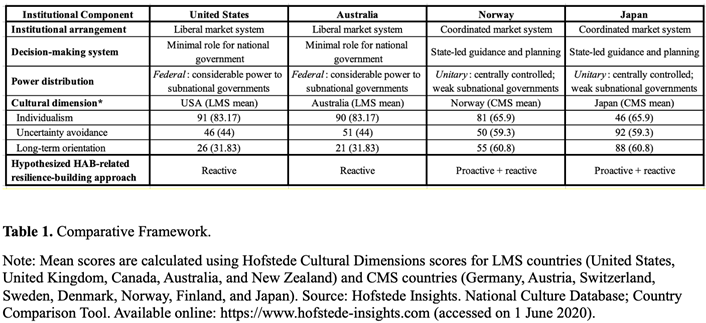
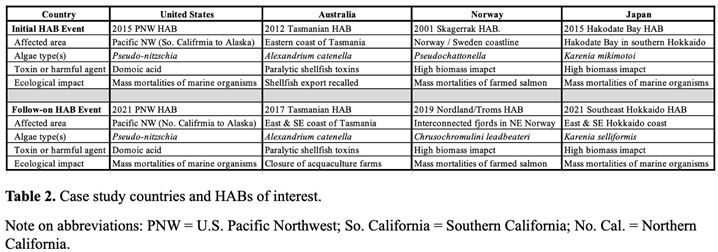
Disclaimer/Publisher’s Note: The statements, opinions and data contained in all publications are solely those of the individual author(s) and contributor(s) and not of MDPI and/or the editor(s). MDPI and/or the editor(s) disclaim responsibility for any injury to people or property resulting from any ideas, methods, instructions or products referred to in the content. |
© 2026 by the authors. Licensee MDPI, Basel, Switzerland. This article is an open access article distributed under the terms and conditions of the Creative Commons Attribution (CC BY) license (http://creativecommons.org/licenses/by/4.0/).
Copyright: This open access article is published under a Creative Commons CC BY 4.0 license, which permit the free download, distribution, and reuse, provided that the author and preprint are cited in any reuse.


