

Submitted:
25 May 2026
Posted:
26 May 2026
You are already at the latest version
Abstract
This article examines the strategic intersection between agricultural heritage conservation and sustainable rural development by analyzing the Serra da Canastra cheese-producing microregion in Minas Gerais, Brazil. Following the historic inclusion of Artisanal Minas Cheese on UNESCO’s Intangible Cultural Heritage of Humanity list in late 2024, a significant structural disconnect persists between the product’s elevated global cultural reputation and the localized economic returns realized by traditional family farms. Utilizing a comparative mixed-methods approach, this study evaluates institutional frameworks, policy documents, and territorial data against the benchmark model of Italy’s Parmigiano Reggiano region. The findings indicate that international heritage designations do not automatically yield regional economic resilience; rather, symbolic value must be actively converted through coordinated multilevel governance. To capture sustainable growth, Brazilian stakeholders must transition from formal Geographical Indication (GI) compliance to an integrated system of experiential agri-tourism routes, strict collective quality enforcement via producer consortia, and landscape-driven narrative marketing. This paper contributes a transferable, transnational framework for policymakers and rural sociologists seeking to leverage cultural heritage assets as drivers of sustainable territorial development and economic diversification.
Keywords:
artisanal cheese
; heritage economics
; geographical indication
; rural tourism
; sustainable development
1. Introduction
The globalization of food systems has catalyzed a powerful counter-trend prioritizing authenticity, localized traditions, and territorial identity. Within this landscape, heritage food products have emerged as vital economic and cultural resources for rural territories. The Italian Parmigiano Reggiano region serves as a premier global benchmark for this phenomenon, demonstrating how strict designation of origin legislation, robust cooperative governance, and integrated landscape preservation can successfully transform an artisanal craft into a highly resilient, multi-billion-euro economy. By embedding traditional production methods within a broader regional ecosystem of agri-tourism and institutional protection, the Emilia-Romagna region has effectively leveraged its culinary legacy to stabilize rural populations and foster deep territorial pride.
In South America, Brazil’s Canastra Cheese (Queijo Canastra) represents a highly sophisticated parallel. Produced across the rugged, high-altitude savannas of the Cerrado biome in southwestern Minas Gerais, this traditional raw-milk cheese embodies a 250-year-old cultural lineage adapted from Portuguese colonial roots. It mirrors Parmigiano Reggiano in its artisanal essence, its reliance on localized microbial ecosystems (pingo), and its profound link to local identity. In December 2024, this cultural importance achieved ultimate global validation when UNESCO officially inscribed the traditional ways of making Artisan Minas Cheese onto the Representative List of the Intangible Cultural Heritage of Humanity. This milestone elevated Canastra Cheese from a prized regional specialty to an asset of universal cultural significance.
2. Problem Statement
Despite this unparalleled level of institutional and international recognition, a stark structural disconnect persists within the Canastra microregion. There remains a notable failure to systematically translate high cultural prestige and symbolic recognition into measurable, equitable economic security for the area’s predominantly family-run farms. While international designations like the 2024 UNESCO listing and the FAO-GIAHS status validate the historical legitimacy of the territory, the local dairy sector remains hindered by fragmented producer networks, inconsistent territorial branding, and a lack of structured cross-sector integration with the broader tourism economy.
Consequently, Canastra Cheese frequently functions as an isolated commodity sold in volatile niche markets rather than serving as the central anchor of a comprehensive, diversified territorial experience. Without a coordinated governance framework capable of operationalizing heritage values (similar to the models deployed in European GI territories) the region risks diluting its cultural assets without capturing the sustainable development spillovers necessary to ensure long-term community resilience and prevent rural exodus.
This paper argues that bridging this gap requires moving beyond mere symbolic preservation toward an active, institutional conversion of heritage value into structured territorial wealth.
3. Background Context
Following the European experience, particularly that of Parmigiano Reggiano, stakeholders in the Canastra region have begun to explore how institutional frameworks, geographic indication, and community-based promotion may stimulate local development. While legislative changes and heritage status have positioned Canastra cheese for growth, fragmentation in producer organizations and limited policy alignment continue to challenge its trajectory.
4. Research Questions and Objectives
This work asks: what lessons from Parmigiano Reggiano’s development can serve as strategies for enhancing the heritage value and economic potential of Canastra Cheese?
The objective is to compare the historical development and governance structures of Parmigiano Reggiano and Canastra cheese. In addition, analyze successes and challenges in translating heritage status into economic gains and attempting to identify strategies for building cooperation between branding, rural tourism, and economic development in the Canastra region.
5. Methodological Approach
This article applied a mixed methods approach to understanding Canastra Cheese as a heritage product and its possible impacts on regional economic development and tourism. The paper is guided by two principal methodological supports: a case study and content analysis. The strategy of examining Parmigiano Reggiano as a case study exposes how regional policies have influenced its production and contributed to increasing its reputation. This perspective considers not just the economic side, but also the broader social and cultural factors at play. It offers a way to look at the legacy and meaning of these cheeses and compare the challenges faced in safeguarding traditional craft methods, as it can be helpful for both historically and in current times, Parmigiano Reggiano and Canastra Cheese.
In addition to the case study, this paper operated on a content analysis on relevant policy documents, tourism promotion materials, and market reports related to Canastra Cheese and the wider region to identify trends, policy priorities, and the main strategies for heritage preservation and economic promotion.
Quantitative data from economic studies, official statistics, and regional tourism trends are integrated to triangulate results and assess the broader effects of heritage cheese production on local development. Combining these methodological approaches, the study achieves both analytical depth and scope, strengthening the reliability of its conclusions and providing solid evidence to guide policy and stakeholder strategies in heritage-driven regional development.
6. Canastra Cheese
Queijo Canastra or Canastra Cheese (CC) is a Brazilian traditional cheese produced in the Serra da Canastra highlands, a type of Artisan Minas Cheese (AMC). It embodies the cooperation between cultural practices and landscape heritage. Originating centuries ago, during Brazil’s colonial period, this cheese has evolved as a culinary icon and an emblem of local identity embedded in its unique ecological context. The Serra da Canastra region’s alpine-like climate, defined by elevated altitude, native flora, and distinctive geology, forms an essential natural foundation for the cheese’s production and characteristics.
Serra da Canastra, located in southwestern Minas Gerais state, is renowned for its rugged plateaus, dramatic cliffs, and the birthplace of the São Francisco River (CONFESSOR et al., 2024; CARMO et al., 2016). Contrary to the common misconception among many foreign visitors that it resembles a lush tropical rainforest, Serra da Canastra is characterized primarily by the Cerrado biome—a tropical savanna featuring grasslands, rocky outcrops, small trees adapted to drought, and vast open fields, not dense jungle foliage (CONFESSOR et al., 2024; RIOS et al., 2024; PINTO et al., 2024). Its unique landscape and high altitudes give rise to endemic wildlife and panoramic vistas, distinctly different from the Amazon or other famous rainforests in Brazil (CARMO et al., 2016; RIOS et al., 2024).
6.1. Origins
Like other types of AMC, Canastra Cheese (CC) emerged from Portuguese settlers’ cheesemaking traditions, adapted to Minas Gerais’s local environmental conditions and socio-economic needs. The tropeiros, cattle drovers facilitating transport during the colonial gold rush, played a vital role in popularizing the cheese across rural communities. This 200+-year trajectory underscores CC as an agricultural and cultural heritage, encompassing traditional knowledge, artisanal skills, and the socio-ecological relationship between people and landscape.
CC originated in the Serra da Canastra during the late eighteenth century, parallel to the arrival of settlers and the expansion of cattle raising in Brazil. Historical and scholarly evidence confirms that Canastra cheesemaking began in the 1700s, giving the cheese a documented legacy of approximately 250 years, contrary to some popular or commercial claims of a 300-year history (PACIULLI, et al. 2024).
Early producers adapted Portuguese cheese-making techniques with raw cow’s milk. They developed a distinctive local practice by using wild microbial cultures (“pingo”) and maturing cheese wheels on wooden boards, a tradition that persists among the region’s predominantly family-run farms. Over generations, CC evolved into a unique food symbol, valued for its connection to local landscapes and communities (BASTOS; CONSONI; MESQUITA, 2024); PINEDA et al., 2021). Affirming its cultural and artisanal importance, CC was designated as Brazilian Intangible Cultural Heritage by IPHAN in 2008 and granted Geographical Indication status in 2012, formalizing its historical ties to place and method. (INSTITUTO DO PATRIMÔNIO HISTÓRICO E ARTÍSTICO NACIONAL, 2014). Today, CC continues to express this centuries-old tradition, blending deeply rooted practices with ongoing adaptation and innovation.
6.2. Alpine-like Climate and Production
The similarity between Alpine-like terroir and CC production emerges from the influence of altitude, climate, native pastures, and centuries-old artisanal methods that shape local cheese identity in both contexts. Many Alpine cheeses, including those from regions such as Savoie and Tyrol, are traditionally produced from raw cow’s milk obtained from animals grazing on botanically diverse mountain pastures, and this grazing system has been shown to influence milk composition and to contribute distinctive flavors, aromas and colors associated with the cheeses’ terroir. Likewise, Canastra cheese from Brazil is produced in a high-altitude tropical region, where native and cultivated grasses impart volatile compounds—such as α-pinene and caryophyllene oxide—closely linked to plant markers also typical of Alpine terroirs, resulting in distinctive sensorial profiles (DÁRGERE et al., 2023).
Alpine and Canastra cheeses rely heavily on traditional techniques: the use of raw milk, minimal technological intervention, and preservation of local microbial communities vital to cheese maturation and complexity (PINEDA et al., 2021). Allowing ripening molds or yeasts to develop naturally, as seen in some contemporary Canastra producers, further aligns this Brazilian cheese with European Alpine traditions (MARTIN et al., 2023). In Canastra, as in Alpine regions, seasonality, pasture composition, and producer expertise contribute to subtle but meaningful variations in cheese, reinforcing the product’s deep connection to its landscape and local culture (BASTOS; CONSONI; MESQUITA, 2024; DÁRGERE et al., 2023).
This correspondence validates that Serra da Canastra embodies an “Alpine-like” terroir, where environmental and human factors synchronize to create cheeses that reflect tradition and place.
6.3. Terroir Milk
“Terroir milk” refers to milk whose organoleptic and compositional qualities are shaped by a complex interplay of local biophysical and cultural factors, encompassing region-specific elements such as climate, soil, pasture flora, animal breeds, and traditional management practices. The concept of terroir, rooted in French tradition, denotes a geographically limited area where a human community cultivates distinctive practices and knowledges that interact with environmental conditions, resulting in products whose originality and reputation are intimately tied to their place of origin (CASABIANCA et al., 2005; BARHAM, 2003). Studies in scientific literature demonstrate that milk microbiota displays significant regional differentiation, with microbial communities and sensory profiles strongly influenced by geographical provenance and local know-how (IRLINGER et al., 2024). Thus, terroir milk embodies the expression of landscape, human intervention, and heritage in a tangible, biochemical form.
This concept is exemplified by Minas artisanal cheeses from Brazil, particularly CC, which is produced exclusively within the Serra da Canastra microregion using raw milk from cattle grazing on native and cultivated pastures unique to the area. The specific environmental conditions—altitude, climate, soil, and local flora—combined with locally inherited techniques, define the cheese’s texture, flavor, and microbiological profile, marking it as a product of its terroir. Official recognition via Geographical Indication (GI) has enshrined CC as a unique regional specialty, whose distinctiveness and quality depend crucially on the terroir milk that forms its raw material (BASTOS; CONSONI; MESQUITA, 2024; APROCAN, 2011). As such, CC illustrates how the terroir concept is operationalized in Brazilian dairy systems, linking the origins of milk to cultural identity and product excellence.
6.4. Recognition
In 2008, Brazil’s National Institute of Historic and Artistic Heritage (IPHAN) recognized CC as an intangible cultural heritage, acknowledging its artisanal production and cultural significance. More recently, the Serra da Canastra region has been acknowledged under the FAO’s Globally Important Agricultural Heritage Systems (GIAHS) program, further emphasizing the interplay between agriculture, biodiversity, and cultural practices. These designations underscore a framework for safeguarding tangible and intangible heritage associated with CC and its landscape.
In December 2024, UNESCO included Minas Cheese in the Intangible Cultural Heritage of Humanity, honoring over three centuries of family-driven, rural cheesemaking tradition. The listing highlights the use of raw milk, local natural yeasts, and know-how handed down through generations. This acknowledgment reinforces the cheese’s cultural and economic significance, sustaining thousands of rural households and promoting sustainable regional development. It is also anticipated to enhance Minas cheese’s global visibility and encourage continued preservation of its artisanal heritage (AGÊNCIA BRASIL, 2024; BRAZILIAN FARMERS, 2025).
7. Case Study: Parmigiano Reggiano (Italy)
The proposed case study for Minas Gerais CC is the model of Italy’s Parmigiano Reggiano cheese region, which combines heritage conservation with rural economic development. The Emilia-Romagna region has leveraged its cheese heritage through:
- Geographic Indication (GI) certification warranting product authenticity.
- Integrated landscape and heritage conservation programs.
- Development of agritourism and culinary tourism routes.
- Local cooperative models empowering small-scale producers.
- Strong institutional support combining regional, national, and EU-level frameworks.
These strategies have enhanced local economies, sustained rural populations, and promoted cultural pride while protecting natural and cultural landscapes.
The case of Emilia-Romagna’s Parmigiano Reggiano region exemplifies how integrated heritage and rural development strategies create substantial economic and social benefits. Following the adoption of Geographic Indication (GI) certification, the region saw robust growth in the cheese sector and rural tourism. By 2024–2025, Parmigiano Reggiano achieved record-breaking revenues: €1.4 billion at production and €2.4 billion at final consumption, while exports surged past 40% of sales, with key foreign markets including France, the United States, Germany, and the United Kingdom. Exports grew by 5.5% year-over-year, while production reached 3.7 million wheels—a 6.6% increase over the prior two years (PARMIGIANO REGGIANO CONSORTIUM, 2025).
This economic expansion is directly connected to heritage-based strategies, such as GI enforcement, landscape conservation, collaborative rural cooperatives, and strong multilevel institutional support, including funding from national and European rural development policies. For instance, the Emilia-Romagna Rural Development Program (RDP) targeted more than €1.7 billion to competitive agriculture, environmental quality, and rural diversification - including €188 million dedicated to rural tourism and quality of life. These investments created 2,524 full-time jobs, an increase of 122,827 tourists in rural municipalities, and €108.8 million in additional economic growth during the RDP period (EUROPEAN COMMISSION, 2010).
Integrated heritage, landscape, tourism, and cooperative models have fostered rural economic resilience and helped maintain population stability in mountain cheese-producing areas (ARFINI et al., 2019; LOVARELLI et al., 2019). Small dairies increased profits through tourism-driven direct sales, farm visits, and local events, and the sector proved exceptionally resilient during periods of economic downturn, with innovative marketing and institutional collaboration supporting ongoing growth (MANCINI; ARFINI, 2018). Local pride and participatory governance have further contributed to sustaining the rural population and the integrity of cultural landscapes.
8. Heritage, Rural Tourism, and Economic Benefits
CC’s heritage status and distinctive landscape context provide a strong foundation for multifaceted rural tourism models interweaving gastronomy, cultural experience, and nature-based tourism. The Canastra microregion’s cheese production, deeply rooted in family farming and safeguarded as intangible cultural heritage, is linked to local identity and economic tradition, offering significant opportunities for diversification through visitor infrastructure, guided tours, and thematic festivals (MENESES, 2006; PINEDA et al., 2021; PACIULLI et al., 2024). Studies have shown that municipalities like São Roque and Medeiros benefit from a dynamic synergy between cheese innovation and tourism, with regular farm visits, cheese-tasting events, and eco-cultural trails driving not only added value for artisanal products but also generating local employment and enhancing community engagement (PACIULLI et al., 2024).
By mapping and demarcating the CC production sites, researchers highlight how tourism supports the emergence of new cheese varieties, elevates producer recognition, and encourages culinary innovation, thus differentiating products in niche markets (DUPIN, 2019; SILVA et al., 2021). Seasonal cheese fairs and gastronomic contests improve visibility, catalyze economic development, and foster knowledge exchange among producers and visitors (PACIULLI et al., 2024). Furthermore, these integrated models stimulate heritage conservation by aligning economic incentives with cultural preservation goals and reinforcing sustainable rural development (PENNA; GIGANTE; TODOROV, 2021). At last, the combination of unique terroir, family tradition, and proactive tourism infrastructure enhances Queijo Canastra’s global profile, advances rural economies, and ensures the safeguarding of heritage values for future generations (MENESES, 2006; PINEDA et al., 2021; PACIULLI et al., 2024).
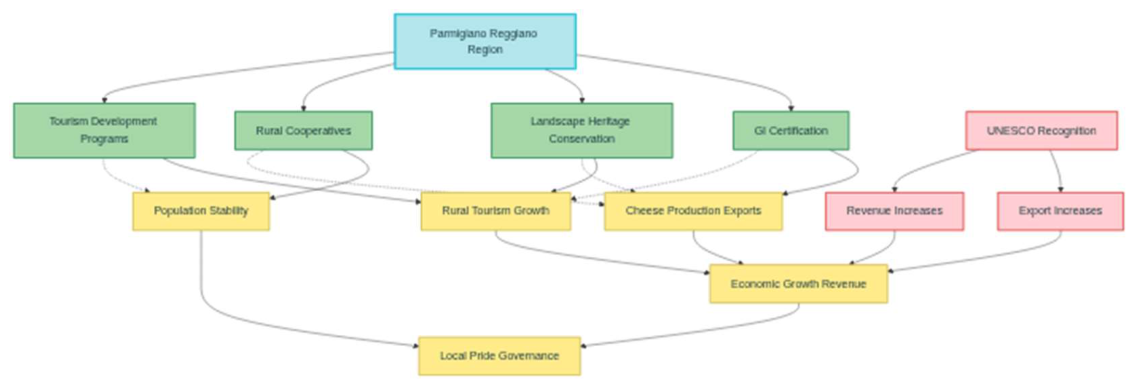
The following network diagram visualizes the connections between heritage-based strategies (such as GI certification, landscape conservation, rural cooperatives, and tourism development) and their direct influence on tourism growth, cheese production and sales, economic growth, local employment, population stability, and regional pride in the Parmigiano Reggiano region. Increases in exports and revenue post-UNESCO recognition are also illustrated as key outcomes.
Figure 1 shows Connections between heritage-based strategies, tourism growth, and economic outcomes in the Parmigiano Reggiano region. By the author, 2025.
The diagram of the Parmigiano Reggiano Region offers a model for regions with distinctive agricultural products to foster sustainable development through a combination of economic, social, and heritage-driven strategies. At its core, the model suggests that targeted initiatives like Tourism Development Programs and the strengthening of Rural Cooperatives stabilize population—counteracting rural exodus—and stimulate Rural Tourism Growth, providing additional income streams and enhancing community resilience.
Crucially, Landscape Heritage Conservation and the pursuit of Geographical Indication (GI) Certification protect the authenticity of local products and landscapes, bolstering exports and elevating the product’s reputation worldwide. The certification process functions as both a marketing tool and a preservation instrument, ensuring that traditional methods are maintained while adapting to market demands.
As the diagram demonstrates, these interconnected strategies lead to Cheese Production Exports, driving local and international demand. They reinforce a cycle where economic gains—evidenced through Export and Revenue Increases—are closely linked with Local Pride Governance and community empowerment. Such pride manifests in proactive local policies, further encouraging conservation and innovation.
Notably, the region’s comprehensive approach culminates in higher-tier recognition, such as UNESCO Recognition, a global endorsement of cultural heritage and production quality. This recognition can exponentially enhance marketing efforts, attract investment, and increase international tourism.
9. Discussion and Applied Implications
The comparative analysis developed in this article indicates that the economic success of heritage foods depends not only on symbolic recognition, but on the institutional and territorial mechanisms that translate recognition into coordinated development strategies. In the case of Parmigiano Reggiano, the interaction between geographical indication protection, cooperative governance, landscape valorization, and food tourism has produced a dense territorial system in which production, branding, and rural development reinforce one another. By contrast, Canastra Cheese already possesses strong historical legitimacy, a distinctive terroir, and important heritage recognitions, but these assets are not yet fully articulated through an equally consolidated governance and tourism framework.
This comparison helps clarify the article’s central argument: Canastra Cheese should not be understood only as an artisanal food product, but as a territorial heritage resource whose value emerges from the relationship between landscape, knowledge, institutions, and market organization. The evidence reviewed in the manuscript suggests that, in Serra da Canastra, the challenge is less one of cultural visibility than of institutional conversion—namely, converting symbolic prestige into stable economic gains for producers and into broader territorial spillovers such as tourism income, local employment, and community resilience. In this sense, the Parmigiano Reggiano case is analytically useful not because it offers a model to be copied mechanically, but because it demonstrates how heritage can become economically productive when embedded in coordinated multilevel governance.
A first implication concerns the role of geographical indication and territorial branding. The Canastra region has already advanced through heritage recognition and GI protection, yet the comparison with Emilia-Romagna shows that legal certification becomes more effective when accompanied by strict quality communication, collective enforcement, and a strong public narrative connecting the product to place. In practical terms, this means that Canastra Cheese branding should consistently foreground the Serra da Canastra landscape, artisanal know-how, raw milk practices, and the specificity of local pastures, thereby strengthening the association between authenticity and territory. Such an approach would help transform GI from a formal label into an active territorial development instrument.
A second implication concerns diversification and experiential tourism. The literature and policy material examined throughout the article show that food tourism in successful GI regions is not limited to product tasting; rather, it combines farm visits, production demonstrations, thematic itineraries, and links with broader cultural and environmental attractions. This is especially relevant for Serra da Canastra, where the dramatic Cerrado landscape, protected areas, rural traditions, and artisanal cheesemaking already provide the raw material for integrated tourism experiences. Farm-to-table visits, guided cheese-making demonstrations, tastings at production sites, and routes connecting cheese with local gastronomy, nature trails, and hospitality services would allow Canastra Cheese to function not simply as a product sold to visitors, but as the organizing element of a territorial experience.
The examples from Emilia-Romagna are especially useful when interpreted as applied implications rather than as a standalone concluding message. Farm-to-table tours in Parmigiano Reggiano territories demonstrate the value of making production processes visible to visitors, transforming trust, authenticity, and educational experience into market value. Thematic itineraries that connect dairies with vineyards, balsamic vinegar producers, historic villages, and local restaurants show how cross-sector coordination can lengthen visitor stays and increase spending across the territory. Likewise, the integration of gastronomy with nature and cultural tourism illustrates that heritage foods generate stronger development outcomes when embedded in regional storytelling rather than promoted in isolation.
Transferred to the Canastra context, these examples suggest that local development strategies should move toward stronger coordination among producers, tourism boards, municipalities, environmental actors, and hospitality businesses. The goal would not be to replicate Emilia-Romagna’s institutional landscape, but to build a Brazilian and regionally specific model in which cheese routes, festivals, interpretation centers, local museums, and landscape trails are organized around the singularity of the Canastra territory. This also implies a more active role for producer associations such as APROCAN in joint promotion, quality communication, and negotiation with public actors.
A third implication concerns innovation within tradition. The article has shown that Canastra Cheese derives much of its value from continuity in methods, microbial cultures, and local knowledge, yet contemporary rural development also requires adaptive strategies capable of reaching diverse consumers and visitors. The evidence on differentiated products, maturing styles, and heritage-based marketing suggests that innovation need not undermine authenticity; on the contrary, it can extend the commercial reach of artisanal production when anchored in territorial identity. Therefore, product diversification, curated tastings, educational branding, and selective partnerships with restaurants and specialty retailers should be framed as ways of amplifying the value of heritage rather than diluting it.
Finally, the discussion highlights the importance of collaborative governance. The Parmigiano Reggiano experience points to the relevance of institutions capable of aligning producer interests, tourism strategies, regulatory frameworks, and rural development policy. In Serra da Canastra, a more integrated governance arrangement could help reduce fragmentation, improve marketing coherence, and ensure that recognition by IPHAN, FAO-GIAHS, and UNESCO generates cumulative effects instead of remaining largely symbolic. From this perspective, the development potential of Canastra Cheese depends not only on the quality of the product itself, but on the capacity of territorial actors to construct collective strategies around heritage, landscape, and long-term rural sustainability.
10. Conclusion
This article examined what lessons from the historical development and governance of Parmigiano Reggiano can help explain and strengthen the heritage value and economic potential of Canastra Cheese. The analysis shows that Canastra already possesses the core attributes of a strong heritage product—territorial specificity, artisanal know-how, cultural recognition, and growing international visibility—but that these assets do not automatically generate broad rural development outcomes.
The comparison with Emilia-Romagna demonstrates that the decisive factor is not recognition alone, but the existence of coordinated systems linking geographical indication, collective organization, territorial branding, tourism development, and multilevel institutional support. In Serra da Canastra, the main challenge therefore lies in converting symbolic heritage value into stable material benefits for producers and the wider territory.
The article contributes to the field by showing that heritage foods should be analysed not only as market products, but also as landscape-based territorial resources shaped by governance, identity, and rural development strategies. In this sense, the Canastra case broadens debates on terroir, geographical indications, and heritage by highlighting how recognition frameworks such as IPHAN, GI, FAO-GIAHS, and UNESCO can create opportunities, but only when supported by collective action and institutional coordination.
Some limitations should be acknowledged. The study relies mainly on secondary sources, policy documents, and comparative interpretation, which means that the perspectives of producers, residents, and visitors were not explored through primary fieldwork in a systematic way. In addition, the available socioeconomic and tourism data for Serra da Canastra remain more limited than those available for the Parmigiano Reggiano region, which constrains direct comparison.
Future research could address these limits through interviews, surveys, and longitudinal analysis of tourism, income, and governance change in the Canastra territory. Comparative work with other Brazilian geographical indications would also help clarify which elements of the Italian experience are most transferable and which must be adapted to specific regional contexts.
References
- BRASIL, A.G.Ê.N.C.I.A. UNESCO recognizes Artisanal Minas cheese as intangible heritage. 2024. Available online: https://agenciabrasil.ebc.com.br/en/cultura/noticia/2024-12/unesco-recognizes-artisanal-minas-cheese-intangible-heritage.
- APROCAN - ASSOCIAÇÃO DOS PRODUTORES DE QUEIJO DA CANASTRA. Nota da Aprocan sobre certificação de registro de indicação geográfica. 25 nov 2025. Available online: https://sertaobras.org.br/nota-da-aprocan-sobre-certificao-de-registro-de-indicao-geogrfica/.
- ARFINI, F.; ANTONIOLI, F.; COZZI, E.; DONATI, M.; GUARESCHI, M.; MANCINI, M. C.; VENEZIANI, M. Sustainability, Innovation and Rural Development: The Case of Parmigiano-Reggiano PDO, 2019. Sustainability Acesso em. 2025, 11(18), 4978. [Google Scholar] [CrossRef]
- BARHAM, Elizabeth. Translating terroir: the global challenge of French AOC labeling. J. Rural Stud. Disponível em. 2003, v. 19(n. 1), 127–138. [Google Scholar] [CrossRef]
- BASTOS, Letícia Silva; CONSONI, Flávia Luciane; MESQUITA, Fernando Campos. Growth and productive sophistication of Minas Artisanal Cheese from Canastra: an analysis based on innovative processes in natural resources. Soc. Nat. [S. l.] 2024, v. 36(n. 1). Available online: https://seer.ufu.br/index.php/sociedadenatureza/article/view/69754. [CrossRef]
- BRAZILIAN FARMERS. Brazilian Minas Artisanal Cheese recognized as Intangible Cultural Heritage by UNESCO. 19 mar 2025. Available online: https://www.brazilianfarmers.com/news/brazilian-minas-artisanal-cheese-recognized-as-intangible-cultural-heritage-by-unesco/.
- CARMO, D. M.; et al. Survey of bryophytes in Serra da Canastra National Park, southwestern Minas Gerais, Brazil. Acta Botan. Bras. 2016, v. 30(n. 2). Available online: https://www.scielo.br/j/abb/a/YkvrWQZWXWcG3XzQHcq6xGj/?lang=en.
- CASABIANCA, F.; et al. Terroir et typicité: deux concepts-clés des Appellations d’origine contrôlée. Essai de définitions scientifiques et opérationnelles. Symposium international Territoires et enjeux du développement régional, Lyon, PSDR, 9–11 mar. 2005; Comunicação. [Google Scholar]
- CONFESSOR, H. S. R.; et al. Hydraulic soil dynamics of the sparse Cerrado physiognomy in Chapadão do Diamante – Serra da Canastra (MG). Mercat. Fortaleza 2024, v. 23, e23006. [Google Scholar] [CrossRef]
- 2025. [CrossRef]
- DÁRGERE, A. F.; et al. Characterization of the volatile compound profile of artisanal cheeses from Minas Gerais, Brazil, reveals plant markers typical of Alpine terroirs. FST J. 2023, v. 9(n. 2), 157–167. Available online: https://fstjournal.com.br/revista/article/view/197.
- DUPIN, L. V. A vida dos queijos mineiros: uma etnografia multiespécie. Tese (Doutorado em Ciências Sociais) – Instituto de Filosofia e Ciências Humanas, Universidade Estadual de Campinas, 2019. Available online: https://bdtd.ibict.br/vufind/Record/UNICAMP-30_7f4e1b7aba691526071f14437b88e243.
- EUROPEAN COMMISSION. Rural Development Programme (RDP) of Emilia Romagna, Italy. Brussels, 2010. [Google Scholar]
- INSTITUTO DO PATRIMÔNIO HISTÓRICO E ARTÍSTICO NACIONAL. Modo artesanal de fazer queijo de Minas: Serro, Serra da Canastra e Serra do Salitre (Alto Paranaíba). Brasília: Iphan, 2014. 140 p. (Dossiê Iphan, 11). 2026. Available online: https://bibliotecadigital.iphan.gov.br/items/7cca1dab-b72b-447b-8cbb-3bb893a4215f.
- IRLINGER, F.; et al. A comprehensive, large-scale analysis of “terroir” cheese and milk microbiota reveals profiles strongly shaped by both geographical and human factors. ISME Commun. Acesso em. 2024, v. 4(n. 1), ycae095. [Google Scholar] [CrossRef] [PubMed]
- LOVARELLI, D.; et al. Improvements to dairy farms for environmental sustainability in Grana Padano and Parmigiano Reggiano production systems. Ital. J. Anim. Sci. [S.l.] 2019, v. 18(n. 1), 1035–1048. [Google Scholar] [CrossRef]
- MANCINI, M. C.; ARFINI, F. Direct-to-consumer strategies in the Parmigiano Reggiano supply chain. 2018. Available online: http://ruralager.org/wp-content/uploads/10_4422ager_2018_11_Mancini-et-al.pdf.
- MARTIN, J. G. P.; et al. Seasonal variation in the Canastra cheese mycobiota. Front. Microbiol. 2023, v. 13, 1076672. Available online: https://www.frontiersin.org/journals/microbiology/articles/10.3389/fmicb.2022.1076672/full. [CrossRef] [PubMed]
- MENESES, J. N. C. Queijo Artesanal de Minas: Patrimônio cultural do Brasil: Dossiê interpretativo. Instituto do Patrimônio Histórico e Artístico Nacional. 2006. Available online: http://portal.iphan.gov.br/uploads/ckfinder/arquivos/Dossie_modo_fazer_queijo_minas.pdf.
- PACIULLI, S. O. D.; et al. Geographical demarcation of the manufacturing territory of artisanal Minas cheeses of the Canastra microregion. Braz. J. Food Technol. 2024, v. 27, e2023125. Available online: https://www.scielo.br/j/bjft/a/QNpCPLF6vwHyDjnd4M6QR9z/.
- PARMIGIANO REGGIANO CONSORTIUM. Parmigiano Reggiano: All-time high revenue, exports soar. 15 set. 2025. Available online: https://www.parmigianoreggiano.com/en-US/news/parmigiano-reggiano-all-time-high-revenue-exports-soar.
- PENNA, A. L. B.; GIGANTE, M. L.; TODOROV, S. D. Artisanal Brazilian cheeses – history, marketing, technological and microbiological aspects. Foods, [S.l.] 2021, v. 10(n. 7), 1562. [Google Scholar] [CrossRef] [PubMed]
- PINEDA, A. P. A.; CAMPOS, G. Z.; PIMENTEL-FILHO, N. J.; GOMBOSSY DE MELO FRANCO, B. D.; PINTO, U. M. Brazilian artisanal cheeses: Diversity, microbiological safety, and challenges for the sector. Front. Microbiol. Acesso em. 2021, v. 12, 666922. [Google Scholar] [CrossRef] [PubMed]
- PINTO, G. S.; et al. Assessment of active fire detection in Serra da Canastra using VIIRS sensors. ISPRS Archives XLVIII-3-2024, p. 407–414, 2024. 25 nov 2025. Available online: https://isprs-archives.copernicus.org/articles/XLVIII-3-2024/407/2024/isprs-archives-XLVIII-3-2024-407-2024.pdf.
- RIOS, G. S.; SANTANA, D. B.; LENSE, G. H.; RUBIRA, F. G.; AYER, J. E.; MINCATO, R. L. Serra da Canastra National Park: Influence of forest fires on the RUSLE C factor and its impact on water erosion. Not. Bot. Horti Agrobot. Cluj.-Napoca [S. l.] 2024, v. 52(n. 1), 13577. Available online: https://www.notulaebotanicae.ro/index.php/nbha/article/view/13577. [CrossRef]
- SILVA, M. T.; SILVA, A. H. D.; PACIULLI, S. O. D.; ORTIZ, G. P. T.; SILVA, V. A. Identificação das vertentes do tradicional queijo minas artesanal da canastra: descritores físicos, sensoriais, históricos e econômicos. 2021. Available online: https://www.ifmg.edu.br/sic/edicoes-anteriores/resumos-2021/ciencias-agrarias/identificacao-das-vertentes-do-tradicional-queijo-.
Figure 1.
Connections between heritage-based strategies, tourism growth, and economic outcomes in the Parmigiano Reggiano region.
Figure 1.
Connections between heritage-based strategies, tourism growth, and economic outcomes in the Parmigiano Reggiano region.
Disclaimer/Publisher’s Note: The statements, opinions and data contained in all publications are solely those of the individual author(s) and contributor(s) and not of MDPI and/or the editor(s). MDPI and/or the editor(s) disclaim responsibility for any injury to people or property resulting from any ideas, methods, instructions or products referred to in the content. |
© 2026 by the authors. Licensee MDPI, Basel, Switzerland. This article is an open access article distributed under the terms and conditions of the Creative Commons Attribution (CC BY) license (http://creativecommons.org/licenses/by/4.0/).
Copyright: This open access article is published under a Creative Commons CC BY 4.0 license, which permit the free download, distribution, and reuse, provided that the author and preprint are cited in any reuse.


