
Submitted:
24 May 2026
Posted:
26 May 2026
You are already at the latest version
Abstract
In the present study, rapid, robust and reproducible reverse phase high performance liquid chromatographic (RP-HPLC) method has been developed and validated for simultaneous determination of avobenzone and octocrylene in bulk and sunscreen formulation. The separation was done at a flow rate of 1.0 mL/min on a Symmetry C18 (4.6 × 250 mm, 5 μm) column at 5% water and 95% methanol as mobile phase and at the detection wavelength of 256 nm. Under the optimal chromatographic conditions, octocrylene and avobenzone were eluted at 4.0 and 6.6 min, respectively, with good peak symmetry and resolution. The developed method was validated as per the criteria mentioned in ICH Q2 (R1) such as System suitability, Specificity, Linearity, Precision, Accuracy, Sensitivity, Robustness, Ruggedness and Solution stability. The method showed a good linear range of 10–50 μg/mL with correlation coefficient of 0.9979 for octocrylene and 0.9976 for avobenzone. The %RSD for the precision studies were < 2%, which represents good intermediate and repeatability precision. The percentage recoveries were within the acceptable limits of the analysis and acceptable accuracy was achieved in the recovery studies. An equivalent method was also proved to be robust for intentional changes of the chromatograph conditions. Furthermore, the validated method could be used with nanosponge-loaded sunscreen lotion formulations and there was no interference of the excipients. The proposed RP-HPLC method is easy, economical, sensitive and can be applied in the routine quality control analysis of avobenzone and octocrylene in pharmaceutical and cosmetic formulations.
Keywords:
avobenzone
; octocrylene
; nanosponge
; RP-HPLC
; sunscreen
1. Introduction
Analysis of active ingredients in drug and cosmetic products is indispensable to guarantee the quality, safety, efficacy and regulatory compliance of the products [1]. The need for this is particularly critical for formulations that contain sun protection ingredients, where the effectiveness of the sun protection filters in the product is directly proportional to their uniformity, stability and concentration. When an agent is not correctly determined, sunscreens may not be effective in protecting the wearer from the sun, be chemically unstable, or be ineffective at their therapeutic or cosmetic action [2]. Hence, analytical tools which can simultaneously determine a number of UV filters are essential in the pharmaceutical and cosmetic quality control laboratories [3].
Among the various chemicals used as organic UV filters, avobenzone and octocrylene are widely found in sunscreen products because they have complementary photoprotective and synergistic stabilising properties. Derivatives of dibenzoylmethane are used as UVA absorbers, and avobenzone (butyl methoxydibenzoylmethane) has a high absorbance in the UVA wavelength range (320–400 nm). Its molecular formula is C20H22O3, and its molecular weight is ~310.39 g/mol. Avobenzone comprises conjugated aromatic rings and a β-diketone functional group, which can undergo keto–enol tautomerism, and is expected to exert a significant effect on the physicochemical and chromatographic properties of the drug. The compound is extremely lipophilic, with a reported logP of ~5.1 and extremely low aqueous solubility, which favours partitioning to organic phases. Moreover, avobenzone is weakly acidic (pKa ~ 9.8) and should therefore be partially ionised under normal reversed-phase chromatographic conditions [4,5].
Although avobenzone is a good absorber of UVA, it photodegrades extensively upon exposure to UV radiation, resulting in a decrease in its photoprotective efficacy and the formation of degradation products [6]. Avobenzone undergoes significant loss of photoprotection after long-term exposure to UV radiation because of structural instability resulting from keto–enol tautomerism and cleavage reactions. Therefore, formulations that include avobenzone often contain stabilising agents to improve the stability of avobenzone and maintain the performance of the sunscreen [7].
Sunscreen products contain many UVB filters and photostabilizing agents, such as octocrylene. The chemical formula for octocrylene is C24H27NO2, with a molecular weight of approximately 361–362 g/mol. Similar to avobenzone, octocrylene is highly lipophilic and almost non-polar in water and is strongly attracted to non-polar solvents and hydrophobic stationary phases. The remarkable solvent compatibility and UV-stabilizing properties of octocrylene are often used in sun care products in combination with avobenzone, which also has a broad spectrum of UV protection, to enhance formulation stability and extend UV protection. In addition to functioning as a UVB absorber, octocrylene acts as a stabiliser for photolabile UV filters and contributes to the enhancement of the sun protection factor (SPF) of formulations [8,9].
The analysis of avobenzone and octocrylene, both individually and in combination, is difficult because of their high lipophilicity and poor water solubility, as well as their strong interactions with hydrophobic stationary phases. Many compounds having logP values greater than 5 have large retention times and often show large, asymmetric, and co-eluted peaks on conventional RP chromatographic systems. In addition, avobenzone can exhibit a keto-enol tautomerism that can also influence the chromatographic behaviour of the molecule, such as peak shape, altering the polarity of the molecule during the analytical process [10]. The physicochemical properties must be carefully optimized by a mixture of the mobile phase, ratio of organic solvents, flow rate and selection of stationary phase so as to get satisfactory chromatographic separation and reproducibility [11].
The influence of analytical complexity is more marked in formulations which include all the aforementioned ingredients and both compounds. These excipients can affect separation in the chromatography column and the response of the detector, which can impact quantitative accuracy. In addition, there may be some interference in the UV absorption spectra of the agents in sunscreens when analysed at inappropriate analytical wavelengths. To this end, it is important to have a selective and powerful chromatographic method to resolve the two analytes with almost no interference [12].
HPLC, especially reversed-phase HPLC (RP-HPLC), is one of the most commonly used analytical methods for the simultaneous determination of sunscreen agents of interest owing to its high sensitivity, reproducibility, selectivity, and suitability for complex pharmaceutical and cosmetic formulations. Various analytical methods have been reported for the simultaneous estimation of avobenzone, octocrylene, oxybenzone, octinoxate, and other sun protection agents using RP-HPLC systems with UV or photodiode array (PDA) detectors. Most reported methods use C18 stationary phases and mobile phases with high organic content to separate highly lipophilic analytes [13].
The previously reported analytical methods shows that there are some limitations. Numerous methods are based on gradient elution, which involves long equilibration times, large amounts of solvent, complicated mobile phase programming, and long chromatographic run times. In some reported studies, it takes > 15–20 min to analyse a sample, resulting in lower analytical throughput and high operational costs. Furthermore, certain analytical procedures employ a ternary solvent system or mobile phases with buffers, making routine chromatography more complex and/or reducing column life. The use of gradient methods is more flexible in separation, but often more complex and the use of solvents makes their application difficult in routine quality control laboratories.
The other shortcoming of the methods reported by previous studies is that they have not been fully analytically validated. There are several studies that deal primarily with linearity and assay determination, with less robustness, ruggedness and solution stability analysis. Validation of chromatographic methods for routine pharmaceutical analysis should be performed in compliance with the International Council of Harmonisation (ICH) Q2 (R1) guidelines and should be as comprehensive as possible for reliability and reproducibility. Robustness studies are particularly important when the compound is highly lipophilic because the chromatographic conditions, such as flow rate, solvent composition and column performance, can have a dramatic impact on the retention time of the compound [14].
Avobenzone and octocrylene were found to be highly retained in the stationary phase and yielded highly skewed peaks, suggesting high organic mobile phase composition for the best chromatographic results. Similarly, if the analyte is not very soluble in water, a sufficient quantity of an appropriate organic solvent should be used in the sample preparation to ensure the extraction and analytical response. In addition, the appropriate selection of the wavelength is crucial to achieve good sensitivity for the concurrent determination of both analytes and reduce baseline interference from formulation excipients.
In recent years the interest in simplified and inexpensive analytical process that can be applied to routine industrial analysis has been growing. An isocratic RP-HPLC method is generally preferred over gradient RP-HPLC because it is easier to use, less time consuming for system equilibration, more reproducible, uses less solvent and is less cumbersome to run routinely. But quantitative simultaneous analysis of isocratic chromatography is analytically complex and difficult, because of the difference of retention behaviour and the strength of the hydrophobic interaction of highly lipophilic sunscreen agents [15].
In the present work, the objective was to develop and validate a rapid, robust, and reproducible isocratic RP-HPLC method for the simultaneous estimation of Av and Oct in bulk and Av loaded nanosponge sunscreen formulation due to these analytical challenges and formulation difficulties. The chromatographic method was optimised systematically to obtain efficient chromatographic separation with peak symmetry, theoretical plate count and resolution within a short analysis time by varying the stationary phase, composition of mobile phase, flow rate and detection wavelength. The developed methodology was also fully validated according to the guidelines of the ICH Q2(R1) on system suitability, specificity, linearity, precision, accuracy, sensitivity, robustness, ruggedness and solution stability. Validation method was also tested for validation of its suitability for formulation matrix assay estimation to establish its applicability for routine quality control analysis of pharmaceutical and cosmetic formulation.
2. Experimental
2.1. Instrumentation
The Waters Alliance HPLC system included a Waters 2695 quaternary HPLC pump, autosampler, and Waters 2996 photodiode array (PDA) detector, and was connected to the Waters Empower 3 software for chromatographic data analysis, used to measure the concentration of avobenzone and octocrylene simultaneously. The stationary phase for separation was a Symmetry C18 analytical column (4.6 mm × 250 mm, 5 μm particle size). Good resolution, peak symmetry, and reproducibility of both compounds were observed in the C18 column, which is appropriate for lipophilic compounds. First, a UV-1700 spectrophotometre (Shimadzu, Japan) was used to scan the analytes in the UV range before the chromatographic separation process to determine the optimal detection wavelength.
2.2. Pure Sample and Solvent
Pure samples of avobenzone and octocrylene were received as free gifts from Aurochem Pharmaceuticals India Pvt. Ltd., Palghar, India. Methanol and acetonitrile (HPLC grade) were obtained from Sigma Aldrich (Bengaluru, India). All analyses were performed using deionised Milli-Q water. All solvents used in the chromatographic study were filtered through a 0.45-μm membrane and degassed.
2.3. Standard Solution
Avobenzone and octocrylene stock solutions (1000 μg/mL) were dissolved in methanol and stored at 2–8 °C before preparing the working standards (100 μg/mL) in the mobile phase. The solutions used for the linearity assessment were prepared from the working standard and analysed at concentrations of 10, 20, 30, 40, and 50 μg/mL.
2.4. Optimization of Chromatographic Conditions
Optimisation of chromatographic conditions was conducted at room temperature using a Symmetry C18 column. Column chemistry, mobile phase composition, flow rate, and column temperature were varied to obtain the best separation and peak quality to explore various chromatographic conditions. Several methanol-to-water ratios were used as mobile phases, and the 95:05 (v/v) ratio afforded the best results. The mobile phase was filtered through a nylon membrane (0.45 μm) and sonicated for 10 min prior to use. To guarantee good separation and resolution of the analytes, an isocratic flow of 1.0 mL per min was established. The column oven and sample cooler were maintained at ambient temperature. Detection was conducted at a wavelength of 256 nm, and the injection volume was 20 μL. The retention times, peak symmetry, theoretical plate numbers and resolution were good for simultaneous quantification of avobenzone with octocrylene [11,16,17].
2.5. Validation of Chromatographic Conditions
2.5.1. System Suitability
Optimised chromatographic conditions were used for system suitability testing by analysing a standard solution containing 100 μg/mL of avobenzone and octocrylene. The performance of the chromatographic system was evaluated with six replicate injections after a diluent blank. Important parameters, including retention time, peak symmetry, theoretical plate count, resolution, and %RSD of peak area, were investigated. The method was determined to be suitable for routine analysis, with all parameters within acceptable limits, as per USP general chapter <621>.
2.5.2. Specificity and Selectivity
To verify that there was no interference from the developed RP-HPLC method for blank or other formulation components at the retention time of avobenzone and octocrylene, specificity and selectivity were evaluated. The tests included blank and individual solutions of each of the analytes, as well as combined standards under optimal chromatographic conditions. The chromatograms yielded good peak for both analytes, and no blank interference peaks at the same retention time. Moreover, peak purity analysis using PDA detector was conducted, to illustrate the simultaneous accurate and selective estimation of both avobenzone and octocrylene.
2.5.3. Sensitivity
Optimised chromatographic conditions were used to determine the limit of detection (LOD) and limit of quantification (LOQ) values of the developed method for avobenzone and octocrylene. LOQ is the lowest concentration at which the amount of analyte can be determined with acceptable accuracy and precision, and LOD is the lowest concentration at which the analyte can be detected. These are the LOD and LOQ values, which were computed in accordance with ICH guidelines from the signal-to-noise ratio and chromatographic responses at lower concentrations of the analyte.
2.5.4. Linearity and Range
The linearity of the developed RP-HPLC method was evaluated by preparing the standard solutions of avobenzone and octocrylene in the range of 10–50 μg/mL. The solutions were analysed under optimised chromatographic conditions, and calibration curves were prepared by plotting the peak area versus the concentration of the solutions. Linear regression analysis was carried out to calculate the regression equations and correlation coefficients. The overall method demonstrated good linearity for both analytes over the range of concentrations studied.
2.5.5. Accuracy
The method developed was tested for accuracy using recovery studies at three concentration levels (low, intermediate, and high: 80%, 100%, and 120%). Triplicate analysis of sample solutions at these levels was conducted under optimised chromatographic conditions, and the percentage recovery was calculated for each analyte. The recovery data and %RSD values were in good agreement, revealing the precision and accuracy of the proposed RP-HPLC method for the simultaneous detection of avobenzone and octocrylene.
2.5.6. Precision
Repeatability and intermediate precision were used to test the precision of the developed method. The precision of method was evaluated by carrying out six replicate injections of the sample solution at 100% level of test concentration, under optimum chromatographic conditions and calculating % assay and %RSD values for avobenzone and octocrylene. To ensure that the method was robust, intermediate precision was assessed by testing on a different day with different instruments and analysts. Obtained %RSD values were within the acceptable limit which showed that the method used is accurate and repeatable.
2.5.7. Robustness
The developed RP-HPLC method was validated by deliberate changes in the chromatographic conditions like flow rate of the column, temperature and composition of mobile phase. Variations were a flow rate of 0.8 and 1.2 mL/min, column temperature of 20 and 30 °C and mobile phase of 93:07 v/v methanol:water and 97:03 v/v methanol:water. These changes affected the retention time, peak area, and recovery percentage, thus verifying the robustness of the method. The results indicated that these minor adjustments had no effect on the method, thus demonstrating that it could be used routinely.
2.5.8. Solution Stability
The stability of the solution was determined by analysing the standard and sample solutions at certain intervals after preparation. The system suitability parameters, such as retention time, resolution, tailing factor, theoretical plate count, and %RSD from the standard response, were checked for these solutions. The results showed that both the standard and sample solutions were stable during the analytical procedure and were suitable for routine chromatographic analysis.
2.6. Assay of Nanosponge Loaded Sunscreen Formulation
Ethyl cellulose was used as polymer and polyvinyl alcohol (PVA) as stabiliser to prepare the nanosponges with avobenzone and octocrylene by quasi-emulsion solvent diffusion method using dichloromethane as organic solvent [18,19,20]. The prepared nanosponges were added to the sunscreen lotion at 2% w/w level each containing avobenzone and octocrylene.
A precisely measured quantity of nanosponge loaded sunscreen lotion equivalent to 20 mg of avobenzone and 20 mg of octocrylene was placed in a 100 mL volumetric flask containing ~70 mL of methanol. The dispersion was sonicated for 15 min to achieve complete extraction of both analytes from the formulation matrix and the final volume was adjusted to 100 mL with methanol. The solution was then filtered through a 0.45-μm membrane filter to remove polymeric and formulation excipients.
The filtered aliquot (2 mL) was then diluted to 100 mL with the mobile phase (methanol: water, 95:5, v/v) to give an end concentration of 20 μg/mL of each analyte. The prepared sample solution was subjected to RP-HPLC with the optimised conditions using a Symmetry C18 column and a mobile phase of methanol: water (95:5 v/v) at a flow rate of 1.0 mL/min and a detection wavelength of 256 nm.
3. Results and Discussion
3.1. Analytical Method Selection
Several analytical methods using advanced chromatographic techniques, such as quality by design (QbD) and design of experiments (DoE), are currently available for pharmaceutical analysis. These methods can be used to optimise chromatographic conditions systematically and provide reliable analyses. Most methods for the simultaneous measurement of sunscreen agents are based on gradient elution systems, which also require a higher amount of solvents, longer running times, and complicated chromatographic conditions. The following are the reasons why they are not used routinely in quality control laboratories.
The isocratic RP-HPLC method developed in this study was simple, rapid, reproducible and cost effective for simultaneous detection of avobenzone and octocrylene. The method was developed to ensure efficient chromatographic separation, shorter analysis times, better peak shape, and good system suitability parameters without compromising sensitivity and accuracy. Furthermore, it reduces the complexity of routine formulation testing and is suitable for routine formulation testing.
3.2. Analytical Method Development
The analytical method was carefully optimised by evaluating the chromatographic factors including stationary phase, mobile phase formulation, solvent system, flow rate, column temperature and detection wavelength. A range of C18 columns such as Phenomenex Luna C18, Inertsil Silica, XDB, Xterra and Symmetry C18 columns were tested to obtain the best separation of the analytes and the best performance of the peaks.
The methanol-water ratios were varied to obtain the best peak symmetry, theoretical plate count, and resolution. Flow rates (0.8–1.2 mL/min) and column temperature (30–40 °C) were also investigated during the optimisation. The final chromatographic conditions were optimised according to the retention behaviour, peak response, theoretical plate count, tailing factor, and resolution of avobenzone and octocrylene. The results of the trials carried out in the process of method optimization are summarized in Table 1.
3.3. Development and Optimization of Chromatographic Conditions
Several chromatographic optimisation parameters, including the stationary phase, mobile phase composition, flow rate, and detection wavelength, were systematically optimised to achieve efficient separation of avobenzone and octocrylene. UV spectrophotometric studies of the absorbance profiles of both analytes at various wavelengths were performed, and the detection wavelength was chosen to be 256 nm. Several stationary phases belonging to the C18 family were tested during the optimisation. Good chromatographic separation, sharp peaks, and consistent retention of both analytes were achieved with a Symmetry C18 column (4.6 mm × 250 mm, 5 μm). Various methanol-water mobile phases were tested. An 80:20 (v/v) methanol-to-water ratio at a flow rate of 1.0 mL/min, wasocratic, afforded the best separation. Under these conditions, the retention times were 4.0 and 6.6 min for octocrylene and avobenzone, respectively, with good theoretical plate counts and resolution.
The optimized chromatographic conditions gave symmetrical peaks with an acceptable tailing factor, and good resolution between the analytes, which confirmed the suitability of the method for the simultaneous estimation of avobenzone and octocrylene. The optimal parameters are summarized in Table 2 while a representative chromatogram is depicted in Figure 1.
3.4. Validation of the Developed RP-HPLC Method
The developed RP-HPLC method was validated according to ICH Q2(R1) guidelines for method validation such as system suitability, specificity and selectivity, sensitivity, linearity and range, accuracy, precision, robustness and solution stability. The validation tests showed the developed chromatographic method was reliable, repeatable and acceptable for the simultaneous determination of avobenzone (AV) and octocrylene (OC) in bulk and formulations.
3.4.1. System Suitability
Six injections of the standard solution of avobenzone and octocrylene were injected into the HPLC system to verify that the system is suitable for the optimised chromatographic conditions. The developed method exhibited good chromatographic performance in terms of retention time, peak symmetry, theoretical plate count, and resolution of the analytes. The % RSD of the peak area was found to be within the acceptable range, which indicates that the chromatographic system is suitable for routine analysis and is reproducible. The system suitability parameters obtained were in accordance with the USP. The best chromatographic parameters obtained are listed in Table 2.
3.4.2. Specificity and Selectivity
The specificity and selectivity of the developed RP-HPLC method were assessed to check for any possible interference caused by the blank or other formulation ingredients at the retention time of avobenzone and octocrylene. Optimised chromatographic conditions were used to analyse the blank solution, individual standard solutions, and composite standard solutions.
The chromatograms showed good separation of the octocrylene and avobenzone peaks, with no blank interference. Peak purity analysis results of the developed method obtained with the PDA detector indicated that the developed method was highly selective and specific, with purity values above 950 for both analytes. A representative chromatogram is shown in Figure 2, and the results of the specificity test are summarised in Table 3.
3.4.3. Sensitivity
Under the optimised chromatographic conditions, the developed RP-HPLC method was evaluated for its sensitivity by determining the LOD and LOQ of avobenzone and octocrylene. The LOD is the lowest concentration that can be detected, and the LOQ is the lowest concentration that can be quantified with reasonable precision and accuracy.
The results obtained showed that the developed chromatographic method was highly sensitive for the simultaneous estimation of both analytes. The limits of detection (LOD) and quantification (LOQ) were calculated for avobenzone and octocrylene, respectively, and are summarised in Table 4 and Table 5.
3.4.4. Linearity and Range
The developed RP-HPLC method was found to be linear for both avobenzone and octocrylene over the concentration range of 10–50 μg/mL. Peak area versus the corresponding concentration of the analyte was plotted to obtain calibration curves under the optimised chromatographic conditions.
Avobenzone exhibited an R2 of 0.9976 and an equation of y = 27135x − 84132, whereas octocrylene exhibited an R2 of 0.9979 and an equation of y = 23764x − 985.7. The results obtained demonstrated good linearity in the concentration range chosen for both analytes. The linearity data for these are summarised in Table 6 and Table 7, and the calibration curves are shown in Figure 3A and Figure 3B, respectively.
3.4.5. Precision
The repeatability of the developed RP-HPLC method was assessed using the developed method at 100% test concentration for both avobenzone and octocrylene. Six replicate injections of the sample solution were analysed under optimum chromatographic conditions, and the percentage assay and %RSD values were calculated.
The average % assay found for avobenzone was 101.97% with a %RSD of 0.87% while for octocrylene it was 100.98% with a %RSD of 0.91%. The %RSD values obtained were within acceptable limits (<2%), indicating that the developed method had good precision and repeatability for the simultaneous estimation of both analytes. Table 8 and Table 9 summarise the data obtained from the precision study.
3.4.6. Accuracy
The accuracy of the developed RP-HPLC method was assessed based on ICH guidelines through recovery studies at three different concentration levels (80%, 100%, and 120% of the target concentration). Avobenzone and octocrylene were analysed in triplicate for each concentration, and percentage recovery and %RSD were calculated.
The percentage recovery values obtained were within acceptable limits, and low %RSD values were obtained, indicating high accuracy and reproducibility of the developed chromatographic method. The developed RP-HPLC method was found to be suitable for the accurate and simultaneous estimation of avobenzone and octocrylene in pharmaceutical formulations. Table 10 and Table 11 provide a summary of the recovery data.
3.4.7. Robustness and Ruggedness
The robustness of the developed RP-HPLC method was determined by making deliberate changes to the chromatographic conditions, such as the flow rate and composition of the mobile phase. The flow rate of the mobile phase was changed to 0.8 and 1.2 mL/min, and the mobile phase composition was changed to methanol:water (93:07 v/v) and methanol:water (97:03 v/v). These modified experimental conditions were used to assess the chromatographic performance of avobenzone and octocrylene, which were present in the sample at a concentration of 10 μg/mL.
The method developed was found to be robust, with no significant changes in the chromatographic responses, such as retention time, peak area, theoretical plate count, and tailing factor. The robustness results for octocrylene and avobenzone are summarised in Table 12 and Table 13, respectively.
In addition, ruggedness studies were conducted by various analysts under the same set of chromatographic conditions to assess the reproducibility of the developed method. The results obtained validated the method developed for the study and showed it to be unaffected by minor variations in operation and suitable for routine analysis. The two summary tables for ruggedness data for octocrylene and avobenzone are Table 14 and Table 15, respectively.
3.4.8. Solution Stability
In the validation study, standard and sample solutions were prepared, and solution stability was examined by injecting and analysing the solutions at certain time intervals. The parameters of system suitability were monitored in standard samples including retention time, resolution, tailing factor, theoretical plate count, and %RSD.
The chromatograms obtained were found to be stable throughout the study period and the system suitability parameters were found to be not significantly different, so the prepared standard and sample solutions were found to be stable and satisfactory for routine chromatographic analysis.
3.4.9. Assay Estimation of Sunscreen Lotion and Nanosponge Formulation
4. Conclusions
A simple, rapid, and robust isocratic RP-HPLC method was successfully developed and validated for the simultaneous determination of avobenzone and octocrylene in bulk and sunscreen formulations. The optimized chromatographic conditions resulted in good peak shape, a reasonable theoretical plate count, and excellent resolution in a short analysis time. The developed method met the ICH Q2(R1) guidelines for specificity, linearity, precision, accuracy, sensitivity, robustness, ruggedness, and stability of the solution.
The validated method was successfully applied for assay estimation in nanosponge-loaded sunscreen lotion, which did not interfere with the formulation excipients; thus, it can be used for routine formulation analysis. The proposed isocratic RP-HPLC method has significant advantages over the previously reported methods in terms of simplified chromatographic conditions, short analysis time, and lower consumption of solvents, making it applicable for routine quality control analysis in the pharmaceutical and cosmetic industries.
Supplementary Materials
The following supporting information can be downloaded at the website of this paper posted on Preprints.org.
Author Contributions
A.D.G.; Writing – review & editing, Methodology, Investigation, Formal analysis, Conceptualization. K.B.B.; Writing – review & editing, Methodology. D.N.R.; Formal analysis, Methodology, S.F.S.; Writing – review & editing, Resource, Supervision, Formal analysis.
Institutional Review Board Statement
Not applicable.
Data Availability Statement
The data is available in manuscript and supplementary file.
Conflicts of Interest
The authors declare no conflicts of interest.
Funding
This research received no external funding.
Acknowledgments
The authors are grateful to the administration and management of Amrutvahini College of Pharmacy, Sangamner 422608, Maharashtra, India, and St. John Institute of Pharmacy and Research, Palghar 401404, Maharashtra, India, for providing the necessary resources and facilities for the successful completion of this research work.
References
- Finotti Cordeiro, C.; Lopardi Franco, L.; Teixeira Carvalho, D.; Bonfilio, R. Impurities in Active Pharmaceutical Ingredients and Drug Products: A Critical Review. Crit. Rev. Anal. Chem. 2026, 56, 55–75. [Google Scholar] [CrossRef] [PubMed]
- Ziglar, J.; Mohammad, T.F.; Gilaberte, Y.; Lim, H.W. Sunscreens: Updates on Sunscreen Filters and Formulations. Photodermatol. Photoimmunol. Photomed. 2025, 41. [Google Scholar] [CrossRef] [PubMed]
- Araki, S.M.; Baby, A.R. New Perspectives on Titanium Dioxide and Zinc Oxide as Inorganic UV Filters: Advances, Safety, Challenges, and Environmental Considerations. Cosmetics 2025, 12, 77. [Google Scholar] [CrossRef]
- Gholap, A.D.; Sayyad, S.F.; Hatvate, N.T.; Dhumal, V.V.; Pardeshi, S.R.; Chavda, V.P.; Vora, L.K. Drug Delivery Strategies for Avobenzone: A Case Study of Photostabilization. Pharmaceutics 2023, 15, 1008. [Google Scholar] [CrossRef] [PubMed]
- Gholap, A.D.; Pardeshi, S.R.; Hatvate, N.T.; Dhorkule, N.; Sayyad, S.F.; Faiyazuddin, M.; Khalid, M. Environmental Implications and Nanotechnological Advances in Octocrylene-Enriched Sunscreen Formulations: A Comprehensive Review. Chemosphere 2024, 358, 142235. [Google Scholar] [CrossRef] [PubMed]
- Kuroda, C.; Tsuchida, T.; Tsunoda, C.; Minamide, M.; Hiroshige, R.; Goto, S. Stability and Properties of Ultraviolet Filter Avobenzone under Its Diketo/Enol Tautomerization Induced by Molecular Encapsulation with β-Cyclodextrin. Langmuir 2025, 41, 1429–1445. [Google Scholar] [CrossRef] [PubMed]
- Krishnappa, R.; Shit, S.; Dey, P.; Nayak, A.; Sahoo, D.K.; Shaik, K.; Sonti, R.; Raghothama, S.; Gowd, K.H. Comparative Study of UVA Filtering Compounds 2-Methyl/2-Amino Pyrimidine Derivatives of Avobenzone under Acidic Conditions. ACS Omega 2025, 10, 50139–50152. [Google Scholar] [CrossRef] [PubMed]
- Fernández-Martín, M.-E.; Tarazona, J.V. Next Generation Risk Assessment to Address Disease-Related Vulnerability—A Proof of Concept for the Sunscreen Octocrylene. Toxics 2025, 13, 110. [Google Scholar] [CrossRef] [PubMed]
- Norman, K.G.; Kaufman, L.E.; Griem, P.; D’Ruiz, C.; Loretz, L.; Kowcz, A.; Cohen, S.M.; Scialli, A.R.; Boobis, A.R.; Jacobson-Kram, D.; et al. Comprehensive Review of Octocrylene Toxicology Data and Human Exposure Assessment for Personal Care Products. Crit. Rev. Toxicol. 2025, 55, 890–915. [Google Scholar] [CrossRef] [PubMed]
- Németh, Z.; Fodor, I.; Molnár, É.; Svigruha, R.; Elekes, K.; Vertes, A.; Schmidt, J.; Pirger, Z. An Improved and Validated Solid-Phase Extraction and Liquid Chromatography-Coupled Mass Spectrometry Method for the Simultaneous Analysis of Organic UV-Filtering Compounds in Surface Waters. Microchem. J. 2025, 218, 115462. [Google Scholar] [CrossRef]
- Miranda, J.A.; da Cruz, Y.F.; Alencar, É.N.; Oliveira, W.N.; Soares, D.C.F.; Donovan, M.D.; Egito, E.S.T. Development and Validation of an Isocratic HPLC Method for the Simultaneous Determination of Avobenzone and Tris-Biphenyl Triazine. ACS Omega 2026, 11, 20534–20546. [Google Scholar] [CrossRef] [PubMed]
- D’Atri, V.; Fekete, S.; Clarke, A.; Veuthey, J.-L.; Guillarme, D. Recent Advances in Chromatography for Pharmaceutical Analysis. Anal. Chem. 2019, 91, 210–239. [Google Scholar] [CrossRef] [PubMed]
- Khairy, M.A.; Hamad, A.; Hamed, M.; Locatelli, M.; Mansour, F.R. A Stability Indicating RP-HPLC-UV Assay Method for the Simultaneous Determination of Hydroquinone, Tretinoin, Hydrocortisone, Butylated Hydroxytoluene and Parabens in Pharmaceutical Creams. J. Pharm. Biomed. Anal. 2024, 242, 116021. [Google Scholar] [CrossRef] [PubMed]
- Borman, P.; Elder, D. Q2(R1) Validation of Analytical Procedures. In ICH Quality Guidelines; Wiley, 2017; pp. 127–166. [Google Scholar]
- Basak, S.; Das, P. Reverse Phase High-Performance Liquid Chromatography: A Comprehensive Review of Principles, Instrumentation, Analytical Procedures, and Pharmaceutical Applications. J. Prev. Diagn. Treat. Strateg. Med. 2025, 4, 83–92. [Google Scholar] [CrossRef] [PubMed]
- Galimany-Rovira, F.; Pérez-Lozano, P.; Suñé-Negre, J.M.; García-Montoya, E.; Miñarro, M.; Ticó, J.R. Development and Validation of a New RP-HPLC Method for the Simultaneous Determination of Hydroquinone, Kojic Acid, Octinoxate, Avobenzone, BHA and BHT in Skin-Whitening Cream. Anal. Methods 2016, 8, 1170–1180. [Google Scholar] [CrossRef]
- Pan, P.; Svirskis, D.; Waterhouse, G.I.N.; Wu, Z. A Simple and Reliable Isocratic High-performance Chromatographic Assay for the Simultaneous Determination of Hydrophilic Benzophenone-4 and Lipophilic Octocrylene in Sunscreens. Int. J. Cosmet. Sci. 2023, 45, 512–523. [Google Scholar] [CrossRef] [PubMed]
- Ahmed, M.M.; Fatima, F.; Anwer, M.K.; Ansari, M.J.; Das, S.S.; Alshahrani, S.M. Development and Characterization of Ethyl Cellulose Nanosponges for Sustained Release of Brigatinib for the Treatment of Non-Small Cell Lung Cancer. J. Polym. Eng. 2020, 40, 823–832. [Google Scholar] [CrossRef]
- Sengupta, P.; Das, A.; Khanam, J.; Biswas, A.; Mathew, J.; Mondal, P.K.; Romero, E.L.; Thomas, S.; Trotta, F.; Ghosal, K. Evaluating the Potential of Ethyl Cellulose/Eudragit-Based Griseofulvin Loaded Nanosponge Matrix for Topical Antifungal Drug Delivery in a Sustained Release Pattern. Int. J. Biol. Macromol. 2024, 276, 133953. [Google Scholar] [CrossRef] [PubMed]
- Aboelazayem, S.; Nasra, M.; Ebada, H.; Abdallah, O. Ethyl-Cellulose Nanosponges for Topical Delivery of Simvastatin with Preferential Skin Retention for Wound Healing in a Full-Thickness Wound Rat Model. AAPS PharmSciTech 2025, 26, 126. [Google Scholar] [CrossRef] [PubMed]
Figure 1.
Optimized RP-HPLC chromatogram of mixture of octocrylene (Peak A) and avobenzone (Peak B) with optimized chromatographic conditions.
Figure 1.
Optimized RP-HPLC chromatogram of mixture of octocrylene (Peak A) and avobenzone (Peak B) with optimized chromatographic conditions.
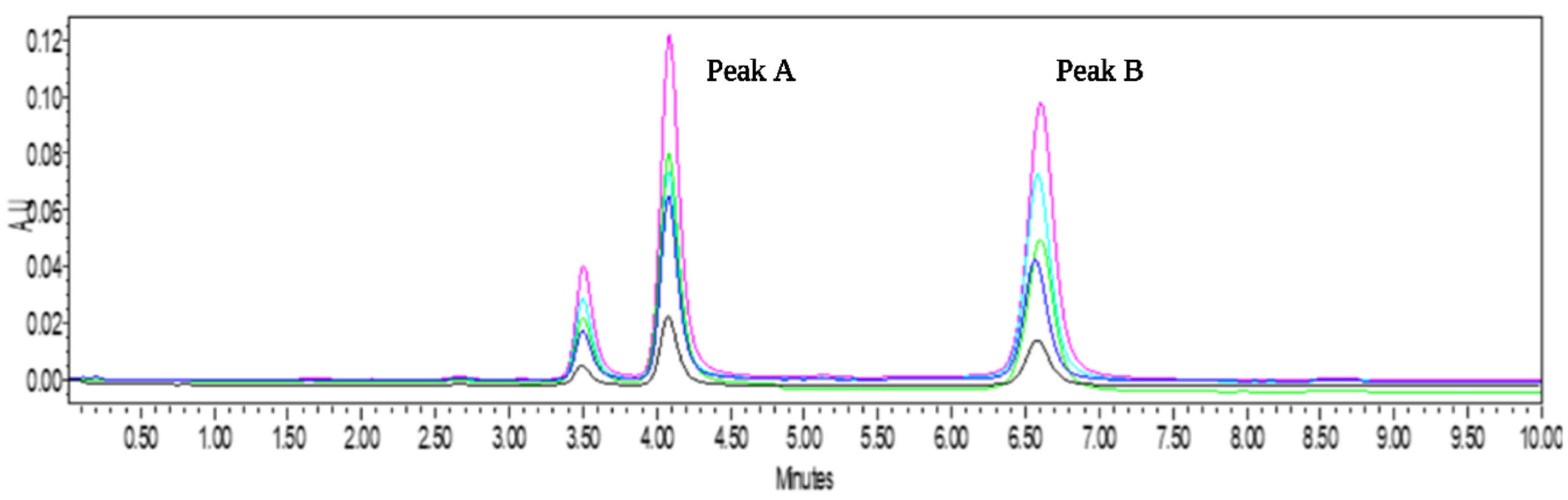
Figure 2.
Representative chromatogram showing specificity and selectivity of octocrylene and avobenzone.
Figure 2.
Representative chromatogram showing specificity and selectivity of octocrylene and avobenzone.
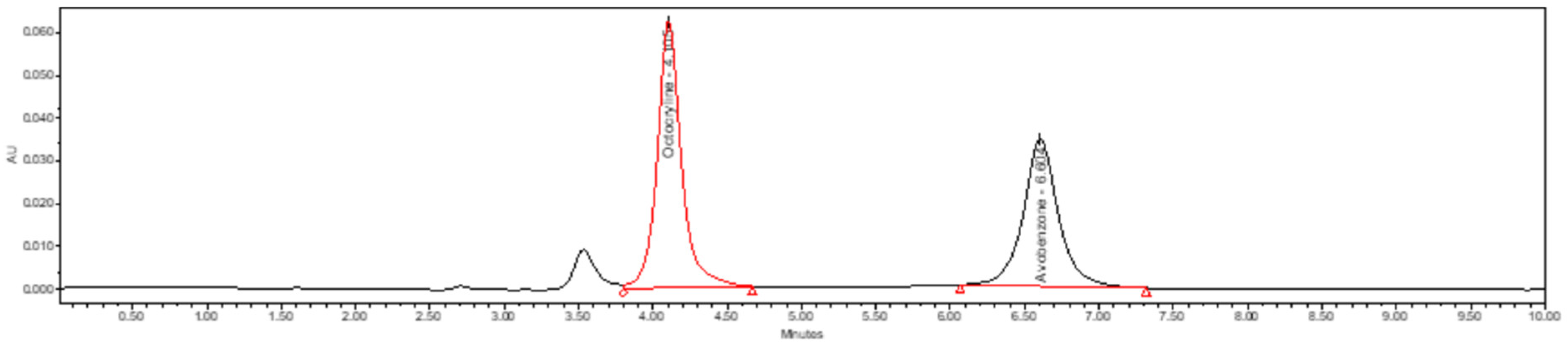
Figure 3.
3A and 3B. Calibration curves of avobenzone and octocrylene, respectively, in the concentration range of 10–50 µg/mL.
Figure 3.
3A and 3B. Calibration curves of avobenzone and octocrylene, respectively, in the concentration range of 10–50 µg/mL.
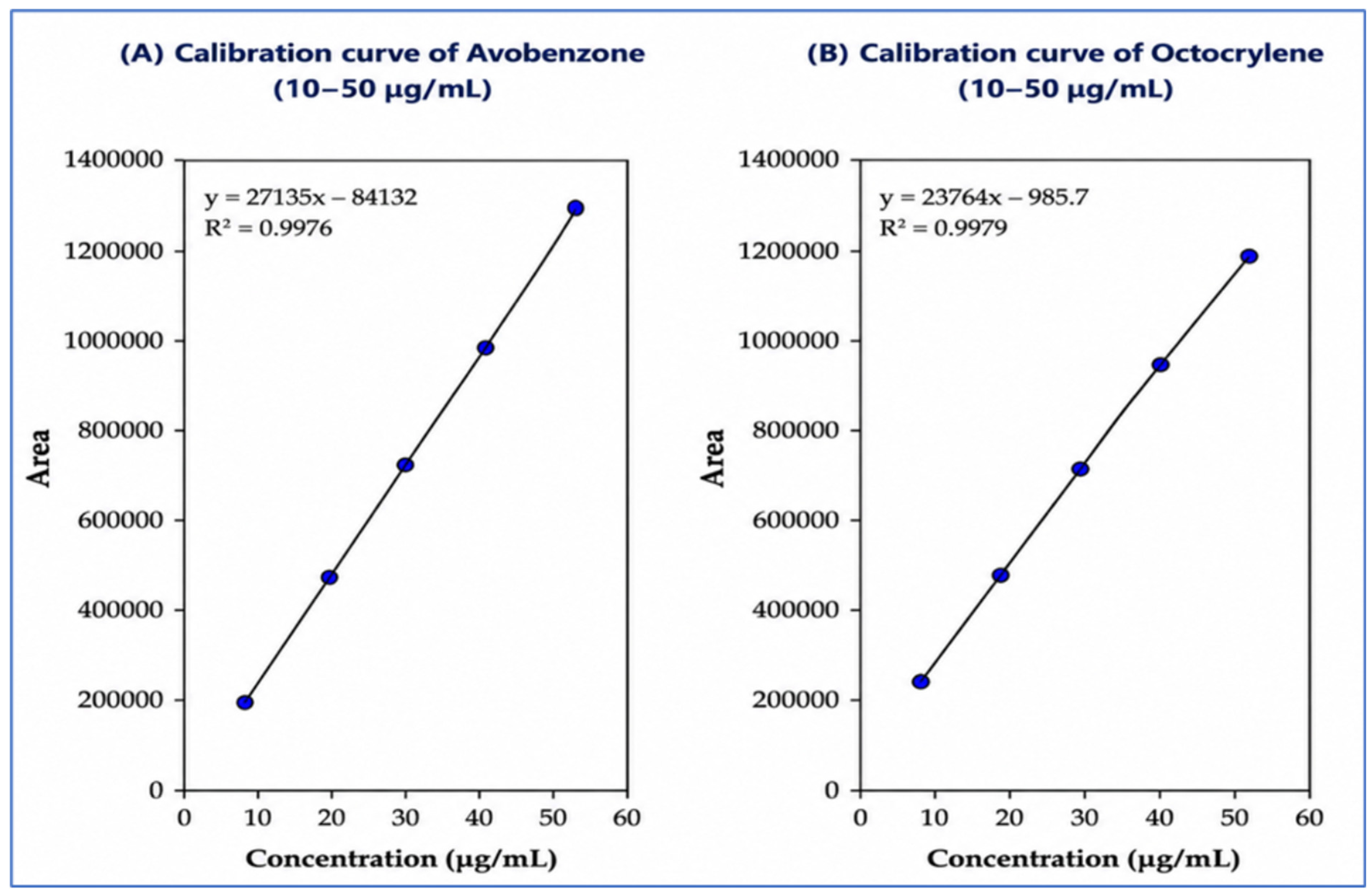
Figure 4.
RP-HPLC chromatogram of nanosponge-loaded sunscreen lotion showing avobenzone and octocrylene without excipient interference.
Figure 4.
RP-HPLC chromatogram of nanosponge-loaded sunscreen lotion showing avobenzone and octocrylene without excipient interference.
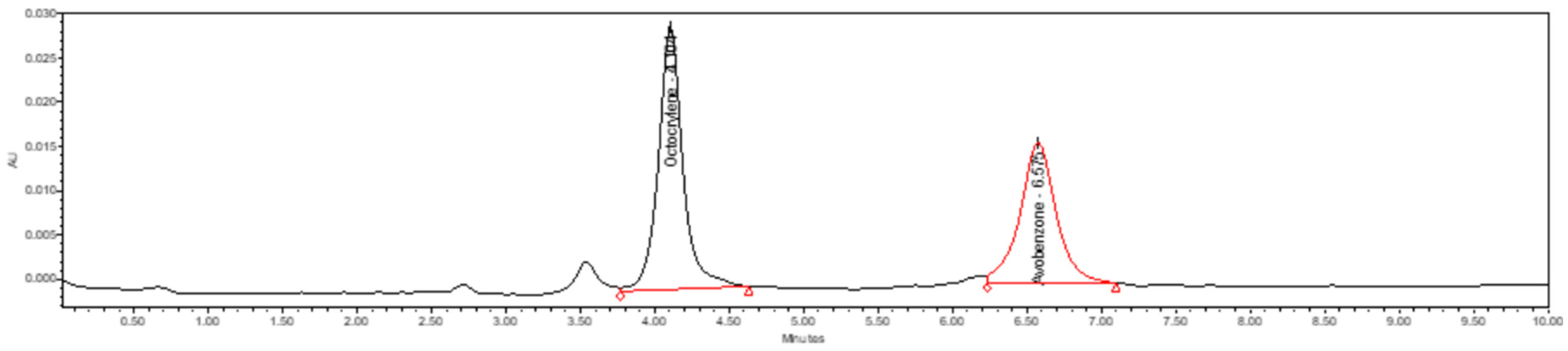

Table 1.
Summary of chromatographic trials performed during method optimization.
| Trial | Methanol (%) | Water (%) | Flow rate (mL/min) | Peak response (Oct) | Peak response (Avo) | Peak symmetry (Oct) | Peak symmetry (Avo) | Theoretical plate count (Oct) | Theoretical plate count (Avo) | Resolution |
| 1 | 50 | 50 | 0.8 | — | 6590089 | 0.8 | — | 2023 | — | — |
| 2 | 70 | 30 | 1.2 | 1067340 | 4422015 | 1.4 | 1.2 | 6258 | 5352 | 9.2 |
| 3 | 80 | 20 | 0.8 | 59235 | 284596 | 0.9 | 0.8 | 4526 | 4958 | 11.5 |
| 4 | 90 | 10 | 1.0 | 1265620 | 605648 | 1.2 | 1.3 | 5432 | 4189 | 11.8 |
| 5 | 95 | 05 | 1.0 | 1567340 | 6422015 | 1.3 | 1.0 | 6238 | 6807 | 12.0 |
Table 2.
Optimized chromatographic parameters for simultaneous estimation of avobenzone and octocrylene.
Table 2.
Optimized chromatographic parameters for simultaneous estimation of avobenzone and octocrylene.
| Sr. No. | Component | Retention time (min) | Peak area | Tailing factor | Theoretical plate count | Resolution |
| 1 | Octocrylene | 4.0 | 1567340 | 1.3 | 6238 | — |
| 2 | Avobenzone | 6.6 | 6422015 | 1.0 | 6807 | 12.0 |
Table 3.
Specificity and selectivity study of avobenzone and octocrylene.
| Component | Retention time (min) | Peak area | Peak purity |
| Blank | NA | NA | NA |
| Unknown peak | 3.5 | 16253 | — |
| Octocrylene | 4.0 | 1567340 | 1000 |
| Avobenzone | 6.6 | 6422015 | 1000 |
Table 4.
Limit of detection and limit of quantification of avobenzone.
| Parameter | Measured value |
| Limit of Quantification (LOQ) | 0.0015 μg/mL |
| Limit of Detection (LOD) | 0.0045 μg/mL |
Table 5.
Limit of detection and limit of quantification of octocrylene.
| Parameter | Measured value |
| Limit of Quantification (LOQ) | 0.0187 μg/mL |
| Limit of Detection (LOD) | 0.0568 μg/mL |
Table 6.
Linearity study of avobenzone.
| Concentration (μg/mL) | Peak area |
| 10 | 188146 |
| 20 | 473946 |
| 30 | 719742 |
| 40 | 971865 |
| 50 | 1295958 |
| Parameter | Value |
| Slope | 27135.43 |
| Intercept | -84131.56 |
| Correlation coefficient (R2) | 0.9976 |
Table 7.
Linearity study of octocrylene.
| Concentration (μg/mL) | Peak area |
| 10 | 236654 |
| 20 | 474294 |
| 30 | 712934 |
| 40 | 950574 |
| 50 | 1188214 |
| Parameter | Value |
| Slope | 23764 |
| Intercept | -985.7 |
| Correlation coefficient (R2) | 0.9979 |
Table 8.
Precision study of avobenzone.
| Injection | Peak area | Concentration | % Assay | |
| 1 | 463910 | 20.196 | 100.98 | |
| 2 | 470955 | 20.456 | 102.28 | |
| 3 | 469940 | 20.418 | 102.09 | |
| 4 | 463670 | 20.187 | 100.94 | |
| 5 | 470825 | 20.451 | 102.26 | |
| 6 | 476365 | 20.655 | 103.28 | |
| Parameter | Value | |||
| Mean | 101.972 | |||
| Standard deviation | 0.888 | |||
| %RSD | 0.87 | |||
Table 9.
Precision study of octocrylene.
| Injection | Peak area | Concentration | % Assay | |
| 1 | 471320 | 19.874 | 99.37 | |
| 2 | 481590 | 20.307 | 101.53 | |
| 3 | 481505 | 20.303 | 101.52 | |
| 4 | 483200 | 20.374 | 101.87 | |
| 5 | 476594 | 20.096 | 100.48 | |
| 6 | 479523 | 20.220 | 101.10 | |
| Parameter | Value | |||
| Mean | 100.979 | |||
| Standard deviation | 0.920 | |||
| %RSD | 0.91 | |||
Table 10.
Accuracy study of avobenzone.
| Concentration level | Peak area | % Recovery | Mean % Recovery | %RSD |
| 80% | 405255 | 100.19 | 100.35 | 0.87 |
| 400676 | 99.26 | |||
| 412635 | 101.71 | |||
| 100% | 461139 | 100.47 | 101.07 | 0.56 |
| 467559 | 101.66 | |||
| 464402 | 101.07 | |||
| 120% | 518853 | 101.01 | 100.68 | 0.72 |
| 519976 | 101.19 | |||
| 511951 | 99.85 |
Table 11.
Accuracy study of octocrylene.
| Concentration level | Peak area | % Recovery | Mean % Recovery | %RSD |
| 80% | 428152 | 100.32 | 100.319 | 0.04 |
| 427945 | 100.27 | |||
| 428320 | 100.36 | |||
| 100% | 478980 | 100.98 | 100.98 | 0.04 |
| 478745 | 100.93 | |||
| 479110 | 101.01 | |||
| 120% | 519450 | 99.54 | 100.82 | 0.86 |
| 529210 | 101.41 | |||
| 529670 | 101.50 |
Table 12.
Robustness data of octocrylene.
| Parameters | RT | Area | % RSD | Theoretical Plates | Tailing factor |
| Actual condition | 4.0 | 1567340 | 0.89 | 7425 | 1.00 |
| Flow rate: 0.8 mL/min | 3.8 | 1530785 | 1.17 | 6907 | 1.09 |
| Flow rate: 1.2 mL/min | 4.1 | 1498320 | 0.65 | 6724 | 1.08 |
| MP MeOH: Water (93:07) | 4.6 | 1502652 | 0.96 | 6774 | 1.05 |
| MP MeOH: Water (97:03) | 4.4 | 1568920 | 0.36 | 6873 | 1.08 |
| Different column | 4.0 | 1562358 | 0.72 | 6905 | 1.08 |
Table 13.
Robustness data of avobenzone.
| Parameters | RT | Area | % RSD | Theoretical Plates | Tailing factor |
| Actual condition | 6.6 | 6422015 | 1.12 | 7168 | 1.08 |
| Decrease flow 0.8 mL/min | 5.3 | 6222890 | 1.17 | 6382 | 1.09 |
| Increase flow 1.2 mL/min | 6.1 | 6123589 | 1.36 | 5695 | 1.08 |
| MP MeOH: Water (93:07) | 7.2 | 6015892 | 1.64 | 6278 | 1.09 |
| MP MeOH: Water (97:03) | 4.1 | 623889 | 1.58 | 6120 | 1.08 |
| Different column | 6.5 | 635781 | 1.32 | 6820 | 1.05 |
Table 14.
Ruggedness data of octocrylene.
| Parameters | RT | Area | Theoretical Plates | Tailing factor | % RSD | % Absolute difference |
| Analyst 1 | 4.012 | 187604 | 6838.50 | 1.09 | 0.53 |
0.01 |
| Analyst 2 | 4.002 | 187424 | 6769.67 | 1.09 | 0.12 |
Table 15.
Ruggedness data of avobenzone.
| Parameters | RT | Area | Theoretical Plates | Tailing factor | % RSD | % Absolute difference |
| Analyst 1 | 6.585 | 6422015 | 6838.50 | 1.09 | 0.79 |
0.03 |
| Analyst 2 | 6.586 | 6523142 | 6769.67 | 1.09 | 0.80 |
Table 16.
Assay estimation of nanosponge-loaded sunscreen lotion.
| Component | Label claim (% w/w) | Concentration analysed (μg/mL) | Peak area | Amount found (% w/w) | % Assay |
| Avobenzone | 2.0 | 20 | 463850 | 1.98 | 99.12 |
| Octocrylene | 2.0 | 20 | 474620 | 2.01 | 100.54 |
Disclaimer/Publisher’s Note: The statements, opinions and data contained in all publications are solely those of the individual author(s) and contributor(s) and not of MDPI and/or the editor(s). MDPI and/or the editor(s) disclaim responsibility for any injury to people or property resulting from any ideas, methods, instructions or products referred to in the content. |
© 2026 by the authors. Licensee MDPI, Basel, Switzerland. This article is an open access article distributed under the terms and conditions of the Creative Commons Attribution (CC BY) license (http://creativecommons.org/licenses/by/4.0/).
Copyright: This open access article is published under a Creative Commons CC BY 4.0 license, which permit the free download, distribution, and reuse, provided that the author and preprint are cited in any reuse.


