

Submitted:
22 May 2026
Posted:
26 May 2026
You are already at the latest version
Abstract
Background: Anatomical variations of the mental nerve are critical to recognize during maxillo-facial trauma surgery to prevent iatrogenic nerve injury. The nerve typically divides into three main branches upon exiting the mental foramen. Case Presentation: A 27-year-old male presented to the Department of craniomaxillofacial Sur-gery at Sherbin Central Hospital following a motor vehicle accident, sustaining a mandibular parasymphyseal fracture. During an open reduction and internal fixation via a mandibular ves-tibular approach, an unusually superficial neurovascular configuration was noted. Meticulous skeletonization revealed a rare six-branch arborization of the mental nerve arising from a single foramen. All six branches were carefully isolated and preserved during fracture reduction and miniplate osteosynthesis. Post-operative neurosensory assessment confirmed completely intact sensation.Conclusion: This case highlights the importance of adaptive surgical dissection and a high index of anatomical suspicion during trauma surgery to avoid permanent neu-rosensory deficits.
Keywords:
mental nerve
; anatomical variation
; arborization
; mandibular fracture
; open reduction and internal fixation
1. Introduction
the mental nerve, a major sensory terminal branch of the inferior alveolar nerve, emerges through the mental foramen to provide sensation to the lower lip, labial mucosa, and the chin. Classic anatomical descriptions state that the nerve typically trifurcates into mental, labial, and inferior gingival branches.
While anomalies such as accessory mental foramina or secondary trunks have been documented, macroscopic variations involving hyper-branching or a prominent six-branch arborization from a single clinical portal are exceptionally rare. In maxillofacial trauma surgery, standard incisions and blind tissue retraction are frequently performed near the parasymphyseal region. Unfamiliarity with superficial or hyper-branched variations increases the risk of inadvertent nerve transection. This report details the incidental discovery and successful preservation of a six-branch mental nerve during mandible fracture fixation.
2. Case Presentation
A 27-year-old male patient was admitted to the Department of Oral and Maxillofacial Surgery at Sherbin Central Hospital (Directorate of Health Affairs in Dakahlia, Egyptian Ministry of Health) presenting with severe pain, malocclusion, and localized swelling following a motor vehicle accident. Clinical and radiographic examinations revealed a displaced fracture of the mandibular parasymphysis.
The patient was scheduled for open reduction and internal fixation (ORIF) under general anesthesia. A standard intraoral mandibular vestibular approach was utilized. Following mucosal incision and during submucosal dissection toward the inferior border of the mandible, an atypical, highly superficial neurovascular network was encountered near the mental foramen region.
Instead of proceeding with routine blunt retraction, a careful, atraumatic micro-dissection was initiated to isolate the structures. Skeletonization of the nerve bundle revealed a remarkable anatomical variant: a distinct six-branch macroscopic arborization originating from a single mental foramen. The branches spread out in a fan-like pattern to supply the adjacent mental and labial tissues.
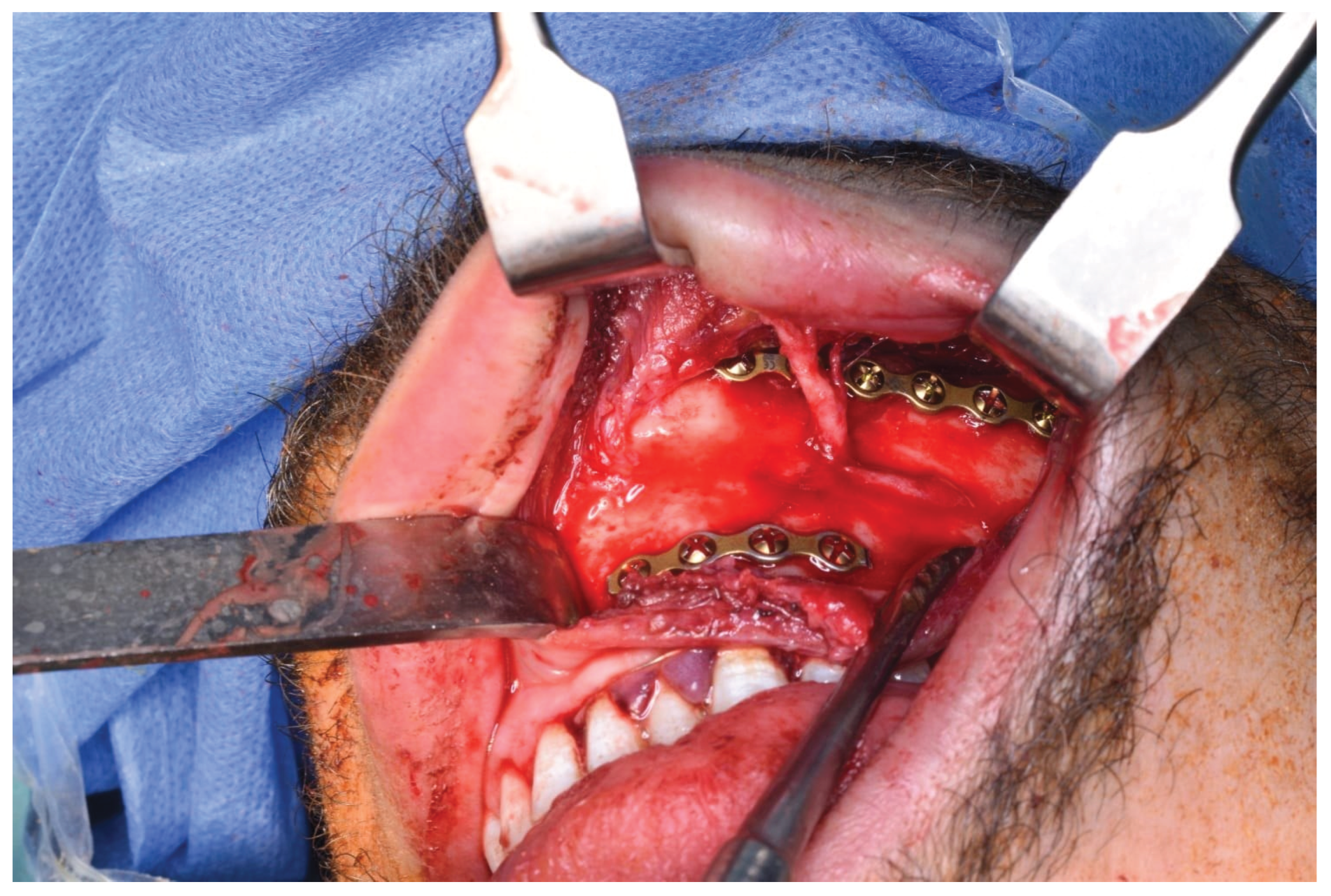
The six individual filaments were gently mobilized and protected using vascular loops and specialized retractors. Two titanium miniplates and screws were subsequently adapted and fixed across the fracture line while maintaining direct visualization of the nerve branches to prevent any compression or entrapment. The surgical site was irrigated and closed in layers. Neurosensory follow-up at 1 week, 1 month, and 3 months post-operatively demonstrated normal sensation in the lower lip and chin, with no paresthesia or dysesthesia reported.
Figure 1.
Intraoperative view showing the atraumatic skeletonization of the six distinct branches of the mental nerve emerging from a single portal.
Figure 1.
Intraoperative view showing the atraumatic skeletonization of the six distinct branches of the mental nerve emerging from a single portal.
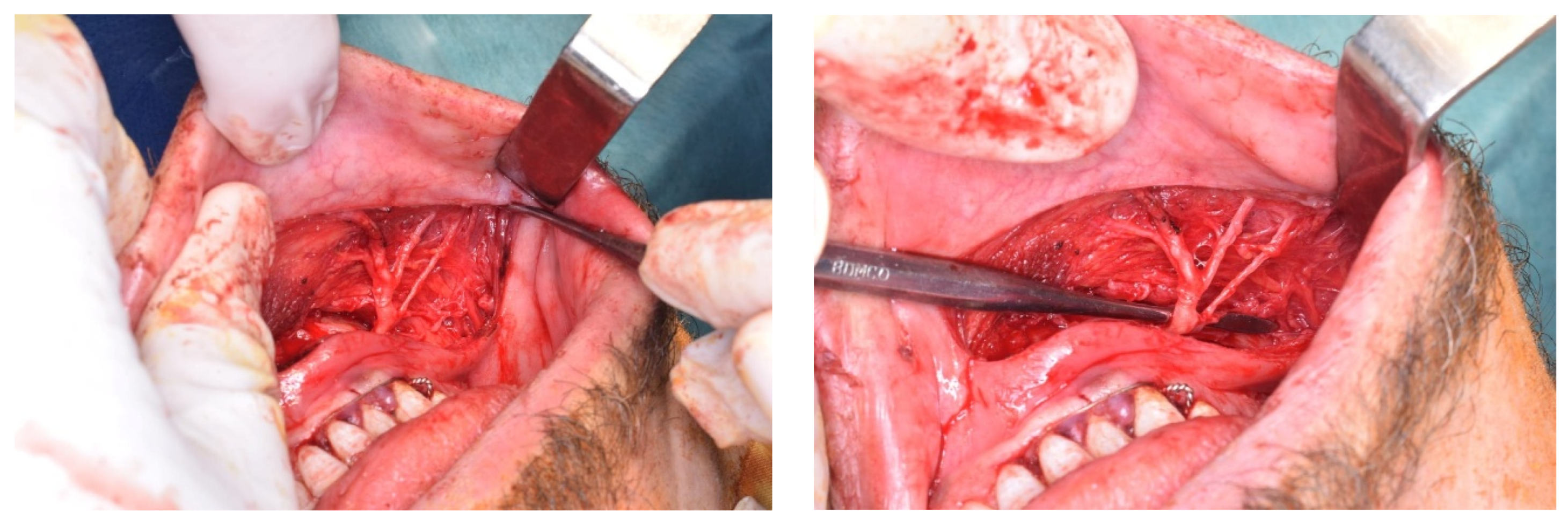
Figure 2.
Stable internal fixation with titanium miniplates executed while carefully protecting the isolated nerve branches.
Figure 2.
Stable internal fixation with titanium miniplates executed while carefully protecting the isolated nerve branches.
3. Discussion
Anatomical deviations of the mandibular canal and its mental branch represent a continuous challenge in oral and maxillofacial surgery. Most surgical textbooks guide clinicians to expect a standard trifurcation pattern after identifying the mental foramen. However, variations where the nerve exhibits early branching or an extensive superficial arborization—such as the six distinct branches observed in this patient—are critical clinical anomalies.
The identification of this variation was particularly vital given the surgical context. During fracture fixation, significant traction is often required to achieve adequate reduction and plate adaptation. If a surgeon assumes a standard anatomy and applies aggressive soft-tissue retraction or places vertical releasing incisions superficially, peripheral fibers in a six-branch configuration can be easily severed or crushed. This case demonstrates that adopting a cautious, layer-by-layer dissection technique when entering the parasymphyseal territory is mandatory, regardless of the urgency of the trauma case. Documenting these findings reinforces the need for surgical flexibility and underscores that relying solely on conventional landmarks can lead to preventable iatrogenic morbidity.
Funding
This study received no specific grant from any funding agency in the public, commercial, or not-for-profit sectors.
Informed Consent
Written informed consent was obtained from the patient for publication of this case report and any accompanying clinical images.
Conflicts of Interest
The authors declare no conflicts of interest.
References
- Al-Shayyab, M. H.; Al-Soleihat, F. Anatomical variations of the mental nerve: A review of clinical and radiological relevance. Journal of Maxillofacial and Oral Surgery 2019, 18(2), 163–171. [Google Scholar]
- Juodzbalys, G.; Wang, H. L.; Sabalys, G. Injury of the inferior alveolar nerve during implant placement: a literature review. Journal of Oral & Maxillofacial Research 2011, 2(1), e1. [Google Scholar]
- Singh, R. Variation in branching pattern of mental nerve: clinical significance. Journal of Clinical and Diagnostic Research 2014, 8(2), AC01–AC03. [Google Scholar]
- Iwanaga, J.; Watanabe, K.; Saga, T.; Tubbs, R. S. Anatomical study of the branching patterns of the mental nerve: application to local anesthesia and surgical interventions. Surgical and Radiologic Anatomy 2020, 42(5), 515–521. [Google Scholar]
Disclaimer/Publisher’s Note: The statements, opinions and data contained in all publications are solely those of the individual author(s) and contributor(s) and not of MDPI and/or the editor(s). MDPI and/or the editor(s) disclaim responsibility for any injury to people or property resulting from any ideas, methods, instructions or products referred to in the content. |
© 2026 by the authors. Licensee MDPI, Basel, Switzerland. This article is an open access article distributed under the terms and conditions of the Creative Commons Attribution (CC BY) license (http://creativecommons.org/licenses/by/4.0/).
Copyright: This open access article is published under a Creative Commons CC BY 4.0 license, which permit the free download, distribution, and reuse, provided that the author and preprint are cited in any reuse.


