
Submitted:
24 May 2026
Posted:
26 May 2026
You are already at the latest version
Abstract
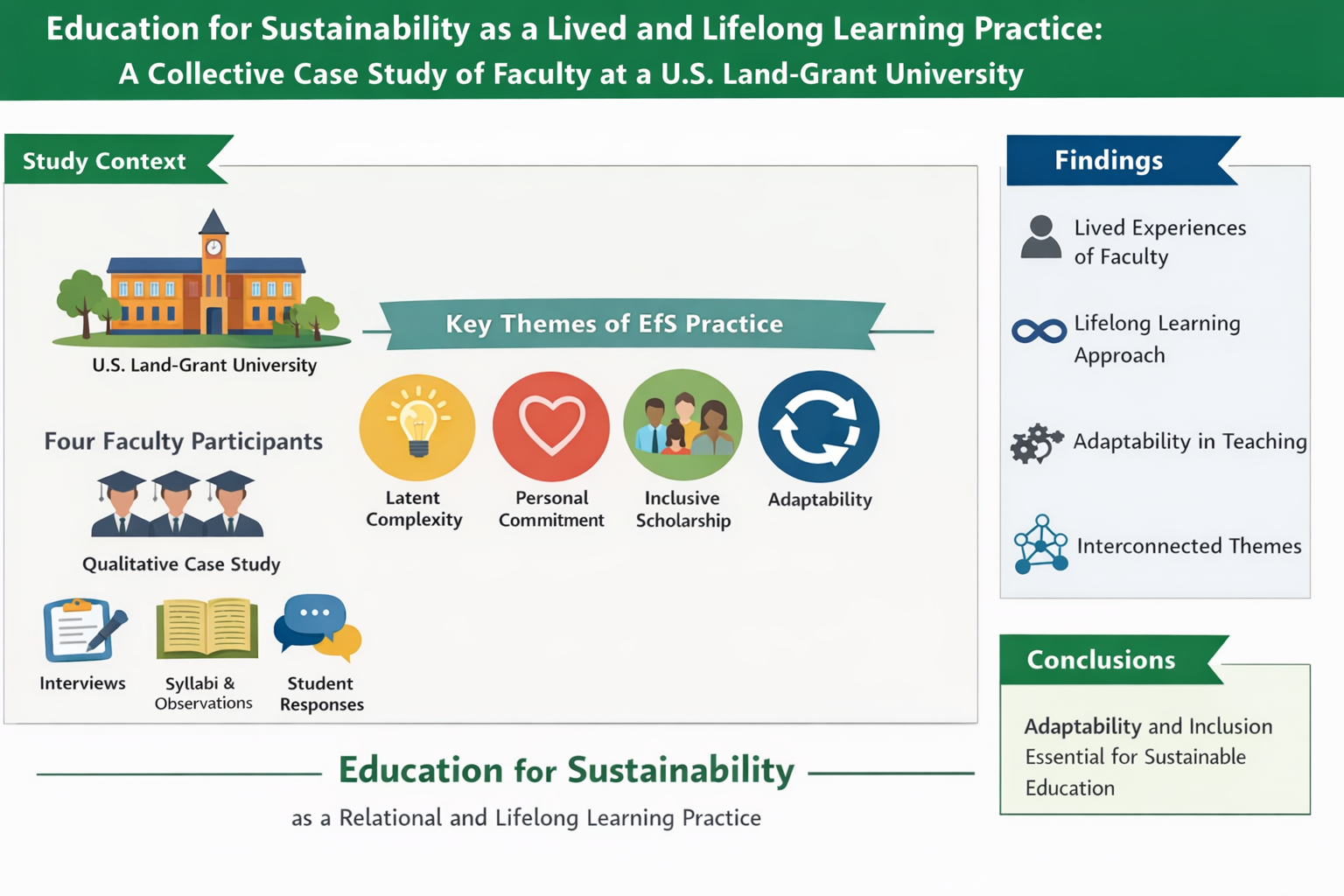
Education for Sustainability (EfS) has emerged as a key response through which higher education engages ecological, social, and civic challenges. While EfS is well represented in policy and conceptual scholarship, fewer empirical studies examine how faculty enact sustainability within everyday teaching practice. This qualitative collective case study investigates the lived experiences and pedagogical practices of four faculty members at a U.S. land-grant university. Data were collected through semi-structured interviews, supported by syllabi, observations, and student responses, and analyzed using cross-case thematic analysis. Analysis identified four interconnected themes: latent complexity, personal commitment, inclusive scholarship, and adaptability to student motivations and context. These themes position EfS as a relational, context-responsive process shaped through interaction among faculty identity, student engagement, and institutional conditions. These findings reposition faculty practice as a primary mechanism through which sustainability is continuously enacted, adapted, and sustained within higher education systems, with implications for institutional policy, faculty development, and long-term sustainability capacity.
Keywords:
education for sustainability
; sustainable higher education
; sustainability pedagogy
; higher education systems
; faculty practice
; lifelong learning
; sustainability competencies
; institutional sustainability
; sustainability transitions
; qualitative case study
; sustainability capacity
Copyright: This open access article is published under a Creative Commons CC BY 4.0 license, which permit the free download, distribution, and reuse, provided that the author and preprint are cited in any reuse.


