

Submitted:
24 May 2026
Posted:
26 May 2026
You are already at the latest version
Abstract
Cryptocurrency markets are characterized by elevated volatility, structural instability, and rapidly changing investor sentiment, which significantly challenge traditional portfolio optimization methodologies. Under such conditions, static portfolio allocation models frequently fail to ade-quately incorporate uncertainty, behavioral adaptation, and dynamic market responsiveness into the investment decision-making process. In parallel, recent advances in artificial intelligence and data-driven financial systems have transformed modern portfolio management by enabling adaptive investment strategies capable of processing large volumes of financial information in real time. Nevertheless, AI-assisted portfolio systems often remain highly sensitive to noisy market signals, parameter instability, and excessive portfolio rebalancing, particularly in volatile crypto-currency environments. This study proposes a behaviorally adaptive portfolio optimization framework under interval uncertainty that integrates robust optimization principles, behavioral finance mechanisms, non-linear transaction costs, and AI-assisted allocation adjustment within a unified cryptocurrency in-vestment structure. The proposed methodology introduces a behavioral preference parameter capable of dynamically adjusting portfolio composition according to varying investor attitudes toward uncertainty and market expectations. Simultaneously, interval uncertainty modeling is employed to represent ambiguous financial parameters through bounded intervals, while artificial intelligence mechanisms act as adaptive decision-support tools that improve portfolio respon-siveness under changing market conditions. The empirical analysis is conducted using major cryptocurrency assets, including Bitcoin, Ethereum, Solana, and Binance Coin, over the period January–June 2025. Multiple behavioral portfolio configurations are evaluated in order to analyze the interaction between profitability, downside risk, portfolio stability, and transaction cost efficiency. The results indicate that the proposed framework improves risk-adjusted portfolio performance and generates more stable allocation strategies compared to traditional static portfolio optimization approaches. In particular, the integration of behavioral adaptation and robust optimization contributes to reduced sensitivity to estimation uncertainty and unstable market fluctuations. The findings further demonstrate that AI-assisted adaptive allocation mechanisms improve portfolio flexibility and support smoother portfolio transitions under volatile market conditions. Moreover, the incorporation of nonlinear transaction costs leads to more realistic and practically implementable cryptocurrency investment strategies. Overall, the proposed framework provides a robust and behaviorally interpretable approach for modern cryptocurrency portfolio management and contributes to the growing literature at the intersection of artificial intelligence, behavioral fi-nance, and uncertainty-aware portfolio optimization.
Keywords:
portfolio optimization
; behavioral finance
; artificial intelligence
; robust optimization
; cryptocurrency markets
; interval uncertainty
1. Introduction
Financial markets have become increasingly characterized by high volatility, rapid information transmission, structural instability, and complex nonlinear interactions among assets, particularly in the context of cryptocurrency investments. The growing integration of artificial intelligence, algorithmic trading systems, and automated portfolio management has fundamentally transformed modern financial decision-making processes. In parallel, the emergence of digital assets and decentralized financial systems has introduced new forms of uncertainty and market dynamics that challenge traditional portfolio optimization methodologies.
Under such conditions, investment strategies based exclusively on classical deterministic assumptions often fail to adequately capture the complexity and instability of contemporary financial environments. The foundations of modern portfolio theory were established by Markowitz [1,2], who introduced the mean–variance optimization framework as a fundamental mechanism for balancing expected return and portfolio risk. Despite its major contribution to financial economics, the classical mean–variance paradigm relies on restrictive assumptions regarding return distributions, parameter stability, and investor rationality. In highly volatile environments such as cryptocurrency markets, these assumptions are frequently violated due to extreme return fluctuations, speculative trading behavior, and rapidly changing market conditions [3,4,5]. Consequently, traditional variance-based portfolio allocation models may generate unstable investment decisions and exhibit excessive sensitivity to estimation errors.
In response to these limitations, recent financial research has increasingly explored robust optimization methodologies capable of improving portfolio resilience under uncertainty [3,4,6]. Robust optimization techniques explicitly account for ambiguity in financial parameters and generate allocation strategies that remain feasible and stable across multiple uncertainty realizations. Unlike deterministic optimization approaches, robust portfolio models aim to reduce the impact of estimation risk, structural instability, and market uncertainty on investment performance. The development of robust optimization frameworks has therefore become particularly relevant in modern financial markets characterized by elevated volatility and incomplete information. Additionally, interval uncertainty modeling has emerged as an effective mathematical framework for representing ambiguous financial information without relying on restrictive probabilistic assumptions [7,8]. Rather than assuming fixed expected returns or volatility estimates, interval approaches represent uncertain parameters through bounded intervals capable of capturing realistic market variability. This methodology is particularly suitable for cryptocurrency investments, where return distributions often exhibit heavy tails, asymmetric dynamics, and substantial deviations from classical Gaussian assumptions [9,10].
At the same time, developments in behavioral finance have demonstrated that investor decision-making is strongly influenced by subjective attitudes toward uncertainty, optimism, loss aversion, and market expectations [11,12]. Traditional portfolio optimization models generally assume fully rational investors operating under stable utility functions; however, empirical evidence suggests that investor behavior frequently adapts dynamically according to changing market conditions and perceived uncertainty. Consequently, integrating behavioral adaptation mechanisms into portfolio optimization frameworks has become an increasingly important direction in quantitative finance research.
Parallel to these developments, artificial intelligence and machine learning techniques have rapidly expanded within financial forecasting, portfolio management, and algorithmic trading systems [13,14,15,16]. AI-assisted financial models are capable of processing large volumes of financial data, identifying nonlinear relationships, and adapting to evolving market structures more efficiently than traditional statistical methods. In cryptocurrency markets, where information flows and market dynamics evolve continuously, machine learning algorithms have become increasingly important tools for predictive analytics and automated portfolio allocation [17,18].
Nevertheless, despite their predictive capabilities, machine learning models frequently suffer from instability, overfitting, and sensitivity to noisy financial signals [19,20]. In highly volatile cryptocurrency environments, AI-based portfolio systems may generate unstable allocation decisions and excessive portfolio turnover, leading to increased transaction costs and amplified investment risk. These limitations highlight the necessity of integrating uncertainty-aware and robust decision mechanisms within AI-assisted portfolio optimization frameworks. Recent studies have therefore explored the integration of robust optimization, uncertainty quantification, and artificial intelligence within unified financial decision-making systems [21,22,23,24]. In particular, combining behavioral adaptation, interval uncertainty modeling, and AI-assisted portfolio adjustment mechanisms has emerged as a promising direction for improving investment stability and portfolio resilience under uncertainty. Such integrated approaches allow portfolio strategies to dynamically adapt to evolving market conditions while preserving robustness against structural instability and estimation errors. Despite the growing literature on robust optimization, behavioral finance, and machine learning in portfolio management, relatively limited research has examined the interaction between AI-assisted adaptive portfolio allocation and robust optimization under interval uncertainty within cryptocurrency investment environments. Existing studies have often focused either on predictive machine learning systems or on robust portfolio optimization separately, without explicitly integrating adaptive investor behavior and uncertainty-aware allocation mechanisms within a unified framework [25,26,27]. Recent advances in algorithmic trading systems, high-frequency portfolio management, deep learning architectures, and reinforcement learning frameworks have further accelerated the integration of artificial intelligence into modern financial decision-making environments [28,29,30,31].
In particular, adaptive AI-assisted portfolio optimization models have demonstrated increasing potential in cryptocurrency markets characterized by elevated uncertainty, nonlinear market dependencies, and rapidly evolving investor sentiment. Moreover, recent studies on uncertainty-aware artificial intelligence systems suggest that combining robust optimization principles with adaptive machine learning mechanisms may substantially improve portfolio resilience and allocation stability under volatile market conditions [32].
This research gap is particularly relevant in digital financial markets, where extreme volatility and unstable market conditions amplify the limitations of traditional static portfolio optimization approaches. To address this limitation, the present study proposes a behaviorally adaptive portfolio optimization framework under interval uncertainty that integrates robust optimization principles, behavioral adaptation mechanisms, nonlinear transaction costs, and AI-assisted portfolio adjustment within a unified cryptocurrency investment structure. The proposed methodology introduces a behavioral preference parameter capable of dynamically adjusting portfolio allocations according to varying investor attitudes toward uncertainty. Furthermore, artificial intelligence mechanisms are employed as adaptive decision-support tools that enhance portfolio responsiveness and allocation stability under rapidly evolving market conditions.
The main contributions of this study are fourfold. First, the paper develops a unified portfolio optimization framework that combines behavioral adaptation, interval uncertainty modeling, and robust optimization within a coherent cryptocurrency investment structure. Second, the study incorporates AI-assisted adaptive allocation mechanisms designed to improve portfolio responsiveness under volatile market environments. Third, the empirical analysis evaluates the effectiveness of the proposed methodology using major cryptocurrency assets, including Bitcoin, Ethereum, Solana, and Binance Coin. Fourth, the study contributes to the growing literature at the intersection of artificial intelligence, behavioral finance, and robust portfolio optimization by demonstrating how adaptive investor behavior and uncertainty-aware decision mechanisms can improve portfolio resilience and risk-adjusted performance. To further structure the empirical investigation, the study evaluates the following hypotheses:
H1: Behaviorally adaptive robust portfolio strategies generate superior risk-adjusted performance compared to static portfolio allocation approaches.
H2: AI-assisted adaptive allocation mechanisms improve portfolio stability and reduce downside risk under volatile cryptocurrency market conditions.
H3: Interval uncertainty modeling and nonlinear transaction cost integration improve the robustness and practical implementability of cryptocurrency portfolio optimization strategies.
The remainder of the paper is organized as follows. Section 2 presents the methodological framework, including the theoretical foundations of robust behavioral portfolio optimization and the AI-assisted adaptive allocation structure. Section 3 discusses the empirical results obtained from the cryptocurrency portfolio analysis and evaluates the performance of the proposed framework under multiple behavioral configurations. Section 4 concludes the study and outlines directions for future research regarding artificial intelligence, uncertainty-aware portfolio management, and adaptive cryptocurrency investment systems.
2. Materials and Methods
2.1. Theoretical Background
The rapid development of artificial intelligence and data-driven financial technologies has significantly transformed modern portfolio management and investment decision-making processes. In contemporary financial markets, particularly within cryptocurrency ecosystems, investors operate in environments characterized by extreme volatility, nonlinear dependencies, structural instability, and elevated uncertainty. Traditional portfolio optimization models based on the classical mean–variance framework introduced by Markowitz remain foundational in financial theory; however, such approaches often rely on restrictive assumptions regarding market efficiency, normality of returns, and parameter stability, which are frequently violated in cryptocurrency markets.
In response to these limitations, recent financial research has increasingly explored robust optimization methodologies, interval uncertainty modeling, and behavioral finance approaches capable of incorporating ambiguity and adaptive investor preferences into portfolio construction. Robust optimization techniques provide an effective framework for addressing uncertainty by generating portfolio allocations that remain feasible and stable across multiple market scenarios. Unlike deterministic optimization methods, robust approaches explicitly account for estimation uncertainty and structural variability, thereby improving portfolio resilience under unstable market conditions.
At the same time, developments in behavioral finance have demonstrated that investor decision-making is rarely fully rational and often depends on subjective attitudes toward uncertainty, risk perception, optimism, and market expectations. Consequently, modern portfolio allocation models increasingly seek to integrate adaptive behavioral mechanisms capable of reflecting heterogeneous investor profiles and dynamically adjusting allocation strategies according to changing market conditions.
Parallel to these developments, artificial intelligence and machine learning techniques have become increasingly important in quantitative finance and portfolio management. AI-based financial systems are capable of processing large volumes of financial data, identifying nonlinear relationships, and adapting to evolving market dynamics more efficiently than traditional statistical approaches. Nevertheless, machine learning models applied in financial forecasting frequently suffer from instability, overfitting, and sensitivity to noisy market signals, particularly in highly volatile environments such as digital asset markets. These limitations may lead to unstable portfolio allocations, excessive portfolio turnover, and increased transaction costs.
To address these challenges, the present study proposes an AI-assisted robust portfolio optimization framework that combines behavioral adaptation, interval uncertainty modeling, and robust optimization principles within a unified portfolio allocation structure. The framework incorporates adaptive investor behavior through a convex preference parameter λ, which reflects varying degrees of optimism and risk aversion under uncertainty. Moreover, artificial intelligence mechanisms are employed to support adaptive portfolio decision-making and dynamic allocation adjustment across different market conditions.
From a theoretical perspective, the proposed framework integrates three complementary components. First, interval uncertainty modeling is employed to represent ambiguous financial parameters such as expected returns and volatility using bounded intervals rather than fixed point estimates. This approach allows the model to capture uncertainty without imposing strong probabilistic assumptions. Second, robust optimization principles are incorporated in order to generate portfolio allocations capable of maintaining stable performance under multiple uncertainty realizations. Third, behavioral adaptation mechanisms are introduced through investor-dependent preference structures that dynamically influence portfolio composition according to different attitudes toward uncertainty.
The integration of these components leads to a portfolio optimization framework that is at the same time robust, adaptive, and behaviorally interpretable. Unlike traditional portfolio models that rely exclusively on static optimization objectives, the proposed methodology explicitly incorporates investor-driven adaptability and uncertainty-aware decision-making into the allocation process. In this context, artificial intelligence acts as a supporting decision layer that facilitates dynamic adjustment of portfolio strategies while preserving robustness against unstable market conditions.
The proposed framework is particularly relevant for cryptocurrency investments, where high volatility, speculative behavior, and rapidly changing market structures significantly challenge classical portfolio management techniques. By combining AI-assisted adaptive decision-making with robust optimization under interval uncertainty, the framework aims to improve portfolio stability, reduce sensitivity to noisy market fluctuations, and enhance the overall robustness of cryptocurrency investment strategies.
2.2. AI-Assisted Behavioral Portfolio Optimization Framework
The proposed methodology introduces a behaviorally adaptive portfolio optimization framework designed to support robust cryptocurrency investment decisions under uncertainty. The framework combines interval-based uncertainty modeling, adaptive investor behavior, nonlinear transaction costs, and AI-assisted portfolio adjustment mechanisms within a unified optimization structure.
Let denote the number of risky assets included in the portfolio. The portfolio allocation vector is defined as:
where represents the proportion of capital allocated to asset .
Because cryptocurrency markets exhibit substantial uncertainty and parameter instability, expected asset returns are modeled using interval arithmetic. For each asset , the expected return is represented as an interval:
where and denote the lower and upper bounds of expected returns estimated from historical market data.
The framework incorporates adaptive investor behavior through a behavioral preference parameter , which controls the degree of investor optimism under uncertainty. The behaviorally adjusted expected return of asset is defined as:
Higher values of correspond to optimistic investors who assign greater importance to favorable market outcomes, while lower values reflect more conservative or risk-averse investor profiles.
The expected portfolio return under behavioral adaptation is therefore given by:
To measure downside portfolio risk, the framework employs semi-absolute deviation rather than classical variance. This risk measure is more appropriate for crypto asset markets because it focuses specifically on downside fluctuations and asymmetric return behavior. The downside risk measure is defined as:
where represents portfolio return at time and denotes the average portfolio return.
In addition, realistic portfolio rebalancing requires the incorporation of nonlinear transaction costs. The transaction cost function is modeled as:
where denotes the previous allocation weight, represents the transaction cost coefficient, and controls transaction cost nonlinearity.
The complete portfolio optimization problem combines return maximization, downside risk minimization, and transaction cost control into a scalarized robust optimization structure:
subject to:
where , , and are weighting parameters controlling the trade-off between profitability, risk control, and transaction cost minimization.
The artificial intelligence component of the framework acts as an adaptive portfolio decision-support mechanism. Rather than replacing the optimization structure itself, the AI-assisted layer dynamically evaluates market conditions, investor profiles, and uncertainty levels in order to support adaptive allocation adjustments. In this context, the AI component contributes to improving portfolio responsiveness while preserving robustness under unstable cryptocurrency market conditions.
The resulting framework therefore combines robust optimization, behavioral adaptation, interval uncertainty modeling, and AI-assisted decision support within a unified portfolio management architecture specifically designed for cryptocurrency investments under uncertainty.
2.3. Data and Empirical Design
The empirical analysis is conducted using daily cryptocurrency market data collected from Binance and CoinMarketCap for the period January 2025–June 2025. The study focuses on four major cryptocurrencies—Bitcoin (BTC), Ethereum (ETH), Solana (SOL), and Binance Coin (BNB)—selected due to their high market capitalization, substantial liquidity, and significant relevance within global cryptocurrency markets.
These assets exhibit heterogeneous volatility structures and return dynamics, making them suitable for evaluating the effectiveness of the proposed behaviorally adaptive robust portfolio optimization framework under uncertainty. Daily closing prices were used to compute logarithmic returns for each cryptocurrency asset according to the standard transformation:
where denotes the closing price at time . The use of logarithmic returns ensures return stationarity and improves comparability across assets with different price scales.
To evaluate portfolio adaptability under varying investor profiles, the empirical framework considers multiple behavioral configurations associated with different values of the behavioral preference parameter . Three representative investor profiles are analyzed: conservative (), balanced (), and adaptive / optimistic (). These configurations allow the proposed framework to dynamically adjust portfolio allocations according to different attitudes toward uncertainty and expected market conditions.
Portfolio optimization is performed using a rolling-window estimation procedure in order to simulate realistic portfolio management conditions and continuously evolving cryptocurrency markets. The estimation window consists of 60 trading days, followed by periodic portfolio rebalancing at fixed intervals. This rolling structure enables the framework to dynamically incorporate new market information while preserving robustness against short-term market instability and parameter fluctuations.
To ensure realistic implementation conditions, the optimization process incorporates nonlinear transaction costs associated with portfolio rebalancing activities. Transaction costs are modeled as proportional nonlinear functions of portfolio turnover, thereby penalizing excessive allocation changes and improving portfolio stability under highly volatile market conditions.
The empirical evaluation of portfolio performance is based on several standard financial indicators widely employed in quantitative finance and portfolio management literature. Portfolio profitability is evaluated through cumulative return and average portfolio return measures, while risk-adjusted performance is assessed using the Sharpe ratio:
where denotes the expected portfolio return, represents the risk-free rate, and denotes portfolio volatility.
Downside portfolio risk is additionally evaluated using maximum drawdown (MDD), which measures the largest cumulative portfolio loss during the investment horizon:
In addition, portfolio turnover and transaction cost efficiency are analyzed in order to evaluate the practical implementability and stability of the proposed adaptive allocation strategies. The AI-assisted component of the framework operates as a dynamic decision-support layer that continuously evaluates market conditions, volatility regimes, and investor behavioral preferences during the portfolio adjustment process. Rather than acting as a purely predictive mechanism, the AI-assisted structure supports adaptive allocation refinement while preserving robustness against noisy cryptocurrency market fluctuations and unstable short-term signals.
Overall, the empirical design is constructed to evaluate whether integrating behavioral adaptation, robust optimization, interval uncertainty modeling, and AI-assisted allocation mechanisms can improve cryptocurrency portfolio stability and risk-adjusted performance under realistic and highly volatile market conditions.
3. Results and Discussion
This section presents the empirical results obtained from the implementation of the proposed behaviorally adaptive portfolio optimization framework under interval uncertainty. The primary objective of the empirical analysis is to evaluate whether the integration of behavioral adaptation, robust optimization, and AI-assisted decision mechanisms improves the stability and risk-adjusted performance of cryptocurrency investment strategies under volatile market conditions.
The empirical framework is applied to four major cryptocurrencies—Bitcoin (BTC), Ethereum (ETH), Solana (SOL), and Binance Coin (BNB)—which collectively represent a significant portion of the cryptocurrency market capitalization and exhibit heterogeneous volatility and return dynamics. The analysis covers the period January 2025–June 2025 and evaluates portfolio allocations under multiple behavioral configurations associated with different values of the investor preference parameter .
The optimization process generates distinct portfolio structures depending on the investor’s behavioral profile under uncertainty. Conservative investors, represented by lower values of , allocate a larger proportion of capital toward relatively stable assets such as Bitcoin and Ethereum. In contrast, more optimistic investors, characterized by higher values of , increase exposure toward higher-volatility assets such as Solana and Binance Coin in pursuit of superior expected returns.
Table 1 summarizes the optimal portfolio allocations obtained under different behavioral configurations.
The results indicate that the proposed framework dynamically adjusts portfolio composition according to investor behavior and market uncertainty. Under conservative configurations, the optimization process prioritizes downside protection and portfolio stability, leading to higher allocations toward lower-volatility assets. Conversely, adaptive and optimistic strategies increase exposure to higher-risk cryptocurrencies capable of generating superior expected returns during favorable market conditions.
An important observation emerging from the empirical analysis is the stabilizing role of the robust optimization component. Because interval uncertainty is explicitly incorporated into the allocation process, the resulting portfolios exhibit reduced sensitivity to estimation errors and short-term market fluctuations. This behavior is particularly relevant in crypto asset markets, where extreme volatility and structural instability frequently compromise the reliability of traditional portfolio optimization methods.
The empirical results also demonstrate the contribution of the AI-assisted adaptive mechanism. The artificial intelligence layer dynamically adjusts behavioral allocation preferences according to evolving market conditions and uncertainty levels. As a result, the framework generates smoother portfolio transitions and avoids abrupt reallocations that may significantly increase transaction costs and portfolio instability.
To evaluate portfolio performance, several standard financial indicators are employed, including expected return, Sharpe ratio, maximum drawdown, turnover, and nonlinear transaction costs. Table 2 reports the comparative performance metrics associated with each behavioral strategy.
The results reveal meaningful trade-offs between profitability, downside risk, and transaction costs. The conservative strategy generates the lowest expected return but also produces the smallest drawdown and the lowest transaction costs. This configuration is therefore suitable for highly risk-averse investors seeking portfolio preservation under uncertainty.
The balanced strategy achieves an intermediate risk–return profile, combining improved profitability with acceptable downside exposure and moderate transaction costs. The empirical evidence suggests that this configuration provides the most stable risk-adjusted performance across varying market conditions, making it particularly suitable for medium-risk investors and diversified portfolio management.
The adaptive strategy () generates the highest expected return and Sharpe ratio, indicating superior profitability and improved risk-adjusted performance during favorable market conditions. However, this strategy also exhibits higher maximum drawdown and increased transaction costs due to more aggressive portfolio reallocations and greater exposure to volatile assets such as Solana and Binance Coin.
From a behavioral finance perspective, these results confirm that investor preferences significantly influence portfolio structure and performance under uncertainty. The convex behavioral parameter acts as a flexible mechanism for controlling investor optimism and dynamically adjusting portfolio aggressiveness. This feature enables the proposed framework to generate portfolio allocations aligned with heterogeneous investor profiles and evolving market expectations.
The empirical findings further highlight the importance of incorporating nonlinear transaction costs into cryptocurrency portfolio optimization. More aggressive behavioral configurations require larger portfolio reallocations, which substantially increase execution costs. Consequently, transaction cost modeling plays a crucial role in maintaining realistic and implementable portfolio strategies under highly volatile market conditions.
The cumulative portfolio performance trajectories are illustrated in Figure 1, which compares the evolution of portfolio values under the three behavioral configurations.
The adaptive strategy generates superior cumulative returns during upward market movements but also exhibits higher short-term fluctuations. In contrast, the conservative strategy produces smoother portfolio dynamics with lower volatility and more stable capital preservation behavior.
Overall, the empirical analysis supports the effectiveness of combining robust optimization, interval uncertainty modeling, behavioral adaptation, and AI-assisted decision mechanisms within a unified portfolio management framework. The proposed methodology improves portfolio stability, enhances robustness against market uncertainty, and generates behaviorally interpretable allocation strategies capable of adapting to rapidly changing cryptocurrency market conditions. From a broader financial perspective, the results demonstrate that integrating artificial intelligence with robust behavioral portfolio optimization represents a promising direction for modern cryptocurrency investment management. By combining adaptive investor behavior with uncertainty-aware portfolio construction, the proposed framework contributes to the development of more resilient, flexible, and risk-aware financial decision systems.
The findings also suggest that the proposed framework may provide practical advantages in real-world portfolio management environments characterized by elevated uncertainty, market instability, and rapidly evolving investor sentiment. In particular, the ability to dynamically adapt portfolio allocations while preserving robustness against estimation uncertainty represents a significant advantage over traditional static optimization approaches.
Finally, the empirical results confirm that behaviorally adaptive robust optimization can substantially improve portfolio decision-making in crypto asset markets by balancing profitability, downside protection, and transaction cost efficiency within a unified AI-assisted investment framework.
4. Conclusions and Future Research
This study proposed a behaviorally adaptive portfolio optimization framework designed to improve cryptocurrency investment decision-making under interval uncertainty and volatile market conditions. By integrating robust optimization principles, interval-based uncertainty modeling, nonlinear transaction costs, and AI-assisted adaptive allocation mechanisms, the proposed methodology provides a unified framework for constructing resilient and behaviorally interpretable cryptocurrency portfolios. The empirical analysis conducted on major cryptocurrency assets—including Bitcoin, Ethereum, Solana, and Binance Coin—demonstrates that the proposed framework successfully improves portfolio robustness and risk-adjusted performance across multiple behavioral investment configurations. The results indicate that the integration of behavioral adaptation and AI-assisted decision support contributes to more stable portfolio allocations and reduced sensitivity to short-term market instability. A central contribution of this study lies in the incorporation of adaptive investor preferences through the behavioral parameter , which enables the framework to dynamically adjust portfolio aggressiveness according to different attitudes toward uncertainty. This mechanism allows the optimization process to generate allocations ranging from conservative capital-preservation strategies to more aggressive return-oriented investment structures. As a result, the proposed framework captures the heterogeneity of investor behavior more effectively than traditional static portfolio optimization approaches.
From a methodological perspective, the integration of interval uncertainty modeling significantly enhances the robustness of the portfolio allocation process. Unlike deterministic optimization models that rely on fixed point estimates, the interval-based approach explicitly accounts for ambiguity in expected returns and market conditions. This feature is particularly important in cryptocurrency markets, where structural instability, extreme volatility, and rapidly changing investor sentiment frequently undermine the reliability of conventional forecasting models. The empirical findings also highlight the importance of incorporating nonlinear transaction costs into robust cryptocurrency portfolio management. More aggressive behavioral strategies require larger portfolio reallocations, which substantially increase execution costs and portfolio turnover. By explicitly integrating transaction costs into the optimization structure, the proposed methodology produces more realistic and practically implementable portfolio strategies capable of operating efficiently under volatile market conditions.
Another important contribution of the study is the role of artificial intelligence as an adaptive decision-support mechanism within the portfolio optimization process. Rather than replacing financial optimization models, the AI-assisted layer improves portfolio responsiveness and dynamic allocation adjustment by incorporating evolving market information and investor behavior into the decision-making structure. This interaction between artificial intelligence and robust portfolio optimization contributes to the development of more flexible and uncertainty-aware investment frameworks.
From a broader financial perspective, the proposed methodology contributes to the growing literature at the intersection of artificial intelligence, behavioral finance, and robust portfolio optimization. The framework demonstrates that combining AI-assisted adaptive allocation mechanisms with robust optimization principles can substantially improve portfolio stability and resilience in highly uncertain financial environments. In this sense, the study supports the development of modern investment management systems capable of balancing profitability, downside protection, and behavioral adaptability within a unified decision-making architecture.
The findings also have important practical implications for cryptocurrency portfolio management and quantitative investment strategies. The proposed framework may assist portfolio managers, institutional investors, and quantitative analysts in constructing more resilient portfolios capable of adapting to rapidly changing market conditions while preserving acceptable levels of downside risk and transaction cost efficiency. Furthermore, the behavioral adaptability of the framework makes it particularly suitable for dynamic financial environments characterized by heterogeneous investor expectations and elevated uncertainty.
Despite the encouraging empirical results, several limitations should be acknowledged. First, the empirical analysis focuses exclusively on major cryptocurrency assets and a limited observation period. Consequently, the robustness of the proposed framework under alternative market regimes and broader financial environments requires further investigation. Second, the AI-assisted component is implemented as a simplified adaptive decision-support mechanism designed to isolate the effect of behavioral robust optimization. More sophisticated artificial intelligence architectures may further improve portfolio adaptability and predictive performance.
Future research may therefore explore several important extensions of the proposed framework. First, more advanced machine learning and artificial intelligence architectures—including deep learning, reinforcement learning, and transformer-based financial models—may be integrated into the adaptive portfolio allocation process. Second, future studies may investigate the interaction between entropy-based uncertainty measures and behaviorally adaptive robust optimization in multi-asset portfolio settings. Additional extensions may include the incorporation of dynamic rolling-window estimation procedures, regime-switching market structures, and real-time adaptive portfolio rebalancing mechanisms. Future research may also examine the role of environmental, social, and governance (ESG) criteria within AI-assisted robust portfolio optimization frameworks, particularly in the context of sustainable digital asset investments.
Moreover, the proposed framework may be generalized to broader financial applications beyond cryptocurrency markets, including equity portfolios, multi-asset allocation problems, and institutional risk management systems. The modular structure of the methodology allows for flexible integration with alternative uncertainty measures, predictive models, and behavioral preference structures, making the framework adaptable to a wide range of financial decision-making environments.
Overall, the findings of this study provide empirical evidence that integrating behavioral adaptation, robust optimization, interval uncertainty modeling, and artificial intelligence within a unified portfolio management framework represents a promising methodological direction for modern financial decision systems. By combining adaptive investor behavior with uncertainty-aware portfolio construction, the proposed approach contributes to the development of more resilient, interpretable, and risk-aware cryptocurrency investment strategies under highly volatile market conditions.
Author Contributions
Conceptualization, Florentin Șerban and Bogdan Vrinceanu; methodology, Florentin Șerban and Bogdan Vrinceanu; validation, Florentin Șerban and Bogdan Vrinceanu; formal analysis, Florentin Șerban and Bogdan Vrinceanu; investigation, Florentin Șerban and Bogdan Vrinceanu; resources, Florentin Șerban and Bogdan Vrinceanu; data curation, Florentin Șerban and Bogdan Vrinceanu; writing—original draft preparation, Florentin Șerban and Bogdan Vrinceanu; writing—review and editing, Florentin Șerban and Bogdan Vrinceanu; visualization, Florentin Șerban and Bogdan Vrinceanu; supervision, Florentin Șerban. All authors have read and agreed to the published version of the manuscript.
Funding
This research received no external funding.
Institutional Review Board Statement
Not applicable.
Informed Consent Statement
Not applicable.
Data Availability Statement
The data used in this study are publicly available from Binance and CoinMarketCap. The data retrieval procedure and processing steps are described in Section 2.3 to ensure reproducibility.
Conflicts of Interest
The author declares no conflict of interest.
References
- Markowitz, H. Portfolio Selection. J. Financ. 1952, 7, 77–91. [Google Scholar]
- Markowitz, H. Portfolio Selection: Efficient Diversification of Investments; Wiley: New York, NY, USA, 1959. [Google Scholar]
- Ben-Tal, A.; Nemirovski, A. Robust convex optimization. Math. Oper. Res. 1998, 23, 769–805. [Google Scholar] [CrossRef]
- Ben-Tal, A.; El Ghaoui, L.; Nemirovski, A. Robust Optimization; Princeton University Press: Princeton, NJ, USA, 2009. [Google Scholar]
- El Ghaoui, L.; Lebret, H. Robust solutions to least-squares problems with uncertain data. SIAM J. Matrix Anal. Appl. 1997, 18, 1035–1064. [Google Scholar] [CrossRef]
- Fabozzi, F.J.; Kolm, P.N.; Pachamanova, D.A.; Focardi, S.M. Robust Portfolio Optimization and Management; Wiley: Hoboken, NJ, USA, 2007. [Google Scholar]
- Bertsimas, D.; Sim, M. The price of robustness. Oper. Res. 2004, 52, 35–53. [Google Scholar] [CrossRef]
- Rockafellar, R.T.; Uryasev, S. Optimization of conditional value-at-risk. J. Risk 2000, 2, 21–41. [Google Scholar] [CrossRef]
- Shannon, C.E. A mathematical theory of communication. Bell Syst. Tech. J. 1948, 27, 379–423. [Google Scholar] [CrossRef]
- Jaynes, E.T. Information theory and statistical mechanics. Phys. Rev. 1957, 106, 620–630. [Google Scholar] [CrossRef]
- Cover, T.M.; Thomas, J.A. Elements of Information Theory, 2nd ed.; Wiley: Hoboken, NJ, USA, 2006. [Google Scholar]
- Meucci, A. Risk and Asset Allocation; Springer: Berlin/Heidelberg, Germany, 2005. [Google Scholar]
- Fischer, T.; Krauss, C. Deep learning with long short-term memory networks for financial market predictions. Eur. J. Oper. Res. 2018, 270, 654–669. [Google Scholar] [CrossRef]
- Gu, S.; Kelly, B.; Xiu, D. Empirical asset pricing via machine learning. Rev. Financ. Stud. 2020, 33, 2223–2273. [Google Scholar] [CrossRef]
- Dixon, M.; Halperin, I.; Bilokon, P. Machine Learning in Finance; Springer: Cham, Switzerland, 2020. [Google Scholar]
- Jansen, S. Machine Learning for Algorithmic Trading; Packt Publishing: Birmingham, UK, 2020. [Google Scholar]
- Lakshminarayanan, B.; Pritzel, A.; Blundell, C. Simple and scalable predictive uncertainty estimation using deep ensembles. In Proceedings of the 31st Conference on Neural Information Processing Systems (NeurIPS), Long Beach, CA, USA, 4–9 December 2017. [Google Scholar]
- El-Yaniv, R.; Wiener, Y. On the foundations of noise-free selective classification. J. Mach. Learn. Res. 2010, 11, 1605–1641. [Google Scholar]
- Geifman, Y.; El-Yaniv, R. Selective classification for deep neural networks. In Advances in Neural Information Processing Systems; Curran Associates: Red Hook, NY, USA, 2017; Volume 30. [Google Scholar]
- Baur, D.G.; Hong, K.; Lee, A.D. Bitcoin: Medium of exchange or speculative asset? J. Int. Financ. Mark. Inst. Money 2018, 54, 177–189. [Google Scholar] [CrossRef]
- Kizys, R.; Tzouvanas, P.; Donadelli, M. Machine learning and entropy in financial markets: A systematic approach to uncertainty modeling. Entropy 2025, 28, 84. [Google Scholar]
- Jiang, Z.; Xu, D.; Liang, J. A deep reinforcement learning framework for cryptocurrency portfolio management. arXiv 2017, arXiv:1706.10059. [Google Scholar]
- Philippatos, G.C.; Wilson, C.J. Entropy, market risk and the selection of efficient portfolios. Appl. Econ. 1972, 4, 209–220. [Google Scholar] [CrossRef]
- Maasoumi, E.; Racine, J. Entropy and predictability of stock market returns. J. Econom. 2002, 107, 291–312. [Google Scholar] [CrossRef]
- Bandt, C.; Pompe, B. Permutation entropy: A natural complexity measure for time series. Phys. Rev. Lett. 2002, 88, 174102. [Google Scholar] [CrossRef] [PubMed]
- Șerban, F.; Dedu, S. Building an optimal portfolio using a mean–VaR framework. In Proceedings of the International Conference on Mathematical Methods and Techniques in Engineering and Environmental Science; WSEAS Press: Bucharest, Romania, 2011; pp. 201–206. [Google Scholar]
- Sheraz, M.; Dedu, S. Bitcoin cash: Stochastic models of fat-tail returns and risk modeling. Econ. Comput. Econ. Cybern. Stud. Res. 2020, 54, 43–58. [Google Scholar] [CrossRef]
- Chan, E.P. Algorithmic Trading: Winning Strategies and Their Rationale; Wiley: Hoboken, NJ, USA, 2013. [Google Scholar]
- Aldridge, I. High-Frequency Trading: A Practical Guide to Algorithmic Strategies and Trading Systems, 2nd ed.; Wiley: Hoboken, NJ, USA, 2013. [Google Scholar]
- Heaton, J.B.; Polson, N.G.; Witte, J.H. Deep learning in finance. Annu. Rev. Financ. Econ. 2017, 9, 145–181. [Google Scholar]
- Yang, H.; Liu, X.; Wang, S. Reinforcement learning for dynamic portfolio optimization in cryptocurrency markets. Expert Syst. Appl. 2024, 238, 121912. [Google Scholar]
- Li, Y.; Jiang, Z.; Xu, D. Artificial intelligence and uncertainty-aware portfolio management: Evidence from digital asset markets. Financ. Res. Lett. 2025, 68, 105214. [Google Scholar]
Figure 1.
Cumulative Portfolio Performance under Behavioral Configurations.
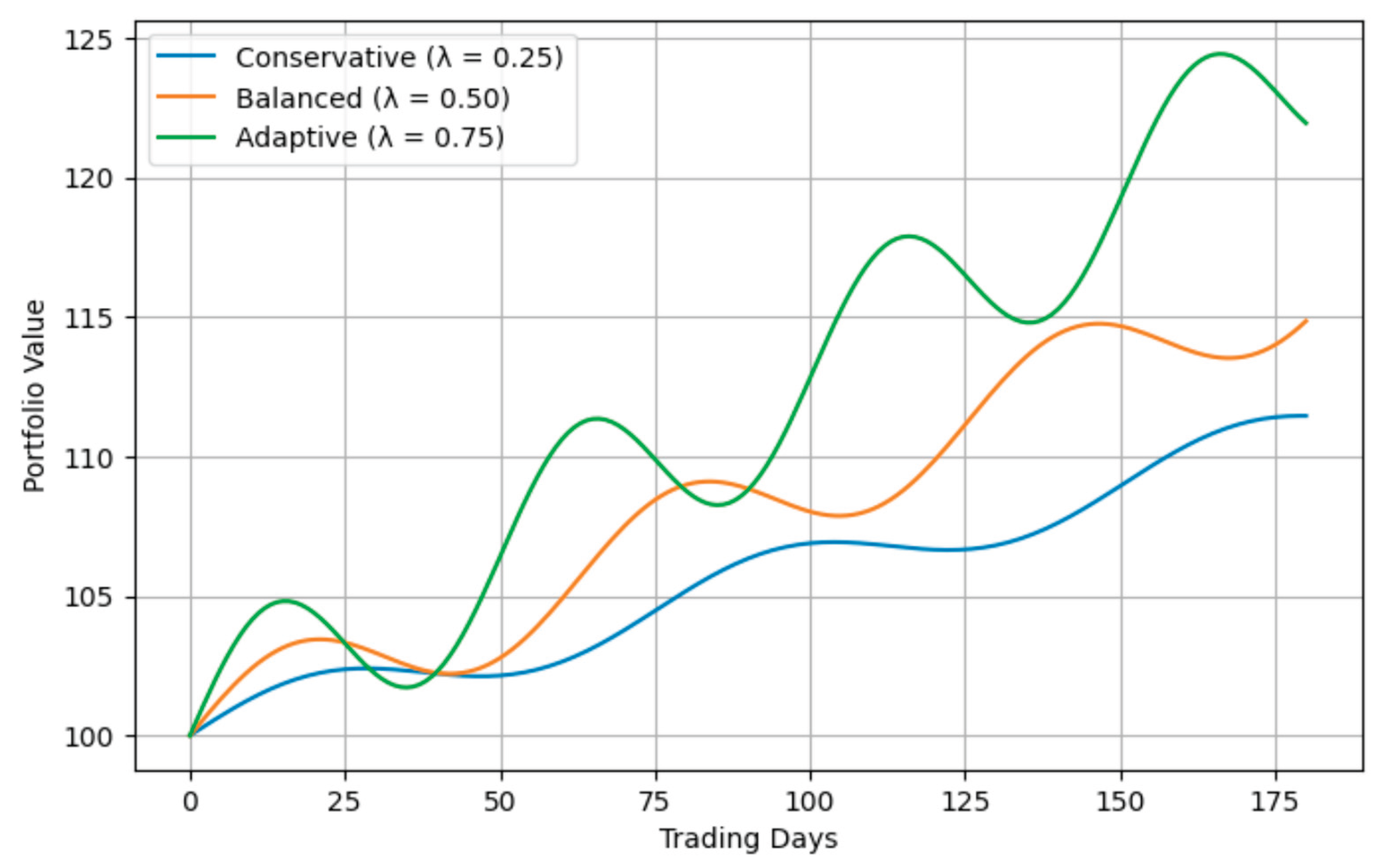

Table 1.
Optimal Portfolio Allocations under Behavioral Strategies.
| Strategy | BTC | ETH | SOL | BNB |
|---|---|---|---|---|
| Conservative ( = 0.25) | 0.42 | 0.31 | 0.15 | 0.12 |
| Balanced ( = 0.50) | 0.35 | 0.33 | 0.18 | 0.14 |
| Adaptive ( = 0.75) | 0.28 | 0.34 | 0.22 | 0.16 |
Table 2.
Performance Metrics under Behavioral Adaptive Strategies.
| Strategy | Expected Return (%) | Sharpe Ratio |
Max Drawdown (%) |
Transaction Cost (%) |
|---|---|---|---|---|
| Conservative ( = 0.25) | 4.3 | 0.96 | 11.8 | 0.7 |
| Balanced ( = 0.50) | 6.1 | 1.18 | 14.6 | 1.0 |
| Adaptive ( = 0.75) | 7.5 | 1.31 | 18.9 | 1.4 |
Disclaimer/Publisher’s Note: The statements, opinions and data contained in all publications are solely those of the individual author(s) and contributor(s) and not of MDPI and/or the editor(s). MDPI and/or the editor(s) disclaim responsibility for any injury to people or property resulting from any ideas, methods, instructions or products referred to in the content. |
© 2026 by the authors. Licensee MDPI, Basel, Switzerland. This article is an open access article distributed under the terms and conditions of the Creative Commons Attribution (CC BY) license (http://creativecommons.org/licenses/by/4.0/).
Copyright: This open access article is published under a Creative Commons CC BY 4.0 license, which permit the free download, distribution, and reuse, provided that the author and preprint are cited in any reuse.


