
Submitted:
25 May 2026
Posted:
25 May 2026
You are already at the latest version
Abstract
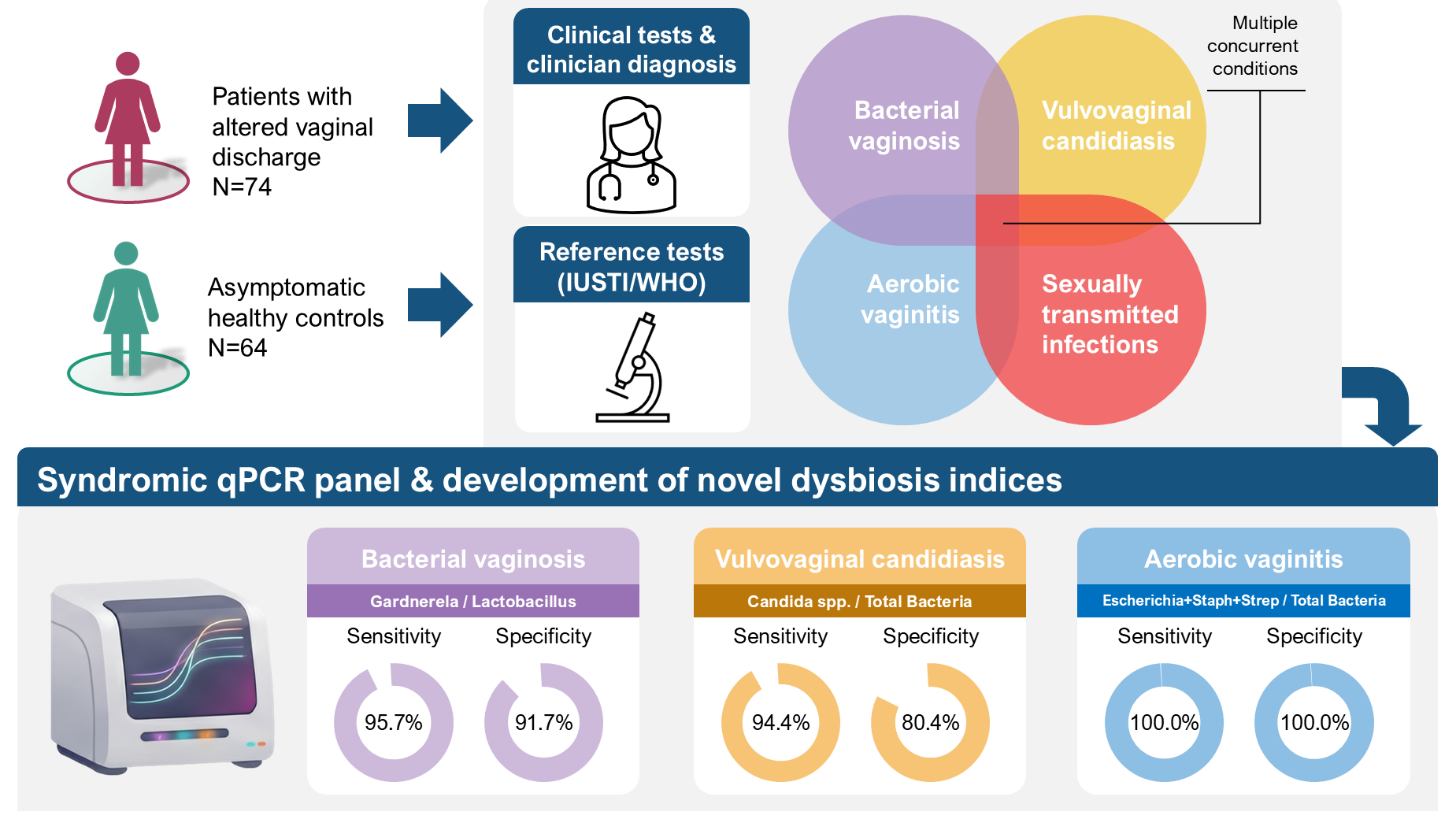
Background/Objectives: Abnormal vaginal discharge (AVD) is a common complaint among women of reproductive age often involving multiple, overlapping etiologies, most commonly bacterial vaginosis (BV), vulvovaginal candidiasis (VVC), aerobic vaginitis (AV), and sexually transmitted infections (STIs). We aimed to evaluate a syndromic diagnostic approach by developing qPCR-derived dysbiosis indices for BV, VVC, and AV, subsequently comparing their performance against established reference methods and clinician-assigned diagnoses. Methods: Vaginal swabs were collected in a case-control design from 74 symptomatic and 64 asymptomatic women at two clinics in Slovenia. Commercial qPCR assays quantified microbial species associated with AVD. Relative abundances were integrated into novel dysbiosis indices. Diagnostic performance was validated against Nugent scoring (BV), semiquantitative Candida culture with clinical symptoms (VVC), and Hay–Ison criteria (AV). Results: The dysbiosis indices demonstrated significantly higher agreement with their respective reference tests compared to clinician-assigned diagnoses across all three conditions. The syndromic approach further revealed that mixed etiologies were frequent, providing diagnostic resolution for this patient subset. Conclusions: qPCR-based microbial dysbiosis indices offer a robust alternative to microscopy, particularly in settings where microscopy is not routinely performed. This syndromic testing improves the accuracy of AVD evaluation and supports more targeted clinical management.
Keywords:
vaginal discharge
; bacterial vaginosis
; aerobic vaginitis
; candida
; sexually transmitted infections
Copyright: This open access article is published under a Creative Commons CC BY 4.0 license, which permit the free download, distribution, and reuse, provided that the author and preprint are cited in any reuse.


