

Submitted:
25 May 2026
Posted:
25 May 2026
You are already at the latest version
Abstract
Small and medium-sized enterprises (SMEs) in the food and beverage industry play an important role in advancing economic, social and environmental sustainability in emerging economies. However, many resource-endowed SMEs remain unable to translate their potential into sustainable business outcomes. This study examines the factors influencing the business sustainability of food and beverage SMEs in Northeastern Thailand and explains how organizational capabilities are hierarchically structured to create sustainable competitive advantage. A mixed-methods design was employed. Qualitative in-depth interviews with entrepreneurship-incubation experts informed the development of the research instrument, while quantitative data were collected from 401 entrepreneurs in the three highest-GPP provinces: Nakhon Ratchasima, Khon Kaen and Ubon Ratchathani. Structural equation modelling was used to test causal relationships among strategic planning, finance and accounting, leadership, business knowledge, product development and external factors. The model demonstrated acceptable fit and explained 92% of the variance in business sustainability. Strategic planning emerged as the strongest direct driver, supported by business knowledge and product development as complementary capabilities. In contrast, finance, leadership and external factors showed no significant direct effects, suggesting indirect or contextual roles. The study proposes a Planning-Centric Sustainability Model and contributes to Resource-Based View and Dynamic Capabilities perspectives in emerging economies.
Keywords:
SME sustainability
; dynamic capabilities
; resource-based view
; emerging economies
; food and beverage industry
1. Introduction
Small and medium-sized enterprises (SMEs) are central to sustainable development because they generate employment, support local value chains, stimulate innovation and contribute to regional economic resilience. In emerging economies, SMEs are particularly important because they connect local resources, communities and markets, while also facing persistent constraints in finance, management capability, technology adoption and market access [1,2]. Sustainability in the SME context therefore extends beyond short-term profitability. It refers to the ability of firms to maintain economic viability, adapt to changing environments, contribute to social well-being and manage resources responsibly over time [3,4]. For food and beverage SMEs, this issue is especially significant because their activities are closely linked to agriculture, local employment, food systems, consumer health and resource use.
Thailand provides an important context for examining SME sustainability. The country’s 20-Year National Strategy (2018–2037) positions entrepreneurship, innovation, productivity improvement and value-added production as key mechanisms for achieving “security, prosperity and sustainability” [5]. However, recent economic conditions show that achieving this goal remains challenging. Thailand’s economic recovery has been uneven, with growth constrained by external uncertainty, weaker demand, household debt pressures and uneven private investment [6,7]. These conditions place additional pressure on SMEs, which often operate with limited resources and weaker resilience than large firms.
The food and beverage sector is one of Thailand’s most important economic sectors. Thailand is internationally recognized as a major food and agricultural exporter with a well-developed food processing industry [8]. Recent industry reports also show continued opportunities in processed foods, health foods, functional foods, plant-based products and convenience-oriented food products [9]. At the same time, the sector faces increasing challenges from rising operating costs, changing consumer demand, export uncertainty and slower domestic purchasing power [9]. These conditions make sustainability a strategic issue for food and beverage SMEs. Firms are not only required to survive market disruption but also to improve products, manage costs, develop knowledge and respond to external change.
Northeastern Thailand provides a particularly relevant regional setting for this study. The region is one of Thailand’s largest agricultural areas and has strong potential for value-added food and beverage processing. Its abundant agricultural resources create opportunities for local entrepreneurs to transform raw materials into higher-value products, strengthen local supply chains and support regional development. However, the region continues to experience economic disparities when compared with more industrialized and urbanized parts of the country [10]. This creates an important sustainability paradox: although the region is rich in agricultural resources, many SMEs remain unable to convert these resources into sustainable business outcomes. The central issue is therefore not simply whether entrepreneurs possess resources, but how they organize, develop and mobilize those resources through firm-level capabilities.
Previous research has examined several factors associated with SME sustainability and performance, including financial management, leadership, strategic planning, business knowledge, innovation capability, product development and external environmental conditions [11,12,13]. However, findings remain mixed. Some studies suggest that internal capabilities, such as strategic planning and innovation, are important for SME resilience and long-term performance [12,14]. Other studies emphasize the importance of external pressures, institutional support, market conditions and stakeholder expectations in shaping sustainability practices [15,16]. These different perspectives indicate that SME sustainability is not driven by a single factor. Rather, it may depend on the interaction between internal capabilities and external conditions.
The theoretical debate also remains open. The Resource-Based View (RBV) argues that firms achieve sustained competitive advantage when they possess valuable, rare, inimitable and non-substitutable resources [17,18]. This perspective is useful for explaining why some SMEs perform better than others. However, RBV has been criticized for giving insufficient attention to how firms adapt when environments change. Dynamic Capabilities theory responds to this limitation by emphasizing the firm’s ability to sense opportunities, seize resources and reconfigure capabilities in response to uncertainty [19]. The Competency-Based View further highlights the role of knowledge, learning and coordinated managerial action in transforming resources into organizational outcomes [20]. These perspectives suggest that business sustainability may depend not only on the presence of resources or individual competencies, but also on how capabilities are structured and coordinated.
Despite these theoretical advances, there remains limited empirical evidence on how different SME capabilities are hierarchically organized to support sustainability, particularly in food and beverage SMEs located in emerging regional economies. Much of the existing research treats factors such as finance, leadership, planning, knowledge and product development as separate predictors. This approach provides useful evidence but offers limited explanation of whether some capabilities function as core coordinating mechanisms while others play supporting, indirect or contextual roles. Addressing this gap is important for both theory and practice because capability-building programs, incubation services and public policy interventions often need to know which capabilities should be prioritized.
Accordingly, this study aims to examine the factors influencing the business sustainability of food and beverage SMEs in Northeastern Thailand and to model how these factors are structured as a capability system. The study focuses on six factors: strategic planning, finance and accounting, leadership, business knowledge, product development and external factors. A mixed-methods research design was employed. Qualitative in-depth interviews with entrepreneurship-incubation experts were used to support instrument development, followed by a quantitative survey of 401 food and beverage entrepreneurs in Nakhon Ratchasima, Khon Kaen and Ubon Ratchathani. Structural equation modelling was then applied to test the relationships among the proposed factors.
The principal conclusion of this study is that SME sustainability is best understood as a planning-centric capability system. Strategic planning emerged as the strongest direct driver of business sustainability, while business knowledge and product development operated as complementary capabilities. In contrast, finance and accounting, leadership and external factors did not show significant direct effects, suggesting that their roles may be indirect, enabling or contextual rather than independently predictive. Based on these findings, the study proposes a Planning-Centric Sustainability Model. This model contributes to sustainability and SME literature by explaining how regional food and beverage SMEs can transform local resources into sustainable business value through the coordination of strategic, knowledge-based and innovation-related capabilities.
2. Literature Review
The literature review is organized into four main themes: the Competency-Based View, the Resource-Based View, Dynamic Capabilities, and the sustainable development of SMEs. These perspectives are then integrated to explain how the six factors examined in this study—strategic planning, finance and accounting, leadership, business knowledge, product development, and external factors—may operate as a hierarchical capability system influencing SME sustainability.
2.1. Competency-Based View
The Competency-Based View (CBV) explains firm competitiveness by focusing on the knowledge, skills, routines and coordinated actions embedded within an organization. The concept is closely linked to the idea of core competence, which argues that sustainable competitive advantage arises not merely from products or services, but from deeper organizational capabilities that are difficult for competitors to imitate [20]. Competencies are therefore not isolated skills; rather, they are integrated patterns of knowledge, behavior and managerial action that enable firms to use resources effectively.
In the SME context, CBV is particularly relevant because the entrepreneur or owner-manager often plays a central role in shaping the firm’s competence base. Unlike large corporations, SMEs usually have less formalized systems and fewer specialized departments. As a result, entrepreneurial competencies are often embedded in the founder’s experience, decision-making ability, market understanding, networks and commitment. Man et al. proposed an entrepreneurial competency framework consisting of opportunity, relationship, conceptual, organizing, strategic and commitment competencies, showing that these competencies are important for SME competitiveness and long-term performance [22]. Similarly, Ahmad et al. found that entrepreneurial competencies are associated with SME success, although this relationship may depend on the business environment in which the firm operates [23].
CBV therefore provides a useful foundation for this study because it allows the success factors of SMEs to be understood as part of a competency system. Strategic planning, business knowledge, leadership, financial management and product development can all be interpreted as firm-level competencies that help entrepreneurs convert available resources into sustainable business outcomes.
2.2. Resource-Based View
The Resource-Based View (RBV) provides a complementary explanation of firm-level sustainability by emphasizing the strategic importance of internal resources. Penrose argued that the growth of the firm depends not only on the resources it possesses, but also on the productive services that those resources can generate [21]. This argument is highly relevant to SMEs because many resource-endowed firms may still fail to grow if they lack the capability to organize and apply resources effectively.
Wernerfelt later formalized RBV by arguing that firms can be analyzed in terms of their resources, including tangible and intangible assets [18]. Barney further developed the theory by proposing that sustained competitive advantage arises from resources that are valuable, rare, imperfectly imitable and non-substitutable [17]. These resources may include financial capital, physical assets, human capital, organizational culture, knowledge, reputation, customer relationships and managerial experience.
In food and beverage SMEs, important resources may include local agricultural raw materials, product-specific knowledge, supplier relationships, recipes, production know-how, brand identity, customer trust and entrepreneurial experience. However, RBV also implies that resources alone are insufficient. For example, access to agricultural raw materials does not automatically lead to sustainable business performance unless entrepreneurs can transform those resources into marketable products, manage costs, create customer value and respond to changing demand. Therefore, this study uses RBV to explain why finance and accounting, leadership and business knowledge may function as strategic resources or capability foundations for SME sustainability.
2.3. Dynamic Capabilities
Dynamic Capabilities theory was developed to address a limitation of RBV. While RBV explains how firms achieve competitive advantage through valuable resources, it is less able to explain how firms adapt when environments are uncertain or rapidly changing [19]. Dynamic Capabilities theory focuses on the firm’s ability to integrate, build and reconfigure internal and external competencies in response to environmental change [19].
Teece later explained dynamic capabilities through three micro-foundations: sensing, seizing and reconfiguring [24]. Sensing refers to the ability to identify opportunities and threats in markets, technologies and consumer behavior. Seizing refers to the ability to mobilize resources and make strategic decisions to capture opportunities. Reconfiguring refers to the ability to renew organizational resources, processes and structures in response to change [24]. These three processes are highly relevant to food and beverage SMEs because entrepreneurs must continuously respond to changes in consumer preferences, input costs, technology, distribution channels, food trends and regulatory requirements.
Dynamic capabilities are also related to adaptive capability, absorptive capability and innovative capability [25]. Adaptive capability allows firms to adjust to environmental changes; absorptive capability enables firms to acquire and apply external knowledge; and innovative capability supports the development of new products, services and processes. In SMEs, these capabilities may appear in less formal but more flexible forms than in large organizations. Eisenhardt and Martin argued that dynamic capabilities can take the form of identifiable routines, but their specific patterns may vary across market conditions [26]. For food and beverage SMEs, dynamic capabilities are often embedded in the entrepreneur’s ability to learn from customers, adjust products, use external support and reconfigure resources quickly.
In this study, dynamic capabilities help explain how business knowledge, strategic planning, product development and external responsiveness may contribute to sustainability. Business knowledge supports sensing, strategic planning supports seizing, and product development reflects the firm’s ability to reconfigure resources into new value propositions.
2.4. SME Sustainability and Capability Integration
Business sustainability in SMEs is commonly understood through economic, social and environmental dimensions. The triple bottom line perspective emphasizes that firms should create value not only through financial performance, but also through social contribution and environmental responsibility [27]. For SMEs, however, sustainability often begins with economic viability because survival, cash flow, profitability and market continuity are necessary before firms can consistently pursue broader social and environmental goals [3,4].
Previous research has shown that SME sustainability depends on both internal capabilities and external conditions. Internal factors include strategic planning, leadership, financial management, knowledge, innovation, product development and managerial capability [11,28,29]. External factors include government support, market conditions, technology change, competition, regulations, customer demand and broader economic uncertainty [30,31]. In emerging economies, these external factors are especially important because SMEs often operate in environments where institutional support, access to finance, infrastructure and market information may be unevenly developed.
In the Thai context, previous studies have found that SME success is influenced by multiple factors, including management capability, knowledge, product and service quality, customer and market orientation, finance, strategy and the external environment [32,33]. However, many studies still treat these factors as independent predictors of success. This limits the theoretical explanation of how different capabilities interact or whether some capabilities are more central than others in generating sustainability outcomes.
To address this limitation, the present study integrates CBV, RBV and Dynamic Capabilities into a hierarchical capability system. RBV explains the importance of firm resources; CBV explains how knowledge, skills and managerial competencies coordinate those resources; and Dynamic Capabilities theory explains how firms adapt and renew their competencies under changing conditions. This integrated perspective supports the argument that SME sustainability is not simply the result of individual factors, but of a structured capability system.
2.5. Strategic Planning and Business Sustainability
Strategic planning refers to the process of setting goals, analyzing internal and external environments, allocating resources and determining future courses of action. In SMEs, strategic planning may be informal, but it remains essential because it helps entrepreneurs clarify direction, reduce uncertainty and make better decisions about resource allocation. Strategic planning can also help SMEs integrate sustainability concerns into business models, operations and product development.
Previous research has shown that systematic strategic planning positively influences the sustainable performance of SMEs [34]. Strategic planning research also suggests that planning improves coordination, decision quality and strategic alignment within organizations [35]. For food and beverage SMEs, strategic planning is particularly important because entrepreneurs must respond to changing consumer preferences, manage production costs, identify target markets, develop products and comply with quality or safety requirements.
From the RBV perspective, strategic planning helps firms organize resources into value-creating activities. From the CBV perspective, it reflects a managerial competency that coordinates knowledge, finance, leadership and innovation. From the Dynamic Capabilities perspective, strategic planning supports the seizing process by enabling entrepreneurs to select opportunities and mobilize resources. Therefore, strategic planning is expected to positively influence business sustainability.
H1. Strategic planning has a positive direct effect on the business sustainability of food and beverage SMEs.
2.6. Finance and Accounting Capability and Business Sustainability
Finance and accounting capability refers to the ability of SMEs to record financial information, control costs, manage cash flow, assess profitability, plan budgets and make informed financial decisions. Financial management is widely recognized as a critical capability for SME survival because many small firms face liquidity constraints, limited access to credit and weak financial systems [36,37].
In the context of sustainability, finance and accounting capability enables entrepreneurs to evaluate whether business strategies and product development activities are economically feasible. It also supports investment decisions, cost control and risk management. For food and beverage SMEs, this capability is especially important because firms often face volatile input prices, inventory management challenges, production costs and uncertain market demand.
However, the role of finance and accounting capability may be both direct and enabling. It may directly support sustainability by improving financial stability, but it may also indirectly support other capabilities such as strategic planning and product development. Therefore, the relationship requires empirical testing.
H2. Finance and accounting capability has a positive direct effect on the business sustainability of food and beverage SMEs.
2.7. Leadership and Business Sustainability
Leadership is a key factor in SME sustainability because owner-managers often act as the main decision-makers, resource coordinators and drivers of organizational change. Leadership affects vision, employee motivation, organizational culture, learning, innovation and the firm’s willingness to pursue long-term goals. Sustainable leadership also encourages resilience, ethical decision-making and stakeholder-oriented management [38].
Empirical evidence from Thai SMEs suggests that sustainable leadership practices can support financial performance and business resilience [39]. In food and beverage SMEs, leadership may influence sustainability by shaping how entrepreneurs respond to market uncertainty, develop employees, manage relationships and implement strategic decisions. However, leadership may not always produce direct sustainability outcomes unless it is translated into concrete strategic plans, financial systems, product development and organizational learning.
Therefore, leadership is expected to contribute positively to business sustainability, although its role may be direct or mediated through other managerial capabilities.
H3. Leadership has a positive direct effect on the business sustainability of food and beverage SMEs.
2.8. Business Knowledge and Business Sustainability
Business knowledge refers to the entrepreneur’s understanding of customers, markets, competitors, operations, regulations, marketing, finance and business development. Knowledge is a key intangible resource because it allows firms to identify opportunities, solve problems and make informed decisions. The knowledge-based view of the firm emphasizes that knowledge is one of the most strategically important resources because it supports coordination, learning and value creation [40].
For food and beverage SMEs, business knowledge is especially important because entrepreneurs must understand food trends, consumer preferences, pricing, distribution channels, branding, quality standards and competitive positioning. Business knowledge supports sustainability by improving decision-making, enhancing market responsiveness and enabling firms to adapt to changing demand.
From the Dynamic Capabilities perspective, business knowledge supports sensing and learning. Entrepreneurs with stronger business knowledge are more likely to detect market opportunities, understand customer needs and make strategic adjustments. Therefore, business knowledge is expected to positively influence business sustainability.
H4. Business knowledge has a positive direct effect on the business sustainability of food and beverage SMEs.
2.9. Product Development Capability and Business Sustainability
Product development capability refers to the ability of firms to create, improve and commercialize products that respond to customer needs and market opportunities. In food and beverage SMEs, product development may include improvements in taste, packaging, nutrition, shelf life, safety, branding, convenience, functional benefits and environmental friendliness.
Innovation and product development are important for SME sustainability because they allow firms to differentiate products, create value-added offerings and respond to changing consumer preferences. Research has shown that innovation capability can contribute to SME performance and competitive advantage, although the relationship may depend on firm size, market conditions and the type of innovation pursued [41]. Sustainability-oriented innovation is also particularly important for SMEs because it can help firms improve resource efficiency, reduce waste and create products that meet changing stakeholder expectations [42].
In resource-endowed regions, product development capability is especially important because it allows entrepreneurs to transform local agricultural raw materials into higher-value food and beverage products. Therefore, product development capability is expected to positively affect business sustainability.
H5. Product development capability has a positive direct effect on the business sustainability of food and beverage SMEs.
2.10. External Factors and Business Sustainability
External factors refer to environmental conditions outside the firm that influence business operation and sustainability. These include market competition, customer demand, government support, technology change, economic conditions, regulations, infrastructure and supply-chain conditions. For SMEs, external factors can create both opportunities and constraints.
Institutional theory suggests that firms are influenced by rules, norms and expectations in their external environment [43]. Stakeholder theory also suggests that firms must respond to the needs and pressures of customers, suppliers, employees, communities, regulators and other stakeholders [44]. In SME sustainability research, external support and pressure are often found to influence sustainability practices, innovation and performance [45].
However, the effect of external factors may depend on the firm’s internal capabilities. External support may not produce sustainable outcomes if SMEs lack planning, knowledge, leadership or product development capability. Conversely, firms with stronger internal capabilities may be better able to use external opportunities to improve sustainability. Therefore, external factors may function as contextual or enabling conditions, but this study tests whether they also have a direct effect on business sustainability.
H6. External factors have a positive direct effect on the business sustainability of food and beverage SMEs.
2.11. Integration into a Hierarchical Capability System
The six factors examined in this study are not treated merely as independent predictors. Instead, they are conceptualized as components of a hierarchical capability system. Drawing on RBV, CBV and Dynamic Capabilities theory, the factors can be organized into three capability layers.
The first layer consists of foundational capabilities, including finance and accounting capability and leadership. These capabilities provide the basic managerial and resource-control conditions necessary for SME survival. They correspond to the basic resources emphasized in RBV and the managerial competencies emphasized in CBV.
The second layer consists of integrative capabilities, including strategic planning and business knowledge. These capabilities help entrepreneurs interpret information, make decisions and convert resources into actionable strategies. They correspond to the strategic and conceptual competencies in CBV and the seizing function in Dynamic Capabilities theory.
The third layer consists of dynamic capabilities, including product development and responsiveness to external factors. These capabilities allow firms to adapt to market change, develop new value propositions and reconfigure resources in response to opportunities and threats. They correspond to the sensing and reconfiguring functions of Dynamic Capabilities theory.
This hierarchical perspective provides the theoretical basis for the Planning-Centric Sustainability Model tested in this study. While all six factors are expected to have positive effects on sustainability, the model also allows their relative importance to be compared. This is important because SME support programs, incubation services and regional policies need to understand not only which factors matter, but also which capabilities should be prioritized to enhance sustainable business outcomes.
3. Research Methodology
3.1. Research Design
This study employed a mixed-methods research design combining qualitative and quantitative approaches. The mixed-methods design was appropriate because the study aimed not only to test causal relationships among predetermined variables but also to ensure that the research instrument reflected the practical realities of food and beverage SMEs in Northeastern Thailand. The qualitative phase was used to explore the business context, identify practical challenges faced by entrepreneurs and refine the measurement items. The quantitative phase was then used to test the hypothesized relationships among the six independent variables and business sustainability through structural equation modelling.
The overall research process consisted of nine stages, as presented in Figure 1. First, the research objective was defined as identifying the factors influencing the sustainability of food and beverage SMEs. Second, the literature review was conducted based on the Competency-Based View, Resource-Based View, Dynamic Capabilities theory and SME sustainability literature. Third, the conceptual framework was developed by identifying six key factors: strategic planning, finance and accounting, leadership, business knowledge, product development and external factors. Fourth, a mixed-methods design was implemented, beginning with qualitative expert interviews and followed by a quantitative questionnaire survey. Fifth, the questionnaire was developed and validated through expert review, the Item-Objective Congruence index and pilot testing. Sixth, data were collected, screened and prepared for analysis. Seventh, structural equation modelling using maximum likelihood estimation was conducted. Eighth, model fit was evaluated using standard goodness-of-fit indices. Finally, hypothesis testing and model building were performed to develop the Planning-Centric Sustainability Model.
3.2. Qualitative Phase
The qualitative phase consisted of in-depth interviews with entrepreneurship-incubation experts and entrepreneurs. The purpose of this phase was to obtain contextual insights into the factors affecting the sustainability of food and beverage SMEs and to ensure that the questionnaire reflected both theoretical constructs and real-world business conditions. The interview topics covered business planning, financial and accounting practices, leadership, business knowledge, product development, external environmental conditions and sustainability outcomes.
The findings from the qualitative phase were used together with the literature review to refine the questionnaire items. This process helped improve content relevance and ensured that the instrument was suitable for the context of food and beverage SMEs in Northeastern Thailand.
3.3. Quantitative Phase, Population and Sampling
The quantitative phase collected survey data from food and beverage entrepreneurs located in the three provinces with the highest gross provincial product (GPP) in Northeastern Thailand: Nakhon Ratchasima, Khon Kaen and Ubon Ratchathani. These provinces were selected because they represent major economic centers of the region and have strong potential for food and beverage entrepreneurship, agricultural value addition and regional supply-chain development.
In 2022, the target population consisted of 23,799 food and beverage businesses across the three provinces. Of these, 8,246 businesses were located in Nakhon Ratchasima, 8,178 in Khon Kaen and 7,375 in Ubon Ratchathani. The required sample size was calculated using Yamane’s formula at a 95% confidence level and a 5% margin of error [46]. The minimum required sample size was 394 respondents. To increase the adequacy of the sample and compensate for possible unusable responses, 402 questionnaires were collected.
A combination of stratified sampling and purposive sampling was used. Stratified sampling was applied to ensure that respondents were proportionally drawn from the three selected provinces. Purposive sampling was then used to select respondents who were entrepreneurs, owners or managers of food and beverage SMEs and who had sufficient knowledge of their business operations. After data screening, one outlier was removed, resulting in 401 valid cases for analysis.
3.4. Research Instrument
The research instrument was a structured questionnaire developed from the literature review and qualitative findings. The questionnaire consisted of three main parts. The first part collected general business information, including business characteristics and respondent background. The second part measured the six factors affecting SME sustainability: strategic planning, finance and accounting, leadership, business knowledge, product development and external factors. Each factor was measured using seven items, resulting in 42 items. The third part measured business sustainability using eight items covering business continuity, revenue stability, liquidity, customer retention, customer expansion, cost control, adaptability and sustainable growth trend.
The questionnaire used a Likert-type scale to measure respondents’ level of agreement with each statement. The scale was appropriate for measuring perceptions, managerial practices and sustainability-related outcomes among SME entrepreneurs.
3.5. Validity and Reliability
Content validity was assessed using the Item-Objective Congruence (IOC) index. A panel of experts reviewed each questionnaire item to determine whether it was consistent with the research objectives and the intended construct. The expert review confirmed that all items met the acceptable IOC criterion and were therefore retained for pilot testing.
Reliability was assessed using Cronbach’s alpha based on a pilot test with 40 respondents, representing approximately 10% of the required sample size. A Cronbach’s alpha value of 0.70 or above was considered acceptable for internal consistency [47]. The reliability results indicated that all latent variables met the recommended threshold. Specifically, Cronbach’s alpha values were 0.74 for strategic business planning, 0.95 for finance and accounting, 0.94 for organizational leadership, 0.95 for business knowledge, 0.90 for product development, 0.85 for external factors and 0.90 for business sustainability. These results indicate that the questionnaire demonstrated acceptable to excellent internal consistency and was suitable for full-scale data collection.
3.6. Data Screening
Before conducting structural equation modelling, the dataset was screened to ensure its suitability for multivariate analysis. Five screening procedures were conducted: outlier detection, missing data assessment, normality testing, linearity assessment and multicollinearity diagnosis.
First, multivariate outliers were assessed using Mahalanobis distance in SPSS, with a significance criterion of p < 0.001. One outlier was identified and removed, leaving 401 valid cases. Second, missing data were examined, and no missing values were found. Third, normality was assessed using skewness and kurtosis. The skewness values were within ±2 and the kurtosis values were within ±7, indicating an acceptable approximation of normality for SEM analysis [48]. Fourth, linearity was assessed using Jamovi, and the relationships between the six independent variables and business sustainability were found to be predominantly positive and linear. Fifth, multicollinearity was assessed using Pearson correlation coefficients, variance inflation factor values and tolerance values. All pairwise correlations were below 0.70, all VIF values were below 3.00 and all tolerance values exceeded 0.20, indicating that multicollinearity was not a serious concern.
Reliability was also rechecked during the data screening process. Items with corrected item-total correlations below 0.30 were considered weak and removed. After item refinement, composite reliability values ranged from 0.693 to 0.876, indicating acceptable construct reliability for further analysis.
3.7. Analytical Strategy
Structural equation modelling was employed to test the hypothesized relationships among the six independent latent variables and the dependent latent variable of business sustainability. SEM was appropriate for this study because it allows simultaneous assessment of the measurement model and the structural model, while also accounting for measurement error among latent constructs [49].
The analysis was conducted in two stages. First, confirmatory factor analysis was used to assess the measurement model. The CFA examined whether the observed indicators adequately represented their respective latent variables. Items with low standardized factor loadings below 0.60 were removed iteratively, while ensuring that each latent variable retained at least three valid indicators. Construct reliability and model fit were also assessed.
Second, the structural model was tested to examine the direct effects of strategic planning, finance and accounting, leadership, business knowledge, product development and external factors on business sustainability. Parameters were estimated using maximum likelihood estimation, which is suitable for large samples and approximately normally distributed data. Since the final sample size was 401, it exceeded the recommended minimum sample size for SEM and was considered adequate for maximum likelihood estimation [49,50].
Model fit was evaluated using multiple goodness-of-fit indices, including the chi-square statistic, root mean square error of approximation, standardized root mean square residual and comparative fit index. A good model fit was indicated by RMSEA values below 0.08, SRMR values below 0.08 and CFI values close to or above 0.90 [48,49]. Hypotheses H1–H6 were tested based on the sign, size and statistical significance of the standardized path coefficients.
4. Result
4.1. Sample Profile
The final sample consisted of 401 valid responses from food and beverage SME entrepreneurs in Nakhon Ratchasima, Khon Kaen and Ubon Ratchathani. Most respondents had operated their businesses for three to five years, representing 37.06% of the sample. A majority of businesses were operated as unregistered sole proprietorships, accounting for 60.70%, while 52.99% were classified as service-oriented food and beverage businesses. In terms of business performance, 42.29% of respondents reported volatile and unstable revenue over the preceding three years.
This profile suggests that the sample largely represents informal and micro-scale food and beverage entrepreneurs. Such characteristics are common in regional emerging-economy contexts, where many SMEs operate with limited formalization, constrained managerial systems and high exposure to market uncertainty. The sample was therefore appropriate for examining how firm-level capabilities influence business sustainability among resource-constrained food and beverage SMEs.
4.2. Measurement Model
Confirmatory factor analysis was conducted to assess the adequacy of the measurement model. The model was refined through five iterations by removing indicators with low standardized factor loadings while ensuring that each latent variable retained at least three valid indicators. In the final measurement model, standardized factor loadings ranged from 0.517 to 0.845, and all retained indicators were statistically significant at p < 0.001. These results indicate that the observed indicators adequately represented their respective latent constructs.
The overall measurement model demonstrated an acceptable fit with the empirical data. Although the chi-square statistic was significant, χ² = 767, df = 303, p < 0.001, this result was expected due to the relatively large sample size. Other fit indices provided stronger evidence of model adequacy. The RMSEA value was 0.062 and the SRMR value was 0.055, both of which were below the recommended threshold of 0.08. The incremental fit indices were also within an acceptable range, with CFI = 0.885, TLI = 0.866, IFI = 0.886 and NFI = 0.825. Although some indices were slightly below the conventional 0.90 cut-off, values between 0.80 and 0.90 may be considered acceptable in applied social science research, particularly when the model is theoretically grounded and includes multiple latent constructs. Taken together, the fit indices indicate that the measurement model was sufficiently consistent with the empirical data for further structural analysis.
4.3. Structural Model and Hypothesis Testing
Structural equation modelling was used to test the direct effects of the six independent latent variables on business sustainability. The results are summarized in Table 1 and illustrated in Figure 2. The model explained 92% of the variance in business sustainability, indicating strong explanatory power. Following Fornell and Larcker [51], the high coefficient of determination was interpreted together with the model fit indices, theoretical consistency and path significance to reduce the risk of overinterpreting model fit or overfitting.
The results show that three hypotheses were supported. Strategic planning had the strongest positive direct effect on business sustainability, β = 0.255, p < 0.001, supporting H1. Business knowledge also had a significant positive effect, β = 0.181, p = 0.006, supporting H4. Product development had a significant positive effect as well, β = 0.148, p = 0.027, supporting H5. These findings indicate that food and beverage SME sustainability is most strongly influenced by capabilities related to planning, knowledge and product innovation.
In contrast, finance and accounting, leadership and external factors did not show statistically significant direct effects on business sustainability. Finance and accounting had a positive but non-significant effect, β = 0.103, p = 0.082, leading to the rejection of H2. Leadership also showed a positive but non-significant effect, β = 0.093, p = 0.142, leading to the rejection of H3. External factors had the weakest and non-significant effect, β = 0.071, p = 0.257, leading to the rejection of H6.
The non-significant results do not necessarily imply that finance and accounting, leadership and external factors are unimportant. Rather, their positive but non-significant coefficients suggest that these factors may play indirect, enabling or contextual roles. For example, finance and accounting may support sustainability by strengthening strategic planning and resource allocation, while leadership may influence sustainability through its effect on planning, learning and product development. Similarly, external factors may shape the business environment but may not directly generate sustainable outcomes unless entrepreneurs possess the internal capabilities needed to respond effectively.
The full structural model is presented in Figure 2. Significant paths are represented by solid lines, while non-significant paths are represented by dashed lines. The model supports the view that business sustainability among food and beverage SMEs is not equally driven by all organizational factors. Instead, sustainability appears to be primarily explained by a planning-centric capability structure in which strategic planning functions as the strongest direct driver, supported by business knowledge and product development.
5. Discussion
This study examined the factors influencing the business sustainability of food and beverage SMEs in Northeastern Thailand and developed a structural model explaining how these factors operate as a capability system. The findings show that business sustainability is not equally driven by all organizational and environmental factors. Instead, sustainability is primarily shaped by three significant capabilities: strategic planning, business knowledge and product development. Among these, strategic planning emerged as the strongest direct predictor. Finance and accounting, leadership and external factors showed positive but non-significant direct effects, suggesting that their roles may be indirect, enabling or contextual rather than directly predictive.
These findings support the argument that SME sustainability should be understood not merely as the result of resource possession, but as the outcome of how resources, knowledge and innovation capabilities are organized and mobilized. This interpretation is consistent with the Resource-Based View, which emphasizes the role of valuable and difficult-to-imitate resources [17,18], the Competency-Based View, which highlights the importance of coordinated entrepreneurial competencies [20,22], and Dynamic Capabilities theory, which explains how firms adapt and reconfigure capabilities in changing environments [19,24]. The results therefore extend previous SME sustainability research by showing that capabilities may be hierarchically structured rather than operating as independent predictors.
5.1. Strategic Planning as the Core Capability for SME Sustainability
The strongest finding of this study is that strategic planning had the largest positive direct effect on business sustainability. This result supports H1 and confirms that strategic planning is a central capability for food and beverage SMEs. In practical terms, strategic planning enables entrepreneurs to define business direction, allocate limited resources, identify target markets, control costs, plan product development and respond to market uncertainty. This is particularly important in food and beverage SMEs, where firms must deal with changing consumer preferences, fluctuating input prices, competitive pressure and quality-related requirements.
From the Competency-Based View, strategic planning can be interpreted as a higher-order entrepreneurial competency. It reflects not only the ability to prepare a business plan, but also the capacity to translate business vision into measurable objectives, operational priorities and adaptive decisions. This is consistent with Man et al., who identify strategic competency as an important dimension of entrepreneurial competitiveness [22]. From the Resource-Based View, strategic planning functions as a resource-orchestration mechanism. It helps entrepreneurs combine financial resources, human capital, knowledge and market information into coherent actions that support sustainability [17,18]. From the Dynamic Capabilities perspective, strategic planning corresponds closely to the seizing function, because it allows firms to select opportunities and mobilize resources in response to environmental change [24].
This finding is especially relevant to Northeastern Thailand. The region has substantial agricultural resources and potential for food and beverage value creation, yet many local entrepreneurs remain unable to transform this potential into sustainable business outcomes. The results suggest that the core challenge is not simply the lack of resources, but the lack of strategic capability to convert available resources into viable and adaptive business models. This interpretation is consistent with previous studies showing that SME sustainability and performance are strongly influenced by strategic planning, managerial capability and the ability to align resources with market opportunities [28,34,35].
5.2. Business Knowledge and Product Development as Complementary Capabilities
Business knowledge and product development also had significant positive effects on business sustainability, supporting H4 and H5. However, their effects were smaller than that of strategic planning. This suggests that knowledge and product development are important complementary capabilities, but they may generate stronger sustainability outcomes when integrated through a clear strategic direction.
Business knowledge represents an important intangible resource. Entrepreneurs with stronger business knowledge are more capable of understanding customer needs, market trends, pricing, branding, competitors, regulations and distribution channels. From the knowledge-based perspective, knowledge supports coordination, learning and value creation within the firm [40]. In food and beverage SMEs, such knowledge is essential because entrepreneurs must continuously interpret changing consumer preferences, food trends, quality expectations and market opportunities. However, knowledge alone may not automatically lead to sustainability unless it is converted into strategy, decisions and action.
Product development capability also plays a significant role in SME sustainability. For food and beverage SMEs, product development may involve improvements in taste, packaging, shelf life, nutritional value, convenience, branding, food safety or the use of local agricultural inputs. This finding is consistent with innovation literature, which suggests that innovation and product development can enhance SME competitiveness and long-term performance [41,42]. In resource-endowed regions such as Northeastern Thailand, product development is particularly important because it allows entrepreneurs to transform local raw materials into higher-value products.
Together, business knowledge and product development reflect the sensing and adaptation dimensions of Dynamic Capabilities. Business knowledge helps entrepreneurs identify market opportunities, while product development enables them to respond to those opportunities through improved or new offerings [19,24]. However, the relatively smaller effect sizes indicate that these capabilities require strategic planning to fully support sustainability. Without planning, entrepreneurs may possess knowledge or develop products, but these efforts may remain fragmented, reactive or poorly aligned with long-term business goals.
5.3. The Contextual Roles of Finance, Leadership and External Factors
Finance and accounting, leadership and external factors did not have significant direct effects on business sustainability. These results do not mean that these factors are unimportant. Rather, they suggest that these factors may function as foundational or contextual conditions that support sustainability indirectly.
Finance and accounting capability is generally important for SME survival because it supports cost control, cash-flow management, budgeting and investment decisions [36,37]. However, in this study, its direct effect on sustainability was not significant. One possible explanation is that many food and beverage SMEs in the sample were informal or micro-scale businesses. For such firms, financial practices may be basic and survival-oriented rather than strategic. Financial capability may therefore support sustainability only when it is connected to strategic planning, product investment or business growth decisions.
Leadership also showed a positive but non-significant direct effect. In SMEs, leadership is often concentrated in the owner-manager. Leadership may influence the firm’s vision, motivation, learning culture and willingness to change [38,39]. However, leadership may not directly create sustainability unless it is translated into concrete managerial systems, strategic planning and innovation activities. This finding suggests that leadership in SMEs may operate through other capabilities rather than independently producing sustainability outcomes.
External factors also did not show a significant direct effect. This result is theoretically meaningful. External conditions such as market competition, government support, technology change and consumer demand shape the business environment, but they do not automatically generate sustainable outcomes. From a Dynamic Capabilities perspective, what matters is not only the external environment itself, but the firm’s ability to sense, seize and respond to external opportunities and threats [19,24]. Therefore, external factors may act as contextual conditions, while internal capabilities determine whether entrepreneurs can benefit from or adapt to those conditions.
This interpretation helps explain why some SMEs survive and grow under difficult conditions while others struggle despite having similar access to resources or support. In regional emerging economies, sustainability may depend less on favorable external conditions alone and more on the entrepreneur’s ability to strategically respond to uncertainty.
5.4. The Planning-Centric Sustainability Model
The findings support the development of the Planning-Centric Sustainability Model, presented in Figure 3. The model retains only the statistically significant paths and identifies strategic planning as the core capability directly influencing SME sustainability. Business knowledge and product development are positioned as complementary capabilities that support sustainability by providing market understanding and innovation potential.
The model contributes to theory in three ways. First, it extends the Resource-Based View by showing that resources do not automatically produce sustainability. Instead, resources must be coordinated through planning and transformed into action. Second, it refines the Competency-Based View by demonstrating that entrepreneurial competencies are not equal in their contribution to sustainability. Strategic planning appears to be a higher-order competency, while business knowledge and product development operate as complementary competencies. Third, it contributes to Dynamic Capabilities theory by showing that sensing, seizing and reconfiguring may not have equal effects. In this study, the seizing capability, represented by strategic planning, played the most central role.
The model also has practical importance. For food and beverage SME entrepreneurs, the findings suggest that sustainability should begin with clear strategic planning. Entrepreneurs should not focus only on products, finance or external support in isolation. Instead, they should develop planning systems that connect market knowledge, financial decisions, product development and long-term growth objectives. For policymakers, incubators and regional science parks, the findings suggest that SME support programs should prioritize strategic planning capability as the foundation of sustainability-oriented entrepreneurship development.
5.5. Broader Implications and Future Research Directions
The findings have broader implications for sustainability research and regional development policy. For sustainability research, the study shows that SME sustainability in emerging economies should be analyzed through capability systems rather than isolated success factors. This is important because many SMEs possess resources, knowledge or local advantages but still fail to achieve sustainable outcomes. The key issue is how these elements are organized and converted into strategic action.
For regional development, the results suggest that resource-endowed regions require more than raw materials, infrastructure or general support programs. They also need capability-building mechanisms that help entrepreneurs plan, learn, innovate and adapt. In the case of Northeastern Thailand, strengthening strategic planning, business knowledge and product development could help food and beverage SMEs transform agricultural resources into higher-value and more sustainable business outcomes.
Future research could extend this study in several directions. First, future studies may examine the indirect effects among finance, leadership, external factors, strategic planning, business knowledge and product development. This would help clarify whether non-significant factors influence sustainability through mediating variables. Second, longitudinal research could be conducted to examine how SME capabilities evolve over time and whether planning capability leads to sustained performance in the long term. Third, comparative studies across regions, industries or countries could test whether the Planning-Centric Sustainability Model applies beyond food and beverage SMEs in Northeastern Thailand. Finally, future research could incorporate environmental and social sustainability indicators more explicitly to strengthen the multidimensional measurement of SME sustainability.
Overall, the findings indicate that business sustainability among food and beverage SMEs is best understood as a planning-centric capability system. Strategic planning provides the central mechanism through which entrepreneurs organize resources, apply knowledge and guide product development toward sustainable outcomes. Business knowledge and product development strengthen this process, while finance, leadership and external factors appear to play enabling or contextual roles. This capability-based explanation provides a useful foundation for improving SME development programs and sustainability-oriented regional policy in emerging economies.
6. Conclusions and Implications
6.1. Conclusions
This study examined the factors influencing the business sustainability of food and beverage SMEs in Northeastern Thailand and developed a capability-based model explaining how these factors contribute to sustainable business outcomes. Drawing on the Resource-Based View, the Competency-Based View and Dynamic Capabilities theory, the study tested the effects of six factors: strategic planning, finance and accounting, leadership, business knowledge, product development and external factors.
The results show that business sustainability among food and beverage SMEs is primarily driven by strategic planning, business knowledge and product development. Among these factors, strategic planning had the strongest direct effect, indicating that sustainability depends not only on the possession of resources but also on the entrepreneur’s ability to organize resources, define direction and convert knowledge and innovation into actionable business strategies. Business knowledge and product development also contributed significantly to sustainability, suggesting that market understanding and product innovation are important complementary capabilities.
In contrast, finance and accounting, leadership and external factors did not show significant direct effects. These findings suggest that such factors may function as enabling or contextual conditions rather than independent drivers of sustainability. Overall, the study concludes that SME sustainability is best understood as a Planning-Centric Sustainability Model, in which strategic planning functions as the central coordinating capability that transforms resources, knowledge and product development into sustainable business outcomes.
6.2. Theoretical Contributions
This study makes three theoretical contributions. First, it advances SME sustainability research by demonstrating that the determinants of sustainability should not be examined only as isolated factors. Instead, they can be understood as a structured capability system in which some capabilities play central roles while others function as supporting or contextual conditions. This responds to the limitation of previous studies that often examine SME success factors separately without explaining how they are organized into a sustainability mechanism.
Second, the study extends the Resource-Based View and Dynamic Capabilities perspectives by showing that resources and capabilities do not contribute equally to sustainability. Business knowledge and product development are valuable capabilities, but their effects are strengthened when they are guided by strategic planning. This finding supports the argument that resources must be organized, coordinated and converted into action before they can generate sustainable competitive advantage [17,18,19,24].
Third, the study contributes empirical evidence from a regional emerging-economy context that remains under-represented in mainstream SME sustainability research. The case of food and beverage SMEs in Northeastern Thailand shows that resource-endowed regions may still experience weak business sustainability when entrepreneurs lack the strategic capability to transform local resources into marketable and resilient business outcomes.
6.3. Practical and Policy Implications
The findings offer important implications for entrepreneurs, SME development agencies, incubators, regional science parks and policymakers. For entrepreneurs, the results suggest that business sustainability should begin with strategic planning. Food and beverage SMEs should not focus only on access to finance, product improvement or external support in isolation. Instead, entrepreneurs should develop clear goals, identify target markets, analyze costs, plan product development and connect business knowledge with long-term growth strategies.
For business incubation and SME support programs, the Planning-Centric Sustainability Model can be used as a basis for developing entrepreneurial-capability assessment tools. Such tools could diagnose whether entrepreneurs possess foundational capabilities, such as finance and leadership, as well as higher-order capabilities, such as strategic planning, market knowledge and product development. This would allow incubators and development agencies to design more tailored support programs rather than offering the same training to all entrepreneurs.
For policymakers, the findings suggest that place-based SME policy should move beyond resource provision alone. In resource-rich but economically lagging regions such as Northeastern Thailand, the key challenge is not only access to agricultural raw materials, finance or government support, but also the capability to convert these inputs into sustainable value. Policy interventions should therefore prioritize strategic capability development, business knowledge enhancement and product development support. These capabilities can help SMEs improve economic sustainability through revenue stability, liquidity and cost control; social sustainability through employment continuity and community-based enterprise resilience; and environmental sustainability by creating the managerial conditions for more efficient resource use in agri-food processing.
6.4. Limitations and Future Research
This study has several limitations that provide opportunities for future research. First, the study tested only the direct effects of six factors on business sustainability. Since finance and accounting, leadership and external factors showed positive but non-significant direct effects, future studies should examine whether these variables influence sustainability indirectly through strategic planning, business knowledge or product development. Mediation and moderated-mediation models would provide a deeper explanation of the capability system.
Second, the study used cross-sectional data, which limits the ability to make strong causal claims. Future research should employ longitudinal designs over three to five years to examine whether strategic planning capability continues to influence sustainability over time and whether the Planning-Centric Sustainability Model remains stable across different stages of SME development.
Third, the study focused on food and beverage SMEs in three provinces of Northeastern Thailand. Although this context is theoretically and practically important, future research should compare SMEs across other Thai regions and ASEAN emerging economies, such as Vietnam, Indonesia and the Philippines, to test whether the model is generalizable or context-specific.
Fourth, future research should examine digital capability as a potential moderator of the relationship between strategic planning and sustainability. This is increasingly important because many food and beverage entrepreneurs rely on e-commerce platforms, social media marketing, food-delivery applications and digital payment systems to reach customers and manage operations.
Finally, future studies could operationalize the Planning-Centric Sustainability Model into a validated Entrepreneurial Capability Assessment Tool. Such a tool could be tested with larger samples across different industries and regions, and could support evidence-based SME development policy, incubation design and sustainability-oriented entrepreneurship training.
Overall, this study demonstrates that the sustainability of food and beverage SMEs in emerging regional economies depends less on isolated resources and more on the strategic capability to organize, apply and transform those resources into sustainable business value. Strategic planning is therefore not merely an administrative activity, but a central capability for building resilient, adaptive and sustainable SMEs.
Author Contributions
Conceptualization, W.N. and P.P.; methodology, W.N., P.P. and W.P.; software, W.P.; validation, P.P., C.P. and S.W.; formal analysis, W.N. and W.P.; investigation, W.N.; data curation, W.N. and C.P.; writing—original draft preparation, W.N.; writing—review and editing, P.P., W.P., C.P. and S.W.; visualization, W.P.; supervision, P.P.; project administration, W.N.; funding acquisition, P.P. All authors have read and agreed to the published version of the manuscript.
Funding
This work was supported by (i) the Suranaree University of Technology (SUT), (ii) Thailand Science Research and Innovation (TSRI), and (iii) the National Science, Research and Innovation Fund (NSRF), Project No. 4778402.
Institutional Review Board Statement
The study was conducted in accordance with the Declaration of Helsinki and approved by the Institutional Review Board of Suranaree University of Technology (protocol code SUT-EC- 0138/2566 and date of approval on 26 September 2023).
Informed Consent Statement
Informed consent was obtained from all subjects involved in the study.
Data Availability Statement
The raw data supporting the conclusions of this article will be made available by the authors on request.
Conflicts of Interest
The authors declare no conflicts of interest.
References
- OECD. OECD SME and Entrepreneurship Outlook 2023; OECD Publishing: Paris, France, 2023. [Google Scholar]
- United Nations. Transforming Our World: The 2030 Agenda for Sustainable Development; United Nations: New York, NY, USA, 2015. [Google Scholar]
- Schaltegger, S.; Lüdeke-Freund, F.; Hansen, E.G. Business cases for sustainability: The role of business model innovation for corporate sustainability. Int. J. Innov. Sustain. Dev. 2012, 6, 95–119. [Google Scholar] [CrossRef]
- Johnson, M.P.; Schaltegger, S. Two decades of sustainability management tools for SMEs: How far have we come? J. Small Bus. Manag. 2016, 54, 481–505. [Google Scholar] [CrossRef]
- Office of the National Economic and Social Development Council. National Strategy 2018–2037; Office of the National Economic and Social Development Council: Bangkok, Thailand, 2018. [Google Scholar]
- World Bank. Thailand Economic Monitor: Digital Pathways for Growth; World Bank: Washington, DC, USA, 2025. [Google Scholar]
- Office of the National Economic and Social Development Council. Thai Economic Performance in Q2 of 2025 and the Outlook for 2025; Office of the National Economic and Social Development Council: Bangkok, Thailand, 2025. [Google Scholar]
- USDA Foreign Agricultural Service. Food Processing Ingredients Annual: Thailand; United States Department of Agriculture: Washington, DC, USA, 2024. [Google Scholar]
- USDA Foreign Agricultural Service. Food Processing Ingredients Annual: Thailand; United States Department of Agriculture: Washington, DC, USA, 2026. [Google Scholar]
- Office of the National Economic and Social Development Council. Gross Regional and Provincial Product 2023; Office of the National Economic and Social Development Council: Bangkok, Thailand, 2025. [Google Scholar]
- Bartolacci, F.; Caputo, A.; Soverchia, M. Sustainability and financial performance of small and medium sized enterprises: A bibliometric and systematic literature review. Bus. Strategy Environ. 2020, 29, 1297–1309. [Google Scholar] [CrossRef]
- Molete, O.B.; Mtyingizana, M.; Mawela, T. The impact of IT strategic planning process on SME performance: A systematic review. Businesses 2025, 5, 2. [Google Scholar] [CrossRef]
- Kannan, S.; Garad, A.; Bresciani, S. Technology-driven sustainability in small and medium-sized enterprises: A systematic literature review. J. Small Bus. Strategy 2025, 35, 1–21. [Google Scholar] [CrossRef]
- Tennakoon, W.; Janadari, M.P.N. In search of sustainability in strategic planning of SMEs: A review of literature. J. Bus. Stud. 2022, 9, 88–109. [Google Scholar]
- Wattanapinyo, A.; Mol, A.P.J. Ecological modernization and environmental policy reform in Thailand: The case of food processing SMEs. Sustain. Dev. 2013, 21, 309–323. [Google Scholar] [CrossRef]
- Putri, A.N.A.; Sari, R.; Wijaya, T. Unpacking green growth in SMEs: A framework for sustainability transitions through green dynamic capabilities and value co-creation. Sustain. Futur. 2025, 9, 100405. [Google Scholar]
- Barney, J. Firm resources and sustained competitive advantage. J. Manag. 1991, 17, 99–120. [Google Scholar] [CrossRef]
- Wernerfelt, B. A resource-based view of the firm. Strateg. Manag. J. 1984, 5, 171–180. [Google Scholar] [CrossRef]
- Teece, D.J.; Pisano, G.; Shuen, A. Dynamic capabilities and strategic management. Strateg. Manag. J. 1997, 18, 509–533. [Google Scholar] [CrossRef]
- Prahalad, C.K.; Hamel, G. The core competence of the corporation. Harv. Bus. Rev. 1990, 68, 79–91. [Google Scholar]
- Penrose, E.T. The Theory of the Growth of the Firm; Blackwell: Oxford, UK, 1959. [Google Scholar]
- Man, T.W.Y.; Lau, T.; Chan, K.F. The competitiveness of small and medium enterprises: A conceptualization with focus on entrepreneurial competencies. J. Bus. Ventur. 2002, 17, 123–142. [Google Scholar] [CrossRef]
- Ahmad, N.H.; Ramayah, T.; Wilson, C.; Kummerow, L. Is entrepreneurial competency and business success relationship contingent upon business environment? Int. J. Entrep. Behav. Res. 2010, 16, 182–203. [Google Scholar] [CrossRef]
- Teece, D.J. Explicating dynamic capabilities: The nature and microfoundations of sustainable enterprise performance. Strateg. Manag. J. 2007, 28, 1319–1350. [Google Scholar] [CrossRef]
- Wang, C.L.; Ahmed, P.K. Dynamic capabilities: A review and research agenda. Int. J. Manag. Rev. 2007, 9, 31–51. [Google Scholar] [CrossRef]
- Eisenhardt, K.M.; Martin, J.A. Dynamic capabilities: What are they? Strateg. Manag. J. 2000, 21, 1105–1121. [Google Scholar]
- Elkington, J. Cannibals with Forks: The Triple Bottom Line of 21st Century Business; Capstone: Oxford, UK, 1997. [Google Scholar]
- Cant, M.C.; Wiid, J.A. Establishing the challenges affecting South African SMEs. Int. Bus. Econ. Res. J. 2013, 12, 707–716. [Google Scholar] [CrossRef]
- Chittithaworn, C.; Islam, M.A.; Keawchana, T.; Yusuf, D.H.M. Factors affecting business success of SMEs in Thailand. Asian Soc. Sci. 2011, 7, 180–190. [Google Scholar] [CrossRef]
- Roxas, B.; Coetzer, A. Institutional environment, managerial attitudes and environmental sustainability orientation of small firms. J. Bus. Ethics 2012, 111, 461–476. [Google Scholar] [CrossRef]
- Wattanapinyo, A.; Mol, A.P.J. Ecological modernization and environmental policy reform in Thailand: The case of food processing SMEs. Sustain. Dev. 2013, 21, 309–323. [Google Scholar] [CrossRef]
- Tor-udom, R. Success Factors of Small and Medium Enterprises (SMEs) in the Agro-Industry Trade Sector, Chachoengsao Province. Master’s Thesis, (In Thai) Rajamangala University of Technology Thanyaburi, Pathum Thani, Thailand, 2007. [Google Scholar]
- Kantabutra, P. Success factors of small and medium entrepreneurs: SMEs. West. Univ. Res. J. Humanit. Soc. Sci. (In Thai) 2016, 2, 59–76. [Google Scholar]
- Dwikat, S.Y.; Arshad, D.; Shariff, M.N.M. The influence of systematic strategic planning and strategic business innovation on the sustainable performance of manufacturing SMEs: The case of Palestine. Sustainability 2022, 14, 13388. [Google Scholar] [CrossRef]
- Wolf, C.; Floyd, S.W. Strategic planning research: Toward a theory-driven agenda. J. Manag. 2017, 43, 1754–1788. [Google Scholar] [CrossRef]
- Mazzarol, T.; Reboud, S.; Clark, D. The financial management practices of small to medium enterprises. Small Enterp. Res. 2015, 22, 2–22. [Google Scholar]
- Fatoki, O. The financial literacy of micro entrepreneurs in South Africa. J. Soc. Sci. 2014, 40, 151–158. [Google Scholar] [CrossRef]
- Avery, G.C.; Bergsteiner, H. Sustainable leadership practices for enhancing business resilience and performance. Strategy Leadersh. 2011, 39, 5–15. [Google Scholar] [CrossRef]
- Suriyankietkaew, S.; Avery, G.C. Sustainable leadership practices driving financial performance: Empirical evidence from Thai SMEs. Sustainability 2016, 8, 327. [Google Scholar] [CrossRef]
- Grant, R.M. Toward a knowledge-based theory of the firm. Strateg. Manag. J. 1996, 17, 109–122. [Google Scholar] [CrossRef]
- Rosenbusch, N.; Brinckmann, J.; Bausch, A. Is innovation always beneficial? A meta-analysis of the relationship between innovation and performance in SMEs. J. Bus. Ventur. 2011, 26, 441–457. [Google Scholar] [CrossRef]
- Klewitz, J.; Hansen, E.G. Sustainability-oriented innovation of SMEs: A systematic review. J. Clean. Prod. 2014, 65, 57–75. [Google Scholar] [CrossRef]
- Scott, W.R. Institutions and Organizations: Ideas, Interests, and Identities, 4th ed.; Sage: Thousand Oaks, CA, USA, 2014. [Google Scholar]
- Freeman, R.E. Strategic Management: A Stakeholder Approach; Pitman: Boston, MA, USA, 1984. [Google Scholar]
- Johnson, M.P. Sustainability management and small and medium-sized enterprises: Managers’ awareness and implementation of innovative tools. Corp. Soc. Responsib. Environ. Manag. 2015, 22, 271–285. [Google Scholar] [CrossRef]
- Yamane, T. Statistics: An Introductory Analysis, 2nd ed.; Harper and Row: New York, NY, USA, 1967. [Google Scholar]
- Nunnally, J.C.; Bernstein, I.H. Psychometric Theory, 3rd ed.; McGraw-Hill: New York, NY, USA, 1994. [Google Scholar]
- Kline, R.B. Principles and Practice of Structural Equation Modeling, 4th ed.; Guilford Press: New York, NY, USA, 2016. [Google Scholar]
- Hair, J.F.; Black, W.C.; Babin, B.J.; Anderson, R.E. Multivariate Data Analysis, 8th ed.; Cengage Learning: Andover, UK, 2019. [Google Scholar]
- Byrne, B.M. Structural Equation Modeling with AMOS: Basic Concepts, Applications, and Programming, 3rd ed.; Routledge: New York, NY, USA, 2016. [Google Scholar]
- Fornell, C.; Larcker, D.F. Evaluating structural equation models with unobservable variables and measurement error. J. Mark. Res. 1981, 18, 39–50. [Google Scholar] [CrossRef]
Figure 1.
Research methodology procedure.
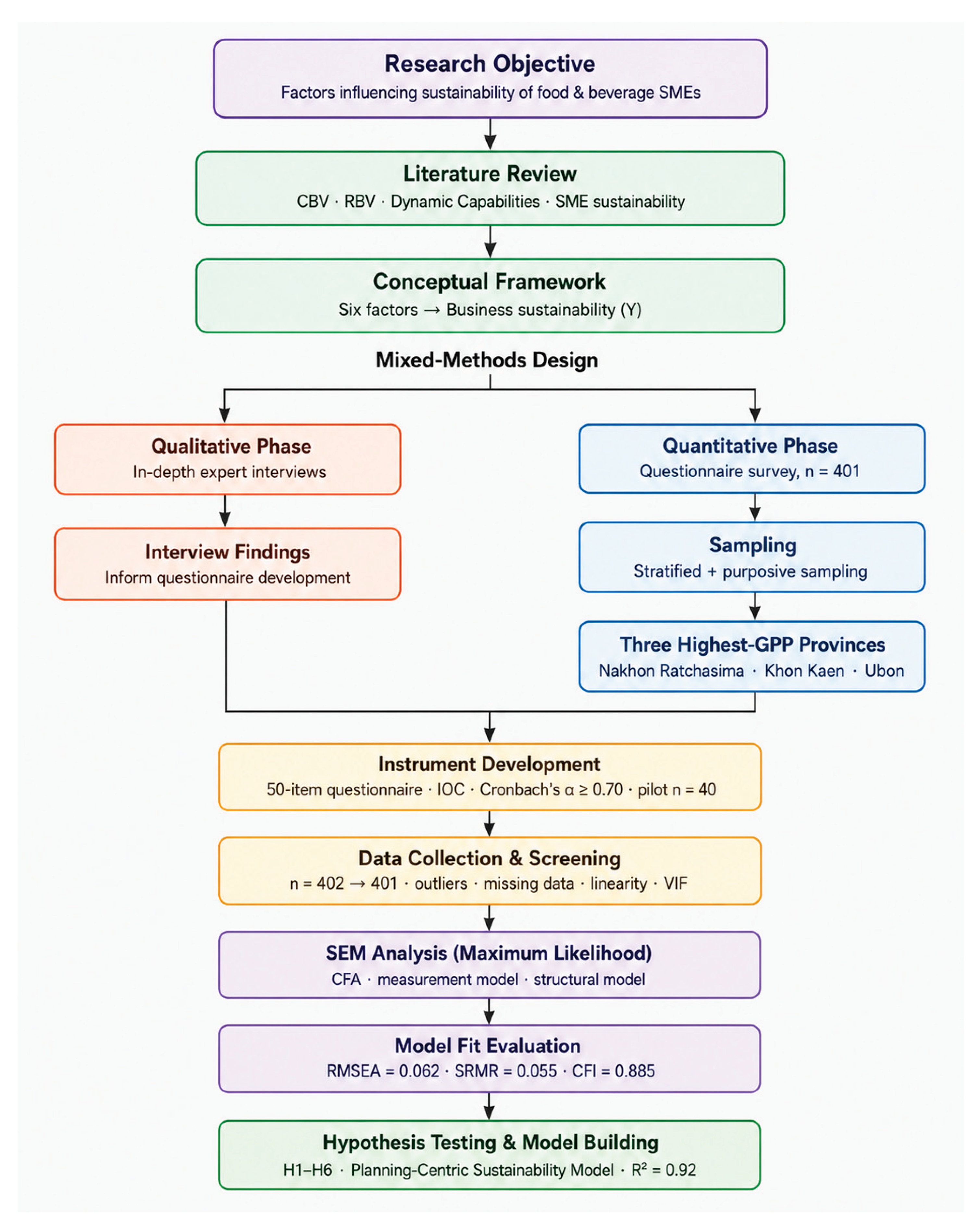
Figure 2.
Structural equation model: full SEM path diagram (X1–X6 → Y).
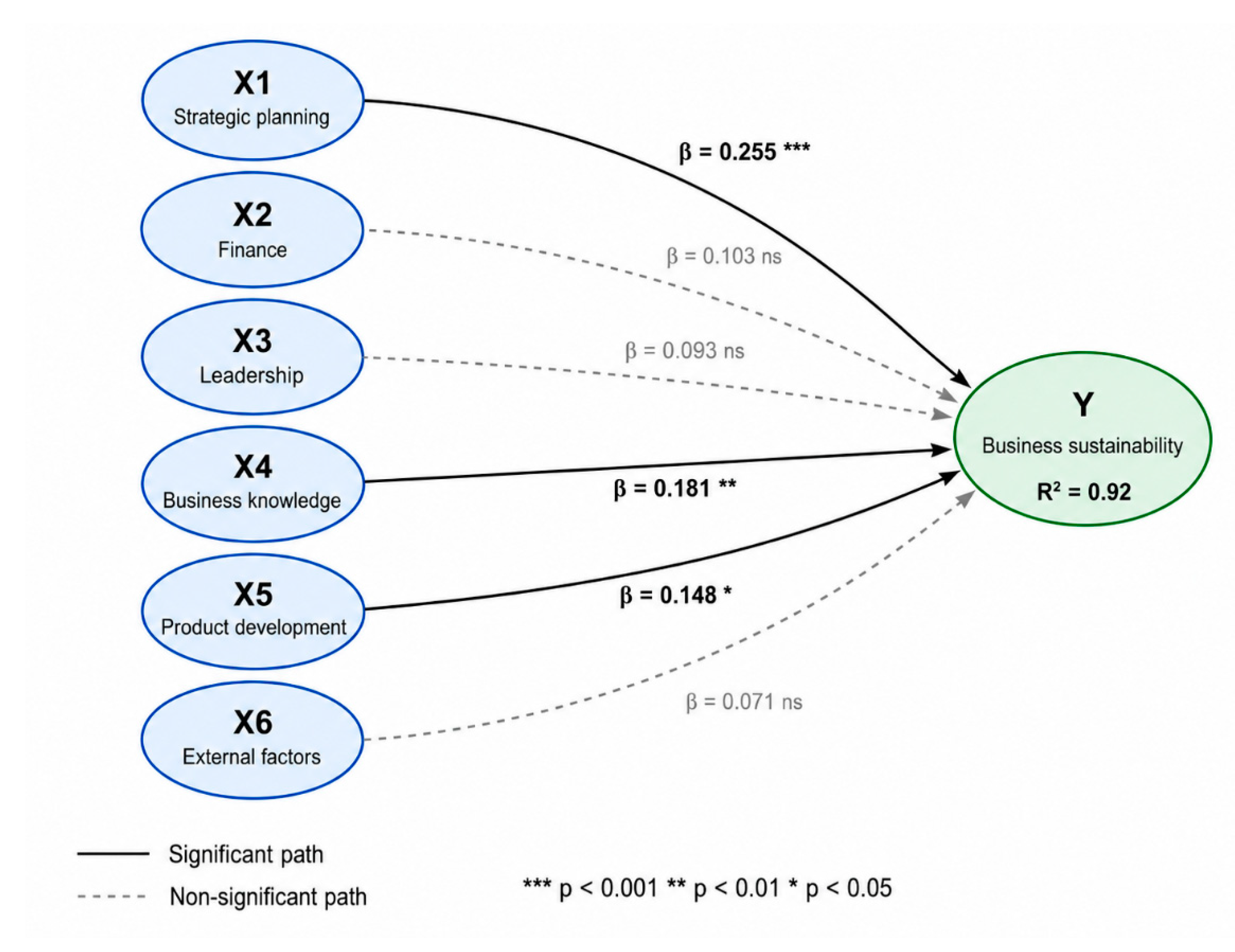
Figure 3.
Planning-Centric Sustainability Model: significant paths only.
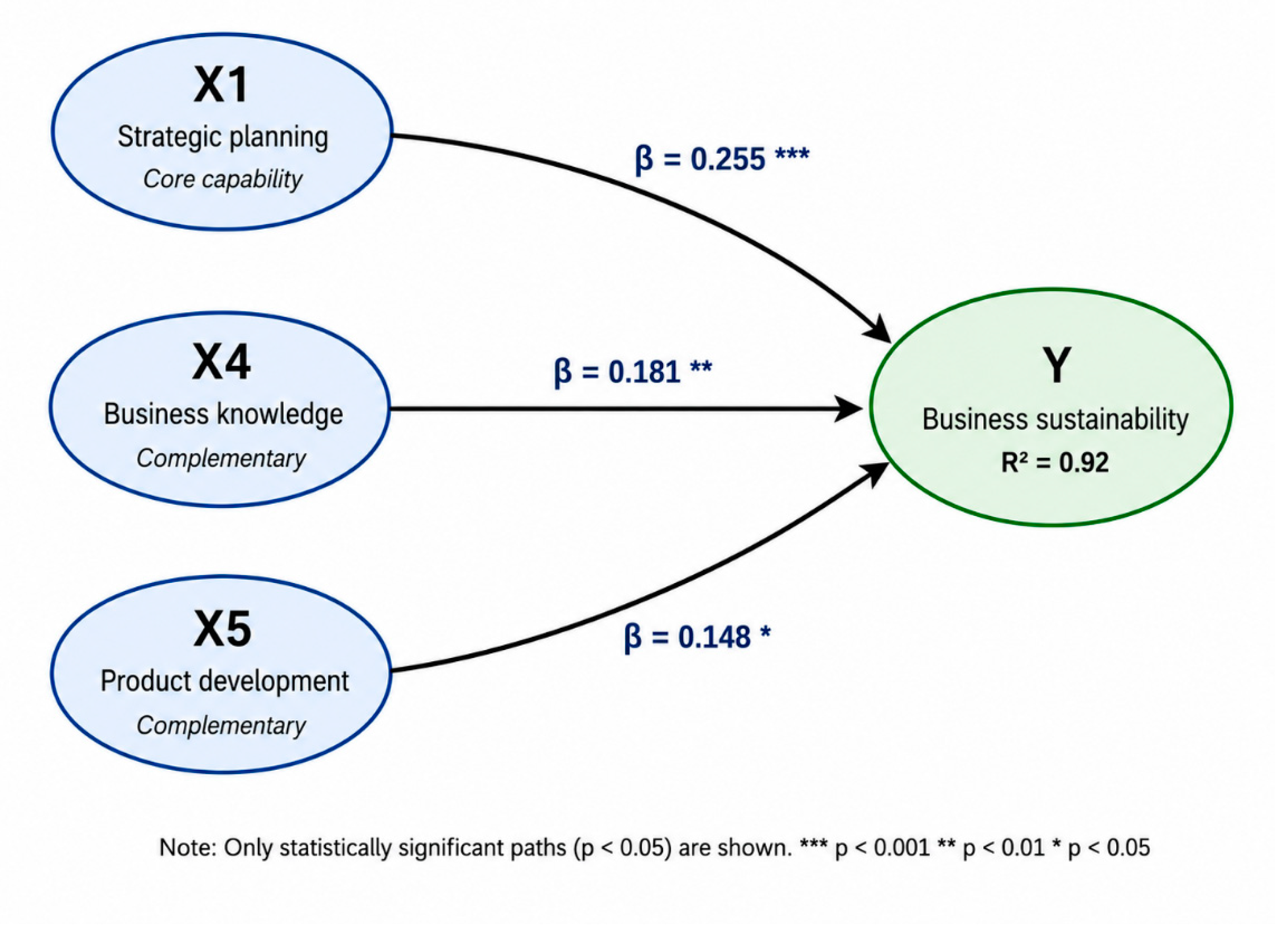

Table 1.
Results of hypothesis testing.
| Hypothesis | Path | β | p-value | Result |
| H1 | Strategic planning → Business sustainability | 0.255 | < 0.001 | Supported |
| H2 | Finance and accounting → Business sustainability | 0.103 | 0.082 | Not supported |
| H3 | Leadership → Business sustainability |
0.093 | 0.142 | Not supported |
| H4 | Business knowledge → Business sustainability | 0.181 | 0.006 | Supported |
| H5 | Product development → Business sustainability | 0.148 | 0.027 | Supported |
| H6 | External factors → Business sustainability |
0.071 | 0.257 | Not supported |
Note: β = standardized path coefficient; p = significance level. *** p < 0.001, ** p < 0.01, * p < 0.05. Supported hypotheses indicate positive and statistically significant effects on business sustainability. Model R² = 0.92.
Disclaimer/Publisher’s Note: The statements, opinions and data contained in all publications are solely those of the individual author(s) and contributor(s) and not of MDPI and/or the editor(s). MDPI and/or the editor(s) disclaim responsibility for any injury to people or property resulting from any ideas, methods, instructions or products referred to in the content. |
© 2026 by the authors. Licensee MDPI, Basel, Switzerland. This article is an open access article distributed under the terms and conditions of the Creative Commons Attribution (CC BY) license.
Copyright: This open access article is published under a Creative Commons CC BY 4.0 license, which permit the free download, distribution, and reuse, provided that the author and preprint are cited in any reuse.


