
Submitted:
25 May 2026
Posted:
25 May 2026
You are already at the latest version
Abstract
Although small and medium enterprises (SMEs) anchor employment and output across Sub-Saharan Africa, their uptake of artificial intelligence (AI) lags global benchmarks, and prevailing explanations dwell on capital, infrastructure, and institutional voids while overlooking the leadership competencies that determine whether available resources are mobilised at all. Addressing this gap, the present study asks how the digital leadership capabilities of SME owner-managers shape their intention to adopt AI in Nigeria, and through what organizational mechanism and under what boundary condition this influence operates. Anchored in the Diffusion of Innovation Theory and the Tigre–Henriques–Curado model of digital leadership, a cross-sectional survey was administered to owner-managers of registered SMEs drawn from six states; a sample of 390 was derived from a population of 23,290 firms using the Taro Yamane formula with proportionate allocation, and 306 valid responses were retained. Partial Least Squares Structural Equation Modeling (WarpPLS 8.0) was applied after confirming reliability (Cronbach's \( \alpha \): 0.69–0.84; composite reliability: 0.83–0.88), convergent validity (AVE: 0.56–0.67), and common method bias control. Strategic (\( \beta \) = 0.298), interpersonal (\( \beta \) = 0.245), and personal-attribute (\( \beta \) = 0.129) capabilities each significantly raised AI adoption intention, whereas delivery-related capabilities (\( \beta \)= 0.090, p= 0.057) did not, indicating that pre-adoption intention is governed by cognitive-strategic and relational competencies rather than execution skills. Organizational innovation climate partially transmitted the effects of strategic and interpersonal capabilities, and firm size amplified the interpersonal pathway in medium-sized firms. The study contributes a leadership-centred account of AI adoption in an under-researched African setting and, by estimating mediation and moderation within a single framework, clarifies both why and when digital leadership translates into AI readiness, yielding capability-specific guidance for owner-managers and SME-support policy.
Keywords:
digital leadership capabilities
; AI adoption intention
; organizational innovation climate
; SMEs
; PLS-SEM
; Diffusion of Innovation Theory
; Nigeria
1. Introduction
In a rapidly evolving and digitally interconnected global economy, small and medium enterprises (SMEs) must explore and exploit emerging technological opportunities to sustain competitiveness and secure long-term survival. Artificial intelligence (AI) presents transformative potential in this regard, enabling SMEs to enhance operational efficiency, strengthen competitive positioning, and respond more adaptively to shifting market demands [1]. The integration of AI technologies bolsters SMEs’ dynamic capabilities, facilitating swift responses to environmental uncertainty, the redesign of business processes, and the sustenance of long-term competitiveness [2,3]. Globally, evidence suggests that 91% of SMEs using AI report direct revenue gains, underscoring the strategic imperative of AI adoption for enterprise growth [4].
The intention of SMEs to adopt AI technologies is shaped by a complex interplay of organizational, technological, situational, and individual factors [2,5]. Among these, leadership has emerged as a central driver, influencing strategic direction while cultivating environments that support data-driven decision-making, innovation, and the development of employee competencies essential for digital transformation [6,7]. The adoption of AI within SMEs is thus closely linked to the presence of strong digital leadership capabilities: leaders who possess the competencies to understand AI technologies, communicate their benefits, and integrate them effectively into organizational processes are better placed to initiate adoption [8,9].
Despite growing scholarly attention to the intersection of digital leadership and technology adoption, research focusing specifically on Nigerian SMEs remains scarce. Nigeria, Africa’s largest economy, hosts over 41 million SMEs that collectively contribute approximately 48% of national GDP and account for 84% of total employment [10]. Yet existing accounts of weak AI adoption among African SMEs concentrate overwhelmingly on external and resource-based constraints, infrastructural deficits, financing gaps, scarce digital skills, and institutional voids [7,11,12,13]. Far less attention has been paid to an internal, agentic explanation: why firms possessing comparable basic resources nonetheless differ markedly in whether they initiate AI adoption at all. We argue that this divergence is rooted substantially in digital leadership, the strategic, relational, and adaptive competencies of owner-managers who must first recognise AI’s relevance, frame its value, and marshal organizational commitment before any technical or financial enabler can take effect. Viewed this way, the deficit of digital leadership, rather than capital or infrastructure alone, constitutes a core bottleneck restraining AI adoption across much of the African SME sector. This reframing both motivates the present study and structures its research design, which isolates leadership capability as the focal antecedent while accounting for the resource and structural factors that prior work has emphasised.
Furthermore, existing research has predominantly examined direct relationships between leadership and technology adoption, with limited attention to the mechanisms through which digital leadership capabilities translate into adoption intention. Individual leadership traits do not act on collective firm decisions in isolation; their value must be converted into organizational capacity through shared norms and collaborative routines [14]. Organizational innovation climate, the shared perception that an organization encourages and supports innovative behavior, may therefore serve as a critical mediating mechanism, as leaders who foster innovation-supportive environments amplify the translation of their capabilities into organizational technology adoption decisions [15,16]. Additionally, firm size may moderate these relationships, given that larger SMEs typically possess greater resources, more formalized structures, and stronger absorptive capacity than their smaller counterparts [17].
Accordingly, this study pursues four primary objectives: (1) to examine the direct influence of the four dimensions of digital leadership capabilities (strategic, delivery-related, interpersonal, and personal attributes) on AI adoption intention among Nigerian SMEs; (2) to investigate the mediating role of organizational innovation climate in the relationship between digital leadership capabilities and AI adoption intention; (3) to assess the moderating effect of firm size on the relationships between digital leadership capability dimensions and AI adoption intention; and (4) to provide evidence-based recommendations for policy-makers and SME support agencies seeking to accelerate AI adoption across Nigeria’s SME sector. Positioning the study within this frame also connects it to a broader agenda: AI is increasingly a lever not only for operational efficiency but for the green and sustainable transformation of resource-constrained firms, and digital leadership determines the starting point of that trajectory [18].
This study makes three contributions. Theoretically, it extends the Diffusion of Innovation Theory and the Tigre–Henriques–Curado digital leadership model to a developing-economy SME context and specifies organizational innovation climate as the transmission mechanism linking individual leader competence to collective adoption intention, thereby clarifying why leadership capability requires an organizational conduit to shape firm-level decisions. Empirically, it provides one of the first capability-disaggregated, PLS-SEM tests of digital leadership and AI adoption among African SMEs, and by estimating mediation and moderation within a single model establishes both the pathway and the firm-size boundary of the effect rather than treating them in isolation. Practically, it converts these findings into capability- and segment-specific guidance for owner-managers and for the design of differentiated SME-support and training policy.
2. Literature Review and Hypothesis Development
2.1. AI Adoption Intention: Conceptual Foundations
Artificial intelligence encompasses systems capable of perceiving, understanding, acting, and learning, operating with degrees of autonomy to achieve objectives through diverse methodological approaches [19,20]. In organizational contexts, AI commonly manifests as intelligent agents, chatbots, expert systems, natural language processing tools, and predictive analytics platforms that automate and enhance business operations [21]. The economic significance of AI is substantial: global AI market projections indicate growth from $233.46 billion in 2024 to an estimated $1771.62 billion by 2032, representing a compound annual growth rate of 29.2% [4].
Adoption intention is a construct reflecting an individual’s or organization’s readiness and willingness to engage with a new technology [22]. Grounded in behavioral theories such as the Theory of Planned Behavior and the Technology Acceptance Model, adoption intention posits that behavior can be predicted by the intention to perform that behavior, serving as a proximal determinant of actual adoption [22,23]. A consistent positive association between adoption intention and actual adoption behavior has been demonstrated across diverse technological domains [24,25], establishing intention as a reliable predictor of technology uptake.
For SMEs, AI adoption intention encompasses both current utilization of AI tools and plans for more comprehensive future implementation [26,27]. This reflects a gradual integration process, as SMEs typically occupy different stages along the adoption continuum from initial exploration through active expansion of AI-enabled capabilities. However, in developing economies such as Nigeria, AI adoption among SMEs remains constrained by financial limitations, technological barriers, knowledge gaps, cultural rigidity, and weak governance practices [5,7,12]. African evidence is instructive here: surveys of South-West Nigerian SMEs report high AI awareness coexisting with low actual adoption, with managerial cognition and leadership support, not only infrastructure emerging as decisive [28], while continent-wide reviews stress that opportunity in African AI adoption is gated as much by organizational and human factors as by technology endowments [13]. The broader evidence base is also unsettled on which leadership competencies matter: systematic syntheses report mixed findings on whether operational and delivery-oriented capabilities drive adoption or merely support post-adoption implementation [29], an inconsistency this study addresses directly. Recent systematic reviews further indicate that the evidence disproportionately centers on European and North American SMEs, with considerably less attention given to African contexts [30], underscoring the need for context-sensitive investigation.
2.2. Digital Leadership and Digital Leadership Capabilities
Digital leadership evolved from e-leadership and focuses on effectively leading in digital environments while managing organizational digital transformation [31]. This leadership approach involves engaging organizational members in digitalization processes, recognizing and developing necessary competencies, and fostering digital learning cultures [32]. Modern digital leaders are increasingly defined by their ability to foster inclusive cultures, implement ethical governance, and empower employees moving beyond mere technological adoption to strategic organizational transformation [33,34].
The concept of digital leadership capabilities has emerged as a multidimensional construct comprising distinct yet interrelated competency domains. Abbu et al. ([35]) conceptualized digital leadership as encompassing character (integrity, ethical AI application, transparency) and competency (digital literacy, continuous skill acquisition, knowledge sharing). Chen ([36]) identified technology literacy, data-driven decision-making, innovative thinking, and collaboration as core capability elements, while Hokmabadi et al. [37] emphasized strategic foresight, change management, and digital innovation as developmental priorities.
Building on these foundations, Tigre et al. [31] proposed a comprehensive four-dimensional model of digital leadership capabilities: strategic capabilities (vision, change management, innovation, agility, calculated risk-taking); delivery-related capabilities (analytical thinking, technological proficiency, team performance, results orientation); interpersonal capabilities (relationship building, communication, coaching, psychological safety); and personal attributes (adaptability, lifelong learning, ethical conduct, empathy). This model integrates business-oriented competencies with people-oriented qualities, offering a holistic framework for examining how digital leaders connect strategic thinking with organizational outcomes.
Research demonstrates that leaders’ digital capabilities constitute a core element of internal AI application, as executives’ digital awareness directly determines organizational push for AI adoption [8]. Leaders with strong digital capabilities exhibit heightened digital acumen, enabling more effective absorption, processing, and application of AI technologies [8,9]. These leaders exert significant influence within organizational structures, driving AI integration through both enhanced personal decision-making and increased organizational receptivity to AI-driven solutions [9].
2.3. Strategic Capabilities and AI Adoption Intention
Strategic capabilities refer to a leader’s ability to plan, guide, and manage digital transformation through clear vision-setting, digital-business alignment, and competent strategy implementation [38,39]. This dimension encompasses data management skills for informed decision-making, continuous updating of digital tools and knowledge, and the capacity for calculated risk-taking and change management [40].
Empirical evidence consistently supports the positive influence of strategic capabilities on technology adoption. Hossain et al. [9] demonstrated that leaders who align technological initiatives with strategic organizational goals significantly drive AI adoption. Yu et al. [8], using firm-level data, established that executives’ digital backgrounds accelerate corporate AI utilization. Mahmood et al. [41] found through PLS-SEM analysis of 245 employee responses in Pakistan that strategic digital leadership significantly enhances AI’s positive effects on organizational performance. Similarly, Suljic [42] argued that strategic leadership in AI-driven transformation is critical for both global enterprises and SMEs. The Diffusion of Innovation Theory further supports this relationship, as Rogers’ concept of “relative advantage” suggests that leaders with strategic vision are better positioned to recognize and communicate AI’s potential benefits [43].
Based on this theoretical and empirical evidence, the following hypothesis is proposed:
H1:
Strategic capabilities have a significant positive influence on AI adoption intention among SMEs in Nigeria.
2.4. Delivery-Related Capabilities and AI Adoption Intention
Delivery-related capabilities refer to the practical skills needed to translate digital strategies into measurable outcomes, encompassing analytical thinking, technological proficiency, team performance management, collaboration, and results orientation [31]. This dimension represents the execution-oriented facet of digital leadership.
The relationship between delivery capabilities and adoption intention is theoretically ambiguous, and we position the two expectations explicitly as competing. On one hand, Sony et al. [44] argued that operational competence facilitates Industry 4.0 implementation success. On the other, a strategy-before-execution logic holds that, in the digital economy, firm-level improvement is driven first by strategic top-level design and only subsequently by executive optimisation; absent prior strategic cognition and overall planning, enhancing execution capacity alone yields little substantive benefit [45]. Because adoption intention is fundamentally a cognitive and strategic phenomenon formed before implementation, execution-oriented skills may be more relevant to post-adoption delivery than to the pre-adoption decision [46]. This is especially likely among firms still at the threshold of AI adoption, where strong delivery capacity cannot compensate for limited strategic and relational cognition. Consistent with this view, Arroyabe et al. [47], analyzing 12,108 EU SMEs, found that digital maturity and innovation capability rather than operational competence were the primary enablers of AI adoption.
Notwithstanding this ambiguity, to formally test whether delivery-related capabilities contribute to adoption intention, the following hypothesis is proposed:
H2:
Delivery-related capabilities have a significant positive influence on AI adoption intention among SMEs in Nigeria.
2.5. Interpersonal Capabilities and AI Adoption Intention
Interpersonal capabilities constitute the people-focused dimension of digital leadership, encompassing communication, team leadership, digital collaboration, network building, coaching, mentoring, and the creation of psychologically safe environments [31,40]. These relational competencies are essential for fostering shared understanding and collective commitment to technological change.
Research consistently demonstrates the importance of interpersonal leadership dimensions for technology adoption. Kumari et al. [48] argued that effective digital-era leadership requires collaboration, communication, and shared influence to foster innovation. Jack and Nathan [49] found that trust, transparency, and ethical communication are fundamental for fostering employee engagement in AI-driven organizations. Yang et al. [50] demonstrated through a moderated mediation model that digital leadership enhances employee creativity through knowledge sharing, with innovation self-efficacy as a moderator. Alghamdi [51], studying 158 UK leaders, found strong positive relationships between leaders’ interpersonal digital competencies and favorable attitudes toward AI. The DOI theory further supports this relationship through the concept of “social system,” which emphasizes that innovation adoption is shaped by interpersonal communication and social influence within organizations [43].
Accordingly, the following hypothesis is proposed:
H3:
Interpersonal capabilities have a significant positive influence on AI adoption intention among SMEs in Nigeria.
2.6. Personal Attributes and AI Adoption Intention
Personal attributes refer to individual qualities and traits that equip leaders to manage transformation challenges, including adaptability, lifelong learning orientation, ethical grounding, initiative, empathy, and the ability to view problems from multiple perspectives [52,53].
Empirical evidence supports the role of personal attributes in technology adoption. Mikalef et al. [54] established that traits such as openness, adaptability, and digital self-efficacy enhance leaders’ readiness to embrace new technologies. Alghamdi [51] demonstrated that personal digital literacy among leaders positively influences AI adoption attitudes. Malik et al. [55] identified agility, openness, and participative orientation as essential personal traits for successful digital transformation. Within the DOI framework, Rogers’ concept of “innovativeness”, an individual’s propensity to adopt innovations earlier than peers aligns directly with personal attributes such as risk tolerance, openness, and adaptability [43].
Therefore, the following hypothesis is proposed:
H4:
Personal attributes have a significant positive influence on AI adoption intention among SMEs in Nigeria.
2.7. The Mediating Role of Organizational Innovation Climate
Organizational innovation climate refers to shared perceptions among organizational members regarding the extent to which the organization encourages, supports, and rewards innovative behavior [15,16]. Innovation climate encompasses dimensions such as tolerance for ambiguity, resource availability for experimentation, management support for novel ideas, and psychological safety for risk-taking.
Digital leadership capabilities are expected to shape organizational innovation climate, as leaders who demonstrate strategic vision, collaborative behavior, and adaptive thinking naturally cultivate environments conducive to innovation. In turn, organizations with stronger innovation climates are more likely to develop favorable attitudes toward novel technologies such as AI, as the climate reduces perceived risk and increases organizational receptivity to change. Yansen and Yujie [56] demonstrated that transformative digital leadership fosters innovation across product, process, and organizational dimensions. Sarkis and Pallotta [57] found that while leaders experience resistance during AI adoption, the process simultaneously promotes the development of innovation-supportive organizational competencies. Recent research further confirms that digital leadership enhances organizational resilience and innovation through job crafting and supportive organizational cultures [58].
This theoretical reasoning suggests that organizational innovation climate serves as a mechanism through which digital leadership capabilities translate into AI adoption intention. The deeper logic is that the value of a leader’s digital competence cannot be realised through the individual alone: relational and strategic advantages must be converted into organizational capacity via internal collaboration and a shared innovation atmosphere before they can shape collective, firm-level technology decisions [14]. This account explains why individual leadership traits require an organizational conduit rather than acting directly on adoption. Among candidate mechanisms, organizational innovation climate is theorised here as the primary conduit rather than, say, organizational learning or digital readiness, because it is the most proximal collective expression of the very behaviours digital leaders enact (encouraging experimentation, tolerating ambiguity, and rewarding novelty), whereas learning orientation and digital readiness operate as more distal antecedents or downstream resources. Accordingly:
H5:
Organizational innovation climate mediates the relationship between digital leadership capabilities and AI adoption intention among SMEs in Nigeria.
2.8. The Moderating Role of Firm Size
Firm size is widely recognized as a contextual factor influencing technology adoption decisions. Larger SMEs typically possess greater financial resources, more formalized management structures, stronger absorptive capacity, and broader talent pools compared to micro and small enterprises [17,59]. These resource advantages may amplify the effectiveness of leadership capabilities in driving technology adoption.
Badghish and Soomro [17], studying AI adoption among Saudi Arabian SMEs, found that firm size moderated the relationship between AI adoption and performance outcomes, with medium-sized enterprises experiencing stronger effects. Arroyabe et al. [47] similarly demonstrated heterogeneous adoption dynamics across firm size categories in their analysis of EU SMEs. In the Nigerian context, micro enterprises (those with fewer than 10 employees) face particularly acute resource constraints that may attenuate the translation of leadership capabilities into adoption intention [10].
Therefore, the following hypothesis is proposed:
H6:
Firm size moderates the relationship between digital leadership capabilities and AI adoption intention, such that the relationship is stronger for medium-sized enterprises than for micro and small enterprises.
2.9. Theoretical Framework
This study integrates two complementary theoretical perspectives. First, the Diffusion of Innovation (DOI) Theory [43] explains how innovations spread within social systems through four key elements: the innovation, communication channels, time, and the social system. The theory identifies five perceived attributes influencing adoption rates (relative advantage, compatibility, complexity, trialability, observability) and categorizes adopters based on innovativeness. The DOI framework is relevant because it provides foundations for understanding how individual characteristics (personal attributes), social influence (interpersonal capabilities), and perceived innovation benefits (strategic capabilities) shape adoption intention.
Second, the Tigre, Henriques, and Curado Model of Digital Leadership Capabilities [31] provides the operational framework for conceptualizing and measuring the four dimensions of digital leadership examined in this study. The two perspectives are integrated as follows: the Tigre–Henriques–Curado model supplies the antecedent structure (the four capability dimensions), while the DOI theory supplies the explanatory logic for why each dimension should move adoption intention, -strategic capabilities map onto relative advantage (the leader’s ability to perceive and frame AI’s benefits), interpersonal capabilities onto social influence within the social system, personal attributes onto individual innovativeness, and delivery-related capabilities onto the management of perceived complexity at implementation. Organizational innovation climate is positioned as the mediator because it is the collective, climate-level realisation of these leader behaviours and thus the conduit through which individual capability becomes a firm-level decision; firm size enters as a contextual moderator of the capability–intention paths. Together these elements constitute the conceptual model depicted in Figure 1 and summarised in Table 1.
3. Materials and Methods
3.1. Research Design and Population
This study employed a cross-sectional survey research design, appropriate for examining relationships among variables at a single point in time and widely used in organizational behavior and management research [60]. The target population comprised 23,290 registered SMEs across six Nigerian states (Lagos, Ogun, Oyo, Osun, Ekiti, and Ondo), as recorded in the Small and Medium Enterprises Development Agency of Nigeria (SMEDAN) database; the sampling frame and the population on which the sample size was based therefore consist of enterprises formally classified as SMEs, not of the general business population. While these states are geographically located in South-West Nigeria, they collectively represent the most commercially active and digitally advanced SME ecosystem in the country, housing the nation’s primary commercial hub (Lagos) and several major industrial centers. We nonetheless acknowledge this as a source of potential regional bias: South-West firms may enjoy stronger digital infrastructure and market exposure than firms in other geopolitical zones, so the estimates are best read as reflective of Nigeria’s most digitally mature SME segment, with extension to other zones flagged as a limitation and a direction for future research.
3.2. Sample Size Determination and Sampling Technique
The sample size was determined using the Taro Yamane formula [61]:
where N = 23,290 (total population) and e = 0.05 (margin of error), yielding a required sample of 390 SMEs. The Bowley proportionate allocation formula distributed sampling across states proportional to each state’s SME population (Table 2). Within each state, SMEs were selected using stratified random sampling across three firm-size categories: micro (1–9 employees), small (10–49 employees), and medium (50–199 employees).
3.3. Research Instrument
Data were collected using a structured questionnaire administered to SME owners and managers, individuals with decision-making authority regarding technology adoption. The questionnaire comprised four sections: (A) demographic characteristics; (B) digital leadership capability items adapted from [31], measuring strategic capabilities (SC; 3 items), delivery-related capabilities (DRC; 6 items), interpersonal capabilities (IC; 4 items), and personal attributes (PA; 3 items); (C) organizational innovation climate items adapted from [15], measuring the extent to which organizations support innovative behavior (OIC; 4 items); and (D) AI adoption intention items adapted from established technology adoption scales [23,27] (AIAI; 4 items). All items were measured on a five-point Likert scale (1 = strongly disagree to 5 = strongly agree).
Because the original instruments were developed in Western and East Asian organizational settings, items were contextually adapted to the Nigerian SME environment before fielding. Adaptation involved three steps: (i) terminology was simplified and localised so that constructs framed for large corporations referred to owner-manager and small-firm realities (e.g., “executive team” rendered as “you and your management”); (ii) two domain experts in information resources management and an SME practitioner reviewed each item for face and content validity, after which ambiguous or doubly-loaded items were reworded; and (iii) a pilot study with 40 SME managers (not part of the main sample) was conducted to confirm clarity, comprehensibility, and internal consistency. The pilot returned acceptable construct-level reliabilities (Cronbach’s between 0.71 and 0.86) and informed the final sample-size adequacy assessment relative to the variance and model complexity observed; items that reduced reliability or were poorly understood were dropped, which accounts for the retained-indicator counts reported in the measurement model. Of the 390 questionnaires distributed, 306 valid responses were obtained, yielding an effective response rate of 78.5%.
3.4. Analytical Technique
Data were analyzed using Partial Least Squares Structural Equation Modeling (PLS-SEM) with WarpPLS version 8.0 software [62]. PLS-SEM was selected for three methodological reasons: (1) its suitability for data exhibiting non-normal distributions, common in survey-based behavioral research [60]; (2) its effectiveness with moderate sample sizes relative to model complexity [63]; and (3) its capacity to simultaneously estimate complex path models encompassing direct, mediating, and moderating relationships [59].
The analysis followed a rigorous two-stage approach [59,60]. Stage one assessed the measurement model through indicator reliability (factor loadings ≥ 0.70), internal consistency reliability (Cronbach’s alpha ≥ 0.70; composite reliability ≥ 0.70), convergent validity (AVE ≥ 0.50), and discriminant validity (Fornell–Larcker criterion, HTMT < 0.90, and cross-loadings). Stage two assessed the structural model through model fit indices (APC, ARS, AARS, AFVIF, GoF), path coefficient analysis, mediation testing via the Sobel test and bootstrapped indirect effects, and moderation testing through interaction term analysis. Effect sizes () were evaluated using Cohen’s [64] benchmarks: 0.02 (small), 0.15 (medium), and 0.35 (large).
3.5. Bias Assessment and Causal Considerations
Because the data are self-reported and collected from a single source at one point in time, three potential threats were addressed. First, common method bias (CMB) was evaluated procedurally and statistically. Procedurally, respondent anonymity was assured, predictor and criterion items were separated within the instrument, and item wording was simplified to reduce evaluation apprehension. Statistically, Kock’s full collinearity test was applied: all variance inflation factors from the full collinearity assessment were below the conservative 3.3 threshold (and well below the 5.0 ceiling reported in Table 8, AFVIF = 2.277), indicating that common method bias is unlikely to have materially distorted the estimates [62]. Second, non-response bias was examined by comparing early and late respondents (the last quartile of returns serving as a proxy for non-respondents) on key demographic and construct means; independent-samples comparisons revealed no statistically significant differences, suggesting that non-response is not a serious concern. Third, the design cannot rule out reverse or reciprocal causality: for instance, firms already favourably disposed toward AI may cultivate stronger innovation climates, and adoption-oriented firms may attract or develop more digitally capable leaders. While the hypothesised directions are grounded in theory (leadership and climate as antecedents of intention), the cross-sectional structure precludes definitive causal ordering, and this is acknowledged as a limitation that longitudinal or experimental designs should address.
4. Results
4.1. Demographic Profile of Respondents
Table 3 presents the demographic characteristics of the 306 respondents. The majority (66%) were male; 52.3% were aged 18–28 years, indicating a predominantly young respondent profile. Most (58.8%) held at least a bachelor’s degree, and over half (53.9%) had operated their businesses for five years or less. Regarding firm size, 47.1% of respondents represented micro enterprises (1–9 employees), 38.6% represented small enterprises (10–49 employees), and 14.3% represented medium enterprises (50–199 employees).
Figure 2 provides a visual summary of the demographic distribution.
4.2. Measurement Model Assessment
4.2.1. Internal Consistency Reliability
Table 4 presents the reliability results. All constructs demonstrated satisfactory internal consistency based on established thresholds: Cronbach’s alpha values ≥ 0.70 (with personal attributes at 0.69, acceptable in exploratory contexts; [63]), composite reliability values ≥ 0.70, and all factor loadings exceeding 0.70 [60].
4.2.2. Convergent and Discriminant Validity
4.3. Structural Model Assessment
4.3.1. Model Fit and Quality Indices
Table 8 presents the structural model fit indices, all of which satisfy established thresholds, indicating strong model quality and explanatory power.
4.3.2. Direct Effects: Path Coefficients and Hypothesis Testing
Table 9 presents the path coefficient analysis and Figure 3 illustrates the structural model results.
Beyond statistical significance, the relative importance of the predictors is informative. Ranking the standardised coefficients and effect sizes places strategic capabilities first ( = 0.298, = 0.171, medium), interpersonal capabilities second ( = 0.245, = 0.134, small-to-medium), and personal attributes third ( = 0.129, = 0.062, small), with delivery-related capabilities not reaching significance. The four leadership dimensions and the innovation-climate path jointly explain a substantively meaningful share of variance in adoption intention (R2 = 0.418), which in practical terms means that owner-manager capabilities and climate factors that are developed through training account for a large part of why some firms intend to adopt AI and others do not. The gap between the strategic and delivery coefficients (0.298 versus 0.090) is itself practically consequential: it implies that an SME-support programme that raises strategic-cognitive capability is likely to move adoption intention several times more than one of equal intensity targeting operational execution.
To probe the non-significant delivery-related effect, two robustness checks were performed. First, the model was re-estimated with delivery-related capabilities entered alone (without the competing strategic and interpersonal paths); the coefficient rose modestly but remained non-significant ( = 0.121, p = 0.071), indicating the null result is not merely an indication of multicollinearity among capability dimensions (full-collinearity VIFs were all below 3.3). Second, splitting the sample by adoption stage showed the delivery effect to be uniformly weak across both lower- and higher-readiness firms. The most plausible interpretation is therefore substantive rather than methodological: at the pre-adoption intention stage, execution capacity is latent rather than activated, so its influence is muted until firms move into implementation.
4.3.3. Mediation Analysis
The mediating role of organizational innovation climate () was tested using bootstrapped indirect effects and the Sobel test. Table 10 presents the results.
The results indicate that organizational innovation climate partially mediates the relationship between strategic capabilities and AI adoption intention (indirect = 0.076, p = 0.003) and between interpersonal capabilities and AI adoption intention (indirect = 0.048, p = 0.024). The total effect of strategic capabilities on AI adoption intention is thus 0.374 (direct 0.298 + indirect 0.076), reinforcing its position as the strongest predictor. Hypothesis is partially supported.
4.3.4. Moderation Analysis
The moderating effect of firm size () was tested through interaction term analysis. Firm size was coded as a categorical variable (1 = micro, 2 = small, 3 = medium) and introduced as a moderator of each digital leadership capability path.

Table 11.
Moderation analysis: firm size as moderator.
| Interaction Path | p | Decision | |
|---|---|---|---|
| SC × Firm Size → AIAI | 0.067 | 0.124 | Not Significant |
| DRC × Firm Size → AIAI | 0.038 | 0.268 | Not Significant |
| IC × Firm Size → AIAI | 0.109 | 0.029 | Significant |
| PA × Firm Size → AIAI | 0.054 | 0.178 | Not Significant |
Firm size significantly moderates the relationship between interpersonal capabilities and AI adoption intention ( = 0.109, p = 0.029), with the effect of interpersonal capabilities being stronger in medium-sized enterprises than in micro enterprises. Hypothesis is partially supported.
5. Discussion
This study developed and tested a comprehensive model examining how four dimensions of digital leadership capabilities—strategic, delivery-related, interpersonal, and personal attributes—influence AI adoption intention among Nigerian SMEs, with organizational innovation climate as a mediating mechanism and firm size as a contextual moderator. The findings advance both theoretical understanding and practical knowledge regarding the leadership antecedents of AI adoption in developing economy SMEs.
5.1. Direct Effects of Digital Leadership Capabilities
The strongest predictor of AI adoption intention is strategic capabilities ( = 0.298, p < 0.001, = 0.171), a finding consistent with [9], who demonstrated through a dynamic managerial capability framework that leaders who align technological initiatives with strategic goals significantly drive AI adoption. This finding is further corroborated by [8], who established that executives’ digital backgrounds accelerate corporate AI utilization, and by [41], who found that strategic digital leadership enhances AI’s positive effects on organizational performance in Pakistan. The medium effect size ( = 0.171) indicates that strategic vision, change management competence, and innovation orientation provide substantive cognitive and organizational foundations for SME leaders to recognize AI’s potential and commit to its adoption.
Interpersonal capabilities emerge as the second-strongest predictor ( = 0.245, p < 0.001, = 0.134), consistent with [48], who argued that effective digital-era leadership requires collaboration and shared influence to foster innovation, and with [46], who demonstrated strong correlations between relational leadership competencies and digital transformation outcomes. [50] further showed that digital leadership enhances creativity through knowledge sharing—a mechanism consistent with the interpersonal pathway to AI adoption observed in this study. Leaders who build networks, foster psychological safety, and promote team collaboration create organizational environments conducive to embracing novel technologies.
Personal attributes demonstrate a positive though more modest influence ( = 0.129, p = 0.011, = 0.062), corroborating [54], who found that openness, adaptability, and digital self-efficacy enhance leaders’ technology readiness, and [51], who demonstrated that personal digital literacy positively influences AI adoption attitudes. The small-to-medium effect size suggests that personal attributes serve as facilitating conditions rather than primary drivers of adoption intention.
The insignificant effect of delivery-related capabilities ( = 0.090, p = 0.057, = 0.049) represents a noteworthy finding that diverges from [44], who emphasized operational competence in Industry 4.0 implementation. However, this result aligns with the conceptual distinction between pre-adoption intention and post-adoption implementation. Adoption intention is primarily a cognitive-strategic phenomenon, shaped by a leader’s vision, relational influence, and adaptive capacity rather than by execution-oriented skills. This interpretation is consistent with [47], who found that digital maturity and innovation capability, not operational competence were primary adoption enablers among EU SMEs. Within the DOI framework, Rogers’ emphasis on perceived innovation characteristics and individual innovativeness as determinants of adoption intention, rather than implementation capacity, further supports this finding [43].
5.2. Mediation Through Organizational Innovation Climate
The partial mediation of organizational innovation climate between strategic capabilities and AI adoption intention (indirect = 0.076, p = 0.003) and between interpersonal capabilities and AI adoption intention (indirect = 0.048, p = 0.024) offers important mechanistic insights. Leaders with strong strategic vision and collaborative orientation cultivate innovation-supportive environments that, in turn, enhance organizational receptivity to AI technologies. This finding extends [56], who demonstrated that transformative digital leadership fosters multi-dimensional innovation, by identifying organizational innovation climate as a specific mediating mechanism. It also aligns with [57], who found that AI adoption challenges simultaneously promote innovation-supportive organizational competencies. From a practical standpoint, this suggests that developing digital leadership capabilities alone may be insufficient, organizations must concurrently cultivate innovation-supportive climates to maximize the translation of leadership competencies into AI adoption readiness.
5.3. Moderation by Firm Size
The significant moderating effect of firm size on the interpersonal capabilities–AI adoption intention relationship ( = 0.109, p = 0.029) indicates that the impact of relational leadership competencies on adoption intention is amplified in medium-sized enterprises. This finding is consistent with [17], who found stronger AI adoption–performance relationships in medium-sized Saudi Arabian enterprises, and with the resource-based logic that larger SMEs possess greater absorptive capacity, more formalized communication structures, and broader talent pools that enable interpersonal leadership competencies to operate more effectively [59]. A plausible explanation for why size moderates the interpersonal path specifically and not the strategic, personal, or delivery paths lies in the social mechanics of relational leadership: communication, coaching, and coalition-building yield returns only when there are enough organizational members and structural layers for them to act upon. In a micro firm of a few employees, the owner’s interpersonal competence has a thin social field in which to operate, so its marginal effect on collective adoption intention is small; as the firm grows into the medium-sized range, the same competence governs a larger, more differentiated team and thus exerts a stronger effect. Strategic vision and personal adaptability, by contrast, shape the owner-manager’s own decision calculus regardless of headcount, which is consistent with their size-invariant effects observed here.
5.4. Theoretical Implications
These findings contribute to theory in several ways, extending some positions while challenging others. First, the study extends the DOI theory and the Tigre–Henriques–Curado digital leadership framework to a developing-economy SME context, demonstrating their explanatory utility in a non-Western setting and answering calls to test Western-derived leadership constructs in African organizations. Second, by identifying organizational innovation climate as a partial mediator, it advances the literature beyond direct leadership–adoption associations and specifies how individual competence becomes a collective adoption decision, a transmission account consistent with the view that leader-level resources require organizational conversion to influence firm outcomes [14]. Third, the non-significant delivery-related effect challenges a common assumption that operational competence drives technology uptake; our results instead support a strategy-before-execution logic in which cognitive and relational capability govern the pre-adoption stage while execution capacity becomes salient only at implementation [45]. Fourth, the firm-size moderation findings refine contingency perspectives by showing that digital leadership’s effect is not uniformly context-dependent but selectively so confined here to the relational dimension. Finally, situating these mechanisms within the sustainability agenda extends the contribution beyond efficiency: where digital leadership initiates AI adoption among resource-constrained, production-oriented firms, it also conditions their capacity for green innovation and sustainable transition, a linkage that is especially pronounced for traditional manufacturing and resource-limited organizations of the kind that dominate the present sample [18].
6. Conclusions
This study examined the influence of four digital leadership capability dimensions on AI adoption intention among Nigerian SMEs, integrating organizational innovation climate as a mediator and firm size as a moderator within a PLS-SEM framework. Based on 306 valid responses, the findings lead to several conclusions. First, strategic capabilities constitute the most potent driver of AI adoption intention, followed by interpersonal capabilities and personal attributes. Delivery-related capabilities, while positively associated, do not significantly predict adoption intention. This hierarchy demonstrates that cognitive, strategic, and relational leadership dimensions outweigh operational competencies in shaping pre-adoption decisions. Second, organizational innovation climate partially mediates the influence of strategic and interpersonal capabilities on AI adoption intention, revealing that leadership’s effect on adoption is amplified when organizations cultivate innovation-supportive environments.
Third, firm size moderates the interpersonal capabilities–AI adoption intention relationship, with medium-sized enterprises showing stronger effects, indicating that relational leadership competencies operate more effectively in organizations with sufficient structural complexity to benefit from enhanced communication and collaboration.
These findings translate into segment-specific rather than generic guidance. For micro-enterprise owners (fewer than 10 employees), the priority is strategic-cognitive: because relational competence has a thin social field at this scale, owners should first build a clear understanding of AI’s concrete business value and a feasible adoption plan before investing in execution tooling, avoiding blind expenditure on operational digital capability that the firm cannot yet exploit. For small firms, the emphasis shifts toward pairing that strategic cognition with the early formalisation of an innovation-supportive climate. For medium-sized firms, where the interpersonal pathway is strongest, managers should foreground communication, coaching, and team cooperation to forge organizational consensus around AI adoption. For policy-makers and SME-support agencies, capacity-building should be hierarchical and differentiated: training for micro firms should emphasise AI’s commercial value and transformation planning; courses for medium firms should centre on team collaboration and innovation-climate construction; and programmes should be regionally calibrated to local digital-infrastructure conditions, so that better-resourced states accelerate application while less-developed states first build owner-manager digital cognition.
This study acknowledges several limitations that frame directions for future research. First, the cross-sectional design precludes causal inference and cannot exclude reciprocal effects between leadership, climate, and adoption intention; longitudinal panels that track how leadership capabilities shape AI adoption trajectories over time, or quasi-experimental designs, would establish temporal ordering. Second, although the sample captures Nigeria’s most commercially active SME ecosystem, it is drawn from a single geopolitical zone, so cross-zone and cross-country comparative studies are needed to test the generalisability of the leadership–adoption mechanism across differing institutional and infrastructural settings. Third, future work should explore additional mediating mechanisms (e.g., technology readiness, organizational learning culture) and moderating variables (e.g., industry sector, founder digital experience, leader educational background) that may further explain the leadership–adoption nexus in developing economies. Finally, as AI adoption matures, the agenda should extend from technology uptake toward human-centric system design, examining how SMEs can integrate AI in ways that keep human well-being, sustainability, and resilience central—the orientation of the emerging Industry 5.0 paradigm [67] and of work linking Industry 5.0 with green supply-chain management for sustainable development in resource-constrained economies [68].
Author Contributions
Conceptualization, A.I. and Y.T.B.; methodology, A.I. and Y.T.B.; software, A.I.; validation, A.I., Y.T.B., A.I. and Y.T.B.; formal analysis, A.I. and Y.T.B.; investigation, A.I. and Y.T.B.; resources, A.I. and Y.T.B.; data curation, A.I.; writing—original draft preparation, A.I.; writing—review and editing, A.I. and Y.T.B.; visualization, A.I.; supervision, Y.T.B.; project administration, A.I. and Y.T.B. All authors have read and agreed to the published version of the manuscript.
Funding
This research received no external funding.
Institutional Review Board Statement
Ethical review and approval were obtained from the appropriate institutional review board prior to data collection.
Informed Consent Statement
Informed consent was obtained from all subjects involved in the study.
Data Availability Statement
The data presented in this study are available on request from the corresponding author. The data are not publicly available due to confidentiality agreements with participating SMEs.
Conflicts of Interest
The authors declare no conflicts of interest.
Abbreviations
The following abbreviations are used in this manuscript:
| AI | Artificial Intelligence |
| AIAI | AI Adoption Intention |
| AVE | Average Variance Extracted |
| CR | Composite Reliability |
| DOI | Diffusion of Innovation |
| DRC | Delivery-Related Capabilities |
| GoF | Goodness-of-Fit |
| HTMT | Heterotrait–Monotrait Ratio |
| IC | Interpersonal Capabilities |
| OIC | Organizational Innovation Climate |
| PA | Personal Attributes |
| PLS-SEM | Partial Least Squares Structural Equation Modeling |
| SC | Strategic Capabilities |
| SME | Small and Medium Enterprise |
| SMEDAN | Small and Medium Enterprises Development Agency of Nigeria |
References
- Drydakis, N. Artificial intelligence and reduced SMEs’ business risks: A dynamic capabilities analysis during the COVID-19 pandemic. Inf. Syst. Front. 2022, 24, 1223–1247. [Google Scholar] [CrossRef]
- Chaudhuri, R.; Chatterjee, S.; Vrontis, D.; Chaudhuri, S. Innovation in SMEs, AI dynamism, and sustainability. Sustainability 2022, 14, 12760. [Google Scholar] [CrossRef]
- Cimino, A.; Ferraris, A.; Santoro, G.; Vrontis, D. Artificial intelligence adoption for sustainable growth in SMEs: An extended dynamic capability framework. Corp. Soc. Responsib. Environ. Manag. 2025, 32, 3201–3220. [Google Scholar] [CrossRef]
- Agbaakin, O. Leveraging artificial intelligence as a strategic growth catalyst for small and medium-sized enterprises. arXiv 2025, arXiv:2509.14532. [Google Scholar] [CrossRef]
- Kasigit, L.; Akhlaghpour, S.; Karanasios, S. AI adoption by SMEs in developing countries: Challenges, applications, and benefits. In Proceedings of the ACIS 2025 Proceedings, Petrie, QLD, Australia, 1–5 December 2025; p. 271. [Google Scholar]
- Dey, P.K.; Chowdhury, S.; Abadie, A.; Yaroson, E.V.; Sarkar, S. Artificial intelligence-driven supply chain resilience in Vietnamese manufacturing SMEs. Int. J. Prod. Res. 2023, 62, 5417–5456. [Google Scholar] [CrossRef]
- Nwagbala, S.C.; Ezeanokwasa, F.N.; Nwachukwu, R.; Uzodike, N.J. AI adoption and sustainability of SMEs in Africa: Opportunities and challenges. Int. J. Sci. Res. Arch. 2025, 14, 467–475. [Google Scholar] [CrossRef]
- Yu, R.; Wu, L.; Li, G.; Wang, Z. Can executives’ digital background develop AI utilization in enterprises. PeerJ Comput. Sci. 2025, 11, e2848. [Google Scholar] [CrossRef] [PubMed]
- Hossain, S.; Fernando, M.; Akter, S. Digital leadership: Towards a dynamic managerial capability perspective of AI-driven leader capabilities. J. Leadersh. Organ. Stud. 2025, 32, 189–208. [Google Scholar] [CrossRef]
- SMEDAN. National Survey of Micro, Small and Medium Enterprises (MSMEs) in Nigeria; Technical Report; Small and Medium Enterprises Development Agency of Nigeria: Abuja, Nigeria, 2023. [Google Scholar]
- Awotunde, O.M.; Oyedele, O.O.; Adewale, A.R. Navigating the 21st century marketplace: The role of digital marketing in SME development in Nigeria. Int. J. Res. Bus. Soc. Sci. 2024, 13, 902–913. [Google Scholar] [CrossRef]
- Uwagaba, J.; Omotosho, T.D.; George, G.O. Exploring the barriers to artificial intelligence adoption in Sub-Saharan Africa’s Small and Medium Enterprises and the potential for increased productivity. World Wide J. Multidiscip. Res. Dev. 2023, 9, 4–10. [Google Scholar]
- Arakpogun, E.O.; Elsahn, Z.; Olan, F.; Elsahn, F. Artificial intelligence in Africa: Challenges and opportunities. In The Fourth Industrial Revolution: Implementation of Artificial Intelligence for Growing Business Success; Hamdan, A., Hassanien, A.E., Razzaque, A., Alareeni, B., Eds.; Studies in Computational Intelligence; Springer: Cham, Switzerland, 2021; Volume 935, pp. 375–388. [Google Scholar] [CrossRef]
- Wang, H. Supply chain digital integration and operational resilience: An empirical study based on matched data between manufacturing and logistics firms in Central and Eastern Europe. Int. Sci. Tech. Econ. Res. 2026, 4, 23–46. [Google Scholar] [CrossRef]
- Scott, S.G.; Bruce, R.A. Determinants of innovative behavior: A path model of individual innovation in the workplace. Acad. Manag. J. 1994, 37, 580–607. [Google Scholar] [CrossRef]
- Anderson, N.R.; West, M.A. Measuring climate for work group innovation: Development and validation of the team climate inventory. J. Organ. Behav. 2014, 19, 235–258. [Google Scholar] [CrossRef]
- Badghish, S.; Soomro, Y.A. Artificial intelligence adoption by SMEs to achieve sustainable business performance: A TOE framework. Sustainability 2024, 16, 1864. [Google Scholar] [CrossRef]
- Sun, G.; Song, Y.; Xiao, J.; Xu, D. Artificial intelligence and sustainable aviation manufacturing: A perspective from green innovation in China. Sustainability 2026, 18, 4298. [Google Scholar] [CrossRef]
- Chang, A.C. Intelligence-Based Medicine: Artificial Intelligence and Human Cognition in Clinical Medicine and Healthcare; Academic Press: Cambridge, MA, USA, 2020; pp. 7–22. [Google Scholar]
- Webster, C.; Ivanov, S. Robotics, artificial intelligence, and the evolving nature of work. In Digital Transformation in Business and Society; George, B., Paul, J., Eds.; Palgrave Macmillan: London, UK, 2020; pp. 127–143. [Google Scholar]
- Saravanan, K. A review of artificial intelligence systems. Int. J. Adv. Res. Comput. Sci. 2017, 8, 418–421. [Google Scholar] [CrossRef]
- Nguyen, X.T.; Luu, Q.K. Factors affecting adoption of Industry 4.0 by SMEs in Ho Chi Minh City, Vietnam. J. Asian Financ. Econ. Bus. 2020, 7, 255–264. [Google Scholar] [CrossRef]
- Bawack, R.; Desveaud, K. Consumer adoption of artificial intelligence: A review of theories and antecedents. In Proceedings of the 55th Hawaii International Conference on System Sciences, Maui, HI, USA, 4–7 January 2022. [Google Scholar] [CrossRef]
- Ogunode, P.O.; Ayodele, A.A. Predictors of sustainable energy technology adoption behavior in South-Western Nigeria. J. Econ. Sustain. Dev. 2020, 11, 61–73. [Google Scholar]
- Hashimy, L.; Jain, G.; Grifell-Tatjé, E. Determinants of blockchain adoption as decentralized business model by Spanish firms. Ind. Manag. Data Syst. 2022, 122, 1320–1342. [Google Scholar]
- Kukanja, M. Examining the impact of entrepreneurial orientation, self-efficacy, and perceived business performance on managers’ attitudes towards AI adoption in hospitality SMEs. Systems 2024, 12, 526. [Google Scholar] [CrossRef]
- Kwon, O.; Bae, S.; Shin, B. Understanding the adoption intention of AI through the ethics lens. In Proceedings of the 53rd Hawaii International Conference on System Sciences, Maui, HI, USA, 7–10 January 2020. [Google Scholar]
- Adegbuyi, A.; Noor, S.; Adeniyi, A.O. Role of artificial intelligence on small and medium-sized enterprises (SMES) management in southwest, Nigeria. Int. J. Entrep. Technol. Innov. 2024, 1, 11–28. [Google Scholar]
- Ayinaddis, S.G. Artificial intelligence adoption dynamics and knowledge in SMEs and large firms: A systematic review and bibliometric analysis. J. Innov. Knowl. 2025, 10, 100682. [Google Scholar] [CrossRef]
- Iyelolu, T.V.; Adebiyi, O.O.; Oladipo, J.D. Artificial intelligence adoption as a driver of innovation and competitiveness in SMEs: A bibliometric and systematic review. Technol. Anal. Strateg. Manag. 2025. [Google Scholar] [CrossRef]
- Tigre, F.; Henriques, P.; Curado, C. The digital leadership emerging construct: A multi-method approach. Manag. Rev. Q. 2024, 74, 2321–2359. [Google Scholar] [CrossRef]
- Sagbas, M.; Erdogan, F.A. Digital leadership: A systematic conceptual literature review; 2023; pp. 49–66.
- Basu, S. Digital leadership and organizational transformation: A review. Int. J. Manag. Rev. 2024, 26, 234–258. [Google Scholar]
- Araujo, L.M.d.; Priadana, S.; Paramarta, V.; Sunarsi, D. Digital leadership in business organizations. Int. J. Educ. Adm. Manag. Leadersh. 2021, 2, 5–16. [Google Scholar] [CrossRef]
- Abbu, H.; Mugge, P.; Gudergan, G.; Hoeborn, G.; Kwiatkowski, A. Measuring the human dimensions of digital leadership for successful digital transformation. Res.-Technol. Manag. 2022, 65, 39–49. [Google Scholar] [CrossRef]
- Chen, Q. Research on building a digital leadership capability model: Requirements and challenges of the artificial intelligence era. J. Hum. Resour. Dev. 2024, 6, 1–8. [Google Scholar] [CrossRef]
- Hokmabadi, H.; Rezvani, S.M.H.S.; de Matos, C.A. Business resilience for SMEs and startups by digital transformation and the role of marketing capabilities. Systems 2024, 12, 220. [Google Scholar] [CrossRef]
- Zeike, S.; Bradbury, K.; Lindert, L.; Pfaff, H. Digital leadership skills and associations with psychological well-being. Int. J. Environ. Res. Public Health 2019, 16, 2628. [Google Scholar] [CrossRef]
- Wang, Q. The impact of AI on organizational employees: A literature review. J. Educ. Humanit. Soc. Sci. 2023, 19, 45–53. [Google Scholar] [CrossRef]
- Brunner, M.; Gonzalez-Castañé, G.; Ravesteijn, P. Digital leadership capabilities: A framework for the future. J. Int. Technol. Inf. Manag. 2023, 32, 1–30. [Google Scholar]
- Mahmood, G.; Khakwani, M.S.; Zafar, A.; Abbas, Z. Impact of digital transformation and AI through fostering digital leadership excellence. J. Account. Financ. Emerg. Econ. 2024, 10, 105–120. [Google Scholar]
- Suljic, V. Strategic leadership in AI-driven digital transformation: Ethical governance, innovation management, and sustainable practices. SBS J. Appl. Bus. Res. 2025, 13, 17. [Google Scholar] [CrossRef]
- Rogers, E.M. Diffusion of Innovations, 4th ed.; Free Press: New York, NY, USA, 1995. [Google Scholar]
- Sony, M.; Antony, J.; McDermott, O. How do technological capability and strategic flexibility impact Industry 4.0 implementation? A qualitative viewpoint. Benchmarking An. Int. J. 2023, 30, 924–949. [Google Scholar] [CrossRef]
- Hu, Y.; Jiang, P. Multi-stage network optimization model and decomposition algorithm for improving the efficiency of enterprise production system under the background of digital economy. Int. Sci. Tech. Econ. Res. 2026, 4, 168–187. [Google Scholar] [CrossRef]
- Brunner, M.; Gonzalez-Castañé, G.; Ravesteijn, P. How digital leadership competences and IT capabilities affect an organization’s ability to digitally transform. J. Int. Technol. Inf. Manag. 2021, 30, 139–156. [Google Scholar]
- Arroyabe, M.F.; Silva, F.; Sanz, J.; Arranz, C. Artificial intelligence adoption in the EU SMEs: An empirical analysis. Technol. Forecast. Soc. Change 2024, 204, 123419. [Google Scholar]
- Kumari, A.; Khan, M.; Singh, S. Innovative talent management practices for digital employee experience with mediation of shared leadership in IT. J. Innov. Entrep. 2025, 14, 96. [Google Scholar] [CrossRef]
- Jack, M.; Nathan, J. Psychological insights into leadership in AI-driven organizations. Int. J. Adv. Eng. Technol. Innov. 2023, 1, 157–172. [Google Scholar]
- Yang, M.; Talha, M.; Zhang, S.; Zhang, Y. Exploring the mechanisms linking digital leadership to employee creativity: A moderated mediation model. Behav. Sci. 2025, 15, 1024. [Google Scholar] [CrossRef]
- Alghamdi, A. Academic leaders’ attitudes toward artificial intelligence applications in leadership work in light of the diffusion of innovation theory: The impact of possession of digital literacy. J. Educ. Leadersh. Policy Stud. 2024, 8, 1–28. [Google Scholar]
- Li, Z.; Yang, C.; Yang, Z.; Zhao, Y. The impact of middle managers’ digital leadership on employee work engagement. Front. Psychol. 2024, 15, 1368442. [Google Scholar] [CrossRef]
- Adie, B.U.; Tate, M.; Valentine, E. Digital leadership in the public sector: A scoping review and outlook. Int. Rev. Public Adm. 2024, 29, 42–58. [Google Scholar] [CrossRef]
- Mikalef, P.; Fjørtoft, S.; Torvatn, H. Developing an artificial intelligence capability: A theoretical framework for business value. In Proceedings of the 27th European Conference on Information Systems; Springer: Cham, Switzerland, 2019. [Google Scholar]
- Malik, M.; Raziq, M.M.; Sarwar, N.; Tariq, A. Digital leadership, business model innovation and organizational change. Benchmarking An. Int. J. 2024, 31, 20–32. [Google Scholar]
- Yansen, Y.; Yujie, Z. The impact of transformative digital leadership on organizational innovation. Int. J. Adv. Res. Technol. Innov. 2023, 5, 12–27. [Google Scholar]
- Sarkis, E.; Pallotta, V. Leadership in the artificial intelligence era. Strategica 2022, 1, 224–239. [Google Scholar]
- Chen, S.; Yu, H.; Wang, L. Digital leadership enhances organizational resilience by fostering job crafting: The moderating role of organizational culture. Sci. Rep. 2025, 15, 23841. [Google Scholar] [CrossRef]
- Hair, J.F.; Hult, G.T.M.; Ringle, C.M.; Sarstedt, M. A Primer on Partial Least Squares Structural Equation Modeling (PLS-SEM), 3rd ed.; SAGE: Los Angeles, CA, USA, 2021. [Google Scholar]
- Hair, J.F.; Hult, G.T.M.; Ringle, C.M.; Sarstedt, M. A Primer on Partial Least Squares Structural Equation Modeling (PLS-SEM), 2nd ed.; SAGE: Los Angeles, CA, USA, 2017. [Google Scholar]
- Yamane, T. Statistics: An Introductory Analysis, 2nd ed.; Harper and Row: New York, NY, USA, 1967. [Google Scholar]
- Kock, N. WarpPLS 5.0 user manual, 2015.
- Hair, J.F.; Risher, J.J.; Sarstedt, M.; Ringle, C.M. When to use and how to report the results of PLS-SEM. Eur. Bus. Rev. 2019, 31, 2–24. [Google Scholar] [CrossRef]
- Cohen, J. Statistical Power Analysis for the Behavioral Sciences, 2nd ed.; Lawrence Erlbaum Associates: Mahwah, NJ, USA, 1988. [Google Scholar]
- Fornell, C.; Larcker, D.F. Evaluating structural equation models with unobservable variables and measurement error. J. Mark. Res. 1981, 18, 39–50. [Google Scholar] [CrossRef]
- Henseler, J.; Ringle, C.M.; Sarstedt, M. A new criterion for assessing discriminant validity in variance-based structural equation modeling. J. Acad. Mark. Sci. 2015, 43, 115–135. [Google Scholar] [CrossRef]
- Sariisik, G.; Demir, S. Industry 5.0: A human-centric paradigm for sustainable and resilient industrial transformation. J. Soc. Perspect. Stud. 2025, 2, 50–66. [Google Scholar] [CrossRef]
- Al Amin, M.; Chakraborty, A.; Baldacci, R. Industry 5.0 and green supply chain management synergy for sustainable development in Bangladeshi RMG industries. Clean. Logist. Supply Chain 2025, 14, 100208. [Google Scholar] [CrossRef]
Figure 1.
Conceptual framework showing direct effects of digital leadership capability dimensions on AI adoption intention, with organizational innovation climate as mediator and firm size as moderator.
Figure 1.
Conceptual framework showing direct effects of digital leadership capability dimensions on AI adoption intention, with organizational innovation climate as mediator and firm size as moderator.
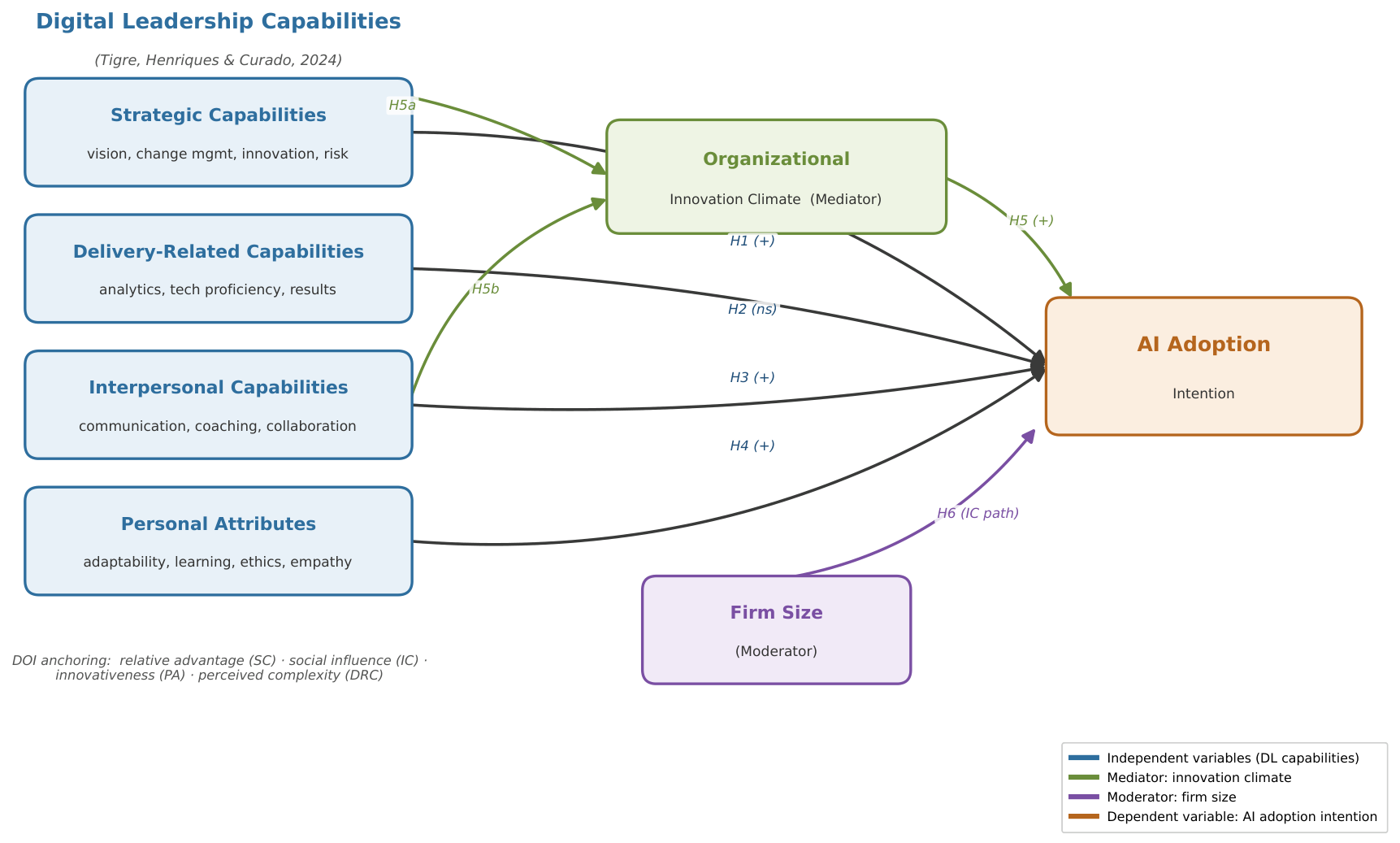
Figure 2.
Demographic profile of respondents: (a) gender distribution; (b) age distribution; (c) educational qualification; (d) years of business operation.
Figure 2.
Demographic profile of respondents: (a) gender distribution; (b) age distribution; (c) educational qualification; (d) years of business operation.
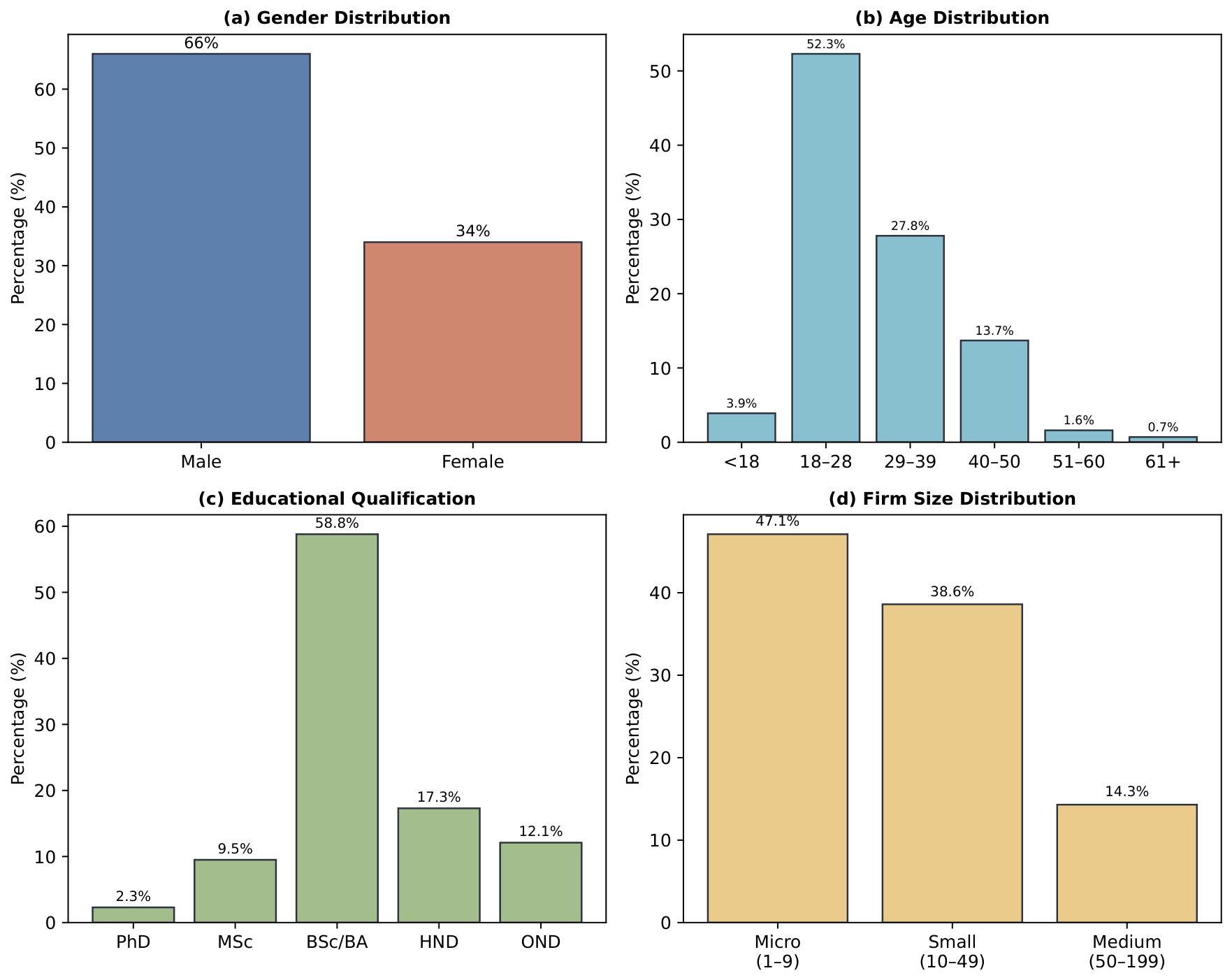
Figure 3.
PLS-SEM structural model results showing direct path coefficients and significance levels. *** p < 0.001; * p < 0.05; ns = not significant (p ≥ 0.05).
Figure 3.
PLS-SEM structural model results showing direct path coefficients and significance levels. *** p < 0.001; * p < 0.05; ns = not significant (p ≥ 0.05).
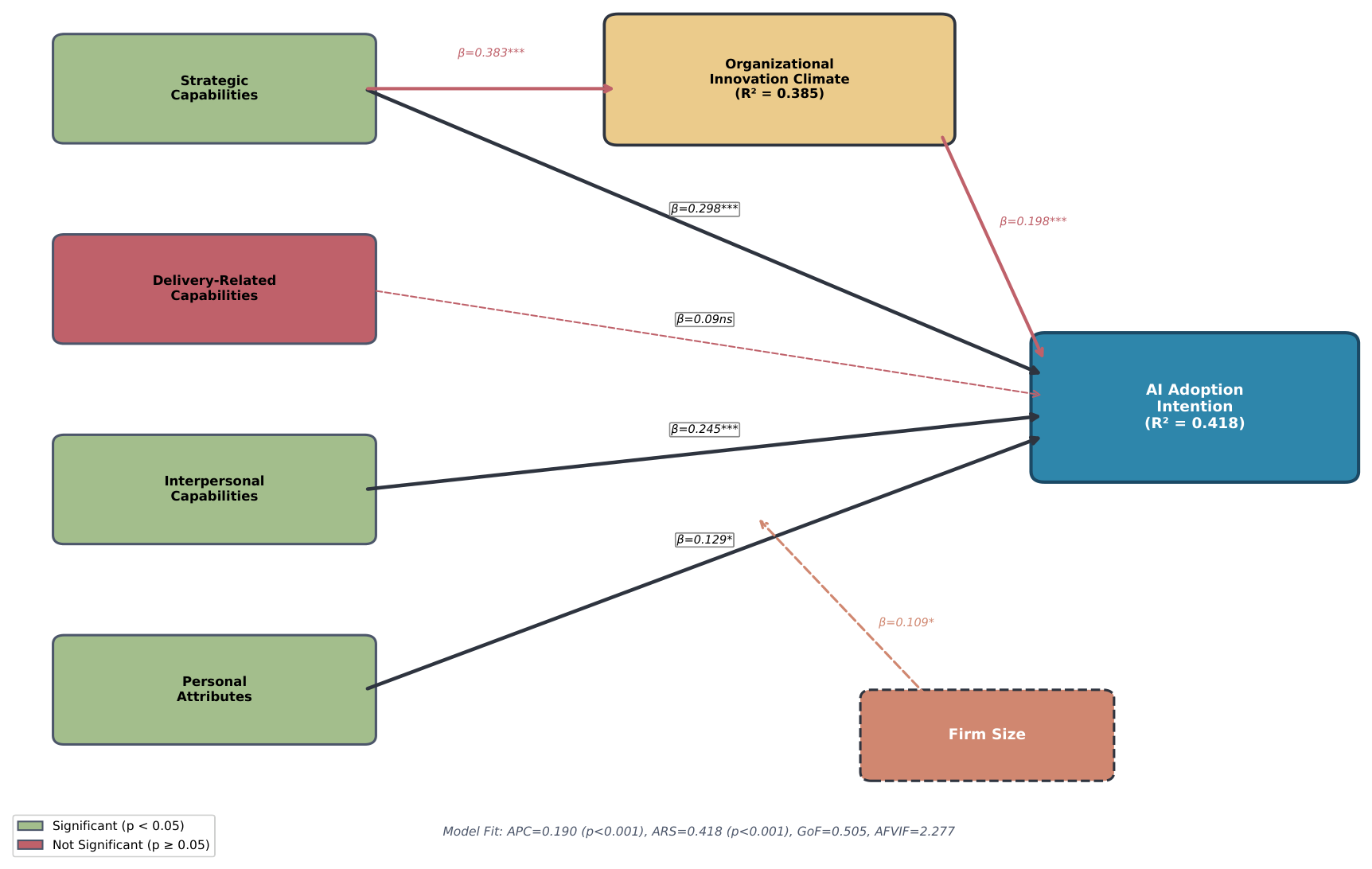
Table 1.
Conceptual mapping of constructs, theoretical anchors, and expected relationships.
| Construct (Role) | Theoretical Anchor | Expected relationship |
|---|---|---|
| Strategic capabilities (IV) | DOI: relative advantage | Positive direct effect on AIAI (); indirect via OIC () |
| Delivery-related capabilities (IV) | DOI: complexity (implementation) | Effect on AIAI hypothesised but theoretically contested () |
| Interpersonal capabilities (IV) | DOI: social system/influence | Positive direct effect on AIAI (); indirect via OIC () |
| Personal attributes (IV) | DOI: innovativeness | Positive direct effect on AIAI () |
| Organizational innovation climate (Mediator) | Innovation-climate theory | Transmits capability effects to AIAI () |
| Firm size (Moderator) | Resource-based view | Strengthens capability–AIAI paths in larger SMEs () |
| AI adoption intention (DV) | TPB/TAM, DOI | Proximal determinant of actual AI adoption |
IV = independent variable; DV = dependent variable; AIAI = AI adoption intention; OIC = organizational innovation climate.
Table 2.
Proportional distribution of the sample size across Nigerian states.
| State | Number of SMEs | Proportional Sample |
|---|---|---|
| Lagos State | 8396 | 141 |
| Ogun State | 2465 | 41 |
| Oyo State | 6131 | 103 |
| Osun State | 3007 | 50 |
| Ekiti State | 928 | 16 |
| Ondo State | 2363 | 39 |
| Total | 23,290 | 390 |
Table 3.
Demographic characteristics of respondents (n = 306).
| Variable | Frequency | Percentage (%) |
|---|---|---|
| Gender | ||
| Male | 202 | 66.0 |
| Female | 104 | 34.0 |
| Age | ||
| Less than 18 years | 12 | 3.9 |
| 18–28 years | 160 | 52.3 |
| 29–39 years | 85 | 27.8 |
| 40–50 years | 42 | 13.7 |
| 51–60 years | 5 | 1.6 |
| 61 years and above | 2 | 0.7 |
| Educational Qualification | ||
| PhD | 7 | 2.3 |
| MSc | 29 | 9.5 |
| BSc/BA | 180 | 58.8 |
| HND | 53 | 17.3 |
| OND | 37 | 12.1 |
| Years of Business Operation | ||
| 0–5 years | 165 | 53.9 |
| 6–10 years | 89 | 29.1 |
| 11–15 years | 34 | 11.1 |
| 16–20 years | 6 | 2.0 |
| 21+ years | 12 | 3.9 |
| Firm Size | ||
| Micro (1–9 employees) | 144 | 47.1 |
| Small (10–49 employees) | 118 | 38.6 |
| Medium (50–199 employees) | 44 | 14.3 |
Table 4.
Internal consistency reliability results.
| Construct | Indicator | Loading | CR | |
|---|---|---|---|---|
| AI Adoption Intention (AIAI) | AIAI1 | 0.815 | 0.76 | 0.85 |
| AIAI2 | 0.749 | |||
| AIAI6 | 0.757 | |||
| AIAI7 | 0.719 | |||
| Personal Attributes (PA) | PA7 | 0.761 | 0.69 | 0.83 |
| PA8 | 0.758 | |||
| PA9 | 0.842 | |||
| Strategic Capabilities (SC) | SC2 | 0.819 | 0.76 | 0.86 |
| SC3 | 0.841 | |||
| SC5 | 0.800 | |||
| Interpersonal Capabilities (IC) | IC11 | 0.778 | 0.80 | 0.87 |
| IC12 | 0.780 | |||
| IC13 | 0.836 | |||
| IC14 | 0.762 | |||
| Delivery-Related Capabilities (DRC) | DRC15 | 0.752 | 0.84 | 0.88 |
| DRC16 | 0.725 | |||
| DRC17 | 0.774 | |||
| DRC18 | 0.771 | |||
| DRC19 | 0.734 | |||
| DRC20 | 0.720 | |||
| Org. Innovation Climate (OIC) | OIC1 | 0.804 | 0.78 | 0.86 |
| OIC2 | 0.791 | |||
| OIC3 | 0.768 | |||
| OIC4 | 0.742 |
= Cronbach’s alpha; CR = composite reliability. All loadings exceed 0.70.
Table 5.
Convergent validity results (average variance extracted).
| Construct | AVE |
|---|---|
| AI Adoption Intention | 0.58 |
| Personal Attributes | 0.62 |
| Strategic Capabilities | 0.67 |
| Interpersonal Capabilities | 0.62 |
| Delivery-Related Capabilities | 0.56 |
| Org. Innovation Climate | 0.60 |
Table 6.
Fornell–Larcker criterion results.
| AIAI | PA | SC | IC | DRC | OIC | |
|---|---|---|---|---|---|---|
| AIAI | (0.761) | |||||
| PA | 0.476 | (0.788) | ||||
| SC | 0.573 | 0.615 | (0.820) | |||
| IC | 0.548 | 0.500 | 0.569 | (0.789) | ||
| DRC | 0.542 | 0.625 | 0.661 | 0.753 | (0.746) | |
| OIC | 0.564 | 0.512 | 0.621 | 0.583 | 0.549 | (0.775) |
Diagonal values in parentheses = ; off-diagonal = inter-construct correlations.
Table 7.
Heterotrait–monotrait (HTMT) ratio results.
| AIAI | PA | SC | IC | DRC | OIC | |
|---|---|---|---|---|---|---|
| AIAI | — | |||||
| PA | 0.661 | — | ||||
| SC | 0.756 | 0.850 | — | |||
| IC | 0.703 | 0.675 | 0.733 | — | ||
| DRC | 0.677 | 0.822 | 0.828 | 0.875 | — | |
| OIC | 0.718 | 0.694 | 0.789 | 0.741 | 0.683 | — |
All HTMT values fall below the 0.90 threshold.
Table 8.
Model fit and quality indices.
| Index | Full Name | Threshold | Value | Decision |
|---|---|---|---|---|
| APC | Average Path Coefficient | p < 0.05 | 0.190 (p < 0.001) | Accepted |
| ARS | Average R-Squared | p < 0.05 | 0.418 (p < 0.001) | Accepted |
| AARS | Avg. Adjusted R-Squared | p < 0.05 | 0.410 (p < 0.001) | Accepted |
| AFVIF | Avg. Full Collinearity VIF | ≤5.0 | 2.277 | Accepted |
| GoF | Tenenhaus Goodness-of-Fit | >0.36 | 0.505 | Accepted |
| SPR | Sympson’s Paradox Ratio | ≥0.70 | 0.857 | Accepted |
| RSCR | R-Sq. Contribution Ratio | ≥0.90 | 0.981 | Accepted |
| SSR | Statistical Suppression Ratio | ≥0.70 | 1.000 | Accepted |
GoF thresholds: small > 0.10; medium > 0.25; large > 0.36 [62].
Table 9.
Direct effects: path coefficients, t-statistics, effect sizes, and hypothesis testing.
| Path | t | p | Decision | ||
|---|---|---|---|---|---|
| : SC → AIAI | 0.298 | 5.459 | <0.001 | 0.171 | Supported |
| : DRC → AIAI | 0.090 | 1.589 | 0.057 | 0.049 | Not Supported |
| : IC → AIAI | 0.245 | 4.453 | <0.001 | 0.134 | Supported |
| : PA → AIAI | 0.129 | 2.304 | 0.011 | 0.062 | Supported |
| SC → OIC | 0.383 | 7.143 | <0.001 | 0.238 | Significant |
| OIC → AIAI | 0.198 | 3.612 | <0.001 | 0.112 | Significant |
effect sizes: 0.02 = small; 0.15 = medium; 0.35 = large [64]. R2 (AIAI) = 0.418; R2 (OIC) = 0.385; Q2 (AIAI) = 0.412; Q2 (OIC) = 0.379.
Table 10.
Mediation analysis results: indirect effects through organizational innovation climate.
| Indirect Path | Indirect | 95% CI | p | Mediation Type |
|---|---|---|---|---|
| SC → OIC → AIAI | 0.076 | [0.031, 0.128] | 0.003 | Partial |
| IC → OIC → AIAI | 0.048 | [0.009, 0.096] | 0.024 | Partial |
| PA → OIC → AIAI | 0.032 | [−0.008, 0.074] | 0.112 | None |
| DRC → OIC → AIAI | 0.021 | [−0.015, 0.059] | 0.234 | None |
CI = confidence interval (bias-corrected bootstrapping, 5000 resamples). Partial mediation: both direct and indirect effects significant.
Disclaimer/Publisher’s Note: The statements, opinions and data contained in all publications are solely those of the individual author(s) and contributor(s) and not of MDPI and/or the editor(s). MDPI and/or the editor(s) disclaim responsibility for any injury to people or property resulting from any ideas, methods, instructions or products referred to in the content. |
© 2026 by the authors. Licensee MDPI, Basel, Switzerland. This article is an open access article distributed under the terms and conditions of the Creative Commons Attribution (CC BY) license (http://creativecommons.org/licenses/by/4.0/).
Copyright: This open access article is published under a Creative Commons CC BY 4.0 license, which permit the free download, distribution, and reuse, provided that the author and preprint are cited in any reuse.


