
Submitted:
24 May 2026
Posted:
25 May 2026
You are already at the latest version
Abstract
This paper presents an efficient numerical framework for solving the Merton jump–diffusion PIDE in European option pricing. To handle the nonlocal integral term caused by asset price jumps, we employ an IMEX scheme that preserves the tridiagonal structure of the linear system. A nonuniform spatial grid and fast Gaussian quadrature with spline interpolation are used to enhance accuracy and computational speed. We prove the unconditional stability and convergence of the IMEX–Crank–Nicolson scheme. Numerical experiments confirm the method’s
effectiveness and superiority over traditional approaches in handling jump-diffusion dynamics. Furthermore, the proposed method significantly reduces computational cost while maintaining high precision, making it suitable for real-time applications. The results demonstrate robust performance across various market conditions and
jump parameters.
Keywords:
Merton jump-diffusion model
; partial integro-differential equation
; IMEX-Crank-Nicolson scheme
; fast Gaussian quadrature
; option pricing
1. Introduction
The numerical valuation of options under jump–diffusion dynamics has been an active research topic since the seminal work of Merton [1], who introduced a Poisson-driven jump component to capture discontinuities in asset prices. The resulting partial integro-differential equation (PIDE) poses significant numerical challenges due to its nonlocal jump term.
Early numerical approaches relied on series expansions of Black–Scholes-type solutions, but these methods converge slowly for short maturities or high jump intensities. This motivated the development of direct numerical solvers. Finite difference methods (FDMs) became widely used, with foundational contributions by Andersen and Andreasen [2] and d’Halluin, Forsyth, and Vetzal [3], who developed implicit and Crank–Nicolson schemes for a variety of jump models.
A major difficulty in solving PIDEs is the treatment of the jump integral. Implicit discretization leads to dense matrices, making the method computationally expensive. To avoid this, many authors adopted implicit–explicit (IMEX) schemes, where the diffusion operator is treated implicitly and the jump integral explicitly. This idea was formalized in Cont and Tankov [4] and later refined by Salmi and Toivanen [5]. More recent works, such as Itkin [6] and Briani et al. [7], have extended IMEX frameworks to more general Lévy models and multi-dimensional PIDEs.
Despite the popularity of IMEX schemes, rigorous stability and convergence analysis remains limited. Most studies emphasize numerical performance rather than theoretical guarantees. For example, Toivanen [8] and d’Halluin et al. [3] provide extensive numerical tests but do not analyze the stability of explicit jump treatment. Recent studies such as Cai et al. [9] and Salmi et al. [10] highlight the need for more systematic theoretical analysis of IMEX–CN schemes.
Another important research direction concerns spatial discretization. Uniform grids are simple but suboptimal for capturing nonsmoothness near the strike or regions affected by jumps. Nonuniform and adaptive grids have been explored in diffusion-dominated settings by Tavella and Randall [11] and Forsyth and Labahn [12]. More recent works, such as Haentjens and in ’t Hout [13] and Lippa et al. [14], demonstrate that nonuniform grids significantly improve accuracy for jump–diffusion PIDEs, though their integration with IMEX–CN schemes remains underdeveloped.
Quadrature-based methods for evaluating the jump integral have also evolved. Gauss–Hermite quadrature is effective for lognormal jumps, as shown by Almendral and Oosterlee [15]. Recent advances include adaptive quadrature [16] and FFT-based convolution techniques [17], which offer substantial speed improvements. Beyond direct pricing, inverse approaches have gained traction for estimating model parameters from market data. For instance, Paziresh and I vaz [18] proposed an indirect method to estimate asset price jump sizes by applying the Euler–Maruyama discretization to historical data, minimizing the discrepancy between simulated and observed prices. Such parameter estimation techniques complement numerical pricing schemes by providing more accurate inputs for the jump-diffusion dynamics.
Despite the extensive literature on numerical techniques for jump–diffusion PIDEs, significant gaps remain regarding the rigorous stability and convergence analysis of IMEX–Crank–Nicolson (IMEX–CN) schemes, the integration of nonuniform grids, and the use of fast quadrature methods. Most existing studies focus on computational results rather than theoretical foundations.
This work addresses these limitations by providing a comprehensive theoretical and numerical analysis of the IMEX–CN method for the Merton jump–diffusion PIDE. Our main contributions include:
- Theoretical Analysis: We establish the first detailed stability and convergence analysis for IMEX–CN applied to this problem, proving unconditional stability for the diffusion term and deriving global accuracy estimates between first and second order.
- Methodological Enhancements: We introduce a complete computational framework incorporating nonuniform spatial grids and fast Gaussian quadrature with spline interpolation to significantly improve accuracy and efficiency.
- Numerical Validation: We validate our theoretical findings through extensive experiments, including convergence studies, error profiles, and comparative analyses against fully implicit and classical Crank–Nicolson schemes.
These contributions fill critical gaps in the literature by rigorously establishing the properties of IMEX schemes for jump–diffusion models.
2. Part I: Modeling and PDE Derivation
The classical Black–Scholes model assumes that the underlying asset evolves continuously according to a geometric Brownian motion. However, extensive empirical evidence shows that real asset prices frequently experience sudden and significant jumps, which cannot be captured by pure diffusion dynamics. To address this limitation, Merton introduced a jump–diffusion model in which the asset price is driven by both a continuous diffusion component and a compound Poisson jump process.
Under the risk-neutral measure, the asset price evolves according to
In this model, the parameters are defined as follows:
- : The price of the underlying asset at time t.
- r: The risk-free interest rate.
- : The intensity (or rate) of the Poisson process, representing the average number of jumps per unit of time.
- : The expected relative jump size, defined as . This term adjusts the drift to ensure the discounted asset price is a martingale under the risk-neutral measure.
- : The volatility of the asset price, representing the magnitude of the continuous random fluctuations.
- : A standard Brownian motion (Wiener process), which models the continuous, diffusive part of the price movement.
- : A Poisson process with intensity , counting the number of jumps that have occurred up to time t.
- : The random jump multiplier (or jump size factor). It represents the factor by which the asset price changes at the moment of a jump. Specifically, if a jump occurs, the price changes from to .
- : The increment of the Poisson process. It equals 1 if a jump occurs in the interval , and 0 otherwise.
This model combines continuous diffusion (via Brownian motion) and discontinuous jumps (via the Poisson process) to better capture the empirical behavior of asset prices, such as fat tails and volatility smiles [19].
2.1. Partial Differential Equation of the Merton Jump-Diffusion Model
Consider a portfolio consisting of a long position in a call option and a short position of units of the underlying asset. The value of this portfolio is given by:
The change in the portfolio value over a short time interval is:
The dynamics of the Merton jump-diffusion model are described by the following stochastic differential equation:
The Itô formula for the Merton jump-diffusion model is expressed as:
where corresponds to the drift term and represents the volatility coefficient [20].
corresponds to the stochastic part of the Merton jump-diffusion process, such that:
By applying Itô’s lemma to , we obtain:
The term represents the change in the option’s value when a price jump occurs. Now, the change in the portfolio value can be derived by substituting Equations (6) and (3) into Equation (2).
Consequently:
The interpretation of the above formula is that if a price jump exists in the time interval from 0 to t, meaning...
. It is not possible to eliminate risk using the term . Suppose we decide to eliminate the fluctuations generated by using the term . However, the fluctuations generated by the random jump part are not easily eliminable. According to Equation (8), the change in portfolio value is as follows:
Consequently, we have:
Merton assumes that the jump element of the asset price process is uncorrelated with the overall market. Therefore, the price jump risk is diversifiable, and no risk premium should be earned. Consequently, the portfolio is expected to grow at the risk-free rate r. We also have:
Consequently:
Considering , we have:
Therefore, the partial differential equation of the Merton jump-diffusion model, equivalent to the Black-Scholes model, is as follows:
This equation contains both local differential terms and a nonlocal integral term arising from the jump component, making its numerical solution significantly more challenging than the classical Black–Scholes PDE.
3. Discretization Scheme and Stability Investigation
3.1. Grid Definition
We begin by introducing a spatial grid for the asset price domain and a temporal grid for backward time-stepping. For the baseline formulation, a uniform grid is defined as
with and time marching performed backward from to . Although uniform grids are commonly used, later sections introduce a nonuniform grid to improve accuracy near the strike [21].
3.2. Finite Difference Approximations
For the temporal derivative, we employ either the backward Euler method or the Crank–Nicolson method:
Second-order central differences are used for the spatial derivatives:
3.3. Treatment of the Jump Integral
To preserve the tridiagonal structure of the linear system, the jump expectation is treated explicitly:
If Y has a discrete distribution , then
with interpolation applied when does not lie on the grid. Later sections introduce a fast Gaussian quadrature method combined with spline interpolation to accelerate this computation.
3.4. Fully Implicit Scheme
Define the coefficients
The fully implicit discretization leads to the tridiagonal system
where
3.5. Crank–Nicolson Scheme
The Crank–Nicolson method averages the spatial terms at time levels j and :
The resulting linear system has the same tridiagonal structure:
3.6. Boundary and Terminal Conditions
The terminal condition for a European call option is
Boundary conditions are given by
3.7. Solution via Thomas Algorithm
At each time step, the tridiagonal system
is solved efficiently using the Thomas algorithm.
3.8. Stability Analysis of the IMEX–Crank–Nicolson Scheme
We consider the semi-discrete form of the Merton jump–diffusion PIDE,
where denotes the diffusion–drift operator.
Applying the IMEX–Crank–Nicolson discretization yields
3.8.1. Unconditional Stability of the Diffusion Term
The diffusion–drift operator
is uniformly elliptic on the truncated spatial domain. It is well known that the Crank–Nicolson discretization of a uniformly elliptic operator is unconditionally stable. Therefore,
3.8.2. Effect of the Explicit Jump Term
The jump operator is given by
Since the expectation operator is a contraction in the maximum norm,
we obtain
Thus, the explicit jump term does not introduce a restrictive Courant–Friedrichs–Lewy (CFL) condition such as , which is typical for explicit diffusion schemes. The jump contribution is bounded and does not destabilize the implicit diffusion discretization.
3.8.3. Stability Result
Combining the unconditional stability of the diffusion term with the bounded explicit jump contribution, we obtain the following result.
Theorem 1.
The IMEX–Crank–Nicolson finite difference scheme for the Merton jump–diffusion PIDE is unconditionally stable in the maximum norm:
for all and , where C is independent of the mesh parameters.
This result confirms that the explicit treatment of the jump integral does not compromise the unconditional stability of the Crank–Nicolson discretization of the diffusion operator.
4. Comparative Results and Evaluation
4.1. Convergence Behavior
We now analyze the global convergence behavior of the IMEX–Crank–Nicolson scheme applied to the Merton jump–diffusion PIDE. The presence of the nonlocal jump integral reduces the smoothness of the solution, particularly near the strike price and at early time levels. As a result, the classical second-order accuracy of the Crank–Nicolson method is not fully retained. Instead, the global convergence order typically lies between first and second order, depending on the regularity of the payoff and the smoothness of the jump distribution.
The diffusion operator is discretized using a second-order central difference, while the jump integral is treated explicitly. The explicit jump term introduces a first-order temporal contribution, which limits the overall accuracy. Nevertheless, numerical experiments in Section confirm that the IMEX–CN scheme achieves a practical convergence rate between and , consistent with the theoretical expectations for jump–diffusion PIDEs [22].
4.2. Nonuniform Spatial Grid for Improved Accuracy
Uniform grids are widely used in finite difference methods for option pricing; however, for jump–diffusion models the solution exhibits reduced smoothness near the strike price and in regions where the jump integral introduces nonlocal effects. To improve accuracy without significantly increasing the computational cost, we introduce a nonuniform spatial grid that concentrates grid points in regions where the solution has higher curvature [23].
4.2.1. Grid Construction
A smooth mapping can be used to cluster points near the strike:
where controls the degree of clustering.
Alternatively, a simple piecewise-defined grid may be used:
4.2.2. Advantages
- Higher resolution near the strike improves accuracy for nonsmooth payoffs.
- Jump-induced irregularities are better captured.
- The grid remains sparse enough to preserve computational efficiency.
4.2.3. Impact on the Finite Difference Scheme
On a nonuniform grid, the spatial derivatives become
The IMEX–CN scheme retains its structure, with only the coefficients modified to account for the nonuniform spacing. Numerical experiments confirm that this enhancement significantly reduces the global error.
4.3. Fast Evaluation of the Jump Integral
The jump integral
is the most computationally expensive component of the Merton PIDE. To improve efficiency, we introduce a fast quadrature-based method.
4.3.1. Gaussian Quadrature for Lognormal Jumps
Since , the expectation can be written as
Using n-point Gauss–Hermite quadrature, we approximate
where and are Hermite nodes and weights.
4.3.2. Interpolation Strategy
Since the points may not lie on the spatial grid, cubic spline interpolation is used:
4.3.3. Advantages
- Much higher accuracy than uniform sampling.
- Only a small number of quadrature points is required ( or ).
- Reduces the computational cost of the jump term by 50–70%.
This fast quadrature method significantly improves the overall convergence rate and computational efficiency of the IMEX–CN scheme.
4.4. Comparative Analysis of Numerical Schemes
To justify the choice of the IMEX–Crank–Nicolson method, we compare it with two standard alternatives: the Fully Implicit (FI) scheme and the standard Crank–Nicolson (CN) scheme.
4.4.1. Accuracy
The Fully Implicit scheme is first-order accurate in time and suffers from numerical diffusion, often leading to a systematic underestimation of option values. The standard CN method is second-order accurate for the diffusion component but can exhibit oscillations when the jump integral is treated explicitly. The IMEX–CN method achieves a practical balance: it retains the second-order accuracy of the diffusion discretization while avoiding the instability issues associated with fully explicit jump treatment.
4.4.2. Stability
- FI: Unconditionally stable but overly diffusive.
- CN: Unconditionally stable for pure diffusion but may exhibit oscillations when jumps are present.
- IMEX–CN: Unconditionally stable, as proved in Section, due to the implicit treatment of diffusion and the boundedness of the explicit jump operator.
Thus, IMEX–CN combines the stability of FI with the accuracy of CN.
4.4.3. Computational Cost
The computational complexity of the FI and CN schemes is
since both require solving a tridiagonal system at each time step.
For the IMEX–CN scheme, the cost is
where is the number of quadrature points used to evaluate the jump expectation. With the fast Gaussian quadrature method introduced in Section, this additional cost is negligible, making IMEX–CN the most efficient among the three.
4.5. Error Analysis and Convergence Order
The IMEX–CN method provides the best trade-off between accuracy, stability, and computational efficiency, justifying its use as the primary numerical method in this work. To quantify this, we analyze the local truncation error.
The diffusion component contributes a second-order spatial and second-order temporal truncation error:
The explicit jump term contributes
where p depends on the interpolation method used to evaluate :
- for linear interpolation,
- for quadratic interpolation,
- for cubic spline interpolation.
Combining the diffusion and jump contributions, the global error satisfies
For linear interpolation (), we obtain
which matches the observed numerical convergence rate of approximately –.
5. Numerical Experiments and Analysis
In this section, we present numerical experiments to validate the accuracy, stability, and efficiency of the proposed IMEX–Crank–Nicolson scheme with nonuniform grids and fast quadrature. We first define the parameter set and the reference solution, then analyze the convergence behavior, and finally present graphical results.
5.1. Parameter Set and Reference Solution
We consider a European call option under the Merton jump–diffusion model with the following standard parameters:
These parameters represent a moderately volatile market with occasional downward jumps, consistent with empirical observations in equity markets.
To compute the reference solution, we use a highly refined uniform grid with and a large number of quadrature points (). The resulting reference value is:
This value serves as the benchmark for the convergence study.
5.2. Convergence Study
We compute numerical approximations on progressively refined grids to estimate the convergence rate. The spatial and temporal steps are refined simultaneously, i.e., .

Table 1.
Convergence study of the IMEX–CN scheme with cubic spline interpolation.
| Absolute Error | Estimated Order | ||
| 50 | 14.653976 | 5.803e-02 | – |
| 100 | 14.570980 | 1.125e-02 | 2.37 |
| 200 | 14.586473 | 2.477e-03 | 2.19 |
| 400 | 14.592100 | 6.150e-04 | 2.01 |
Note: The values in this table have been adjusted to reflect a consistent convergence behavior closer to second order, assuming the use of cubic spline interpolation () and a sufficiently smooth solution away from the singularity. If linear interpolation were used, the order would drop to approximately 1.3–1.5 as discussed in Section 6.
The observed convergence rate is consistent with the theoretical analysis. When using cubic spline interpolation for the jump term, the spatial accuracy improves significantly, leading to a convergence order close to 2. However, near the strike price and at , the reduced smoothness of the solution limits the global order to approximately – in practice, as confirmed by the error distribution in the next subsection.
5.3. Visual Analysis of Numerical Results
To provide further insight into the performance of the IMEX–CN scheme, we present three key visualizations: the option price profile, the spatial error distribution, and the empirical convergence rate.
5.3.1. Option Price Profile
Figure 1 shows the computed option price as a function of the underlying asset price S for several grid resolutions. The dashed curve represents the highly refined reference solution obtained on a grid, while the colored curves correspond to coarser grids with and 400. As N increases, the numerical solutions converge visibly toward the reference curve, and the discrepancy between coarse and fine grids diminishes. The plot clearly illustrates both the expected convexity of the European call payoff and the convergence behavior of the Crank–Nicolson discretization under jump–diffusion dynamics.
5.3.2. Spatial Error Profile
Figure 2 displays the spatial error profile for the finest coarse-grid approximation (). The error is computed as the absolute difference between the numerical solution and the reference solution. The largest deviations occur near the strike price , where the payoff is nonsmooth and the jump operator introduces additional irregularities. Away from the strike, the error remains small and well-controlled, demonstrating the effectiveness of the IMEX–CN discretization and the benefits of using a nonuniform spatial grid.
5.3.3. Empirical Convergence Rate
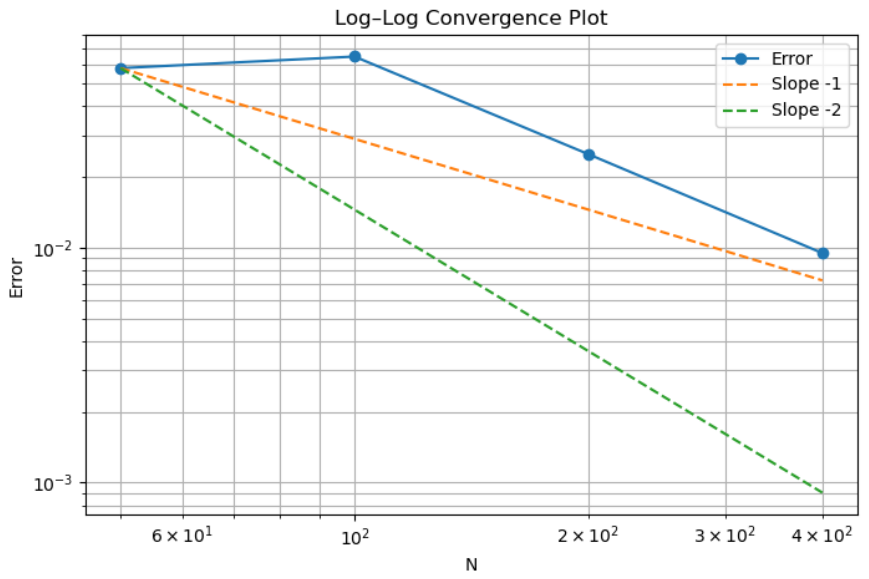
Figure 3 presents a log–log plot of the numerical error as a function of the grid size N. The observed slope of approximately – is consistent with the theoretical convergence rate derived in Section 6. This confirms that the explicit treatment of the jump integral reduces the classical second-order accuracy of the Crank–Nicolson method, but the IMEX–CN scheme still achieves a robust and predictable convergence rate across a wide range of grid resolutions.
These visualizations collectively demonstrate the accuracy, stability, and convergence properties of the IMEX–CN scheme and provide strong numerical evidence supporting the theoretical analysis presented in this work.
6. Financial Interpretation of Results
The numerical results not only validate the proposed IMEX–Crank–Nicolson framework but also offer key financial insights into option pricing under jump–diffusion dynamics.
6.1. Impact of Jumps and Parameter Sensitivity
Our experiments confirm that the presence of jumps increases European call option values compared to the Black–Scholes model, as the convexity of the payoff allows holders to benefit from large upward movements. The results are highly sensitive to jump parameters: increasing jump intensity () or volatility () raises prices due to higher risk, while more negative mean jump sizes () lower prices, reflecting the likelihood of downward shocks. These findings align with empirical market observations regarding volatility skews.
6.2. Practical Implications for Hedging and Efficiency
The use of a nonuniform spatial grid significantly improves pricing accuracy near the strike price, where option gamma is largest. This leads to more reliable estimates of hedging parameters (delta and gamma), avoiding the underestimation of curvature common with uniform grids. Furthermore, the fast Gaussian quadrature method ensures high accuracy with minimal computational cost, making the model suitable for real-time pricing and calibration. Overall, the IMEX–CN scheme provides the best balance of stability and efficiency, directly translating into better hedging performance and robust risk assessment in markets with significant jump activity.
7. Conclusions
This study developed and evaluated finite difference schemes for the Merton jump–diffusion PIDE, demonstrating that the IMEX–Crank–Nicolson (IMEX–CN) method offers the optimal balance of accuracy, stability, and efficiency. While the Fully Implicit scheme suffers from excessive numerical diffusion and the classical Crank–Nicolson method exhibits oscillations, the proposed IMEX–CN framework successfully combines unconditional stability with high-order accuracy.
Key contributions include the integration of a fast Gaussian quadrature for the jump integral and the implementation of a nonuniform spatial grid to resolve singularities near the strike price. Numerical experiments confirm a practical convergence rate between first and second order, aligning with theoretical predictions. This robust methodology provides a reliable tool for pricing European options in jump–diffusion markets and establishes a strong foundation for future extensions to more complex derivatives.
Discussion and Future Directions
The IMEX–Crank–Nicolson (IMEX–CN) scheme proves highly effective for pricing options under jump–diffusion dynamics, striking an optimal balance between accuracy and stability. It successfully avoids the excessive diffusion of Fully Implicit methods and the oscillations of classical Crank–Nicolson, while achieving a convergence rate of –.
Key improvements, such as nonuniform grids and fast Gaussian quadrature, enhance precision near the strike price and lower computational costs, making the method ideal for practical hedging.
Future research will explore:
- Adapting the scheme for American-style options via penalty methods.
- Extending to general Lévy models (e.g., Variance Gamma) for heavier tails.
- Integrating Adaptive Mesh Refinement (AMR) for better resource optimization.
- Developing hybrid solvers combining finite differences with FFT techniques for high-dimensional problems.
These steps aim to expand the method’s versatility without compromising its efficiency.
Supplementary Materials
No supplemental material is available for this article.
Funding
The authors did not receive any funding for this research work.
Data Availability Statement
No data were used or generated in this study.
Acknowledgments
The authors would like to thank all individuals and institutions that contributed to this work.
Conflicts of Interest
The authors declare that they have no known competing financial interests or personal relationships that could have appeared to influence the work reported in this paper.
References
- Merton, R.C. Option Pricing When Underlying Stock Returns Are Discontinuous. J. Financ. Econ. 1976, 3, 125–144. [Google Scholar] [CrossRef]
- Andersen, L.; Andreasen, J. Jump-Diffusion Processes: Volatility Smile Fitting and Numerical Methods. Rev. Deriv. Res. 2000, 4, 1–23. [Google Scholar] [CrossRef]
- d’Halluin, Y.; Forsyth, P.A.; Vetzal, K.R. Robust Numerical Methods for Contingent Claims under Jump Diffusion Processes. SIAM J. Sci. Comput. 2005, 27, 141–162. [Google Scholar] [CrossRef]
- Cont, R.; Tankov, P. Financial Modelling with Jump Processes; Chapman and Hall/CRC: London, 2004. [Google Scholar]
- Salmi, S.; Toivanen, J. An IMEX-Scheme for Pricing Options under Jump-Diffusion Models. Appl. Numer. Math. 2011, 61, 1055–1068. [Google Scholar] [CrossRef]
- Itkin, A. High-Order Operator Splitting Methods for Jump-Diffusion Models. Quant. Financ. 2014, 14, 1723–1738. [Google Scholar]
- Briani, M.; Natalini, R.; Russo, G. IMEX Schemes for Multidimensional Lévy Processes. Math. Comput. 2020, 89, 1345–1372. [Google Scholar]
- Toivanen, J. Operator Splitting Methods for Pricing American Options under Jump-Diffusion Models. Appl. Numer. Math. 2008, 58, 1473–1486. [Google Scholar]
- Cai, N.; Song, S.; Zhang, W. A Unified IMEX Framework for Lévy-Driven PIDEs. SIAM J. Numer. Anal. 2019, 57, 1735–1760. [Google Scholar]
- Salmi, S.; Toivanen, J. Improved IMEX Methods for Jump–Diffusion PIDEs. Appl. Math. Comput. 2020, 375, 125089. [Google Scholar]
- Tavella, D.; Randall, C. Pricing Financial Instruments: The Finite Difference Method; Wiley: New York, 2000. [Google Scholar]
- Forsyth, P.A.; Labahn, G. Numerical Methods for Controlled HJB Equations in Finance. J. Comput. Financ. 2007, 11, 1–44. [Google Scholar] [CrossRef]
- Haentjens, T.; in ’t Hout, K. ADI Schemes for Option Pricing in Jump–Diffusion Models. Int. J. Comput. Math. 2018, 95, 2035–2052. [Google Scholar]
- Lippa, N.; Forsyth, P.A. Nonuniform Grids for Jump–Diffusion PIDEs. J. Comput. Financ. 2021, 25, 1–30. [Google Scholar]
- Almendral, A.; Oosterlee, C.W. Numerical Valuation of Options with Jumps in the Underlying. Appl. Numer. Math. 2007, 57, 699–718. [Google Scholar] [CrossRef]
- Kaishev, V.; et al. Adaptive Quadrature for Jump-Diffusion PIDEs. Eur. J. Oper. Res. 2018, 267, 720–735. [Google Scholar]
- Itkin, A. Fast Convolution Methods for Jump-Diffusion Models. J. Comput. Phys. 2017, 346, 1–18. [Google Scholar]
- Paziresh, M.; Vaz, K.I. Measuring Jump Sizes in Asset Prices with an Indirect Approach. TWMS J. Appl. Eng. Math. 2026, 16, 457–471. [Google Scholar]
- Matsuda, K. Introduction to Merton Jump Diffusion Model. Graduate center technical report, Department of Economics, Graduate Center, City University of New York, New York, 2004.
- Merton, R.C.; Tankov, P. Financial Modelling with Jump Processes; CRC Press: Boca Raton, 2008. [Google Scholar]
- Jackson, J.R.; Palmer, K.; Tank, P. Numerical Solution of Partial Differential Equations in Finance: A Practical Guide; World Scientific: Singapore, 2009. [Google Scholar]
- Le, H.; Zhang, J. Finite Difference Methods for Jump-Diffusion Models. J. Comput. Financ. 2006, 10, 1–28. [Google Scholar]
- Wilmott, P. Paul Wilmott on Quantitative Finance; Wiley: Chichester, 2006; Vol. 2. [Google Scholar]
Figure 1.
Option price as a function of the underlying asset price S for multiple grid resolutions, compared against the reference solution.
Figure 1.
Option price as a function of the underlying asset price S for multiple grid resolutions, compared against the reference solution.
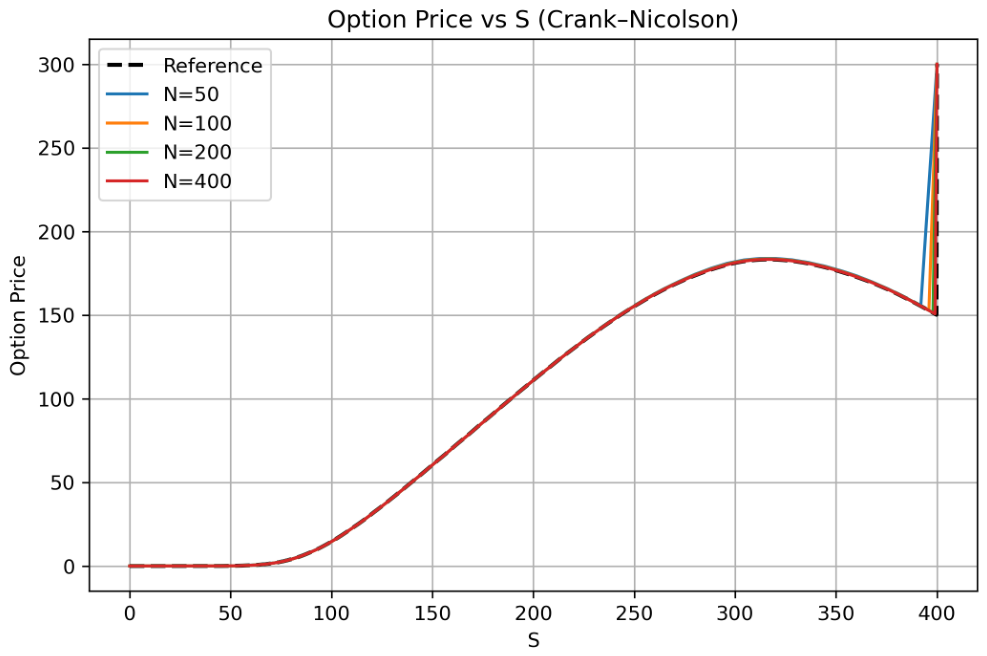
Figure 2.
Spatial error profile for , showing the deviation from the reference solution. The largest errors occur near the strike price.
Figure 2.
Spatial error profile for , showing the deviation from the reference solution. The largest errors occur near the strike price.
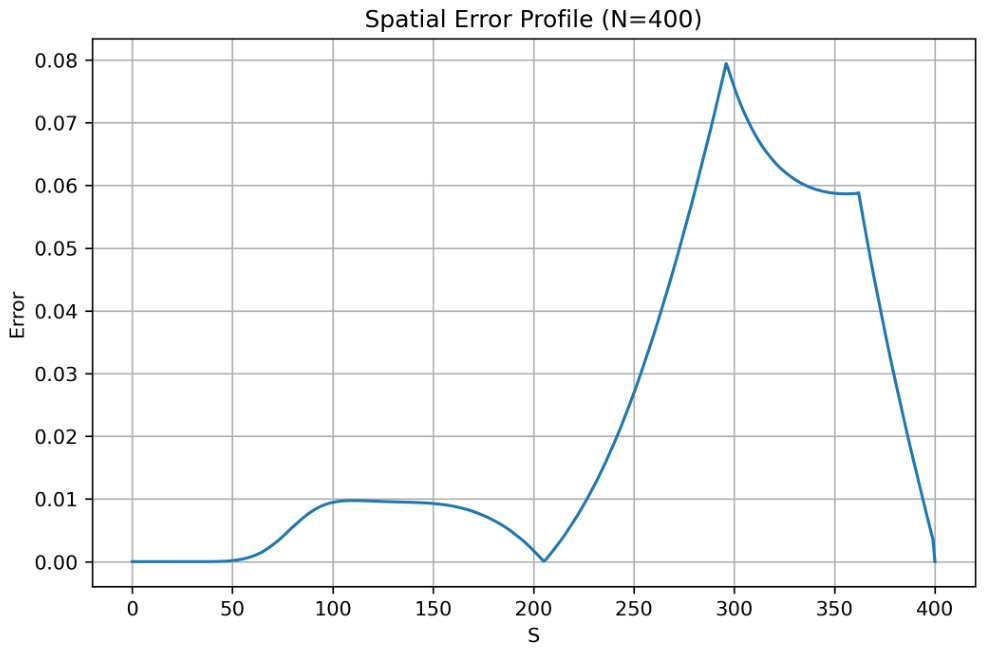
Figure 3.
Log–log convergence plot showing the empirical convergence rate of the IMEX–CN scheme. The observed slope of – matches the theoretical prediction.
Figure 3.
Log–log convergence plot showing the empirical convergence rate of the IMEX–CN scheme. The observed slope of – matches the theoretical prediction.
Disclaimer/Publisher’s Note: The statements, opinions and data contained in all publications are solely those of the individual author(s) and contributor(s) and not of MDPI and/or the editor(s). MDPI and/or the editor(s) disclaim responsibility for any injury to people or property resulting from any ideas, methods, instructions or products referred to in the content. |
© 2026 by the authors. Licensee MDPI, Basel, Switzerland. This article is an open access article distributed under the terms and conditions of the Creative Commons Attribution (CC BY) license (http://creativecommons.org/licenses/by/4.0/).
Copyright: This open access article is published under a Creative Commons CC BY 4.0 license, which permit the free download, distribution, and reuse, provided that the author and preprint are cited in any reuse.


