
Submitted:
22 May 2026
Posted:
25 May 2026
You are already at the latest version
Abstract
Selecting native species for ecological restoration remains a challenge, especially when the commercial supply of seedlings does not adequately represent the regional flora. We used the tree flora of Iguaçu National Park as a regional ecological reference to assess its similarity to the species available in forest nurseries in the surrounding region and propose a multicriteria protocol. We sampled 471 individuals belonging to 73 species and 30 botanical families in six permanent plots in Iguaçu National Park. Similarity between the local flora and the nurseries was low, ranging from 0.11 to 0.16, whereas similarity among nurseries was moderate, ranging from 0.438 to 0.574, indicating that seedling supply is partially homogeneous and poorly representative of the reference flora. Based on these results, we applied a weighted multicriteria protocol integrating ecological, operational, and normative criteria to prioritize native species for seedling production in regional nurseries. Phenology, seed storage behavior, threat status, and dormancy were identified as the attributes with the greatest relative contribution to category differentiation. The protocol provides a technical and scientific basis to guide nurseries and restoration actions based on the local reference flora.
Keywords:
Iguaçu National Park
; ecological restoration
; forest nurseries
; Atlantic forest
; Brazilian subtropical forest
1. Introduction
Ecological restoration is an essential strategy for reversing environmental degradation and promoting biodiversity conservation, especially in highly threatened biomes such as the Atlantic Forest, which currently retains only 12.4% of its original cover [1]. In the state of Paraná, the Seasonal Semideciduous Forest and the Mixed Ombrophilous Forest have undergone severe losses, making them priority targets for ecological restoration actions, even though restored vegetation has increased over the last 20 years [2].
To achieve ambitious targets, such as the restoration of 12 million hectares by 2030 [3], it is essential to strengthen the supply chain for native seeds and seedlings, especially in forest nurseries. However, nurseries face challenges in species production, often due to the lack of criteria that combine ecological value with operational feasibility [4,5]. Although ecological restoration has advanced in scale and visibility, the technical basis supporting species selection in nurseries remains weak, which hinders the achievement of ecological and functional goals in restored areas [6].
Species production decisions are commonly based on the immediate availability of seeds or on generic market lists, overlooking ecological and functional attributes [5,7]. Therefore, there is a need for accessible, replicable tools adapted to the actual conditions of nurseries and forest restoration programs [8].
Forest nurseries play a strategic role in the ecological restoration supply chain by supporting seed availability, seedling production, and project implementation [8,9]. However, the supply of native species remains limited and does not always adequately represent the diversity of the area to be restored [10], which makes decision-making more difficult for nurseries. In this context, multicriteria protocols have emerged as promising tools for guiding species prioritization based on ecological, functional, and operational attributes [11,12].
Our objectives were to identify the tree flora of Iguaçu National Park, compare this flora with the species currently produced by the main public nurseries in the region, and, based on this comparison, develop a multicriteria prioritization protocol grounded in species ecological characteristics, current legislation, and the operational feasibility of seed collection and nursery production.
2. Materials and Methods
2.1. Study Area and Sampling of Tree Flora
Iguaçu National Park (PARNA Iguaçu) is a strictly protected conservation unit. It covers an area of 185,262 hectares and represents one of the largest remnants of the Atlantic Forest in South America. It is located in the western portion of the state of Paraná, between 25°05’ and 25°41’ south latitude and 53°40’ and 54°38’ west longitude [13]. The park is composed of Seasonal Semideciduous Forest (SSF) and Mixed Ombrophilous Forest (MOF). The regional climate is humid subtropical mesothermal (Cfa), with hot summers, high rainfall, low frequency of frost, and no defined dry season. Mean annual temperature ranges from 20.1 °C to 22 °C, and annual precipitation is high, ranging from 1,600 mm to 2,000 mm [14]. The sampling area is located in the northern portion of the park, in the municipality of Céu Azul, Paraná, where six 30 × 30 m plots were established, totaling 5,400 m², distributed along the Manoel Gomes River and one of its tributaries (Figure 1).
We sampled all rooted woody individuals with a tree growth form within six permanent 30 × 30 m plots, totaling 5,400 m² of sampled area. Sampling was carried out throughout 2023 and 2024, covering a total of 12 complete months [15]. We recorded all woody tree individuals and palms with a circumference at breast height greater than or equal to 15 cm (CBH ≥ 15 cm). Material not identified in the field was collected, herborized, and identified at the UNOP laboratory of the Western Paraná State University (Unioeste), Cascavel campus.
2.2. Survey of Species Produced in Nurseries
To assess the similarity between the tree flora sampled in Iguaçu National Park and the species produced in forest nurseries in the region, we compiled species lists commercialized by the four main public nurseries located in municipalities near the park: Cascavel, Umuarama, Toledo, and Engenheiro Beltrão, all in the western region of the state of Paraná (Figure 1). The lists were obtained from the official websites of each nursery and organized into a binary presence–absence matrix.
2.3. Comparison Between the Local Flora and Nursery Species Lists
To quantify the floristic overlap between the sampled local flora and the species lists produced by the nurseries, we used the Jaccard similarity index. The dissimilarity matrix was generated using the vegdist function (method = “jaccard”) from the vegan package in the R environment. The resulting values were then converted into similarity values (1 − dissimilarity) to assess the similarity between the floristic composition recorded in this study and the regional supply of native species, as well as to identify gaps in the availability of species potentially relevant for ecological restoration.
2.4. Development of the Multicriteria Prioritization Protocol
The multicriteria protocol adopted in this study was adapted from [12], developed for characteristic Cerrado species, including grasses, shrubs, and trees. The original protocol considered nine ecological attributes; however, to better fit the context of this study, we included criteria related to regional abundance, ease of seed processing and storage, presence of dormancy, reproductive phenology, and seed size, while the attributes rarity and origin were excluded, since their effect on prioritization is already largely captured by threat status.
Based on the floristic list obtained from the sampled areas, each species was evaluated according to 11 ecological, functional, and operational attributes, in addition to one complementary ecological composition attribute. For each of the 11 scored attributes, a score of 1 or 2 was assigned to the condition considered more compatible with the ecological profile of the reference area and with the operational feasibility of seed collection and seedling production, whereas a score of 0 was assigned to the less compatible condition (Table 1). Species with higher scores were interpreted as those combining greater adherence to the characteristics of the reference tree flora with greater potential for use in forest nurseries aimed at ecological restoration.
To make the protocol more sensitive to differences among the criteria considered, we adopted a weighted scoring structure. The maximum possible score per species was 15 points, resulting from the sum of weighted scores. Threat status, phenology, dormancy, seed storage behavior, and regional abundance were considered of greater ecological and operational relevance and therefore received a weight of 2, whereas vegetation types, phytogeographic domain, endemism, processing, dispersal syndrome, and seed size received a weight of 1. The definition of these weights was guided by exploratory analyses, specialized literature, and with Ordinance [25].
The final score for each species corresponded to the sum of the scores assigned to the attributes, allowing species to be organized into priority groups for use in nurseries and ecological restoration actions. This structure was intended to keep the protocol transparent, replicable, and adaptable to different native vegetation restoration contexts, while maintaining its link to the reference flora.
2.5. Definition and Justification of the Attributes
The attributes selected to compose the protocol were defined to prioritize native tree species that combine greater adherence to the ecological characteristics of the reference flora with greater operational feasibility for seed collection and seedling production. Vegetation types, phytogeographic domain, and endemism were used as indicators of species ecological breadth [8,26], whereas regional abundance was used as a proxy for local propagule availability and collection feasibility. Species were considered abundant when, taken together, they represented more than 51% of the individuals recorded in the plots sampled in Iguaçu National Park.
Processing, dormancy, seed storage behavior, and phenology were included because of their direct influence on nursery production logistics [27], with phenology assessed based on records from southern Brazil available in SpeciesLink [24]. Dispersal syndrome was considered because of its functional relevance, especially in the context of the reference area, where zoochoric species represent an important component of the tree flora and of the interactions associated with restoration [28,29].
Threat status was considered based on official assessments [22,23], and seed size was included because of its influence on the feasibility of collection, transport, and storage [18,30]. Successional class was used as a complementary ecological composition attribute, with a simplified classification into pioneer and non-pioneer species based on technical lists for ecological restoration [21]. When this classification could not be assigned with confidence, the species was kept as pending, with no influence on the final score.
2.6. Expert-Based Validation of Protocol Attributes
To assess the consistency and relevance of the attributes included in the prioritization protocol, we conducted an expert-based evaluation using a structured questionnaire. We applied the survey to 13 professionals with experience in ecological restoration, native seedling production, seed collection, seed processing, seed storage, restoration monitoring, and species prioritization, representing different sectors, including academia, environmental agencies, consulting, and forest nurseries.
We asked participants to evaluate each protocol attribute using a qualitative relevance scale: not relevant, relevant, and very relevant. Respondents were also invited to provide optional comments and suggest attributes that could be included, excluded, or adjusted. We used this step as a content validation procedure to assess the adequacy and practical relevance of the selected criteria from different technical and operational perspectives.
2.7. Attribute Weighting and Exploratory Analyses
The hierarchical organization of attributes and the assignment of weights were defined based on ecological, operational, and normative criteria, considering the reference flora and their convergence with IAT Ordinance No. 17/2025 [25]. In this process, exploratory analyses of the attribute matrix, especially SIMPER (Similarity Percentage Analysis) using binary data, were used as a supporting tool to verify the consistency of the weighting.
Based on the distribution of scores in the evaluated set, species were organized into three priority groups for use in nurseries and ecological restoration actions: strategic species for enrichment (5-8 points), complementary species for production (9-11 points), and priority species for production (12-14 points). These score ranges were used as operational prioritization categories appropriate to the set of species analyzed.
Based on the weighted data, we performed a Non-metric Multidimensional Scaling (NMDS) analysis using the Jaccard dissimilarity matrix in order to visualize species distribution. A second SIMPER analysis was used to examine the relative contribution of the attributes after weighting. All statistical analyses were performed in the R environment [31].
3. Results
3.1. Composition of the Sampled Tree Flora
We recorded a total of 471 tree individuals, belonging to 73 species and distributed across 30 botanical families, in a sampled area of 0.54 ha (5,400 m²). Fabaceae was the most representative family, with 13 species (18.5% of total richness), followed by Meliaceae (7 species), Lauraceae and Sapindaceae (5 species each), Euphorbiaceae (4 species), and Salicaceae, Myrtaceae, and Malvaceae (3 species each). The families Apocynaceae, Arecaceae, Cordiaceae, Rutaceae, Sapotaceae, Urticaceae, Solanaceae, and Moraceae were represented by 2 species each. The remaining families were represented by a single species. In addition, 27% of the recorded families were monospecific (Table 2).
3.2. Correspondence Between the Local Flora and the Nurseries
Floristic similarity between the tree flora sampled in Iguaçu National Park and the species produced by forest nurseries in the region was low. Jaccard similarity values ranged from 0.11 in Toledo to 0.16 in Cascavel, with values of 0.14 in Umuarama and 0.14 in Engenheiro Beltrão (Figure 2). Only nine species were shared by all evaluated nurseries and the sampled flora: Aspidosperma polyneuron, Campomanesia xanthocarpa, Cedrela fissilis, Cordia trichotoma, Euterpe edulis, Parapiptadenia rigida, Peltophorum dubium, Ruprechtia laxiflora, and Senegalia polyphylla.
The species richness produced by the nurseries was 59 species in Cascavel, 48 in Umuarama, and 46 in both Toledo and Engenheiro Beltrão. Floristic similarity among the nurseries was moderate, with Jaccard values ranging from 0.438 to 0.574. The highest similarity was observed between Cascavel and Umuarama (0.574) and between Umuarama and Toledo (0.567), whereas the lowest values occurred between Cascavel and Toledo (0.438) and between Cascavel and Engenheiro Beltrão (0.438) (Figure 3A). Across the set of lists analyzed, 26 species occurred simultaneously in all four nurseries, eight occurred in three nurseries, 19 occurred in two nurseries, and 33 species were recorded in only one nursery. Among the nurseries, Cascavel had 15 exclusive species, followed by Engenheiro Beltrão with nine, Toledo with six, and Umuarama with three species, while 52 species found in Iguaçu National Park were not being produced by any of the nurseries (Figure 3B).
3.3. Score Structure and Prioritization Categories
Species scores ranged from 5 to 14 points, with a median of 10 and a mean of 10.23. The distribution was concentrated mainly between 9 and 11 points (45 species), with 18 species scoring between 12 and 14 points and only 10 species scoring between 5 and 8 points (Figure 4).
Based on this distribution, we grouped the species into three production prioritization categories: strategic species for enrichment, with scores between 5 and 8 points; complementary species for production, with scores between 9 and 11 points; and priority species for production, with scores between 12 and 14 points. In the evaluated set, 10 species were classified as strategic for enrichment, 45 as complementary for production, and 18 as priority for production. As a complementary attribute related to successional class, we classified 49 species as non-pioneer, 23 as pioneer, and one species remained unclassified pending further assignment (Table 2).
3.4. Relative Contribution of Attributes in the Protocol
The exploratory SIMPER analysis used to assess the relative contribution of attributes showed that phenology (A8), seed storage behavior (A10), threat status (A7), and dormancy (A9) had the highest mean contributions to the differentiation among operational categories. The attributes with the lowest mean contributions were vegetation types (A1) and endemism (A3) (Figure 5).
NMDS ordination revealed a pattern in species organization, with a stress value of 0.216, and was used only as an exploratory visualization of the distribution of operational categories (Figure 6).
4. Discussion
4.1. Flora Composition
The tree flora sampled in Iguaçu National Park can be considered a local ecological reference for restoration, as it was obtained from a protected area that contains one of the largest inland remnants of the Atlantic Forest in the state of Paraná and one of the last major protected remnants of the Brazilian Atlantic Forest biome, with recognized importance for the conservation of regional flora. This is consistent with approaches that use primary or protected forests to define reference areas for ecological restoration [13,32,33].
The taxonomic composition resembles patterns described for forest remnants in western and southern Paraná, such as the occurrence of Lauraceae, Fabaceae, and Meliaceae in areas of Seasonal Semideciduous Forest and Mixed Ombrophilous Forest [34,35]. Fabaceae, which had the highest number of species in the sampled area, is highly rich and representative in the Brazilian flora and in the Atlantic Forest [17].
The species composition recorded here can be regarded as comprising key species for ecological reference based on regional occurrence, which may make the collection and production of these species more consistent for defining reference conditions and targets for ecological restoration in this region, since the composition and diversity depend, to a large extent, on the availability of species in the regional and local species pool [36,37]. In addition, the presence of several monospecific families suggests that the flora of Iguaçu National Park includes less repetitive taxonomic components, which may favor taxonomic and ecological diversity in restoration actions, as taxonomic diversity is associated with important components of biota and groups with low redundancy may play a disproportionate role in maintaining ecological functions [38,39].
4.2. Correspondence Between the Reference Flora and Nursery Supply
The low similarity between the tree flora sampled in Iguaçu National Park and the species produced in the nurseries indicates that the regional seedling supply represents only a small fraction of the species richness occurring in the region. This highlights the mismatch between an ecologically relevant reference area for the interior of Paraná and the set of species currently available for use in restoration. In practice, this means that the species composition produced by the nurseries does not reflect the tree composition observed in the study area. This pattern is consistent with other studies on native species nurseries in Brazil, which show that although the production chain may reach high total richness in some contexts, it still presents compositional biases and limitations in the floristic representation of the regions to be restored [5,40].
The moderate similarity among nurseries indicates that regional supply is not random, but rather organized around a recurrent subset of species, even though each nursery maintains some exclusive species. The simultaneous occurrence of 26 species in all four nurseries reinforces the existence of this shared core, while the presence of exclusive species shows that there is still some room for differentiation in supply. We observed a partial homogenization of the set of species produced, which helps explain why the low correspondence with the local flora does not result only from the occasional absence of species in specific nurseries, but also from a restricted core of species. Nursery stocks may differ from one another yet still compose a biased and incomplete set of species used for restoration relative to regional floras, in agreement with recent studies pointing to the repeated use of a small and homogeneous group of species in different Atlantic Forest restoration contexts [5,41].
The nine species shared between the sampled flora and all nurseries, in turn, reveal a minimum set of convergence between regional occurrence and commercial supply. However, this set remains small in relation to the richness recorded in Iguaçu National Park, confirming that the match between local flora and regional production is still limited. Our results indicate that increasing the alignment of restoration with the regional ecological context depends not only on increasing the number of seedlings available, but also on diversifying the composition of species produced, thereby reducing supply filters that constrain the recovery of taxonomic and functional diversity in restoration plantings [40,42].
The moderate similarity among nurseries should be interpreted as evidence of partial homogenization of supply, rather than as a guarantee of ecological adequacy to the local context, since the sets of species offered by nurseries may constitute non-random subsets that are poorly representative of the regional flora [10,43].
4.3. Score Structure and Prioritization Categories
The organization of species into three prioritization categories represents a refinement of the classification proposed in other protocol [12], which was based only on Production and Conservation species. Whereas the previous proposal separated more common and accessible species from those recommended for maintaining diversity and conservation, the structure adopted here introduces an operational prioritization gradient, distinguishing strategic species for enrichment, complementary species for production, and priority species for production in nurseries. This gradation is consistent with restoration approaches in which species selection depends on the combination of site conditions, restoration objectives, and the functional and operational attributes of species [44].
Higher scores reflect not only greater feasibility for nursery production, but also stronger adherence to the ecological characteristics of the reference area, Iguaçu National Park. Accordingly, attributes such as broader phenology, greater regional abundance, and zoochoric dispersal syndrome were given greater weight because they are associated both with the observed functional composition and with practical usefulness for restoration. In the case of phenology, species with longer fruiting periods tend to increase the temporal availability of propagules, thereby favoring seed collection and seedling production [45].
Similarly, the emphasis placed on zoochoric species reflects their functional relevance in the reference flora and their importance for reestablishing ecological interactions in restoration areas [28,29].
The concentration of a large proportion of species in the intermediate and upper score ranges indicates that the flora of Iguaçu National Park includes a substantial number of species with potential for use in nurseries, provided that prioritization takes ecological and operational criteria into account. The adoption of a multicriteria approach, in which different attributes are weighted transparently, may facilitate decisions related to planning, prioritization, and species use in ecological restoration [12,44,46].
The incorporation into the protocol of criteria compatible with Ordinance [25] reinforces its potential as a decision-support tool, and the proposed categories should be understood as operational and contextual rather than as universal performance classes, since their meaning depends on the set of attributes selected and on the context in which the protocol is applied.
4.4. Relative Contribution of Attributes in the Protocol
The relative contribution of attributes was consistent with species selection approaches in which prioritization depends on the combination of site conditions, restoration goals, and the practical feasibility of species use [44,47,48]. Phenology, seed storage behavior, threat status, and dormancy made the greatest contribution to distinguishing among the operational categories, indicating the central role of attributes related to propagule availability, propagation, and species use in nurseries. In contrast, attributes with lower relative contribution, such as vegetation types and endemism, acted mainly as complementary qualifiers. Thus, we understand that the main value of the protocol does not lie in providing strong and definitive validation, but rather in making explicit the attributes that structure species prioritization and, in doing so, providing a more transparent technical and scientific basis to guide nurseries and ecological restoration actions [44,48,49,50].
The expert-based evaluation supported the relevance of the attributes proposed in the protocol, enhancing its applicability as a decision-support tool for species selection and prioritization of seed collection and production in native plant nurseries. Expert agreement was particularly strong for attributes related to regional abundance, dispersal syndrome, phenology, dormancy, seed storage behavior, and threat status. However, attributes such as seed size, dormancy, and storage behavior showed greater variation in expert perception, indicating that they should be interpreted primarily as operational criteria rather than universal indicators of ecological priority. This validation should therefore be understood as a content-based assessment, and further empirical studies are still needed to test whether higher-scoring species are associated with improved outcomes in seedling production, field establishment, and ecological restoration trajectories.
5. Conclusions
The tree flora sampled in Iguaçu National Park showed low correspondence with the species offered by forest nurseries in the region, whereas the nurseries showed moderate similarity to one another, indicating a partially homogeneous supply. The multicriteria protocol made it possible to organize species into prioritization categories based on ecological attributes of the reference area and operational attributes relevant to nurseries, with particular emphasis on phenology, seed storage behavior, threat status, and dormancy. In addition, the proposal incorporates criteria compatible with current legislation in the state of Paraná, reinforcing its potential application as a decision-support tool for the production of native species in forest nurseries and for ecological restoration actions.
Author Contributions
Bruno S. Francisco, Daniela S. da Silva, Patricia Iatskiu, Norma C. Bueno, Ricardo R. Rodrigues, and Livia G. Temponi contributed equally to the manuscript, including Conceptualization, Data curation, Formal analysis, Investigation, Methodology, Visualization, Writing – original draft, and Writing – review & editing.
Funding
This study was funded by the Coordination for the Improvement of Higher Education Personnel (CAPES), under the PDPG-POSDOC / Strategic Postdoctoral Program (PDPG-Posdoutorado Estratégico), linked to the Graduate Program in Conservation and Management of Natural Resources (40015017015P8), through grant numbers 88881.691682/2022-01 and 888887.691681/2022-00.
Institutional Review Board Statement
Ethical review and approval were waived for this study due to its non-invasive nature and the absence of sensitive personal data.
Informed Consent Statement
Informed consent was obtained from all participants involved in the study.
Data Availability Statement
The datasets generated and analyzed during the current study are available from the corresponding author upon reasonable request.
Acknowledgments
The authors thank the professionals who participated in the questionnaire and contributed to the validation of the protocol. This study was financed in part by the Coordination for the Improvement of Higher Education Personnel – Brazil (CAPES) – Finance Code 001.
Conflicts of Interest
The authors declare that there is no conflict of interest related to this manuscript.
References
- Fundação SOS Mata Atlântica; INPE. Atlas da Mata Atlântica 2023–2024. Available online: https://www.sosma.org.br/iniciativas/atlas-da-mata-atlantica (accessed on 31 March 2026).
- Munhoz, H.M.; Francisco, B.S.; Prudente, V.H.R.; Mercante, E.; Temponi, L.G. Forest fragmentation dynamics in the direct influence area of Iguaçu National Park, Brazil. Environ. Monit. Assess. 2025, 197, 334. [Google Scholar] [CrossRef] [PubMed]
- Brasil. Plano Nacional de Recuperação da Vegetação Nativa—PLANAVEG; Ministério do Meio Ambiente; Ministério da Agricultura, Pecuária e Abastecimento; Ministério da Educação: Brasília, Brazil, 2017. [Google Scholar]
- Rodrigues, R.R.; Gandolfi, S.; Nave, A.G.; Aronson, J.; Barreto, T.E.; Vidal, C.Y.; Brancalion, P.H.S. Large-scale ecological restoration of high diversity tropical forests in SE Brazil. For. Ecol. Manag. 2011, 261, 1605–1613. [Google Scholar] [CrossRef]
- Vidal, C.Y.; Naves, R.P.; Viani, R.A.G.; Rodrigues, R.R. Assessment of the nursery species pool for restoring landscapes in southeastern Brazil. Restor. Ecol. 2020, 28, 427–434. [Google Scholar] [CrossRef]
- Calmon, M.; Brancalion, P.H.; Paese, A.; Aronson, J.; Castro, P.; da Silva, S.C.; Rodrigues, R.R. Emerging threats and opportunities for large-scale ecological restoration in the Atlantic Forest of Brazil. Restor. Ecol. 2011, 19, 154–158. [Google Scholar] [CrossRef]
- Inocente, M.C.; Santos, M.; Oliveira, A.R.T.; Dutra, F.B.; Shiguehara, A.P.P.; Cipriano, A.B.V.; Piña-Rodrigues, F.C.M. How are we choosing species for direct seeding restoration in megadiverse neotropical landscapes? Recommendations from projects implemented in Brazil. Restor. Ecol. 2026, e70280. [Google Scholar] [CrossRef]
- Brancalion, P.H.S.; Gandolfi, S.; Rodrigues, R.R. Restauração Florestal; Oficina de Textos: São Paulo, Brazil, 2015. [Google Scholar]
- César, R.G.; Belei, L.; Badari, C.G.; Viani, R.A.G.; Gutierrez, V.; Chazdon, R.L.; Morsello, C. Forest and landscape restoration: A review emphasizing principles, concepts, and practices. Land 2020, 10, 28. [Google Scholar] [CrossRef]
- Zinnen, J.; Barak, R.S.; Matthews, J.W. Influence of ecological characteristics and phylogeny on native plant species’ commercial availability. Ecol. Appl. 2025, 35, e3070. [Google Scholar] [CrossRef]
- Galetti, G.; da Silva, J.M.S.; Piña-Rodrigues, F.C.M.; Piotrowiski, I. Análise multicriterial da estabilidade ecológica em três modelos de restauração florestal. Rev. Bras. Cienc. Ambient. 2018, 48, 142–157. [Google Scholar] [CrossRef]
- Francisco, B.S.; Dutra, F.B.; Viveiros, E.; Martins, R.P.; Passaretti, R.A.; Filho, P.C.S.; Silva, J.M.S.; Piña-Rodrigues, F.C.M. A practical approach to species selection for restoration in a Brazilian Cerradão. Int. J. Environ. Stud. 2022, 79, 1–8. [Google Scholar] [CrossRef]
- Instituto Chico Mendes de Conservação da Biodiversidade (ICMBio). Plano de manejo do Parque Nacional do Iguaçu; ICMBio: Brasília, Brazil, 2018. [Google Scholar]
- Nietsche, P.R.; Caramori, P.H.; Ricce, W.S.; Pinto, F.F.D. Atlas Climático do estado do Paraná; Instituto Agronômico do Paraná: Londrina, Brazil, 2019. [Google Scholar]
- Felfili, J.M.; Eisenlohr, P.V.; Melo, M.M.R.F.; Andrade, L.A.; Meira-Neto, J.A.A. Fitossociologia no Brasil: métodos e estudos de casos; UFV: Viçosa, Brazil, 2011. [Google Scholar]
- Piotrowski, I.; Paladines, H.M.; Almeida, L.S.; López, A.M.T.; Dutra, F.B.; Francisco, B.S.; Silva, J.M.S.; Piña-Rodrigues, F.C.M. Seeds’ early traits as predictors of performance in direct seeding restoration. Forests 2023, 14, 547. [Google Scholar] [CrossRef]
- Brazil Flora Group (BFG). Flora e Funga do Brasil. Available online. (accessed on 15 January 2025). [CrossRef]
- Carvalho, P.E.R. Espécies Arbóreas Brasileiras; Embrapa Informação Tecnológica: Brasília, Brazil; Embrapa Florestas: Colombo, Brazil, 2006; Volume 2. [Google Scholar]
- Nogueira, A.C.; Souza, A.C. Extração e Beneficiamento de Sementes Florestais Nativas. In Circular Técnica 131; Embrapa Florestas: Colombo, Brazil, 2007. [Google Scholar]
- Mori, E.S.; Piña-Rodrigues, F.C.M.; Freitas, N.P. Sementes Florestais: Guia para a Germinação de 100 Espécies Nativas; Instituto Refloresta: São Paulo, Brazil, 2012. [Google Scholar]
- Barbosa, M.L.; Shirasuna, T.R.; Lima, F.C.; Ortiz, P.R.T. Lista de Espécies Indicadas para Restauração Ecológica para Diversas Regiões do Estado de São Paulo; Instituto de Botânica: São Paulo, Brazil, 2017. [Google Scholar]
- IUCN. The IUCN Red List of Threatened Species. Available online: https://www.iucnredlist.org/ (accessed on 14 January 2025).
- CNCFlora. Centro Nacional de Conservação da Flora. Available online: http://cncflora.jbrj.gov.br/portal/pt-br (accessed on 14 February 2025).
- CRIA. speciesLink Network. Available online: https://specieslink.net/ (accessed on 31 March 2026).
- Paraná; Instituto Água e Terra. Portaria nº 17 Estabelece procedimentos para elaboração, análise, aprovação, execução e monitoramento de Projetos de Recuperação de Áreas Degradadas ou Alteradas—PRADs em ecossistemas terrestres. 2025. Available online: https://www.iat.pr.gov.br/sites/agua-terra/arquivos_restritos/files/documento/2025-06/portaria17de2025completa.pdf (accessed on 28 March 2026).
- Venzke, T.S.V.; Martins, S.V.; Neri, A.V.E.; Kunz, S.H. Síndromes de dispersão de sementes em estágios sucessionais de mata ciliar, no extremo sul da Mata Atlântica, Arroio do Padre, RS, Brasil. Rev. ÁRvore 2014, 38, 403–413. [Google Scholar] [CrossRef]
- Carvalho, L.R.; Davide, A.C.; Amaral, E.A.; Silva, E.A.A.; Carvalho, M.L.A.M. Classificação de sementes de espécies florestais dos gêneros Nectandra e Ocotea (Lauraceae) quanto ao comportamento no armazenamento. Rev. Bras. Sementes 2008, 30, 1–9. [Google Scholar] [CrossRef]
- Viani, R.A.G.; Vidas, N.B.; Pardi, M.M.; Castro, D.C.V.; Gusson, E.; Brancalion, P.H.S. Animal-dispersed pioneer trees enhance the early regeneration in Atlantic Forest restoration plantations. Nat. Conserv. 2015. [Google Scholar] [CrossRef]
- Kuster, C.L.; Higuchi, P.; Silva, A.C.; Ansolin, R.A.; Bento, M.A.; Júnior, F.B.; Ferreira, T.S. Origem fitogeográfica, estrutura filogenética e síndromes de dispersão de espécies arbóreas em Floresta Ombrófila Mista no planalto catarinense. Acta Ambient. Catarin. 2021, 18, 55–71. [Google Scholar] [CrossRef]
- Pedrini, S.; D’Agui, H.M.; Arya, T.; Turner, S.; Dixon, K.W. Seed quality and the true price of native seed for mine site restoration. Restor. Ecol. 2022, 30, e13638. [Google Scholar] [CrossRef]
- R Core Team. R: A Language and Environment for Statistical Computing; R Foundation for Statistical Computing: Vienna, Austria, 2026; Available online: https://www.R-project.org/ (accessed on 30 March 2026).
- Souza, R.F.; Machado, S.A.; Galvão, F.; Figueiredo Filho, A. Fitossociologia da vegetação arbórea do Parque Nacional do Iguaçu. Cienc. Florest. 2017, 27, 853–869. [Google Scholar] [CrossRef]
- Maes, J.; Bruzón, A.G.; Barredo, J.I.; Vallecillo, S.; Vogt, P.; Marí Rivero, I.; Santos-Martín, F. Accounting for forest condition in Europe based on an international statistical standard. Nat. Commun. 2023, 14, 3723. [Google Scholar] [CrossRef]
- Boldarini, F.R.; Gris, D.; Conceição, L.H.S.M.; Temponi, L.G. Phytosociological characterization of an urban fragment of interior Araucaria forest—Paraná, Brazil. Floresta 2024, 54, e92974. [Google Scholar] [CrossRef]
- Gris, D.; Temponi, L.G. Similaridade florística entre trechos de Floresta Estacional Semidecidual do Corredor de Biodiversidade Santa Maria—PR. Cienc. Florest. 2017, 27, 1069–1081. [Google Scholar] [CrossRef]
- Zobel, M. The species pool concept as a framework for studying patterns of plant diversity. J. Veg. Sci. 2016, 27, 8–18. [Google Scholar] [CrossRef]
- Suganuma, M.S.; Assis, G.B.; Melo, A.C.G.; Durigan, G. Ecossistemas de referência para restauração de matas ciliares: existem padrões de biodiversidade, estrutura florestal e atributos funcionais? Rev. ÁRvore 2013, 37, 835–847. [Google Scholar] [CrossRef]
- Hanif, M.A.; Guo, Z.; Moniruzzaman, M.; He, D.; Yu, Q.; Rao, X.; Liu, S.; Tan, X.; Shen, W. Plant taxonomic diversity better explains soil fungal and bacterial diversity than functional diversity in restored forest ecosystems. Plants 2019, 8, 479. [Google Scholar] [CrossRef] [PubMed]
- Londe, V. The importance of ecological redundancy for ecosystems restoration. Res. Ecol. 2021, 3, 25–31. [Google Scholar] [CrossRef]
- Moreira da Silva, A.P.; Schweizer, D.; Marques, H.R.; Teixeira, A.M.C.; Nascente dos Santos, T.V.M.; Sambuichi, R.H.R.; Badari, C.G.; Gaudare, U.; Brancalion, P.H.S. Can current native tree seedling production and infrastructure meet an increasing forest restoration demand in Brazil? Restor. Ecol 2016. [Google Scholar] [CrossRef]
- Almeida, C.; Reid, J.L.; Lima, R.A.F.; Pinto, L.F.G.; Viani, R.A.G. Restoration plantings in the Atlantic Forest use a small, biased, and homogeneous set of tree species. For. Ecol. Manag. 2024, 553, 121628. [Google Scholar] [CrossRef]
- Andres, S.E.; Atkinson, J.; Coleman, D.; Brazill-Boast, J.; Wright, I.J.; Allen, S.; Gallagher, R.V. Constraints of commercially available seed diversity in restoration: Implications for plant functional diversity. Plants People Planet 2024, 6, 1341–1357. [Google Scholar] [CrossRef]
- Brancalion, P.H.S.; Bello, C.; Chazdon, R.L.; Galetti, M.; Jordano, P.; Lima, R.A.F.; Medina, A.; Pizo, M.A.; Reid, J.L. Maximizing biodiversity conservation and carbon stocking in restored tropical forests. Conserv. Lett. 2018, 11, e12454. [Google Scholar] [CrossRef]
- Fremout, T.; Thomas, E.; Taedoumg, H.; Briers, S.; Gutiérrez-Miranda, C.E.; Alcázar-Caicedo, C.; Lindau, A.; Mounmemi Kpoumie, H.; Vinceti, B.; Kettle, C.; Ekué, M.; Atkinson, R.; Jalonen, R.; Gaisberger, H.; Elliott, S.; Brechbühler, E.; Ceccarelli, V.; Krishnan, S.; Vacik, H.; Wiederkehr-Guerra, G.; Salgado-Negret, B.; González, M.A.; Ramírez, W.; Moscoso-Higuita, L.G.; Vásquez, Á.; Cerrón, J.; Maycock, C.; Muys, B. Diversity for Restoration (D4R): Guiding the selection of tree species and seed sources for climate-resilient restoration of tropical forest landscapes. J. Appl. Ecol. 2022, 59, 664–679. [Google Scholar] [CrossRef]
- Luna-Nieves, A.L.; Meave, J.A.; Morellato, L.P.C.; Ibarra-Manríquez, G. Reproductive phenology of useful Seasonally Dry Tropical Forest trees: Guiding patterns for seed collection and plant propagation in nurseries. For. Ecol. Manag. 2017, 393, 52–62. [Google Scholar] [CrossRef]
- Convertino, M.; et al. Multi-criteria decision analysis to select metrics for design and monitoring of sustainable ecosystem restorations. Ecol. Indic. 2013, 26, 76–86. [Google Scholar] [CrossRef]
- Santala, K.; Cardou, F.; Yemshanov, D.; Campioni, F.; Simpson, M.; Handa, I.T.; Ryser, P.; Aubin, I. Finding the perfect mix: An applied model that integrates multiple ecosystem functions when designing restoration programs. Ecol. Eng. 2022, 180, 106646. [Google Scholar] [CrossRef]
- Aubin, I.; Deschênes, É.; Santala, K.R.; Emilson, E.J.S.; Schoonmaker, A.L.; McIntosh, A.C.S.; Bourgeois, B.; Cardou, F.; Dupuch, A.; Handa, I.T.; Lapointe, M.; Lavigne, J.; Maheu, A.; Nadeau, S.; Naeth, M.A.; Neilson, E.W.; Wiebe, P.A. Restoring forest ecosystem services through trait-based ecology. Environ. Rev. 2024, 32, 498–524. [Google Scholar] [CrossRef]
- Merchant, T.K.; Henn, J.J.; de Silva, I.; Van Cleemput, E.; Suding, K.N. Four reasons why functional traits are not being used in restoration practice. Restor. Ecol. 2023, 31, e13788. [Google Scholar] [CrossRef]
- Yadav, N.; Rakholia, S.; Yosef, R. Decision Support Systems in Forestry and Tree-Planting Practices and the Prioritization of Ecosystem Services: A Review. Land 2024, 13, 230. [Google Scholar] [CrossRef]
Figure 1.
Location of the analyzed forest nurseries (blue triangles) and the study area in Iguaçu National Park (yellow square). The yellow arrows indicate the plots where data were collected in the western region of the state of Paraná, Brazil. The sampling area is located in the northern portion of the park, in the municipality of Céu Azul, along the Manoel Gomes River. Geographic coordinate system: SIRGAS 2000.
Figure 1.
Location of the analyzed forest nurseries (blue triangles) and the study area in Iguaçu National Park (yellow square). The yellow arrows indicate the plots where data were collected in the western region of the state of Paraná, Brazil. The sampling area is located in the northern portion of the park, in the municipality of Céu Azul, along the Manoel Gomes River. Geographic coordinate system: SIRGAS 2000.
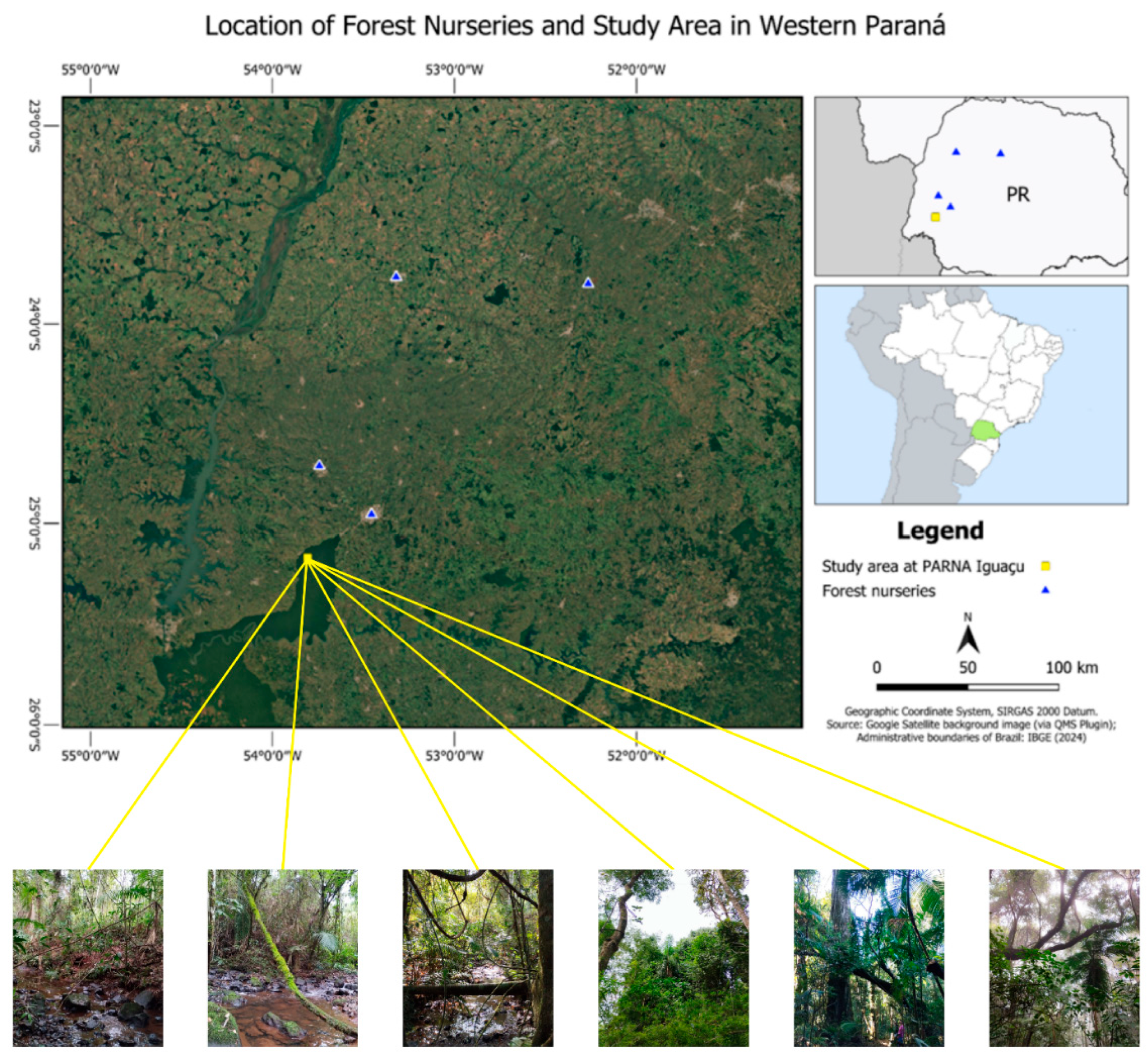
Figure 2.
Floristic similarity between the tree flora sampled in PARNA Iguaçu and the forest nurseries.
Figure 2.
Floristic similarity between the tree flora sampled in PARNA Iguaçu and the forest nurseries.
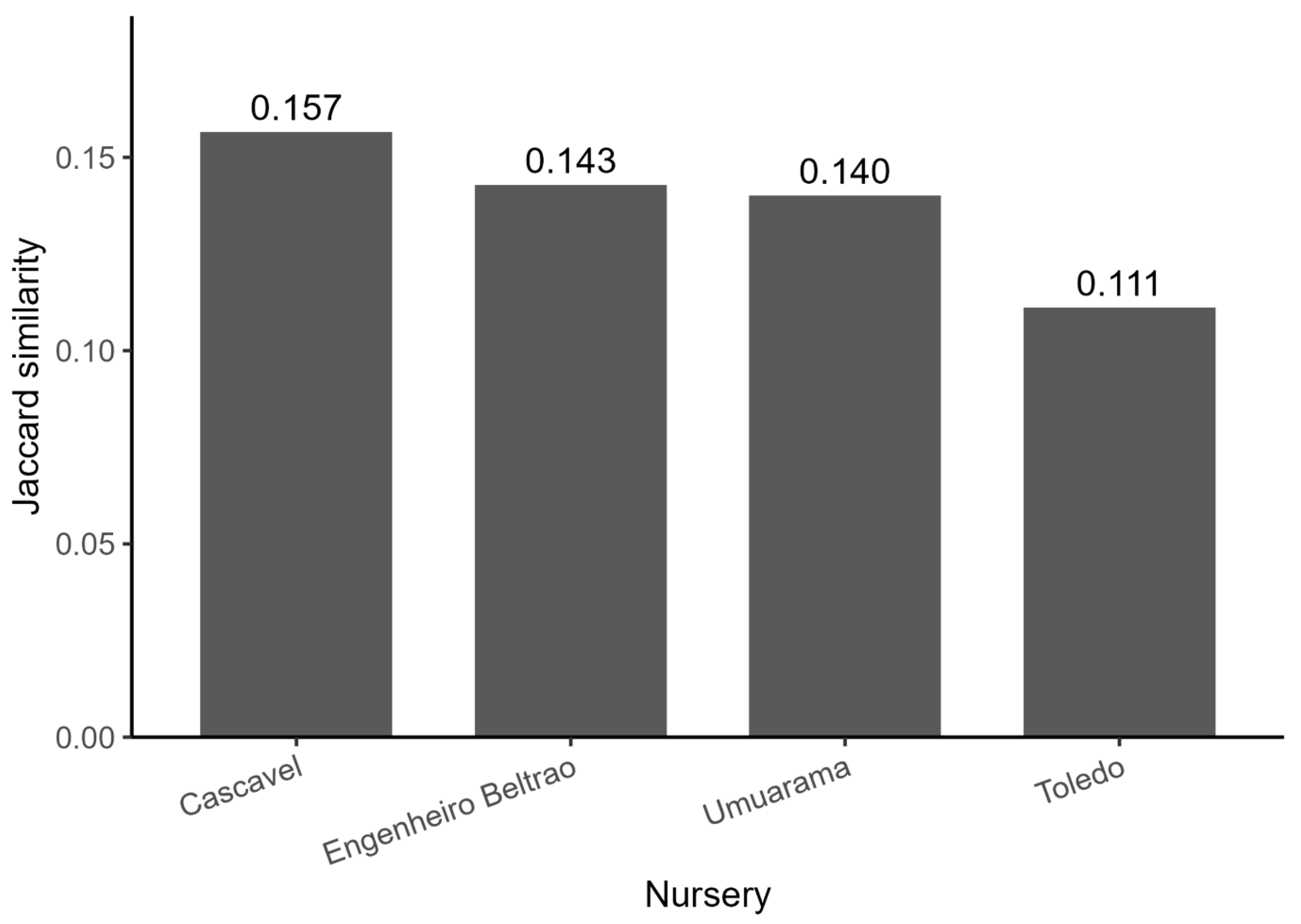
Figure 3.
Floristic similarity among the nurseries. (A) Heatmap of Jaccard similarity values. (B) Distribution of species according to the number of nurseries in which they occur.
Figure 3.
Floristic similarity among the nurseries. (A) Heatmap of Jaccard similarity values. (B) Distribution of species according to the number of nurseries in which they occur.
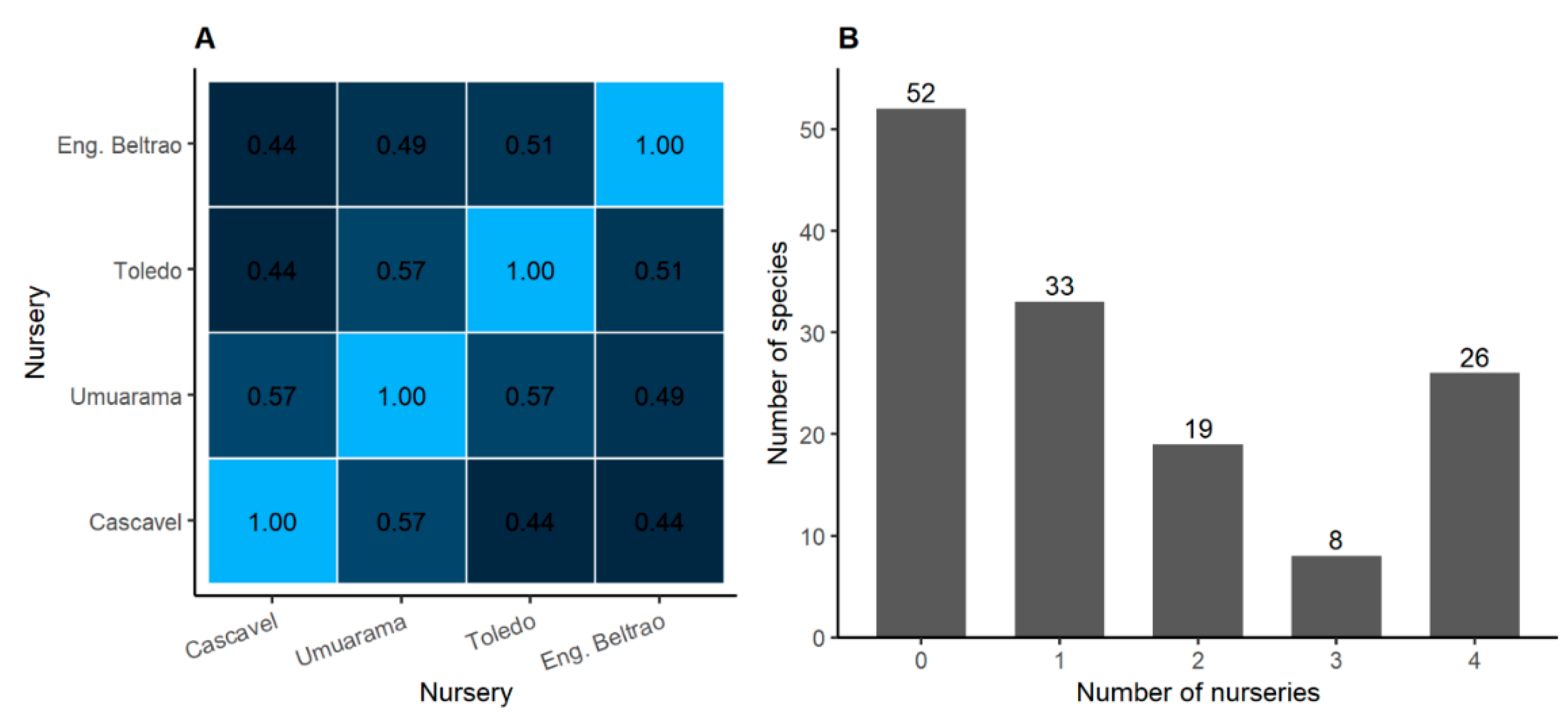
Figure 4.
Distribution of species scores across the three operational categories of the protocol: strategic species for enrichment (scores 5–8), complementary species for production (scores 9–11), and priority species for production (scores 12–14). Numbers above the bars indicate the number of species in each score class.
Figure 4.
Distribution of species scores across the three operational categories of the protocol: strategic species for enrichment (scores 5–8), complementary species for production (scores 9–11), and priority species for production (scores 12–14). Numbers above the bars indicate the number of species in each score class.
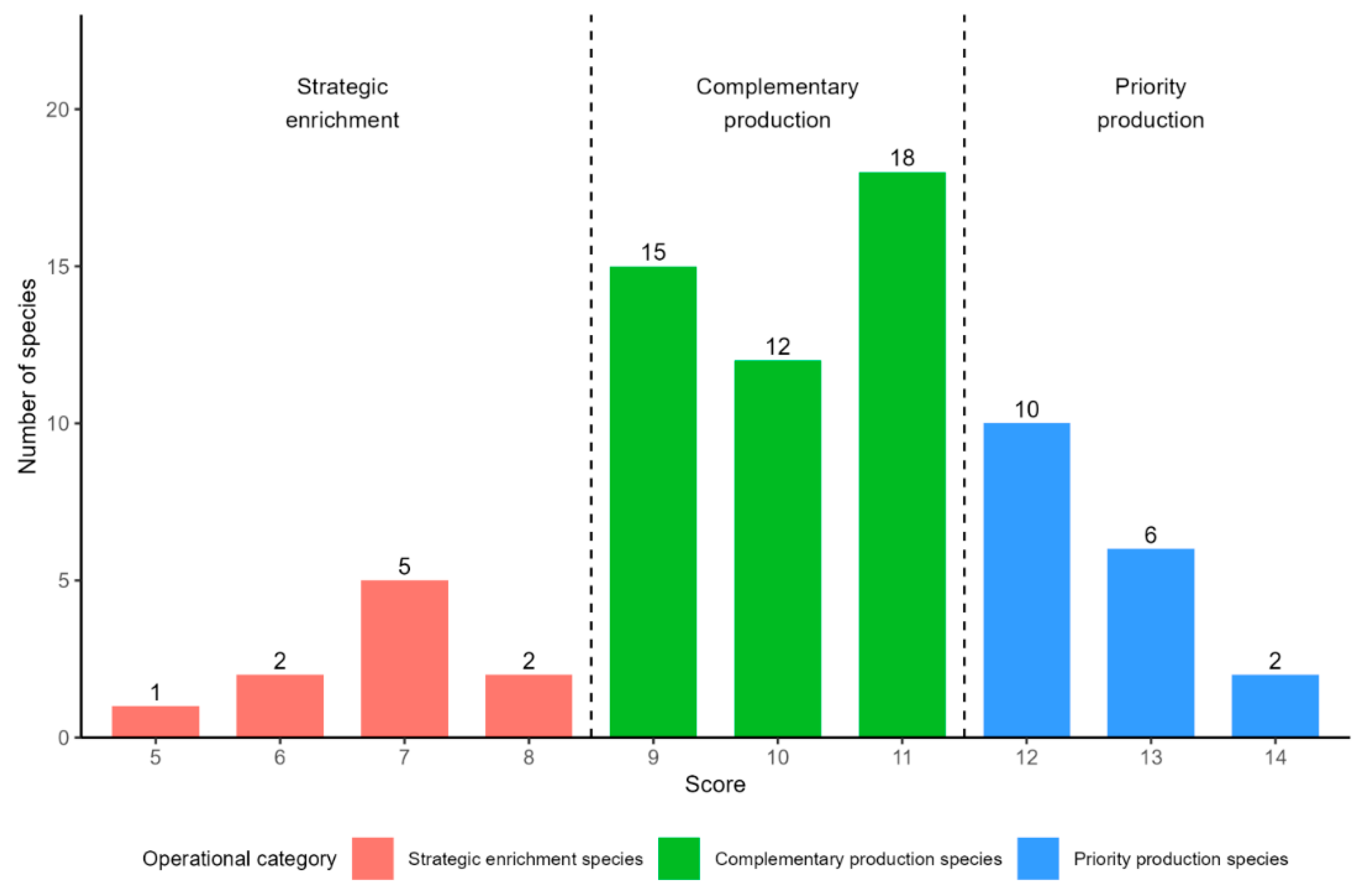
Figure 5.
Mean contribution of protocol attributes to the differentiation among operational categories, based on the SIMPER analysis.
Figure 5.
Mean contribution of protocol attributes to the differentiation among operational categories, based on the SIMPER analysis.
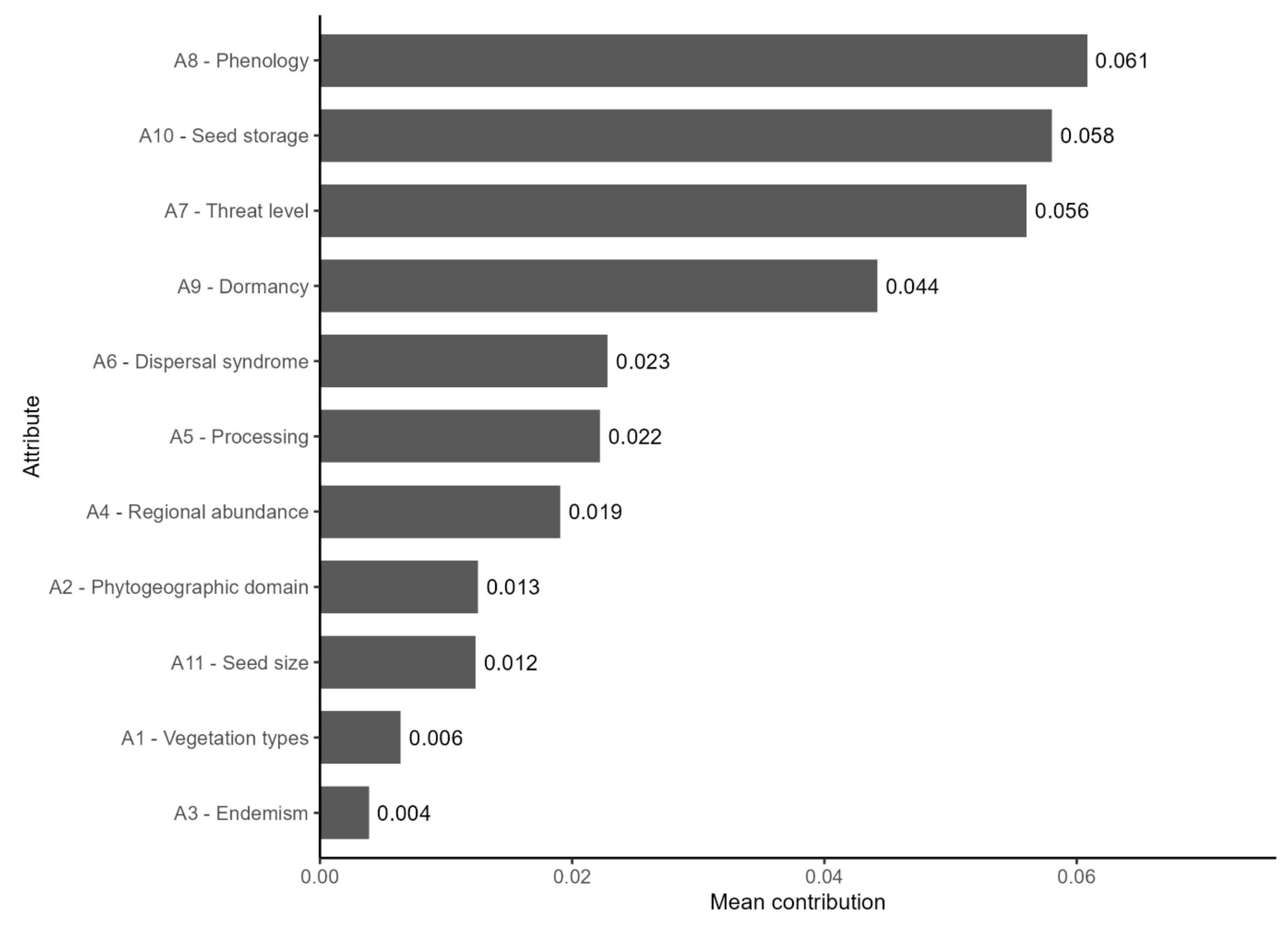
Figure 6.
NMDS ordination of species based on the protocol attributes, colored according to the three operational categories, presented as an exploratory visualization.
Figure 6.
NMDS ordination of species based on the protocol attributes, colored according to the three operational categories, presented as an exploratory visualization.
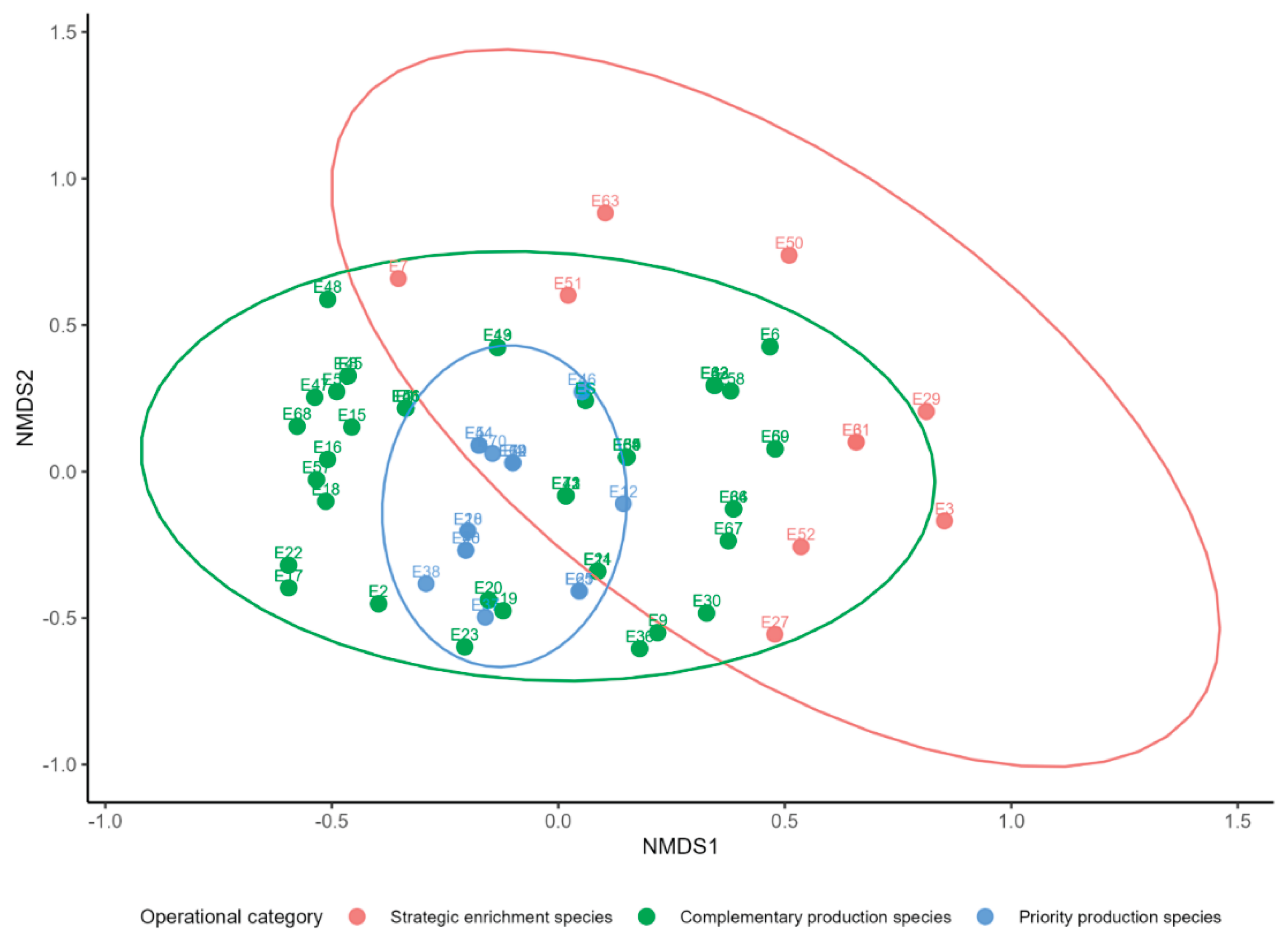

Table 1.
Attributes, criteria, and scores applied to the classification and selection of potential species for ecological restoration in Atlantic Forest areas. Threat categories: CR = Critically Endangered; EN = Endangered; VU = Vulnerable; NT = Near Threatened; LC = Least Concern (IUCN, 2025). Seed size categories: large (< 1,000 seeds kg⁻¹), medium (> 1,000 and < 10,000 seeds kg⁻¹), and small (> 10,000 seeds kg⁻¹) [16].
Table 1.
Attributes, criteria, and scores applied to the classification and selection of potential species for ecological restoration in Atlantic Forest areas. Threat categories: CR = Critically Endangered; EN = Endangered; VU = Vulnerable; NT = Near Threatened; LC = Least Concern (IUCN, 2025). Seed size categories: large (< 1,000 seeds kg⁻¹), medium (> 1,000 and < 10,000 seeds kg⁻¹), and small (> 10,000 seeds kg⁻¹) [16].
| CODE | ATTRIBUTE | CRITERION | SCORE | SOURCE |
|---|---|---|---|---|
|
A1 |
Types of Vegetation | Occurrence in more than one vegetation formation | 1 | [17] |
| Restricted to only one formation | 0 | |||
| A2 | Phytogeographic Domain | Generalist species, occurring in more than one phytogeographic domain | 1 | [17] |
| Species typical of the phytogeographic domain (e.g., Atlantic Forest) | 0 | |||
| A3 | Endemism | Occurrence in more than one region of the country | 1 | [17] |
| Occurrence restricted to the southern region | 0 | |||
| A4 | Abundance | Species with high regional abundance | 1 | Field data from 5.400 m² |
| Species with low abundance | 0 | |||
| A5 | Processing | Species with easily processed propagules | 1 | [18,19] |
| Species with medium/difficult to process propagules | 0 | |||
| A6 | Dispersion | Species with biotic dispersion syndrome | 1 | [20,21] |
| Species with abiotic dispersal syndrome | 0 | |||
| A7 | Threat level | Not Threatened (LC) | 2 | [22,23] |
| Threatened (CR, EN, VU, NT) | 0 | |||
| A8 | Phenology | Fruiting for more than four months in the geographical region of the study | 2 | [24] |
| Fruiting for up to four months in the geographical region of the work | 0 | |||
| A9 | Dormancy | No dormancy | 2 | [20] |
| Dormancy | 0 | |||
| A10 | Storage | Greater tolerance to water loss, orthodox or intermediate seeds | 2 | [19] |
| Lower tolerance to water loss, recalcitrant seeds | 0 | |||
| A11 | Seed size | Small or Medium | 1 | [18,20] |
| Large | 0 | |||
| A12 | Successional class | Pioneer/Non-pioneer | Not scored | [21] |
Table 2.
List of tree species sampled in Iguaçu National Park and their classification according to the multicriteria prioritization protocol, including total score, successional class, and prioritization category. Abbreviations: P = pioneer; NP = non-pioneer; Pe = pending; EE = strategic species for enrichment; CP = complementary species for production; PP = priority species for production.
Table 2.
List of tree species sampled in Iguaçu National Park and their classification according to the multicriteria prioritization protocol, including total score, successional class, and prioritization category. Abbreviations: P = pioneer; NP = non-pioneer; Pe = pending; EE = strategic species for enrichment; CP = complementary species for production; PP = priority species for production.
| Family/Species | Total score | Sucessional class | Prioritization category |
Voucher |
|---|---|---|---|---|
| Annonaceae | ||||
| Annona mucosa Jacq. | 11 | Pe | CP | UNOP12889 |
| Apocynaceae | ||||
| Aspidosperma polyneuron Müll.Arg. | 10 | NP | CP | HCF 29567 |
| Aquifoliaceae | ||||
| Rauvolfia sellowii Müll.Arg. | 7 | NP | EE | UNOP12904 |
| Ilex paraguariensis A.St.-Hil. | 13 | NP | PP | HCF 29567 |
| Araliaceae | ||||
| Didymopanax calvus (Cham.) Decne. & Planch. | 11 | P | CP | HCF 24016 |
| Arecaceae | ||||
| Euterpe edulis Mart. | 9 | NP | CP | HCF 17687 |
| Syagrus romanzoffiana (Cham.) Glassman | 8 | NP | EE | UNOP 6641 |
| Asteraceae | ||||
| Vernonanthura petiolaris (DC.) H.Rob. | 10 | P | CP | UNOP12896 |
| Bignoniaceae | ||||
| Jacaranda micrantha Cham. | 9 | P | CP | UNOP 6742 |
| Cariaceae | ||||
| Jacaratia spinosa (Aubl.) A.DC. | 13 | NP | PP | UNOP 10542 |
| Celastraceae | ||||
| Monteverdia ilicifolia (Mart. ex Reissek) Biral | 11 | NP | CP | HCF 21006 |
| Cordiaceae | ||||
| Cordia americana (L.) Gottschling & J.S.Mill. | 12 | NP | PP | UNOP 5532 |
| Cordia trichotoma (Vell.) Arráb. ex Steud. | 9 | NP | CP | UNOP 9505 |
| Euphorbiaceae | ||||
| Actinostemon concolor (Spreng.) Müll.Arg. | 13 | NP | PP | EVB 4322 |
| Alchornea glandulosa Poepp. & Endl. | 9 | P | CP | UNOP 10202 |
| Sebastiania brasiliensis Spreng. | 10 | NP | CP | UNOP12898 |
| Fabaceae | ||||
| Anadenanthera colubrina (Vell.) Brenan | 11 | NP | CP | EVB 1364 |
| Bauhinia forficata Link | 11 | P | CP | UNOP 9998 |
| Calliandra foliolosa Benth. | 11 | P | CP | UNOP12882 |
| Muellera campestris (Mart. ex Benth.) M.J. Silva & A.M.G. Azevedo | 12 | P | PP | UNOP12885 |
| Erythrina falcata Benth. | 9 | P | CP | UNOP 10527 |
| Holocalyx balansae Micheli | 10 | NP | CP | EVB 4631 |
| Machaerium paraguariense Hassl. | 11 | NP | CP | UNOP 6725 |
| Machaerium stipitatum Vogel | 12 | NP | PP | UNOP 10344 |
| Parapiptadenia rigida (Benth.) Brenan | 14 | NP | PP | UNOP 10459 |
| Myrocarpus frondosus Allemão | 7 | NP | EE | HCF 20580 |
| Senegalia polyphylla (DC.) Britton & Rose | 13 | P | PP | UNOP 6722 |
| Inga marginata Willd. | 6 | NP | EE | UNOP 10340 |
| Peltophorum dubium (Spreng.) Taub. | 10 | P | CP | UNOP 1549 |
| Lauraceae | ||||
| Nectandra lanceolata Nees | 7 | NP | EE | HCF 18025 |
| Nectandra megapotamica (Spreng.) Mez | 9 | NP | CP | EVB 4095 |
| Ocotea diospyrifolia (Meisn.) Mez | 9 | NP | CP | UNOP12902 |
| Ocotea puberula (Rich.) Nees | 9 | NP | CP | EVB 2928 |
| Ocotea silvestris Vattimo-Gil | 11 | NP | CP | UNOP12881 |
| Malvaceae | ||||
| Heliocarpus popayanensis Kunth | 10 | P | CP | UNOP 6717 |
| Luehea divaricata Mart. | 12 | P | PP | EVB 4575 |
| Ceiba speciosa (A.St.-Hil.) Ravenna | 12 | NP | PP | HCF 19105 |
| Meliaceae | ||||
| Cabralea canjerana (Vell.) Mart. | 11 | NP | CP | UNOP12894 |
| Cedrela fissilis Vell. | 14 | NP | PP | UNOP 10626 |
| Guarea kunthiana A.Juss. | 11 | NP | CP | UNOP 12895 |
| Trichilia catigua A.Juss. | 11 | NP | CP | UNOP 12886 |
| Trichilia claussenii C.DC. | 9 | NP | CP | UNOP 12880 |
| Trichilia casaretti C.DC. | 12 | NP | PP | HUFU 64025 |
| Trichilia elegans A.Juss. | 10 | NP | CP | EVB 4329 |
| Monimiaceae | ||||
| Hennecartia omphalandra J.Poiss. | 12 | NP | PP | UNOP 12887 |
| Moraceae | ||||
| Ficus insipida Willd. | 10 | NP | CP | UNOP 6724 |
| Sorocea bonplandii (Baill.) W.C.Burger et al. | 9 | NP | CP | EVB 4672 |
| Myrcinaceae | ||||
| Myrsine umbellata Mart. | 9 | NP | CP | UNOP 10218 |
| Myrtaceae | ||||
| Campomanesia xanthocarpa (Mart.) O.Berg | 5 | NP | EE | UNOP 6708 |
| Plinia rivularis (Cambess.) Rotman | 7 | NP | EE | UNOP 8295 |
| Eugenia burkartiana (D.Legrand) D.Legrand | 8 | NP | EE | UNOP 11273 |
| Nyctaginaceae | ||||
| Pisonia ambigua Heimerl | 10 | NP | CP | UNOP 12884 |
| Polygonaceae | ||||
| Ruprechtia laxiflora Meisn. | 12 | P | PP | UNOP 1577 |
| Rosaceae | ||||
| Prunus myrtifolia (L.) Urb. | 11 | NP | CP | UNOP 10221 |
| Rubiaceae | ||||
| Ixora venulosa Benth. | 11 | NP | CP | UNOP 10692 |
| Rutaceae | ||||
| Balfourodendron riedelianum (Engl.) Engl. | 11 | NP | CP | UNOP 12893 |
| Zanthoxylum riedelianum Engl. | 10 | NP | CP | HCF 25221 |
| Salicaceae | ||||
| Casearia sylvestris Sw. | 9 | P | CP | UNOP 11009 |
| Casearia decandra Jacq. | 9 | NP | CP | UNOP 1388 |
| Prockia crucis P.Browne ex L. | 7 | P | EE | UNOP 9515 |
| Sapindaceae | ||||
| Allophylus edulis (A.St.-Hil. et al.) Hieron. ex Niederl. | 9 | P | CP | UNOP12897 |
| Allophylus guaraniticus (A. St.-Hil.) Radlk. | 6 | P | EE | UNOP 7863 |
| Cupania vernalis Cambess. | 11 | NP | CP | UNOP 10205 |
| Diatenopteryx sorbifolia Radlk. | 12 | P | PP | UNOP12897 |
| Matayba elaeagnoides Radlk. | 9 | NP | CP | UNOP 6715 |
| Sapotaceae | ||||
| Chloroluma gonocarpa (Mart. & Eichler ex Miq.) Baill. ex Aubrév. | 10 | NP | CP | UNOP 12888 |
| Chrysophyllum marginatum (Hook. & Arn.) Radlk. | 11 | NP | CP | UNOP 10011 |
| Styracaceae | ||||
| Styrax leprosus Hook. & Arn. | 13 | NP | PP | UPCB 27826 |
| Solanaceae | ||||
| Cestrum intermedium Sendtn. | 12 | P | PP | UNOP 12891 |
| Solanum sanctae-catharinae Dunal | 11 | P | CP | UNOP 12892 |
| Urticaceae | ||||
| Cecropia pachystachya Trécul | 13 | P | PP | UNOP 6723 |
| Urera baccifera (L.) Gaudich. ex Wedd. | 11 | P | CP | HCF 25203 |
Disclaimer/Publisher’s Note: The statements, opinions and data contained in all publications are solely those of the individual author(s) and contributor(s) and not of MDPI and/or the editor(s). MDPI and/or the editor(s) disclaim responsibility for any injury to people or property resulting from any ideas, methods, instructions or products referred to in the content. |
© 2026 by the authors. Licensee MDPI, Basel, Switzerland. This article is an open access article distributed under the terms and conditions of the Creative Commons Attribution (CC BY) license (http://creativecommons.org/licenses/by/4.0/).
Copyright: This open access article is published under a Creative Commons CC BY 4.0 license, which permit the free download, distribution, and reuse, provided that the author and preprint are cited in any reuse.