

Submitted:
23 May 2026
Posted:
25 May 2026
You are already at the latest version
Abstract
Assessing water quality in lotic ecosystems using biological indicators is essential for their conservation. This study analyzed the influence of physicochemical parameters (pH, conductivity, dissolved oxygen, total nitrogen, nitrates, total phosphorus, phosphates, alkalinity, and hardness) on the diversity, abundance, and distribution of protozoa in 15 sites of the upper Soto la Marina River basin, Tamaulipas, Mexico, including the Corona, Purificación, Pilón, San Felipe rivers and the Vicente Guerrero Reservoir. Through bimonthly sampling over an annual cycle (February-December), 24 protozoan morphospecies were identified, with a dominance of Ciliophora (10 morphospecies) and Amoebozoa (4 morphospecies). Chi-square analyses revealed that morphospecies frequency was significantly dependent on the sampling site (χ² = 246.72, df = 69, p < 0.001) but independent of seasonality (χ² = 0.86, df = 15, p = 1.0). Beta diversity (Sorensen-Dice index) showed low faunistic similarity among most sites (<60%), suggesting high species turnover and a local environmental filter. Using Outlying Mean Index (OMI) analysis, most morphospecies exhibited a generalist niche (low marginality, high tolerance), showing no significant relationship with the measured environmental variables. However, Vorticella sp. emerged as an exception, showing a significant association (p = 0.0329) and positive correlation with maximum pH and alkalinity values, and at sites with high NO₃⁻ and PO₄³⁻ concentrations, suggesting its potential as a bioindicator of organic enrichment conditions in the region. The lack of a strong environmental signal in most species underscores the complexity of these systems and the need to integrate multiple levels of bioindicators. This study provides the first baseline on the protozoan community in the area and discusses its relevance for water quality monitoring in a region of high conservation value, such as the area of influence of the Sierra de Tamaulipas.
Keywords:
bioindicators
; Vorticella sp.
; multivariate analysis
; watershed conservation
; Sierra de Tamaulipas
1. Introduction
The relationship between protozoan communities and physicochemical gradients in water has been studied since the dawn of modern limnology. The first studies that established this association date back to the pioneering research of Curds and colleagues in the 1960s and 1970s [1,2], who systematically documented that the composition of ciliate and other protozoan communities in wastewater treatment systems varied predictably as a function of organic load, dissolved oxygen, and nutrient concentration [1,2]. These authors demonstrated that protozoans were not only abundant components of aquatic systems, but that their presence, abundance, and diversity accurately reflected prevailing environmental conditions. The theoretical foundation of this association lies in the physiological ecology of protozoans: their small size, short life cycle (hours to days), high rate of asexual reproduction, and sensitivity to changes in temperature, pH, dissolved oxygen, and nutrient availability make them organisms that respond rapidly to environmental disturbances, acting as integrators of environmental conditions over fine temporal scales [3,4]. This capacity for immediate response, together with their central role in microbial food webs as bacterial consumers and as prey for larger organisms, underpins their utility as bioindicators of water quality in lotic and lentic ecosystems.
Empirical evidence accumulated over the past two decades has consolidated the utility of protozoans as indicators of physicochemical gradients in various aquatic systems on a global scale. In high-altitude rivers of Tibet, Yang et al. [5] demonstrated that protozoan diversity in the middle reach of the Yarlung Zangbo River during the wet season is significantly correlated with electrical conductivity, water temperature, turbidity, and total nitrogen concentration, identifying a clear pattern of geographical decay in community similarity as distance between sites increased. In shallow lakes of the Yangtze River basin in China, Qi et al. [6] documented that seasonal variations in the structure of protozoan and rotifer communities accurately reflect the eutrophication gradient, identifying water temperature, chlorophyll-a concentration, Secchi depth, orthophosphates, and dissolved oxygen as the main environmental factors structuring the community. In Lake Mariout in Egypt, Heneash et al. [7] applied multivariate statistical techniques (principal component analysis and canonical correspondence analysis) to establish quantitative relationships between physicochemical parameters and the zooplankton community (including protozoans), demonstrating that anthropogenic activities induce significant changes in community composition that can be detected using these analytical approaches.
Despite the strong empirical evidence supporting the utility of protozoans as bioindicators on a global scale, there is a critical knowledge gap in northeastern Mexico, particularly in the upper Soto la Marina River basin. This basin, which supplies the Vicente Guerrero Reservoir—the main water source for the central area of Tamaulipas—and is hydrologically connected to the Sierra de Tamaulipas, a high-biodiversity Protected Natural Area [8], lacks systematic studies evaluating the relationship between water quality and protozoan communities. Previous hydrological studies have modeled contaminant dynamics in this basin under climate change scenarios [9], and recent studies have documented seasonal variations in water quality associated with drought and rainfall cycles [10]. However, none of these studies have incorporated the biological dimension through protozoan monitoring, limiting our ability to assess the ecological integrity of these systems from an integrated perspective combining physicochemical and biological indicators. This gap is particularly concerning given that the basin is under increasing pressure from agricultural and urban activities, and its conservation is essential both for the provision of drinking water and for the preservation of biodiversity in the adjacent protected natural area. Therefore, the following research question arises: Is there a quantifiable relationship between the physicochemical parameters of water and the structure of protozoan communities in the upper Soto la Marina River basin, and can any morphospecies with potential as a local bioindicator be identified?
The present study was designed to answer this question with the following objectives: (i) to characterize water quality using physicochemical parameters (pH, conductivity, dissolved oxygen, total nitrogen, nitrates, total phosphorus, phosphates, alkalinity, and hardness) at 15 sites distributed along the upper Soto la Marina River basin over a complete annual cycle; (ii) to inventory the morphospecies richness of protozoans associated with sediments at these sites; (iii) to evaluate the spatial and temporal dependence of protozoan communities; and (iv) to quantify, using Outlying Mean Index (OMI) analysis, the relationship between physicochemical variables and the frequency of occurrence of protozoan morphospecies. It is hypothesized that protozoan communities will exhibit significant spatial structuring in response to water quality gradients, with at least one morphospecies showing a restricted ecological niche that makes it a promising candidate as a local bioindicator. The main conclusions of this research are: (1) the first inventory of protozoans for the upper Soto la Marina River basin is presented, establishing a baseline of 24 morphospecies; (2) the protozoan community is strongly structured by local factors, evidenced by the significant dependence of species on sampling site and high turnover among sites; (3) although most morphospecies are generalists and showed no correlation with the measured physicochemical variables, Vorticella sp. emerged as a significant exception, showing a positive association with high values of pH, alkalinity, and nutrients; and (4) Vorticella sp. is positioned as a potential bioindicator of organic enrichment that can be incorporated into water quality monitoring programs in the region, thus contributing to the conservation of lotic ecosystems in northeastern Mexico and to the fulfillment of the management objectives of the Sierra de Tamaulipas Protected Natural Area.
2. Materials and Methods
2.1. Study Area
The study was conducted in the Soto la Marina River hydrological basin (CRSLM) located in Hydrological Region 25 (RH25) San Fernando-Soto la Marina, situated in the central region of the State of Tamaulipas, Mexico (Figure 1). This basin originates on the eastern slope of the Sierra Madre Oriental, where the Purificación, Corona, and Pilón rivers converge. RH25 has a contributing area of 56,928 km², and the CRSLM represents 37.2% of the total surface area of RH25 [11]. The basin has a surface area of 21,185 km² and its main river has a length of 416 km, with an average natural surface runoff of 2,086 million m³ per year.
2.2. Selection of Sampling Sites
The selection of the 15 sampling sites was based on the technical criteria of APHA [12] for sample representativeness, integrating a landscape analysis based on land use, hydrological dynamics, system interconnectivity, and the characterization of polluting discharges [13]. For this purpose, cartography and databases from the National Water Commission [11] and the Secretariat of Water Resources of Tamaulipas were consulted, identifying stations of the National Monitoring Network, hydrometric stations, municipal and industrial discharges, as well as agricultural returns from irrigation districts. The selected sites (Table 1; Figure 1) comprise reference points (without influence from discharges), water quality gradient verification points, and representative sites of the Vicente Guerrero Reservoir. Each point was georeferenced in situ using a Garmin GPS (precision ±3 m).
2.3. Sampling Design
Bimonthly sampling of water and sediments was carried out during the months of February, April, June, August, October, and December of the year 2021, covering the dry season (February-June) and rainy season (August-December) characteristic of the region.
2.3.1. Physicochemical Parameters
At each site and sampling date, physicochemical parameters were measured in situ using a previously calibrated Hanna HI9829 multiparameter probe: temperature (°C), pH, electrical conductivity (µS/cm), and dissolved oxygen (mg/L). For the analysis of nutrients (total nitrogen, NO₃⁻, total phosphorus, PO₄³⁻), alkalinity, and total and calcium hardness, water samples were collected in 1 L polyethylene bottles, preserved at 4 °C, and transported to the laboratory for analysis within 24 hours, following the standard methods of APHA [12].
2.3.2. Protozoan Sampling
Simultaneously with water collection, surface sediment samples (0-5 cm) were taken in the littoral or riparian zone using an Ekman dredge (15 × 15 cm). At each site, three replicates were obtained and homogenized to form a composite sample. A 100 g aliquot of sediment was fixed in situ with 70% alcohol for microbiological analysis. In the laboratory, samples were processed using the flotation technique in Ludox TM-50 solution (density 1.2 g/mL) [13,14]. Protozoan identification and quantification were performed under an optical microscope (Leica DM500) using specialized taxonomic keys [15,16], counting a minimum of 300 individuals per sample or performing a total count in three 1 mL subsamples of the final solution. Abundance was expressed as individuals per gram of dry sediment (ind/g).
2.4. Data Analysis
2.4.1. Frequency Analysis
To evaluate the independence between protozoan frequency and the factors ‘site’ and ‘month’ of collection, a Chi-square test (χ²) was applied to a contingency table (4 main sites × 6 months). Statistical significance was set at α = 0.05. The same test was also used to evaluate the independence of protozoan morphospecies with respect to collection site. These analyses were performed using PAST software [17].
2.4.2. Beta Diversity
Beta diversity (species turnover) among the four main lotic systems (San Felipe, Corona, Purificación, and Pilón rivers) was quantified using the Sorensen-Dice qualitative similarity index: CCₛ = 2a / (2a + b + c), where ‘a’ is the number of shared species between two sites, ‘b’ is the number of species exclusive to the first site, and ‘c’ is the number of species exclusive to the second site.
2.4.3. Outlying Mean Index (OMI) Analysis
To model the relationship between the abundance of protozoan morphospecies and the physicochemical variables of water, an Outlying Mean Index (OMI) analysis was employed. OMI analysis is particularly useful in ecological niche studies because it does not assume a linear or unimodal response of species, and it quantifies marginality (deviation of the species’ average habitat from the average habitat of the study area) and tolerance (niche breadth) [18,19]. Total inertia (InerO) was decomposed into:
- OMI: Measures the deviation between the average environmental conditions used by the species and the average environmental conditions for the entire study area. Species with high marginality are uncommon species with limited distribution (specialists), while low marginality indicates common or uniformly distributed species (generalists).
- Tolerance (T1): Value analogous to niche breadth. High values represent greater niche breadth (generalist species), while low values indicate small niche breadth (specialist species).
- Residual Tolerance (T2): Represents the proportion of variability in the habitat that is not explained by the measured environmental variables.
The statistical significance of marginality for each species was evaluated using a Monte Carlo permutation test with 10,000 iterations, which tests the null hypothesis that species distribution is independent of environmental conditions (α = 0.05). All calculations were performed using ADE-4 software [20], while interpretation was carried out according to the parameters proposed by Morris and Patel [19].
3. Results
3.1. Composition and Structure of the Protozoan Community
A total of 24 protozoan morphospecies belonging to 8 phyla were recorded (Table 2). The phylum with the highest number of morphospecies (n = 10) was Ciliophora, while the phyla with the lowest number (only one morphospecies each) were Choanozoa, Bigyra, Ochrophyta, and Cryptophyta. The highest number of records (n = 25) was presented by the genera Arcella sp. and Difflugia sp. (Table 2), and the lowest number (n = 5) was recorded by the genus Halteria sp.
3.2. Frequency Analysis: Spatial and Temporal Effects
The frequency analysis for independence between sampling sites and collection months showed no statistically significant association (χ² = 0.86, df = 15, p = 1.0), suggesting the absence of a seasonal effect on the total abundance of protozoans during the evaluated annual cycle (Table 3). These results indicate a structural stability in the global representativeness of the community across the four lotic systems, regardless of the timing of the sampling events.
In contrast, a highly significant dependence was determined between the frequency of individual morphospecies and the collection site (χ² = 246.72, df = 69, p < 0.001). This finding reveals that, although the total number of organisms remains constant throughout the basin, the specific taxonomic composition is strongly structured by local factors. This suggests that the particular environmental conditions of each river act as ecological filters that determine the identity and dominance of protozoan communities at the site level.
3.3. Beta Diversity
The beta diversity analysis using the Sorensen-Dice index corroborated this spatial differentiation. Faunistic similarity among the rivers was generally low (Table 4). The highest similarity value was observed between the Purificación and Pilón rivers (69.2%), which could reflect their geographical proximity and comparable hydrological characteristics. This was followed by the similarity between Purificación and San Felipe (62.5%). The rest of the comparisons between sites showed similarities below 60%, evidencing high species turnover throughout the basin.
The analysis of beta diversity using the Sorensen-Dice index corroborated the spatial differentiation suggested by the independence tests, showing generally low faunistic similarity among the evaluated systems (Table 4). The highest degree of taxonomic coincidence was recorded between the Purificación and Pilón rivers (69.2%), which could be associated with their geographical proximity and homogeneity in their hydrological characteristics. This relationship was followed by the similarity between the Purificación and San Felipe rivers (62.5%).
In contrast, most intersite comparisons showed similarity values below 60%, with marked differentiation observed in the Corona River. These results evidence high species turnover (beta diversity) throughout the basin, suggesting that environmental heterogeneity among the lotic systems promotes the establishment of distinct and specialized protozoan assemblages at each locality.
3.4. Relationship Between Protozoans and Physicochemical Variables: OMI Analysis
3.4.1. Niche Structure and Ecological Strategies
The Outlying Mean Index (OMI) analysis revealed that most of the 24 identified morphospecies exhibit low marginality and high tolerance (Table 5). Under this scheme, total inertia (InerO) was predominantly explained by tolerance (T1 + T2), allowing most of the community to be classified as generalist taxa. These results suggest that the distributions of protozoans in the study area are not strictly restricted by the evaluated physicochemical gradients. Consequently, other factors not included in this analysis — such as sediment composition, hydrological dynamics, or biotic interactions — may be acting as the main determinants of their ecological niche.
3.4.2. Influence of pH and Productivity Gradients
Despite the generalist trend of the community, the Monte Carlo permutation test identified a statistically significant relationship only for Vorticella sp. (p = 0.0329). This morphospecies presented significant marginality, indicating a specialization where its optimal niche deviates considerably from the average habitat.
The ordination analysis showed that the variables with the greatest weight on Axis 1 were pH and alkalinity (r = -0.28 and r = -0.25, respectively; Table 6). The abundance of Vorticella sp. was positively associated with the maximum values of these parameters, as well as with elevated concentrations of nitrates (NO₃⁻) and phosphates (PO₄³⁻) (Figure 2). This association suggests that Vorticella sp. could act as an indicator of organic enrichment or higher productivity in the Soto la Marina River basin. In contrast, other taxa such as Oxytricha sp., Euglena sp., and Peranema sp. showed a tendency toward lower pH and alkalinity conditions, although without reaching statistical significance, which reinforces the plastic and resilient nature of these microorganisms in the face of local environmental variations.
4. Discussion
The main objective of this research was to evaluate the influence of physicochemical parameters on the diversity, abundance, and distribution of protozoans in the upper Soto la Marina River basin, Tamaulipas, Mexico, in order to identify potential bioindicators of water quality in lotic systems of northeastern Mexico. To this end, 15 sites were analyzed over an annual cycle, characterizing the protozoan community in sediments and its relationship with variables such as pH, conductivity, dissolved oxygen, nutrients (nitrogen and phosphorus), alkalinity, and hardness. This study represents the first systematic effort to document the protozoan community in this basin of high ecological and socioeconomic value, which is also connected to the Sierra de Tamaulipas Protected Natural Area.
The main finding of this work was the identification of Vorticella sp. as a potential bioindicator of organic enrichment conditions in the region’s water systems. This morphospecies showed a significant (p = 0.0329) and positive association with maximum pH and alkalinity values, and its presence coincided with sites that presented the highest concentrations of nitrates and phosphates. Contrary to expectations, most of the 24 recorded morphospecies (23 of them) did not show a significant relationship with the measured physicochemical gradients, presenting low marginality values and high tolerance in the OMI analysis, which classifies them as generalist organisms whose distribution is not strongly restricted by the evaluated environmental variables. This result, in itself, is a relevant finding that underscores the complexity of the studied ecosystems and the need to consider multiple factors in water quality assessment using bioindicators.
4.1. Protozoan Community in the Upper Soto la Marina Basin: An Initial Approach to Its Diversity and Structure
The richness of 24 morphospecies found in this study constitutes the first baseline for the upper Soto la Marina River basin. This figure is comparable to that reported in other lotic systems of Latin America subjected to different anthropogenic pressures, where protozoan richness (mainly ciliates and testate amoebae) ranges between 15 and 35 morphospecies [14,21]. The dominance of Ciliophora and Amoebozoa is consistent with the literature, since these groups are fundamental components of benthic microfauna in rivers and freshwater lakes [15]. The high frequency of Arcella sp. and Difflugia sp. (testate amoebae) suggests a good representation of organisms associated with substrates and sediments, typical of environments with certain stability and accumulation of particulate organic matter [22].
4.2. Spatial Structuring of the Community and Absence of Seasonality
The significant dependence of morphospecies on collection site (χ² = 246.72, df = 69, p < 0.001), together with low faunistic similarity (<60% in most cases), demonstrates high spatial heterogeneity and marked species turnover (high beta diversity) in the basin [23]. This pattern suggests that protozoan assemblages are being filtered by local environmental conditions, which is a prerequisite for their use as bioindicators [24]. The absence of a significant seasonal effect (p = 1.0 in the Chi-square test) coincides with that reported by Anderson and Johnson [25], who indicate that in lotic systems of subtropical regions, spatial variability (habitat heterogeneity, pollution gradients) can be a stronger structuring factor than temporal variability, as long as extreme seasonal fluctuations do not exist.
4.3. Weak Environmental Signal and Predominance of Generalist Strategists
Contrary to expectations (H2), the OMI analysis revealed that the vast majority of morphospecies (23 out of 24) did not show a significant relationship with the measured physicochemical gradients. Their high tolerance values (T1) and low marginality (OMI) classify them as generalist taxa, with a wide niche breadth that allows them to persist in a varied range of pH, nutrient, and hardness conditions [19]. This lack of environmental signal may be due to multiple non-exclusive factors.
First, the measured physicochemical variables, although standard in water quality monitoring programs, may not be those that fundamentally structure protozoan communities. Factors such as hydrodynamics (current velocity), sediment granulometric composition, availability of food resources (bacteria, microalgae), and biotic interactions (competition, predation) are key determinants of protozoan distribution and were not considered in this study [26,27]. Second, the spatial scale of the study, although wide (15 sites along the basin), may not capture critical microhabitats for these organisms, whose distribution can be highly aggregated at centimeter scales [15]. Third, it is possible that protozoan communities in this basin are more influenced by pollution history or by disturbance pulses than by the instantaneous conditions measured during sampling, a phenomenon already observed in other bioindicator groups [28,29]. This result underscores the complexity of aquatic ecosystems and the need to integrate multiple approaches (physicochemical, biological, habitat) for a holistic assessment of their health [30].
4.4. Vorticella sp.: A Candidate Bioindicator in the Regional Context
Despite the general trend, Vorticella sp. emerged as a significant exception. Its positive association with maximum pH and alkalinity values, and its presence in sites with high concentrations of NO₃⁻ and PO₄³⁻, are consistent with its known ecology. Species of the genus Vorticella are sessile peritrich ciliates that feed on bacteria, and their proliferation is commonly linked to environments with high organic matter load and bacterial activity, typical of eutrophic waters or those influenced by wastewater discharges [31,32]. In lotic systems, the increase in pH and alkalinity may be associated with higher photosynthetic activity (due to CO₂ consumption) under nutrient enrichment conditions, creating a favorable microhabitat for these ciliates [33].
This finding positions Vorticella sp. as a promising, low-cost bioindicator for monitoring organic enrichment and incipient eutrophication in the rivers of the central region of Tamaulipas. It is consistent with H2 and provides a concrete tool for participatory monitoring programs or sanitary surveillance [31]. However, it is important to note that the observed correlation, although significant, was moderate (r values between -0.2 and -0.3), suggesting that even for this species, other unmeasured factors also contribute to explaining its distribution.
4.5. Implications for the Conservation of the Basin and the Sierra de Tamaulipas
The hydrological connectivity between the Corona, Purificación, and Pilón rivers and the Vicente Guerrero Reservoir implies that disturbances in the upper basin are transmitted downstream. The sites where Vorticella sp. was most abundant could be receiving nutrient and organic matter inputs from agricultural activities in the foothills of the Sierra de Tamaulipas or from human settlements. This mountain range, in addition to being a protected natural area, is a nesting area for the white-winged dove (Zenaida asiatica) and a refuge for important biodiversity [8]. The degradation of water quality in its rivers not only affects aquatic ecosystems but also compromises the integrity of riparian habitats and the ecosystem services that support local communities and wildlife [35].
Our results, although preliminary, indicate that protozoan monitoring such as Vorticella sp. could be integrated into basin management plans to early detect diffuse pollution hotspots and guide mitigation actions, thus contributing to the conservation of this socio-ecosystem [36]. The identification of sites with low faunistic similarity can also help prioritize areas for conservation, since those with unique communities or high beta diversity may represent habitats with particular environmental conditions or relicts that deserve special protection.
4.6. Limitations and Future Perspectives
This study, pioneering in the region, has limitations that must be addressed in future research. Identification at the morphospecies level, although valid for ecological and bioindication studies, limits comparisons with literature based on fine taxonomy. The use of molecular tools (18S rRNA gene metabarcoding) is recommended for a more precise characterization of cryptic diversity and to reveal indicator species not detected morphologically [37]. Likewise, future studies should incorporate a greater number of environmental variables, especially those related to physical habitat (granulometry, sediment organic matter) and the basal microbial community (bacterial density, algal biomass), and design manipulative experiments (microcosms) to establish stronger cause-effect relationships beyond correlation. Finally, it is crucial to expand the spatial and temporal monitoring network to validate the response of Vorticella sp. and explore the potential of other groups (e.g., testate amoebae, euglenoids) as indicators of specific conditions, such as riparian zone integrity or the presence of emerging contaminants [38].
5. Conclusions
- 1)
- The first inventory of protozoans for the upper Soto la Marina River basin is presented, establishing a baseline of 24 morphospecies (belonging to 8 phyla, with dominance of Ciliophora and Amoebozoa) for future ecological and monitoring studies in northeastern Mexico.
- 2)
- The protozoan community in this basin is strongly structured by local factors, evidenced by: (i) significant dependence of species on sampling site (χ² = 246.72, p < 0.001); (ii) high species turnover among sites (low beta similarity, <60% in most comparisons); and (iii) independence of community structure from temporality (absence of significant seasonal effect).
- 3)
- Most of the identified protozoans (23 out of 24 morphospecies) are generalist organisms, whose distributions did not correlate significantly with the measured physicochemical parameters (pH, conductivity, dissolved oxygen, nutrients, alkalinity, hardness). This suggests that other unconsidered environmental factors (sediment type, hydrodynamics, food resources, biotic interactions) are the main modulators of their ecological niche in these systems.
- 4)
- Vorticella sp. stands out as a potential bioindicator of organic enrichment and high alkalinity conditions in the region, showing a significant (p = 0.0329) and specific response to these gradients. Its monitoring could be a useful, low-cost, and easily implementable tool for the early detection of nutrient and organic matter pollution in the basin.
- 5)
- The results underscore the importance of integrating multivariate analyses such as OMI in bioindication studies, since they allow discerning between generalist and specialist species, and evaluating the real strength of the environmental signal. This approach is fundamental for the development of effective biological monitoring programs in support of the conservation of the basin and protected natural areas such as the Sierra de Tamaulipas.
- 6)
- The hydrological connectivity between the rivers of the upper basin and the Vicente Guerrero Reservoir, the main water supply source for the region, highlights the relevance of implementing continuous biological monitoring programs that allow early detection of anthropogenic impacts and guide mitigation measures to preserve water quality and the ecological integrity of these ecosystems.
Author Contributions
Conceptualization, J.H.R.-C. and L.A.V.-O.; methodology, J.H.R.-C.; L.A.V.-O. and S.E.O.-dlF.; software, L.A.V.-O.; J.H.R.-C.; J.A.R.-O.; A.B.-L. and M.L.G.-C.; validation, J.H.R.-C.; L.A.V.-O.; S.E.O.-dlF.; U.J.S.-R.; A.B.-L. and M.L.G.-C.; formal analysis, L.A.V.-O.; J.H.R.-C.; S.E.O.-dlF. and J.A.R.-O.; investigation, L.A.V.-O.; J.H.R.-C.; S.E.O.-dlF. and U.J.S.-R.; resources, L.A.V.-O.; J.H.R.-C.; S.E.O.-dlF. and J.A.R.-O.; data curation, J.A.R.-O.; U.J.S.-R.; A.B.-L. and M.L.G.-C.; writing—original draft preparation, J.H.R.-C.; L.A.V.-O. and S.E.O.-dlF.; writing—review and editing, J.H.R.-C.; L.A.V.-O. and S.E.O.-dlF.; visualization, J.H.R.-C.; L.A.V.-O.; S.E.O.-dlF.; J.A.R.-O.; U.J.S.-R.; A.B.-L. and M.L.G.-C.; supervision, J.H.R.-C.; L.A.V.-O.; S.E.O.-dlF.; J.A.R.-O.; U.J.S.-R.; A.B.-L. and M.L.G.-C.; project administration, J.H.R.-C.; L.A.V.-O. and S.E.O.-dlF.; funding acquisition, J.H.R.-C.; L.A.V.-O. and S.E.O.-dlF.; All authors have read and agreed to the published version of the manuscript.
Funding
This research received no external funding.
Institutional Review Board Statement
Not applicable. This study did not involve humans or animals.
Informed Consent Statement
Not applicable. This study did not involve humans.
Data Availability Statement
All relevant data are presented within the manuscript.
Acknowledgments
The authors thank M.C. Pablo Puga Patlán and M.C. Pedro Emmanuel Espinoza Rocha for their support in the field and laboratory; and Dr. Alfonso Correa Sandoval for his suggestions, comments, and identification of protozoan species.
Conflicts of Interest
The authors declare no conflicts of interest.
References
- Curds, C. R. The Role of Protozoa in the Activated-Sludge Process. Am. Zool. 1973, 13 (1), 161–169. [CrossRef]
- Curds, C. R.; Cockburn, A. Protozoa in Biological Sewage-Treatment Processes—I. A Survey of the Protozoan Fauna of British Percolating Filters and Activated-Sludge Plants. Water Res. 1970, 4 (3), 225–236. [CrossRef]
- Finlay, B. J.; Esteban, G. F. Freshwater Protozoa: Biodiversity and Ecological Function. Biodiversity Conserv. 1998, 7 (9), 1163–1186. [CrossRef]
- Foissner, W.; Berger, H.; Schaumburg, J. Identification and Ecology of Limnetic Plankton Ciliates; Bavarian State Office for Water Management: Munich, Germany, 1999.
- Yang, Q.; Li, X.; Yang, S.; Chao, X.; Liu, H.; Ba, S. Protozoan Community Diversity and Its Impact Factor in the Middle Reaches of the Yarlung Zangbo River in the Wet Season. Biodiversity Sci. 2023, 31 (4), 22500. [CrossRef]
- Qi, J.; Wang, Y.; Yuan, J.; Liao, C.; Liu, J.; Guo, C. Variations of Zooplankton Community as Bioindicators of Eutrophication and Water Quality in Shallow Yangtze Lakes. Limnologica 2025, 126248. [CrossRef]
- Heneash, A. M.; Alprol, A. E.; Abd El-Hamid, H. T.; Khater, M.; El Damhogy, K. A. Assessment of Water Pollution Induced by Anthropogenic Activities on Zooplankton Community in Mariout Lake Using Statistical Simulation. Environ. Sci. Pollut. Res. 2021, 28 (1), 1–21. [CrossRef]
- Comisión Nacional de Áreas Naturales Protegidas (CONANP). Programa de Manejo de la Sierra de Tamaulipas; Secretaría de Medio Ambiente y Recursos Naturales: Mexico City, Mexico, 2020.
- Vázquez-Ochoa, L. A.; Correa-Sandoval, A.; Vargas-Castilleja, R. C.; Vázquez-Sauceda, M. L.; Rodríguez-Castro, J. H. Modelo hidrológico, calidad del agua y cambio climático: soporte para la gestión hídrica de la cuenca del río Soto la Marina. CienciaUAT 2021, 16 (1), 20–41. [CrossRef]
- Universidad Autónoma de Tamaulipas (UAT). Aportan universitarios al monitoreo de la calidad del agua en la región. Gaceta UAT [Online] 2025. https://www.uat.edu.mx/gaceta-uat/aportan-universitarios-al-monitoreo-de-la-calidad-del-agua-en-la-region (accessed date).
- Comisión Nacional del Agua (CONAGUA). Informe sobre la Región Hidrológica 25; Technical Report; CONAGUA: Mexico City, Mexico, 2020. https://www.conagua.gob.mx.
- American Public Health Association (APHA). Standard Methods for the Examination of Water and Wastewater, 23rd ed.; American Public Health Association: Washington, DC, USA, 2017.
- Gibson, C.; Munro, D. Field Surveys and Sampling Design for Water Quality Assessment in Rivers and Lakes. Water Res. 2010, 44 (15), 4690–4703. [CrossRef]
- Borges, B. N.; Rocha, O.; Santos-Wisniewski, M. J. Protozooplankton Communities in Tropical Reservoirs: Structure, Diversity and Response to Environmental Gradients. Acta Limnol. Bras. 2017, 29, e107. [CrossRef]
- Foissner, W.; Berger, H. A User-Friendly Guide to the Ciliates (Protozoa, Ciliophora) Commonly Used by Hydrobiologists as Bioindicators in Rivers, Lakes, and Waste Waters, with Notes on Their Ecology. Freshwater Biol. 1996, 35 (2), 375–482. [CrossRef]
- In An Illustrated Guide to the Protozoa, 2nd ed.; Lee, J. J.; Leedale, G. F.; Bradbury, P., Eds. An Illustrated Guide to the Protozoa, 2nd ed.; Society of Protozoologists: Lawrence, KS, USA, 2000.
- Hammer, Ø.; Harper, D. A. T.; Ryan, P. D. PAST: Paleontological Statistics Software Package for Education and Data Analysis. Palaeontol. Electron. 2001, 4 (1), 1–9.
- Doledec, S.; Chessel, D.; Gimaret-Carpentier, C. Niche Separation in Community Analysis: A New Method. Ecology 2000, 81 (10), 2914–2927. [CrossRef]
- Morris, E. M.; Patel, A. S. Application of Multivariate Analysis in Water Quality Assessment: Understanding Complex Interactions among Environmental Variables. Environ. Monit. Assess. 2023, 195 (2), 150. [CrossRef]
- Thioulouse, J.; Chessel, D.; Dolédec, S.; Olivier, J. M. ADE-4: A Multivariate Analysis and Graphical Display Software. Stat. Comput. 1997, 7, 75–83.
- López, S. R.; Ríos, J. C. Application of Protozoan Communities as Bioindicators for Assessing Water Quality in Industrial and Urban Areas. Ecol. Indic. 2015, 52, 1–10. [CrossRef]
- Smith, H. G.; Bobrov, A.; Lara, E. Diversity and Biogeography of Testate Amoebae: A Review. Protist 2018, 169 (3), 337–357. [CrossRef]
- Anderson, M. J.; Crist, T. O.; Chase, J. M.; Vellend, M.; Inouye, B. D.; Freestone, A. L.; Sanders, N. J.; Cornell, H. V.; Comita, L. S.; Davies, K. F.; et al. Navigating the Multiple Meanings of β Diversity: A Roadmap for the Practicing Ecologist. Ecol. Lett. 2011, 14 (1), 19–28. [CrossRef]
- Dufour, A.; Arnot, J. A. Biological Indicators of Water Quality in Rivers and Reservoirs. Water Res. 2018, *134*, 234–245. [CrossRef]
- Anderson, R. J.; Johnson, L. M. Seasonal Dynamics of Protozoan Communities in Subtropical Lotic Systems: A Multi-Year Assessment. J. Freshwater Ecol. 2023, 38 (1), 45–62. [CrossRef]
- Lennon, J. T.; Jones, S. E. Microbial Community Structure and Function in Aquatic Ecosystems: The Role of Protozoa. Limnol. Oceanogr. 2011, 56 (5), 1539–1548. [CrossRef]
- Wey, J. K.; Jürgens, K.; Weitere, M. Seasonal and Spatial Patterns of Protozooplankton in a Shallow, Temperate Lake: Implications for Microbial Food Web Dynamics. Freshwater Biol. 2020, 65 (4), 712–727. [CrossRef]
- Clements, W. H.; Kiffney, P. M. Effects of Pollutants on Aquatic Communities: A Review of the Literature. Environ. Monit. Assess. 1994, 32 (1), 65–85. [CrossRef]
- Harris, R.; Thompson, G. J. Impacts of Phosphate Enrichment on Freshwater Ecosystems: From Algal Blooms to Biodiversity Loss. J. Appl. Ecol. 2022, 59 (5), 1234–1247. [CrossRef]
- Behmel, S.; Krol, M. S.; Van Vliet, M. T. H. Water Quality and Availability in a Changing World: A Review of the Potential Impact of Climate Change on Water Resources. Environ. Sci. Policy 2016, 66, 106–117. [CrossRef]
- Madoni, P. Protozoa in Wastewater Treatment Processes: A Minireview. Ital. J. Zool. 2011, 78 (1), 3–11. [CrossRef]
- Smith, A. J.; Lee, C. H. Effects of pH Fluctuations on Freshwater Ecosystems: Implications for Aquatic Health and Ecosystem Structure. Aquat. Ecol. 2023, 57 (2), 215–230. [CrossRef]
- Li, X.; Wang, H. Effects of Water Hardness on Freshwater Ecosystems: A Review of Calcium and Magnesium Impacts on Aquatic Biota. Water Res. 2022, 215, 118237. [CrossRef]
- Comisión Nacional de Áreas Naturales Protegidas (CONANP). Programa de Manejo de la Sierra de Tamaulipas; Secretaría de Medio Ambiente y Recursos Naturales: Mexico City, Mexico, 2020.
- Kebede, S.; McKay, L.; Vass, K. Assessment of Water Quality Using Biological Indicators in Freshwater Ecosystems. Environ. Monit. Assess. 2020, 192 (11), 712. [CrossRef]
- Gomez, E. R.; White, R. M. Impact of Land Use on Water Quality in Tropical Watersheds: A Case Study from Northeastern Mexico. J. Hydrol. 2021, 598, 126237. [CrossRef]
- Pawlowski, J.; Kelly-Quinn, M.; Altermatt, F.; Apothéloz-Perret-Gentil, L.; Beja, P.; Boggero, A.; Borja, A.; Bouchez, A.; Cordier, T.; Domaizon, I.; et al. The Future of Biotic Indices in the Ecogenomic Era: Integrating (e)DNA Metabarcoding in Biological Assessment of Aquatic Ecosystems. Sci. Total Environ. 2018, 637–638, 1295–1310. [CrossRef]
- Morris, E. M.; Patel, A. S. Application of Multivariate Analysis in Water Quality Assessment: Understanding Complex Interactions among Environmental Variables. Environ. Monit. Assess. 2023, 195 (2), 150. [CrossRef]
Figure 1.
Geographical location of the Soto la Marina River basin within the San Fernando-Soto la Marina Hydrological Region (RH-25) in Tamaulipas, Mexico, and location of the 15 water quality sampling sites (see codes in Table 1).
Figure 1.
Geographical location of the Soto la Marina River basin within the San Fernando-Soto la Marina Hydrological Region (RH-25) in Tamaulipas, Mexico, and location of the 15 water quality sampling sites (see codes in Table 1).
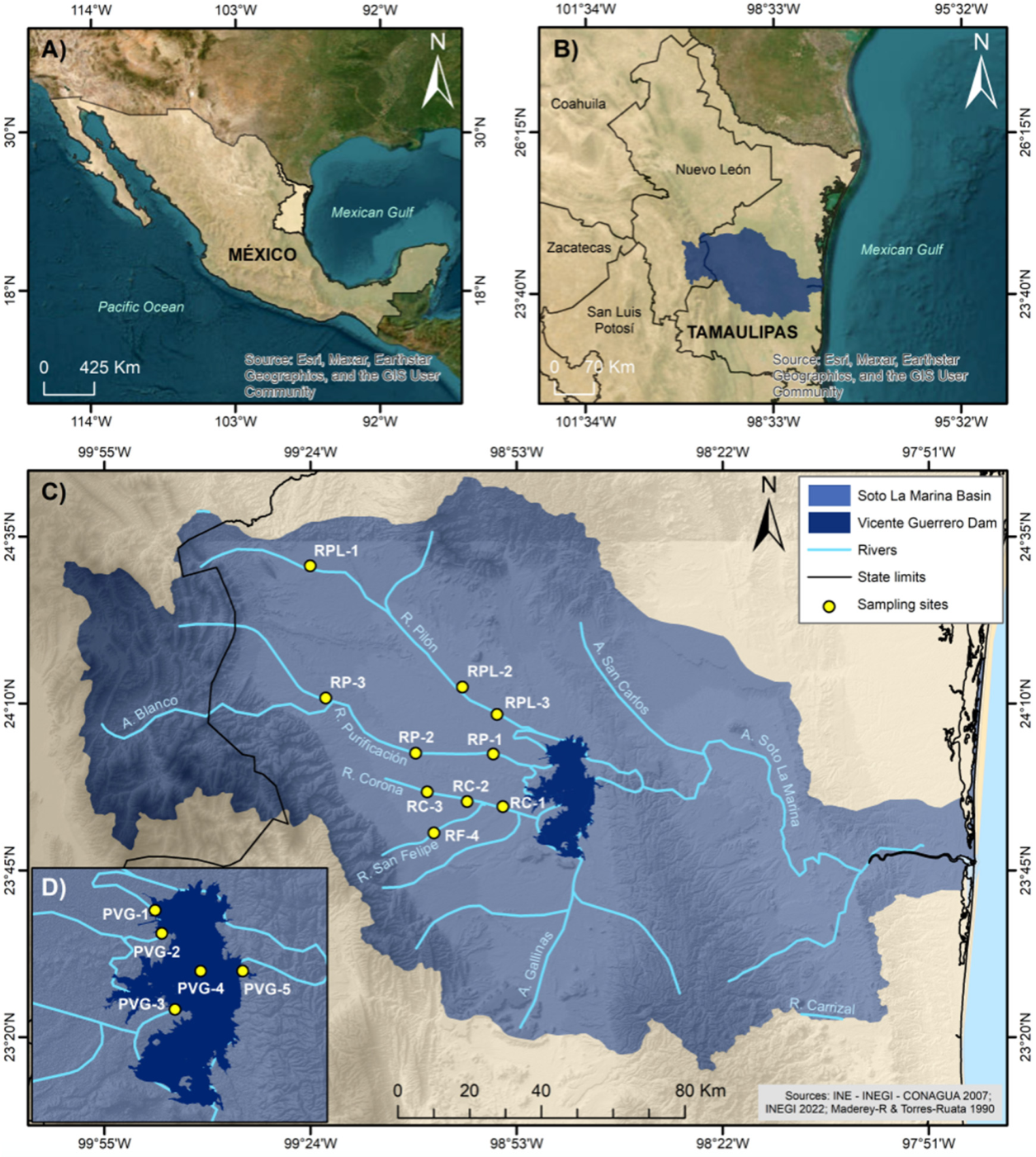
Figure 2.
Outlying Mean Index (OMI) analysis for the protozoan community in the study area. A) Ordination of species centroids in the environmental space defined by the first two axes of the analysis. Circle size is proportional to the relative abundance of each species. B) Correlation circle of physicochemical variables with the first two ordination axes. Variable abbreviations correspond to those defined in Table 6. The position of Vorticella sp. in relation to pH and alkalinity vectors is highlighted.
Figure 2.
Outlying Mean Index (OMI) analysis for the protozoan community in the study area. A) Ordination of species centroids in the environmental space defined by the first two axes of the analysis. Circle size is proportional to the relative abundance of each species. B) Correlation circle of physicochemical variables with the first two ordination axes. Variable abbreviations correspond to those defined in Table 6. The position of Vorticella sp. in relation to pH and alkalinity vectors is highlighted.
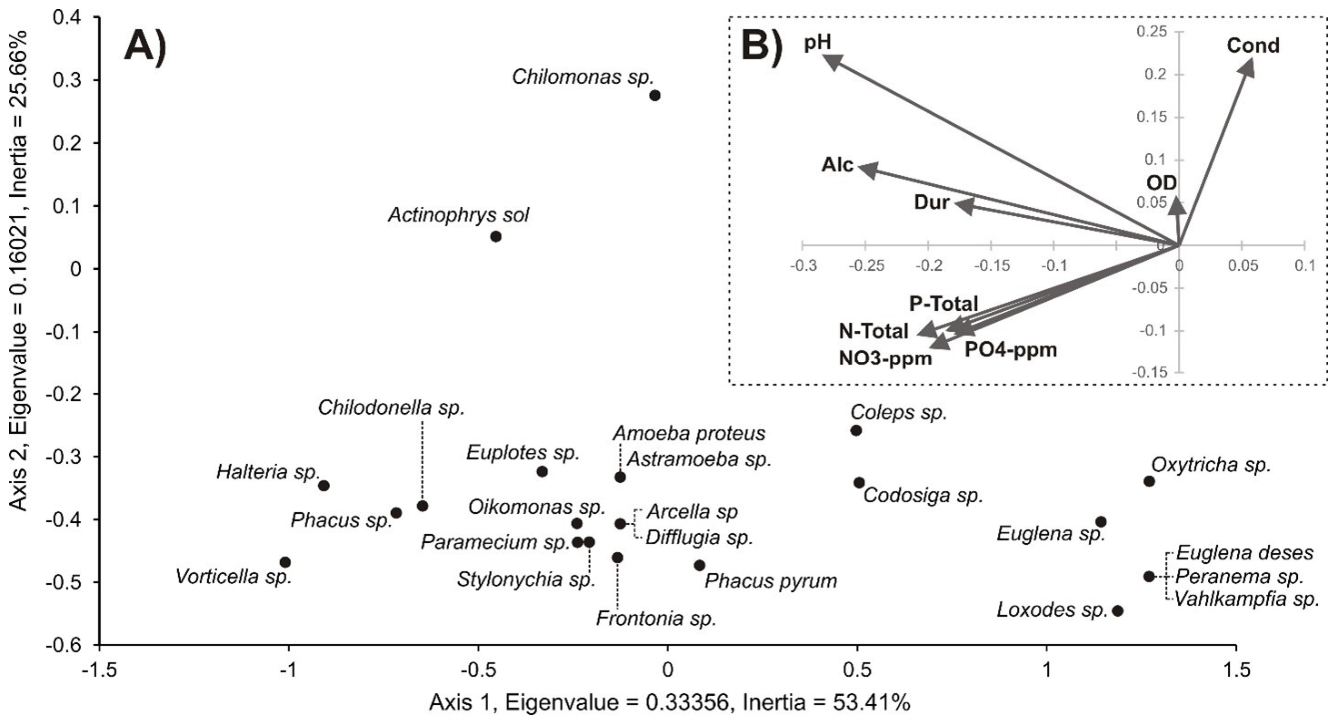

Table 1.
Designation of water quality sampling stations in the upper Soto la Marina River basin, Tamaulipas, Mexico.
Table 1.
Designation of water quality sampling stations in the upper Soto la Marina River basin, Tamaulipas, Mexico.
| Code | Name | Description | Coordinates |
| RC-1 | Corona River - Final | 2,460 m downstream from the bridge on the Victoria-Matamoros highway | 23° 55’ 24.40” N; 98° 55’ 0.06” W |
| RC-2 | San Felipe River - Tributary of RC | On access to the town of Güémez | 23° 55’ 17.21” N; 99° 0’ 29.27” W |
| RC-3 | Corona River - Middle Reference | On bridge of the Victoria-Monterrey highway | 23° 58’ 8.54” N; 99° 6’ 24.33” W |
| RC-4 | Corona River - Reference | Interejidal highway - Upstream from Ejido El Alamito | 23° 0’ 24.35” N; 99° 18’ 38.43” W |
| RP-1 | Purificación River - Final | Highway bridge in the town of Nuevo Padilla | 23° 2’ 20.49” N; 98° 5’ 1.71” W |
| RP-2 | Purificación River - Middle | On highway bridge of the town of El Barretal | 23° 4’ 46.57” N; 99° 7’ 22.91” W |
| RP-3 | Purificación River - Reference | 11 km before the town of El Tomaseño, and 2 km upstream from the river | 24° 10’ 53.11” N; 99° 21’ 42.38” W |
| RPL-1 | Pilón River - Reference | 10 km north of the town of Villagrán along the road to the town of Garza Valdés | 24° 30’ 39.17” N; 99° 24’ 1.46” W |
| RPL-2 | Pilón River - Middle | Along La Soledad-San Carlos highway, 15.73 km north (Camacho Viejo) | 24° 12’ 28.49” N; 99° 1’ 9.57” W |
| RPL-3 | Pilón River - Final | Victoria-Matamoros highway, 6.5 km north of Nuevo Padilla | 24° 5’ 33.51” N; 99° 51’ 37.68” W |
| PVG-1 | Vicente Guerrero Reservoir - Pilón River confluence | River access | 24° 2’ 57.3” N; 98° 47’ 55.9” W |
| PVG-2 | Vicente Guerrero Reservoir - Purificación River confluence | River access | 24° 0’ 48.5” N; 98° 46’ 56.5” W |
| PVG-3 | Vicente Guerrero Reservoir - Corona River confluence | River access | 24° 56’ 12.8” N; 98° 48’ 36.5” W |
| PVG-4 | Vicente Guerrero Reservoir - Center | River access | 23° 57’ 51.1” N; 98° 44’ 34.9” W |
| PVG-5 | Vicente Guerrero Reservoir - Dam | River access | 23° 57’ 53.1” N; 98° 41’ 6.11” W |
Note: LN = North Latitude; LW = West Longitude.
Table 2.
Taxonomic composition and frequency of occurrence of protozoans in the rivers of the Soto la Marina River basin.
Table 2.
Taxonomic composition and frequency of occurrence of protozoans in the rivers of the Soto la Marina River basin.
| Phylum | Morphospecies | Rivers | ||||
| San Felipe | Corona | Purificación | Pilón | Total | ||
| Ciliophora | Loxodes sp. | 5 | 0 | 1 | 0 | 6 |
| Chilodonella sp. | 0 | 6 | 6 | 6 | 18 | |
| Euplotes sp. | 0 | 6 | 0 | 0 | 6 | |
| Oxytricha sp. | 5 | 0 | 1 | 0 | 6 | |
| Stylonychia sp. | 6 | 0 | 5 | 6 | 17 | |
| Halteria sp. | 0 | 0 | 5 | 0 | 5 | |
| Coleps sp. | 6 | 6 | 1 | 0 | 13 | |
| Frontonia sp. | 6 | 0 | 6 | 6 | 18 | |
| Paramecium sp. | 6 | 6 | 5 | 6 | 23 | |
| Vorticella sp. | 0 | 0 | 5 | 6 | 11 | |
| Euglenozoa | Peranema sp. | 6 | 0 | 0 | 0 | 6 |
| Euglena sp. | 6 | 0 | 1 | 0 | 7 | |
| Euglena deses | 6 | 0 | 0 | 0 | 6 | |
| Phacus sp. | 0 | 6 | 0 | 6 | 12 | |
| Phacus pyrum | 6 | 0 | 0 | 6 | 12 | |
| Percolozoa | Vahlkampfia sp. | 6 | 0 | 0 | 0 | 6 |
| Amoebozoa | Amoeba proteus | 1 | 6 | 0 | 0 | 7 |
| Arcella sp. | 6 | 7 | 6 | 6 | 25 | |
| Difflugia sp. | 6 | 7 | 6 | 6 | 25 | |
| Astramoeba sp. | 1 | 6 | 0 | 0 | 7 | |
| Choanozoa | Codosiga sp. | 6 | 7 | 0 | 0 | 13 |
| Bigyra | Actinophrys sol | 0 | 6 | 1 | 0 | 7 |
| Ochrophyta | Oikomonas sp. | 6 | 6 | 5 | 6 | 23 |
| Cryptophyta | Chilomonas sp. | 0 | 1 | 11 | 5 | 17 |
Table 3.
Total frequency of protozoans (sum of all morphospecies) between sites and collection months throughout the annual cycle.
Table 3.
Total frequency of protozoans (sum of all morphospecies) between sites and collection months throughout the annual cycle.
| Site (River) | February | April | June | August | October | December | Total |
| Corona | 14 | 12 | 13 | 12 | 13 | 12 | 76 |
| Pilón | 11 | 10 | 11 | 11 | 11 | 11 | 65 |
| Purificación | 11 | 10 | 11 | 12 | 9 | 12 | 65 |
| San Felipe | 17 | 15 | 14 | 15 | 14 | 15 | 90 |
| Total | 53 | 47 | 49 | 50 | 47 | 50 | 296 |
Table 4.
Matrix of faunistic similarity (Sørensen-Dice index, expressed as percentage) among the sampled rivers.
Table 4.
Matrix of faunistic similarity (Sørensen-Dice index, expressed as percentage) among the sampled rivers.
| Rivers | San Felipe | Corona | Purificación | Pilón |
| San Felipe | 100 | |||
| Corona | 46.2 | 100 | ||
| Purificación | 62.5 | 48.0 | 100 | |
| Pilón | 54.5 | 46.2 | 69.2 | 100 |
Table 5.
Parameters of the Outlying Mean Index (OMI) analysis for protozoan morphospecies: total inertia (InerO), marginality (OMI), tolerance (T1), residual tolerance (T2), and statistical significance (p).
Table 5.
Parameters of the Outlying Mean Index (OMI) analysis for protozoan morphospecies: total inertia (InerO), marginality (OMI), tolerance (T1), residual tolerance (T2), and statistical significance (p).
| Morphospecies | InerO | OMI | T1 | T2 | p |
| Loxodes sp. | 11.47 | 1.792 | 4.71 | 4.964 | 0.1729 |
| Chilodonella sp. | 12.07 | 0.5706 | 6.071 | 5.43 | 0.0729 |
| Euplotes sp. | 10.5 | 1.027 | 6.058 | 3.414 | 0.4769 |
| Oxytricha sp. | 12.53 | 1.773 | 2.674 | 8.083 | 0.1807 |
| Stylonychia sp. | 12.92 | 0.3122 | 3.76 | 8.851 | 0.4069 |
| Halteria sp. | 14.53 | 1.344 | 9.279 | 3.907 | 0.4581 |
| Coleps sp. | 10.76 | 0.5381 | 0.5506 | 9.667 | 0.3446 |
| Frontonia sp. | 12.62 | 0.3042 | 3.433 | 8.885 | 0.3628 |
| Paramecium sp. | 12.45 | 0.2527 | 4.561 | 7.633 | 0.1857 |
| Vorticella sp. | 13.91 | 1.379 | 4.636 | 7.897 | 0.0329 |
| Peranema sp. | 11.71 | 1.857 | 3.72 | 6.134 | 0.1647 |
| Euglena sp. | 10.2 | 1.482 | 3.05 | 5.665 | 0.1816 |
| Euglena deses | 11.71 | 1.857 | 3.72 | 6.134 | 0.1647 |
| Phacus sp. | 11.65 | 0.7047 | 4.073 | 6.869 | 0.2371 |
| Phacus pyrum | 12.25 | 0.566 | 3.674 | 8.013 | 0.3971 |
| Vahlkampfia sp. | 11.71 | 1.857 | 3.72 | 6.134 | 0.1647 |
| Amoeba proteus | 9.34 | 0.8715 | 4.121 | 4.348 | 0.4723 |
| Arcella sp. | 11.57 | 0.1866 | 3.833 | 7.554 | 0.2084 |
| Difflugia sp. | 11.57 | 0.1866 | 3.833 | 7.554 | 0.2084 |
| Astramoeba sp. | 9.34 | 0.8715 | 4.121 | 4.348 | 0.4723 |
| Codosiga sp. | 10.39 | 0.5223 | 0.8365 | 9.033 | 0.3659 |
| Actinophrys sol | 10.59 | 1.033 | 3.722 | 5.831 | 0.3604 |
| Oikomonas sp. | 12.29 | 0.2257 | 4.79 | 7.275 | 0.2451 |
| Chilomonas sp. | 7.189 | 0.1037 | 0.4459 | 6.639 | 0.9285 |
Note: Values in bold indicate statistical significance (p < 0.05).
Table 6.
Correlation coefficients of physicochemical variables with the first two axes of the Outlying Mean Index (OMI) analysis.
Table 6.
Correlation coefficients of physicochemical variables with the first two axes of the Outlying Mean Index (OMI) analysis.
| Variable | Code | Axis 1 | Axis 2 |
| Conductivity (µS/cm) | Cond | 0.0587 | 0.2211 |
| Hydrogen Potential | pH | -0.2849 | 0.2240 |
| Dissolved oxygen (mg/L) | DO | -0.0025 | 0.0591 |
| Total nitrogen (mg/L) | N-Total | -0.2094 | -0.1054 |
| Nitrates (mg/L) | NO₃⁻ | -0.1998 | -0.1207 |
| Total phosphorus (mg/L) | P-Total | -0.1864 | -0.1006 |
| Phosphates (mg/L) | PO₄³⁻ | -0.1797 | -0.1042 |
| Alkalinity (mg/L CaCO₃) | Alc | -0.2566 | 0.0925 |
| Total hardness (mg/L CaCO₃) | Hard | -0.1797 | 0.0496 |
Note: Values in bold indicate the variables with the greatest contribution to Axis 1.
Disclaimer/Publisher’s Note: The statements, opinions and data contained in all publications are solely those of the individual author(s) and contributor(s) and not of MDPI and/or the editor(s). MDPI and/or the editor(s) disclaim responsibility for any injury to people or property resulting from any ideas, methods, instructions or products referred to in the content. |
© 2026 by the authors. Licensee MDPI, Basel, Switzerland. This article is an open access article distributed under the terms and conditions of the Creative Commons Attribution (CC BY) license (http://creativecommons.org/licenses/by/4.0/).
Copyright: This open access article is published under a Creative Commons CC BY 4.0 license, which permit the free download, distribution, and reuse, provided that the author and preprint are cited in any reuse.


