

Submitted:
22 May 2026
Posted:
25 May 2026
You are already at the latest version
Abstract
Background/Objectives: Despite its proven benefits for mother and newborn, skin-to-skin contact (SSC) following a caesarean section faces significant organisational and professional obstacles in clinical settings. This descriptive qualitative study aimed to identify the barriers and facilitators experienced by multidisciplinary healthcare teams implementing SSC, using this frontline evidence to design a standardised hospital-wide protocol. Methods: Following phenomenological approaches and COREQ guidelines, forty semi-structured interviews were conducted at a Spanish tertiary hospital. Partici-pants included professionals directly involved in the caesarean care pathway: anaest-hesiologists, gynaecologists, neonatologists, midwives, nurses, and nursing assistants. The collected data underwent thematic categorisation at semantic and pragmatic levels using MAXQDA software. Results: Analysis revealed several overarching barriers hin-dering SSC implementation. Institutional obstacles included understaffing, inadequate physical infrastructure, and the absence of specific guidelines. Professional challenges involved knowledge gaps, limited training, and resistance rooted in established routines. Furthermore, attitudinal barriers emerged from uncertainty regarding the safety of caesarean following major abdominal surgery. Conversely, key facilitators encompassed the absence of clinical complications and the profound emotional impact of SSC, which greatly enhances bonding and family-centred connection. Crucially, these qualitative findings directly informed the successful deployment of an operational hospital-wide SSC protocol. Conclusions: Although caesarean SSC is safe, feasible, and deeply valued by families, it remains systematically underimplemented due to addressable barriers. Scaling this practice requires targeted training, multidisciplinary commitment, and in-frastructural adaptations in recovery rooms. Such investments are fully justified by the extensive clinical benefits for maternal and neonatal well-being.
Keywords:
skin-to-skin contact
; caesarean section
; newborn
; postpartum haemorrhage
; attitudes
; healthcare professionals
; facilitating factors
; barriers
; clinical protocol
; postpartum period
; family-centred care
1. Introduction
Early skin-to-skin contact (SSC) consists of placing the naked newborn (NB) in a prone position on the bare chest of the mother or father immediately after birth or within the first minutes of life. Globally, caesarean section now accounts for approximately 21% of all births a proportion that continues to rise yet SSC is systematically withheld in most caesarean deliveries despite the mother being awake and the newborn healthy. We know that in normal deliveries more preterm/low birth weight (<2.0 kg) babies die if they do not perform the SSC from birth (Arya S., et al. 2021). Even in cases of COVID 19, the trend is clear, since separating mothers from their newborns due to this disease has negative effects (Bartick MC., et al., 2021).
The benefits of the SSC are widely demonstrated. In mothers, a shortening of the delivery period, reduction of postpartum hemorrhage, improvement in the perception of childbirth, strengthening of the mother child bond and reduction of postpartum depression and anxiety levels are observed. It has been concluded that mothers present less stress, with greater feelings of confidence and competence in managing their babies (Costa Romero M., et al., 2019) and a better recovery of post-caesarean plasma hemoglobin levels has been observed (Pérez-Jiménez, J.M., et al., 2023).
In newborns, it favors physiological adaptation to extrauterine life, with rapid improvement in oxygenation, regulation of body temperature, and decreased energy expenditure (Asociación Española de Pediatría. 2017). Along with this, it is also known that skin-to-skin contact (SSC) causes an increase in oxytocin that favors uterine contraction and colostrum ejection (Boyd MM., 2017). High levels of this hormone promote interactive social behaviors, bonding, and attachment in the mother. It also stimulates more complex maternal behaviors by reducing levels of anxiety, fear and pain (Perez-Jimnez-JM, et al., 2025; Moberg KU, et al., 2020).
The fact of getting in touch in this first hour of life is related to an increase in the expression of genes that synthesize certain molecules and hormones such as cortisol or adrenaline produced in the brain and adrenal gland in both, hence this separation influences the decrease in the probability of physiological and neurobehavioral benefits (Bergman NJ., 2019). This delay in the recognition of the mother can create a weak bond with her child, which can be avoided with a loving and nurturing environment, thanks to the SSC (Luby JL., et al., 2020). All these events are included in a concept called DOHaD (Developmental Origins of Health and Disease), which explains that early events in life can determine different forms of mental and biological behavior in the long term, even favoring the development of diseases (D’Vaz, N., et al., 2023).
SSC is done systematically in normal deliveries (vaginal route), but it remains unapplied in most caesarean deliveries, even though the mother is awake and the newborn is a healthy, full-term child. The first contact between the two is delayed due to residual effects of epidural anesthesia or other complications. During this time the newborn is in the crib or in exceptional cases doing skin-to-skin with his father (Costa Romero M., et al., 2019; Kollmann M., et al., 2017).
Previous studies have suggested that SSC should be initiated immediately after birth in vaginal deliveries and as soon as the mother is alert and responsive after a caesarean delivery. However, data are needed on the influence of the environment, infant-related factors, health professional support, safety issues, and time and knowledge constraints. In addition, there is an urgent need for further research into the enablers, barriers, outcomes and experiences of immediate SSC after caesarean section, and more evidence needs to be gathered on how to provide SSC safely from the operating theatre and achieve short- and long-term outcomes (Pérez-Jiménez J.M., et al., 2023).
The central question this study addresses is therefore not whether SSC is beneficial the evidence overwhelmingly confirms it is but why it remains so rarely performed after caesarean section, and what institutional and professional changes are needed to make it the standard of care.
Patient and Public Contributions: We thank all participants for their valuable input throughout the study.
2. Materials and Methods
This research follows two randomized clinical trials, one of which was published in this journal in 2025, “Beyond Pain Management: Skin-to-Skin Contact as a Humanization Strategy in Cesarean Delivery: A Randomized Controlled Trial”(https://doi.org/10.3390/healthcare13151866) and “Does skin-to-skin contact immediately after caesarean section promote uterine contraction and recovery of maternal blood haemoglobin levels?’ (https://doi.org/10.1002/nop2.1331 ). The importance of skin-to-skin contact in women with caesarean section in terms of recovery and prevention of postpartum haemorrhage and the pain was analysed. Due to the difficulties encountered in carrying out the research, we decided to carry out a second study, with a phenomenological and qualitative basis, interviewing the professionals involved in this process and determining the causes, barriers and facilitating elements related to this technique. Thanks to these two articles, at the beginning of this year we designed and implemented a hospital protocol so that women undergoing caesarean section can perform skin-to-skin contact from the operating theatre.
2.1. Research Design
A qualitative and exploratory study was carried out that aims to describe the meaning of an experience by identifying main essential themes (Moser A. & Korstjens I., 2018). Semi-structured interviews were used to enable adaptability in the collection of information, allowing the researcher to know how the participants understand and make sense of the topic in question (Flick U., 2015).
2.2. Setting and Sample
The study was carried out at the Hospital xxxxxxx, located in the province xxxxx, xxxxx (xxx). This hospital has an operating theater area for caesarean sections, next to the delivery room. The recovery of these women is carried out in the recovery and critical care unit, which is located elsewhere. As there is no protocol in this unit for the reception of healthy newborns, who have not undergone any intervention, they are not admitted with their mother. The study included healthcare professionals involved in childbirth care, including gynecologists, midwives, anesthesiologists, pediatricians, residents, nurses and nurses involved in the caesarean section care process.
2.3. Procedures
The type of interview that was used was the semi-structured interview. This type was chosen since it combines part of the dimensions associated with depth and freedom that are observed in unstructured interviews with the characteristics of the structured ones. The chosen sampling was intentional. The goal of the semi-structured interviews was for participants to be able to expound on subjects they were concerned about, while also giving the researcher the opportunity to ask for elaborations about specific topics, explanations of observed events, and clarification of ambiguities.
2.4. Recruitment and Selection
To recruit the professionals, we enlisted the help of obstetric and post-surgical critical care staff. The interviews were carried out starting at 9 in the morning, to ensure the availability of the professionals. The interviews were carried out at 9:00 am, 9:30 am, 10:00 am and 10:20 am, with 4 interviews being carried out daily. The possibility was offered that the interviews could be carried out in a place where the participant is comfortable, alone with him, ensuring his privacy and no interruptions. The duration of the interview was approximately 30 minutes, although they were given extra time if necessary to carry out the interview.
Prior to the start of the interview, the participants were asked to read the informed consent, which clarified the purpose of the study, risks, benefits, cost, confidentiality and requirements, as well as the contact number of the researcher for any questions that many arise.
2.5. Instrument
An interview script with open-ended questions divided into two sections was used. The first section covers the sociodemographic characteristics and the other section deals answer about the aspect indicated above. This interview guide is presented in Table 1.

Table 1.
Interview Guide.
|
2.6. Data Analysis
A classification and coding of the information was carried out. Initially, some categories were designed that, applying the principle of circularity typical of qualitative research, were expanded with other emerging categories that appeared during the development of the interviews: Relationship with skin-to-skin contact (Knowledge of the technique, Degree of training, Interest in its application); Benefits of the SSC (Relationship with breastfeeding); SSC vs Caesarean sections (Knowledge of the caesarean section process. Mother-child separation, Benefits SSC-mother caesarean section-newborn); Hospital facilities for caesarean sections and SSC (Resuscitation and Post-Surgical Critical Care Unit, Implementation of this technique in the hospital).
Figure 1.
Categories.
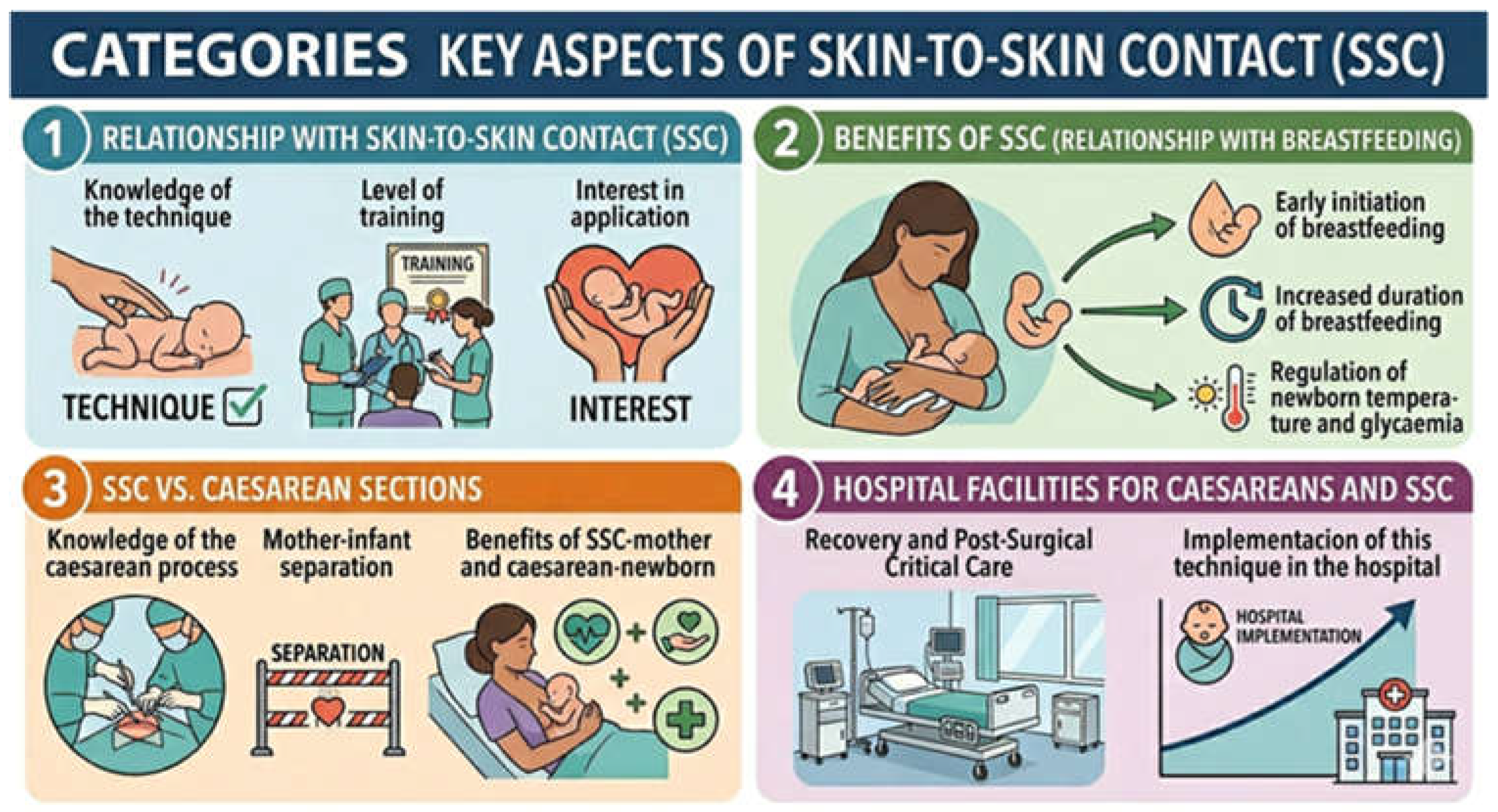
Qualitative analysis was carried out using the following steps: (1) familiarisation with the data; (2) generation of categories; (3–5) search, review, and definition of themes; and (6) final report, which was prepared with the statements of the informants, indicated by participant number, gender, age, place of work, and transcription, literal reading and theoretical manual categorisation were performed. The analysis of the categories was carried out at the semantic and pragmatic level. The semantics has been done by analyzing the meaning that people give to the topics or categories of analysis that are objects of interest and relating the fragments of categorized texts with the context, thus reaching the pragmatic level.
Furthermore, MAXQDA 2022 qualitative data was employed for the analysis and handling of data. MAXQDA is a specialized software application developed for conducting research involving qualitative, quantitative, and mixed methods approaches.
2.7. Trustworthy
For data triangulation, the consulted bibliography and the results provided by the qualitative methodology were used. In addition, the analysis and treatment of MAXQDA qualitative data was used and followed The Consolidated Criteria for Reporting Qualitative Studies (COREQ) (Tong A., et al., 2007) (Supplementary material Table S1).
2.8. Ethical Consideration
This study followed the ethical principles for medical research in human beings that are included in the Declaration of Helsinki of the World Medical Association and successively revised in Tokyo (1975), Venice (1983), Hong Kong (1989), Somerset West (1996), Edinburgh (2000), Washington (2002), and Seoul (2008), in the Declaration of Fortaleza (Brazil) and the Oviedo Agreement.
Inclusion in the project was voluntary and the request to participate was made as a health research proposal, informing about the objectives, risks and consequences of the study, as well as the right to revoke consent at any time without having to give explanations. The participants were verbally informed of the characteristics of the study and all the doubts raised were resolved. The main investigator duly kept the records and the corresponding informed consent of each participant who is identified only by the assigned case number, complying with Spanish legislation on data protection. (Organic Law 3/2018, of December 5, Protection of Personal Data and guarantee of digital rights). The study received approval from Andalusian Ethics and Research Committee (internal code: XXXX-X-XX).
3. Results
This section describes the results generated after the detailed analysis of the 40 interviews carried out during the study. First, the profile of the participants is detailed (Table 2). The results are presented below according to the different established categories.
3.1. Participant Profile
The interviewees were health personnel involved in the path taken by a woman who has undergone a caesarean section, being anesthetists, gynecologists, neonatologists, residents, midwives, nurses, and nursing assistants care technicians.
Table 2.
Characteristics of the sample.
| Code | Age | Gender | Civil Status |
Children | Household | Occupation | Employment status |
Workplace |
|---|---|---|---|---|---|---|---|---|
| E1 | 29 | Woman | Single | 0 | 2 | Anesthesiologist | Casual worker | Operating room |
| E2 | 47 | Woman | Married | 3 | 4 | Gynecologist | Employees on indefinite | Maternity Delivery room High-risk |
| E3 | 63 | Woman | Married | 2 | 4 | Midwife | Employees on indefinite | Delivery room |
| E4 | 28 | Man | Single | 0 | 1 | Anesthesiologist | Resident | Recovery room |
| E5 | 59 | Woman | Married | 3 | 5 | Gynecologist | Employees on indefinite | High-risk |
| E6 | 25 | Woman | Single | 0 | 5 | Neonatologist | Resident | Delivery room |
| E7 | 64 | Woman | Single | 0 | 1 | Midwife | Employees on indefinite | Delivery room |
| E8 | 61 | Woman | Married | 3 | 5 | Nurse | Employees on indefinite | Recovery room |
| E9 | 42 | Man | Married | 2 | 4 | Nurse | Interim worker | Recovery room |
| E10 | 46 | Woman | Married | 1 | 3 | Nursing assistant | Employees on indefinite | Recovery room |
| E11 | 50 | Man | Married | 4 | 6 | Nursing assistant | Interim worker | Recovery room |
| E12 | 28 | Man | Single | 0 | 2 | Anesthesiologist | Casual worker | Operating room |
| E13 | 51 | Woman | Married | 2 | 4 | Gynecologist | Employees on indefinite | Maternity Delivery room High-risk |
| E14 | 63 | Woman | Married | 2 | 4 | Midwife | Employees on indefinite | Delivery room |
| E15 | 29 | Man | Single | 1 | 3 | Anesthesiologist | Resident | Recovery room / Operating room |
| E16 | 27 | Woman | Married | 0 | 2 | Gynecologist | Casual worker | High-risk |
| E17 | 25 | Woman | Single | 0 | 1 | Neonatologist | Resident | Delivery room |
| E18 | 64 | Woman | Single | 0 | 1 | Midwife | Employees on indefinite | Delivery room |
| E19 | 58 | Woman | Married | 3 | 5 | Nurse | Employees on indefinite | Recovery room |
| E20 | 42 | Woman | Married | 2 | 4 | Nurse | Interim worker | Recovery room |
| E21 | 53 | Woman | Married | 4 | 6 | Nursing assistant | Employees on indefinite | Recovery room |
| E22 | 50 | Man | Married | 1 | 3 | Nursing assistant | Employees on indefinite | Recovery room |
| E23 | 29 | Man | Single | 0 | 1 | Anesthesiologist | Casual worker | Operating room |
| E24 | 51 | Woman | Married | 2 | 4 | Gynecologist | Employees on indefinite | Maternity Delivery room High-risk |
| E25 | 61 | Woman | Married | 2 | 4 | Midwife | Employees on indefinite | Delivery room |
| E26 | 28 | Man | Single | 0 | 2 | Anesthesiologist | Resident | Recovery room / Operating room |
| E27 | 56 | Woman | Married | 3 | 5 | Nurse | Employees on indefinite | Recovery room |
| E28 | 25 | Woman | Single | 2 | 4 | Neonatologist | Resident | Delivery room |
| E29 | 38 | Woman | Single | 0 | 1 | Midwife | Interim worker | Delivery room |
| E30 | 61 | Man | Married | 3 | 5 | Nurse | Employees on indefinite | Recovery room |
| E31 | 39 | Woman | Single | 0 | 1 | Nurse | Interim worker | Recovery room |
| E32 | 53 | Woman | Married | 1 | 3 | Nursing assistant | Employees on indefinite | Recovery room |
| E33 | 50 | Hombre | Married | 4 | 6 | Nursing assistant | Interim worker | Recovery room |
| E34 | 32 | Man | Single | 0 | 1 | Anesthesiologist | Casual worker | Operating room |
| E35 | 54 | Woman | Married | 2 | 4 | Gynecologist | Employees on indefinite | Maternity Delivery room High-risk |
| E36 | 63 | Woman | Married | 2 | 4 | Midwife | Employees on indefinite | Delivery room |
| E37 | 35 | Man | Single | 0 | 2 | Anesthesiologist | Resident | Recovery room / Operating room |
| E38 | 37 | Woman | Married | 0 | 2 | Nurse | Interim worker | Recovery room |
| E39 | 37 | Man | Single | 0 | 2 | Neonatologist | Resident | Delivery room |
| E40 | 61 | Woman | Single | 0 | 1 | Midwife | Employees on indefinite | Delivery room |
3.2. Relationship with Skin to Skin Contact
Regarding the degree of knowledge about the SSC, it was evidenced that all of them knew the meaning of the technique, although not in all its aspects. Most of the interviewees referred to the definition of the process and the placement of the newborn on the mother´s breast at birth and some benefits. Not everyone commented on the security measure that must be followed or the time needed for SSC to be affective. Neither did they mention when it is advisable to carry out newborn identification tasks or the administration of drugs as prophylaxis. Few highlighted that sometimes the father does it.
“little thing… I believe that it favors the early care of the newborn, the relationship with the parents and reduces anxiety”. (Man, 50 years old, HCA).
“in my opinion, it is about the non-separation between mother and baby immediately after delivery”. (Woman, 63 years old, midwife).
“when the child is born, it´s put on the mother´s breast and remains in that place for several hours”. (Man, 42 years old, nurse).
Some professionals had working knowledge of the procedure, but expressed fears: that women might be uncomfortable, or that SSC was too brief to be meaningful in practice.
“basically, the center focuses on having the child at the breast. I was in a course and the mothers made the human incubator” (Woman, 58 years old, nurse).
“there are ladies who cannot be harassed, because they end up rejecting the baby, so we must be careful” (Woman, 51 years old, gynecologist-obstetrician).
“at first it´s a procedure that makes women happy, but it lasts a short time, about five or ten minutes, because the pediatrician passes, at least from my experience” (Woman, 64 years old, midwife).
On the other hand, almost all the professionals commented that they didn’t receive training on this procedure. This factor was a piece of information to take into account as it is closely related to the interest and acceptance of professionals in performing this technique.
“well... I have never been told about these things, I only know data that I have read in manuals” (Woman, 29 years old, anesthetist).
“I haven´t obtained information. I am aware of the issue on my own initiative, by reviewing the protocols of some services, although there are few in which it is implemented” (Woman, 38 years old, midwife).
“favored o promoted by the institution, none” (Man, 28 years old, MIR anesthesia).
3.3. Acceptance and Interest in Your Application
In order to find out the level of personal interest in relation to this technique, the interviewees were asked if the topic in question aroused their concern. Most of them showed a medium level of interest. This degree of acceptance was linked to a certain concern to ensure that both the mother and her child had to meet the necessary conditions for the SSC to develop safely. They weren´t calm in being able to care for the mother and the newborn properly. It´s in this question where an idea appeared that was repeated during all the interviews and that was present in almost all the answers; that of the lack personnel to carry out a safe SSC. The other issue that appeared in almost all the responses is that the hospital didn´t have appropriate facilities.
“attends... it seems to me an advisable technique as long as maternal or fetal conditions don´t prevent it” (Woman, 47 years old, ginecologist-obstetrician).
“I think it´s essential whenever possible since it encourages early feeding and the mother-child relationship” (Woman, 54 years old, ginecologist-obstetrician).
“honestly... the subject doesn´t arouse much interest in me, because I believe that children are better in the crib because they don´t lose heat and if they need to be revived it is easier, also, after so many hours in the operating room, the mother doesn´t feel like carry the baby” (Woman, 61 years old, midwife).
3.4. SSC Benefits
The professionals were also asked about their beliefs regarding the benefits of SSC in the mother and in the child. All the interviewees agreed that this fact was important for the mother, her son and for the family in general, but with some reluctance.
“scientifically, no one has shown me the importance of the SCC performed by the father, but for me, personally, with the body hair, sweat... it doesn´t seem right to me” (Woman, 63 years old, midwife).
“the skin to skin relationship with the increase in sudden infant death is being investigated” (Woman, 54 years old, ginecologist-obstetrician).
“Well... in my perception, it´s a feeling that can´t be explained, it´s very emotional. That skin... that body... your baby. It´s a very intimate thing, blood of my blood” (Woman, 53 years old, HCA).
“Of course…this is the most important moment for the woman, this is the first time that you feel your child on your skin after nine months, this is a miracle” (Woman, 61 years old, nurse).
3.5. Relationship with the Maternal Lactancy
To find out if there was a relationship between SSC and breastfeedinf, this question was posed. As is the general rule, in this study there was always a sector that I didn´t find related to the benefits or had certain doubts, but in general there was quite unanimity, almost all the answers were positive in this union, highlighting that the sooner the SSC started, the sooner the lactation process began.
“It seems essential to me whenever possible because promoting early feeding also favors the sucking reflex and the rise of milk” (Woman, 29 years old, anesthetist).
“the SSC can favor the establishment of breastfeeding and the duration of this” (Woman, 42 years old, nurse).
“yes... why the child makes the first skin to skin contact and favors breastfeeding, otherwise the child has a harder time”. (Woman, 25 years old, MIR neonatology).
3.6. Skin to Skin Contact VS Caesarean Sections
Next, the professionals were asked if they thought the same in cases of caesarean sections. Regarding the knowledge of the process of caesarean section and mother-child separation, in this hospital where the study was carried out, the women who underwent a caesarean section, once the operation was finished, followed a different circuit to the newborn. The first thing interviewees were asked was if that knew about this process. After analysing the responses, all professionals were aware that the patient was transferred to a resuscitation and critical care unit and her son to a room with his father.
“Yes... children and mothers are separated while the anesthesia lasts” (Woman, 58 years old, nurse).
“In the operating room I have never seen the child placed on the father´s chest, in fact, there is a mother-child separation for at least two hours” (Woman, 64 years old, midwife).
“no skin to skin occurs... separation of mother and newborn occurs” (Woman, 27 years old, gynecologist-obstetrician).
Together with the above, we wanted to know what relationship it had in cases where the mother was a caesarean section. The most repeated opinion was that they didn´t consider it beneficial, alleging that a caesarean section was a very annoying operation, that only the professionals who attended her should allow it, or that the mother was very uncomfortable, among other comments. Some health workers stressed that it was necessary to take certain aspects into account before performing the SSC, one of the most repeated is that it was necessary to have the approval of the professionals. There was clear general agreement that SSC in normal deliveries was beneficial, bur in caesarean sections it was not:
“no… for neither of us... I think that immediately after a major intervention such as a caesarean section, skin to skin contact isn´t beneficial, what is more, it coerces many woman due to the increasing information and social pressure, so that, despite being in pain and if they cannot take care of the newborn, they try to complete the SSC” (Woman, 47 years old, gynecologist-obstetrician).
‘’I imagine so, although you will have to ask the mother because it depends on how tired she is because there are women who end up very upset”. (Man, 29 years old, MIR anesthetist).
‘’It could be... especially because of the danger since a caesarean section is more dangerous than a delivery as long as the mother doesn´t have complications such as bleeding, for this very reason, I don´t know to what extent the SSC can be beneficial for a woman who has just to go through a caesarean section” (Woman, 64 years old, midwife).
3.7. Hospital Facilities Caesarean Section vs Skin to Skin Contact
During the interviews, the participants were asked if they considered that the hospital infrastructure met the optimal conditions for carrying out a safe SSC. It was asked about the general perception they had of the organization of the space in gynecological and recovery areas and that they qualified it in some way. One of the most repeated reasons that they expressed to justify that they did not agree with the SSC in caesarean sections, was that the hospital infrastructure was not prepared. Likewise, the fact that the personnel wasn’t prepared for this purpose and hadn’t received the necessary training reappeared as a justifying comment.
“No…there are still no trained personnel for this” (Man, 61 years old, nurse).
"No... infrastructure or possibility... you place everything on the midwife... the child, the mother and everything... I'm not a pediatrician... I can't care for the child if something happens to him... (Woman, 59 years old, obstetrician-gynecologist).
The majority didn’t agree with the implementation of the SSC, due to lack of personnel and lack of conditioning of an adequate space to care for the mother with the newborn.
"A series of adaptations could be made... not currently" (Woman, 56 years old, nurse).
“Everything depends on what we want…in a bed and alone…it's will. (Man, 28 years old, MIR anesthesia).
"They do not exist... since after a caesarean section... the mother and the child must remain separated until she’s discharged from the room." (Man, 50 years old, HCA).
In addition, they were asked whether they considered the resuscitation and post-surgical critical care unit, which is where the mother whose delivery is by caesarean section goes, to be an adequate place to attend her and her child for the SSC. All the interviewees, except one, were of the opinion that this space was not prepared for this purpose. The main opinions were directed at the discomfort and lack of safety for the child and the mother and, of course, the lack of staff.
“no…there are other patients with multiple pathologies…that…for example…that could be of infectious origin…we expose the newborn…in addition, the temperature is usually lower and we cool the creature…in addition to the rest of the patients who after the operation needs calm and with a newborn crying... it's difficult” (Man, 50 years old, HCA).
"It isn’t the most appropriate place... it’s shared with other patients and the environment isn’t the most desirable" (Man, 42 years old, nurse).
“Everything is possible if you want to…if there is good will and desire to work…” (Woman, 47 years old, gynecologist-obstetrician).
3.8. Implantation of this Technique in the Hospital
Finally, it was found that the type of attitude would be maintained (proactive or not) if this technique were implemented in the hospital where they work. The disagreement was quite widespread, mostly alleging that the hospital wasn’t prepared and that there was a lack of health personnel.
“If putting a beach bar for them… who is going to take care of those women... and the child... because I don't... not everything for us” (Woman, 61 years old, midwife)
“"Totally agree... as long as the way is considered... that they set up a site in the awakening room" (Woman, 27 years old, gynecologist-obstetrician).
"I would agree...as long as...only in the case...hygienic measures are given...that skin-to-skin contact was healthy...it did not cause pathologies to the mother and the child...especially the child" (Woman, 61 years old, nurse).
“strongly agree…but…if they conditioned it…as long as they had adequate postoperative monitoring…if they agreed” (Man, 50 years old, HCA).
There is no general agreement among health professionals that SSC in elective caesarean sections is beneficial for mother and child. Some say that the general dynamic has always been like this, "why is it going to change now?", "that this technique has never been carried out and that it has not been tested".
The lack of training in question, the shortage of personnel and the lack of an adequate hospital infrastructure, are the comments that appeared the most in the responses to justify that they did not agree that this procedure should be carried out in the hospital where they work.
4. Discussion
The aim of this study was to identify barriers and facilitators to the performance of SSC at caesarean section. The main results indicate that the poor training of health personnel, the absence of adequate hospital infrastructure, security and lack of human resources, constitute a barrier to the development of this technique. On the other hand, the absence of complications and the full satisfaction that this method brings to the family act as facilitating elements.
4.1. Relationship with Skin-to-Skin Contact, in Terms of Knowledge of the SSC Technique, Degree of Training, and Interest in Its Application
The health professionals interviewed have made descriptions of the SSC technique in a very varied and sometimes incorrect way. In this sense, other authors state the need to assess the knowledge of health professionals who work in obstetric operating rooms about SSC, as well as its application to women with caesarean deliveries (Pérez-Escamilla R., et al. 2021; Pachón-Muñoz V., 2020).
One of the barriers that have been observed in the study is the lack of knowledge and experiences about the SSC, as well as the changes in daily work routines. All of this makes early implementation of the SSC difficult after a caesarean delivery. This knowledge deficit coincides with the postulates of other authors (Moran, C., et al., 2023). Along with this, other authors refer that to establish this technique in health centers it’s important to collect data on the influence of the environment, elements related to the infant baby, support for health professionals, safety concerns, and time and knowledge limitations (Bhardwaj, NK., et al., 2024).
4.2. SSC Benefits
The women participating in this study have presented very high levels of comfort and satisfaction, however, other authors refer to the possibility that it causes stress to the mother by not feeling capable of providing the SSC due to her postoperative state (Bedetti, L., et al., 2023) which has also been expressed as an obstacle by the professionals involved in this research.
Regarding the factors that facilitate SSC, the professionals highlight the newborn's satisfaction when receiving early SSC, as well as the feeling of well-being, support, and security that mothers experience when holding the newborn on their skin. In addition, the joy of the parents to be able to participate from the beginning in the care of the newborn is highlighted. In this sense, it is necessary to avoid separation and take advantage of the newborn's alert period (Boyd MM., 2017). Other authors report that receiving early SSC improves the maternal perception regarding the birth experience, as well as the maternal-infant bond (Feng, X., & Zhang, Y., 2024).
Another facilitating element has been the absence of complications for both the mother and the newborn. In fact, some authors describe that the application of the SSC is considered a criterion of good practice, the absence of which can cause complications in recovery and increase the risk of disease development in both the newborn and the mother(Costa Romero M., et al., 2019).
Given the impact of SSC on the establishment of the mother-child bond, previous studies have pointed to the need to offer all mothers, in this sense immediate or early SSC after a caesarean section, provides maternal and newborn well-being, increases communication between the parents and the newborn, reduces pain and maternal anxiety, helps in the physiological stabilization of the mother and the newborn, as well as improves the results related to breastfeeding (Stevens J., et al., 2019).
4.3. Hospital Facilities for Caesarean Sections and for the SSC Technique
Another of the barriers observed is related to insecurity regarding the space where the SSC is carried out. The midwives allude to the fact that the SSC had never been performed in this way in the operating room, expressing concern about the lack of safety, since if any adverse event occurred to the child or the mother, they would be the ones to assume subsequent responsibility. The auxiliary nursing technicians in the operating room fear that the newborn will be cold when placed on the mother's chest and allude to the fact that this is not the usual practice. Neonatologists, operating room nurses, as well as technicians and nurses from the resuscitation and post-surgical critical care unit, agree to perform SSC during the mother's recovery, provided that there is a specific and adequate area. Some gynecologists point out the lack of safety for the newborn and discomfort for the mother, as it is a major surgery. In this sense (Boyd MM., 2017) they raise the difficulty in the safety and stability of the newborn.
Among the barriers, the lack of adequate infrastructure in the hospital to perform the SSC has also been described, as well as a space for the companion until the mother recovers. Adequate pre-planning is necessary to achieve a secure SSC. In this sense, some authors have described how the operating room barriers have been successfully overcome in caesarean sections to help mothers initiate breastfeeding within half an hour after delivery (Boyd MM., 2017). It should be borne in mind that in most caesarean sections it is possible to perform SSC in the operating theatre and in the post-operative resuscitation and critical care department, provided that the conditions of the mother and the newborn allow it. Some authors state that, although separation in the immediate postoperative period occurs to promote the safety of the newborn and reduce complications, this risk is low when the caesarean section has not presented complications or is performed urgently, recommending that early SSC should be encouraged to make the caesarean section experience more humanised (Mercier RJ., & Durante JC., 2018).
4.4. Implementation of the SSC Technique in the Hospital
For the implementation of the SSC technique, one of the barriers described by the participants has been insufficient personnel, which coincides with other authors who refer to the lack of personnel and time. Midwives especially highlight that lack of personnel, time and space interfere with the practice of SSC (Al Mutair, A., et al., (2023). .
According to the results of this study, in order to successfully execute the SSC technique, it is essential to establish multidisciplinary committees of personnel involved in caesarean sections to unify criteria and draw up action protocols (Asociación Española de Pediatría. 2017). In addition, to perform the SSC technique it´s necessary to have adequately trained professionals. In this regard, some authors report that among the obstacles to applying the SSC technique is the lack of training of reference health personnel. The collaboration of all health professionals is essential to perform the SSC from the operating room, highlighting the need to incorporate additional personnel with knowledge and specific training in the technique (Lorenzo-Viso KA., 2019). Coupled with this, the lack personnel has been described by various authors as a limitation in the implementation of the early SSC (Boyd MM., 2017).
Another barrier to the implementation of the SSC is the concern about sudden infant death and exposure to the cold of the newborn, which have been described by the participants. Health professionals report fear of not being able to control the medical conditions of the newborn and the mother, this being especially important in this first hours after the caesarean section due to the risk of apnea. However, other authors state that the SSC has multiple benefits for the newborn, such as the stability of body and cardiorespiratory temperature, the reduction of stress after birth, and that it facilitates the transition to extrauterine life (Crenshaw JT., et al., 2019).
- Strengths and Limitations
The main limitations of this study are its single centre design and the purposive sampling strategy, which, while appropriate for qualitative research, limits transferability to hospitals with different organisational structures or staffing models. Data collection was also more demanding than initially anticipated, as securing participation required the prior approval of each professional. The absence of patients’ perspectives is a further limitation; future research should incorporate the experiences of women who have undergone caesarean section to complement the staff viewpoint captured here.
The principal strengths are the breadth of the multidisciplinary sample spanning seven distinct professional categories across the full caesarean care pathway the rigorous application of the COREQ checklist, and the use of MAXQDA 2022 for systematic qualitative analysis. Most importantly, this study forms part of a two paper programme of research: (doi:10.1002/nop2.1331and doi:10.3390/healthcare13151866). Along with the hospital design and implementation of an SSC protocol for cesarean sections. This translational pathway from evidence to practice is the defining strength of the project as a whole.
- Recommendations or Implications for Practice and/or Further Research
It is of vital importance that all obstetric units design a protocol for implementing skin-to-skin contact at caesarean section, grounded in multidisciplinary consensus, as has been demonstrated in the hospital where this study was conducted. Training must be systematic and profession-specific: anaesthesiologists, midwives, neonatologists, and recovery nurses each encounter distinct barriers and require tailored education. Recovery areas should be structurally adapted to allow safe, supervised SSC alongside other postoperative patients. Patient-centred information for expectant mothers should be integrated into antenatal care so that SSC after caesarean section becomes an anticipated, requested element of birth planning. Future research should evaluate the clinical outcomes of SSC protocols once implemented particularly rates of postpartum haemorrhage, breastfeeding initiation, and maternal anxiety and should include the perspectives of women themselves.
- RELEVANCE TO CLINICAL PRACTICE
In most cases of cesarean section, immediate skin-to-skin contact is not performed. This exerts a negative influence on the recovery of uterine contractility and causes an increased risk of postpartum hemorrhage.
The practice of caesarean section is increasing exponentially and accounts for 21 per cent of all deliveries. 35% of maternal deaths are due to postpartum haemorrhage. The caesarean section group is the most at risk, due to the type of abdominal surgery and the lower amount of circulating oxytocin, a hormone that promotes uterine contractility.
To date, most of the published research on skin-to-skin contact has been conducted on normal or other variable births. It is necessary to know the degree of acceptance and knowledge of the professionals involved in caesarean delivery in relation to skin-to-skin contact, in order to assess the design and implementation of a protocol that guarantees an effective bond between mother and newborn by caesarean section.
Phenomenologically analysing the attitude and degree of training of the professionals, our study contributes to scientific knowledge with the design and implementation in this hospital of the caesarean section and skin-to-skin contact protocol.
This is related to greater stability for mothers, by reducing the risk of postpartum haemorrhage, and better adaptation of the newborn, by remaining close to its mother.
Keeping mothers and newborns together after caesarean delivery promotes family-centred care as the centre of self-care and increases the satisfaction of women, nurses and obstetric staff. Going a step further and implementing skin-to-skin contact in all health services does not require high costs, and its benefits will have a great impact on the child's physical and psychosocial development.
5. Conclusions
This study identifies three interlocking barriers that prevent SSC from becoming routine practice after caesarean section: a knowledge and training deficit among healthcare professionals; attitudinal resistance rooted in entrenched routines and safety concerns about the postoperative setting; and structural deficiencies in hospital infrastructure and staffing. These barriers are mutually reinforcing professionals with limited training feel less confident, institutions without protocols provide no framework for action, and understaffed units cannot safely supervise SSC and must therefore be addressed simultaneously.
In addition, the absence of complications in the execution of skin-to-skin contact in caesarean sections, the happiness that this technique brings to the family, and the degree of attachment, comfort, and confidence that mothers experience when performing it, are facilitating elements for the implementation of this technique.
Although health professionals currently perceive SSC as more readily achievable in vaginal deliveries, this study demonstrates that their concerns about the caesarean context are primarily organisational rather than clinical. When professional training is provided, clear protocols are established, and appropriate recovery-room infrastructure is in place, SSC after caesarean section is both safe and highly valued. The successful implementation of the SSC protocol at the study hospital since January 2024 shows that these changes are achievable, and serves as a replicable model for other obstetric units seeking to humanise caesarean care and reduce the preventable burden of postpartum haemorrhage.
Supplementary Materials
The following supporting information can be downloaded at the website of this paper posted on Preprints.org.
Author Contributions
Conceptualization, J.M.P-J.and R.d.D.-C; Methodology, J.M.P.-J; Formal analysis, J.M.P.-J and R.d.D.-C.; Investigation, J.M.P.-J., R.d.D.-C., E.B.V, M.F.R, T.F.A. and J.V.E; Resources, J.M.P.-J., R.d.D.-C., E.B.V, M.F.R, T.F.A. and J.V.E.; Data curation, J.M.P.-J. and R.d.D.-C.; Writing original draft preparation, J.M.P.-J., R.d.D.-C., E.B.V, M.F.R, T.F.A. and J.V.E Writing review and editing, J.M.P.-J., R.d.D.-C., E.B.V, M.F.R, T.F.A. and J.V.E.; supervision, J.M.P.-J. All authors have read and agreed to the published version of the manuscript.
Funding
This research received no external funding.
Institutional Review Board Statement
This study has been approved, strictly adhering to ethical principles and protecting the privacy of respondents. Prior to participating in the study, informed written consent has been obtained from each participant and received approval from Andalusian Ethics and Research Committee (Internal code 0428-N-17). Our study was based on the Helsinki Declaration.
Informed Consent Statement
Informed consent was obtained from all subjects involved in the study. Written informed consent has been obtained from the patient(s) to publish this paper if applicable.
Data Availability Statement
The data presented in this study are available upon request due to Ethical Restrictions.
Acknowledgments
To all the healthcare professionals of this hospital who have voluntarily participated in this research.
Conflicts of Interest
The authors declare no conflicts of interest.
References
- Al Mutair, A.; Almutairi, W.; Aljarameez, F.; Kay, E.; Rabanal, R.; Abellar, K.; Ahmed, G.Y. Evaluación de los conocimientos, actitudes e implementación de los cuidados piel con piel de las enfermeras en el ámbito perinatal en Arabia Saudita: estudio de encuesta. Nursing open 2023, 10(4), 2165–2171. [Google Scholar] [CrossRef] [PubMed]
- Arya, S.; Naburi, H.; Kawaza, K.; Newton, S.; Anyabolu, C.H.; Bergman, N. Immediate “Kangaroo Mother Care” and Survival of Infants with Low Birth Weight. N Engl J Med [Internet] 2021, 384(21), 2028–38. [Google Scholar] [CrossRef]
- Asociación Española de Pediatría. Contacto piel con piel en las cesáreas. Aspectos prácticos para la puesta en marcha [Internet]. Comité de lactancia Materna. Madrid. 2017. Available online: https://www.aeped.es/sites/default/files/documentos/201702-cpp_en_cesareas.pdf.
- Bartick, M.C.; Valdés, V.; Giusti, A.; Chapin, E.M.; Bhana, N.B.; Hernández-Aguilar, M.T. Maternal and Infant Outcomes Associated with Maternity Practices Related to COVID-19: The COVID Mothers Study. Breastfeed Med [Internet] 2021, 16(3), 189–99. [Google Scholar] [CrossRef]
- Bedetti, L.; Lugli, L.; Bertoncelli, N.; Spaggiari, E.; Garetti, E.; Lucaccioni, L.; Berardi, A. Contacto temprano piel con piel en bebés prematuros: ¿es seguro? Una experiencia italiana. Niños 2023, 10(3), 570. [Google Scholar]
- Bhardwaj, N.K.; Sasidharan, R.; Toteja, N.; Yadav, B.; Prasanna, K.L.; Bishnoi, B.; Singh, A. Implementación de la práctica del contacto piel con piel temprano entre bebés ≥ 35 semanas de gestación nacidos por vía vaginal: un estudio de mejora de la calidad. BMJ Open Quality 2024, 13 (Suppl 1), e002408. [Google Scholar] [CrossRef]
- Bergman, N.J. Birth practices: maternal-neonate separation as a source of toxic stress. Birth Defects Res [Internet] 2019, 111(15), 1087–109. [Google Scholar] [CrossRef] [PubMed]
- Boyd, M.M. Implementing Skin-to-Skin Contact for Cesarean Birth. AORN J [Internet] 2017, 105(6), 579–92. [Google Scholar] [CrossRef]
- Costa Romero, M.; Lalaguna Mallada, P.; Díaz Gómez, N.M. Skin to skin contact after cesarean delivery. Theme update and actuation proposal. Rev Esp Salud Publica [Internet] 2019, 93, 1–10. Available online: https://recyt.fecyt.es/index.php/RESP/article/view/75187.
- Crenshaw, J.T.; Adams, E.D.; Gilder, R.E.; DeButy, K.; Scheffer, K.L. Effects of Skin-to-Skin Care During Cesareans: A Quasiexperimental Feasibility/Pilot Study. Breastfeed Med [Internet] 2019, 14(10), 731–43. [Google Scholar] [CrossRef] [PubMed]
- D’Vaz, N.; Kidd, C.; Miller, S.; Amin, M.; Davis, J. A.; Talati, Z.; Prescott, S. L. The ORIGINS project biobank: a collaborative bio resource for investigating the developmental origins of health and disease. International Journal of Environmental Research and Public Health 2023, 20(13), 6297. [Google Scholar] [CrossRef]
- Feng, X.; Zhang, Y. Efectos del contacto piel con piel entre madre e hijo en la relación madre-hijo y los sentimientos de psicología materna: un estudio cualitativo. Nursing Open 2024, 11(6), e2181. [Google Scholar] [CrossRef]
- Flick, U. El diseño de la investigación cualitativa [Internet]. Ediciones Morata, editor. Madrid. 1–167 p. Madrid, 2015. Available online: https://dpp2017blog.files.wordpress.com/2017/08/disec3b1o-de-la-investigacic3b3n-cualitativa.pdf.
- Kollmann, M.; Aldrian, L.; Scheuchenegger, A.; Mautner, E.; Herzog, S.A.; Urlesberger, B. Early skin-to-skin contact after cesarean section: A randomized clinical pilot study. PLoS One [Internet] 2017, 12(2), e0168783. [Google Scholar] [CrossRef] [PubMed]
- Lorenzo-Viso, K.A. ¿Es posible la implantación de un protocolo de actuación para favorecer el contacto piel con piel en la unidad de reanimación post- anestésica del hospital general de La Palma? [Internet]. La Laguna. 2019. Available online: https://riull.ull.es/xmlui/bitstream/handle/915/15194/¿Esposible la implantacion de un protocolo de actuacion para favorecer el contacto piel con piel en la unidad de reanimacion postanestesica del hospital general de La Palma.pdf?sequence=1.
- Luby, J.L.; Baram, T.Z.; Rogers, C.E.; Barch, D.M. Neurodevelopmental Optimization after Early-Life Adversity: Cross-Species Studies to Elucidate Sensitive Periods and Brain Mechanisms to Inform Early Intervention. Trends Neurosci [Internet] 2020, 43(10), 744–51. [Google Scholar] [CrossRef] [PubMed]
- Mercier, R.J.; Durante, J.C. Physician and Nurse Perceptions of Gentle Cesarean Birth. MCN Am J Matern Child Nurs [Internet] 2018, 43(2), 97–104. [Google Scholar] [CrossRef]
- Moberg, K.U.; Handlin, L.; Petersson, M. Neuroendocrine mechanisms involved in the physiological effects caused by skin-to-skin contact – With a particular focus on the oxytocinergic system. Infant Behav Dev [Internet] 2020, 61, 101482. [Google Scholar] [CrossRef]
- Moser, A.; Korstjens, I. Series: Practical guidance to qualitative research. Part 3: Sampling, data collection and analysis. Eur J Gen Pract [Internet] 2018, 24(1), 9–18. [Google Scholar] [CrossRef]
- Pachón-Muñoz, V. Promoción de la lactancia materna tras la cesárea [Internet]. Católica de Valencia. 2020. Available online: http://hdl.handle.net/20.500.12466/1277.
- Pérez-Escamilla, R.; Vilar-Compte, M.; Rhodes, E.; Sarmiento, O.L.; Corvalan, C.; Sturke, R. [Implementación de políticas de prevención y control de la obesidad infantil en Estados Unidos y Latinoamérica: lecciones para la investigación y la práctica transfronterizas]. Obes Rev [Internet] 2021, 22 Suppl 5, e13347. [Google Scholar] [CrossRef]
- Pérez-Jiménez, J. M.; de-Diego-Cordero, R.; Borrallo-Riego, Á.; Luque-Oliveros, M.; de-Pedro-Jimenez, D.; Coheña-Jimenez, M.; Sierra, P. B.; Guerra-Martín, M. D. Beyond Pain Management: Skin-to-Skin Contact as a Humanization Strategy in Cesarean Delivery: A Randomized Controlled Trial. Healthcare 2025, 13(15), 1866. [Google Scholar] [CrossRef]
- Pérez-Jiménez, J. M.; Luque-Oliveros, M.; Gonzalez-Perez, D.; Rivera-Sequeiros, A.; Rodriguez-Blanco, C. Does immediate skin-to-skin contact at caesarean sections promote uterine contraction and recovery of the maternal blood haemoglobin levels? A randomized clinical trial. Nursing open 2023, 10(2), 649–657. [Google Scholar] [CrossRef] [PubMed]
- Stevens, J.; Schmied, V.; Burns, E.; Dahlen, H.G. Skin-to-skin contact and what women want in the first hours after a caesarean section. Midwifery [Internet] 2019, 74, 140–6. [Google Scholar] [CrossRef]
- Tong, A.; Sainsbury, P.; Craig, J. Consolidated criteria for reporting qualitative research (COREQ): a 32-item checklist for interviews and focus groups. International Journal for Quality in Health Care [Internet] 2007, 14;19(6), 349–57. [Google Scholar] [CrossRef]
Disclaimer/Publisher’s Note: The statements, opinions and data contained in all publications are solely those of the individual author(s) and contributor(s) and not of MDPI and/or the editor(s). MDPI and/or the editor(s) disclaim responsibility for any injury to people or property resulting from any ideas, methods, instructions or products referred to in the content. |
© 2026 by the authors. Licensee MDPI, Basel, Switzerland. This article is an open access article distributed under the terms and conditions of the Creative Commons Attribution (CC BY) license (http://creativecommons.org/licenses/by/4.0/).
Copyright: This open access article is published under a Creative Commons CC BY 4.0 license, which permit the free download, distribution, and reuse, provided that the author and preprint are cited in any reuse.


