

Submitted:
21 May 2026
Posted:
25 May 2026
You are already at the latest version
Abstract
We present a preliminary study of the feasibility assessment of a magnetic shield designed to protect a space probe from cosmic radiation via magnetic deflection using neodymium permanent magnets.
This work is based on theoretical considerations whose preliminary indications are intended to provide the base for future Monte Carlo simulations and laboratory validation.
The novelty of our approach is the use of a magnetic shield whose competitiveness with conventional passive absorbing shielding is not investigated here but deserves to be the topic of upcoming work.
The primary objective is to protect a spacecraft from the flux of charged particles emitted by the Sun. To achieve this, we will combine theoretical modeling and numerical simulations, followed by the construction of a prototype to be tested in a laboratory environment and and a potential future CubeSat-scale experimental validation.
Keywords:
space radiation protection
; magnetic shielding
; permanent magnets
; solar particle events (SPEs)
; radiation deflection
; crewed space missions
1. Introduction
Space missions beyond low Earth orbit expose astronauts to a harsh radiation environment dominated by Solar Particle Events (SPEs) and Galactic Cosmic Rays (GCRs) [1]. SPEs consist mainly of protons with energies up to several GeV and can deliver life-threatening doses in unshielded conditions [2], while GCRs, though less intense, are highly penetrating and responsible for long-term health risks [3]. Current radiation protection strategies rely primarily on passive shielding (e.g., polyethylene, aluminum), but their mass grows rapidly with the required protection level, making them costly for deep-space missions [4].
Active shielding using electromagnetic fields has been proposed as a lighter alternative [5]. However, most concepts employ superconducting magnets, which face challenges in spaceflight due to cryogenic requirements and structural complexity [6,7]. Permanent magnets, by contrast, offer intrinsic field stability and simplicity, yet their use for radiation deflection has received little attention.
In this work, we present a first-order feasibility study of a magnetic shield based on neodymium permanent magnets. We develop a simplified analytical model to estimate the deflection of a collimated proton beam (representing SPEs) by a constant magnetic field of finite volume. We roughly estimate mass, size, and deflection efficiency for different magnet configurations, and compare the performance with conventional passive shielding. The aim is to assess whether permanent magnets can provide a mass-competitive solution for directional protection during solar particle events.
The paper is organized as follows: Section 2 deal with the frame of space rediation environment and the need of specific protection. Section 4 introduces our idea of a radition protection by mean of a passive magnetic deflector based on a battery of permanent (neodimium) magnets. Section 5 gives Preliminary indications on the magnetic shield efficiency. Finally, Section 6 presents conclusions and aims for a follow-up of the work.
2. Space Radiation Protection
Conventional shielding relies on passive materials with low atomic number (e.g., polyethylene, water, aluminum) to absorb or fragment incoming particles [4]. However, the mass required scales with the stopping power; for a Mars mission, cumulative exposure can reach Sv, exceeding NASA’s career limits [8]. A storm shelter adequately shielding against a large SPE may weigh up to tens of tons.
Active shielding using electromagnetic fields offers the potential for mass reduction by deflecting charged particles rather than absorbing them. Several concepts have been proposed, including electrostatic shields, plasma shields, and magnetic fields generated by superconducting coils [5]. Superconducting magnets can produce strong fields ( T) over large volumes, but they require cryogenic cooling, which poses reliability and power challenges for spaceflight [6,7]. Permanent magnets, in contrast, are simple, robust, and require no power, but they produce weaker fields (typically –1 T at the surface) over limited volumes. Their feasibility for space radiation protection has not been systematically explored. In this work, we assess whether a practical magnetic shield using permanent neodymium magnets could provide a mass-competitive alternative for directional SPE protection.
3. A Possible Magnetic Shield
In light of previous considerations, we decided to attempt the study of a radiation shield based on a protection via magnetic field as deviator of incoming damaging particles that does not require an excessive weight to embark on the space probe [9,10]. Figure 1 gives a concept sketch of the problem. This is in principle possible using permanent magnets but it will of course require a deep analysis of efficiency, feasibility, and cost.
In this paper, we deal with the theoretical foundations of our proposed shielding mechanism giving preliminary indications on its feasibility.
3.1. Magnetic Deflection of a Collimated Charged-Particle Flux
As a first step, we approach the topic using several simplifying approximations.
The effectiveness of a permanent-magnet system for deflecting collimated particle radiation can be estimated with a relatively simple approach. This approach should determine whether further development of the shielding system is warranted. It is worth recalling here that our scheme, as proposed in the following, aims at efficient deflection of particles coming from a given direction and in an interval of energies. This applies well to situations of active Sun, when bursts of high energy protons are emitted and may dangerously hit the space probe along its journey.
The next phase of the study will involve an extensive set of practical simulations, both numerical and laboratory-based, followed by testing on specific space missions scaled to the CubeSat level. In this way we would check properly the actual capability of the proposed mechanism in terms of reliability, efficiency and estimated costs, in view of a possible practical use for manned space missions.
The framework is that of the study of the performance of a single cylindrical permanent magnet in the deflection of a hypothetical, collimated (so, non isotropic) beam of identical and monoenergetic charged particles. This type of beam ideally represents SPEs.
The additional assumption of a simple estimate of the magnetic field produced by the magnet in its surrounding environment will provide a reliable estimation of the system’s deflection effectiveness by means of simple geometric evaluations, without the need for numerical simulations.
Let us consider a cylindrical permanent magnet having length L and radius R, with symmetry axis z such that on the upper surface (see Figure 2). The magnetic flux density along z is given by
The expression in Eq. 1 is such that if , in the center of the magnet () it results , while, on both the top () and bottom () plane surface of the magnet it results in .
In the case , in a volume of order containing the magnet, the intensity of the magnetic field remains at same order of magnitude. This means that, as a first-order approximation to evaluate the deflection capability of the cylindrical magnet, we can consider the magnetic field generated by the cylindrical magnet as almost constant within a sphere of radius containing the magnet and zero outside of the sphere. Given a cylindrical (permanent) neodymium magnet characterized by a quite standard value T, whose specific weight is g cm−3 [11,12,13,14], we considered three cases:
- cm and cm; it weighs kg and produces a field of order T over few m3;
- cm and cm; it weighs kg, that is about a factor 100 less than above producing a field also a factor less than above ( T) over the same volume of few m3;
- cm and cm; it weighs kg and produces a field of order T over few thousands of m3;
With reference to Figure 2 and Figure 3, consider a magnetic field of intensity inside a parallelepiped of dimensions and outside. To fully deviate unidirectional and monochromatic particle radiation from a target sized , the deviation angle between the incoming particle trajectory and the deviated trajectory must be , where d is the distance between the parallelepipedal screen and the target.
In the case of incoming protons of 1 MeV kinetic energy, the gyroradius in presence of a constant T is m. Taking m and m, the proton trajectory deflection angle should be at least . Consequently, the distance between the screen and the target must be m.
Of course, this threshold distance increases with a reduction in the magnetic field strength and/or an increase in the incoming proton energy.
Preliminary estimates indicate that the goal of efficiently deflecting ( 20%) SPEs at moderate energies (0.1 MeV 10 MeV) could be realized keeping the weight below 300 kg by a battery of 1482 Neodymium–Iron–Boron (NdFeB) cubic magnets (the most powerful available) of size 3 cm × 3 cm × 3 cm each, located on an almost square ( m) 2D grid. The grid dimensions correspond to 39 magnets along the m side and 38 along the m side, giving magnets. Each magnet provides a field T at its surface. This structure should deviate about of the incoming solar particles to protect a target of area size similar to the battery shield at distance of 2–3 m. At present cost estimates for NdFeB magnets, the above set of magnets would imply a euro ( US$).
On the other side a configuration based on cylindrical magnets, instead of cubic, with performance similar to the previous one but with a stronger directionality in the generated field would be composed by 1283 magnets of 3 cm diameter and 3 cm height packed in a honeycomb pattern over a comparable area. The number 1283 is obtained from the hexagonal close-packing density () applied to the same m area, considering the footprint of each cylinder. The weight would be approximately 230 to 280 kg with a high degree of modularity. We think this weight would be competitive with traditional passive shieldings, although it deserves deeper investigation. The advantage of cubic magnets is that they completely fill the container structure without leaving empty spaces. On the other side cylindrical magnets allow a better directionality, i.e. a field better focused than for cubic magnets and are thus better suited for deflecting charged particles coming from a known direction.
4. Preliminary Indications on the Magnetic Shield Efficiency
In the context of a detailed development of a proper architecture for a magnetic shield to radiation it is necessary to have preliminary indications on both the efficiency and feasibility of such devices. At such scope, in Figure 4 we show the protection effectiveness of a device of the type described in the previous section in the case of a value of field intensity T, ans m, m and m, and m, m and m taken as examples. Effectiveness is defined as the fraction of solar protons actually deviated from the impact trajectory on the target.
Note that the device works essentially as a high-pass filter, deviating all protons of energy less than an energy threshold which, in the exmaples of Figure 4 is MeV and MeV keeping a protection up to . The most important parameter is, so, the threshold energy , that is shown as function of the magnetic field intensity in Figure 5 for the same example cases of Figure 4.
Regarding the energy distribution of the incoming solar protons, we cite the comprehensive catalog of solar energetic protons in the energy range that was compiled from SOHO/ERNE data for solar cycles 23 and 24 [15]. It appears that most SPEs fall in the MeV energy range.
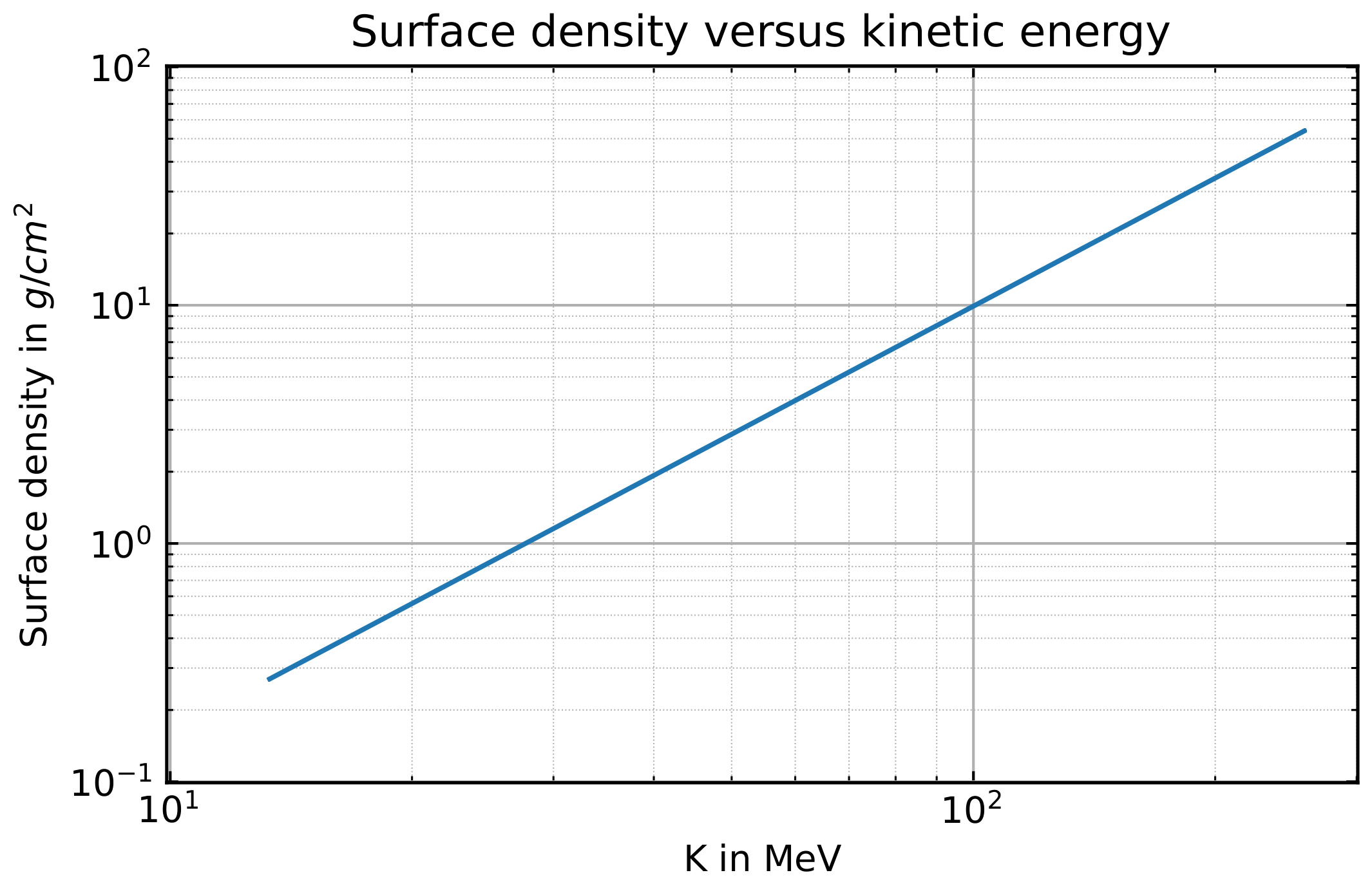
Finally, in Figure 6, we plot as a useful comparison our evaluation (done using [16] fitting formulas) of the surface density of an alluminium protection shield needed to screen from mono-energetic protons of given kinetic energy.
A precise comparison between the performance and possible advantages of the magnetic screen and the standard passive screen would require an analysis of many aspects and degrees of freedom in the realization of the magnetic shield (geometry of the magnet distribution, granularity of the magnetic structure, dimensions and location of the structure, etc.). This is beyond the scope of this paper, but certainly of great importance for the final realization of the device..
Here, we merely give some rough indications. The 1/100 Tesla field, which would protect against protons of energies up to a few MeV and a few tens of MeV in the cases of the upper and lower panels of Figure 5, respectively, can be produced, for example, within a 1 m-size cubic distribution of neodymium magnets equivalent to a volume density of 50 kg/m3 — corresponding indeed to a 50 kg weight for the screen.
Consider the different types of protection given by magnets and aluminum: 1) a perfect screen with magnets below the energy threshold against partial protection in the aluminum case; 2) compare areal protection in the 2 cases, keeping also into account that magnet protection surpasses the physical dimensions of the cubic distribution (due to external lines of fields).
5. Conclusions
This work presents a preliminary assessment of a magnetic shielding strategy for space radiation protection, based on the active deflection of charged particles via permanent neodymium magnets. Motivated by the critical need to mitigate exposure to high-energy particles, particularly during Solar Particle Events, and, to a lesser extent, from the persistent flux of Galactic Cosmic Rays, we have analyzed the viability of generating localized magnetic fields capable of altering the trajectories of incident charged particles. All this with the aim of reducing the payload penalty associated with traditional passive shielding. The choice of a kind of active magnetic shield would surely be advantageous in terms of weight respect to complete passive shielding of a crewed spacecraft whose surface area cannot be smaller than 100 m2 or so.
The simplified model here presented considers the magnetic field generated by cylindrical permanent magnets to give an initial estimate of the deflection capability for mono-energetic, collimated particle beams. These approximations, while neglecting complex particle dynamics and magnetogeometrical interactions, offer insight into the scale of field intensities and volumes required for effective deviation. The analysis indicates that magnetic fields of the order of T can produce significant deflection angles for low-energy protons (e.g., 1 MeV) within practical distances, suggesting that directional shielding of sensitive spacecraft regions is feasible under realistic constraints.
It is important to note that the magnetic field strength inside the spacecraft would be low enough to be harmless to the crew and not interfere with internal electronic devices (with the possible exception of magnetic compasses or sensors).
The proposed scheme overcomes some of the inherent limitations of superconducting magnet systems, such as cryogenic requirements and mechanical complexity, by exploiting the intrinsic field stability and structural simplicity of permanent magnets. However, this comes at the cost of reduced field tunability and potentially limited shielding volume.
Further development will involve detailed numerical simulations of particle-magnet interactions under realistic space radiation spectra, multi-particle species, and angular distributions, as well as the inclusion of spacecraft structural effects and secondary radiation production. Laboratory validation using charged-particle beams and scaled magnet configurations will serve as a precursor to potential CubeSat-level in-orbit demonstrations.
Ultimately, the results support the plausibility of a magnetostatic shielding architecture as a complementary or alternative strategy to conventional passive systems, particularly for targeted protection during transient high-flux events. This approach could represent a scalable and mass-efficient component within an integrated space radiation protection framework for future crewed missions beyond low Earth orbit.
Finally, this concept, while preliminary, represents a potentially scalable element in an integrated hybrid shielding system combining magnetic deviation and light passive materials.
Limitations and Open Issues
We acknowledge that the present first-order assessment rests on several simplifying assumptions that will need to be addressed in subsequent work. First, our analytical model assumes a perfectly collimated, monoenergetic proton beam and a constant magnetic field over a finite volume; realistic SPE spectra, angular distributions, and field inhomogeneities require numerical simulations (e.g., Geant4 or COMSOL) to validate the deflection estimates. Second, the interaction of primary protons with the high-Z materials (Nd, Fe, B) of the permanent magnets may generate secondary neutrons and gamma rays, whose additional dose contribution should be evaluated. Third, long-term exposure to space radiation could partially demagnetize the neodymium magnets, potentially reducing their effectiveness over multi-year missions; experimental studies on demagnetization under simulated space conditions are needed. Fourth, although the expected static magnetic field inside the spacecraft is low ( T) and generally considered safe for crew and most electronics, its electromagnetic compatibility with sensitive on-board instruments (e.g., magnetometers, compasses) requires case-by-case verification. Finally, a full trade-off analysis comparing the mass, volume, and cost of the proposed magnetic shield with optimized passive shielding (e.g., polyethylene or water) is left for a dedicated follow-up study. Addressing these aspects will form the core of our future research, including Monte Carlo simulations, laboratory beam tests, and a potential CubeSat-based in-orbit demonstration.
Author Contributions
Conceptualization, V. Parisi, R. Capuzzo Dolcetta, F. Frezza and L. Lunati; methodology, R. Capuzzo Dolcetta, V. Parisi, F. Frezza and L. Lunati; resources, F. Frezza; data curation, R. Capuzzo Dolcetta and V. Parisi; writing—original draft preparation, R. Capuzzo Dolcetta; writing—review and editing, R. Capuzzo Dolcetta and V. Parisi; project administration, F. Frezza; funding acquisition, F. Frezza and V. Parisi. All authors have read and agreed to the published version of the manuscript.
Funding
This works fruits of the SPACE IT UP (Spoke 9) Italian funding.
Data Availability Statement
No new data were created or analyzed in this study. Data sharing is not applicable to this article.
Acknowledgments
We warmly acknowledge Giuseppe Presta for discussions on the topics of this paper.
Conflicts of Interest
The authors declare no conflicts of interest.
References
- Durante, M.; Cucinotta, F.A. Physical basis of radiation protection in space travel. Rev. Mod. Phys. 2011, 83, 1245. [Google Scholar] [CrossRef]
- Kim, M.H.Y.; Hayat, M.J.; Feiveson, A.H.; Cucinotta, F.A. Prediction of frequency and exposure level of solar particle events. Health Phys. 2009, 97, 68–81. [Google Scholar] [CrossRef] [PubMed]
- Cucinotta, F.; Nikjoo, H.; Goodhead, D. Model for radial dependence of frequency distributions for energy imparted in nanometer volumes from HZE particles. Radiat. Res. 2000, 153, 459–468. [Google Scholar] [CrossRef] [PubMed]
- Narici, L.; Casolino, M.; Di Fino, L.; Larosa, M.; Picozza, P.; Rizzo, A.; Zaconte, V. Performances of Kevlar and Polyethylene as radiation shielding on-board the International Space Station in high latitude radiation environment. Sci. Rep. 2017, 7, 1644. [Google Scholar] [CrossRef] [PubMed]
- Townsend, L. Overview of active methods for shielding spacecraft from energetic space radiation. Phys. Medica 2001, 17, 84–85. [Google Scholar]
- Battiston, R.; Li, T.; Zuccon, P. SpacePart 2006. Nuclear Physics B (Proc. Suppl.), 2007; 166. [Google Scholar]
- Spillantini, P.; Casolino, M.; Durante, M.; Mueller-Mellin, R.; Reitz, G.; Rossi, L.; Shurshakov, V.; Sorbi, M. Shielding from cosmic radiation for interplanetary missions: Active and passive methods. Radiat. Meas. 2007, 42, 14–23. [Google Scholar] [CrossRef]
- Zeitlin, C.; Narici, L.; Rizzo, A.; Semones, E.; Guzman, M.; Stoffle, N.; Hassler, D.; Ehresmann, B.; Wimmer-Schweingruber, R.; Appel, J.; et al. Radiation Shielding in Deep Space: Insights from MSL-RAD. Life Sci. Space Res. 2021, 30, 20–29. [Google Scholar] [CrossRef]
- Battiston, R.; Burger, W.J.; Calvelli, V.; Musenich, R.; Choutko, V.; Datskov, V.I.; Della Torre, A.; Venditti, F.; Gargiulo, C.; Laurenti, G.; et al. Active Radiation Shield for Space Exploration Missions (ARSSEM). arXiv E-Prints 2012, arXiv:physics.spacep, arXiv:1209.1907. [Google Scholar] [CrossRef]
- Parisi, V.; Capuzzo-Dolcetta, R.; Frezza, F.; Lunati, L. New Solutions to an Old Problem: How to Magnetically Protect Astronauts from Cosmic Radiation. 2024. [Google Scholar] [CrossRef]
- Coey, J.M.D. Permanent magnet applications. J. Magn. Magn. Mater. 2002, 248, 441–456. [Google Scholar] [CrossRef]
- Coey, J.M.D. Perspective and Prospects for Rare Earth Permanent Magnets. Engineering 2020, 6, 119–131. [Google Scholar] [CrossRef]
- Heim, J., II; Vander Wal, R. NdFeB Permanent Magnet Uses, Projected Growth Rates and Nd Plus Dy Demands across End-Use Sectors through 2050: A Review. Minerals 2023, 13, 1274. [Google Scholar] [CrossRef]
- Maltseva, V.E.; Andreev, S.V.; Neznakhin, D.S.; et al. The Magnetic Properties of a NdFeB Permanent Magnets Prepared by Selective Laser Sintering. Phys. Met. Metallogr. 2022, 123, 740–745. [Google Scholar] [CrossRef]
- Miteva, R.; Samwel, S.W.; Dechev, M. Energy Dependence of Solar Energetic Protons and Their Origin in Solar Cycles 23 and 24. Atmosphere 2024, 15. [Google Scholar] [CrossRef]
- Nakache, F.R.; Krumbein, A.D.; Celnik, J.; Certaine, J. Minimum Weight Shield Synthesis for Space Vehicles. Technical Report NAS 8-5277, 1964. [Google Scholar]
Figure 1.
Simple schematization of the cosmic bombardment onto a space probe (from [10]).
Figure 1.
Simple schematization of the cosmic bombardment onto a space probe (from [10]).
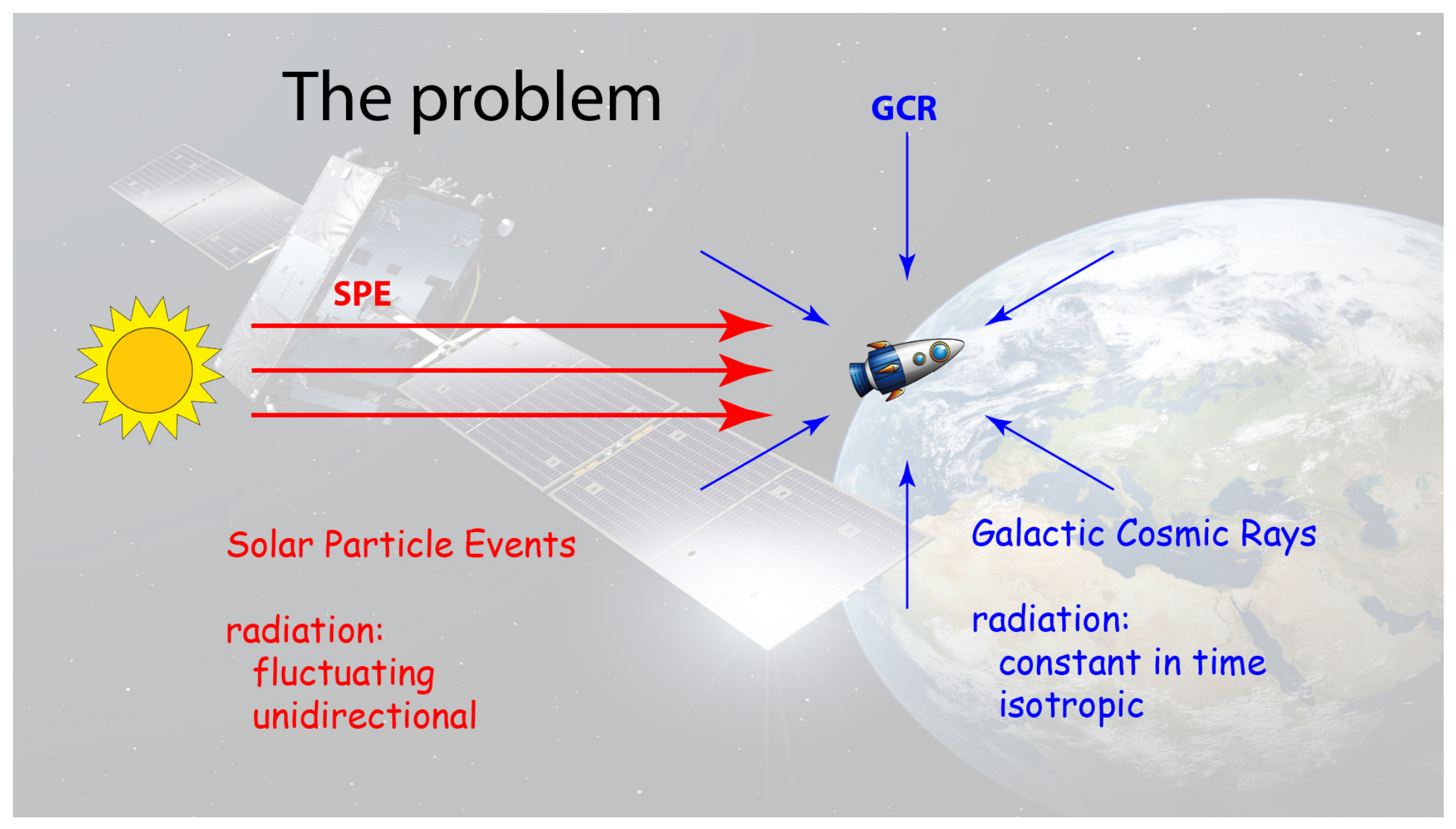
Figure 2.
Panel a): single magnetic cylinder; panel b): field lines of the single magnet; panel c): the magnetic field generated by the cylindrical permanent magnet (in grey) is almost constant in the (yellow) parallelepiped and approximately zero outward; panel d): battery of 4 cylindrical permanent magnets producing an almost constant magnetic field in the yellow volume and approximately zero outward.
Figure 2.
Panel a): single magnetic cylinder; panel b): field lines of the single magnet; panel c): the magnetic field generated by the cylindrical permanent magnet (in grey) is almost constant in the (yellow) parallelepiped and approximately zero outward; panel d): battery of 4 cylindrical permanent magnets producing an almost constant magnetic field in the yellow volume and approximately zero outward.
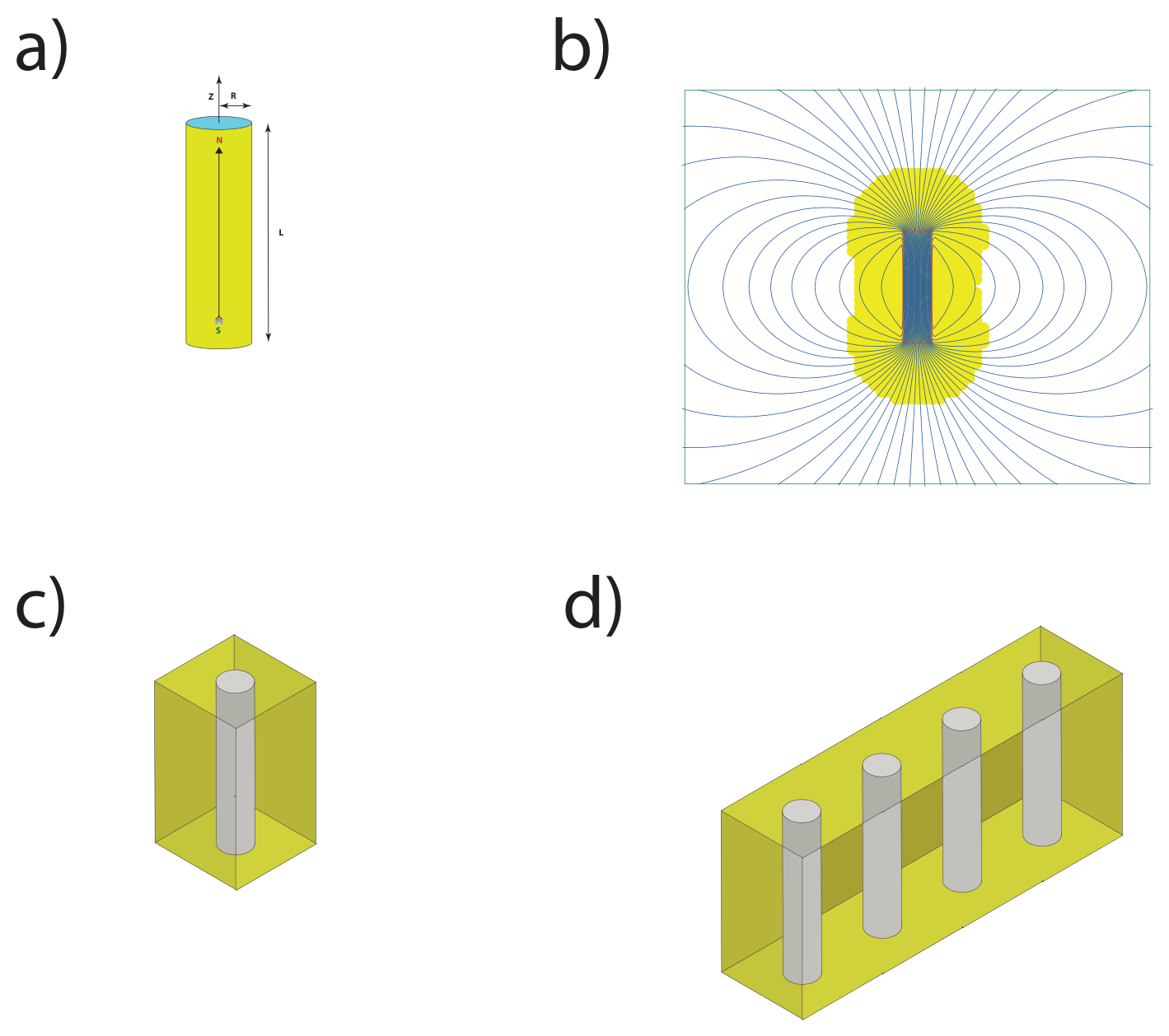
Figure 3.
Deflection schemes. From partial to total protection of the target by a magnetic shield placed at distance d.
Figure 3.
Deflection schemes. From partial to total protection of the target by a magnetic shield placed at distance d.
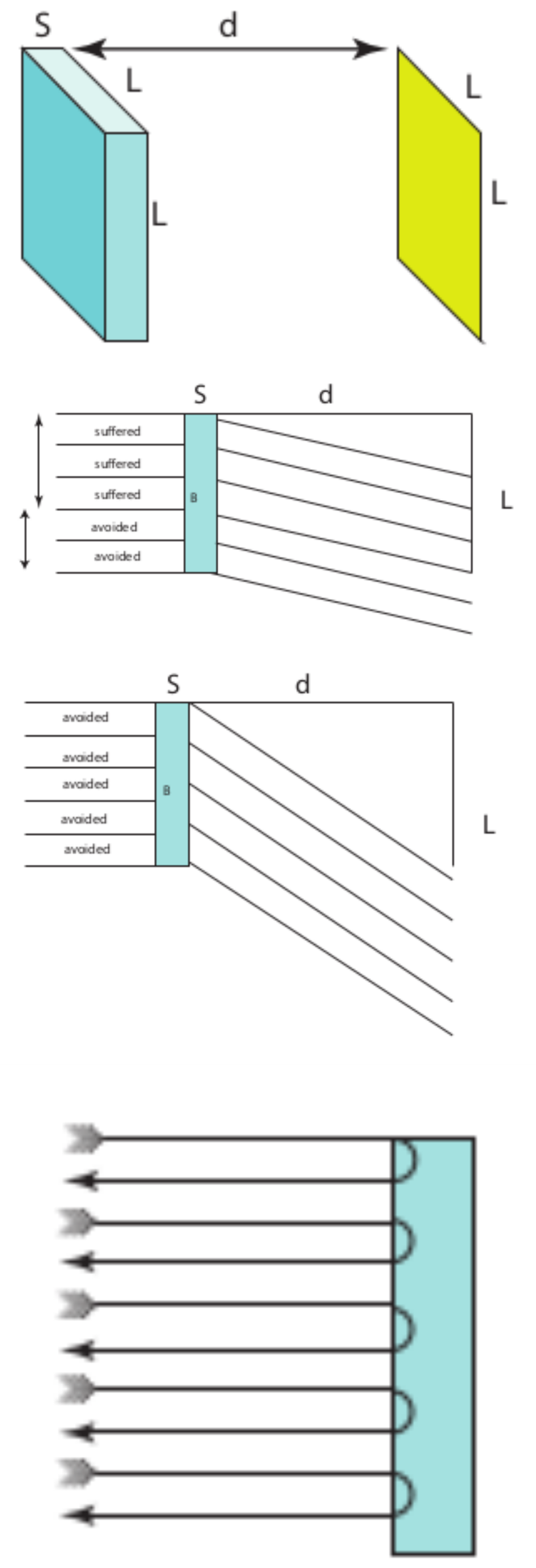
Figure 4.
Protection effectiveness as function of the energy of incoming protons for T, and two cases for the set of values .
Figure 4.
Protection effectiveness as function of the energy of incoming protons for T, and two cases for the set of values .
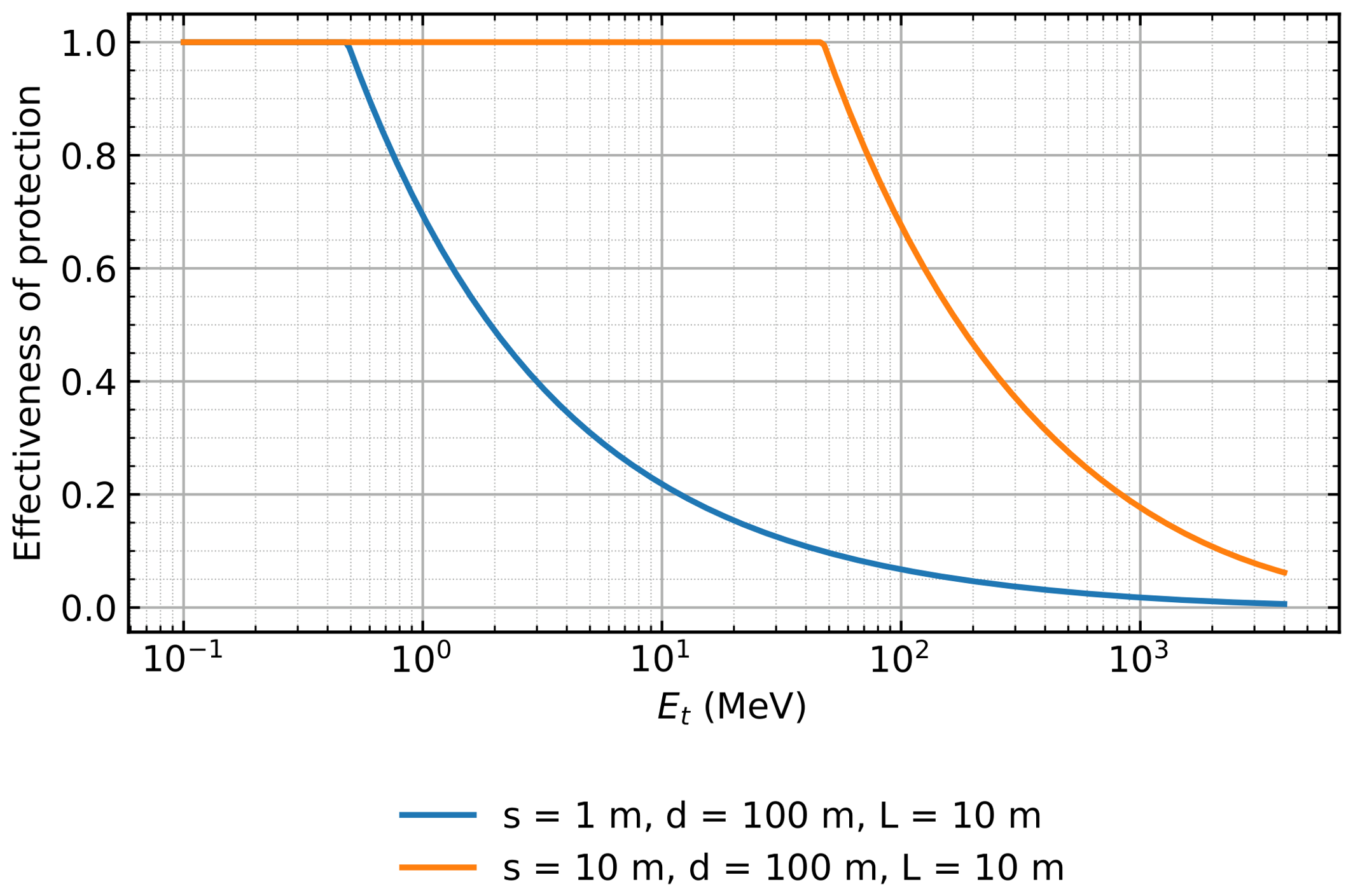
Figure 5.
Cutting (threshold) energy as function of B for two cases.
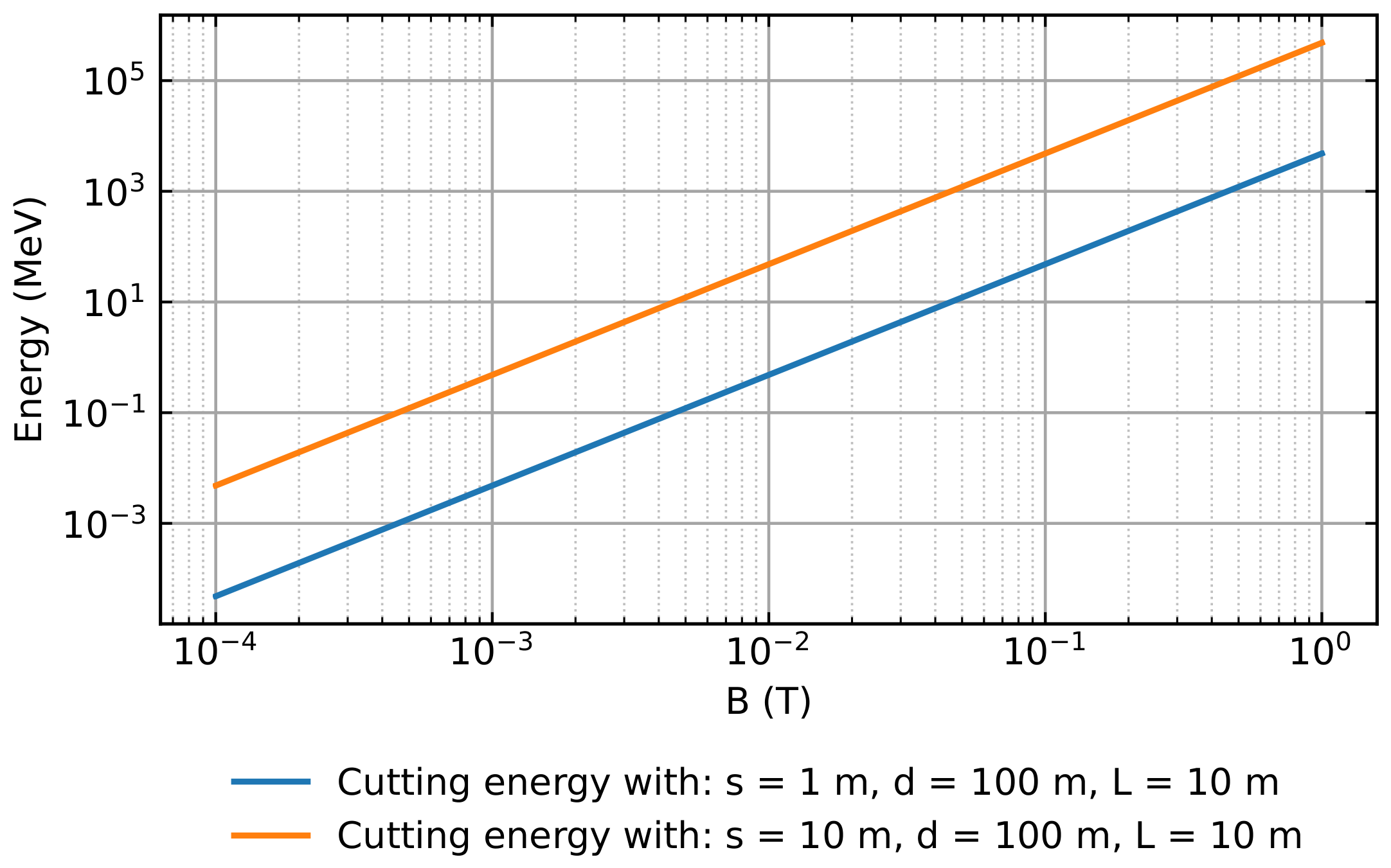
Figure 6.
Surface density (g cm−2) of an alluminium shield to screen from mono-energetic protons of kinetic energy K.
Figure 6.
Surface density (g cm−2) of an alluminium shield to screen from mono-energetic protons of kinetic energy K.
Disclaimer/Publisher’s Note: The statements, opinions and data contained in all publications are solely those of the individual author(s) and contributor(s) and not of MDPI and/or the editor(s). MDPI and/or the editor(s) disclaim responsibility for any injury to people or property resulting from any ideas, methods, instructions or products referred to in the content. |
© 2026 by the authors. Licensee MDPI, Basel, Switzerland. This article is an open access article distributed under the terms and conditions of the Creative Commons Attribution (CC BY) license (http://creativecommons.org/licenses/by/4.0/).
Copyright: This open access article is published under a Creative Commons CC BY 4.0 license, which permit the free download, distribution, and reuse, provided that the author and preprint are cited in any reuse.


