

Submitted:
21 May 2026
Posted:
25 May 2026
You are already at the latest version
Abstract
Autonomous Underwater Vehicles (AUVs) have emerged as an effective solution for data collection in Underwater Wireless Sensor Networks (UWSNs), addressing fundamental limitations of acoustic communication such as limited bandwidth, long propagation delays, and high error rates. By moving close to each sensor node for direct data retrieval, AUVs improve energy balance, extend network lifetime, and enhance coverage flexibility. However, AUV-assisted data collection introduces complex challenges, including trajectory optimization under energy, latency, and coverage constraints, as well as robustness to dynamic ocean environments, intermittent connectivity, and large-scale multi-AUV coordination. This survey presents a systematic review of 56 representative AUV-assisted data gathering protocols (2011–2025) and introduces a unified six-class taxonomy that consolidates fragmented classifications in the literature. Following a structured screening of more than 200 peer-reviewed records, these 56 protocols were selected for detailed taxonomy-based analysis. The proposed taxonomy spans classical trajectory optimization, clustering-based organization, learning-based single-AUV methods, multi-AUV coordination, hybrid communication and quality-aware strategies, and energy and lifetime management. In addition, we provide a comparative analysis across key performance dimensions, including energy efficiency, network lifetime, latency, Age of Information (AoI), delivery reliability, and scalability, highlighting fundamental trade-offs among these metrics. Our analysis reveals a clear shift toward learning-based and AoI-driven approaches, while identifying critical gaps in real-world validation, scalability of multi-AUV systems, and security-aware cross-layer design. Finally, we outline open research challenges and future directions to guide the development of robust, scalable, and deployable AUV-assisted data collection systems for next-generation ocean monitoring applications.
Keywords:
underwater wireless sensor networks
; autonomous underwater vehicle-assisted data collection
; mobile sink
; trajectory optimization
; learning
; multi-AUV coordination
; age of information
1. Introduction
The world’s oceans, covering over 70% of Earth’s surface, play an indispensable role in regulating global climate, sustaining biodiversity, and supporting economic activities ranging from fisheries to offshore energy production. As climate change accelerates and human activities in marine environments intensify, the demand for continuous, large-scale ocean observation has grown exponentially [1,2]. Applications such as environmental monitoring, tsunami early warning, underwater infrastructure inspection, marine biology research, and pollution tracking require persistent data collection from vast oceanic regions. UWSNs have emerged as a transformative technology enabling autonomous, long-term monitoring of these challenging marine environments [3,4].
A typical UWSN comprises sensor nodes deployed at different depths to monitor underwater environments. Unlike terrestrial networks, UWSNs operate under severe physical constraints that fundamentally alter network design [5]. Radio frequency signals attenuate rapidly in seawater, making acoustic communication the primary transmission medium. However, acoustic signals propagate at approximately 1500 m/s—nearly 200,000 times slower than electromagnetic waves—resulting in high latency and unreliable links, particularly for time-sensitive applications [6].
Beyond slow propagation, underwater acoustic channels suffer from limited bandwidth and severe impairments such as multipath propagation and Doppler effects, leading to high bit error rates and unreliable links [6]. Frequent packet losses and retransmissions significantly increase energy consumption, which is particularly critical in UWSNs due to the difficulty and high cost of battery replacement [7]. Since conventional energy harvesting methods, such as solar power, are ineffective in deep-water environments, sensor nodes must operate for long durations on finite energy reserves, making energy efficiency a primary design objective [8].
Traditional multi-hop data collection schemes, proven effective in terrestrial sensor networks, become fundamentally problematic in underwater environments [9]. In multi-hop architectures, sensor nodes relay data packets through intermediate nodes toward a static sink, with each node forwarding not only its own data but also traffic from downstream neighbors. This creates severe energy imbalances across the network. Nodes positioned near the sink bear disproportionate relay burdens, depleting their batteries rapidly despite distant nodes retaining substantial residual energy. This phenomenon, known as the energy hole problem, causes premature network partitioning where the sink becomes isolated from functional nodes, rendering collected data inaccessible even though the majority of the network remains operational [10,11]. The slow acoustic propagation speed compounds this issue by accumulating delays across multiple hops, often rendering time-sensitive data obsolete before reaching the sink.
To overcome these fundamental limitations, researchers have increasingly adopted AUVs as mobile data collectors in UWSNs [12,13]. In AUV-assisted architectures, one or more vehicles navigate through the deployment region, establishing direct single-hop communication with sensor nodes to retrieve buffered data. This paradigm shift offers transformative advantages over static multi-hop schemes. By moving close to each sensor, AUVs eliminate the need for multi-hop relaying, distributing energy consumption evenly across all nodes and preventing energy hole formation [14]. Direct communication eliminates cumulative relay delays; however, overall latency becomes dependent on AUV revisit intervals and mission scheduling, introducing a trade-off between energy efficiency and timeliness [15]. Furthermore, AUVs can be recharged at surface stations or docking facilities, enabling sustainable operation without node replacement. Their mobility provides flexible coverage, allowing dynamic trajectory adjustments to reach isolated nodes, adapt to environmental changes, or prioritize critical monitoring regions based on real-time requirements [16].
Despite these advantages, AUV-assisted data gathering poses significant challenges. Efficient trajectory design must balance conflicting objectives such as minimizing travel distance and energy consumption while reducing latency and ensuring full data coverage [17,18]. This problem is commonly formulated as an NP-hard Traveling Salesperson Problem (TSP) variant, becoming increasingly intractable as network size grows. Additional complications arise from dynamic ocean currents, unreliable acoustic links, physical obstacles, and node mobility, while large-scale deployments with multiple AUVs further require effective coordination, collision avoidance, and communication under severe bandwidth and latency constraints [19].
Over the past fifteen years, the research community has developed a diverse array of AUV-assisted data gathering protocols addressing these challenges. Early works from 2011 to 2020 focused predominantly on heuristic-based optimization techniques, including clustering strategies to reduce communication overhead, trajectory planning algorithms based on TSP variants and geometric optimization, distributed architectures for scalable operation, and hybrid communication schemes combining acoustic with alternative modalities such as magnetic induction or optical links. More recent studies from 2021 to 2025 have witnessed a paradigm shift toward learning-based intelligence, employing deep reinforcement learning (DRL) for adaptive single-AUV trajectory planning under uncertain environments [19,20], multi-agent reinforcement learning (MARL) for coordinated swarm behavior in multi-AUV systems [21,22], and optimization frameworks targeting Age of Information (AoI) to ensure data freshness for time-critical applications [23].
This survey presents a comprehensive analysis of AUV-assisted data gathering techniques for UWSNs. We examine 56 representative protocols published between 2011 and 2025, covering the evolution from heuristic optimization to recent learning-driven approaches. The contributions of this survey are fourfold: (1) we propose a consolidated taxonomy that categorizes existing techniques into six major classes based on core methodology and optimization objective; (2) we provide a unified comparative evaluation of representative protocols, offering quantitative insights into energy efficiency, latency, network lifetime, and scalability; (3) we present a trade-off analysis highlighting tensions between performance, computational cost, and scalability; and (4) we identify key open challenges, including limited real-world validation, scalability constraints in multi-AUV deployments, and the lack of integrated security and cross-layer optimization.
The remainder of this paper is organized as follows. Section 2 introduces UWSN fundamentals and data collection paradigms. Section 3 presents the proposed taxonomy and evolutionary trends. Section 4 reviews representative protocols with critical synthesis. Section 5 reports comparative evaluation results and application-oriented guidelines. Section 6 discusses open challenges and future research directions, and Section 7 concludes the paper.
2. Fundamentals and Challenges
This section establishes the foundational concepts required to understand AUV-assisted data gathering in UWSNs. We summarize UWSN architecture and underwater acoustic communication characteristics, compare traditional multi-hop data collection with AUV-assisted paradigms, and define key performance metrics used throughout this survey.
2.1. UWSN Architecture and Acoustic Communication
A typical UWSN consists of battery-powered sensor nodes deployed at various depths to monitor parameters such as temperature, pressure, salinity, dissolved oxygen, pH, turbidity, and other water-quality indicators. Because underwater nodes are difficult and costly to retrieve for battery replacement, energy efficiency is a primary design constraint. Radio frequency communication is generally impractical in seawater, and most UWSNs rely on underwater acoustic links for networking and data delivery [24,25]. Acoustic channels exhibit slow propagation (≈1500 m/s), limited and range-dependent bandwidth, and strong sensitivity to environmental factors. Practical deployments also face multipath and Doppler effects, time-varying ambient noise (e.g., shipping and wind), and frequency-dependent attenuation, which collectively reduce link reliability and increase retransmissions and energy cost [24,25,26]. These constraints motivate protocols that explicitly account for delay, errors, and energy consumption when designing routing and scheduling mechanisms [27].
2.2. Multi-Hop Versus AUV-Assisted Data Collection
Traditional multi-hop data collection forwards sensed data toward a static sink through relay nodes. While simple, this approach often creates severe energy imbalance: nodes near the sink forward disproportionate traffic and deplete their batteries faster, leading to the well-known energy-hole problem and premature network partitioning, especially in large-scale deployments [28]. Moreover, multi-hop routing in acoustic networks can accumulate substantial end-to-end delay due to slow propagation and retransmissions, limiting suitability for time-sensitive monitoring tasks [27].
AUV-assisted data collection restructures this paradigm by introducing mobile collectors that establish direct (single-hop) communication with sensor nodes. Sensors buffer data locally and transmit when the AUV comes within communication range, while the AUV later offloads data (and can be recharged) at a surface station or docking point. This approach can reduce relay burden on hotspot nodes, improve energy balance, and increase robustness to sparse connectivity [25]. AUV trajectory design, however, becomes a critical part of the system because it directly affects coverage, latency, data freshness, and mission energy cost. Tour-planning and path-planning schemes have been widely studied to optimize these trade-offs [28,29]. Table 1 summarizes key differences between the two paradigms.
2.3. Key Performance Metrics
To enable consistent comparison of AUV-assisted data gathering protocols, this survey uses widely reported metrics:
- Network Lifetime: time to first node failure, time to k% node failure, or time to partition or connectivity loss; definitions vary and should be stated explicitly [28].
- Age of Information (AoI): freshness metric capturing how “old” the latest received update is; trajectory and scheduling directly control AoI behavior [30].
- Data Delivery Ratio: fraction of generated data successfully collected and delivered, impacted by losses, buffer overflow, incomplete coverage, and link outages [30].
3. Taxonomy and Protocol Classification
This section presents a consolidated taxonomy of AUV-assisted data gathering protocols, traces the field’s evolution, and describes our systematic selection methodology.
3.1. Evolution of AUV-Assisted Data Gathering (2011–2025)
Research on AUV-assisted data gathering has progressed through three broad phases. Early studies (2011–2015) mainly adapted classical optimization and routing ideas, formulating AUV tour planning as TSP and VRP-style problems and using deterministic heuristics for visiting and collecting data from sensors [32]. The next phase (2016–2019) expanded toward more practical designs, including clustering-based organization, model/prediction-assisted planning, and initial multi-AUV concepts to improve coverage and reduce collection delay under acoustic constraints [27,33]. Since 2020, the field has shifted toward adaptability and freshness-aware collection, with increasing use of deep reinforcement learning for single-AUV decision-making [19,34], multi-agent learning and coordination mechanisms for multi-AUV systems [21,22], and explicit optimization of data freshness (e.g., Age of Information) [23]. Figure 1 summarizes these trends and highlights the growing emphasis on learning-based and freshness-driven designs in recent work.
3.2. Consolidated Taxonomy
Previous surveys often rely on fragmented taxonomies, where several categories contain only a small number of protocols, making cross-paper comparison difficult and obscuring research gaps [35,36]. The six categories were selected to balance methodological distinction and analytical clarity, ensuring that each class represents a fundamentally different optimization objective while avoiding the excessive fragmentation observed in prior surveys. To enable clearer comparison and more systematic synthesis, we consolidate AUV-assisted data gathering protocols into six major categories based on their core design principles and primary optimization objectives. Figure 2 illustrates the resulting taxonomy structure, while Table 2 summarizes defining characteristics (adaptability, scalability, and computational cost) and lists representative references for each category.
The six category counts (12 + 8 + 14 + 9 + 7 + 6) sum to the 56 protocols analyzed in this survey. Representative protocols from each category are discussed in detail in Section 4; the remaining works are grouped within their respective categories and contribute to the aggregate counts and comparative trends reported here.
3.3. Selection Methodology and Comparison
We conducted a systematic literature review spanning 2011–2025 to identify representative research on AUV-assisted data gathering in UWSNs. Candidate studies were collected through keyword-based searches combining terms such as “AUV data gathering/data collection,” “underwater sensor networks,” “mobile sink,” “trajectory optimization,” and “reinforcement learning / deep reinforcement learning.”
Inclusion criteria were: (i) the primary contribution targets AUV-based data collection (single- or multi-AUV), (ii) the work proposes a clearly defined protocol/algorithm (e.g., trajectory planning, clustering, learning-based collection, coordination, hybrid communication, or energy/lifetime optimization), (iii) the study is peer-reviewed, and (iv) sufficient technical detail and performance evaluation are provided (simulation, experimental, analytical, or a combination).
Exclusion criteria were: (i) studies focused purely on localization/navigation without a data-gathering contribution, (ii) conceptual/vision papers without algorithmic details, (iii) duplicates or extended versions (where only the most complete version was retained), and (iv) non-English publications.
We first screened titles and abstracts, followed by full-text screening for eligibility and relevance. This process reduced an initial pool of over 200 records to 80 papers after preliminary screening, and finally to 56 protocols included for detailed taxonomy-based analysis in the remainder of this survey. Table 3 compares this survey with existing related surveys across key dimensions.
Compared with prior surveys, this work (i) expands coverage through 2025, (ii) focuses specifically on AUV-assisted data gathering rather than general UWSN routing/localization, and (iii) adopts a consolidated taxonomy to support clearer comparison and highlight the growing role of learning-based methods.
4. Protocol Survey and Analysis
This section provides a comprehensive analysis of 56 AUV-assisted data gathering protocols spanning 2011 to 2025, organized into six major categories based on their primary optimization objectives and methodological approaches.
4.1. Classical Trajectory Optimization Approaches
Classical trajectory optimization methods (mainly 2011–2020) plan AUV routes to minimize travel distance, time, or energy while visiting all sensors. Most cast planning as TSP/TSPN/VRP (Vehicle Routing Problem)-style problems and solve them using heuristics or approximation algorithms.
Hollinger et al. formulated communication-constrained collection and used TSP-with-neighborhoods approximations to scale beyond small optimal solutions, validated experimentally but sensitive to channel variation and drift [32]. Chang and Shih added docking-aware tour planning with 3D partitioning and representative points to extend mission range, though it assumes fixed docking locations and offers limited adaptability [31]. Han et al. reduced energy hotspots by periodically shifting the AUV path and adapting speed based on density, improving lifetime with added overhead [15]. Farooq et al. proposed an atomic-shaped trajectory design to reduce end-to-end delay and improve data delivery ratio in underwater sensor networks, at the cost of higher AUV energy consumption and reduced effectiveness in irregularly shaped topologies [37]. VoI-aware planning prioritizes high-value sensing rather than distance, improving mission utility but requiring reliable VoI estimates [18]. Joint trajectory–power–schedule optimization reduces total energy but increases computation [12]. Current-aware replanning improves robustness under ocean dynamics yet depends on current prediction accuracy [19]. Heterogeneous multi-AUV planning balances workload and reduces makespan, but real-time replanning remains difficult [29].
4.2. Cluster-Based Organization
Cluster-based organization strategies reduce communication overhead and balance energy use by structuring the network (e.g., clustering, hierarchy, partitioning) so that only selected nodes communicate with the AUV and local traffic stays short-range.
Motahari Nasab et al. used dynamic clustering where nodes join clusters and a cluster head (CH) is elected based on residual energy and proximity to the AUV route; only CHs upload to the AUV, which lowers overall energy but can overload CHs along frequently visited paths [14]. Khan and Cho proposed a distributed hierarchical scheme with LEACH-style role rotation to improve scalability, though it is tied to a largely fixed AUV tour pattern [38]. Huang et al. combined clustering with matrix completion so that when full collection is infeasible, missing readings can be reconstructed from spatiotemporal correlations—improving mission speed while preserving utility, but relying on correlation stability and added computation [16].
Some works in this family extend clustering strategies to enhance network lifetime and robustness beyond basic energy reduction. For instance, Shi et al. propose an energy-aware clustering routing protocol where cluster heads are selected based on residual energy and connectivity metrics, and AUVs collect aggregated data from CHs to balance energy use and prolong network lifetime; while effective, CH selection overhead and mobility coordination remain challenges in dynamic underwater environments [39]. Chen et al. introduce a hybrid clustering and learning framework that combines fuzzy clustering with optimization algorithms to adaptively form clusters and refine AUV trajectories, enhancing both energy efficiency and data collection timeliness, though at the cost of increased computational complexity for cluster refinement [40]. Xia et al. apply affinity propagation clustering to partition sensor nodes and determine representative CHs for subsequent AUV tours, significantly reducing path length and balancing energy consumption across clusters, with robustness contingent on stable cluster distributions under mobility and environmental uncertainty [41]. For very large deployments, hierarchical clustering schemes that organize nodes into multi-level regional clusters can improve scalability by reducing intra-cluster communication and simplifying planning complexity, though they introduce additional management overhead and require careful tuning of cluster scales and thresholds for varying network densities [42].
4.3. Single-AUV Learning-Based Methods
Learning-based approaches—mainly deep reinforcement learning (DRL)—enable a single AUV to adapt its trajectory and collection decisions under uncertainty (e.g., currents, time-varying link quality, and changing priorities). Recent studies explicitly incorporate ocean-current effects into the state/reward design to outperform static routing in dynamic environments [19]. Other works optimize data utility by prioritizing sensors using Value of Information (VoI) and continuous-control DRL (e.g., DDPG) to generate 3D waypoints and energy-aware visitation schedules [20]. Environment- and energy-aware designs further integrate learning with context such as channel variability or terrain constraints to improve delivery ratio and energy efficiency [19]. Overall, single-AUV DRL methods offer strong adaptability, but often face high training cost, limited scalability as node count grows, and sensitivity to modeling/estimation errors when deployed outside training conditions. This highlights that learning-based approaches improve adaptability but introduce scalability and generalization challenges [19,20].
4.4. Multi-AUV Coordination
Multi-AUV coordination improves scalability by parallelizing coverage and sharing workload, increasingly via MARL. Jiang et al. proposed an AoI-aware MAPPO framework for coordinated search and multiround collection, reducing redundancy and improving freshness but with notable training/coordination overhead as fleet size grows [21]. Wang et al. introduced a hierarchical local–global DQN design where local policies react quickly while a global coordinator periodically resolves conflicts and reallocates tasks, reducing communication while improving deadline/value satisfaction, but relying on periodic synchronization and accurate workload estimation [22]. Beyond pure swarms, Li et al. proposed a multi-AUV collaborative data collection scheme integrating clustering and routing for heterogeneous UWSNs, improving coverage efficiency and load balancing across diverse node types, though coordination complexity increases with fleet size [43]. Thus, while multi-AUV systems improve coverage and reduce latency, their benefits are constrained by coordination overhead and communication limitations. Overall, multi-AUV methods boost freshness and robustness, yet remain constrained by acoustic bandwidth and coordination overhead at larger swarm sizes [21,22].
4.5. Hybrid Communication and Quality Enhancements
Hybrid communication and quality-aware approaches enhance AUV-assisted data gathering by improving transmission reliability and prioritizing high-utility information. Hybrid communication techniques integrate complementary underwater modalities—such as long-range acoustics and short-range optical or magnetic induction (MI) links—to mitigate the severe bandwidth limitations and high attenuation of acoustic channels [25,26]. Multimodal underwater networking frameworks demonstrate that combining acoustic control signaling with high-rate optical data transfer can significantly improve throughput and reliability when environmental conditions permit [26]. Similarly, cross-layer AUV-aided data gathering protocols exploit adaptive communication strategies to enhance delivery performance under dynamic underwater conditions [30]. While such hybrid schemes improve efficiency and robustness, their effectiveness depends on channel visibility, alignment constraints, and additional hardware complexity.
Beyond physical-layer adaptation, quality-aware collection strategies shift the objective from maximizing data volume to maximizing information utility. Value-of-Information (VoI)-driven AUV path planning explicitly prioritizes data that is time-sensitive or mission-critical, seeking routes that maximize cumulative information value rather than minimizing distance alone [34]. These approaches improve freshness and mission relevance, particularly in event-driven monitoring scenarios, but require accurate value estimation and introduce additional computational overhead. Collectively, hybrid communication and quality-driven strategies reframe AUV-assisted data collection as a reliability- and utility-optimized process rather than purely an energy-minimization task, aligning transmission adaptation with information value under dynamic underwater environments.
4.6. Energy and Lifetime Management
Energy- and lifetime-oriented protocols aim to prolong network operation and prevent topology failures such as premature partitioning. Acarer proposes an energy-aware AUV path planning strategy that optimizes collection routes to reduce energy consumption and improve network safety in UWSNs, though the approach relies on accurate network state information and may face scalability challenges in larger deployments [17]. Wu et al. present an optimal AUV scheduling strategy based on node importance and Age of Information, balancing collection efficiency and data freshness in large-scale deployments, though it focuses primarily on scheduling rather than topology robustness [44]. Overall, these approaches show that proactive energy management and intelligent scheduling can substantially extend network lifetime and improve robustness, while practical performance depends on reliable state estimation and manageable coordination cost [17,44].
5. Comparative Analysis and Future Directions
This section synthesizes the surveyed AUV-assisted data gathering protocols through a comparative perspective, focusing on how major design choices influence performance across energy consumption, network lifetime, latency and data freshness, delivery reliability, and scalability. We then discuss the key trade-offs that repeatedly emerge in the literature, contrast classical optimization with learning-based decision-making, provide practical guidance for selecting suitable approaches under different application requirements, and conclude with open challenges that limit real-world deployability.
5.1. Performance Comparison Across Protocol Families
The reviewed studies report improvements along four recurring dimensions. First, energy efficiency and network lifetime are most strongly impacted by whether sensor nodes rely on multi-hop forwarding or communicate directly with a mobile collector, and by whether clustering and duty-cycling mechanisms are used to reduce transmissions [45]. Second, latency and freshness depend primarily on revisit frequency and trajectory structure; protocols that explicitly incorporate deadlines, AoI, or VoI tend to prioritize timely updates at the expense of longer travel and higher propulsion energy [23]. Third, data delivery reliability is shaped by the robustness of communication decisions (e.g., link-quality awareness, multimodal fallback, retransmission control) and by how buffering and congestion are handled [45]. Finally, scalability is governed by the computational cost of planning and by coordination overhead in multi-AUV deployments [21]. Overall, classical trajectory and clustering schemes provide stable and reliable performance under predictable conditions, whereas learning-based methods improve adaptability in dynamic environments but may face training and scalability constraints. Multi-AUV coordination reduces mission time and enhances coverage for large areas, yet its benefits can be limited by acoustic contention and coordination complexity. Computational complexity and planning overhead emerge as critical differentiators between classical and learning-based families, especially when deployment scales increase.
5.2. Trade-Offs and Design Tensions
Across protocol categories, several trade-offs appear consistently. The first is the energy–freshness trade-off: minimizing latency or AoI generally requires more frequent visits, higher speeds, or tighter scheduling, all of which increase propulsion energy and reduce mission endurance [23]. A second recurring tension is coverage versus efficiency. Ensuring complete coverage, especially in sparse deployments or in the presence of obstacles and dead zones, can impose long detours that delay high-priority collections and increase energy cost [29]. A third trade-off is optimality versus computational complexity. As the number of nodes grows, exact routing formulations become impractical and even sophisticated heuristics can become expensive, motivating hierarchical decomposition, clustering, or approximate planning. For multi-AUV systems, the dominant tension becomes scalability versus coordination overhead. Adding vehicles reduces travel time, but increases the need for collision avoidance, workload balancing, and communication—often under severe bandwidth and latency limitations—so the marginal benefit can diminish without careful coordination design. Table 4 summarizes these recurring trade-offs along with the most affected protocol categories and suggested mitigation strategies [21].
5.3. Classical Optimization Versus Learning-Based Intelligence
Classical approaches—including TSP/VRP variants, greedy and metaheuristic planning, and cluster-based organization—remain attractive due to their interpretability, modest computational requirements, and predictable behavior. They are particularly effective when environmental conditions are stable or can be modeled reliably, and when planning must be performed onboard with limited compute. However, these methods can degrade when assumptions break down (e.g., strong currents, intermittent links, time-varying priorities), since they typically rely on fixed models or limited adaptation [29].
Learning-based approaches, particularly deep reinforcement learning for single-AUV planning and multi-agent reinforcement learning for coordinated fleets, offer a complementary advantage: they can learn policies that adapt to uncertainty and non-stationary conditions. This adaptability is most valuable when currents, channel quality, obstacles, or data priority evolve during the mission. The limitations are also clear across the literature: training is often costly and environment-specific, transferability across deployments can be weak, and scalability is constrained by growing state/action spaces and by the difficulty of maintaining stable learning in multi-agent settings. In practice, learning-based methods are most compelling when paired with domain structure (e.g., graph representations, hierarchical decision layers, or constraint-aware safety modules) rather than used as purely end-to-end planners [19].
5.4. Application-Oriented Selection Guidelines
From an application standpoint, protocol selection should be guided by the dominant operational requirement rather than by aggregate performance claims. For time-critical monitoring, freshness-aware approaches that incorporate AoI or deadline constraints are preferable, and adaptive strategies are beneficial when dynamics are strong [19,23]. For long-term environmental monitoring, energy and lifetime management mechanisms (duty cycling, clustering, balanced collection schedules) are typically more important than aggressive freshness optimization [45]. For large-scale or sparse deployments, hierarchical planning and multi-AUV coordination become necessary to keep mission time feasible, but coordination overhead must be controlled explicitly [43]. For harsh or rapidly changing conditions, environment-aware and adaptive methods are more robust than purely geometric planning, provided that the required sensing or environmental knowledge is available. Finally, for high-value event detection and prioritized monitoring, VoI- or quality-driven schemes are more appropriate than byte-maximizing collection, since the objective is utility (relevance, freshness, and fidelity) rather than raw throughput. Overall, the design of AUV-assisted data collection systems is inherently application-dependent, requiring careful balancing of energy efficiency, data freshness, scalability, and computational complexity.
6. Open Challenges and Research Gaps
Despite substantial progress, several barriers continue to limit the transition from algorithmic demonstrations to operational systems. A first gap is the limited extent of real-world validation: many results remain simulation-centric, and robustness to realistic currents, noise, localization drift, hardware constraints, and unexpected failures is often not fully demonstrated [46]. A second gap concerns multi-AUV scalability. As the fleet grows, acoustic contention, coordination signaling, and safety constraints can offset the benefits of parallelism, motivating scalable coordination architectures and communication-efficient task allocation. A third major gap is the lack of security- and trust-aware designs, even though underwater networks are vulnerable to disruption and manipulation [47,48]. A fourth gap is the shortage of cross-layer optimization, since trajectory planning, communication scheduling, buffering, and application objectives are often treated separately [49]. Additional needs include tighter integration of energy harvesting and sustainable operation, and the development of shared benchmarks, datasets, and testbeds that enable reproducible comparison under common conditions. Addressing these gaps is essential for making AUV-assisted data gathering robust, scalable, and deployable in long-duration ocean monitoring missions. Table 5 summarizes these open challenges alongside current gaps and suggested research directions.
7. Conclusions
AUV-assisted data gathering has become a central paradigm for improving UWSN reliability and lifetime by reducing reliance on static multi-hop acoustic relaying and mitigating the energy-hole problem [28]. By enabling direct (or near-direct) collection from sensor nodes, AUVs can better balance energy consumption and improve connectivity in sparse or harsh deployments. However, these benefits come with new system-level challenges, especially trajectory optimization under multiple constraints (energy, travel time, deadlines/AoI, and coverage), robustness to ocean currents and intermittent links, and the growing complexity of coordination when multiple AUVs are deployed.
This survey reviewed AUV-assisted data gathering research from 2011–2025 and organized representative protocols into a consolidated taxonomy covering: (i) classical trajectory optimization, (ii) cluster-based organization, (iii) learning-based single-AUV planning, (iv) multi-AUV coordination, (v) hybrid communication and quality/VoI-aware collection, and (vi) energy and lifetime management. Across these categories, the main insight is that no single design dominates across all metrics—protocol selection depends on application priorities and the acceptable trade-offs among energy efficiency, latency/AoI, data completeness, scalability, and computational burden [45,50].
Looking forward, the field would benefit most from (1) stronger real-world and long-duration validation beyond simulation, (2) scalable multi-AUV coordination that explicitly accounts for acoustic bandwidth and contention, and (3) more integrated cross-layer designs that jointly consider communication, routing/collection policies, and vehicle motion. In addition, security and resilience considerations remain underexplored despite the vulnerability of underwater networks [47]. Addressing these gaps will be essential to transition AUV-assisted data gathering from promising research prototypes to robust, deployable systems for long-term ocean monitoring and mission-critical operations.
References
- Jouhari, M.; Ibrahimi, K.; Tembine, H.; Ben-Othman, J. Underwater wireless sensor networks: A survey on enabling technologies, localization protocols, and internet of underwater things. IEEE Access 2019, 7, 96879–96899. [Google Scholar] [CrossRef]
- Gola, K.K.; Arya, S. Underwater acoustic sensor networks: Taxonomy on applications, architectures, localization methods, deployment techniques, routing techniques, and threats: A systematic review. Concurr. Comput. Pract. Exp. 2023, 35, e7815. [Google Scholar] [CrossRef]
- Fattah, S.; Gani, A.; Ahmedy, I.; Idris, M.Y.I.; Hashem, I.A.T. A survey on underwater wireless sensor networks: Requirements, taxonomy, recent advances, and open research challenges. Sensors 2020, 20, 5393. [Google Scholar] [CrossRef]
- Taher, R.J.; Mohsen, K.K. Underwater wireless sensor networks. BIO Web Conf. EDP Sci. 2024, 97, 00023. [Google Scholar] [CrossRef]
- Su, X.; Ullah, I.; Liu, X.; Choi, D. A review of underwater localization techniques, algorithms, and challenges. J. Sens. 2020, 2020, 6403161. [Google Scholar] [CrossRef]
- Li, Z.; Chitre, M.; Stojanovic, M. Underwater acoustic communications. Nat. Rev. Electr. Eng. 2025, 2, 83–95. [Google Scholar] [CrossRef]
- Lu, Y.; He, R.; Chen, X.; Lin, B.; Yu, C. Energy-efficient depth-based opportunistic routing with Q-learning for underwater wireless sensor networks. Sensors 2020, 20, 1025. [Google Scholar] [CrossRef]
- Khan, A.; Aurangzeb, K.; Qazi, E.-H.; Rahman, A.U. Energy-aware scalable reliable and void-hole mitigation routing for sparsely deployed underwater acoustic networks. Appl. Sci. 2019, 10, 177. [Google Scholar] [CrossRef]
- Rathore, R.S.; et al. W-GUN: Whale optimization for energy and delay-centric green underwater networks. Sensors 2020, 20, 1377. [Google Scholar] [CrossRef] [PubMed]
- Khan, I.U.; et al. Adaptive hop-by-hop cone vector-based forwarding protocol for underwater wireless sensor networks. Int. J. Distrib. Sens. Netw. 2020, 16, 1550147720958305. [Google Scholar] [CrossRef]
- Chenthil, T.; Jayarin, P.J. An energy-efficient distributed node clustering routing protocol with mobility pattern support for underwater wireless sensor networks. Wirel. Netw. 2022, 28, 3367–3390. [Google Scholar] [CrossRef]
- Khan, M.T.R.; Ahmed, S.H.; Jembre, Y.Z.; Kim, D. An energy-efficient data collection protocol with AUV path planning in the Internet of Underwater Things. J. Netw. Comput. Appl. 2019, 135, 20–31. [Google Scholar] [CrossRef]
- Khan, W.; Hua, W.; Anwar, M.S.; Alharbi, A.; Imran, M.; Khan, J.A. An Effective Data-Collection Scheme with AUV Path Planning in Underwater Wireless Sensor Networks. Wirel. Commun. Mob. Comput. 2022, 2022, 8154573. [Google Scholar] [CrossRef]
- MotahariNasab, R.; Bohlooli, A.; Moghim, N. An Energy-Aware Data-Gathering Protocol Based on Clustering using AUV in Underwater Sensor Networks. Int. J. Comput. Netw. Inf. Secur. 2016, 8, 36. [Google Scholar] [CrossRef]
- Han, G.; Long, X.; Zhu, C.; Guizani, M.; Bi, Y.; Zhang, W. An AUV location prediction-based data collection scheme for underwater wireless sensor networks. IEEE Trans. Veh. Technol. 2019, 68, 6037–6049. [Google Scholar] [CrossRef]
- Huang, M.; Zhang, K.; Zeng, Z.; Wang, T.; Liu, Y. An AUV-assisted data gathering scheme based on clustering and matrix completion for smart ocean. IEEE Internet Things J. 2020, 7, 9904–9918. [Google Scholar] [CrossRef]
- Acarer, T. Energy-Aware path planning by autonomous underwater vehicle in underwater wireless sensor networks for safer maritime transportation. 2024.
- Gjanci, P.; Petrioli, C.; Basagni, S.; Phillips, C.A.; Bölöni, L.; Turgut, D. Path finding for maximum value of information in multi-modal underwater wireless sensor networks. IEEE Trans. Mob. Comput. 2017, 17, 404–418. [Google Scholar] [CrossRef]
- Li, Y.; Huang, H.; Zhuang, Y.; Zhong, Z.; Wang, C.-X.; Wang, X. An AUV-assisted data collection scheme for UWSNs based on reinforcement learning under the influence of ocean current. IEEE Sens. J. 2023, 24, 3960–3972. [Google Scholar] [CrossRef]
- Xu, J.; Zhang, Z.; Wang, Z.; Wang, J.; Ren, Y. VoI and energy-aware AUV-assisted data collection for internet of underwater things. In Proceedings of the 2024 IEEE Wireless Communications and Networking Conference (WCNC), Dubai, United Arab Emirates, 21–24 April 2024; pp. 1–6. [Google Scholar]
- Jiang, B.; Du, J.; Jiang, C.; Han, Z.; Debbah, M. Underwater searching and multiround data collection via AUV swarms: An energy-efficient AoI-aware MAPPO approach. IEEE Internet Things J. 2023, 11, 12768–12782. [Google Scholar] [CrossRef]
- Wang, J.; Liu, S.; Shi, W.; Han, G.; Yan, S. A multi-AUV collaborative ocean data collection method based on LG-DQN and data value. IEEE Internet Things J. 2023, 11, 9086–9106. [Google Scholar] [CrossRef]
- Cao, W.; Chen, K.; Cheng, E. Joint optimization of AoI and energy for AUV-assisted data collection in underwater acoustic sensor networks. Front. Mar. Sci. 2025, 12, 1580751. [Google Scholar] [CrossRef]
- Akyildiz, I.F.; Pompili, D.; Melodia, T. Underwater acoustic sensor networks: Research challenges. Ad Hoc Netw. 2005, 3, 257–279. [Google Scholar] [CrossRef]
- Stojanovic, M.; Preisig, J. Underwater acoustic communication channels: Propagation models and statistical characterization. IEEE Commun. Mag. 2009, 47, 84–89. [Google Scholar] [CrossRef]
- Campagnaro, F.; Francescon, R.; Casari, P.; Diamant, R.; Zorzi, M. Multimodal underwater networks: Recent advances and a look ahead. In Proceedings of the 12th International Conference on Underwater Networks & Systems, Halifax, NS, Canada, 6–8 November 2017; pp. 1–8. [Google Scholar]
- Javaid, N.; et al. Delay-sensitive routing schemes for underwater acoustic sensor networks. Int. J. Distrib. Sens. Netw. 2015, 11, 532676. [Google Scholar] [CrossRef]
- Khan, J.U.; Cho, H.-S. Data-gathering scheme using AUVs in large-scale underwater sensor networks: A multihop approach. Sensors 2016, 16, 1626. [Google Scholar] [CrossRef]
- Cui, Y.; Zhu, P.; Lei, G.; Chen, P.; Yang, G. Energy-efficient multiple autonomous underwater vehicle path planning scheme in underwater sensor networks. Electronics 2023, 12, 3321. [Google Scholar] [CrossRef]
- Alfouzan, F.A.; Ghoreyshi, S.M.; Shahrabi, A.; Ghahroudi, M.S. An AUV-aided cross-layer mobile data gathering protocol for underwater sensor networks. Sensors 2020, 20, 4813. [Google Scholar] [CrossRef]
- Chang, S.-H.; Shih, K.-P. Tour planning for AUV data gathering in underwater wireless sensor networks. In Proceedings of the 2015 18th International Conference on Network-Based Information Systems, Taipei, Taiwan, 2–4 September 2015; pp. 1–8. [Google Scholar]
- Hollinger, G.A.; Mitra, U.; Sukhatme, G.S. Autonomous data collection from underwater sensor networks using acoustic communication. In Proceedings of the 2011 IEEE/RSJ International Conference on Intelligent Robots and Systems, San Francisco, CA, USA, 25–30 September 2011; pp. 3564–3570. [Google Scholar]
- Khan, J.U.; Cho, H.-S. A multihop data-gathering scheme using multiple AUVs in hierarchical underwater sensor networks. In Proceedings of the 2016 International Conference on Information Networking (ICOIN), Kota Kinabalu, Malaysia, 13–15 January 2016; pp. 265–267. [Google Scholar]
- Liu, Z.; Meng, X.; Liu, Y.; Yang, Y.; Wang, Y. AUV-aided hybrid data collection scheme based on value of information for Internet of Underwater Things. IEEE Internet Things J. 2021, 9, 6944–6955. [Google Scholar] [CrossRef]
- Ahmed, M.; Salleh, M.; Channa, M.I. Routing protocols based on protocol operations for underwater wireless sensor network: A survey. Egypt. Inform. J. 2018, 19, 57–62. [Google Scholar] [CrossRef]
- Ghoreyshi, S.M.; Shahrabi, A.; Boutaleb, T. A novel cooperative opportunistic routing scheme for underwater sensor networks. Sensors 2016, 16, 297. [Google Scholar] [CrossRef]
- Farooq, W.; Ali, T.; Shaf, A.; Umar, M.; Yasin, S. Atomic-shaped efficient delay and data gathering routing protocol for underwater wireless sensor networks. Turk. J. Electr. Eng. Comput. Sci. 2019, 27, 3454–3469. [Google Scholar] [CrossRef]
- Khan, J.U.; Cho, H.-S. A distributed data-gathering protocol using AUV in underwater sensor networks. Sensors 2015, 15, 19331–19350. [Google Scholar] [CrossRef]
- Shi, Y.; Xue, X.; Wang, B.; Hao, K.; Chai, H. High-efficiency clustering routing protocol in AUV-assisted underwater sensor networks. Sensors 2024, 24, 6661. [Google Scholar] [CrossRef] [PubMed]
- Chen, Y.; Zhu, R.; Boukerche, A.; Yang, Q. AUV-assisted data collection using hybrid clustering and reinforcement learning in underwater acoustic sensor networks. Ad Hoc Netw. 2025, 178, 103877. [Google Scholar] [CrossRef]
- Xia, N.; et al. Improved AP-clustering-based AUV-aided data collection method for UWSNs. Electronics 2023, 12, 3116. [Google Scholar] [CrossRef]
- Khan, M.T.R.; Ahmed, S.H.; Kim, D. AUV-assisted energy-efficient clustering in underwater wireless sensor networks. In Proceedings of the 2018 IEEE Global Communications Conference (GLOBECOM), Abu Dhabi, United Arab Emirates, 9–13 December 2018; pp. 1–7. [Google Scholar]
- Li, Y.; Huang, H.; Zhuang, Y.; Chen, Z.; Wang, X.; Xu, X. Multi-AUV collaborative data collection scheme to clustering and routing for heterogeneous UWSNs. IEEE Sens. J. 2024, 24, 42289–42301. [Google Scholar] [CrossRef]
- Wu, T.; Wen, P.; Tang, S. Optimal scheduling strategy of AUV based on importance and age of information. Wirel. Netw. 2023, 29, 87–95. [Google Scholar] [CrossRef]
- Wei, X.; Guo, H.; Wang, X.; Wang, X.; Qiu, M. Reliable data collection techniques in underwater wireless sensor networks: A survey. IEEE Commun. Surv. Tutor. 2021, 24, 404–431. [Google Scholar] [CrossRef]
- Zhang, B.; Ji, D.; Liu, S.; Zhu, X.; Xu, W. Autonomous underwater vehicle navigation: A review. Ocean Eng. 2023, 273, 113861. [Google Scholar] [CrossRef]
- Zhu, R.; Boukerche, A.; Long, L.; Yang, Q. Design guidelines on trust management for underwater wireless sensor networks. IEEE Commun. Surv. Tutor. 2024, 26, 2547–2576. [Google Scholar] [CrossRef]
- He, Y.; Han, G.; Li, A.; Taleb, T.; Wang, C.; Yu, H. A federated deep reinforcement learning-based trust model in underwater acoustic sensor networks. IEEE Trans. Mob. Comput. 2023, 23, 5150–5161. [Google Scholar] [CrossRef]
- Hou, X.; Wang, J.; Bai, T.; Deng, Y.; Ren, Y.; Hanzo, L. Environment-aware AUV trajectory design and resource management for multi-tier underwater computing. IEEE J. Sel. Areas Commun. 2022, 41, 474–490. [Google Scholar] [CrossRef]
- Khan, S.U.; Khan, Z.U.; Alkhowaiter, M.; Khan, J.; Ullah, S. Energy-efficient routing protocols for UWSNs: A comprehensive review of taxonomy, challenges, opportunities, future research directions, and machine learning perspectives. J. King Saud Univ.-Comput. Inf. Sci. 2024, 36, 102128. [Google Scholar] [CrossRef]
Figure 1.
Evolution of Optimization Techniques (2011 to 2025).
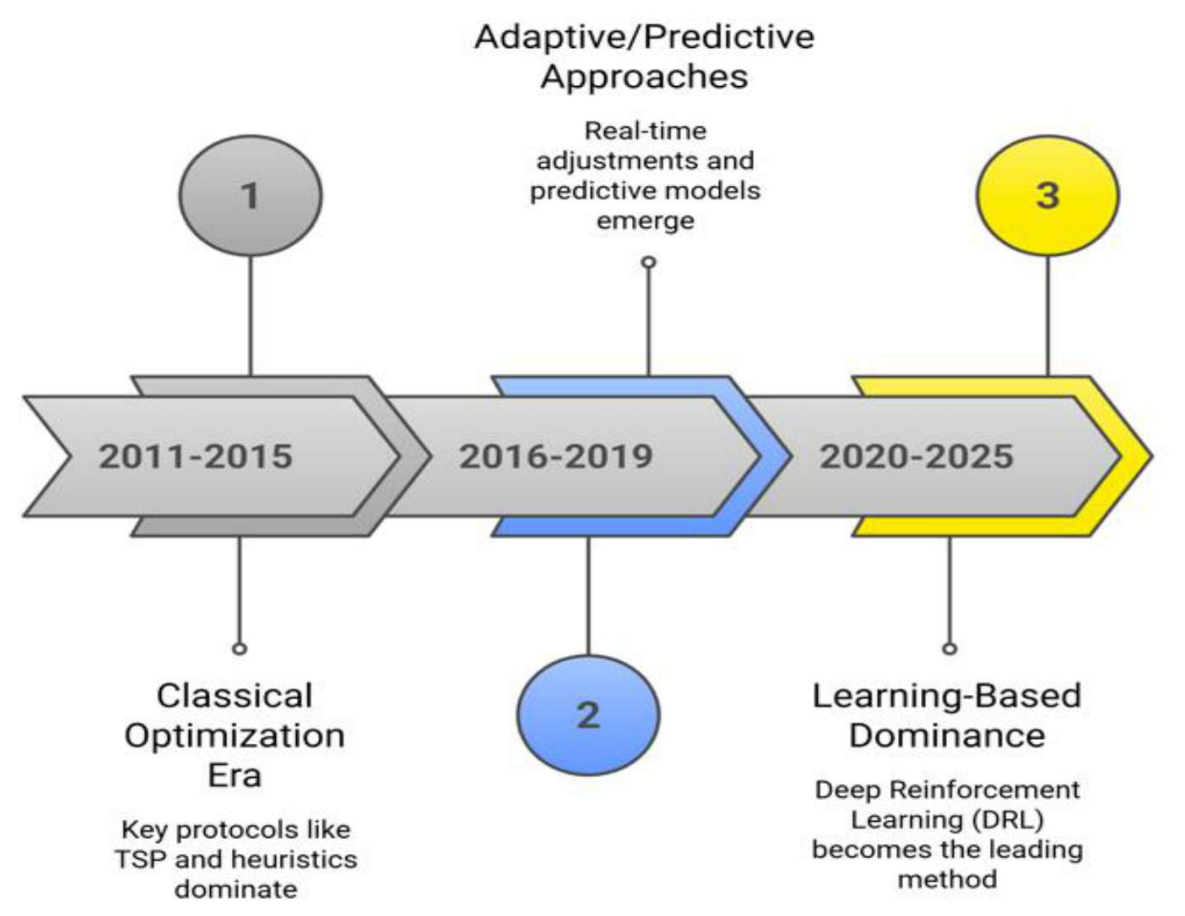
Figure 2.
Consolidated taxonomy of AUV-assisted data gathering protocols.
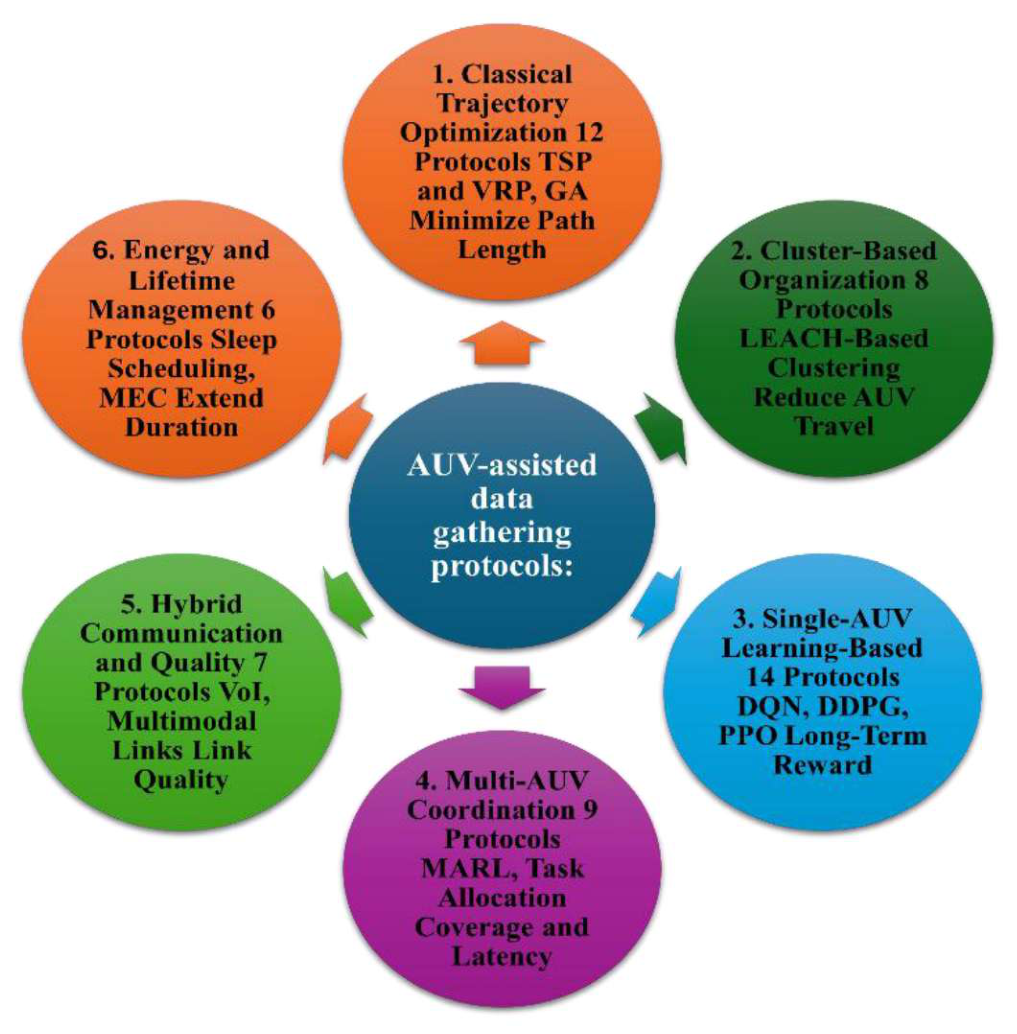

Table 1.
Comparative Characteristics of Multi-Hop and AUV-Assisted Collection.
| Performance Dimension | Multi-Hop Collection | AUV-Assisted Collection |
|---|---|---|
| Energy Distribution | Highly imbalanced; sink-adjacent relays drain early (energy-hole) [28] | More balanced; reduced relay burden via direct collection [25,30] |
| Network Lifetime | Limited by early failure of hotspot relays [28] | Commonly extended due to better energy balance (depends on tour design) [25,30] |
| End-to-End Latency | Can grow across multiple hops with slow propagation and retransmissions [27] | Dominated by AUV visit cycle + single-hop transfer; controllable via trajectory planning [28,29,30] |
| Scalability | Degrades as relay load and control overhead increase [28] | Scales with path-planning and scheduling complexity [28,29] |
| Infrastructure Cost | Lower (sensors + static sink) | Higher (sensors + AUV + docking/offload support) |
| Adaptability | Requires re-routing under failures/topology changes [27] | Enables replanning and flexible servicing of isolated nodes [29,31] |
Table 2.
Consolidated Taxonomy Comparison.
| Category | Protocols | Primary Goal | Adaptability | Scalability | Computation |
|---|---|---|---|---|---|
| Classical Trajectory Optimization | 12 | Minimize path length | Low | Moderate | Low |
| Cluster-Based Organization | 8 | Reduce AUV travel | Moderate | High | Low |
| Single-AUV Learning-Based | 14 | Maximize long-term reward | High | Moderate | High |
| Multi-AUV Coordination | 9 | Optimize coverage and latency | High | High | High |
| Hybrid Communication & Quality | 7 | Improve link quality and VoI | Moderate | Moderate | Moderate |
| Energy & Lifetime Management | 6 | Extend network duration | Moderate | High | Low |
Table 3.
Comparison with Existing Surveys.
| Survey | Year | # Papers | Timeframe Covered | # Categories | Learning-Based Coverage |
|---|---|---|---|---|---|
| Hollinger et al. [32] | 2012 | 12 | 2005–2011 1 | 3 | None |
| Khan & Cho [38] | 2015 | 25 | 2008–2015 | 8 | Minimal |
| Ghoreyshi et al. [36] | 2018 | 35 | 2010–2017 | 11 | Limited |
| Luo et al. [45] | 2022 | 30 | 2010–2021 | 5 | Limited |
| Wei et al. [45] | 2021 | 40 | 2011–2022 | 6 | Moderate |
| This Survey | 2025 | 56 | 2011–2025 | 6 | Extensive |
1 Hollinger et al. is included for historical context as it represents the earliest systematic work on AUV-assisted data collection, predating the formal scope of this survey.
Table 4.
Summary of Recurring Design Trade-offs in AUV-Assisted Data Gathering.
| Trade-off | Tension | Most Affected Category | Mitigation Strategy |
|---|---|---|---|
| Energy vs. Freshness | Lower AoI → higher propulsion cost | Single-AUV DRL, Multi-AUV | Adaptive scheduling, speed control |
| Coverage vs. Efficiency | Full coverage → longer tour length | Classical Trajectory | Clustering, TSPN approximation |
| Optimality vs. Complexity | Exact planning → NP-hard at scale | All categories | Hierarchical decomposition, RL |
| Scalability vs. Coordination | More AUVs → more overhead | Multi-AUV | MARL, task partitioning |
Table 5.
Open Challenges and Suggested Directions.
| Challenge | Description | Current Gap | Suggested Direction |
|---|---|---|---|
| Real-world Validation | Most results are simulation-only | Robustness to currents, hardware faults | Field testbeds, hardware-in-loop trials |
| Multi-AUV Scalability | Acoustic contention grows with fleet size | Coordination overhead limits benefit | Scalable MARL, acoustic-efficient task allocation |
| Security & Trust | No security-aware AUV data collection designs | Vulnerable to spoofing/jamming | Trust-aware scheduling, secure acoustic protocols |
| Cross-layer Optimization | Trajectory, MAC, buffer, app treated separately | Suboptimal joint performance | Joint cross-layer frameworks |
| Energy Harvesting | AUV battery limits mission duration | Solar/thermal harvesting underexplored | Renewable-powered AUV trajectory co-design |
| Benchmarking | No standard datasets/testbeds for comparison | Reproducibility is poor | Open simulation environments, shared datasets |
Disclaimer/Publisher’s Note: The statements, opinions and data contained in all publications are solely those of the individual author(s) and contributor(s) and not of MDPI and/or the editor(s). MDPI and/or the editor(s) disclaim responsibility for any injury to people or property resulting from any ideas, methods, instructions or products referred to in the content. |
© 2026 by the authors. Licensee MDPI, Basel, Switzerland. This article is an open access article distributed under the terms and conditions of the Creative Commons Attribution (CC BY) license (http://creativecommons.org/licenses/by/4.0/).
Copyright: This open access article is published under a Creative Commons CC BY 4.0 license, which permit the free download, distribution, and reuse, provided that the author and preprint are cited in any reuse.


