

Submitted:
21 May 2026
Posted:
26 May 2026
You are already at the latest version
Abstract
Memory encoding depends on the joint convergence of substrate readiness, internal drive, environmental input, and a permissive temporal–physiological state. The same logic recurs across vertebrate learning systems: hippocampal-dependent spatial and schema-modulated memory (the Navigia substrate in the Systema Behavorum taxonomy), filial imprinting in the chick intermediate medial mesopallium (Lorenz's prägung), vocal learning in the songbird auditory pallium, and Pavlovian conditioning in the basolateral amygdala and ventral striatum. Despite differences in substrate, timescale, and output, writing events are gated by the multiplicative convergence of substrate (A), drive (D), content/context (C), and a permissive state (Φ); retrieval is gated by a parallel conjunction on the same substrate; and behavioral output depends on the match between current input and the stored trace. The framework specifies f in Lewin's B = f(P, E) as the multiplicative threshold A × D × C × Φ ≥ T, decomposing person and environment into computationally separable terms with empirical signatures.Three contributions advance beyond descriptive integration. First, retrieval is formalized as ARCH × Φ-gated in the same form as encoding, generating dissociation predictions between trace-degradation and Φ-mediated retrieval failures that current accounts do not formalize. Second, inherited priors (ethology) and acquired schemas (Tse, Morris, and colleagues) are unified under the same conjunctive logic, both biasing C through Bayesian-like prior weighting. Third, the multiplicative form generates a quantitatively precise prediction — supra-additive failure under combined partial perturbations — that distinguishes the framework from interactionist accounts; a tractable 2 × 2 factorial in chick imprinting is developed in §4.7, with detection power calculated in Appendix A.The framework yields four testable predictions. Single-domain perturbation should cause categorical encoding failure regardless of other domains. Combined partial perturbations should produce supra-additive failure distinguishable from additive null models in factorial designs not yet performed in any of the four systems. Reading-event Φ-suppression should produce retrieval failures dissociable from trace-degradation failures. Pharmacological Φ-modulators (ketamine, psilocybin, MDMA) are reframed as substrate-state modulators that widen the retrieval envelope, converting reading events into writing events, and supply a clinical-translational test. The framework is offered as a falsifiable account of common computational structure across vertebrate memory systems.
Keywords:
memory encoding
; spatial navigation
; filial imprinting
; song learning
; Pavlovian conditioning
; sensitive period
; schema
; prior knowledge
; threshold model
; Lewin
; releaser theory
; reconsolidation
; psychedelics
; ARCH × Φ
1. Introduction
A common pattern recurs across vertebrate memory neuroscience that the field’s vocabulary tends to obscure. In hippocampal-dependent spatial and schema-modulated learning, in filial imprinting, in vocal learning, and in Pavlovian conditioning, an organism in a particular developmental and physiological state encounters environmental input during a defined window, retains a representation as a persistent neural trace, and behaves later in life in ways that depend on the trace and on the current configuration of releasing cues. Spatial memory researchers speak of encoding, consolidation, schema-dependent assimilation, and retrieval (Tse et al. 2007; Tse et al. 2011; Alonso et al. 2020). Imprinting researchers speak of acquisition and recognition (McCabe et al. 1981; Horn 2004). Song-learning researchers speak of sensory and sensorimotor phases, of templates and crystallization (Bottjer et al. 1984). Fear-conditioning researchers discuss acquisition, consolidation, retrieval, reconsolidation, and extinction (Lee et al. 2006). The architectures these vocabularies describe share more than has typically been noted. Prominent models of mammalian hippocampal consolidation propose that the hippocampus temporarily holds recently acquired information until it can be integrated into preexisting neocortical traces for long-term storage (Rattenborg et al. 2010); the framework developed here is that this read–write logic, properly generalized, recurs across substrates that differ by orders of magnitude in timescale and anatomical organization.
Lewin’s field theory (1936) provided the foundational equation of person-environment interaction in psychology: B = f(P, E), where behavior is the joint product of the person’s and the environment’s properties. The framework developed here was a refinement of that equation (Rahman et al. 2025). Lewin’s P unpacks into the substrate (A), its drive state (D), and the temporal-physiological window (Φ); Lewin’s E maps onto the content/context term (C) and onto the environmental components of Φ that gate when encoding can occur; and Lewin’s function f, left unspecified in the original formulation, is here specified as the multiplicative threshold form A × D × C × Φ ≥ T. The framework thus extends Lewin in two specific ways: by decomposing P and E into computationally separable terms with empirical signatures, and by treating f as a falsifiable claim — multiplicative rather than additive integration, with the supra-additive prediction of Section 2.3 as the discriminating empirical signature.
The framework draws on two traditions usually treated separately. From classical ethology: Lorenz’s establishment of imprinting as a discrete biological phenomenon with a sensitive period, and his concept of the innate releasing mechanism (Lorenz 1935); Tinbergen’s experimental demonstration that releasers are testable entities, including the canonical quantitative demonstration of supernormal stimuli (Tinbergen and Perdeck 1950); and Hess’s establishment of the time course of imprinting in ducklings, in which he observed that young animals were not “blank” but “definitely structured and ready to act and absorb the features of the environment in certain highly specific ways” (Hess 1959, p. 41). From hippocampal memory research: the schema-and-prior-knowledge tradition demonstrating that prior structure dramatically shapes the rate, durability, and neural organization of new encoding (Tse et al. 2007; Tse et al. 2011; Alonso et al. 2020). The framework’s contribution is not the recording-medium analogy or the releaser concept, both of which are inherited, but the formal multiplicative threshold logic that integrates these traditions with contemporary molecular and circuit-level evidence — and the claim that reading events are not passive playback but ARCH × Φ-gated processes that can themselves become writing events under appropriate conditions, with the trace itself a dynamically maintained pattern of synaptic modifications rather than a fixed recording.
Each system exhibits five structural elements: a defined neural substrate that can be written; a writing event in which environmental input or association produces a persistent change in that substrate; a stored trace whose maintenance does not require continued exposure; reading events in which subsequent stimuli are tested against the trace; and releasers — feature configurations in the current environment that must satisfy the trace’s specifications for behavior to be produced. The substrates differ — hippocampal formation for spatial and schema-modulated memory, the intermediate medial mesopallium for filial imprinting, HVC and associated nuclei for song learning, and the basolateral amygdala for fear conditioning. The writing windows differ by orders of magnitude. The releasers range from environmental landmarks to biological objects to single tones. The architectural logic is nonetheless the same.
The hypothesis developed here has three parts. First, the same threshold-gated multiplicative logic governs both writing and reading events across these systems. Second, the substrate on which these events occur is not content-neutral but pre-loaded with both inherited and acquired priors. Third, the substrate’s operating parameters are themselves tuned by experience to bias all subsequent events — a distinction between content-specific traces and content-neutral substrate gain that the literature does not always make cleanly (developed in §2.5).
This architecture extends the ARCH × Φ framework previously applied to molecular replication initiation (Rahman 2025), socially controlled sex change in clownfish (Rahman 2026a), rapid threshold-governed mechanical decisions in plants (Rahman 2026b), and behavioral execution more generally (Rahman et al. 2025). The behavioral-substrate extension articulated here treats vertebrate memory systems as instances of a general threshold-gated read–write architecture. The four terms, originally defined for behavioral execution, require reinterpretation when the gated event is the writing of a trace into substrate rather than the release of a stored script into action:
- A (Substrate readiness). Originally an Archetype vector — evolutionarily conserved neurocircuit scripts that structure perception, affect, and action (Rahman et al. 2025). In the memory-system formulation, A denotes the anatomical substrate on which writing and reading occur — hippocampus, IMM, HVC, BLA in the four cases below — pre-loaded with both inherited priors and acquired schemas that bias what is encoded.
- D (Drive). The biochemical and neuromodulatory signals required to gate plasticity at the substrate: dopamine, NMDA receptor activation, thyroid hormone, and prediction-error signals. Substrate readiness alone does not produce a trace; D is the writing signal that fires into a permissive substrate.
- C (Content/context). Originally a scalar of symbolically coded cues that bias archetypal activation (Rahman et al. 2025). Here C denotes the current input being written, jointly determined by the environmental stimulus and the substrate’s prior weighting of that input. The prior may be inherited (species-typical biases, releaser specifications) or acquired (schemas built through prior experience). The architectural role is the same in both cases: the prior shapes which inputs cross the writing threshold (developed in §2.4).
- Φ (Phase permissiveness). The temporal–physiological state of the substrate that determines whether writing or reading is currently permitted: theta phase, sleep state, sensitive-period hormonal and neurosteroid milieu, GABAA maturation, NMDA receptor competence. Φ varies across timescales from sub-second (theta cycle) to lifetime (developmental critical period).
The dissociation between D and Φ matters for the predictions that follow. D is the signal that, when present, drives plasticity into a permissive substrate; Φ is the envelope that determines whether the substrate is permissive at all. Both must be non-zero for a writing event to occur, and the framework’s central claim is that they combine multiplicatively rather than additively with A and C.
2. The Detailed Architecture
2.1. Structural Elements
The architecture comprises several elements. A substrate — neural circuitry capable of being written by experience, pre-loaded with both inherited priors and acquired schemas that bias which inputs are most readily encoded. A writing event — gated by ARCH × Φ during a defined window, in which the substrate undergoes a persistent change. A stored trace — the encoded representation that persists in the substrate without continued exposure. Reading events — gated by ARCH × Φ in their own right, in which current stimuli are tested against the trace. Releasers — feature configurations in the current environment that must satisfy the trace’s specifications for behavior to be produced. The first four are properties of the organism; the fifth is a property of the environment, whose match to the trace is evaluated at reading event times. This is illustrated in Figure 1.

Table 1.
Four-domain mapping across systems with quantitative anchors and evidence ratings.
| Domain | System | Quantitative anchor | Evidence |
|---|---|---|---|
| A (Substrate) | Hippocampal memory | Hippocampal lesion abolishes spatial paired-associate learning despite intact reward and exploration (Tse et al. 2007); hippocampal–entorhinal theta organizes encoding/retrieval (Buzsáki and Moser 2013) | Strong |
| Imprinting | Bilateral IMM lesion → preference at chance (n=12 pairs; McCabe et al. 1981); distributed network including hippocampus, medial striatum, arcopallium, NCL (Behroozi et al. 2024) | Strong | |
| Song learning | LMAN lesion in juveniles → permanently abnormal song; same lesion in adults → no effect on crystallized song (Bottjer et al. 1984); HVC cooling slows song by up to 45% without altering structure (Long and Fee 2008) | Strong | |
| Pavlovian (fear) | LA projection neurons <1 Hz baseline; firing approximately doubles during CS anticipation post-conditioning (Gaudreau and Paré 1996; Paré and Collins 2000) | Strong | |
| Pavlovian (reward) | Dog caudate fMRI: associations form in as few as 22 trials (Prichard et al. 2018); differential caudate activation predicts behavioral choice (Cook et al. 2016) | Strong | |
| D (Drive) | Hippocampal memory | Dopaminergic D1/D5 modulation of hippocampal NMDA-dependent paired-associate persistence (Bethus, Tse, Morris 2010) | Strong |
| Imprinting | T3 i.v. injection reopens window in 4- and 6-day-old chicks; rescue is dose-dependent and abolished by bilateral IMM lesion (Yamaguchi et al. 2012) | Strong | |
| Song learning | NMDAR-mediated plasticity; LMAN–RA almost entirely NMDAR (Mooney 1992); NR2B → NR2A subunit shift across sensitive period (Bolhuis et al. 2010) | Strong | |
| Pavlovian (fear) | NR2B-containing NMDARs in BLA required for acquisition but not expression (Rodrigues et al. 2001) | Strong | |
| Pavlovian (reward) | Midbrain dopamine prediction-error signal gates new CS–reward learning (Schultz et al. 1997) | Strong | |
| C (Content) | Hippocampal memory | Schema-consistent flavor–place associations consolidate in 48h vs. weeks for novel; mPFC schema-dependent gene expression (Tse et al. 2007; Tse et al. 2011) | Strong |
| Imprinting | Dark-rearing 72h → failure to imprint unless rescued by exogenous T3 (Yamaguchi et al. 2012); inherited priors for biological motion, hen-like configurations (Versace et al. 2017; Miura et al. 2018) | Strong | |
| Song learning | Tutored similarity 70–90% vs. isolate-reared impoverished song (Gobes et al. 2019; Bolhuis et al. 2010) | Strong | |
| Pavlovian | Zero contingency → no conditioning despite chance pairings (Rescorla 1968); modality-specific priors (taste–illness vs. visual–shock; Garcia and Koelling 1966) | Strong | |
| Φ (Phase) | Hippocampal memory | Theta-rhythm gating of encoding/retrieval (Buzsáki and Moser 2013); critical-period plasticity (Hensch 2005); sleep-dependent consolidation | Strong (gating); Moderate (factorial perturbation) |
| Imprinting | GABAA receptor expression rises and GABAB falls across days 1–5; pharmacological manipulation advances or delays closure (Aoki et al. 2018); T3 entry gates window opening (Yamaguchi et al. 2012) | Strong | |
| Song learning | HVC neurogenesis declines with crystallization (Wang et al. 2002; Pytte et al. 2007); inhibitory firing tracks protection of acquired segments (Vallentin et al. 2016) | Strong (writing window); Moderate (closure mechanism) | |
| Pavlovian (writing) | α5β2γ2-selective inverse agonist RY024 in hippocampus decreases fear conditioning (Bailey et al. 2002); GABA-A modulation gates fear-memory writing (Makkar et al. 2010, review) | Strong | |
| Pavlovian (reading) | Same NMDAR antagonist produces opposite effects on same trace depending on retrieval duration (Lee et al. 2006); reconsolidation window <6h after retrieval (Nader et al. 2000) | Strong | |
| R (Releaser) | Cross-system | Tinbergen gull supernormal stimulus → ~25% more pecks than natural model (Tinbergen and Perdeck 1950) | Moderate (quantitative); Strong (qualitative) |
2.2. The Multiplicative Form of ARCH × Φ–Gated Writing and Reading
Let A, D, C, and Φ each be normalized to the interval [0, 1]. At a writing event, the probability of producing a persistent trace is governed by:
where the subscript w denotes the values of each domain at the writing event, and Tw is the threshold for trace formation. At a reading event, the probability of producing the stored behavior is governed by:
where R is a releaser term that depends on the match between current stimuli and the stored trace, and Tr is the threshold for behavioral execution.
The two inequalities are not independent. They describe the same substrate in two configurations — writing-permissive and reading-permissive — distinguished by which Φ regime is currently in force. The framework’s central claim is that biological execution governed by stored traces is determined by these two coupled inequalities, with the multiplicative form generating the supra-additive, single-domain-veto, and reading-event-dissociation predictions developed in §2.3. A minimal mathematical formalization is provided in Appendix A.
2.3. Four Falsifiable Predictions
1. Single-domain veto. Reducing any one of A, D, C, or Φ to zero at either a writing or a reading event produces categorical failure regardless of the other domains’ states. This follows directly from the multiplicative form: if any factor approaches zero, the product approaches zero. The empirical content is whether biological encoding actually shows this categorical pattern under single-domain ablation, as predicted, or shows graded failure that would favor an additive form.
2. Supra-additive failure. Simultaneous reductions in two or more domains produce failures exceeding the sum of independent effects, because the multiplicative form makes each domain’s contribution depend on the others’ magnitudes. Two partial reductions of magnitude 0.5 each yield a product of 0.25, against an additive prediction near 0.75 — a threefold worse-than-expected failure. The decisive empirical signature, developed in §A.2, is that an additive logistic-regression model fitted to factorial data requires interaction terms (A × D, D × C, etc.) to fit, while a multiplicative model fits with main effects on log-domains alone. The two models are AIC-comparable and out-of-sample testable.
3. Releaser scaling. The strength of the behavioral response at reading events scales with the releaser’s feature-match strength to the stored trace, including beyond the natural range — producing the supernormal-stimulus phenomenon described in classical ethology and quantified by Tinbergen and Perdeck (1950).
4. Reading-event dissociation. If reading events are Φ-gated in the same form as writing events, retrieval should fail under conditions of Φr suppression even when the trace is fully formed and releaser features are intact. This generates a specific dissociation between trace-degradation failures (caused by encoding-side perturbation) and Φ-mediated retrieval failures (caused by reading-side perturbation) that current accounts of memory retrieval do not formalize. The cleanest existing instantiation of the underlying logic is Lee, Milton, and Everitt’s (2006) demonstration that the same NMDA antagonist applied during retrieval of a fear memory produces opposite outcomes — reduced fear after brief retrieval, preserved fear after long retrieval — with retrieval duration alone determining which process is engaged.
2.4. Substrate Is Not Content-Neutral: Inherited Priors and Acquired Schemas
The substrate on which writing occurs is not “blank.” Two distinct sources of prior structure bias what gets encoded, and although they differ in origin, they play architecturally identical roles in the framework’s C term.
Inherited priors. Newly hatched chicks do not weigh all stimuli equally during the sensitive window. Predispositions for hen-like configurations, biological motion, face-like patterns, and self-propelled motion bias which stimuli are most readily imprinted (Hess 1959; Versace et al. 2017; Miura et al. 2018). Zebra finches preferentially learn zebra-finch-like song over alien song, even when tutored by heterospecifics (Eales 1987). Garcia and Koelling’s (1966) classical demonstration that flavors readily associate with subsequent illness but not with shock — and that visual–auditory cues show the opposite pattern — established that the substrate carries inherited weightings over which CS–US relationships are biologically plausible. These are evolutionarily installed priors over what categories of input are biologically meaningful: the substrate’s wiring carries information about the world before any individual experience writes into it.
Acquired schemas. Prior structures acquired through development also bias what gets encoded. Tse and colleagues demonstrated that when new flavor–place associations fit a pre-existing schema in rat hippocampus, systems consolidation accelerates dramatically — single-trial learning becomes hippocampus-independent within 48 hours rather than the weeks normally required (Tse et al. 2007). Subsequent work showed schema-dependent gene expression in medial prefrontal cortex during this accelerated consolidation (Tse et al. 2011). The role of prior knowledge in shaping encoding rate, durability, and neural organization has been reviewed across episodic, semantic, and procedural memory domains (Alonso et al. 2020). Hess’s (1959) earlier observation that imprinting strength varies with the chick’s emotional and arousal state at the time of exposure is a related though distinct phenomenon — operating on D and Φ rather than on the prior weighting of C — and is treated under those terms in §4.
Both inherited priors and acquired schemas differ in origin (selection-installed versus experience-installed) and in implementation (likely involving distributed substrate weighting versus mPFC–hippocampal interaction), but both bias the C term at writing events in the same architectural sense: they encode prior probability distributions over which input is biologically meaningful, and they modulate the substrate’s readiness to encode it. The framework’s C term at writing events is therefore the conjunction of the current input and the substrate’s prior weighting of that input, with the prior arising from either evolutionary or experiential history. The accelerated consolidation Tse and colleagues documented in rats (~48 hours versus weeks for schema-fit information) and the tight species-prior gating Versace and colleagues documented in chicks (selective imprintability of hen-like configurations within the sensitive window) are, in this view, the same architectural phenomenon — prior-weighted C — operating on different substrates with priors of different developmental origin. Making this connection explicit is one of the framework’s substantive integrations: the ethological priors literature and the schema-and-prior-knowledge literature have been treated as separate research traditions, and they describe the same architectural role.
Recent computational work supports this framing. Artificial neural networks endowed with moderate computation noise spontaneously develop hallmarks of Bayesian-like decision-making under uncertainty (Findling and Wyart 2024), suggesting that the brain’s apparent Bayesian competence may emerge from the interaction between substrate dynamics and inherited or acquired priors. The framework provides the gating logic for when computation occurs; Bayesian frameworks describe the content of the computation when it does.
2.5. Substrate Versus Trace
A central but often-overlooked distinction in the architecture is between the trace — content-specific, written by particular experiences — and the substrate’s operating parameters, which are content-neutral but tuned by cumulative experience and bias all subsequent encoding and retrieval. Two converging empirical anchors make this distinction concrete. Sapolsky’s decades of fieldwork on baboon social hierarchies provide the clearest cross-species demonstration: chronic glucocorticoid exposure associated with subordinate social rank produces hippocampal dendritic atrophy, suppressed neurogenesis, and altered HPA-axis reactivity that biases responses across all domains (Sapolsky 1996, 2005). The cumulative cortisol exposure does not encode specific stressful events into a content-storing substrate; it elevates the gain on threat-relevant processing such that subsequent threats produce amplified responses regardless of whether they resemble the original stressors. Luby and colleagues (2016) provide the human longitudinal counterpart: in a longitudinal MRI study tracking children across three scan waves, maternal support measured during the preschool period predicted the trajectory of hippocampal development across childhood and adolescence, while the same measure assessed at school age — only a few years later — did not. The preschool environment did not lay down preschool memories as the operative variable; it tuned the hippocampal substrate that all subsequent memory operations would run on. Together these findings instantiate the architectural claim across timescales (chronic adult stress; developmental sensitive period) and species (baboons; humans): substrate operating parameters are shaped by cumulative environmental exposure independently of any specific content stored.
The trace and the gain are dissociable in principle and frequently confused in practice. Distinguishing them empirically requires manipulations that alter substrate reactivity without altering specific stored content, or the converse — a separation the literature does not always make cleanly. The framework formalizes the distinction: the gain effects modulate A and Φ at all subsequent writing and reading events; the trace is what gets written when those modulated terms cross threshold.
2.6. Shared Machinery for Writing and Reading
One feature of biological substrate distinguishes it from most engineered storage systems: the synapses that wrote a memory are the synapses that read it. The molecular machinery does not partition into writing-only and reading-only components. The two coupled equations of §2.2 therefore describe a single system in two configurations rather than two independent systems sharing a substrate. What distinguishes a reading event from a writing event is not the substrate or the trace but the Φ regime currently in force — the phase configuration that determines whether the substrate is in playback mode or rewrite mode at the moment a stimulus arrives. This has a direct empirical consequence: reading events can become writing events under appropriate ARCH × Φ configurations, which is the basis of reconsolidation (Nader et al. 2000; Lee et al. 2006). The framework’s claim that retrieval is itself ARCH × Φ-gated, in the same form as encoding, generates the dissociation predictions of §2.3 that current accounts of memory retrieval do not formalize.
3. Example I: Hippocampal-Dependent Spatial and Schema-Modulated Memory
3.1. The System
Hippocampal-dependent encoding in rodents and humans constitutes the canonical mammalian writing-and-reading architecture for spatial, contextual, and episodic memory. In the Systema Behavorum taxonomy of conserved archetypal systems (Rahman et al. 2025), this is the Navigia system — exploration, novelty-seeking, and purposive navigation — whose substrate (hippocampus, dorsal striatum, VTA–NAc dopaminergic projections) is the locus of the writing and reading events analyzed in this section. Writing events occur during environmental exploration, in which the hippocampal formation encodes representations of spatial layout, contextual features, and event sequences. Reading events occur during retrieval — goal-directed navigation, episode recall, or recognition of familiar contexts — in which the stored trace guides current behavior. Releasers are current environmental cues that match a sufficient subset of the stored representation through pattern completion. The framework’s claim is that the same A × D × C × Φ logic that governs Navigia activation in behavioral execution (Rahman et al. 2025) governs the writing and reading of the spatial-contextual traces on which that activation depends. Among the four systems treated here, this is the one in which acquired schemas dominate the C term and inherited priors play a comparatively quiet structural role; in §4 the asymmetry reverses.
3.2. A — Substrate
The hippocampal formation, entorhinal cortex, dorsal striatum, and dopaminergic projections from the ventral tegmental area constitute the principal substrate for spatial and contextual encoding. The hippocampal–entorhinal system supports memory and navigation through coordinated theta-rhythm dynamics that organize encoding and retrieval (Buzsáki and Moser 2013). Hippocampal lesions abolish the formation of new spatial paired associations even when reward, exploration, and prior schemas are intact (Tse et al. 2007) — a clean instance of single-domain veto: A near zero produces categorical encoding failure regardless of D, C, and Φ. The substrate’s role extends beyond pure spatial mapping to schema-dependent encoding: the medial prefrontal cortex interacts with the hippocampus during accelerated consolidation of schema-consistent information (Tse et al. 2011).
3.3. D — Drive
Dopaminergic signaling provides drive at hippocampal NMDA-dependent synapses. Bethus, Tse, and Morris (2010) demonstrated that dopaminergic afferents from the ventral tegmental area modulate the persistence of memory for novel NMDA-dependent paired associates: D1/D5 receptor activation extends memory persistence, and antagonism shortens it. NMDA-receptor-dependent plasticity provides the molecular substrate for plasticity; dopaminergic novelty signaling determines whether and how durably the substrate is written. The drive term is therefore both molecularly specific (NMDA-receptor-dependent) and modulated by neuromodulatory tone reflecting current behavioral state — drive in this system is a conjunction of a permissive molecular pathway (NMDAR) and a graded behavioral signal (dopamine release).
3.4. C — Content and the Role of Acquired Priors
The environmental input encountered during exploration is the content being written, weighted by both inherited spatial priors (boundary cells, head-direction systems, geometric representations) and acquired schemas (prior knowledge of similar layouts, contexts, or associations). The schema effect is quantitatively striking. When new flavor–place associations fit an established schema, single-trial learning becomes hippocampus-independent within 48 hours, compared with the weeks normally required for systems consolidation (Tse et al. 2007). Schema-consistent encoding is accompanied by distinct gene expression patterns in medial prefrontal cortex that are absent for schema-inconsistent or schema-novel encoding (Tse et al. 2011). The role of prior knowledge in modulating encoding rate, durability, and neural organization has been reviewed across episodic, semantic, and procedural memory domains (Alonso et al. 2020). The C term at hippocampal writing events is therefore the conjunction of current environmental input and substrate-installed priors, with the priors including both inherited spatial-representation structure and acquired schemas built through prior experience. The architectural role is identical to that of inherited priors in imprinting (§4.4); the developmental origin and the cortical implementation differ.
The C term at hippocampal writing events is therefore the conjunction of current environmental input and prior knowledge stored in the substrate. This is Lewin’s E, refined: not merely the environmental field encountered at the moment of encoding, but the environment as filtered through prior structures — both inherited and acquired — that determine what becomes memorable. Tse and colleagues’ demonstration that schema-fit information consolidates in 48 hours rather than weeks (Tse et al. 2007) is the empirical signature of this prior-weighted E.
3.5. Φ — Phase Control
The hippocampal Φ term operates at multiple nested timescales and through multiple molecular substrates. At sub-second resolution, theta rhythm in the hippocampal–entorhinal system gates encoding and retrieval, with distinct theta phases supporting writing versus reading operations (Buzsáki and Moser 2013) — the cleanest demonstration in any vertebrate system that the same substrate alternates between writing-permissive and reading-permissive Φ regimes within a single oscillatory cycle. At intermediate timescales, sleep-dependent consolidation operates as a Φ window during which traces are stabilized through hippocampal replay. Across these timescales, NMDA-receptor function gates the molecular plasticity required for trace formation; pharmacological NMDA antagonism during encoding produces dose-dependent reductions in trace strength even with intact substrate, drive, and content. Critical-period plasticity in early development represents a developmental Φ scale, with age-dependent changes in inhibitory tone and structural consolidation modulating what can be encoded (Hensch 2005). At the molecular level, hippocampal LTP is gated by oxysterol and neurosteroid tone: pro-inflammatory stimulation suppresses LTP through low-grade inflammation acting via 25-hydroxycholesterol and high-grade inflammation acting via 5α-reduced neurosteroids, with neurosteroid-synthesis inhibition reversing the effect (Izumi et al. 2024). The bidirectional effect of neurosteroids on Φ — suppressing LTP under inflammatory conditions while supporting plasticity under others — is consistent with Φ being a functional state property rather than a fixed pharmacological direction; the same molecular family can narrow or widen the writing window depending on baseline state, with implications for the pharmacological Φ-modulators discussed in Section 6.7.
3.6. Reading Events
Retrieval is goal-directed navigation or recognition under current environmental cues, with the cues activating a sufficient subset of the stored representation through pattern completion. The framework predicts that reading events themselves should show Ar × Dr × Cr × Φr conjunctive gating — that retrieval should fail under conditions of Φr suppression (sleep deprivation, neuromodulatory perturbation, NMDA antagonism during retrieval) even when the trace is fully formed and releaser features are intact. The dissociation between trace-degradation failures and Φ-mediated retrieval failures is the specific empirical signature the framework predicts (Prediction 4 in §2.3).
Lee, Milton, and Everitt (2006) provide the clearest existing demonstration of the underlying principle, though in fear memory rather than spatial memory: the same NMDA antagonist (MK-801) applied during retrieval produces opposite behavioral outcomes — reduced fear after brief retrieval (blocking reconsolidation) versus preserved fear after long retrieval (blocking extinction) — with retrieval duration alone determining which process is engaged. This is a Φr-dependent reversal not accommodated by accounts that treat retrieval as automatic playback. The direct hippocampal test — retrieval-time NMDA antagonism applied to well-consolidated spatial traces with intact retrieval cues, varying retrieval duration as the Φr parameter — has not been performed and constitutes a tractable empirical gap.
The framework also predicts specific dissociations in clinical conditions characterized by Navigia dysregulation (Rahman et al. 2025). ADHD, restlessness, and compulsive novelty-seeking have been characterized in terms of dopaminergic novelty-pathway hyperactivity and impaired prefrontal regulatory tone (Volkow et al. 2009; Sonuga-Barke 2003). Within the framework, these phenotypes are most parsimoniously read as elevated D combined with reduced Φr — drive amplification without adequate retrieval gating, producing the characteristic pattern of attentional capture by novel stimuli, impaired retrieval of contextually-appropriate stored information, and distractibility. The architectural prediction is that ADHD-related encoding and retrieval deficits should be selectively attenuated by manipulations that restore Φr (e.g., methylphenidate’s tonic dopaminergic stabilization) without altering the substrate (A) or content priors (C). The pharmacological-rescue pattern in ADHD treatment is consistent with this prediction at a qualitative level; an explicit factorial dissociation — comparing methylphenidate effects on novel-stimulus capture (D-driven) versus contextually-cued retrieval (Φr-gated) — has not been performed.
4. Example II: Filial Imprinting in the Domestic Chick
4.1. The System
Where hippocampal-dependent memory exhibits acquired-schema modulation of encoding, filial imprinting demonstrates the same architectural logic with the C term dominated by inherited priors and a Φ envelope set by neuroendocrine state rather than by ongoing oscillatory dynamics. Filial imprinting is the writing of a persistent representation of the imprinter into the chick forebrain during a sensitive period in the first days post-hatch. The window opens approximately 12–24 hours after hatching and closes by approximately 72–96 hours under standard rearing conditions (Yamaguchi et al. 2012; Aoki et al. 2018). The trace persists for life. Reading events are subsequent encounters with stimuli that match the stored trace, producing the approach and following behavior Lorenz first described as prägung — the “stamping in” of the mother’s features during a developmental window.
The four ARCH × Φ terms map onto four mechanistically distinct systems in this preparation, which is one reason imprinting offers the cleanest empirical test of the framework’s predictions: A is anatomically circumscribed (IMM), D is a discrete biochemical signal (T3) acting on identified neurons, C is a stimulus presented under experimental control with a well-characterized inherited weighting, and Φ is the developmental envelope whose opening and closing are independently manipulable. The 2 × 2 design developed in §4.7 exploits this dissociability.
4.2. A — Substrate
The intermediate medial mesopallium (IMM, formerly IMHV) is the principal substrate. Bilateral IMM lesions placed before training abolish acquisition (McCabe et al. 1981); lesions placed after training abolish retention (McCabe et al. 1982). The lesion effect is content-dependent: profound for artificial stimuli but only partially impairing for naturalistic stimuli, indicating that the IMM stores acquired preferences while the predisposition system for conspecific-like stimuli operates outside the IMM (Horn and McCabe 1984). IMHV lesions impair imprinting-acquired preferences while sparing operant associative learning (Johnson and Horn 1986) — a substrate-specific rather than learning-specific deficit. The intermediate hyperpallium apicale (IMHA) is a downstream area required for memory recall (Aoki et al. 2015). Functional MRI in awake newborn chicks reveals a broader distributed network — hippocampal formation, medial striatum, arcopallium, and nidopallium caudolaterale — that participates in long-term storage (Behroozi et al. 2024). Quantitative anchor: in matched-pair comparisons (n = 12 pairs), sham-operated controls showed strong preference for the training stimulus while bilaterally lesioned chicks showed no preference, demonstrating a categorical rather than graded effect of IMM ablation (McCabe et al. 1981) — Prediction 1 (single-domain veto) instantiated cleanly: A near zero, no trace, regardless of D, C, or Φ.
4.3. D — Drive
Thyroid hormone (3,5,3’-triiodothyronine, T3) is the drive signal that gates plasticity at IMM. Imprinting training induces rapid Dio2-mediated T3 inflow into the telencephalon (Yamaguchi et al. 2012). Quantitative anchor: intravenous T3 injection enables imprinting in 4- and 6-day-old chicks whose sensitive period has closed under standard rearing, with the rescue showing dose-dependence and being abolished by bilateral IMM lesion — demonstrating that T3 acts on IMM neurons specifically (Yamaguchi et al. 2012). Wnt-2b signaling is downstream of T3 in the IMM plasticity cascade (Yamaguchi et al. 2018). T3 is therefore the writing signal that fires into a permissive substrate; it does not, by itself, constitute the permissive envelope. The distinction between drive (D) and envelope (Φ) matters in this system because both are state-dependent and both must be present for a writing event to occur, and because the two terms are dissociable by manipulations targeting different molecular machinery — a dissociation developed in §4.5 and exploited in §4.7.
4.4. C — Content and Inherited Priors
The visual stimulus presented during the sensitive window is the content being written, weighted by inherited priors for hen-like configurations, biological motion, face-like patterns, and self-propelled motion (Hess 1959; Versace et al. 2017; Miura et al. 2018). The chick is not, in Hess’s phrase, a “blank” recording medium — it is “definitely structured and ready to act and absorb the features of the environment in certain highly specific ways” (Hess 1959, p. 41), and the structure is the prior. Quantitative anchor: dark-rearing for the first 72 hours post-hatch leaves chicks unable to imprint on previously imprintable stimuli unless rescued by exogenous T3 (Yamaguchi et al. 2012), demonstrating the conjunctive necessity of stimulus exposure (C) and drive (D) — neither alone suffices.
Where hippocampal C is shaped predominantly by acquired schemas built through prior experience (§3.4), IMM C is shaped predominantly by inherited priors installed by selection. The architectural role is identical: the prior weights which inputs cross the writing threshold and which do not. The acceleration Tse and colleagues documented in rats — schema-fit information consolidating in 48 hours rather than weeks (Tse et al. 2007) — and the selectivity Versace and colleagues documented in chicks — preferential imprintability of hen-like configurations within the sensitive window (Versace et al. 2017) — are, in the framework’s terms, the same phenomenon (prior-weighted C) on substrates whose priors arise from different developmental sources.
4.5. Φ — Phase Control
The sensitive period itself is the Φ term, and its mechanistic decomposition has been a moving target in the literature. The framework’s commitment is that Φ is the permissive envelope — the temporal–physiological state of the substrate that determines whether writing is currently possible at all — and is mechanistically distinct from the writing signal (D) that fires into that envelope. In the chick, the envelope appears to have at least two components, opening and closing through partly different mechanisms:
Opening. The window’s opening is associated with neurosteroid and oxysterol signaling at the IMM substrate that establishes the permissive milieu in which T3-driven plasticity can occur [oxysterol citation(s) to be inserted]. T3 entry into IMM at training (Yamaguchi et al. 2012) operates as the drive signal that fires into this envelope, not as the envelope itself: T3 rescue of a closed window in 4- and 6-day-old chicks (Yamaguchi et al. 2012) is most parsimoniously read as drive injection sufficient to reach threshold under a still-marginally-permissive Φ, not as Φ itself being supplied exogenously.
Closing. The window’s closing is associated with maturational changes in inhibitory signaling. GABAA receptor expression rises gradually from days 1 to 5 post-hatch while GABAB receptor expression declines, and pharmacological manipulation of either receptor type can advance or delay sensitive-period closure (Aoki et al. 2018). This developmental closure parallels the GABA-driven critical-period architecture documented across cortical systems (Hensch 2005), and operates as a contraction of the Φ envelope rather than as a withdrawal of D.
The conceptual payoff of separating D from Φ in this system is that it converts what otherwise looks like an indeterminacy — does T3 open the window or drive plasticity within it? — into a decomposable empirical question with two predictions. First, manipulations targeting the oxysterol-set permissive envelope should reduce imprintability without abolishing T3-driven plasticity in vitro (Φ-specific reduction with intact D). Second, manipulations targeting NMDAR or Wnt-2b downstream of T3 should reduce imprintability without altering the temporal envelope of the sensitive period (D-specific reduction with intact Φ). The framework predicts that joint partial reduction of D and Φ will produce supra-additive failure — a prediction tractable in this preparation in a way it is not in the others (§4.7).
4.6. Reading Events
After the writing event, the imprinted chick reads the stored trace whenever it encounters potential releasers. Cross-imprinting experiments demonstrate the asymmetric dyadic structure: a chick imprinted on a moving cylinder will follow that cylinder, a different cylinder of similar dimensions, or a human moving at similar speed and scale, with following strength scaling with feature-match strength (Horn 2004) — the releaser-scaling prediction (Prediction 3) instantiated as a graded approach response to graded R.
The framework predicts that reading events should themselves show Ar × Dr × Cr × Φr conjunctive gating (Prediction 4) — that releaser presentation under conditions of Φr suppression should produce reading failures even when the trace is fully formed. In imprinting, candidate Φr manipulations include neurosteroid antagonism at the IMM, sleep-state disruption, or pharmacological perturbation of the inhibitory tone that organizes downstream IMHA recall circuitry. This prediction has not been systematically tested in imprinting and constitutes a tractable empirical gap; the cross-imprinting paradigm provides a graded behavioral readout (following strength) suitable for detecting Φr-dependent retrieval failures dissociable from trace-degradation failures.
4.7. A Tractable Test: 2 × 2 Partial Perturbation of D and C
The framework’s strongest distinguishing prediction is supra-additive failure under combined partial perturbations (Prediction 2 in §2.3). Of the four systems treated here, imprinting in the domestic chick offers the cleanest preparation in which to test it: D, C, and Φ are mechanistically distinct and individually titratable, A is anatomically circumscribed, the behavioral readout (following strength toward the training stimulus versus a novel stimulus) is graded and well-validated, and a categorical zero-domain control already exists in the IMM-lesion literature (McCabe et al. 1981). The design proposed here is a 2 × 2 factorial on D and C, with Φ and A held intact across all four cells.
The D arm reduces the T3 drive signal to approximately half-maximal. Goitrogen (e.g., methimazole) administration calibrated against published T3-dose-response curves provides a tunable handle; alternatively, a sub-saturating dose of an NMDAR antagonist or Wnt-2b inhibitor delivered to IMM achieves D-pathway reduction downstream of T3 itself, controlling for any residual Φ effects of thyroid hormone. The C arm reduces the prior-weighted match of the stimulus to inherited hen-like-configuration weighting — for example, by training on a scrambled or counter-rotated version of a stimulus that, when presented intact, evokes strong species-typical preference (Versace et al. 2017; Miura et al. 2018). Both manipulations are graded, replicable, and well-anchored in the existing chick literature.
The cells of the design and the predicted outcomes are:
| C intact (hen-like) | C reduced (degraded prior match) | |
| D intact | Baseline imprinting; multiplicative ≈ 1.00, additive ≈ 1.00 | Single-domain partial perturbation; multiplicative ≈ 0.50, additive ≈ 0.75 |
| D reduced | Single-domain partial perturbation; multiplicative ≈ 0.50, additive ≈ 0.75 | Joint partial perturbation; multiplicative ≈ 0.25, additive ≈ 0.50 |
The decisive cell is the bottom-right. Under multiplicative integration, two simultaneous 0.5 reductions in D and C yield a product of 0.25 — a roughly threefold worse outcome than the two-domain additive prediction of ~0.50. Under the additive null model specified in §A.2, the same data require interaction terms (D × C) to fit; under the multiplicative form, they fit with main effects on log-domains alone. The two models are AIC-comparable on the same data, and the supra-additive prediction is detectable with modest cell sizes (Appendix A.3).
Three controls strengthen the design. First, the IMM-lesion arm (A → 0) confirms the categorical-veto baseline and pegs the lower bound of the behavioral readout. Second, varying Φ across the four cells — for example, training at the early edge versus the late edge of the sensitive window — generates the 2 × 2 × 2 extension predicted to show further supra-additive interaction with D and C. Third, the cross-imprinting reading-event design of §4.6 provides an orthogonal test of Prediction 4 on the same trained subjects. None of these tests has been performed in the form the framework requires.
5. Example III: Birdsong Learning in the Zebra Finch
5.1. The System
Vocal learning illustrates the same architecture in a sensorimotor learning system, with inherited conspecific-song priors weighting C and a sensitive period that, like imprinting, closes through inhibitory maturation but, unlike imprinting, brackets a writing event divided into two functionally distinct phases. Vocal learning in zebra finches proceeds in two overlapping phases. During the sensory phase (approximately post-hatch days 25–65), the juvenile bird memorizes the song of an adult tutor, with auditory memory formation primarily occurring between 25 and 35 dph (Gobes et al. 2019). During the sensorimotor phase (approximately days 65–90), the bird produces increasingly stereotyped vocalizations that converge on the memorized tutor song. The mature crystallized song persists for life. In the framework’s terms: the sensory phase is the writing event for the auditory template, the sensorimotor phase is a series of writing events for motor production matching that template, the stored trace is the tutor template plus the matching motor program, and reading events are each subsequent vocal production attempt under social or self-elicited conditions.
5.2. A — Substrate
The song system comprises two parallel pathways. The motor pathway (HVC → robust nucleus of the arcopallium, RA → vocal motor neurons) is required for song production throughout life. The anterior forebrain pathway (HVC → Area X → DLM → LMAN → RA) is required for juvenile song learning but not for adult song production (Bottjer et al. 1984). The caudal mesopallium and surrounding auditory regions are implicated as sites of tutor-template storage (Bolhuis et al. 2010). Bilateral lesions of LMAN in juveniles produce a permanently abnormal, highly repetitive and simplified song; the same lesions placed in adults aged ≥90 days do not affect already-crystallized song (Bottjer et al. 1984), demonstrating that LMAN’s contribution is restricted to the writing window — a temporal dissociation of A-mediated function that mirrors IMM’s role in imprinting (§4.2). Cooling HVC slows song timing in a graded manner — by up to 45% across all timescales — without altering acoustic structure, while cooling RA has no comparable effect (Long and Fee 2008), localizing the temporal-sequence representation to HVC.
5.3. D — Drive
NMDA receptor-mediated synaptic plasticity is required for tutor-song acquisition. NMDAR subunit composition in LMAN shifts during the sensitive period: NR2B-dominated currents during juvenile learning give way to NR2A-dominated currents as the song crystallizes (Bolhuis et al. 2010). At the LMAN–RA synapse, glutamatergic transmission is mediated almost entirely by NMDA receptors (Mooney 1992), in contrast to HVC–RA synapses, which use both NMDA and AMPA components. The NR2B → NR2A subunit shift is itself a Φ-bounded transition: the molecular composition of D-pathway machinery changes across the sensitive window, with NR2B prevalence corresponding to the writing-permissive phase. The same NR2B specificity for acquisition but not expression appears in fear conditioning (§6.3), suggesting a conserved D-architecture across systems in which a developmentally regulated subunit gates writing while a maturer subunit supports reading.
5.4. C — Content and Species Priors
The tutor song is the content being written, weighted by inherited priors that bias birds toward conspecific-typical song structure. Socially-tutored zebra finches achieve substantial imitation of tutor song under standard rearing, while birds raised in social isolation produce impoverished songs lacking normal conspecific structure (Bolhuis et al. 2010, for review). Even zebra finches tutored by heterospecifics preferentially copy elements consistent with conspecific song structure (Eales 1987) — the prior weighting C overrides the heterospecific stimulus, just as the chick’s hen-like-configuration prior weights C against scrambled or non-hen-like stimuli (§4.4) and the rat’s flavor–illness prior weights C against flavor–shock pairings (§6.4). The architectural role is identical across systems; the species-typical content of the prior differs.
5.5. Φ — Phase Control
The sensitive period closes through structural and inhibitory mechanisms. HVC neurogenesis declines progressively as juveniles transition to song crystallization and continues to decline through adulthood, with the magnitude of the decline correlating with increasing song stereotypy (Wang et al. 2002; Pytte et al. 2007) — a structural Φ-contraction operating on a timescale of weeks. GABAergic interneurons in HVC also gate the window directly: parvalbumin-positive fast-spiking interneurons produce GABAA-mediated inhibition onto HVC projection neurons, and the strength of this inhibition tracks the protection of acquired song segments (Vallentin et al. 2016). The GABAA maturation that closes the song-learning window parallels the GABA-A/B switch that closes the imprinting sensitive period (Aoki et al. 2018) and the broader GABA-driven cortical critical-period architecture (Hensch 2005). Across these systems, Φ closure is a recurrent inhibitory-maturation phenomenon, and the framework’s claim is that closure operates by contracting the permissive envelope rather than by withdrawing drive — a prediction empirically distinguishable in the chick preparation developed in §4.7 and tractable in zebra finch via parallel manipulations.
5.6. Reading Events
Each act of song production is a reading event. The releaser term R is the social context that elicits singing — most prominently, the presence of a female conspecific. When a male sings to a female (“directed song”), syllable spectral variability is significantly reduced compared to when he sings alone (“undirected song”), and this context-dependent variability difference depends on LMAN activity — pharmacological inactivation of LMAN abolishes the directed/undirected variability difference (Kao and Brainard 2006). The same circuit that injected variability during sensorimotor learning now modulates variability at reading events, illustrating the framework’s claim that the substrate’s writing and reading machinery are not separable (§2.6) — and instantiating Prediction 4 in a behaviorally specific form: Φr differs between directed and undirected singing contexts, and that Φr difference produces categorically different reading outputs from the same trace.
6. Example IV: Pavlovian Conditioning Across Mammalian Species and Valences
6.1. The System
Pavlovian conditioning differs from the three preceding systems in that it is robustly induced in adults and can be written by a single trial — the writing window is not a developmental sensitive period but a transient state-dependent envelope that opens whenever appropriate Φ conditions arise. The case is developed across two valences (fear and reward) and three mammalian species (cat, rat, dog), at three complementary levels of analysis (single-unit, molecular, network). The framework’s claim is that the same A × D × C × Φ logic applies regardless of valence, species, or temporal scale; what changes is which substrate is engaged and which neuromodulators carry the drive signal.
6.2. A — Substrate
The basolateral amygdala (BLA) is the primary substrate for fear conditioning across mammals (Fanselow and LeDoux 1999; Maren 2001). The ventral striatum encodes reward value in dogs (Cook et al. 2016). At the cellular level, lateral amygdala (LA) projection neurons in conscious cats exhibit extremely low spontaneous firing rates of 0.09 Hz under control conditions (Gaudreau and Paré 1996), which approximately double during anticipation of a noxious stimulus following Pavlovian conditioning (Paré and Collins 2000) — a quantitative substrate signature of an established trace. At the network level, in 19 awake dogs imaged with fMRI, neurobiological learning curves for caudate, amygdala, and parietotemporal cortex showed reward-stimulus associations forming in as few as 22 trials (Prichard et al. 2018). Differential caudate activation predicted each dog’s behavioral choices (Cook et al. 2016).
6.3. D — Drive
NMDA receptors in BLA are required for fear-conditioning acquisition (Davis 1992; Rodrigues et al. 2001), with NR2B-containing receptors specifically required for acquisition but not for expression (Rodrigues et al. 2001) — the same NR2B → NR2A acquisition/expression split documented in song-learning LMAN (§5.3). Noradrenergic signaling supports consolidation and reconsolidation (Debiec and LeDoux 2004). For Pavlovian reward learning, the dopaminergic prediction-error signal computed in midbrain dopamine neurons gates the writing of new CS–reward associations (Schultz et al. 1997) — a direct parallel to the dopaminergic D signal in hippocampal paired-associate persistence (§3.3). The prediction-error signal itself is modulated by confidence in the perceptual judgment that produced the outcome: rewards earned after low-confidence decisions produce larger updating effects than rewards earned after high-confidence decisions, a pattern conserved across mice, rats, and humans (Lak et al. 2020). The D term at writing events is therefore not a fixed pharmacological signal but a confidence-scaled gain that interacts with the C-term’s prior weighting of evidence. Across systems and valences, D in this framework is consistently a conjunction of a permissive molecular pathway (NMDAR) and a graded behavioral signal (dopamine, noradrenaline, T3 in the chick) — the same architectural decomposition called out in Section 3.3.
6.4. C — Content and Modality Priors
The CS–US pairing is the content being written. Contingency, not mere contiguity, drives associative learning: when CS and US are presented with truly random temporal relation (zero contingency), no conditioning develops even when many CS–US pairings occur by chance (Rescorla 1968) — a foundational demonstration that what is being encoded is a relational structure, not a sensory co-occurrence. Inherited priors bias which CS modalities readily associate with which US types: flavors are easily associated with subsequent illness but not with shock, while visual and auditory cues show the opposite pattern (Garcia and Koelling 1966). This demonstrates substrate-installed priors over biologically plausible CS–US relationships, architecturally analogous to the conspecific-song priors of zebra finches (§5.4) and the hen-like-stimulus priors of imprinting chicks (§4.4). The same prior-weighted-C structure recurs in a system whose writing window is state-dependent rather than developmentally bounded — evidence that prior weighting of C is not a peculiarity of sensitive-period systems but a general property of substrate-installed structure.
6.5. Φ — Phase Control
The phase term corresponds to current arousal, attention, and physiological state at the time of CS–US pairing. At the molecular level, GABAergic transmission gates fear-memory writing: pre- and post-training administration of drugs that facilitate GABAA signaling disrupts the formation of fear memories (Makkar et al. 2010, review). Hippocampal infusion of the α5β2γ2-selective GABA/benzodiazepine inverse agonist RY024 prior to training, at the highest concentration tested, decreases the strength of fear conditioning measured 24 hours later (Bailey et al. 2002).
Reading-event Φ is well characterized by reconsolidation studies, and offers the framework’s cleanest empirical foothold for Prediction 4. NMDA receptor antagonists produce opposite effects on the same trace depending on the duration of the reading event: brief retrieval engages reconsolidation (NMDAR blockade impairs restorage), while prolonged retrieval engages extinction (NMDAR blockade prevents new extinction learning) — the same drug applied to the same trace produces a categorical reversal of effect depending on phase configuration at reading (Lee et al. 2006). Two features of this result are central. First, A, C, and the trace itself are held constant; only Φr is varied (by retrieval duration). Second, the readout is a categorical reversal, not a graded modulation — exactly what the multiplicative form predicts when one term flips sign-equivalent. This is among the cleanest empirical instantiations the framework has of any prediction in any of the four systems.
6.6. Reading Events
Reading events are CS presentations after acquisition. The reconsolidation window for fear memories opens within minutes of CS retrieval and closes within approximately 6 hours, during which protein synthesis inhibition or NMDA receptor blockade in the BLA can disrupt reconsolidation and produce lasting attenuation of the conditioned response (Nader et al. 2000). The reading-becomes-writing property — that retrieval can re-open the synapses for modification under appropriate Φr conditions — is the empirical content of §2.6’s shared-machinery claim. In framework terms, retrieval initiates a Φr → Φw transition: the substrate that was permissive for reading becomes briefly permissive for writing, and a new writing event can occur on the same trace. This Φ-regime transition is what makes the trace dynamically maintained rather than statically stored, and it is what licenses the clinical applications developed in §6.7.
6.7. Pharmacological Φr Modulation: Psilocybin, Ketamine, MDMA, and Clinical Applications
The reconsolidation literature establishes that brief retrieval of an aversive trace, paired with pharmacological perturbation of Φr, can produce lasting attenuation of the conditioned response (Nader et al. 2000; Lee et al. 2006). The framework recasts this as a Φr → Φw transition under pharmacological control: the drug widens the permissive envelope at retrieval, and what would otherwise have been a reading event becomes a writing event in which the trace is updated. Three clinically relevant compounds — ketamine, psilocybin, and MDMA — are most parsimoniously read as Φ-modulators in this sense.Ketamine, an NMDA receptor antagonist, has rapid antidepressant effects whose duration outlasts the drug’s pharmacokinetic half-life by orders of magnitude (Berman et al. 2000; Zarate et al. 2006), and produces durable reductions in PTSD symptoms when administered in conjunction with trauma-related cue presentation (Feder et al. 2014, 2021). Within the framework, ketamine’s NMDAR antagonism during retrieval of trauma traces is the same molecular handle Lee and colleagues (2006) used pharmacologically in rats — applied at a clinical scale where the reading event is a remembered traumatic episode and the writing event that follows is a clinically observable reduction in symptom load.Psilocybin produces durable reductions in depression and anxiety symptoms following one or two sessions (Carhart-Harris et al. 2016; Davis et al. 2021; Goodwin et al. 2022), with effects sustained at 6–12 months in cancer-related distress (Griffiths et al. 2016; Ross et al. 2016). The serotonergic mechanism differs from ketamine’s glutamatergic one, but the framework-level structure is the same: psilocybin appears to widen Φ during sessions in which trauma-, mood-, or self-related traces are accessed, converting what would otherwise be reading events into writing events on those traces. Direct neuroimaging evidence for psilocybin’s effect on substrate organization comes from precision functional mapping in healthy adults: a single 25 mg dose acutely produces functional connectivity changes more than threefold larger than dose-matched methylphenidate, with the largest disruption in the default mode network and a persistent decrease in hippocampal–default mode network connectivity that lasts for weeks after the acute drug effect dissipates (Siegel et al. 2024). The acute change tracks the intensity of the subjective psychedelic experience (r2 = 0.81 between whole-brain connectivity change and mystical-experience score), and is reduced when participants perform a perceptual task during the dosing session — suggesting that the substrate change is not a fixed pharmacokinetic effect but is shaped by what the brain is engaged with during the Φ-widening window. The empirical signature predicted by the framework is that lasting clinical effect should depend on the conjunction of pharmacological Φr perturbation and trace-relevant content access during the session — neither alone should suffice, and the joint effect should be supra-additive in the §2.3 sense. The set-and-setting literature on psychedelic-assisted therapy is consistent with this prediction at a qualitative level (Carhart-Harris et al. 2018); a factorial design crossing pharmacological Φr perturbation with directed versus undirected trace access has not been performed and constitutes a tractable clinical-translational test.The strongest current evidence that pharmacological Φ-window modulation is a substrate-state property rather than a drug-class effect comes from the Nardou laboratory’s demonstration that MDMA, psilocybin, ketamine, ibogaine, and LSD all reopen a closed critical period for social reward learning in adult mice (Nardou et al. 2019, 2023). The 2019 result established that a single dose of MDMA returns the adult mouse brain to a juvenile-like state of social-reward plasticity through an oxytocin-dependent mechanism; the 2023 follow-up showed the same critical-period reopening across four additional compounds with disparate receptor profiles, with the duration of reopening tracking each compound’s acute behavioral effect rather than its receptor specificity. This convergence across drug classes is itself the architectural finding: what the compounds have in common is not their receptor pharmacology but their downstream effect on the substrate’s permissiveness to writing. The framework’s prediction that Φ is a functional state of the substrate, modulable by multiple molecular routes, is precisely the cross-drug convergence Nardou and colleagues have documented.The framework does not require that ketamine, psilocybin, MDMA, and allopregnanolone share a mechanism of action at the molecular level. It requires only that each compound, by its respective route, produces a transient widening of Φr during which trace-relevant reading events become writing events. This architectural-level convergence is consistent with — and not contradicted by — empirical demonstrations that rapid antidepressants targeting different molecular receptors produce dissociable acute network signatures. Lambert et al. (2023) showed that allopregnanolone (a GABAA positive allosteric modulator with FDA-approved rapid antidepressant action in postpartum depression) and ketamine (an NMDA antagonist) produce distinct cortical EEG signatures in mice during acute drug action: allopregnanolone increases beta and low-gamma power, while ketamine decreases beta and increases high-gamma. Two compounds with shared rapid-antidepressant clinical profiles diverge at the level of network rhythm. The framework’s claim of convergence is not at the level of molecular target or acute network rhythm but at the level of substrate permissiveness to writing — a functional property that acute EEG does not directly index. The diversity of molecular mechanisms supporting Φ across systems (theta phase, sleep state, T3 milieu, GABAA maturation, oxysterol tone) and the apparent diversity of pharmacological Φ-modulators (NMDAR antagonism, 5-HT2A agonism, MDMA’s serotonergic-empathogenic action, neurosteroid GABAA modulation; Nardou et al. 2019, 2023; Lambert et al. 2023) is not a difficulty for the framework but a prediction of it: Φ is defined functionally, and any molecular mechanism that modulates substrate permissiveness should produce framework-consistent effects regardless of receptor pharmacology or acute network signature.A clinical-translational corollary follows. The framework predicts that the same architectural logic applies to therapeutic and to maladaptive Φ-window modulation: pharmacological widening of a Φ window licenses writing, and what gets written depends on the trace-relevant content present during the window. This generates a falsifiable directional prediction for psychedelic-assisted therapy: clinical benefit should track not the drug exposure alone but the conjunction of drug exposure and the content of the reading event at which Φ is widened. Drug administered without trace-relevant content access should produce smaller and less durable effects than drug administered with such access; trace-relevant content access without pharmacological Φ-widening should produce smaller and less durable effects than the conjunction. Siegel et al. (2024) provide preliminary support for this directional prediction at the level of acute neural reorganization: a perceptual task performed during psilocybin dosing reduced functional-connectivity disruption, indicating that what the brain is engaged with during the Φ-widening window modulates the magnitude of the substrate change. The clinical factorial — directed versus undirected trace access during pharmacological Φ-widening — has not been performed.
7. Releasers, Supernormal Stimuli, and the Dyadic Case
7.1. The Releaser Term R
Classical ethology provided the strongest empirical evidence for the releaser term R, and supplied the methodology for testing it. Tinbergen and Perdeck (1950) demonstrated that a stylized model — a red knitting needle with three white bands — elicits a stronger begging response from newly hatched herring gull chicks than an accurate three-dimensional model of the parental head. Quantitative anchor: the supernormal stimulus elicited approximately 25% more pecks than the natural-form model. Within the framework, supernormal stimuli are values of R that exceed the natural feature range, and the behavioral output, governed by Φr · (Ar × Ar × Cr) × R, scales accordingly. The supernormal phenomenon is therefore not a curiosity but a prediction of the multiplicative form: if R is unbounded above, then for any fixed Φr · (Ar × Dr × Cr), increases in R must produce increases in behavioral output until other terms saturate or new constraints engage. Tinbergen demonstrated this empirically; the framework explains why it had to be the case.
A subtler point follows. The releaser does not act on the trace — it activates it. R is a feature-match function, not a property of the substrate or the stored representation. This is why imprinted chicks follow not only the original imprinter but a sufficiently feature-similar substitute (Horn 2004, §4.6), why zebra finches sing in response to female conspecifics rather than to the specific tutor whose song they memorized (§5.6), and why a CS that resembles the original CS produces a conditioned response (§6.6). The trace specifies what features must be present in the environment for the stored behavior to be released; R quantifies how well the current environment satisfies those specifications.
7.2. Releasers as the Limiting Case of Dyadic ARCH × Φ
The framework accommodates a more general structure in which two organisms must each be in a particular threshold-crossing state for behavior to occur — the dyadic case. Lordosis in receptive female mammals requires the conjunctive alignment of the female’s hormonal state, lordosis circuitry, social context, and estrous phase, with simultaneous threshold crossing in the male’s mounting behavior; mating fails if either partner’s ARCH × Φ does not cross threshold. The dyadic structure can be written as the product of two complete ARCH × Φ systems:
Both bracketed terms must be non-zero for the joint behavior to occur, and a near-zero term in either partner produces categorical failure regardless of the other’s state — a single-domain veto operating across organisms rather than within one.
The asymmetric case is the one familiar from classical ethology. A chick imprinted on a moving cylinder, a researcher, or a cardboard cutout (Horn 2004) does not require the cylinder, the researcher, or the cutout to be in any particular ARCH × Φ state — the cylinder has none. Only the chick’s ARCH × Φ matters; the partner contributes a feature configuration that is read by the chick’s stored trace. Releasers are therefore the limiting case of dyadic ARCH × Φ in which one partner’s biological readiness is replaced by a configuration of physical features. R quantifies the match between those features and the trace specifications.
This formalization clarifies what makes a partner count as fully ARCH × Φ versus reducing to R: the criterion is whether the partner’s substrate is itself written by the encounter. In lordosis, both substrates are written — the encounter modifies hormonal, social, and reproductive state in both organisms. In imprinting onto a cylinder, only the chick’s substrate is written, and the cylinder reduces to R. In imprinting onto a researcher who in turn becomes habituated to the chick, both substrates are written but on radically different timescales and architectures, and the framework treats this as a degenerate dyadic case whose mathematical form is determined by which writing matters for the behavior under examination.
7.3. Releasers in the Four Systems
Each of the four memory systems treated in §3–6 has a corresponding releaser structure that is informative about the framework’s generality:
- Hippocampal spatial memory. R is the match between current environmental cues and the stored cognitive map, evaluated through pattern completion. Releasers are graded and continuous: partial cue match produces partial recall, with the gradedness determined by attractor dynamics in hippocampal CA3 and downstream pattern-completion networks.
- Filial imprinting. R is the match between current visual stimuli and the stored imprinter representation in IMM. Releasers are graded — Horn (2004) demonstrated following strength scales with feature-match — and weighted by the same inherited priors that biased C at writing (§4.4).
- Song learning. R is the social context, most prominently the presence of a female conspecific. The releaser here is categorical at the social level (female present versus absent) but graded at the production level — the directed-versus-undirected variability difference (§5.6) reflects Φr modulation by R itself, an unusual case in which R modulates not just whether but how the trace is read out.
- Pavlovian conditioning. R is the CS — narrower and more impoverished than in the other systems, often a single tone or context. The narrowness is what makes Pavlovian conditioning the cleanest experimental preparation for studying R parametrically: the CS can be titrated, generalized to similar stimuli, or extinguished, with the conditioned response scaling accordingly.
The diversity of R across systems — graded environmental cues, inherited-prior-weighted visual configurations, social-context releasers that themselves modulate Φr, and parametric conditioned stimuli — is itself evidence for the framework’s claim that R is a separable term. A theory that treated retrieval as automatic playback would have no principled way to accommodate all four cases; the framework treats them as the same architectural element instantiated against substrates of different specificity.
8. Cross-System Summary and Evidence Base
The four systems treated in §3–6 differ in substrate, in temporal scale, in the developmental origin of their priors, and in the molecular machinery that gates writing and reading. They share the architectural logic articulated in §2: a multiplicatively gated writing event whose probability of producing a persistent trace is governed by Wtr = Φw · (Aw × Dw × Cw) ≥ Tw, and a multiplicatively gated reading event whose probability of producing the stored behavior is governed by B = Φr · (Ar × Dr × Cr) × R ≥ Tr. Across systems, the same architectural roles are played by mechanistically distinct biological machinery: A is the hippocampal formation, IMM, HVC, or BLA; D is dopaminergic novelty signaling, T3, NMDAR-mediated plasticity, or the dopaminergic prediction-error signal; C is environmental input weighted by acquired schemas (hippocampus), inherited hen-like-configuration priors (imprinting), inherited conspecific-song priors (song learning), or inherited modality priors (Pavlovian conditioning); and Φ is theta phase, sleep state, oxysterol-set developmental envelope, GABAA maturational closure, or transient state-dependent permissiveness.
Table 1 consolidates this four-domain mapping with quantitative anchors and an evidence rating across all four systems. The rating scheme follows a three-tier convention. Strong evidence requires direct experimental demonstration in the species under discussion, with replicated findings, quantitative parameters, and ideally pharmacological or genetic perturbation. Moderate evidence consists of indirect demonstration, single-laboratory findings, or strong demonstration in a closely related species with reasonable expectation of conservation. Weak evidence consists of inference from related systems, theoretical extrapolation, or single qualitative reports.
The evidence ratings are not uniform across the four-domain mapping, and the asymmetry is itself informative. Substrate (A) is the most experimentally tractable term in all four systems, with strong-evidence ratings supported by lesion, imaging, and electrophysiological data. Drive (D) is well-characterized in all four systems at the molecular level, though the conjunction of permissive pathway and graded behavioral signal (§3.3, §6.3) is more fully demonstrated in some systems than in others. Content (C) is empirically anchored where the priors have been studied directly — chick imprintability, conspecific-song bias, modality-specific CS–US plausibility — and less well-anchored as a general claim about prior-weighted C, which is one of the framework’s substantive integrative contributions (§2.4) and an ongoing empirical project. Phase permissiveness (Φ) is the term whose evidence base is most heterogeneous: theta and sleep-state Φ in hippocampus are strongly supported, sensitive-period Φ in chick and finch is supported through partly different mechanisms (developmental hormonal and oxysterol envelope, GABAA maturational closure), and reading-event Φ as predicted in §2.3 is well-instantiated only in fear-memory reconsolidation (Lee et al. 2006) and qualitatively in clinical Φr modulation (§6.7). Φ is therefore the term where the framework’s empirical reach is least uniform and where its predictions are most directly testable.
9. Predictions, Gaps, and Falsification
The framework’s value is determined by whether its predictions are sharp enough to be wrong, and whether the experiments needed to test them are tractable enough to be performed. This section consolidates the four predictions developed in §2.3 and instantiated across §3–6, identifies the empirical gaps where the framework’s reach exceeds existing data, and specifies what observations would falsify the framework’s central claims.
9.1. Falsifiable Predictions
Prediction 1 (single-domain veto). Single-domain ablation at a writing event should produce categorical failure of trace formation regardless of the other domains’ states. The single-perturbation literature (Table 1) is broadly consistent across all four systems for A, D, and C. The McCabe et al. (1981) IMM-lesion result (n = 12 pairs, categorical loss of preference, §4.2), the Bottjer et al. (1984) juvenile-LMAN-lesion result (§5.2), and the Tse et al. (2007) hippocampal-lesion result (§3.2) instantiate Prediction 1 cleanly for A. NMDAR-blockade results (Davis 1992; Rodrigues et al. 2001; §6.3) and the dark-rearing-without-T3-rescue result (Yamaguchi et al. 2012; §4.4) instantiate it for D and C respectively. Φ instantiation is uneven: theta-phase and critical-period dynamics in hippocampus are well-characterized (Buzsáki and Moser 2013; Hensch 2005), GABAA maturational closure in imprinting is moderately supported (Aoki et al. 2018), and Φr in fear reconsolidation is strongly supported (Lee et al. 2006; §6.5).
Prediction 2 (supra-additive failure). Combined partial perturbations should produce supra-additive failure relative to additive null models, with the multiplicative form predicting that two simultaneous 0.5 reductions yield ~0.25 against an additive prediction of ~0.75. This is the framework’s most specific and most diagnostic claim, and it has not been tested with the explicit factorial design required to distinguish multiplicative from additive integration in any of the four systems. The decisive empirical signature, developed in §A.2, is that an additive logistic-regression model fitted to factorial data requires interaction terms (D × C, A × Φ, etc.) to fit, while a multiplicative model fits with main effects on log-domains alone. The two models are AIC-comparable on the same data, and the supra-additive prediction is detectable with modest cell sizes (§A.3).
The 2 × 2 design developed in §4.7 — partial T3 reduction × stimulus-prior degradation in chick imprinting — is the framework’s flagship test, and is tractable in a preparation where D, C, A, and Φ are mechanistically distinct and individually titratable. Three further factorial experiments are tractable in the other systems with existing methods. In hippocampal memory: partial NMDA antagonism × partial schema-violation in a flavor–place paradigm of the Tse type, with the predicted supra-additive failure visible against the well-characterized 48-hour-versus-weeks consolidation-rate baseline. In Pavlovian fear: partial NMDA blockade × partial CS-degradation in a single-trial paradigm, with the predicted supra-additive failure visible against the 22-trial reward-association baseline (Prichard et al. 2018). In song learning: partial LMAN inactivation × partial heterospecific-tutor exposure during the sensory phase, with template fidelity assayed at crystallization. None of these experiments has been performed.
Prediction 3 (releaser scaling). Releaser strength should scale with feature-match strength to the stored trace, including supranatural responses where R exceeds the natural feature range. Strong qualitative evidence; moderate quantitative evidence (Tinbergen and Perdeck 1950; Horn 2004). The multiplicative form predicts that supernormal responses are not curiosities but consequences of an unbounded R term, and the prediction generalizes: parametric variation of R against fixed Φr · (Ar × Dr × Cr) should produce graded behavioral output across all four systems (§7.3).
Prediction 4 (reading-event Φ-gating). Retrieval should fail under conditions of Φr suppression even when the trace is fully formed and releaser features are intact. Lee, Milton, and Everitt (2006) provides the cleanest existing support: the same NMDAR antagonist applied during retrieval of a fear memory produces categorically opposite outcomes — impaired reconsolidation after brief retrieval, impaired extinction after long retrieval — with retrieval duration alone determining which process is engaged. Two features of this result anchor Prediction 4 specifically: A, C, and the trace are held constant while only Φr varies, and the readout is a categorical reversal rather than a graded modulation. The prediction generalizes. Reading-event manipulations of arousal, sleep state, neuromodulatory tone, or pharmacological permissiveness should produce retrieval failures distinguishable from the trace-degradation failures of encoding-only manipulations. This dissociation has not been systematically tested in hippocampal memory, imprinting, or song learning, and the candidate manipulations developed in §3.6, §4.6, and §5.6 constitute tractable empirical gaps.
The clinical-translational extension of Prediction 4 developed in §6.7 — that psilocybin and ketamine produce lasting symptomatic effects by transient widening of Φr during which trauma-, mood-, or self-related traces are accessed and updated — is testable through factorial designs crossing pharmacological Φr perturbation with directed versus undirected trace access during sessions. The framework predicts that lasting clinical effect should depend on the conjunction of pharmacological Φr perturbation and trace-relevant content access, with the joint effect supra-additive in the §2.3 sense and neither alone sufficient.
9.2. What Would Falsify the Framework
The framework makes four distinct claims, each independently falsifiable:
The zero-term-veto claim is falsified by single-domain perturbations producing only graded rather than categorical failures across all four systems. Some graded failures already exist in the literature (e.g., dose-dependent effects of partial NMDA blockade), and these are accommodated within the framework as partial reductions of D rather than zeroing of D. The falsifying observation would be the complete removal of one domain failing to produce categorical failure when the others are intact.
The multiplicative-form claim is falsified by strict additivity rather than supra-additive failure under combined partial perturbations. The 2 × 2 designs of §4.7 and the further factorial designs proposed in §9.1 supply the operational test. If the additive model fits factorial data with main effects alone — no interaction terms required — and AIC favors the additive model out-of-sample, the multiplicative form is wrong.
The releaser-as-feature-match claim is falsified by releaser scaling independent of stored-trace strength. The framework predicts that R modulates output multiplicatively against Φr · (Ar × Dr × Cr); if R produces behavioral output independently of the trace strength (e.g., supernormal responses in unimprinted controls equivalent to those in imprinted subjects), R is acting as a separate trigger rather than a feature-match function.
The reading-event-Φ-gating claim is falsified by reading-event manipulations producing no dissociation between trace-degradation and Φr-suppression failures. If retrieval failures under Φr perturbation are indistinguishable from retrieval failures under encoding-side perturbation — same time course, same recovery profile, same molecular signature — retrieval is not separately Φ-gated and §2.6’s mode-switch account is wrong.
9.3. Empirical Gaps
Three gaps follow from the prediction structure above. First, the explicit factorial perturbation experiment that would distinguish multiplicative from additive integration has not been performed in any of the four systems. The chick preparation developed in §4.7 is the most tractable starting point because D, C, and Φ are mechanistically distinct, individually titratable, and the behavioral readout is graded and well-validated. Second, the molecular gate that closes developmental sensitive periods has been characterized in terms of GABAergic inhibition (Aoki et al. 2018; Vallentin et al. 2016; Hensch 2005), but the relationships among GABAA subunit composition, NMDA-mediated plasticity, and writing-window closure remain open — and the framework’s commitment to Φ-as-envelope versus D-as-drive (§4.5) generates specific predictions about which manipulations should and should not affect window closure. Third, reading-event Φ in hippocampal memory, imprinting, and song learning is largely untested in the form Prediction 4 specifies, despite the candidate manipulations being well within reach of existing methods.
10. Discussion
10.1. What Is Novel
Three claims in this paper are not redundant with the existing literature.
Retrieval as ARCH × Φ-gated. The formalization of reading events as governed by the same multiplicative inequality as writing events generates Prediction 4 — the dissociation between trace-degradation and Φr-suppression failures — that current accounts of memory retrieval do not formalize. Lee, Milton, and Everitt (2006) is the clearest existing instance, and the prediction generalizes to systems where it has not been tested. The shared-machinery claim of §2.6 — that what distinguishes a reading event from a writing event is not the substrate or the trace but the Φ regime currently in force — is the substantive resolution of what would otherwise be a circularity in any account that posits separate writing and reading systems on a single substrate.
Inherited priors and acquired schemas under the same conjunctive logic. The integration of ethological inherited priors with hippocampal acquired schemas under a single architectural role for the C term connects two literatures that operate independently. The matched quantitative pair developed in §2.4 and §4.4 — Tse et al.’s (2007) 48-hour-versus-weeks consolidation acceleration paired with Versace et al.’s (2017) selective imprintability of hen-like configurations — instantiates the integration empirically: the same architectural phenomenon (prior-weighted C) operates on substrates whose priors arise from different developmental sources. The framework provides the gating logic for when encoding occurs; Bayesian and schema accounts describe the content of what gets encoded under that gating.
Supra-additive failure as a quantitative discriminator. The multiplicative form generates a quantitatively precise prediction — two simultaneous 0.5 reductions yield ~0.25 against an additive prediction of ~0.75 — that distinguishes the framework from interactionist accounts the existing literature already supports. Interactionist accounts predict that domains contribute to encoding success and that interactions exist; the framework predicts the form of those interactions and supplies an AIC-decisive statistical signature (§A.2). The factorial designs needed to test this prediction are tractable and have not been performed in any of the four systems.
10.2. Reformulating Lorenz
Lorenz described filial imprinting as prägung — the “stamping in” of the imprinter’s features during a sensitive period. The framework reformulates prägung as a threshold-gated writing event in which stimulus features are encoded into the IMM substrate only when substrate readiness (A), internal drive (D, mediated by T3 acting through NMDAR-dependent plasticity), content with prior weighting toward hen-like configurations (C), and phase permissiveness (Φ, set by the developmental neuroendocrine and oxysterol envelope and closed by GABAA maturation) jointly exceed a writing threshold. A releaser, in this view, is not a stimulus that triggers behavior directly but a feature configuration whose match to the stored trace gates behavioral output multiplicatively against the reading-event values of A, D, C, and Φ. Tinbergen’s supernormal stimuli are the empirical signature of an unbounded R term acting on the same multiplicative form. Hess’s “definitely structured and ready to act” substrate is the recognition that A is content-loaded with inherited priors before any individual experience writes into it. The framework does not displace the classical ethological vocabulary; it formalizes the architecture the ethologists were describing.
10.3. Connection to Schema Research and Other ARCH × Φ Applications
The framework’s claim that C is jointly determined by current input and substrate-installed priors formalizes an empirical observation developed substantively in hippocampal memory research. Tse and colleagues have shown that schema-consistent information consolidates dramatically faster than schema-inconsistent information (Tse et al. 2007), produces distinct mPFC gene-expression signatures (Tse et al. 2011), and reshapes the temporal dynamics of memory transfer between hippocampus and neocortex (Alonso et al. 2020). The framework provides the gating logic; schema research provides the content of what gets encoded under that gating. The two accounts are complementary, and the framework’s substantive contribution to this conversation is the explicit unification of acquired schemas with inherited priors as architecturally analogous biases on C.
This work also extends a programmatic application of ARCH × Φ across biological scales. The framework was originally formalized as a model of behavioral execution (Rahman et al. 2025) and has been applied to molecular replication initiation (Rahman 2025), socially controlled sex change in clownfish (Rahman 2026a), and rapid threshold-governed mechanical decisions in plants (Rahman 2026b). The behavioral-substrate extension developed here demonstrates that the same multiplicative threshold logic governs both the writing of substrate and the subsequent reading of stored traces — a scope extension beyond the moment of execution to the establishment and dynamic maintenance of the structures that make execution possible.
10.4. Limitations
The framework collapses a vast array of molecular and circuit-level mechanisms into four composite domains, and the boundaries between A, D, C, and Φ are not always sharp in real biological systems. The T3 case in chick imprinting is illustrative: T3 is the drive signal that fires into a permissive envelope (D), and the envelope is set by neuroendocrine and oxysterol signaling (Φ), but T3 itself contributes to the establishment of the envelope through Dio2-mediated cascades that cannot be cleanly partitioned between D and Φ. The framework’s commitments are functional rather than molecular: D is the writing signal, Φ is the permissive envelope, and where a single molecule contributes to both, the framework predicts that the functional manipulations targeting one or the other will produce dissociable effects even when the molecules overlap.
The framework’s central quantitative prediction (supra-additive failure under combined partial perturbations) has not been formally tested with the explicit factorial design required to distinguish multiplicative from additive integration in any of the four systems. The integration of inherited and acquired priors requires further empirical work to dissociate their contributions to C cleanly, particularly in systems where both kinds of prior operate (hippocampal spatial encoding, where boundary-cell and head-direction inherited structures coexist with experience-built schemas). The clinical-translational extension to psilocybin and ketamine (§6.7) is, at present, a framework-consistent reading of clinical observations rather than a tested prediction; the factorial designs needed to test it are clinically feasible but have not been performed.
The framework is offered to sharpen its claims and reveal where it may or may not apply. The systems treated here are studied separately within neuroscience; the framework does not argue for replacing existing vocabularies, only that the underlying logic shared across them is sufficiently consistent to support a unified formal treatment with falsifiable predictions.
10.5. Conclusion
The ARCH × Φ framework unifies the writing and reading of memory traces across hippocampal-dependent spatial and schema-modulated learning, filial imprinting, vocal learning, and Pavlovian conditioning through a threshold-gated multiplicative logic. Beyond consolidating the descriptive integration, the framework makes three specific contributions: it formalizes retrieval as conjunctively gated in the same form as encoding; it integrates inherited priors and acquired schemas under the same multiplicative architecture for the C term; and it generates a quantitatively precise prediction (supra-additive failure under combined partial perturbations) that distinguishes the framework from interactionist accounts the existing literature already supports. Lorenz’s prägung is reformulated as a threshold-gated writing event, a releaser as a feature-match function rather than a direct trigger, and Tinbergen’s supernormal stimuli as the empirical signature of an unbounded R term. The factorial perturbation experiments required to test the supra-additive prediction are tractable in all four systems and have not been performed. The framework is offered as a falsifiable account of common computational structure across diverse vertebrate memory systems.
Funding
The author received no external funding for this work. Conflict of interest: The author declares no conflict of interest.
Data availability
Data sharing is not applicable to this article as no new datasets were generated or analyzed.
Acknowledgments
Gratitude is extended to Michael Clark, Gregory Santoscoy, Charles F. Zorumski, and Robert Sapolsky for ongoing discussions relevant to the framework.
AI assistance
Portions of this manuscript (grammar, editing, and formatting) were refined using an AI writing assistant under the author’s direction. The AI model in the appendix was generated with an AI assistance tool (Claude AI). All conceptual, analytical, and scientific content, including the theoretical framework, hypotheses, literature interpretation, and conclusions, were developed by the author.
Appendix A
Appendix A.1. Model Definition
Define normalized domain variables, each on the interval [0, 1]: A (substrate readiness), D (drive), C (content/context, including prior weighting), and Φ (phase permissiveness). Define substrate readiness at time t as the multiplicative product of the four domains:
A writing-event commitment occurs when R(t) exceeds the writing threshold Tw:
A reading-event behavioral release occurs when R(t) combined with the feature-match function M exceeds the reading threshold Tr:
where M is the match between current input and the stored trace (the releaser term, written as R in the body of the paper at §2.2 and renamed M here to avoid notational collision with the readiness function R(t)). The framework’s central claim is that biological execution governed by stored traces is determined by these two coupled inequalities.
The multiplicative form immediately encodes the zero-term-veto property of Prediction 1 (§2.3, §9.1): if any one of A, D, C, or Φ approaches zero, then R(t) → 0, and no threshold can be crossed regardless of the other domains’ values. The four domains are substitutable in the sense that any of them can hold the system below threshold, but they are not fungible — no value of one domain can compensate for the absence of another.
Appendix A.2. Falsifiable Regression Form
The multiplicative form is testable as a logistic regression on log-transformed domain variables. Let p = P(success) for either a writing event (trace formation) or a reading event (behavioral release). The multiplicative model is:
The multiplicative claim predicts all four coefficients are positive; the strict form (equal contribution from each domain) predicts they are equal. The threshold T is absorbed into the intercept β0.
The additive null model is:
The two models can be compared by AIC, by likelihood-ratio test (where nested via Box-Cox transformation), or by out-of-sample prediction on factorial data. The decisive empirical signature is the necessity of interaction terms in the additive model. If a multiplicative process generates the data, the additive main-effects model fits poorly and requires A × D, A × C, D × Φ, C × Φ, and higher-order interaction terms to fit. The multiplicative model on log-domains fits the same data with main effects alone. The number of interaction terms required by the additive model — and the AIC penalty those terms incur — is the discriminating signature.
For estimation, domain values are bounded away from zero (e.g., A ← A + ε, with ε set to the measurement-precision floor of the manipulation) to avoid log-zero. The bound is empirically motivated rather than theoretically problematic: in any real preparation, a manipulation cannot reduce a domain below the noise floor of the measurement, so ε corresponds to the operational definition of “zero” in that preparation.
Appendix A.3. Worked Simulation: a 2 × 2 Factorial Under Each Model
The supra-additive prediction of §2.3 — two 0.5 reductions yielding R = 0.25 versus an additive prediction of ~0.75 — is detectable with modest cell sizes. This subsection illustrates the predicted data pattern under each generative model in a 2 × 2 factorial design crossing partial D-perturbation and partial C-perturbation, with A and Φ held intact at unity. The design is the one developed in §4.7 for chick imprinting.
Parameterization. Assume baseline encoding success of p0 = 0.85 with all four domains at unity. Partial perturbation of either D or C reduces that domain to 0.5; the other domains remain at 1.0. Cell sizes are n = 20 chicks per cell (total N = 80), reflecting standard practice in the chick-imprinting literature (cf. McCabe et al. 1981, n = 12 per group). The encoding-success measure is binary (preference for trained stimulus over novel stimulus, at a behavioral criterion), with measurement noise modeled as Bernoulli sampling around the cell-mean p.
Multiplicative generative model. Predicted cell-mean success rates under R(t) = Φ · A · D · C with Φ = A = 1:
| C = 1.0 (intact prior) | C = 0.5 (degraded prior) | |
| D = 1.0 (intact T3) | p = 0.85 (R = 1.00) | p = 0.43 (R = 0.50) |
| D = 0.5 (partial T3 block) | p = 0.43 (R = 0.50) | p = 0.21 (R = 0.25) |
The cell values are obtained by passing R(t) through the threshold function calibrated to baseline p0. The bottom-right joint-perturbation cell is dramatically below the marginal predictions of the two single-perturbation cells.
Additive null generative model. Under additive contributions, two simultaneous 0.5 reductions produce a cell mean approximately equal to the average of the single-perturbation cells. Predicted cell-mean success rates:
| C = 1.0 | C = 0.5 | |
| D = 1.0 | p = 0.85 | p = 0.64 |
| D = 0.5 | p = 0.64 | p = 0.43 |
The bottom-right cell is above 0.4 — substantially above the multiplicative prediction of 0.21.
Discrimination. The decisive cell is the joint-perturbation bottom-right. The multiplicative model predicts p ≈ 0.21; the additive model predicts p ≈ 0.43. The difference is 0.22 in proportion units — large, in the sense that with n = 20 per cell, the standard error on a binomial proportion of 0.21 is approximately 0.09, and the standard error on 0.43 is approximately 0.11. The two predictions are separated by roughly 2 SE under the multiplicative model and roughly 2 SE under the additive model, giving a clean discrimination at conventional power.
A power calculation under these assumptions gives approximately 80% power to reject the additive null in favor of the multiplicative model with n = 20 per cell, using a likelihood-ratio test on the interaction term in the additive model. Halving cell sizes to n = 10 reduces power to approximately 55%; doubling to n = 40 raises it above 95%. n = 20 is therefore a reasonable target for a tractable initial test in chick imprinting; if the underlying noise floor turns out to be higher than assumed (e.g., baseline p0 = 0.70 rather than 0.85), cell sizes should be scaled accordingly.
These cell predictions and power estimates rest on three assumptions worth flagging. First, the threshold function mapping R(t) to p is calibrated to the baseline cell, and a different calibration shifts the absolute predictions but preserves the relative spacing of cells under the two models. Second, the assumption of independent Bernoulli sampling per chick understates within-clutch and within-batch correlations that increase real-world variance; designs accounting for clutch as a random effect should plan for somewhat higher n. Third, the 0.5-reduction values are nominal: in practice, methimazole dosing and stimulus-prior degradation produce graded effects whose calibration against the D = 0.5 and C = 0.5 targets requires pilot work. The decisive signature — interaction terms required in the additive model but not in the multiplicative model on log-domains — is robust to these calibration details.
Appendix A.4. Estimating A, D, C, and Φ in Practice
The framework’s predictions can only be tested when the four domains can be independently manipulated and quantified. The four systems treated in §3–6 differ in how tractable each domain is, and §A.4 summarizes the practical estimation considerations.
A is most directly manipulated by lesion, optogenetic silencing, or pharmacological inactivation, with the magnitude of A-reduction calibrated against behavioral or physiological signatures of substrate function (e.g., place-cell activity in hippocampus, IMM unit firing in chick, song-system activity in zebra finch, BLA firing in fear conditioning). Single-domain veto demonstrations (Prediction 1) provide the A = 0 anchor; partial reductions are achievable with sub-saturating doses or partial lesions but require empirical calibration in each preparation.
D is manipulated by pharmacological perturbation of the writing-signal pathway: NMDAR antagonism, dopaminergic blockade or augmentation, T3 manipulation in the chick, noradrenergic perturbation in fear conditioning. Calibration against dose-response curves provides the link from manipulation to nominal D-value. The dissociation of D from Φ is most cleanly achieved by targeting molecular machinery downstream of the writing-signal entry point (e.g., Wnt-2b inhibition rather than thyroid synthesis blockade in chicks; §4.5).
C is manipulated by varying the prior-weighted match of stimuli to substrate-installed weightings. In the chick, this is stimulus geometry against the hen-like-configuration prior. In hippocampal memory, it is schema-consistent versus schema-inconsistent flavor-place associations of the Tse type. In song learning, it is conspecific versus heterospecific tutor song. In Pavlovian conditioning, it is biologically plausible versus implausible CS-US pairings of the Garcia type. The C = 0 anchor is rarely operationally defined; partial C reductions are the experimentally tractable manipulation.
Φ is the most heterogeneous to manipulate across systems. Within-day, Φ is theta phase (hippocampus), sleep state (across systems), and arousal/attention (Pavlovian). Across days, Φ is the developmental sensitive period (imprinting, song learning) and the reconsolidation window (Pavlovian). Pharmacological Φ manipulations include neurosteroid antagonism, GABAA agonism or inverse agonism, and — at the clinical-translational scale — psilocybin, ketamine, and related compounds (§6.7). The Φ = 0 anchor is operationally provided by manipulations producing categorical loss of writing or reading capacity (e.g., bilateral lesion of theta-generating regions, full GABAA facilitation).
A practical consequence of the multiplicative form is that an experiment manipulating one domain must hold the other three constant and document that they are held constant. Single-domain perturbation studies that fail to control for incidental effects on other domains cannot cleanly test single-domain veto (Prediction 1) and cannot generate the factorial data needed to test supra-additive failure (Prediction 2). The framework therefore implies a methodological standard for memory-system experiments: factorial designs with explicit documentation of the magnitude of perturbation in each manipulated domain, and physiological or behavioral verification that non-manipulated domains remain at baseline.
References
- Alonso, A., van der Meij, J., Tse, D., & Genzel, L. (2020). Naïve to expert: Considering the role of previous knowledge in memory. Brain and Neuroscience Advances, 4, 2398212820948686.
- Aoki, N., Yamaguchi, S., Kitajima, T., et al. (2015). Critical role of the neural pathway from the intermediate medial mesopallium to the intermediate hyperpallium apicale in filial imprinting of domestic chicks. Neuroscience, 308, 115-124. [CrossRef]
- Aoki, N., Yamaguchi, S., Fujita, T., et al. (2018). GABAA and GABAB receptors in filial imprinting linked with opening and closing of the sensitive period in domestic chicks. Frontiers in Physiology, 9, 1837.
- Bailey, D. J., Tetzlaff, J. E., Cook, J. M., et al. (2002). Effects of hippocampal injections of a novel ligand selective for the α5β2γ2 subunits of the GABA/benzodiazepine receptor on Pavlovian conditioning. Neurobiology of Learning and Memory, 78, 1-10. [CrossRef]
- Behroozi, M., Lorenzi, E., Tabrik, S., et al. (2024). Functional MRI of imprinting memory in awake newborn domestic chicks. Communications Biology, 7(1), 1326. [CrossRef]
- Berman, R. M., Cappiello, A., Anand, A., Oren, D. A., Heninger, G. R., Charney, D. S., & Krystal, J. H. (2000). Antidepressant effects of ketamine in depressed patients. Biological Psychiatry, 47(4), 351-354. [CrossRef]
- Bethus, I., Tse, D., & Morris, R. G. M. (2010). Dopamine and memory: modulation of the persistence of memory for novel hippocampal NMDA receptor-dependent paired associates. Journal of Neuroscience, 30(5), 1610-1618. [CrossRef]
- Bolhuis, J. J., Okanoya, K., & Scharff, C. (2010). Twitter evolution: converging mechanisms in birdsong and human speech. Nature Reviews Neuroscience, 11(11), 747-759. [CrossRef]
- Bottjer, S. W., Miesner, E. A., & Arnold, A. P. (1984). Forebrain lesions disrupt development but not maintenance of song in passerine birds. Science, 224(4651), 901-903. [CrossRef]
- Buzsáki, G., & Moser, E. I. (2013). Memory, navigation and theta rhythm in the hippocampal-entorhinal system. Nature Neuroscience, 16(2), 130-138. [CrossRef]
- Carhart-Harris, R. L., Bolstridge, M., Rucker, J., Day, C. M. J., Erritzoe, D., Kaelen, M., Bloomfield, M., Rickard, J. A., Forbes, B., Feilding, A., Taylor, D., Pilling, S., Curran, V. H., & Nutt, D. J. (2016). Psilocybin with psychological support for treatment-resistant depression: an open-label feasibility study. Lancet Psychiatry, 3(7), 619-627. [CrossRef]
- Carhart-Harris, R. L., Roseman, L., Haijen, E., Erritzoe, D., Watts, R., Branchi, I., & Kaelen, M. (2018). Psychedelics and the essential importance of context. Journal of Psychopharmacology, 32(7), 725-731. [CrossRef]
- Cook, P. F., Prichard, A., Spivak, M., & Berns, G. S. (2016). Awake canine fMRI predicts dogs’ preference for praise vs food. Social Cognitive and Affective Neuroscience, 11(12), 1853-1862.
- Davis, M. (1992). The role of the amygdala in fear and anxiety. Annual Review of Neuroscience, 15(1), 353-375.
- Davis, A. K., Barrett, F. S., May, D. G., Cosimano, M. P., Sepeda, N. D., Johnson, M. W., Finan, P. H., & Griffiths, R. R. (2021). Effects of psilocybin-assisted therapy on major depressive disorder: a randomized clinical trial. JAMA Psychiatry, 78(5), 481-489.
- Dębiec, J., & LeDoux, J. E. (2004). Disruption of reconsolidation but not consolidation of auditory fear conditioning by noradrenergic blockade in the amygdala. Neuroscience, 129(2), 267-272. [CrossRef]
- Eales, L. A. (1987). Song learning in zebra finches: some effects of song model availability on what is learnt and when. Animal Behaviour, 33(4): 1293-1300. [CrossRef]
- Fanselow, M. S., & LeDoux, J. E. (1999). Why we think plasticity underlying Pavlovian fear conditioning occurs in the basolateral amygdala. Neuron, 23(2), 229-232. [CrossRef]
- Feder, A., Parides, M. K., Murrough, J. W., Perez, A. M., Morgan, J. E., Saxena, S., Kirkwood, K., Aan Het Rot, M., Lapidus, K. A. B., Wan, L.-B., Iosifescu, D., & Charney, D. S. (2014). Efficacy of intravenous ketamine for treatment of chronic posttraumatic stress disorder: a randomized clinical trial. JAMA Psychiatry, 71(6), 681-688.
- Feder, A., Costi, S., Rutter, S. B., Collins, A. B., Govindarajulu, U., Jha, M. K., Horn, S. R., Kautz, M., Corniquel, M., Collins, K. A., Bevilacqua, L., Glasgow, A. M., Brallier, J., Pietrzak, R. H., Murrough, J. W., & Charney, D. S. (2021). A randomized controlled trial of repeated ketamine administration for chronic posttraumatic stress disorder. American Journal of Psychiatry, 178(2), 193-202. [CrossRef]
- Findling, C., & Wyart, V. (2024). Computation noise promotes zero-shot adaptation to uncertainty during decision-making in artificial neural networks. Science Advances, 10(44), eadl3931. [CrossRef]
- Garcia, J., & Koelling, R. A. (1966). Relation of cue to consequence in avoidance learning. Psychonomic Science, 4(1), 123-124. [CrossRef]
- Gaudreau, H., & Paré, D. (1996). Projection neurons of the lateral amygdaloid nucleus are virtually silent throughout the sleep-waking cycle. Journal of Neurophysiology, 75(3), 1301-1305. [CrossRef]
- Gobes, S. M., Jennings, R. B., & Maeda, R. K. (2019). The sensitive period for auditory-vocal learning in the zebra finch. Behavioural Processes, 163, 5-12. [CrossRef]
- Goodwin, G. M., Aaronson, S. T., Alvarez, O., Arden, P. C., Baker, A., Bennett, J. C., Bird, C., Blom, R. E., Brennan, C., Brusch, D., Burke, L., Campbell-Coker, K., Carhart-Harris, R., Cattell, J., Daniel, A., DeBattista, C., Dunlop, B. W., Eisen, K., Feifel, D., … Malievskaia, E. (2022). Single-dose psilocybin for a treatment-resistant episode of major depression. New England Journal of Medicine, 387(18), 1637-1648. [CrossRef]
- Griffiths, R. R., Johnson, M. W., Carducci, M. A., Umbricht, A., Richards, W. A., Richards, B. D., Cosimano, M. P., & Klinedinst, M. A. (2016). Psilocybin produces substantial and sustained decreases in depression and anxiety in patients with life-threatening cancer: a randomized double-blind trial. Journal of Psychopharmacology, 30(12), 1181-1197. [CrossRef]
- Hensch, T. K. (2005). Critical period plasticity in local cortical circuits. Nature Reviews Neuroscience, 6(11), 877-888. [CrossRef]
- Hess, E. H. (1959). Imprinting: an effect of early experience. Science, 130(3368), 133-141.
- Horn, G. (2004). Pathways of the past: the imprint of memory. Nature Reviews Neuroscience, 5(2), 108-120. [CrossRef]
- Horn, G., & McCabe, B. J. (1984). Predispositions and preferences. Effects on imprinting of lesions to the chick brain. Animal Behaviour, 32(1), 288-292. [CrossRef]
- Izumi, Y., O’Dell, K. A., Cashikar, A. G., Paul, S. M., Covey, D. F., Mennerick, S. J., & Zorumski, C. F. (2024). Neurosteroids mediate and modulate the effects of pro-inflammatory stimulation and toll-like receptors on hippocampal plasticity and learning. PLOS ONE, 19(6), e0304481. [CrossRef]
- Johnson, M. H., & Horn, G. (1986). Dissociation between learning and emotion in the brain of the domestic chick. Animal Behaviour, 34(4), 1044-1054.
- Kao, M. H., & Brainard, M. S. (2006). Lesions of an avian basal ganglia circuit prevent context-dependent changes to song variability. Journal of Neurophysiology, 96(3), 1441-1455. [CrossRef]
- Lak, A., Hueske, E., Hirokawa, J., Masset, P., Ott, T., Urai, A. E., Donner, T. H., Carandini, M., Tonegawa, S., Uchida, N., & Kepecs, A. (2020). Reinforcement biases subsequent perceptual decisions when confidence is low, a widespread behavioral phenomenon. eLife, 9, e49834. [CrossRef]
- Lambert, P.M., Ni, R., Benz, A. et al. Non-sedative cortical EEG signatures of allopregnanolone and functional comparators. Neuropsychopharmacol. 48, 371–379 (2023). [CrossRef]
- Lee, J. L. C., Milton, A. L., & Everitt, B. J. (2006). Reconsolidation and extinction of conditioned fear: inhibition and potentiation. Journal of Neuroscience, 26(39), 10051-10056. [CrossRef]
- Lewin, K. (1936). Principles of Topological Psychology. McGraw-Hill.
- Long, M. A., & Fee, M. S. (2008). Using temperature to analyse temporal dynamics in the songbird motor pathway. Nature, 456(7219), 189-194. [CrossRef]
- Lorenz, K. (1935). Der Kumpan in der Umwelt des Vogels. Journal für Ornithologie, 83, 137-213, 289-413.
- Luby, J. L., Belden, A., Harms, M. P., Tillman, R., & Barch, D. M. (2016). Preschool is a sensitive period for the influence of maternal support on the trajectory of hippocampal development. Proceedings of the National Academy of Sciences USA, 113(20), 5742–5747. [CrossRef]
- Makkar, S. R., Zhang, S. Q., & Cranney, J. (2010). Behavioral and neural analysis of GABA in the acquisition, consolidation, reconsolidation, and extinction of fear memory. Neuropsychopharmacology, 35(8), 1625-1652. [CrossRef]
- Maren, S. (2001). Neurobiology of Pavlovian fear conditioning. Annual Review of Neuroscience, 24(1), 897-931. [CrossRef]
- McCabe, B. J., Horn, G., & Bateson, P. P. G. (1981). Effects of restricted lesions of the chick forebrain on the acquisition of filial preferences during imprinting. Brain Research, 205(1), 29-37. [CrossRef]
- McCabe, B. J., Cipolla-Neto, J., Horn, G., & Bateson, P. (1982). Amnesic effects of bilateral lesions placed in the hyperstriatum ventrale of the chick after imprinting. Experimental Brain Research, 48(1), 13-21. [CrossRef]
- Miura, M., Aoki, N., Yamaguchi, S., Homma, K. J., & Matsushima, T. (2018). Thyroid hormone sensitizes the imprinting-associated induction of biological motion preference in domestic chicks. Frontiers in Physiology, 9, 1740. [CrossRef]
- Mooney, R. (1992). Synaptic basis for developmental plasticity in a birdsong nucleus. Journal of Neuroscience, 12(7), 2464-2477. [CrossRef]
- Nader, K., Schafe, G. E., & LeDoux, J. E. (2000). Fear memories require protein synthesis in the amygdala for reconsolidation after retrieval. Nature, 406(6797), 722-726. [CrossRef]
- Nardou, R., Lewis, E. M., Rothhaas, R., Xu, R., Yang, A., Boyden, E., & Dölen, G. (2019). Oxytocin-dependent reopening of a social reward learning critical period with MDMA. Nature, 569(7754), 116-120. [CrossRef]
- Paré, D., & Collins, D. R. (2000). Neuronal correlates of fear in the lateral amygdala. Journal of Neuroscience, 20(7), 2701-2710. [CrossRef]
- Prichard, A., Chhibber, R., Athanassiades, K, et al. (2018). Fast neural learning in dogs: A multimodal sensory fMRI study. Scientific reports, 8(1), 14614. [CrossRef]
- Pytte, C. L., Gerson, M., Miller, J., & Kirn, J. R. (2007). Increasing stereotypy in adult zebra finch song correlates with a declining rate of adult neurogenesis. Developmental Neurobiology, 67(13), 1699-1720. [CrossRef]
- Rahman, T. (2025). A multiplicative behavioral model of DNA replication initiation in cells. Open Life Sciences, 20(1), 20251229. [CrossRef]
- Rahman, T. (2026a). Sex change in clownfish as an ARCH-governed biological decision. Hormones and Behavior, 180, 105907. [CrossRef]
- Rahman, T. (2026b). Threshold decision-making in the Venus flytrap. Plant Science, 365, 113010. [CrossRef]
- Rahman, T., Zorumski, C. F., & Meloy, J. R. (2025). The ARCH model: a neuroevolutionary framework for behavioral execution. Frontiers in Psychiatry, 16, 1669530. [CrossRef]
- Rattenborg, N.C., Martinez-Gonzalez, D., Roth, T.C., II and Pravosudov, V.V. (2011), Hippocampal memory consolidation during sleep: a comparison of mammals and birds. Biological Reviews, 86: 658-691. [CrossRef]
- Rescorla, R. A. (1968). Probability of shock in the presence and absence of CS in fear conditioning. Journal of Comparative and Physiological Psychology, 66(1), 1-5. [CrossRef]
- Rodrigues, S. M., Schafe, G. E., & LeDoux, J. E. (2001). Intra-amygdala blockade of the NR2B subunit of the NMDA receptor disrupts the acquisition but not the expression of fear conditioning. Journal of Neuroscience, 21(17), 6889-6896. [CrossRef]
- Saheki, Y., Aoki, N., Homma, K. J., & Matsushima, T. (2022). Suppressive modulation of the chick forebrain network for imprinting by thyroid hormone: an in vitro study. Frontiers in Physiology, 13, 881947. [CrossRef]
- Sapolsky, R. M. (1996). Why stress is bad for your brain. Science, 273(5276), 749-750.
- Sapolsky, R. M. (2005). The influence of social hierarchy on primate health. Science, 308(5722), 648-652. [CrossRef]
- Schultz, W., Dayan, P., & Montague, P. R. (1997). A neural substrate of prediction and reward. Science, 275(5306), 1593-1599. [CrossRef]
- Siegel, J.S., Subramanian, S., Perry, D. et al. Psilocybin desynchronizes the human brain. Nature 632, 131–138 (2024). [CrossRef]
- Tinbergen, N., & Perdeck, A. C. (1950). On the stimulus situation releasing the begging response in the newly hatched herring gull chick. Behaviour, 3, 1-39. [CrossRef]
- Tse, D., Langston, R. F., Kakeyama, M., et al. (2007). Schemas and memory consolidation. Science, 316(5821), 76-82.
- Tse, D., Takeuchi, T., Kakeyama, M., et al. (2011). Schema-dependent gene activation and memory encoding in neocortex. Science, 333(6044), 891-895. [CrossRef]
- Vallentin, D., Kosche, G., Lipkind, D., & Long, M. A. (2016). Inhibition protects acquired song segments during vocal learning in zebra finches. Science, 351(6270), 267-271. [CrossRef]
- Versace, E., Fracasso, I., Baldan, G., et al. (2017). Newborn chicks show inherited variability in early social predispositions for hen-like stimuli. Scientific Reports, 7(1), 40296. [CrossRef]
- Volkow, N. D., Wang, G.-J., Kollins, S. H., Wigal, T. L., Newcorn, J. H., Telang, F., Fowler, J. S., Zhu, W., Logan, J., Ma, Y., Pradhan, K., Wong, C., & Swanson, J. M. (2009). Evaluating dopamine reward pathway in ADHD: clinical implications. JAMA, 302(10), 1084-1091.
- Wang, N., Hurley, P., Pytte, C., & Kirn, J. R. (2002). Vocal control neuron incorporation decreases with age in the adult zebra finch. Journal of Neuroscience, 22(24), 10864-10870. [CrossRef]
- Yamaguchi, S., Aoki, N., Kitajima, T., et al. (2012). Thyroid hormone determines the start of the sensitive period of imprinting and primes later learning. Nature Communications, 3(1), 1081. [CrossRef]
- Yamaguchi, S., Aoki, N., Matsushima, T., & Homma, K. J. (2018). Wnt-2b in the intermediate hyperpallium apicale of the telencephalon is critical for the thyroid hormone-mediated opening of the sensitive period for filial imprinting in domestic chicks. Hormones and Behavior, 102, 120-128. [CrossRef]
- Zarate, C. A., Jr., Singh, J. B., Carlson, P. J., Brutsche, N. E., Ameli, R., Luckenbaugh, D. A., Charney, D. S., & Manji, H. K. (2006). A randomized trial of an N-methyl-D-aspartate antagonist in treatment-resistant major depression. Archives of General Psychiatry, 63(8), 856-864. [CrossRef]
Figure 1.
The ARCH × Φ writing and reading architecture. Both events are governed by the multiplicative conjunction of four domains, with the central intersection representing the conjunctive product. The same four-domain logic governs both events, but the molecular instantiations of each domain differ — in particular, Φ is governed by developmental permissiveness factors at writing and by real-time permissiveness factors at reading. The releaser term R at reading represents the match between the current input and the stored trace, accommodating the supernormal-stimulus phenomenon by allowing R to exceed the natural feature range. See Table 1 for system-specific quantitative anchors and Table 2 for molecular candidates at each domain at each event.
Figure 1.
The ARCH × Φ writing and reading architecture. Both events are governed by the multiplicative conjunction of four domains, with the central intersection representing the conjunctive product. The same four-domain logic governs both events, but the molecular instantiations of each domain differ — in particular, Φ is governed by developmental permissiveness factors at writing and by real-time permissiveness factors at reading. The releaser term R at reading represents the match between the current input and the stored trace, accommodating the supernormal-stimulus phenomenon by allowing R to exceed the natural feature range. See Table 1 for system-specific quantitative anchors and Table 2 for molecular candidates at each domain at each event.
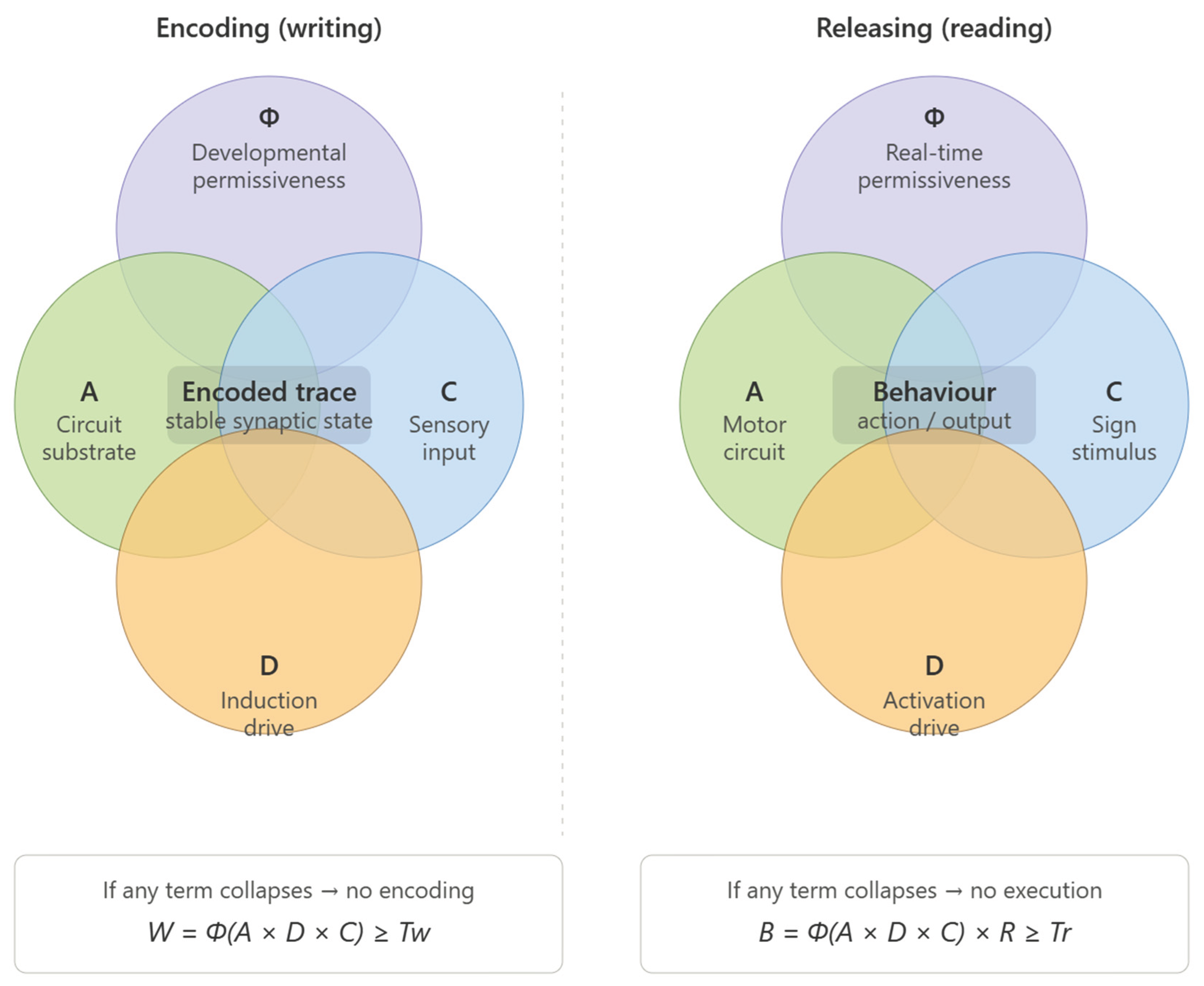
Disclaimer/Publisher’s Note: The statements, opinions and data contained in all publications are solely those of the individual author(s) and contributor(s) and not of MDPI and/or the editor(s). MDPI and/or the editor(s) disclaim responsibility for any injury to people or property resulting from any ideas, methods, instructions or products referred to in the content. |
© 2026 by the authors. Licensee MDPI, Basel, Switzerland. This article is an open access article distributed under the terms and conditions of the Creative Commons Attribution (CC BY) license (http://creativecommons.org/licenses/by/4.0/).
Copyright: This open access article is published under a Creative Commons CC BY 4.0 license, which permit the free download, distribution, and reuse, provided that the author and preprint are cited in any reuse.


