

Submitted:
22 May 2026
Posted:
25 May 2026
You are already at the latest version
Abstract
Direct compression is a widely used manufacturing method for solid oral dosage forms; however, its performance strongly depends on powder flowability, cohesiveness, and compactability, particularly in systems containing fine cohesive particles. This study investigated the influence of mixing time, fill level, and rotational speed on the properties of sodium naproxen–calcium carbonate blends and the resulting tablets prepared by direct compression. Powder blends were produced in a V-type mixer according to a central composite design, and the effects of process variables were evaluated using response surface methodology and analysis of variance. Blend properties were characterized by the angle of repose, angle of fall, and angle of difference, whereas tablet quality was assessed in terms of thickness, mass, active pharmaceutical ingredient content, and abrasiveness. Mixing time significantly affected the angle of difference, indicating changes in blend cohesiveness and flow uniformity, while fill level was identified as the main factor influencing active pharmaceutical ingredient content uniformity. Response surface analysis enabled identification of operating regions satisfying predefined criteria for blend homogeneity, active pharmaceutical ingredient content, and abrasiveness. The results provide guidance for optimization of direct compression processes involving cohesive pharmaceutical powders and support the application of Quality by Design principles in tablet manufacturing.
Keywords:
quality by design
; direct compression
; process optimization
; response surface methodology
; cohesive powders
1. Introduction
Direct compression (DC) is an attractive manufacturing method for solid oral dosage forms due to its simplified process flow, elimination of granulation steps, and potential for improved production efficiency. From a chemical engineering perspective, however, DC is highly sensitive to powder material properties, as unit operations such as feeding, conveying, blending, and die filling are performed without prior modification of particle structure. Consequently, powder flowability, cohesiveness, and compressibility directly govern process stability as well as critical quality attributes of the final tablets, including mass uniformity, content uniformity, and mechanical strength [1,2,3].
Sodium naproxen is a representative active pharmaceutical ingredient exhibiting particularly unfavourable processing characteristics, including fine particle size, high specific surface area, limited flowability, and poor compactability [4]. Similar challenges are associated with fine-grade calcium carbonate, widely used as a mineral filler, whose bulk behaviour is dominated by strong interparticle interactions rather than frictional forces [5]. Rheological studies of pharmaceutical powders consistently demonstrate that cohesion is the primary factor controlling bulk flow and handling behaviour, outweighing the influence of particle shape or friction coefficients [6,7]. As a result, blends of sodium naproxen with calcium carbonate represent one of the most demanding material systems for direct compression, especially at high drug loadings, where stable die filling and reproducible tablet mass become increasingly difficult to achieve [3,8].
From a powder engineering standpoint, mixing technology and the amount of mechanical energy introduced into cohesive systems are critical determinants of blend performance. Early fundamental studies on cohesive powder mixing highlighted the narrow operational window between insufficient dispersion and excessive energy input leading to segregation or particle structure alteration [9]. More recent investigations have shown that appropriately selected high-intensity mixing techniques, including vibratory mixing, can significantly improve content uniformity and compact mechanical strength in direct compression, even for extremely poorly flowing materials [10]. Such effects have also been reported for sodium naproxen systems combined with carbonate-based mineral fillers, where short, well-controlled mixing times enabled tablet quality comparable to that obtained via wet granulation, despite unfavourable raw-material flow properties [11].
To mitigate the adverse effects of powder cohesion on individual unit operations, a range of material and process engineering strategies has been proposed. These include the selection of excipients with favourable flow properties, the use of glidants, pre-blending approaches, and particle engineering techniques such as agglomeration, spray drying, or surface modification [3,12,13,14]. However, the effectiveness of these strategies is highly system-specific and strongly dependent on interactions between material attributes and process parameters, which complicates scale-up and the design of robust operating conditions [6,8]. In this context, Quality by Design (QbD) has increasingly been adopted as a structured framework for analysing and designing complex particulate processes. When interpreted from an engineering rather than a regulatory perspective, QbD provides a systematic approach to linking material properties, operating parameters, and product quality through risk analysis and experimental design [15,16,17]. The application of such tools enables identification of critical material attributes and process parameters governing mixing, flow, and compaction behaviour [18,19]. Related work in QbD-based blending and continuous direct compression also shows the value of design-space definition, predictive modelling, and process intensification, particularly when handling cohesive powders and variable raw materials [20,21,22,23].
In recent years, process analytical technologies and data-driven modelling have further expanded the QbD toolbox. Near-infrared spectroscopy and multivariate modelling have been used to monitor blend homogeneity, assess raw-material variability, and support adaptive process control in cohesive powder systems [24,25]. Likewise, continuous direct compression platforms and semi-continuous mini-blending approaches have demonstrated that robust performance at larger scale is possible, provided that process parameters are carefully tuned and material variability is accounted for [21,22,26]. These developments are particularly relevant for poorly flowing systems, where small changes in formulation or process conditions can strongly affect blend quality and downstream tablet performance.
Despite growing interest in this approach, its application to strongly cohesive powder systems combining poorly flowing active pharmaceutical ingredients with mineral fillers remains limited. Although numerous studies address sodium naproxen, calcium carbonate, powder mixing technologies, and QbD frameworks individually, there is a lack of integrated investigations that combine these aspects within a unified chemical engineering perspective on direct compression. In particular, the influence of mixing energy and mixing time on blend homogeneity, flowability, and compactibility of sodium naproxen–calcium carbonate systems, and the resulting implications for process stability and product quality, remain insufficiently understood. The present study aims to address this gap.
2. Results
2.1. Raw Materials
The first step in the project was to investigate the properties of raw materials for tablet production. The properties of the active pharmaceutical ingredient (sodium naproxen) and the excipients used in the formulation are summarized in Table 1. Flow properties were assessed by measuring the angle of repose, angle of fall, and angle of difference, which provide insight into powder cohesiveness and flowability. Sodium naproxen and microcrystalline cellulose exhibited relatively high angles of repose (45.9° and 44.6°, respectively), indicating moderate cohesiveness and potential challenges in flow during handling. In contrast, calcium carbonate displayed a lower angle of difference (13.3°), suggesting better flowability and confirming its suitability as a primary diluent in tablet formulations. Polyvinylpyrrolidone (PVP) showed a small particle size (d(0.5) = 21 µm) and moderate flow angles, consistent with its role as a binder requiring good dispersibility. Aerosil®200 presented an ultrafine particle size (0.012 µm, according to the manufacturer), which explains its high surface area and efficiency as a lubricant, despite the absence of measurable flow parameters.
Particle size distributions further indicate that calcium carbonate has the finest particles, whereas sodium naproxen and cellulose have broader distributions, which may influence powder compressibility, blend uniformity, and tablet homogeneity. Collectively, these data provide a foundation for predicting the handling behavior, mixing efficiency, and compaction performance of the powder blends during tablet production.
2.2. Design of Experiment
A Central Composite Design (CCD) was employed to investigate the effect of three process parameters on tablet properties. The total number of runs in CCD is given by equation 1:
where k is the number of factors and C0 the number of center points. For three factors, mixing time (5, 12.5, 20 min), fill level (25%, 40%, 55%), and rotational speed (10, 20, 30 rpm) and three center points including one replicate, the total number of runs is N=17.
N = 2k + 2k + 3 + C0,
Factor levels were selected based on prior knowledge: mixing time affects blend homogeneity; fill level influences granulation and flow; rotational speed controls shear forces impacting particle size and tablet mechanical properties.
Responses measured included angle of repose, angle of fall, angle of difference, average tablet thickness and mass, API content, and tablet abrasiveness, all reported with standard deviations to account for measurement variability.
This CCD enables efficient estimation of main, interaction, and quadratic effects while providing a reliable assessment of process reproducibility.
Analysis of the results demonstrates that powder flow properties were influenced differently by each factor. The angle of repose ranged from 49.2° to 53.6°, with the highest values observed at longer mixing times combined with high rotational speeds, suggesting increased cohesiveness under these conditions. Lower fill levels tended to slightly reduce the angle of repose, improving flowability. The angle of fall and angle of difference followed similar trends, indicating that both the packing of the powder and the interparticle interactions were affected by the processing conditions. Notably, combinations of high fill level and low mixing time produced higher angles of difference, reflecting less uniform powder distribution.
Tablet characteristics also showed clear dependencies on the process parameters. Average tablet thickness varied from 3.130 mm to 3.498 mm, with longer mixing times and higher fill levels generally producing thicker tablets due to improved homogeneity and powder consolidation. Tablet mass followed similar trends, increasing with fill level and mixing time. API content remained relatively consistent, with values ranging from 0.0419 g to 0.1333 g per tablet. Deviations in API content were most pronounced under conditions of low mixing time and high fill level, indicating local inhomogeneities in the blend. Tablet abrasiveness was particularly sensitive to fill level, with the highest abrasiveness observed at high fill levels combined with low mixing time, likely due to insufficient binder distribution and weaker interparticle bonding. Conversely, tablets produced under intermediate conditions or longer mixing times exhibited lower abrasiveness, demonstrating improved mechanical integrity.
The results indicate that mixing time is crucial for blend homogeneity, fill level significantly influences tablet mass, thickness, and abrasiveness, and rotational speed affects powder cohesiveness and flow, particularly when combined with other factors. These findings provide a comprehensive understanding of the process–property relationships, offering guidance for optimizing manufacturing conditions to ensure consistent and reproducible tablet performance.

Table 2.
Effect of process parameters on the physical properties of blends and tablets.
| Run | Mixing Time [min] | Fill Level [%] | Rotational Speed [rpm] | Angle of repose [deg] ±SD | Angle of fall [deg] ±SD | Angle of difference [deg] ±SD | Average tablet thickness [mm] ±SD | Average tablet mass [mm] ±SD | API content in a tablet [g] ±SD | Abrasiveness of tablets [%] ±SD |
|---|---|---|---|---|---|---|---|---|---|---|
| 1 | 5 | 25 | 10 | 50.6 ±0.97 | 28.3 ±0.37 | 22.3 ±0.52 | 3.254 ±0.113 | 0.229 ±0.011 | 0.066830 ±0.001384 | 0.485 ±0.035 |
| 2 | 20 | 25 | 10 | 50.2 ±0.64 | 24.0 ±0.27 | 26.2 ±0.56 | 3.433 ±0.210 | 0.247 ±0.023 | 0.054367 ±0.002586 | 1.072 ±0.099 |
| 3 | 5 | 55 | 10 | 50.2 ±0.90 | 22.1 ±0.39 | 28.1 ±0.67 | 3.239 ±0.201 | 0.218 ±0.016 | 0.041903 ±0.001371 | 3.727 ±0.244 |
| 4 | 20 | 55 | 10 | 51.0 ±0.63 | 24.2 ±0.41 | 26.8 ±0.71 | 3.409 ±0.111 | 0.239 ±0.014 | 0.046057 ±0.001211 | 0.988 ±0.089 |
| 5 | 5 | 25 | 30 | 50.7 ±0.56 | 26.8 ±0.28 | 23.9 ±0.61 | 3.498 ±0.076 | 0.253 ±0.010 | 0.054367 ±0.002515 | 1.185 ±0.117 |
| 6 | 20 | 25 | 30 | 53.6 ±0.74 | 24.9 ±0.28 | 28.7 ±0.74 | 3.130 ±0.131 | 0.192 ±0.058 | 0.050212 ±0.001555 | 1.101 ±0.090 |
| 7 | 5 | 55 | 30 | 51.8 ±0.58 | 27.9 ±0.47 | 23.9 ±0.52 | 3.245 ±0.057 | 0.226 ±0.013 | 0.075140 ±0.003277 | 0.556 ±0.054 |
| 8 | 20 | 55 | 30 | 51.7 ±0.54 | 25.0 ±0.44 | 26.7 ±0.59 | 3.318 ±0.039 | 0.222 ±0.005 | 0.112531 ±0.005521 | 0.741 ±0.037 |
| 9 | 12.5 | 40 | 20 | 51.1 ±0.61 | 25.5 ±0.39 | 25.6 ±0.61 | 3.325 ±0.097 | 0.220 ±0.011 | 0.104222 ±0.004835 | 1.137 ±0.110 |
| 10 | 12.5 | 25 | 20 | 51.6 ±0.90 | 23.4 ±0.33 | 28.2 ±0.57 | 3.361 ±0.087 | 0.227 ±0.009 | 0.075140 ±0.003671 | 0.581 ±0.037 |
| 11 | 12.5 | 55 | 20 | 51.7 ±1.00 | 24.2 ±0.29 | 27.5 ±0.68 | 3.406 ±0.067 | 0.235 ±0.009 | 0.100068 ±0.003915 | 0.362 ±0.023 |
| 12 | 12.5 | 40 | 10 | 51.1 ±0.52 | 25.8 ±0.35 | 25.3 ±0.57 | 3.373 ±0.044 | 0.231 ±0.005 | 0.133304 ±0.004688 | 0.582 ±0.051 |
| 13 | 12.5 | 40 | 30 | 50.7 ±0.72 | 24.5 ±0.45 | 26.2 ±0.62 | 3.391 ±0.067 | 0.221 ±0.008 | 0.133304 ±0.006082 | 0.604 ±0.046 |
| 14 | 5 | 40 | 20 | 49.2 ±0.80 | 25.4 ±0.44 | 23.8 ±0.67 | 3.392 ±0.114 | 0.233 ±0.012 | 0.133304 ±0.004415 | 0.422 ±0.024 |
| 15 | 20 | 40 | 20 | 49.9 ±0.69 | 21.7 ±0.36 | 28.2 ±0.57 | 3.348 ±0.124 | 0.230 ±0.014 | 0.066830 ±0.002464 | 0.721 ±0.039 |
| 16 | 12.5 | 40 | 20 | 51.4 ±0.71 | 25.1 ±0.38 | 26.3 ±0.65 | 3.387 ±0.080 | 0.234 ±0.009 | 0.066830 ±0.002376 | 0.305 ±0.025 |
| 17 | 12.5 | 40 | 20 | 51.7 ±0.75 | 25.3 ±0.40 | 26.7 ±0.70 | 3.400 ±0.085 | 0.242 ±0.010 | 0.068000 ±0.002500 | 0.310 ±0.027 |
2.3. Blend Properties
The response surface analysis revealed distinct effects of mixing time, fill level, and rotational speed on powder flowability parameters.
For the angle of repose (Figure 1), values ranged from approximately 49° to 54°. Higher angles were obtained under conditions of extended mixing time combined with elevated rotational speed, indicating increased powder cohesiveness. This behavior may be attributed to partial agglomeration or intensified interparticle interactions caused by prolonged shear. In contrast, reduced fill levels were consistently associated with smaller angles of repose, reflecting improved blend flowability.
In the case of the angle of fall (Figure 2), values varied between 22° and 28°. The dominant effect was exerted by fill level, where higher values promoted more efficient particle rearrangement and improved packing. Short mixing times, particularly at low fill levels, produced elevated angles of fall, signifying poorer particle mobility and reduced uniformity of the blends.
Regarding the angle of difference (Figure 3), the results showed the highest sensitivity to process variations, with values spanning 22° to 29°. Maximal differences occurred under conditions of high mixing time combined with low fill level, suggesting inadequate powder distribution and heterogeneity in flow behavior. Conversely, intermediate parameter settings produced lower angle differences, indicative of more stable and reproducible flow characteristics.
These findings confirm that process variables significantly influence blend properties. Moderate conditions ensure balanced flowability, while extreme parameter combinations, particularly long mixing times with low fill or high rotational speed tend to increase cohesiveness and variability, which may compromise downstream processing efficiency.
2.4. Tablet Properties
The response surface methodology demonstrated that tablet characteristics were strongly influenced by the studied process variables, with distinct trends observed for thickness, mass, API content, and abrasiveness.
With respect to tablet thickness (Figure 4), values ranged from approximately 3.13 mm to 3.50 mm. Increased fill levels and longer mixing times generally produced thicker tablets, suggesting more efficient die filling and improved powder consolidation. By contrast, shorter mixing times combined with low fill levels yielded thinner compacts, reflecting insufficient homogeneity of the powder blend.
For tablet mass (Figure 5), variations followed a similar pattern, spanning from 0.192 g to 0.253 g. Fill level exerted the most pronounced effect, with higher levels consistently associated with increased mass. Moderate mixing times supported stable mass distribution, whereas extreme combinations (very low or very high shear) introduced variability, indicative of irregular die filling and potential segregation.
Concerning API content uniformity (Figure 6), the values per tablet ranged from 0.0419 g to 0.1333 g. The most stable SD of API distribution was obtained under intermediate mixing times and rotational speeds, conditions that ensured sufficient blending without promoting segregation (Figure 7). In contrast, short mixing times at high fill levels produced marked deviations, pointing to incomplete dispersion of the active ingredient within the excipient matrix.
Tablet abrasiveness (Figure 8) exhibited the widest variability, with values spanning 0.3% to 3.7%. The most critical determinant was fill level: high fill levels in combination with short mixing times resulted in highly fragile tablets, likely due to inadequate binder distribution and insufficient interparticle bonding. Conversely, intermediate process conditions minimized abrasiveness, yielding mechanically more robust compacts suitable for further handling.
Overall, these results highlight that process variables must be carefully balanced to achieve desirable tablet properties. While increased fill levels enhance mass and thickness, they simultaneously pose risks for API inhomogeneity and reduced mechanical strength if not coupled with adequate mixing. The CCD approach thus provided valuable insights into parameter optimization to ensure both uniformity and robustness of the final dosage form.
2.5. Response Surface Analysis of Tablet Properties
The relationships between the three process variables - mixing time (MT, min), fill level (FL, %), and rotational speed (RS, rpm) - and seven critical tablet properties were modeled using second-order polynomial regression. Each dependent variable Y is described by equation 2:
where β0 is the intercept, βMT, βFL, βRS, represent linear effects of each process variable, βMT2, βFL2, βRS2 represent quadratic (nonlinear) effects, βMF, βMR, βFR are interaction terms, and ε is the residual error.
The angle of repose quantifies powder flowability (Equation 3). Linear coefficients indicate that increasing mixing time enhances flowability, whereas higher fill level and rotational speed reduce it slightly. Quadratic and interaction terms capture subtle curvature and combined effects. Surface plots reveal that at low rotational speeds (10 rpm), the angle increases with longer mixing times and moderate fill levels, while high rotational speeds (30 rpm) lower the overall angle. Contours indicate that Fill Level has a nonlinear effect, strongest at intermediate levels.
The angle of fall reflects powder settling behavior and cohesion (Equation 4). Rotational speed has the strongest negative effect, decreasing the angle as speed increases. Surface plots show that at higher fill levels, the angle slightly increases, while longer mixing times marginally reduce it. Interaction terms manifest as slight tilts in the surfaces, showing that the combined influence of mixing and rotation modifies the cohesion.
The angle of difference measures powder cohesiveness (Equation 5). Surface plots demonstrate that longer mixing times and higher rotational speeds increase cohesion. Fill Level has a minor nonlinear effect, observable as a gentle curvature in the surfaces. Interaction terms indicate that the effect of one variable is slightly modulated by the level of the other, producing subtle tilts and curvatures on the surface.
Tablet thickness is moderately influenced by rotational speed and marginally by mixing time (Equation 6). Surface plots indicate an overall increase in thickness with higher rotational speeds. Contours remain relatively parallel, suggesting limited nonlinear interactions, although small curvatures show that extreme combinations of mixing time and rotation produce slight deviations from linearity.
Tablet mass reflects powder quantity per tablet (Equation 7). Linear coefficients are small, but surface plots reveal that rotational speed slightly increases mass, whereas mixing time and fill level reduce it slightly. Quadratic and interaction terms introduce gentle curvatures, visible as small bends in the surface contours.
API content ensures dosage uniformity (Equation 8). Surface plots indicate that fill level and mixing time slightly increase API content, while higher rotational speeds have a minor reducing effect. Contours and gradient colors illustrate that these effects are additive and moderately linear, with slight nonlinearities arising from interaction terms.
The abrasive properties of the powder system increase mechanical wear of tablet press tooling and related process equipment. (Equation 9). Surface plots show a strong negative effect of mixing time, reducing abrasiveness, while fill level increases it. Rotational speed moderately reduces abrasiveness. Contours highlight that interactions, especially between mixing time and rotational speed, produce curved regions, indicating complex combined effects of process parameters on tablet abrasiveness.
Across all surfaces, rotational speed consistently shifts surfaces, usually in the negative direction for flow and cohesiveness measures. Mixing time often increases angles of repose and difference, while Fill Level exhibits non-linear effects that are most pronounced at intermediate levels. Contours on each surface illustrate these interactions and nonlinearities, making response surface plots a valuable tool for process optimization and understanding the interplay of factors. A quadratic model (RSM) was fitted for all responses, and the quality of the fit was assessed based on the coefficient of determination R², which varied depending on the variable analyzed. The highest value was obtained for the angle of repose, R² = 0.895, indicating a very good model fit, while a moderate fit was observed for the average tablet weight, R² = 0.769, average tablet thickness R² = 0.721, abrasion R² = 0.706, and angle of repose R² = 0.673, and slightly lower values for the angle of flow R² = 0.639 and API content R² = 0.587, suggesting that the model best describes the variability of the angle of difference, and least well the API content.
2.6. Statistical Analysis (ANOVA)
One-way ANOVA was performed to quantify the effect of individual process variables, mixing time, fill level, and rotational speed on both blend and tablet properties.
For powder mixture properties (Table 3, Figure 9) no statistically significant influence of the studied factors was observed on the angle of repose or angle of fall (p > 0.05). Mean values for the angle of repose remained consistent across all categories (≈50–52°), while the angle of fall showed slightly lower values at longer mixing times (≈23°) compared with shorter mixing durations (≈26°). In contrast, a significant effect of mixing time was identified for the angle of difference (p = 0.0245). Short mixing times (5 min) yielded the lowest values (≈24°), whereas longer mixing times (12.5–20 min) resulted in elevated differences (≈27–28°), suggesting that extended shear promotes less uniform powder flow. Neither fill level nor rotational speed showed significant effects on this parameter.
In the case of tablet properties (Table 4, Figure 10) most responses were not significantly affected by the process variables. Average thickness and mass were highly consistent across all conditions, with no statistical differences (p > 0.05). API content, however, was significantly influenced by fill level (p = 0.0411). The highest values were observed at intermediate fill levels (40%), reaching up to 0.133 g per tablet, whereas both low (25%) and high (55%) fill levels showed lower API contents, reflecting potential segregation effects. Tablet abrasiveness exhibited large variability, but differences across process conditions did not reach statistical significance. Nonetheless, a tendency toward higher abrasiveness was observed at high fill levels (mean ≈16%) and at the lowest rotational speed (mean ≈15%), indicating suboptimal binder distribution and weaker interparticle bonding under these conditions.
The ANOVA results confirm that most process parameters exert limited effects on blend and tablet properties within the tested range. The key exception is the influence of mixing time on blend flow uniformity (angle of difference) and of fill level on API content, both of which highlight critical aspects of process optimization. These findings emphasize that robust manufacturing requires careful adjustment of mixing and filling parameters to minimize variability and ensure consistent product quality.
2.7. The Optimization of Process
The optimization of pharmaceutical powder blending processes requires a thorough understanding of the relationships between process parameters and critical quality attributes (CQAs). In this study, a systematic design space analysis was conducted to evaluate the effects of mixing time (MT), fill level (FL), and rotational speed (RS) on key product characteristics, including active pharmaceutical ingredient (API) content, angle of difference, and abrasiveness. Quadratic response surface models (RSM) were developed based on experimental central composite design data, enabling the prediction of process outcomes across a wide range of operating conditions.
Acceptance criteria were defined a priori based on technological performance requirements. Adequate blend homogeneity was ensured by requiring the predicted angle of difference to remain below 27°. API content was constrained to lie within ±5% of the experimental mean API value, reflecting acceptable assay variability. Abrasiveness values were limited to a maximum of 1.0 to avoid excessive mechanical degradation of the material. Only operating conditions simultaneously fulfilling all three criteria were considered acceptable for further analysis.
To enable ranking and visualization of acceptable operating conditions, individual desirability functions were defined for each response variable. Linear desirability functions with hard cutoffs were employed. These functions map predicted responses onto a dimensionless scale between 0 (unacceptable) and 1 (fully desirable). The formulation was intentionally kept simple and transparent and does not represent the classical Harrington log–exponential desirability function.
API content was treated as a target response, with maximum desirability assigned to the experimental mean API value. Desirability decreased linearly with increasing deviation from the target and reached zero at ±5% deviation (Equation 10):
For angle of difference, a minimization-type desirability function was applied by equation 11:
Predicted values exceeding 27° were assigned zero desirability. A similar linear desirability function was used for abrasiveness (Equation 12):
The overall desirability was calculated as the unweighted product of the individual desirability functions (Equation 13):
All responses were assigned equal importance. Operating points that failed to meet at least one acceptance criterion were assigned an overall desirability of zero.
The three-dimensional operational design space was defined as the set of all combinations of mixing time, fill level, and rotational speed for which all acceptance criteria were satisfied. The desirability function was used exclusively to rank and visualize acceptable operating points within this region and did not influence the shape or boundaries of the operational window.
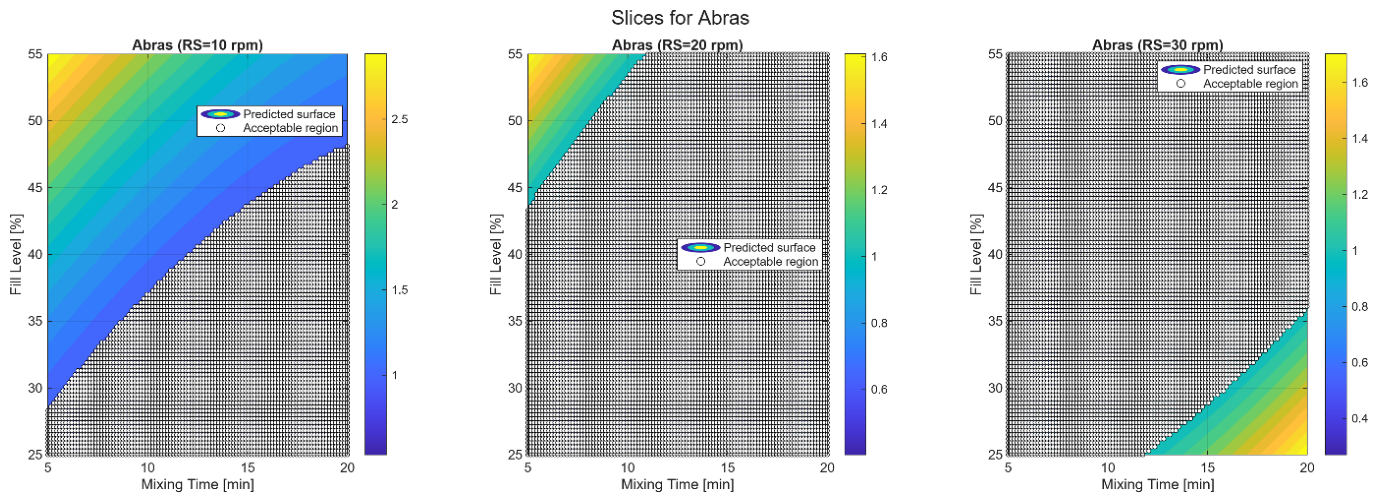
The contour plots representing the design space at discrete rotational speeds of 10, 20, and 30 rpm (Figure 11 and Figure 12) illustrate the influence of process parameters on compliance with pharmacopeial criteria. At a rotational speed of 10 rpm, the acceptable operational region is concentrated at lower mixing times, approximately 5–12 minutes, and fill levels between 25% and 40%, indicating that reduced mechanical energy requires tighter control of mixing duration and fill volume to maintain uniformity and prevent excessive abrasion. At 20 rpm, the acceptable region expands toward longer mixing times of 8–18 minutes and fill levels of 30%–50%, reflecting the increased mixing efficiency that permits a wider range of operational conditions while still satisfying all quality criteria. At the highest rotational speed of 30 rpm, the contour plot reveals that acceptable conditions are predominantly located at intermediate mixing times of 12–20 minutes and higher fill levels of 35%–55%, demonstrating that elevated rotational speed shifts the operational window toward longer mixing times and larger batch volumes, while maintaining compliance with pharmacopeial specifications. Across all three levels of rotational speed, the contour plots indicate that the interplay between mixing time and fill level is critical, and that careful selection of these parameters is required to ensure consistent API content, controlled particle uniformity, and minimal abrasiveness. These findings provide practical guidance for process design and optimization, identifying precise operational windows at each rotational speed that enable robust production and regulatory compliance.
Figure 11.
Contour plot showing acceptable regions of API content of tablets. .
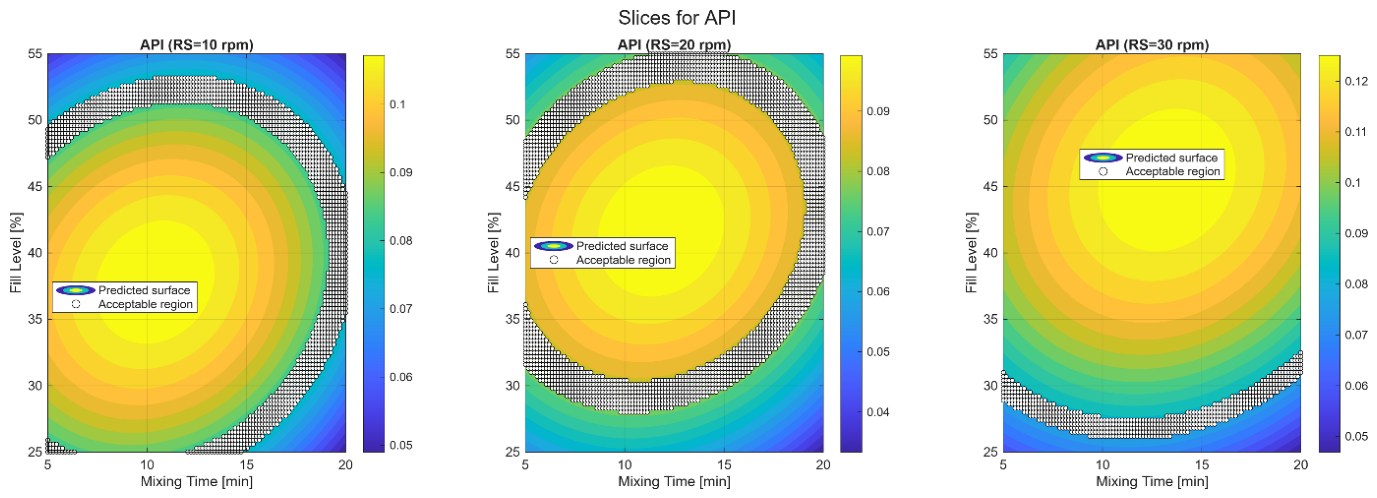
Figure 12.
Contour plot showing acceptable regions of particle angle of difference.
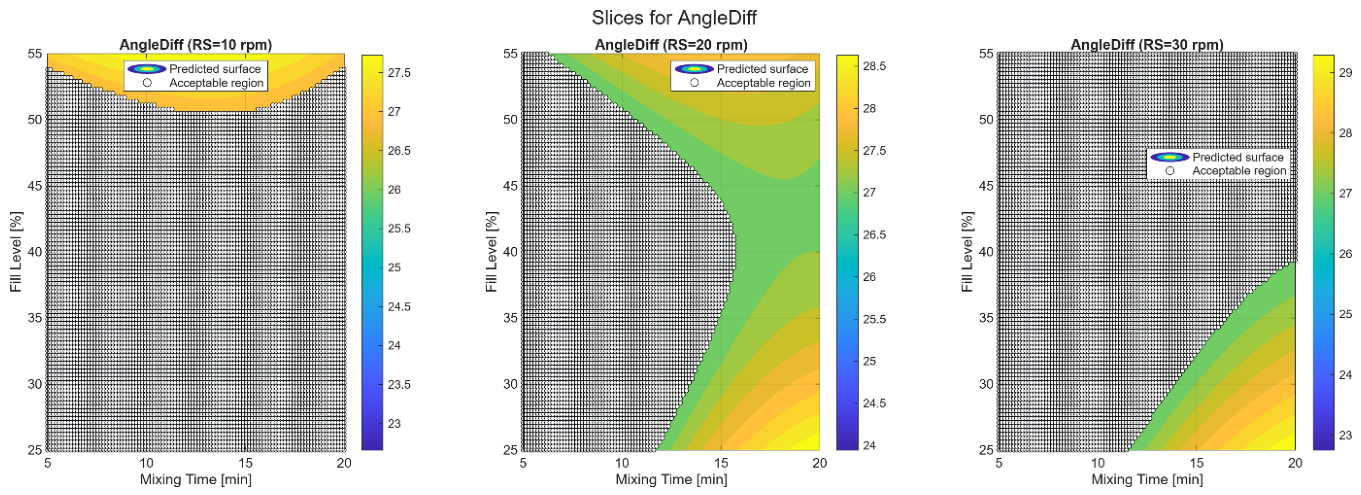
Figure 13.
Contour plot showing acceptable regions of abrasiveness of tablets.
The three-dimensional design space (Figure 14) for the powder mixing process, defined according to pharmacopeial criteria of API content (±5% of the mean), particle angle difference (≤27°), and abrasiveness (≤1%), exhibits a complex and non-uniform geometry. Two distinct regions of acceptable operation are observed, corresponding to separate combinations of process parameters that satisfy all quality requirements. The lower region is associated with a rotational speed of approximately 10–15 rpm, mixing times between 5 and 12 minutes, and fill levels ranging from 25% to 40%. The upper region corresponds to higher rotational speeds of 20–30 rpm, mixing times of 12–20 minutes, and similar fill levels of 35–55%. These findings indicate that compliance with pharmacopeial specifications is governed by the interaction between all three process variables, rather than by any single factor independently. The partially transparent surfaces in the visualization represent the isosurface of acceptable points; variations in apparent intensity are attributable to the superposition of surface layers and the applied lighting, rather than differences in the density of acceptable points. From a practical perspective, the identified regions define operational windows that ensure consistent API content, maintain particle uniformity, and prevent excessive abrasion. Process operation within the specified ranges, specifically a mixing time of 8–18 minutes, fill levels of 30–50%, and rotational speeds of 10–30 rpm, provides a robust and flexible framework for maintaining product quality while accommodating variations in process conditions. These results provide clear guidance for process optimization and control, facilitating the selection of parameter sets that maximize product consistency and compliance with regulatory standards.
All experiments were performed using small tablets with a diameter of 8 mm. This tablet size was deliberately selected to ensure sufficient mechanical sensitivity and to allow subsequent extrapolation of the obtained operational design space toward larger tablet sizes. The applicability of the identified operating window to smaller tablets is not expected, due to fundamentally different stress transmission and contact mechanics at reduced dimensions.
3. Discussion
The present study indicates that the behaviour of the sodium naproxen–calcium carbonate formulation is governed primarily by the interplay between mixing time and fill level, rather than by a strong main effect of rotational speed within the tested operating window. In particular, the angle of difference was the only powder-flow descriptor that showed a statistically significant dependence on mixing time, whereas fill level was the only factor that significantly affected API content. By contrast, tablet thickness and mass remained comparatively stable across the experimental domain, suggesting that the formulation preserved acceptable compressibility under the conditions studied. Tablet abrasiveness showed the widest numerical variability and tended to increase under high fill levels combined with short mixing times, which is consistent with insufficient homogenization and less effective binder distribution.
These findings are in line with the broader literature indicating that blend uniformity in direct compression is highly sensitive to cohesive behaviour and to the mechanical history of the powder bed. Reviews on continuous direct compression and powder segregation emphasize that losses in content uniformity often originate during blend transfer, hopper discharge, and die filling rather than from a single formulation variable alone [1,8,28]. The present results, particularly the significant influence of fill level on API content, support this interpretation and suggest that blender loading should be treated as a critical process variable when cohesive materials are processed by direct compression [28].
The choice of mixing technology strongly influenced the homogeneity and quality of sodium naproxen tablets. High-energy or vibratory mixing can improved blend homogeneity and API distribution relative to low-energy tumbling, whereas excessive mechanical input could introduce local over-processing and variability in tablet properties [10]. This aligns well with the present work, in which the tested blending window produced only modest changes in the simple flow indices but still affected blend cohesiveness and dosage uniformity in a process-dependent manner.
From a Quality by Design perspective, the results support a conservative interpretation of the operating space rather than a single universal optimum. Yeom and Choi demonstrated, using a QbD–DEM framework, that the effective blending window may shift after scale-up and that pilot-scale conditions can require shorter blending times than laboratory-scale settings to meet target values [21]. Similarly, process-modelling studies in Pharmaceutics have shown that direct compression requires adequate flow, blend uniformity, compaction behaviour, and ejection properties, and that tablet weight variability can remain sensitive to process assumptions even when the formulation appears robust at bench scale [29]. In the present study, the two acceptable regions identified in the design space indicate that multiple combinations of mixing time, fill level, and rotational speed can satisfy the selected acceptance criteria, but only within a limited and non-linear operating window.
Importantly, the present data also indicate that improved blend homogeneity does not automatically translate into lower abrasiveness. This is an important practical point because cohesive powders may respond favourably in terms of content distribution while still showing signs of mechanical degradation under overly aggressive processing conditions. Such trade-offs are well recognised in powder engineering and support the use of a QbD-based strategy in which flowability, content uniformity, and mechanical integrity are evaluated together rather than independently [1,6,15,16,28]. Within that framework, the present study suggests that mixing time primarily contributes to blend stabilisation, whereas fill level exerts a stronger influence on dose distribution. The resulting process window may therefore be useful for balancing homogeneity and robustness in cohesive direct-compression formulations.
Overall, the results extend previous work on sodium naproxen direct-compression systems by showing that, for this formulation, the most relevant optimisation lever is not a single mixer setting but the combined selection of mixing time and fill level. The data further support the view that cohesive systems require process development strategies that are formulation-specific and scale-aware, especially when the goal is to maintain both dosage uniformity and acceptable mechanical performance [10,28,29].
4. Materials and Methods
4.1. Materials
The formulation was composed of sodium naproxen (Divi’s Laboratories, Hyderabad, India), calcium carbonate (Chmpur, Piekary Śląskie, Poland), microcrystalline cellulose (FMC BioPolymer, Philadelphia, PA, USA), polyvinylpyrrolidone, and magnesium stearate (both from Sigma-Aldrich, St. Louis, MO, USA). All raw materials were of analytical grade. The blend consisted of 20 wt.% sodium naproxen, 68 wt.% calcium carbonate as the main diluent, 8.5 wt.% microcrystalline cellulose serving as filler and disintegrant, 3 wt.% polyvinylpyrrolidone as binder, and 0.5 wt.% silica, Aerosil®200 (Evonik, Germany) as lubricant.
4.2. Methods for Determining the Properties of Raw Materials, Blends, and Tablets
The characteristics of raw powders and formulation blends were evaluated using a pharmacopoeia-compliant powder tester (PT-S Powder Tester, Hosokawa Micron B.V., Doetinchem, The Netherlands). The analyses comprised determination of the angle of repose, angle of fall, and angle of difference. Particle size of the raw materials was assessed by laser diffraction with wet dispersion (Mastersizer 2000 Hydro MU, Malvern Instruments, Malvern, UK), performed in accordance with ISO 13320-1:1999 [27].
Tablet weight was measured using an analytical balance (Pioneer PX224, Ohaus, Greifensee, Switzerland), while thickness was determined with a digital caliper (0.01 mm resolution) based on 20 tablets per batch. All determinations were performed in quadruplicate. Tablet friability was examined using a rotating drum mixer (CE 245, GUNT, Barsbüttel, Germany). Approximately 50 g of tablets was subjected to 200 rpm rotation for 5 min in a 1.15 dm³ drum. The residues collected on a 500 µm sieve were weighed, and abrasiveness was expressed as the percentage of the initial mass. Each test was conducted in four replicates.
The content of the active pharmaceutical ingredient (API) was quantified using a laboratory refractometer (RX 5000, ATAGO CO., Tokyo, Japan). Individual tablets were placed in 50 mL round-bottom flasks, subjected to continuous agitation for 24 h, and filtered through 2 µm syringe filters prior to measurement of the refractive index. Ten replicates were performed to ensure analytical reliability.
4.3. Preparation of Powder Blends and Tablets
Powder mixtures were homogenized in a V-type tumble mixer (chamber capacity 750 cm³, CDK, Gliwice, Poland). Tablet compaction was performed using a manual single-punch press TDP 0 (LFA Machines Oxford LTD, Oxfordshire, UK). Compression was carried out with 6 mm concave punches with beveled edges, the upper punch containing a score line to enable subdivision. Each tablet was produced under a constant compression force of 3.5 kN.
4.4. Quality by Design Framework
A QbD framework was applied to systematically evaluate the influence of process parameters on blend and tablet quality attributes. The approach was based on identification of critical process parameters (CPPs), including mixing time, fill level, and rotational speed, and their relationship with critical quality attributes (CQAs) of the final product. The investigated CQAs included powder flow characteristics expressed by the angle of repose, angle of fall, and angle of difference, as well as tablet thickness, mass, active pharmaceutical ingredient (API) content, and abrasiveness.
A Central Composite Design (CCD) combined with Response Surface Methodology (RSM) was employed to establish quantitative relationships between process variables and measured responses. Experimental results were analyzed using second-order polynomial models to identify the main, interaction, and quadratic effects of the investigated parameters. Statistical significance of the factors was evaluated using analysis of variance (ANOVA).
Based on the obtained models, a design space defining acceptable operating conditions was established according to predefined quality criteria for blend homogeneity, API content uniformity, and tablet abrasiveness. The QbD framework enabled systematic assessment of process robustness and supported identification of operating regions ensuring reproducible product quality during direct compression processing.
5. Conclusions
The results demonstrated that process parameters exert highly selective and property-specific effects rather than uniform influences across all critical quality attributes. In particular, mixing time was identified as the dominant factor governing blend homogeneity, as reflected by the angle of difference, while fill level primarily controlled active pharmaceutical ingredient content uniformity. Rotational speed showed secondary but non-linear effects, particularly in combination with other variables, influencing both flow behaviour and tablet mechanical performance.
Importantly, the application of response surface methodology enabled the definition of a robust and experimentally validated design space for direct compression of a highly cohesive powder system. Two distinct operational regions satisfying all predefined quality criteria were identified, demonstrating that acceptable product quality can be achieved through different combinations of process parameters rather than a single optimal point.
These findings fill an important gap between empirical powder blending studies and systematic process design approaches. They provide a mechanistic understanding of how mixing energy distribution affects cohesion-driven segregation and consolidation phenomena in direct compression. From a practical perspective, the results support the implementation of Quality by Design principles in the development and scale-up of cohesive powder formulations, enabling more predictable and robust manufacturing of solid dosage forms.
Author Contributions
Conceptualization, M.P.; methodology, M.P. and P.L.; software, M.P., and P.L.; validation, M.P.; formal analysis, M.P. and P.L.; investigation, M.P.; resources, M.P.; data curation, M.P.; writing—original draft preparation, M.P.; writing—review and editing, M.P.; visualization, M.P.; supervision, M.P. and P.L.; project administration, M.P. All authors have read and agreed to the published version of the manuscript.
Funding
Financed by the Minister of Science and Higher Education Republic of Poland within the program “Regional Excellence Initiative”, agreement no. RID/SP/0032/2024/01.
Institutional Review Board Statement
Not applicable.
Informed Consent Statement
Not applicable.
Data Availability Statement
The data that support the findings of this study are available from the corresponding author upon reasonable request.
Conflicts of Interest
The authors declare no conflicts of interest.
References
- Jones-Salkey, O.; Chu, Z.; Ingram, A.; Windows-Yule, C.R.K. Reviewing the impact of powder cohesion on continuous direct compression performance. Pharmaceutics 2023, 15, 1587. [Google Scholar] [CrossRef]
- Leung, L.Y.; Mao, C.; Srivastava, I.; Du, P.; Yang, C. Flow function of pharmaceutical powders is predominantly governed by cohesion, not by friction coefficients. J. Pharm. Sci. 2017, 106, 257–264. [Google Scholar] [CrossRef]
- Lindberg, N.; Pålsson, M.; Pihl, A.; Freeman, R.; Freeman, T.; Zetzener, H.; Enstad, G. Flowability measurements of pharmaceutical powder mixtures with poor flow using five different techniques. Drug Dev. Ind. Pharm. 2004, 30, 785–791. [Google Scholar] [CrossRef]
- Al-Zoubi, N.; Odeh, F.; Partheniadis, I.; Gharaibeh, S.; Nikolakakis, I. Spray drying of naproxen and naproxen sodium for improved tableting and dissolution. Pharm. Dev. Technol. 2021, 26, 212–224. [Google Scholar] [CrossRef]
- Garg, V.; Mallick, S.; García-Triñanes, P.; Berry, R.J. Investigation into flowability of fine powders used in pharmaceutical industries. Powder Technol. 2018, 336, 237–250. [Google Scholar] [CrossRef]
- Capece, M.; Silva, K.; Sunkara, D.; Strong, J.; Gao, P. Relationship of inter-particle cohesiveness and bulk powder behavior. Int. J. Pharm. 2016, 511, 664–674. [Google Scholar] [CrossRef]
- Brubaker, J.; Moghtadernejad, S. A comprehensive review of the rheological properties of powders in pharmaceuticals. Powders 2024, 3, 215–241. [Google Scholar] [CrossRef]
- Jones-Salkey, O.; Chu, Z.; Ingram, A.; Windows-Yule, C.R.K. Reviewing the impact of powder cohesion on continuous direct compression performance. Pharmaceutics 2023, 15, 1587. [Google Scholar] [CrossRef] [PubMed]
- Shotton, E.; Orr, N. Studies on mixing cohesive powders. J. Pharm. Pharmacol. 1971, 23, 1–6. [Google Scholar] [CrossRef] [PubMed]
- Przywara, M.; Lech-Przywara, R.; Rupar, P.; Zapała, W. Effect of mixing technology on homogeneity and quality of sodium naproxen tablets. Molecules 2025, 30, 3119. [Google Scholar] [CrossRef]
- Przywara, M.; Jękot, K.; Jednacz, W. Evaluation of vibratory ball mill mixing as an alternative to wet granulation in sodium naproxen tablets. Appl. Sci. 2025, 15, 6966. [Google Scholar] [CrossRef]
- Shah, D.; Moravkar, K.; Jha, D.; Lonkar, V.; Amin, P.; Chalikwar, S. Powder processing methodologies for flow enhancement. Heliyon 2023, 9, e16498. [Google Scholar] [CrossRef]
- Maghsoodi, M.; Taghizadeh, O.; Martin, G.P.; Nokhodchi, A. Particle design of naproxen–disintegrant agglomerates for direct compression. Int. J. Pharm. 2008, 351, 45–54. [Google Scholar] [CrossRef]
- Verbeek, T.; De Man, A.; Snick, B.; Otava, M.; Vervaet, C.; Vanhoorne, V. Impact of glidants on rheological properties of APIs. Int. J. Pharm. 2025, 654, 125121. [Google Scholar] [CrossRef] [PubMed]
- Amidon, G.L.; Polli, J.E.; Woodcock, J.; Yu, L.X.; Khan, M.A.; Hoag, S.W.; Raju, G. Understanding pharmaceutical Quality by Design. AAPS J. 2014, 16, 771–783. [Google Scholar] [CrossRef]
- Grangeia, H.B.; Silva, C.; Simões, S.P.; Reis, M.S. Quality by design in pharmaceutical manufacturing. Eur. J. Pharm. Biopharm. 2019, 147, 19–37. [Google Scholar] [CrossRef]
- Przywara, M.; Leszczak, P. Quality by design strategies in fluidized bed granulation. Adv. Sci. Technol. Res. J. 2025, 19, 429–444. [Google Scholar] [CrossRef]
- Su, Q.; Ganesh, S.; Moreno, M.; et al. Quality-by-control in pharmaceutical continuous manufacturing. Comput. Chem. Eng. 2019, 125, 216–231. [Google Scholar] [CrossRef]
- Arshad, M.; Zafar, S.; Yousef, B.; et al. Emerging technologies for solid oral dosage forms. Adv. Drug Deliv. Rev. 2021, 178, 113840. [Google Scholar] [CrossRef] [PubMed]
- Adam, S.; Suzzi, D.; Radeke, C.; Khinast, J. QbD and DEM-based blending design space. Eur. J. Pharm. Sci. 2011, 42, 106–115. [Google Scholar] [CrossRef]
- Yeom, S.; Choi, D. Scale-up strategy in QbD blending with DEM. Pharmaceutics 2019, 11, 264. [Google Scholar] [CrossRef]
- Bekaert, B.; Van Snick, B.; Pandelaere, K.; et al. Continuous direct compression predictive model. Int. J. Pharm. X 2021, 4, 100110. [Google Scholar] [CrossRef]
- Shi, G.; Xu, B.; Zhang, Z.; et al. Raw material variability and NIR-based control. Processes 2019, 7, 568. [Google Scholar] [CrossRef]
- Jones-Salkey, O.; Chu, Z.; Ingram, A.; Windows-Yule, C.R.K. Cohesion impact on CDC performance. Pharmaceutics 2023, 15, 1587. [Google Scholar] [CrossRef]
- Dhondt, J.; Bertels, J.; Kumar, A.; et al. Multivariate formulation platform for DC. Int. J. Pharm. 2022, 121962. [Google Scholar] [CrossRef] [PubMed]
- Jaspers, M.; Roelofs, T.; Lohrmann, A.; et al. Semi-continuous mini-blender process intensification. Powder Technol. 2023, 427, 118844. [Google Scholar] [CrossRef]
- ISO 13320-1:1999; Particle size analysis—laser diffraction methods. International Organization for Standardization: Geneva, 1999.
- Jakubowska, E.; Ciepluch, N. Blend Segregation in Tablets Manufacturing and Its Effect on Drug Content Uniformity—A Review. Pharmaceutics 2021, 13, 1909. [Google Scholar] [CrossRef]
- Peddapatla, R.V.G.; Sheridan, G.; Slevin, C.; Swaminathan, S.; Browning, I.; O’Reilly, C.; Worku, Z.A.; Egan, D.; Sheehan, S.; Crean, A.M. Process Model Approach to Predict Tablet Weight Variability for Direct Compression Formulations at Pilot and Production Scale. Pharmaceutics 2021, 13, 1033. [Google Scholar] [CrossRef]
Figure 1.
Response surface plots showing the effect of process variables on angle of repose.
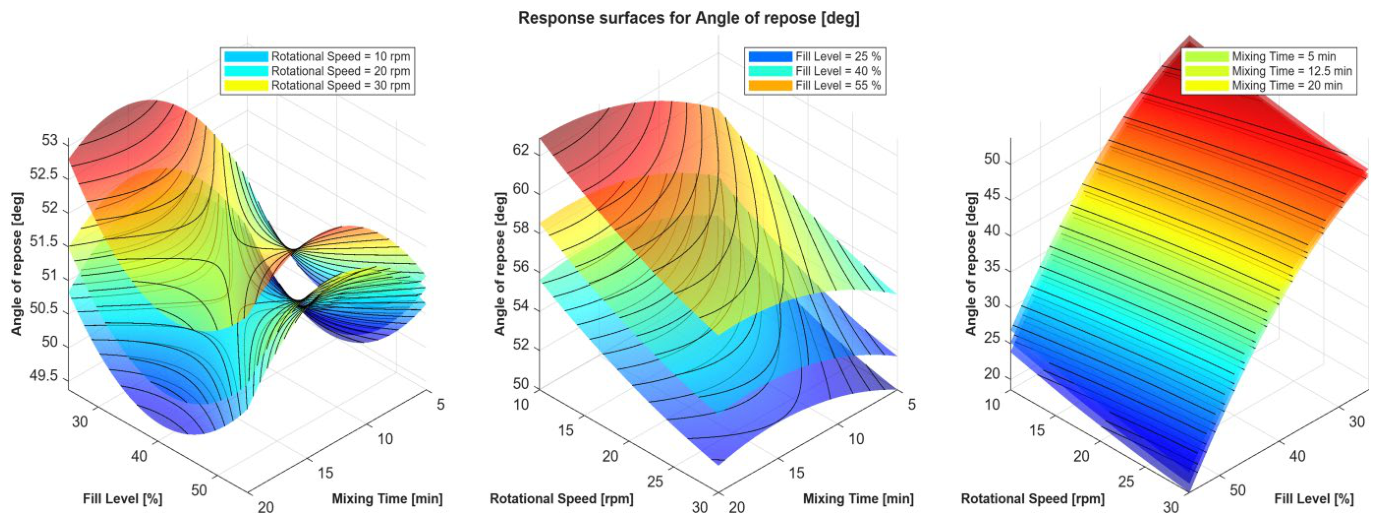
Figure 2.
Response surface plots showing the effect of process variables on angle of fall.
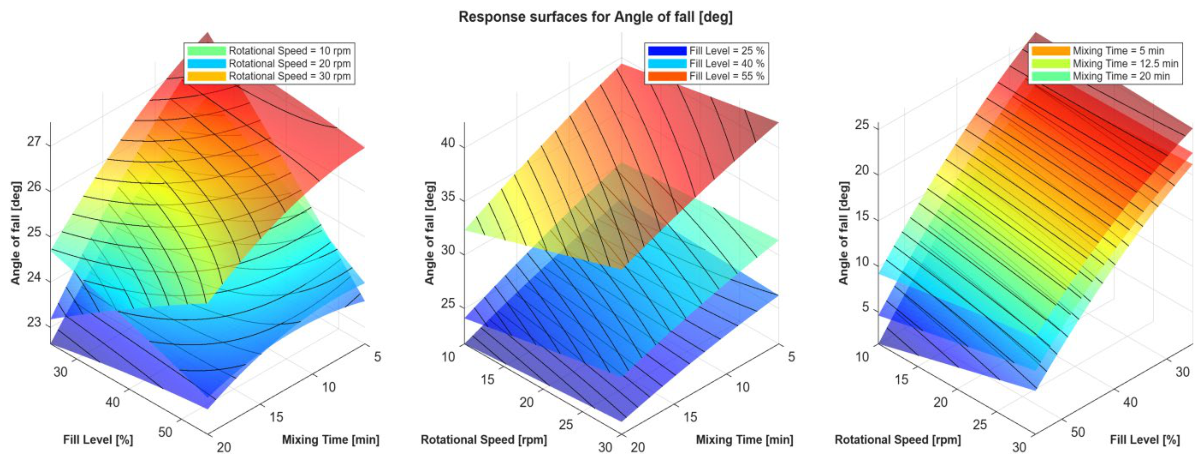
Figure 3.
Response surface plots showing the effect of process variables on angle of difference.
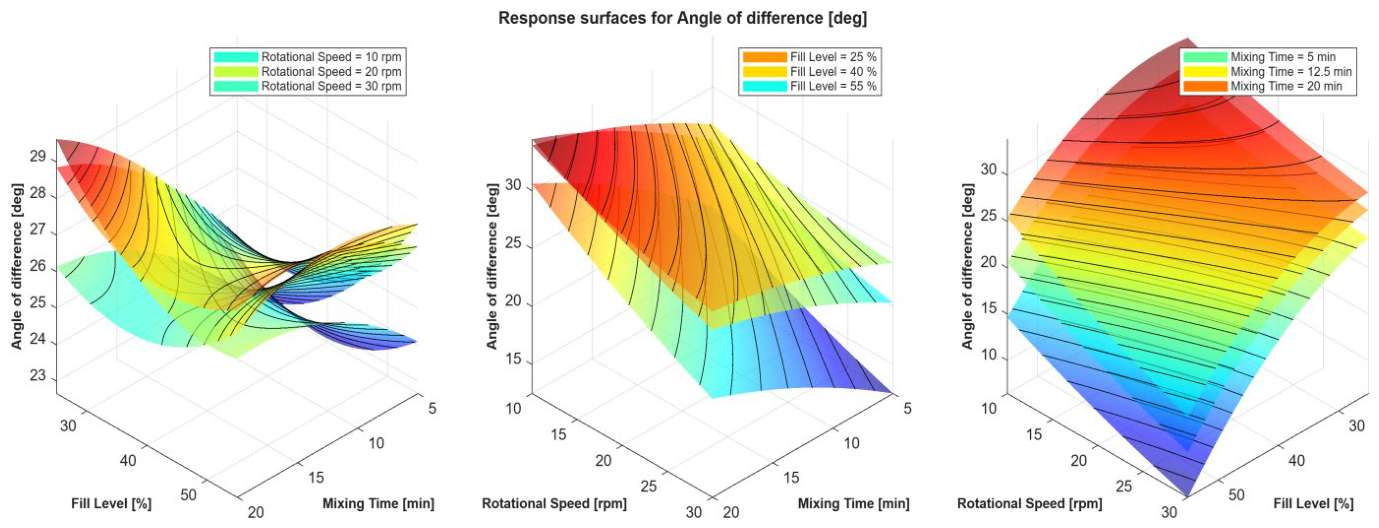
Figure 4.
Response surface plots showing the effect of process variables on average tablet thickness.
Figure 4.
Response surface plots showing the effect of process variables on average tablet thickness.
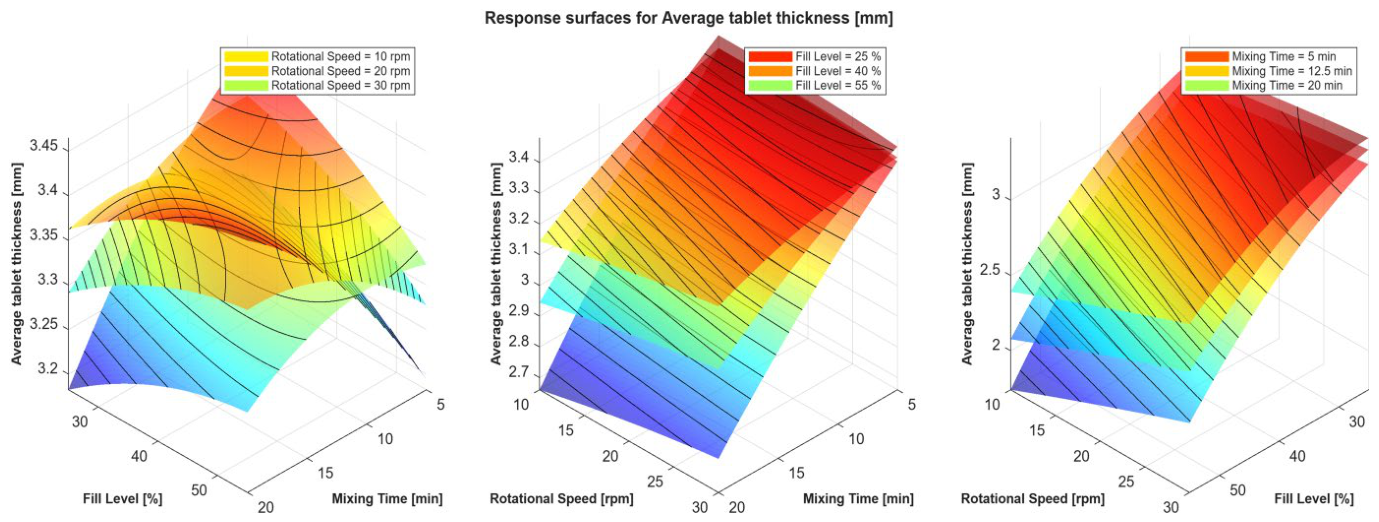
Figure 5.
Response surface plots showing the effect of process variables on average tablet mass.
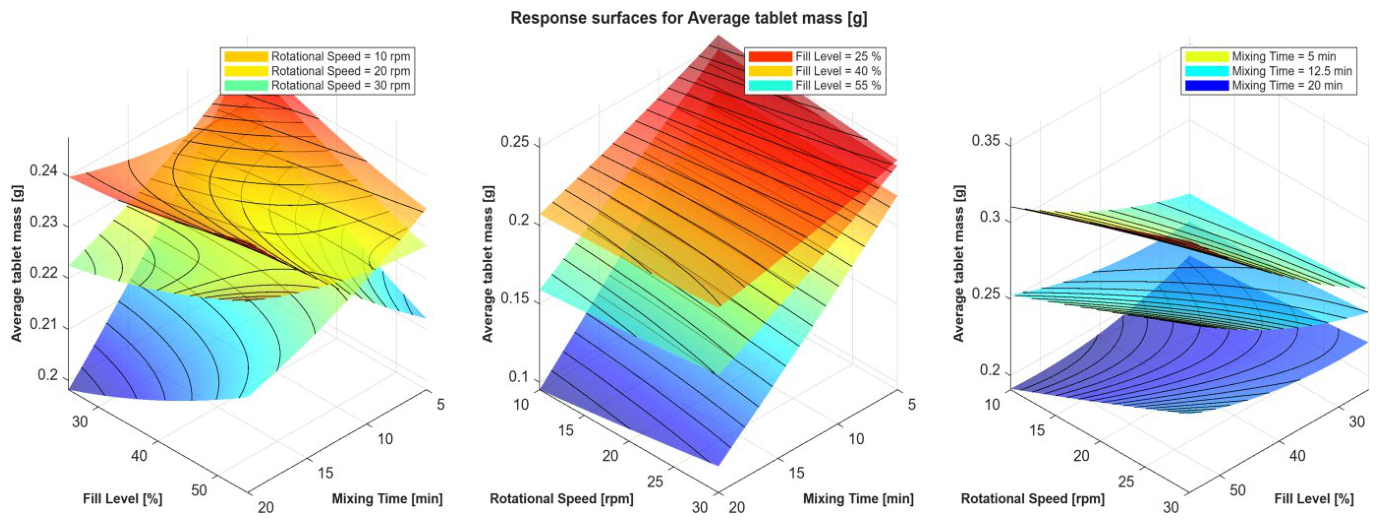
Figure 6.
Response surface plots showing the effect of process variables on API content in a tablet.
Figure 6.
Response surface plots showing the effect of process variables on API content in a tablet.
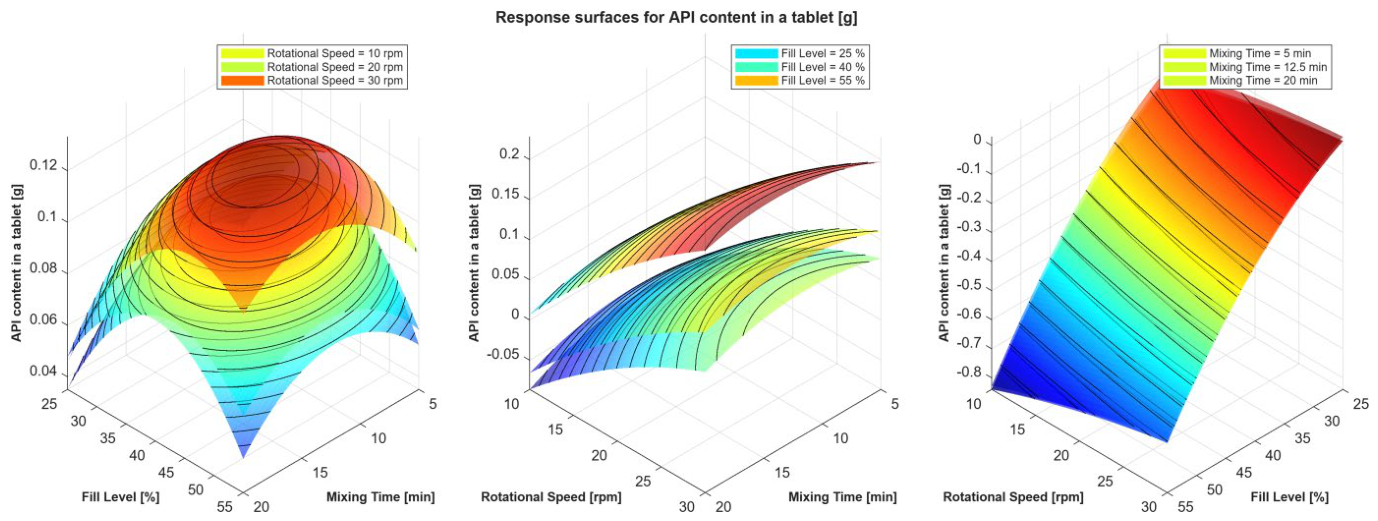
Figure 7.
Response surface plots showing the effect of process variables on SD of API content in a tablet.
Figure 7.
Response surface plots showing the effect of process variables on SD of API content in a tablet.
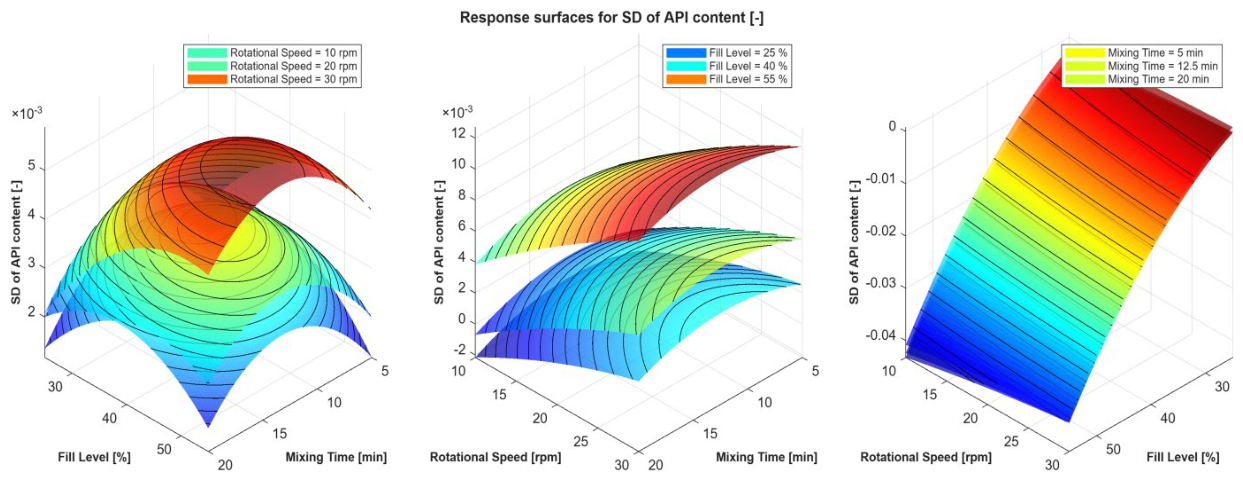
Figure 8.
Response surface plots showing the effect of process variables on abrasiveness of tablets.
Figure 8.
Response surface plots showing the effect of process variables on abrasiveness of tablets.
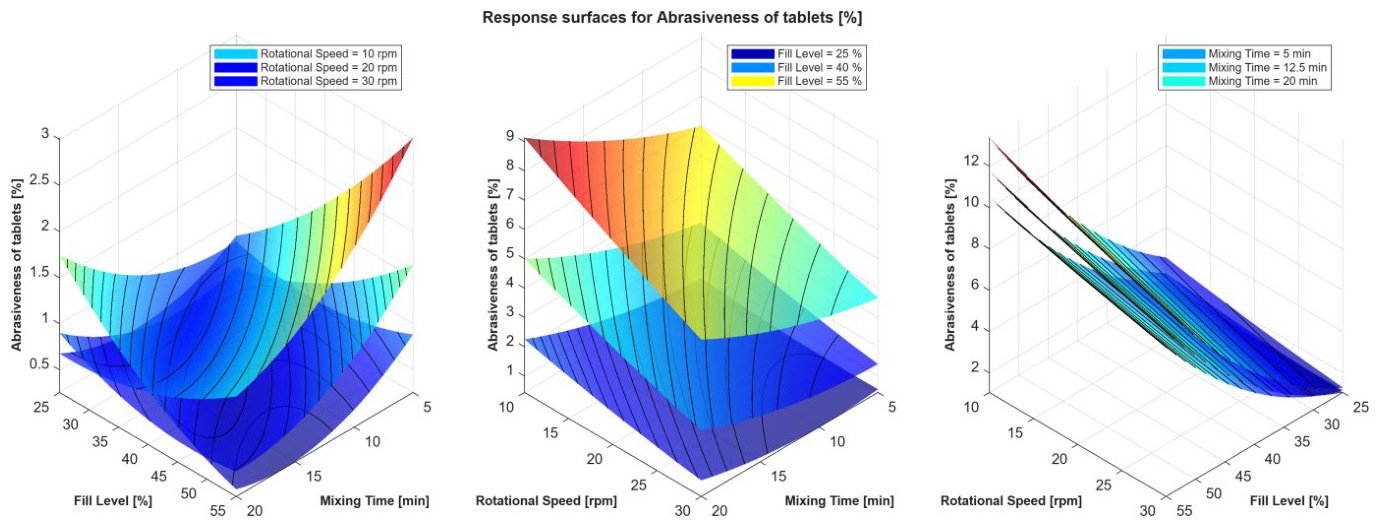
Figure 9.
Boxplots illustrating the influence of process variables on powder mixture properties. Asterisks indicate levels of statistical significance based on one-way ANOVA.
Figure 9.
Boxplots illustrating the influence of process variables on powder mixture properties. Asterisks indicate levels of statistical significance based on one-way ANOVA.
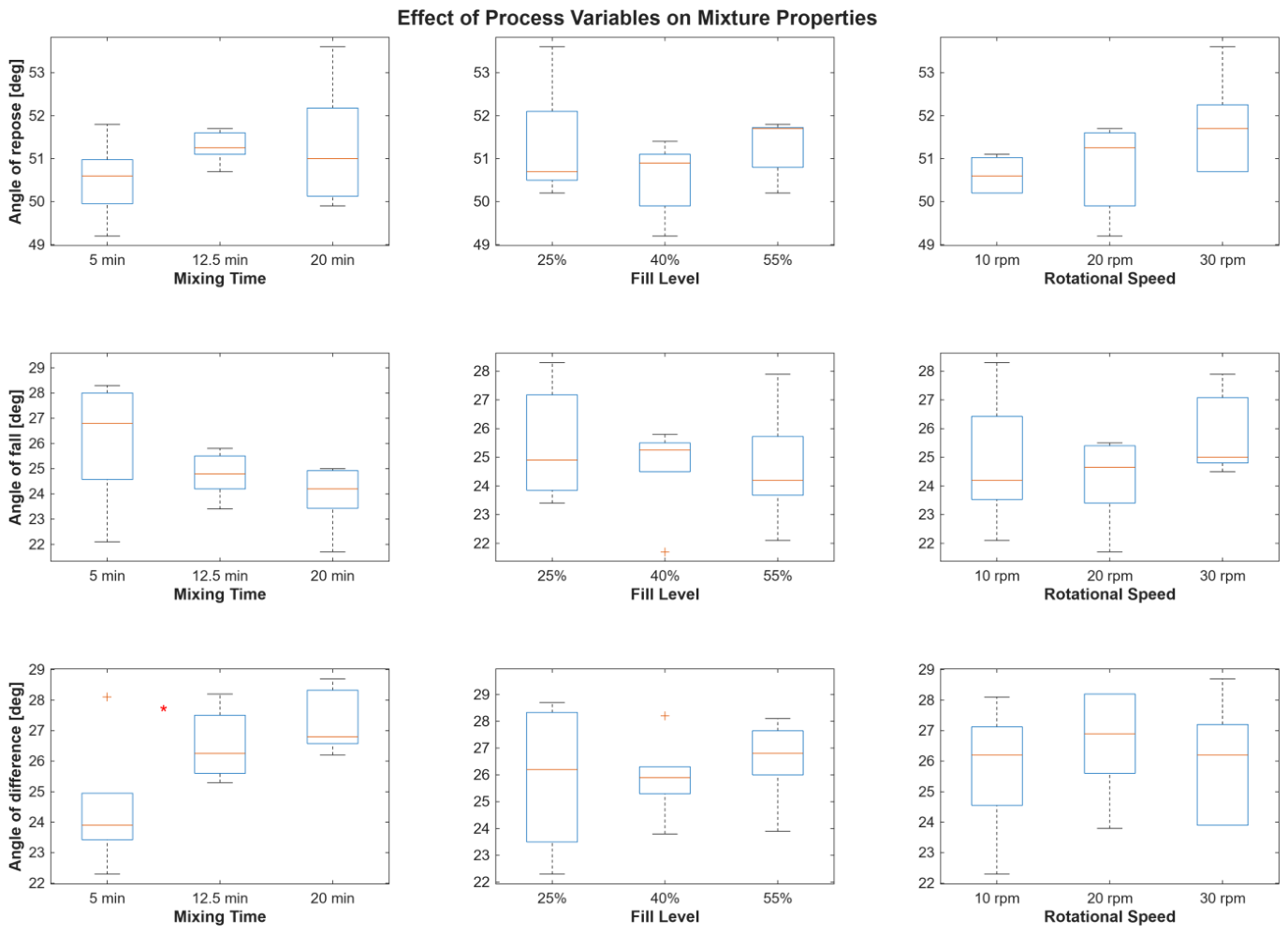
Figure 10.
Boxplots illustrating the influence of process variables on tablet properties. Asterisks indicate levels of statistical significance based on one-way ANOVA.
Figure 10.
Boxplots illustrating the influence of process variables on tablet properties. Asterisks indicate levels of statistical significance based on one-way ANOVA.
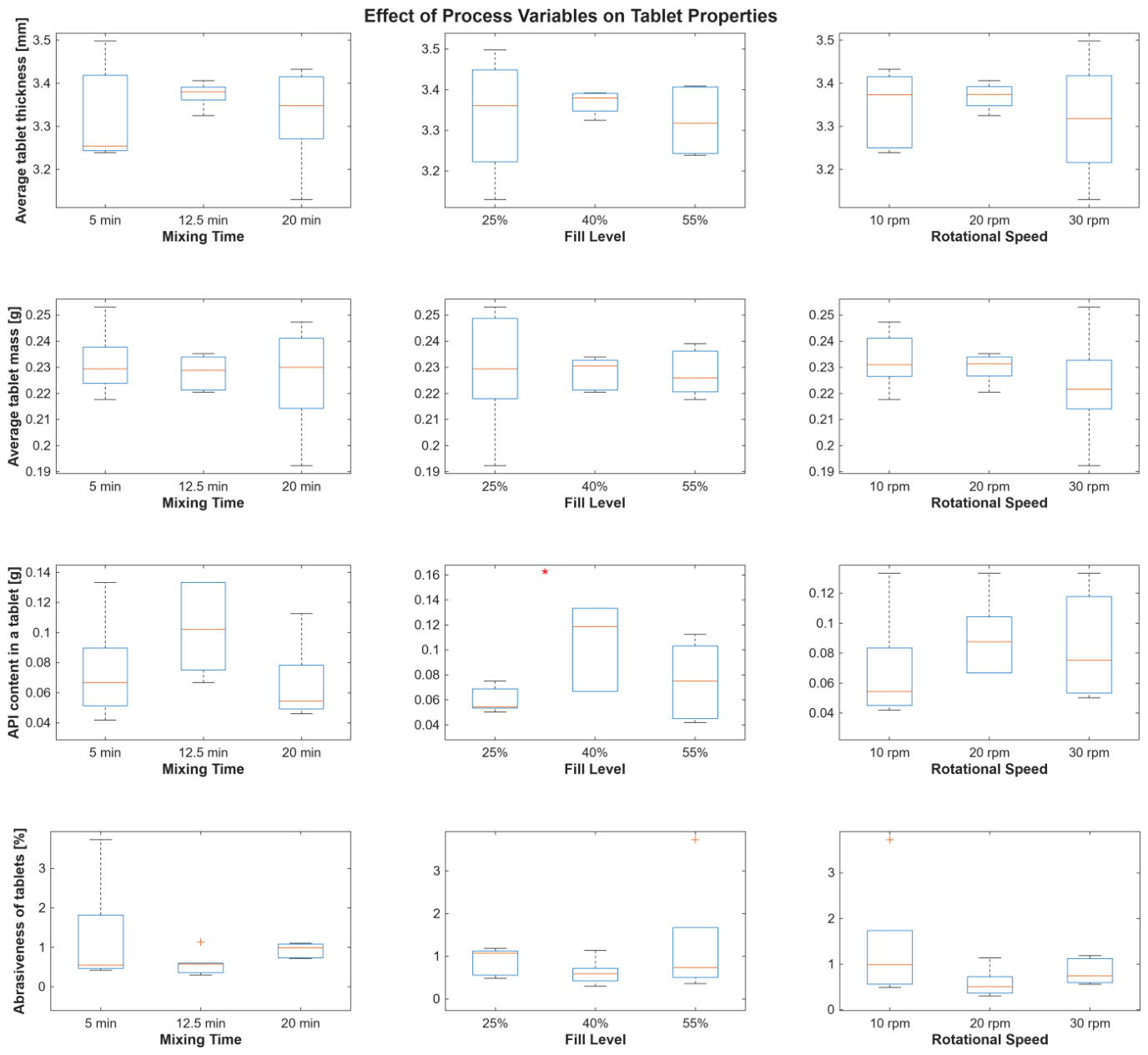
Figure 14.
Three-dimensional representation of the design space, illustrating all combinations of mixing time, fill level, and rotational speed that comply with pharmacopeial requirements.
Figure 14.
Three-dimensional representation of the design space, illustrating all combinations of mixing time, fill level, and rotational speed that comply with pharmacopeial requirements.
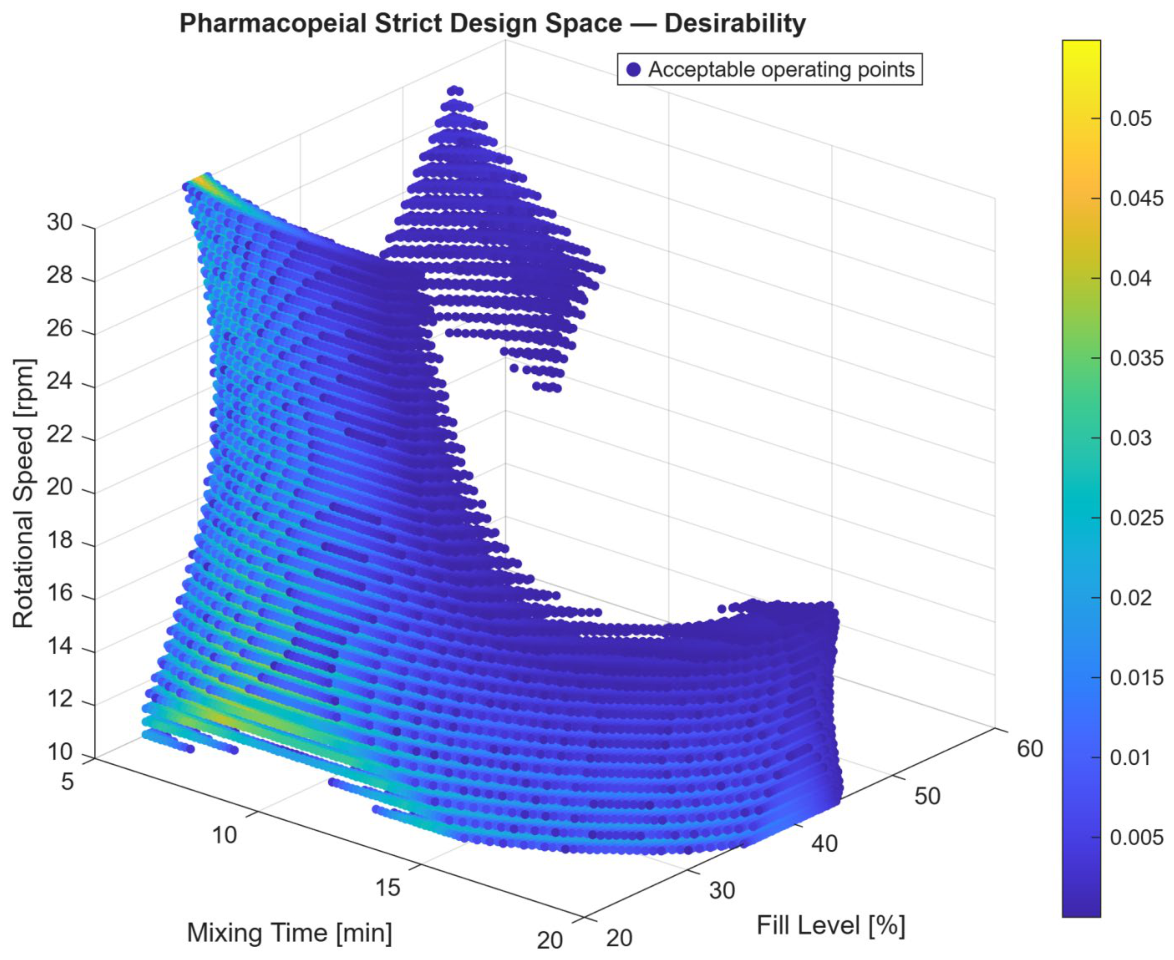
Table 1.
Properties of pharmaceutical ingredients.
| Sample | Angle of repose | Angle of fall | Angle of difference | d(0.5) | d(0.9) | d(0.1) |
| [deg] | [deg] | [deg] | [um] | [um] | [um] | |
| Sodium naproxen | 45.9 | 23.4 | 22.5 | 154 | 258 | 17 |
| Polyvinylpyrrolidone (PVP) | 39.6 | 16.5 | 23.1 | 21 | 50 | 4 |
| Cellulose | 44.6 | 23.2 | 21.4 | 123 | 178 | 11 |
| Calcium carbonate | 42.8 | 29.5 | 13.3 | 6 | 10 | 0.7 |
| Aerosil®200 | - | - | - | 0.012* | - | - |
1 According to the manufacturer.
Table 3.
Results of one-way ANOVA showing the effect of process variables on powder mixture properties.
Table 3.
Results of one-way ANOVA showing the effect of process variables on powder mixture properties.
| Mixture properties | ||||||||
| Angle of repose [deg] | ||||||||
| Factor | F | p | Category | Mean | SD | Median | Min | Max |
| Mixing Time | 1.033 | 0.3835 | 5 min | 50.6 | 0.8 | 50.7 | 49.2 | 51.8 |
| 12.5 min | 51.2 | 0.28 | 51.1 | 51.1 | 51.7 | |||
| 20 min | 51.2 | 1.53 | 51 | 49.9 | 53.6 | |||
| Fill Level | 1.049 | 0.3781 | 25% | 51.5 | 1.57 | 51.1 | 50.2 | 53.6 |
| 40% | 50.9 | 0.77 | 51.1 | 49.2 | 51.7 | |||
| 55% | 51.2 | 0.74 | 51 | 50.2 | 51.8 | |||
| Rotational Speed | 1.879 | 0.1919 | 10 rpm | 50.7 | 0.36 | 50.7 | 50.2 | 51.1 |
| 20 rpm | 51.1 | 0.87 | 51.3 | 49.2 | 51.7 | |||
| 30 rpm | 51.7 | 1.05 | 51.7 | 50.7 | 53.6 | |||
| Angle of fall [deg] | ||||||||
| Factor | F | p | Category | Mean | SD | Median | Min | Max |
| Mixing Time | 2.11 | 0.1608 | 5 min | 25.9 | 2.47 | 26.1 | 22.1 | 28.3 |
| 12.5 min | 24.9 | 0.91 | 25 | 23.4 | 25.8 | |||
| 20 min | 23.3 | 1.18 | 24.2 | 21.7 | 24.9 | |||
| Fill Level | 0.319 | 0.7325 | 25% | 25.5 | 2.05 | 25 | 23.4 | 28.3 |
| 40% | 24.6 | 1.29 | 25 | 21.7 | 25.8 | |||
| 55% | 24.8 | 1.89 | 24.5 | 22.1 | 27.9 | |||
| Rotational Speed | 1.117 | 0.3567 | 10 rpm | 24.6 | 2.09 | 25 | 21.7 | 28.3 |
| 20 rpm | 24.6 | 1.18 | 25 | 23.4 | 25.5 | |||
| 30 rpm | 25.4 | 1.32 | 25 | 24.5 | 27.9 | |||
| Angle of difference [deg] | ||||||||
| Factor | F | p | Category | Mean | SD | Median | Min | Max |
| Mixing Time | 4.999 | 0.0245* | 5 min | 23.9 | 0.77 | 23.9 | 22.3 | 25.4 |
| 12.5 min | 26.8 | 1 | 26.3 | 25.3 | 28.2 | |||
| 20 min | 27.9 | 0.92 | 26.8 | 26.2 | 28.7 | |||
| Fill Level | 0.227 | 0.8003 | 25% | 26.6 | 1.4 | 26.2 | 23.9 | 28.7 |
| 40% | 26.1 | 1.37 | 26.3 | 23.8 | 28.2 | |||
| 55% | 25.9 | 1.41 | 26.2 | 22.3 | 27.9 | |||
| Rotational Speed | 0.308 | 0.7399 | 10 rpm | 25.8 | 2.14 | 26 | 22.3 | 28.3 |
| 20 rpm | 26 | 1.43 | 26.2 | 23.8 | 28.2 | |||
| 30 rpm | 26.4 | 1.44 | 26.2 | 23.9 | 28.7 | |||
Table 4.
Results of one-way ANOVA showing the effect of process variables on tablet properties.
| Tablet properties | ||||||||
| Average tablet thickness [mm] | ||||||||
| Factor | F | p | Category | Mean | SD | Median | Min | Max |
| Mixing Time | 0.475 | 0.6322 | 5 min | 3.33 | 0.11 | 3.32 | 3.24 | 3.5 |
| 12.5 min | 3.37 | 0.03 | 3.38 | 3.33 | 3.41 | |||
| 20 min | 3.32 | 0.14 | 3.37 | 3.13 | 3.43 | |||
| Fill Level | 0.354 | 0.7082 | 25% | 3.34 | 0.13 | 3.37 | 3.13 | 3.5 |
| 40% | 3.36 | 0.03 | 3.37 | 3.33 | 3.39 | |||
| 55% | 3.34 | 0.09 | 3.33 | 3.24 | 3.41 | |||
| Rotational Speed | 0.443 | 0.6517 | 10 rpm | 3.35 | 0.09 | 3.37 | 3.24 | 3.41 |
| 20 rpm | 3.36 | 0.03 | 3.36 | 3.33 | 3.39 | |||
| 30 rpm | 3.32 | 0.14 | 3.33 | 3.13 | 3.5 | |||
| Average tablet mass [g] | ||||||||
| Factor | F | p | Category | Mean | SD | Median | Min | Max |
| Mixing Time | 0.202 | 0.8197 | 5 min | 0.23 | 0.01 | 0.23 | 0.22 | 0.25 |
| 12.5 min | 0.23 | 0.01 | 0.23 | 0.22 | 0.24 | |||
| 20 min | 0.23 | 0.02 | 0.23 | 0.19 | 0.25 | |||
| Fill Level | 0.022 | 0.9779 | 25% | 0.22 | 0.03 | 0.23 | 0.19 | 0.25 |
| 40% | 0.23 | 0.01 | 0.23 | 0.22 | 0.24 | |||
| 55% | 0.23 | 0.01 | 0.23 | 0.22 | 0.24 | |||
| Rotational Speed | 0.694 | 0.5172 | 10 rpm | 0.23 | 0.01 | 0.23 | 0.22 | 0.24 |
| 20 rpm | 0.23 | 0.01 | 0.23 | 0.22 | 0.23 | |||
| 30 rpm | 0.23 | 0.02 | 0.23 | 0.19 | 0.25 | |||
| API content in a tablet [g] | ||||||||
| Factor | F | p | Category | Mean | SD | Median | Min | Max |
| Mixing Time | 2.198 | 0.1506 | 5 min | 0.061 | 0.015 | 0.055 | 0.042 | 0.075 |
| 12.5 min | 0.093 | 0.029 | 0.071 | 0.067 | 0.133 | |||
| 20 min | 0.07 | 0.03 | 0.066 | 0.046 | 0.133 | |||
| Fill Level | 4.121 | 0.0411* | 25% | 0.07 | 0.015 | 0.067 | 0.054 | 0.082 |
| 40% | 0.095 | 0.027 | 0.071 | 0.067 | 0.133 | |||
| 55% | 0.069 | 0.024 | 0.075 | 0.042 | 0.113 | |||
| Rotational Speed | 0.655 | 0.5356 | 10 rpm | 0.084 | 0.036 | 0.071 | 0.042 | 0.133 |
| 20 rpm | 0.09 | 0.024 | 0.071 | 0.067 | 0.133 | |||
| 30 rpm | 0.064 | 0.02 | 0.055 | 0.046 | 0.113 | |||
| Abrasiveness of tablets [%] | ||||||||
| Factor | F | p | Category | Mean | SD | Median | Min | Max |
| Mixing Time | 0.973 | 0.4038 | 5 min | 14.6 | 13.1 | 8.4 | 4.9 | 37.3 |
| 12.5 min | 6.5 | 3.5 | 5.8 | 3 | 11.4 | |||
| 20 min | 9.6 | 3.3 | 9.9 | 7.2 | 11 | |||
| Fill Level | 0.87 | 0.4421 | 25% | 9.8 | 3.1 | 10.7 | 4.9 | 11.9 |
| 40% | 6.8 | 3.3 | 6 | 3 | 11.4 | |||
| 55% | 16.4 | 14.5 | 7.4 | 5.6 | 37.3 | |||
| Rotational Speed | 1.391 | 0.2836 | 10 rpm | 15.4 | 13.4 | 7.9 | 5.8 | 37.3 |
| 20 rpm | 5.9 | 1.5 | 5.8 | 3 | 7.2 | |||
| 30 rpm | 9.5 | 2.6 | 9.6 | 5.6 | 11.9 | |||
Disclaimer/Publisher’s Note: The statements, opinions and data contained in all publications are solely those of the individual author(s) and contributor(s) and not of MDPI and/or the editor(s). MDPI and/or the editor(s) disclaim responsibility for any injury to people or property resulting from any ideas, methods, instructions or products referred to in the content. |
© 2026 by the authors. Licensee MDPI, Basel, Switzerland. This article is an open access article distributed under the terms and conditions of the Creative Commons Attribution (CC BY) license (http://creativecommons.org/licenses/by/4.0/).
Copyright: This open access article is published under a Creative Commons CC BY 4.0 license, which permit the free download, distribution, and reuse, provided that the author and preprint are cited in any reuse.