

Submitted:
22 May 2026
Posted:
25 May 2026
You are already at the latest version
Abstract
The striped mullet (Mugil cephalus) and white mullet (Mugil curema) support artisanal fishing at the mouth of the Soto La Marina River, Gulf of Mexico, an area of great ecological value within the Laguna Madre and Rio Bravo Delta Protected Natural Area, the Terrestrial Priority Region RTP-83, and the Marine Priority Region RMP-44. Given the absence of historical catch and effort time series—a typical constraint of data limited fisheries—a length based frequency approach was used to estimate growth parameters, mortality rates, and the exploitation rate (E = F/Z). During 2018–2019, 1,134 specimens of M. cephalus and 339 of M. curema were sampled. Due to sexual dimorphism in M. cephalus, analyses were performed separately for females, males, and combined sexes, while M. curema was analyzed with sexes combined. Growth (L∞, k) and mortality (Z, M, F) parameters for combined sexes were: M. cephalus (562 mm, 0.14 year⁻¹; 3.72, 0.21, 3.51 year⁻¹); M. curema (329 mm, 0.15 year⁻¹; 1.46, 0.25, 1.21 year⁻¹). Exploitation rates (E) substantially exceeded Gulland (E = 0.5) and Patterson (E = 0.4) reference points: M. cephalus females (0.891), males (0.915), combined sexes (0.944); M. curema (0.828). It is concluded that both stocks are experiencing severe overexploitation, revealing a disconnect between the area's conservation designations and the actual condition of the resource.
Keywords:
mullets
; datalimited fisheries
; exploitation rate
; overfishing
; protected areas
; sexual dimorphism
; reference points
1. Introduction
The assessment of the exploitation status of fishery resources is fundamental for the sustainable management of fisheries [1]. However, in most artisanal fisheries in developing countries, and particularly in Mexico, historical catch and effort time series are not available [2]. This situation, known as "data-limited fisheries", affects approximately 80% of global fisheries and 95% of artisanal fisheries [3]. Faced with this reality, length-based methods allow useful diagnoses to be obtained using only growth parameters and instantaneous mortality rate estimates [4,5,6].
There is a controversy in the literature regarding the optimal reference point for the exploitation rate. Gulland [7] established the classic criterion of E = 0.5 (F = M), below which a stock is considered underexploited and above which it is considered overexploited [8]. However, Patterson [9], analyzing 28 pelagic fish stocks, empirically demonstrated that E values > 0.4 (F = 2/3 M) are consistently associated with biomass declines over 10-year periods, while below this level the trend has been towards recovery. This finding has generated a divergence in data-limited fisheries assessments: while some authors [7,8] consider E = 0.5 acceptable as a reference point, others [9,10] advocate for a more conservative approach (E = 0.4), particularly in high-conservation-value areas. The present study will evaluate the results against both reference points.
In Mexico, the striped mullet (Mugil cephalus) and the white mullet (Mugil curema) support highly relevant fisheries in the Gulf of Mexico [11]. In Tamaulipas, these species represent the second largest volume and value in the state's fishery production, surpassed only by shrimp [12,13]. Additionally, M. cephalus generates a high-commercial-value byproduct: mature gonads ("mullet roe"), which increases fishing pressure on the species [14].
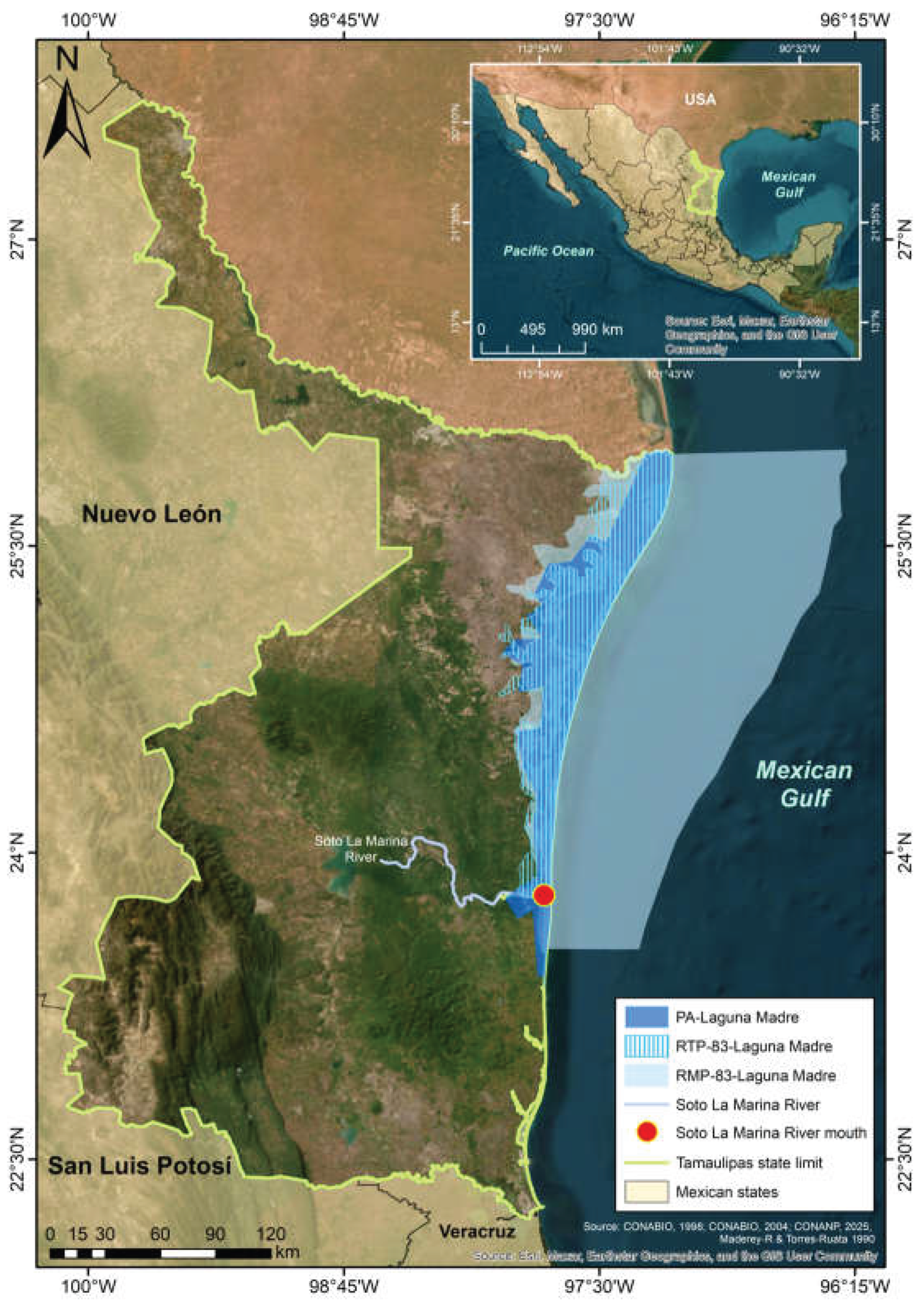
A fundamental aspect of this study is that the fishing area of this research—the Mouth of the Soto La Marina River, in the Municipality of Soto La Marina, Tamaulipas, Mexico (MSLMR)—concentrates three federal conservation protection and prioritization designations. First, the Protected Area "Laguna Madre y Delta del Río Bravo", under the category of Flora and Fauna Protection Area [15] (PA-Laguna Madre), specifically Polygon 13 "Mouth of the Soto La Marina River", classified as Special Use Subzone A and designated for fishing and aquaculture [16]. Second, the Terrestrial Priority Region RTP-83 "Laguna Madre" (RTP-83-Laguna Madre) of the Comisión Nacional para el Conocimiento y Uso de la Biodiversidad (CONABIO), characterized by its high biodiversity, endemism, and function as a biological corridor [17]. Third, the Marine Priority Region RMP-44 "Laguna Madre" (RMP-44-Laguna Madre), also of CONABIO, where the problem of fishing overexploitation has been explicitly documented [18]. This triple designation gives the region exceptional conservation value and demands that productive activities be carried out sustainably.
Despite this relevance, information on the exploitation status of mullets in the area is scarce. The Carta Nacional Pesquera [19] mentions "exploitation at maximum sustainable yield" without quantitative evidence to support it, and the only previous study in Tamaulipas dates back to 1980 [20]. This lack of information prevents evaluating the effectiveness of current management measures: minimum capture size (30 cm for M. cephalus; 26 cm for M. curema), seasonal closures, and fishing gear regulation [21].
Therefore, the general objective of this study was to assign an exploitation status to the stocks of M. cephalus (with sex-separated analysis, given documented sexual dimorphism) and M. curema (sexes combined) in the MSLMR; an area that forms part of the PA-Laguna Madre, as well as the RTP-83-Laguna Madre and RMP-44-Laguna Madre, using a data-limited approach and evaluating the results against the reference points of Gulland [7] (E = 0.5) and Patterson [9] (E = 0.4). It was hypothesized that both stocks are overexploited. As will be shown in this study, the estimated exploitation rates exceed both reference points (E > 0.8), and fishing mortality (F) values double or triple natural mortality (M), confirming the overexploitation hypothesis and evidencing a disconnection between the area's conservation designations and the actual condition of the resource.
2. Materials and Methods
2.1. Study Area
The study area is the Mouth of the Soto La Marina River (MSLMR), where commercial artisanal fishing is carried out by the inhabitants of the towns of Miguel de la Madrid Hurtado and La Pesca, in the Municipality of Soto la Marina, Tamaulipas, Mexico. The MSLMR is located in the western Gulf of Mexico, at approximately 23°46'22" N, 97°44'16" W. These localities are situated in the southern portion of the Laguna Madre system, one of the most extensive coastal lagoons in Mexico [22]. In this area, the average annual surface water temperature is 27°C [23]. Fishing activity is predominantly artisanal, using small vessels with a maximum overall length of 10.5 m that employ gillnets and trammel nets [21].
Figure 1.
Geographic location of the Mouth of the Soto La Marina River, in the Municipality of Soto La Marina, Tamaulipas, Mexico, and the geographic convergence of federal conservation protection and prioritization designations.
Figure 1.
Geographic location of the Mouth of the Soto La Marina River, in the Municipality of Soto La Marina, Tamaulipas, Mexico, and the geographic convergence of federal conservation protection and prioritization designations.
2.2. Sampling and Data Collection
Monthly samplings were conducted during the 2018–2019 period at fish reception centers in the towns of Miguel de la Madrid Hurtado and La Pesca, located in the Municipality of Soto La Marina, Tamaulipas, Mexico. Specimens of M. cephalus and M. curema from the artisanal fishery of the MSLMR were examined.
Data collection was structured under a two-stage sampling design [24]. In the first stage, a mass sampling was conducted directly at landing sites to characterize the size structure of the commercial catch, fit growth to the von Bertalanffy model (VBM), and estimate total (Z), natural (M), and fishing (F) mortality rates. From the mass sample, a simple random subsample was selected for sex assignment of individuals and validation of taxonomic identification of the species. This subsampling procedure ensures that the analyzed specimens retain the biometric proportionality of the original catch, providing unbiased estimates of biological parameters [25,26]. For each organism included in the biological sampling, the following variables were determined:
Biometry: Total length (TL, mm) was recorded using a graduated measuring tape, and total weight (TW, g) was obtained using a digital scale with 5 kg capacity (precision ±1 g). Biometry was performed on individuals from both sampling types.
Sex determination: Through abdominal dissection, sex was identified using standard macroscopic criteria for teleosts [27,28,29].
Taxonomic validation: Due to the sympatry of mullets in the estuarine system, the biological subsample was used to confirm the taxonomic identity of the species through the analysis of specific meristic and morphometric characters [30].
2.3. Data Analysis
2.3.1. Sex Ratio and Morphometric Differences
The sex ratio was evaluated using a chi-square test (χ²) to determine whether it differed from the expected 1:1 ratio [31]. Student's t-test for independent samples [32] was applied to compare mean lengths and weights between females and males of each species. Normality of the data was verified with the Shapiro–Wilk test [33]. These tests determined that, for M. cephalus, analyses would be performed separately by sex (due to significant differences), while for M. curema, combined sexes (C) would be used (no significant differences).
2.3.2. Length–Weight Relationship
The length–weight relationship was estimated using the power model [34]: TW = a·TLᵇ, where TW is total weight in grams, TL is total length in millimeters, and a and b are parameters of the power regression model, where a is the condition factor and b represents the allometry coefficient. Parameters were estimated by least squares after logarithmic transformation [35]. The isometry hypothesis (b = 3) was evaluated using Student's t-test [32]. Normality of the data was verified with the Shapiro–Wilk test [33]. To compare length–weight relationship curves between sexes, Chen et al.'s test [36] was used according to the following model: (RSSp - RSSs/(3(K-1))/(RSSs/(N-3)K); where RSSp is the residual sum of squares of the grouped fit (without sex differentiation), RSSs is the residual sum of squares of both groups (F and M), N is the total number of samples, and K is the number of groups being compared.
2.3.3. Growth Parameters
Growth was described using the von Bertalanffy model [37]: Lt = L∞[1 - e-k(t - t₀)], where L∞: asymptotic length, k: growth coefficient (curvature parameter), and t₀: age at zero length. The parameters L∞ and k were estimated using the ELEFAN I [38] and Shepherd's [39] methods, contained in the FISAT II software package (FAO-ICLARM Stock Assessment Tools, version 1.2.2) [40]. Parameters with the best fit ("score") according to each method were selected. The parameter t₀ was estimated using Pauly's empirical relationship [41]: log₁₀(-t₀) = -0.3922 - 0.2752·log₁₀(L∞) - 1.038·log₁₀(k). Reliability of the parameters was evaluated using the Phi-prime index (Ø' = log₁₀k + 2log₁₀L∞) [42].
2.3.4. Longevity (Age Limit)
2.3.5. Instantaneous Mortality Rates
Total mortality (Z) was estimated using four methods: linearized catch curve [4], Jones and van Zalinge method [45], Beverton and Holt method [46], and Ault and Ehrhardt method [47]. The method with the highest coefficient of determination (r²) was selected. The Jones and van Zalinge method was selected because it presented the best fit (r² > 0.96). Natural mortality (M) was estimated using Pauly's empirical equation [44]: log₁₀M = -0.0066 - 0.279 log₁₀L∞ + 0.6543 log₁₀k + 0.4632 log₁₀T, where T is the mean water temperature (T = 27°C) [23]. Fishing mortality (F) was obtained by difference: F = Z - M.
2.3.6. Exploitation Rate
The exploitation rate (E) was calculated as E = F/Z. The obtained values were evaluated against two reference points: Gulland's [7] with E = 0.5, and the more conservative Patterson's [9] with E = 0.4, corresponding to F = 2/3 M. In this data-limited context, E constitutes a diagnostic indicator of the fishing pressure level [1].
2.3.7. Reliability of Biological Parameters
The reliability of M and k was assessed using the Beverton and Holt invariant [48], defined as Φ = M/k. This analysis was used to verify the biological coherence of the results, contrasting the obtained values with ranges reported in the literature for the genus Mugil. The consistency of this relationship ensures that the growth and natural mortality estimates adequately reflect the life strategy of the studied species before their integration into fishery assessment models.
3. Results
3.1. Size and Weight Structure
From the mass sampling, a total of 1,473 specimens were examined, of which 1,134 corresponded to M. cephalus and 339 to M. curema. M. cephalus showed a wider size range (205–530 mm) and a notably higher maximum weight (1,511 g) compared to M. curema (235–310 mm; 266 g) (Figure 2; Table 1).
Sex was assigned to 357 specimens. For M. cephalus, 210 individuals were sexed, of which 108 were females with mean TL of 349 mm and mean TW of 416 g; and 102 males with mean TL of 308 mm and mean TW of 294.3 g. The total length ranges for M. cephalus females and males were 255–440 mm and 235–390 mm, respectively (Figure 3).
For M. curema (n = 147), 83 individuals were females with mean TL of 267 mm and mean TW of 170.2 g, respectively; and 64 were males with mean TL of 266 mm and mean TW of 169.9 g.
3.2. Length–Weight Relationship
The length–weight relationship showed a good fit in all analyzed categories, with coefficients of determination (r²) ranging between 0.971 and 0.989 (Table 2). Based on the allometric coefficient b, M. cephalus exhibited negative allometric growth in females, males, and combined sexes. Student's t-test confirmed that the b values were significantly different from 3 in all cases (females: t₁.₉₆ = 21.15, p < 0.05; males: t₁.₉₆ = 8.71, p < 0.05; combined sexes: t₁.₉₆ = 170.0, p < 0.05). This indicates that in M. cephalus weight does not increase proportionally to the cube of length, but rather at a lower rate, characterizing negative allometric growth (the fish becomes less heavy in relation to its length as it grows).
In M. curema, a differential pattern between sexes was observed. Males exhibited isometric growth, since the b value (2.94) was not significantly different from 3 (t₁.₉₆ = 0.891, p > 0.05), suggesting that in males weight remains proportional to the cube of length. In contrast, females (b = 2.42) and combined sexes (b = 2.85) exhibited negative allometric growth, with b values significantly lower than 3 (females: t₁.₉₆ = 10.898, p < 0.05; combined sexes: t₁.₉₆ = 9.135, p < 0.05). These differences between sexes could be associated with reproductive factors affecting body condition in females during the gonadal maturation period [49].
3.3. Differences Between Sexes and Sex Ratio
Significant differences were recorded between mean TL and mean TW of females and males of M. cephalus (TL: t₁.₉₇ = 7.39, p < 0.05; TW: t₁.₉₇ = 7.62, p < 0.05), while in M. curema no significant differences were evidenced (TL: t₁.₉₈ = 0.18, p > 0.05; TW: t₁.₉₈ = 0.06, p > 0.05). Consequently, subsequent analyses were performed with sexes separated for M. cephalus and with combined sexes for M. curema.
Chen et al.'s test [36] revealed significant differences between the length–weight relationship curves of females and males in M. cephalus (F₂,₆₅ = 35.94, p < 0.05), but not in M. curema (F₂,₆₇ = 0.45, p > 0.05).
The female:male sex ratio was 1.06:1 in M. cephalus (108:102) and 1.30:1 in M. curema (83:64). In both cases, the chi-square test indicated no significant differences with respect to the expected 1:1 ratio (M. cephalus: χ² = 0.17, *p* > 0.05; M. curema: χ² = 2.46, *p* > 0.05).
3.4. Growth Parameters
The estimates of growth parameters for species of the genus Mugil in the MSLMR revealed structural differences depending on the analysis method and the dataset used (Table 3).
For M. cephalus, asymptotic length (L∞) values showed a marked gradient, where the combined sexes group reached the largest dimensions with 561 mm, while the male group recorded the most conservative sizes, ranging between 377 and 410 mm. In terms of growth rate (k), the species showed moderate development with values ranging between 0.100 and 0.200 year⁻¹. These variations in growth velocity directly influenced longevity estimates (A₀.₉₅), which were 21 years for females, 30 for males, and 21 for combined sexes.
For its part, M. curema presented a distinct life strategy, characterized by smaller dimensions and, in certain models, faster growth. Its L∞ stabilized around 320 mm; however, the parameter k exhibited a notable discrepancy between methods: while ELEFAN suggested rapid growth of 0.590 year⁻¹ with a reduced longevity of 4 years, Shepherd's method estimated slower development (0.150 year⁻¹) and a longer average lifespan of 20 years.
Regarding statistical robustness, Shepherd's method proved to be the most accurate for both species, consistently reaching the maximum goodness-of-fit value (Score RN = 1). Finally, estimates derived from Powell's method indicated that the Z/k ratio remained close to unity in most cases, ranging from 0.813 to 1.109, offering a preliminary perspective on the mortality-relative-to-growth structure in the studied population.
3.5. Growth Performance Reliability
The Phi-prime index (Ø') values were for M. cephalus: females = 4.6, males = 4.2, combined sexes = 4.5; and for combined sexes of M. curema = 4.2. These values were compared with ranges reported in the literature (2.6–4.8 for M. cephalus; 2.3–4.8 for M. curema), falling within the expected intervals [50,51,52].
3.6. Instantaneous Mortality Rates
3.6.1. Total Mortality (Z)
Table 4 presents the Z estimates obtained using four methods. The Jones and van Zalinge method [45] showed the best fits (r² > 0.96), therefore its estimates were selected. The Z values in decreasing order were for M. cephalus: 3.72 year⁻¹ for combined sexes, 2.115 year⁻¹ for males, and 2.025 year⁻¹ for females; and for M. curema: 1.455 year⁻¹ for combined sexes.
3.6.2. Natural Mortality (M), Fishing Mortality (F), and Exploitation Rate (E)
M. cephalus presented lower M than M. curema, but higher F and higher E than M. curema (Table 5). In all point estimates and in all confidence intervals, for all datasets of both species, E values were greater than 0.5, substantially exceeding both reference points (Gulland [7]: E = 0.5; Patterson [9]: E = 0.4). This indicates that, with high confidence, current exploitation rates in both species significantly exceed the reference levels.
3.6.3. Reliability of Biological Parameters
4. Discussion
The overall objective of this study was to assign an exploitation status to the fish populations of M. cephalus (with separate analysis by sex, due to the significant morphometric differences found) and M. curema (with combined sexes, due to the absence of dimorphism) in the mouth of the Soto La Marina River, in the Gulf of Mexico; an area that has a triple conservation value because it is integrated within the Laguna Madre Protected Area [15], the Terrestrial Priority Region RTP 83 [17] and the Marine Priority Region RMP 44 [18]. Using a methodological approach appropriate for data-limited conditions (absence of historical catch and effort time series), growth parameters, mortality rates, and the exploitation rate (E = F/Z) were estimated as a diagnostic indicator of fishing pressure level, evaluating it against two reference points: the classic Gulland [7] (E = 0.5) and the more conservative Patterson [9] (E = 0.4).
The main finding of this research is that the E values estimated across all analyzed datasets (E = 0.828–0.944) far exceed both reference points. This result allows us to conclude that both stocks are in a state of severe overexploitation. Notably, this condition occurs in an area that concentrates three conservation protection and prioritization designations, revealing a critical disconnect between the formal recognition of the area's ecological value and the actual condition of the fishery resources it supports.
4.1. Growth Parameters and Sexual Dimorphism in the Regional Context
The growth parameters estimated using methods appropriate for data-limited conditions (ELEFAN I [38] and Shepherd's [39]) were consistent with the ranges reported in the literature for both species in the Gulf of Mexico and other regions [20,30,50,52,54]. In M. cephalus, marked sexual dimorphism was observed: females reached a greater asymptotic length (L∞ = 463 mm) and a faster growth rate (k = 0.14 year⁻¹) compared to males (L∞ = 411 mm; k = 0.10 year⁻¹). This pattern has been previously documented in mullets and is attributed to differences in energy allocation to reproduction, where females invest more energy in somatic growth to reach larger sizes that increase fecundity [55,56]. For combined sexes, M. cephalus showed L∞ = 562 mm and k = 0.14 year⁻¹, while M. curema reached L∞ = 329 mm with k = 0.15 year⁻¹. These values align with those reported by Ibañez-Aguirre et al. [50] in the Gulf of Mexico (L∞ = 400–461 mm; k = 0.10–0.20 year⁻¹) and by Díaz and Hernández [20] in Tamaulipas (L∞ = 581 mm; k = 0.19 year⁻¹).
The length–weight relationship revealed negative allometric growth in most categories (b < 3), indicating that fish become less heavy in relation to their length as they grow [8]. This pattern is common in mullets and has been reported for M. cephalus in Tamiahua Lagoon [56]. The exception was male M. curema, which exhibited isometric growth (b = 2.94; t = 0.891, p > 0.05), suggesting a different growth strategy, possibly related to lower energy investment in gonadal development compared to females [49].
The sex ratio close to 1:1 in both species indicates no bias in differential mortality by sex or in fishing gear selectivity [27]. This result is consistent with previous studies on Mexican mullets [57,58] and suggests that the population maintains a balanced sexual structure despite high fishing pressure.
The Phi-prime index (Ø' = 4.2–4.6) falls within the range reported for mullets in Mexico and worldwide [50,51,59]. Since Ø' is a robust indicator of growth performance and relatively independent of the methodology used [42,60], its similarity to previous studies validates the reliability of our estimates and demonstrates that, even with simple methods appropriate for data-limited conditions, robust biological parameters can be obtained.
The estimated longevity (21–30 years for M. cephalus; 20 years for M. curema) is higher than that reported in previous studies for mullets (generally 4–16 years) [61], but consistent with the longevity documented for lightly exploited populations or those under favorable environmental conditions [62]. The greater longevity of male M. cephalus (30 years) compared to females (21 years) correlates with their lower growth rate (k = 0.10 year⁻¹), an inverse relationship between k and longevity that has been widely documented in fish [63,64].
4.2. Exploitation Rate as a Diagnostic Indicator: Contribution of Sex-Specific Analysis
The estimation of E constitutes a diagnostic indicator widely used in data-limited fishery assessments [9,10]. A novel aspect of this study is the sex-differentiated analysis in M. cephalus, which revealed contrasting patterns in fishing pressure. Although E values were high in all cases (females: E = 0.891; males: E = 0.915; combined sexes: E = 0.944), males presented slightly higher F (F = 1.935 year⁻¹) than females (F = 1.805 year⁻¹). This could be due to differences in fishing gear selectivity or in spatial aggregation patterns between sexes [46]. Murugan et al. [65] also reported sex-specific exploitation differences in M. cephalus on the southeast coast of India (males: E = 0.674; females: E = 0.227), although in the opposite direction to that found in our study, suggesting that sexual selectivity may vary regionally depending on the fishing gear used and local reproductive behaviors.
In combined sexes M. cephalus, the E value of 0.944 implies that 94% of deaths in the population are attributable to fishing. This situation constitutes a case of growth overfishing [46], where individuals are captured before reaching their optimal harvest size.
The E values obtained (0.83–0.94) exceed not only Gulland's reference point [7] (E = 0.5) but also Patterson's more conservative one [9] (E = 0.4). Patterson [9], analyzing 28 pelagic fish stocks, demonstrated that E values > 0.4 are consistently associated with biomass declines over 10-year periods. For E = 0.6, the probability of stock decline is approximately 0.85 [9]. For our E values > 0.8, these probabilities would be close to 1, suggesting that, if current conditions persist, it is highly likely that both stocks will continue to decline severely.
Comparison with other localities reveals that the situation at the MSLMR is particularly critical. Gallardo-Cabello et al. [66] reported E = 0.730 for M. cephalus in the central Mexican Pacific. In Cuyutlán Lagoon in the State of Colima, Mexico, Cabral-Solís et al. [57] documented E = 0.75 for M. curema, while Meléndez-Galicia and Romero-Acosta [67] reported underexploitation (E = 0.19) on the coast of Michoacán, showing the regional variability in stock status and making the situation documented in our study area, which also has conservation designations, even more concerning.
4.3. Implications for Conservation in a Triple Ecological Value Zone
A particularly relevant finding is that the documented overexploitation occurs in an area that concentrates three conservation protection and prioritization designations: the LM-PA [15], the RTP-83-LM [17], and the RMP-44-LM [18]. In the LM-PA, Special Use Subzone A was explicitly designated for fishing activities under the concept of "sustainable use" [16]. Our results indicate that, at least for the mullet stocks, this use is far from sustainable.
In the RMP-44, the region's data sheet [18] explicitly mentions fishing overexploitation as one of the region's problems. Our results confirm and update this diagnosis for the mullet resource, which had not been quantitatively evaluated previously. In the RTP-83, overexploitation of fishery resources can have indirect effects on associated terrestrial ecosystems, particularly on birds that depend on fish for food [17].
This situation shows that designation of an area as protected or priority does not automatically guarantee the sustainability of the fisheries it harbors [68,69]. Edgar et al. [70] demonstrated that the effectiveness of marine protected areas critically depends on five factors: (1) absence of fishing (not applicable in this subzone), (2) effective surveillance, (3) age, (4) size, and (5) isolation. In our case, Special Use Subzone A explicitly allows fishing, so its effectiveness in maintaining healthy stocks fundamentally depends on the implementation of appropriate management measures and their enforcement [71].
4.4. Management Recommendations in a Data-Limited and High Conservation Value Context
Based on our results, on the reference points of Gulland [7] and Patterson [9], and on the triple conservation value of the area, the following measures are proposed:
Strengthening surveillance within the PA: Increase coordinated presence of fishing authorities (CONAPESCA) and environmental authorities (CONANP) at the landing sites of La Pesca and Miguel de la Madrid Hurtado.
Adoption of Patterson's reference point (E = 0.4): Given the high conservation value of the area, adopting the more conservative reference point [9] as a management target is recommended, seeking to reduce F until reaching F ≤ 2/3 M.
Review of fishing gear selectivity: Technically evaluate the mesh size of nets currently used in the PA, aiming to increase it to allow the escape of juvenile individuals.
Implementation of simple community-based monitoring indicators: Following Froese [72], using (a) proportion of juveniles in catch, (b) comparison of mean length with length at first maturity, and (c) percentage of mature individuals in the catch as easily measurable indicators for participatory monitoring with fishers.
Participatory research and co-management: Involve fishers in systematic collection of length and catch data, and promote their participation in co-management schemes, where international experience shows that effectiveness of measures is increased and conflicts reduced [73,74].
Sex-specific monitoring: Given the sexual dimorphism found in M. cephalus, maintaining sex-specific data collection in future monitoring is recommended, since differences in growth rates and longevity between females and males may require differentiated management strategies.
Interinstitutional coordination: Establish a joint monitoring program between Mexican government institutions such as CONANP (management of the PA-Laguna Madre), CONABIO (monitoring of RTP-83-Laguna Madre and RMP-44-Laguna Madre), IMIPAS (Instituto Mexicano de Investigación de Pesca y Acuacultura Sustentables) (fishery assessment), and local academic institutions.
4.5. Study Limitations and Future Perspectives
This study is based on a data-limited approach, which is a strength in contexts of scarce information, but imposes methodological limitations. The methods used assume population equilibrium conditions that are likely not met in overexploited stocks [75]. Biomass could not be estimated directly, preventing calculation of maximum sustainable yield (MSY) using surplus production models [6].
As noted in the methodological introduction, estimation of E constitutes a diagnostic indicator of fishing pressure level, not a complete stock assessment [1]. However, as Patterson [9] empirically demonstrated, this indicator has high predictive power for biomass trends, and its combination with other simple indicators (proportion of juveniles, size comparison) allows robust diagnoses to be generated under limited information conditions [72].
Future research should focus on: (1) estimating biomass using direct methods (acoustic surveys, swept area) within the PA-Laguna Madre polygon; (2) validating growth parameters using direct methods (otolith analysis), particularly to corroborate the estimated longevity of 30 years for male M. cephalus; (3) evaluating the stock-recruitment relationship to identify possible overfishing effects on recruitment; (4) analyzing the selectivity of fishing gear currently used in the PA-Laguna Madre; (5) developing data-limited biomass dynamics models specific to the region; and (6) evaluating the ecological impact of mullet overexploitation on birds and other ecosystem components that depend on these fish as a food resource.
5. Conclusions
- 1)
- The growth parameters estimated for M. cephalus (females: L∞ = 463 mm, k = 0.14 year⁻¹; males: L∞ = 411 mm, k = 0.10 year⁻¹; combined sexes: L∞ = 562 mm, k = 0.14 year⁻¹) and for M. curema (L∞ = 329 mm, k = 0.15 year⁻¹) at the MSLMR are biologically plausible and consistent with values reported in the literature for the Gulf of Mexico and other regions [20,50,52,54], validating the methodological approach used for data-limited conditions.
- 2)
- The presence of sexual dimorphism in M. cephalus was confirmed, evidenced by significant differences in size, weight, length–weight relationship curves, and growth parameters between females and males [55,56]. Females reach a larger asymptotic length and grow faster than males, a pattern that should be considered in future assessment and management studies. In contrast, M. curema did not present sexual dimorphism, justifying its analysis with combined sexes.
- 3)
- The estimated exploitation rates were notably high in all analyzed categories: M. cephalus (females = 0.891, males = 0.915, combined sexes = 0.944) and M. curema (combined sexes = 0.828). These values far exceed both Gulland's classic reference point [7] (E = 0.5) and Patterson's more conservative one [9] (E = 0.4). This result allows us to conclude that both stocks are in a state of severe overexploitation.
- 4)
- The proposed hypothesis is confirmed: fishing mortality rates (F) exceed natural mortality rates (M) in all analyzed categories (F/M between 8.2 and 16.7), which explains the decline observed in catches during the last decade and confirms the overexploitation status of both resources.
- 5)
- A particularly relevant finding is that the documented overexploitation occurs in an area with triple conservation value: the PA-Laguna Madre [15], the RTP-83-Laguna Madre [17], and the RMP-44-Laguna Madre [18] of CONABIO. This condition contradicts the "sustainable use" objectives established in the PA-Laguna Madre Management Plan [16] and in the priority region designations, revealing a critical disconnect between the formal recognition of the area's ecological value and the actual condition of the fishery resources it sustains.
- 6)
- A coordinated management program between fishing authorities (National Commission for Aquaculture and Fisheries, CONAPESCA) and environmental authorities (National Commission of Natural Protected Areas, CONANP) is urgently needed, including: (a) strengthening surveillance at the landing sites of the towns of La Pesca and Miguel de la Madrid Hurtado; (b) adoption of Patterson's reference point [9] (E = 0.4) as a management target; (c) review and adjustment of fishing gear selectivity to allow juvenile escape; (d) protection of nursery areas identified within the PA-Laguna Madre; (e) implementation of a continuous monitoring program based on simple indicators [72]; (f) development of co-management schemes with active fisher participation [73,74]; and (g) establishment of a joint monitoring program involving CONANP, CONABIO, IMIPAS, and academic institutions.
- 7)
- The methodological approach employed, based on simple indicators (exploitation rate E = F/Z, and size comparison), proved to be a useful, low-cost, and scientifically robust tool for diagnosing the exploitation status of fishery resources in data-limited contexts [1,9]. This approach is particularly valuable for artisanal fisheries in developing countries and for high conservation value areas, where available scientific information is scarce but the need for reliable diagnoses is urgent.
- 8)
- The replication of this assessment model is recommended for other commercially important species present in the region (such as pompano, drum, snapper, and croaker), as well as in other coastal protected areas of Mexico, as part of a national strategy for data-limited fisheries assessment that can generate preliminary diagnoses to guide future management and research.
Author Contributions
Conceptualization, J.H.R.-C. and S.E.O.-dlF.; methodology. J.H.R.-C.; S.E.O.-dlF.; U.J.S.-R.; G.H.-I.; software, J.H.R.-C.; J.A.R.-O.; U.J.S.-R.; L.G.Y.-CH. and M.R.-G.; validation, J.H.R.-C.; U.J.S.-R.; G.H.-I.; L.G.Y.-CH. and M.R.-G.; formal analysis, J.H.R.-C.; S.E.O.-dlF. and J.A.R.-O.; investigation, J.H.R.-C.; S.E.O.-dlF.; J.A.R.-O.; G.H.-I.; resources, J.H.R.-C.; S.E.O.-dlF.; G.H.-I. ; L.G.Y.-CH. and M.R.-G.; data curation, J.H.R.-C.; J.A.R.-O.; U.J.S.-R.; G.H.-I.; L.G.Y.-CH. and M.R.-G.; writing—original draft preparation, J.H.R.-C. and S.E.O.-dlF.; writing—review and editing, J.H.R.-C.; S.E.O.-dlF.; G.H.-I.; visualization, J.H.R.-C.; S.E.O.-dlF.; J.A.R.-O.; U.J.S.-R.; G.H.-I.; L.G.Y.-CH. and M.R.-G.; supervision, J.H.R.-C.; S.E.O.-dlF.; J.A.R.-O.; U.J.S.-R.; G.H.-I.; project administration, J.H.R.-C.; S.E.O.-dlF. and J.A.R.-O.; funding acquisition, J.H.R.-C. and S.E.O.-dlF. ; G.H.-I. ; L.G.Y.-CH. and M.R.-G. All authors have read and agreed to the published version of the manuscript.
Funding
This research received no external funding.
Institutional Review Board Statement
Not applicable.
Informed Consent Statement
Not applicable.
Data Availability Statement
The authors will make the raw data that support the conclusions of this article available to others without undue reservation.
Conflicts of Interest
The authors declare that they have no conflicts of interest.
References
- Hilborn, R.; Walters, C. J. Quantitative Fisheries Stock Assessment: Choice, Dynamics and Uncertainty; Chapman and Hall: New York, 1992.
- Arreguín-Sánchez, F.; Arcos, E. La pesca en México: estado de la explotación y uso de los ecosistemas. Hidrobiológica 2011, 21 (3), 321–462.
- Costello, C.; Ovando, D.; Hilborn, R.; Gaines, S. D.; Deschenes, O.; Lester, S. E. Status and solutions for the world's unassessed fisheries. Science 2012, 338 (6106), 517–520. [CrossRef]
- Pauly, D. Algunos métodos sencillos para la evaluación de las poblaciones de peces tropicales; FAO Documento Técnico de Pesca No. 234; Organización de las Naciones Unidas para la Agricultura y la Alimentación: Roma, 1983.
- Sparre, P.; Venema, S. C. Introducción a la evaluación de recursos pesqueros tropicales. Parte 1: Manual; FAO Documento Técnico de Pesca No. 306/1; Organización de las Naciones Unidas para la Agricultura y la Alimentación: Roma, 1995.
- García, S.; Sparre, P.; Csirke, J. Estimating surplus production and maximum sustainable yield from biomass data when catch and effort time series are not available. Fish. Res. 1989, 8, 13–23. [CrossRef]
- Gulland, J. A. The Fish Resources of the Ocean; Fishing News Books: West Byfleet, UK, 1971.
- Pauly, D. Fishbyte section. Naga, ICLARM Q. 1993, 16, 26.
- Patterson, K. Fisheries for small pelagic species: an empirical approach to management targets. Rev. Fish Biol. Fish. 1992, 2, 321–338. [CrossRef]
- Caddy, J. F.; Mahon, R. Reference points for fisheries management; FAO Fisheries Technical Paper No. 347; Food and Agriculture Organization of the United Nations: Rome, 1995.
- DOF. Acuerdo por el que se da a conocer el Plan de Manejo Pesquero de Lisa (Mugil cephalus) y Lebrancha (Mugil curema), en las costas de Tamaulipas y Veracruz. Diario Oficial de la Federación, 11 de junio de 2018.
- Rodríguez-Castro, J. H.; Garza, A. E.; Olmeda, S. La actividad pesquera en Tamaulipas, ejemplo nacional. CienciaUAT 2010, 4 (4), 28–35.
- CONAPESCA. Anuario Estadístico de Acuacultura y Pesca 2017; Comisión Nacional de Acuacultura y Pesca: México, 2017.
- Ortiz, M.; Peña, R.; Telles, J.; Barbosa, G. Evaluación biológica y pesquera de las pesquerías de escama de mayor importancia comercial en la Laguna Madre, Tamaulipas. IV Foro Científico de Pesca Ribereña 2007, 1, 91–102.
- DOF. Decreto por el que se declara área natural protegida, con el carácter de área de protección de flora y fauna, la región conocida como Laguna Madre y Delta del Río Bravo. Diario Oficial de la Federación, 14 de abril de 2005.
- CONANP. Programa de Manejo del Área de Protección de Flora y Fauna Laguna Madre y Delta del Río Bravo; Comisión Nacional de Áreas Naturales Protegidas: México, 2015.
- Arriaga, L.; Espinoza, J. M.; Aguilar, C.; Martínez, E.; Gómez, L.; Loa, E. Regiones terrestres prioritarias de México; Comisión Nacional para el Conocimiento y Uso de la Biodiversidad (CONABIO): México, 2000.
- Arriaga, L.; Aguilar, V.; Alcocer, J. Regiones marinas prioritarias de México; Comisión Nacional para el Conocimiento y Uso de la Biodiversidad (CONABIO): México, 1998.
- DOF. Acuerdo por el que se da a conocer la actualización de la Carta Nacional Pesquera. Diario Oficial de la Federación, 11 de junio de 2018.
- Díaz, E.; Hernández, S. Crecimiento, reproducción y hábitos alimenticios de la lisa Mugil cephalus en la Laguna de San Andrés, Tamps. Anales Esc. Nac. Cienc. Biol. 1980, 23, 109–127.
- DOF. NORMA Oficial Mexicana NOM-016-SAG/PESC-2014, Para regular la pesca de lisa y liseta o lebrancha en aguas de jurisdicción federal del litoral del Golfo de México y Mar Caribe, así como del Océano Pacífico, incluyendo el Golfo de California. Diario Oficial de la Federación, 29 de julio de 2015.
- CONABIO. Sitios de manglar con relevancia biológica y con necesidades de rehabilitación ecológica, ficha de caracterización; Comisión Nacional para el Conocimiento y Uso de la Biodiversidad: México, 2009.
- INAPESCA. Temperatura superficial del mar; Instituto Nacional de Pesca: México, 2013.
- Cochran, W. G. Sampling Techniques, 3rd ed.; John Wiley & Sons: New York, 1977.
- Cadima, E. L. Fish Stock Assessment Manual; FAO Fisheries Technical Paper No. 393; Food and Agriculture Organization of the United Nations: Rome, 2003.
- Thompson, S. K. Sampling, 3rd ed.; Wiley: Hoboken, NJ, 2012.
- Nikolsky, G. V. The Ecology of Fishes; Academic Press: London, 1963.
- Holden, M. J.; Raitt, D. F. S. Manual of Fisheries Science. Part 2. Methods of Resource Investigation and Their Application; FAO Fisheries Technical Paper No. 115; Food and Agriculture Organization of the United Nations: Rome, 1974.
- Ospina, J. F.; Pardo, F.; Álvarez, R. Madurez gonadal de la ictiofauna presente en la Bahía de Cartagena, Caribe Colombiano. Bol. Cient. Mus. His. Nat. 2008, 12, 117–140.
- Ibáñez, A. L.; Gallardo-Cabello, M. Total length--standard length length--weight relationships of the striped mullet Mugil cephalus. J. Appl. Ichthyol. 2004, 20 (1), 73–74.
- Daniel, W. W. Bioestadística: Base para el análisis de las ciencias de la salud, 4th ed.; Limusa Wiley: México, 2012.
- Zar, J. H. Biostatistical Analysis, 3rd ed.; Prentice Hall: Upper Saddle River, NJ, 1996.
- Shapiro, S. S.; Wilk, M. B. An analysis of variance test for normality (complete samples). Biometrika 1965, 52 (3/4), 591–611.
- Ricker, W. E. Computation and interpretation of biological statistics of fish populations. Bull. Fish. Res. Board Can. 1975, 191, 1–382.
- Sokal, R. R.; Rohlf, F. J. Introducción a la bioestadística; Reverté: Barcelona, 1986.
- Chen, Y.; Jackson, D. A.; Harvey, H. H. A comparison of von Bertalanffy and polynomial functions in modelling fish growth data. Can. J. Fish. Aquat. Sci. 1992, 49 (6), 1228–1235. [CrossRef]
- von Bertalanffy, L. A quantitative theory of organic growth. Hum. Biol. 1938, 10 (2), 181–213.
- Pauly, D.; David, N. ELEFAN I, a BASIC program for the objective extraction of growth parameters from length-frequency data. Meeresforschung 1981, 28 (4), 205–211.
- Shepherd, J. G. A weakly parametric method for the analysis of length composition data. In Length-based methods in fisheries research; Pauly, D., Morgan, G. R., Eds.; ICLARM Conference Proceedings 13; International Center for Living Aquatic Resources Management: Manila, 1987; pp 113–119.
- Gayanilo, F. C.; Sparre, P.; Pauly, D. The FAO-ICLARM Stock Assessment Tools II (FISAT II) User's Guide; FAO Computerized Information Series (Fisheries) No. 8; Food and Agriculture Organization of the United Nations: Rome, 2005.
- Pauly, D. Fish population dynamics in tropical waters: A manual for use with programmable calculators. ICLARM Stud. Rev. 1984, 8, 1–325.
- Pauly, D.; Munro, J. L. Once more on the comparison of growth in fish and invertebrates. Fishbyte 1984, 2 (1), 21–27.
- Taylor, C. C. Cod growth and temperature. J. Cons. Int. Explor. Mer 1958, 23 (3), 366–370. [CrossRef]
- Pauly, D. On the interrelationships between natural mortality, growth parameters, and mean environmental temperature in 175 fish stocks. J. Cons. Int. Explor. Mer 1980, 39 (2), 175–192. [CrossRef]
- Jones, R.; van Zalinge, N. P. Estimates of mortality rate and population size for shrimp in Kuwait waters. Kuwait Bull. Mar. Sci. 1981, 2, 273–288.
- Beverton, R. J. H.; Holt, S. J. The theory of fishing. In Sea fisheries: Their investigation in the United Kingdom; Graham, M., Ed.; Edward Arnold: London, 1956; pp 372–441.
- Ault, J. S.; Ehrhardt, N. M. Correction to the Beverton and Holt Z-estimator for truncated catch length-frequency distributions. Fishbyte 1991, 9 (1), 37–39.
- Beverton, R. J. H.; Holt, S. J. A review of the lifespans and mortality rates of fish in nature, and their relation to growth and other physiological characteristics. In CIBA Foundation Colloquia on Ageing; Wolstenholme, G. E. W., O'Connor, M., Eds.; John Wiley & Sons: Hoboken, NJ, 1959; Vol. 5, pp 142–180.
- Lucano-Ramírez, G.; Michel-Morfín, J. E. Ciclo reproductivo y aspectos poblacionales de Mugil curema (Valenciennes 1836) (Pisces: Mugilidae) en la laguna costera Agua Dulce, Jalisco, México. Oceanologia 1997, 1 (13), 105–115.
- Ibañez-Aguirre, A. L.; Gallardo-Cabello, M.; Carrara, X. Growth analysis of striped mullet, Mugil cephalus, and white mullet, M. curema (Pisces: Mugilidae), in the Gulf of Mexico. Fish. Bull. 1999, 97 (4), 861–872.
- Dankwa, H. R. Length-weight relationship and growth parameters of grey mullets (Pisces: Mugilidae) in two estuaries in Ghana. West Afr. J. Appl. Ecol. 2011, 18, 53–61.
- Panda, D.; Mohanty, S. K.; Pattnaik, A. K.; Das, S.; Karna, S. K. Growth, mortality and stock status of mullets (Mugilidae) in Chilika Lake, India. Lakes Reserv. Res. Manag. 2018, 23 (1), 4–16. [CrossRef]
- Pauly, D. On the interrelationships between natural mortality, growth parameters, and mean environmental temperature in 175 fish stocks. J. Cons. Int. Explor. Mer 1980, 39 (2), 175–192. [CrossRef]
- Ibañez-Aguirre, A. L.; Gallardo-Cabello, M. Age determination of the grey mullet Mugil cephalus L. and the white mullet Mugil curema V. (Pisces: Mugilidae) in Tamiahua Lagoon, Veracruz. Cienc. Mar. 1996, 22 (3), 329–345.
- Ibáñez-Aguirre, A. L.; Gallardo-Cabello, M. Reproduction of Mugil cephalus and M. curema (Pisces: Mugilidae) from a coastal lagoon in the Gulf of Mexico. Bull. Mar. Sci. 2004, 75 (1), 37–49.
- Ramos-Santiago, E.; Gil-López, H.; Labastida-Che, A.; Gómez-Ortega, R. Reproducción y madurez gonádica de la lisa Mugil cephalus en las costas de Oaxaca y Chiapas. Cienc. Pesq. 2010, 18 (2), 79–91.
- Cabral-Solís, E.; Espino-Barr, E.; Gallardo-Cabello, M.; Ibáñez-Aguirre, A. L. Fishing impact on Mugil curema stock of multi-species gill net fishery in a tropical lagoon, Colima, Mexico. J. Fish. Aquat. Sci. 2007, 2 (3), 235–242.
- Ramos-Santiago, E.; Gil-López, H.; Labastida-Che, A.; Gómez-Ortega, R. Reproducción y madurez gonádica de la lisa Mugil cephalus en las costas de Oaxaca y Chiapas. Cienc. Pesq. 2010, 18 (2), 79–91.
- Gallardo-Cabello, M.; Cabral-Solís, E.; Espino-Barr, E.; Ibáñez-Aguirre, A. L. Growth analysis of white mullet Mugil curema (Valenciennes, 1836) (Pisces: Mugilidae) in the Cuyutlán Lagoon, Colima, México. Hidrobiológica 2005, 15 (3), 321–325.
- Pauly, D. Growth performance in fishes: Rigorous description of patterns as a basis for understanding causal mechanisms. ICLARM Q. 1991, 14 (4), 18–21.
- Ibáñez-Aguirre, A. L. Determinación de la edad de lisa Mugil cephalus L. y la lebrancha Mugil curema V. (Pisces: Mugilidae) en la Laguna de Tamiahua, Veracruz. Cienc. Mar. 1996, 22 (3), 329–345.
- Thompson, J. M. Synopsis of biological data on the grey mullet Mugil cephalus Linnaeus 1758. CSIRO Fish. Synop. 1963, 1, 1–75.
- Beverton, R. J. H. Patterns of reproductive strategy parameters in some marine teleost fishes. J. Fish Biol. 1992, 41 (sB), 137–160. [CrossRef]
- Charnov, E. L. Life History Invariants: Some Explorations of Symmetry in Evolutionary Ecology; Oxford University Press: Oxford, 1993.
- Murugan, S.; Ashiq Ur Rahman, M.; Ajmal Khan, S.; Lyla, P. S. Crecimiento y dinámica de la población del salmonete de cabeza plana, Mugil cephalus (Linnaeus, 1758) de las aguas de Parangipettai (costa sureste de la India). Thalassas 2014, 30 (2), 47–56.
- Gallardo-Cabello, M.; Espino-Barr, E.; García-Boa, A.; Puente-Gómez, M. Fishery analysis of Mugil cephalus in Central Mexican Pacific Coast. J. Mar. Biol. Oceanogr. 2016, 5 (1), 2.
- Meléndez-Galicia, C.; Romero-Acosta, A. Evaluación biológico-pesquera de la lisa Mugil curema, en la costa de Michoacán. Cienc. Pesq. 2010, 18 (1), 68–78.
- Kaiser, M. J. Are marine protected areas a red herring or fisheries panacea? Can. J. Fish. Aquat. Sci. 2005, 62 (5), 1194–1199. [CrossRef]
- Lester, S. E.; Halpern, B. S.; Grorud-Colvert, K.; Lubchenco, J.; Ruttenberg, B. I.; Gaines, S. D.; et al. Biological effects within no-take marine reserves: a global synthesis. Mar. Ecol. Prog. Ser. 2009, 384, 33–46. [CrossRef]
- Edgar, G. J.; Stuart-Smith, R. D.; Willis, T. J.; Kininmonth, S.; Baker, S. C.; Banks, S.; et al. Global conservation outcomes depend on marine protected areas with five key features. Nature 2014, 506 (7487), 216–220. [CrossRef]
- Day, J.; Dudley, N.; Hockings, M.; Holmes, G.; Laffoley, D.; Stolton, S.; Wells, S. Guidelines for applying the IUCN protected area management categories to marine protected areas; IUCN: Gland, Switzerland, 2012.
- Froese, R. Keep it simple: three indicators to deal with overfishing. Fish Fish. 2004, 5, 86–91. [CrossRef]
- Pinkerton, E., Ed. Co-operative Management of Local Fisheries: New Directions for Improved Management and Community Development; University of British Columbia Press: Vancouver, 1989. [CrossRef]
- Gutiérrez, N. L.; Hilborn, R.; Defeo, O. Leadership, social capital and incentives promote successful fisheries. Nature 2011, 470 (7334), 386–389. [CrossRef]
- Sparre, P.; Venema, S. C. Introduction to Tropical Fish Stock Assessment. Part 1. Manual; FAO Fisheries Technical Paper No. 306/1; Food and Agriculture Organization of the United Nations: Rome, 1995.
Figure 2.
Total length distribution of combined sexes of striped mullet Mugil cephalus (a) and white mullet Mugil curema (b) at the Mouth of the Soto La Marina River, Gulf of Mexico.
Figure 2.
Total length distribution of combined sexes of striped mullet Mugil cephalus (a) and white mullet Mugil curema (b) at the Mouth of the Soto La Marina River, Gulf of Mexico.
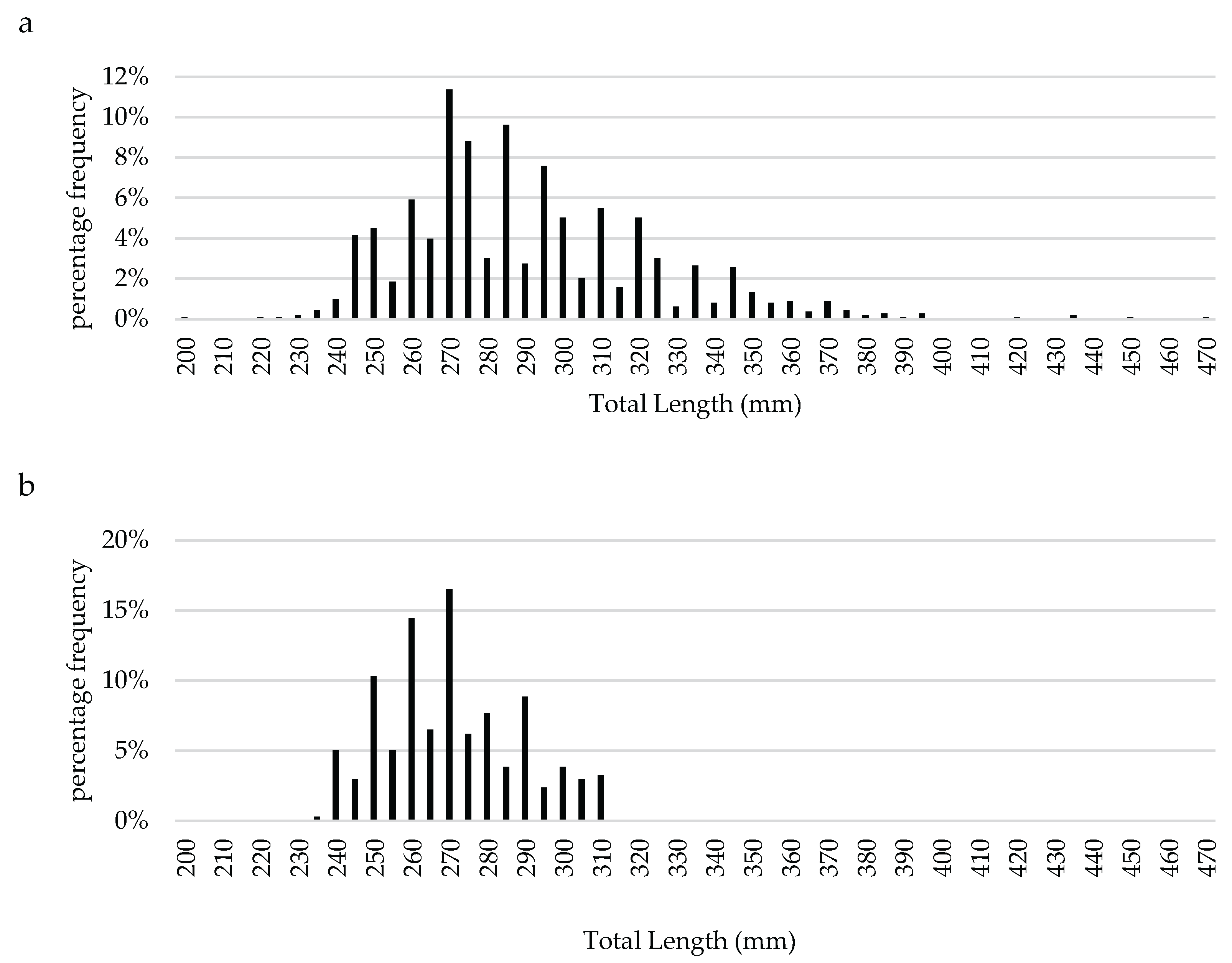
Figure 3.
Total length distribution of females (a) and males (b) of striped mullet Mugil cephalus at the Mouth of the Soto La Marina River, Gulf of Mexico.
Figure 3.
Total length distribution of females (a) and males (b) of striped mullet Mugil cephalus at the Mouth of the Soto La Marina River, Gulf of Mexico.
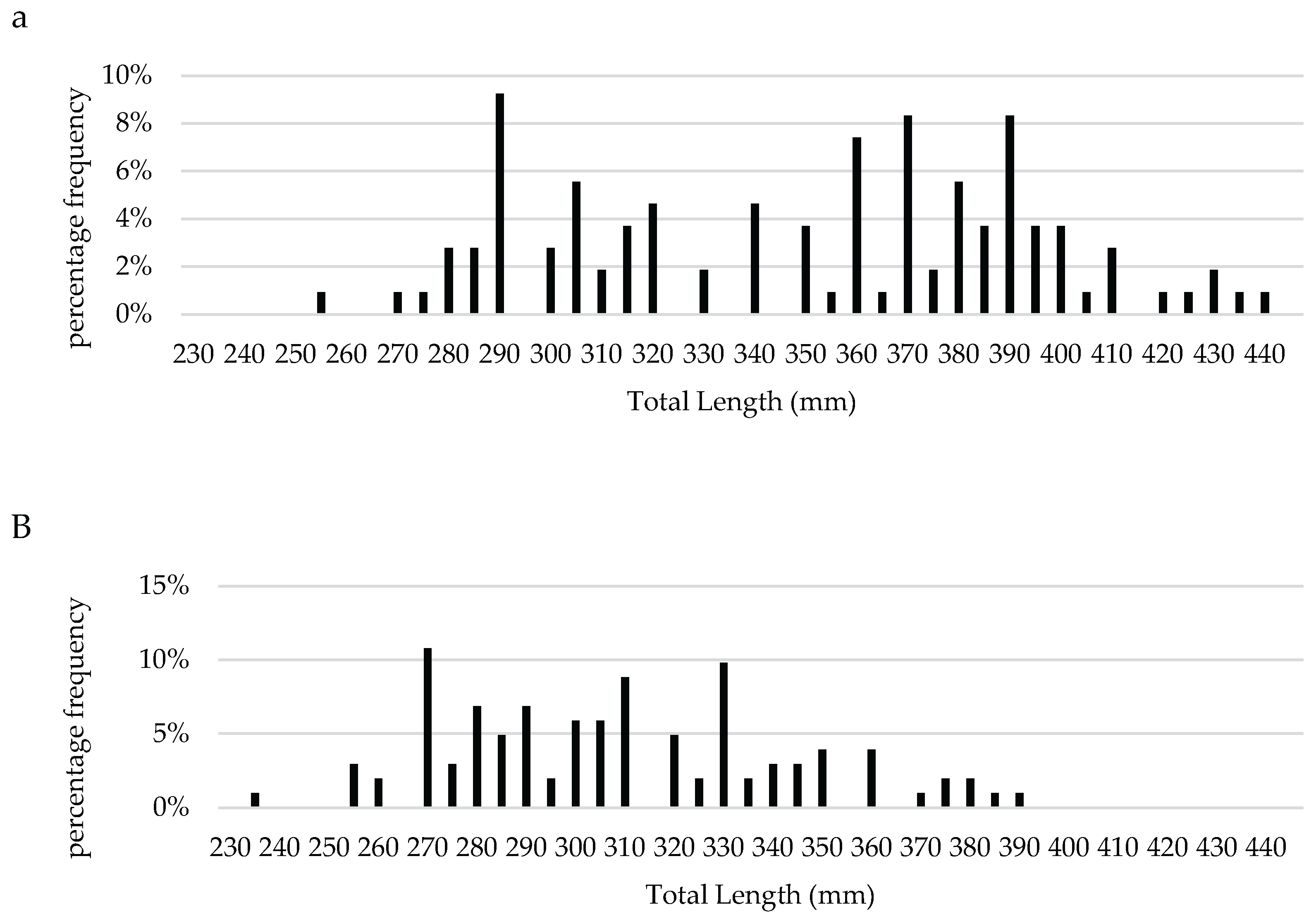

Table 1.
Descriptive statistics of total length and total weight of striped mullet Mugil cephalus and white mullet Mugil curema, combined sexes from mass sampling, at the Mouth of the Soto La Marina River, Gulf of Mexico.
Table 1.
Descriptive statistics of total length and total weight of striped mullet Mugil cephalus and white mullet Mugil curema, combined sexes from mass sampling, at the Mouth of the Soto La Marina River, Gulf of Mexico.
| Dataset | Measure | Total Length (mm) | Total Weight (g) |
|---|---|---|---|
| Mugil cephalus | Mean | 317 | 325.5 |
| Mugil cephalus | Minimum | 205 | 155 |
| Mugil cephalus | Maximum | 530 | 1,511 |
| Mugil cephalus | Standard deviation | 3.9 | 128.7 |
| Mugil curema | Mean | 271 | 176.9 |
| Mugil curema | Minimum | 235 | 114 |
| Mugil curema | Maximum | 310 | 266 |
| Mugil curema | Standard deviation | 1.8 | 34.5 |
Table 2.
Length–weight relationship parameters by sex and for combined sexes of striped mullet Mugil cephalus and white mullet Mugil curema at the Mouth of the Soto La Marina River, Gulf of Mexico.
Table 2.
Length–weight relationship parameters by sex and for combined sexes of striped mullet Mugil cephalus and white mullet Mugil curema at the Mouth of the Soto La Marina River, Gulf of Mexico.
| Dataset | a | b | r² | Growth type |
|---|---|---|---|---|
| Mugil cephalus (F) | 0.0723 | 2.422 | 0.989 | Negative allometric |
| Mugil cephalus (M) | 0.0335 | 2.637 | 0.977 | Negative allometric |
| Mugil cephalus (C) | 0.0240 | 2.740 | 0.978 | Negative allometric |
| Mugil curema (F) | 0.0146 | 2.422 | 0.973 | Negative allometric |
| Mugil curema (M) | 0.0108 | 2.942 | 0.971 | Isometric |
| Mugil curema (C) | 0.0146 | 2.848 | 0.988 | Negative allometric |
(F) = females, (M) = males, (C) = combined sexes; a and b = parameters of the power regression model of the length–weight relationship; r² = coefficient of determination.
Table 3.
Estimation of von Bertalanffy growth parameters (L∞, k, and t₀) of striped mullet Mugil cephalus and white mullet Mugil curema at the Mouth of the Soto La Marina River, Gulf of Mexico.
Table 3.
Estimation of von Bertalanffy growth parameters (L∞, k, and t₀) of striped mullet Mugil cephalus and white mullet Mugil curema at the Mouth of the Soto La Marina River, Gulf of Mexico.
| Dataset | Method | L∞ (mm) | k (year⁻¹) | t₀ | A₀.₉₅ (years) | Z/k | Score "Rn" |
|---|---|---|---|---|---|---|---|
| M. cephalus (F) | ELEFAN | 463 | 0.170 | -0.33 | 17 | - | 0.85 |
| M. cephalus (F) | Shepherd's | 463 | 0.140 | -0.24 | 21 | - | 1.00 |
| M. cephalus (F) | Powell | 421 | - | - | - | 0.813 | - |
| M. cephalus (M) | ELEFAN | 410 | 0.200 | -0.39 | 15 | - | 0.62 |
| M. cephalus (M) | Shepherd's | 410 | 0.100 | -0.07 | 30 | - | 1.00 |
| M. cephalus (M) | Powell | 377 | - | - | - | 1.109 | -0.96 |
| M. cephalus (C) | ELEFAN | 561 | 0.170 | -0.35 | 17 | - | 0.423 |
| M. cephalus (C) | Shepherd's | 561 | 0.140 | -0.26 | 21 | - | 1.00 |
| M. cephalus (C) | Powell | 391 | - | - | - | 0.903 | -0.916 |
| M. curema (C) | ELEFAN | 328 | 0.590 | -0.85 | 4 | - | 0.77 |
| M. curema (C) | Shepherd's | 328 | 0.150 | -0.23 | 20 | - | 1.00 |
| M. curema (C) | Powell | 314 | - | - | - | 0.890 | - |
(F) = females, (M) = males, (C) = combined sexes. L∞ = asymptotic length (mm); k = curvature parameter (rate at which the fish reaches L∞); Score Rn = correlation coefficient (r²); t₀ = initial condition parameter (zero length of the fish).
Table 4.
Total instantaneous mortality rate (Z) calculated using various methods, and required life parameters for the models, of striped mullet Mugil cephalus and white mullet Mugil curema at the Mouth of the Soto La Marina River, Gulf of Mexico.
Table 4.
Total instantaneous mortality rate (Z) calculated using various methods, and required life parameters for the models, of striped mullet Mugil cephalus and white mullet Mugil curema at the Mouth of the Soto La Marina River, Gulf of Mexico.
| Dataset | Method for Z estimation | Z | r² | Mean L | L' | Lmax | Confidence intervals |
| M. cephalus (F) | Linearized catch curve | 0.21 | 0.76 | - | - | - | 0.13-0.280 |
| M. cephalus (F) | Jones & van Zalinge (1981) | 2.025 | 0.97 | - | - | - | 1.845-2.206 |
| M. cephalus (F) | Beverton & Holt (1975) | 0.17 | - | 349 | 255 | - | - |
| M. cephalus (F) | Ault & Ehrhardt (1991) | 0.15 | - | 349 | 245 | 440 | - |
| M. cephalus (M) | Linearized catch curve | 0.19 | 0.93 | - | - | - | 0.16-0.230 |
| M. cephalus (M) | Jones & van Zalinge (1981) | 2.115 | 0.98 | - | - | - | 1.976-2.252 |
| M. cephalus (M) | Beverton & Holt (1975) | 0.14 | - | 308 | 235 | - | - |
| M. cephalus (M) | Ault & Ehrhardt (1991) | 0.12 | - | 308 | 235 | 390 | - |
| M. cephalus (C) | Linearized catch curve | 0.65 | 0.95 | - | - | - | 0.60-0.100 |
| M. cephalus (C) | Jones & van Zalinge (1981) | 3.72 | 0.96 | - | - | - | 3.453-3.987 |
| M. cephalus (C) | Beverton & Holt (1975) | 0.306 | - | 317 | 205 | - | - |
| M. cephalus (C) | Ault & Ehrhardt (1991) | 0.286 | - | 317 | 205 | 530 | - |
| M. curema (C) | Linearized catch curve | 0.13 | 0.99 | - | - | - | 0.12-0.130 |
| M. curema (C) | Jones & van Zalinge (1981) | 1.455 | 0.98 | - | - | - | 1.311-1.600 |
| M. curema (C) | Beverton & Holt (1975) | 0.251 | - | 270 | 235 | - | - |
| M. curema (C) | Ault & Ehrhardt (1991) | 0.191 | - | 270 | 235 | 310 | - |
(F) = females, (M) = males, (C) = combined sexes.
Table 5.
Selected total instantaneous mortality rates (Z), natural mortality (M), fishing mortality (F), and exploitation rate (E) of striped mullet Mugil cephalus and white mullet Mugil curema at the Mouth of the Soto La Marina River, Gulf of Mexico.
Table 5.
Selected total instantaneous mortality rates (Z), natural mortality (M), fishing mortality (F), and exploitation rate (E) of striped mullet Mugil cephalus and white mullet Mugil curema at the Mouth of the Soto La Marina River, Gulf of Mexico.
| Dataset | Z (year⁻¹) | M (year⁻¹) | F (year⁻¹) | E | Confidence interval for E |
|---|---|---|---|---|---|
| M. cephalus (F) | 2.025 | 0.22 | 1.805 | 0.891 | 0.881-0.900 |
| M. cephalus (M) | 2.115 | 0.18 | 1.935 | 0.915 | 0.909-0.920 |
| M. cephalus (C) | 3.720 | 0.21 | 3.510 | 0.944 | 0.939-0.947 |
| M. curema (C) | 1.455 | 0.25 | 1.205 | 0.828 | 0.809-0.844 |
(F) = females, (M) = males, (C) = combined sexes.
Table 6.
Natural mortality to growth ratio (M/k) values for females, males, and combined sexes of striped mullet Mugil cephalus, and for combined sexes of white mullet Mugil curema, at the Mouth of the Soto La Marina River, Gulf of Mexico.
Table 6.
Natural mortality to growth ratio (M/k) values for females, males, and combined sexes of striped mullet Mugil cephalus, and for combined sexes of white mullet Mugil curema, at the Mouth of the Soto La Marina River, Gulf of Mexico.
| Dataset | Shepherd's method | ELEFAN method |
|---|---|---|
| M. cephalus (F) | 1.6 | 1.5 |
| M. cephalus (M) | 1.8 | 1.5 |
| M. cephalus (C) | 1.5 | 1.4 |
| M. curema (C) | 1.7 | 1.1 |
(F) = females, (M) = males, (C) = combined sexes.
Disclaimer/Publisher’s Note: The statements, opinions and data contained in all publications are solely those of the individual author(s) and contributor(s) and not of MDPI and/or the editor(s). MDPI and/or the editor(s) disclaim responsibility for any injury to people or property resulting from any ideas, methods, instructions or products referred to in the content. |
© 2026 by the authors. Licensee MDPI, Basel, Switzerland. This article is an open access article distributed under the terms and conditions of the Creative Commons Attribution (CC BY) license (http://creativecommons.org/licenses/by/4.0/).
Copyright: This open access article is published under a Creative Commons CC BY 4.0 license, which permit the free download, distribution, and reuse, provided that the author and preprint are cited in any reuse.


