

Submitted:
21 May 2026
Posted:
22 May 2026
You are already at the latest version
Abstract
Digital dentistry increasingly relies on artificial intelligence to automate restorative design. Yet the ability of generative networks to produce multiple clinically plausible solutions for the same prosthetic field remains insufficiently evaluated. This study assessed the creative potential of a previously developed three-dimensional generative adversarial network (3DGAN) for screw-retained implant crown design. Nine AI-generated implant crown designs were analyzed, consisting of three independently generated crowns for each of three different prosthetic fields. Within each set, the crowns were superimposed and compared using “MeshLab”. Mean HD, maximum HD, and RMS values were recorded, with 0.05 model units used as the threshold for identifying insufficient morphological variation. The overall mean HD was 3.32 model units, the mean maximum HD was 16.18 model units, and the mean RMS value was 4.40 model units. No pairwise comparison showed values equal to or below 0.05 model units. In conclusion we found that the investigated 3DGAN demonstrates real creative potential.
Keywords:
artificial intelligence
; 3DGAN
; creativity
; generalization
; implants
; design
1. Introduction
The digital transformation of prosthetic dentistry has created favorable conditions for the integration of artificial intelligence into restorative workflows [1,2]. Computer-aided design and manufacturing systems have improved precision and reproducibility in implant-supported restorations, yet final crown morphology remains strongly dependent on CAD operators [1,2]. Generative neural networks offer a different approach by learning morphological patterns directly from data and then producing restorations fully automatically [3,4,5,6]. Within this context, evaluating an AI system only by speed or basic geometric similarity is insufficient. For clinical relevance, such a system should also be able to generate more than one design solution for a given case and remain functional when the prosthetic field differs from the exact configurations encountered during training process of the network [7,8,9,10].
The present article focuses on investigation of the creative potential of a previously developed 3DGAN for screw-retained implant crowns [10]. Creative potential was interpreted as the ability to produce multiple morphologically distinct designs as an output from the same input field while preserving plausibility. [7,8,9,10]. The aim of the study was therefore to assess whether the investigated 3DGAN can generate multiple individualized crown designs.
2. Materials and Methods
Nine screw-retained implant crown designs generated by the 3DGAN described in a previous published study [10] were analyzed. Three designs were generated per every single of three different prosthetic fields (sets) unseen by the 3DGAN during the learning process but still similar to the learning data set used to train the network. The designs were numbered and recorded visible at Figure 1, Figure 2 and Figure 3. MeshLab 2025.07 software was used to compare the generated crowns within each design by superimposition and Hausdorff distance (HD) analysis.
As a condition indicating the presence of creative potential in the 3DGAN network, we accepted that, in each of the three investigated sets, the HD recording values—Max, Mean, and RMS—for each of the examined triplets of generated designs, should differ from 0.05 model units (World Unit), which was used as the tolerance threshold. As a condition indicating negative creative potential, or lack of creative potential, we accepted that the HD recording values—Max, Mean, and RMS—between the three automatically generated designs should, in at least one of the comparisons, be equal to 0.00 or <0.05 model units (World Unit).
3. Results
At Table 1 are shown the values recorded in “model units” (World Unit) for the Hausdorff distance between the studied pairs at the moment of superimposition in the program “MeshLab 2025.07”. Figure 4 shows the examined Set No. 1, which includes three automated wax-ups on the same prosthetic field; Figure 5 shows the examined Set No. 2, which includes three automated wax-ups on the same prosthetic field; and Figure 6 shows the examined Set No. 3, which includes three automated wax-ups on the same prosthetic field.
Results for HD: The mean HD value is 3.32. The lowest value is 1.08, observed in the studied pair 1→2, generated relative to STL file No. 1. The highest value is 5.14, observed in the studied pair 2→3, generated relative to STL file No. 3.
Results for “max HD”: The mean value is 16.18. The lowest value is 12.20, observed in the studied pair 1→2, generated relative to STL file No. 1. The highest value is 23.32, observed in the studied pair 2→3, generated relative to STL file No. 3.
Results for RMS: The mean value is 4.40. The lowest value is 1.84, observed in the studied pair 1→2, generated relative to STL file No. 1. The highest value is 6.74, observed in the studied pair 2→3, generated relative to STL file No. 3.
No values less than or equal to 0.05 model units were recorded for any of the Hausdorff distance parameters investigated (Table 1).
4. Discussion
The present results should be interpreted within the broader context of generative artificial intelligence in dental crown design. Recent evidence shows that AI-based crown design is no longer only a theoretical concept, but an emerging restorative workflow with measurable performance in morphology, accuracy, fit, and time efficiency. Ding et al. used a true three-dimensional deep convolutional generative adversarial network for automatic crown design and reported that the generated crowns showed the lowest morphological discrepancy compared with other design methods, as well as biomechanical behavior close to that of natural teeth [11]. Similarly, Liu et al. demonstrated that AI-designed restorations can improve efficiency and accuracy, reporting reduced design time and clinically relevant reproducibility compared with conventional workflows [12]. These findings support the clinical relevance of evaluating not only whether an AI system can generate a crown, but also whether it can generate morphologically plausible and usable crown designs.
Kong et al. reported that AI applications in crown prostheses include crown design, crown evaluation, finish-line detection, preparation assessment, and prognosis prediction, while also noting that many studies still use small datasets and do not fully disclose the underlying algorithms [13]. A later scoping review focused specifically on AI-designed crowns found that most studies evaluated morphological accuracy, design time, and occlusal contacts, but also concluded that standardized evaluation protocols and further clinical validation are still needed [14]. This supports the methodological importance of the present study, because the use of repeated generation on the same prosthetic field and quantitative superimposition provides direct information about output variability.
Until recently, throughout the long history of artificial intelligence, creativity was not considered a real quality of the technology. The working definition of computational creativity is the creation of something new and valuable, often also “surprising” [15].
The indicators selected by us for investigating creativity/diversity in generative models—Precision & Recall—distinguish quality (precision) from coverage/diversity (recall) and represent a standard for evaluating generative models beyond one-dimensional metrics [16]. Other commonly used values include FID (Fréchet Inception Distance), which correlates with perceived quality and was introduced by Heusel et al. [17]. For 3D shapes, Coverage/MMD/JSD represent de facto metrics for diversity and similarity, as demonstrated by Achlioptas et al. [18].
We also aimed to answer the question: What does creativity in GAN networks depend on? We found that the training data used and the network architecture provide controllable variability without loss of plausibility [19]. BigGAN networks also exist, which improve latent noise during generation [20].
The creative potential in the present study was interpreted as controlled morphological variation: the ability to generate different crown designs for the same input field, while maintaining clinically plausible morphology. This interpretation is consistent with recent work on generative model evaluation, which emphasizes that fidelity and diversity are complementary aspects of performance and that common metrics may be insufficient when used alone [21].
The relevance of diversity assessment is even greater for three-dimensional data. Recent 3D-generation literature emphasizes that the evaluation of generated shapes should include not only realism or surface similarity, but also diversity, coverage, and geometric consistency [22].
The results obtained from the superimposition of three independent automated digital designs on the same prosthetic field, across three sets, show that the network generates different yet plausible solutions: mean Hausdorff distance (HD) ~3.32 world units, maxHD ~16.18, and RMS ~4.40. There were no superimposed pairs with HD ≤0.05; in other words, the network does not replicate the same solution and demonstrates characteristics of creative potential. This is desirable behavior in tasks involving multiple clinically acceptable morphologies, as it allows selection of the “most suitable” crown according to specific priorities, such as contacts, screw-access channel, and fissure aesthetics.
We believe that the observed positive creativity has substantial practical significance and provides clinicians with the opportunity to obtain multiple instant, individualized wax-ups of prosthetic restorations, from which they can select the one that best corresponds to their requirements.
5. Conclusions
The recorded mean values indicate that the assessed 3DGAN network possesses creative potential. The quality of creative potential enables the instant generation of multiple individualized, morphologically plausible digital designs, from which the clinician can select according to the specific case and preference.
Author Contributions
Conceptualization, A.N. and T.U..; methodology, T.U.; software, G.K.; validation, G.K., A.N..; formal analysis, T.U.; writing—original draft preparation, A.N.; writing—review and editing, A.N.; supervision, T.U.; All authors have read and agreed to the published version of the manuscript.
Funding
This research received no external funding.
Institutional Review Board Statement
Not applicable.
Informed Consent Statement
Not applicable.
Data Availability Statement
The datasets used and analyzed during the current study are available from the corresponding author on reasonable request.
Acknowledgments
During the preparation of this manuscript, the authors used Chat GPT 5.2 for correction and structuring purposes. The authors have reviewed and edited the output and take full responsibility for the content of this publication.
Conflicts of Interest
The authors declare no conflicts of interest.
Abbreviations
The following abbreviations are used in this manuscript:
| AI | Artificial Intelligence |
| 3DGAN | Three-Dimensional Generative Adversarial Network |
| HD | Hausdorff Distance |
| STL | Standard Tessellation Language |
| RMS | Root Mean Square |
References
- Miyazaki, T.; Hotta, Y.; Kunii, J.; Kuriyama, S.; Tamaki, Y. A review of dental CAD/CAM: current status and future perspectives. J. Prosthodont Res. 2009, 53, 123–132. [Google Scholar]
- Rekow, E.D. Digital dentistry: the new state of the art—Is it disruptive or destructive? Dent. Mater. 2020, 36, 9–24. [Google Scholar] [CrossRef] [PubMed]
- Schwendicke, F.; Samek, W.; Krois, J. Artificial intelligence in dentistry: chances and challenges. J. Dent. Res. 2020, 99, 769–774. [Google Scholar] [CrossRef] [PubMed]
- Khanagar, S.B.; Al-Ehaideb, A.; Maganur, P.C.; et al. Developments, application, and performance of artificial intelligence in dentistry – A systematic review. J. Dent. Sci. 2021, 16, 508–522. [Google Scholar] [CrossRef] [PubMed]
- Goodfellow, I.; Pouget-Abadie, J.; Mirza, M.; et al. Generative adversarial nets. Adv. Neural Inf. Process Syst. 2014, 27, 2672–2680. [Google Scholar]
- Yi, X.; Walia, E.; Babyn, P. Generative adversarial network in medical imaging: A review. Med. Image Anal. 2019, 58, 101552. [Google Scholar] [CrossRef] [PubMed]
- Lerner, H.; Nagy, K.; Fehér, A.; et al. Artificial intelligence in dental CAD/CAM: a review. BMC Oral. Health 2022, 22, 1. [Google Scholar]
- Ding, Y.; Zhang, J.; Liu, X.; et al. Automated design of dental crowns using deep learning. Comput Biol. Med. 2021, 134, 104494. [Google Scholar]
- Mangano, F.; Admakin, O.; Bonacina, M.; et al. Artificial intelligence and dental implants: a systematic review. Int. J. Env. Res. Public Health 2021, 18, 9736. [Google Scholar]
- Kostadinov, G.; Naydenov, A. 3D Cycle-Consistent Adversarial Network for Designing Dental Implant Crown. Comput. Sci. Educ. Comput. Sci. CSECS 2024, 609. [Google Scholar]
- Ding, H.; Cui, Z.; Maghami, E.; Chen, Y.; Matinlinna, J.P.; Pow, E.H.N.; Fok, A.S.L.; Burrow, M.F.; Wang, W.; Tsoi, J.K.H. Morphology and mechanical performance of dental crown designed by 3D-DCGAN. Dent. Mater. 2023, 39, 320–332. [Google Scholar] [CrossRef] [PubMed]
- Liu, C.M.; Lin, W.C.; Lee, S.Y. Evaluation of the efficiency, trueness, and clinical application of novel artificial intelligence design for dental crown prostheses. Dent. Mater. 2024, 40, 19–27. [Google Scholar] [CrossRef] [PubMed]
- Kong, H.J.; Yang, S.; Lee, J.H.; et al. Application of artificial intelligence in dental crown prosthesis: a scoping review. BMC Oral. Health 2024, 24, 890. [Google Scholar] [CrossRef] [PubMed]
- Kong, H.J.; et al. Accuracy of artificial intelligence-designed dental crowns: a scoping review of in-vitro studies. Appl. Sci. 2025, 15, 9866. [Google Scholar] [CrossRef]
- Colton, S.; Wiggins, G.A. Computational creativity: The final frontier? Front. Artif. Intell. Appl. 2012, 242, 21–26. [Google Scholar]
- Sajjadi, M.S.M.; Bachem, O.; Lucic, M.; Bousquet, O.; Gelly, S. Assessing generative models via precision and recall. Adv. Neural Inf. Process. Syst. 2018, 31. [Google Scholar]
- Heusel, M.; Ramsauer, H.; Unterthiner, T.; Nessler, B.; Hochreiter, S. GANs trained by a two time-scale update rule converge to a local Nash equilibrium. Adv. Neural Inf. Process. Syst. 2017, 30. [Google Scholar]
- Achlioptas, P.; Diamanti, O.; Mitliagkas, I.; Guibas, L. Learning representations and generative models for 3D point clouds. Proc. 35th Int. Conf. Mach. Learn. 2018, 80, 40–49. [Google Scholar]
- Karras, T.; Laine, S.; Aila, T. A style-based generator architecture for generative adversarial networks. In Proceedings of the IEEE/CVF Conference on Computer Vision and Pattern Recognition; 2019; pp. 4401–4410. [Google Scholar]
- Brock, A.; Donahue, J.; Simonyan, K. Large scale GAN training for high fidelity natural image synthesis. In Proceedings of the International Conference on Learning Representations; 2019. [Google Scholar]
- Betzalel, E.; Penso, C.; Fetaya, E. Evaluation metrics for generative models: an empirical study. Mach. Learn. Knowl. Extr. 2024, 6, 1531–1544. [Google Scholar] [CrossRef]
- Wang, C.; Peng, H.Y.; Liu, Y.T.; Gu, J.; Hu, S.M. Diffusion models for 3D generation: a survey. Comput. Vis. Media 2025, 11, 1–28. [Google Scholar] [CrossRef]
Figure 1.
The three newly generated crowns produced by the 3DGAN network, used as Set No. 1 for investigating the creative potential of the network. Each crown—1, 2, and 3—was superimposed against the others within the set in MeshLab 2025.07 to measure the Hausdorff distance (HD).
Figure 1.
The three newly generated crowns produced by the 3DGAN network, used as Set No. 1 for investigating the creative potential of the network. Each crown—1, 2, and 3—was superimposed against the others within the set in MeshLab 2025.07 to measure the Hausdorff distance (HD).
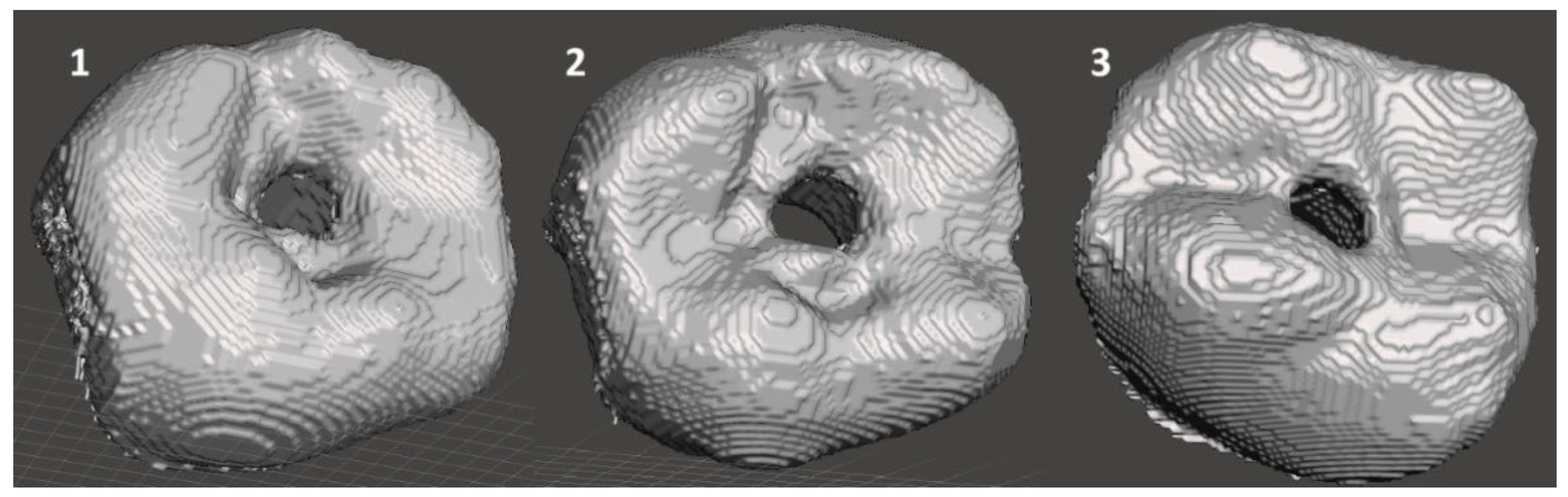
Figure 2.
The three newly generated crowns produced by the 3DGAN network, used as Set No. 2 for analyzing the creative potential of the network. Each crown—1, 2, and 3—was superimposed against the others within the set in MeshLab 2025.07 to measure the Hausdorff distance (HD).
Figure 2.
The three newly generated crowns produced by the 3DGAN network, used as Set No. 2 for analyzing the creative potential of the network. Each crown—1, 2, and 3—was superimposed against the others within the set in MeshLab 2025.07 to measure the Hausdorff distance (HD).
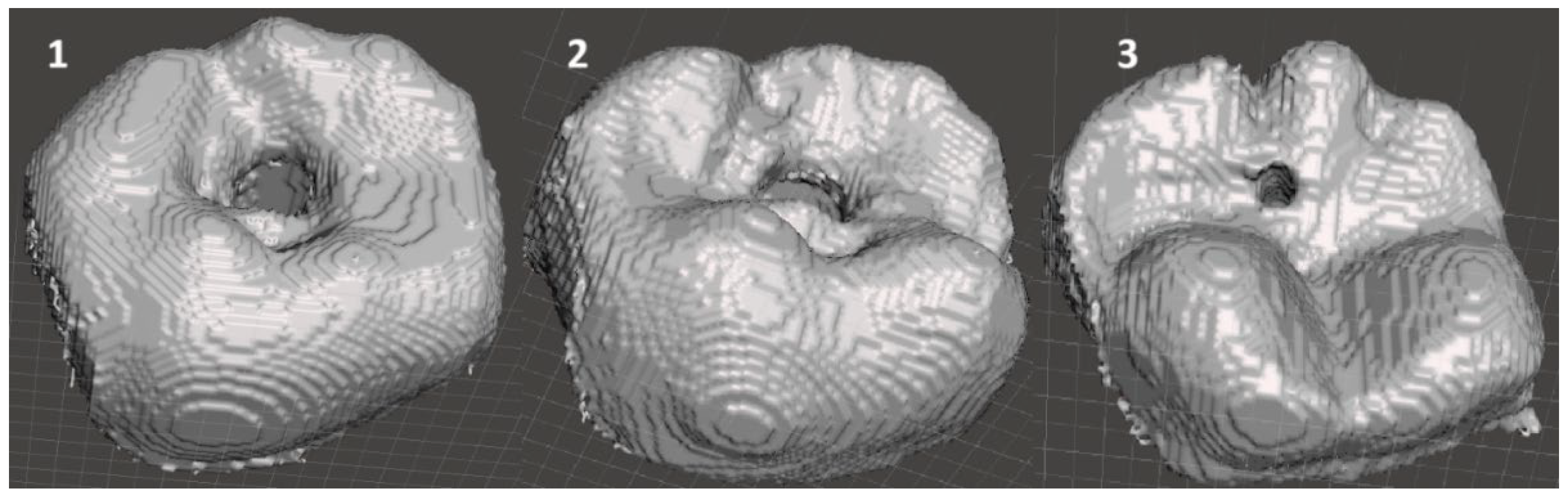
Figure 3.
The three newly generated crowns produced by the 3DGAN network, used as Set No. 3 for analyzing the creative potential of the network. Each crown—1, 2, and 3—was superimposed against the others within the set in MeshLab 2025.07 to measure the Hausdorff distance (HD).
Figure 3.
The three newly generated crowns produced by the 3DGAN network, used as Set No. 3 for analyzing the creative potential of the network. Each crown—1, 2, and 3—was superimposed against the others within the set in MeshLab 2025.07 to measure the Hausdorff distance (HD).
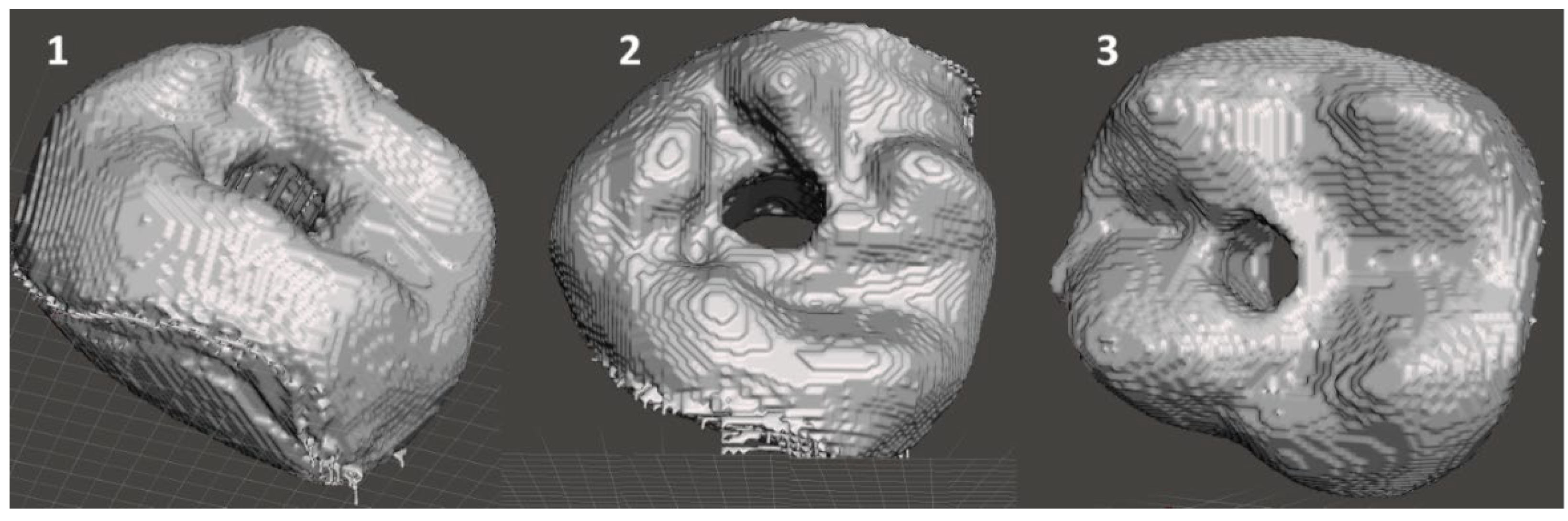
Figure 4.
Visualization of the superimposed pairs of STL files (1, 2, and 3) generated by the 3DGAN network using the prosthetic field from STL file No. 1 as input. The histogram is visible on the left side of each of the three images, with the individual colors representing the discrepancies between the files. A – Crown 1 superimposed on Crown 2. B – Crown 1 superimposed on Crown 3. C – Crown 2 superimposed on Crown 3.
Figure 4.
Visualization of the superimposed pairs of STL files (1, 2, and 3) generated by the 3DGAN network using the prosthetic field from STL file No. 1 as input. The histogram is visible on the left side of each of the three images, with the individual colors representing the discrepancies between the files. A – Crown 1 superimposed on Crown 2. B – Crown 1 superimposed on Crown 3. C – Crown 2 superimposed on Crown 3.
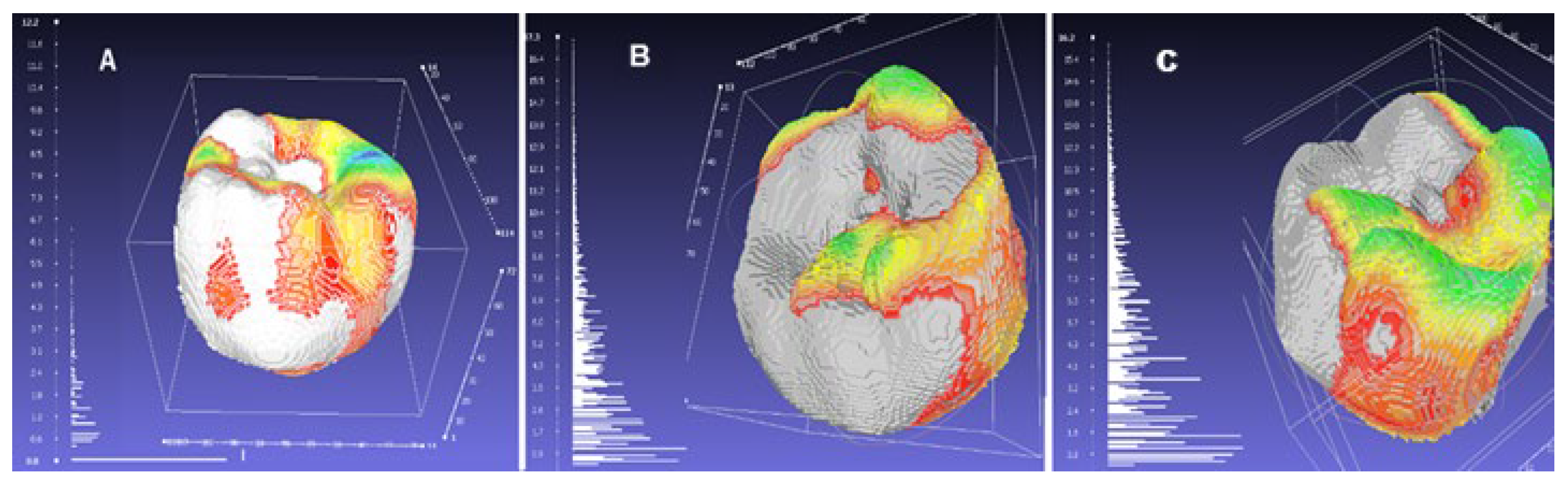
Figure 5.
Visualization of the superimposed pairs of STL files (1, 2, and 3) generated by the 3DGAN network using the prosthetic field from STL file No. 2 as input. The histogram is visible on the left side of each of the three images, with the individual colors representing the discrepancies between the files. A – Crown 1 superimposed on Crown 2. B – Crown 1 superimposed on Crown 3. C – Crown 2 superimposed on Crown 3.
Figure 5.
Visualization of the superimposed pairs of STL files (1, 2, and 3) generated by the 3DGAN network using the prosthetic field from STL file No. 2 as input. The histogram is visible on the left side of each of the three images, with the individual colors representing the discrepancies between the files. A – Crown 1 superimposed on Crown 2. B – Crown 1 superimposed on Crown 3. C – Crown 2 superimposed on Crown 3.
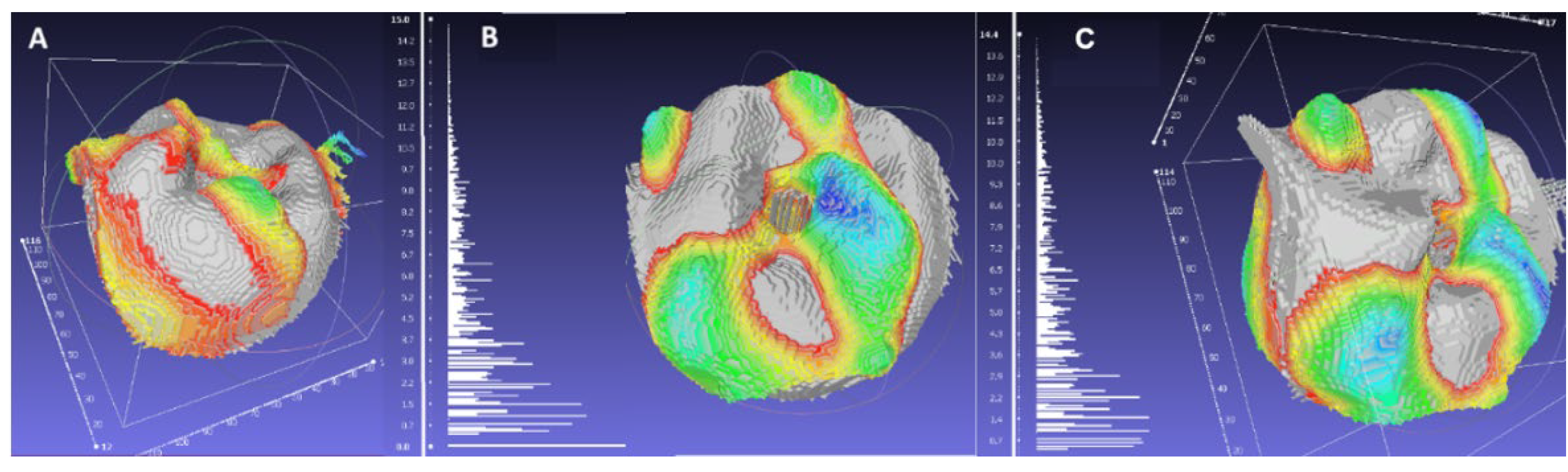
Figure 6.
Visualization of the superimposed pairs of STL files (1, 2, and 3) generated by the 3DGAN network using the prosthetic field from STL file No. 3 as input. The histogram is visible on the left side of each of the three images, with the individual colors representing the discrepancies between the files. A – Crown 1 superimposed on Crown 2. B – Crown 1 superimposed on Crown 3. C – Crown 2 superimposed on Crown 3.
Figure 6.
Visualization of the superimposed pairs of STL files (1, 2, and 3) generated by the 3DGAN network using the prosthetic field from STL file No. 3 as input. The histogram is visible on the left side of each of the three images, with the individual colors representing the discrepancies between the files. A – Crown 1 superimposed on Crown 2. B – Crown 1 superimposed on Crown 3. C – Crown 2 superimposed on Crown 3.
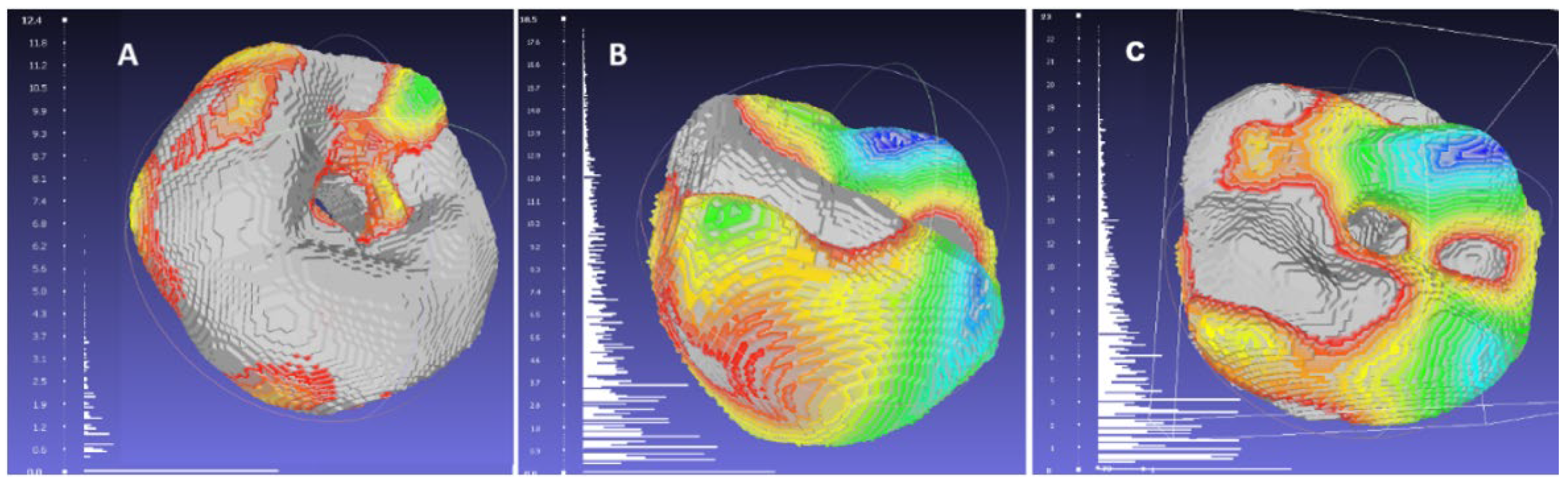

Table 1.
Results for HD (Mean, Max and RMS) in each compared pair of designs.
| Prosthetic field (input information) | Compared pair of designs | HD results | ||
| Mean HD | Max HD | RMS | ||
| №1 | 1 vs 2 | 1.12 | 12.20 | 1.84 |
| 1 vs 3 | 3.87 | 17.26 | 4.96 | |
| 2 vs 3 | 4.31 | 16.20 | 5.35 | |
| №2 | 1 vs 2 | 1.32 | 16.40 | 2.42 |
| 1 vs 3 | 4.00 | 14.98 | 5.01 | |
| 2 vs 3 | 4.13 | 14.35 | 5.16 | |
| №3 | 1 vs 2 | 1.08 | 12.40 | 1.87 |
| 1 vs 3 | 4.89 | 18.49 | 6.26 | |
| 2 vs 3 | 5.14 | 23.32 | 6.74 | |
Disclaimer/Publisher’s Note: The statements, opinions and data contained in all publications are solely those of the individual author(s) and contributor(s) and not of MDPI and/or the editor(s). MDPI and/or the editor(s) disclaim responsibility for any injury to people or property resulting from any ideas, methods, instructions or products referred to in the content. |
© 2026 by the authors. Licensee MDPI, Basel, Switzerland. This article is an open access article distributed under the terms and conditions of the Creative Commons Attribution (CC BY) license (http://creativecommons.org/licenses/by/4.0/).
Copyright: This open access article is published under a Creative Commons CC BY 4.0 license, which permit the free download, distribution, and reuse, provided that the author and preprint are cited in any reuse.


