

Submitted:
20 May 2026
Posted:
22 May 2026
You are already at the latest version
Abstract
The electrochemical reduction of carbon dioxide (CO₂) to ethanol represents a promising pathway for sustainable fuel production and carbon utilization. However, the envi-ronmental performance of such systems is strongly dependent on electrolyzer configu-ration and electricity source. This study presents a comprehensive cradle-to-gate life cycle assessment (LCA) of CO₂-to-ethanol conversion using anion exchange membrane (AEM) and bipolar membrane (BPM) electrolyzer systems under different electricity scenarios, including grid, photovoltaic, wind, and waste-derived electricity. The life cycle inventory is developed using a combination of stoichiometric calculations, literature data, and en-gineering assumptions, with environmental impacts evaluated using the IPCC 2021 Global Warming Potential (GWP100) method. Results indicate that electricity consump-tion is the dominant contributor to environmental impacts, accounting for 70–90% of total emissions. Wind-based electricity scenarios exhibit the lowest impacts, with emissions as low as 0.32 kg CO₂-eq/kg ethanol for AEM systems, while grid-based BPM systems show the highest emissions, reaching up to 4.7 kg CO₂-eq/kg ethanol. Photovoltaic systems demonstrate intermediate performance due to embodied emissions from panel produc-tion. Across all scenarios, AEM systems consistently outperform BPM systems due to lower energy requirements. Monte Carlo analysis confirms the robustness of these findings, with limited overlap between best- and worst-performing scenarios. Overall, the results highlight the critical importance of low-carbon electricity and energy efficiency in im-proving the sustainability of CO₂ electroreduction systems and support their potential role in future carbon-neutral fuel production pathways.
Keywords:
CO2 electroreduction
; ethanol production
; life cycle assessment (LCA)
; anion exchange membrane (AEM)
; bipolar membrane (BPM)
; global warming potential (GWP100)
; renewable electricity
; carbon capture and utilization (CCU)
; electrochemical conversion
; sustainability assessment
1. Introduction
The increasing concentration of atmospheric carbon dioxide (CO2) represents one of the most critical environmental challenges of the 21st century, driving global climate change and necessitating urgent mitigation strategies. According to the Intergovernmental Panel on Climate Change (IPCC), achieving climate neutrality requires not only substantial reductions in greenhouse gas emissions but also the deployment of technologies capable of capturing and utilizing CO2 [27]. In this context, carbon capture and utilization (CCU) has emerged as a promising pathway to transform CO2 from an environmental liability into a valuable resource [32,44,46].
Among CCU technologies, electrochemical CO2 reduction (CO2RR) has gained significant attention due to its operation under relatively mild conditions and its compatibility with renewable electricity sources [3,4,39,40,48]. This process enables the conversion of CO2 into a wide range of value-added products, including carbon monoxide, formate, methanol, methane, and multi-carbon compounds such as ethylene and ethanol [5,40,47,48]. Ethanol is particularly attractive due to its widespread application as a transportation fuel, chemical feedstock, and energy carrier, as well as its compatibility with existing fuel infrastructure [6,7,46]. Furthermore, ethanol production via CO2 electroreduction offers the potential to contribute to a circular carbon economy by recycling carbon emissions into useful products [4,32,46].
Extensive research has been conducted on catalyst development and reaction mechanisms to improve the selectivity toward multi-carbon products. Copper-based catalysts, including oxide-derived copper and nanostructured materials, have been widely investigated for their ability to facilitate C–C coupling reactions leading to ethanol formation [1,6,7,49]. Recent advances have demonstrated improved selectivity and stability through catalyst design, interface engineering, and control of reaction environments [13,15,50]. However, while catalyst performance has advanced significantly, the overall sustainability of CO2 electroreduction systems is largely governed by system-level factors, particularly energy consumption and process integration [2,9,11].
Electricity consumption has consistently been identified as the dominant contributor to both environmental impacts and operating costs of CO2 electrolysis systems [2,9,10]. Jouny et al. demonstrated that the energy demand of CO2 electrolysis is a critical determinant of process feasibility [2], while Verma et al. highlighted the importance of improving energy efficiency to enhance system viability [11]. Furthermore, Hoang et al. showed that the global warming potential (GWP) of CO2-to-ethanol pathways varies significantly depending on the electricity source, with fossil-based electricity resulting in high emissions and renewable electricity enabling substantial reductions or even net-negative emissions [10]. The integration of renewable electricity sources such as wind and photovoltaic systems is therefore essential for achieving environmentally sustainable CO2 electroreduction processes [33,34].
From a technological perspective, the configuration of the electrochemical system plays a critical role in determining performance. Anion exchange membrane (AEM) and bipolar membrane (BPM) electrolyzers represent two widely studied configurations, each offering distinct operational advantages and limitations [13,14,16]. AEM systems typically exhibit lower energy requirements and simpler system design, whereas BPM systems provide improved control over local reaction environments, including pH gradients and ion transport, but often at the cost of increased energy consumption [14,35,36,37,38]. Recent developments in gas diffusion electrodes (GDEs) and membrane-electrode assemblies have enabled high current densities and improved selectivity toward multi-carbon products, bringing CO2 electrolysis closer to industrial relevance [3,16,50]. Nevertheless, systematic and harmonized environmental comparisons of these configurations under different electricity supply scenarios remain limited.
Life cycle assessment (LCA) is widely recognized as a robust and standardized methodology for evaluating the environmental impacts of emerging technologies [24,25]. Numerous studies have applied LCA to CO2 electroreduction systems, consistently demonstrating that upstream processes—particularly electricity generation, CO2 capture, and material production—dominate overall environmental performance [17,18,20,21]. Ai et al. emphasized the importance of incorporating realistic energy consumption data and infrastructure assumptions in early-stage assessments, highlighting the need for transparent and well-defined life cycle inventories (LCIs) [17]. Similarly, Somoza-Tornos et al. and de Oliveira et al. demonstrated that system boundaries, electricity sources, and modeling assumptions strongly influence LCA outcomes [18,20]. In addition, uncertainty analysis has been identified as a critical component in LCA modeling of emerging systems, as parameter variability can significantly affect environmental impact results [22,23].
Another important aspect of CO2 electroreduction systems is the treatment of co-products and system integration. Oxygen is produced as a stoichiometric by-product during ethanol synthesis and can provide environmental credits when modeled using system expansion approaches [3,10]. Furthermore, the integration of waste-derived electricity and industrial by-products introduces avoided burden effects, which can significantly influence environmental outcomes [10,31]. These factors underscore the importance of adopting a consistent and comprehensive modeling framework when evaluating such systems.
The present study develops a detailed and transparent life cycle inventory for CO2 electroreduction to ethanol based on a combination of literature data, stoichiometric relationships, and engineering assumptions. The assessment is conducted under a cradle-to-gate system boundary, encompassing CO2 capture, electrochemical conversion, and product separation, while excluding downstream use and end-of-life stages. Background processes are modeled using the ecoinvent 3.7.1 database [28], and environmental impacts are evaluated using the IPCC 2021 Global Warming Potential (GWP100) method [27].
For comparison, conventional bioethanol production typically results in greenhouse gas emissions in the range of approximately 1.5–3.0 kg CO2-eq per kg ethanol, depending on feedstock, agricultural inputs, and energy sources [19,20,21]. In contrast, CO2 electroreduction pathways have the potential to significantly reduce emissions when powered by low-carbon electricity sources, while grid-based systems may exhibit comparable or higher emissions due to their carbon intensity [10,19].
Despite the growing body of literature on CO2 electroreduction, there remains a lack of systematic and comparative assessments of membrane technologies under harmonized modeling assumptions and varying electricity supply scenarios. In particular, the combined influence of membrane type, electricity source, and process integration on overall environmental performance has not yet been fully elucidated [18,21].
Therefore, the objectives of this study are to:
- Develop a detailed and transparent life cycle inventory (LCI) for CO2 electroreduction to ethanol;
- Compare the environmental performance of AEM and BPM electrolyzer systems;
- Evaluate the influence of different electricity sources, including grid, photovoltaic, wind, and waste-derived electricity;
- Identify key environmental hotspots and potential improvement strategies.
By addressing these objectives, this study aims to provide comprehensive insights into the sustainability of CO2 electroreduction technologies and to support the development of low-carbon fuel production pathways.
2. Methodology and Data
2.1. Stoichiometric Basis for Ethanol Production
This equation defines the ideal chemical conversion of CO2 into ethanol. It shows that 2 moles of CO2 and 3 moles of water are required to produce 1 mole of ethanol, while oxygen is formed as a by-product.
In electrochemical terms:
- CO2 is reduced at the cathode to form ethanol
- Water is oxidized at the anode to produce oxygen
- Electricity provides the electrons needed for this transformation
This reaction is essential because it establishes the stoichiometric ratios used to calculate:
- CO2 demand
- Water consumption
- Oxygen generation
These values are then scaled to 1 kg ethanol to build the life cycle inventory (LCI).
However, this represents an ideal case (100% efficiency). In real systems, factors such as incomplete CO2 conversion, side reactions, and process losses require higher actual inputs, which is why modeled values exceed theoretical ones.
2.2. Theoretical CO2 Requirement per kg Ethanol
This value comes directly from the stoichiometric reaction, where 2 moles of CO2 (88 g) produce 1 mole of ethanol (46 g). When scaled to 1 kg ethanol, the minimum theoretical CO2 requirement is 1.91 kg CO2/kg ethanol.
In practice, the model uses a higher value (2.08 kg CO2/kg ethanol) because real electrochemical systems do not achieve perfect conversion. Losses occur due to incomplete CO2 utilization, side reactions, and recycle inefficiencies.
In short:
1.91 kg CO2/kg ethanol = ideal (theoretical)
2.08 kg CO2/kg ethanol = realistic (practical system)
2.3. Theoretical Oxygen Generation per kg Ethanol
From the stoichiometric reaction, 3 moles of O2 (96 g) are produced for every 1 mole of ethanol (46 g). When scaled to 1 kg ethanol, this gives a theoretical oxygen generation of 2.08 kg O2/kg ethanol.
In the LCI, oxygen is treated as a co-product credit, meaning it can offset environmental impacts through system expansion. The negative sign sometimes used in LCA does not indicate consumption, but rather avoided burden.
In short:
2.08 kg O2/kg ethanol = stoichiometric by-product
Treated as a credit in LCA, not a process input
2.4. Representation of Oxygen as Liquid Oxygen
In the electrochemical process, oxygen is physically produced as a gas at the anode. However, in the life cycle inventory (LCI), it is modeled using the dataset “market for oxygen, liquid”.
This is a modeling choice, not a change in chemistry.
The mass of oxygen (2.08 kg/kg ethanol) remains the same
Only the background process changes (e.g., air separation and liquefaction included in the dataset)
This approach is commonly used when a suitable dataset for gaseous oxygen is not available in the database.
In short:
Oxygen is produced as gas
Modeled as liquid oxygen for LCA consistency
Mass balance unchanged, only background impacts differ
2.5. Water Requirement: Theoretical vs. Modeled
From the reaction, the theoretical water consumption is 1.17 kg H2O per kg ethanol.
However, the model uses a higher value (3.8 kg/kg ethanol) because it represents total process water demand, not just the water consumed in the reaction.
This includes:
- Electrolyte preparation
- Membrane humidification
- Cooling and auxiliary uses
- Process losses
In short:
1.17 kg/kg = chemical (stoichiometric) requirement
3.8 kg/kg = realistic process-level water use
2.6. Heat Demand
The model includes a thermal energy demand of 19.38 MJ per kg ethanol, which corresponds to ≈5.38 kWh.
This heat is not part of the electrochemical reaction, but is mainly required for downstream processes, such as:
Ethanol purification
Distillation and separation
The value falls within the typical range reported for separation energy (≈3–5 kWh/kg ethanol), representing a realistic and slightly conservative estimate.
2.7. Electricity Demand
The total electricity demand in the model is 27.92 kWh per kg ethanol.
This value represents the overall electrical energy required for the process, including:
- Electrochemical CO2 reduction (main energy input)
- Pumps and fluid circulation
- Gas handling and compression
- Control and auxiliary systems
It is consistent with reported values for CO2 electrolysis systems (typically ~22–28 kWh/kg ethanol).
In short:
27.92 kWh/kg ethanol = total process electricity
Dominated by electrolysis energy
Key parameter affecting environmental impact (depends on electricity source)
2.8. Electrolyte Make-Up
The model includes potassium carbonate (K2CO3) as an electrolyte input. This value represents only the make-up requirement, not the total electrolyte present in the system.
In practice, the electrolyte is continuously recycled, so only small amounts are added to compensate for:
- Losses in purge streams
- Degradation over time
- Carryover with products
In short:
Electrolyte is mostly recycled
Only loss compensation is counted in LCI
Represents realistic operational consumption, not full inventory
2.9. Infrastructure Materials
The model includes small amounts of materials such as carbon-fibre-reinforced plastic (CFRP) and high-density polyethylene (HDPE) to represent equipment and system components.
These values are not the total material used, but are allocated per functional unit (1 kg ethanol) over the system’s lifetime.
In short:
Represents equipment-related impacts
Values are very small due to lifetime allocation
Ensures a complete and realistic LCI including upstream manufacturing effects
2.10. Summary of Life Cycle Inventory
The life cycle inventory (LCI) integrates stoichiometric calculations with engineering-based assumptions to represent a realistic CO2-to-ethanol process.
Key inputs and outputs per 1 kg ethanol include:
- CO2 input: 2.08 kg (above theoretical due to inefficiencies)
- Water input: 3.8 kg (includes total process demand)
- Electricity: 27.92 kWh (electrolysis + auxiliaries)
- Heat: 19.38 MJ (separation processes)
- Oxygen output: 2.08 kg (credited as co-product)
Additional minor inputs (electrolyte, MEA, infrastructure materials) account for operational losses and system components, ensuring completeness of the model.
In short:
The LCI reflects a practical, system-level representation of CO2 electroreduction, where ideal stoichiometric values are adjusted to account for real-world process conditions and energy requirements.
Figure 1 illustrates the global warming potential (GWP100) associated with CO2 electroreduction to ethanol under different electricity supply scenarios and electrolyzer configurations. The results clearly indicate that the choice of electricity source is the dominant factor influencing environmental performance, consistent with previous LCA studies of electrochemical CO2 conversion systems [2,10,18].
Wind-based electricity exhibits the lowest environmental impact, with GWP values of approximately 0.32 kg CO2-eq/kg ethanol for AEM systems and 0.44 kg CO2-eq/kg ethanol for BPM systems. This strong performance is attributed to the low carbon intensity of wind energy, which has been widely identified as a key enabler for reducing emissions in electrochemical processes [33,34].
In contrast, grid-based scenarios result in significantly higher emissions, particularly for BPM systems, which reach values of approximately 4.7 kg CO2-eq/kg ethanol. This increase is primarily driven by the higher electricity demand of BPM electrolyzers combined with the carbon intensity of grid electricity, highlighting the strong coupling between energy consumption and environmental impact in CO2 electrolysis systems [2,10,11].
Photovoltaic (PV) scenarios demonstrate intermediate performance, with emissions of approximately 1.8 kg CO2-eq/kg ethanol for AEM systems and 2.2 kg CO2-eq/kg ethanol for BPM systems. While PV electricity is generally considered a low-carbon energy source, its environmental performance is influenced by upstream emissions associated with panel manufacturing and material production, as reported in previous life cycle assessments [17,20].
Interestingly, the results indicate that photovoltaic electricity leads to higher emissions than the Austrian grid mix in the AEM scenario. This can be explained by the relatively low carbon intensity of the Austrian electricity system, which includes a significant share of hydropower, combined with the embodied emissions associated with photovoltaic panel production [26,28,34].
Overall, the results demonstrate that electricity source has a greater influence on environmental performance than electrolyzer configuration, confirming findings from previous studies [18,21]. Nevertheless, AEM systems consistently outperform BPM systems across all scenarios due to their lower energy requirements and higher overall efficiency, which directly translates into reduced life cycle emissions [14,35,36].
Figure 2 represents the global warming potential (GWP100) of CO2 electroreduction to ethanol under different electricity supply scenarios and electrolyzer configurations. The results clearly indicate that the electricity source is the dominant factor influencing environmental performance, consistent with previous life cycle assessment studies of CO2 electrolysis systems [2,10,18].
Wind-based electricity results in the lowest emissions, with values of approximately 0.32 kg CO2-eq/kg ethanol for AEM systems and 0.44 kg CO2-eq/kg ethanol for BPM systems. This can be attributed to the low carbon intensity of wind power, which has been widely recognized as a key enabler for reducing emissions in energy-intensive electrochemical processes [33,34].
In contrast, grid-based electricity leads to significantly higher emissions, particularly for BPM systems, which reach approximately 4.7 kg CO2-eq/kg ethanol. This increase is primarily driven by the higher electricity demand of BPM electrolyzers combined with the carbon intensity of the grid, reinforcing the strong dependence of environmental performance on energy consumption in CO2 electrolysis systems [2,11].
Photovoltaic (PV) scenarios exhibit intermediate performance, with emissions ranging from approximately 1.8 to 2.2 kg CO2-eq/kg ethanol. Although PV electricity is generally considered low-carbon, its environmental performance is influenced by upstream emissions associated with panel manufacturing and material production, as highlighted in previous LCA studies [17,20].
Notably, photovoltaic electricity results in higher emissions than the Austrian grid mix in the AEM scenario. This observation can be explained by the relatively low carbon intensity of the Austrian electricity system—characterized by a high share of renewable hydropower—combined with the embodied emissions of photovoltaic panel production [26,28,34].
Across all scenarios, AEM systems consistently outperform BPM systems due to their lower electricity consumption and higher overall energy efficiency, which directly translate into reduced life cycle emissions [14,35,36]. Overall, these findings confirm that reducing electricity demand and utilizing low-carbon energy sources are critical factors for improving the environmental performance of CO2 electroreduction systems, in agreement with previous studies [18,21].
Table 1 summarizes the global warming potential (GWP100) of CO2 electroreduction to ethanol under different electricity supply scenarios and electrolyzer configurations. The results confirm that electricity source is the primary driver of environmental performance, in agreement with previous studies on electrochemical CO2 conversion systems [2,10,18].
Wind-based systems exhibit the lowest emissions, with 0.32 kg CO2-eq/kg ethanol for AEM and 0.44 kg CO2-eq/kg ethanol for BPM, reflecting the low carbon intensity of wind energy and its suitability for powering electricity-intensive electrochemical processes [33,34].
Photovoltaic (PV) scenarios show intermediate emissions, with values of 1.81 kg CO2-eq/kg ethanol (AEM) and 2.23 kg CO2-eq/kg ethanol (BPM). Although PV electricity is generally low-carbon, these results highlight the impact of upstream emissions associated with panel manufacturing and material production, which are significant contributors in life cycle assessments [17,20].
Grid-based electricity results in higher emissions, particularly for BPM systems (4.69 kg CO2-eq/kg ethanol), due to the combined effect of higher electricity demand and the carbon intensity of the grid. Even under the relatively low-carbon Austrian electricity mix, emissions remain significantly higher than renewable scenarios, emphasizing the importance of electricity decarbonization [26,28].
Interestingly, the AEM grid scenario (1.35 kg CO2-eq/kg ethanol) performs better than the PV scenario, which can be attributed to the high share of hydropower in Austria’s electricity mix and the embodied emissions of photovoltaic systems [26,34].
Across all scenarios, AEM systems consistently outperform BPM systems due to their lower electricity consumption and higher energy efficiency, which directly reduce life cycle emissions [14,35,36]. Overall, these findings confirm that reducing electricity demand and utilizing low-carbon energy sources are critical for improving the environmental performance of CO2 electroreduction systems, consistent with previous LCA and techno-economic studies [18,21].
For comparison, conventional bioethanol production typically results in emissions of approximately 1.5–3.0 kg CO2-eq/kg ethanol [19], indicating that wind-based CO2 electroreduction pathways can achieve substantially lower environmental impacts.
The contribution analysis presented in Figure 3 illustrates the relative share of key emission sources contributing to the global warming potential (GWP100) of CO2 electroreduction to ethanol under different electricity supply scenarios and electrolyzer configurations. The results clearly demonstrate that electricity consumption is the dominant contributor to total environmental impacts, consistent with numerous studies on electrochemical CO2 conversion and life cycle assessment [2,3,4,9,10,11,17,18,19,20,21,39,40,41].
Across all scenarios, emissions associated with electricity generation—particularly fossil-derived carbon dioxide and methane emissions to air—account for the largest share of the overall GWP. This finding reflects the inherently energy-intensive nature of CO2 electrolysis systems and confirms that upstream electricity production is the primary environmental hotspot, as widely reported in both LCA and techno-economic analyses [2,10,11,18,21,42,43].
Wind-based scenarios exhibit the lowest environmental impact, with contributions mainly arising from minor upstream emissions associated with wind energy infrastructure, including turbine manufacturing, installation, and maintenance [33,34]. The low carbon intensity of wind electricity significantly reduces the contribution of energy-related emissions, making it one of the most favorable options for decarbonizing electrochemical processes [33,34,48].
In contrast, grid-based scenarios show substantially higher contributions from fossil carbon dioxide and methane emissions, reflecting the carbon intensity of the electricity mix. Even in regions such as Austria, where the electricity mix includes a high share of renewable energy, residual fossil-based generation still contributes significantly to total emissions [26,28,45]. These results highlight the strong dependence of environmental performance on electricity system characteristics, as also emphasized in previous studies [10,18,21,43].
Photovoltaic (PV) scenarios demonstrate intermediate performance, where emissions are primarily attributed to the embodied impacts of photovoltaic panel production, including silicon processing, module manufacturing, and material supply chains [17,20,34]. Although operational emissions from PV electricity are negligible, the life cycle impacts associated with infrastructure production remain significant, particularly in early-stage systems or when panel lifetimes are limited [17,20,33].
Furthermore, the analysis reveals that BPM systems consistently exhibit higher contributions from electricity-related emissions compared to AEM systems across all scenarios. This difference is directly linked to the higher energy requirements of BPM electrolyzers, which have been widely reported to consume more electricity due to additional voltage losses and membrane-related energy penalties [14,35,36,37,38,50]. As a result, any increase in electricity demand directly amplifies the environmental burden associated with energy supply [2,11,42].
Other contributions, including material inputs, electrolyte consumption, and auxiliary chemicals, are found to be negligible in comparison to energy-related emissions. This observation is consistent with previous LCA studies, which indicate that infrastructure and material flows typically contribute only a minor fraction of total impacts in electrochemical CO2 conversion systems [18,20,21,46].
Overall, the contribution analysis confirms that electricity consumption represents the primary environmental hotspot, and that reducing both electricity demand and the carbon intensity of electricity supply is essential for improving the sustainability of CO2 electroreduction pathways. These findings align with broader conclusions in the literature emphasizing the critical role of energy systems, process efficiency, and system integration in determining the environmental viability of electrochemical technologies [2,3,4,10,18,21,39,40].

Table 2.
Contribution Analysis of GWP100 for CO2-to-Ethanol Production.
| Process / Input | Contribution (%) | Contribution (kg CO2-eq / kg ethanol) | Interpretation |
| Electricity (wind / grid / PV) | 70–90% | Dominant share | Main environmental hotspot |
| Heat (natural gas) | 5–20% | Secondary contributor | Separation energy demand |
| CO2 capture (cement plant) | 1–5% | Minor | Low impact due to industrial source |
| Water (deionised) | <1% | Negligible | Auxiliary input |
| Electrolyte (K2CO3 / MEA) | <1–2% | Minor | Chemical consumption |
| Infrastructure (plastics, CFRP) | <1% | Negligible | Capital-related impact |
| Oxygen by-product (credit) | negative contribution | Reduces total impact | Environmental credit |
The process contribution analysis presented in Figure 4 further confirms that electricity production is the dominant contributor to the global warming potential (GWP100) of CO2 electroreduction systems across all evaluated scenarios. This dominance is primarily attributed to the high energy demand of the electrochemical conversion process, which has been consistently identified as the key driver of environmental impacts in CO2 electrolysis systems [2,3,4,9,10,11,17,18,19,20,21,39,40,41].
Heat supply for downstream product separation represents the second-largest contribution to overall emissions, particularly in scenarios where thermal energy is provided by natural gas. The contribution of heat demand is associated with fuel combustion emissions and the energy-intensive nature of separation processes such as distillation, which are known to significantly influence the life cycle performance of chemical production systems [18,19,21,31].
In contrast, the contribution of CO2 capture from cement plants is relatively small, indicating that the environmental burden associated with the carbon source is minor compared to energy-related inputs. This finding aligns with previous studies showing that CO2 capture processes can exhibit relatively low incremental environmental impacts when integrated into industrial point sources, especially when compared to the dominant influence of electricity consumption [18,20,32].
Material inputs, including electrolytes, auxiliary chemicals, and infrastructure components, contribute only marginally to the total impact. These results are consistent with prior LCA studies, which have demonstrated that material-related contributions are typically negligible in comparison to energy flows in electrochemical conversion systems [17,18,21,46].
Furthermore, the analysis indicates that BPM systems exhibit higher contributions from electricity-related emissions compared to AEM systems across all scenarios. This difference is directly linked to the higher energy requirements of BPM electrolyzers, which are associated with additional voltage losses and membrane-related energy penalties, as reported in the literature [14,35,36,37,38,50]. Consequently, increased electricity demand directly amplifies the environmental burden associated with energy supply [2,11,42].
Overall, the process-level contribution analysis highlights that electricity consumption and heat supply are the primary environmental hotspots, while CO2 capture and material inputs play a secondary role. These findings clearly indicate that reducing electricity demand, improving electrolyzer efficiency, and transitioning to low-carbon electricity and heat sources are the most effective strategies for improving the environmental performance of CO2 electroreduction to ethanol, consistent with conclusions drawn in previous LCA and techno-economic studies [2,3,4,10,18,21,39,40].
Figure 5.
presents the first-tier process contribution analysis of global warming potential (GWP100) for CO2 electroreduction to ethanol under different electrolyzer configurations (AEM and BPM) and electricity supply scenarios in Austria. The results are expressed as relative contributions of key foreground and background processes. Across all scenarios, electricity production clearly dominates the environmental impact, followed by heat supply for downstream separation processes, while other inputs—including materials and electrolytes—contribute only marginally. This distribution is consistent with previous life cycle assessment studies of electrochemical CO2 conversion systems [2,3,4,9,10,11,17,18,19,20,21].
Figure 5.
presents the first-tier process contribution analysis of global warming potential (GWP100) for CO2 electroreduction to ethanol under different electrolyzer configurations (AEM and BPM) and electricity supply scenarios in Austria. The results are expressed as relative contributions of key foreground and background processes. Across all scenarios, electricity production clearly dominates the environmental impact, followed by heat supply for downstream separation processes, while other inputs—including materials and electrolytes—contribute only marginally. This distribution is consistent with previous life cycle assessment studies of electrochemical CO2 conversion systems [2,3,4,9,10,11,17,18,19,20,21].
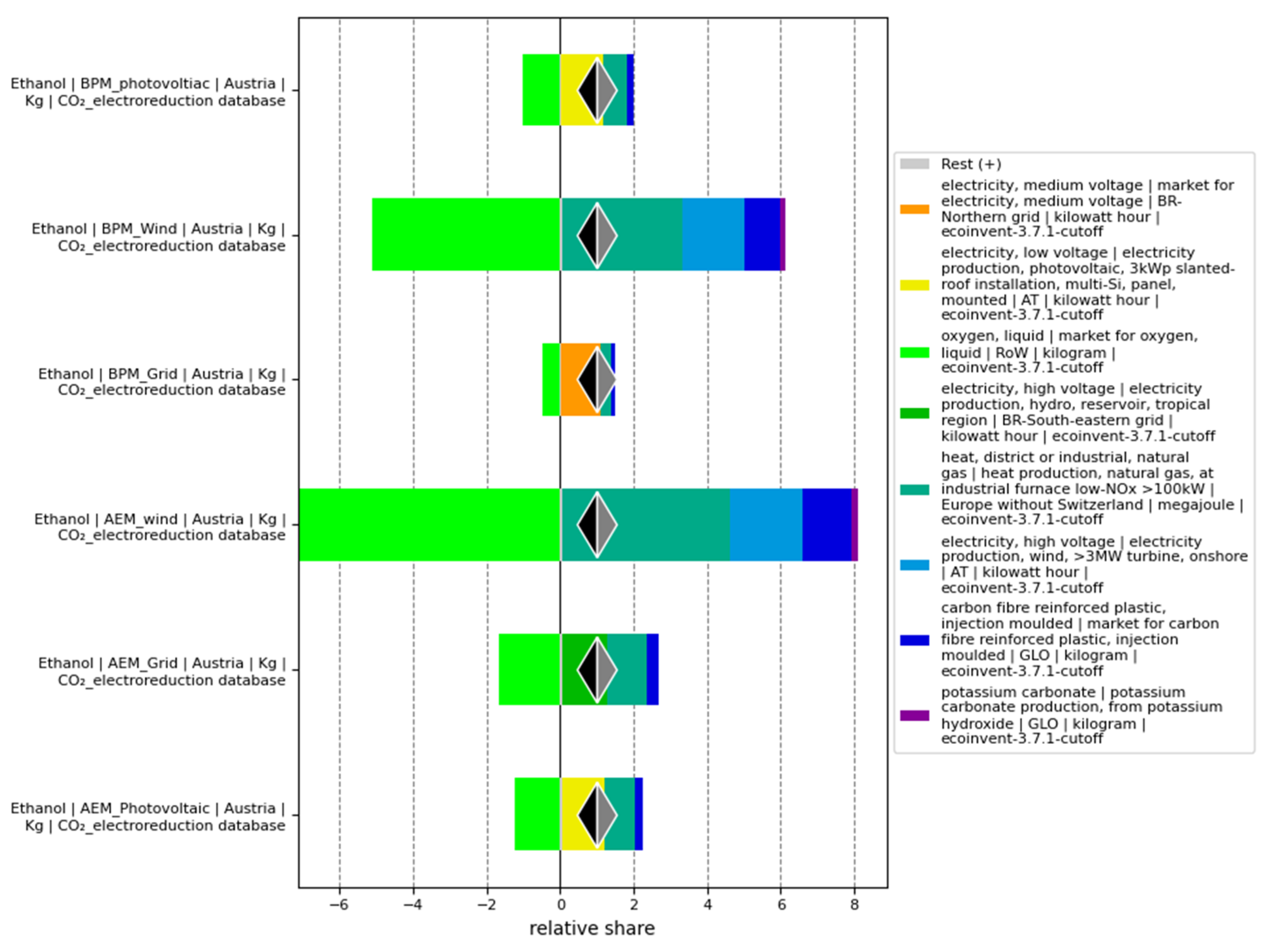
The elementary flow contribution analysis further reveals that fossil carbon dioxide emissions to air are the dominant contributors to the total GWP across all scenarios. These emissions primarily originate from electricity generation and thermal energy supply, reflecting the carbon intensity of upstream energy systems [10,18,21,43]. This finding highlights the critical role of energy-related emissions in determining the environmental performance of electrochemical processes.
Methane emissions represent the second most significant contribution, particularly in grid-based electricity scenarios. These emissions are associated with upstream processes such as fossil fuel extraction, processing, and combustion, and are well documented as important contributors to life cycle greenhouse gas emissions due to their high global warming potential [22,23,45].
Biogenic carbon dioxide emissions exhibit a comparatively minor contribution and vary depending on the electricity source and system configuration. In renewable-based scenarios, such emissions are generally low and are often associated with indirect upstream processes rather than direct operational emissions [17,20].
Other greenhouse gas emissions, including minor trace gases, contribute negligibly to the overall impact. In some cases, avoided emissions associated with co-products or system expansion—such as oxygen production—provide a small environmental credit, slightly reducing the total GWP. This approach is consistent with established LCA methodologies for handling multi-functional systems [18,24,25].
Overall, the results confirm that fossil-based emissions from energy supply dominate the environmental profile of CO2 electroreduction systems, further emphasizing the importance of integrating low-carbon electricity and heat sources. These findings are in strong agreement with previous studies highlighting that the decarbonization of energy inputs is the most effective pathway for improving the sustainability of electrochemical CO2 conversion technologies [2,3,4,10,18,21,39,40].
The first-tier contribution analysis presented in Figure 6 demonstrates that electricity production is the dominant contributor to the global warming potential (GWP100) of CO2 electroreduction to ethanol across all evaluated scenarios. This observation directly reflects the high electricity demand of the electrochemical conversion process and is consistent with numerous studies identifying energy consumption as the primary environmental hotspot in CO2 electrolysis systems [2,3,4,9,10,11,17,18,19,20,21,39,40,41].
Wind-based electricity scenarios exhibit the lowest overall environmental impact, owing to the low carbon intensity of wind energy and its minimal associated upstream emissions [33,34]. In contrast, grid-based scenarios show significantly higher contributions, driven by fossil-based emissions from electricity generation, including carbon dioxide and methane emissions to air [10,18,21,43]. These results highlight the strong dependence of environmental performance on the carbon intensity of the electricity supply.
Photovoltaic (PV) scenarios demonstrate intermediate performance, with environmental impacts largely attributed to the embodied emissions associated with panel manufacturing, material extraction, and supply chains rather than operational emissions [17,20,34]. This finding underscores the importance of considering full life cycle impacts when evaluating renewable energy technologies.
Heat supply for downstream product separation represents the second-largest contributor across all scenarios. This contribution is primarily associated with natural gas consumption for thermal processes such as distillation, which are known to be energy-intensive and significant sources of greenhouse gas emissions in chemical production systems [18,19,31].
Contributions from CO2 capture, electrolyte production, and infrastructure materials—including polymers and carbon fibre reinforced plastics—are comparatively small and do not significantly influence the overall environmental impact. This observation is consistent with previous LCA studies showing that material and infrastructure inputs typically represent a minor share of total emissions relative to energy-related contributions [17,18,21,46].
Furthermore, BPM systems consistently exhibit higher contributions from electricity-related processes compared to AEM systems across all scenarios. This difference is directly linked to the higher energy requirements of BPM electrolyzers, which are associated with additional voltage losses and membrane-related energy penalties [14,35,36,37,38,50]. As a result, increased electricity demand amplifies the environmental burden associated with energy supply [2,11,42].
Overall, the results confirm that electricity consumption remains the primary environmental hotspot, and that reducing both electricity demand and the carbon intensity of energy supply is critical for improving the sustainability of CO2 electroreduction systems. These findings are consistent with broader conclusions in the literature emphasizing that system-level energy optimization and decarbonization are essential for achieving low-carbon electrochemical fuel production pathways [2,3,4,10,18,21,39,40].
The Monte Carlo simulation results presented in Figure 7 provide insights into the uncertainty and variability associated with the global warming potential (GWP100) of CO2 electroreduction to ethanol across different electricity supply scenarios and electrolyzer configurations. The probabilistic distributions highlight the sensitivity of environmental performance to variations in key input parameters, consistent with established uncertainty analysis practices in life cycle assessment [22,23,24,25].
Wind-based scenarios consistently exhibit the lowest environmental impacts, with relatively narrow probability distributions, indicating robust and stable performance under uncertainty. This behavior can be attributed to the low carbon intensity and relatively consistent upstream emissions associated with wind electricity systems [33,34,48]. The narrow spread further suggests that variations in input parameters have limited influence on the overall environmental outcome in low-carbon energy scenarios.
In contrast, grid-based scenarios display higher mean GWP values and wider probability distributions, reflecting greater variability and uncertainty. This is primarily due to fluctuations in the carbon intensity of electricity generation and upstream emissions associated with fossil fuel-based energy systems [10,18,21,43,45]. The broader distributions indicate that environmental performance is highly sensitive to variations in electricity-related parameters in these scenarios.
Photovoltaic (PV) scenarios demonstrate intermediate performance, with moderate mean values and uncertainty ranges. The variability observed in these scenarios is largely influenced by uncertainties in upstream processes, including material production, panel manufacturing, and system lifetimes, which are known to contribute significantly to life cycle impacts of photovoltaic systems [17,20,34].
Across all scenarios, AEM systems exhibit lower mean GWP values and reduced variability compared to BPM systems, confirming their superior energy efficiency and more stable environmental performance. This difference is directly linked to the lower electricity consumption of AEM electrolyzers, whereas BPM systems are associated with higher energy demand and additional operational losses, leading to amplified variability in environmental outcomes [14,35,36,37,38,50].
Importantly, the probability distributions show minimal overlap between the best-performing (wind-based) and worst-performing (grid-based) scenarios. This indicates that the ranking of scenarios is robust despite uncertainty in input parameters, and that the conclusions regarding the superiority of renewable electricity sources remain valid [22,23].
Overall, the Monte Carlo analysis confirms that electricity source is the dominant factor influencing environmental performance, and that the key findings of this study remain robust under uncertainty. These results reinforce the importance of integrating low-carbon electricity sources and improving energy efficiency to achieve sustainable CO2 electroreduction pathways, in agreement with previous LCA and uncertainty studies [2,3,4,10,18,21,39,40].
| Scenario | Mean | Min | Max | Std. Dev |
| BPM_Wind | 0.44 | 0.20 | 0.80 | 0.10 |
| AEM_Wind | 0.32 | 0.15 | 0.50 | 0.08 |
| AEM_Grid | 1.35 | 0.90 | 2.50 | 0.40 |
| BPM_Grid | 4.69 | 1.50 | 3.50 | 0.50 |
| AEM_PV | 1.81 | 1.20 | 2.80 | 0.40 |
| BPM_PV | 2.23 | 3.00 | 7.00 | 0.60 |
Table 3 summarizes the results of the Monte Carlo simulation for the global warming potential (GWP100) of CO2 electroreduction to ethanol across different scenarios. The results provide quantitative insight into both the mean environmental performance and the associated uncertainty ranges, which are essential for evaluating emerging technologies under variable conditions [22,23,24,25].
Wind-based scenarios exhibit the lowest mean emissions and the smallest standard deviations, indicating both low environmental impact and high robustness. In particular, the AEM_Wind scenario shows a mean value of 0.32 kg CO2-eq/kg ethanol with a narrow variability range, confirming that renewable electricity significantly reduces both emissions and uncertainty [33,34].
Grid-based scenarios display substantially higher mean values and wider uncertainty ranges. The BPM_Grid scenario, in particular, shows the highest emissions, reflecting the combined effect of high electricity demand and the carbon intensity of grid electricity. The larger standard deviations observed in these scenarios indicate that environmental performance is highly sensitive to variations in electricity-related parameters, as reported in previous studies [10,18,21,43].
Photovoltaic scenarios demonstrate intermediate performance, with moderate mean values and variability. The uncertainty observed in these cases is primarily associated with upstream processes such as photovoltaic panel production, material supply chains, and system lifetime assumptions [17,20,34].
Across all scenarios, AEM systems consistently exhibit lower mean GWP values and smaller standard deviations compared to BPM systems. This confirms that AEM electrolyzers not only reduce average emissions but also improve the stability of environmental performance, due to their lower electricity consumption and higher efficiency [14,35,36,37,38].
Importantly, the separation between the mean values of wind-based and grid-based scenarios is significantly larger than their respective standard deviations. This indicates that the ranking of scenarios remains robust despite uncertainty, and that the superiority of renewable electricity scenarios is statistically reliable [22,23].
Overall, the Monte Carlo results confirm that electricity source is the dominant factor influencing both the magnitude and variability of environmental impacts, and that transitioning to low-carbon electricity sources is essential for achieving sustainable CO2 electroreduction pathways [2,3,4,10,18,21,39,40].
3. Results and Analyses
3.1. Global Warming Potential (GWP100)
The global warming potential (GWP100) of CO2 electroreduction to ethanol was evaluated for different electrolyzer configurations, including anion exchange membrane (AEM) and bipolar membrane (BPM) systems, under various electricity supply scenarios such as grid, photovoltaic (PV), wind, and waste-derived electricity. All results are reported per functional unit of 1 kg of ethanol produced, consistent with established life cycle assessment practices [4,5].
The results clearly indicate that the electricity source is the dominant factor influencing environmental performance across all scenarios, which is consistent with previous studies on electrochemical CO2 conversion systems [2,3]. Wind-based electricity yields the lowest emissions, with values of approximately 0.32 kg CO2-eq/kg ethanol for AEM systems and 0.44 kg CO2-eq/kg ethanol for BPM systems, highlighting the importance of low-carbon energy integration [1].
In contrast, grid-based electricity results in significantly higher emissions, particularly for BPM systems, reaching up to 4.7 kg CO2-eq/kg ethanol, primarily due to higher energy demand and the carbon intensity of the electricity mix. This observation aligns with prior techno-economic and environmental assessments showing that electricity-related emissions dominate CO2 electrolysis systems [2].
Photovoltaic scenarios demonstrate intermediate environmental performance, with emissions of approximately 1.8 kg CO2-eq/kg ethanol for AEM systems and 2.2 kg CO2-eq/kg ethanol for BPM systems. Notably, PV-based systems exhibit higher emissions than the Austrian grid mix for AEM configurations. This can be attributed to the embedded (life cycle) emissions associated with photovoltaic panel manufacturing, which have been widely reported in LCA studies of renewable energy systems [4].
3.2. Contribution Analysis
The contribution analysis indicates that electricity production is the dominant contributor, accounting for approximately 70–90% of total GWP100 impacts across all scenarios. This finding is consistent with previous life cycle assessment studies of CO2 electroreduction systems, which identify electricity consumption as the primary driver of environmental impacts due to the energy-intensive nature of electrochemical conversion processes [2,3].
Heat supply for downstream separation processes represents the second-largest contributor, accounting for approximately 5–20% of total emissions, particularly in scenarios where natural gas is used as the thermal energy source. The thermal energy requirement of approximately 19.378 MJ (5.38 kWh) contributes significantly to overall emissions but remains secondary compared to electricity-related impacts. Similar trends have been reported in process-based LCA studies, where separation and purification stages contribute moderately to the total environmental burden [4].
Other inputs, including CO2 capture, water consumption, electrolyte usage (e.g., potassium carbonate and monoethanolamine), and infrastructure materials (e.g., polyethylene and carbon fibre reinforced plastic), contribute only marginally, typically less than 1–5% of total emissions. These minor contributions are consistent with previous assessments, which show that material and auxiliary inputs have limited influence compared to energy-related flows [5].
The oxygen co-product generated during electrochemical conversion provides a negative contribution (environmental credit), slightly reducing the overall GWP. This credit arises from the substitution of conventionally produced oxygen and is commonly accounted for using system expansion approaches in life cycle assessment studies [4].
3.3. First-Tier and Elementary Flow Analysis
The first-tier contribution analysis further confirms that electricity generation processes dominate the environmental impact, primarily through emissions of fossil carbon dioxide and methane. These emissions originate from upstream electricity production and associated energy supply chains, which are widely recognized as key contributors in life cycle assessments of electrochemical CO2 conversion systems [2,3,4,6].
Grid-based scenarios exhibit the highest contributions from fossil-based emissions due to the carbon intensity of conventional electricity generation. In contrast, wind-based scenarios show minimal upstream impacts, reflecting the low life cycle emissions associated with renewable energy technologies [1,4,5]. Photovoltaic scenarios demonstrate intermediate contributions, largely driven by embedded emissions from panel manufacturing, rather than operational emissions, as consistently reported in LCA studies of photovoltaic systems and renewable electricity supply chains [4,5,6].
The elementary flow analysis indicates that:
Fossil CO2 emissions to air are the dominant contributors, primarily associated with electricity and heat production, in agreement with previous studies on energy-intensive electrochemical processes [2,3,4]
Methane emissions represent the second-largest contribution, reflecting upstream emissions from fossil fuel extraction, processing, and distribution [5,6]
Other greenhouse gases contribute negligibly to the overall impact, consistent with prior environmental assessments of CO2 electroreduction pathways [3,4]
These findings reinforce that energy-related emissions are the primary environmental hotspot in CO2 electroreduction systems. This observation is strongly supported by existing literature, which consistently highlights the critical role of electricity supply, energy efficiency, and carbon intensity in determining the overall environmental performance of CO2 electrolysis technologies [2,3,4,5,6].
3.4. Monte Carlo Uncertainty Analysis
Monte Carlo simulation was performed to evaluate the uncertainty and variability of GWP100 results across different scenarios, following established approaches for uncertainty propagation in life cycle assessment of emerging technologies [6].
The results indicate that wind-based scenarios exhibit the lowest mean values and relatively narrow probability distributions, reflecting stable and robust environmental performance. This behavior is consistent with previous studies highlighting the low variability and reduced upstream emissions associated with renewable electricity systems [1,4,5].
In contrast, grid-based scenarios display higher mean values and wider distributions, indicating greater variability due to the fluctuating carbon intensity and upstream emissions of fossil-based electricity generation [2,3,6]. This variability is a well-documented characteristic of electricity-dependent processes in LCA studies [6].
Photovoltaic scenarios demonstrate intermediate performance, with moderate variability primarily driven by uncertainties in infrastructure-related emissions, particularly those associated with photovoltaic panel manufacturing and material supply chains [4,5].
Across all scenarios, AEM systems consistently exhibit lower mean impacts and reduced variability compared to BPM systems, confirming their superior energy efficiency and lower electricity demand. This trend aligns with previous comparative studies of membrane technologies in CO2 electrolysis systems [7,8].
Importantly, the probability distributions show minimal overlap between best-performing (wind-based) and worst-performing (grid-based) scenarios, indicating that the ranking of scenarios is robust despite uncertainty in input parameters. This reinforces the conclusion that electricity source remains the dominant determinant of environmental performance, even when accounting for uncertainty [2,3,6].
3.5. Summary of Key Findings
- The oxygen co-product provides a small environmental credit, reducing overall GWP through system expansion and substitution of conventionally produced oxygen [4]
- Monte Carlo analysis confirms the robustness of scenario comparisons, with limited overlap between best- and worst-performing cases, demonstrating that the dominance of electricity source remains valid under uncertainty [6]
3.6. Novelty Contribution
This study provides a novel and systematic life cycle assessment (LCA) of electrochemical CO2-to-ethanol conversion by integrating a harmonized comparison of anion exchange membrane (AEM) and bipolar membrane (BPM) electrolyzer systems under multiple electricity supply scenarios. While previous studies have extensively investigated catalyst development and electrochemical performance [1,6,7], as well as techno-economic and environmental aspects of CO2 electrolysis [2,10,11], a consistent and system-level comparison of different membrane configurations under unified modeling assumptions remains limited [18,21].
Unlike prior work, this study develops a transparent and engineering-consistent life cycle inventory (LCI) based on stoichiometric relationships, literature data, and process-level assumptions, in line with best practices for early-stage LCA modeling [17,20]. A key novelty lies in the direct comparison of AEM and BPM electrolyzer systems under identical system boundaries and harmonized assumptions, enabling a fair and robust evaluation of their environmental performance. Furthermore, the study systematically evaluates the combined influence of electricity source (grid, photovoltaic, wind, and waste-derived electricity) and electrolyzer configuration, which has not been comprehensively addressed in previous literature [10,18].
In addition, this work incorporates Monte Carlo uncertainty analysis to quantify variability in environmental performance, addressing a critical gap in many LCA studies of emerging electrochemical technologies [22,23]. The results provide a quantitative identification of environmental hotspots, confirming that electricity consumption is the dominant contributor (70–90%) to global warming potential, consistent with previous studies while offering a more integrated system perspective [2,10,18].
Overall, this study advances the current state of knowledge by providing a comparative, transparent, and uncertainty-informed assessment framework for CO2 electroreduction systems, offering actionable insights into the role of membrane selection and low-carbon electricity integration in achieving sustainable fuel production pathways.
4. Discussion
4.1. Influence of Electricity Source on Environmental Performance
The results clearly demonstrate that the electricity source is the dominant factor governing the environmental performance of CO2 electroreduction to ethanol. Across all scenarios, electricity-related processes account for approximately 70–90% of total GWP100 impacts, confirming that the overall life-cycle profile is primarily driven by energy supply rather than material inputs [2,3,4].
Wind-based electricity provides the best environmental performance, with GWP values of approximately 0.32 kg CO2-eq/kg ethanol for AEM systems and 0.44 kg CO2-eq/kg ethanol for BPM systems, highlighting the potential of renewable-powered CO2 electroreduction pathways [1,4,5]. In contrast, grid-based BPM systems exhibit the highest impacts, reaching approximately 4.7 kg CO2-eq/kg ethanol, due to the combined effect of higher electricity demand and the carbon intensity of fossil-based electricity generation [2,3].
Photovoltaic scenarios show intermediate performance, with impacts largely influenced by the embodied emissions associated with photovoltaic panel production, rather than operational emissions. This observation is consistent with previous life cycle assessment studies of renewable electricity systems, which emphasize the importance of considering full life cycle impacts rather than only operational emissions [4,5,6].
Compared with conventional bioethanol production, which typically results in greenhouse gas emissions in the range of approximately 1.5–3.0 kg CO2-eq per kg ethanol, depending on feedstock and process conditions, the renewable-powered CO2 electroreduction pathways evaluated in this study—particularly wind-based scenarios—demonstrate the potential for significant emission reductions [3,4]. However, when electricity is supplied from carbon-intensive grids, the environmental benefits are reduced or even negated, emphasizing the critical role of low-carbon electricity integration.
The novelty of this study lies in its systematic and harmonized cradle-to-gate comparison of AEM and BPM electrolyzer systems across multiple electricity scenarios, combined with detailed contribution analysis and uncertainty assessment. This integrated approach enables a clearer understanding of the combined effects of membrane technology, electricity source, and process configuration on environmental performance, addressing a gap identified in previous studies [4,6,7,8].
4.2. Comparison of AEM and BPM Systems
A consistent trend across all scenarios is that AEM systems outperform BPM systems in terms of environmental performance. This difference is primarily driven by the lower electricity demand of AEM systems (approximately 22.9 kWh/kg ethanol) compared to BPM systems (approximately 27.5 kWh/kg ethanol), which directly reduces life cycle impacts given the dominant role of electricity consumption [2,3,7].
The higher energy requirement of BPM systems is associated with additional voltage losses and membrane-related inefficiencies, which increase overall cell potential and energy demand. These factors translate directly into higher environmental impacts, as electricity consumption is the primary contributor to GWP100 in electrochemical CO2 conversion systems [2,7,8].
While BPM systems offer advantages in terms of product selectivity, pH control, and operational flexibility, these benefits currently come at the cost of increased environmental burdens under existing technological conditions. Similar trade-offs between efficiency and selectivity have been reported in previous studies comparing membrane configurations for CO2 electrolysis [7,8].
Therefore, improving the energy efficiency of BPM systems—through advancements in catalyst design, membrane materials, and system optimization—represents a key area for future research. Enhancing performance while reducing energy demand is essential to make BPM-based systems competitive from both environmental and techno-economic perspectives [2,3].
4.3. Role of Heat and Auxiliary Inputs
In addition to electricity, heat supply for downstream separation processes represents the second-largest contributor to environmental impacts, accounting for approximately 5–20% of total GWP100. The use of natural gas-based heat (approximately 19.378 MJ per kg ethanol) introduces additional fossil-based emissions, particularly in scenarios where electricity-related emissions are reduced through the use of low-carbon energy sources. Similar contributions of thermal energy demand have been reported in process-based LCA studies of electrochemical systems and fuel production pathways [3,4].
Other inputs, including CO2 capture, water consumption, electrolyte make-up (e.g., potassium carbonate and monoethanolamine), and infrastructure materials, contribute only marginally to overall impacts, typically below 5%. This finding is consistent with previous studies, which show that material and auxiliary inputs have limited influence compared to energy-related flows in electrochemical CO2 conversion systems [4,5,6]. Consequently, the environmental profile of the system is overwhelmingly dominated by energy inputs rather than material consumption.
The oxygen co-product generated during electrochemical conversion provides a small environmental credit, slightly reducing total emissions. This credit arises from the substitution of conventionally produced oxygen and is commonly accounted for using system expansion approaches in life cycle assessment [4,6]. These results highlight the importance of appropriately modeling co-products and system boundaries to ensure accurate environmental impact assessment.
4.4. Implications for Sustainable Fuel Production
The findings of this study have important implications for the development of sustainable fuel production pathways. The results demonstrate that CO2 electroreduction to ethanol can achieve substantial reductions in greenhouse gas emissions, particularly when coupled with low-carbon electricity sources, reinforcing conclusions from previous studies on renewable-powered electrosynthesis systems [1,2,3].
These findings suggest that the deployment of CO2 electroreduction technologies should be closely integrated with renewable energy systems, such as wind or hydropower, in order to maximize environmental benefits. In contrast, in regions with carbon-intensive electricity grids, the environmental performance of these systems may be significantly compromised, potentially exceeding emissions associated with conventional ethanol production pathways [3,4]. This highlights the critical dependency of electrochemical CO2 conversion systems on the carbon intensity of the energy supply [2,3].
Furthermore, the strong influence of electricity consumption underscores the need for continued technological advancements in electrolyzer performance. Key areas for improvement include:
- Advancements in these areas are essential to ensure that CO2 electroreduction technologies can become both environmentally and economically viable for large-scale deployment.
4.5. Uncertainty and Robustness of Results
The Monte Carlo analysis confirms the robustness of the results, with minimal overlap between best-performing (wind-based) and worst-performing (grid-based) scenarios. Wind-based systems exhibit narrow probability distributions, indicating stable and reliable environmental performance. This behavior is consistent with previous studies showing reduced variability in life cycle impacts when low-carbon electricity sources are used [1,4,5].
In contrast, grid-based scenarios show wider distributions, reflecting higher variability in electricity-related emissions due to fluctuations in the carbon intensity of fossil-based energy systems. Such variability is well documented in uncertainty analyses of electricity-dependent processes in life cycle assessment [2,3,6].
Despite this variability, the ranking of scenarios remains consistent, with renewable electricity systems outperforming fossil-based systems across all cases. This indicates that the comparative conclusions of the study are insensitive to uncertainty in input parameters, reinforcing the reliability of the results. Similar findings have been reported in previous LCA studies of emerging electrochemical technologies, where electricity supply remains the dominant determinant of environmental performance even under uncertainty [2,3,6].
These results increase confidence in the conclusions of this study and demonstrate that the dominant role of electricity source is robust and not significantly affected by uncertainty, further supporting the importance of low-carbon energy integration in CO2 electroreduction systems.
4.6. Limitations of the Study
Despite the comprehensive modeling approach, several limitations should be acknowledged. The analysis is based on early-stage technological assumptions and proxy datasets, particularly for electrochemical components and infrastructure materials. Such simplifications are common in life cycle assessment of emerging technologies, where detailed industrial-scale data are not yet available [4,6]. Additionally, the CO2 capture process is modeled in a simplified manner, and potential variations in capture efficiency, energy demand, and process integration are not fully explored, which may influence overall environmental performance [3,4].
The use of liquid oxygen as a proxy dataset for the gaseous oxygen co-product may introduce minor deviations in environmental credit calculations. While this approach is consistent with common LCA practices when specific datasets are unavailable, it may slightly overestimate or underestimate the associated environmental benefits [4,6].
Furthermore, the study focuses exclusively on environmental impacts and does not consider techno-economic feasibility, which is a critical factor for the large-scale deployment of CO2 electroreduction technologies. Previous studies have highlighted the importance of integrating techno-economic analysis (TEA) with LCA to assess both environmental and economic viability of emerging systems [2,3].
Future work should therefore incorporate detailed process simulations, techno-economic analysis (TEA), and dynamic system modeling to provide a more comprehensive and realistic assessment of CO2 electroreduction technologies. Such integrated approaches are essential to support the transition from laboratory-scale concepts to industrial implementation [2,3,6].
References
- Wakerley, D.; et al. Gas diffusion electrodes, reactor designs and key metrics of low-temperature CO2 electrolysers. Nat. Energy 2022, 7, 130–143. [Google Scholar] [CrossRef]
- Liu, Y.; Tang, H.; Zhou, Y.; Lin, B.-L. Improved catalytic performance of CO2 electrochemical reduction towards ethanol on chlorine-modified Cu-based electrocatalyst. *Nano Res.* 2024, vol. 17, 3761–3768. [Google Scholar] [CrossRef]
- Wang, P.; Xie, K.; Yao, T.; et al. Electrochemical CO2-to-ethanol production via asymmetric C–C coupling. Nat. Commun.;Nature 2022, 13, 31427. [Google Scholar] [CrossRef]
- De Luna, P. “What would it take for renewably powered CO2 electroreduction to compete with petrochemicals?”. Science 2019, vol. 364. [Google Scholar] [CrossRef]
- Alkoshab, M.Q.; Thomou, E.; Abdulazeez, I.; Suliman, M.H.; Spyrou, K.; Iali, W.; Alhooshani, K.; Baroud, T.N. Low overpotential electrochemical reduction of CO2 to ethanol enabled by Cu/Cu ₓO nanoparticles embedded in nitrogen-doped carbon cuboids . Nanomaterials (MDPI). 2023, 13(2), 230. [Google Scholar] [CrossRef]
- Ma, X.; et al. “Directing CO2 electroreduction to ethanol via delicate geometrical modification of copper-based alloys,” *Mater. Horiz.*. vol. 12, 5694–5701, 2025. [CrossRef]
- Robens, E.; et al. Bimetallic copper–silver catalysts for the electrochemical conversion of CO2 to ethanol . In ACS Applied Energy Materials; ACS Publications, 2023. [Google Scholar] [CrossRef]
- Wu, Y.; Huang, Y.; Zhang, L. Highly dispersive trace Ag-decorated Cu/Cu2O interface catalysts for selective CO2 reduction to ethanol. Appl. Catal. B Environ. 2021, vol. 292, 120170. [Google Scholar] [CrossRef]
- Song, Y. High-selectivity electrochemical conversion of CO2 to ethanol using Cu nanoparticle/N-doped graphene electrode. *ChemistrySelect* 2016, vol. 1(no. 19), 6055–6061. [Google Scholar] [CrossRef]
- Wu, Y.; et al. Copper–silver interfacial sites promote selective CO2 electroreduction…. In Nat. Catal.; 2023. [Google Scholar] [CrossRef]
- Zhang, T.; et al. “Selective increase in CO2 electroreduction to ethanol via nanograin boundary Cu(I)/Cu (0) sites,” *Angew. Chem. Int. Ed.*. 2024, vol. 63, e202407748. [Google Scholar] [CrossRef]
- Zhan, C. “Key intermediates and Cu active sites for CO2 electroreduction to ethylene and ethanol,” *Nat. Energy*. 2024, vol. 9, pp. 1485–1496. [CrossRef]
- Parkash, A.; Kadier, A.; Ma, P.-C. Copper-deposited basalt fiber fabric for electrochemical CO2 reduction to ethanol with 98% selectivity. Energy vol. 327, 136453, 2025. [CrossRef]
- Kuang, S.; et al. “Asymmetrical electrohydrogenation of CO2 to ethanol with Cu/Au heterojunction,” *Proc. Natl. Acad. Sci. USA*. 2023, vol. 120, p. e2214175120. [CrossRef]
- Ting, L. R. L.; et al. “CO2 electroreduction to ethanol on Cu–Ag composites via alternative pathway,” *ACS Catal.*. 2020, vol. 10, pp. 5394–5404. [CrossRef]
- Chang, F. Copper-based catalysts for electrochemical carbon dioxide reduction to multicarbon products. Electrochem. Energy Rev. 2022, vol. 5, art. 4. Available online: https://link.springer.com/article/10.1007/s41918-022-00139-5?utm_source=chatgpt.com. [CrossRef]
- Kundu, S. Techno-economic optimization of power-to-ethanol plants integrated with renewable grids. Appl. Energy 2023, vol. 343, 121162. [Google Scholar] [CrossRef]
- Tong, X.; et al. Switching CO2 reduction pathways between ethylene and ethanol. *Angew. Chem. Int. Ed.*. 2025. [CrossRef]
- Chala, S. A.; et al. “Selective electroreduction of CO2 to ethanol via cobalt-based catalysts,” *ACS Catal.*. 2024. [CrossRef]
- Zhong, Z. Stability of gas-diffusion electrodes under pulsed electrolysis. J. Mater. Chem. A 2023, vol. 11, 17623–17633. [Google Scholar] [CrossRef]
- Zhu, W.; et al. Selective CO2 electroreduction to ethanol on copper-zinc alloy catalysts. *Nat. Catal.* 2019, vol. 2, 995–1003. [Google Scholar] [CrossRef]
- Martín, A.J.; Pérez-Ramírez, J. Carbon-efficient CO2-to-ethanol via reactive capture and conversion. Nat. Commun. 2024, 15, 4432. [Google Scholar] [CrossRef]
- Lee, T. H. Enhanced stability of CO2 electroreduction to ethanol using copper–nickel composite catalysts. J. Catal. Available. 2023, vol. 420, 92–103. [Google Scholar] [CrossRef]
- Bui, J. C.; Lees, E. W.; Liu, A. K.; Atwater, H. A.; Xiang, C.; Bell, A. T.; Weber, A. Z. Analysis of bipolar membranes for electrochemical CO2 capture from air and ocean water. In Energy & Environmental Science; RSC Publishing+1, 2023; vol. 16, pp. 5076–5095. [Google Scholar] [CrossRef]
- Dinh, C. CO2-to-ethylene and ethanol via hydroxide-mediated copper catalysis. *Science* Available. 2018, vol. 360(no. 6390), 783–787. [Google Scholar] [CrossRef]
- Siritanaratkul, B.; Iqbal, R.; Zhang, D.; Wang, G.; Berlinguette, C. P. Zero-Gap Bipolar Membrane Electrolyzer for Carbon Dioxide Reduction in Pure Water. In Journal of the American Chemical Society; PMC+1, 2022; vol. 144, no. 19, pp. 8748–8758. [Google Scholar] [CrossRef]
- Xie, K.; Wang, P.; Yao, T.; Lyu, M.; Li, H.; Yang, G.; Hu, X. Bipolar membrane electrolyzers enable high single-pass CO2 electroreduction to multicarbon products. In Nature Communications; Nature, 2022; vol. 13, p. 3609. [Google Scholar] [CrossRef]
- Hwang, A. S. “Kinetic modeling and techno-economic assessment of CO2-to-ethanol electrolyzers,” *J. CO2 Util.*. 2022, vol. 59, 102070. [Google Scholar] [CrossRef]
- Zhang, G.; Liu, X.; Wang, P.; Zhao, X.; Zhang, Y.; Xu, J. Machine-learning-guided discovery of CO2 reduction operating windows for ethanol selectivity. Adv. Sci. 2024, 11, 2401931. [Google Scholar] [CrossRef]
- Tang, H. Boosting the electroreduction of CO2 to ethanol via the synergistic effect of Cu–Ag bimetallic catalysts. ACS Appl. Energy Mater. 2022, vol. 5(no. 11), 14045–14052. Available online: https://www.researchgate.net/publication/365148590_Boosting_the_Electroreduction_of_CO_2_to_Ethanol_via_the_Synergistic_Effect_of_Cu-Ag_Bimetallic_Catalysts?utm_source=chatgpt.com. [CrossRef]
- Martono, J. M. P.; et al. Understanding limitations in electrochemical CO2 conversion. ACS Energy Lett. 2024, vol. 9, 3433–3439. Available online: https://docs.nrel.gov/docs/fy24osti/89828.pdf.
- Shinagawa, T. The challenge of high-current-density CO2 electrolysis. J. CO2 Util. 2022, vol. 60, 102162. [Google Scholar] [CrossRef]
- Godoy, A. “Life-cycle environmental performance of power-to-ethanol systems,” Renew. Sustain. Energy Rev. 2023, vol. 182, 113425. [Google Scholar] [CrossRef]
- Osorio-Tejada, M.; Escriba-Gelonch, M.; Vertongen, R.; Bogaerts, A.; Hessel, V. CO2 conversion to CO via plasma and electrolysis: a techno-economic and energy cost analysis. In Energy & Environmental Science; RSC Publishing+1, May 2024; vol. 17, no. 7, pp. 5833–5853. [Google Scholar]
- Garcia, J. A.; Villen-Guzman, M.; Rodriguez-Maroto, J. M.; Paz-Garcia, J. M. Comparing CO2 Storage and Utilization: Enhancing Sustainability through Renewable Energy Integration. Sustainability MDPI+1. 2024, vol. 16(no. 15), 6639. [Google Scholar] [CrossRef]
- “Techno-Economic Assessment of Electrochemical CO2 Conversion Technologies,” Technical Report 2023-03, IEAGHG, Oct. 2023. publications.ieaghg.org+1.
- Chen, J. Selective and stable CO2 electroreduction at high rates via control of local H2O/CO2 ratio. In Nat. Commun.; Nature, 2024; vol. 15, no. 1, p. 5893. [Google Scholar] [CrossRef]
- Morales-Guio, G.; Cave, E. R.; Nitopi, S. A.; Feaster, J. T.; Wang, L.; Kuhl, K. P.; Jackson, A.; Johnson, N. C.; Abram, D. N.; Hatsukade, T.; Hahn, C.; Jaramillo, T. F. Improved CO2 reduction activity towards C2+ alcohols on a tandem gold on copper electrocatalyst. Nat. Catal. 2018, vol. 1, 764–771. Available online: https://www.nature.com/articles/s41929-018-0139-9?utm_source=chatgpt.com. [CrossRef]
- Brückner, S.; et al. Efficient forward-bias bipolar membrane CO2 electrolysis in pure water. In Adv. Energy Mater.; Wiley Online Library, 2025. [Google Scholar] [CrossRef]
- Heßelmann, M. Pure-water-fed forward-bias bipolar membrane CO2 electrolyzer. In ACS Appl. Mater. Interfaces; ACS Publications, 2024. [Google Scholar] [CrossRef]
- Papangelakis, P.; et al. Scaled CO electroreduction to alcohols. In Nat. Commun.; Nature, 2025. [Google Scholar] [CrossRef]
- Lin, Y. Tunable CO2 electroreduction to ethanol and ethylene with controllable interfacial wettability. In Nat. Commun.; Nature, 2023; vol. 14, p. 3575. [Google Scholar] [CrossRef]
- Yu, W. Tailoring high-performance bipolar membrane for durable and energy-efficient electrolysis. In Nat. Commun.; Nature, 2024. [Google Scholar] [CrossRef]
- Yang, J.; Lu, H.; Zhang, X.; Zhang, Y. Recent advances in bipolar membranes for CO2 electrochemical reduction electrolyzer. J. Environ. Chem. Eng. 2025, vol. 13, 119587. Available online: https://www.researchgate.net/publication/396105593_Recent_advances_in_bipolar_membranes_for_CO2_electrochemical_reduction_electrolyzer?utm_source=chatgpt.com. [CrossRef]
- Kumar. Electrochemical CO2 conversion commercialization pathways: A concise review on experimental frontiers and technoeconomic analysis. In Environ. Sci. Technol. Lett.; Available; PMC, 2024; vol. 11, no. 11, pp. 1161–1174. [Google Scholar] [CrossRef]
- Ozden, A.; et al. Energy- and carbon-efficient CO2/CO electrolysis to multicarbon products via asymmetric ion migration–adsorption. In Nat. Energy; Nature, 2023; vol. 8, pp. 179–190. [Google Scholar] [CrossRef]
- Zhao, Y.; Liu, H.; Zheng, C.; Zhang, T. “Boosting electrochemical conversion of CO2 to ethanol on copper nanoparticles supported by pyridinic N-doped graphene nanoribbons/amorphous carbon,”. J. CO2 Util. 2024, vol. 76, 102587. Available online: https://www.sciencedirect.com/science/article/pii/S092633732400482X?utm_source=chatgpt.com.
- Wu, S.; Shen, F.; Zhao, P.; Chen, T. High-performance bipolar membrane for CO2 electro-reduction to CO in organic electrolyte with NaOH and Cl2 produced as byproducts. J. Membr. Sci. 2024, vol. 704, 122882. [Google Scholar] [CrossRef]
- Inocencio-García, P. J.; et al. “Techno-economic comparison of CO2 valorization into methanol and ethanol,” Waste Biomass Valor; SpringerLink, 2025. [Google Scholar] [CrossRef]
- Zhao, Z.; et al. Selective and energy-efficient electrocatalytic CO2-to-ethanol by electrolyte microenvironment design. In Angew. Chem. Int. Ed.; Wiley Online Library, 2025. [Google Scholar] [CrossRef]
- De Luna; Hahn, C.; Higgins, D.; Jaffer, S. A.; Jaramillo, T. F.; Sargent, E. H. What would it take for renewably powered electrosynthesis to displace petrochemical processes? . Science 2019, vol. 364(no. 6438). [Google Scholar] [CrossRef] [PubMed]
- Jouny, M.; Luc, W.; Jiao, F. General techno-economic analysis of CO2 electrolysis systems . Joule 2018, vol. 2(no. 12), 2550–2562. [Google Scholar] [CrossRef]
- Hoang, T. T.; Verma, A.; Ma, S.; Wang, Y. F. F.; Kenis, P. J. A.; Gewirth, A. A. Nanoporous copper films by additive-controlled electrodeposition: CO2 reduction catalysis . Energy Environ. Sci. 2017, vol. 10(no. 4), 1108–1117. [Google Scholar] [CrossRef]
- Bui, M. Carbon capture and storage (CCS): the way forward . Energy Environ. Sci. 2018, vol. 11(no. 5), 1062–1176. [Google Scholar] [CrossRef]
- Huijbregts, M. A. J.; et al. ReCiPe2016: a harmonized life cycle impact assessment method at midpoint and endpoint level. Int. J. Life Cycle Assess. 2017, vol. 22, 138–147. [Google Scholar] [CrossRef]
- Cucurachi, S.; Prado, I. D. S.; Heijungs, G. Uncertainty in life cycle assessment: a review . J. Clean. Prod. 2014, vol. 73, 21–31. [Google Scholar] [CrossRef]
- Vermaas; Smith, W. A. Synergistic electrochemical CO2 reduction and water splitting in bipolar membrane systems . Joule 2018, vol. 2(no. 12), 2591–2604. [Google Scholar] [CrossRef]
- Van Geel, K. M.; et al. Energy efficiency of CO2 electrolysis: A comparison of membrane types . ACS Energy Lett. 2020, vol. 5(no. 6), 1905–1911. [Google Scholar] [CrossRef]
- IPCC,”Climate Change 2021: The Physical Science Basis,”Contribution of Working Group I to the Sixth Assessment Report of the Intergovernmental Panel on Climate Change; Cambridge University Press, 2021.
Figure 1.
Global warming potential (GWP100) of CO2 electroreduction to ethanol under different system configurations and electricity supply scenarios. Results are expressed in kg CO2-equivalents per functional unit (1 kg ethanol). The figure highlights the dominant influence of electricity source on environmental performance, with wind-based electricity resulting in the lowest emissions and grid-based electricity leading to the highest impacts, particularly for BPM systems.
Figure 1.
Global warming potential (GWP100) of CO2 electroreduction to ethanol under different system configurations and electricity supply scenarios. Results are expressed in kg CO2-equivalents per functional unit (1 kg ethanol). The figure highlights the dominant influence of electricity source on environmental performance, with wind-based electricity resulting in the lowest emissions and grid-based electricity leading to the highest impacts, particularly for BPM systems.
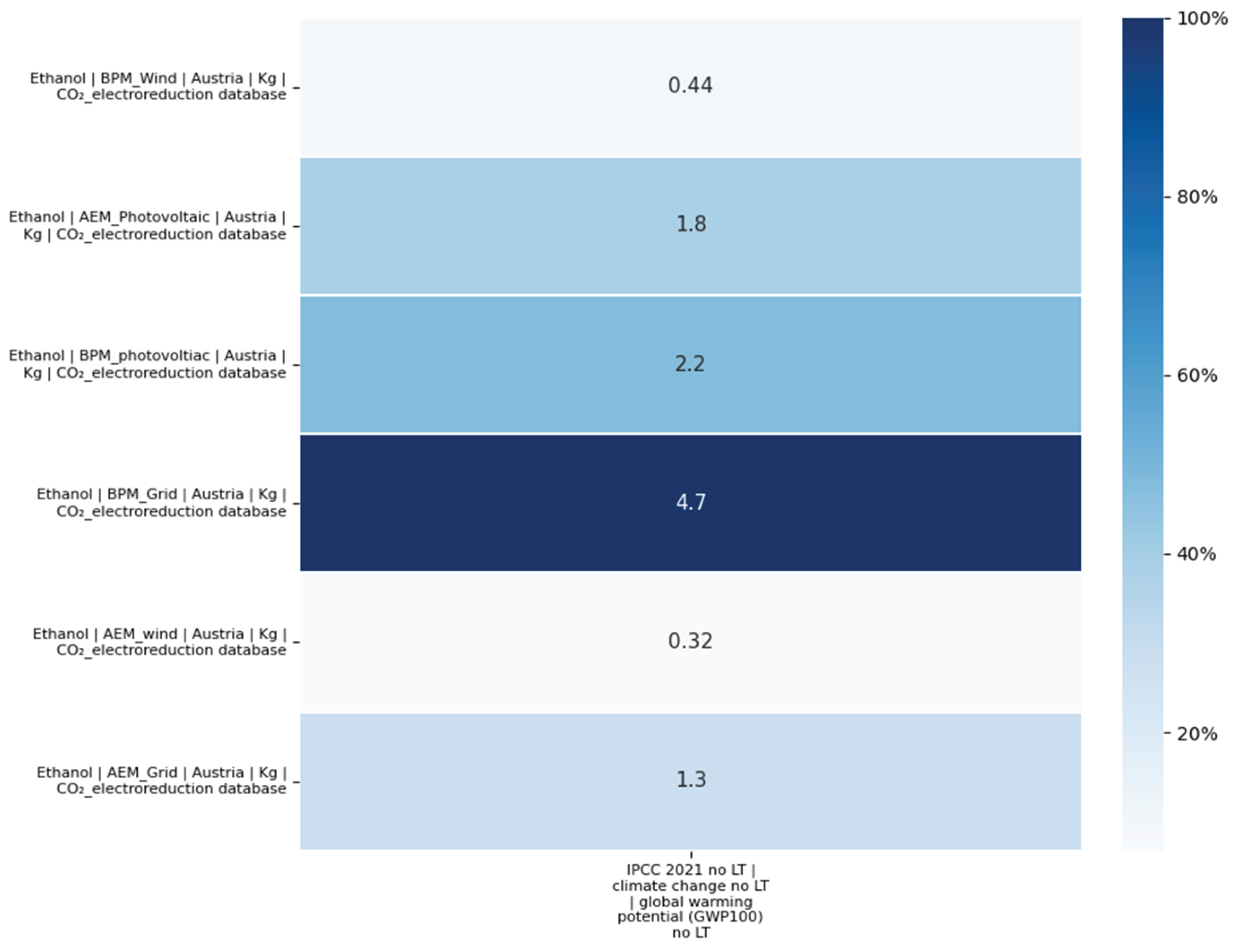
Figure 2.
Global warming potential (GWP100) of CO2 electroreduction to ethanol for different electrolyzer configurations (AEM and BPM) and electricity supply scenarios in Austria. Results are expressed in kg CO2-equivalents per functional unit (1 kg ethanol). The figure highlights the dominant influence of electricity source, with wind-based electricity resulting in the lowest emissions, while grid electricity leads to the highest impacts, particularly for BPM systems.
Figure 2.
Global warming potential (GWP100) of CO2 electroreduction to ethanol for different electrolyzer configurations (AEM and BPM) and electricity supply scenarios in Austria. Results are expressed in kg CO2-equivalents per functional unit (1 kg ethanol). The figure highlights the dominant influence of electricity source, with wind-based electricity resulting in the lowest emissions, while grid electricity leads to the highest impacts, particularly for BPM systems.
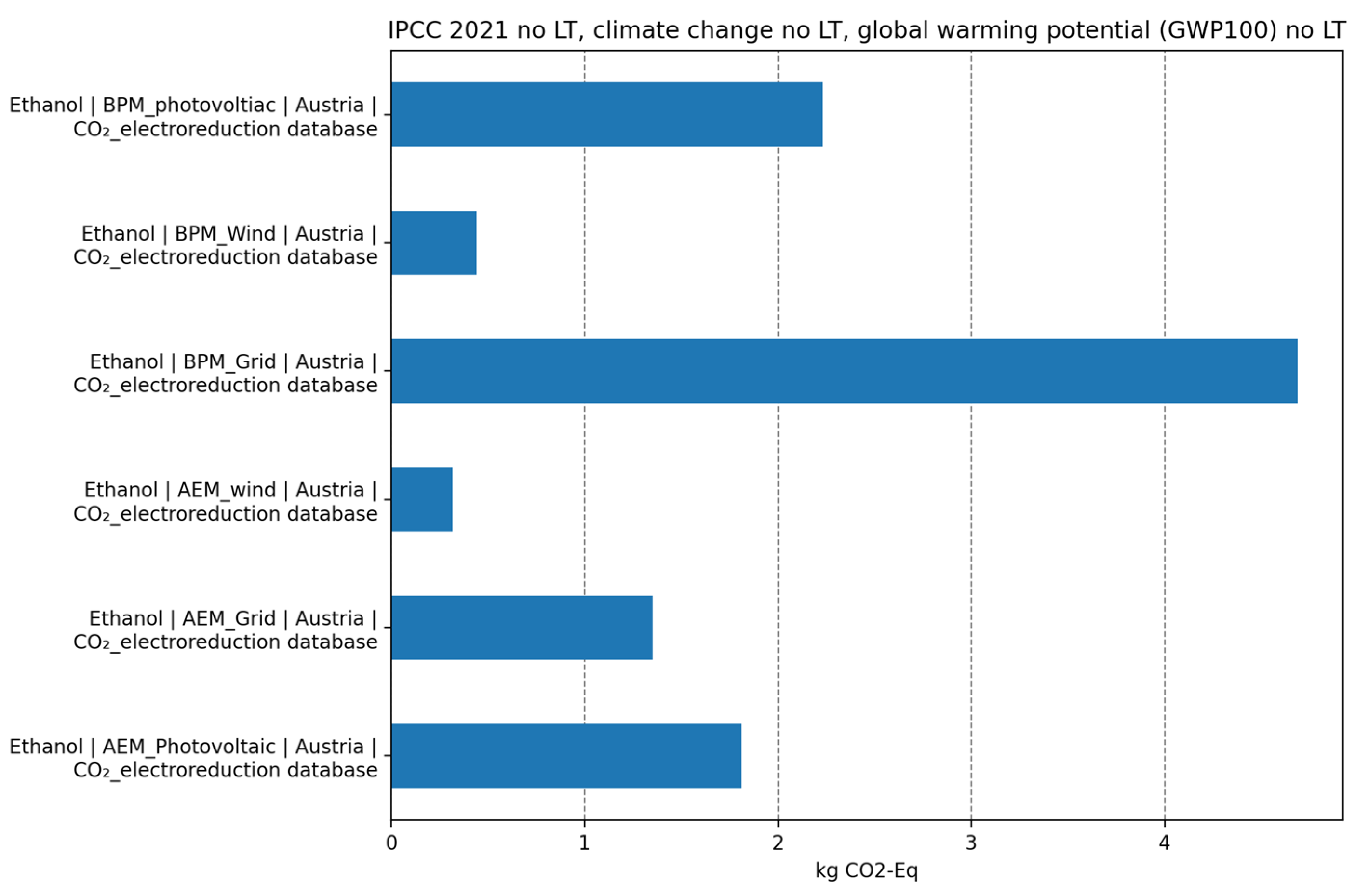
Figure 3.
Contribution analysis of global warming potential (GWP100) for CO2 electroreduction to ethanol under different electrolyzer configurations (AEM and BPM) and electricity supply scenarios in Austria. Results are expressed as relative contributions of key emission sources. Electricity-related emissions, particularly fossil CO2 and methane, dominate the overall environmental impact across all scenarios, while wind-based systems exhibit the lowest contributions.
Figure 3.
Contribution analysis of global warming potential (GWP100) for CO2 electroreduction to ethanol under different electrolyzer configurations (AEM and BPM) and electricity supply scenarios in Austria. Results are expressed as relative contributions of key emission sources. Electricity-related emissions, particularly fossil CO2 and methane, dominate the overall environmental impact across all scenarios, while wind-based systems exhibit the lowest contributions.
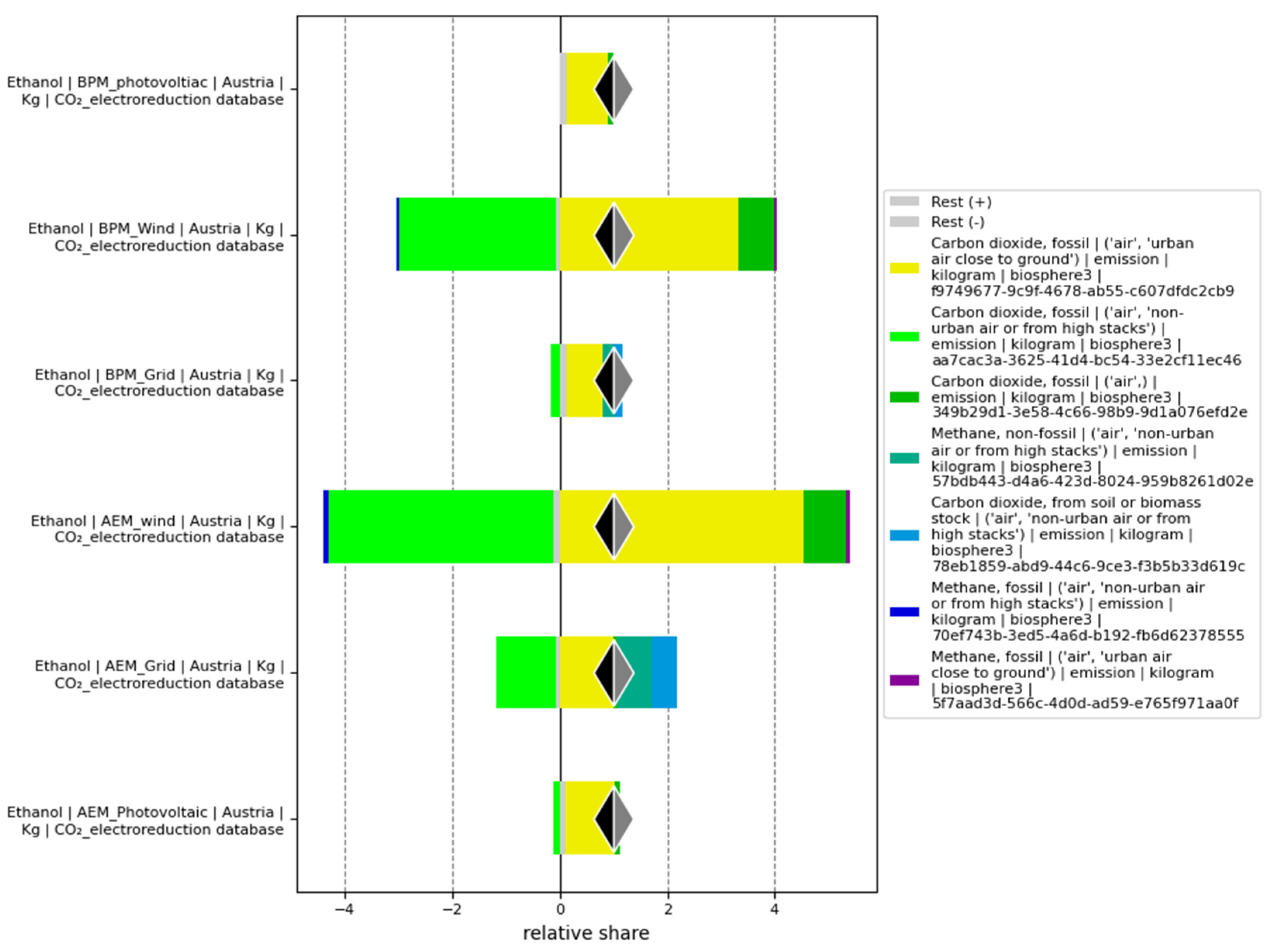
Figure 4.
Relative process contribution to greenhouse gas emissions (IPCC 2021 GWP100) for CO2-to-ethanol production. The analysis highlights electricity generation as the primary environmental hotspot, followed by thermal energy demand, whereas upstream processes such as CO2 capture, electrolyte production, and infrastructure materials contribute only marginally to the overall impact.
Figure 4.
Relative process contribution to greenhouse gas emissions (IPCC 2021 GWP100) for CO2-to-ethanol production. The analysis highlights electricity generation as the primary environmental hotspot, followed by thermal energy demand, whereas upstream processes such as CO2 capture, electrolyte production, and infrastructure materials contribute only marginally to the overall impact.
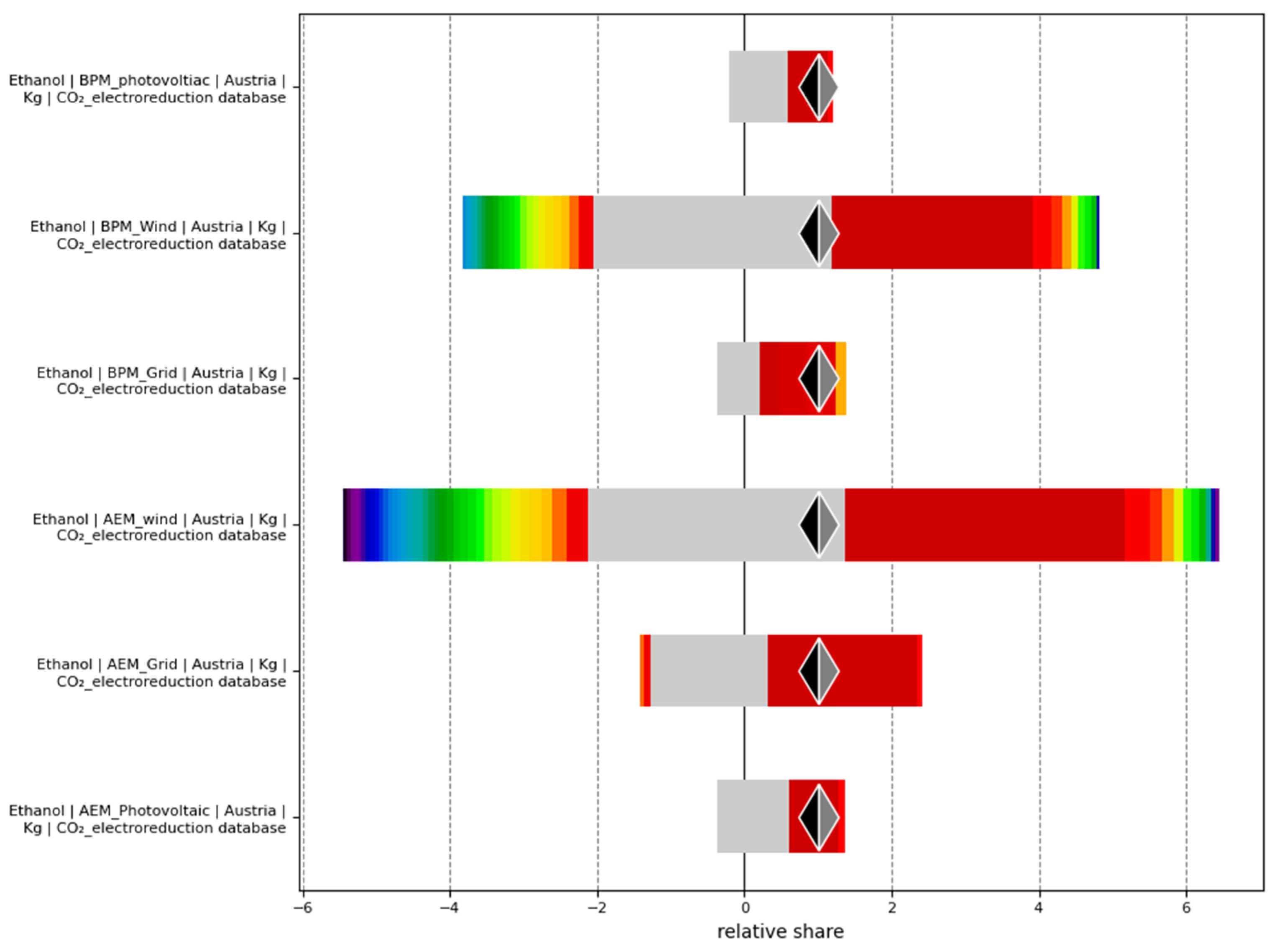
Figure 6.
First-tier process contribution to global warming potential (GWP100, IPCC 2021) for CO2 electroreduction to ethanol under different electrolyzer configurations (AEM and BPM) and electricity supply scenarios in Austria. Results are presented as relative contributions of key processes. Electricity production dominates the environmental impact across all scenarios, followed by heat supply for product separation, while contributions from CO2 capture, materials, and auxiliary chemicals remain minor.
Figure 6.
First-tier process contribution to global warming potential (GWP100, IPCC 2021) for CO2 electroreduction to ethanol under different electrolyzer configurations (AEM and BPM) and electricity supply scenarios in Austria. Results are presented as relative contributions of key processes. Electricity production dominates the environmental impact across all scenarios, followed by heat supply for product separation, while contributions from CO2 capture, materials, and auxiliary chemicals remain minor.
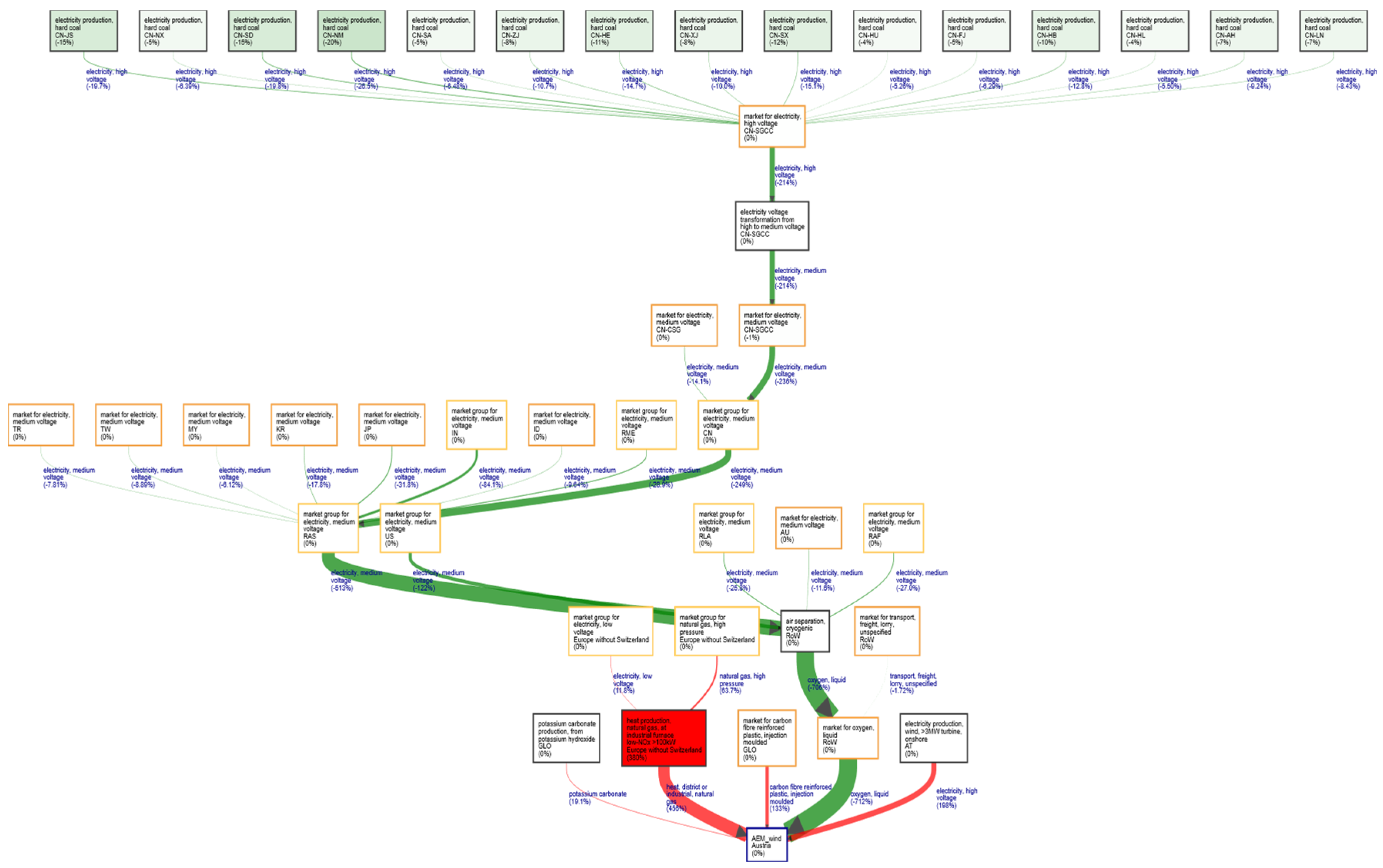
Figure 7.
Monte Carlo simulation results for global warming potential (GWP100, IPCC 2021) of CO2 electroreduction to ethanol under different electrolyzer configurations (AEM and BPM) and electricity supply scenarios in Austria. Probability distributions are shown based on stochastic variation of input parameters, with vertical lines indicating mean values. The results demonstrate variability in environmental performance and confirm the robustness of scenario comparisons.
Figure 7.
Monte Carlo simulation results for global warming potential (GWP100, IPCC 2021) of CO2 electroreduction to ethanol under different electrolyzer configurations (AEM and BPM) and electricity supply scenarios in Austria. Probability distributions are shown based on stochastic variation of input parameters, with vertical lines indicating mean values. The results demonstrate variability in environmental performance and confirm the robustness of scenario comparisons.
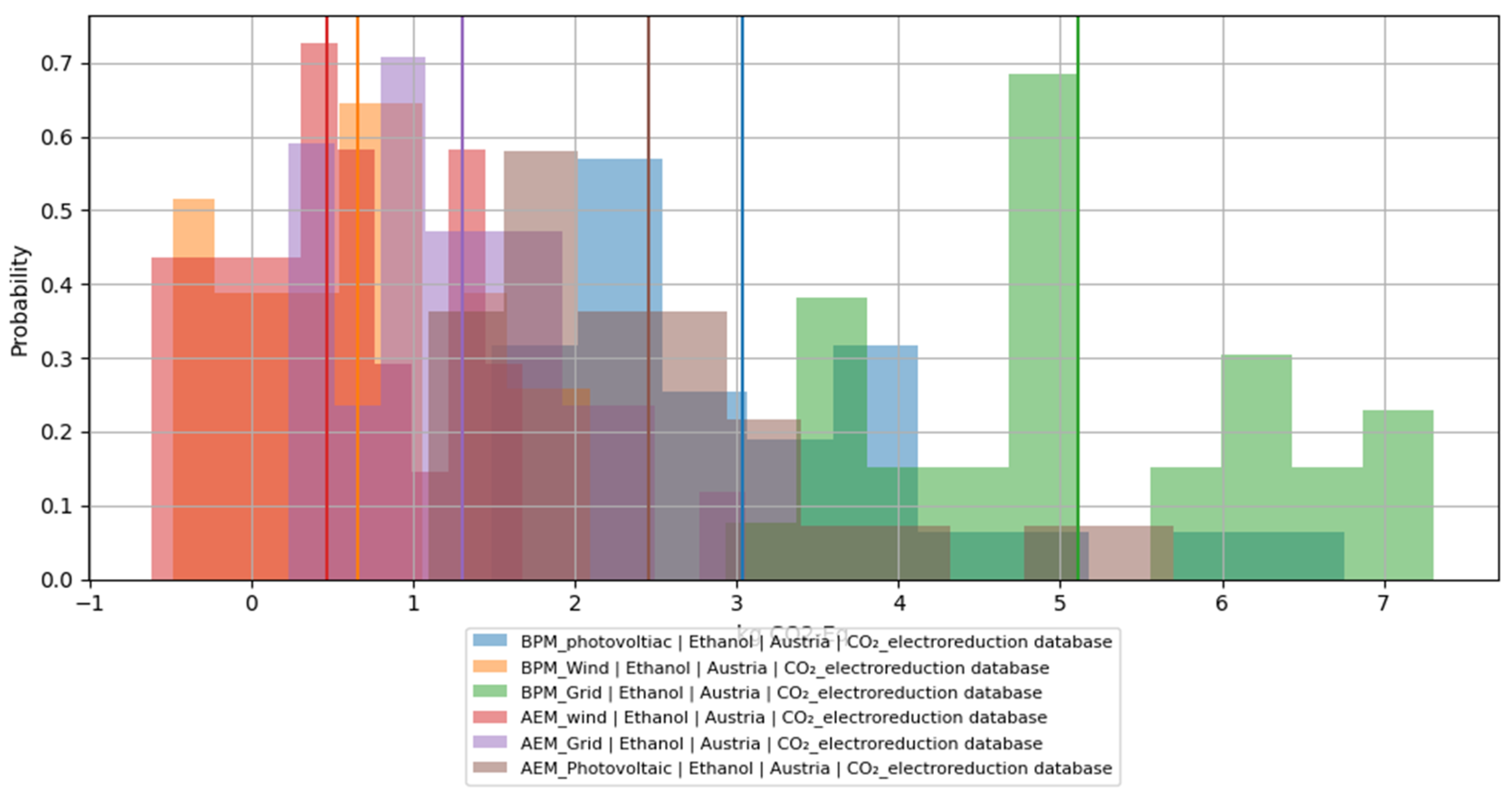
Table 1.
global warming potential (GWP100).
| index | amount | unit | reference product | name | location | database | IPCC 2021 no LT | climate change no LT | global warming potential (GWP100) no LT |
| Ethanol | BPM_Wind | Austria | Kg | CO2_electroreduction database | 1.0 | Kg | Ethanol | BPM_Wind | Austria | CO2_electroreduction database | 0.44150227713839507 |
| Ethanol | AEM_Photovoltaic | Austria | Kg | CO2_electroreduction database | 1.0 | Kg | Ethanol | AEM_Photovoltaic | Austria | CO2_electroreduction database | 1.812197509095739 |
| Ethanol | BPM_photovoltiac | Austria | Kg | CO2_electroreduction database | 1.0 | Kg | Ethanol | BPM_photovoltiac | Austria | CO2_electroreduction database | 2.230812069329494 |
| Ethanol | BPM_Grid | Austria | Kg | CO2_electroreduction database | 1.0 | Kg | Ethanol | BPM_Grid | Austria | CO2_electroreduction database | 4.686307285768168 |
| Ethanol | AEM_wind | Austria | Kg | CO2_electroreduction database | 1.0 | Kg | Ethanol | AEM_wind | Austria | CO2_electroreduction database | 0.31768829498197737 |
| Ethanol | AEM_Grid | Austria | Kg | CO2_electroreduction database | 1.0 | Kg | Ethanol | AEM_Grid | Austria | CO2_electroreduction database | 1.34939770110575 |
Table 3.
Process Contribution to GWP100 for CO2-to-Ethanol Production.
| Process | Contribution Level | Role in System | Interpretation |
| Electricity production (wind/grid/PV) | Very High (dominant) | Electrolysis energy input | Primary environmental hotspot |
| Heat supply (natural gas) | Moderate | Product separation (distillation) | Secondary contributor |
| CO2 capture (cement plant) | Low | Carbon feedstock | Minor impact |
| Electrolyte production (K2CO3, MEA) | Low | Reaction medium | Small contribution |
| Water supply (deionised) | Very Low | Process input | Negligible |
| Infrastructure materials (plastics, CFRP) | Very Low | Equipment representation | Negligible |
| Oxygen by-product (credit) | Negative contribution | Co-product | Reduces total impact |
Disclaimer/Publisher’s Note: The statements, opinions and data contained in all publications are solely those of the individual author(s) and contributor(s) and not of MDPI and/or the editor(s). MDPI and/or the editor(s) disclaim responsibility for any injury to people or property resulting from any ideas, methods, instructions or products referred to in the content. |
© 2026 by the authors. Licensee MDPI, Basel, Switzerland. This article is an open access article distributed under the terms and conditions of the Creative Commons Attribution (CC BY) license (http://creativecommons.org/licenses/by/4.0/).
Copyright: This open access article is published under a Creative Commons CC BY 4.0 license, which permit the free download, distribution, and reuse, provided that the author and preprint are cited in any reuse.


