

Submitted:
21 May 2026
Posted:
21 May 2026
You are already at the latest version
Abstract
Hepatobiliary surgery is a technically complex subspecialty within general surgery, which requires a comprehensive understanding of complex liver and liver tumour anatomy. The current body of literature highlights the use of three-dimensional-printed liver models (3DPLMs) reconstructed from medical imaging datasets may improve clinician comprehension of patient-specific liver anatomy thus creating a useful tool for hepatobiliary surgical planning and clinician training. The purpose of this systematic review was to examine the clinical utility and feasibility of 3DPLMs in hepatobiliary surgical planning and clinical education and investigate whether these applications influence patient outcomes. Studies were retrieved from three electronic databases (ProQuest, PubMed and Scopus) according to predetermined eligibility criteria. In total, 25 eligible articles were identified, including 18 original research articles and seven case reports. An inductive content analysis approach suitable for heterogeneous bodies of literature was used to synthesise key concepts in this review. There are significant case report and descriptive evidence to support the use of 3DPLMs in clinical education, preoperative planning and intraoperative guidance of patient liver and tumour anatomy to improve hepatobiliary surgical decision making. The studies presented display a large variance in cost and times necessary for the production of 3DPLMs, as studies did not include the software, equipment and full expense of materials used. Additionally, studies concentrated on different aspects of the 3DPLMs production process making them not comparable. This review demonstrates the potential value of 3DPLMs in clinical education, preoperative planning and intraoperative guidance in hepatobiliary anatomy and surgery. Future studies, in particular, randomised controlled trials and experimental research are required to investigate the relationship between 3DPLMs and clinical education and surgical planning outcomes.
Keywords:
three-dimensional printing
; liver
; education
; surgical planning
; model
; intraoperative guidance
1. Introduction
A technically complex subspecialty within general surgery is the performance of operations or interventional procedures involving the hepatobiliary system [1]. There is considerable anatomical variability within the liver lobes, portal vein, hepatic artery, hepatic veins, and biliary tract, all of which can potentially complicate surgical approaches and learning [2,3,4]. This variability in liver morphology, combined with technical difficulties, prolonged training requirements, high surgical risks and frequent postoperative complications, makes education and surgery on the hepatobiliary system challenging [2]. Traditionally, tools used for teaching include videos, atlases and computed tomography (CT) imaging which are still widely used in medicine [5]. While these methods are essential, they require the surgeon to conceptually reconstruct spatial and depth location information from two-dimensional (2D) images [6,7]. Due to the liver’s complex anatomy and marked variations between patients, conventional teaching methods regularly fail to provide learners with a sufficient understanding of the hepatobiliary system [8]. As a result, educational outcomes are inadequate and surgical skill acquisition remains a challenge [8]. Furthermore, due to the complexity and variability of the spatial relationships between intrahepatic structures, a comprehensive pre- and intra-operative understanding of hepatic anatomy and pathology is crucial for enhancing patient outcomes [9].
Three-dimensional printing (3DP) (a type of additive manufacturing) enables the rapid fabrication of accurate and precise anatomical models using specialised printers [10]. With the continual advancements in 3D printer software, hardware and material diversity, 3DP has garnered an extensive applicability across the medical field [11]. More specifically, the segmentation of a patients’ liver pathology and anatomy from their medical imaging data, such as CT images, can be reconstructed in a 3D file format that is suitable for 3DP which can then be used to print a liver model [12,13]. In the past, clinicians and students comprehension of medical images has been restricted to 2D representations on computer screens or in textbooks [14]. Conversely, 3DP directly converts medical imaging data (e.g., CT scans or magnetic resonance imaging) into high-fidelity 3D structures [15]. This ability makes 3DP a robust alternative to traditional methods of teaching in the medical field. Improvements in processing speed, material costs and resolution have significantly increased its accessibility [16]. Therefore, current 3D-printed models can achieve anatomical precision and a higher fidelity as well as simulate human tissues realistically, thus showing a strong promise for surgical simulation and technical training [17].
The current literature shows that 3D-printed models can facilitate skill acquisition and advanced procedural training across multiple surgical disciplines [18,19,20,21]. Regarding hepatobiliary surgery, 3D-printed models have been used in endoscopy, laparoscopy, tumour localisation, preoperative planning and anatomical teaching [22,23,24,25]. Therefore, reproducible, high-quality simulations are crucial for improving technical proficiency and decision-making capabilities [22,23,24,25]. However, traditional training methods for clinicians face increasing constraints including heavy workloads and a lack of operative exposure. Incorporation of 3D-printed models into hepatobiliary preoperative planning and training may help address these challenges by providing additional opportunities for hands-on, safe, ethical practice [22,23,24,25]. By integrating detailed 3D visualisation of hepatobiliary anatomy, 3DP may provide a transformative instrument in surgical preoperative planning and education [26,27,28]. While surgical training has traditionally relied on traineeship models with direct supervision within an operating theatre, current studies have highlighted the value of simulation as a way to provide effective, transferable and safe procedural training [29,30]. However, limitations are still prevalent as high-fidelity models can be expensive, and there are concerns of a lack of standardisation in manufacturing protocols and accuracy [30].
Previous systematic reviews demonstrate that 3D-printed liver models (3DPLMs) enhance preoperative planning, clinician education and anatomical visualisation [26,27,31,32]. This review aims to build on the previous 3DPLM body of literature by providing an updated critical review of the utilisation of 3DPLMs for surgical skill acquisition and preoperative planning, exploring whether these applications enhance clinician training and patient outcomes. Due to the increasing incidence of primary liver cancer and the rapidly evolving nature of 3DP technology [11], an updated review is justified to contribute to the current body of literature to improve clinicians’ education and preoperative comprehension of hepatobiliary anatomy. The existing reviews are either over five years old [31,32] or focus on isolated applications such as surgical education and tumour-specific surgical planning which limits their applicability to current, integrated practice. Furthermore, rapid advancements in 3DP technology and its expanding clinical use have not been comprehensively synthesised across surgical and educational domains. Therefore, this critical review will address the following research question: Do 3DPLMs enhance clinician training and preoperative surgical planning of the hepatobiliary system?
2. Materials and Methods
2.1. Search Strategy
A comprehensive literature search was conducted through searching three main databases comprising ProQuest, PubMed and Scopus. The search strategy used the keywords “3D printing”, “model/phantom”, “liver/hepatic”, “teaching/surgery”. The complete search strategy is provided in Table 1. The search strategy was restricted to either title, title/abstract or anywhere except full text to improve relevance depending on the search matrix of the database source. To further expand the search results, truncation and the search engine wildcard asterisk (*) were used. For this review, the final search was performed in March 2026.
2.2. Inclusion and Exclusion Criteria
A journal article was included if it was performed on humans, full-text, peer-reviewed and published in English within the last five years and researched the use of 3DPLMs use in clinician training and/or surgical planning. Due to the rapid advances in 3DP technology in recent years, a five-year publication date was chosen to ensure currency [11]. Articles were only included if they were original research and excluded if they were review articles, letters, guidelines, or editorials. Results investigating the production of 3DP material or methods were included, as these aspects may directly influence 3DPLM’s clinical feasibility and validity [33]. Due to the limited number of original research articles currently within the literature case reports were included which is common practice in past 3DPLM reviews [27,31,32]. To ensure the focus of the review remained appropriate, articles were excluded if they exclusively focused on bioprinting or virtual 3D models.
2.3. Article Identification, Screening and Quality Appraisal
Once all searches were performed, duplicate articles were removed. Subsequently, the titles and abstracts of the remaining articles were then screened to exclude irrelevant results. After screening the full text of the remaining articles, 17 eligible articles were identified [34,35,36,37,38,39,40,41,42,43,44,45,46,47,48,49,50]. Subsequently, the resultant articles’ reference lists were examined to identify six secondary articles [6,51,52,53,54,55]. Two additional articles were identified during a manual search serendipitously [56,57]. Therefore, for this review a total of 25 articles were identified for inclusion (Figure 1). Data extraction and analysis was performed by one assessor (B.R) with another assessor (Z.S) checking the details for moderation.
In this review, quality appraisal of the included articles was completed using the Mixed Methods Appraisal Tool (MMAT) developed by Hong et al. [59] as it allows for the methodological quality appraisal of qualitative, quantitative and mixed-methods studies [59]. This tool utilises two screening questions to determine whether a study is empirical and suitable for appraisal [59]. Once a study is deemed eligible, it is assigned to the appropriate category (qualitative, quantitative randomised controlled, quantitative non-randomised, quantitative descriptive or mixed methods) and the corresponding five criteria are applied to appraise the quality of the included articles [59]. The MMAT was selected as it is an established tool devised to overcome the challenges of critically appraising mixed studies reviews in healthcare, making it applicable for the studies included within this review [59].
2.4. Data Extraction and Synthesis
3. Results
The studies identified and included in this review are highly heterogeneous, comprising seven case reports and 18 original research studies. Of the 18 original research articles, of which two use true experimental research methodologies, four are quasi-experimental studies, three descriptive surveys, one ethnographical study and eight observational studies. Table 2 shows additional summaries of the key characteristics of each article.
Due to the heterogeneous nature of the included literature the MMAT from Hong et al. [59] was used for quality assessment, with the results shown in Appendix A Table 1A-5A. All studies included were eligible for appraisal using the MMAT as they met the screening criteria. Therefore, 11 articles met 75-100% of the MMAT criteria, indicating high-quality. There were 13 articles that met 50-75% of the MMAT criteria, representing moderate quality, and one article [35] met less than 50% of the evaluation criteria indicating low quality. A principal limitation of the included studies and by extension this review, is the small proportion of methodologically rigorous study designs for the application of 3DPLMs in clinical education and surgical planning. Most of the reported evidence is descriptive, qualitative, or case reports, and lack methodological rigour or statistical significance, therefore, generalisations cannot be made regarding the use of 3DPLMs in hepatobiliary education and surgical planning. However, in this review, distinct themes appear that may provide explanatory power for 3DPLM’s clinical utility in hepatobiliary surgery and education potentially encouraging future research to rigorously investigate the influence of 3DPLMs on clinician education and patient surgical outcomes.
3.1. Surgical Planning and Intraoperative Guidance
Fourteen studies (56%) described the use of 3DPLMs improving surgical planning for hepatobiliary surgeries [6,36,37,40,43,44,46,48,50,51,52,53,54,56]. With ten of these studies being original research articles [6,36,37,40,43,44,46,50,53,56]. The remaining three investigated how patient-specific 3DPLMs enhanced trainee surgeons’ anatomical understanding and surgical planning [37,43,53], however, their observations were less applicable to the preoperative decision-making of experienced surgeons.
Four articles (16%) reported the clinical utility of 3DPLMs for intraoperative navigation and guidance during hepatobiliary surgery [6,40,41,49]. Two of them were original research studies that supported these findings [6,40]. The remaining two studies were qualitative [41] and case report [49] evidence, thus restricting their generalisability.
3.2. 3DPLMs Can Improve Patient Outcomes
One study by Yao et al. [50] demonstrated that the use of 3DPLMs could significantly reduce intraoperative and postoperative surgical complications, thus improving patient outcomes. The majority of the remaining articles did not demonstrate statistically significant enhancements in surgical outcomes for patients [6,34,36,37,39,40,43,44,47,48,49,55,57]. However, there was still considerable evidence (mostly qualitative, descriptive or case report evidence) to suggest the use of 3DPLMs can improve hepatobiliary surgical planning, performance and safety thereby improving patients’ clinical outcomes.
3.3. Clinical Education and Surgical Simulation
Eight articles (32%) described how 3DPLMs can improve anatomical/surgical teaching of the hepatobiliary system and related surgical procedures [35,37,38,43,45,47,55,56]. Only two of these were original research articles that demonstrated the use of 3DPLMs in clinical teaching can significantly improve surgical trainees’ understanding of hepatobiliary anatomy and pathology and surgical procedures [35,37]. The remaining six articles are primarily case reports, descriptive or qualitative evidence [38,43,45,47,55,56]. However, their findings further suggested the use of 3DPLMs may provide a suitable alternative to traditional clinical education methods, such as cadaveric material, 3D volume renders (3DVR) or atlases. Compared with conventional methods, 3DPLMs may improve surgical trainees’ spatial understanding of liver anatomy and pathology as well as their comprehension of surgical procedures.
Seven articles (28%) demonstrated the use of 3DPLMs for surgical simulation for hepatobiliary surgery [34,36,39,42,44,49,51]. Only three of these are original research articles [34,36,39]. The remaining four provided case report or descriptive evidence [42,44,49,51]. Despite most evidence comprising qualitative, descriptive or case report evidence, this evidence suggests that the use of 3DPLMs may improve the preparedness of trainee surgeons and by extension their surgical performance.
3.4. Diversity of 3DPLM Development and Technical Innovation
The diverse 3DP materials, technologies, costs and times in 3DPLM production are demonstrated in Table 2. In this review, fused filament fabrication was the most common 3DP technology reported (44%), followed by stereolithography (28%) and material jetting (16%). This is consistent with the commonly utilised 3DP materials which include silicone (28%), acrylonitrile butadiene styrene (24%), and polylactic acid (20%). To represent liver parenchyma, transparent materials (silicone or silicone-like material) were used in nine articles (36%).
Across the included articles, the utilised imaging protocols, segmentation and processing methods were varied. However, the 3DPLMs accuracy was generally satisfactory for clinical use with studies describing CT-validated spatial errors of less than five millimetres [40,43,48,49] or <0.6%-2% [43,46,55]. Most of the articles developed 3DPLMs based on CT datasets (76%), three articles used a combination of MRI and CT imaging data, two studies used anatomical atlases, and one study exclusively used MRI imaging data, to segment their 3DPLMs.
3.5. Need for Experiemental Studies
A majority of the articles described the necessity for more methodologically rigorous, true-experimental research to demonstrate the feasibility and clinical utility of 3DPLMs in preoperative and intraoperative hepatobiliary surgical outcomes and in surgeon education [6,34,35,36,37,40,41,42,43,46,50,53,54,57]. Further research is also required to determine a standardised, best-practice approach to the production of 3DPLMs regarding monetary and time considerations [34,36,41,42,46,47].
4. Discussion
Several key findings have been identified from the analysis of the 25 articles included in this review. First, the use of 3DPLMs can improve intraoperative guidance and surgical planning in hepatobiliary surgery by providing a tangible representation of a patient’s liver pathology and anatomy. 3DPLMs provided a tool that improved a patient’s comprehension of liver anatomy facilitating more accurate and targeted surgical plans and enhancing surgical decision-making. Therefore, 3DPLMs may improve overall surgical outcomes for patients undergoing hepatobiliary surgery. Second, this review highlights their use of 3DPLMs to improve spatial reasoning, tumour localisation, surgical confidence and procedural understanding amongst experts and trainees regarding their pedagogical value.
Historically, CT and/or magnetic resonance imaging (MRI) images of patients have been used for hepatobiliary surgical planning. The clinician then uses the 2D axial and multiplanar images or 3DVRs to establish appropriate biliary/vascular reconstruction approaches and planes of dissection/resection. This requires the surgeon to view these images on a 2D screen and to conceptualise a 3D visualisation mentally of a patient’s complex liver pathology and anatomy. 3DPLMs can assist this by providing a tactile [34,40,44,51,52,53,54,56], cognisable [6,35,37,39,40,42,44,49,50,51,53,54,55,57], colour coded [6,35,40,41,42,43,44,47,48,49,52,53,57], transparent [35,39,40,41,43,45,52,53,54], self-healing [44], and manipulable [34,36,37,41,43,51] representation of patient-specific liver anatomy. This improves liver tumour localisation [35,37,43,53] and enhances the comprehension of the highly varying and intricate and spatial relationships between hepatic internal structures [38,41,42,45,47,52]. This improved understanding of anatomy supports clinicians in choosing the most appropriate surgical techniques [6,34,36,37,49,50,52] and resection planes [40,42,43,44,54].
The previously described depiction of 3DPLM’s value in preoperative planning and intraoperative guidance is predominantly based on case reports or qualitative evidence which limits its external validity. Lopez-Lopez et al. [43] surveyed hepatobiliary surgeons, who indicated that using a 3DPLM could improve preoperative planning and intraoperative guidance by providing improved 3D visualisation of margins and planes of resection and enhanced perception of spatial relationships. Fukumitsu et al. [40] report the potential value of 3DPLMs in complex hepatobiliary cases where surgical approaches must be modified and their usefulness as an intraoperative navigation system to minimise accidental bleeding and secure planned hepatectomy resection lines. These studies suggest 3DPLM’s clinical utility for preoperative planning and intraoperative guidance; however, they are limited by small sample sizes and a lack of methodological rigour. Further studies warrant the use of 3DPLMs in surgical planning for the medical intern population. A randomised controlled trial showed statistically significant improvements in interns’ ability to appropriately design surgical plans compared to using 3DVR or CT [37]. Furthermore, Igami et al. [41] performed an ethnographical study that suggested the clinical value of 3DPLMs for intraoperative guidance in non-expert surgeons. While these studies were conducted with greater methodological rigour, they demonstrate 3DPLMs only among hepatobiliary surgical interns. However, Heuttl et al. [53] conducted a quasi-experimental study that indicated there was no statistically significant difference in the surgical planning ability of experienced hepatobiliary surgeons’ when using 3DPLMs or 3DVR. While this study lacked adequate controls (e.g., 2D axial imaging) or sample size, it may suggest that the clinical utility of 3DPLMs for experienced hepatobiliary surgeons is redundant [6]. Therefore, the clinical merit of 3DPLMs may be constrained to complicated surgical hepatobiliary cases, where there are complex liver-tumour relationships or the lesion location is deep to intrahepatic structures [6,36,41,43,46,48].
Hepatobiliary surgeons must be skilled in relating 2D reconstruction of a patient’s liver anatomy with the surgical field [6]. Multiple studies, therefore, suggest the value of 3DPLMs for intraoperative navigation in hepatobiliary surgery [6,40,41,49,50]. Surgeons can position and contrast the 3DPLM directly in the operating field thus enhancing their understanding and navigation of liver anatomy. Therefore, 3DPLMs can be used to confirm the localisation of intrahepatic vasculature to modify surgical approaches, improve localisation and identification of lesions and may reduce the risk of intraoperative complications. However, these findings are again drawn from case report or qualitative evidence, lack methodological rigour and cannot be generalised. There was only one article by Cheng et al. [6] that stated that the use of 3DPLMs in preoperative planning and real-time intraoperative guidance led to modifications in surgical strategies for four patients (16.7% of cases) due to the model providing enhanced localisation of intrahepatic structures. However, this study was limited by the heterogeneity of included cases and small sample size.
While 3DPLMs have demonstrated preoperative and intraoperative benefits in hepatobiliary surgery, this review identified limited significant evidence suggesting their value in improving patient surgical outcomes. Only six of the identified studies included in this review reported patient intraoperative or postoperative outcomes [6,40,43,46,50,57]. There was a limited statistically significant positive correlation between the application of 3DPLMs and surgical operating time, blood loss, pathological outcomes, intraoperative outcomes, postoperative complications, recovery conditions, deviation of surgical concept and duration of hospital stays. However, Yao et al. [50] demonstrated significant improvements in intraoperative blood loss, postoperative complications and major complications in patients who received the 3DPLM compared with a control group, however, this finding is not supported by the broader literature. Though there is limited significant evidence regarding patient outcomes, this does not negate the possible value of 3DPLMs in influencing those outcomes. The lack of significance in these studies may be attributed to small sample sizes that does not overcome the heterogeneity the included cases, single-centre designs, subjective measures and differences in surgeon experience [6,40,43,57]. Overall, there is a large amount of qualitative evidence supporting the use of 3DPLMs to improve hepatobiliary surgical approaches thus minimising potential complications. Which in turn may increase the chance of postoperative success and decrease the likelihood of future complications, suggesting that 3DPLMs may directly enhance clinical outcomes. From the literature, what is clear is that there is a need for multi-centred, methodologically rigorous clinical trials to verify the clinical use of 3DPLMs in preoperative planning and intraoperative guidance in hepatobiliary surgery [6,40,43,50,57]. A study developed by Huber et al. [61] aims to address these limitations by including sufficient patients and appropriate control groups and was scheduled for completion in 2024. Studies of this calibre are paramount to advancing the clinical utility of 3DPLMs.
3DPLMs could potentially improve patients’ comprehension of their pathology, surgical procedure and post-operative complications [43,48,49,57]. Giehl-Brown et al. [57] performed a randomised controlled trial demonstrating statistically significant improvements in patients’ understanding of their surgical procedure when 3DPLMs were used compared with patients who received standard education sheets. Lopez-Lopez et al. [43] also reported improved patient understanding and communication following the use of 3D-printed liver models is indicated by questionnaire responses; however, they did not state whether this was statistically significant. This finding is consistent with the current literature regarding the educational value of 3D-printed models in patient education [62,63,64]. By using 3DPLMs to enhance patients’ knowledge about their hepatobiliary surgery it can enhance their ability to give informed consent and participation in preoperative decision-making [57]. Greater understanding of healthcare following 3DPLM-based surgical education may also increase a patient’s postoperative compliance, positively correlating with a decreased postoperative complication and length of hospital stays [57].
The current evidence highlights the extensive role of 3DPLMs in hepatobiliary anatomical education and surgical training with broad consensus among experts and trainees regarding their pedagogical value. For anatomical teaching, 3DPLMs may exceed conventional methods such as atlas-based learning, by improving anatomical understanding [37,42,45,53], spatial visualisation [37,42,45,53], procedural comprehension [34,35], surgical planning [37,42,43] and tumour localisation [37,45,53]. Furthermore, it is reported that the trainees exhibit higher levels of confidence and satisfaction regarding hepatobiliary education and surgical procedures [34,35,37,42]. 3DPLMs provide greater retention of spatial knowledge through visual-haptic multisensory integration, allowing trainees to comprehend and observe hepatobiliary anatomy from multiple perspectives thus developing their understanding of intrahepatic structures. Furthermore, 3DPLMs enable trainees to practise surgical procedures in a simulated environment becoming familiar with surgical techniques demonstrating increased proficiency in real surgeries. These 3DPLMs provide a low-risk scenario for recognising and rectifying technical errors, potentially mitigating the risk of intraoperative mishaps and complications. The included studies conduct isolated training sessions that provide proof of concept, but do not indicate long-term retention of knowledge or skill. Despite promising results, these studies are limited by short training exposures, minimal longitudinal data and small sample sizes.
This review extends previous systematic reviews by providing a comprehensive and critical synthesis of the use of 3DPLMs across both clinical education and surgical planning [26,27,31,32]. Prior reviews have typically focused on either educational applications or surgical planning in isolation, this review integrates both domains to evaluate 3DPLMs clinical utility. By incorporating current literature and offering an analysis of educational, technological and clinical utility this review provides a more comprehensive and critical perspective to guide future research and clinical implementation.
5. Conclusions
This review provides further evidence suggesting the use of 3DPLM as a critical tool in hepatobiliary clinical education and surgical planning by improving anatomical understanding, skill acquisition and preoperative and intraoperative guidance. These models offer a reproducible, safe platform for complex surgical rehearsal which could optimise clinical decision-making and improve procedural performance in hepatobiliary surgery. Future studies should prioritise longitudinal, randomised controlled, multi-centre trials with large sample sizes to determine the feasibility and clinical value of 3DPLMs in hepatobiliary surgery. This future research should focus on investigating perioperative and postoperative patient surgical outcomes. Additionally, such studies should assess the long-term impact of 3DPLM use in clinician education, including anatomical and surgical understanding to better establish its benefits.
Author Contributions
Conceptualization, B.R.; methodology, B.R.; formal analysis, B.R.; writing—original draft preparation, B.R.; writing—review and editing, B.R. and Z.S.; visualization, B.R.; supervision, Z.S. All authors have read and agreed to the published version of the manuscript.”.
Funding
This research received no external funding.
Institutional Review Board Statement
Not applicable.
Informed Consent Statement
Not applicable.
Data Availability Statement
Not applicable.
Conflicts of Interest
The authors declare no conflicts of interest.
References
- Rengers, T.; Ubl, D.; Habermann, E.; Cleary, S.P.; Thiels, C.A.; Warner, S.G. Supply and demand of hepatopancreatobiliary surgeons in the United States. HPB 2024, 26(2), 299–309. [Google Scholar] [CrossRef] [PubMed]
- Ragavan, S.; Muraleedharan, A.; Bage, N.N.; Devi, R. A comprehensive study and extensive review of morphological variations of liver with new insights. Surg. Radiol. Anat. 2022, 44(3), 455–466. [Google Scholar] [CrossRef]
- Xia, B.T. Biliary anatomy and variations. Surg. Clin. North. Am. 2024, 104(6), 1137–1144. [Google Scholar] [CrossRef]
- Choi, T.W.; Chung, J.W.; Kim, H.C.; et al. Anatomic variations of the hepatic artery in 5625 patients. Radiol. Cardiothoracic. Imaging. 2021, 3(4), e210007. [Google Scholar] [CrossRef]
- Pandurangam, G.; Gurajala, S. Pedagogical strategies in medical anatomy: a comprehensive review. Natl. J. Clin. Anat. 2023, 12(4), 216–222. [Google Scholar] [CrossRef]
- Cheng, J.; Wang, Z.; Liu, J.; Dou, C.; Yao, W.; Zhang, C. Value of 3D printing technology combined with indocyanine green fluorescent navigation in complex laparoscopic hepatectomy. PLoS. One. 2022, 17(8), e0272815. [Google Scholar] [CrossRef]
- Haberman, D.M.; Andriani, O.C.; Segaran, N.L.; et al. Role of CT in two-stage liver surgery. Radiographics 2022, 42(1), 106–124. [Google Scholar] [CrossRef]
- Wang, L.; Hu, X.; Cao, M.; Zhang, B.; Hou, H. An introductory course to improve surgical core competencies of young hepatobiliary surgeon. BMC. Med. Educ. 2026, 26(1), 231. [Google Scholar] [CrossRef] [PubMed]
- Agostini, A.; Borgheresi, A.; Floridi, C.; et al. The role of imaging in surgical planning for liver resection: what the radiologist needs to know. Acta. Biomed. 2020, 91 (Suppl 8), 18. [Google Scholar] [CrossRef] [PubMed]
- Liacouras, P.; Wake, N. 3D printing principles and technologies. In 3D Printing for the Radiologist; Accessed; Wake, N., Ed.; Elsevier, 2022; pp. 61–73. (accessed on 3 April 2026). [Google Scholar] [CrossRef]
- Jakus, A.E.; Huang, Y.H.; Wake, N. The future of medical 3D printing in radiology. In 3D Printing for the Radiologist; Accessed; Wake, N., Ed.; Elsevier; Volume 2022, pp. 201–214. (accessed on 3 April 2026). [CrossRef]
- Guachi, R.; Bici, M.; Bini, F.; et al. 3D printing of prototypes starting from medical imaging: a liver case study. Paper presented at: International Conference on Design, Simulation, Manufacturing: The Innovation Exchange, Accessed. Rome, Italy, September 9-10, 2021; (accessed on 29 March 2026). [Google Scholar] [CrossRef]
- Witowski, J.; Budzyński, A.; Grochowska, A.; et al. Decision-making based on 3D printed models in laparoscopic liver resections with intraoperative ultrasound: a prospective observational study. Eur. Radiol. 2020, 30(3), 1306–1312. [Google Scholar] [CrossRef]
- Binder, J.; Krautz, C.; Engel, K.; et al. Leveraging medical imaging for medical education—a cinematic rendering-featured lecture. Ann. Anat. 2019, 222, 159–165. [Google Scholar] [CrossRef]
- Tsui, J.K.S.; Bell, S.; Cruz, L.D.; Dick, A.D.; Sagoo, M.S. Applications of three-dimensional printing in ophthalmology. Surv. Ophthalmol. 2022, 67(4), 1287–1310. [Google Scholar] [CrossRef]
- Chen, J.V.; Dang, A.B.C.; Dang, A. Comparing cost and print time estimates for six commercially-available 3D printers obtained through slicing software for clinically relevant anatomical models. 3D. Print. Med. 2021, 7(1), 1. [Google Scholar] [CrossRef]
- Zhu, Z.; Amadi, S.M.; Mao, J.; et al. A randomized cohort study on the use of 3D printed models to enhance surgical training in suturing techniques. Sci. Rep. 2025, 15(1), 636. [Google Scholar] [CrossRef] [PubMed]
- Taritsa, I.C.; Lee, D.; Foppiani, J.; et al. Three-dimensional printing in surgical education: an updated systematic review of the literature. J. Surg. Res. 2024, 300, 425–431. [Google Scholar] [CrossRef] [PubMed]
- Shiezadeh, F.; Moghadasin, M.; Mastour, H. Educational use of patient-specific 3D-printed models in dental operative procedures: enhancing clinical training through technology. BMC. Med. Educ. 2025, 25(1), 1223. [Google Scholar] [CrossRef]
- Cravano, S.M.; Carmine, A.D.; De Maio, C.; et al. Technical skill acquisition in pediatric minimally invasive surgery: evaluation of a 3D-printed simulator for thoracoscopic esophageal atresia repair. Healthcare 2025, 13(14), 1720. [Google Scholar] [CrossRef]
- Xie, G.; Wang, T.; Fu, H.; et al. The role of three-dimensional printing models in medical education: a systematic review and meta-analysis of randomized controlled trials. BMC. Med. Educ. 2025, 25(1), 826. [Google Scholar] [CrossRef] [PubMed]
- Kwon, C.I.; Shin, Y.; Hong, J.; et al. Production of ERCP training model using a 3D printing technique (with video). BMC. Gastroenterol. 2020, 20(1), 145. [Google Scholar] [CrossRef]
- Yang, J.; Luo, P.; Wang, Z.; Shen, J. Simulation training of laparoscopic pancreaticojejunostomy and stepwise training program on a 3D-printed model. Int. J. Surg. 2022, 107, 106958. [Google Scholar] [CrossRef]
- Streba, C.T.; Popescu, S.; Pirici, D.; et al. Three-dimensional printing of liver tumors using CT data: proof of concept morphological study. Rom. J. Morphol. Embryol. 2018, 59(3), 885–893. Available online: https://www.rjme.ro/RJME/resources/files/590318885893.pdf.
- Gallo, C.; Boškoski, I.; Matteo, M.V.; Orlandini, B.; Costamagna, G. Training in endoscopic retrograde cholangio-pancreatography: a critical assessment of the broad scenario of training programs and models. Expert. Rev. Gastroenterol. Hepatol. 2021, 15(6), 675–688. [Google Scholar] [CrossRef] [PubMed]
- Lin, J.; Li, W.; Yu, X.; et al. 3D printing technology in hepatobiliary surgery education: a systematic review. Ann. Med. 2025, 57(1), 2601411. [Google Scholar] [CrossRef]
- Rossi, T.; Williams, A.; Sun, Z. Three-dimensional printed liver models for surgical planning and intraoperative guidance of liver cancer resection: a systematic review. Appl. Sci. 2023, 13(19), 10757. [Google Scholar] [CrossRef]
- Li, L.; Cheng, S.; Li, J.; et al. Randomized comparison of AI enhanced 3D printing and traditional simulations in hepatobiliary surgery. NPJ. Digit. Med. 2025, 8(1), 293. [Google Scholar] [CrossRef] [PubMed]
- Ealing, I.V.; Whereat, S.; Forsyth, R.; Hong, J.; Laurence, J. Surgeon and trainee perspectives on intraoperative education: a systematic review and meta-synthesis. Med. Educ. Online. 2025, 30(1), 2560628. [Google Scholar] [CrossRef]
- Elendu, C.; Amaechi, D.C.; Okatta, A.U.; et al. The impact of simulation-based training in medical education: a review. Medicine 2024, 103(27), e38813. [Google Scholar] [CrossRef]
- Witowski, J.S.; Coles-Black, J.; Zuzak, T.Z.; et al. 3D printing in liver surgery: a systematic review. Telemed. J. E. Heal. 2017, 23(12), 943–947. [Google Scholar] [CrossRef] [PubMed]
- Perica, E.R.; Sun, Z. A systematic review of three-dimensional printing in liver disease. J. Digit. Imaging. 2018, 31(5), 692–701. [Google Scholar] [CrossRef] [PubMed]
- Higgins, M.; Leung, S.; Radacsi, N. 3D printing surgical phantoms and their role in the visualization of medical procedures. Ann. 3D. Print. Med. 2022, 6, 100057. [Google Scholar] [CrossRef]
- Aranovich, D.; Goldman, Y.F.; Tchernin, N.; et al. Specialized educational program for high-grade liver injury management: a three-dimensional printed model approach. Surg. Today. 2025, 55(2), 283–287. [Google Scholar] [CrossRef]
- Bao, G.; Yang, P.; Yi, J.; et al. Full-sized realistic 3D printed models of liver and tumour anatomy: a useful tool for the clinical medicine education of beginning trainees. BMC. Med. Educ. 2023, 23(1), 574. [Google Scholar] [CrossRef]
- Cao, W.; Pan, X.; Jin, L.; et al. Construction of reusable fluorescent assembled 3D-printed hydrogen-based models to simulate minimally invasive resection of complex liver cancer. PLoS. One. 2024, 19(12), e0316199. [Google Scholar] [CrossRef]
- Cheng, J.; Wang, Z.F.; Yao, W.F.; et al. Comparison of 3D printing model to 3D virtual reconstruction and 2D imaging for the clinical education of interns in hepatocellular carcinoma: a randomized controlled study. J. Gastrointest. Oncol. 2023, 14(1), 325–333. [Google Scholar] [CrossRef] [PubMed]
- Chua, P.S.B.; Lee, C.Z.; Teng, D.R.K.; et al. Affordable and accessible 3D printed models of the liver to support medical education. Mater. Today. Pro. 2022, 70, 258–264. [Google Scholar] [CrossRef]
- Elisei, R.C.; Graur, F.; Melzer, A.; et al. Liver phantoms cast in 3D-printed mold for image-guided procedures. Diagnostics 2024, 14(14), 1521. [Google Scholar] [CrossRef] [PubMed]
- Fukumitsu, K.; Ishii, T.; Ogiso, S.; et al. Impact of patient-specific three-dimensional printed liver models on hepatic surgery safety: a pilot study. HPB 2023, 25(9), 1083–1092. [Google Scholar] [CrossRef]
- Igami, T.; Maehigashi, A.; Nakamura, Y.; et al. A clinical assessment of three-dimensional-printed liver model navigation for thrice or more repeated hepatectomy based on a conversation analysis. Surg. Today. 2024, 54(10), 1238–1247. [Google Scholar] [CrossRef] [PubMed]
- Labakoum, B.; Farhan, A.; Hamid, Em.; Mouhsen, A.; Aissam, L. Development of a personalized and low-cost 3D-printed liver model for preoperative planning of hepatic resections. Appl. Sci. 2025, 15(16), 9033. [Google Scholar] [CrossRef]
- Lopez-Lopez, V.; Robles-Campos, R.; García-Calderon, D.; et al. Applicability of 3D-printed models in hepatobiliary surgey: results from “LIV3DPRINT” multicenter study. HPB 2021, 23(5), 675–684. [Google Scholar] [CrossRef]
- Lu, Y.; Chen, X.; Han, F.; et al. 3D printing of self-healing personalized liver models for surgical training and preoperative planning. Nat. Commun. 2023, 14(1), 8447. [Google Scholar] [CrossRef]
- Maehigashi, A.; Miwa, K.; Oda, M.; Nakamura, Y.; Mori, K.; Igami, T. Use of 3D-printed model of liver by experts and novices: research and reviews. Curr. Psychol. 2024, 43(19), 17185–17197. [Google Scholar] [CrossRef]
- Sanchez-Garcia, J.; Lopez-Verdugo, F.; Shorti, R.; et al. Three-dimensional liver model application for liver transplantation. Transplantation 2024, 108(2), 464–472. [Google Scholar] [CrossRef] [PubMed]
- Smillie, R.W.; Williams, M.A.; Richard, M.; Cosker, T. Producing three-dimensional printed models of the hepatobiliary system from computed tomography imaging data. Ann. R. Coll. Surg. Engl. 2021, 103(1), 41–46. [Google Scholar] [CrossRef]
- Tooulias, A.; Tsoulfas, G.; Papadopoulos, V.; et al. Assisting difficult liver operations using 3D printed models. Livers 2021, 1(3), 138–146. [Google Scholar] [CrossRef]
- Valls-Esteve, A.; Tejo-Otero, A.; Lustig-Gainza, P.; et al. Patient-specific 3D printed soft models for liver surgical planning and hands-on training. Gels 2023, 9(4), 339. [Google Scholar] [CrossRef]
- Yao, W.F.; Huang, X.K.; Fu, T.W.; et al. Precise planning based on 3D-printed dry-laboratory models can reduce perioperative complications of laparoscopic surgery for complex hepatobiliary diseases: a preoperative cohort study. BMC. Surg. 2024, 24(1), 148. [Google Scholar] [CrossRef]
- Arm, R.; Shahidi, A.; Clarke, C.; Alabraba, E. Synthesis and characterisation of a cancerous liver for presurgical planning and training applications. BMJ. Open. Gastroenterol. 2022, 9(1), e000909. [Google Scholar] [CrossRef] [PubMed]
- Aseni, P.; Santaniello, T.; Rizzetto, F.; et al. Hybrid additive fabrication of a transparent liver with biosimilar haptic response for preoperative planning. Diagnostics 2021, 11(9), 1734. [Google Scholar] [CrossRef]
- Huettl, F.; Saalfeld, P.; Hansen, C.; et al. Virtual reality and 3D printing improve preoperative visualization of 3D liver reconstructions-results from a preclinical comparison of presentation modalities and user’s preference. Ann. Transl. Med. 2021, 9(13), 1074. [Google Scholar] [CrossRef]
- Raichurkar, K.K.; Lochan, R.; Jacob, M.; Asthana, S. The use of a 3D printing model in planning a donor hepatectomy for living donor liver transplantation: first in India. J. Clin. Exp. Hepatol. 2021, 11(4), 515–517. [Google Scholar] [CrossRef]
- Tan, X.; Li, D.; Jeong, M.; et al. Soft liver phantom with a hollow biliary system. Ann. Biomed. Eng. 2021, 49(9), 2139–2149. [Google Scholar] [CrossRef]
- Al-Thani, A.; Sharif, A.; El Borgi, S.; et al. Development of a flexible liver phantom for hepatocellular carcinoma treatment planning: a useful tool for training & education. 3D. Print. Med. 2024, 10(1), 24. [Google Scholar] [CrossRef]
- Giehl-Brown, E.; Dennler, S.; Garcia, S.A.; et al. 3D liver model-based surgical education improves preoperative decision-making and patient satisfaction—a randomized pilot trial. Surg. Endosc. 2023, 37(6), 4545–4554. [Google Scholar] [CrossRef] [PubMed]
- Page, M.J.; Moher, D.; Bossuyt, P.M.; et al. PRISMA 2020 explanation and elaboration: updated guidance and exemplars for reporting systematic reviews. BMJ. 2021, 372, n160. [Google Scholar] [CrossRef] [PubMed]
- Hong, Q.N.; Gonzalez-Reyes, A.; Pluye, P. Improving the usefulness of a tool for appraising the quality of qualitative, quantitative and mixed methods studies, the mixed methods appraisal tool (MMAT). J. Eval. Clin. Pract. 2018, 24(3), 459–467. [Google Scholar] [CrossRef] [PubMed]
- Vears, D.F.; Gillam, L. Inductive content analysis: a guide for beginning qualitative researchers. Focus. Heal. Prof. Educ. 2022, 23(1), 111–127. [Google Scholar] [CrossRef]
- Huber, T.; Hanke, L.I.; Boedecker, C.; et al. Patient-individualized resection planning in liver surgery using 3D print and virtual reality (i-LiVR)-a study protocol for a prospective randomized controlled trial. Trials 2022, 23(1), 403. [Google Scholar] [CrossRef]
- Grab, M.; Hundertmark, F.; Thierfelder, N.; et al. New perspectives in patient education for cardiac surgery using 3D-printing and virtual reality. Front. Cardiovasc. Med. 2023, 10, 1092007. [Google Scholar] [CrossRef]
- Woo, S.B.; Lee, C.Y.; Kim, C.H.; et al. Efficacy of 3D-printed simulation models of unruptured intracranial aneurysms in patient education and surgical simulation. J. Cerebrovasc. Endovasc. Neurosurg. 2023, 25(1), 19–27. [Google Scholar] [CrossRef]
- Scott, E.R.; Singh, A.; Quinn, A.M.; et al. The use of individualized 3D-printed models on trainee and patient education, and surgical planning for robotic partial nephrectomies. J. Robot. Surg. 2023, 17(2), 465–472. [Google Scholar] [CrossRef]
Figure 1.
PRISMA flow diagram of literature search [58].
Figure 1.
PRISMA flow diagram of literature search [58].
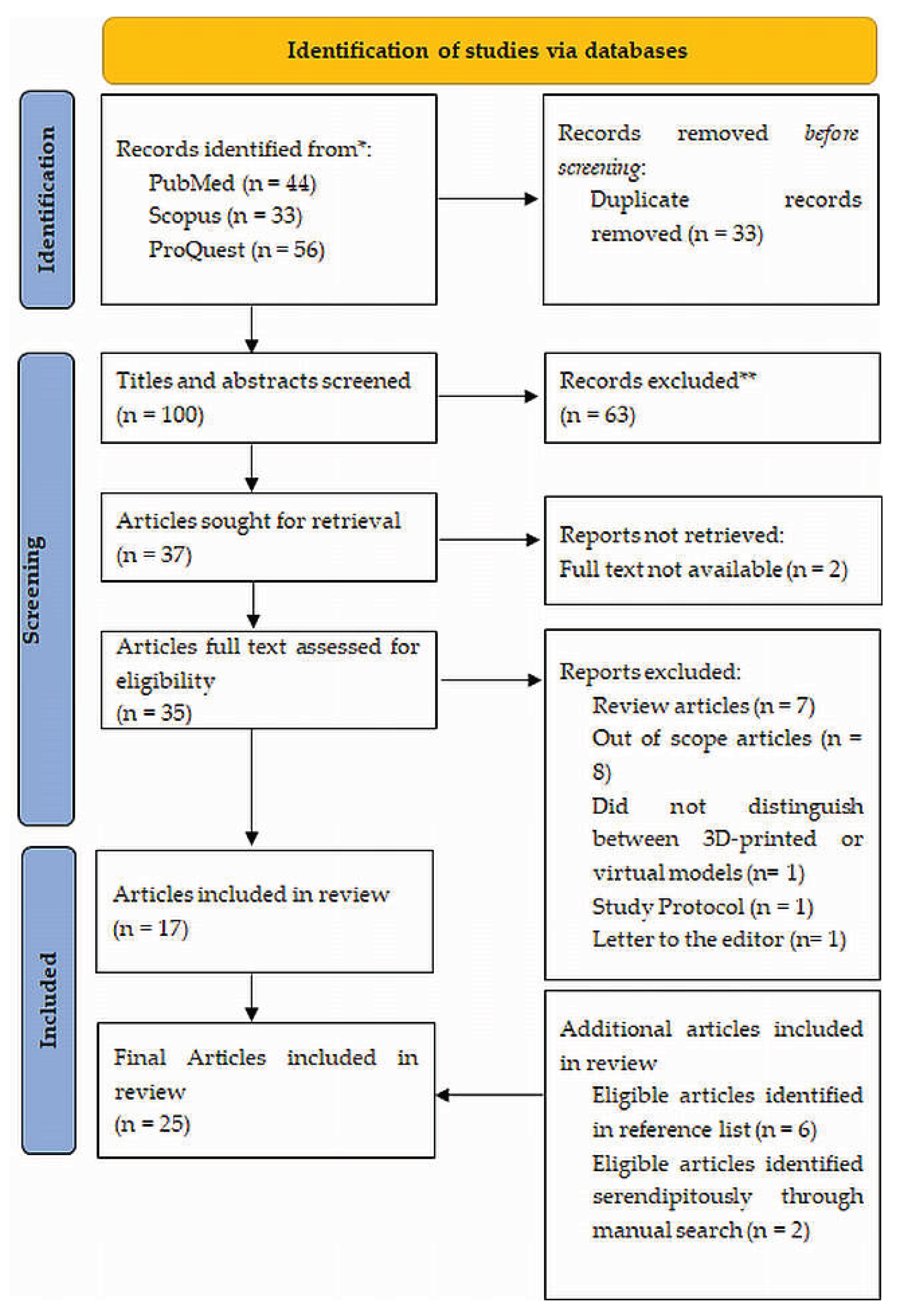

Table 1.
Search strategy.
| Concept 1 3D printing |
Concept 2 Model |
Concept 3 Liver |
Concept 4 Teaching/Surgery |
|---|---|---|---|
| “3D print*” OR “3D-print*” OR “three-dimensional” OR “three dimensional” OR “additive manufactur*” OR “three-dimensional print*” OR “3-dimensional print*” | model* OR phantom | liver OR hepat* | teach* OR train* OR instruct* OR simulat*OR educat* OR surg* OR oper* OR “intervention*” |
Table 2.
Eligible articles characteristics and key findings.
| Articles | Purpose | Country of Origin | Study Design | Sample | Imaging modality/3D model software/3D printing method | 3D printing materials | Production cost and time | Key Findings |
|---|---|---|---|---|---|---|---|---|
| Cheng et al. (2022) [6] | Method to reduce cost and improve efficiency of 3DPLM creation. Investigate the effects and value of 3DPLM in complex laparoscopic hepatectomy procedures | China | Prospective comparative | Patients with complex hepatobiliary lesions n = 54 |
CT E3D, Cura SLA |
Photosensitive resin |
$104.40 USD 56.8h |
The 3DP liver model assisted in preop planning and intraoperative navigation, however, there was no significant improvement of intra- or postoperative outcomes |
| Aranovich et al. (2025) [34] | Develop a specialised educational program using a 3DPLM for managing high grade liver injuries | Israel | Single-group cross-sectional | General surgery and trauma residents n = 8 |
CT N/S N/S |
TPU-95 | N/S N/S |
3DPLM improved participant proficiency indicating potential for improved patient outcomes |
| Bao et al. (2023) [35] | Evaluating the value of 3DPLMs in trainees’ understanding of liver tumour location and surgical procedures | China | Quasi-experimental | Medical trainees n = 30 |
CT Mimics, Magics Material jetting |
Photosensitive resin |
$260 USD 14h |
Use of 3DPLM significantly improved the trainees’ surgical procedure understanding, surgical planning, and tumour location |
| Cao et al. (2024) [36] | Develop a reusable 3DPLM to simulate surgical resection of complex liver cancer | China | Single-group cross-sectional | Patients with complex liver cancer n = 2 |
MRI E3D, Cura FFF, SLA |
Silicone, hydrogel, photosensitive resin | N/S N/S |
3DPLM potentially replicates minimally invasive resection of complex liver cancer, demonstrating value in simulated surgery |
| Cheng et al. (2023) [37] | Comparing the educational value of 2D imaging, 3DVR and 3DPLM for hepatic tumour location and surgical planning | China | Randomised controlled | HPB surgical interns n = 62 |
CT E3D SLA |
Photosensitive resin | N/S N/S |
Using 3DPLM significantly enhanced the interns’ ability to indicate correct tumour location and design appropriate surgical plans |
| Chua et al. (2022) [38] | Investigate the use of low-cost FFF and SLA 3DP to create a realistic 3DPLM for medical education | Singapore | Descriptive experimental | 3DPLM n = 4 |
N/S Blender FFF, SLA |
PLA, PETG, silicone | N/S N/S |
Developed a workflow to create four different 3DPLM for use in liver anatomy education |
| Elisei et al. (2024) [39] | Develop a 3DPLM that can be used for the training of surgeons in image-guided interventional procedures | Romania | Single-group cross-sectional | Residents and specialist surgeons n = 33 |
CT InVesalius, Autodesk Fusion 360 with Netfabb FFF |
Mold: ABS Phantom: gelatine, silicone | Mold: €1000 Gelatin phantom: €8-15 Silicone phantom: €85 42h |
The multi-modal 3DPLM provided an realistic model for simulation of image-guided interventional procedures of the liver for surgical training |
| Fukumitsu et al. (2023) [40] | Evaluate the use of a patient-specific 3DPLM as an intraoperative navigation tool for surgical safety | Japan | Quasi-experimental | Patients requiring advanced HPB surgery n = 15 |
CT SYNAPSE VINCENT SLA, DLP |
Acrylic resin |
$700-2500 USD N/S |
Accurate patient-specific 3DPLM was an effective intraoperative navigation tool to improve safety and psychological stress, but did not reduce blood loss or operative time |
| Igami et al. (2024) [41] | Investigate the value of 3DPLM on patients undergoing ≥3 repeated hepatectomy for intraoperative navigation for trainee surgeons | Japan | Ethnographical | Patients undergoing ≥3 repeated hepatectomy n = 17 |
CT PLUTO Material jetting |
Acrylic and polyurethane resin | 50,000¥ 18h |
Use of 3DPLM improves surgical trainees anatomical understanding and preoperative planning in complex surgical cases |
| Labakoum et al. (2025) [42] | Develop an accurate patient-specific 3DPLM for education, preoperative planning and surgical rehearsal | Morocco | Descriptive survey | Medical trainees (2 surgical residents, 3 senior medical students) n = 5 |
CT 3D Slicer, Meshmixer, Cura FFF, LCD |
Mold and intrahepatic structures: PLA Model: gelatine |
Model: $50 USD 128h |
3DPLM developed was low-cost and anatomically accurate showing potential for surgical training simulations and preoperative planning |
| Lopez-Lopez et al. (2021) [43] | Verify the accuracy of 3DPLM and investigate its utility regarding liver surgical planning, teaching and provision of patient information | Spain | Multicentre study: Case report, descriptive survey, randomised control |
Patients with complex hepatic tumours n = 35 HPB surgeons n = 23 Medical students n = 75 |
CT and MRI 3D-MSP N/S |
TPUR, ABS | €950 22h |
3DPLM showed good correlation with CT/MRI, and the models supported surgical education and planning and enhanced patient understanding of their surgery and pathology but did not affect the surgical outcome. |
| Lu et al. (2023) [44] | Develop a soft, self-healing 3DPLM for preoperative planning and surgical training | China | Single-group cross-sectional | Patients presenting for liver surgery n = 5 |
CT N/S SLA |
Elastomeric copolymer | N/S N/S |
Produced a high-fidelity self-healing 3DPLM for use in preoperative planning and surgical training which may enhance patient safety |
| Maehigashi et al. (2024) [45] | Explore the effects of using 3D computer and 3DPLM on the spatial reasoning of liver anatomy of experts and novices | Japan | Quasi-experimental | University students n = 48 Digestive surgeons n = 22 |
CT PLUTO SLA |
Acrylic resin | N/S N/S |
Use of 3DPLM improved spatial reasoning for novices and increased the expert’s confidence in their spatial reasoning |
| Sanchez-Garcia et al. (2024) [46] | Demonstrate the feasibility and accuracy of using 3DPLM in paediatric liver transplant decision-making and living donor selection | United States of America | Prospective multi-centre cohort |
Paediatric liver transplant candidates n = 28 Living liver donors n = 41 |
CT and MRI IQQA-Liver, Mimics FFF |
Photopolymer resin | N/S N/S |
3DPLM is a highly accurate way to estimate recipient liver volume and reduce costs in a living donor program, while potentially improving surgical decision-making and improving organ allocation efficiency |
| Smilie et al. (2021) [47] | Develop a method for producing 3DPLM for use in anatomical and surgical teaching | United Kingdom | Case report | 3DPLM n = 1 |
CT Simpleware ScanIP, GrabCAD, Meshmixer Material Jetting |
Photopolymer | £1,343 58h |
3DPLM provide a suitable alternative to cadaveric teaching, but further development is required to ensure human liver tissue characteristics are simulated for more realistic surgical training |
| Tooulias et al. (2021) [48] | Create a patient-specific, accurate 3DPLM with a tumour for surgical resection | Greece | Case report | Patient with liver tumour for surgical resection n = 1 |
CT N/S N/S |
N/S | N/S N/S |
3DPLM may promote a more targeted tumour resection where a larger volume of healthy liver tissue is preserved |
| Valls-Esteve et al. (2023) [49] | Produce a low-cost method for producing patient-specific 3DLMs for training and simulation | Spain | Case report | Paediatric patients with complex hepatic tumours n = 3 |
CT IntelliSpace Portal FFF and SLS |
PA12, PLA, silicone | μ = €549 8-24h |
3DP mould used to cast soft, transparent silicone liver model allowing for surgical rehearsals and improve pre-operative planning |
| Yao et al. (2024) [50] | Evaluate the value of 3DPLM in surgical planning of laparoscopic liver resection in complex HPB disease | China | Retrospective cohort |
Patients with complex liver disease n = 62 |
CT E3D, Cura SLA |
Photosensitive resin | N/S N/S |
Use of 3DPLM for preoperative planning can aid in reducing postoperative complications |
| Arm et al. (2022) [51] | Develop and characterise a 3DPLM to aid in surgical planning, teaching and rehearse liver tumour resection | United Kingdom | Case report | Patient with liver tumour n = 1 |
CT Mimics FFF |
Thermoplastic aliphatic polyester, PLA and PVA | N/S N/S |
3DPLM closely mimicked the mechanical properties of real liver tissue for surgical simulation and preoperative planning |
| Aseni et al. (2021) [52] | Develop a transparent 3DPLM to investigate surgeon understanding of anatomical spatial changes during surgery to optimise preoperative planning | Italy | Descriptive survey | 6 HPB surgeons and 6 radiologists n = 12 |
CT and MRI 3D Slicer FFF |
ABS | N/S N/S |
Transparent 3DPLM improved surgeons’ understanding of positional changes of intrahepatic structures during surgery |
| Huettl et al. (2021) [53] | Comparing the clinical value of 2D imaging, 3DVR and 3DPLM regarding preop planning for liver surgery | Germany | Quasi-experimental | Medical students and HPB doctors n = 30 |
CT Synapse 3D N/S |
TPUR, ABS | N/S N/S |
Use of 3DPLM enables partially faster and more accurate identification of liver tumour location |
| Raichurkar et al. (2021) [54] | Investigate the feasibility and clinical utility of a patient-specific 3DPLM for preoperative planning in living donor liver transplants | India | Case report | Paediatric patient with end stage liver failure n = 1 |
CT Osirix Material jetting |
Silicone | 25,000 Rupees ~One week |
3DPLM improved visualisation of hepatic structures and facilitated surgical planning through preoperative simulation |
| Tan et at. (2021) [55] | Develop a high-fidelity, durable and soft 3DPLM with a hollow biliary system for surgical planning and simulation | Germany | Case report | 3DPLM n = 1 |
N/S SolidWorks, Meshmixer FFF |
Silicone rubber, rubber-like photopolymer TangoBlack+, ABS | N/S N/S |
3DPLM accurately mimicked human liver tissue and successfully simulated surgical procedures |
| Al-Thani et al. (2024) [56] | Develop a realistic 3DPLM for HCC preoperative planning | Qatar |
Descriptive survey | HPB surgeons n = 3 |
CT SolidWorks, Blender FFF |
Mold: ABS Phantom: silicone, gelatine |
N/S N/S |
A flexible 3DPLM made from 10% gelatine to water mixture showed decent fidelity to real liver tissue which may hold value in improving medical training and preoperative planning |
| Giehl-Brown et al. (2023) [57] | Investigate the influence of 3DPLM on preoperative decision making and patient satisfaction | Germany | Randomised controlled | Patients presenting for liver surgery n = 40 |
CT Meshmixer and segmentation by MeVis FFF |
PLA | N/S N/S |
3DP group had improved understanding of their liver disease and surgery; no significant difference between non-3DP and 3DP group |
Abbreviations—2D: 2-dimensional, 3D: 3-dimensional, 3DPLM: 3D-printed liver model, 3DP: 3D printer, 3DVR: 3D volume rendering, HCC: hepatocellular carcinoma, HPB: hepatopancreatobiliary, CT: computed Tomography, MRI: magnetic resonance imaging, FFF: fused filament fabrication, SLA: stereolithography, ABS: acrylonitrile butadiene styrene, TPU: thermoplastic polyurethane, TPUR: transparent polyurethane rubber, PVA: polyvinyl acetate, PLA: polylactic acid, PETG: polyethylene terephthalate glycol, DLP: digital light processing, LCD: liquid crystal display, PA12: polyamide 12, N/S: not specified.
Disclaimer/Publisher’s Note: The statements, opinions and data contained in all publications are solely those of the individual author(s) and contributor(s) and not of MDPI and/or the editor(s). MDPI and/or the editor(s) disclaim responsibility for any injury to people or property resulting from any ideas, methods, instructions or products referred to in the content. |
© 2026 by the authors. Licensee MDPI, Basel, Switzerland. This article is an open access article distributed under the terms and conditions of the Creative Commons Attribution (CC BY) license (http://creativecommons.org/licenses/by/4.0/).
Copyright: This open access article is published under a Creative Commons CC BY 4.0 license, which permit the free download, distribution, and reuse, provided that the author and preprint are cited in any reuse.


