

Submitted:
20 May 2026
Posted:
21 May 2026
You are already at the latest version
Abstract
Brain-Computer Interface (BCI) is a system that enables the human brain to interact with the external environment without using muscles. Electroencephalography (EEG) is a commonly used modality for measuring neural brain activity. However, its low signal-to-noise ratio (SNR) and electrode reference problems lead to poor spatial resolution. As a result, EEG signals are often contaminated with physiological artifacts such as muscle movements. Therefore, this study used novel tripolar concentric ring electrodes (TCREs) that are used to record brain activity related to the overt and covert speech. Brain signals associated with overt and covert speech were recorded using TCREs and disc electrodes. Classification algorithms, including K-Nearest Neighbors (KNN), Fully Connected Neural Networks (FCNNN), and Convolutional Neural Networks (CNN), were used to classify the TCRE and conventional EEG signals. The data was collected from 16 healthy participants. The experimental results demonstrate that TCREs provide superior performance compared to conventional disc electrodes. In addition to that, the 0.5–1.2s interval, corresponding to the peak stimulus window, exhibits a maximum power of 250µV. The average accuracy achieved during this epoch was 86.25%, whereas the remaining epoch shows an accuracy of 83.5% using TCREs.
Keywords:
electroencephalography (EEG)
; Brain-Computer Interface (BCI)
; overt and covert speech
; concentric ring electrodes
; Surface Laplacian
; machine learning
; deep learning
; neural signal classification
; biomedical signal analysis
; biosensors
1. Introduction
The Brain–Computer Interface (BCI) is a system that enables direct communication between the brain and external devices [1]. These systems enable individuals with motor impairments to perform everyday tasks and interact with the external environment [2]. There are a number of signals that are used in BCI, such as electromyography (EMG) [3], functional magnetic resonance imaging (fMRI) [4], magnetoencephalography (MEG) [5], electroencephalography (EEG) [6], and electrocorticography (ECoG) [7].
Among these signals, EEG and ECoG are commonly used in BCI as these signals reflect the electrical response of the brain. ECoG studies require surgery to insert electrodes in the human brain [8]. On the other hand, scalp EEG is one of the most popular modalities of BCI systems because it is non-invasive and does not require surgery to insert electrodes in the brain. However, there are some limitations of EEG electrodes, such as spatial resolution, signal contamination, and the reference electrode problem [9,10]. Therefore, there is a need for new types of electrodes, such as Tripolar Concentric Ring Electrode (TCRE) that can attenuate the dependency of reference electrodes, signal contamination, and muscle artifacts. The TCRE are developed using three rings that calculate the Surface Laplacian (SL) directly on the hardware of TCRE. The SL works as a high pass filter that enhances the spatial resolution and reduces the reference electrode problem [11]. This helps to extract the more distinctive features of the EEG. Figure 1 presents the structural difference between conventional disc and TCRE electrodes.
In the last few decades, BCI research has been explored in large parts of the human body such as elbows [12], wrists [13], legs [14], tongue [15], and upper limbs [16]. Limited research has been done on the overt (aloud) and covert (silent) behavior of the brain. Overt and covert brain signals are very critical to understand because they help people who suffer from aphasia or speech impairment injuries and are unable to communicate with the outside world. Therefore, this study focuses on the overt and covert behavior of the brain. Machine learning and deep learning will be used to analyze the overt and covert data which are recorded through conventional and TCRE electrodes.
The main contributions discussed in this paper are: (i) a comparative evaluation of TCRE and conventional disc electrodes for EEG-based Overt and covert speech discrimination; (ii) investigation of machine learning and deep learning models to differentiate overt and covert signals.
This paper consists of (i) an introduction which explains the EEG signals; (ii) related work that elaborates the recent work done on overt/covert speech, electrode types, and machine learning or deep learning models; (iii) methodology, which explains the flow of the research study; (iv) results and discussion show the output of conventional and TCRE electrodes and overt and covert speech differentiation; (v) conclusion of the paper; (vi) future work.
2. Related Work
Recent studies focus on BCI to investigate the potential of decoding speech related brain activities that are recorded using non-invasive conventional EEG. In particular, imagined speech received more attention due to its significant applications in assistive communication systems.
2.1. Speech Decoding Using Conventional EEG
Hossain et al. [17] worked to recognize the imagined speech classifying of 26 letters of the English alphabet and 10 digits. Data collected from 20 healthy participants in real time while they imagined letters and digits. The classification accuracy reported in this study was 85.65% for letters and 83.65% for digits using BiLSTM. In this study, the EEG data were prepared with 75% overlap segmentation, which can increase the number of samples with strong similarity in the training and test datasets, potentially limiting the validity of this result.
Jiang et al. [18] worked on decoding overt and covert EEG signals. Data were recorded using conventional EEG electrodes. The EEG data were recorded from 57 right handed native English speaking adult males. During the covert experiment paradigm, participants were asked to imagine the word silently, whereas in the overt condition, they pronounce the word loudly. During the experiment, the same word was repeated 5 times. Their results show that the model achieved a classification accuracy of 34.7%. Furthermore, in this study, the data were recorded from conventional EEG electrodes, which inherently has low spatial resolution, low signal-to-noise ratio, and reference electrode problem [11].
Similarly, Milyani and Attar [19] conducted a pilot study on inner speech decoding. Data were extracted from a publicly available EEG-fMRI dataset (4 participants). The study compared the results of the EEGNet-based architecture with those of the spectro-temporal transformer. The results achieved from the transformer model outperform with an accuracy of 82.4%, whereas EEGNet achieved approximately 36% accuracy. In addition, it was observed that socially meaningful words (wife, father, child) yield better results compared to numerical words(six, ten). This shows that emotionally meaningful words may give better brain signals.
In addition, Alharbi and Alotaibi [20] conducted research on the publicly available BCI2020 data set for imagined speech, which is based on 15 participants. The five imagined words were used: “Hello", “Help me,” “Stop,” “Thank you,” and “Yes". Hybrid deep learning algorithms were used for the decoding of imagined speech using EEG signals. The results show that the 3DCNN-BiLSTM model achieved a maximum accuracy of 75.2% for imagined words, while the 3DCNN-stackLSTM model yielded a maximum accuracy of 44.7%.
Similarly, Abdulghani et al. [21] worked on decoding imagined speech brain signals. Data were recorded from 4 healthy participants using an 8 channel EEG acquisition system.The participants were instructed to imagine these commands: up, down, left, right. The results show a generalization accuracy of 92.50% using LSTM recurrent neural network. This high accuracy may be result of overfitting because a limited data set negatively effects the performance of deep learning due to overfitting [22].
2.2. TCRE-Based EEG Studies
Among the earlier studies on the TCRE, Besio et al. [23] worked on the TCRE to improve the spatial selectivity of the EEG signal recorded from the brain. Six males and four females participated in this experiment between the ages of 23 and 27. All participants were right-handed. The subjects were asked to use their right-hand index finger to press the micro-switch with closed eyes to minimize the eye movement artifacts. The EEG signals were recorded for 5 minutes and each participant made two recordings: one with disc electrodes and the other with TCRE electrodes. The statistical Bonferroni t-test was performed to compare the signal-to-noise (SNRs) of the disc and TCRE electrodes at a significance level of 1%. The results showed that the TCRE electrode showed a significantly higher mean SNR of 30.46 compared to the disc electrode’s mean SNR of 7.23.
Besio et al. [10] worked with epilepsy subjects to detect High-Frequency Oscillation (HFO) using TCREs. The initial experiment was performed on healthy subjects with the eyes closed using TCREs to detect physiological alpha waves. Subsequently, the recording from epilepsy patients were obtained using conventional electrodes and TCREs. The TCREs enable the detection of the HFOs (30 - 500 Hz) from the scalp, which are difficult to capture using conventional disc electrodes. The results show that HFO were detected approximately 35.5% of the TCRE channels prior to the onset of the seizure and among these 78.2% located within the seizure onset zone and irritative zone. However, some HFOs were also detected outside the onset region, indicating that TCREs improve spatial resolution, but still signals are not confined to the TCREs region.
Toole et al. [24] also worked with epilepsy patients to record the onset of seizures. The conventional electrodes and TCREs were used to record the High-Frequency Activity (HFA) during the seizures. The study was conducted on nine patients, of which 8 patients had seizures during recording and one had the epileptic activity. The results show that HFA detected using TCREs were more localized to the cortical regions and found in seizure onset and irritative zone. Although some HFA found outside the electrodes’ region. This shows that TCRE can non-invasively detect the epileptic activity with good resolution.
Liu et al. [25] compared TCRE electrodes and the conventional electrode to analyze the spatial resolution of EEG signals. The visual evoked experiment was conducted to collect visual evoked potentials (VEPs) to investigate TCRE-based Laplacian sensing. In addition, TCRE-based VEPs were also collected using computer simulation. The TCRE results show a ten fold improvement in spatial resolution compared to conventional electrodes. Furthermore, TCREs were more capable of isolating human VEPs activities that were not separable using conventional electrodes. These findings show that TCREs offer a great advantage for applications that require enhanced spatial selectivity in EEG-based neural signals.
Alzahrani et al. [26] investigated TCRE electrodes on motor tasks such as finger movements. Their study compared conventional and TCRE electrodes. Conventional electrodes limit their ability to distinguish the overlapped neural activities that occur in the sensorimotor cortex. To address this issue, TCRE electrodes were used to record the movement related potentials. The results showed that the TCRE achieved a higher SNR with low mutual information [27,28] and reduced the electrode reference problem.
Based on the previous studies, the common limitation is the data recorded from conventional EEG, which suffers from poor spatial resolution, low SNR, and an electrode reference problem. Therefore, it is very important to enhance the electrode design and the recording protocol. In this regard, TCRE has been an alternative due to its high spatial resolution and attenuated artifacts because it provides SL on the hardware. Table 1 shows the comparison of previous studies related to TCRE and the applications where it is used.
3. Methodology
This study aims to classify conventional disc electrodes and TCRE signals based on overt and covert speech data. Figure 2 represents the methodology of the experiment carried out in this study.
3.1. EEG Data Acquisition
In this study, EEG data were recorded using both TCRE and disc electrodes. The image was shown on the computer screen and the participant was instructed to speak loudly the name of the image within 2.5 seconds, followed by 3.5 seconds break time. For the covert experiment, the participant was asked to silently imagine the name of the image shown on the screen.TCRE and disc electrodes were placed on the scalp to concurrently record the EEG signals.
3.1.1. Participants
Data were obtained from 16 healthy participants. It is observed that there is high variability between the participant data and inter-trial variability within the same participant’s EEG signals [29]. Data for this article were recorded in the Neural Rehabilitation Lab at the University of Rhode Island (URI). Before the experiment, all participants provided their consent, which was approved by the URI’s Institutional Review Board (IRB). Each participant performed two runs: overt and covert. Each run recorded 100 trials. In total, 200 trials were recorded for each participant, with overt and covert trials interspersed.
3.1.2. Experimental Naming Paradigm
The following picture naming paradigm was performed. Participants were presented a random image and asked to speak loudly the name of that picture and also imagine silently the name of the same picture. Each image stimulus was shown for 3500 milliseconds, followed by a 2500 milliseconds for the participant to speak overtly or covertly the name of the image. The EEG data were sampled at a rate of 1000 samples per second. The impedance was maintained below 10K. The 10-20 International Electrode Positioning System was referenced to place both TCRE and conventional electrodes. Data were recorded using 5, 7, and 8 electrodes placed on the front and parietal parts of both left and right hemispheres.
3.2. Signal Preprocessing
The raw EEG signals contain noise and artifacts such as eye blink, muscle movements, body posture, etc. The band-pass filter was used to improve signal quality and data was extracted between 1 Hz and 40 Hz to remove low and high frequency signals which also include power-line signals [30]. Therefore, pre-processing is necessary to preserve neural activity while minimizing irrelevant signals.
3.3. Epoch Extraction
Once the pre-processing step was done, the EEG signals were segmented into epochs. Each epoch represents the neural activity within a time window that follows the stimulus. The signal was separated peak Vs. non-peak stimuli, where peak refers to time interval with higher EEG amplitude and non-peak represents the lower activity period.
3.4. TCRE and Disc Electrodes Separation
Data were recorded using TCRE and disc electrodes at the same time at the same region of the brain according to the 10-20 montage to analyze the signals from both electrode types. Signals from disc electrodes were obtained from the outer ring of a TCRE. The EEG signals exhibit a maximum power of 60 throughout the entire segmented epoch, while TCRE shows fluctuation, which separated both signals from each other.
3.5. Time–Frequency Analysis
The EEG signals are non-stationary with changes in frequency and time. This requires a time-frequency analysis to represent the EEG signals [31]. In this paper, the Morlet wavelet transform was used to analyze the temporal evaluation of the signal with frequency. This Morlet Wavelet transform provides the baseline for the EEG signal [32]. It helps to extract the discriminative feature of overt and covert speech.
3.6. Classification Models
The classification algorithms are used to evaluate the TCRE and conventional disc electrodes signals and also to classify overt versus covert performance. The KNN, CNN, and FCNN will be used to classify the signals from TCRE and conventional disc electrodes. These classification algorithms will be evaluated separately.
3.7. Performance Evaluation
To ensure the performance of the classification algorithms, 5-fold cross validation will be performed. This can reduce the overfitting problem [33]. The final performance of the model was evaluated using the accuracy and confusion matrices.
4. Results and Discussion
In this section, the results of EEG-based speech experiment using TCRE and conventional electrodes will be explained.
4.1. Overall Performance Comparison
The overall performance will be compared between TCRE and disc electrodes. The classification algorithms such as KNN, FCNNN, and CNN will be used to analyze data capture from both TCRE and disc electrodes. Data were divided into 80% training and 20% testing data. The 5-fold cross validation was performed to partition the training data and validation set. The validation set was used in each cycle during the training phase. Once the ML model is trained, testing data was given to the model to check its robustness. Table 2 shows the results of testing data, which were not seen during the training phase.
The results of three participants will be discussed: one which has lowest accuracy in all algorithms, another which has highest accuracy, and the third which has average accuracy in almost all classification algorithms.
Among all the classification algorithms used in this study, KNN shows the highest accuracy for many participant results. Participant 01 shows the accuracy of 55.0% using TCRE and 50.0% using disc electrodes. Participant 11 represents the accuracy of 97.5% with TCRE and 77.5% with disc electrodes. Participant 16 shows the accuracy of 97.5% using both TCRE and disc electrodes.
The performance of classification algorithms varies among participants and no single algorithm consistently outperforms in all the participants. In addition to that, the electrode type also influences the performance of classification algorithms. These findings suggest that the electrode selection and classification algorithm plays an important role in the differentiation of overt versus covert EEG-speech. The results calculated using TCRE electrodes shows the enhanced signal quality and separability of neural patterns associated with overt and covert speech.
4.2. TCRE vs. Disc Electrode Analysis
Figure 3 illustrate the distribution of test data accuracies for the KNN, FCNN, and CNN classifiers using TCRE and disc electrodes. The TCRE based classifiers exhibit higher accuracy compared to the disc electrode classifiers. Among the classifiers, CNN with TCRE showed a higher median accuracy with more data points observed in the upper range. KNN exhibits competitive performance with TCRE but shows a reduction in accuracy and increased variability using disc electrodes. However, FCNN shows lower accuracy but it is more consistent in both electrode types. The observed variability in the results shows that the performance of the classification algorithm differs among the participants and is influenced by the electrode type.
4.3. Classifier Performance Analysis
The classification algorithms such as KNN, FCNNN, and CNN were evaluated using confusion matrices to see the performance of classification algorithms. The confusion matrices are shown in the Figure 4, Figure 5 and Figure 6. It is observed that KNN consistently achieved higher results compared to CNN and FCNNN. This can be attributed to the KNN’s ability to capture more localized neural EEG signals. CNN also illustrates strong performance especially TCRE captured data. In contrast, FCNN represents a relatively lower performance. This represents its limited ability to capture spatiotemporal EEG patterns. These results suggest the importance of selecting the classification algorithms for EEG-based overt/covert differentiation.
4.4. Epoch Segmentation and Analysis
In this section, we examine the time duration of the epoch (0 - 2.5 seconds). For analysis purposes, a participant was taken from the overt and covert data set to investigate the variation in the epoch over time. Figure 7 represents the overt and covert EEG signals of Participant 11. Each epoch comprises of two parts: peak and non-peak. Peak is the amplitude of signals over the time when the participant speaks aloud(overt) or silently imagines (covert) the name of the image shown on the computer to record the brain activity. The non-peak refers to the neural activity recorded before and after the peak activity. Each epoch represents the average response of 200 runs that were collected for a single participant.
Figure 8 exhibits the confusion matrix for classification algorithm KNN on data from participant 11. The overt data are correctly classified at a rate of 68.2% while experiencing a mis-classification rate of 31.8%. In contrast, covert data are correctly classified with an accuracy of 94.4%, with a mis-classification rate of 5.6%. On the other hand, at non-peak intervals of the epoch, overt and covert runs are correctly classified at a rate of 75%, with a mis-classifcation rate of 25% for both overt and covert runs.
5. Conclusion
This study focused on the analysis of EEG data recorded during overt and covert speech using both TCRE and disc electrodes. Different classification algorithms such as KNN, FCNN, and CNN were used to differentiate between overt and covert speech. The results suggest that TCRE based EEG more consistently improves the classification performance compared to the disc electrodes. Among the classification algorithms, KNN captures more EEG neural patterns, while CNN also exhibited strong performance. On the other hand, FCNN shows comparatively lower performance in both electrode types.
In addition to that, the analysis of epoch segments show that the peak interval, which represents the strong neural activity during overt and covert speech task, contain more discriminative information than non-peak intervals. The classification results showed that the higher accuracy of covert during peak segment shows the potential of the EEG signals to capture a more subtle neural pattern associated with imagined speech. The findings illustrate that the electrode type plays a very important role in capturing the EEG data. The TCRE results suggest its potential to be used as an alternative to conventional disc electrodes for non-invasive BCI.
6. Future Work
Future work will focus on improving the TCRE design and exploring new channel configurations to capture EEG data. In addition to that, advanced classification algorithms and larger data sets will be used to improve the robustness of EEG-based overt and covert speech systems.
Acknowledgments
The authors express sincere gratitude to the Neural Rehabilitation Lab at the University of Rhode Island (URI) for providing the EEG data set and also the development of novel electrodes, which form the core contribution of this study. The authors also thank all subjects who voluntarily helped record the data and helped in the data collection process.
Abbreviations
The abbreviations used in this manuscript are these:
| BCI | Brain Computer Interface |
| EEG | Electroencephalography |
| ECoG | Electrocorticography |
| EMG | Electromyography |
| fMRI | Functional Magnetic Resonance Imaging |
| MEG | Magnetoencephalography |
| TCRE | Tripolar Concentric Ring Electrode |
| KNN | K-Nearest Neighbors |
| FCNNN | Fully Connected Neural Network |
| CNN | Convolutional Neural Network |
| SNR | Signal toNoise Ratio |
| HFO | High Frequency Oscillation |
References
- Lotte, F.; Bougrain, L.; Cichocki, A.; Clerc, M.; Congedo, M.; Rakotomamonjy, A.; Yger, F. A review of classification algorithms for EEG-based brain–computer interfaces: a 10 year update. J. Neural Eng. 2018, 15, 031005. [Google Scholar] [CrossRef]
- Liao, K.; Xiao, R.; Gonzalez, J.; Ding, L. Decoding individual finger movements from one hand using human EEG signals. PLoS ONE 2014, 9, e85192. [Google Scholar] [CrossRef] [PubMed]
- Boostani, R.; Moradi, M.H. Evaluation of the forearm EMG signal features for the control of a prosthetic hand. Physiol. Meas. 2003, 24, 309. [Google Scholar] [CrossRef]
- Sitaram, R.; Caria, A.; Veit, R.; Gaber, T.; Rota, G.; Kuebler, A.; Birbaumer, N. FMRI brain-computer interface: a tool for neuroscientific research and treatment. Comput. Intell. Neurosci. 2007, 2007, 1. [Google Scholar] [CrossRef]
- Bradberry, T.J.; Rong, F.; Contreras-Vidal, J.L. Decoding center-out hand velocity from MEG signals during visuomotor adaptation. Neuroimage 2009, 47, 1691–1700. [Google Scholar] [CrossRef]
- Bradberry, T.J.; Gentili, R.J.; Contreras-Vidal, J.L. Reconstructing three-dimensional hand movements from noninvasive electroencephalographic signals. J. Neurosci. 2010, 30, 3432–3437. [Google Scholar] [CrossRef]
- Pistohl, T.; Schulze-Bonhage, A.; Aertsen, A.; Mehring, C.; Ball, T. Decoding natural grasp types from human ECoG. Neuroimage 2012, 59, 248–260. [Google Scholar] [CrossRef]
- Schalk, G.; Kubanek, J.; Miller, K.; Anderson, N.; Leuthardt, E.; Ojemann, J.; Limbrick, D.; Moran, D.; Gerhardt, L.; Wolpaw, J. Decoding two-dimensional movement trajectories using electrocorticographic signals in humans. J. Neural Eng. 2007, 4, 264. [Google Scholar] [CrossRef] [PubMed]
- Babiloni, F.; Babiloni, C.; Fattorini, L.; Carducci, F.; Onorati, P.; Urbano, A. Performances of surface Laplacian estimators: a study of simulated and real scalp potential distributions. Brain Topogr. 1995, 8, 35–45. [Google Scholar] [CrossRef]
- Besio, W.G.; Martínez-Juárez, I.E.; Makeyev, O.; Gaitanis, J.N.; Blum, A.S.; Fisher, R.S.; Medvedev, A.V. High-frequency oscillations recorded on the scalp of patients with epilepsy using tripolar concentric ring electrodes. IEEE J. Transl. Eng. Health Med. 2014, 2. [Google Scholar] [CrossRef] [PubMed]
- Makeyev, O.; Ding, Q.; Besio, W.G. Improving the accuracy of Laplacian estimation with novel multipolar concentric ring electrodes. Measurement 2016, 80, 44–52. [Google Scholar] [CrossRef]
- Zhou, J.; Yao, J.; Deng, J.; Dewald, J.P. EEG-based classification for elbow versus shoulder torque intentions involving stroke subjects. Comput. Biol. Med. 2009, 39, 443–452. [Google Scholar] [CrossRef]
- Gu, Y.; Dremstrup, K.; Farina, D. Single-trial discrimination of type and speed of wrist movements from EEG recordings. Clin. Neurophysiol. 2009, 120, 1596–1600. [Google Scholar] [CrossRef]
- Pfurtscheller, G.; Brunner, C.; Schlögl, A.; Da Silva, F.L. Mu rhythm (de) synchronization and EEG single-trial classification of different motor imagery tasks. NeuroImage 2006, 31, 153–159. [Google Scholar] [CrossRef] [PubMed]
- Morash, V.; Bai, O.; Furlani, S.; Lin, P.; Hallett, M. Classifying EEG signals preceding right hand, left hand, tongue, and right foot movements and motor imageries. Clin. Neurophysiol. 2008, 119, 2570–2578. [Google Scholar] [CrossRef]
- Doud, A.J.; Lucas, J.P.; Pisansky, M.T.; He, B. Continuous three-dimensional control of a virtual helicopter using a motor imagery based brain-computer interface. PLoS ONE 2011, 6, e26322. [Google Scholar] [CrossRef] [PubMed]
- Hossain, A.; Ovi, T.H.; Mahmood, M.A.I.; Kader, M.F. Classification of Envisioned English Speech from EEG using deep learning approaches. Mach. Learn. With Appl. 2025, 22, 100752. [Google Scholar] [CrossRef]
- Jiang, M.; Ding, Y.; Zhang, W.; Teo, K.A.C.; Fong, L.; Zhang, S.; Guo, Z.; Liu, C.; Bhuvanakantham, R.; Sim, W.K.J.; et al. Decoding covert speech from EEG using a functional areas spatio-temporal transformer. arXiv 2025, arXiv:2504.03762. [Google Scholar] [CrossRef]
- Milyani, A.H.; Attar, E.T. Deep learning for inner speech recognition: a pilot comparative study of EEGNet and a spectro-temporal Transformer on bimodal EEG-fMRI data. Front. Hum. Neurosci. 2025, 19, 1668935. [Google Scholar] [CrossRef]
- Alharbi, Y.F.; Alotaibi, Y.A. Decoding imagined speech from eeg data: A hybrid deep learning approach to capturing spatial and temporal features. Life 2024, 14, 1501. [Google Scholar] [CrossRef] [PubMed]
- Abdulghani, M.M.; Walters, W.L.; Abed, K.H. Imagined speech classification using EEG and deep learning. Bioengineering 2023, 10, 649. [Google Scholar] [CrossRef]
- Safonova, A.; Ghazaryan, G.; Stiller, S.; Main-Knorn, M.; Nendel, C.; Ryo, M. Ten deep learning techniques to address small data problems with remote sensing. Int. J. Appl. Earth Obs. Geoinf. 2023, 125, 103569. [Google Scholar] [CrossRef]
- Besio, G.; Koka, K.; Aakula, R.; Dai, W. Tri-polar concentric ring electrode development for Laplacian electroencephalography. IEEE Trans. Biomed. Eng. 2006, 53, 926–933. [Google Scholar] [CrossRef] [PubMed]
- Toole, C.; Martinez-Juárez, I.E.; Gaitanis, J.N.; Blum, A.; Sunderam, S.; Ding, L.; DiCecco, J.; Besio, W.G. Source localization of high-frequency activity in tripolar electroencephalography of patients with epilepsy. Epilepsy Behav. 2019, 101, 106519. [Google Scholar] [CrossRef] [PubMed]
- Liu, X.; Makeyev, O.; Besio, W. Improved spatial resolution of electroencephalogram using tripolar concentric ring electrode sensors. J. Sens. 2020, 2020. [Google Scholar] [CrossRef]
- Alzahrani, S.I.; Anderson, C.W. A Comparison of Conventional and Tri-Polar EEG Electrodes for Decoding Real and Imaginary Finger Movements from One Hand. Int. J. Neural Syst. 2021, 31, 2150036. [Google Scholar] [CrossRef]
- Besio, W.; Koka, K. Mutual Information of Tri-polar Concentric Ring Electrodes. In Proceedings of the 2006 International Conference of the IEEE Engineering in Medicine and Biology Society, 2006; pp. 1106–1109. [Google Scholar]
- Koka, K.; Besio, W.G. Improvement of spatial selectivity and decrease of mutual information of tri-polar concentric ring electrodes. J. Neurosci. Methods 2007, 165, 216–222. [Google Scholar] [CrossRef]
- García-Salinas, J.S.; Villaseñor-Pineda, L.; Reyes-García, C.A.; Torres-García, A.A. Transfer learning in imagined speech EEG-based BCIs. Biomed. Signal Process. Control 2019, 50, 151–157. [Google Scholar] [CrossRef]
- Jiang, X.; Bian, G.B.; Tian, Z. Removal of artifacts from EEG signals: a review. Sensors 2019, 19, 987. [Google Scholar] [CrossRef]
- Morales, S.; Bowers, M.E. Time-frequency analysis methods and their application in developmental EEG data. Dev. Cogn. Neurosci. 2022, 54, 101067. [Google Scholar] [CrossRef]
- Cohen, M.X. A better way to define and describe Morlet wavelets for time-frequency analysis. NeuroImage 2019, 199, 81–86. [Google Scholar] [CrossRef] [PubMed]
- Kramer, O. Dimensionality reduction with unsupervised nearest neighbors; Springer, 2013; Vol. 51. [Google Scholar]
Figure 1.
Structural difference between conventional disc electrodes and TCRE.
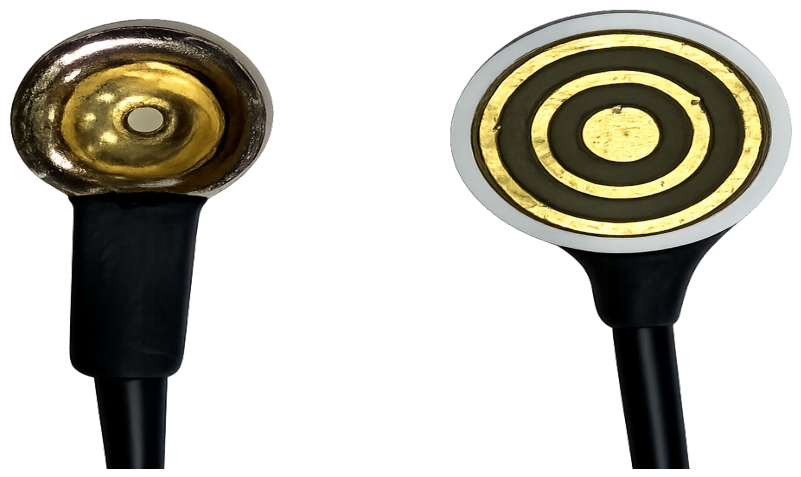
Figure 2.
Overview of classification of TCRE and conventional electrodes EEG signal recorded using over/covert speech.
Figure 2.
Overview of classification of TCRE and conventional electrodes EEG signal recorded using over/covert speech.
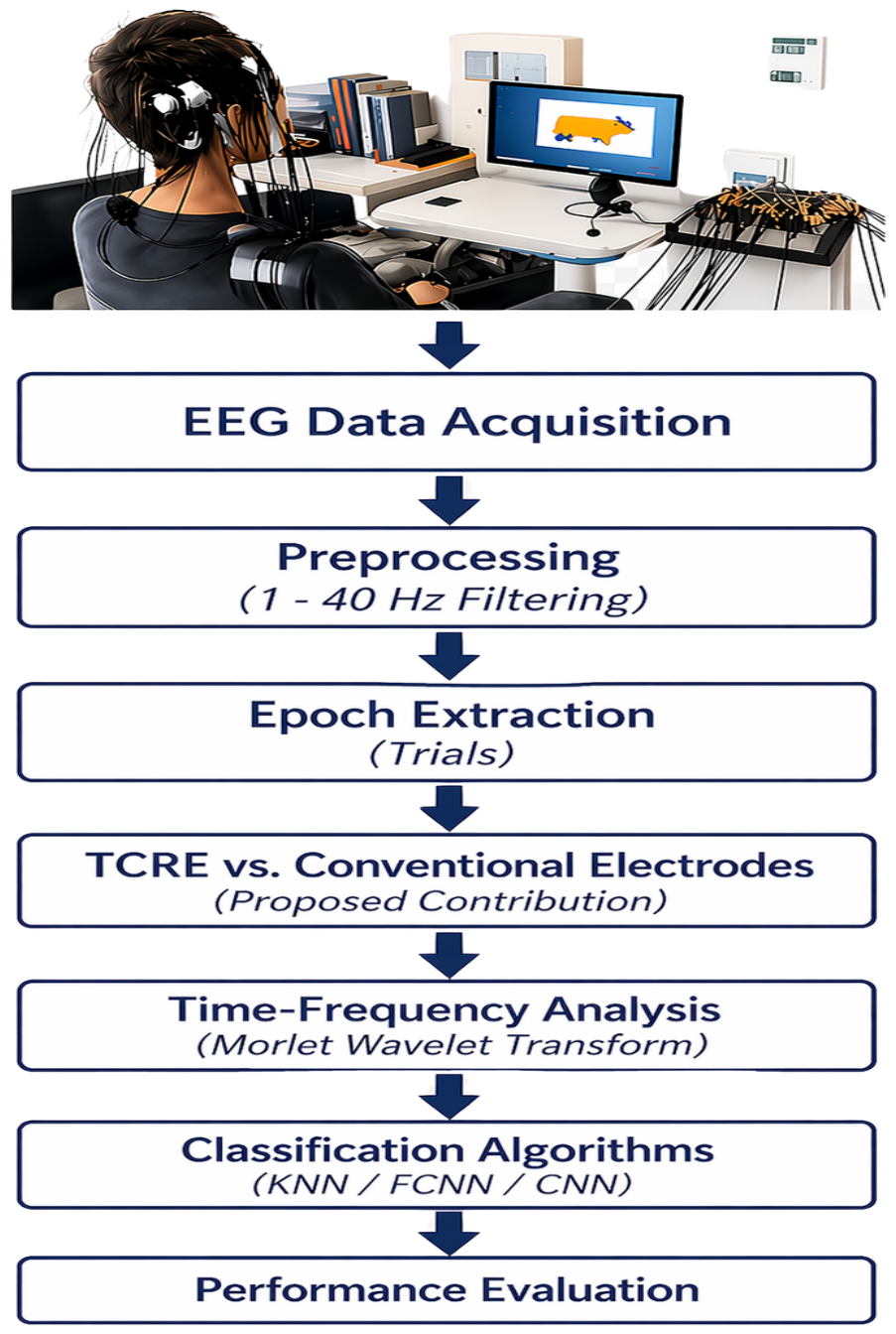
Figure 3.
All participants classifiers’ results.
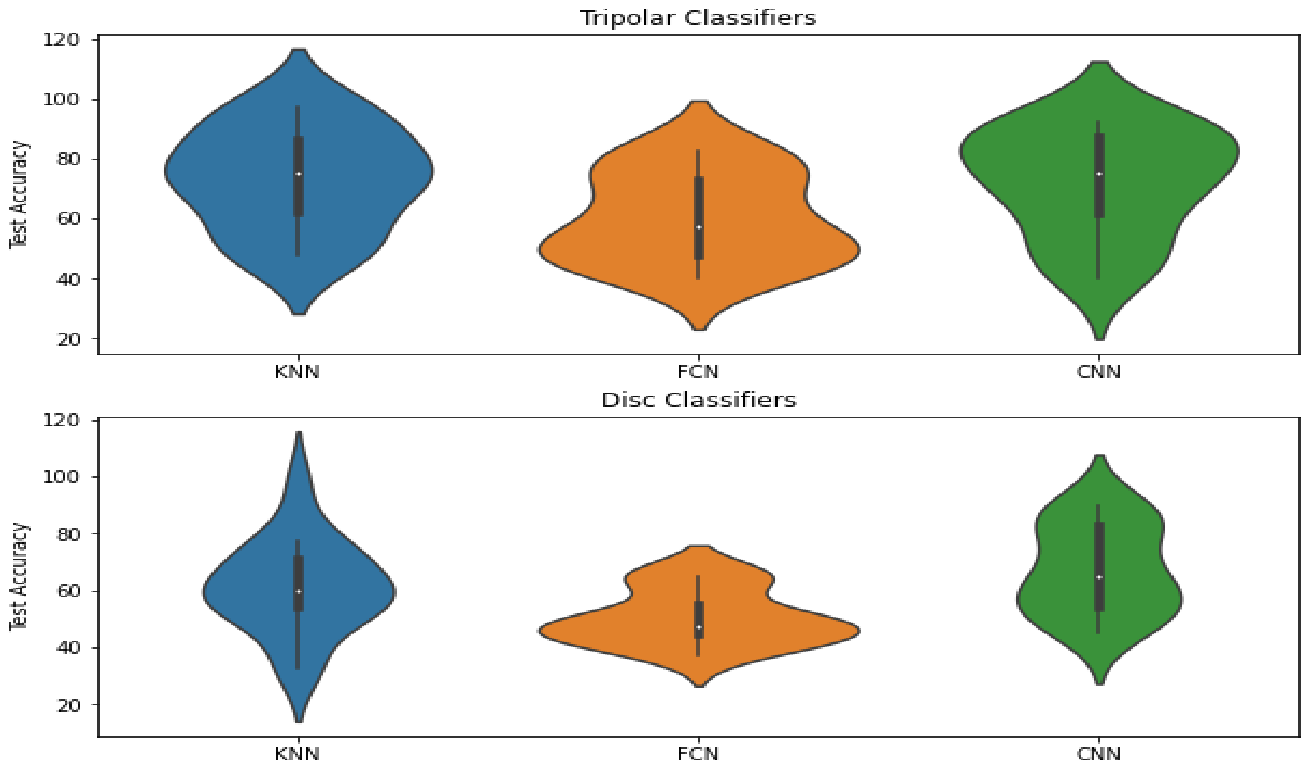
Figure 4.
Confusion matrix of TCRE and disc electrodes using KNN.
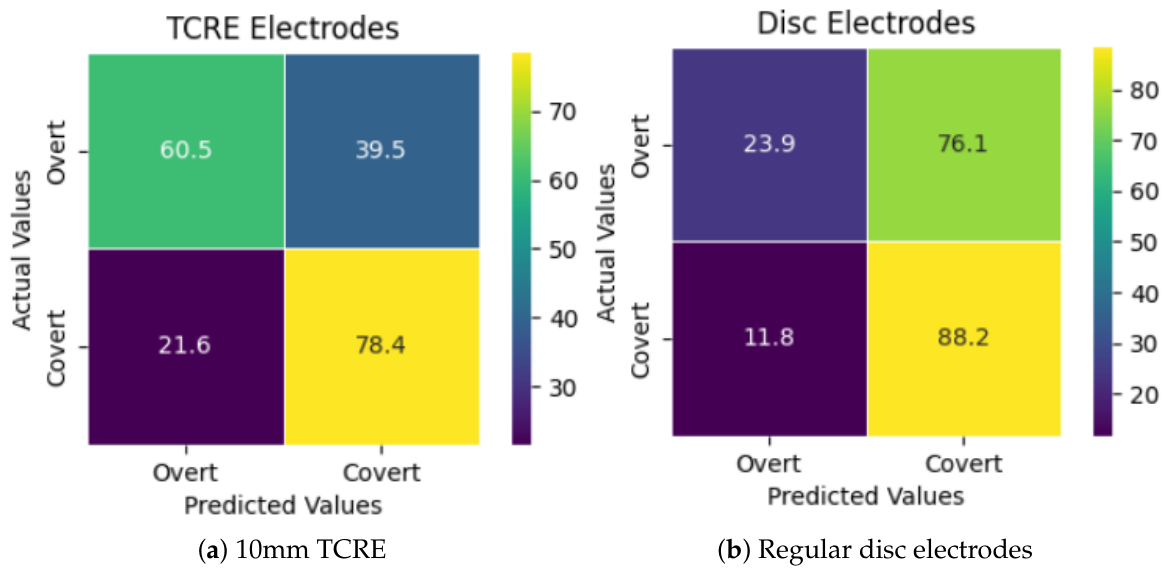
Figure 5.
Confusion matrix of TCRE and disc electrodes using FCNNN.
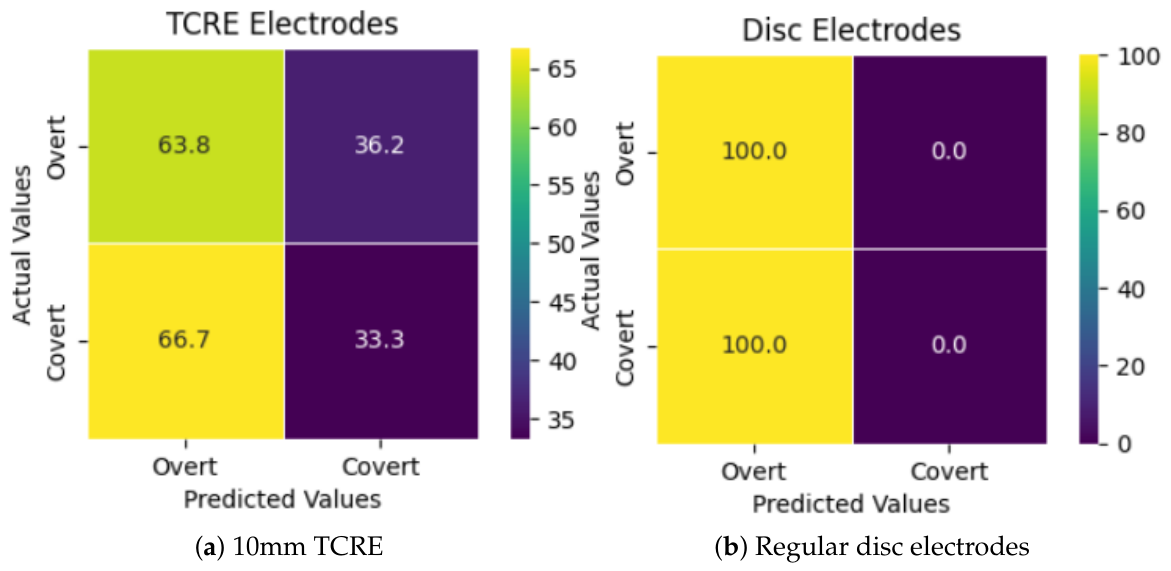
Figure 6.
Confusion matrix of TCRE and disc electrodes using CNN.
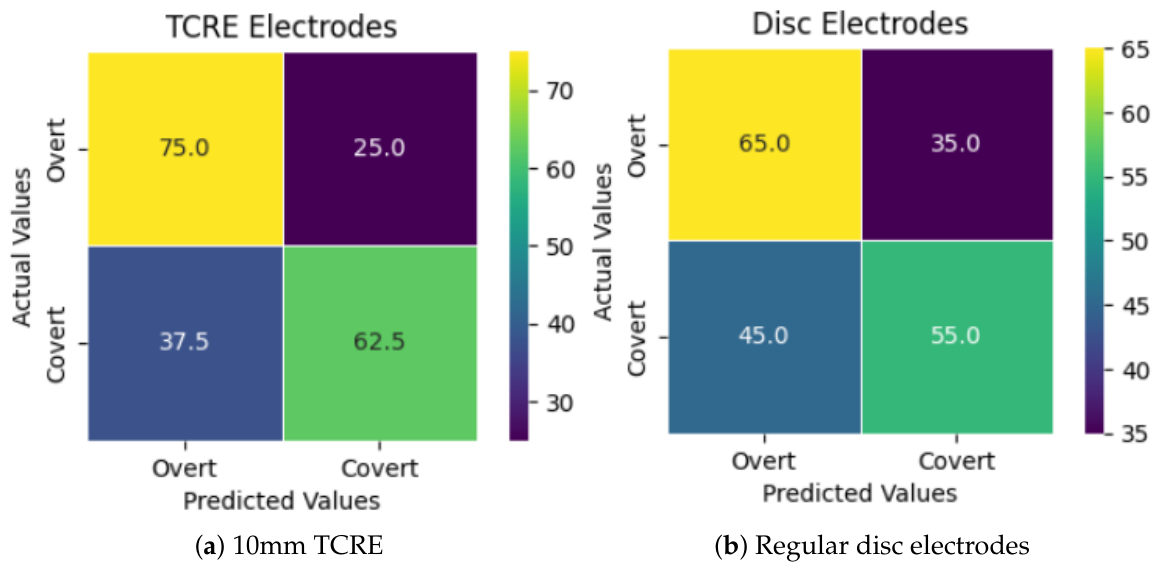
Figure 7.
Participant 11 - Analysis of peak epoch between (0.5-1.2) Vs. remaining non-peak epoch.
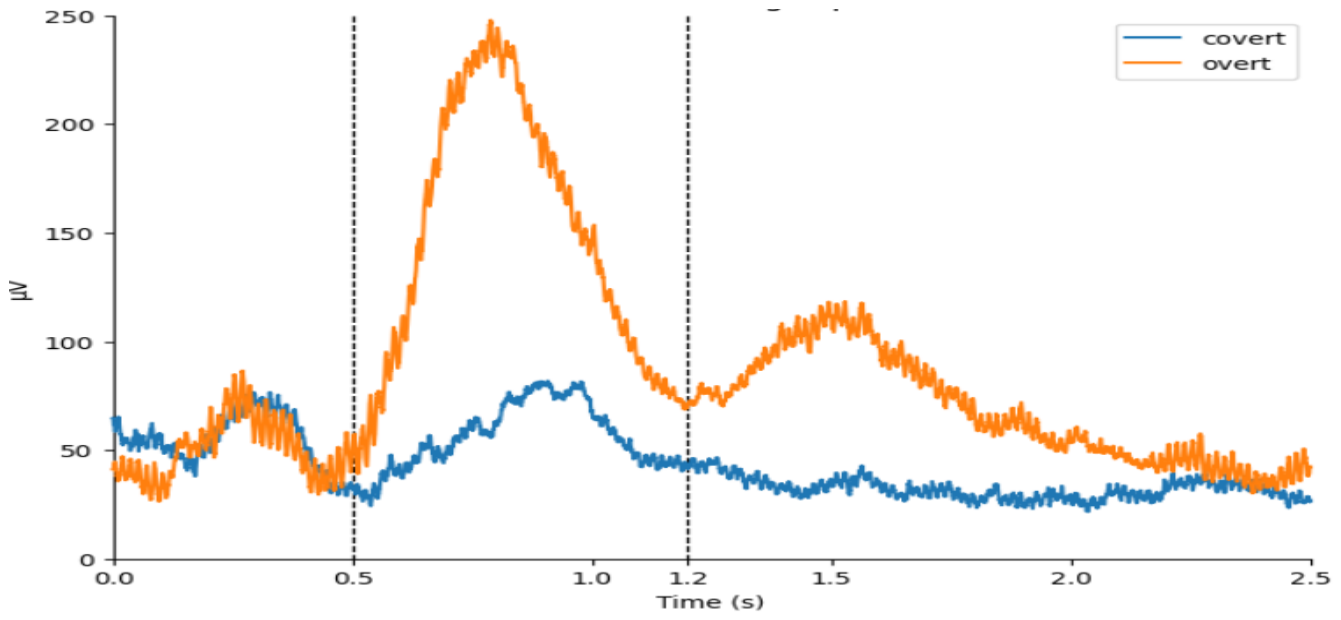
Figure 8.
Confusion matrix of epochs peak Vs. non-peak.
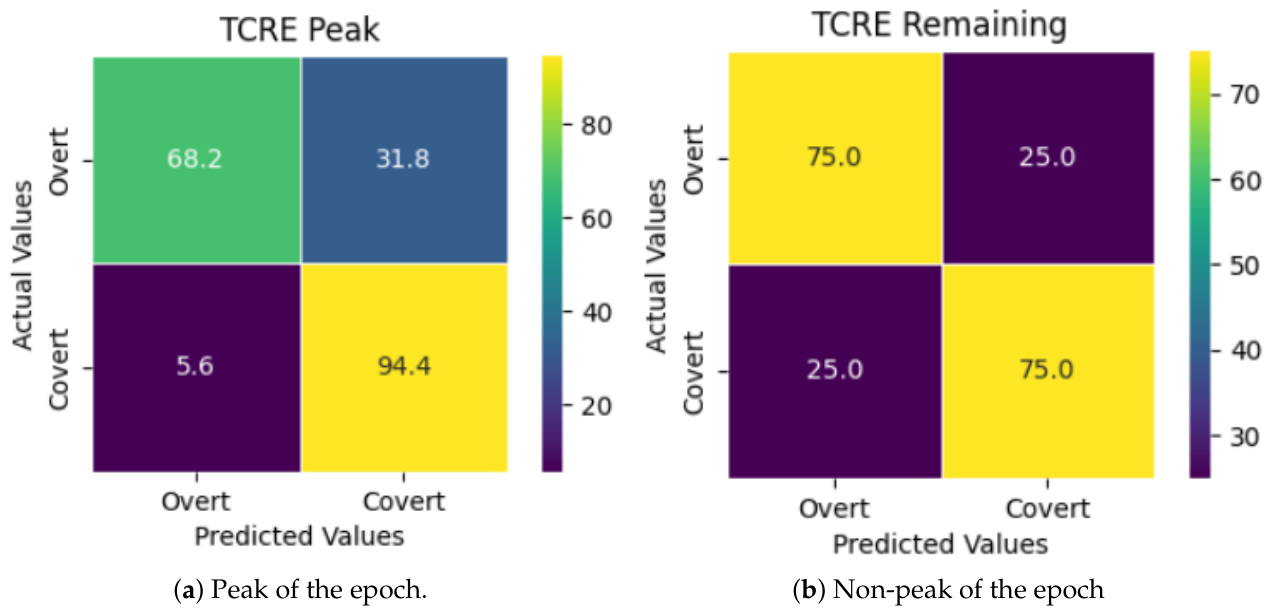

Table 1.
Summary of related work: shaded cells represent no prior work done on the speech decoding using TCRE
Table 1.
Summary of related work: shaded cells represent no prior work done on the speech decoding using TCRE
| Reference | Electrode Type | Application | Key Finding | |
|---|---|---|---|---|
| Disc | TCRE | |||
| Hossain et al. [17] | ✓ | – | Speech Decoding | 85.65% (letters) |
| 83.65% (digits) | ||||
| Liu et al. [18] | ✓ | – | Speech Decoding | 34.7% covert speech |
| Milyani and Attar [19] | ✓ | – | Speech Decoding | 82.4% (Transformer) |
| Alharbi and Alotaibi [20] | ✓ | – | Speech Decoding | 75.2% |
| Abdulghani et al. [21] | ✓ | – | Speech Decoding | 92.50% |
| Besio et al. [23] | – | ✓ | Motor Task | SNR improved from 7.23 to 30.46 |
| Besio et al. [10] | – | ✓ | HFO Detection | 35.5% onset seizure detection |
| Toole et al. [24] | – | ✓ | HFA Localization | HFA localized in onset & irritative zone |
| Liu et al. [25] | – | ✓ | Spatial Resolution | 10× improvement |
| Alzahrani et al. [26] | – | ✓ | Motor Task | Improved finger movement discrimination |
Table 2.
All participants’ results using TCRE and disc electrodes.
| TCRE(%) | Disc(%) | |||||
|---|---|---|---|---|---|---|
| Participants | KNN | FCNNN | CNN | KNN | FCNNN | CNN |
| P01 | 55.0 | 45.0 | 45.0 | 32.5 | 47.5 | 50.0 |
| P02 | 85.0 | 72.5 | 75.0 | 55.0 | 45.0 | 77.5 |
| P03 | 75.0 | 75.0 | 75.5 | 60.0 | 37.5 | 68.0 |
| P04 | 67.5 | 80.0 | 67.5 | 35.0 | 52.5 | 65.0 |
| P05 | 90.0 | 82.5 | 87.5 | 65.0 | 65.0 | 82.5 |
| P06 | 50.0 | 57.49 | 52.5 | 62.5 | 65.0 | 60.0 |
| P07 | 92.5 | 57.49 | 92.5 | 70.0 | 50.0 | 85.0 |
| P08 | 77.5 | 50.0 | 87.5 | 75.0 | 47.5 | 85.0 |
| P09 | 47.5 | 50.0 | 40.0 | 52.5 | 40.0 | 65.0 |
| P10 | 50.0 | 45.0 | 50.0 | 55.0 | 45.0 | 45.0 |
| P11 | 97.5 | 82.5 | 85.5 | 77.5 | 65.0 | 88.75 |
| P12 | 65.0 | 60.0 | 65.0 | 55.0 | 65.0 | 55.0 |
| P13 | 77.5 | 70.0 | 70.0 | 52.5 | 52.5 | 52.5 |
| P14 | 75.0 | 40.0 | 92.0 | 60.0 | 42.5 | 50.0 |
| P15 | 72.5 | 47.5 | 80.0 | 75.0 | 47.5 | 90.0 |
| P16 | 97.5 | 47.5 | 90.0 | 97.5 | 42.5 | 57.49 |
Disclaimer/Publisher’s Note: The statements, opinions and data contained in all publications are solely those of the individual author(s) and contributor(s) and not of MDPI and/or the editor(s). MDPI and/or the editor(s) disclaim responsibility for any injury to people or property resulting from any ideas, methods, instructions or products referred to in the content. |
© 2026 by the authors. Licensee MDPI, Basel, Switzerland. This article is an open access article distributed under the terms and conditions of the Creative Commons Attribution (CC BY) license (http://creativecommons.org/licenses/by/4.0/).
Copyright: This open access article is published under a Creative Commons CC BY 4.0 license, which permit the free download, distribution, and reuse, provided that the author and preprint are cited in any reuse.


