

Submitted:
20 May 2026
Posted:
21 May 2026
You are already at the latest version
Abstract
Digital transformation has become a major strategic priority for organizations seeking operational efficiency, automation, scalability, and modernization. Despite significant investments in digital infras-tructure and enterprise technologies, many transformation initiatives continue to face organizational resistance, legacy system dependency, cybersecurity exposure, and governance limitations. This study investigates the relationship between digital infrastructure growth, cybersecurity governance, human resistance, and modernization readiness within enterprise digital transformation environments. The analysis integrates publicly available statistical datasets, governance reports, cybersecurity studies, and comparative organizational evaluation methods to examine how technical, organizational, and governance-related factors influence transformation outcomes. The findings indicate that increasing digital connectivity and dependence on interconnected technologies significantly expand operational complexity and cybersecurity risk, while legacy systems continue to limit organizational adaptabil-ity and modernization flexibility. The study further demonstrates that organizations with stronger governance maturity, improved cybersecurity readiness, and lower legacy infrastructure dependency generally exhibit higher modernization readiness and operational resilience. Human resistance and limited organizational adaptation were also identified as major barriers to successful transformation initiatives. Overall, the findings emphasize that sustainable digital transformation depends not only on technological adoption, but also on governance integration, cybersecurity planning, workforce adaptation, and long-term organizational strategy.
Keywords:
digital transformation
; cybersecurity governance
; organizational resistance
; legacy systems
; IT governance
; organizational modernization
; cybersecurity risk
; governance frameworks
; digital infrastructure
; operational transparency
; modernization strategy
; enterprise systems
1. Introduction
Digital transformation has become a major strategic objective for modern organizations seeking operational efficiency, scalability, automation, and long-term technological modernization. Governments, universities, healthcare institutions, financial organizations, and industrial enterprises increasingly depend on cloud platforms, interconnected infrastructures, and data-driven operations to support organizational services and decision-making processes [1]. The rapid growth of digital technologies and internet connectivity has accelerated modernization initiatives worldwide. However, despite significant technological progress, many digital transformation projects continue to experience implementation failure, operational instability, organizational resistance, and cybersecurity exposure [2]. Prior studies emphasize that digital transformation is not solely a technological process, but also an organizational and governance challenge [3,4]. Many organizations successfully deploy modern technologies while struggling to adapt governance structures, operational workflows, and workforce behavior to changing digital environments. As organizations modernize operational systems, employees and management teams may resist automation, operational transparency, monitoring mechanisms, and changes to traditional decision-making structures [5]. Resistance frequently emerges from fear of automation, uncertainty regarding organizational change, and limited workforce readiness for new digital processes. At the same time, legacy systems remain one of the primary barriers to modernization efforts. Many organizations continue operating outdated infrastructure because of operational dependency, migration complexity, financial limitations, and compatibility concerns. Although legacy systems often provide operational continuity, they may reduce flexibility, increase maintenance costs, and slow cloud migration and digital adoption processes. As a result, organizations frequently allocate substantial resources toward maintaining existing systems rather than supporting innovation and modernization initiatives. Cybersecurity governance has also become increasingly important during digital transformation processes. The adoption of cloud computing, remote access services, automation platforms, and interconnected enterprise systems significantly expands organizational attack surfaces and operational risk exposure [6]. Weak governance structures, insufficient auditing mechanisms, and poor cybersecurity planning may increase organizational vulnerability during modernization initiatives. Consequently, organizations increasingly require governance frameworks capable of supporting operational monitoring, cybersecurity accountability, and digital resilience [7,8,9].
In addition, operational transparency and governance maturity have become essential components of sustainable modernization. Modern digital environments generate large volumes of organizational and operational data that require effective auditing, accountability mechanisms, and governance oversight. Weak visibility and insufficient governance controls may reduce organizational trust, increase operational instability, and weaken cybersecurity readiness during transformation processes [10,11]. Although previous studies have examined digital transformation, organizational adaptation, cybersecurity governance, and modernization strategy independently, limited research has investigated how governance maturity, organizational resistance, legacy system dependency, and cybersecurity readiness collectively influence modernization success within an integrated analytical framework. Existing studies frequently focus on either technological modernization or cybersecurity protection separately, while fewer studies examine how organizational behavior, governance structures, and operational readiness interact simultaneously during enterprise digital transformation initiatives. Accordingly, this study investigates the interconnected relationship between organizational resistance, legacy infrastructure dependency, governance maturity, and cybersecurity readiness in digital transformation environments. The presented analysis combines comparative organizational evaluation, governance-oriented assessment, and publicly available digital infrastructure statistics to examine how technical and organizational factors collectively influence modernization outcomes. Specifically, this study aims to:
- analyze how legacy infrastructure dependency influences modernization readiness and operational flexibility;
- examine the role of organizational resistance and workforce adaptation during digital transformation initiatives;
- evaluate how cybersecurity governance and operational transparency contribute to organizational resilience during modernization; and
- investigate how governance maturity and cybersecurity readiness collectively support sustainable digital transformation environments.
This study provides several contributions to the understanding of digital transformation challenges. First, the paper integrates organizational resistance, legacy system dependency, cybersecurity governance, and modernization readiness into a unified analytical framework. Second, the study emphasizes that modernization failure is frequently associated with governance maturity, workforce adaptation, and operational readiness rather than technological limitations alone. Third, the paper highlights the importance of integrating cybersecurity governance, operational transparency, and organizational adaptation into modernization planning processes.
The remainder of this manuscript is structured as follows. Section 2 reviews the relevant literature on digital transformation, organizational resistance, legacy systems, cybersecurity governance, and operational transparency. Section 3 presents the analytical methodology and comparative evaluation framework used in this study. Section 4 presents the organizational and statistical analysis results. Section 5 discusses the implications of governance maturity, organizational adaptation, and cybersecurity readiness for sustainable modernization environments. Finally, Section 6 concludes the paper.
The novelty of this study lies in its integrated governance-oriented analytical framework that comparatively examines cybersecurity readiness, organizational resistance, governance maturity, and legacy infrastructure dependency within digital transformation environments.
2. Literature Review
2.1. Digital Transformation and Organizational Strategy
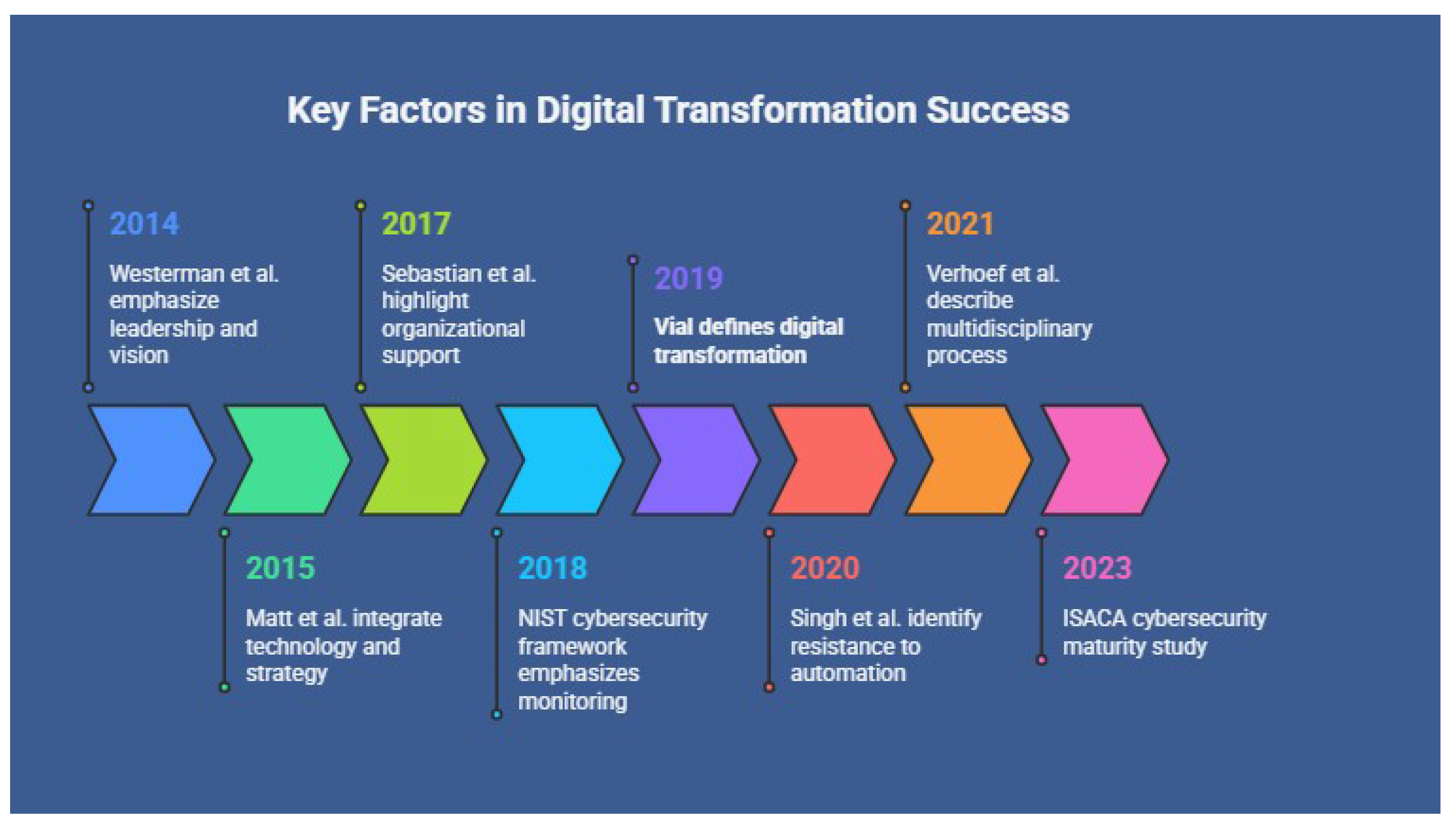
Digital transformation has been widely studied as a multidimensional organizational and technological process. Vial defined digital transformation as a process in which digital technologies disrupt organizational environments and require strategic and structural adaptation [2]. This perspective emphasizes that transformation involves not only technology adoption, but also organizational restructuring, governance adaptation, and operational change. Westerman et al. further explained that successful digital transformation depends on leadership capability, governance alignment, and long-term organizational vision rather than technology investment alone [12,13]. Similarly, Verhoef et al. described digital transformation as a multidisciplinary process involving digitization, digitalization, and organizational transformation simultaneously [3]. Their work highlighted the importance of organizational capability, strategic alignment, and operational readiness during modernization initiatives. Matt et al. also emphasized that effective digital transformation strategies must integrate technology adoption, organizational structure, and business process adaptation within a unified framework [4]. Sebastian et al. similarly argued that modernization initiatives require coordinated organizational support mechanisms in addition to technological deployment [14]. Collectively, these studies demonstrate that digital transformation success depends on organizational alignment and governance maturity in addition to technological modernization.
Figure 1.
Timeline of major concepts and governance-related factors influencing digital transformation success based on prior literature.
Figure 1.
Timeline of major concepts and governance-related factors influencing digital transformation success based on prior literature.
2.2. Organizational Resistance and Workforce Adaptation
Human resistance has consistently been identified as one of the primary barriers to organizational transformation. Kotter explained that organizational change is a continuous process requiring leadership vision, cultural integration, and workforce adaptation [15]. Organizations frequently experience failure when modernization initiatives are implemented without sufficient employee engagement or organizational preparation. Recent digital transformation studies further indicate that employees and management teams may resist automation, operational monitoring, and changes to established workflows because such changes alter organizational authority structures and operational behavior [5]. Fear of automation, uncertainty regarding workforce roles, and limited technical understanding often contribute to organizational resistance during modernization initiatives. These findings suggest that workforce adaptation and organizational readiness are critical components of successful digital transformation.
2.3. Legacy Systems and Modernization Challenges
Legacy systems remain a major technical and operational challenge in enterprise modernization environments. Many organizations continue depending on outdated infrastructure because legacy systems support critical organizational operations and long-established workflows. However, legacy infrastructure frequently limits operational flexibility, increases maintenance costs, and reduces integration capability with cloud-based and automated platforms. Previous studies have shown that dependence on outdated infrastructure may significantly slow modernization initiatives and reduce organizational adaptability. As organizations allocate substantial resources toward maintaining aging systems, innovation and cybersecurity modernization efforts may become limited. Consequently, legacy systems represent both a technical constraint and an organizational modernization barrier.
2.4. Cybersecurity Governance and Operational Transparency
Cybersecurity governance has become increasingly important as organizations adopt interconnected digital infrastructures, remote access systems, cloud platforms, and automated operational environments. Buczak and Guven reviewed data-driven cybersecurity analytics methods and highlighted the growing importance of security monitoring and intrusion detection within modern enterprise systems [6]. Recent governance studies further emphasize that cybersecurity maturity is strongly associated with organizational resilience and digital trust management [7]. Organizations with stronger governance frameworks generally demonstrate improved operational stability, cybersecurity readiness, and risk management capability during modernization initiatives. NIST cybersecurity frameworks also emphasize the importance of continuous monitoring, governance integration, and operational risk assessment within digital infrastructures [8]. These frameworks support the argument that cybersecurity governance should be integrated directly into modernization planning processes rather than treated as an isolated technical component. Operational transparency and auditing mechanisms also play important roles in maintaining organizational trust during digital transformation. Modern organizations generate large volumes of operational data that require effective governance oversight, accountability structures, and auditing controls [10,11]. Weak governance visibility may reduce trust, increase operational instability, and weaken cybersecurity resilience within digital environments.
2.5. Research Gap
The reviewed literature demonstrates that digital transformation success depends on several interconnected organizational and technological factors, including governance maturity, workforce adaptation, cybersecurity readiness, and operational modernization. However, most previous studies examine these factors independently rather than within a unified analytical framework. Existing research frequently focuses on technological modernization, organizational strategy, or cybersecurity governance separately, while limited attention has been given to how organizational resistance, legacy system dependency, governance maturity, and cybersecurity readiness collectively influence modernization outcomes. Therefore, this study addresses this gap by investigating the interconnected relationship between governance structures, organizational adaptation, legacy infrastructure dependency, and cybersecurity readiness within enterprise digital transformation environments.
3. Methodology
This study employs a comparative analytical research methodology to investigate the relationship between digital infrastructure growth, organizational resistance, legacy system dependency, cybersecurity governance, and modernization readiness during digital transformation processes [2,3]. The research follows a secondary-data analytical design based on publicly available datasets, governance frameworks, cybersecurity reports, and prior digital transformation studies. The presented methodology combines quantitative statistical evaluation with qualitative comparative organizational analysis methods commonly applied in digital transformation and cybersecurity governance research [4,6]. The quantitative component focuses on digital infrastructure growth trends and publicly available modernization indicators, while the qualitative component examines governance maturity, organizational adaptation challenges, legacy system dependency, and cybersecurity readiness using comparative analytical evaluation.
Public statistical datasets were collected from trusted open-data sources, including the World Bank Open Data platform and publicly available governance and cybersecurity reports. The collected datasets were used to examine internet adoption growth, digital infrastructure expansion, modernization readiness, governance capability, and cybersecurity exposure across digital transformation environments. Digital infrastructure growth analysis was performed using World Bank internet usage datasets for Germany and the United States [16]. These countries were selected because both represent highly developed digital economies with large-scale modernization initiatives, while also demonstrating different organizational and industrial transformation characteristics. The selected datasets were analyzed to evaluate long-term digital adoption growth and modernization trends associated with enterprise digital transformation environments.
The quantitative data processing and visualization procedures were implemented using Python-based analytical tools. Statistical processing, dataset organization, and figure generation were performed using the pandas, matplotlib, and wbdata Python libraries. The generated figures were exported in PDF format for integration into the journal manuscript. Additional governance and cybersecurity-related evidence was collected from publicly available industry reports, organizational governance studies, and cybersecurity frameworks, including ISACA governance reports and NIST cybersecurity frameworks [7,8]. These sources were used to support comparative analysis regarding governance maturity, cybersecurity readiness, operational transparency, modernization limitations, and organizational transformation barriers.
The comparative organizational analysis component evaluates differences between traditional operational environments and modernized digital environments across several categories, including legacy infrastructure dependency, automation adoption, governance maturity, operational transparency, and cybersecurity readiness. Within this study, traditional organizational environments refer to organizations that continue relying heavily on legacy infrastructure, manual operational processes, and limited governance integration, whereas modernized environments refer to organizations adopting cloud-based platforms, automation systems, cybersecurity governance frameworks, and digitally integrated operational structures. Human resistance and organizational adaptation challenges were analyzed using organizational transformation and change-management concepts discussed in prior literature [5,15]. The analysis focuses on commonly reported organizational resistance factors, including fear of automation, workforce adaptation challenges, operational culture limitations, resistance to transparency, and uncertainty regarding technological change. Rather than measuring employee behavior directly, the study evaluates organizational resistance conceptually through comparative analysis of findings reported in existing transformation and governance literature. Governance-oriented evaluation principles were incorporated to examine how governance maturity, auditing capability, operational visibility, and cybersecurity accountability influence modernization readiness within enterprise environments [10,11]. Governance maturity in this study refers to the organizational capability to implement structured cybersecurity controls, operational monitoring, accountability mechanisms, risk-management integration, and auditing processes during digital transformation initiatives. The presented study does not involve direct experimental testing, surveys, or human subject participation. Instead, the methodology relies on secondary statistical evidence, comparative organizational evaluation, governance framework analysis, and prior research findings to investigate interconnected modernization challenges across enterprise digital transformation environments.
To summarize the integrated comparative methodology used in this study, Figure 2 presents the conceptual digital transformation readiness framework applied throughout the analytical evaluation process. The framework illustrates the relationship between organizational resistance, governance maturity, infrastructure modernization, and cybersecurity readiness across traditional and modernized digital environments.
Overall, the methodology provides an integrated comparative framework for evaluating how governance maturity, organizational readiness, cybersecurity planning, and legacy infrastructure dependency collectively influence digital transformation environments and modernization outcomes. Several limitations should also be acknowledged. First, the study relies primarily on secondary data sources and publicly available organizational reports rather than direct organizational case studies or primary survey data. Second, the quantitative infrastructure analysis focuses mainly on Germany and the United States, which may limit broader global generalization. Third, organizational resistance and governance maturity are evaluated conceptually through comparative literature-based analysis rather than direct behavioral measurement. Despite these limitations, the integrated analytical framework provides a structured approach for examining the interconnected relationship between governance, cybersecurity readiness, organizational adaptation, and modernization challenges during digital transformation processes. Overall, the methodology provides an integrated comparative framework for evaluating how governance maturity, organizational readiness, cybersecurity planning, and legacy infrastructure dependency collectively influence digital transformation environments and modernization outcomes.
4. Results and Analysis
This section presents the statistical and organizational analysis results related to digital transformation, legacy systems, cybersecurity governance, and organizational resistance. The presented figures were generated using publicly available datasets, comparative analytical evaluation, governance-oriented interpretation, and secondary organizational statistics. The results demonstrate that digital transformation is not solely a technological process, but also an organizational and governance-related challenge. Several comparative figures were developed to support analytical interpretation of modernization trends, governance readiness, cybersecurity exposure, and organizational adaptation challenges.
4.1. Digital Infrastructure Growth and Transformation Readiness
Figure 3 presents internet usage growth in Germany and the United States based on publicly available World Bank statistical datasets covering long-term digital adoption trends [16]. The figure shows that both countries experienced significant internet adoption growth beginning in the early 2000s. Germany demonstrated slower early adoption compared to the United States; however, both countries eventually achieved high digital connectivity levels over time. The result indicates that organizations and societies became increasingly dependent on digital infrastructure, online platforms, remote connectivity, and cloud-based services. As digital dependency increases, organizations also become more exposed to modernization challenges related to governance maturity, cybersecurity readiness, operational transparency, and infrastructure management. The presented trend further supports the argument that digital transformation environments require not only technological deployment, but also organizational readiness and governance adaptation capable of supporting highly interconnected digital operations.
4.2. Legacy Systems and Modernization Constraints
Figure 4 presents a comparative organizational analysis of enterprise IT resource allocation across several operational categories, including legacy system maintenance, innovation initiatives, cloud migration, and cybersecurity modernization activities. The comparative distribution was developed using governance-oriented organizational analysis and publicly discussed enterprise modernization trends reported in prior digital transformation literature.
The result illustrates that legacy infrastructure maintenance frequently consumes a substantial portion of organizational IT resources compared to innovation and modernization initiatives. Organizations that continue depending heavily on legacy systems often experience reduced operational flexibility, increased maintenance complexity, and slower modernization capability. This finding supports the argument that legacy systems remain one of the major organizational barriers during digital transformation processes. High operational dependence on outdated infrastructure may limit cloud migration capability, delay cybersecurity modernization efforts, and reduce organizational adaptability within rapidly evolving digital environments.
4.3. Human Resistance and Organizational Barriers
Figure 5 illustrates several commonly reported organizational factors associated with digital transformation failure, including organizational resistance, legacy infrastructure limitations, governance-related challenges, and operational adaptation barriers. The comparative representation was developed using organizational transformation findings frequently discussed in change-management and digital transformation literature [5,15].
The analysis indicates that organizational resistance represents one of the most significant barriers to modernization initiatives. Employee reluctance, resistance to workflow modification, fear of automation, uncertainty regarding technological change, and preference for traditional operational methods may significantly reduce transformation effectiveness. The result further demonstrates that digital transformation failure is frequently associated with organizational behavior and workforce adaptation challenges rather than technological limitations alone. In many enterprise environments, modernization implementation progresses faster than organizational adaptation capability, creating operational instability and resistance to change. This finding supports the view that successful digital transformation requires both technological modernization and effective organizational adaptation strategies capable of supporting workforce readiness, governance alignment, and operational transition management.
4.4. Cybersecurity and Governance Risks During Transformation
Figure 6 presents several cybersecurity and governance-related risk factors associated with modern digital transformation environments, including cybersecurity exposure, governance weakness, unpatched vulnerabilities, insider risk, and operational auditing limitations. The comparative representation was synthesized using publicly available governance reports, cybersecurity frameworks, and organizational risk analysis studies [7,8]. The analysis demonstrates that cybersecurity exposure may increase when organizations modernize systems without implementing sufficiently mature governance structures and cybersecurity controls. Cloud migration, remote connectivity, digital integration, and automation platforms may improve operational efficiency; however, these technologies also increase operational complexity and expand organizational attack surfaces. Weak governance structures and insufficient auditing mechanisms may reduce operational visibility, increase cybersecurity exposure, and weaken organizational accountability during modernization processes. Consequently, cybersecurity governance becomes a critical component of sustainable digital transformation initiatives. The result also highlights the importance of integrating governance maturity, cybersecurity planning, operational monitoring, and risk-management capability into modernization strategies rather than treating cybersecurity as an isolated technical component.
4.5. Comparative Organizational Transformation Analysis
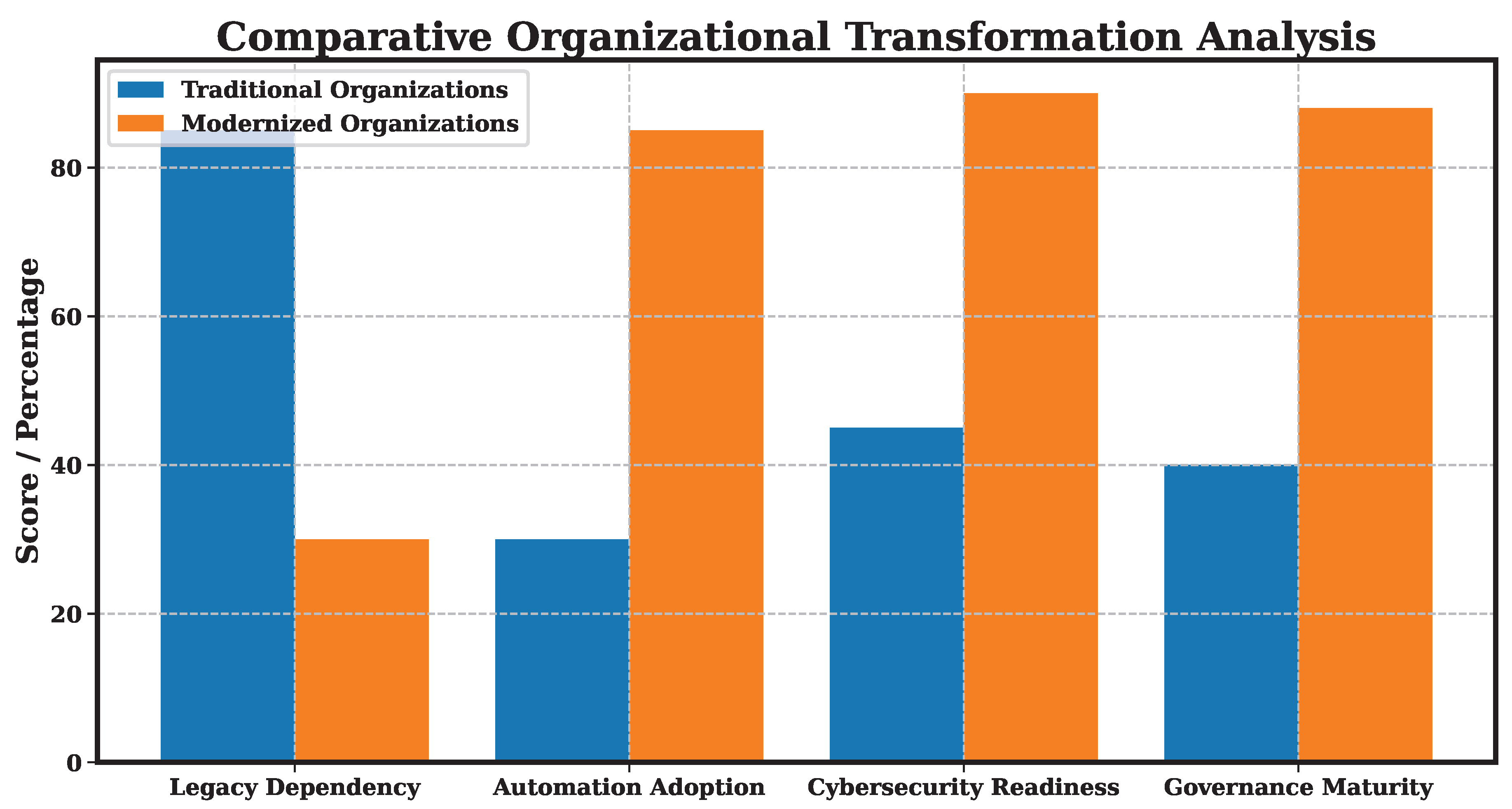
Figure 7 presents a comparative organizational evaluation between traditional operational environments and modernized digital environments across several operational and governance dimensions, including legacy infrastructure dependency, automation adoption, cybersecurity readiness, governance maturity, and operational adaptability.
Within this analysis, traditional organizational environments refer to organizations that rely heavily on legacy infrastructure, manual operational processes, and limited governance integration, whereas modernized environments represent organizations adopting cloud-based systems, cybersecurity governance frameworks, automation platforms, and digitally integrated operational structures. The comparative analysis indicates that organizations with stronger governance maturity, higher cybersecurity readiness, lower legacy dependency, and greater automation capability are generally more adaptable to modern digital transformation environments. In contrast, organizations with limited governance integration and higher dependence on traditional infrastructure frequently experience reduced modernization flexibility and increased operational constraints. The presented comparison further suggests that successful digital transformation depends not only on technological deployment, but also on organizational readiness, workforce adaptation, leadership support, governance maturity, and cybersecurity integration capability.
4.6. Summary of Findings
Overall, the presented results demonstrate that digital transformation is influenced by interconnected technical, organizational, operational, and governance-related factors. Digital infrastructure growth provides the technological foundation for modernization; however, legacy system dependency, organizational resistance, cybersecurity exposure, governance limitations, and operational readiness continue to create significant transformation barriers. The findings further indicate that modernization failure frequently occurs when multiple organizational and technical challenges emerge simultaneously. Organizations that modernize technological systems without sufficiently addressing governance maturity, workforce adaptation, cybersecurity readiness, and operational transparency may experience reduced transformation effectiveness and increased operational risk. Several limitations should also be acknowledged regarding the presented results. Some comparative organizational figures were developed primarily to support governance-oriented analytical interpretation based on publicly discussed modernization trends and secondary organizational evidence rather than direct large-scale organizational survey collection. Consequently, the presented analysis should be interpreted as an integrated comparative analytical evaluation of digital transformation environments rather than direct causal statistical measurement across all enterprise sectors. Overall, the findings support the argument that sustainable digital transformation requires integrated modernization strategies that combine technological advancement, cybersecurity governance, organizational adaptation, workforce readiness, and operational transparency within enterprise environments.
5. Discussion
The presented analysis demonstrates that digital transformation is influenced by interconnected technological, organizational, operational, and governance-related factors. Although modern organizations increasingly invest in cloud computing, automation platforms, digital infrastructure, and interconnected operational technologies, the findings suggest that technological deployment alone is insufficient for achieving sustainable modernization outcomes [2,3]. Instead, successful transformation environments appear to depend strongly on governance maturity, workforce adaptation capability, cybersecurity readiness, and operational transparency. The internet usage analysis demonstrates that digital connectivity and infrastructure expanded rapidly during the last two decades. This growth created the technological foundation required for modernization across universities, healthcare systems, financial organizations, government institutions, and industrial environments. However, increasing dependence on digital infrastructure also introduces additional operational complexity, governance requirements, cybersecurity exposure, and organizational risk-management challenges. These observations suggest that modernization initiatives may simultaneously improve operational capability while increasing the importance of governance integration and cybersecurity planning within enterprise environments. The findings further indicate that legacy systems remain a major modernization barrier in many organizations. Previous transformation-oriented studies have also suggested that organizational resistance and legacy infrastructure dependency may significantly reduce modernization flexibility and operational adaptation capability during digital transformation initiatives [17]. Operational migration processes are frequently expensive, technically complex, and organizationally disruptive, causing organizations to continue depending on older infrastructure environments. Although legacy systems may support operational continuity, excessive dependence on outdated infrastructure may reduce organizational flexibility, increase maintenance complexity, and slow innovation capability. The comparative organizational analysis suggests that organizations allocating substantial operational resources toward maintaining legacy infrastructure may experience greater difficulty implementing cloud migration strategies, cybersecurity modernization initiatives, and automation-based operational improvements. Human resistance also emerged as a significant factor influencing modernization effectiveness. The analysis suggests that organizational resistance frequently limits transformation capability even when technological resources are available. Employees and management teams may resist operational changes because of uncertainty regarding workforce adaptation, concern regarding operational transparency, fear of automation, or disruption of established workflows [5,15]. These findings support the argument that digital transformation should be approached not only as a technical migration process, but also as a long-term organizational adaptation process requiring leadership coordination, workforce preparation, and governance alignment.The presented findings additionally emphasize the importance of cybersecurity governance during modernization initiatives. Governance-oriented cybersecurity studies have further emphasized that cybersecurity risk-control integration is necessary for maintaining operational resilience and reducing organizational exposure within interconnected enterprise environments [18]. As organizations increase dependence on cloud services, remote access systems, automation platforms, and interconnected operational environments, cybersecurity exposure and operational complexity may also increase [6]. The comparative governance analysis suggests that organizations with weaker governance structures, insufficient auditing capability, and limited operational visibility may experience greater operational instability and cybersecurity exposure during transformation processes. Previous governance-related studies have further indicated that insider-risk exposure and weak identity-management controls may significantly increase cybersecurity vulnerability within digitally interconnected operational environments [19].
These observations align with governance-oriented studies emphasizing that cybersecurity governance should be integrated directly into modernization strategies rather than treated as an isolated technical function [7,8]. Organizations that fail to integrate governance maturity, cybersecurity planning, operational monitoring, and accountability mechanisms into modernization initiatives may experience reduced organizational resilience and increased operational risk during digital transformation processes. The comparative organizational evaluation further suggests that modernization readiness depends strongly on governance maturity, cybersecurity preparedness, workforce adaptation capability, operational flexibility, and leadership support [4,12,20]. Modernized digital environments generally demonstrate stronger automation capability, improved governance integration, and higher cybersecurity readiness compared to environments with strong dependence on legacy operational structures. These findings support prior research emphasizing the importance of organizational alignment and governance integration during technological modernization initiatives. Strategic alignment studies have similarly emphasized that coordination between organizational objectives and information technology capability plays an important role in enterprise transformation effectiveness and operational adaptability [21].
The analysis also highlights the role of operational auditing and governance transparency in maintaining organizational trust within modern digital environments [10,11]. Prior governance and auditing studies have additionally emphasized the importance of operational auditing mechanisms for improving accountability, organizational trust, and cybersecurity risk assessment during modernization initiatives [22]. As organizations generate increasingly large volumes of operational and digital data, continuous monitoring, accountability mechanisms, and auditing capability become more important for maintaining governance visibility and cybersecurity readiness. Weak operational visibility and insufficient governance controls may reduce organizational trust and increase operational instability across interconnected enterprise systems.
Several practical implications emerge from the presented findings. First, organizations should integrate governance planning and cybersecurity readiness into modernization initiatives during early implementation stages rather than after technological deployment. Second, workforce adaptation and organizational preparation should be treated as essential components of modernization strategy rather than secondary operational considerations. Third, organizations with strong dependence on legacy infrastructure may benefit from phased modernization approaches that gradually integrate cloud services, operational automation, and governance monitoring mechanisms while maintaining operational continuity. Several limitations should also be acknowledged. The presented analysis relies primarily on publicly available datasets, governance reports, comparative organizational evaluation, and secondary analytical interpretation rather than direct organizational experimentation or large-scale survey collection. In addition, the quantitative infrastructure analysis focused mainly on Germany and the United States, which may limit broader global generalization. Furthermore, the comparative organizational figures were designed primarily to support governance-oriented analytical interpretation rather than direct causal statistical measurement across all enterprise sectors.
Future research may extend this work by incorporating larger cross-organizational datasets, longitudinal modernization analysis, direct organizational case studies, and quantitative governance maturity metrics. Additional studies may also examine industry-specific modernization behavior, workforce adaptation measurements, and cybersecurity governance effectiveness across different operational environments. Overall, the presented discussion supports the argument that sustainable digital transformation requires integrated organizational strategies combining governance maturity, cybersecurity readiness, modernization planning, workforce adaptation, operational transparency, and leadership coordination. Digital transformation should therefore be viewed not only as technological modernization, but also as a long-term organizational and governance transition requiring coordinated operational and cybersecurity support mechanisms.
6. Conclusion
This study investigated the relationship between digital transformation, organizational resistance, legacy system dependency, cybersecurity governance, and modernization readiness within enterprise environments. The presented analysis combined publicly available datasets, governance frameworks, cybersecurity reports, and comparative organizational evaluation methods to examine how technical, organizational, and governance-related factors collectively influence modernization outcomes. The findings demonstrated that rapid digital infrastructure growth continues to increase organizational dependence on interconnected technologies, cloud services, automation platforms, and digitally integrated operational environments. However, the analysis further indicated that technological modernization alone is insufficient for sustainable digital transformation. Legacy infrastructure dependency, organizational resistance, governance limitations, and cybersecurity exposure continue to create major operational and strategic barriers across many enterprise environments. The presented results additionally showed that workforce adaptation and organizational readiness play important roles during modernization initiatives. Organizational resistance may reduce transformation effectiveness when employees and management teams experience uncertainty regarding workflow changes, operational transparency, automation processes, and evolving organizational structures. These findings suggest that modernization initiatives require coordinated organizational adaptation strategies in addition to technological deployment. The study also emphasized the importance of cybersecurity governance during digital transformation processes. As organizations increase digital integration, remote connectivity, cloud adoption, and automation capability, operational attack surfaces and cybersecurity complexity may also increase. Weak governance structures, insufficient auditing mechanisms, and limited cybersecurity readiness may significantly increase organizational exposure during modernization initiatives.
Furthermore, the comparative organizational evaluation suggested that organizations with stronger governance maturity, improved cybersecurity readiness, lower legacy system dependency, and greater operational flexibility are generally better positioned to adapt to modern digital environments. These findings support the argument that successful modernization requires integrated organizational strategies combining governance planning, cybersecurity integration, workforce adaptation, operational transparency, and long-term leadership support. Several limitations should also be acknowledged. The presented analysis relied primarily on publicly available datasets, governance reports, comparative organizational interpretation, and secondary analytical evaluation rather than direct organizational experimentation or large-scale survey collection. In addition, the quantitative infrastructure analysis focused primarily on Germany and the United States, which may limit broader global generalization. Overall, this study highlights that digital transformation should not be viewed solely as a technical migration process. Instead, sustainable modernization requires coordinated governance maturity, cybersecurity planning, workforce readiness, operational auditing, organizational flexibility, and leadership alignment across enterprise environments. Future research may extend this work through larger cross-organizational datasets, longitudinal modernization studies, quantitative governance maturity assessment models, industry-specific transformation analysis, and AI-assisted cybersecurity monitoring approaches for modern digital transformation environments.
Acknowledgments
The author would like to express sincere appreciation to the University of Houston UIT and Mr. Hahues Sven, Assistant Vice President/Vice Chancellor for IT Security and Chief Information Security Officer (CISO) at the University of Houston, Texas, USA, for professional support, guidance, and valuable discussions related to cybersecurity governance and organizational modernization that contributed to the development of this work.
References
- Bharadwaj, A.; El Sawy, O.A.; Pavlou, P.A.; Venkatraman, N. Digital business strategy: Toward a next generation of insights. MIS Q. 2013, 37, 471–482. [Google Scholar] [CrossRef]
- Vial, G. Understanding digital transformation: A review and a research agenda. J. Strateg. Inf. Syst. 2019, 28, 118–144. [Google Scholar] [CrossRef]
- Verhoef, P.C.; Broekhuizen, T.; Bart, Y.; Bhattacharya, A.; Dong, J.Q.; Fabian, N.; Haenlein, M. Digital transformation: A multidisciplinary reflection and research agenda. J. Bus. Res. 2021, 122, 889–901. [Google Scholar] [CrossRef]
- Matt, C.; Hess, T.; Benlian, A. Digital transformation strategies. Bus. Inf. Syst. Eng. 2015, 57, 339–343. [Google Scholar] [CrossRef]
- Singh, A.; Hess, T. How Chief Digital Officers Promote the Digital Transformation of Their Companies. MIS Q. Exec. 2017, 16, 1–17. [Google Scholar]
- Buczak, A.L.; Guven, E. A survey of data mining and machine learning methods for cyber security intrusion detection. IEEE Commun. Surv. Tutor. 2015, 18, 1153–1176. [Google Scholar] [CrossRef]
- ISACA. State of Cybersecurity Report. ISACA Research. 2023. Available online: https://www.isaca.org/resources/research.
- National Institute of Standards and Technology. Framework for Improving Critical Infrastructure Cybersecurity. NIST Cybersecur. Framew. 2018. [Google Scholar]
- von Solms, B. Information security governance: COBIT or ISO 17799 or both? Comput. Secur. 2005, 24, 99–104. [Google Scholar] [CrossRef]
- Weill, P.; Ross, J. IT Governance: How Top Performers Manage IT Decision Rights for Superior Results. Harv. Bus. Sch. Press 2004. [Google Scholar]
- De Haes, S.; Van Grembergen, W. An exploratory study into IT governance implementations and its impact on business/IT alignment. Inf. Syst. Manag. 2009, 26, 123–137. [Google Scholar] [CrossRef]
- Westerman, G.; Bonnet, D.; McAfee, A. Leading Digital: Turning Technology into Business Transformation. Harv. Bus. Rev. Press 2014. [Google Scholar]
- Kane, G.C.; Palmer, D.; Phillips, A.N.; Kiron, D.; Buckley, N. Strategy, not technology, drives digital transformation. MIT Sloan Manag. Rev. 2015, 14, 1–25. [Google Scholar]
- Sebastian, I.M.; Ross, J.W.; Beath, C.; Mocker, M.; Moloney, K.; Fonstad, N. How big old companies navigate digital transformation. MIS Q. Exec. 2017, 16, 197–213. [Google Scholar]
- Kotter, J.P. Leading change: Why transformation efforts fail. Harv. Bus. Rev. 1995, 73, 59–67. [Google Scholar]
- World Bank. World Development Indicators. World Bank Open Data. Available online: https://data.worldbank.org/.
- Rah, A. Why Digital Transformation Fails: Human Resistance, Legacy Systems, and IT Modernization Challenges. ResearchGate Preprint 2026. Available online: https://www.researchgate.net/publication/404348819_Why_Digital_Transformation_Fails_Human_Resistance_Legacy_Systems_and_IT_Modernization_Challenges.
- Rah, A. Cybersecurity Risk Controls in IT Organizations. ResearchGate Preprint 2026. Available online: https://www.researchgate.net/publication/404348824_Cybersecurity_Risk_Controls_in_IT_Organizations.
- Rah, A. Reducing Insider Risk in Identity Recovery Through Zero-Exposure Governance. ResearchGate Preprint 2026. Available online: https://www.researchgate.net/publication/404921423_Reducing_Insider_Risk_in_Identity_Recovery_Through_Zero-Exposure_Governance.
- Luwigi, R.; Cullen, A. Digital transformation governance and organizational resilience. Gov. Inf. Q. 2022, 39, 101685. [Google Scholar]
- Henderson, J.C.; Venkatraman, N. Strategic alignment: Leveraging information technology for transforming organizations. IBM Syst. J. 1993, 32, 4–16. [Google Scholar] [CrossRef]
- Rah, A. Auditing Operational Data Records to Improve Trust and Risk Assessments. ResearchGate Preprint. 2026. Available online: https://www.researchgate.net/publication/404347907_Auditing_Operational_Data_Records_to_Improve_Trust_and_Risk_Assessments.
Figure 2.
Comparative digital transformation readiness framework illustrating the transition from legacy-dependent organizational environments toward governance-oriented and modernized digital infrastructures.
Figure 2.
Comparative digital transformation readiness framework illustrating the transition from legacy-dependent organizational environments toward governance-oriented and modernized digital infrastructures.
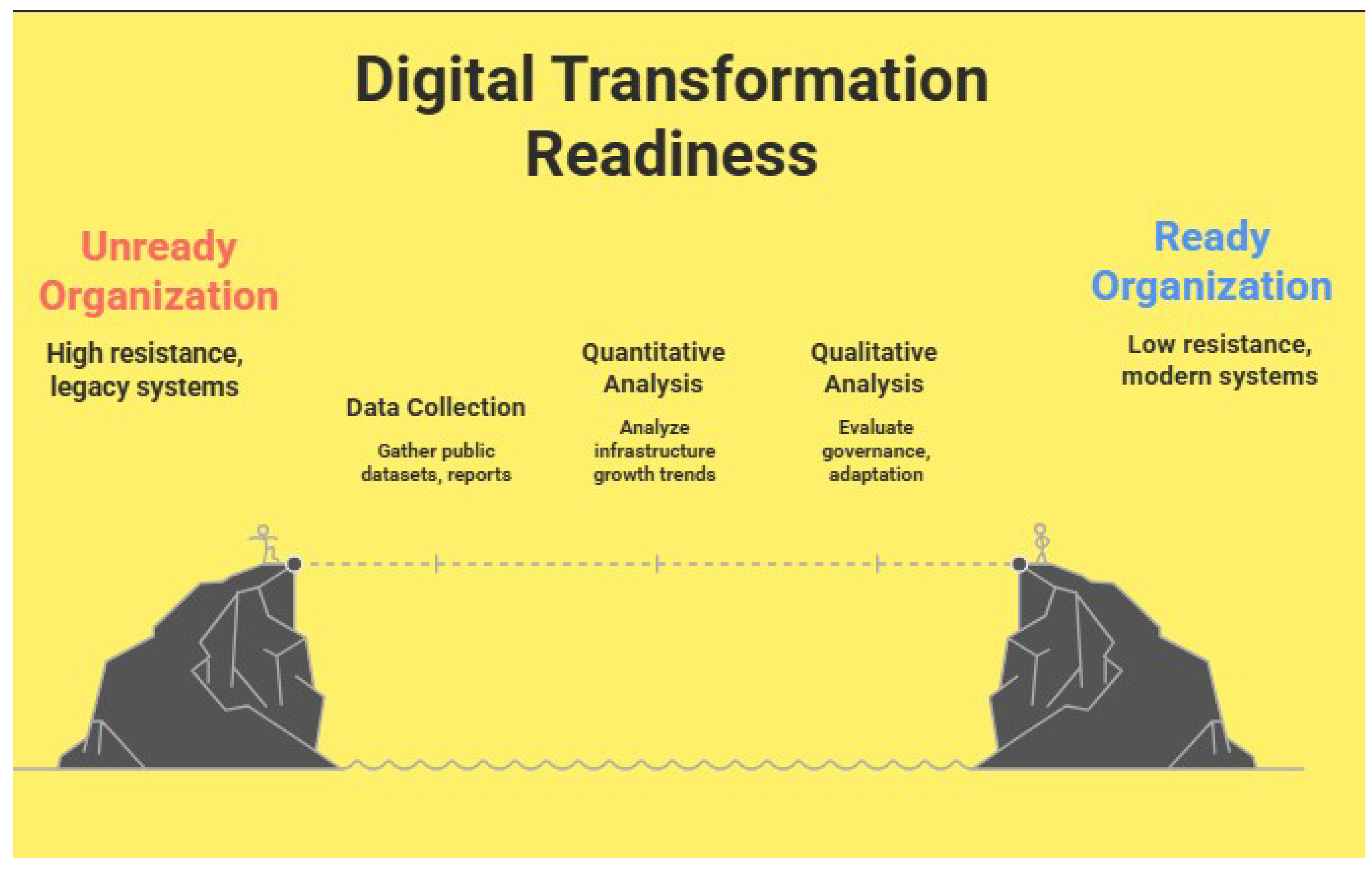
Figure 3.
Internet usage growth in Germany and the United States based on publicly available World Bank statistical data. The figure illustrates long-term digital adoption growth and increasing dependence on digital infrastructure environments.
Figure 3.
Internet usage growth in Germany and the United States based on publicly available World Bank statistical data. The figure illustrates long-term digital adoption growth and increasing dependence on digital infrastructure environments.
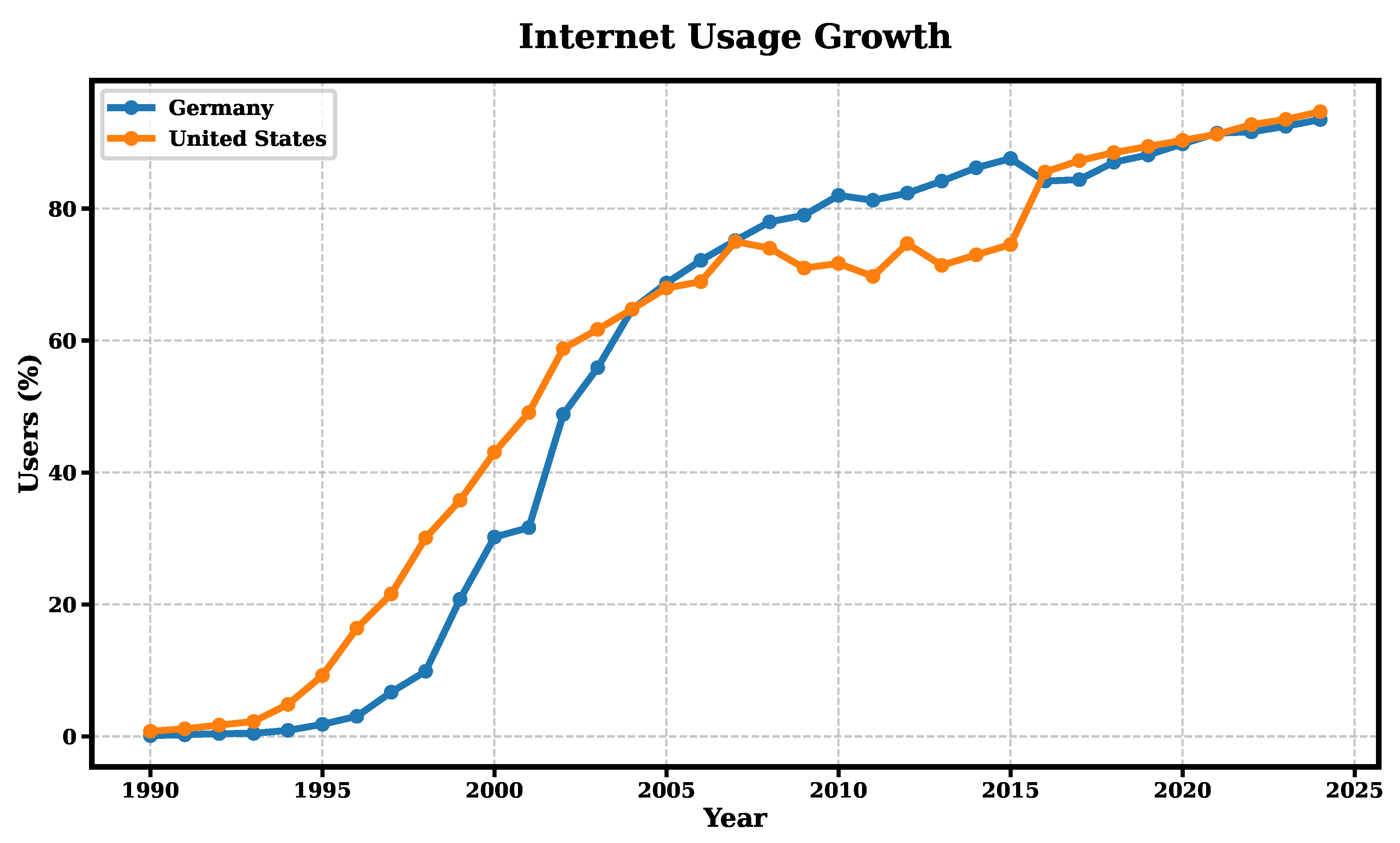
Figure 4.
Comparative representation of enterprise IT resource allocation and the organizational impact of legacy system maintenance during modernization initiatives.
Figure 4.
Comparative representation of enterprise IT resource allocation and the organizational impact of legacy system maintenance during modernization initiatives.
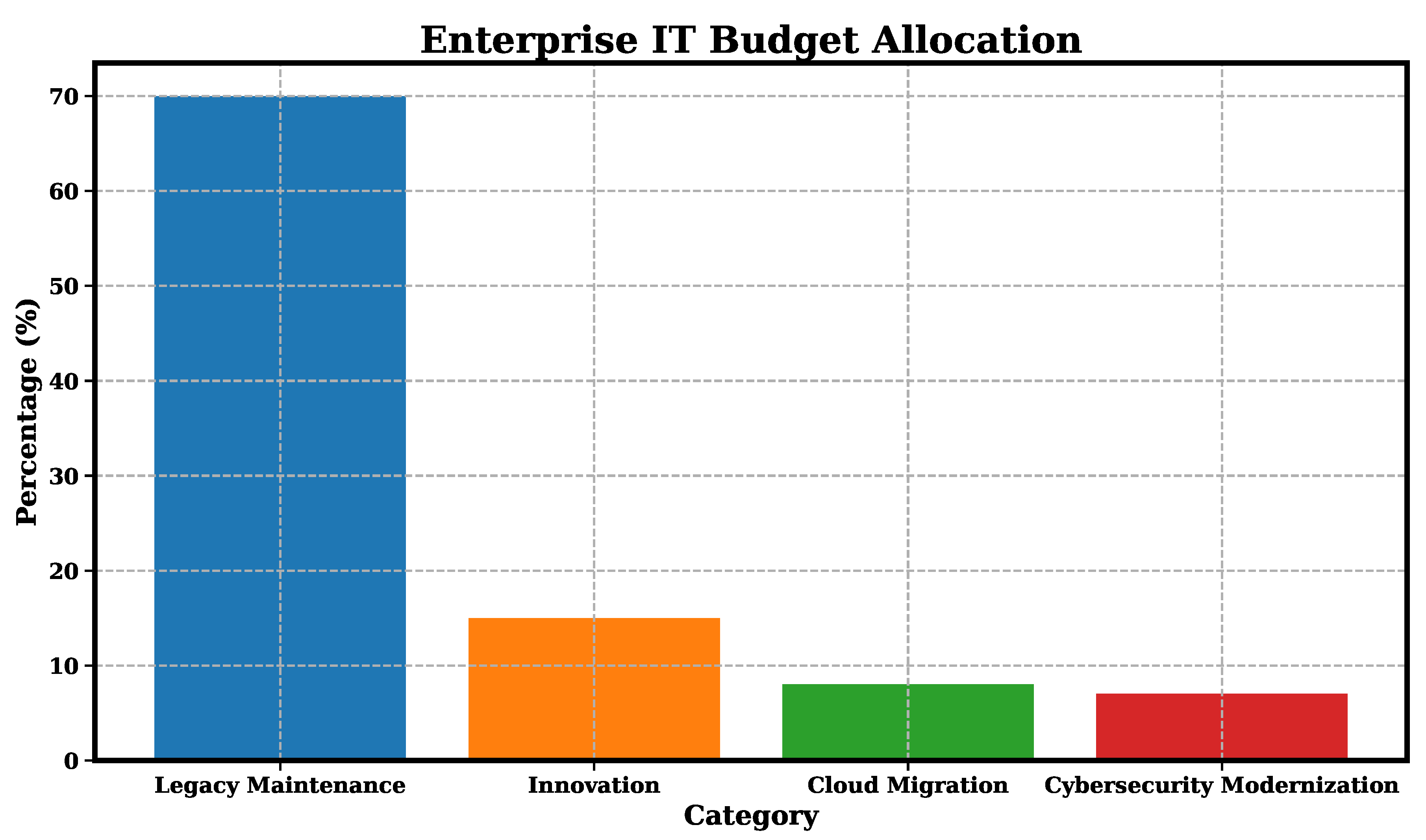
Figure 5.
Comparative illustration of organizational and operational factors commonly associated with digital transformation failure.
Figure 5.
Comparative illustration of organizational and operational factors commonly associated with digital transformation failure.
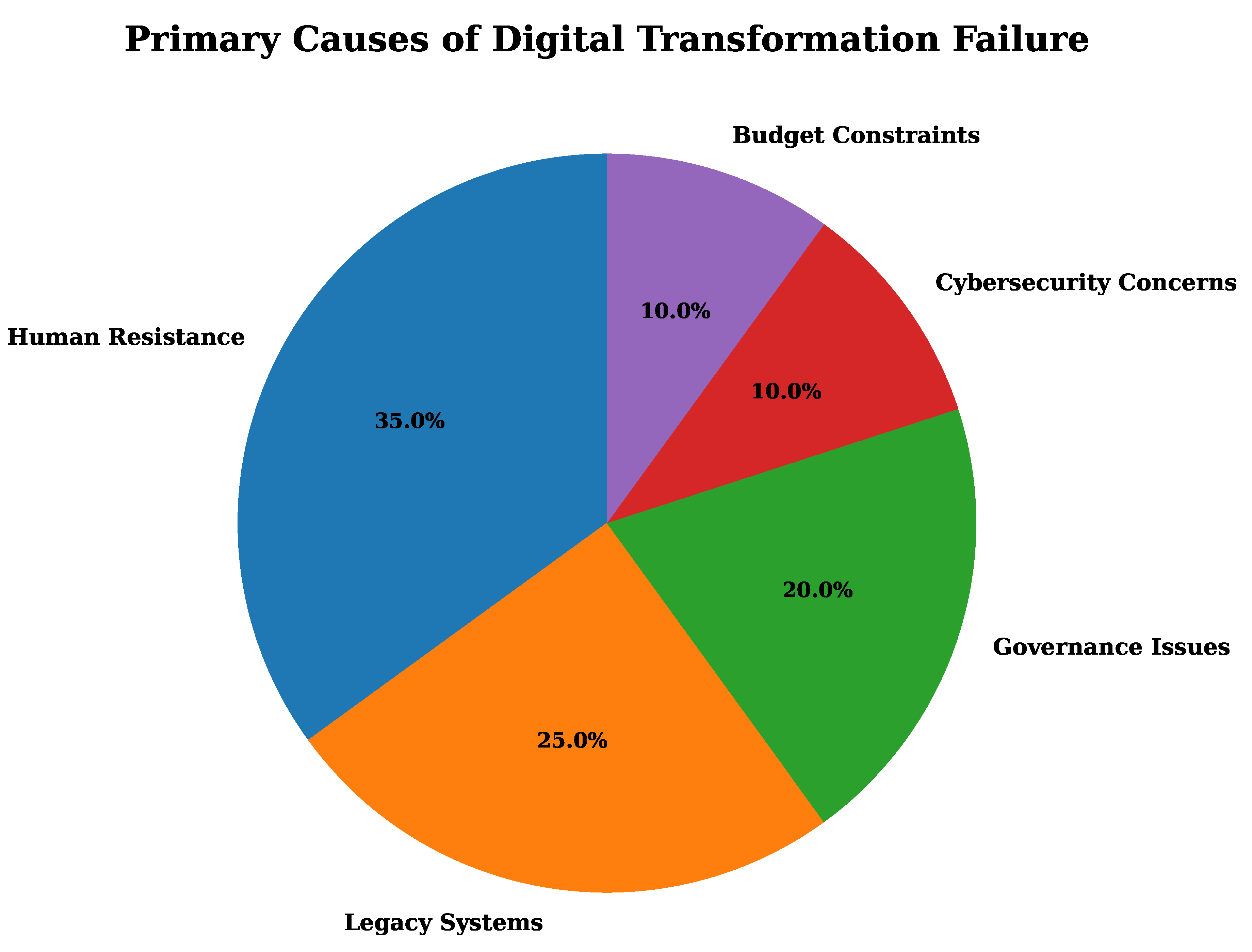
Figure 6.
Comparative representation of cybersecurity and governance-related risks associated with digital transformation environments.
Figure 6.
Comparative representation of cybersecurity and governance-related risks associated with digital transformation environments.
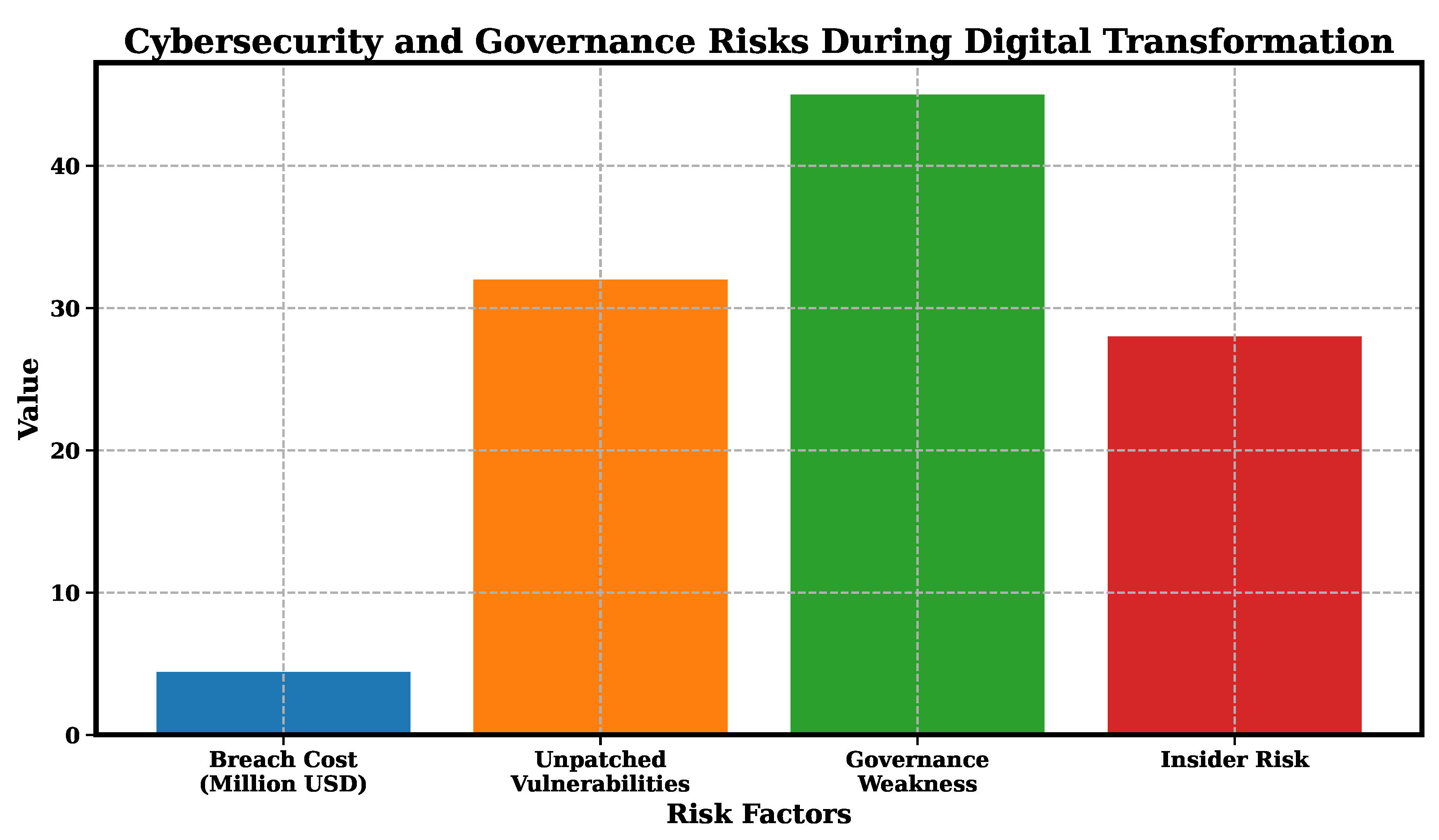
Figure 7.
Comparative organizational evaluation between traditional operational environments and modernized digital environments across governance and modernization dimensions.
Figure 7.
Comparative organizational evaluation between traditional operational environments and modernized digital environments across governance and modernization dimensions.
Disclaimer/Publisher’s Note: The statements, opinions and data contained in all publications are solely those of the individual author(s) and contributor(s) and not of MDPI and/or the editor(s). MDPI and/or the editor(s) disclaim responsibility for any injury to people or property resulting from any ideas, methods, instructions or products referred to in the content. |
© 2026 by the authors. Licensee MDPI, Basel, Switzerland. This article is an open access article distributed under the terms and conditions of the Creative Commons Attribution (CC BY) license (http://creativecommons.org/licenses/by/4.0/).
Copyright: This open access article is published under a Creative Commons CC BY 4.0 license, which permit the free download, distribution, and reuse, provided that the author and preprint are cited in any reuse.


