

Submitted:
27 May 2026
Posted:
28 May 2026
You are already at the latest version
Abstract
The charged-lepton Koide relation Q = (∑mℓ)/(∑√mℓ)2 = 2/3 has held to one part in 105 for over four decades without an accepted derivation. The same rational value 2/3 is forced by C3 phase cancellation identities in three-beam interference, where three coherent sources at 120◦ separation produce hexagonal patterns with a fixed quadratic intensity ratio. Whether the shared 2/3 is a surface coincidence or reflects deeper structural overlap between interference geometry and the fermion mass spectrum is the question this paper investigates. We show that a companion identity (the F identity) reduces to the classical Descartes circle theorem at Q = 2/3, and that integer-wavelength resonance conditions at sinθ = 2/(3N) provide a geometric counterpart to Shulga’s compact-cycle offset δ = 2/9. A geometric-mean cascade motivated by hierarchies previously noted in the quark mass literature suggests fixed closed-form targets for three light-quark masses (ms, md, mu) from a single input µ⋆ = ∑mℓ = 1883.1 MeV, with internal self-consistency at 0.06% and deviations from PDG/FLAGreference values within current uncertainties. The algebraic overlap is not limited to the shared numerical value 2/3: the C3 phase-cancellation algebra that forces Q = 2/3 in interference also fixes the companion identity and the Descartes connection, while the associated integer-wavelength resonance conditions place δ = 2/9 in the same geometric framework. The construction does not propose a mechanism for fermion masses; we present these correspondences as empirical constraints on whatever dynamics produces the fermion spectrum, not as a theory of those dynamics. This work appears within the same month as three independent publications on the Koide relation (Sec. 10), suggesting the tools for understanding it may be maturing.
Keywords:
Koide relation
; light-quark masses
; fermion mass spectrum
; C3 symmetry
; three-beam interference
; Descartes circle theorem
; Berry phase
; geometric mean cascade
; Z2 symmetry
1. Introduction
Electron-positron pair production is one of three possible charged-lepton channels: a photon above threshold may produce , , or . It is the conversion of electromagnetic field energy into charged fermionic excitations whose masses are already encoded in the underlying quantum field theory; the threshold represents the lowest energy scale at which charged-lepton pair excitations can be produced from the vacuum. Dumlu and Dunne [30,34] showed that pair production in time-dependent laser fields exhibits discrete resonance patterns in the momentum spectrum, with the production rate governed by interference between turning-point pairs, producing the same cos structure as multi-slit diffraction. Akkermans and Dunne [38] extended this to Ramsey-fringe and time-domain multiple-slit interference directly from vacuum.
Three-beam laser interference provides a macroscopic parallel. Three coherent beams separated by produce hexagonal intensity patterns [1,2]: a textbook result in interference lithography. The phase-cancellation identities underlying this pattern force the quadratic intensity ratio to , independent of the phase offset (Section 2). This is the same rational value that defines the charged-lepton Koide relation [18,19], a mass-spectrum identity whose precision and persistence remain unexplained. That a mass formula shares its defining algebraic ratio with the mathematics governing pair production invites the question: is this a coincidence, or a diagnostic signature of common structure?
The Koide relation has been addressed via family gauge symmetry [7] and compact-cycle Berry phase [8]; its history and early extensions are reviewed in [37]. Koide-like relations also appear in the quark sector, though this is less widely known. Rivero [9] showed that the triple satisfies at pole masses; under pure QCD, all quark mass ratios share the same anomalous dimension, so Q is approximately RG-invariant (broken only by small QED corrections). Rodejohann and Zhang [11] found an analogous relation for the sector; because the top quark decays before hadronization ( s), it does not run under QCD, forcing the Koide to hold at a specific scale rather than being scale-invariant. (The top is also anomalous in that its pole mass is perturbatively well-defined, free of the infrared renormalon ambiguity that afflicts lighter quarks, so any comparison inherently mixes scheme-clean and scheme-ambiguous masses.) Rivero [10] recently obtained new Koide-type sum rules for down-type quarks. Gao and Li [35] showed that a Koide-like ratio for all six quarks is approximately RG-independent but persistently larger than by ; Żenczykowski [36] explored doubly special parametrizations. The gap in this landscape is the light-quark sector: u, d, s are confined, cannot be isolated, and no common perturbative scale exists at which all three can be simultaneously evaluated. The present approach fills this gap not by claiming for (the data do not support that) but by using the lepton-sector identities to bridge to via the F-identity, then cascading to and through geometric means. The light-quark masses are derived from lepton-sector identities; the construction does not require or claim that the triple independently satisfies .
Two of the mathematical tools used below are native to condensed matter: geometric-mean hierarchies in multi-phase media, and Berry phases / topological invariants on compact manifolds [4,5,12] (general background in [3]). Cross-domain applications of these tools to particle physics have been explored at book length by Volovik [6]. The phase-cancellation identity used here arises directly from the threefold geometry rather than from any of these references.
We emphasize what this paper does and does not claim. It does not propose that pair-production interference causes fermion masses or that the interference pattern is a dynamical mechanism. It observes that the algebraic identities forced by symmetry in any physical realization (interference, crystallography, vortex systems) are the same identities the fermion mass spectrum satisfies. A snowflake is hexagonal because water’s bonding geometry has sixfold character, not because hexagons cause ice; the pattern is diagnostic of the underlying structure. If the algebraic relations documented here survive further tests, they constrain the symmetry class of any future dynamical theory; if they do not, the interference framework stands on its own mathematical terms. We report the correspondence and propose it merits investigation.
2. Phase Cancellation
Place identical sources at intervals on a circle. Three coherent beams at these angles produce an intensity pattern whose structure follows from two trigonometric identities that hold for any offset :
where . The first identity encodes the phase cancellation underlying the hexagonal pattern; the second fixes the quadratic normalization.
Writing the intensity at each sampling point in the cosine parametrization of Brannen [33] (with ; see also Foot [27] and Koide [19])
the total intensity is (by Equations 1–2), and the ratio
is forced by the identities alone. The coefficient is simultaneously fixed: requiring gives . Neither Q nor is fitted. The parametrization (3) can be viewed as an algebraic realization of the identities; whether it corresponds to a physical interference pattern in an internal space is an open question. Throughout, denotes the positive branch; the identity is exact for signed roots, and the charged-lepton sector uses the branch where , which requires ; the value satisfies this comfortably ().
3. Resonance Conditions
The hexagonal lattice constant from three-beam interference is [1]
Integer-wavelength resonances, , occur at :
| N | Interpretation | ||
| 2 | 2 | sublattice doubling | |
| 3 | 3 | Three wavelengths per cell | |
| 6 | 6 | fully resolved |
The rational number appears in three distinct roles: as in the resonance table, as the Shulga orientation parameter in the charged-lepton spectrum, and as the compact-cycle Berry phase. The proposed connection is an equality of dimensionless rational values, not an identification of the physical incidence angle with the Koide phase.
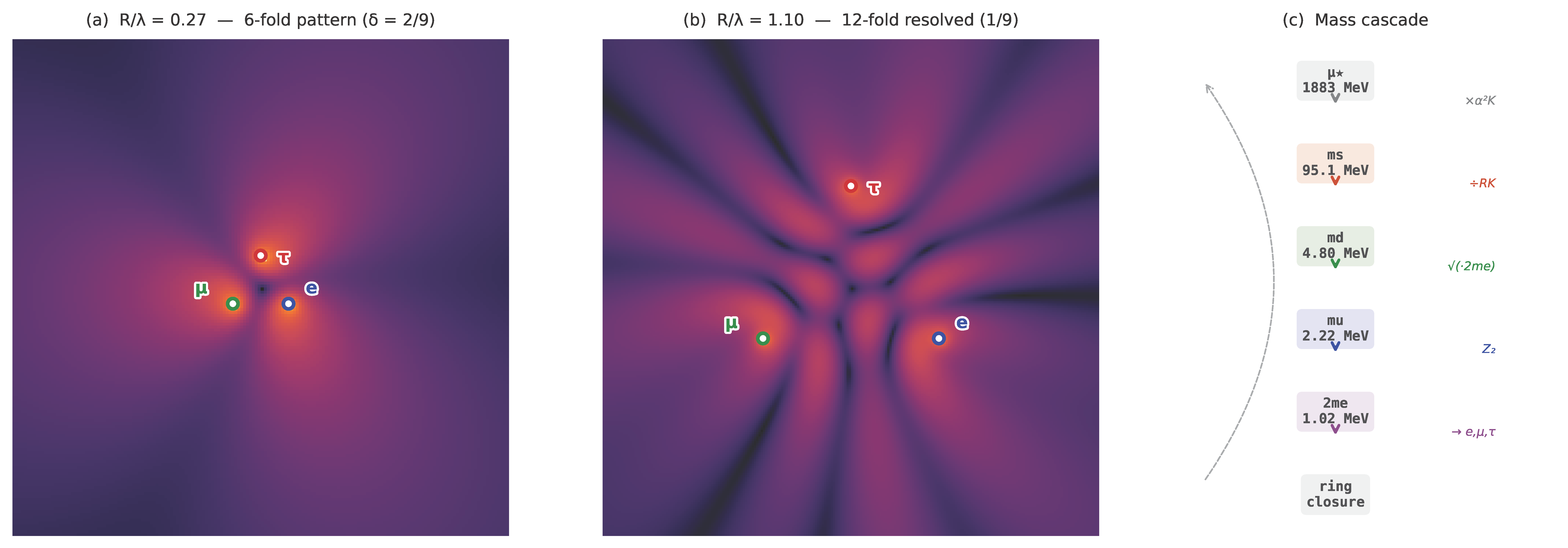
Figure 1.
(a) Steady-state intensity for three cylindrical-wave sources at on a ring of radius , showing the interference pattern with sixfold visual symmetry. (b) At , additional fringes resolve between the primary arms, consistent with the row of the resonance table ( regime). Peak counts follow the sequence as increases, adding three peaks per step in the numerical examples studied here. Each resolved interference ring contributes one peak per source. (c) The geometric-mean cascade from to , with ring closure.
Figure 1.
(a) Steady-state intensity for three cylindrical-wave sources at on a ring of radius , showing the interference pattern with sixfold visual symmetry. (b) At , additional fringes resolve between the primary arms, consistent with the row of the resonance table ( regime). Peak counts follow the sequence as increases, adding three peaks per step in the numerical examples studied here. Each resolved interference ring contributes one peak per source. (c) The geometric-mean cascade from to , with ring closure.
At , three standing-wave antinodes fit inside one lattice cell. Numerical simulation of three cylindrical-wave point sources (2D Helmholtz equation, equal amplitude , wavelength grid units, exponential damping with ) on a ring of radius R illustrates this: at , six intensity peaks appear at spacing. Doubling R resolves the sublattice structure, doubling the peak count and halving the sector width to . Simulation code is available from the corresponding author.
Shulga [8] independently derived as a Berry phase on a compact family cycle, from integrating out higher Fourier harmonics on an internal circle. The resonance interpretation proposed here reads the same rational value as a boundary-condition analogue: the cycle accommodates three wavelengths, suggesting three selected modes. Shulga’s compact-cycle calculation remains the derivation of ; the resonance picture is a geometric correspondence. All prior Berry-phase-fixes-an-observable examples in condensed matter (TKNN, Zak, Jauregui; see Xiao et al. [12] for a review) give integer or -rational values; a non-integer rational like is, to our knowledge, without CM precedent outside Shulga’s construction.
3.1. Quark-Sector Offsets
Żenczykowski [13] reported the low-energy values
parametrized in his treatment via weak hypercharge Y. In the present interference picture, the same numerical offsets correspond to and with , so the charge ratio reads . The factor corresponds naturally to the row, where the full structure is resolved.
4. Effective Medium: Geometric Means
Geometric-mean hierarchies are independently established in the quark-mass literature: Ng [31] showed that the empirical relations and organize the quark spectrum. The present construction substitutes lepton-derived scales (, ) for the heavy-quark boundaries:
treating adjacent scales as boundary values of a geometric-mean interpolation. The ansatz is adopted here as the simplest form consistent with the structure; it is an empirical observation, not a derived result. The pair-production threshold enters as the lightest scale at which charged fermions can be produced.
5. A Companion Identity
The phase cancellation and the geometric-mean cascade suggest a natural companion quantity. Given any three intensities , define
The companion uses only addition, square roots, and subtraction.
The Descartes circle theorem [14,15] gives a companion via curvatures : . Writing , , , the Soddy formula subtracts ; the F-identity subtracts . They agree when :
This is proved in Section 2: the cancellation forces identically. The companion identity therefore reduces to the Descartes circle theorem as a consequence of the interference geometry.
The identification as a curvature variable was noted by Kocik [16]. In condensed matter, is standard [3]; Satija [17] showed that the integer Apollonian gasket maps onto the Hofstadter butterfly energy spectrum, with curvatures encoding quantum Hall conductivities; this establishes a precedent for Descartes-type circle geometry appearing as a physical energy spectrum.
From :
where . The cascade ratio
is unitless and independent of .
6. Correspondence with Charged-Lepton Masses
The Koide relation [18,19] for charged-lepton pole masses,
is approximately RG-invariant [20]: the charged-lepton pole masses are scheme-independent observables, and under running all three acquire the same multiplicative QED factor at one loop, preserving Q exactly; residual two-loop threshold effects are . Setting MeV and in Eq. 3 reproduces , , and to four significant figures.
The companion evaluates to
All comparisons use PDG 2024 / FLAG 2024 values as a frozen reference convention. Since light-quark masses are scheme- and scale-dependent parameters rather than direct observables, the comparison below is convention-dependent; , computed from charged-lepton pole masses, is compared with running masses at the same numerical scale . The stability of this comparison across conventions is audited in Appendix A. We note that is not selected to optimize the match; it is the sum of charged-lepton pole masses, a scheme-independent physical observable that enters the construction before any quark-sector comparison is made. Comparison with PDG 2024 [21], run to via four-loop (RunDec 3 [22], , ):
The companion of the charged-lepton intensity pattern lies on the strange-quark mass at within current uncertainties. The comparison scale is not arbitrary: the residual under four-loop QCD evolution is minimized at MeV, within of ; conversely, to (Figure 2). The two directions agree to better precision than either input is known. This coincidence is empirical; the interference model does not predict which particle the companion should match. Among QCD mass scales below 1 GeV, only falls within the band of ; the pion decay constant MeV lies below, and no meson, baryon, or other quark mass falls within .
7. Light-Quark Cascade
The geometric-mean cascade (Equations 7–8) gives:
PDG 2024 gives MeV (). QED corrections for charge- quarks reach (Appendix A), giving MeV systematic. The relation selects MeV. The quoted MeV scale reflects the estimated size of the missing QED correction (QED is not applied; see Appendix A), not an experimental uncertainty. The deviation is computed in a QCD-only scheme against PDG values.
The prediction chain forms a loop:
The light-quark sum, pair-normalized, follows from the cascade: where . This evaluates to , a self-consistency check rather than an independent prediction:
FLAG 2024 [24] values run to give . This empirical closure provides a fourth equation for three unknowns; equations 7–8 plus the closure alone give MeV versus MeV. Agreement: .
8. Cross-Checks
The coincidence was subjected to pre-registered Monte Carlo analysis [25]: under a log-uniform prior for Koide-compatible lepton spectra, the conditional hit fraction is (Clopper–Pearson 95% CI ; range – across three priors), with pre-registered predictions archived at [26]. Figure 3 displays the constraint graphically: is approximately flat near 95 MeV for small , then rises steeply; the value , fixed by the lepton masses, sits at the elbow where begins to depart the band. The present paper extends the chain to four masses through parameter-free closed-form links (Table 1); no free parameter buffers a discrepancy at any step, so a single failure at the bridge propagates through the entire cascade. The observed residual at the bridge point is MeV . The cascade outputs are fixed-point predictions against which future lattice determinations will converge or diverge.
9. Frozen-Input Outputs and Comparisons
The outputs are chained: determines , which determines . No free parameters buffer a discrepancy at any link.
Predictions were archived at Zenodo [26] prior to PDG 2026; any drift relative to updated PDG/FLAG values will be reported without retrofitting. The current agreements are suggestive but not yet decisive: the u and d quark masses carry large uncertainties (PDG quotes for , for ), and the cascade values fall well within these bands. The true test is convergence: as lattice QCD+QED determinations sharpen over the next several years, the cascade outputs are fixed point values that will either be confirmed or excluded. Only that convergence, not the present-day overlap, can discriminate the construction from coincidence. Concretely, the strange-quark mass is the most sensitive discriminator: FLAG error bars on have been shrinking at approximately per review cycle, and a drift in the central value combined with two further cycles of improvement (projected ) would produce a exclusion. For , the inclusion of QED corrections in future lattice determinations is expected to shift the central value at the level; the cascade output MeV is a fixed target against which that shift will be measured.
10. Discussion
The central result is a diagnosis, not a mechanism. The charged-lepton and light-quark mass spectra satisfy a specific set of algebraic identities: the Koide ratio , the Descartes companion , and the geometric-mean cascade . These are not generic relations that many mass spectra would satisfy. The Monte Carlo analysis (Section 8) tests the coincidence alone and reports a conditional hit fraction of (log-uniform prior; – across three priors); the full cascade chains three additional masses through parameter-free closed-form links, each of which must independently land within current uncertainties. These identities coincide with the characteristic algebraic constraints of systems, forced by phase cancellation in any physical realization with threefold rotational symmetry and a twofold sign structure.
This identification constrains, but does not construct, the underlying theory. The Standard Model accommodates fermion masses through Yukawa couplings that are free parameters; the present work observes that six of those parameters are matched by closed-form geometric relations involving a single measured scale and the dimensionless constant fixed by the identities. For the charged leptons and light quarks, the construction effectively reduces six independent Yukawa couplings to one input, constraining the Yukawa sector rather than competing with it. The geometric-mean eigenvalue structure ( in Ng’s formulation [31], or here) is mathematically equivalent to the texture-zero mass matrices introduced by Fritzsch [29]; that two independent routes (matrix ansätze and identities) arrive at the same eigenvalue relations suggests both may be symptoms of a common algebraic cause.
The diagnostic value is specific: any dynamical theory that produces the observed fermion mass spectrum must, as a necessary consequence, reproduce the identity structure documented here. This is a constraint on the solution space, not a solution. Whether the fermion spectrum ultimately reflects an internal compact space with threefold symmetry, or whether the algebraic correspondence has a different origin, remains open.
A structural limitation of the present comparison is that derives from charged-lepton pole masses (scheme-independent observables) while the light-quark masses it is compared against are scheme- and scale-dependent parameters. This scheme mixing is not an artefact of the construction; it is inherent to any comparison involving confined quarks, whose masses can only be defined within a renormalization convention. We have disclosed the conventions used, audited the comparison across PDG and FLAG reference values (Appendix A), and shown that the match is specific to rather than generically compatible. As lattice QCD+QED determinations converge toward percent-level precision over the coming years, the cascade outputs provide fixed numerical targets that will either be confirmed or excluded without any change to the lepton-sector input.
We note that this work appears within weeks of three independent publications exploring related aspects of the Koide relation: Rivero [10] obtains approximately scale-invariant sum rules for down-type quarks in PLB, Shulga [8] derives as a Berry phase on a compact family cycle, and Hübner [28] proves a minimization theorem for the Koide ratio and introduces an effective-participant interpretation . Four groups arriving at geometric or algebraic readings of the same relation in the same month may indicate that the tools for understanding it are maturing. We caution that the preprints (including the present work) are not yet independently peer-reviewed; Rivero’s PLB paper has passed review. The convergence is noted as context for the timeliness of the investigation, not as mutual corroboration.
AI usage disclosure. AI tools were used for programming assistance (Monte Carlo implementation, LaTeX formatting) and document editing only. All mathematical derivations, physical arguments, numerical predictions, and scientific claims originate from the author or from prior published work.
Acknowledgments
The author thanks A. Rivero for critical correspondence on the Koide relation; K. Shulga for deriving within a compact-cycle framework [8]; C. A. Brannen for the cosine parametrization; J. Kocik for the Descartes-circle reading [16]; R. Foot for the cone interpretation [27]; and Y. Sumino for the radiative protection mechanism.
Appendix A. Mass Running Procedure
Light quark masses are compared at MeV. PDG 2024 reference values at 2 GeV [21]: MeV, MeV, MeV.
The scheme- and scale-independence of light-quark mass ratios was established by Gasser and Leutwyler [32]; running from 2 GeV to uses four-loop QCD evolution (RunDec 3 [22], version 3.1) with , active flavors, charm threshold at GeV. No flavor thresholds are crossed in the interval .
QED corrections are not applied. For charge- quarks (d, s) these are sub-per-mille. For charge- quarks (u), QED effects can reach and represent the dominant systematic uncertainty in the comparison.
The ratio is RG-invariant for same-charge quarks under QCD. FLAG 2024 [24] reports and for , giving .
Numerical verification is available from the corresponding author.
Appendix A.1. Cross-Scheme Comparison
Table A1 shows cascade predictions against PDG and FLAG (QCD-only lattice) reference values at two scales: the cascade scale and the conventional reference scale 2 GeV. The match is specific to ; at 2 GeV, deviates by in both PDG and FLAG, confirming that the cascade output is scale-locked rather than generically compatible.

Table A1.
Cascade predictions vs. PDG/FLAG reference values across schemes and scales. FLAG values are QCD-only (no QED); the entry carries a systematic from the missing QED correction (†).
Table A1.
Cascade predictions vs. PDG/FLAG reference values across schemes and scales. FLAG values are QCD-only (no QED); the entry carries a systematic from the missing QED correction (†).
| Cascade | Ref. value | σ | Δ/σ | |
| PDG 2024, at | ||||
| 95.12 | ||||
| 4.804 | ||||
| 2.216 | ||||
| FLAG 2024 (QCD only), at | ||||
| 95.12 | ||||
| 4.804 | ||||
| † | 2.216 | |||
| PDG 2024, at 2 GeV (wrong scale) | ||||
| 95.12 | ||||
| 4.804 | ||||
| 2.216 | ||||
| Scale-invariant ratio | ||||
| 19.80 | ||||
References
- de Boor, J.; Geyer, N.; Gösele, U.; Schmidt, V. Three-beam interference lithography: upgrading a Lloyd’s interferometer for single-exposure hexagonal patterning. Opt. Lett. 2009, 34, 1783–1785. [Google Scholar] [CrossRef] [PubMed]
- Hecht, E. Optics, 5th ed.; Pearson: Boston, MA, USA, 2017; Chapter 9, ISBN 978-0-13-397722-6.
- Ashcroft, N.W.; Mermin, N.D. Solid State Physics; Holt, Rinehart and Winston: New York, NY, USA, 1976; Chapter 12, ISBN 978-0-03-083993-1.
- Thouless, D.J.; Kohmoto, M.; Nightingale, M.P.; den Nijs, M. Quantized Hall conductance in a two-dimensional periodic potential. Phys. Rev. Lett. 1982, 49, 405–408. [Google Scholar] [CrossRef]
- Kane, C.L.; Mele, E.J. Z2 topological order and the quantum spin Hall effect. Phys. Rev. Lett. 2005, 95, 146802. [Google Scholar] [CrossRef]
- Volovik, G.E. The Universe in a Helium Droplet; Oxford University Press: Oxford, UK, 2003; ISBN 978-0-19-850782-6.
- Sumino, Y. Family gauge symmetry and Koide’s mass formula. Phys. Lett. B 2009, 671, 477–480. [Google Scholar] [CrossRef]
- Shulga, K. Charged-lepton Koide geometry from a Green-dressed compact family cycle. arXiv 2026, arXiv:2605.10245. [Google Scholar]
- Rivero, A. A new Koide tuple: strange-charm-bottom. arXiv 2011, arXiv:1111.7232. [Google Scholar] [CrossRef]
- Rivero, A. New sum rules of the Koide type. Phys. Lett. B 2026, 877, 140510. [Google Scholar] [CrossRef]
- Rodejohann, W.; Zhang, H. Extended empirical fermion mass relation. Phys. Lett. B 2011, 698, 152–156. [Google Scholar] [CrossRef]
- Xiao, D.; Chang, M.-C.; Niu, Q. Berry phase effects on electronic properties. Rev. Mod. Phys. 2010, 82, 1959–2007. [Google Scholar] [CrossRef]
- Żenczykowski, P. Remark on Koide’s Z3-symmetric parametrization of quark masses. Phys. Rev. D 2012, 86, 117303. [Google Scholar] [CrossRef]
- Soddy, F. The kiss precise. Nature 1936, 137, 1021. [Google Scholar] [CrossRef]
- Lagarias, J.C.; Mallows, C.L.; Wilks, A.R. Beyond the Descartes circle theorem. Am. Math. Mon. 2002, 109, 338–361. [Google Scholar] [CrossRef]
- Kocik, J. The Koide lepton mass formula and geometry of circles. arXiv 2012, arXiv:1201.2067. [Google Scholar] [CrossRef]
- Satija, I.I. A tale of two fractals: the Hofstadter butterfly and the integral Apollonian gaskets. Eur. Phys. J. Spec. Top. 2016, 225, 2533–2547. [Google Scholar] [CrossRef]
- Koide, Y. Fermion-boson two-body model of quarks and leptons and Cabibbo mixing. Lett. Nuovo Cim. 1982, 34, 201–205. [Google Scholar] [CrossRef]
- Koide, Y. New view of quark and lepton mass hierarchy. Phys. Rev. D 1983, 28, 252–254. [Google Scholar] [CrossRef]
- Li, N.; Ma, B.-Q. Energy scale independence of Koide’s relation for quark and lepton masses. Phys. Rev. D 2006, 73, 013009. [Google Scholar] [CrossRef]
- Navas, S.; et al. [Particle Data Group]. Review of particle physics. Phys. Rev. D 2024, 110, 030001. [Google Scholar] [CrossRef]
- Herren, F.; Steinhauser, M. Version 3 of RunDec and CRunDec. Comput. Phys. Commun. 2018, 224, 333–345. [Google Scholar] [CrossRef]
- Leutwyler, H. The ratios of the light quark masses. Phys. Lett. B 1996, 378, 313–318. [Google Scholar] [CrossRef]
- Aoki, Y.; et al. [Flavour Lattice Averaging Group]. FLAG review 2024. Phys. Rev. D 2026, 113, 014508. [Google Scholar] [CrossRef]
- Brilliant, A.M. Pre-registered Monte Carlo protocols for the outer Soddy–Koide numerical observation. Zenodo 2026. [Google Scholar] [CrossRef]
- Brilliant, A.M. Pre-Registered Fermion Mass Predictions for comparison with PDG 2026. Zenodo 2026. [Google Scholar] [CrossRef]
- Foot, R. A note on Koide’s lepton mass relation. arXiv 1994, arXiv:hep-ph/9402242. [Google Scholar]
- Hübner, K. A minimization theorem for the Koide ratio and its Standard Model calibration. arXiv 2026, arXiv:2605.09651. [Google Scholar] [CrossRef]
- Fritzsch, H. Quark masses and flavor mixing. Nucl. Phys. B 1979, 155, 189–207. [Google Scholar] [CrossRef]
- Dumlu, C.K.; Dunne, G.V. The Stokes phenomenon and Schwinger vacuum pair production in time-dependent laser pulses. Phys. Rev. Lett. 2010, 104, 250402. [Google Scholar] [CrossRef]
- Ng, D. QCD renormalization for the top-quark mass in a mass geometrical mean hierarchy. arXiv 1992, arXiv:hep-ph/9204221. [Google Scholar] [CrossRef]
- Gasser, J.; Leutwyler, H. Quark masses. Phys. Rep. 1982, 87, 77–169. [Google Scholar] [CrossRef]
- Brannen, C.A. Koide’s mass formula for neutrinos. Bull. Am. Phys. Soc. 2006. Available online: https://brannenworks.com/MASSES.pdf.
- Dumlu, C.K.; Dunne, G.V. Interference effects in Schwinger vacuum pair production for time-dependent laser pulses. Phys. Rev. D 2011, 83, 065028. [Google Scholar] [CrossRef]
- Gao, G.-H.; Li, N. Explorations of two empirical formulas for fermion masses. Eur. Phys. J. C 2016, 76, 140. [Google Scholar] [CrossRef]
- Żenczykowski, P. A note on Koide’s doubly special parametrization of quark masses. Open Phys. 2018, 16, 266–270. [Google Scholar] [CrossRef]
- Rivero, A.; Gsponer, A. The strange formula of Dr. Koide. arXiv 2005, arXiv:hep-ph/0505220. [Google Scholar] [CrossRef]
- Akkermans, E.; Dunne, G.V. Ramsey fringes and time-domain multiple-slit interference from vacuum. Phys. Rev. Lett. 2012, 108, 030401. [Google Scholar] [CrossRef] [PubMed]
Figure 2.
(a) Descartes circle geometry for the Koide–Soddy relation. Three lepton circles with curvatures determine a fourth tangent circle (the Soddy companion) whose squared curvature MeV matches . The electron circle (dashed arc) encloses the configuration; at this scale its radius is larger than or , so only a segment is visible. (b) The residual under four-loop QCD evolution (RunDec 3, , ). The minimum (0.005 MeV) occurs at MeV; the vertical line marks MeV. The shaded band is the region on . Both and fall well within the band.
Figure 2.
(a) Descartes circle geometry for the Koide–Soddy relation. Three lepton circles with curvatures determine a fourth tangent circle (the Soddy companion) whose squared curvature MeV matches . The electron circle (dashed arc) encloses the configuration; at this scale its radius is larger than or , so only a segment is visible. (b) The residual under four-loop QCD evolution (RunDec 3, , ). The minimum (0.005 MeV) occurs at MeV; the vertical line marks MeV. The shaded band is the region on . Both and fall well within the band.
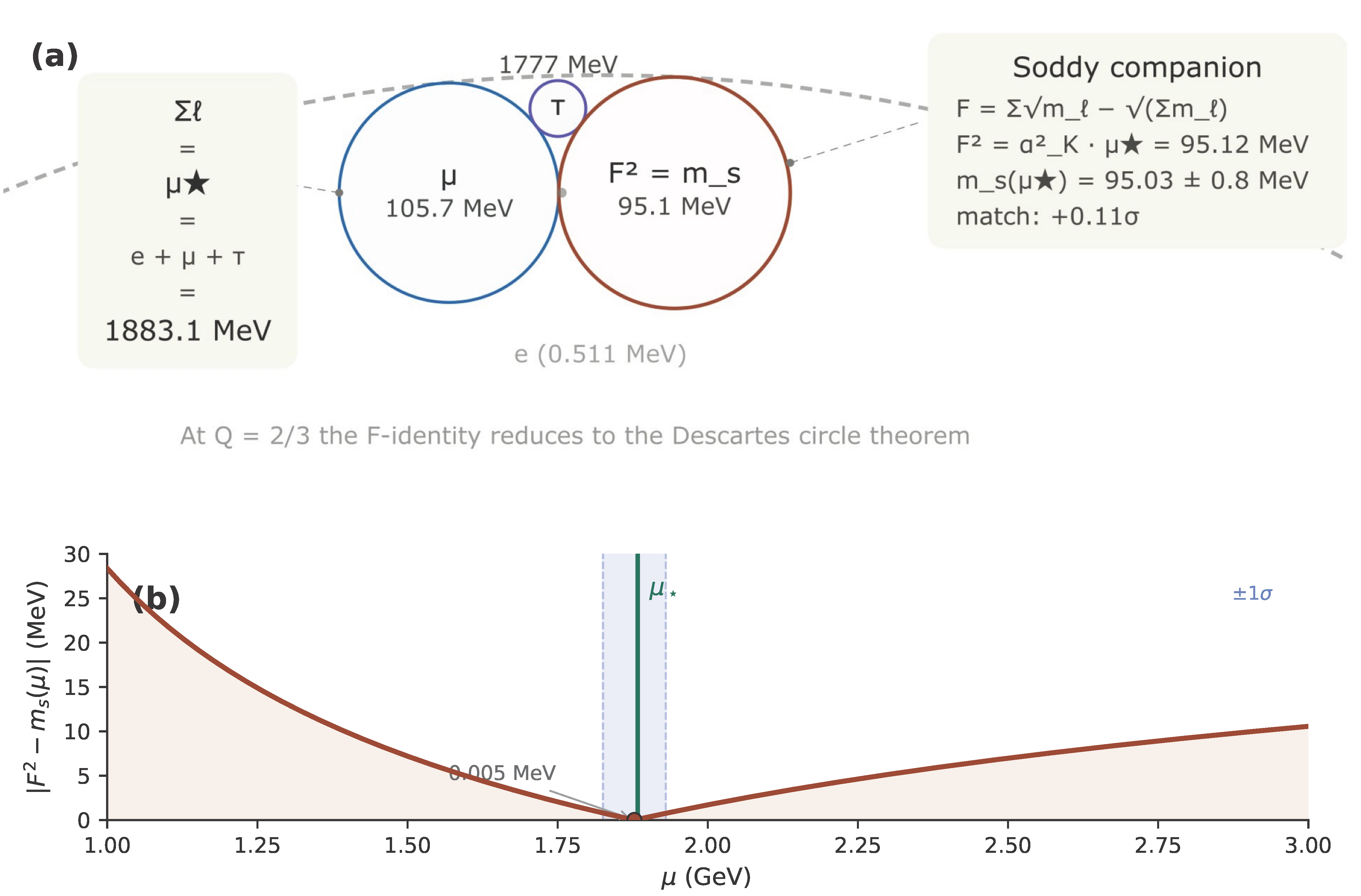
Figure 3.
as a function of the Koide phase over the fundamental domain . The dashed red line marks MeV. intersects the band at (green dot), the value independently determined by the charged-lepton masses. For , diverges from rapidly, illustrating that the match is not generic.
Figure 3.
as a function of the Koide phase over the fundamental domain . The dashed red line marks MeV. intersects the band at (green dot), the value independently determined by the charged-lepton masses. For , diverges from rapidly, illustrating that the match is not generic.
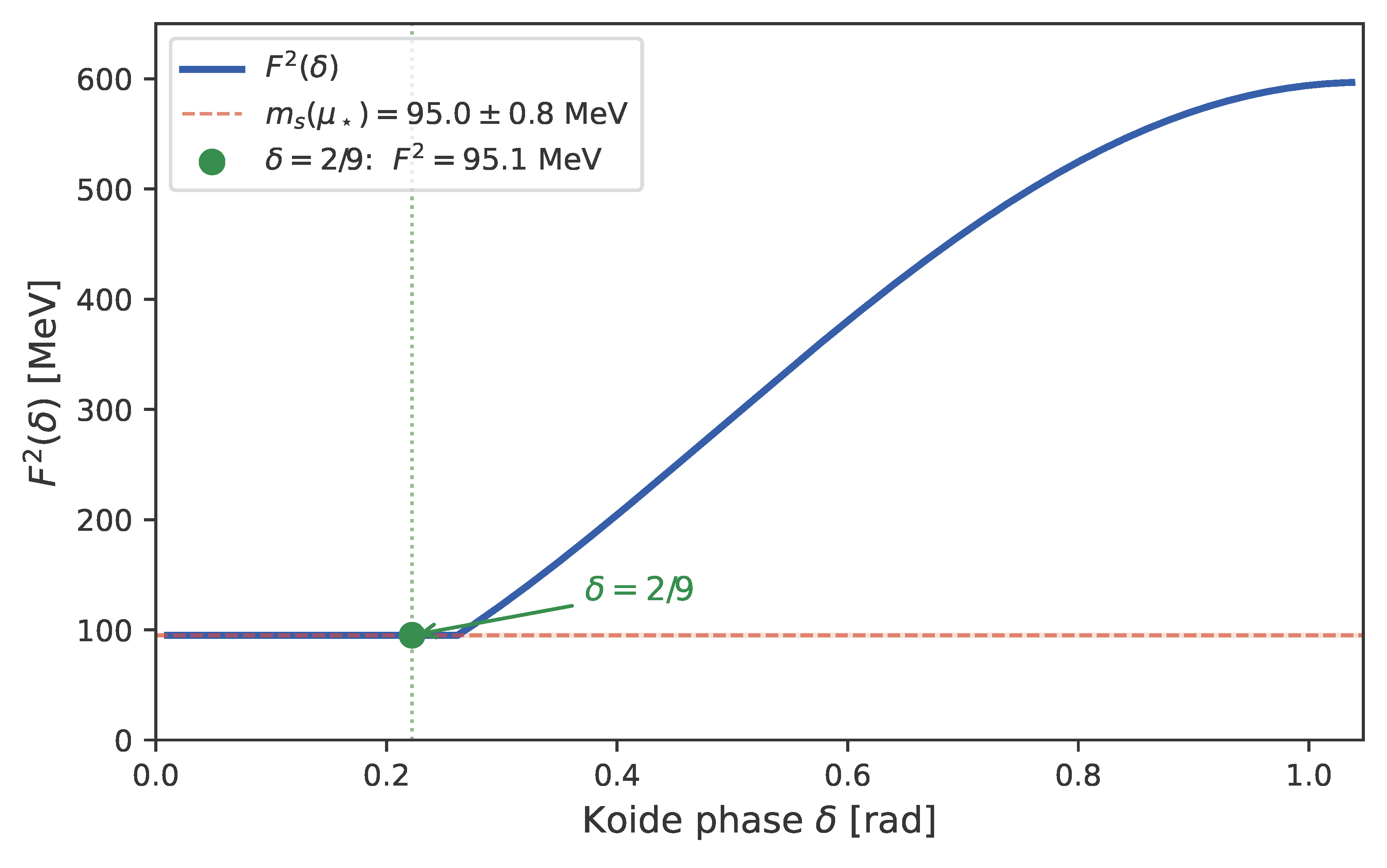
Table 1.
Six masses from closed-form expressions. Input: . The lepton masses () are reproduced by construction via and ; they are inputs, not predictions. The quark masses () are the testable outputs.
Table 1.
Six masses from closed-form expressions. Input: . The lepton masses () are reproduced by construction via and ; they are inputs, not predictions. The quark masses () are the testable outputs.
| Closed-form | Pred. | PDG/FLAG | Dev. | |
| 1776.93 | 1776.93 | |||
| 105.66 | 105.66 | |||
| e | 0.5110 | 0.5110 | ||
| s | 95.12 | |||
| d | 4.804 | |||
| u | 2.216 |
Disclaimer/Publisher’s Note: The statements, opinions and data contained in all publications are solely those of the individual author(s) and contributor(s) and not of MDPI and/or the editor(s). MDPI and/or the editor(s) disclaim responsibility for any injury to people or property resulting from any ideas, methods, instructions or products referred to in the content. |
© 2026 by the authors. Licensee MDPI, Basel, Switzerland. This article is an open access article distributed under the terms and conditions of the Creative Commons Attribution (CC BY) license (http://creativecommons.org/licenses/by/4.0/).
Copyright: This open access article is published under a Creative Commons CC BY 4.0 license, which permit the free download, distribution, and reuse, provided that the author and preprint are cited in any reuse.


