

Submitted:
20 May 2026
Posted:
21 May 2026
You are already at the latest version
Abstract
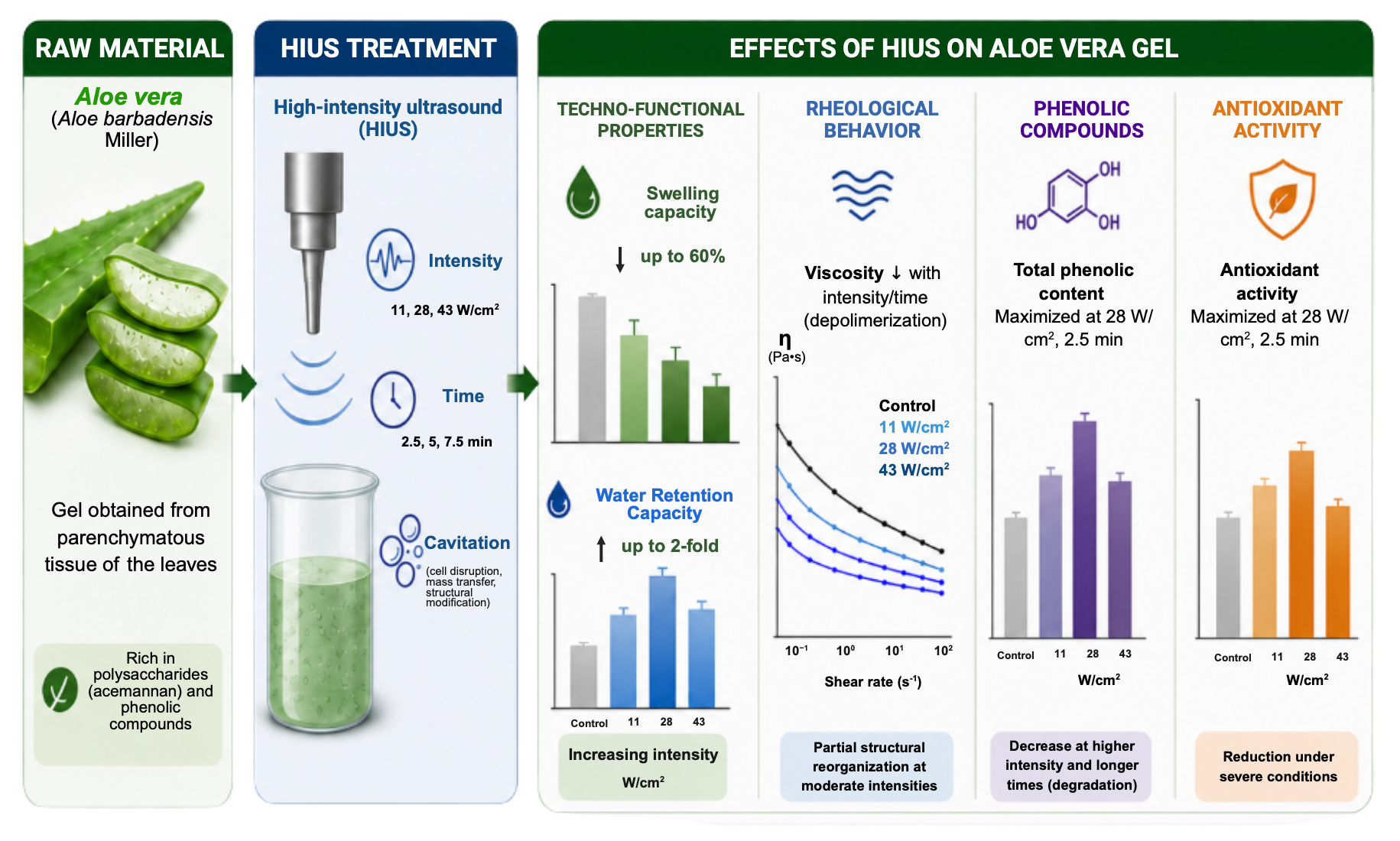
High-intensity ultrasound (HIUS) has emerged as a promising green technology for modifying the structural and functional properties of plant-based matrices. In this study, Aloe vera gel was subjected to HIUS at different acoustic intensities (11, 28, and 43 W/cm2) and processing times (2.5, 5, and 7.5 min) to evaluate its impact on techno-functional properties, rheological behavior, phenolic profile, and antioxidant activity. HIUS significantly reduced swelling capacity (up to ~60%) while enhancing water retention capacity (up to ~2-fold), depending on processing conditions. Rheological analysis revealed a decrease in viscosity associated with cavitation-induced depolymerization, followed by partial structural reorganization at moderate intensities. Total phenolic content and antioxidant activity were maximized at intermediate conditions (28 W/cm2, 2.5 min), indicating enhanced release of bioactive compounds. However, excessive ultrasound intensity and prolonged processing led to a reduction in phenolic content, suggesting degradation effects. These findings demonstrate the presence of an optimal ultrasound treatment that balances structural modification and bioactive compound preservation, highlighting HIUS as an effective tool for tailoring the functional and antioxidant properties of Aloe vera-based ingredients.
Keywords:
Aloe vera
; high-intensity ultrasound
; rheology
; aloin
; phenolic compounds
; antioxidant capacity
1. Introduction
The efficient utilization and valorization of agro-food resources have become central challenges in the transition toward more sustainable and circular food systems. In this context, the development of innovative processing strategies capable of enhancing the functional and bioactive properties of plant-based materials is essential to increase their added value and expand their industrial applications [1]. Among these resources, Aloe vera (Aloe barbadensis Miller) has attracted considerable attention due to its rich composition in polysaccharides, phenolic compounds, and other bioactive constituents, which confer important technological and biological functionalities [2].
Aloe vera gel, obtained from the parenchymatous tissue of the leaves, is widely recognized for its potential use in food, pharmaceutical, and cosmetic industries [3]. Its techno-functional properties, such as water retention, swelling capacity, and fat adsorption, are mainly associated with its polysaccharide matrix, particularly acemannan [4]. Additionally, the presence of phenolic compounds, including anthraquinones and phenolic acids, contributes significantly to its antioxidant and biological activity [4]. However, the effective utilization of Aloe vera as a high-value ingredient is often limited by the sensitivity of these compounds to processing conditions, which may alter both structural integrity and functional performance [4].
Conventional processing methods can induce undesirable changes in the physicochemical and functional properties of Aloe vera, leading to degradation of bioactive compounds and reduced technological performance [4]. Therefore, there is a growing interest in the application of emerging, non-thermal technologies that enable controlled modification of plant matrices while preserving or enhancing their functional attributes. Among these technologies, high-intensity ultrasound (HIUS) has emerged as a promising green processing alternative due to its ability to induce acoustic cavitation, generating localized mechanical and physicochemical effects that can disrupt cell structures, enhance mass transfer, and modify biopolymer organization [5,6].
Previous studies have demonstrated that ultrasound-assisted processing can improve techno-functional properties of plant-based materials, including hydration capacity and structural stability, as well as enhance the extraction of bioactive compounds [6,7,8]. In Aloe vera, ultrasound has been primarily studied in relation to its effects on polysaccharide structure and associated functional properties [7]. However, the impact of HIUS on phenolic compounds and their contribution to antioxidant functionality remains insufficiently explored. More importantly, the relationship between cavitation-induced structural modifications and the release or degradation of bioactive compounds has not been clearly established, limiting the rational design of ultrasound-assisted processes for Aloe vera valorization.
In this context, understanding how processing conditions influence the structure–function–bioactivity relationship is essential to develop strategies that maximize the value of Aloe vera as an agro-food resource. The ability to tailor functional properties and bioactive compound availability through controlled processing would enable the design of novel ingredients with enhanced performance and application potential.
Therefore, the aim of this study was to evaluate the effect of high-intensity ultrasound on the structural, techno-functional, and antioxidant properties of Aloe vera gel, with particular emphasis on the modulation of phenolic compounds. It is hypothesized that moderate ultrasound intensities promote controlled structural disruption, enhancing the release of bioactive compounds and functional performance, whereas excessive cavitation leads to degradation and loss of functionality. This work contributes to the development of sustainable processing strategies for the valorization of Aloe vera and supports its utilization as a high-value functional ingredient within agro-food systems.
2. Materials and Methods
2.1. Raw Material
Aloe vera leaves, used as a raw material, were supplied by AMB Wellness Company (Gomez Palacio, Durango, Mexico.) Leaves of 3-year-old were selected according to uniform size. Prior to the gel extraction, the leaves were washed with tap water. The Aloe vera gel was manually extracted as described by Alvarado-Morales, et al. [7]. The gel was homogenized and stored at 4 ºC for 8 h prior to processing.
2.2. High Intensity Ultrasound (US) Processing
The acoustic treatment of Aloe vera gel was performed using as previously in a Branson Sonifier S-450 (Branson, USA), operating at 450 W and 25 kHz, equipped with a ½ inch tip horn. Approximately 250 g of Aloe vera gel was placed into a double jacket vessel (400 mL) [7]. The US treatments were carried out using 3 different acoustic intensities (11, 28 and 43 W/cm2) for three different times (2.5, 5 and 7.5 min) with continuous irradiation. Temperature of samples was controlled by recirculating water at 20±2 °C. The sonicated Aloe vera gel was freeze-dried and stored under anhydrous conditions until analysis.
2.3. Technofunctional Properties
Swelling capacity (Sw) and water retention capacity (WRC), the principal hydration-related properties, together with fat adsorption capacity (FAC), were evaluated as key techno-functional properties in this study. Thus, the alcohol insoluble residue (AIRs) from HIUS treated and untreated Aloe vera gel were prepared by immersion in boiling ethanol as described in Femenia, et al. [9]. Sw and WRC of AIR’s obtained from freeze-dried Aloe vera samples were determined using phosphate buffer (1 M, pH 6.3), while FAC was assessed using corn oil as the lipid phase. All techno-functional properties were measured following the methodology reported by Alvarado-Morales, et al. [7].
2.4. Flow Behavior Analysis
Rheological measurements were performed using a controlled-stress rheometer (AR-2000, TA Instruments, New Castle, DE, USA) equipped with a parallel-plate geometry (60 mm diameter) and a Peltier plate system for precise temperature control. Sample temperature was maintained at 25 °C through water recirculation using an external thermostatic unit (Haake, Germany).
The flow behavior of untreated and HIUS-treated Aloe vera gel was evaluated under steady shear conditions using simple shear flow tests. Shear rate varied logarithmically from 0.01 to 300 1/s, and the corresponding shear stress values were recorded once steady-state conditions were achieved. Experimental data were fitted to different rheological models, including the Ostwald–de Waele (power law) (Eq. 1) and Cross (Eq. 2) models. All model parameters were estimated by nonlinear regression analysis [10].
Where η is the viscosity (Pa·s), is the shear rate (1/s), K and n are the flow consistency ((Pa·s)n) and the flow behavior (dimensionless) indexes, respectively.
where, η is the viscosity at shear stable state (Pa·s), λ the structural relaxation time (s), m the dimensionless exponent related to the shear-thinning behavior, the shear rate (1/s), and η∞ and η0 the limit viscosities at high and low shear rates (Pa·s), respectively.
The goodness of fit for each model was assessed using the coefficient of determination (R²) and the root mean square error (RMSE). R² was calculated to quantify the proportion of variance in the experimental data explained by the model, while RMSE was used as an absolute measure of the deviation between experimental and predicted shear stress values. Models presenting higher R² values and lower RMSE were considered to provide a more accurate description of the flow behavior of the Aloe vera gel under the evaluated ultrasound processing conditions.
2.5. Analysis of Phenolic Compounds
2.5.1. Extraction of Phenolic Compounds
The phenolic compounds were extracted as previously described by Comas-Serra, et al. [11] with slight modifications. Approximately, 500 mg of freeze-dried sample was homogenized 10 mL of H2O (HPLC grade). Then, the samples were centrifuged at 6000 rpm for 20 min at 25 ºC. The supernatant was filtered through a ∅ 5-μm prior to spectrophotometric and HPLC analysis.
2.5.2. Total Phenolic Compounds Determination
Total soluble polyphenols were spectrophotometrically measured in accordance with the Folin-Ciocalteu method, using 96-well microplates, as previously described by Comas-Serra, et al. [11]. Gallic acid (0–200 ppm) was used as standard for calibration and the phenolic content results were expressed as mg of gallic acid equivalent per g of dry matter (mg GAE/g dm). Each of the given values is the mean of six experimental determinations.
2.5.3. Identification of Individual Phenolic Compounds by HPLC-DAD
The individual phenolic compounds were analyzed by HPLC-DAD according to the method described by González-Delgado, et al. [12] with slight modifications. The chromatographic analysis was carried out using an HPLC Agilent 1200 (Agilent Technology, Palo Alto, CA, USA) equipped with a diode array detector (DAD), a quaternary pump and a Kinetex C18 5-μm (250 mm x 4.6 mm) column. The temperature, flow rate, and injection loop were of 25 ºC, 0.5 mL/min y 20 μL, respectively. The mobile phased was comprised of (A) 50mM ammonium diacid phosphate solution brought to 2.6 pH with phosphoric acid, (B) 80% acetonitrile and 20% phase A, and (C) 200mM phosphoric acid. The mobile phase gradient was of 100% A at 5 min, 92% A and 8% B at 8 min, 14% B and 86% C at 20 min, 16.5% B and 83.5% C at 25 min, 21.5% B and 78.5% C at 35 min, 50% B and 50% C at 70 min, 100% A at 75 min, and 100% A at 80 min. The individual phenolic compounds were monitored at four different wavelengths: 254, 280, 316 and 365 nm. Thirteen high purity standards of were used, not only to identify, but also, to quantify the individual phenolic compounds.
2.6. Antioxidant Activity
The samples used to determine the antioxidant activity were prepared using approximately 50 mg of lyophilized Aloe vera juice suspended in 10 mL of distilled water. The prepared samples were continuously mixed under refrigeration (4 ºC) conditions for 18 h prior to analysis. A multiskan FC spectrophotometer and 96-wells plates were used for antioxidant activity determinations
2.6.1. Radical Scavenging DPPH Assay
The radical scavenging capacity, measured by the DPPH radical assay, of the Aloe vera juice treated with high-intensity ultrasound was determined as described previously [11].
2.6.2. ORAC Assay
ORAC assay of extracts was conducted according to Ou, et al. [13], using AAPH as a peroxyl radical generator, trolox as a standard, and fluorescein as a fluorescent probe. A diluted sample (25 μL), a blank or trolox calibration solutions (0 to 100 μM) were mixed with 150 μL of fluorescein (8.185 × 10⁻⁵ mM). The plate was incubated at 37 °C by at least 30 min in a Synergy HT Multi-Detection Microplate Reader (Bio-Tek, Winooski, Vt., U.S.A.). The reaction was started with the addition of 25 μL of AAPH reagent and kept shaking for 10 s at maximum intensity. Filters were used to select an excitation wavelength of 493 nm and an emission wavelength of 515 nm. The fluorescence was measured every minute for 2 h. All samples were analyzed in duplicate. The final ORAC values were calculated using the area under the decay curves and expressed as μM TE/g.
2.8. Statistical Analysis
The results from total phenolic compounds, antioxidant capacity and cytotoxic assays were analyzed by ANOVA with a statistical significance level α=0.05. All statistical analyses were performed in MINITAB software, while the graphics were prepared using SIGMAPLOT 10.0 software.
3. Results and Discussion
3.1. Technofunctional Properties
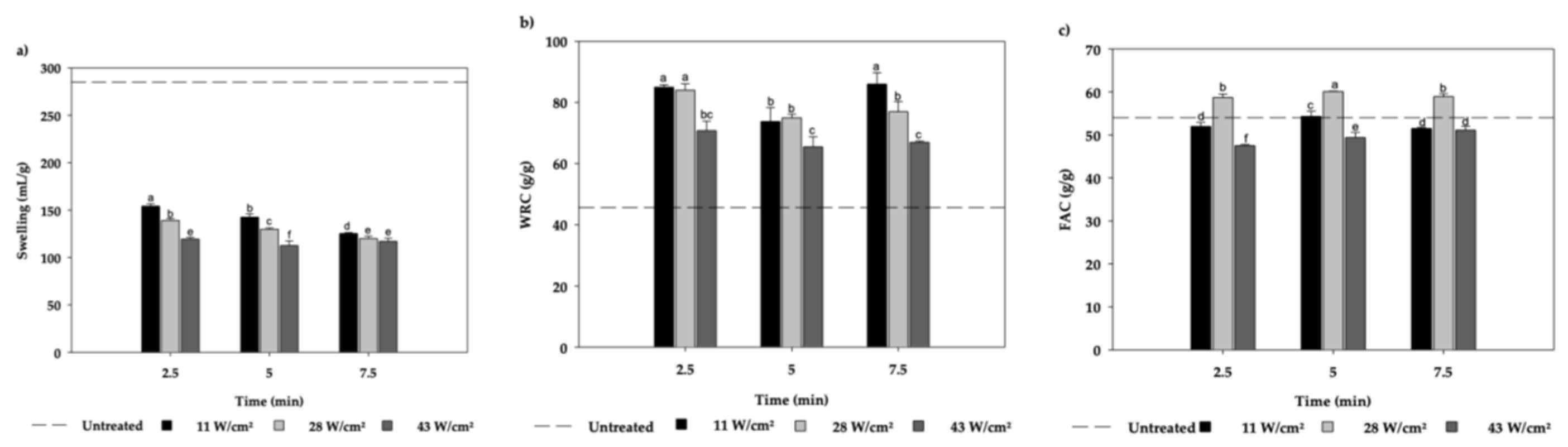
High-intensity ultrasound (HIUS) induced significant changes (p < 0.05) in the techno-functional properties of Aloe vera gel, including swelling capacity (Sw), water retention capacity (WRC), and fat adsorption capacity (FAC), reflecting the strong influence of cavitation on the microstructure of polysaccharide-rich matrices.
The untreated sample exhibited a swelling capacity of 284.92 mL/g, whereas all HIUS-treated samples showed significantly lower values, with reductions of up to ~60% depending on processing conditions. This decrease was more pronounced at higher ultrasound intensities and longer processing times, indicating that cavitation promotes disruption of the polymeric network responsible for water uptake. Mechanistically, the collapse in swelling capacity could be attributed to chain scission, reduction in molecular weight, and loss of structural integrity of acemannan-rich domains [7,14]. While moderate US-intensity (11 W/cm2) induced limited structural relaxation, preserving partial hydration capacity, excessive acoustic energy (43 W/cm2) led to compact and fragmented structures with minimal swelling ability.
In contrast, WRC increased significantly in response to ultrasound treatment, reaching values up to ~90 g/g compared to 45.62 g/g in the untreated sample. Moderate ultrasound conditions (11–28 W/cm2) produced the highest WRC values, corresponding to ~1.7–2.5-fold increases. This behavior suggests that controlled cavitation enhances the formation of a hydrated network with improved water-binding sites, likely due to partial de-esterification and increased exposure of hydrophilic groups. However, excessive ultrasound intensity resulted in a reduction of WRC, indicating that over-fragmentation compromises the three-dimensional structure required for effective water immobilization [7,14,15].
FAC showed a clear dependence on the ultrasound conditions, with the highest lipid-binding capacity observed at 28 W/cm2, particularly after 5 min, where FAC reached approximately 60 g/g. Those treatments performed at 28 W/cm2 were the only ones that consistently exceeded the untreated sample (57 g/g), indicating that moderate acoustic intensity favored the exposure of hydrophobic regions and increased the availability of lipid-binding sites [7,15]. In contrast, samples treated at 11 W/cm2 showed FAC values close to or slightly below the untreated gel, suggesting that this intensity was insufficient to promote major structural changes. At the highest intensity (43 W/cm2), FAC decreased markedly, especially at 2.5 and 5 min, which may reflect excessive cavitation effects, polymer chain disruption, or loss of organized structures required for efficient lipid retention [7]. Therefore, the figure suggests that moderate HIUS intensity improves FAC, whereas low intensity has limited effects and high intensity negatively affects lipid-binding capacity. These results demonstrate that HIUS modifies techno-functional properties through a balance between structural disruption and reorganization. Moderate ultrasound intensities promote optimal microstructural conditions that enhance hydration and lipid-binding properties, whereas excessive cavitation leads to degradation and loss of functionality. This behavior supports the concept of an optimal processing range for maximizing functional performance.
Figure 1.
Technofunctional properties for high-intensity ultrasound (HIUS)–treated Aloe vera gel processed at different ultrasound intensities (11, 28, and 45 W/cm2) and treatment times: 2.5 min, 5 min, and 7.5 min: (a) Swelling, (b) Water retention and (c) Fat adsorption capacity.
Figure 1.
Technofunctional properties for high-intensity ultrasound (HIUS)–treated Aloe vera gel processed at different ultrasound intensities (11, 28, and 45 W/cm2) and treatment times: 2.5 min, 5 min, and 7.5 min: (a) Swelling, (b) Water retention and (c) Fat adsorption capacity.
3.2. Flow Behavior
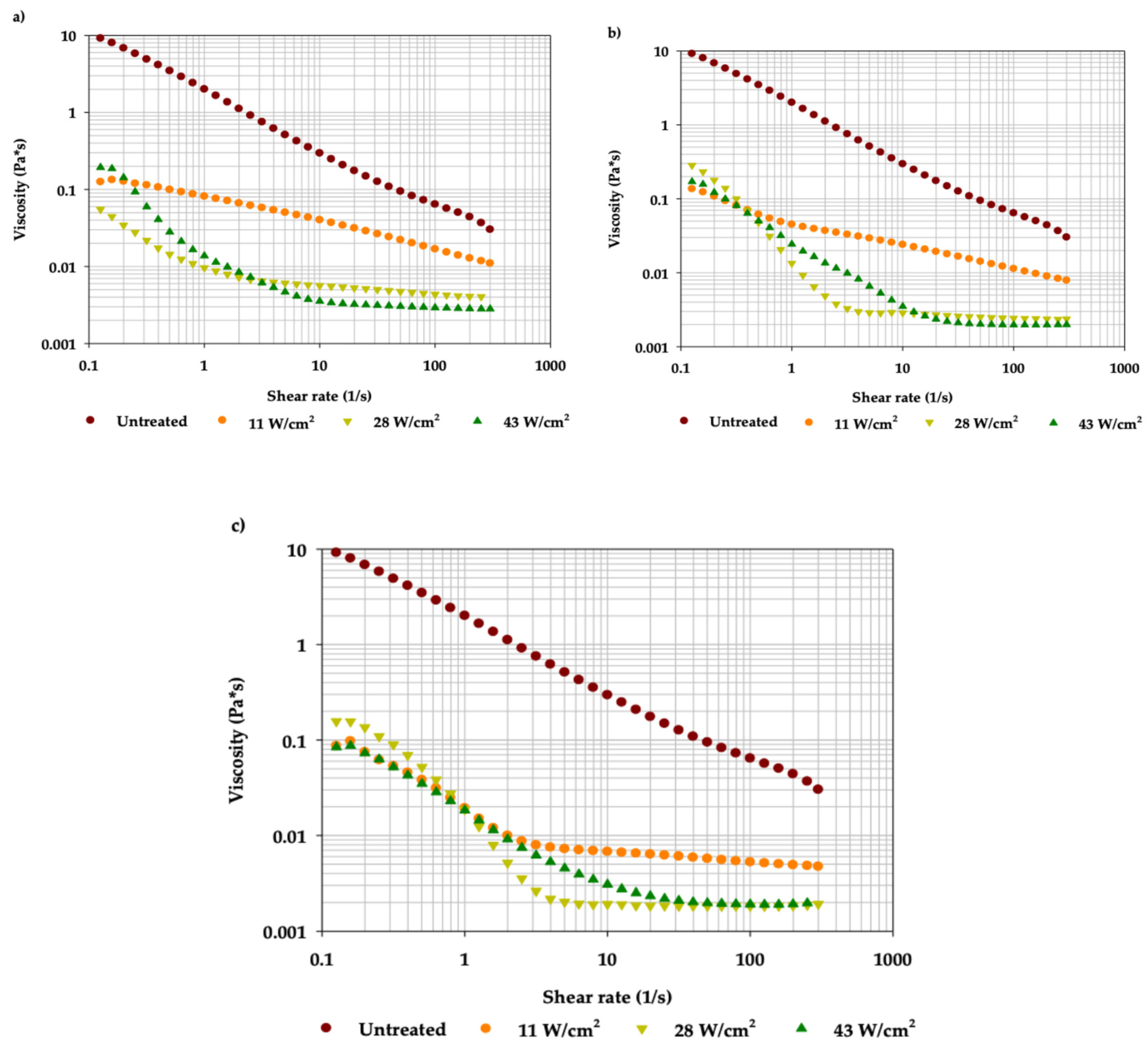
The apparent viscosity as a function of shear rate for untreated and high-intensity ultrasound (HIUS)–treated Aloe vera gel processed at different ultrasound intensities (11, 28, and 45 W/cm2) and treatment times: (a) 2.5 min, (b) 5 min, and (c) 7.5 min, is displayed in Figure 2. As can be seen, the rheological behavior of Aloe vera gel was strongly affected by HIUS, providing further insight into the structural modifications induced by cavitation. All samples exhibited non-Newtonian shear-thinning behavior, characteristic of polysaccharide-based systems [16].
The untreated gel showed the highest apparent viscosity, reflecting an intact and highly entangled polymer network. In contrast, ultrasound-treated samples exhibited a marked reduction in viscosity, particularly at low shear rates, indicating disruption of the gel structure [17]. At short processing times (2.5 min), viscosity decreased significantly at intermediate and high intensities (28 and 43 W/cm2), suggesting rapid depolymerization and chain disentanglement.
Interestingly, at intermediate processing time (5 min), samples treated at 11 and 28 W/cm2 exhibited partial recovery of viscosity, particularly in the low-to-intermediate shear rate range. This behavior suggests that moderate cavitation not only induces depolymerization but also promotes molecular rearrangement and re-entanglement, leading to the formation of a transient network structure [5]. In contrast, samples treated at 43 W/cm² continued to exhibit low viscosity, indicating that excessive acoustic energy prevents structural reorganization.
At longer processing times (7.5 min), the divergence in rheological behavior became more evident. Low-intensity treatment (11 W/cm2) resulted in relatively higher viscosity values, likely due to the formation of compact aggregates or shear-resistant domains [5]. Conversely, higher intensities led to extensive structural degradation and minimal resistance to flow.
The rheological behavior of untreated and HIUS–treated Aloe vera gel was successfully described using the Ostwald–de Waele (power law) and Cross models (Table 1). The untreated gel exhibited clear non-Newtonian, shear-thinning behavior, as evidenced by a flow behavior index (n) of 0.273 and a consistency index (K) of 0.483 Pa·sⁿ. The low n value confirms the pseudoplastic nature of native Aloe vera gel, which is commonly associated with the presence of high-molecular-weight polysaccharides forming weakly entangled networks [10,16,17].
Figure 2.
Apparent viscosity as a function of shear rate for untreated and high-intensity ultrasound (HIUS)–treated Aloe vera gel processed at different ultrasound intensities (11, 28, and 45 W/cm2) and treatment times: (a) 2.5 min, (b) 5 min, and (c) 7.5 min.
Figure 2.
Apparent viscosity as a function of shear rate for untreated and high-intensity ultrasound (HIUS)–treated Aloe vera gel processed at different ultrasound intensities (11, 28, and 45 W/cm2) and treatment times: (a) 2.5 min, (b) 5 min, and (c) 7.5 min.
For HIUS-treated samples, the Cross model provided a more comprehensive description of the flow behavior, depicting both low- and high-shear viscosity plateaus [18,19]. The zero-shear viscosity (η0) showed a strong dependence on ultrasound intensity and treatment time. At short treatment times (2.5 min), η0 decreased markedly at 11 and 28 W/cm2 (0.147 and 0.096 Pa·s, respectively), indicating initial disruption of the polysaccharide network due to cavitation-induced chain scission [5,14]. In contrast, treatment at 43 W/cm2 resulted in a higher η0 (0.240 Pa·s), suggesting partial structural reorganization or aggregation at higher acoustic energy. At 5 min, η0 increased substantially at 11 and 28 W/cm2, reaching 0.391 and 0.566 Pa·s, respectively, which could be attributed to enhanced intermolecular interactions and re-entanglement of fragmented polysaccharide chains [20,21,22]. However, further increases in ultrasound intensity or exposure time led to a decrease in η0, particularly evident at 7.5 min and 43 W/cm2 (η0 = 0.055 Pa·s), consistent with excessive degradation of the gel network. The infinite-shear viscosity (η∞) remained low for most treatments (~0.002–0.013 Pa·s), indicating that, regardless of processing conditions, the gel structure was largely disrupted under high shear rates. An exception was observed for the sample treated at 11 W/cm2 for 7.5 min, which exhibited a markedly higher η∞ (0.447 Pa·s), suggesting the presence of residual or restructured aggregates resistant to shear. The characteristic relaxation time (λ) and the dimensionless parameter m further reflected the complex structural evolution induced by HIUS. Higher λ values, particularly at intermediate conditions, such as 25.727 s at 11 W/cm2 for 5 min, indicate slower structural relaxation and more pronounced viscoelastic behavior. Conversely, lower λ values at higher intensities and longer treatment times suggest faster breakdown and reduced structural integrity. Variations in m (0.665–2.904) highlight differences in the sharpness of the transition between Newtonian plateaus, reinforcing the sensitivity of gel microstructure to ultrasound processing conditions. These results confirm that viscosity is a sensitive indicator of the balance between depolymerization and structural reassembly induced by ultrasound.

Table 1.
Rheological parameters of untreated and high-intensity ultrasound–treated Aloe vera gel determined using the Ostwald–de Waele and Cross models.
Table 1.
Rheological parameters of untreated and high-intensity ultrasound–treated Aloe vera gel determined using the Ostwald–de Waele and Cross models.
| Ostwald-de Waele (Power law) model | Cross Model | R2 | RMSE | ||||||
|---|---|---|---|---|---|---|---|---|---|
| K | n | η0 | η∞ | λ | m | ||||
| Pa·sn | - | Pa·s | Pa·s | s | - | ||||
| Untreated Aloe vera gel | 0.483 | 0.273 | 0.9966 | 0.1608 | |||||
| High-intensity ultrasound treatment | |||||||||
| min | W/cm2 | ||||||||
| 2.5 | 11 | 0.147 | 0.010 | 0.750 | 0.665 | 0.9904 | 0.0038 | ||
| 2.5 | 28 | 0.096 | 0.004 | 7.641 | 1.113 | 0.9626 | 0.0023 | ||
| 2.5 | 43 | 0.240 | 0.005 | 5.730 | 2.904 | 0.9938 | 0.0043 | ||
| 5 | 11 | 0.391 | 0.013 | 25.727 | 0.736 | 0.9673 | 0.0051 | ||
| 5 | 28 | 0.566 | 0.002 | 9.791 | 1.957 | 0.9997 | 0.0009 | ||
| 5 | 43 | 0.388 | 0.002 | 11.870 | 1.240 | 0.9981 | 0.0020 | ||
| 7.5 | 11 | 0.569 | 0.447 | 7.514 | 2.053 | 0.9760 | 0.0034 | ||
| 7.5 | 28 | 0.137 | 0.003 | 2.072 | 2.768 | 0.9842 | 0.0060 | ||
| 7.5 | 43 | 0.055 | 0.002 | 1.291 | 1.288 | 0.9885 | 0.0030 | ||
3.3. Total Phenolic Compounds
Figure 3 shows the effect of high-intensity ultrasound (HIUS) on the total phenolic content (TPC) of Aloe vera gel. The unprocessed gel showed a TPC of approximately 6 mg GAE/g, while the ultrasound-treated samples showed lower values, ranging from 2.6 to 3.3 mg GAE/g, depending on the acoustic intensity and processing time. These results indicate that, under the evaluated conditions, HIUS significantly reduced TPC compared with the untreated sample (p < 0.05).
Among the sonicated samples, TPC varied according to both acoustic intensity and processing time. The highest value was observed at 28 W/cm2 for 2.5 min, suggesting that moderate intensity combined with short exposure was less detrimental to phenolic compounds than longer treatments or higher intensities. Although ultrasound may facilitate the release of phenolics from the Aloe vera gel matrix [8,23,24,25], this effect was not sufficient to compensate for their possible degradation, oxidation, or structural transformation during processing. Consequently, all HIUS-treated samples showed lower TPC than the unprocessed gel.
It is also important to note that increasing HIUS severity did not improve TPC. In general, longer processing times and higher acoustic intensities maintained or further reduced the phenolic content. This behavior suggests that the phenolic fraction of Aloe vera gel is sensitive to excessive sonication. Therefore, HIUS should not be interpreted only as an extraction-enhancing technology, but as a process that must be carefully optimized to balance matrix disruption and bioactive compound preservation.
The reduction in TPC after HIUS treatment may be associated with the physicochemical effects generated by acoustic cavitation [26]. The collapse of cavitation bubbles can produce localized hot spots, high-pressure gradients, and reactive free radicals, which may oxidize or transform phenolic molecules [24,26,27]. Thus, the observed TPC reduction likely reflects the interaction of two simultaneous phenomena: the release of bound or entrapped phenolics and their partial degradation during sonication. These findings highlight the need to define optimal ultrasound processing conditions that allows structural modification of the gel matrix while minimizing the loss of bioactive compounds.
3.3. Phenolic Compounds Identified by HPLC-DAD
The analysis of individual phenolic compounds by HPLC-DAD revealed compound-specific responses to ultrasound treatment. The Table 2 summarizes the effect of ultrasound (US) processing intensity (11, 28, and 43 W/cm2) and treatment time (2.5, 5.0, and 7.5 min) on the concentration of individual phenolic compounds. At the shortest treatment time (2.5 min), increasing US intensity generally promoted higher phenolic release. In particular, gallic acid exhibited a strong intensity dependence, increasing from 1.91 μg/mg d.m. at 11 W/cm2 to 5.75 μg/mg d.m. at 43 W/cm2. A similar trend was observed for 2,3-dihydroxybenzoic acid and ferulic acid, whose concentrations reached their highest values at 43 W/cm2. In contrast, syringic acid and rutin were not detected at low intensity but became detectable at higher US intensities, indicating ultrasound-assisted liberation from the plant matrix. At the intermediate processing time (5 min), most phenolic acids showed maximum or near-maximum concentrations at 28 W/cm2, suggesting an optimal cavitation regime for compound release. Gallic and vanillic acids increased relative to 2.5 min treatments at low and moderate intensities, whereas excessive intensity (43 W/cm2) resulted in reduced gallic acid concentration, suggesting partial degradation or transformation under prolonged high-energy conditions. Epicatechin exhibited a pronounced decrease at 28 W/cm2 (0.23 μg/mg d.m.), indicating higher sensitivity to ultrasonic conditions compared with phenolic acids. At the longest processing time (7.5 min), phenolic profiles revealed divergent behaviors. Syringic, ferulic acids, epicatechin, and rutin reached their highest concentrations at 43 W/cm2, highlighting the role of prolonged cavitation in enhancing the release of more strongly bound or less extractable compounds. Conversely, gallic and chlorogenic acids showed relatively stable or reduced concentrations compared to intermediate conditions, suggesting that extended exposure may favor degradation or conversion reactions for these more labile phenolics. Taken together, the data demonstrate that ultrasound processing modulates the phenolic composition in a highly selective manner, governed by both processing intensity and time. Moderate-to-high ultrasonic intensities enhance the release of most phenolic acids and flavonoids through cavitation-induced cell wall disruption, while excessive energy input and prolonged treatment may promote compound-specific degradation [26,27,28]. These results suggest that ultrasound processing selectively modulates phenolic composition through a combination of enhanced extraction and compound degradation. These results underscore the importance of optimizing ultrasound parameters to maximize the recovery of targeted phenolic compounds while minimizing structural degradation.
Figure 3.
Effect of high-intensity ultrasound (HIUS: 11, 28, and 43 W/cm2) and processing time (2.5, 5, and 7.5 min) on total phenolic content (TPC) of Aloe vera gel, expressed as mg gallic acid equivalents (GAE) per g sample. Values are presented as mean ± standard deviation. Different letters indicate statistically significant differences among treatments (p < 0.05).
Figure 3.
Effect of high-intensity ultrasound (HIUS: 11, 28, and 43 W/cm2) and processing time (2.5, 5, and 7.5 min) on total phenolic content (TPC) of Aloe vera gel, expressed as mg gallic acid equivalents (GAE) per g sample. Values are presented as mean ± standard deviation. Different letters indicate statistically significant differences among treatments (p < 0.05).
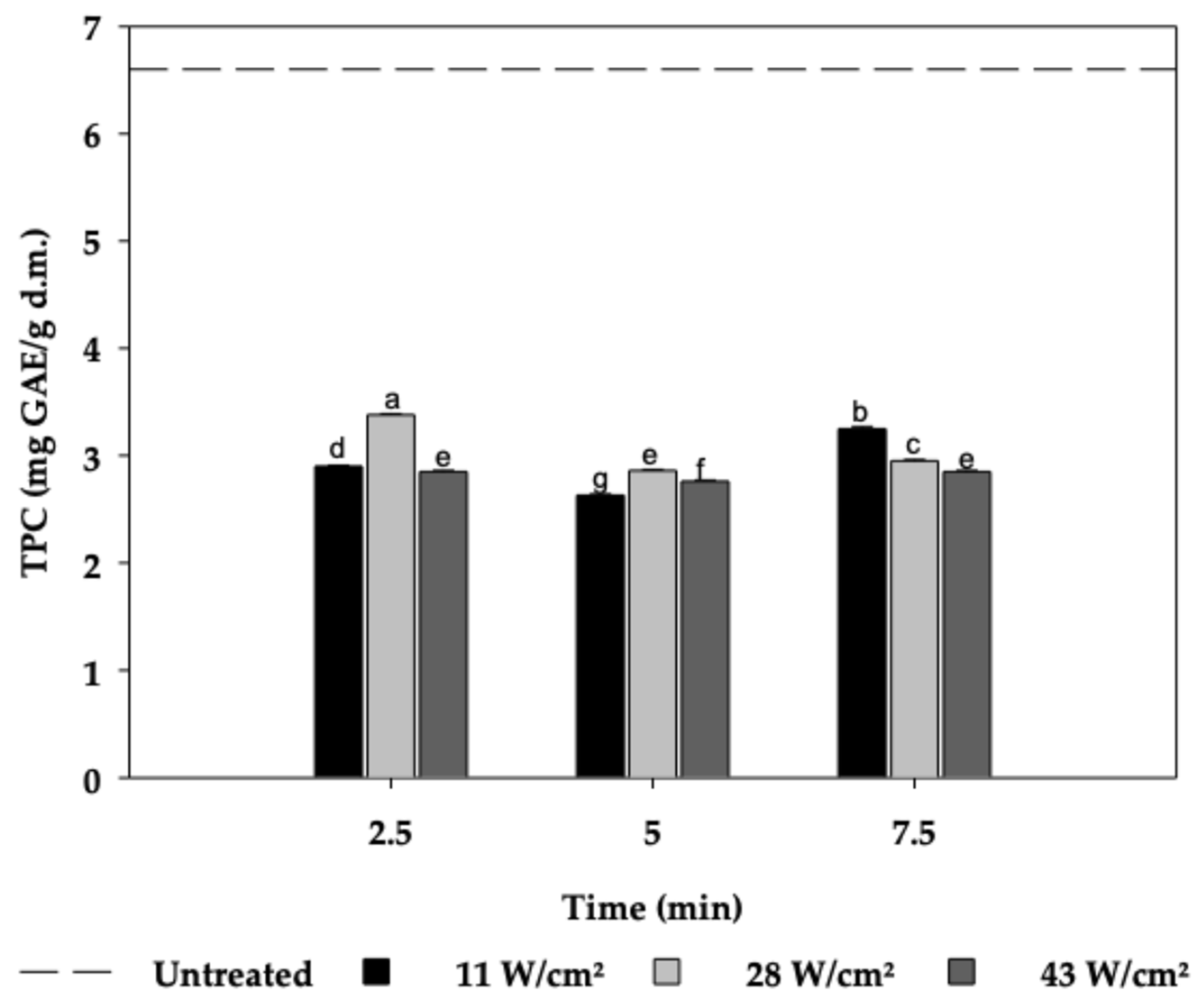
Table 2.
Concentration of phenolic compounds (μg/mg d.m.) identified by HPLC-DAD in Aloe vera gel subjected to ultrasound (US) treatment at different power densities (11, 28, and 43 W/cm2) and processing times (2.5, 5, and 7.5 min).
Table 2.
Concentration of phenolic compounds (μg/mg d.m.) identified by HPLC-DAD in Aloe vera gel subjected to ultrasound (US) treatment at different power densities (11, 28, and 43 W/cm2) and processing times (2.5, 5, and 7.5 min).
| Time | US | Gallic acid | Chlorogenic acid | Vanillic acid | Syringic acid | 2,3-dihydroxybenzoic acid | Ferulic acid | Epicatechin | Ruthin |
|---|---|---|---|---|---|---|---|---|---|
| (min) | (W/cm2) | ||||||||
| 2.5 | 11 | 1.91 | 3.23 | 0.48 | n.d. | 1.19 | 0.17 | 1.07 | n.d. |
| 2.5 | 28 | 2.19 | 3.57 | 0.52 | n.d. | 1.48 | 0.17 | 1.33 | 0.91 |
| 2.5 | 43 | 5.75 | 3.72 | 0.24 | 1.05 | 2.26 | 0.42 | 2.02 | 1.97 |
| 5 | 11 | 2.79 | 3.89 | 0.10 | 3.31 | 2.5 | 0.24 | 0.78 | 1.16 |
| 5 | 28 | 3.33 | 3.67 | 0.25 | 2.76 | 2.61 | 0.35 | 0.23 | 1.62 |
| 5 | 43 | 1.67 | 2.95 | 0.27 | 3.18 | n.d. | 0.39 | 1.77 | 1.38 |
| 7.5 | 11 | 1.31 | 3.12 | 0.29 | 3.34 | n.d | 0.25 | 1.15 | 1.87 |
| 7.5 | 28 | 1.45 | 2.95 | 0.18 | 2.73 | 1.35 | 0.27 | 0.50 | 1.68 |
| 7.5 | 43 | 1.80 | 3.90 | 0.33 | 5.00 | 2.84 | 0.49 | 2.55 | 3.18 |
Results are expressed as mean ± standard deviation (n ≥ 3) in scaled units as indicated for each compound. Different letters within the same column indicate statistically significant differences among treatments (p < 0.05). n.d.: not detected.
3.2. Aloin
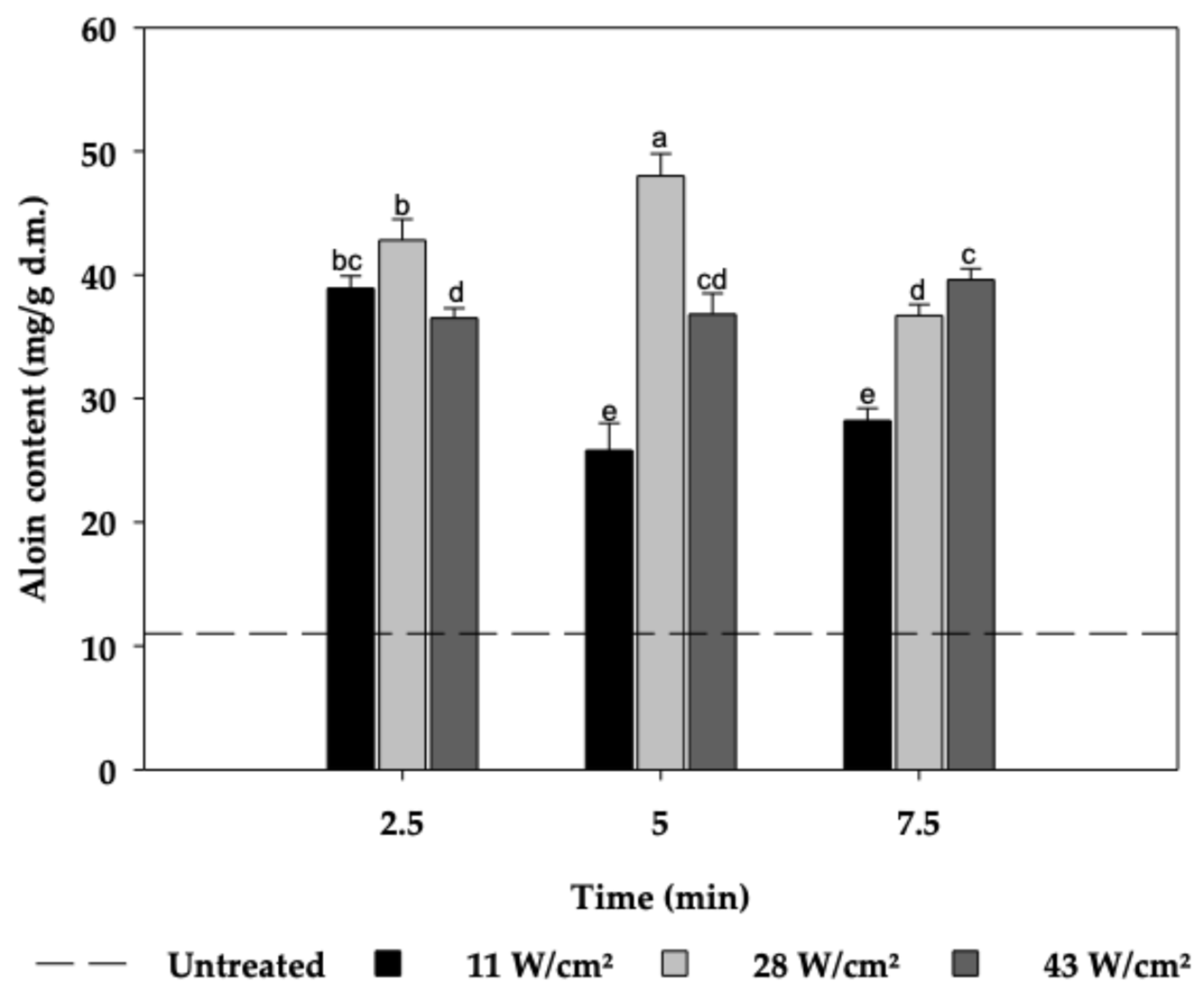
The concentration of aloin present in the different Aloe samples treated with ultrasound is shown in Figure 4. As can be seen, the application of high intensity US promoted significant changes in the Aloin content. In fact, this exhibited a non-linear response to ultrasound processing, reinforcing the concept of a dynamic balance between compound release and degradation. At low intensity (11 W/cm2), aloin decreased with increasing processing time, indicating progressive degradation. This behavior may be attributed to prolonged cavitation exposure leading to structural degradation or transformation of aloin, an anthrone C-glycoside known to be susceptible to hydrolysis and oxidation under energetic conditions. Previous studies indicate that anthraquinones and related glycosides can undergo conversion to aloe-emodin or other derivatives when subjected to intense physicochemical stress, including thermal, acidic, or mechanical treatments [2,29]. Although ultrasound is considered a non-thermal technology, localized hotspots and free radical generation associated with acoustic cavitation may promote similar degradation pathways during extended processing times. At intermediate intensity (28 W/cm2), aloin concentration increased significantly at 5 min, followed by a decrease at 7.5 min, reflecting an optimal extraction range. The increase in aloin content observed at 5 min could be attributed to the improving aloin release from the latex-containing tissues as a consequence of enhanced cell wall disruption and mass transfer promoted by the ultrasound [30,31]. This phenomenon aligns with previous reports showing that moderate intensities of emerging technologies facilitate the liberation of phenolic compounds by disrupting lignocellulosic matrices and vascular bundles where anthraquinones are predominantly localized [32,33]. On the contrary, the marked reduction observed at 7.5 min aligns to the idea of phenolic compounds, including anthraquinones, in Aloe vera and other plant matrices subjected to intensified processing, where excessive energy input results in phenolic breakdown rather than further release [32].
At high intensity (43 W/cm2), aloin content remained relatively constant, suggesting that release and degradation processes occurred simultaneously. Given the known instability and regulatory implications of aloin, these findings highlight the importance of controlling ultrasound conditions to tailor its concentration in Aloe vera-derived products. Anthraquinones such as aloin are known to exhibit limited stability under harsh processing conditions, and regulatory considerations related to anthraquinone content in food and nutraceutical products further emphasize the importance of controlling such treatments [2].
From a food processing perspective, these findings are particularly relevant. Aloin is a bioactive compound with recognized biological activities but also toxicological and regulatory constraints when present above specific thresholds in food products. The ability to modulate aloin concentration through ultrasound intensity and treatment time provides a valuable technological tool to tailor Aloe vera extracts for food applications, either by enhancing aloin recovery for functional ingredients or by reducing its concentration to meet safety requirements. The results confirm that ultrasound processing does not exert a unidirectional effect on aloin content but rather induces a dynamic balance between extraction enhancement and compound degradation. Optimizing ultrasound parameters is therefore critical to harness the functional potential of Aloe vera phenolics while preserving product safety and quality. These findings are in agreement with the broader literature on emerging technologies applied to Aloe vera, which emphasizes the necessity of process optimization to achieve selective recovery of bioactive compounds [32,33].
Figure 4.
Effect of high-intensity ultrasound (HIUS: 11, 28, and 43 W/cm2) and processing time (2.5, 5, and 7.5 min) on aloin content in Aloe vera gel, expressed as mg/g sample. Values are presented as mean ± standard deviation. Different letters indicate statistically significant differences among treatments (p < 0.05).
Figure 4.
Effect of high-intensity ultrasound (HIUS: 11, 28, and 43 W/cm2) and processing time (2.5, 5, and 7.5 min) on aloin content in Aloe vera gel, expressed as mg/g sample. Values are presented as mean ± standard deviation. Different letters indicate statistically significant differences among treatments (p < 0.05).
3.2. Antioxidant Activity and Radical Scavenging Capacity of Aloe vera
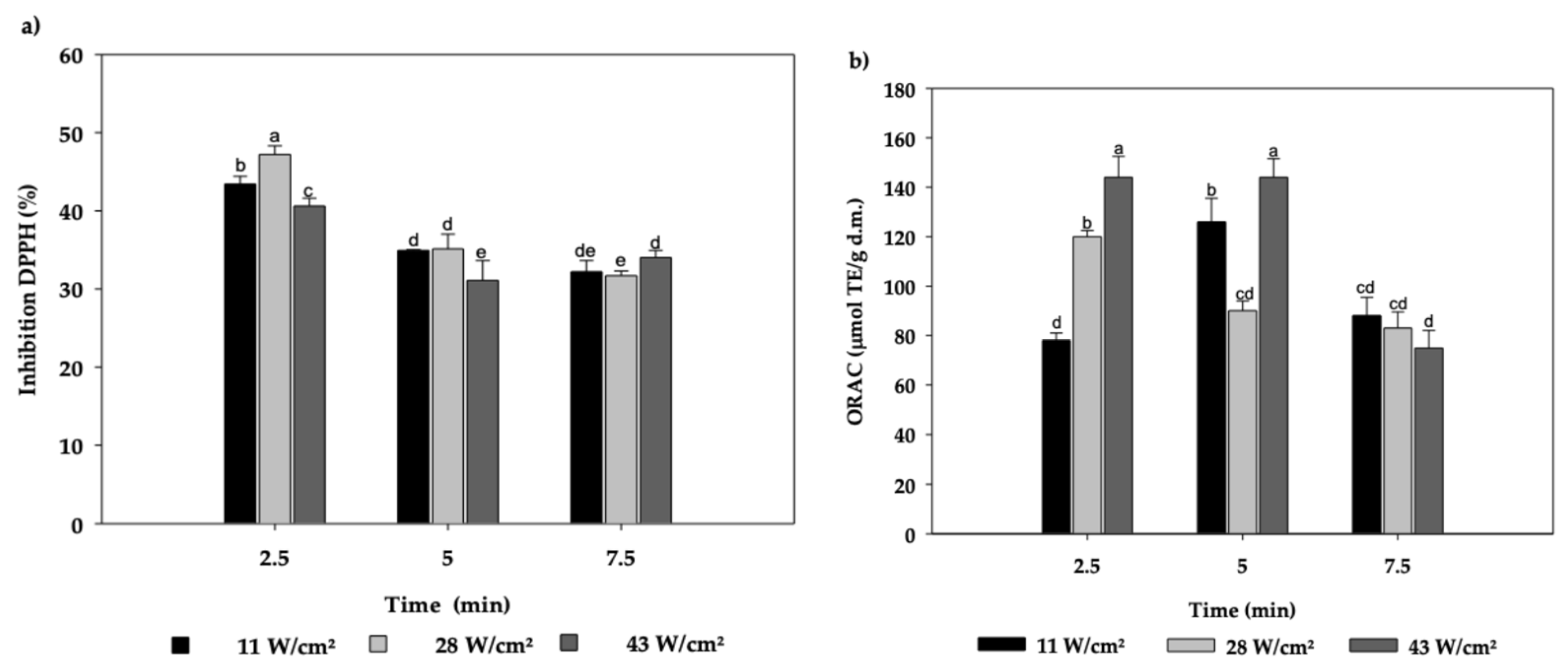
The radical scavenging capacity (RSC) of the Aloe vera juice treated with high intensity ultrasound is shown in Figure 5. The antioxidant response of Aloe vera gel to high-intensity ultrasound (HIUS) exhibited a clear dependence on processing severity, as evidenced by the complementary DPPH and ORAC assays. In agreement with the trends observed for total phenolic content (TPC) and the individual phenolic profile in this study, both assays confirm that antioxidant functionality is also governed by a dynamic balance between cavitation-induced release and degradation of bioactive compounds.
DPPH radical scavenging activity (~31–47%) reached its maximum under moderate conditions (28 W/cm2, 2.5 min), which agrees with the highest TPC. This correlation supports the widely reported role of phenolic compounds as primary contributors to reducing capacity in plant matrices. Similar behavior has been described in ultrasound-treated fruit systems, where moderate acoustic energy enhances the extractability of phenolics through cell wall disruption and increased solvent penetration, resulting in improved DPPH activity [28,31,34]. In Aloe vera, this effect is particularly relevant due to the association of phenolics with the polysaccharide matrix, as previously reported for ultrasound-assisted extraction and processing [7,8]. However, the decrease in DPPH activity observed at longer processing times (≥5 min) indicates that extended cavitation promotes degradation pathways. This behavior is consistent with reports showing that ultrasound can generate reactive oxygen species (ROS) and localized hotspots, which accelerate oxidation and structural breakdown of phenolic compounds [2,32].
In contrast, the ORAC assay showed a broader response (~75–150 µmol TE/g) and a stronger dependence on ultrasound intensity, with maximum values observed at 43 W/cm2, particularly at short processing times. This divergence from DPPH suggests that ORAC captures a wider spectrum of antioxidant compounds, including those acting through hydrogen atom transfer (HAT) mechanisms and exhibiting higher resistance to oxidative degradation. Similar discrepancies between DPPH and ORAC responses have been reported in plant-based systems, where ultrasound selectively enhances the release of different classes of antioxidants depending on their localization and chemical stability [33]. In the present study, the sustained ORAC values at intermediate processing times (5 min) further suggest that some antioxidant compounds, potentially flavonoids or more complex phenolics identified by HPLC-DAD, are less susceptible to degradation than simple phenolic acids.
In general, DPPH and ORAC highlights that HIUS does not uniformly affect antioxidant activity but rather modulates the antioxidant profile in a selective manner. This selectivity could be attributed to differences in compound stability, molecular structure, and interaction with the polysaccharide matrix. Ultrasound-induced depolymerization of acemannan and related polysaccharides, as demonstrated in previous studies [7,15], likely enhances the release of bound phenolics while simultaneously exposing them to oxidative environments. Thus, the observed antioxidant response reflects not only the concentration of released compounds but also their structural integrity and reactivity.
From a mechanistic standpoint, the results align with the dual role of acoustic cavitation. At low-to-moderate processing severity, cavitation bubbles collapse and generate shear forces that disrupt cellular structures, enhancing mass transfer and the liberation of bioactive compounds [26]. This mechanism has been widely recognized as the primary driver of ultrasound-assisted extraction and functional enhancement [7,8]. However, as processing intensity or time increases, secondary effects such as ROS generation, thermal microgradients, and mechanical stress become dominant, promoting degradation reactions that reduce antioxidant capacity [2,26,27,28,32]. This transition explains the decline observed in both DPPH and ORAC at prolonged treatment times (7.5 min), despite continued structural disruption.
Notably, an optimal condition identified in this study (28 W/cm2, 2.5 min) is consistent with the concept of a processing range reported in ultrasound applications, where moderate energy input maximizes functional properties while minimizing degradation [8,26]. This condition ensures sufficient structural modification to enhance phenolic release without exceeding the threshold at which oxidative degradation becomes significant. Similar optimal regimes have been reported in other plant matrices, highlighting the importance of carefully controlling ultrasound parameters to achieve the desired functional properties [28,32,33]. These results validate that HIUS is a powerful tool for modulating the antioxidant properties of Aloe vera, but its effectiveness depends critically on processing conditions. The differential response observed between DPPH and ORAC assays underscores the importance of using complementary analytical approaches to capture the complexity of antioxidant systems. In the context of agro-food valorization, these findings provide valuable insight into the design of ultrasound-assisted processes aimed at maximizing bioactive compound availability while preserving their functional integrity, supporting the development of high-value Aloe vera-based ingredients.
Figure 5.
DPPH radical scavenging activity (%) and Oxygen radical absorbance capacity (ORAC) of Aloe vera gel subjected to ultrasound (US) treatment at different power densities (11, 28, and 43 W/cm²) and processing times (2.5, 5, and 7.5 min). Results are expressed as mean ± standard deviation. Different letters denote statistically significant differences among treatments (p < 0.05).
Figure 5.
DPPH radical scavenging activity (%) and Oxygen radical absorbance capacity (ORAC) of Aloe vera gel subjected to ultrasound (US) treatment at different power densities (11, 28, and 43 W/cm²) and processing times (2.5, 5, and 7.5 min). Results are expressed as mean ± standard deviation. Different letters denote statistically significant differences among treatments (p < 0.05).
5. Conclusions
This study demonstrates that high-intensity ultrasound significantly modifies the structural, functional, and antioxidant properties of Aloe vera gel through cavitation-induced mechanisms. The results reveal a strong interdependence between structural modification, functional performance, and bioactive compound availability. Under moderate ultrasound conditions, controlled depolymerization and reduced viscosity favored the release of phenolic compounds, enhanced antioxidant activity, and improved water retention capacity. In contrast, excessive acoustic intensity or prolonged processing caused over-fragmentation, reducing functional performance and compromising bioactive compound stability. Overall, these findings confirm that the technological and biological properties of Aloe vera gel depend on a balance between structural disruption and molecular stability. Therefore, identifying an optimal ultrasound processing range is essential to maximize the functional, nutritional, and application potential of Aloe vera-based ingredients for food systems.
Author Contributions
Conceptualization, M.A.S.-E. and R.M.-F.; methodology, M.A.S.-E., J.J.M.-G., M.M.-I., M.J.R.-A. and R.M.-F.; software, M.M.-I. and R.M.-F.; validation, M.A.S.-E., A.Q.-R., M.J.R.-A., A.F. and R.M.-F.; formal analysis, M.M.-I., J.J.Q.-R. and R.M.-F.; investigation, M.A.S.-E., M.J.R.-A. and R.M.-F.; resources, M.A.S.-E., J.J.M.-G., J.J.Q.-R., A.Q.-R., M.J.R.-A. and R.M.-F.; data curation, M.A.S.-E., M.M.-I., J.J.Q.-R. and R.M.-F.; writing—original draft preparation, M.A.S.-E. and M.J.R.-A.; writing—review and editing, M.A.S.-E., A.F. and R.M.-F.; visualization, M.M.-I., M.J.R.-A. and R.M.-F.; supervision, J.J.M.-G., M.M.-I., M.J.R.-A. and R.M.-F.; project administration, M.A.S.-E., J.J.Q.-R. and R.M.-F.; funding acquisition, M.A.S.-E. All authors have read and agreed to the published version of the manuscript.
Funding
This research received no external funding.
Institutional Review Board Statement
Not applicable.
Informed Consent Statement
Not applicable.
Data Availability Statement
Data is contained within the article.
Acknowledgments
The authors gratefully acknowledge the financial support provided by the Consejo de Ciencia y Tecnologia del Estado de Durango (COCYTED) under the project “Evaluación de la actividad antimicrobiana de Aloe vera contra fitopatógenos de interés agrícola en el Estado de Durango (Folio 1349)”. During: the preparation of this manuscript, the authors used ChatGPT to improve the language and readability of some paragraphs from manuscript. The authors have reviewed and edited the output and take full responsibility for the content of this publication.
Conflicts of Interest
The authors declare no conflicts of interest.
References
- Pal, P.; Singh, A.K.; Srivastava, R.K.; Rathore, S.S.; Sahoo, U.K.; Subudhi, S.; Sarangi, P.K.; Prus, P. Circular bioeconomy in action: Transforming food wastes into renewable food resources. Foods 2024, 13, 3007. [CrossRef]
- Ushasree, M.V.; Jia, Q.; Do, S.G.; Lee, E.Y. New opportunities and perspectives on biosynthesis and bioactivities of secondary metabolites from aloe vera. Biotechnology Advances 2024, 72, 108325. [CrossRef]
- Rodríguez, E.R.; Martín, J.D.; Romero, C.D. Aloe vera as a functional ingredient in foods. Critical Reviews in Food Science and Nutrition 2010, 50, 305–326. [CrossRef]
- Minjares-Fuentes, J.R.; Femenia, A. Effect of processing on the bioactive polysaccharides and phenolic compounds from aloe vera (aloe barbadensis miller). In Dietary fiber functionality in food and nutraceuticals, Hosseinian, F., Oomah, B.D., Campos-Vega, R., Eds. Wiley Blackwell: Oxford, 2017; pp. 263–287. [CrossRef]
- Zhu, M.; Xiong, W.; Devkota, L.; Dhital, S. Ultrasound-induced changes in the structure and functionality of starch and protein. Food Hydrocoll. 2026, 172, 112111. [CrossRef]
- Torres-Gallo, R.; Andrade-Pizarro, R.; Salcedo, J.; Chávez-Salazar, A.; Castellanos-Galeano, F.J. Optimization of ultrasound-assisted extraction of mango cotyledon starch: Physicochemical, structural, thermal and functional properties. Int. J. Biol. Macromol. 2025, 285, 138239. [CrossRef]
- Alvarado-Morales, G.; Minjares-Fuentes, R.; Contreras-Esquivel, J.C.; Montañez, J.; Meza-Velázquez, J.A.; Femenia, A. Application of thermosonication for aloe vera (aloe barbadensis miller) juice processing: Impact on the functional properties and the main bioactive polysaccharides. Ultrason. Sonochem. 2019, 56, 125–133. [CrossRef]
- Comas-Serra, F.; Eim, V.S.; Minjares-Fuentes, R.; Rodríguez-González, V.M.; Femenia, A. Cellulose-rich polysaccharide extracts with gel-forming potential and improved antioxidant properties from stem (vitis vinifera l.) by-products: Ultrasound-assisted aqueous extraction and characterization. Gels 2026, 12, 154. [CrossRef]
- Femenia, A.; Robertson, J.A.; Waldron, K.W.; Selvendran, R.R. Cauliflower (brassica oleracea l), globe artichoke (cynara scolymus) and chicory witloof (cichorium intybus) processing by-products as sources of dietary fibre. J. Sci. Food Agric. 1998, 77, 511–518. [CrossRef]
- Minjares-Fuentes, R.; Medina-Torres, L.; González-Laredo, R.F.; Rodríguez-González, V.M.; Eim, V.; Femenia, A. Influence of water deficit on the main polysaccharides and the rheological properties of aloe vera (aloe barbadensis miller) mucilage. Ind. Crops Prod. 2017, 109, 644–653. [CrossRef]
- Comas-Serra, F.; Martínez-García, J.J.; Pérez-Alba, A.; Sáenz-Esqueda, M.d.l.Á.; Candelas-Cadillo, M.G.; Femenia, A.; Minjares-Fuentes, R. A new functional food ingredient obtained from aloe ferox by spray drying. Foods 2023, 12. [CrossRef]
- González-Delgado, M.; Minjares-Fuentes, R.; Mota-Ituarte, M.; Pedroza-Sandoval, A.; Comas-Serra, F.; Quezada-Rivera, J.J.; Sáenz-Esqueda, Á.; Femenia, A. Joint water and salinity stresses increase the bioactive compounds of aloe vera (aloe barbadensis miller) gel enhancing its related functional properties. Agric. Water Manag. 2023, 285, 108374. [CrossRef]
- Ou, B.; Hampsch-Woodill, M.; Prior, R.L. Development and validation of an improved oxygen radical absorbance capacity assay using fluorescein as the fluorescent probe. J. Agric. Food Chem. 2001, 49, 4619–4626. [CrossRef]
- Moreira, T.A.; Abreu, C.M.R.; Coelho, J.F.J.; Dalmaschio, C.J. Effects of ultrasonic processing on the structural properties and chain scission of the acemannan biopolymer. Journal of Polymers and the Environment 2025, 33, 4286–4297. [CrossRef]
- Chokboribal, J.; Tachaboonyakiat, W.; Sangvanich, P.; Ruangpornvisuti, V.; Jettanacheawchankit, S.; Thunyakitpisal, P. Deacetylation affects the physical properties and bioactivity of acemannan, an extracted polysaccharide from aloe vera. Carbohydr. Polym. 2015, 133, 556–566. [CrossRef]
- Medina-Torres, L.; Brito-De La Fuente, E.; Torrestiana-Sanchez, B.; Katthain, R. Rheological properties of the mucilage gum (opuntia ficus indica). Food Hydrocoll. 2000, 14, 417–424. [CrossRef]
- Medina-Torres, L.; Calderas, F.; Minjares, R.; Femenia, A.; Sánchez-Olivares, G.; Gónzalez-Laredo, F.R.; Santiago-Adame, R.; Ramirez-Nuñez, D.M.; Rodríguez-Ramírez, J.; Manero, O. Structure preservation of aloe vera (barbadensis miller) mucilage in a spray drying process. LWT - Food Sci. Technol. 2016, 66, 93–100. [CrossRef]
- Cervantes-Martínez, C.V.; Medina-Torres, L.; González-Laredo, R.F.; Calderas, F.; Sánchez-Olivares, G.; Herrera-Valencia, E.E.; Gallegos Infante, J.A.; Rocha-Guzman, N.E.; Rodríguez-Ramírez, J. Study of spray drying of the aloe vera mucilage (aloe vera barbadensis miller) as a function of its rheological properties. LWT - Food Sci. Technol. 2014, 55, 426–435. [CrossRef]
- Morris, E.R.; Cutler, A.N.; Ross-Murphy, S.B.; Rees, D.A.; Price, J. Concentration and shear rate dependence of viscosity in random coil polysaccharide solutions. Carbohydr. Polym. 1981, 1, 5–21. [CrossRef]
- Fu, J.; Fu, X.; Wang, P.; Fu, Y.; Chen, C. Ultrasonic degradation of dendrobium officinale polysaccharide: Kinetics, structural modification, and its impact on wheat starch digestibility. Food Res. Int. 2026, 231, 118776. [CrossRef]
- Gan, J.; Xie, L.; Peng, G.; Xie, J.; Chen, Y.; Yu, Q. Systematic review on modification methods of dietary fiber. Food Hydrocoll. 2021, 119, 106872. [CrossRef]
- Li, X.; Qi, B.; Zhang, S.; Li, Y. Effects of ultrasonic treatment on the structural and functional properties of cactus (opuntia ficus-indica) seed protein. Ultrason. Sonochem. 2023, 97, 106465. [CrossRef]
- González-Centeno, M.R.; Comas-Serra, F.; Femenia, A.; Rosselló, C.; Simal, S. Effect of power ultrasound application on aqueous extraction of phenolic compounds and antioxidant capacity from grape pomace (vitis vinifera l.): Experimental kinetics and modeling. Ultrason. Sonochem. 2015, 22, 506–514. [CrossRef]
- González-Centeno, M.R.; Knoerzer, K.; Sabarez, H.; Simal, S.; Rosselló, C.; Femenia, A. Effect of acoustic frequency and power density on the aqueous ultrasonic-assisted extraction of grape pomace (vitis vinifera l.) – a response surface approach. Ultrason. Sonochem. 2014, 21, 2176–2184. [CrossRef]
- Gil-Martín, E.; Forbes-Hernández, T.; Romero, A.; Cianciosi, D.; Giampieri, F.; Battino, M. Influence of the extraction method on the recovery of bioactive phenolic compounds from food industry by-products. Food Chem. 2022, 378, 131918. [CrossRef]
- Nipornram, S.; Tochampa, W.; Rattanatraiwong, P.; Singanusong, R. Optimization of low power ultrasound-assisted extraction of phenolic compounds from mandarin (citrus reticulata blanco cv. Sainampueng) peel. Food Chem. 2018, 241, 338–345. [CrossRef]
- Wang, X.; Liu, X.; Shi, N.; Zhang, Z.; Chen, Y.; Yan, M.; Li, Y. Response surface methodology optimization and hplc-esi-qtof-ms/ms analysis on ultrasonic-assisted extraction of phenolic compounds from okra (abelmoschus esculentus) and their antioxidant activity. Food Chem. 2023, 405, 134966. [CrossRef]
- Wang, J.; Wang, J.; Ye, J.; Vanga, S.K.; Raghavan, V. Influence of high-intensity ultrasound on bioactive compounds of strawberry juice: Profiles of ascorbic acid, phenolics, antioxidant activity and microstructure. Food Control 2019, 96, 128–136. [CrossRef]
- Canche-Escamilla, G.; Colli-Acevedo, P.; Borges-Argaez, R.; Quintana-Owen, P.; May-Crespo, J.F.; Cáceres-Farfan, M.; Yam Puc, J.A.; Sansores-Peraza, P.; Vera-Ku, B.M. Extraction of phenolic components from an aloe vera (aloe barbadensis miller) crop and their potential as antimicrobials and textile dyes. Sustainable Chemistry and Pharmacy 2019, 14, 100168. [CrossRef]
- Korobiichuk, I.; Mel’nick, V.; Ostapenko, Z.; Ruzhinska, L. Study of heat and mass transfer processes during extraction of plant raw materials under the influence of ultrasound. Ultrason. Sonochem. 2023, 98, 106512. [CrossRef]
- Shehzadi, F.; Shoaib, M.; Munir, S.; Abdi, G. Ultrasound-assisted extraction of bioactive compounds from pomegranate peel and seed: A comprehensive review of key parameters and optimization strategies. Ultrason. Sonochem. 2026, 124, 107722. [CrossRef]
- Akbari, S.; Abdurahman, N.H.; Yunus, R.M.; Alsaggaf, A.H.A.; Ahmed, N. Lc-qtof-ms analysis of phenolics and saponins extracted from aloe vera leaves via microwave technology in optimal condition. S. Afr. J. Bot. 2021, 139, 362–373. [CrossRef]
- Nandi, S.; Majumdar, G.; Mandal, S. Phytochemical profiles, biological activities and medicinal importance of aloe vera l.: A review. Journal of Holistic Integrative Pharmacy 2025, 6, 251–262. [CrossRef]
- Wang, J.; Vanga, S.K.; Raghavan, V. High-intensity ultrasound processing of kiwifruit juice: Effects on the ascorbic acid, total phenolics, flavonoids and antioxidant capacity. LWT 2019, 107, 299–307. [CrossRef]
Disclaimer/Publisher’s Note: The statements, opinions and data contained in all publications are solely those of the individual author(s) and contributor(s) and not of MDPI and/or the editor(s). MDPI and/or the editor(s) disclaim responsibility for any injury to people or property resulting from any ideas, methods, instructions or products referred to in the content. |
© 2026 by the authors. Licensee MDPI, Basel, Switzerland. This article is an open access article distributed under the terms and conditions of the Creative Commons Attribution (CC BY) license (http://creativecommons.org/licenses/by/4.0/).
Copyright: This open access article is published under a Creative Commons CC BY 4.0 license, which permit the free download, distribution, and reuse, provided that the author and preprint are cited in any reuse.


