

Submitted:
19 May 2026
Posted:
20 May 2026
You are already at the latest version
Abstract
Greenhushing—the deliberate under-communication of genuine sustainability achievements —has been examined almost exclusively from an organizational standpoint, leaving the consumer side of the phenomenon largely undertheorized. This study investigates how perceived greenhushing, defined as a consumer’s perception that a brand deliberately withholds information about its environmental performance, affects young consumers’ green purchase intention. Drawing on signaling theory, trust–commitment theory and attribution theory, a model is developed in which brand trust, perceived risk and consumer green skepticism jointly mediate the relationship between perceived greenhushing and green purchase intention, while environmental concern and trait-level green skepticism are positioned as moderators. The model is estimated with partial least squares structural equation modeling (PLS-SEM) on a sample of 404 young consumers in Vietnam. Perceived greenhushing significantly erodes brand trust (β = −0.535), elevates perceived risk (β = 0.571) and activates consumer green skepticism (β = 0.477). Among the three mediators, brand trust is the dominant pathway to green purchase intention (β = 0.444), whereas the skepticism pathway is non-significant (p = 0.093). The direct effect of perceived greenhushing on green purchase intention remains negative and significant (β = −0.152), indicating partial mediation. The findings extend signaling theory to the under-studied domain of communicative absence, sharpen the conceptual boundary between greenwashing and greenhushing at the consumer level, and offer specific guidance for sustainability communication in emerging-market consumer settings.
Keywords:
greenhushing
; perceived greenhushing
; brand trust
; perceived risk
; green skepticism
; green purchase intention
; signaling theory
; PLS-SEM
; sustainability communication
; young consumers
1. Introduction
Sustainability communication has become a central, and increasingly contested, element of the modern brand–consumer relationship. As stakeholders pressure firms to demonstrate environmental responsibility, two opposing communicative pathologies have come to dominate the marketing discourse. On one side stands greenwashing, the practice of exaggerating or fabricating environmental credentials to project a green image disconnected from actual performance [1,2,3,4]. On the other side, and far less examined, stands its mirror image: greenhushing, the strategic decision to under-communicate or remain silent about genuine sustainability achievements [5,6,7,8]. The two practices share a common consequence—a misalignment between firm conduct and firm voice—but reverse the direction of distortion. Where greenwashing inflates the signal, greenhushing suppresses it.
Greenhushing has moved from a marginal curiosity to a documented strategic phenomenon. Recent industry observations suggest that a non-trivial share of corporations now deliberately limit external sustainability communication out of fear of legal exposure, accusations of greenwashing, or politicized backlash, and the prevalence of such silence appears to be rising rather than falling [7,9]. Scholarly attention has, accordingly, begun to shift. Recent qualitative and conceptual contributions characterize greenhushing as an intentional withdrawal driven by ambiguity, legal caution, and the desire to avoid hypocrisy accusations [6,8,10,11], and a nascent body of cross-cultural and financial-market work has begun to explore its organizational antecedents and outcomes [12,13,14]. However, this literature has remained almost exclusively organization-centric. It explains why firms become silent; it has very little to say about what happens after the silence is heard.
This silence on the consumer side is theoretically and managerially troubling. Consumers are not passive recipients of corporate communication; they are signal-sensitive agents who assign meaning to the presence, the content, and—importantly—the absence of brand messages [15,16,17,18]. When a brand that operates in a category saturated by sustainability claims fails to articulate any environmental position, that omission itself constitutes a signal. Whether consumers read it as modesty, as concealment, or as evidence of poor environmental performance remains, at present, an empirical black box. A small but suggestive recent literature on corporate silence in adjacent domains—silence on social issues [19], withheld certification status [10], and post-purchase non-disclosure of green attributes [20]—consistently finds that consumers do not interpret silence neutrally. The absence of communication is processed, evaluated, and acted upon.
Three theoretical gaps motivate the present study. First, the consumer-level construct of perceived greenhushing has not been formally conceptualized or empirically operationalized in survey research. Where greenwashing perception has been measured by multi-item reflective scales for over a decade [21,22,23], the analogous construct for under-communication has remained absent. Second, the psychological mechanisms linking perceived sustainability silence to behavioral outcomes have not been jointly modeled. Trust erosion [24,25,26], risk amplification [21,27], and skepticism activation [28,29,30,31] have each been studied in greenwashing contexts, but their relative weights in the greenhushing context—in which the stimulus is communicative absence rather than misleading communication—remain untested. Third, while greenwashing and greenhushing are now routinely treated as conceptual siblings, the consumer-side mechanism by which they generate parallel or divergent responses has not been empirically distinguished. The present study is, to our knowledge, the first to address these three gaps within a single integrated empirical model.
To address these gaps, this study pursues three objectives. First, it conceptualizes perceived greenhushing as a consumer-perceived construct and operationalizes it through a multi-item reflective scale grounded in the existing greenhushing and greenwashing literatures. Second, it examines the direct effect of perceived greenhushing on green purchase intention among young consumers, who constitute the demographic segment most actively monitoring brand sustainability behavior [32,33]. Third, it tests three competing psychological mechanisms—brand trust, perceived risk and consumer green skepticism—as parallel mediators, and explores the boundary conditions imposed by environmental concern and trait-level green skepticism. The model is estimated on a sample of 404 young consumers in Vietnam using PLS-SEM, an approach increasingly preferred for theory-building studies in consumer behaviour where the focus is on prediction and the explanation of target constructs [34,35,36].
Three contributions follow from these efforts. Theoretically, the study extends signaling theory to the consumer-level processing of communicative absence, integrates it with trust–commitment and attribution mechanisms, and clarifies the boundary between greenwashing perception and greenhushing perception. Methodologically, it provides an initial operationalization of perceived greenhushing that demonstrates acceptable reliability and discriminant validity, opening the construct to further refinement and cross-cultural validation. Managerially, it documents that brand silence is not a safe communicative posture: among young consumers, perceived greenhushing reduces green purchase intention chiefly because it erodes brand trust, and the effect persists even after the mediated pathways are accounted for.
The remainder of the paper is organized as follows. Section 2 reviews the literatures on greenhushing, on sustainability communication and trust, and on the consumer psychology of skepticism and perceived risk. Section 3 develops the hypotheses and presents the conceptual model. Section 4 describes the research design, including measurement, sampling and analytical procedures. Section 5 reports the empirical results. Section 6 discusses the findings, draws theoretical and practical implications, acknowledges the limitations and outlines avenues for future research.
2. Literature Review
2.1. Research on Greenhushing
The concept of greenhushing was introduced by Font, Elgammal and Lamond [5] to describe “the deliberate under-communicating of sustainability practices” by tourism businesses—firms that engage in substantial environmental action but selectively choose to keep that action private. Subsequent work has retained the core idea and extended it across sectors. Falchi and colleagues [6] systematized the drivers of under-communication, identifying legal caution, fear of greenwashing accusations, and complexity of the issues as primary explanations. Carlos and Lewis [10] demonstrated that firms strategically withhold certification status as a hypocrisy avoidance tactic, particularly when their substantive performance might invite scrutiny relative to the standards their public communication would imply. More recent contributions have moved beyond Western tourism and certification contexts. Tao [12] compared Chinese and South Korean corporations and showed that greenhushing is intertwined with national institutional environments. Khan and colleagues [7] provided an empirical account of how and why organizations enact greenhushing, while Huang et al. [11] introduced the notion of conditional silence, in which the choice to under-communicate is moderated by organizational status. Boiral and colleagues [8] examined sustainability silence narratives in the agri-food industry and traced them to the ambiguity inherent in communication on complex sustainability issues. A complementary stream, exemplified by Guercini et al. [9], has begun to map the under-communication of sustainability in digital environments, where silence is increasingly conspicuous because alternative communicative behaviours are so visible.
A second, smaller stream has begun to address the financial-market consequences of greenhushing. Cheng et al. [13] reported a positive association between corporate greenhushing and stock price crash risk in China, while Hilton [14] offered an integrated analysis of the phenomenon for innovation and green development. Dias and colleagues [37] provided a systematic review of the literature on green “under-communication” and concluded, among other things, that “not communicating is seen more favorably than communicating in a wrong or misleading way” by some consumer segments—a finding that simultaneously highlights the absence of empirical work on how consumers actually process sustainability silence.
What this body of research consistently lacks is a consumer-level construct. The studies cited above explain why firms become silent and what it costs them in the capital market. None examines whether and how consumers perceive that silence, what attributions they make, or how those attributions translate into behavioural intentions. The present study addresses this absence directly by introducing perceived greenhushing as a consumer-level reflective construct.
2.2. Sustainability Communication, Transparency and Brand Trust
Sustainability communication research has produced a robust body of evidence that communicating CSR effectively—and in particular communicating it transparently—enhances brand trust, brand equity and consumer responses [24,38,39,40,41]. Kang and Hustvedt [26] demonstrated that perceptions of transparency mediate the relationship between corporate CSR efforts and consumer trust, and Liu et al. [42] confirmed that transparency-based CSR offers a competitive advantage under specifiable conditions. Underlying this literature is the implicit assumption that firms do communicate; the principal empirical questions concern how communication content, channel and tone shape consumer reception [38,43]. Studies that have problematized the absence of communication have approached the question chiefly from the firm side [6,8,10], rather than the consumer side.
The trust mechanism on which this study builds is grounded in commitment–trust theory [25], which posits that trust is generated when relational partners perceive each other as benevolent, honest and reliable. Chaudhuri and Holbrook [44] formalized brand trust as a precursor of brand performance and loyalty, while Pivato et al. [45] and Hur et al. [46] traced the chain from CSR engagement to brand trust to brand equity in consumer goods contexts. Adapted to sustainability, Chen [27] introduced green brand trust and showed that it mediates the effects of green brand image and green satisfaction on green brand equity. Two findings recur throughout this literature: (a) brand trust in the sustainability domain is fragile and slow to rebuild; and (b) it is highly sensitive to perceived inconsistency or opacity in firm communication [21,26,42]. The implication—untested for greenhushing—is that strategic silence should be a particularly effective vector of trust erosion, since it leaves consumers without the very signals on which trust judgements are typically anchored.
2.3. Greenwashing Perception and Consumer Skepticism
The greenwashing literature is the closest empirical analogue to the present study. Perceived greenwashing has been operationalized as a consumer-level reflective construct for over a decade [21,22,23] and has been linked to a wide set of downstream consumer responses—reduced green trust, elevated green perceived risk, reduced purchase intention, and increased word-of-mouth penalties [27,47,48,49,50]. Importantly for the present argument, perceived greenwashing has consistently been shown to activate green skepticism—a generalized disposition to disbelieve corporate environmental claims [28,29,30,51,52]. Green skepticism, in turn, has been shown to suppress green purchase behaviour both directly and through reductions in environmental concern and knowledge [31].
The greenwashing–skepticism mechanism rests on attribution theory: when consumers encounter ambiguous corporate behaviour, they infer motives, and when the inferred motive is egoistic or self-serving, skepticism intensifies [29,53,54]. The same logic applies—arguably more strongly—to greenhushing. Silence is more ambiguous than speech and therefore invites a wider distribution of attributions, including the inference that the firm has something to hide. Whether perceived greenhushing produces the same magnitude of skepticism activation as perceived greenwashing, however, is an open empirical question that the present study addresses.
2.4. Information Voids and Perceived Risk
A third stream of relevant work concerns perceived risk in green purchase decisions. Green perceived risk was introduced by Chen and Chang [21], who defined it as “the expectation of negative environmental consequences associated with purchase behaviour” and showed that it mediates the impact of greenwashing on green trust. Subsequent work [20,49] has confirmed that elevations in environmental uncertainty translate into reduced consumer confidence in green positioning. Green products belong to the credence-attribute category: their environmental quality cannot be readily verified before or even after purchase [18,55], and consumers therefore rely on signals to discount their decision-making risk. When those signals are absent—as in the greenhushing condition—the credence problem is not resolved but amplified. Perceived risk is therefore a plausible second mediator between perceived greenhushing and reduced green purchase intention.
2.5. Research Gap
Three observations from the foregoing literature define the gap that this study addresses. First, while greenhushing has been investigated as an organizational and financial phenomenon, no published study has empirically examined how consumers perceive and respond to it. Second, while the relevant consumer-psychology mechanisms—brand trust, perceived risk and green skepticism—are individually well documented, they have not been jointly modeled in the context of communicative absence. Third, while environmental concern and trait-level skepticism have been identified as boundary conditions for greenwashing effects [47,51,56], their role in shaping consumer responses to greenhushing has not been tested. The present study is designed to fill these three theoretical gaps within a single integrative model.
3. Theoretical Background and Hypotheses Development
3.1. Theoretical Framework
The study integrates three complementary theoretical streams. Signaling theory [15,16,17] supplies the upstream mechanism: under information asymmetry, observable firm behaviour functions as a signal of unobservable quality, and the absence of expected signals is itself informative. Trust–commitment theory [25,44] supplies the downstream mechanism that links the signal to behaviour: brand trust mediates the impact of communicative cues on purchase-related intentions. Attribution theory [29,53,54] supplies a parallel cognitive pathway, in which consumers assign motives to ambiguous brand behaviour and reach behavioural conclusions through inference rather than direct trust judgement. Together, these three streams support a model in which perceived greenhushing produces parallel mediated effects through trust erosion, risk elevation and skepticism activation, each with its own theoretical pedigree and empirical signature.
3.2. Perceived Greenhushing and Brand Trust
Brand trust requires consumers to feel that a brand is willing to disclose what is relevant about itself and that its disclosures are reliable [24,25,26]. When a brand operates in a category in which sustainability is salient—fashion, personal care, food—consumers expect at least some communication about environmental performance [38,40,42]. Strategic silence violates that expectation. Under signaling theory, the absence of expected signals is interpreted as a meaningful, and often negative, signal [15,17]: it suggests either that the firm has nothing to communicate, or that it has something to hide. Either inference erodes the trust that allows consumers to extend brand benefit-of-the-doubt under uncertainty.
H1. Perceived greenhushing is negatively associated with brand trust.
Brand trust, in turn, is a robust antecedent of purchase intention in green and conventional contexts alike [27,44,57]. Consumers who trust a brand are more willing to extend its claims to unobservable attributes, and they bear the credence risk of green purchase more comfortably.
H2. Brand trust is positively associated with green purchase intention.
The joint operation of H1 and H2 produces a mediated pathway.
H3. Brand trust mediates the negative effect of perceived greenhushing on green purchase intention.
3.3. Perceived Greenhushing and Perceived Risk
Green products are credence goods, and their environmental quality cannot be directly verified by the consumer [18,21,55]. Communication serves, in part, to substitute for verification: by providing detailed sustainability information, firms reduce the consumer’s residual uncertainty about whether the product will deliver the environmental benefits implied by its positioning. When a brand declines to provide such information, the credence problem is amplified rather than resolved. Information-processing accounts suggest that consumers facing such voids elevate their estimates of decision risk, particularly the functional and psychological components of risk associated with environmental purchases [20,21,49].
H4. Perceived greenhushing is positively associated with perceived risk.
Elevations in perceived risk in turn suppress green purchase intention by raising the expected cost of an incorrect decision [20,21,57].
H5. Perceived risk is negatively associated with green purchase intention.
H6. Perceived risk mediates the effect of perceived greenhushing on green purchase intention.
3.4. Perceived Greenhushing and Consumer Green Skepticism
Attribution theory predicts that ambiguous corporate behaviour invites consumer inference about underlying motives [29,53,54,58]. Sustainability silence is precisely the sort of ambiguous behaviour that invites such inference, and one of the most readily available inferences is that the brand has nothing to communicate because it has nothing substantive to communicate—an inference that activates green skepticism [28,30,31]. This mechanism is consistent with the persuasion-knowledge model [53,59], under which consumers become alert to potential manipulation when corporate communication appears inconsistent with available cues. Importantly, the skepticism activated here is context-specific: it is skepticism about the focal brand’s environmental claims, distinct from the trait-level disposition that consumers carry into the interaction.
H7. Perceived greenhushing is positively associated with consumer green skepticism.
Activated skepticism, in turn, suppresses green purchase intention by reducing the perceived authenticity of the brand’s environmental positioning [28,29,31].
H8. Consumer green skepticism is negatively associated with green purchase intention.
H9. Consumer green skepticism mediates the effect of perceived greenhushing on green purchase intention.
3.5. Direct Effect
Beyond the three mediated pathways, perceived greenhushing may exert a residual direct effect on green purchase intention that is not fully captured by trust, risk or skepticism. Consumers may simply prefer not to engage with brands they perceive as opaque, irrespective of any particular psychological mediator [22,23]. The direct path is therefore retained.
H10. Perceived greenhushing is negatively associated with green purchase intention.
3.6. Moderating Roles
Two moderators are theorized. First, environmental concern represents the consumer’s degree of involvement with environmental issues and consistently amplifies the effect of green communication cues [47,56]. Consumers with high environmental concern are expected to hold stronger prior expectations of sustainability transparency, so that perceived greenhushing should erode their trust more sharply than that of less concerned consumers.
H11. Environmental concern moderates the effect of perceived greenhushing on brand trust.
Second, trait-level green skepticism represents a stable individual disposition to doubt corporate environmental claims [51,52,60]. Consumers high on this trait already process new environmental stimuli through a skeptical filter, and they are therefore expected to translate perceived greenhushing into context-specific skepticism more readily than less skeptical consumers.
H12. Trait-level green skepticism moderates the effect of perceived greenhushing on consumer green skepticism.
The full set of relationships is summarized as the structural model in Figure 1. To preserve parsimony and statistical power, the moderating relationships are tested as single-path moderations on the most theoretically defensible link in each case (H11 on PGH→BT; H12 on PGH→CGS) rather than across the full network.
4. Methodology
4.1. Research Design and Sampling
The study employs a cross-sectional online survey of young consumers in Vietnam. The young-consumer segment was chosen for two reasons. First, it is the demographic group most engaged with sustainability content and most likely to monitor brand environmental claims actively [32,33,48]. Second, Vietnam represents an emerging-market consumer setting in which green purchase intention has become a salient research topic but in which the role of communicative absence has not been investigated. To ensure sample relevance, the study restricted participation to respondents born between 1997 and 2012, currently residing or studying in Vietnam, and with prior experience of considering or purchasing a product advertised as environmentally friendly. Recruitment was conducted online through social media and student-network channels.
The questionnaire was administered in Vietnamese after a forward–back translation procedure conducted by two independent translators with marketing-research training; a small pilot () confirmed item comprehension. After the three screening questions, respondents were presented with a hypothetical scenario describing a familiar consumer brand (in fashion, food or personal care) that sells environmentally positioned products but rarely or never communicates specific sustainability practices or certifications. Respondents were then asked to evaluate the focal brand on the seven multi-item scales described below. Demographic information was collected at the end of the questionnaire, after all substantive measures, to reduce priming effects.
After screening, 404 usable responses were retained for analysis. This sample size comfortably exceeds the minimum recommended for PLS-SEM in models of the present complexity, where the most demanding rule of thumb requires ten times the largest number of structural paths pointing at any one construct [34,35].
4.2. Measurement
All substantive constructs were measured with multi-item reflective scales on a 7-point Likert format anchored at “Strongly disagree” (1) and “Strongly agree” (7). Items were adapted from established sources and rephrased to fit the greenhushing scenario.
Perceived greenhushing (PGH) was operationalized through five items developed for this study and informed by the conceptual treatment in Font et al. [5], Falchi et al. [6] and the greenwashing-perception scales of Chen and Chang [21] and Szabo and Webster [23]. Example items: “This brand does not provide enough information about its environmental actions”; “This brand hides its sustainability activities from consumers.” Brand trust (BT) was measured by five items adapted from Morgan and Hunt [25], Chaudhuri and Holbrook [44] and Chen [27]. Perceived risk (PR) was measured by five items adapted from Chen and Chang’s [21] green-perceived-risk scale. Consumer green skepticism (CGS), the context-specific skepticism triggered by the focal brand, was measured by four items adapted from Skarmeas and Leonidou [29] and Mohr et al. [30]. Green purchase intention (GPI) was measured by four items adapted from Joshi and Rahman [61] and Paul et al. [62]. Environmental concern (EC) was measured by four items adapted from established environmental-concern instruments [47,56]. Trait-level green skepticism (GS) was measured by four items adapted from Mohr et al. [30] and Matthes and Wonneberger [51].
4.3. Procedural Remedies for Common Method Bias
Following Podsakoff et al. [63], several procedural remedies were implemented at the design stage. Respondent anonymity was emphasized in the introductory text, the substantive scales were physically separated by section breaks and short transitional instructions, and the items within each scale were randomized in display order. Items were phrased concisely and pre-tested for ambiguity in the pilot. Demographic items were placed at the end of the instrument. These remedies were complemented by two statistical tests reported in Section 5.3.
4.4. Data Analysis
The model was estimated by partial least squares structural equation modeling (PLS-SEM) using the seminr package [36] in R. PLS-SEM was selected because the model contains a newly operationalized construct (PGH), tests a relatively complex network of direct and mediated paths, and is oriented toward prediction and theory-building rather than theory confirmation—conditions under which PLS-SEM is generally preferred over covariance-based SEM [34,35]. Reflective measurement was specified for all constructs. The measurement model was evaluated through outer loadings, internal consistency reliability (Cronbach’s and composite reliability), convergent validity (average variance extracted), and discriminant validity (HTMT ratio) [64,65]. The structural model was evaluated through path coefficients, coefficient of determination (), effect size (), and bootstrapped confidence intervals. Bootstrapping was performed with 5,000 resamples and a fixed seed for reproducibility. Indirect effects were computed as the product of relevant path coefficients, with bootstrapped percentile confidence intervals.
5. Empirical Results and Analysis
5.1. Sample Characteristics
After the three screening questions—age cohort (born 1997–2012), Vietnamese residency, and prior consideration or purchase of a green product—the final analytic sample comprised 404 respondents. The sample is balanced across gender and education levels, distributed across northern, central and southern Vietnam, and skewed toward respondents with modest monthly consumer spending, which is consistent with the young-consumer focus.
5.2. Measurement Model
Cronbach’s for all constructs exceeded the conventional 0.70 threshold, with values of 0.903 for PGH, 0.867 for BT, 0.867 for PR, 0.860 for CGS, 0.900 for GPI, 0.879 for EC and 0.888 for GS. Composite reliability () values were correspondingly high (0.929, 0.910, 0.918, 0.905, 0.930, 0.851 and 0.922 respectively), and average variance extracted (AVE) exceeded the 0.50 benchmark for every construct (0.722, 0.717, 0.790, 0.705, 0.769, 0.662 and 0.747 respectively). Convergent validity is thus supported.
The outer loadings reported in Table 1 are all above the 0.70 minimum recommended for reflective indicators [35], with a single exception: item EC2 loaded at 0.596 on its parent construct. The item was retained because (a) the construct already exhibits a CR of 0.851 and an AVE of 0.662, both of which exceed the corresponding thresholds, and (b) removing the item would not materially alter discriminant validity. The retention is acknowledged as a measurement-model limitation in Section 6.3. Several items in earlier scale versions (BT1, PR4, PR5, EC1) were removed during the iterative purification process described in the data-analysis pipeline; the final model retains a parsimonious 27-item set.

Table 2.
Reliability and convergent validity.
| Construct | Cronbach’s | Composite reliability () | AVE |
|---|---|---|---|
| PGH | 0.904 | 0.929 | 0.722 |
| BT | 0.868 | 0.910 | 0.717 |
| PR | 0.867 | 0.918 | 0.790 |
| CGS | 0.860 | 0.905 | 0.705 |
| GPI | 0.900 | 0.930 | 0.769 |
| EC | 0.880 | 0.851 | 0.662 |
| GS | 0.888 | 0.922 | 0.747 |
Note: All constructs meet recommended thresholds (; ; AVE ). [35].
5.3. Common Method Bias
Two statistical assessments complemented the procedural remedies. Harman’s single-factor test yielded a first unrotated factor accounting for 24.91% of the total variance, well below the 50% threshold conventionally used to flag common-method concerns [63]. Following Kock [66], a full-collinearity assessment was conducted by regressing each construct on all others and computing the variance inflation factor for the resulting linear combinations. All VIF values were comfortably below the 3.3 threshold (PGH = 2.136; BT = 1.665; PR = 1.555; CGS = 1.423; GPI = 1.335; EC = 1.010; GS = 1.109). Common method bias is therefore unlikely to threaten the substantive conclusions.
5.4. Structural Model
Bootstrapping with 5,000 resamples (seed = 42) was used to assess the significance of the structural paths. Table 4 reports the standardized path coefficients (), t-statistics, bootstrap p-values, and 95% percentile confidence intervals.
The three antecedent paths from perceived greenhushing are large, in the expected direction, and significant at conventional levels. Perceived greenhushing reduces brand trust (, , ), elevates perceived risk (, , ), and activates consumer green skepticism (, , ). H1, H4 and H7 are therefore supported, and the effect sizes are substantively large.
The downstream paths to green purchase intention reveal a more nuanced picture. Brand trust exerts the strongest positive effect on green purchase intention (, , ), and H2 is supported. Perceived risk also exerts a significant effect (, , ), but the sign is positive rather than the negative direction hypothesized in H5. This unexpected finding is discussed in Section 6. Consumer green skepticism exerts a small, negatively signed effect on green purchase intention, but it does not reach conventional significance (, , ); H8 is therefore not supported. The direct effect of perceived greenhushing on green purchase intention is negative and significant (, , ), supporting H10.
Among the two moderating relationships, the path from trait-level green skepticism to consumer green skepticism is positive and significant (, , ), supporting H12. The path from environmental concern to brand trust is essentially null and non-significant (, , ); H11 is not supported.
values indicate that perceived greenhushing accounts for a substantial share of the variance in the three mediators: , and . The four predictors of green purchase intention jointly explain , a moderate proportion that is comparable to figures reported in similar consumer-behaviour studies [47,48,49]. Effect-size statistics () are consistent with the path-coefficient pattern: PGH→BT (), PGH→PR () and PGH→CGS () are large; BT→GPI () is medium; PR→GPI () and PGH→GPI () are small; CGS→GPI () and EC→BT () are trivial; GS→CGS () is small-to-medium.
5.5. Mediation Analysis
Indirect effects were computed as the product of the constituent path coefficients (Table 5). The trust-mediated indirect effect of perceived greenhushing on green purchase intention is the largest and is negative (), consistent with H3. The risk-mediated indirect effect is positive (), reflecting the unexpected positive sign on the PR→GPI path: H6 receives only partial support, since the mediation is significant but operates in the opposite direction to the hypothesis. The skepticism-mediated indirect effect is small and follows from the non-significant CGS→GPI link (); H9 is therefore not supported.
Taken together, the structural results indicate that brand trust is the dominant pathway through which perceived greenhushing damages green purchase intention. Perceived risk operates as an unexpected suppressor, and consumer green skepticism, despite being strongly activated by perceived greenhushing, does not translate into measurable suppression of green purchase intention in the present sample.
6. Discussion
The present study set out to map the consumer-side processing of perceived greenhushing within an integrated model that combined three mediating mechanisms and two moderators. The empirical pattern is internally consistent and theoretically informative: perceived greenhushing exerts large, well-targeted upstream effects on brand trust, perceived risk and context-specific green skepticism, but its downstream translation into reduced green purchase intention is driven chiefly—and almost entirely—by trust erosion.
The most clearly supported finding is the trust-erosion pathway. Consumers who perceive a brand as deliberately silent about its sustainability practices report substantially lower trust, and that trust deficit, in turn, lowers their intention to purchase the brand’s green products. The magnitude of this mediated effect () is more than 1.5 times the residual direct effect (), implying that whatever else greenhushing does to consumers, it primarily damages them through the channel of broken brand credibility. The result is consistent with commitment–trust theory [25,44] and with the established findings on greenwashing and trust [21,26,27,42], and it extends them by showing that the trust-erosion mechanism is not limited to misleading communication; communicative absence can produce a comparable effect.
The skepticism-activation pathway tells a more nuanced story. Perceived greenhushing strongly activates context-specific green skepticism (), and trait-level skepticism amplifies that activation (). Yet activated skepticism does not translate, in this sample, into a significant suppression of green purchase intention (). One plausible reading is that, in the presence of a more salient trust mechanism, skepticism becomes informationally redundant: once consumers have already discounted the brand’s trustworthiness, they do not need an additional skepticism penalty to revise their intentions downward. A more cautious reading is that the four-item, brand-specific skepticism measure used here may share variance with brand trust in ways that suppress its independent contribution. The literature on greenwashing-induced skepticism reports a wide range of effect sizes for the skepticism→intention link [28,31,48], and the present non-significant finding falls within that range. We note it, but do not over-interpret it.
The perceived-risk pathway produced the most surprising result. Perceived greenhushing strongly elevates perceived risk, as predicted; but elevated perceived risk is associated with higher, not lower, green purchase intention (, ). This positive sign is not what the standard credence-attribute logic would predict [21], and we treat the finding cautiously. Three explanations are plausible. First, the measurement of perceived risk in this study captures functional and value-congruence risk (e.g., “the product may not be as green as expected”; “the purchase may not match my environmental values”); for young, environmentally engaged consumers, awareness of such risks may co-occur with rather than crowd out green purchase intention—those most attuned to the risks are also those most motivated to compensate by purchasing the green option. Second, the suppressor pattern relative to the direct effect (total effect ) suggests that perceived risk and other unmeasured variables share variance that, once partialed out, leaves a residual positive component—a known feature of multiple-mediator PLS-SEM models [35]. Third, in an emerging-market consumer context in which green-product credibility is generally low, perceived risk may have shifted from a deterrent to an indicator of caution-induced engagement. Each explanation is, at this stage, conjectural; we flag the result for replication and further investigation rather than as a substantive consumer-behaviour theory.
The moderation results provide further calibration. Trait-level green skepticism amplifies the skepticism-activation pathway, as expected [30,51,52]. Environmental concern, however, did not moderate the trust-erosion pathway in any meaningful way (, ). This null result is theoretically interesting. The interpretation that high-concern consumers should be more sensitive to brand silence is intuitive but not unique; an alternative reading—that the trust-erosion pathway is so strong that it operates uniformly across consumers regardless of their environmental concern level—is consistent with the data. Greenhushing, in other words, may be a sufficiently powerful negative cue that environmental concern adds no further discriminating power once it has been triggered.
6.1. Theoretical Implications
The study contributes to three literatures. First, it introduces perceived greenhushing as a consumer-level reflective construct, operationalizes it with acceptable psychometric properties (; AVE ), and provides initial evidence of its discriminant validity from related constructs. The construct fills a clear gap in the greenhushing literature, which has been almost wholly organizational in focus [5,6,7,8,10,11,12], and provides a measurable target for future cross-cultural and cross-category research.
Second, the study extends signaling theory [15,16,17] to the under-theorized domain of communicative absence. The dominant signaling-theory tradition in marketing has examined the credibility, specificity and source of present signals [18,55]. The present results show that the absence of expected sustainability signals is itself processed as a meaningful, and predominantly negative, signal that erodes brand credibility along measurable psychological channels. The signaling lens, in short, is no longer purely a theory of present signals; it must also accommodate the consumer interpretation of expected-but-missing signals.
Third, the study refines the conceptual relationship between greenwashing and greenhushing at the consumer level. The greenwashing literature has long established that exaggerated environmental claims activate skepticism and erode trust [21,22,28,48,49]. The present findings indicate that, at least in the studied sample, sustainability silence produces a similar trust effect but a weaker behavioural-skepticism translation. Future comparative designs that vary the stimulus between exaggerated and absent sustainability communication would allow this conjecture to be tested directly.
6.2. Practical Implications
The findings have direct managerial relevance for brands operating in green-claim-saturated markets, especially in emerging-market contexts. The principal recommendation is that strategic silence on sustainability is not a safe option for brands that wish to retain young, environmentally aware consumers. Avoiding greenwashing risk by under-communicating substantive achievements transfers that risk to the trust account; once trust is eroded, recovering it is empirically slow and costly. Brands therefore face a more difficult communicative trade-off than the prevailing “stay quiet to stay safe” heuristic suggests.
A second, more specific recommendation concerns the channel of disclosure. Because the trust pathway is the dominant route through which silence damages purchase intention, the corrective action that brands need is not necessarily loud broadcast but credible substantiation. Concise, externally verifiable disclosures—third-party certifications, audited carbon reports, supply-chain transparency—are likely to be more effective in restoring trust than promotional sustainability messaging, which itself risks triggering greenwashing perception [21,42,56]. From a brand-management perspective, the empirical lesson is that the trust-erosion mechanism is the binding constraint, and managerial effort should be directed primarily at restoring credibility rather than at amplifying volume.
For sustainability-policy actors and platform regulators, the findings suggest that disclosure regimes designed solely to deter greenwashing should also consider their unintended effect on greenhushing. If regulatory frictions push firms toward silence, the present study indicates that the consumer-side cost of that silence is real: trust erosion and reduced green purchase intention, particularly among young consumers who are otherwise the primary growth segment for sustainable markets.
6.3. Limitations and Future Research
Several limitations must be acknowledged. First, the study relies on a single cross-sectional sample of young Vietnamese consumers; replication in other age cohorts, in other countries, and across product categories is needed before the findings can be regarded as generalizable. Second, perceived greenhushing was elicited through a scenario rather than through observation of an actual brand campaign, so the external validity of the construct, while psychometrically promising, remains to be established in field settings. Third, one indicator of environmental concern (EC2) exhibited a sub-threshold loading (0.596) and was retained on construct-level grounds; future studies should refine the EC scale for young emerging-market consumers. Fourth, the unexpected positive sign on the perceived risk–purchase intention path deserves explicit replication and the addition of finer-grained risk dimensions (functional, financial, psychological, social) to clarify which component drives the effect. Fifth, the moderating role of environmental concern on the trust-erosion path could not be detected; whether this reflects a genuine null effect or a measurement-related Type II error remains for future research to determine.
Three avenues for future work follow. First, the construct of perceived greenhushing should be cross-validated against the existing perceived-greenwashing scales, with an explicit empirical test of whether the two constructs share, or do not share, common psychological antecedents and consequences. Second, experimental designs that manipulate the presence, absence and exaggeration of sustainability communication within a single experimental frame would allow causal identification of the silence effect. Third, longitudinal designs that track how consumer trust recovers (or fails to recover) after a brand transitions from greenhushing to substantive disclosure would offer first-order managerial insight.
7. Conclusions
This study examined how young consumers respond to perceived greenhushing—the deliberate under-communication of sustainability practices by a brand. Across a sample of 404 young consumers in Vietnam, perceived greenhushing was found to erode brand trust, elevate perceived risk, and activate consumer green skepticism. Among the three channels, brand trust emerged as the dominant pathway to reduced green purchase intention; the skepticism pathway did not reach significance, and the perceived-risk pathway operated in an unexpected direction. A negative residual direct effect on green purchase intention was also retained. By introducing perceived greenhushing as a consumer-level construct, extending signaling theory to the processing of communicative absence, and providing empirical grounding for the trust-mediated mechanism, the study opens a new line of research on the consumer side of sustainability silence and provides specific guidance to marketers facing the strategic trade-off between greenwashing risk and greenhushing risk.
Author Contributions
Conceptualization, K.D.N and L.T.V; methodology, K.D.N and L.T.V; formal analysis, K.D.N; writing—original draft preparation, K.D.N and L.T.V. All authors have read and agreed to the published version of the manuscript.
Funding
This research received no external funding.
Institutional Review Board Statement
Ethical review and approval were waived for this study as it involved an anonymous online survey of adult consumers and posed no foreseeable risk to participants.
Informed Consent Statement
Informed consent was obtained from all subjects involved in the study via an online consent page presented at the start of the survey.
Data Availability Statement
The data presented in this study are available on request from the corresponding author. The data are not publicly available due to privacy and ethical restrictions agreed at the time of data collection.
Acknowledgments
The authors thank the participating respondents and the colleagues who provided comments on earlier drafts.
Conflicts of Interest
The authors declare no conflicts of interest.
Abbreviations
The following abbreviations are used in this manuscript:
| PGH | Perceived greenhushing |
| BT | Brand trust |
| PR | Perceived risk |
| CGS | Consumer green skepticism |
| GPI | Green purchase intention |
| EC | Environmental concern |
| GS | Trait-level green skepticism |
| PLS-SEM | Partial least squares structural equation modeling |
| AVE | Average variance extracted |
| CR | Composite reliability |
| HTMT | Heterotrait–monotrait ratio of correlations |
| VIF | Variance inflation factor |
Appendix A
The following items constitute the final measurement instrument retained in the analysis after iterative purification. All items were rated on a 7-point Likert scale (1 = “Strongly disagree”, 7 = “Strongly agree”). The original Vietnamese items were obtained through forward–back translation and are available from the corresponding author.
Table A1.
Final measurement instrument (English back-translation).
| Code | Item |
|---|---|
| PGH1 | This brand does not provide enough information about its environmental actions. |
| PGH2 | I believe this brand deliberately avoids communicating its environmental performance. |
| PGH3 | This brand hides its sustainability activities from consumers. |
| PGH4 | It is hard to learn about this brand’s actual environmental impact. |
| PGH5 | I feel this brand is not transparent about whether it is doing anything good for the environment. |
| BT | This brand does not pretend to be something it is not, particularly about environmental commitments. |
| BT2 | I believe this brand’s environmental stance is credible. |
| BT3 | My experience with this brand leads me to expect honesty about its environmental performance. |
| BT4 | This brand has a reputation I can trust on environmental matters. |
| BT5 | This brand follows through on its environmental commitments. |
| PR1 | It is likely that this brand’s products do not really benefit the environment. |
| PR2 | I am uncertain whether this brand’s products are really environmentally friendly. |
| PR3 | It is likely that this brand’s environmental performance is worse than I expect. |
| PR | Buying green products from this brand carries environmental risks I am uncomfortable with. |
| PR | I worry that buying from this brand may not match my environmental values. |
| CGS1 | I doubt whether this brand really cares about the environment. |
| CGS2 | I think this brand’s lack of environmental communication is intended to deceive consumers. |
| CGS3 | I do not believe this brand’s environmental behavior reflects sincere commitment. |
| CGS4 | The way this brand communicates—or stays silent—about sustainability makes me skeptical of its motives. |
| GPI1 | I intend to buy green products from brands that are genuinely committed to the environment. |
| GPI2 | I would consider buying eco-friendly products from a brand I believe to be genuinely green. |
| GPI3 | I plan to increase my purchasing of green products in the near future. |
| GPI4 | When choosing between similar products, I will prefer the more environmentally responsible option. |
| EC | I am concerned about the state of the environment. |
| EC2 | I am willing to sacrifice personal benefits to help protect the environment. |
| EC3 | Environmental problems are among the most serious issues society faces. |
| EC4 | The way humans treat the environment is something I am deeply concerned about. |
| GS1 | Most environmental claims on product labels or in advertising are exaggerated. |
| GS2 | Environmental claims in advertising are often intended to mislead consumers. |
| GS3 | I do not believe most environmental claims that companies make. |
| GS4 | In general, I am skeptical of corporate environmental commitments. |
† Item removed during measurement-model purification.
References
- Delmas, M.A.; Burbano, V.C. The drivers of greenwashing. Calif. Manag. Rev. 2011, 54, 64–87. [Google Scholar] [CrossRef]
- Lyon, T.P.; Montgomery, A.W. The means and end of greenwash. Organ. Environ. 2015, 28, 223–249. [Google Scholar] [CrossRef]
- de Freitas Netto, S.V.; Sobral, M.F.F.; Ribeiro, A.R.B.; Soares, G.R.d.L. Concepts and forms of greenwashing: A systematic review. Environ. Sci. Eur. 2020, 32, 1–12. [Google Scholar] [CrossRef]
- Yang, Z.; Nguyen, T.T.H.; Nguyen, H.N.; Nguyen, T.T.N.; Cao, T.T. Greenwashing behaviours: Causes, taxonomy and consequences based on a systematic literature review. J. Bus. Econ. Manag. 2020, 21, 1486–1507. [Google Scholar] [CrossRef]
- Font, X.; Elgammal, I.; Lamond, I. Greenhushing: The deliberate under communicating of sustainability practices by tourism businesses. J. Sustain. Tour. 2017, 25, 1007–1023. [Google Scholar] [CrossRef]
- Falchi, A.; Grolleau, G.; Mzoughi, N. Why companies might under-communicate their efforts for sustainable development and what can be done? Bus. Strategy Environ. 2022, 31. [Google Scholar] [CrossRef]
- Khan, N.; Nieto-García, M.; Acuti, D.; Viglia, G. An investigation of how and why organizations enact greenhushing. J. Advert. Res. 2025, 1–24. [Google Scholar] [CrossRef]
- Boiral, O.; Brotherton, M.C.; Talbot, D.; Guillaumie, L. Avoiding corporate greenwashing? Sustainability silence narratives in the agri-food industry. Bus. Ethics Environ. Responsib. 2025. [Google Scholar] [CrossRef]
- Guercini, S.; Monteverde, G.; Runfola, A.; Milanesi, M. To tell or not to tell? On the under communicating of sustainability in digital environments. Bus. Strategy Environ. 2025. [Google Scholar] [CrossRef]
- Carlos, W.C.; Lewis, B.W. Strategic silence: Withholding certification status as a hypocrisy avoidance tactic. Adm. Sci. Q. 2018, 63, 130–169. [Google Scholar] [CrossRef]
- Huang, Y.; Francoeur, C.; Zhang, S.; Brammer, S. Conditional silence: Organizational status and under-communication of environmental performance. Br. J. Manag. 2025, 36, 1219–1239. [Google Scholar] [CrossRef]
- Tao, Z. Do not walk into darkness in greenhushing: A cross-cultural study on why Chinese and South Korean corporations engage in greenhushing behavior. Bus. Strategy Dev. 2024, 7. [Google Scholar] [CrossRef]
- Cheng, H.; Dong, D.; Feng, Y. Corporate greenhushing and stock price crash risk: Evidence from China. Environ. Dev. Sustain. 2024. [Google Scholar] [CrossRef]
- Hilton, J. An integrated analysis of greenhush. Innov. Green. Dev. 2025, 4, 100222. [Google Scholar] [CrossRef]
- Connelly, B.L.; Certo, S.T.; Ireland, R.D.; Reutzel, C.R. Signaling theory: A review and assessment. J. Manag. 2011, 37, 39–67. [Google Scholar] [CrossRef]
- Spence, M. Job market signaling. Q. J. Econ. 1973, 87, 355–374. [Google Scholar] [CrossRef]
- Taj, S.A. Application of signaling theory in management research: Addressing major gaps in theory. Eur. Manag. J. 2016, 34, 338–348. [Google Scholar] [CrossRef]
- Atkinson, L.; Rosenthal, S. Signaling the green sell: The influence of eco-label source, argument specificity, and product involvement on consumer trust. J. Advert. 2014, 43, 33–45. [Google Scholar] [CrossRef]
- Qin, M.S.; Luo, X.; Schifeling, T.; Wang, Y. When corporate silence is costly: Negative consumer responses to corporate silence on social issues. Strateg. Manag. J. 2024, 46. [Google Scholar] [CrossRef]
- Zhang, Y.; Zhang, Q.; Li, X. Addressing consumer skepticism: Effects of post-purchase green attribute disclosure on consumer attitude change. Humanit. Soc. Sci. Commun. 2025, 12. [Google Scholar] [CrossRef]
- Chen, Y.S.; Chang, C.H. Greenwash and green trust: The mediation effects of green consumer confusion and green perceived risk. J. Bus. Ethics 2013, 114, 489–500. [Google Scholar] [CrossRef]
- Nyilasy, G.; Gangadharbatla, H.; Paladino, A. Perceived greenwashing: The interactive effects of green advertising and corporate environmental performance on consumer reactions. J. Bus. Ethics 2014, 125, 693–707. [Google Scholar] [CrossRef]
- Szabo, S.; Webster, J. Perceived greenwashing: The effects of green marketing on environmental and product perceptions. J. Bus. Ethics 2020, 171, 719–739. [Google Scholar] [CrossRef]
- Kim, S. The process model of corporate social responsibility (CSR) communication: CSR communication and its relationship with consumers’ CSR knowledge, trust, and corporate reputation perception. J. Bus. Ethics 2019, 154, 1143–1159. [Google Scholar] [CrossRef]
- Morgan, R.M.; Hunt, S.D. The commitment-trust theory of relationship marketing. J. Mark. 1994, 58, 20–38. [Google Scholar] [CrossRef]
- Kang, J.; Hustvedt, G. Building trust between consumers and corporations: The role of consumer perceptions of transparency and social responsibility. J. Bus. Ethics 2013, 125, 253–265. [Google Scholar] [CrossRef]
- Chen, Y.S. The drivers of green brand equity: Green brand image, green satisfaction, and green trust. J. Bus. Ethics 2010, 93, 307–319. [Google Scholar] [CrossRef]
- Leonidou, C.N.; Skarmeas, D. Gray shades of green: Causes and consequences of green skepticism. J. Bus. Ethics 2017, 144, 401–415. [Google Scholar] [CrossRef]
- Skarmeas, D.; Leonidou, C.N. When consumers doubt, watch out! The role of CSR skepticism. J. Bus. Res. 2013, 66, 1831–1838. [Google Scholar] [CrossRef]
- Mohr, L.A.; Eroğlu, D.; Ellen, P.S. The development and testing of a measure of skepticism toward environmental claims in marketers’ communications. J. Consum. Aff. 1998, 32, 30–55. [Google Scholar] [CrossRef]
- Goh, S.K.; Balaji, M.S. Linking green skepticism to green purchase behavior. J. Clean. Prod. 2016, 131, 629–638. [Google Scholar] [CrossRef]
- Do, A.D.; Ha, D.L.; Phan, T.T.L.; Bui, T.M.; Le, T.B.N.; Tran, M.N.; Dang, D.Q. Antecedents of Gen Z’s green purchase intention in Vietnam’s fashion industry with the moderating role of greenwash perception. PLoS ONE 2025, 20, e0324923. [Google Scholar] [CrossRef]
- Ngo, Q.H.; Nguyen, T.D.; Phan, N.B. Exploring green purchasing intentions and behaviours among Vietnamese Generation Z: A perspective from the theory of planned behaviour. PLoS ONE 2025, 20, e0323879. [Google Scholar] [CrossRef] [PubMed]
- Hair, J.F.; Risher, J.J.; Sarstedt, M.; Ringle, C.M. When to use and how to report the results of PLS-SEM. Eur. Bus. Rev. 2019, 31, 2–24. [Google Scholar] [CrossRef]
- Hair, J.F.; Hult, G.T.M.; Ringle, C.M.; Sarstedt, M. A Primer on Partial Least Squares Structural Equation Modeling (PLS-SEM), 3rd ed.; Sage, 2022. [Google Scholar]
- Ray, S.; Danks, N.P.; Calero Valdez, A. SEMinR: Domain-specific language for building, estimating, and visualizing structural equation models in R. SSRN Electron. J. 2021. [Google Scholar] [CrossRef]
- Dias, L.P.C.; Bagatini, F.Z.; Perin, M.G. Green “under-communication”: A systematic literature review on greenhushing. ReMark-Rev. Bras. De Mark. 2025, 24, 387–414. [Google Scholar] [CrossRef]
- Du, S.; Bhattacharya, C.B.; Sen, S. Maximizing business returns to corporate social responsibility (CSR): The role of CSR communication. Int. J. Manag. Rev. 2010, 12, 8–19. [Google Scholar] [CrossRef]
- Morsing, M.; Schultz, M. Corporate social responsibility communication: Stakeholder information, response and involvement strategies. Bus. Ethics A Eur. Rev. 2006, 15, 323–338. [Google Scholar] [CrossRef]
- Kim, S.; Ferguson, M.A.T. Dimensions of effective CSR communication based on public expectations. J. Mark. Commun. 2018, 24, 549–567. [Google Scholar] [CrossRef]
- Verk, N.; Golob, U.; Podnar, K. A dynamic review of the emergence of corporate social responsibility communication. J. Bus. Ethics 2019, 168, 491–515. [Google Scholar] [CrossRef]
- Liu, Y.; Heinberg, M.; Huang, X.; Eisingerich, A.B. Building a competitive advantage based on transparency: When and why does transparency matter for corporate social responsibility? Bus. Horiz. 2023, 66, 517–527. [Google Scholar] [CrossRef]
- Christensen, L.T.; Morsing, M.; Thyssen, O. CSR as aspirational talk. Organization 2013, 20, 372–393. [Google Scholar] [CrossRef]
- Chaudhuri, A.; Holbrook, M.B. The chain of effects from brand trust and brand affect to brand performance: The role of brand loyalty. J. Mark. 2001, 65, 81–93. [Google Scholar] [CrossRef]
- Pivato, S.; Misani, N.; Tencati, A. The impact of corporate social responsibility on consumer trust: The case of organic food. Bus. Ethics A Eur. Rev. 2008, 17, 3–12. [Google Scholar] [CrossRef]
- Hur, W.M.; Kim, H.; Woo, J. How CSR leads to corporate brand equity: Mediating mechanisms of corporate brand credibility and reputation. J. Bus. Ethics 2014, 125, 75–86. [Google Scholar] [CrossRef]
- Zhang, L.; Li, D.; Cao, C.; Huang, S. The influence of greenwashing perception on green purchasing intentions: The mediating role of green word-of-mouth and moderating role of green concern. J. Clean. Prod. 2018, 187, 740–750. [Google Scholar] [CrossRef]
- Nguyen, T.T.H.; Yang, Z.; Nguyen, N.; Johnson, L.W.; Cao, T.K. Greenwash and green purchase intention: The mediating role of green skepticism. Sustainability 2019, 11, 2653. [Google Scholar] [CrossRef]
- Sun, Y.; Shi, B. Impact of greenwashing perception on consumers’ green purchasing intentions: A moderated mediation model. Sustainability 2022, 14, 12119. [Google Scholar] [CrossRef]
- Shi, J.; Omar, N.A. The effect of greenwashing on green purchase intention: Perceived betrayal as a mediator and brand loyalty as a moderator. J. Infrastruct. Policy Dev. 2024, 8, 7520. [Google Scholar] [CrossRef]
- Matthes, J.; Wonneberger, A. The skeptical green consumer revisited: Testing the relationship between green consumerism and skepticism toward advertising. J. Advert. 2014, 43, 115–127. [Google Scholar] [CrossRef]
- do Paço, A.M.F.; Reis, R. Factors affecting skepticism toward green advertising. J. Advert. 2012, 41, 147–155. [Google Scholar] [CrossRef]
- Friestad, M.; Wright, P. The persuasion knowledge model: How people cope with persuasion attempts. J. Consum. Res. 1994, 21, 1–31. [Google Scholar] [CrossRef]
- Campbell, M.C. When attention-getting advertising tactics elicit consumer inferences of manipulative intent: The importance of balancing benefits and investments. J. Consum. Psychol. 1995, 4, 225–254. [Google Scholar] [CrossRef]
- Erdem, T.; Swait, J. Brand credibility, brand consideration, and choice. J. Consum. Res. 2004, 31, 191–198. [Google Scholar] [CrossRef]
- Schmuck, D.; Matthes, J.; Naderer, B. Misleading consumers with green advertising? An affect–reason–involvement account of greenwashing effects in environmental advertising. J. Advert. 2018, 47, 127–145. [Google Scholar] [CrossRef]
- Wang, Y.M.; Zaman, H.M.F.; Alvi, A.K. Linkage of green brand positioning and green customer value with green purchase intention: The mediating and moderating role of attitude toward green brand and green trust. SAGE Open 2022, 12. [Google Scholar] [CrossRef]
- Forehand, M.R.; Grier, S. When is honesty the best policy? The effect of stated company intent on consumer skepticism. J. Consum. Psychol. 2003, 13, 349–356. [Google Scholar] [CrossRef]
- Obermiller, C.; Spangenberg, E.; MacLachlan, D.L. Ad skepticism: The consequences of disbelief. J. Advert. 2005, 34, 7–17. [Google Scholar] [CrossRef]
- Obermiller, C.; Spangenberg, E.R. Development of a scale to measure consumer skepticism toward advertising. J. Consum. Psychol. 1998, 7, 159–186. [Google Scholar] [CrossRef] [PubMed]
- Joshi, Y.; Rahman, Z. Factors affecting green purchase behaviour and future research directions. Int. Strateg. Manag. Rev. 2015, 3, 128–143. [Google Scholar] [CrossRef]
- Paul, J.; Modi, A.; Patel, J. Predicting green product consumption using theory of planned behavior and reasoned action. J. Retail. Consum. Serv. 2016, 29, 123–134. [Google Scholar] [CrossRef]
- Podsakoff, P.M.; MacKenzie, S.B.; Lee, J.Y.; Podsakoff, N.P. Common method biases in behavioral research: A critical review of the literature and recommended remedies. J. Appl. Psychol. 2003, 88, 879–903. [Google Scholar] [CrossRef]
- Henseler, J.; Ringle, C.M.; Sarstedt, M. A new criterion for assessing discriminant validity in variance-based structural equation modeling. J. Acad. Mark. Sci. 2015, 43, 115–135. [Google Scholar] [CrossRef]
- Fornell, C.; Larcker, D.F. Evaluating structural equation models with unobservable variables and measurement error. J. Mark. Res. 1981, 18, 39–50. [Google Scholar] [CrossRef]
- Kock, N. Common method bias in PLS-SEM: A full collinearity assessment approach. Int. J. E-Collab. 2015, 11, 1–10. [Google Scholar] [CrossRef]
Figure 1.
Conceptual model. PGH = perceived greenhushing; BT = brand trust; PR = perceived risk; CGS = consumer green skepticism; GPI = green purchase intention; EC = environmental concern; GS = trait-level green skepticism.
Figure 1.
Conceptual model. PGH = perceived greenhushing; BT = brand trust; PR = perceived risk; CGS = consumer green skepticism; GPI = green purchase intention; EC = environmental concern; GS = trait-level green skepticism.
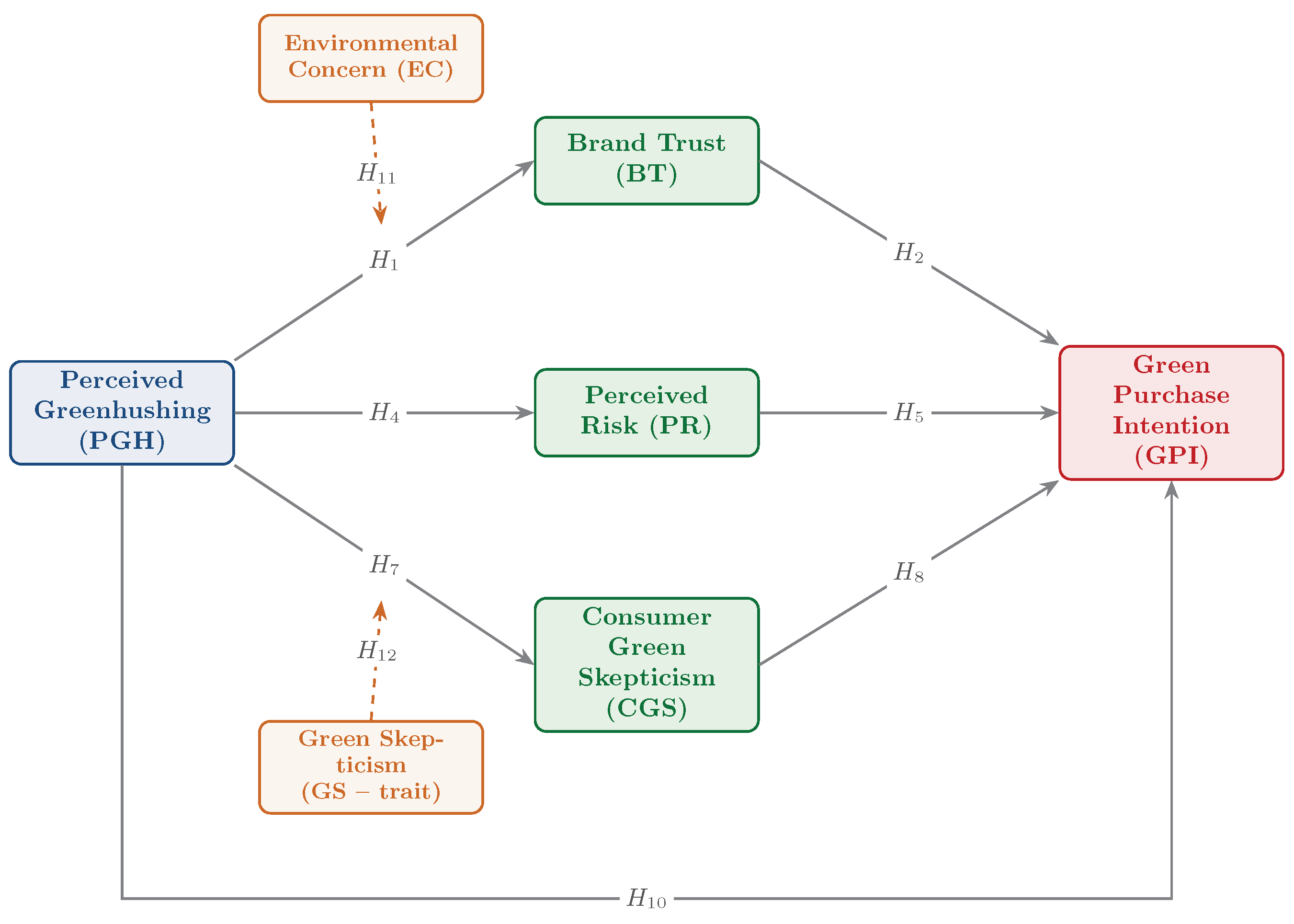
Table 1.
Outer loadings of reflective indicators.
| Construct | Item 1 | Item 2 | Item 3 | Item 4 | Item 5 |
|---|---|---|---|---|---|
| PGH (5 items) | 0.848 | 0.838 | 0.885 | 0.849 | 0.830 |
| BT (4 items) | 0.801 | 0.856 | 0.881 | 0.846 | – |
| PR (3 items) | 0.903 | 0.880 | 0.883 | – | – |
| CGS (4 items) | 0.845 | 0.831 | 0.841 | 0.841 | – |
| GPI (4 items) | 0.876 | 0.882 | 0.870 | 0.881 | – |
| EC (3 items) | 0.890 | 0.596 | 0.916 | – | – |
| GS (4 items) | 0.867 | 0.843 | 0.897 | 0.849 | – |
Note: PGH = perceived greenhushing; BT = brand trust; PR = perceived risk; CGS = consumer green skepticism; GPI = green purchase intention; EC = environmental concern; GS = trait-level green skepticism. Loadings reported in the order of items retained in the final model.
Table 3.
Heterotrait–monotrait ratio of correlations (HTMT).
| PGH | BT | PR | CGS | EC | GS | GPI | |
|---|---|---|---|---|---|---|---|
| PGH | – | – | – | – | – | – | – |
| BT | 0.604 | – | – | – | – | – | – |
| PR | 0.644 | 0.418 | – | – | – | – | – |
| CGS | 0.529 | 0.283 | 0.343 | – | – | – | – |
| EC | 0.048 | 0.045 | 0.040 | 0.078 | – | – | – |
| GS | 0.045 | 0.054 | 0.032 | 0.290 | 0.084 | – | – |
| GPI | 0.334 | 0.522 | 0.067 | 0.221 | 0.046 | 0.040 | – |
Note: All HTMT values are below the conservative 0.85 threshold [64].
Table 4.
Structural path estimates (5,000 bootstrap resamples).
| Path | t | p | 95% CI | Decision | |
|---|---|---|---|---|---|
| PGH → BT | 13.703 | H1 supported | |||
| BT → GPI | 9.507 | H2 supported | |||
| PGH → PR | 17.502 | H4 supported | |||
| PR → GPI | 4.133 | H5 sign reversed | |||
| PGH → CGS | 13.820 | H7 supported | |||
| CGS → GPI | 1.667 | H8 not supported | |||
| PGH → GPI | 2.354 | H10 supported | |||
| EC → BT | 0.461 | H11 not supported | |||
| GS → CGS | 6.571 | H12 supported |
Note: = standardized path coefficient; bootstrap two-tailed p-values; 95% percentile confidence intervals. Moderators EC and GS were entered as additional structural predictors of BT and CGS respectively.
Table 5.
Indirect effects and mediation classification.
| Path | Indirect effect | Direct effect | Total effect | Type |
|---|---|---|---|---|
| PGH → BT → GPI | Complementary partial mediation | |||
| PGH → PR → GPI | Competitive (suppressor) mediation | |||
| PGH → CGS → GPI | Not significant |
Note: Mediation classified following [35]. The direct effect of is identical across rows because the same PGH→GPI path is being compared with each individual indirect channel.
Disclaimer/Publisher’s Note: The statements, opinions and data contained in all publications are solely those of the individual author(s) and contributor(s) and not of MDPI and/or the editor(s). MDPI and/or the editor(s) disclaim responsibility for any injury to people or property resulting from any ideas, methods, instructions or products referred to in the content. |
© 2026 by the authors. Licensee MDPI, Basel, Switzerland. This article is an open access article distributed under the terms and conditions of the Creative Commons Attribution (CC BY) license (http://creativecommons.org/licenses/by/4.0/).
Copyright: This open access article is published under a Creative Commons CC BY 4.0 license, which permit the free download, distribution, and reuse, provided that the author and preprint are cited in any reuse.