
Submitted:
19 May 2026
Posted:
20 May 2026
You are already at the latest version
Abstract
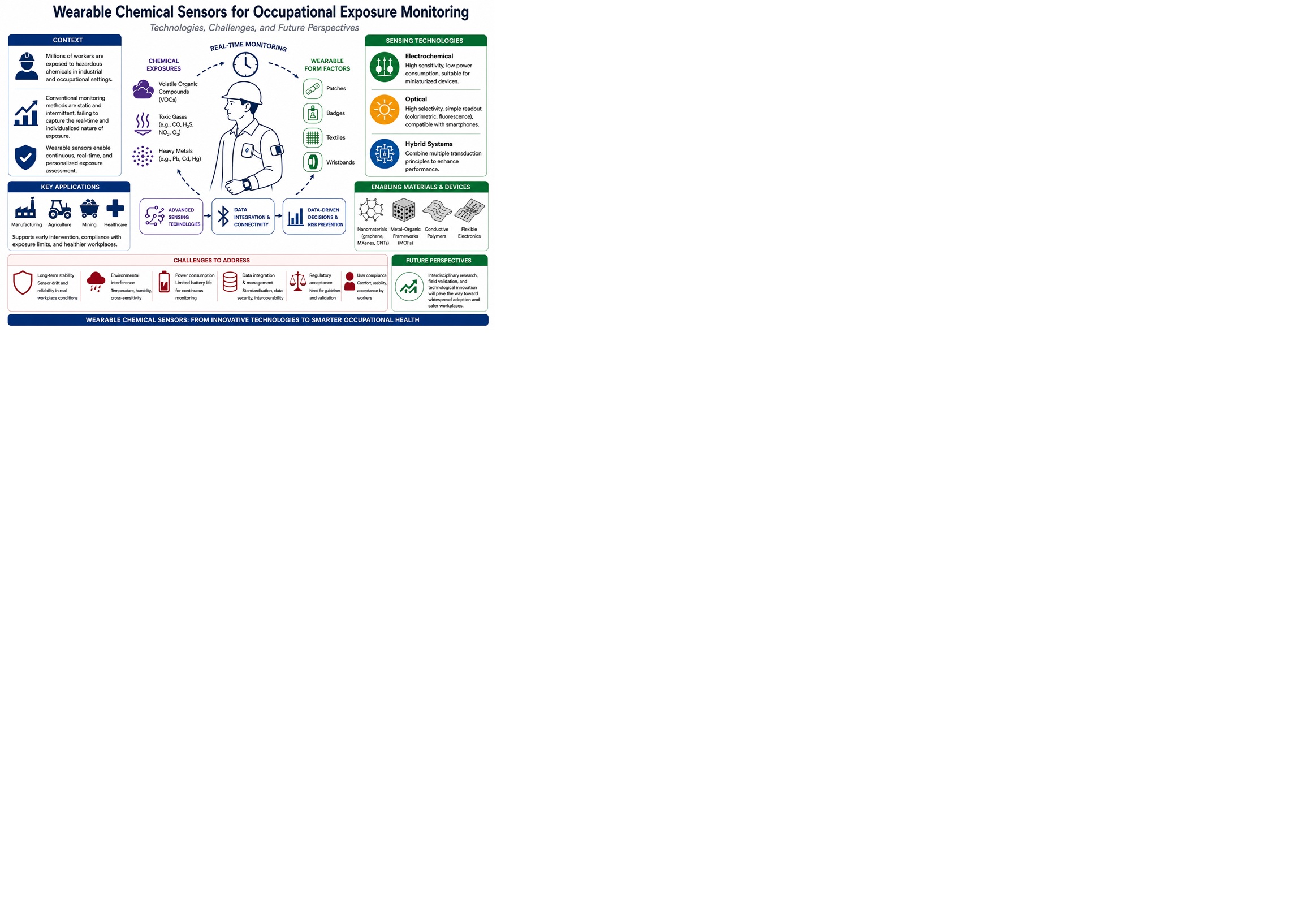
Occupational exposure to hazardous chemicals remains a major concern across several industrial sectors, including, among others, manufacturing, agriculture, mining, and healthcare. Conventional exposure assessment methods, typically based on stationary environmental monitoring or periodic biological sampling, often fail to capture the dynamic and individualized nature of workplace exposures. In this context, wearable chemical sensors have emerged as promising tools for continuous and real-time exposure monitoring.
This exploratory review provides an overview of recent advances in wearable chemical sensing technologies and discusses their potential applications in occupational exposure monitoring. Attention is given to electrochemical, optical, and hybrid sensing systems, as well as to the role of nanomaterials and flexible electronics in improving sensor sensitivity, selectivity, and wearability. Current applications in occupational settings, including monitoring of volatile organic compounds, toxic gases, and heavy metals, are discussed.
The review also examines key challenges limiting the practical implementation of wearable sensors in occupational health programs, including long-term stability, environmental interference, power consumption, data integration, regulatory acceptance, and user compliance. Although wearable chemical sensors represent a rapidly evolving field with significant potential for improving occupational risk assessment and preventive strategies, further interdisciplinary research and long-term field validation studies are required before widespread implementation can be achieved.
Keywords:
wearable sensors
; chemical sensors
; occupational exposure
; real-time monitoring
; volatile organic compounds
; heavy metals
; nanotechnology
Copyright: This open access article is published under a Creative Commons CC BY 4.0 license, which permit the free download, distribution, and reuse, provided that the author and preprint are cited in any reuse.


