
Submitted:
19 May 2026
Posted:
20 May 2026
You are already at the latest version
Abstract
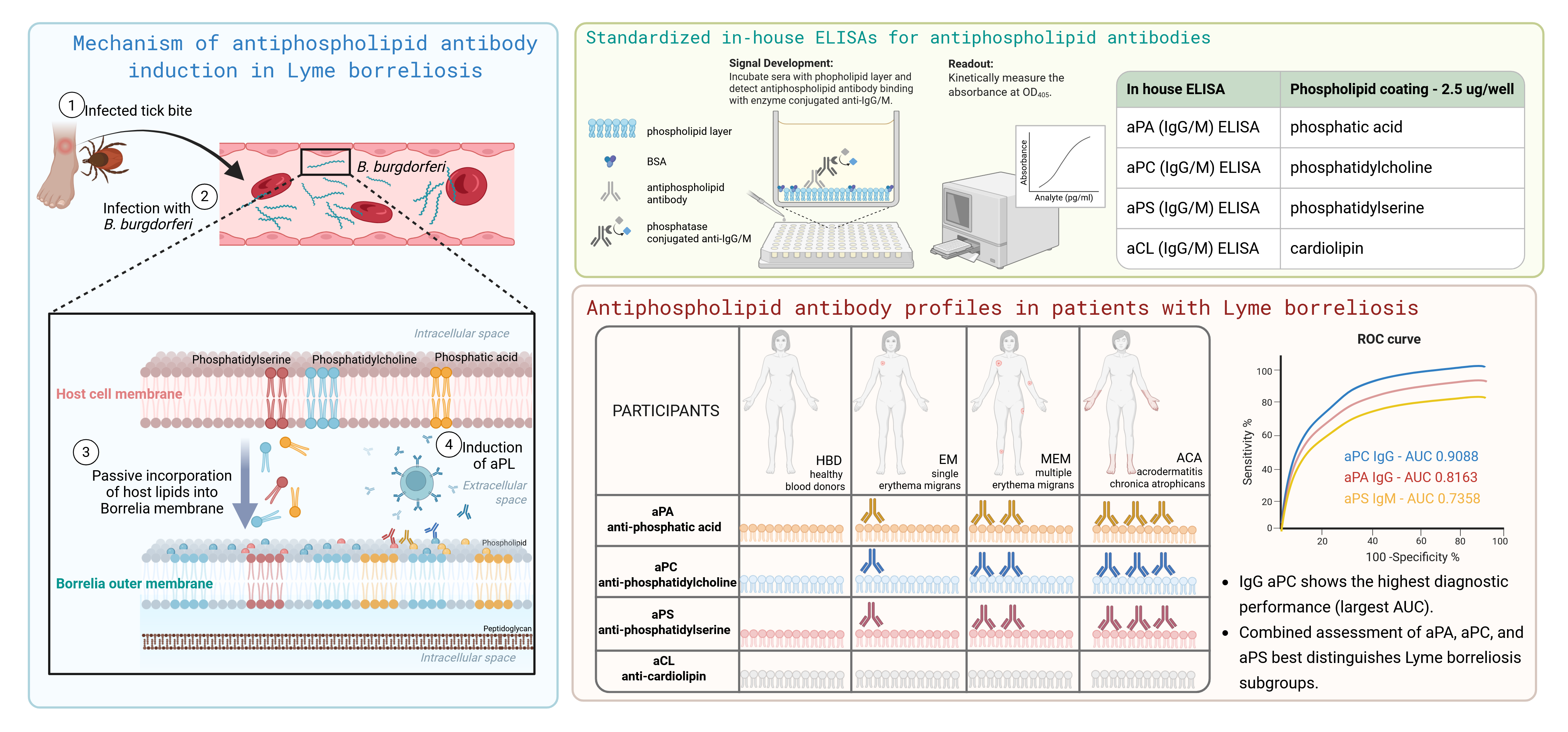
Objectives: Borrelia burgdorferi sensu lato, a spirochete bacterium responsible for Lyme borreliosis - the most common tick-borne infection in North America and Europe - can trigger the production of antiphospholipid antibodies. These antibodies target host lipids such as cardiolipin (CL), phosphatidic acid (PA), phosphatidylcholine (PC), and phosphatidylserine (PS), which the spirochete incorporates into its membrane from the surrounding environment. Although antiphospholipid antibodies are typically associated with antiphospholipid syndrome (APS), they may also arise during infections, including Lyme borreliosis. This study aimed to develop and optimize several enzyme-linked immunosorbent assays (ELISAs) for measuring various antiphospholipid antibodies in patients with Lyme borreliosis. Methods: Thirty patients diagnosed with Lyme borreliosis were enrolled: ten with solitary erythema migrans (EM), ten with multiple EM (MEM), and ten with late manifestations known as acrodermatitis chronica atrophicans (ACA). Forty healthy blood donors served as controls. Four distinct antiphospholipid antibody ELISAs were developed, each using a different phospholipid coating: CL, PA, PC, and PS. Serum of APS patient was used as a positive control and for standard curve generation. Results: All four ELISAs were successfully established and demonstrated good measurement precision. Significant differences in antiphospholipid antibody levels and positivity rates were observed between Lyme borreliosis patients and healthy blood donors. Notably, levels of antibodies directed against PA (aPA), PC (aPC), and PS (aPS), both IgG and IgM, were significantly higher in patients with late Lyme borreliosis, manifested as ACA, compared to healthy blood donors. In contrast, anti-CL (aCL) levels did not differ significantly between groups. Patients with ACA also showed the highest frequency of multiple antiphospholipid antibody positivity, with 7 of 10 patients testing positive for three or more antiphospholipid antibodies. Conclusions: Accurate and precise in-house ELISAs for the detection of aCL, aPA, aPC, and aPS using APS sera as standard material were developed and validated for the analysis of samples of patients with Lyme borreliosis. Our data suggest that antiphospholipid antibody levels—specifically aPA, aPC, and aPS—differ across clinical manifestations of Lyme borreliosis, with the greatest increases observed in patients with ACA.
Keywords:
Lyme borreliosis
; antiphospholipid antibodies
; anti-phosphatidylserine antibodies
; anti-phosphatidic acid antibodies
; anti-phosphatidylcholine antibodies
; Borrelia burgdorferi sensu lato
Copyright: This open access article is published under a Creative Commons CC BY 4.0 license, which permit the free download, distribution, and reuse, provided that the author and preprint are cited in any reuse.


