
Submitted:
19 May 2026
Posted:
20 May 2026
You are already at the latest version
Abstract
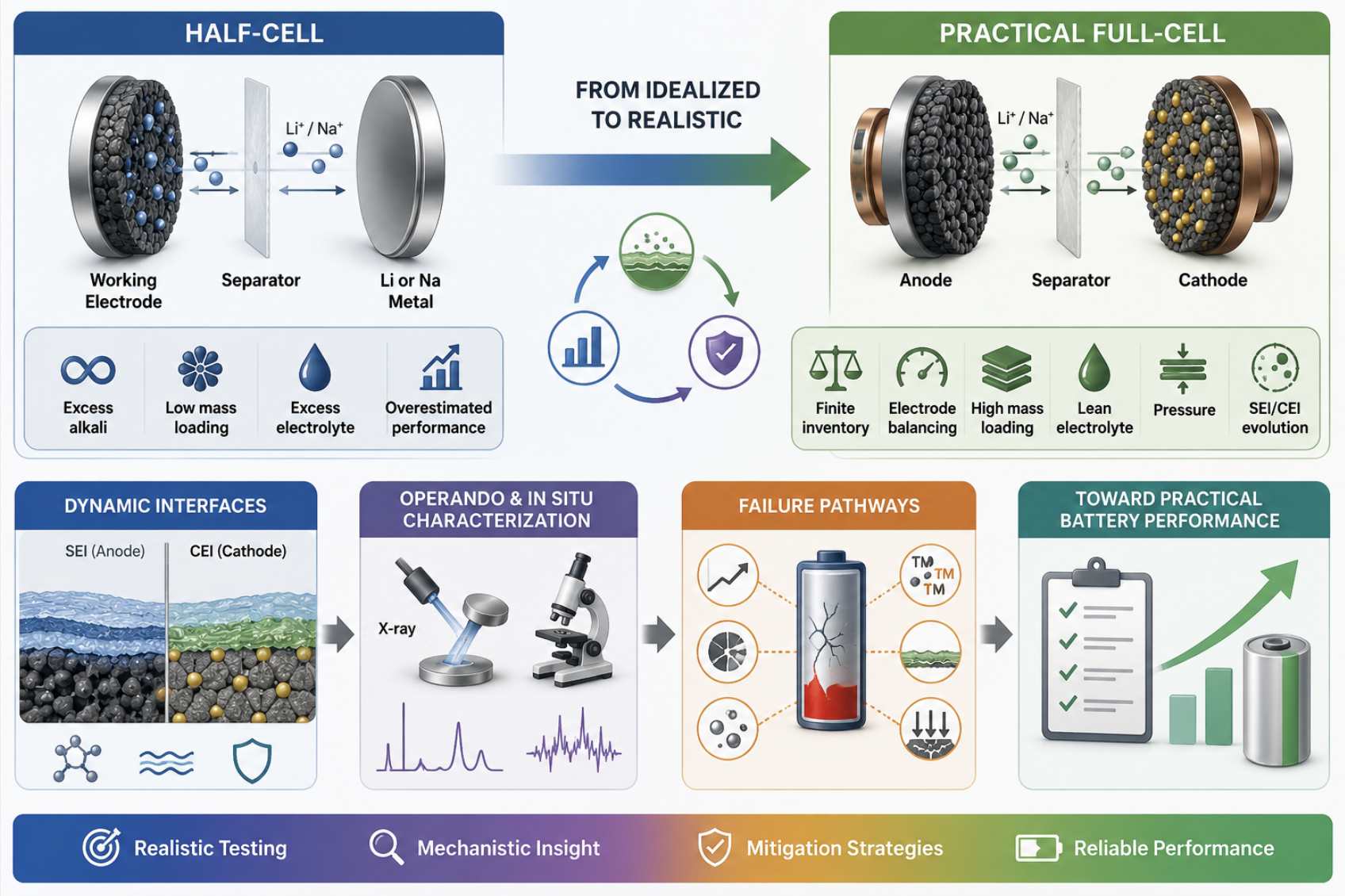
Half-cell testing has long served as a convenient and informative platform for screening electrode materials in lithium-ion and sodium-ion batteries. However, the electrochemical performance obtained under such simplified conditions often fails to predict the behavior of practical full cells, where electrode balancing, mass loading, areal capacity, electrolyte amount, pressure, and interfacial instability impose much stricter constraints. In this review, we examine the limitations of half-cell-based assessment and discuss why moving beyond idealized configurations is essential for the realistic evaluation of advanced battery materials. Particular attention is given to the dynamic nature of interfacial chemistry, including the formation and evolution of the solid electrolyte interphase and cathode electrolyte interphase, as well as to the role of electrolyte decomposition, additives, binders, and electrode formulation in determining cell performance. We further analyze how operando and in situ characterization techniques, including X-ray-based methods, vibrational spectroscopies, microscopy, and electrochemical impedance analysis, are reshaping the understanding of structural evolution, interphase development, and degradation processes under realistic operating conditions. Major failure pathways in practical cells, such as capacity fade, impedance growth, mechanical degradation, electrolyte consumption, gas evolution, transition-metal dissolution, and surface reconstruction, are critically discussed for both lithium-ion and sodium-ion systems. Representative electrode chemistries are considered to illustrate how promising material-level properties do not always translate into practical-cell success. Finally, we address the metrics that matter for practical relevance, summarize current mitigation strategies, and highlight validation criteria and testing workflows that can better connect academic materials research with realistic battery development. By integrating interfacial chemistry, operando insight, and practical performance criteria, this review aims to provide a more translational framework for the design and assessment of next-generation lithium-ion and sodium-ion batteries.
Keywords:
lithium-ion batteries
; sodium-ion batteries
; half-cell testing
; full-cell validation
; interfacial chemistry
; operando characterization
; degradation mechanisms
; practical battery metrics
Copyright: This open access article is published under a Creative Commons CC BY 4.0 license, which permit the free download, distribution, and reuse, provided that the author and preprint are cited in any reuse.


