

Submitted:
19 May 2026
Posted:
20 May 2026
Read the latest preprint version here
Abstract
Dementia represents a growing global public health challenge, driving the rapid expansion of educational interventions aimed at improving awareness and promoting risk-reduction behaviours. Despite this growth, existing research demonstrates a persistent gap between knowledge acquisition and meaningful behavioural change. This paper presents a realist-informed conceptual analysis and proposes an integrative conceptual framework for evaluating the real-world effectiveness of digital dementia education. Integrating health literacy theory, the Capability–Opportunity–Motivation Behaviour (COM-B) model, and implementation science, the framework conceptualises dementia education as a dynamic, multi-component process involving resource availability, user engagement, interpretative engagement, behavioural readiness, contextual influences, and real-world outcomes. Particular emphasis is placed on interpretative engagement, grounded in constructivist and sensemaking perspectives, as a key mechanism linking exposure to educational content with behavioural intention and action. The paper identifies critical limitations in current evaluation approaches, including overreliance on knowledge-based outcomes and insufficient consideration of contextual, emotional, and implementation influences. By advancing a user-centred and context-sensitive framework, this study contributes to the development of more theoretically informed and implementation-oriented approaches for evaluating digital dementia risk-reduction education, particularly among midlife populations.
Keywords:
dementia education
; health literacy
; behaviour change
; COM-B model
; digital health
; engagement
; implementation science
; prevention
; realist evaluation
; conceptual framework
Introduction
Dementia is one of the most significant and rapidly growing global public health challenges, with major implications for individuals, families, healthcare systems, and economies worldwide. Global prevalence is projected to increase substantially over coming decades, particularly within ageing populations such as those in Australia (World Health Organization, 2023; Livingston et al., 2020). In response, dementia prevention and risk-reduction strategies have become an increasing focus of public health policy and research, contributing to rapid growth in educational interventions designed to improve awareness, knowledge, and behavioural risk reduction.
Digital technologies now play a central role in this expansion. Online learning platforms, mobile applications, web-based programs, and public health campaigns provide scalable opportunities for dementia education across diverse populations (Eccleston et al., 2019; Murray et al., 2016). Contemporary initiatives increasingly target not only healthcare professionals and caregivers but also midlife populations who may benefit from early prevention and risk-reduction strategies.
However, despite increasing availability and participation, evidence regarding the real-world effectiveness of dementia education remains inconsistent. Educational interventions often show improvements in knowledge and attitudes, but are less consistent in achieving lasting behavioural change and longer-term impacts on implementation (Webb & Sheeran, 2006; Prestwich et al., 2014; Bailey et al., 2020; Portela Dos Santos, 2022; Arlinghaus, 2026). This limitation reflects a broader challenge within behavioural and implementation science: informational access alone rarely produces meaningful behavioural change.
Existing dementia education research has largely focused on intervention development, dissemination, and knowledge acquisition, with comparatively limited attention to the mechanisms through which individuals interpret, internalise, and apply educational content within everyday contexts (Mazzucca et al., 2021; Kumah et al., 2022). Consequently, many evaluations emphasise participation, reach, or short-term learning outcomes while under examining contextual influences, interpretative processes, and behavioural enactment in real-world settings.
In this paper argues that dementia education is better conceptualised as a dynamic interplay of context, engagement, interpretation, behavioural readiness and implementation conditions (Surr et al., 2017) rather than a linear delivery of information. Drawing on realist evaluation principles (Pawson & Tilley, 1997), health literacy theory, the Capability–Opportunity–Motivation Behaviour (COM-B) model, and implementation science, this paper presents a realist-informed conceptual framework for evaluating digital dementia education.
Rather than asking only whether educational interventions increase knowledge, the framework seeks to explain how, for whom, and under what conditions digital dementia education contributes to meaningful behavioural and health-related outcomes. In particular, interpretative engagement is highlighted as a key mechanism linking exposure to educational content with behavioural intention and enactment (Perski et al., 2017). By integrating behavioural, contextual, and implementation perspectives, the framework advances a more comprehensive approach to evaluating the effectiveness of digital dementia education in practice.
Expansion and Diversification of Dementia Education
Dementia education has expanded substantially in scope, delivery, and target population over the past decade, reflecting broader public health priorities surrounding prevention, early intervention, and evidence translation. Educational initiatives now encompass public awareness campaigns, workforce training programs, community-based interventions, digital learning platforms, and blended educational models.
Digital technologies have become increasingly central to this expansion because they offer scalable and potentially cost-effective approaches for delivering health education across geographically dispersed populations (Lustria et al., 2013; Murray et al., 2016). In dementia contexts, digital education has been used to support caregiver education, workforce development, and public awareness initiatives through online modules, mobile applications, webinars, and Massive Open Online Courses (MOOCs) (Eccleston et al., 2019).
Evidence suggests that dementia education programs can improve knowledge, confidence, and attitudes among both healthcare staff and community participants (Surr et al., 2017; Rasmussen et al., 2023). Increasing attention has also been given to culturally responsive and person-centred educational approaches designed to improve accessibility and relevance across diverse populations (Hulko et al., 2024).
Despite this growth, implementation research consistently demonstrates that educational effectiveness is strongly influenced by contextual and delivery conditions. Knowledge improvements do not always translate into sustained behavioural or practice change (Proctor et al., 2011; Chowdhary et al., 2022; Cullen, 2022). Many interventions continue to be evaluated primarily through participation metrics, satisfaction scores, or short-term knowledge gains rather than through meaningful behavioural, implementation, or long-term outcomes (Glasgow et al., 2019; Gkioka et al., 2020).
As a result, there remains limited understanding of how individuals engage with, interpret, and apply dementia education in everyday life. This represents a critical gap within current approaches to evaluating digital dementia education.
The Knowledge–Behaviour Gap
A central assumption underpinning many educational interventions is that increased knowledge naturally leads to behavioural change. However, this assumption has been repeatedly challenged within behavioural science and health education research. Research continuously shows that awareness, intention, and sustained action differ significantly (Webb & Sheeran, 2006; Prestwich et al., 2014; Conner & Norman, 2022). Within dementia prevention contexts, individuals may understand risk factors and recommended behaviours without successfully adopting or maintaining lifestyle changes. This gap reflects broader insights from behavioural science, which emphasise that behaviour is shaped by multiple interacting influences, including capability, opportunity, motivation, social environment, emotional readiness, and contextual constraints.
The COM-B model provides a useful framework for understanding these interactions by conceptualising behaviour as emerging through relationships between capability, opportunity, and motivation (Michie et al., 2011). From this perspective, knowledge represents only one component of behavioural capability and is insufficient on its own to produce sustained behavioural enactment.
Consequently, educational interventions that focus predominantly on information transmission may improve awareness while failing to address the broader contextual and motivational conditions required for behavioural change. This limitation highlights the need for evaluation approaches capable of examining not only what information is delivered, but also how individuals interpret, internalise, and apply educational content within real-world contexts.
Health Literacy and Interpretative Engagement
Health literacy is increasingly recognised as a critical determinant of health engagement and behavioural outcomes. Contemporary models define health literacy not simply as reading comprehension or information access, but as the capacity to access, understand, appraise, and apply health information within social and contextual environments (Sørensen et al., 2012). Furthermore, health literacy is becoming recognised as a more comprehensive social indicator of health that influences inequality in outcomes, participation, and access (Nutbeam & Lloyd, 2021). Importantly, individuals do not passively receive educational information. Instead, individuals actively analyse, assess, and create meaning based on their lived experiences, cultural background, emotional reactions, past knowledge, and beliefs (Alhazmi & Kaufmann, 2022). This process, referred to in this paper as interpretative engagement, represents a central mechanism linking exposure to educational content with behavioural readiness.
Interpretative engagement extends beyond basic participation or attention. It involves reflection, sensemaking, appraisal of personal relevance, and integration of new information into existing understandings and identities. Individuals exposed to identical educational content may therefore experience substantially different outcomes depending on how meaning is constructed within their particular context.
Interpretative engagement is still understudied in dementia education research, despite its significance (Surr, 2017). Existing evaluations frequently focus on measurable indicators such as participation rates, completion metrics, or knowledge scores while overlooking the interpretative processes through which educational content becomes behaviourally meaningful.
Behaviour Change and Implementation Context
Behavioural and implementation sciences both emphasise that interventions function differently across contexts. Educational interventions that demonstrate effectiveness under controlled conditions may produce weaker or inconsistent outcomes when implemented in routine practice.
The COM-B model highlights how behavioural enactment depends on interactions between psychological and physical capability, environmental opportunity, and reflective and automatic motivation (Michie et al., 2011). This perspective helps explain why knowledge acquisition alone rarely predicts sustained behaviour change.
Implementation science further extends this understanding by emphasising usability, scalability, acceptability, implementation fidelity, and contextual adaptation (Craig et al., 2008; Skivington et al., 2021). Real-world implementation is shaped by organisational systems, digital accessibility, competing demands, policy environments, social support, and broader structural conditions (Moghayedi, 2026).
Digital inequality research also demonstrates that disparities in digital access, literacy, and technological confidence continue to influence who benefits from digital health interventions (Van Dijk, 2006). Consequently, educational resources that appear accessible in principle may remain inaccessible or ineffective for particular populations.
Together, these perspectives highlight the need for evaluation approaches capable of examining not only whether interventions produce outcomes, but how contextual conditions shape the mechanisms through which outcomes emerge.
Emotional and Contextual Influences
Engagement with dementia education is shaped by a wide range of emotional, social, and contextual influences. Emotional responses such as fear, anxiety, denial, stigma, or perceived vulnerability may either facilitate or inhibit engagement with dementia-related information (Bandura, 2004; Brewer et al., 2007).
Similarly, social and environmental conditions influence individuals’ capacity to engage with and apply educational content. Family support, peer influence, cultural norms, work demands, socioeconomic conditions, and access to supportive environments all affect behavioural enactment and maintenance.
These findings reinforce the importance of person-centred and context-sensitive educational approaches. Educational interventions that fail to account for emotional and contextual variability may overestimate their effectiveness by assuming uniform engagement and behavioural capacity across populations.
The Real-World Implementation Gap
Despite substantial advances in digital health innovation, a persistent gap remains between intervention efficacy under controlled research conditions and effectiveness within real-world settings.
Evidence from digital health research suggests that online and mobile interventions can demonstrate positive outcomes within structured environments; however, their effectiveness frequently declines during routine implementation because of variability in engagement, context, usability, and delivery conditions (Murray et al., 2016).
Many evaluation studies continue to prioritise short-term or proximal outcomes while under examining implementation sustainability, behavioural maintenance, and contextual adaptation. Consequently, interventions may appear successful within research environments while producing weaker or inequitable outcomes in practice.
This implementation gap is particularly important within dementia prevention, where meaningful behavioural change often requires long-term engagement, sustained motivation, and supportive environmental conditions.
These limitations underscore the need for more theoretically integrated and context-sensitive approaches to evaluating digital dementia education.
Conceptual Framework: From Information Accessibility to Practical Application
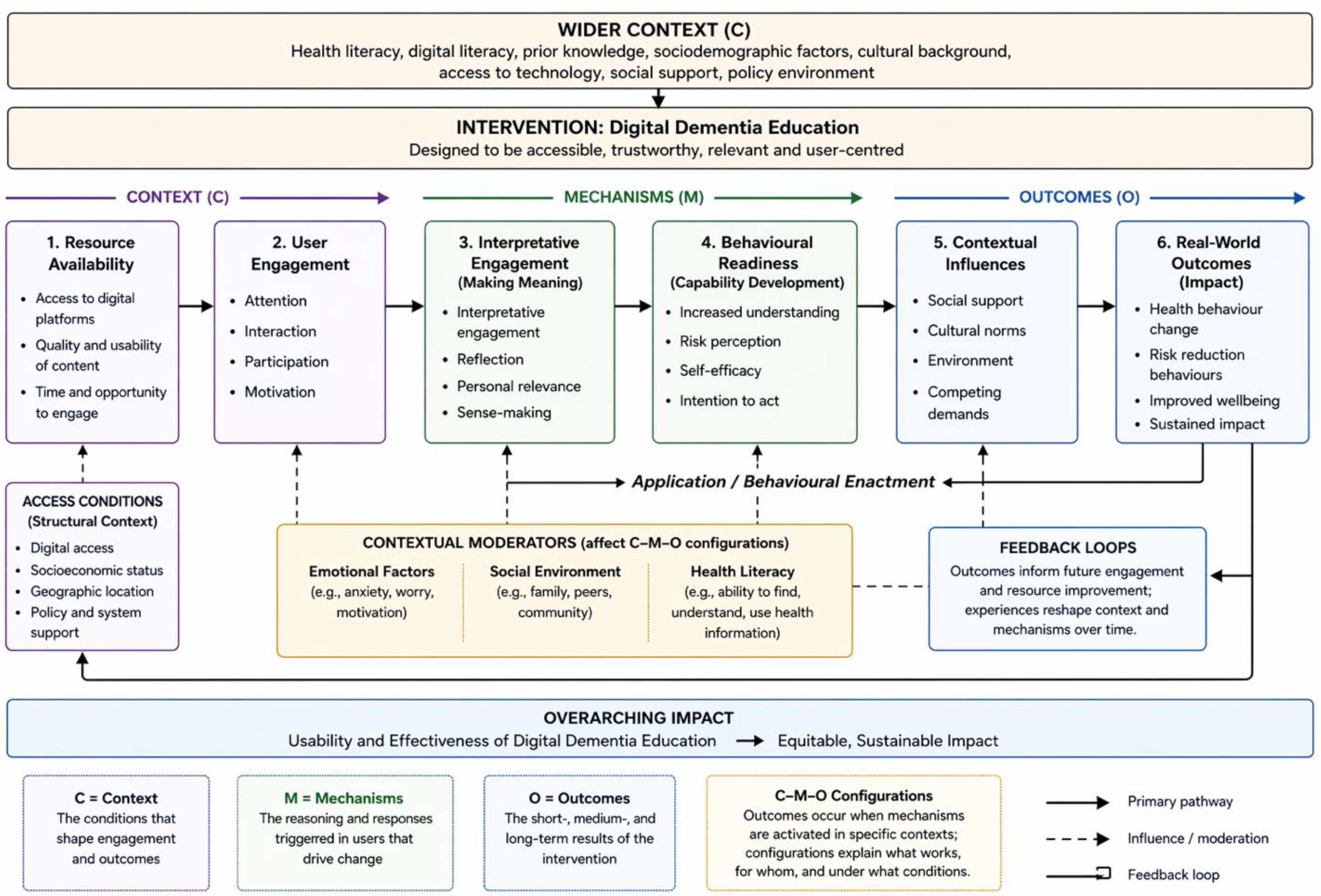
To address limitations in existing evaluation approaches, this paper proposes a realist-informed conceptual framework that conceptualises digital dementia education as a dynamic and context-dependent process through which educational resources may—or may not—produce meaningful behavioural outcomes (Figure 1).
The framework is informed by realist evaluation theory (Pawson & Tilley, 1997), which conceptualises outcomes as emerging through interactions between contexts, mechanisms, and outcomes (CMO configurations). Within this perspective, digital dementia education does not operate as a universally effective intervention; rather, its impact depends on how individuals engage with, interpret, and apply educational content within specific social, emotional, and environmental contexts.
The framework integrates three complementary theoretical perspectives:
health literacy theory,
the COM-B model of behaviour,
implementation science.
Health literacy operates across all stages of the framework, shaping individuals’ capacity to Health literacy influences people's ability to access, comprehend, evaluate, and use knowledge at every level of the framework (Sørensen et al., 2012; Sørensen et al., 2021; Nutbeam & Lloyd, 2021). Behaviour change techniques used in interventions targeting dementia risk factors amongst older adults in rural and remote areas: A systematic review and meta-analysis. The journal of prevention of Alzheimer's disease, 12). The COM-B model explains how capability, opportunity, and motivation influence behavioural readiness and enactment (Michie et al., 2011), while implementation science contributes attention to contextual variability, usability, scalability, and real-world delivery conditions (Craig et al., 2008; Skivington et al., 2021).
The framework consists of six interrelated domains:
Resource Availability (Context)
Access to digital educational resources, including technological accessibility, usability, and opportunity for engagement.
User Engagement (Mechanism)
Initial interaction with educational content, including attention, participation, and motivational engagement.
Interpretative Engagement (Core Mechanism)
The process through which users actively construct meaning from educational content by reflecting on relevance, personal applicability, and lived experience.
Behavioural Readiness (Mechanism)
Development of understanding, self-efficacy, risk perception, and intention to act.
Contextual Influences (Context)
Social, cultural, emotional, and environmental factors that facilitate or constrain behavioural enactment.
Real-World Outcomes (Outcome)
Adoption of dementia risk-reduction strategies, altered behaviour, enhanced wellbeing, and long-lasting effects (Dodds, 2025).
A central innovation of the framework is the explicit positioning of interpretative engagement as a core explanatory mechanism linking exposure to educational information with behavioural outcomes. Existing evaluation models frequently assume that engagement or knowledge acquisition alone predicts behaviour change. In contrast, this framework argues that individuals must actively interpret and contextualise information before behavioural readiness can emerge.
The framework also incorporates feedback loops, recognising that outcomes reshape future engagement, perceptions, and contextual conditions over time. This reflects the iterative and non-linear nature of behaviour change and implementation processes in real-world environments.
Illustrative Context–Mechanism–Outcome Configurations
To strengthen the realist orientation of the framework, several illustrative Context–Mechanism–Outcome (CMO) configurations are provided.
In contexts characterised by limited digital literacy and low prior health knowledge, the availability of digital dementia education alone may be insufficient to produce behavioural change. Under these conditions, mechanisms of interpretative engagement may remain under activated because users struggle to meaningfully interpret or contextualise the educational information presented. Consequently, behavioural readiness remains limited, resulting in minimal adoption of risk-reduction behaviours.
Context: low digital literacy and limited health knowledgeMechanism: limited interpretative engagementOutcome: minimal behavioural change.
Conversely, in contexts where users possess stronger digital and health literacy and where interventions are supported by accessible, user-centred design features, educational content may activate mechanisms of reflection, relevance appraisal, and behavioural motivation.
Context: higher digital literacy and supportive educational designMechanism: interpretative engagement and reflective processingOutcome: increased behavioural readiness and behaviour change
Similarly, emotionally supportive and socially reinforcing environments may strengthen behavioural enactment and maintenance over time, whereas environments characterised by competing demands, stigma, or social isolation may inhibit sustained behavioural adoption despite initial engagement.
These configurations illustrate that outcomes are not generated by educational information alone, but by interactions between contextual conditions and underlying behavioural mechanisms.
Discussion
This framework advances digital dementia education research in several important ways.
First, it challenges the dominant assumption that informational exposure alone is sufficient to produce behavioural change. Much of the existing literature evaluates educational interventions primarily through knowledge acquisition, participation metrics, or short-term attitudinal outcomes. While these measures are important, they provide limited insight into whether individuals meaningfully interpret educational content or successfully translate learning into sustained behavioural action.
Second, the framework integrates perspectives that are often examined separately within dementia education research. By combining health literacy theory, behavioural science, realist evaluation, and implementation science, the framework provides a more comprehensive account of how educational interventions function within complex real-world settings.
Third, the framework contributes a stronger explanatory focus through its emphasis on interpretative engagement. This mechanism helps explain why individuals exposed to the same educational intervention may experience substantially different outcomes depending on prior knowledge, emotional readiness, digital literacy, cultural context, and social support. In doing so, the framework moves beyond linear models of education toward a more context-sensitive understanding of behavioural change.
Fourth, the framework strengthens implementation-oriented evaluation by explicitly recognising feedback loops, contextual moderators, and variability in behavioural enactment. Rather than assuming that interventions function consistently across populations, the framework highlights the importance of examining what works, for whom, and under what conditions.
Collectively, these contributions position the framework as a theoretically integrated approach capable of supporting more meaningful evaluation of digital dementia education initiatives.
Implications for Research, Practice, and Policy
The proposed framework has several implications for future research, intervention design, and public health policy.
For research, the framework highlights the importance of moving beyond outcome-only evaluations toward approaches capable of examining Context–Mechanism–Outcome configurations. Future studies should investigate how interpretative engagement develops across different populations and how contextual conditions shape behavioural enactment and sustainability over time. Mixed-methods and realist-informed evaluation approaches may be particularly valuable for capturing these complex interactions.
For intervention design, the framework emphasises the importance of tailoring educational resources to users’ digital literacy, health literacy, emotional readiness, and sociocultural context. Digital dementia education should move beyond static information delivery toward adaptive, user-centred approaches that facilitate reflection, relevance appraisal, and behavioural capability development.
For policy and implementation, the framework supports the development of equity-focused digital health strategies that recognise variability in access, opportunity, and engagement. Policymakers should avoid assuming uniform benefit from digital educational initiatives and instead prioritise accessibility, inclusivity, and implementation support across diverse populations.
Collectively, these implications suggest that improving dementia prevention outcomes requires alignment between educational design, contextual support, implementation conditions, and evaluation strategy.
Limitations
Several limitations of the proposed framework should be acknowledged (Kim et al., 2026).
First, the framework is conceptual and has not yet been empirically validated across diverse populations or intervention settings. Future research is required to test the proposed Context–Mechanism–Outcome configurations and examine how the framework operates within different demographic and implementation environments.
Second, while the framework integrates multiple theoretical perspectives, additional mechanisms and contextual influences may emerge through empirical application. Behavioural and implementation processes are inherently complex and may vary substantially across cultural, organisational, and technological contexts.
Third, the framework focuses primarily on digital dementia education related to prevention and risk reduction. Adaptation may be required for other contexts such as caregiver education, workforce training, or clinical dementia education.
Despite these limitations, the framework provides a theoretically grounded foundation for more comprehensive and context-sensitive evaluation of digital dementia education.
Conclusions
Digital dementia education has expanded rapidly in response to growing public health concern surrounding dementia prevention and risk reduction. However, existing evaluation approaches remain heavily focused on information delivery and knowledge acquisition, often overlooking the contextual and interpretative processes that shape whether educational interventions produce meaningful behavioural outcomes in practice.
This paper proposes a realist-informed conceptual framework that reconceptualises digital dementia education as a dynamic interaction between context, engagement, interpretation, behavioural readiness, and implementation conditions. By integrating health literacy theory, the COM-B model, and implementation science, the framework provides a theoretically grounded structure for understanding how digital dementia education functions across diverse real-world settings.
The framework's explicit acknowledgment of interpretative engagement as a crucial mechanism connecting educational exposure with behavioral enactment is one of its main contributions (Wang, 2019). This shifts evaluation beyond simplistic assumptions that access to information alone leads to action and instead highlights the importance of meaning-making, contextual fit, and behavioural capability.
Ultimately, improving dementia prevention outcomes will require evaluation approaches capable of identifying not only whether digital education works, but how, for whom, and under what conditions meaningful change occurs. Without such approaches, digital dementia education risks continuing to overestimate informational success while underestimating implementation failure and inequitable impact. The proposed framework offers a foundation for more rigorous, context-sensitive, and implementation-oriented evaluation of digital dementia education moving forward.
References
- Alhazmi, A. A., and A. Kaufmann. 2022. Phenomenological Qualitative Methods Applied to the Analysis of Cross-Cultural Experience in Novel Educational Social Contexts. Frontiers in psychology 13: 785134. [Google Scholar] [CrossRef]
- Althubaiti, A. 2016. Information bias in health research: Definition, pitfalls, and adjustment methods. Journal of Multidisciplinary Healthcare 9, 211–217. [Google Scholar] [CrossRef]
- Ananthakrishnan, A., C. Cong, V. Riccalton, and E. Meinert. 2025. Progressing implementation of behaviour change frameworks for digital health interventions: Challenges and ways forward. Translational Behavioural Medicine 15, 1: ibaf069. [Google Scholar] [CrossRef] [PubMed]
- Ancker, J. S., L. V. Grossman, and N. C. Benda. 2020. Health literacy 2030: Is it time to redefine the term? Journal of General Internal Medicine 35, 8: 2427–2430. [Google Scholar] [CrossRef] [PubMed]
- Arlinghaus, K. R., and C. A. Johnston. 2017. Advocating for Behavior Change With Education. American journal of lifestyle medicine 12, 2: 113–116. [Google Scholar] [CrossRef]
- Batsch, N. L., and M. S. Mittelman. 2012. World Alzheimer report 2012: Overcoming the stigma of dementia. Alzheimer’s Disease International: Available online: https://www.alzint.org/u/WorldAlzheimerReport2012ExecutiveSummary.pdf.
- Bailey, D. H., G. J. Duncan, F. Cunha, B. R. Foorman, and D. S. Yeager. 2020. Persistence and Fade-Out of Educational-Intervention Effects: Mechanisms and Potential Solutions. Psychological science in the public interest: a journal of the American Psychological Society 21, 2: 55–97. [Google Scholar] [CrossRef] [PubMed]
- Bandura, A. 2004. Health promotion by social cognitive means. Health Education & Behaviour 31, 2: 143–164. [Google Scholar] [CrossRef]
- Brewer, N. T., G. B. Chapman, F. X. Gibbons, M. Gerrard, K. D. McCaul, and N. D. Weinstein. 2007. Meta-analysis of the relationship between risk perception and health behaviour: The example of vaccination. Health Psychology 26, 2: 136–145. [Google Scholar] [CrossRef]
- Chowdhary, N., C. Barbui, K. J. Anstey, M. Kivipelto, M. Barbera, R. Peters, L. Zheng, J. Kulmala, R. Stephen, C. P. Ferri, Y. Joanette, H. Wang, A. Comas-Herrera, C. Alessi, K. Suharya Dy, K. J. Mwangi, R. C. Petersen, A. A. Motala, S. Mendis, D. Prabhakaran, and T. Dua. 2022. Reducing the Risk of Cognitive Decline and Dementia: WHO Recommendations. Frontiers in Neurology 12: 765584. [Google Scholar] [CrossRef]
- Conner, M., and P. Norman. 2022. Understanding the intention-behavior gap: The role of intention strength. Frontiers in psychology 13: 923464. [Google Scholar] [CrossRef]
- Craig, P., P. Dieppe, S. Macintyre, S. Michie, I. Nazareth, and M. Petticrew. 2008. Developing and evaluating complex interventions: The New Medical Research Council Guidance. BMJ 337: a1655. [Google Scholar] [CrossRef] [PubMed]
- Cullen, L., K. Hanrahan, S. W. Edmonds, H. S. Reisinger, and M. Wagner. 2022. Iowa Implementation for Sustainability Framework. Implementation science: IS 17, 1: 1. [Google Scholar] [CrossRef] [PubMed]
- Dodds, L., K. Deckers, C. B. Harris, and J. Siette. 2025. Behaviour change techniques used in interventions targeting dementia risk factors amongst older adults in rural and remote areas: A systematic review and meta-analysis. The journal of prevention of Alzheimer's disease 12, 4: 100093. [Google Scholar] [CrossRef]
- Eccleston, C., K. Doherty, A. Bindoff, A. Robinson, J. Vickers, and F. McInerney. 2019. Building dementia knowledge globally through the Understanding Dementia Massive Open Online Course (MOOC). npj Science of Learning 4: Article 3. [Google Scholar] [CrossRef]
- Gkioka, M., J. Schneider, A. Kruse, M. Tsolaki, D. Moraitou, and B. Teichmann. 2020. Evaluation and Effectiveness of Dementia Staff Training Programs in General Hospital Settings: A Narrative Synthesis with Holton's Three-Level Model Applied. Journal of Alzheimer's disease: JAD 78, 3: 1089–1108. [Google Scholar] [CrossRef]
- Glasgow, R. E., S. M. Harden, B. Gaglio, B. Rabin, M. L. Smith, G. C. Porter, M. G. Ory, and P. A. Estabrooks. 2019. RE-AIM planning and evaluation framework: Adapting to new science and practice with a 20-year review. Frontiers in Public Health 7: 64. [Google Scholar] [CrossRef]
- Hagger, M. S., S. Moyers, K. McAnally, and L. E. McKinley. 2020. Known knowns and known unknowns on behaviour change interventions and mechanisms of action*. Health Psychology Review 14, 1: 199–212. [Google Scholar] [CrossRef]
- Hulko, W., N. Mirza, T. Christianson, M. Nazemi, A. Vicic, and E. Bartle. 2024. A scoping review of dementia education programs to assess for the inclusion of culture . Innovation in Aging 8 Supplement_1: 533. [Google Scholar] [CrossRef]
- Kim, Y., K. Lee, and J. Shin. 2026. Interpretable Machine Learning Framework for Performance-Based Retrofit Scheme of Blast-Damaged Reinforced Concrete Columns. Developments in the Built Environment. [Google Scholar]
- Kumah, E. A., R. McSherry, J. Bettany-Saltikov, P. van Schaik, S. Hamilton, J. Hogg, and V. Whittaker. 2022. Evidence-informed practice versus evidence-based practice educational interventions for improving knowledge, attitudes, understanding, and behaviour toward the application of evidence into practice: A comprehensive systematic review of undergraduate students. Campbell Systematic Reviews 18, 2: e1233. [Google Scholar] [CrossRef] [PubMed]
- Kwasnicka, D., S. U. Dombrowski, M. White, and F. F. Sniehotta. 2016. Theoretical explanations for maintenance of behaviour change: A systematic review. Health Psychology Review 10, 3: 277–296. [Google Scholar] [CrossRef]
- Livingston, G., J. Huntley, A. Sommerlad, and et al. 2020. Dementia prevention, intervention, and care: 2020 report of the Lancet Commission. The Lancet 396, 10248: 413–446. [Google Scholar] [CrossRef]
- Lustria, M. L. A., S. M. Noar, J. Cortese, S. K. Van Stee, R. L. Glueckauf, and J. Lee. 2013. Tailored health interventions delivered over the Internet: A meta-analysis of effectiveness and moderators. American Journal of Preventive Medicine 45, 2: 210–226. [Google Scholar] [CrossRef]
- Mazzucca, S., E. M. Arredondo, D. M. Hoelscher, D. Haire-Joshu, R. G. Tabak, S. K. Kumanyika, and R. C. Brownson. 2021. Expanding Implementation Research to Prevent Chronic Diseases in Community Settings. Annual review of public health 42: 135–158. [Google Scholar] [CrossRef]
- Michie, S., and M. Johnston. 2012. Theories and techniques of behaviour change: Developing a cumulative science of behaviour change. Health Psychology Review 6, 1: 1–6. [Google Scholar] [CrossRef]
- Moghayedi, A., K. Michell, S. Urs, A. Tran, and J. Mason. 2026. Unlocking social sustainability and inclusivity of digitalised urban public Facilities: A Causal model across global case studies. Technology in Society 85. [Google Scholar] [CrossRef]
- Moore, K. J., C. Y. Lee, E. L. Sampson, and B. Candy. 2020. Do interventions that include education on dementia progression improve knowledge, mental health and burden of family carers? A systematic review. Dementia 19, 8: 2555–2581. [Google Scholar] [CrossRef]
- Murray, E., E. B. Hekler, G. Andersson, L. M. Collins, A. Doherty, C. Hollis, D. E. Rivera, R. West, and J. C. Wyatt. 2016. Evaluating Digital Health Interventions: Key Questions and Approaches. American journal of preventive medicine 51, 5: 843–851. [Google Scholar] [CrossRef]
- Nutbeam, D., and J. E. Lloyd. 2021. Understanding and responding to health literacy as a social determinant of health. Annual Review of Public Health 42: 159–173. [Google Scholar] [CrossRef]
- Pas, E. T., and C. P. Bradshaw. 2012. Examining the association between implementation and outcomes: State-wide scale-up of school-wide positive behaviour intervention and supports. Journal of Behavioural Health Services & Research 39, 4: 417–433. [Google Scholar] [CrossRef]
- Pawson, R., and N. Tilley. 1997. Realistic evaluation. Sage Publications. [Google Scholar]
- Perski, O., A. Blandford, R. West, and S. Michie. 2017. Conceptualising engagement with digital behaviour change interventions. Translational Behavioural Medicine 7, 2: 254–267. [Google Scholar] [CrossRef]
- Portela Dos Santos, O., P. Melly, R. Hilfiker, K. Giacomino, E. Perruchoud, H. Verloo, and F. Pereira. 2022. Effectiveness of Educational Interventions to Increase Skills in Evidence-Based Practice among Nurses: The EDITcare Systematic Review. Healthcare (Basel, Switzerland) 10, 11: 2204. [Google Scholar] [CrossRef] [PubMed]
- Prestwich, A., F. F. Sniehotta, C. Whittington, S. U. Dombrowski, L. Rogers, and S. Michie. 2014. Does theory influence the effectiveness of health behaviour interventions? Meta-analysis. Health Psychology 33, 5: 465–474. [Google Scholar] [CrossRef]
- Proctor, E. K., H. Silmere, R. Raghavan, P. Hovmand, G. Aarons, A. Bunger, R. Griffey, and M. Hensley. 2011. Outcomes for implementation research: Conceptual distinctions, measurement challenges, and research agenda. Administration and Policy in Mental Health and Mental Health Services Research 38, 2: 65–76. [Google Scholar] [CrossRef]
- Rasmussen, B. M., P. T. Andersen, F. B. Waldorff, and G. Berg-Beckhoff. 2023. Effectiveness of dementia education for professional care staff and factors influencing staff-related outcomes: An overview of systematic reviews. International Journal of Nursing Studies 142: 104469. [Google Scholar] [CrossRef]
- Skivington, K., L. Matthews, S. A. Simpson, and et al. 2021. A new framework for developing and evaluating complex interventions. BMJ 374, n2061. [Google Scholar] [CrossRef] [PubMed]
- Sørensen, K., S. Van den Broucke, J. Fullam, G. Doyle, J. Pelikan, Z. Slonska, H. Brand, and (HLS-EU) Consortium Health Literacy Project European. 2012. Health literacy and public health: a systematic review and integration of definitions and models. BMC public health 12: 80. [Google Scholar] [CrossRef] [PubMed]
- Sørensen, K., D. Levin-Zamir, T. V. Duong, O. Okan, V. V. Brasil, and D. Nutbeam. 2021. Building health literacy system capacity: a framework for health literate systems. Health promotion international 36 Supplement_1: i13–i23. [Google Scholar] [CrossRef]
- Surr, C. A., C. Gates, D. Irving, J. Oyebode, S. J. Smith, S. Parveen, M. Drury, and A. Dennison. 2017. What works in delivering dementia education or training to hospital staff? A critical synthesis of the evidence. International Journal of Nursing Studies 75: 172–188. [Google Scholar] [CrossRef]
- Wang, M. T., J. L. Degol, and D. A. Henry. 2019. An integrative development-in-sociocultural-context model for children's engagement in learning. The American psychologist 74, 9: 1086–1102. [Google Scholar] [CrossRef]
- Webb, T. L., and P. Sheeran. 2006. Does changing behavioural intentions engender behaviour change? A meta-analysis of the experimental evidence. Psychological Bulletin 132, 2: 249–268. [Google Scholar] [CrossRef]
- World Health Organization. 2019. Risk reduction of cognitive decline and dementia: WHO Guidelines. Available online: https://www.who.int/publications/i/item/9789241550543.
- World Health Organization. 2023. Global status report on dementia. WHO. [Google Scholar]
- Van Dijk, J. A. G. M. 2006. Digital divide research, achievements and shortcomings. Poetics 34: 4–5. [Google Scholar] [CrossRef]
- Yardley, L., L. Morrison, K. Bradbury, and I. Muller. 2016. The person-based approach to intervention development: Application to digital health-related behaviour change interventions. Journal of Medical Internet Research 18, 1: e30. [Google Scholar] [CrossRef]
Figure 1.
Realist-Informed Conceptual Framework for Evaluating Digital Dementia Education.NOTE: The framework illustrates how digital dementia education produces outcomes through interactions between context, mechanisms, and outcomes. It conceptualises dementia education as a dynamic process involving resource availability, engagement, interpretative engagement, behavioural readiness, contextual influences, and real-world outcomes. The framework is informed by realist evaluation theory, the COM-B model of behaviour, health literacy theory, and implementation science.
Figure 1.
Realist-Informed Conceptual Framework for Evaluating Digital Dementia Education.NOTE: The framework illustrates how digital dementia education produces outcomes through interactions between context, mechanisms, and outcomes. It conceptualises dementia education as a dynamic process involving resource availability, engagement, interpretative engagement, behavioural readiness, contextual influences, and real-world outcomes. The framework is informed by realist evaluation theory, the COM-B model of behaviour, health literacy theory, and implementation science.
Disclaimer/Publisher’s Note: The statements, opinions and data contained in all publications are solely those of the individual author(s) and contributor(s) and not of MDPI and/or the editor(s). MDPI and/or the editor(s) disclaim responsibility for any injury to people or property resulting from any ideas, methods, instructions or products referred to in the content. |
© 2026 by the authors. Licensee MDPI, Basel, Switzerland. This article is an open access article distributed under the terms and conditions of the Creative Commons Attribution (CC BY) license (http://creativecommons.org/licenses/by/4.0/).
Copyright: This open access article is published under a Creative Commons CC BY 4.0 license, which permit the free download, distribution, and reuse, provided that the author and preprint are cited in any reuse.