

Submitted:
18 May 2026
Posted:
21 May 2026
You are already at the latest version
Abstract
Objective: To provide an overview of definitions and operationalisation criteria across hospital or health system perspectives. Methods: A scoping review following the PRISMA-ScR (Preferred Reporting Items for Systematic Reviews and Meta-Analyses extension for Scoping Reviews) methodology, with a registered protocol on the Open Science Framework. A literature search was conducted in the PubMed database on May 15, 2024, using the MeSH term Value-based health care. Reviews and empirical studies describing a definition or implementation strategy of Value-based health care (VBHC) in hospitals and health systems in high-income countries were included. Data were categorised into VBHC definition components and operationalisation criteria. Criteria from existing frameworks were referenced, and additional criteria were included. Synthesis was organised around two perspectives: hospitals and health systems. Results: 36 studies were included: 27 with a hospital perspective and 9 with a health system perspective. All studies referred to Porter's VBHC definition, focusing on patient-reported outcomes (PROMs), clinician-reported outcomes (CROMs), and costs. Seven studies proposed broader, system-oriented definitions. Fourteen operationalisation criteria were identified. Measuring outcomes and costs for every patient was the most cited criterion in both perspectives, while the health system perspective considered more criteria overall (13 vs. 10) and per study (median 10 vs. 3) compared to the hospital perspective. Conclusion: Value in health care is created at the local level, particularly within hospitals and along care pathways. While hospitals adopt VBHC inconsistently, health systems tend to apply broader criteria. Understanding system-level support could accelerate VBHC adoption, helping address global quality and cost challenges.
Keywords:
value-based health care
; health systems
; hospital implementation
; operationalisation
; scoping review
Introduction
The concept of VBHC, popularised in 2006 by Michael E. Porter and Elizabeth Teisberg in ‘Redefining Health Care: Creating Value-Based Competition on Results’, aims to maximise value for patients by achieving the best possible outcomes at the lowest cost.(Porter & Teisberg, 2006) This approach shifts away from the traditional fee-for-service model, which rewards volume, to a system where reimbursement is tied to measurable patient outcomes relative to costs. VBHC promotes payment models such as bundled payments, shared savings, and pay-for-performance, aligning financial incentives with patient health outcomes.(Porter, 2010) Central to VBHC is the use of outcome measures, including clinician-reported outcomes measures (CROMs), patient-reported outcomes measures (PROMs), and patient-reported experience measures (PREMs), ensuring a patient-centered focus.(Porter et al., 2016)
Since its introduction nearly two decades ago, VBHC has moved from theory to practice, with tentative implementations in the United States, the Netherlands, and Sweden.(Larsson et al., 2023a) However, widespread adoption remains limited, with success often confined to pilot projects.(Zanotto et al., 2021) (Van Hoorn et al., 2024) Steinman demonstrated that diverse interpretations of VBHC emerged among stakeholders (policymakers, hospitals, payers, and patients), and this diversity is a barrier to its broader implementation.(Steinmann et al., 2020) (Cossio-Gil et al., 2022) (Lansdaal et al., 2022) Effective implementation of a concept or theoretical idea is facilitated by its explicit operationalisation, which involves transforming (operationalising) concepts into measurable indicators.(Kaplan & Porter, 2011)
The Value Agenda proposed by Michael Porter was the first comprehensive framework for the operationalisation of VBHC.(Porter & Lee, 2013) It identified six key components: organising care into integrated practice units, measuring outcomes and costs for every patient, moving to bundled payments, integrating care across facilities, expanding geographic reach, and building an enabling information technology platform. Subsequent frameworks have built on Porter’s agenda, largely retaining the same criteria while incorporating additional ones. Van der Nat’s new strategic agenda for value transformation emphasised practical implementation, adding four components: using outcomes data for quality improvement, fostering transparent discussions with patients, promoting a culture of value delivery, and creating learning platforms for health care professionals.(van der Nat, 2022) Teisberg’strategic framework highlighted a holistic, patient-centric perspective for providers, emphasising 5 criteria: understand shared needs of patients, design solution to improve health outcomes, integrate learning teams, measure health outcomes and costs and expand partnerships.(Teisberg et al., 2020) Larsson’s framework for a value-based health system, developed with the World Economic Forum, included health outcomes and costs systematic measurement, design of value-based payment models, digital standards and open digital platform, analytic tools for benchmarking and research, as well as new public policies.(Larsson et al., 2023b)
This scoping review aimed to map VBHC definitions and operationalisations criteria considered in studies adopting either a hospital or a health system perspective.
Methods
This scoping review was conducted following the PRISMA-ScR (Preferred Reporting Items for Systematic Reviews and Meta-Analyses extension for Scoping Reviews) methodology.(Tricco et al., 2018)
The protocol was registered on the Open Science Framework on May 7, 2024 (https://osf.io/x4hda/).(Chabloz et al., 2024) We subsequently identified the recent review by Fernandez-Salido et al. aiming to explore and synthesise the existing knowledge on the VBHC conceptualisation and the key elements and outcomes of implementing value-based care in the healthcare. While their aim was similar to ours, their review did not include a comparative analysis between health system and solely hospital perspectives.(Fernández-Salido et al., 2024) Building on this new basis, we opted to adopt a binary perspective in our protocol: hospitals and health systems. The search strategy and eligibility criteria remained unchanged.
Eligibility Criteria
This review focused on VBHC and its operationalisation from hospital or health system perspectives. We included publications that either defined VBHC or discussed its implementation in hospital settings or health systems. Publications without an explicit definition of VBHC were excluded. We included studies that addressed hospitalised patient populations across all ages, sexes, social backgrounds, and medical conditions, but excluded those conducted in low- or middle-income countries. Eligible publications comprised empirical research or review studies, while protocols, editorials, opinion pieces, and studies not published in English and French were excluded.
Information Sources and Search
A targeted, non-systematic, search of the literature was conducted by the first author on May 15, 2024, using the PubMed database. We retrieved studies indexed with the MeSH term ‘Value-based health care’, which was introduced in PubMed in 2021. Citations obtained from the search were uploaded to Zotero (version 6.0.37) for reference management.
Study Selection
The study selection was an iterative process involving the application of predefined inclusion and exclusion criteria. Two authors independently reviewed a subset of studies to refine the selection process, ensuring consistency and reliability in the screening process. Discrepancies were resolved through discussion.
Data Charting
Key information from the included studies was charted using a customised data extraction form in Microsoft® Excel (version 16.91). Two reviewers independently extracted data of a sample of studies, ensuring accuracy and comprehensiveness. Discrepancies were resolved through discussion.
Data Items
We extracted data on study characteristics (e.g., country of origin, publication year), study type and design (e.g., review or empirical, review type, empirical study design, setting status, population, intervention, medical condition), VBHC definition(s) cited, components of value (outcomes (PROMs, CROMs, PREMs) and costs), and VBHC operationalisation criteria. These criteria were drawn from existing frameworks (Porter, Van der Nat, Teisberg and Larsson) as well as those outside of these frameworks (see Supplemental Table S1).
Synthesis of Results
We conducted a structured synthesis based on the contextual focus of the studies, distinguishing between studies examining hospital settings or those addressing health systems. The findings were synthesised using both descriptive statistics and qualitative thematic analysis.
Results
Selection of Sources of Evidence
A total of 68 studies were screened for eligibility. Title and abstract screening resulted in the exclusions of four studies. Of the remaining 64 studies reviewed in full text, 28 were excluded for the following reasons: 12 were editorials or perspective/opinion studies, 12 did not provide a definition or an operationalisation of VBHC, two were study protocols, one was a reply to the editor, and one was excluded for other reasons. One study was excluded because it was not conducted in a high-income country. The final selection included 36 studies (see Figure 1). [14,15,16,17,18,19,20,21,22,23,24,25,26,27,28,29,30,31,32,33,34,35,36,37,38,39,40,41,42,43,44,45,46,47,48,49]
Characteristics of the Included Studies
The 36 selected studies were conducted in 14 countries: 15 in the Netherlands, five in Australia, two in the UK, two in Austria (including one in collaboration with the Netherlands), two in Wales, two in Belgium, two in the USA. One study each was conducted in China, Denmark, Finland, Ireland, Italy, Sweden and Indonesia. Additionally, two studies had been carried out by European organisations (see Supplemental Figure S1).
Most studies used empirical design (n=22), comprising quantitative studies (n=10), qualitative studies (n=10) and mixed-method studies (n=2). Additionally, 14 reviews were identified: narrative reviews (n=6), scoping reviews (n=6), and systematic reviews (n=2) (see Supplemental Table S3).
Definition of VBHC
All 36 studies referenced Porter's definition of VBHC. However, the key dimensions of this definition, outcomes that matter to patients and costs, were not always fully acknowledged, as some studies mentioned only part of them, and they were not necessarily measured or analysed. Of the 36 studies analysed, 27 cited patient-reported outcome measures (PROMs) and 25 cited clinical-reported outcome measures (CROMs) as part of the definition of VBHC. Patient-reported experience measures (PREMs) were cited in 16 studies, twice more frequently in studies with a health system perspective (6/9) compared to a hospital perspective (11/27). The nature of the outcomes considered in VBHC definition was not explicitly specified in 7/36 of the studies. Costs were acknowledged as part of the VBHC framework in 29 studies and were consistently addressed in all health system-focused studies (9/9), but less so in hospital-focused ones (19/27).
Six studies referenced or proposed alternative definitions of VBHC in addition to Porter's definition, not opposing it but building upon it. (Smith et al., 2023) (Gavaghan et al., 2024) (O’Donnell et al., 2023) (Derks et al., 2024) (van der Voorden et al., 2023) (van Engen et al., 2023) The rationale was that Porter’s definition was ‘too narrow’, ‘focusing mainly on health care’, ‘mostly adopted the provider perspective’, ‘more suitable for private health systems in the United States than for publicly funded systems with finite resources’. These studies preferred broader, more comprehensive definitions.
Four of them(Smith et al., 2023) (Derks et al., 2024) 41 (van Engen et al., 2023), including three with a hospital’s perspective, cited a European expert panel that recommended adapting VBHC to align more closely with the foundational principles of solidarity-based health systems:
‘VBHC is a comprehensive concept built on four value-pillars: appropriate care to achieve patients’ personal goals (personal value), achievement of best possible outcomes with available resources (technical value), equitable resource distribution across all patient groups (allocative value) and contribution of health care to social participation and connectedness (societal value).’ (Directorate-General for Health and Food Safety (European Commission), 2019)
Gavaghan(Gavaghan et al., 2024) referred to Hurst definition:
‘In European countries with publicly funded health systems and finite resources, VBHC has been linked with population health and the need to assess value in terms of how resources are allocated across a population to ensure value is maximised by ensuring the right people within a population receive the right proportion of available resources at the right time.’ (Gray et al., 2017)
O’Donnell(O’Donnell et al., 2023) cited the same passage, and Smith et al proposed their own broader definition :
‘We define health system value to be the contribution of the health system to societal wellbeing, representing an aggregate measure of life satisfaction of its citizens.’(Smith et al., 2023)
These various definitions highlight a broader, more inclusive understanding of VBHC, with an emphasis on societal outcomes, equity, and the integration of population health within the VBHC framework.
VBHC Operationalisation
Half of the studies (18/36) explicitly referred to one or more existing frameworks, mainly the Porter’s value agenda (16/36),(Porter & Lee, 2013) but also Teisberg strategic framework for VBHC care implementation (7/36),(Teisberg et al., 2020) Van der Nat’s new strategic agenda for value transformation (1/36),(van der Nat, 2022) and the most recent Larsson conceptual framework for a value-based system (1/36). (Larsson et al., 2023b) However, even when no existing framework was cited in the paper, we were able to identify operationalisation criteria part of these frameworks in all 36 studies, and all 11 criteria included in these frameworks were found. Additionaly, we identified 3 new criteria: ‘include prevention and early intervention’, ‘involve people and communities’ and ‘involve care delivery workforce’. ‘Measure outcomes and costs for every patient’ was by far the most common operationalisation criterion, considered in 33/36 studies.
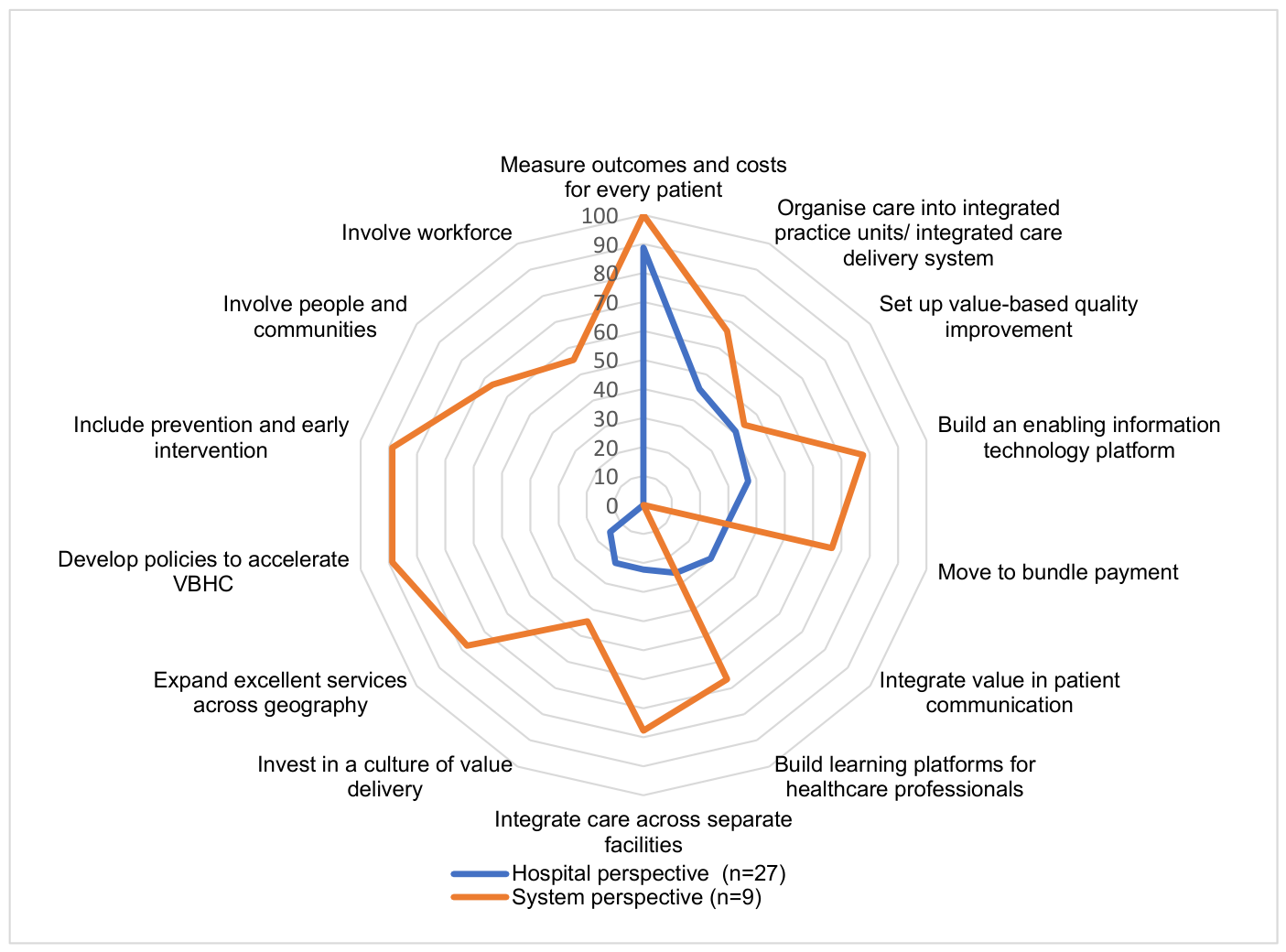
From the hospital perspective, we identified 10 criteria. The average number of criteria cited per study was 3.5, with a median of 3. ‘Measure outcomes and costs for every patient’ was cited in 24/27 studies, followed by ‘organise care into IPU/integrated care delivery system’ (12/27), ‘set up value-based quality improvement’ (11/27), and ‘build and enabling information technology platform’ (10/27). Other criteria were mentioned by less than one-third of the studies. One criterion, ‘integrate value in patient communication’, was cited exclusively in studies with a hospital perspective (8/27).
From the health system perspective, we identified 13 criteria. The average number of criteria cited per study was 9.1, with a median of 10. ‘Measure outcomes and costs for every patient’ was cited in all 9 studies, followed by ‘develop policies to accelerate VBHC’ (8/9), ‘include prevention and early intervention’ (8/9), ‘integrate care across separate facilities’(7/9), ‘expand excellent services across geography’ (7/9), and ‘build an enabling information technology platform’ (7/9). All cited criteria were found in at least 4/9 studies. Four criteria were cited exclusively in studies with a health system perspective: ‘develop policies to accelerate VBHC’ (8/9), ‘include prevention and early intervention’ (8/9), ‘involve people and communities’ (6/9) and ‘involve care delivery workforce’ (5/9) (see Supplemental Table S2).
Figure 2 illustrates the differences in the citation frequencies of VBHC operationalisation criteria between studies adopting a hospital perspective or those adopting a system perspective.
Comparison of Perspectives
Comparing both perspectives, we observed that, apart from the dominant criterion, ‘measure outcomes and costs for every patient’, the frequency of citations varied by perspective. For instance, ‘expand excellent services across geography’ was frequently cited in the healthcare system perspective (7/9 studies) but rarely mentioned in the hospital perspective (4/27). The health system perspective on VBHC was more comprehensive than the hospital perspective, both in terms of the total number of criteria considered (13 vs. 10, respectively) and the median number of criteria considered (10 vs. 3, respectively).
Discussion
The analysis of 36 recent studies revealed key differences in how the VBHC concept is defined and operationalised depending on the perspective taken. While all studies referenced the Porter’s definition, many did not fully consider all patient-relevant outcomes and costs. Upon examining the components of the numerator in the VBHC definition, PROMs measures are always cited as essential outcomes, followed closely by CROMs measures and, with less consistency, by PREMs. Additionally, six studies proposed broader definitions to better align with publicly funded health systems. The operationalisation of VBHC varied significantly between hospital or broader health system perspectives: hospital-focused studies emphasised outcome measurement and care integration, while in recent years, some health systems have endorsed a shift toward a population-centric and participatory approach, adopting a comprehensive set of operationalisation criteria.
Recent literature recognises Porter’s seminal work as the key reference for defining VBHC, as Fernandez-Salido et al also found out in their review.(Fernández-Salido et al., 2024) Prioritising outcome measurement over patient experience is consistent with the findings of Katz et al's, who reported that over 83 per cent of patients prioritise care outcomes when assessing the quality of their medical team.(Katz et al., 2024)
The observed hospital focus on fundamental building blocks may illustrate Porter’s emphasise on a gradual transition.(Porter & Teisberg, 2006) Recommendations for VBHC implementation by Cossio-Gil et al, based on the experiences of nine European university hospitals, also advocate measuring outcomes and organising care into integrated practice units, before developing a technology platform. However, the authors also recognise that hospital implementation of VBHC needs to be embedded in a larger healthcare ecosystem.(Cossio-Gil et al., 2022)
Another reason for hospitals' narrow focus may be the misalignment highlighted by Porter: fee-for-service payment models often conflict with VBHC’s value-driven goals by incentivising volume over outcomes. This creates financial challenges for hospitals striving to prioritise patient health results over service quantity.(Porter, 2010) This issue has been underscored by the lessons learned from Sweden's experience with VBHC, as described by Krohwinkel et al. Systems that do not integrate bundled payments or comprehensive funding for VBHC-related transformation projects, such as Sweden's initial VBHC initiatives, illustrate how hospitals frequently encounter significant constraints without supportive systemic funding and policy adaptations.(Krohwinkel et al., n.d.) While this issue has been observed in Sweden, it is likely not unique to this country, as the reliance on fee-for-service payment structures presents a common challenge for hospitals seeking to implement VBHC more comprehensively.
This study has several limitations. First, we relied on a single bibliographic database (PubMed), which may have resulted in missing relevant studies indexed elsewhere. Our search focused on PubMed articles indexed under the MeSH term ‘Value-based health care’ from 2021 onward, which may have excluded studies published before 2021 or those not indexed under this term. Additionally, by focusing on studies explicitly defining or operationalising VBHC, we may have overlooked relevant insights from broader health policy or implementation science literature. The exclusion of non-English and non-French publications may have introduced language bias. We also limited our analysis to high-income countries, excluding lower-resource settings. While study selection and data extraction were conducted by independent reviewers, discrepancies were resolved through discussion rather than statistical measures of inter-rater reliability, introducing potential subjectivity. Finally, the lack of patient and public involvement may have limited our ability to capture patient-centered perspectives.
Our findings highlight the divergence in VBHC operationalisation between hospitals and health systems. While hospitals tend to focus on core aspects such as outcome measurement and quality improvement, health systems adopt a broader approach, incorporating preventive care, policy alignment, and digital transformation. This distinction underscores the need for greater coordination between hospitals and policymakers to ensure a cohesive and scalable VBHC strategy. Moreover, the persistent reliance on Porter's definition, despite evolving frameworks, suggests a need for clearer guidance on practical implementation. The lack of a universally accepted set of operational criteria may contribute to inconsistent adoption across different settings, requiring policymakers and healthcare leaders to foster alignment between hospital-level initiatives and systemic reforms.
Bridging the gap between hospital-focused and system-wide approaches to VBHC requires interdisciplinary collaboration, investment in enabling infrastructure, and a shared commitment to value-driven care. By fostering an integrated approach, stakeholders can accelerate the transformation toward a more efficient, patient-centered healthcare system.
Conclusions
Value in health care is created at the local level, particularly during the care pathway and within hospitals. Two decades after the seminal work of Porter, the definition of VBHC seems to have reached consensus at the hospital level. However, in practice, when translating the VBHC definition into action, particularly throught the establishment of operationalisation criteria, most hospitals remain focused on the basic aspects of VBHC, such as collecting outcomes and enhancing care pathways, with low consensus in the selection of operationalisation criteria. In contrast, health systems embracing VBHC seems to more systematically embrace a broader, more comprehensive, and unified set of operationalisation criteria. Gaining a deeper understanding of how health systems can support hospitals in accelerating the adoption of VBHC could facilitate hospitals’ VBHC journey. This, in turn, could contribute to adressing the quality and cost challenges that all health systems encounter.
Supplementary Materials
The following supporting information can be downloaded at the website of this paper posted on Preprints.org.
References
- Abubakar, Z.; Sjaaf, A. C.; Gondhowiardjo, T. D.; Giffari Makkaraka, M. A. Implementation of value-based healthcare in ophthalmology: A scoping review. BMJ Open Ophthalmol. 2024, 9(1), e001654. [Google Scholar] [CrossRef] [PubMed]
- Bensink, M.; Volkerink, J.; Teklenburg, G.; Van Bavel, C. C. A. W.; Kuchenbecker, W. K. H.; Cohlen, B. J.; Curfs, M. H. J. M. Value-based healthcare in fertility care using relevant outcome measures for the full cycle of care leading towards shared decision-making: A retrospective cohort study. BMJ Open 2023, 13(9), e074587. [Google Scholar] [CrossRef]
- Carbone, M.; Neuberger, J.; Rowe, I.; Polak, W. G.; Forsberg, A.; Fondevila, C.; Mantovani, L.; Nardi, A.; Colli, A.; Rockell, K.; Schick, L.; Cristoferi, L.; Oniscu, G. C.; Strazzabosco, M.; Cillo, U. European Society for Organ Transplantation (ESOT) Consensus Statement on Outcome Measures in Liver Transplantation According to Value-Based Health Care. Transpl. Int. Off. J. Eur. Soc. Organ Transplant. 2023, 36, 12190. [Google Scholar] [CrossRef]
- Chabloz, C.; Cullati, S.; Chiolero, A. Value-based health care definitions and operationalizations from the hospital’s and healthcare system’s perspectives: A scoping review protocol; OSF, 7 May 2024; Available online: https://osf.io/x4hda/.
- Cossio-Gil, Y.; Omara, M.; Watson, C.; Casey, J.; Chakhunashvili, A.; Gutiérrez-San Miguel, M.; Kahlem, P.; Keuchkerian, S.; Kirchberger, V.; Luce-Garnier, V.; Michiels, D.; Moro, M.; Philipp-Jaschek, B.; Sancini, S.; Hazelzet, J.; Stamm, T. The Roadmap for Implementing Value-Based Healthcare in European University Hospitals—Consensus Report and Recommendations. Value Health 2022, 25(7), 1148–1156. [Google Scholar] [CrossRef]
- Derks, T. G. J.; Venema, A.; Köller, C.; Bos, E.; Overduin, R. J.; Stolwijk, N. N.; Hofbauer, P.; Bolhuis, M. S.; van Eenennaam, F.; Groen, H.; Hollak, C. E. M.; Wortmann, S. B. Repurposing empagliflozin in individuals with glycogen storage disease Ib: A value-based healthcare approach and systematic benefit-risk assessment. J. Inherit. Metab. Dis. 2024, 47(2), 244–254. [Google Scholar] [CrossRef]
- Directorate-General for Health and Food Safety (European Commission). Defining value in ‘value-based healthcare’: Report of the Expert Panel on Effective Ways of Investing in Health (EXPH); Publications Office of the European Union, 2019; Available online: https://data.europa.eu/doi/10.2875/35471.
- Eijsink, J. F. H.; Fabian, A. M.; Vervoort, J. P. M.; Al Khayat, M. N. M. T.; Boersma, C.; Postma, M. J. Value-based health care in Western countries: A scoping review on the implementation of patient-reported-outcomes sets for hospital-based interventions. Expert Rev. Pharmacoeconomics Outcomes Res. 2023, 23(1), 1–13. [Google Scholar] [CrossRef]
- Fernández-Salido, M.; Alhambra-Borrás, T.; Casanova, G.; Garcés-Ferrer, J. Value-Based Healthcare Delivery: A Scoping Review. Int. J. Environ. Res. Public Health 2024, 21(2), 134. [Google Scholar] [CrossRef] [PubMed]
- Gavaghan, B.; Finch, J.; Clarke, K. Creating a framework for change: Transitioning to value-based healthcare in Queensland. Aust. Health Rev. 2024, 48(2), 123–128. [Google Scholar] [CrossRef]
- Gray, M.; Airoldi, M.; Bevan, G.; McCulloch, P. Deriving optimal value from each system. J. R. Soc. Med. 2017, 110(7), 283. [Google Scholar] [CrossRef]
- He, W.; Li, M.; Cao, L.; Liu, R.; You, J.; Jing, F.; Zhang, J.; Zhang, W.; Feng, M. Introducing value-based healthcare perspectives into hospital performance assessment: A scoping review. J. Evid.-Based Med. 2023, 16(2), 200–215. [Google Scholar] [CrossRef]
- Hegde, S.; McKee, S.; Cole, D.; Wainer, Z. Experiences and learnings from developing and implementing a co-designed value-based healthcare framework within Victorian public oral health sector. Aust. Health Rev. 2024a, 48(2), 134–141. [Google Scholar] [CrossRef]
- Hegde, S.; McKee, S.; Cole, D.; Wainer, Z. Experiences and learnings from developing and implementing a co-designed value-based healthcare framework within Victorian public oral health sector. Aust. Health Rev. 2024b, 48. [Google Scholar] [CrossRef]
- Hilhorst, N. T.; Deprez, E.; Balak, D. M. W.; Van Geel, N.; Gutermuth, J.; Hoorens, I.; Lambert, J. L. W. Initiating value-based healthcare in psoriasis: Proposing a value-based outcome set for daily clinical practice. J. Eur. Acad. Dermatol. Venereol. 2023, 37(3), 528–539. [Google Scholar] [CrossRef]
- Kaplan, R. S.; Porter, M. E. The Big Idea: How to Solve the Cost Crisis in Health Care. Harvard Business Review 2011. Available online: https://hbr.org/2011/09/how-to-solve-the-cost-crisis-in-health-care.
- Katz, G.; Bell-Aldeghi, R.; Radoszycki, L.; Testa, D.; Pitts, P.; Song, Z. Outcomes or Experiences—What Do Patients Value More When Evaluating Medical Teams? NEJM Catal. 2024, 5(7). [Google Scholar] [CrossRef]
- Kidanemariam, M.; Pieterse, A. H.; van Staalduinen, D. J.; Bos, W. J. W.; Stiggelbout, A. M. Does value-based healthcare support patient-centred care? A scoping review of the evidence. BMJ Open 2023, 13(7), e070193. [Google Scholar] [CrossRef]
- Krohwinkel, A.; Mannerheim, U.; Rognes, J.; Winberg, H. Value-based healthcare in theory and practice; n.d. [Google Scholar]
- Lansdaal, D.; van Nassau, F.; der Steen, M. van; de Bruijne, M.; Smeulers, M. Lessons learned on the experienced facilitators and barriers of implementing a tailored VBHC model in a Dutch university hospital from a perspective of physicians and nurses. BMJ Open 2022, 12(1), e051764. [Google Scholar] [CrossRef]
- Larsson, S.; Clawson, J.; Howard, R. Value-Based Health Care at an Inflection Point: A Global Agenda for the Next Decade. Catal. Non-Issue Content 2023a, 4(1). [Google Scholar] [CrossRef]
- Larsson, S.; Clawson, J.; Howard, R. Value-Based Health Care at an Inflection Point: A Global Agenda for the Next Decade. Larsson S, Clawson J, Howard R. Value-Based Health Care at an Inflection Point: A Global Agenda for the next Decade. NEJM Catalyst Innovations in Care Delivery 2023b, ((1)), 4. [Google Scholar]
- Leao, D. L. L.; Pavlova, M.; Groot, W. Risk selection reduces efficiency of value-based healthcare. Int. J. Health Plan. Manag. 2023, 38(5), 1088–1096. [Google Scholar] [CrossRef] [PubMed]
- Lee, R. A.; Masic, S.; Bland, J.; Handorf, E.; Kutikov, A.; Esnaola, N.; Farma, J.; Su, S.; Ridge, J. A.; Chu, C.; Patel, S.; Curcillo, P.; Helstrom, J. L.; Uzzo, R. G. Transition to Value-based Healthcare: Development, Implementation, and Results of an Optimal Surgical Care Framework at a National Cancer Institute–designated Comprehensive Cancer Center. Eur. Urol. Focus 2024, 10(1), 123–130. [Google Scholar] [CrossRef]
- Leusder, M.; Porte, P.; Ahaus, K.; van Elten, H. Cost measurement in value-based healthcare: A systematic review. BMJ Open 2022, 12(12), e066568. [Google Scholar] [CrossRef]
- Lin, C. E.; Nguyen, T. M.; McGrath, R.; Patterson, A.; Hall, M. Dental Health Services Victoria value-based health care principles for oral health models of care. J. Public Health Dent. 2023, 83(3), 325–328. [Google Scholar] [CrossRef]
- Newton, D.; Bader, A. M. Value-Based Health Care in Perioperative Medicine. Anesthesiol. Clin. 2024, 42(1), 75–86. [Google Scholar] [CrossRef]
- Nguyen, T. M.; Bridge, G.; Hall, M.; Theodore, K.; Lin, C.; Scully, B.; Heredia, R.; Le, L. K.-D.; Mihalopoulos, C.; Calache, H. Is value-based healthcare a strategy to achieve universal health coverage that includes oral health? An Australian case study. J. Public Health Policy 2023, 44(2), 310–324. [Google Scholar] [CrossRef]
- Nielsen, V. W.; Johansen, C. B.; Todberg, T.; Skov, L.; Nissen, C. V.; Dodge, R.; Egeberg, A.; Thyssen, J. P.; Thomsen, S. F. A value-based healthcare model for initiating and switching psoriasis therapies—Results from the prospective multicentre IMPROVE study. J. Eur. Acad. Dermatol. Venereol. 2024, 38(5), 844–850. [Google Scholar] [CrossRef]
- O’Donnell, M. T.; Lewis, S.; Davies, S.; Dinneen, S. F. Delivering value-based healthcare for people with diabetes in a national publicly funded health service: Lessons from Ireland and Wales. J. Diabetes Investig. 2023, 14(8), 925–929. [Google Scholar] [CrossRef]
- Omara, M.; Stamm, T.; Bekes, K. LESSONS LEARNED FROM the FIRST STEPS of IMPLEMENTING VALUE-BASED ORAL HEALTH CARE: A CASE STUDY FROM the MEDICAL UNIVERSITY of VIENNA. J. Evid.-Based Dent. Pract. 2023, 23(1), 101791. [Google Scholar] [CrossRef] [PubMed]
- Pecoraro, V., Fasano, T., Aspromonte, N., Barocci, S., Bartolucci, D., Clerico, A., Gallucci, F., Gnerre, P., Sasso, B. L., Mariottini, A., Medea, G., Perrone, M. A., Ruscio, M., Sciacovelli, L., Trenti, T., Chiani, V., Paolini, D., & Banfi, G. (n.d.). The role of laboratory medicine in a value-based healthcare system: The example of heart failure patient management in the Italian context.
- Porter, M. E. What Is Value in Health Care? N. Engl. J. Med. 2010, 363(26), 2477–2481. [Google Scholar] [CrossRef] [PubMed]
- Porter, M. E.; Larsson, S.; Lee, T. H. Standardizing Patient Outcomes Measurement. N. Engl. J. Med. 2016, 374(6), 504–506. [Google Scholar] [CrossRef]
- Porter, M. E.; Lee, T. H. The Strategy That Will Fix Health Care. In Harvard Business Review; 1 October 2013; Available online: https://hbr.org/2013/10/the-strategy-that-will-fix-health-care.
- Porter, M. E.; Teisberg, E. O. Redefining health care: Creating value-based competition on results; Harvard Business School Press, 2006. [Google Scholar]
- Raymond, K.; Haddock, R.; Nathan, S.; Harrison, R.; Meyer, L. Value-based public health: Moving beyond value-based health care to support a wellbeing economy. Health Promot. J. Aust. 2023, 34(3), 675–680. [Google Scholar] [CrossRef]
- Silveira Bianchim, M.; Crane, E.; Jones, A.; Neukirchinger, B.; Roberts, G.; Mclaughlin, L.; Noyes, J. The implementation, use and impact of patient reported outcome measures in value-based healthcare programmes: A scoping review. PLoS ONE 2023, 18(12), e0290976. [Google Scholar] [CrossRef] [PubMed]
- Smith, P. C.; Sagan, A.; Siciliani, L.; Figueras, J. Building on value-based health care: Towards a health system perspective. Health Policy 2023, 138, 104918. [Google Scholar] [CrossRef]
- Steinmann, G.; Van De Bovenkamp, H.; De Bont, A.; Delnoij, D. Redefining value: A discourse analysis on value-based health care. BMC Health Serv. Res. 2020, 20(1), 862. [Google Scholar] [CrossRef]
- Teisberg, E.; Wallace, S.; O’Hara, S. Defining and Implementing Value-Based Health Care: A Strategic Framework. Acad. Med. 2020, 95(5), 682–685. [Google Scholar] [CrossRef]
- Theunissen, L.; Cremers, H.-P.; Dekker, L.; Janssen, H.; Burg, M.; Huijbers, E.; Voermans, P.; Kemps, H.; Van Veghel, D. Implementing Value-Based Health Care Principles in the Full Cycle of Care: The Pragmatic Evolution of the Netherlands Heart Network. Circ. Cardiovasc. Qual. Outcomes 2023, 16(4). [Google Scholar] [CrossRef]
- Torkki, P.; Leskelä, R.-L.; Mustonen, P.; Linna, M.; Lillrank, P. How to extend value-based healthcare to population-based healthcare systems? Defining an outcome-based segmentation model for health authority. BMJ Open 2023, 13(11), e077250. [Google Scholar] [CrossRef]
- Tricco, A. C.; Lillie, E.; Zarin, W.; O’Brien, K. K.; Colquhoun, H.; Levac, D.; Moher, D.; Peters, M. D. J.; Horsley, T.; Weeks, L.; Hempel, S.; Akl, E. A.; Chang, C.; McGowan, J.; Stewart, L.; Hartling, L.; Aldcroft, A.; Wilson, M. G.; Garritty, C.; Straus, S. E. PRISMA Extension for Scoping Reviews (PRISMA-ScR): Checklist and Explanation. Ann. Intern. Med. 2018, 169(7), 467–473. [Google Scholar] [CrossRef] [PubMed]
- van der Nat, P. B. The new strategic agenda for value transformation. Health Serv. Manag. Res. 2022, 35(3), 189–193. [Google Scholar] [CrossRef] [PubMed]
- van der Poort, E. K. J.; Kidanemariam, M.; Moriates, C.; Rakers, M. M.; Tsevat, J.; Schroijen, M.; Atsma, D. E.; van den Akker-van Marle, M. E.; Bos, W. J. W.; van den Hout, W. B. How to Use Costs in Value-Based Healthcare: Learning from Real-life Examples. J. General. Intern. Med. 2024, 39(4), 683–689. [Google Scholar] [CrossRef]
- van der Voorden, M.; Sipma, W. S.; de Jong, M. F. C.; Franx, A.; Ahaus, K. C. T. B. The immaturity of patient engagement in value-based healthcare—A systematic review. Front. Public Health 2023, 11, 1144027. [Google Scholar] [CrossRef] [PubMed]
- van Elten, H. J.; Howard, S. W.; De Loo, I.; Schaepkens, F. Reflections on Managing the Performance of Value-Based Healthcare: A Scoping Review. Int. J. Health Policy Manag. 2023, 12, 7366. [Google Scholar] [CrossRef]
- van Engen, V.; Bonfrer, I.; Ahaus, K.; Buljac-Samardzic, M. Identifying consensus on activities that underpin value-based healthcare in outpatient specialty consultations, among clinicians. Patient Educ. Couns. 2023, 109, 107642. [Google Scholar] [CrossRef]
- Van Hoorn, E. S.; Ye, L.; Van Leeuwen, N.; Raat, H.; Lingsma, H. F. Value-Based Integrated Care: A Systematic Literature Review. Int. J. Health Policy Manag. 2024, 13, 8038. [Google Scholar] [CrossRef]
- van Staalduinen, D. J.; van den Bekerom, P. E. A.; Groeneveld, S. M.; Stiggelbout, A. M.; van den Akker-van Marle, M. E. Relational coordination in value-based health care. Health Care Manag. Rev. 2023, 48(4), 334. [Google Scholar] [CrossRef] [PubMed]
- Van Veghel, W.; Van Dijk, S. C.; Klem, T. M.; Weel, A. E.; Bügel, J.-B.; Birnie, E. Is the QCI framework suited for monitoring outcomes and costs in a teaching hospital using value-based healthcare principles? A retrospective cohort study. BMJ Open 2024, 14(5), e080257. [Google Scholar] [CrossRef] [PubMed]
- Walshe, J.; Akbari, A.; Hawthorne, A. B.; Laing, H. Data linkage can reduce the burden and increase the opportunities in the implementation of Value-Based Health Care policy: A study in patients with ulcerative colitis (PROUD-UC Study). Int. J. Popul. Data Sci. n.d., 6(3), 1705. [Google Scholar] [CrossRef]
- Westerink, H. J.; Steinmann, G.; Koomans, M.; van der Kemp, M. H.; van der Nat, P. B. Value-based healthcare implementation in the Netherlands: A quantitative analysis of multidisciplinary team performance. BMC Health Serv. Res. 2024, 24, 224. [Google Scholar] [CrossRef]
- Wolf, A.; Erichsen, A. A.; Wikström, E.; Bååthe, F. Untangling the perception of value in value-based healthcare – an interview study. Leadersh. Health Serv. 2024, 37(5), 130–141. [Google Scholar] [CrossRef] [PubMed]
- Wyffels, E.; Beles, M.; Baeyens, A.; Croeckaert, K.; De Potter, T.; Van Camp, G.; Collet, C.; Sonck, J.; Vanderheyden, M.; Bartunek, J.; Barbato, E.; Bermpeis, K.; Bertolone, D. T.; Gallinoro, E.; Esposito, G.; Schoonjans, G.; Staelens, F.; Van Laer, E.; De Bruyne, B. Same Day Discharge Strategy by Default in a Tertiary Catheterization Laboratory in Belgium: Value Based Healthcare-Change in Practice. Health Policy 2023, 132, 104826. [Google Scholar] [CrossRef]
- Zanotto, B. S.; Etges, A. P. B. D. S.; Marcolino, M. A. Z.; Polanczyk, C. A. Value-Based Healthcare Initiatives in Practice: A Systematic Review. J. Healthc. Manag. 2021, 66(5), 340–365. [Google Scholar] [CrossRef]
- van Zwol-Janssens, C.; Jiskoot, G.; Schipper, J.; Louwers, Y. V. Introducing a value-based healthcare approach for women with premature ovarian insufficiency (POI): Recommendations for patient-centered outcomes in clinical practice. Maturitas 2024, 184. [Google Scholar] [CrossRef]
Figure 1.
Flowchart of studies selection.
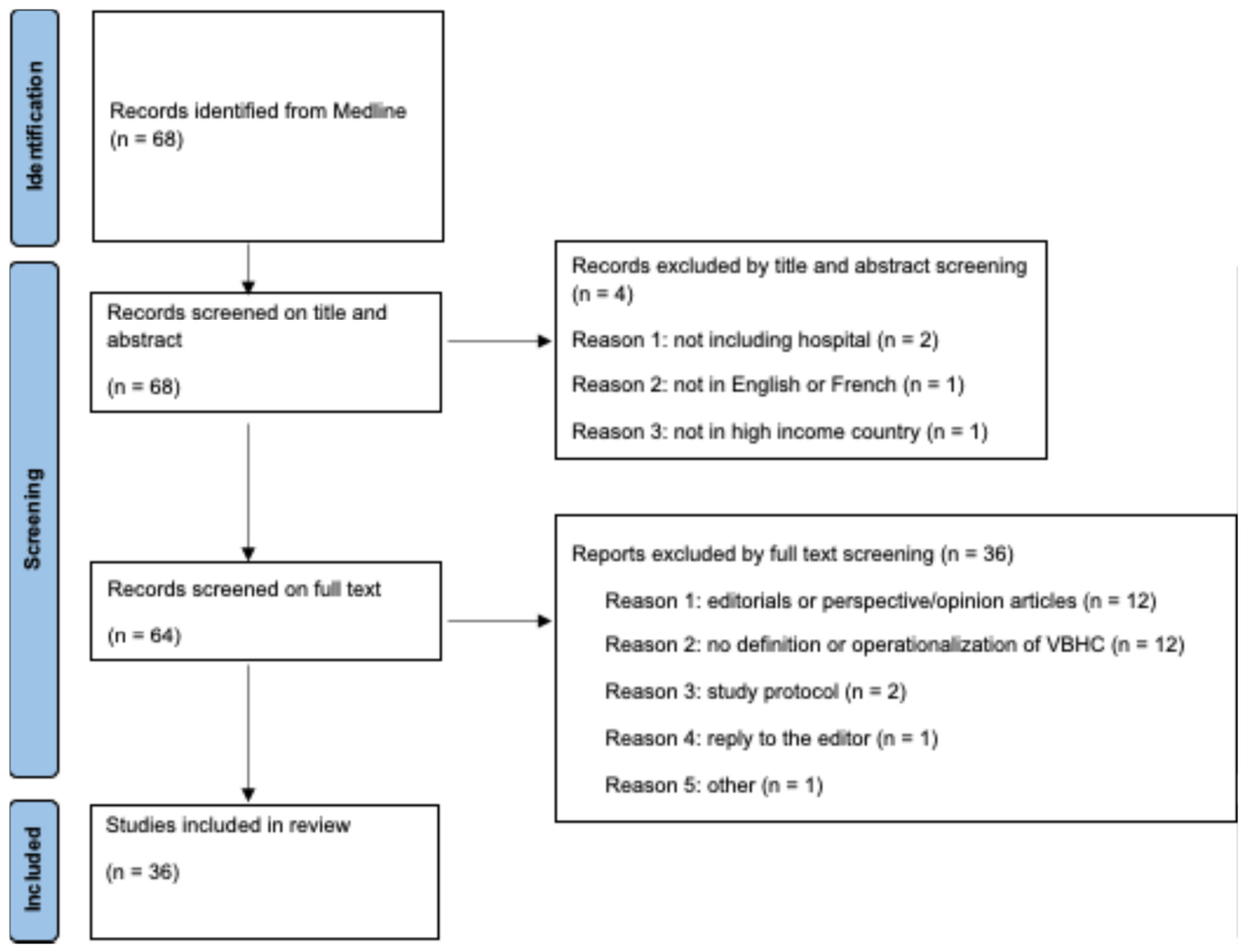
Figure 2.
Comparison of the percentages of citation of each VBHC operationalization criteria between papers with hospital or system perspectives.
Figure 2.
Comparison of the percentages of citation of each VBHC operationalization criteria between papers with hospital or system perspectives.
Disclaimer/Publisher’s Note: The statements, opinions and data contained in all publications are solely those of the individual author(s) and contributor(s) and not of MDPI and/or the editor(s). MDPI and/or the editor(s) disclaim responsibility for any injury to people or property resulting from any ideas, methods, instructions or products referred to in the content. |
© 2026 by the authors. Licensee MDPI, Basel, Switzerland. This article is an open access article distributed under the terms and conditions of the Creative Commons Attribution (CC BY) license (http://creativecommons.org/licenses/by/4.0/).
Copyright: This open access article is published under a Creative Commons CC BY 4.0 license, which permit the free download, distribution, and reuse, provided that the author and preprint are cited in any reuse.


