

Submitted:
18 May 2026
Posted:
20 May 2026
You are already at the latest version
Abstract
Remote and hybrid work have altered where many high-skill workers live, commute, and participate in professional networks, raising new questions for technology-based economic development (TBED) in the United States. This conceptual review asks whether remote work is dispersing innovation activity, creating durable opportunities for smaller metropolitan areas, or reorganizing established geographies of advantage. The article uses a focused conceptual review that synthesizes foundational scholarship on agglomeration, clusters, and innovation geography with post-2020 research on remote work, urban restructuring, regional migration, local innovation systems, and policy responses. Sources were selected for their relevance to spatial concentration, metropolitan hierarchy, remote-worker embeddedness, and TBED strategy. The review shows that remote work has not dissolved agglomeration. Large metropolitan regions continue to concentrate remote-capable, innovation-intensive, and digitally intensive employment, while some smaller and mid-sized metros have gained visibility and mobile talent. However, the evidence points more strongly to selective gains at the margin than to broad spatial equalization. The findings also show that residential inflows alone do not create durable innovation capacity. The article argues that remote work is reorganizing rather than replacing TBED. Its central contribution is a framework of partial geographic decoupling, in which remote work loosens the routine overlap among residence, workplace, and firm location while increasing the importance of local institutions. The main policy challenge is building connective capacity that converts mobile labor into entrepreneurship, collaboration, civic participation, and long-term regional innovation. This framing clarifies how regions can compete without assuming that attracting remote workers automatically produces transformation. Recent federal and multi-survey evidence strengthens the article’s claim that remote work has stabilized above pre-pandemic levels while remaining uneven by education, occupation, and metropolitan context.
Keywords:
remote work
; hybrid work
; technology‐based economic development
; agglomeration
; innovation ecosystems
; regional development
; economic geography
Introduction
Technology-based economic development (TBED) has historically regarded geography as a productive asset rather than a neutral context. Researchers in economic geography, innovation studies, and regional development have consistently posited that innovation clusters form when firms, labor, academic institutions, financiers, and civic organizations co-locate and engage in low-cost knowledge exchange (Porter, 1998; Storper & Venables, 2004; Feldman & Kogler, 2010; Damoah & Yeboah, 2025). This idea influenced both academic research and practical application in the United States. Policymakers established research parks, innovation districts, commercialization programs, venture networks, and university-industry alliances based on the premise that co-location facilitates learning, labor-market alignment, and the establishment of new firms (Porter, 1998; Feldman & Kogler, 2010). Over time, a limited number of metropolitan areas converted those resources into sustainable advantages in high technology, advanced services, and knowledge-intensive employment (Muro & You, 2022).
In this context, remote and hybrid work complicate the traditional TBED model by weakening the linkages among a worker’s residence, their workplace, and a firm’s operations. The proliferation of remote work entails more than merely relocating the laptop from the office to the residence. It modifies commute patterns, reconfigures residential site preferences, diminishes certain office demand, reallocates neighborhood expenditure, and transforms the connection between everyday interactions and metropolitan structure (Burrows et al., 2023; Delventhal et al., 2022; Ramani et al., 2024). Consequently, TBED now faces a more significant structural inquiry. Does the increasing prevalence of high-skill labor that does not necessitate daily physical presence in a central business district undermine the spatial rationale supporting cluster-based development, or does it restructure that rationale across a broader geographical landscape (Monte et al., 2023; Gillette, 2023).
Contemporary scholarship does not endorse a straightforward response. On the one hand, remote work proliferated significantly post-2020 and has stabilized at levels substantially above the pre-pandemic baseline. Barrero, Bloom, and Davis (2023) indicate that full days of remote work constituted 28 percent of compensated workdays for Americans aged 20 to 64 by mid-2023, approximately quadrupling the rate from 2019. Publications from the U.S. Census Bureau indicate that remote work significantly increased from 2019 to 2021 and remained elevated thereafter, albeit lower than the peak observed during the pandemic (Burrows et al., 2023; U.S. Census Bureau, 2025). Conversely, the literature indicates that remote-capable labor is markedly uneven among various occupations, skill levels, and geographic locations. High-skill, digitally intensive, and professional occupations remain concentrated in big metropolitan areas characterized by robust labor markets and solid institutional frameworks (Braesemann et al., 2022; Muro & You, 2022; Ozimek & Carlson, 2022). Collectively, these studies indicate that remote labor expands options without homogenizing the economic terrain. More recent evidence reinforces this stabilization claim: Bick et al. (2025) compare six nationally representative U.S. datasets and conclude that work from home in 2024 remained substantially above pre-pandemic levels, while part-time or hybrid work has become a larger share of overall remote work since 2022. Likewise, the Bureau of Labor Statistics reports that 35.5 million people teleworked or worked at home for pay in the first quarter of 2024, equal to 22.9 percent of people at work, up from 19.6 percent one year earlier (U.S. Bureau of Labor Statistics, 2025).
This article considers such tension as the primary issue. Instead of asking whether remote work is significant, it examines how remote work alters the geography of TBED in the United States. The paper investigates three interconnected inquiries. Has remote labor substantially diminished the spatial concentration of technology-driven economic activity? Secondly, have smaller and mid-sized urban areas established a sustainable technology presence, or have they merely attracted transient residential inflows? Under what conditions do remote workers enhance local innovation ecosystems rather than stay economically linked to external enterprises and networks? These inquiries are significant because the TBED strategy continues to rely predominantly on site-based interventions, while the concept of place has become increasingly complex in a hybrid economy (Porter, 1998; Feldman & Kogler, 2010; Gillette, 2023).
This article advances discourse by reconceptualizing remote work as an issue of partial spatial decoupling, rather than merely a binary decision between dispersion and persistence. Initially, it integrates remote-work research through a TBED perspective, linking urban transformation, labor flexibility, and regional development under a singular framework. Secondly, it elucidates how agglomeration is being reconfigured through evolving linkages among housing, workplace, firm location, and local institutional engagement. Third, it differentiates between talent recruitment and ecosystem development, clarifying why residential inflows do not inherently yield sustainable, technology-driven growth. Fourth, it delineates ideas for future empirical research that can be evaluated concerning urban concentration, smaller metropolitan gains, institutional mediation, and polycentric regional growth.
TBED, Agglomeration, and the Problem of Geographic Decoupling
The TBED scholarship typically starts with the assumption that innovation is not uniformly distributed across geographical areas. Porter (1998) contends that clusters generate competitive advantage by aggregating interrelated enterprises, specialized labor, suppliers, and supporting institutions, hence enhancing productivity and fostering innovation. Feldman and Kogler (2010) similarly view spatial concentration as a persistent characteristic of innovation systems, noting that firms and employees gain advantages when location reduces the costs of interaction and learning. Storper and Venables (2004) refine that reasoning by highlighting the significance of in-person interaction. They contend that co-presence fosters trust, interpretation, problem-solving, and the dissemination of tacit knowledge in ways that digital communication cannot readily emulate. Collectively, this literature elucidates the historical emphasis of TBED policy on physical concentration. Regions have aimed to foster innovation by enhancing local ecosystems and promoting continuous interaction among enterprises, labor, and institutions (Porter, 1998; Storper & Venables, 2004; Feldman & Kogler, 2010).
Remote employment disrupts the framework by undermining a mechanism via which clusters have historically perpetuated themselves: the necessity for regular spatial co-presence. If companies can employ knowledge workers who reside remotely from headquarters and maintain productivity without daily commuting, the conventional correlation among job location, domicile, and local network engagement becomes increasingly tenuous (Choudhury et al., 2021; Barrero et al., 2023). However, remote work does not inherently eradicate agglomeration. An area can nevertheless derive advantages from institutional density, labor-market scale, venture networks, and knowledge spillovers, even if numerous workers commute infrequently. The pertinent inquiry, therefore, is to the magnitude and processes of agglomeration in mixed contexts. Does innovation persist in clustering at the metropolitan level despite the dispersion of jobs within regions? Do residential transitions generate new neighborhood nodes without diminishing the inter-metropolitan hierarchy? Do local institutions gain significance due to the partial decoupling of work and housing (Delventhal et al., 2022; Monte et al., 2023; Ramani et al., 2024)?
This reframing is significant since TBED policy frequently continues to operate under a downtown-centric paradigm of innovation. Local officials often associate technological advancement with concentrated office areas, prominent innovation corridors, and conspicuous physical clusters. Gillette (2023) cautions that cities frequently adhere to outdated cluster strategies despite structural changes undermining the viability of those models. His historical analysis of New York’s Garment District illustrates how local political coalitions can sustain antiquated spatial configurations long after external circumstances have evolved. This concept is immediately applicable to remote work. If policymakers react by upholding traditional office-centric models as if no significant changes have occurred, they may overlook opportunities to reformulate regional development policies for a hybrid economy (Gillette, 2023). Conversely, if policymakers presume that remote work renders location insignificant, they may underinvest in the institutions that continue to underpin innovation. The literature thus indicates a departure from a binary decision between concentration and dispersal. It indicates a more challenging endeavor: comprehending how geographic decoupling alters the mechanisms by which regional systems create value.
Review Approach
This paper employs a targeted conceptual review instead of a systematic review or a unique empirical framework. The review was structured around three categories of literature: foundational studies on agglomeration, clusters, and the geography of innovation; post-2020 research on remote and hybrid work, commuting, residential relocation, and urban structure; and policy-focused investigations on regional development, smaller metropolitan areas, rural innovation, and local innovation systems. Search terms and source screening focused on combinations of remote work, telecommuting, hybrid work, agglomeration, technology-driven economic development, innovation ecosystems, clusters, metropolitan hierarchy, urban structure, and regional development.
Sources were incorporated when they directly addressed at least one of the four analytical inquiries: whether remote work diminishes spatial concentration; whether smaller and mid-sized metropolitan areas are acquiring sustainable technological capacity; whether remote workers achieve local integration; and how technology-based economic development policy should evolve under hybrid work conditions. Peer-reviewed research was emphasized when accessible. Selective use was made of governmental, institutional, and policy sources when they provided timely empirical evidence or contemporary policy analysis that was not yet comprehensively reflected in the peer-reviewed literature (Burrows et al., 2023; Muro & You, 2022; Ozimek & Carlson, 2022; U.S. Census Bureau, 2025). The review prioritizes conceptual synthesis and theory development, given the ongoing evolution of literature, over comprehensive coverage. The review was also updated with 2024 and 2025 evidence from federal statistical agencies, multi-survey labor-market comparisons, and recent urban policy research to ensure that the analysis reflects the post-peak normalization of hybrid work rather than only the initial pandemic shock (Aksoy et al., 2025; Bick et al., 2025; Burrows et al., 2025; Loh & Love, 2024).
The review omits studies that consider remote work solely as an internal human-resource practice devoid of spatial implications, those concentrated exclusively on countries or institutional contexts with minimal relevance to the United States, and commentary articles lacking empirical evidence, theoretical frameworks, or policy analysis. International evidence is used only when it elucidates mechanisms pertinent to U.S. technology labor markets, such as the disparate geography of remote digital employment. This constrained methodology enables the writer to formulate a cohesive TBED argument while recognizing that distant work trends and regional impacts are still evolving.
Conceptual Framework: Reworked Agglomeration Under Partial Geographic Decoupling
The paper proposes a conceptual framework that transcends descriptive synthesis, grounded in agglomeration theory and enriched by scholarship on clusters and innovation ecosystems. Classical agglomeration theory clarifies the reasons enterprises and people achieve productivity enhancements through spatial concentration, robust labor markets, specialized suppliers, and continuous knowledge exchange (Porter, 1998; Storper & Venables, 2004; Feldman & Kogler, 2010). This approach preserves the theoretical foundation while asserting that distant labor modifies the spatial channels through which those benefits function. Instead of eradicating agglomeration, remote work facilitates partial geographic decoupling, resulting in a misalignment among dwelling, workplace, and business locations relative to the office-centric paradigm. This transition shifts the locus of interaction, amplifies the significance of local institutions, and produces more disparate outcomes across regions.
The framework delineates a causal sequence. Remote and hybrid work diminishes the necessity for daily physical presence in core business centers. This transition triggers mediating mechanisms such as residential migration, the distribution of professional interactions, reduced reliance on commuting, neighborhood-level activities, and dependence on local connective institutions. These mechanisms yield results at two levels. In urban regions, activity transitions to suburban and local hubs. In urban areas, certain smaller and mid-sized communities attract mobile talent; however, only a few successfully transform this presence into sustainable ecosystem development. The consequences of TBED are contingent; while closeness remains significant, institutions increasingly dictate whether proximity translates into cooperation, entrepreneurship, and sustained innovation capacity.
Figure 1.
Conceptual framework linking remote work to changing TBED geography.
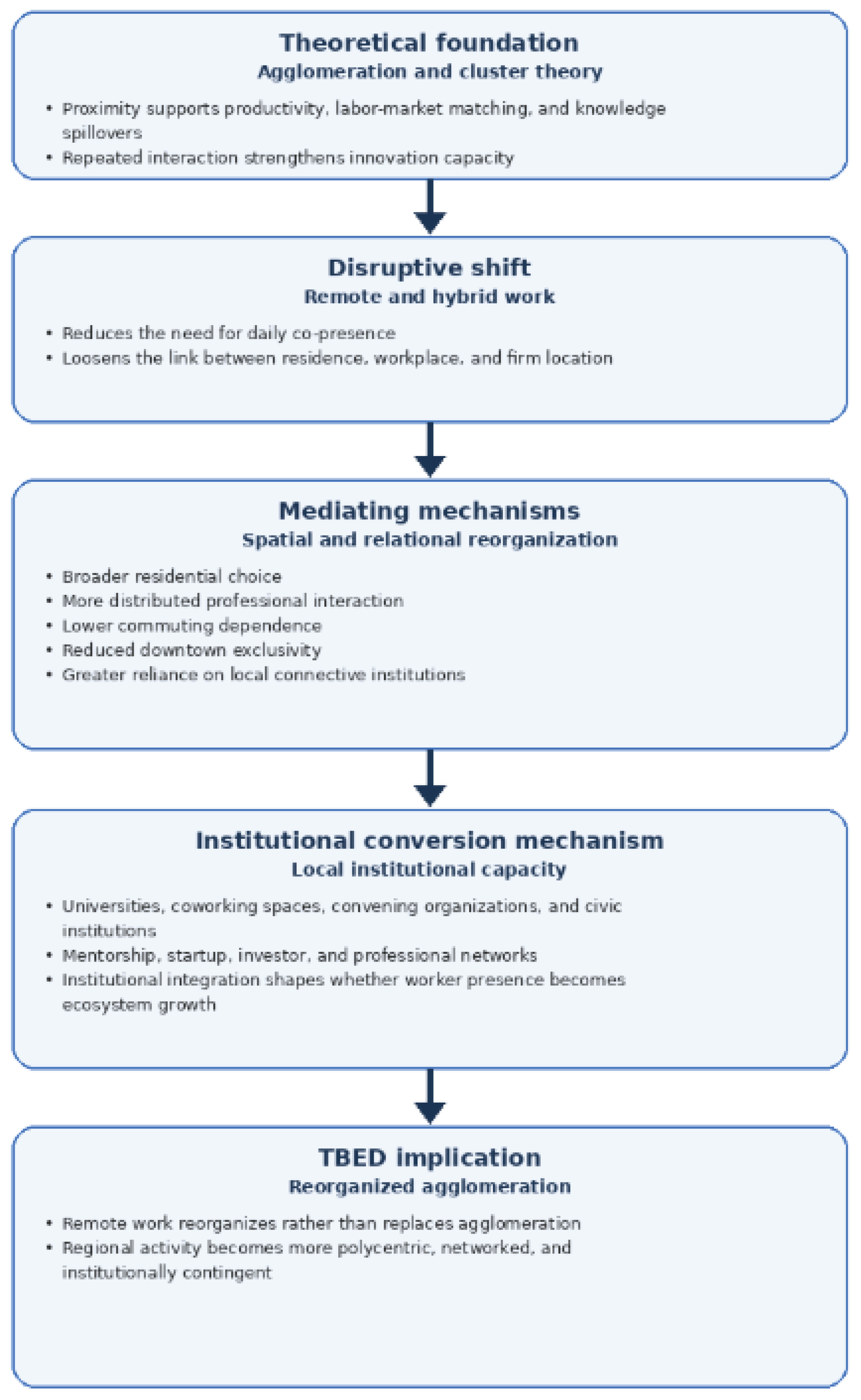
The framework enhances analytical clarity in three respects. Initially, it delineates the process by which remote work influences TBED. Numerous reports characterize remote work as a significant transformation in labor practices; nonetheless, this paradigm indicates that the primary concern is partial spatial decoupling. As everyday co-presence diminishes, organizations can no longer presume that employee presence, corporate location, and local knowledge exchange inherently align. Secondly, the paradigm elucidates the reasons behind the varied regional impacts of distant employment. Locations that attract mobile labor yet lack supportive institutions may attract population and consumer spending without enhancing innovation capacity. Locations that integrate mobile labor with universities, convening groups, entrepreneurial networks, coworking facilities, and mentorship avenues are more likely to transform presence into ecosystem enrichment. The framework clarifies scale. Remote labor may diminish the supremacy of downtown areas while preserving the advantages of metropolitan regions, suggesting that researchers ought to examine both intra-metropolitan rearrangement and inter-metropolitan hierarchy rather than treating geographic change as a singular phenomenon. This distinction is consistent with recent planning scholarship on innovation districts, which argues that remote work and “placelessness” require districts to provide more than office concentration; they must also create interaction-rich environments, shared amenities, and institutional programming that make local knowledge exchange more likely (Mozaffarian et al., 2025).
The approach enhances the article’s rigor by generating testable assertions for future studies. Instead of regarding remote work as a general labor-market phenomenon, the propositions delineate the interconnections between co-presence, metropolitan advantage, institutional mediation, and polycentric regional development. The paradigm is anchored in existing agglomeration theory, illustrating how agglomeration can operate through a more decentralized, institutionally dependent geographical configuration.
Propositions Derived from the Framework
P1. Remote work reduces the need for daily co-presence but does not eliminate the productivity advantages of large metropolitan regions because agglomeration economies still operate through labor-market depth, institutional density, and episodic face-to-face interaction.
P2. Smaller and mid-sized metropolitan areas benefit unevenly from remote work because residential inflows yield durable TBED gains only when local institutions connect mobile workers to entrepreneurship, collaboration, and regional problem-solving.
P3. The developmental effects of remote work increasingly depend on institutional mediation rather than spatial proximity alone, making local governance, convening capacity, and ecosystem infrastructure more central to TBED outcomes.
P4. Remote work reorganizes TBED toward a polycentric and networked geography in which innovation activity spreads across metropolitan nodes without fully displacing the hierarchical advantages of established technology hubs.
Remote Work and the Persistence of Spatial Concentration
The most compelling finding in the literature is that distant work has not diminished spatial concentration. Delventhal, Kwon, and Parkhomenko (2022) elucidate this concept in their urban model of remote labor. They observe that increased remote employment alters the internal structure of cities by reducing certain commuting costs and promoting outward migration, although their model does not predict the eradication of agglomeration. Employment opportunities persist in clustering around efficient areas close to the urban center, and effective interaction continues to bolster concentration at the metropolitan scale (Delventhal et al., 2022). Similarly, Monte, Porcher, and Rossi-Hansberg (2023) arrive at a parallel result in their examination of remote work and urban organization. They contend that remote work alters the frequency of employee travel and residential choices, although they do not perceive these changes as indicative of diminished urban significance. Their model posits that hybrid arrangements alter the locations of activities within metropolitan regions while maintaining the advantages of extensive agglomeration economies (Monte et al., 2023).
Empirical research corroborates this conclusion. Ramani, Alcedo, and Bloom (2024) establish a persistent phenomenon known as the “donut effect,” in which remote work redistributes activity from major urban areas to adjacent neighborhoods and suburbs. This pattern is significant because it suggests that distant labor may diminish the supremacy of central office districts without eliminating urban concentration. Workers and enterprises do not merely disperse throughout the geographical landscape. Instead, they frequently move within broader metropolitan areas that continue to offer labor-market depth, amenities, and institutional density (Ramani et al., 2024). From a TBED perspective, this differentiation is vital, as the transition from central business districts to metropolitan and neighborhood nodes alters the geography of innovation while preserving its significance.
Extensive research on remote work indicates that access to it is significantly stratified. Barrero et al. (2023) observe that remote work varies systematically by education, industry, employment, and local population density. Employees in professional, managerial, technical, and information-centric positions telecommute significantly more frequently than those in various service, production, transportation, and caregiving roles (Barrero et al., 2023). Burrows, Burd, and McKenzie (2023) document analogous trends in U.S. Census Bureau data. The data indicate that remote work surged significantly during the pandemic, predominantly among highly educated individuals and within occupational categories that already possessed enhanced workplace flexibility. Consequently, remote work has proliferated predominantly in sectors of the labor market that are already unevenly distributed across the national urban hierarchy (Burrows et al., 2023).
Research investigating geographic variance directly corroborates that finding. Ozimek and Carlson (2022) demonstrate that remote work remains particularly common in coastal commuting zones and metropolitan regions, but inland areas also report elevated rates. Their analysis reveals distinct correlations between the incidence of remote work and factors such as occupational composition, educational attainment, housing costs, and commuting patterns. The territory of remote employment continues to mirror the geography of prior economic advantages (Ozimek & Carlson, 2022). Muro and You (2022) arrive at a similar result in their Brookings research of the technology sector. Superstar tech hubs continue to exhibit the highest concentrations of technology employment, despite a considerable increase in secondary-tier metropolitan areas during the pandemic. Consequently, remote labor seems to introduce new flexibility inside a rigid hierarchical structure rather than supplant that hierarchy with widespread convergence (Muro & You, 2022).
Global evidence corroborates the identical interpretation. Braesemann et al. (2022) examine a worldwide online labor platform and find that remote employment is polarized across nations, urban areas, and skill sets rather than distributed uniformly. Major metropolitan areas and highly skilled professionals continue to secure unequal shares of remote digital employment. Although their analysis does not concentrate solely on the United States, its results are broadly applicable. Digital mediation alone does not eradicate uneven progress. Companies continue to seek talent in regions where robust capabilities, dependable infrastructure, and many supporting institutions are already established (Braesemann et al., 2022). For TBED, this notion is significant as it contests the presumption that digital employment inherently democratizes opportunities for creativity.
Federal data indicate that remote labor persists, albeit not universally. The U.S. Census Bureau reports that remote work remained above the pre-2020 baseline in 2024, despite a decline from the 2021 zenith (U.S. Census Bureau, 2025). Barrero et al. (2023) contend that remote employment has become an enduring characteristic of the U.S. labor market. The crucial point about TBED is that persistence has not led to equality. Remote-capable employment persists in regions characterized by high levels of human capital, robust digital infrastructure, and dense professional labor markets (Barrero et al., 2023; Burrows et al., 2023; Ozimek & Carlson, 2022). Recent BLS data sharpen this point by showing that telework is strongly patterned by occupation and education: in the first quarter of 2024, management, professional, and related occupations had a 37.9 percent telework rate, while workers with a bachelor’s degree or higher had a 40.4 percent telework rate, compared with 8.5 percent for workers whose highest attainment was a high school diploma (U.S. Bureau of Labor Statistics, 2025). These patterns support the article’s argument that remote work expands flexibility primarily within labor-market segments already associated with high human capital and metropolitan advantage.
Current Census evidence also clarifies why remote work should not be interpreted as spatial equalization. In 2023, 13.8 percent of U.S. workers usually worked from home, more than twice the 2019 share of 5.7 percent but below the 2021 peak of 17.9 percent. The Census Bureau also reports that home-based workers have higher earnings and lower poverty rates than commuters in major metropolitan areas, reinforcing the view that remote work is embedded in existing socioeconomic inequality rather than operating as a neutral dispersal mechanism (Burrows et al., 2025).
Smaller Metros, Relative Gains, and the Limits of Dispersal
While remote work has not eliminated concentration, it has altered the competitive dynamics for many smaller and mid-sized urban regions. Crucial data on this matter are derived from research monitoring geographic changes in technology and distant labor during the epidemic. Muro and You (2022) contend that the U.S. technology sector currently exhibits a more nuanced hierarchy than the simplistic superstar model proposed. Their analysis uncovers a group of “rising star” metropolitan areas that exhibited greater relative increases than other larger hubs during the pandemic. This conclusion is significant as it indicates that remote work, hybrid employment, and associated labor-market changes have expanded the geographical scope of feasible TBED participation. A wider array of metropolitan areas can now vie for a portion of the mobile technology workforce and technology-related endeavors (Muro & You, 2022).
Remote work facilitates this opportunity by reducing a cost that has traditionally benefited costly superstar regions: the need to reside in close proximity to the central workplace. When employees do not commute daily, some gain greater autonomy in choosing cost, home size, amenities, family preferences, or overall quality of life. Ramani et al. (2024) demonstrate that distant work is already shifting residential demand and local economic activity to regions beyond key urban areas. Ozimek and Carlson (2022) similarly recognize significant disparities among commuting zones and observe that certain noncoastal areas have attained considerable proportions of distant work. The findings do not establish that smaller metropolitan areas have transformed into significant technology hubs; nonetheless, they indicate that remote work has expanded the competitive landscape for talent and residency (Ramani et al., 2024; Ozimek & Carlson, 2022).
The literature clearly advises avoiding exaggeration. Muro and You (2022) do not contend that the pandemic resulted in a comprehensive “rise of the rest.” They exhibit relative mobility within a distinctly uneven hierarchy. Leading technology centers continue to possess the largest workforce, the most extensive venture networks, the most distinguished research institutions, and the greatest reputational benefits. Smaller metropolitan areas may attract inhabitants or remote workers without acquiring the headquarters functions, capital resources, entrepreneurial concentration, or specialized supplier networks that characterize a developed technology ecosystem (Muro & You, 2022). In other words, labor mobility by itself does not constitute a complete redistribution of technology-driven progress. Recent downtown research reaches a similar conclusion from the perspective of central business districts: remote and hybrid work weakened the five-day office model and increased vacancy pressures, but the impact varies substantially across metropolitan economies and depends on local industry composition, land use, housing, transportation, and governance capacity (Loh & Love, 2024; Forouhar et al., 2025).
The literature on rural and small-community development articulates this concept more clearly. The Center on Rural Innovation (2022) contends that distant labor can enhance local revenue, diversify employment opportunities, and broaden the tax base in rural and smaller areas; nevertheless, it underscores that these benefits are contingent upon local capacity. Communities require broadband, housing, facilities, communal spaces, and intentional integration measures to attract remote workers for sustainable development. In the absence of those complements, remote workers may only utilize local services while maintaining professional ties elsewhere (Center on Rural Innovation, 2022). This idea is equally applicable to smaller metropolitan areas. A location can draw migratory labor without integrating that influx into the local ecosystem.
The differentiation between population growth and ecological enhancement should be central to TBED analysis. A region can attract remote workers due to its affordable housing and favorable quality of life. An area may attract remote workers due to the presence of colleges, startup ecosystems, coworking networks, local investors, and robust professional connections. These circumstances provide diverse developmental outcomes. The initial option may bolster retail demand and enhance municipal tax collection. The second is more likely to foster entrepreneurship, collaboration, mentoring, commercialization, and sustainable innovation capabilities (Center on Rural Innovation, 2022; Muro & You, 2022). If scholars consolidate those scenarios into a singular narrative of remote-work migration, they jeopardize the accurate assessment of the developmental importance of home transitions.
The evidence at hand substantiates a limited conclusion. Remote employment has expanded the geographical scope for involvement in technology-driven growth; nevertheless, it has not significantly dispersed technological power. Several minor and mid-sized metropolitan areas have enhanced their prominence and improved their relative standings. However, those improvements remain conditional, inconsistent, and often residential rather than entirely productive. For TBED, the pertinent inquiry is not the occurrence of remote-worker movement, but rather whether local institutions are strengthened in conjunction with demographic shifts (Muro & You, 2022; Ozimek & Carlson, 2022; Center on Rural Innovation, 2022).
Remote Workers, Local Embeddedness, and Innovation Ecosystems
The subject of local embeddedness may be the most significant and least settled topic in literature. The local developmental impact of remote workers relocating to a place depends on their integration into local economic and civic networks. A worker residing in one metropolitan area, earning income from a firm in another, and primarily engaging in digital networks based elsewhere, may enhance local consumption while having minimal impact on local innovation capacity. In contrast, a remote worker who mentors entrepreneurs, engages with local professional communities, invests in startups, teaches, collaborates, or establishes a company that can enhance the local ecosystem. TBED relies not only on workers’ geographical location but also on how they integrate their labor, knowledge, and capital with local institutions (Center on Rural Innovation, 2022; Choudhury et al., 2021; Damoah et al., 2023).
Choudhury, Foroughi, and Larson (2021) offer a significant foundation for this discourse. Their analysis of the U.S. Patent and Trademark Office’s remote work initiative reveals that geographic flexibility enhanced productivity for numerous employees. This outcome is significant because it demonstrates that high-skill labor can remain effective even when employers dissociate job performance from a specific geographic locale. Nonetheless, the identical finding also complicates the understanding of local growth. If enterprises can achieve productivity gains while employees work remotely from headquarters, locations may attract smart individuals without attracting their employers or the broader organizational ecosystems of those firms (Choudhury et al., 2021). Geographic flexibility can enhance individual productivity while substantially leaving the spatial distribution of organizational authority and network power unchanged.
The Center on Rural Innovation (2022) directly contends that local leaders must proactively integrate remote workers into local economic and civic activities. The paper highlights pragmatic strategies, including networking events, coworking spaces, workforce development, housing initiatives, and community-building projects. These ideas are significant as they acknowledge that the mere attractiveness of distant workers does not produce spillover effects. Local institutions must transform presence into engagement (Center on Rural Innovation, 2022). This argument aligns closely with traditional TBED reasoning. Clusters provide value due to recurrent interactions and institutional density, which facilitate knowledge transfer and collaboration. If remote workers do not engage with those networks, the region may acquire residents without necessarily enhancing its innovation system (Porter, 1998; Feldman & Kogler, 2010).
Research on urban transformation indicates that embeddedness may also be contingent upon the magnitude of interaction. Ramani et al. (2024) demonstrate that remote employment reallocates activity from core business districts to adjacent neighborhoods and outlying areas. This pattern suggests that innovation-focused interactions may increasingly occur across multiple nodes rather than being confined to a single, concentrated downtown area. Delventhal et al. (2022) and Monte et al. (2023) also propose that remote work alters the internal spatial configuration of metropolitan regions rather than merely reducing their size. If that interpretation is accurate, localities may need to establish neighborhood-scale or distributed infrastructures that link skilled workers beyond the traditional office corridor. Coworking spaces, satellite hubs, university extension nodes, and local convening groups may be increasingly significant in a hybrid geography as they facilitate chances for recurrent engagement across new spatial dimensions (Ramani et al., 2024; Monte et al., 2023). Recent work on innovation-district planning makes the same point in policy terms: if workers are less anchored to one office location, districts must compete through programming, public realm quality, collaborative infrastructure, and institutional partnerships rather than relying only on proximity to firms or real estate branding (Mozaffarian et al., 2025).
Gillette (2023) introduces a political and institutional aspect to this issue. He contends that cities frequently respond to structural upheavals by preserving existing spatial configurations rather than reformulating growth strategies. This discovery is significant as the geography of embeddedness may no longer correspond with the geography of established policy. If municipal governments continue to focus incentives and development efforts just on downtown office districts, they may neglect to develop the diverse social and institutional infrastructures necessary for hybrid work. In this regard, embeddedness transcends mere sociological or entrepreneurial issues. It constitutes a governance issue. Local institutions must develop innovation systems that operate across multiple nodes and fragmented digital connections rather than relying on a single dominant center (Gillette, 2023).
The literature differentiates remote work as a kind of labor-market flexibility from remote employment as a means of regional development. Both firms and people may gain from flexibility; nevertheless, regions experience developmental advantages only when they channel mobility toward enhancing local ecosystems. The conversion is contingent on institutional, infrastructural, policy, and temporal factors. It necessitates continual engagement, structural organization, community trust, and avenues for collaboration and investment (Center on Rural Innovation, 2022; Choudhury et al., 2021; Gillette, 2023).
Implications for TBED Theory and Policy
The subject of local embeddedness may be the most significant and least settled topic in the literature. The local developmental impact of remote workers relocating to a place depends on their integration into local economic and civic networks. A worker residing in one metropolitan area, earning income from a firm in another, and primarily engaging in digital networks based elsewhere, may enhance local consumption without significantly bolstering local innovation ability. In contrast, a remote worker who mentors entrepreneurs, engages with local professional communities, invests in startups, teachers, collaborates, or establishes a company can enhance the local ecosystem. TBED relies not only on workers’ geographical location but also on how they integrate their labor, knowledge, and capital with local institutions (Center on Rural Innovation, 2022; Choudhury et al., 2021; Damoah & Boglo, 2025).
Choudhury, Foroughi, and Larson (2021) offer a significant foundation for this discourse. Their analysis of the U.S. Patent and Trademark Office’s remote work initiative reveals that geographic flexibility enhanced productivity for numerous employees. This outcome is significant as it demonstrates that high-skill labor can remain efficient even when employers dissociate job performance from a specific geographic locale. Nonetheless, the identical finding also complicates the understanding of local growth. If enterprises may achieve productivity improvements while employees dwell remotely, locations may draw skilled individuals without attracting their employers or the larger organizational ecosystems of those firms (Choudhury et al., 2021). Geographic flexibility can enhance individual productivity while substantially leaving the spatial distribution of organizational authority and network power unchanged.
The Center on Rural Innovation (2022) directly contends that local leaders must proactively integrate remote workers into local economic and civic activities. The research underscores pragmatic techniques, including networking events, coworking spaces, workforce development, housing strategies, and community-building initiatives. These ideas are significant as they acknowledge that the mere attractiveness of distant workers does not produce spillover effects. Local institutions must transform presence into engagement (Center on Rural Innovation, 2022). This argument aligns closely with traditional TBED reasoning. Clusters generate value through recurrent interactions and institutional density, facilitating knowledge sharing and collaboration. If remote workers do not engage with those networks, the region may acquire residents but not necessarily enhance its innovation system (Porter, 1998; Feldman & Kogler, 2010).
Research on urban transformation indicates that embeddedness may also be contingent upon the magnitude of interaction. Ramani et al. (2024) demonstrate that remote employment reallocates activity from core business districts to adjacent neighborhoods and outlying areas. This pattern suggests that innovation-focused interactions may increasingly occur across multiple nodes rather than being confined to a single, concentrated downtown area. Delventhal et al. (2022) and Monte et al. (2023) also propose that remote work alters the internal spatial configuration of metropolitan regions rather than merely reducing their size. If that interpretation is valid, localities may need to establish neighborhood-scale or distributed infrastructures that link skilled workers beyond the traditional office corridor. Coworking spaces, satellite hubs, university extension nodes, and local convening groups may be increasingly significant in a hybrid geography, as they create opportunities for recurrent engagement across novel geographical dimensions (Ramani et al., 2024; Monte et al., 2023).
Gillette (2023) introduces a political and institutional aspect to this issue. He contends that cities frequently respond to structural upheaval by preserving existing spatial configurations rather than reconfiguring growth strategies. This discovery is significant as the geography of embeddedness may no longer correspond with the geography of established policy. If municipal governments continue to focus incentives and development efforts just on downtown office districts, they may neglect to develop the diverse social and institutional infrastructures necessary for hybrid work. In this context, embeddedness transcends merely sociological or entrepreneurial issues. It constitutes a governance issue. Local institutions must develop innovation systems that operate across multiple nodes and fragmented digital connections rather than relying on a single dominant center (Gillette, 2023).
The literature thus differentiates remote work as a kind of labor-market flexibility from remote employment as a means of regional development. Companies and employees may both gain from flexibility; nevertheless, areas experience developmental advantages only when they transform mobility into the enrichment of local ecosystems. The conversion is contingent on institutional, infrastructural, policy, and temporal factors. It necessitates continual engagement, structural organization, community trust, and avenues for collaboration and investment (Center on Rural Innovation, 2022; Choudhury et al., 2021; Gillette, 2023).
Table 1 summarizes the policy distinction between attracting remote workers, embedding them in local networks, and converting their presence into durable ecosystem development. This distinction reflects the literature’s caution that remote-worker inflows and technology employment gains do not automatically produce local innovation capacity (Center on Rural Innovation, 2022; Muro & You, 2022).
Consequently, based on the differentiation in Table 1, measurement should transition from presence to participation. A city should not interpret the increase in remote-worker residency as evidence of an enhanced innovation system. Superior factors encompass startup establishment, regional funding, mentoring engagement, university-industry partnerships, professional association affiliation, patent registration, involvement in accelerators, and decentralized activity throughout urban and suburban areas. These measurements would help differentiate symbolic success from substantive TBED benefits (Center on Rural Innovation, 2022; Ramani et al., 2024).
This alteration in measurement is significant for research design. The mere frequency of remote labor does not indicate if a region has fortified its technological foundation. Researchers ought to correlate remote-work indicators with metrics of business creation, network engagement, innovation output, and institutional integration. They should also monitor intra-metropolitan variations, since overall metropolitan employment may remain constant while interactions, expenditures, and collaborations shift within neighborhoods and suburban areas (Ramani et al., 2024; U.S. Census Bureau, 2025). A measurement strategy should therefore distinguish among full-time remote work, part-time hybrid work, and occasional telework, because newer evidence shows that these categories can move in different directions and carry different implications for commuting, office demand, and local engagement (Bick et al., 2025; U.S. Bureau of Labor Statistics, 2025).
Subsequent investigations ought to evaluate the four propositions articulated in this article. Researchers ought to investigate whether remote work reallocates innovation more within metropolitan areas than across them; whether residential inflows to smaller metros result in local firm establishment and network engagement; which institutional frameworks most effectively translate the presence of remote workers into ecosystem expansion; and whether polycentric regional structures maintain or undermine existing metropolitan hierarchies. These inquiries necessitate metropolitan, neighborhood, organizational, and network data rather than relying solely on generalized labor-market indicators (Delventhal et al., 2022; Choudhury et al., 2021; Ramani et al., 2024).
Limitations
This paper possesses three limitations. The review is conceptual and narrative, not systematic, synthesizing the most pertinent theoretical and empirical literature without asserting comprehensive coverage. Secondly, a significant portion of the post-2020 evidence remains in development, and some remote-work trends may evolve as employers modify hybrid policies, real estate markets adapt, and regional institutions react. The essay primarily examines the United States, hence constraining its applicability to nations with divergent labor markets, housing frameworks, digital infrastructures, and governance structures. These constraints underscore the necessity of empirical research to evaluate the hypotheses across various metropolitan sizes and institutional contexts. A fourth limitation is measurement comparability: contemporary datasets define work-from-home differently across reference periods, worker samples, and questions, which can yield different point estimates even when the overall trend is similar (Bick et al., 2025).
Conclusions
Remote labor has transformed the landscape of technology-driven economic progress in the United States while maintaining the significance of location. The evidence examined indicates that major metropolitan areas continue to dominate remote-capable and innovation-intensive employment, that certain smaller and mid-sized metropolitan regions have enhanced their relative standing without disrupting the national hierarchy, and that local institutions influence the sustainability of remote-worker inflows, which serve as a catalyst for ecosystem growth. The essay thus endorses P1 through P4 as a cohesive theoretical framework: remote work diminishes routine co-presence, retains numerous metropolitan benefits, generates disparate opportunities for smaller metropolitan areas, and renders TBED increasingly reliant on institutional mediation.
The primary contribution is a relational framework of TBED amid partial spatial decoupling. Remote work transforms the geography of innovation from a model focused on daily downtown concentration to a more polycentric and interconnected framework, in which enterprises, workers, and institutions engage across multiple spatial dimensions. The primary distinction lies not between concentration and dispersal. It exists between locations that just accommodate mobile work and those that cultivate the connective capacity to transform mobile labor into collaboration, entrepreneurship, and sustainable innovation. The TBED scholarship and policy should examine how regions can facilitate constructive interactions when dwelling, workplace, and firm locations are no longer as closely aligned as before.
Author Contributions
OAO: Conceptualization, Writing original draft, and Analysis; JK: Writing original draft and Review; BD: Review, Editing, and Supervision; All authors reviewed and approved the final manuscript.
Funding
This research did not receive any specific grant from funding agencies in the public, commercial, or Non-Profit agencies.
Institutional Review Board Statement
Not applicable.
Informed Consent Statement
Not applicable.
Data Availability Statement
No new data were created or analyzed in this study. All information sources used in the review are cited in the manuscript.
Acknowledgments
During the preparation of this work, the author(s) used Grammarly to improve language, readability, and organization. After using this tool, the author(s) reviewed and edited the content as needed and take(s) full responsibility for the content of the published article.
Conflicts of Interest
The authors declare there are no competing interests.
References
- Aksoy, C. G.; Barrero, J. M.; Bloom, N.; Davis, S. J.; Dolls, M.; Zarate, P. Working from home in 2025: Five key facts. Stanford Institute for Economic Policy Research. 14 April 2025. Available online: https://siepr.stanford.edu/publications/essay/working-home-2025-five-key-facts.
- Bick, A.; Blandin, A.; Caplan, A.; Caplan, T. Measuring trends in work from home: Evidence from six U.S. datasets. Federal Reserve Bank of St. Louis Review 2025, 107(15), 1–23. [Google Scholar] [CrossRef]
- Burrows, M.; Burd, C.; Ismail, M. S. Socioeconomic inequalities between remote workers and commuters. U.S. Census Bureau, 16 January 2025. Available online: https://www.census.gov/library/stories/2025/01/work-from-home-inequalities.html.
- Forouhar, A.; Chapple, K.; Allen, J.; Jeong, B.; Greenberg, J. Assessing downtown recovery rates and determinants in North American cities after the COVID-19 pandemic. Urban Studies 2025. [Google Scholar] [CrossRef]
- Loh, T. H.; Love, H. How to break the doom loop: Actionable insights from the Brookings Future of Downtowns Learning Exchange. In Brookings Metro; 2024; Available online: https://www.brookings.edu/wp-content/uploads/2024/07/future-of-downtowns-july-2024.pdf.
- Mozaffarian, L.; Zandiatashbar, A.; Reyes-Sanchez, A. How remote working and placelessness affect future planning for innovation districts: A systematic review of the literature. Journal of Planning Literature 2025, 40(2). [Google Scholar] [CrossRef]
- U.S. Bureau of Labor Statistics. Telework trends. Beyond the Numbers, 14. 25 March 2025. Available online: https://www.bls.gov/opub/btn/volume-14/telework-trends.htm.
- Barrero, J. M.; Bloom, N.; Davis, S. J. The evolution of work from home. Journal of Economic Perspectives 2023, 37(4), 23–50. [Google Scholar] [CrossRef]
- Braesemann, F.; Stephany, F.; Teutloff, O.; Kässi, O.; Graham, M.; Lehdonvirta, V. The global polarisation of remote work. PLOS ONE 2022, 17(10), e0274630. [Google Scholar] [CrossRef] [PubMed]
- Burrows, M.; Burd, C.; McKenzie, B. Home-based workers and the COVID-19 pandemic (ACS-52); U.S. Census Bureau, April 2023. [Google Scholar]
- Damoah, B.; Khalo, X.; Omodan, B. I. Disparities in rural universities transformation: A review from a South African perspective. Prizren Social Science Journal 2023, 7(3), 1–10. [Google Scholar] [CrossRef]
- Damoah, B.; Boglo, R. Nuances of economic development and environmental sustainability in Sub-Saharan Africa. In Discover Sustainability 6; 2025; p. 999. [Google Scholar] [CrossRef]
- Damoah, B.; Yeboah, C. Harnessing innovative financial instruments for robust climate change mitigation in the United States. Academia Environmental Sciences and Sustainability 2025, 2(3). [Google Scholar] [CrossRef]
- Center on Rural Innovation. The rise of remote work in rural America. In Center on Rural Innovation; 2022. [Google Scholar]
- Choudhury, P.; Foroughi, C.; Larson, B. Work-from-anywhere: The productivity effects of geographic flexibility. Strategic Management Journal 2021, 42(4), 655–683. [Google Scholar] [CrossRef]
- Delventhal, M. J.; Kwon, E.; Parkhomenko, A. JUE Insight: How do cities change when we work from home? Journal of Urban Economics 2022, 127, 103331. [Google Scholar] [CrossRef]
- Feldman, M. P.; Kogler, D. F. Stylized facts in the geography of innovation. In Handbook of the Economics of Innovation; Hall, B. H., Rosenberg, N., Eds.; Elsevier, 2010; Vol. 1, pp. 381–410. [Google Scholar] [CrossRef]
- Gillette, C. P. Remote work and city decline: Lessons from the Garment District. Journal of Legal Analysis 2023, 15, 201–234. [Google Scholar] [CrossRef]
- Milken Institute. The shift to remote and hybrid work continues to affect U.S. cities. In Milken Institute; 14 August 2024. [Google Scholar]
- Monte, F.; Porcher, C.; Rossi-Hansberg, E. Remote work and city structure. NBER Working Paper No. 31494; National Bureau of Economic Research, 2023. [CrossRef]
- Muro, M.; You, Y. Superstars, rising stars, and the rest: Pandemic trends and shifts in the geography of tech; Brookings Institution, 8 March 2022. [Google Scholar]
- Ozimek, A.; Carlson, E. The uneven geography of remote work. In Economic Innovation Group; 20 September 2022. [Google Scholar]
- Porter, M. E. Clusters and the new economics of competition. Harvard Business Review 1998, 76(6), 77–90. [Google Scholar] [PubMed]
- Ramani, A.; Alcedo, J.; Bloom, N. How working from home reshapes cities. Proceedings of the National Academy of Sciences 2024, 121(45), e2408930121. [Google Scholar] [CrossRef] [PubMed]
- Storper, M.; Venables, A. J. Buzz: Face-to-face contact and the urban economy. Journal of Economic Geography 2004, 4(4), 351–370. [Google Scholar] [CrossRef]
- U.S. Census Bureau. United States commuting at a glance: American Community Survey 1-year estimates. 22 September 2025. [Google Scholar]

Table 1.
Policy Measurement Distinctions for Remote-Work TBED Strategy.
| Development concept | Core question | Evidence or indicators | TBED implication |
| Talent attraction | Are remote-capable workers moving into or remaining in the region? | Migration inflows; remote-work prevalence; residential retention; broadband access; housing affordability; quality-of-life indicators | Shows whether the region is gaining mobile labor, but does not show whether innovation capacity has deepened. |
| Local embeddedness | Are remote workers participating in local economic, professional, and civic networks? | Coworking membership; mentoring activity; professional association participation; accelerator participation; civic or university partnerships | Shows whether mobile labor is being converted into relationships, knowledge exchange, and local problem-solving capacity. |
| Ecosystem development | Are worker inflows contributing to durable regional innovation outcomes? | Startup formation; local investment; patents; university-industry collaboration; founder networks; local firm growth | Shows whether remote work is strengthening the region’s technology-based development capacity over time. |
Note. This table synthesizes distinctions in the review literature on remote-worker attraction, local institutional capacity, and technology-based ecosystem development (Center on Rural Innovation, 2022; Choudhury et al., 2021; Muro & You, 2022; Ramani et al., 2024).
Disclaimer/Publisher’s Note: The statements, opinions and data contained in all publications are solely those of the individual author(s) and contributor(s) and not of MDPI and/or the editor(s). MDPI and/or the editor(s) disclaim responsibility for any injury to people or property resulting from any ideas, methods, instructions or products referred to in the content. |
© 2026 by the authors. Licensee MDPI, Basel, Switzerland. This article is an open access article distributed under the terms and conditions of the Creative Commons Attribution (CC BY) license (http://creativecommons.org/licenses/by/4.0/).
Copyright: This open access article is published under a Creative Commons CC BY 4.0 license, which permit the free download, distribution, and reuse, provided that the author and preprint are cited in any reuse.


