
Submitted:
18 May 2026
Posted:
19 May 2026
You are already at the latest version
Abstract
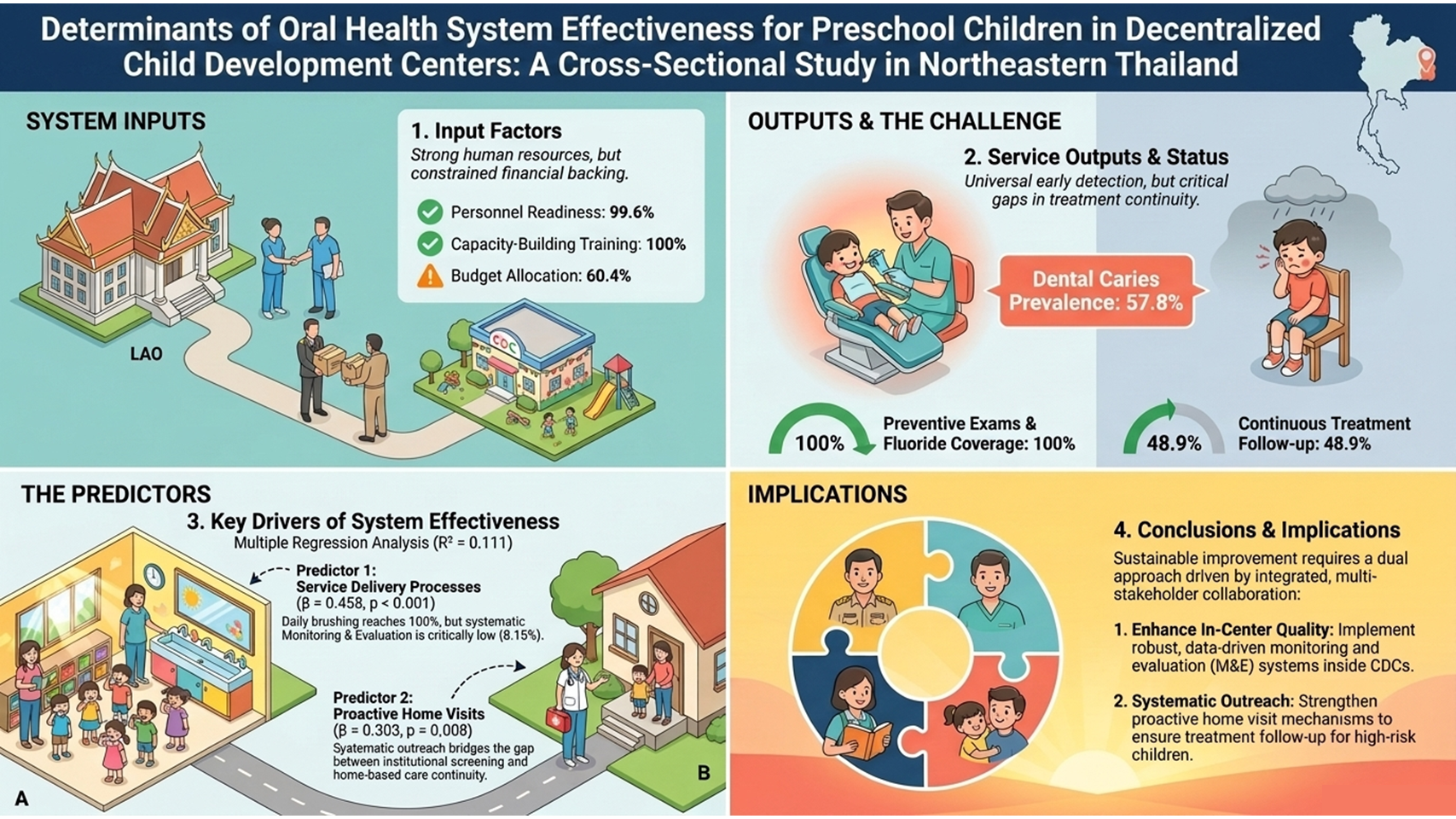
Background: Early childhood caries remains a major public health burden in Thailand, particularly among preschool children, despite the implementation of national oral health policies. With the decentralization of child development centers (CDCs) to local adminis-trative organizations (LAOs), understanding system-level determinants of oral health ser-vice effectiveness has become critical. This study aimed to identify key determinants in-fluencing the effectiveness of oral health care systems for preschool children within CDCs in northeastern Thailand. Methods: A cross-sectional analytical study was conducted among 270 stakeholders across urban, peri-urban, and rural CDCs in Ubon Ratchathani Province. Participants were selected using multi-stage random sampling. Data were col-lected between November 2023 and January 2024 using a structured questionnaire with established content validity (IOC > 0.50) and reliability (Cronbach’s alpha = 0.71–0.77). Variables were organized within an Input–Process–Output (IPO) framework. Descriptive statistics, Pearson’s correlation, and multiple linear regression analyses were performed to identify significant predictors of system effectiveness. Results: The oral health care system demonstrated strong performance in preventive service delivery, including universal oral health examinations and fluoride varnish application (100%), and high personnel readi-ness (99.63%). However, critical gaps were identified in monitoring and evaluation sys-tems (8.15%), budget adequacy (60.37%), and continuity of treatment follow-up (48.89%). The prevalence of dental caries among preschool children was 57.83%. Multiple regression analysis revealed that service delivery processes (β = 0.458, p < 0.001) and home visits by public health and dental personnel (β = 0.303, p = 0.008) were significant determinants of system effectiveness, jointly explaining 11.1% of the variance (R² = 0.111). Conclusions: The effectiveness of preschool oral health care systems in decentralized settings is driven pri-marily by the quality of service delivery processes and the integration of proactive commu-nity outreach through home visits. Strengthening monitoring and evaluation mechanisms, ensuring sustainable financing, and enhancing continuity of care between CDCs and households are essential for improving oral health outcomes. These findings provide ac-tionable evidence for policymakers and local health administrators seeking to optimize oral health systems under decentralized governance structures.
Keywords:
oral health systems
; early childhood caries
; preschool children
; health system determinants
; Thailand
Copyright: This open access article is published under a Creative Commons CC BY 4.0 license, which permit the free download, distribution, and reuse, provided that the author and preprint are cited in any reuse.


