

Submitted:
18 May 2026
Posted:
19 May 2026
You are already at the latest version
Abstract
In resource-constrained settings, structural and material inequalities shape children’s developmental opportunities, yet developmental pathways remain diverse even within shared hardship. This study examined developmental continuity and variation in cognitive trajectories among children born in adversity and assessed whether maternal structural positioning and household material conditions were associated with developmental progression. Data were drawn from 742 children born to adolescent mothers in the large longitudinal cohort in the Eastern Cape, South Africa. Cognitive functioning was assessed using the Mullen Scales of Early Learning (MSEL) at baseline and the Kaufman Assessment Battery for Children (KABC-II) at follow-up. Baseline functioning predicted later cognitive placement, indicating developmental continuity (B = 0.074, SE = 0.030, p = .015). Lower maternal educational attainment was associated with more constrained developmental progression (B = −0.097, SE = 0.023, p < .001), and maternal not in education, employment, or training (NEET) status also predicted constrained trajectories (B = −0.200, SE = 0.049, p < .001). In contrast, consistent access to basic household necessities was associated with more favourable developmental trajectories (B = 0.024, SE = 0.009, p = .012). These findings indicate that variation in children’s developmental trajectories reflects differences in structural positioning and household material conditions. Supporting adolescent mothers’ engagement in education and access to stable resources may represent an important pathway for improving child developmental outcomes.
Keywords:
adolescent mothers
; child development
; cognitive trajectories
; longitudinal
; social determinants
; South Africa
1. Introduction
The early years of life represent a sensitive developmental period during which foundational cognitive and regulatory capacities are established, shaping later outcomes in health, education, economic participation, and social functioning (Britto et al., 2017; Engle et al., 2011; Shonkoff et al., 2012). Early child development (ECD) is central to long-term human capital formation (Attanasio et al., 2024); however, an estimated 66% of children under five in sub-Saharan Africa are exposed to conditions that may limit optimal cognitive development due to structural inequalities (Drago, 2020). The ECD period spans from conception to formal schooling, defined in South Africa as the year a child turns six (Republic of South Africa, 2015). ECD also refers to a set of services and supports that promote young children’s survival, growth, and development, including health care, nutrition, early learning, social protection, and responsive caregiving delivered across sectors. Evidence suggests that these components collectively shape early development (Britto et al., 2017). Children in low-resource households are at increased risk of suboptimal development (Drago, 2020).
However, there remains limited longitudinal evidence on how structural inequalities are associated with variation in children’s developmental trajectories over time, and whether differences in developmental progression reflect structural positioning beyond early developmental foundations. This study examines developmental continuity and individual differences in cognitive trajectories among children of adolescent mothers in South Africa and assesses whether maternal structural positioning and household material conditions are associated with deviation from expected developmental progression.
1.2. Life-Course and Trajectory Models
Development is best understood as a life-course process shaped through continuous interaction between biology and environment, aligning with a trajectory perspective in which early conditions influence later cognitive pathways rather than producing one-off effects (Leach et al., 2025; Tomlinson et al., 2021). Across theory, cohort studies, and intervention research, cognition unfolds through periods of growth, plateau, and decline (Shonkoff, 2012). Some domains develop in a relatively linear and cumulative manner, such as gross motor competencies progressing from rolling and sitting to crawling and walking, while others show multiple peaks and plateaus or rely on divergent base skills that support later abilities (Attanasio et al., 2024). Early developmental gains may therefore provide foundations for later, more differentiated development; for example, early visual tracking, expressive and receptive language, pattern recognition, and memory contribute to later reading skills (Shonkoff & Phillips, 2000). Certain developmental processes are also time-sensitive, with optimal periods for learning, such as expressive language development before the age of three (Kuhl, 2004). Using data from the US-based Head Start programme, Welsh et al. (2010) further demonstrate that development is not purely linear and cumulative but involves reciprocal relations; for example, emergent numeracy predicts later executive function, which in turn predicts later numeracy.
Inputs also vary in importance across developmental periods (Engle et al., 2011). Attig and Weinert (2020) show, for example, that maternal sensitivity is most predictive of language development in the first year of life, whereas maternal stimulation becomes increasingly important in the second year. Longitudinal studies also demonstrate that early gains following developmental interventions may fade if continued support is not available (Tomlinson et al., 2021).
1.3. Development Within Structural and Material Constraints
Developmental trajectories unfold within broader structural and material contexts that shape children’s opportunities for growth. Access to health services, immunisation, clean water, food security, ECD services, and stable household income, including social protection such as South Africa’s Child Support Grant (CSG), form part of the ecological infrastructure supporting early development (Britto et al., 2017). These conditions influence the rate and direction of developmental progression over time.
In low-resource settings, developmental decline relative to Western-developed normative statistics often reflects ecological constraint rather than individual pathology (Boivin & Davidson, 2018; Boivin et al., 2021). Poverty structures the environments in which children grow through chronic material deprivation, instability, and limited access to developmental resources, shaping exposure to learning opportunities and supportive institutional environments (Blair & Raver, 2012; Britto et al., 2017). These structural conditions influence developmental trajectories by altering the environments within which children learn, explore, and acquire cognitive and adaptive skills.
Children’s developmental progress is therefore shaped not only by early developmental status but also by the structural and material conditions that surround them over time. Children who experience sustained access to enabling environments may show accelerated developmental progression, while those exposed to persistent structural constraint may experience constrained gains relative to expectation (Blair & Raver, 2012; Engle et al., 2011). Understanding development in resource-constrained contexts therefore requires attention to both initial developmental positioning and the environments that structure opportunities for learning and exploration (Walker et al., 2007).
Recent longitudinal evidence highlights how children’s cognitive development is shaped by interacting social determinants rather than poverty alone. In a cohort of 542 children in Dhaka followed from infancy to age seven, Valdes et al. (2025) modelled cognitive trajectories alongside household conditions including parental education, housing risks, assets, and food security. Maternal education was particularly important under conditions of poverty: higher maternal education was associated with higher cognitive scores among children living below the poverty line, but not among those above it. Cognitive trajectories showed growth across early childhood followed by a slowing or plateau after around five years of age, suggesting increasing sensitivity to social and environmental conditions over time. Together, these findings indicate that cognitive development in low-resource contexts reflects cumulative household influences—particularly caregiving resources, education, and nutrition—rather than financial poverty alone.
Despite major advances in developmental psychology, economics, and neuroscience, existing theories offer limited guidance on how different types of inputs translate into later cognitive and socio-emotional outcomes, particularly under conditions of chronic adversity. This constrains the design of effective programmes, as policies often assume simple linear relationships between early inputs and later outcomes that do not reflect developmental complexity (Attanasio et al., 2024). Greater attention to how structural conditions, caregiving resources, and material environments shape children’s developmental progression is needed to inform interventions suited to development in contexts of adversity and resource scarcity.
1.4. Measuring Child Development in Africa
Children born into adverse and resource-constrained environments are at increased risk of compromised developmental progression (Attig & Weinert, 2020); however, outcomes vary substantially and not all children are affected in the same way. Boivin et al. (2021), using comparable samples in Uganda and Malawi with the MSEL at 1 year and the KABC-II at 6 years, found that the Mullen composite and gross motor domains at 1 year significantly predicted KABC-II performance at 6 years, with small-to-medium partial eta-squared values (≈0.20–0.40) across most processing domains. Early gross motor functioning also predicted later motor proficiency and cognitive performance, suggesting developmental coupling between motor and cognitive systems across early childhood. At the group level, trajectories on both the Mullen and KABC declined over time (Boivin et al., 2019), consistent with evidence from other African cohorts showing that population-level developmental scores often flatten or fall with age in resource-constrained settings. This pattern is plausibly linked to broader contextual factors, including poverty, nutritional hardship, stunting, and caregiving challenges, where early caregiving may support basic nurturing but not the increasingly cognitively stimulating interaction required as children grow (Britto et al., 2017; Walker et al., 2007).
In South Africa, the Thrive by Five Index provides the only nationally representative standardised measure of preschool development. The Index reports that fewer than half of four-year-olds enrolled in Early Learning Programmes (ELPs) are developmentally on track for early learning (42%; 2025 report on 2024 index). A further 28% are falling behind and 30% are falling far behind expected milestones. Children attending higher-fee ELPs are roughly twice as likely to be on track as those in the poorest settings. These gradients point to entrenched socioeconomic inequality in early development. Structural constraints include late enrolment, household disadvantage, limited learning resources, and nutrition-related risks such as stunting. Together, these conditions constrain the realisation of children’s developmental potential.
Leach (2025) showed that child development is shaped by a package of care, in which ELP access interacts with wider municipal and community service delivery rather than operating as a stand-alone input. Given that 30% of 4-year-olds do not attend ELPs (DataDrive 2030, 2025), the service delivery environment becomes especially important for children who miss these programme-based benefits. This highlights the need to examine how access to ELPs and multidimensional service delivery environments work together to shape children’s developmental trajectories.
A growing body of work highlights the limits of directly transferring developmental assessment frameworks developed in high-income countries to resource-scarce contexts, as such tools embed cultural assumptions about language, materials, and interaction that may be unfamiliar or differently expressed across communities (Milbrath et al., 2020). In a multi-wave study in Ghana, Modrek et al. (2024) report developmental patterns that diverge from those typically observed in high-income settings, with initially differentiated executive function abilities converging over time, suggesting that exposure to adversity may shape the timing and expression of cognitive development. These findings highlight the importance of interpreting developmental assessments within their ecological and structural context and support longitudinal analyses of how developmental trajectories unfold within unequal social environments.
Children in resource-constrained settings are situated within contexts of intergenerational structural inequality, where adolescent mothers often face constrained access to education, employment, and material resources. These conditions shape the environments in which children develop and are associated with variation in cognitive outcomes over time, positioning early cognitive development as a population health concern. While this paper focuses on cognitive development, children develop across multiple domains, including emotional regulation, social functioning, and physical growth, reflecting interacting biological, relational, and environmental influences. The present analysis focuses specifically on structural positioning and material conditions as foundational determinants of developmental opportunity, as these shape access to cognitively enriching environments, learning resources, and stable caregiving contexts.
Despite extensive evidence linking early adversity to developmental outcomes, there is limited longitudinal evidence examining how structural positioning and material conditions shape variation in developmental trajectories among children of adolescent mothers in resource-constrained settings. This study addresses this gap by examining developmental continuity and individual differences in cognitive trajectories and assessing whether maternal structural positioning and household material conditions predict deviation from expected developmental progression. We asked the following research questions:
Q1
To what extent does baseline developmental functioning predict follow-up cognitive functioning among children born to adolescent mothers?
Q2.
To what extent do structural factors predict deviation from expected child development developmental trajectories?
2. Method
2.1. Research Setting
Participants were recruited from a large cohort prospective study of adolescent mothers and their children in the Eastern Cape of South Africa. The study tracked adolescent mothers and their children between 2017-2025 over three waves. Baseline data were collected in 2017–2019, with follow-up waves in 2020–2023 and 2023–2025. Child data were collected at baseline and in the 2023-2025 follow-up wave. The Eastern Cape province of South Africa is a region characterised by marked socioeconomic inequality across health, education, and living standards (Eastern Cape Government, 2025). In the study area, only 38% of children enrolled in ELPs meet expected developmental milestones, while 29% are falling behind and 33% are falling far behind (Giese et al., 2023). Additional risks including food scarcity and high infectious disease exposure, such as HIV, are prevalent in the study communities and are known to affect early childhood development (French et al., 2020).
2.2. Participants
This analysis included 742 children aged between 3 and 66 months at baseline (M = 18.844 months, SD = 14.569) and between 5 and 12 years at follow-up (M = 7.281 years, SD = 1.463) and their mothers. All children were born to mothers who were primiparous during adolescence (before age 20; M = 16.908; SD = 1.725. The sample was predominantly isiXhosa-speaking (97%), with a small number of Afrikaans-speaking children.
Children were excluded if they were older than 66 months at baseline, reflecting the upper sensitivity range of the Mullen Scales of Early Learning (MSEL), or if follow-up cognitive assessment data were missing (n = 385 excluded). The analytic sample therefore included children with both baseline and follow-up cognitive assessments (N = 742).
2.2.1. Sensitivity Checks
Children included in the analytic sample had slightly higher baseline MSEL scores than those excluded (Mdiff = −5.52, 95% CI −11.00 to −0.03; t (1105) = −1.97, p = .049). No statistically meaningful differences were observed in household material adequacy, maternal age at birth, child age, child sex, or rural residence. Baseline cognitive functioning and child age were controlled for in all analyses. Full comparisons between included and excluded participants are presented in Supplementary Table S1 (Section 7).
2.3. Measures
Baseline developmental functioning was assessed using the Mullen Scales of Early Learning (MSEL; Mullen, 1995) subtests, which served as the reference point for estimating developmental trajectory deviation. Explanatory variables were selected from adolescent mother surveys to capture structural positioning, contextual and material conditions, and maternal support resources, consistent with the study’s focus on structural influences on developmental progression. Structural positioning was indexed by z-transformed risks: maternal education level (university / Grade 11–12 or college / Grade 10 or less) and current NEET status (not in education, employment, or training). The concept of NEET was first developed in UK youth policy to capture young people disengaged from both labour markets and education systems (Bynner & Parsons, 2002). Household material conditions were measured using indicators of access to socially perceived necessities for children (Wright, 2008; Pillay et al., 2007), household food insecurity using items from the South African National Food Consumption Survey (Labadarios et al., 2003), and receipt of the Child Support Grant (CSG), South Africa’s primary social protection transfer for children (Department of Social Development et al., 2012). These variables were selected based on theoretical relevance to structural models of developmental inequality and ecological frameworks of early child development.
Covariates were conceptualised as time-invariant and early life contextual confounders. Child sex and maternal age at birth represent fixed characteristics established prior to developmental assessment, while baseline rural residence, child age at baseline, and baseline household material adequacy capture early environmental conditions. Adjusting for these covariates reduces the likelihood that associations between structural positioning, material conditions, and developmental trajectory deviation reflect pre-existing demographic or contextual differences rather than variation in developmental progression. These variables are described in more detail in Supplementary Table S2 (Section 7). The outcome measure was selected subtests from the Kauffman Assessment Battery for Children (Second Edition—KABC-II). The KABC-II manual, kit and scoring sheets were purchased from Pearson. The theoretical framework utilised for this application of the KABC-II was the Luria model (Luria, 1966). The Luria model is recommended in cases where the child is from a bilingual or non-mainstream cultural background or has a known or suspected language disorder (Kaufman & Kaufman, 2004). This model omits the knowledge-based learning sub-tests that can be expected to develop from well-functioning education systems.

Table 1.
Included KABC Subtests by domain.
| Domain | Sub-test |
| Sequential | Number Recall |
| Hand Movements | |
| Learning | Atlantis |
| Atlantis Delayed | |
| Simultaneous | Conceptual Thinking |
| Triangles | |
| Block Counting | |
| Pattern Reasoning |
Subtests were included if they made cultural sense and if they could be administered reliably during piloting. Cultural sense was assessed by the research team who all belonged to the same ethnic group as the children and had substantial working experience collecting data from children (Mitchell et al., 2018). The selection of sub-tests is described in detail elsewhere. All children completed the same subtests regardless of age.
2.4. Ethics
Voluntary informed consent was obtained from mothers of the children and assent was collected from children aged five years and above using a pictorial information book designed for this study. Where mothers were under 18 years, consent was also given by their primary caregiver. Participant children and caregivers were gifted a “thank you” pack which included a small backpack, basic toiletries, and snacks. A comprehensive referral system was in place for this study, and participants were given a brochure with child development information and referral pathways. Ethics approvals were obtained from two large reputable universities, and the Eastern Cape Departments of Health and Basic Education, and participating health and educational facilities.
2.5. Procedure
Cognitive assessments were administered by research assistants trained extensively in the Mullen Scales of Early Learning (MSEL) and the Kauffman Assessment Battery for Children, Second Edition (KABC-II), under the supervision of a registered research psychologist. Assessment procedures followed established guidance for adapting cognitive measures in LMIC settings (Fernald et al., 2009) and were informed by prior use and validation of the MSEL and KABC-II in South Africa and Sub-Saharan African contexts (Boivin et al., 2019; Bornman et al., 2018; Jansen & Greenop, 2008; Mitchell et al., 2018; Van Wyhe et al., 2017). Research assistants were fluent in English and isiXhosa, developed consensus translations, and standardised phrasing field notes. Both instruments were piloted at local childcare centres, and adjustments were made based on piloting feedback. Participants were recruited as part of a large longitudinal study and recruitment processes and mother survey data collection are described elsewhere. Assessments were conducted at children’s homes or suitable community venues using child-sized furniture. The MSEL was hand-scored then loaded on REDCap; the KABC-II was scored directly in REDCap. All scoring and data entries were cross-checked for accuracy. The MSEL took an average of 50 minutes to complete, and the KABC took an average of 45 minutes. Children could take breaks when needed.
2.6. Data Analysis
The data analysis plan was registered on Open Science Framework. The significance level or alpha was set at p < .05 for all analyses. Analysis was completed in Stata 18. Minor analytic refinements were made relative to the preregistered analysis plan to improve construct validity and interpretability of developmental trajectories. Full details of preregistered analyses deviations are provided in Supplementary Materials (see Section 7.1).
Data analysis proceeded in three stages. First, age-adjusted cognitive scores were derived, and exploratory factor analyses were conducted to establish a shared cross-wave general cognitive construct between the MSEL and KABC-II. Second, developmental trajectories were operationalised as deviation from expected follow-up cognitive placement conditional on baseline functioning, allowing developmental progression to be examined as continuous variation in relative cognitive placement over time. Third, linear regression models examined associations between structural positioning, material context, and developmental trajectory deviation, with final models controlling for demographic and baseline contextual covariates.
Raw scores were used for the MSEL and KABC-II because these instruments are normed on different U.S. populations, producing standardised scores that are not comparable in this LMIC cohort. Consistent with LMIC research using raw or sample-standardised scores when imported norms are inappropriate (Abubakar et al., 2010; Bodeau-Livinec et al., 2019; Boivin et al., 2015; Fernald et al., 2009; Gladstone et al., 2010; Hamadani et al., 2010; Wolf et al. 2019; Yoshikawa et al., 2020), each subtest score was regressed on age in months and the residuals were standardised using the analytic sample mean and standard deviation to produce age-adjusted z-scores on a common scale. Exploratory factor analysis was used to identify relationships between the MSEL and the KABC.
Trajectory modelling was restricted to this shared cross-wave factor to ensure comparability of developmental constructs. Age-adjusted z-scores for the four MSEL subtests were averaged to form a baseline general cognitive ability score, and z-scores for the six corresponding KABC-II subtests were averaged to form a follow-up score. Developmental trajectory deviation was operationalised as the residual from a regression predicting follow-up cognitive ability from baseline ability (z_KABCgeneral = β0 + β1[z_MSELgeneral] + ε), where the residual represents deviation from expected developmental placement conditional on baseline functioning.
For descriptive purposes, meaningful change in relative cognitive placement was characterised using a ±0.5 standard deviation threshold applied to the difference between KABC-II and MSEL composite scores (Norman et al., 2003; Wyrwich et al., 1999). However, primary analyses examined trajectory deviation as a continuous variable. Atlantis and Atlantis Delayed were excluded because no equivalent baseline measures were available.
Associations between structural positioning, material conditions, and developmental trajectories were examined using linear regression models with trajectory deviation as the dependent variable. Final models included maternal education, maternal NEET status, and household material adequacy, and controlled for baseline child age, child sex, rural residence, maternal age at birth, and material adequacy. These models evaluated whether structural positioning and material conditions independently predicted accelerated or constrained developmental trajectories.
4. Results
4.1. Sample Characteristics
The analytic sample included 742 children of adolescent mothers. At baseline, children were aged between 3 and 66 months (M = 18.844, SD = 14.569), and 50.810% were boys with 28.570% of children residing in rural settings. Households reported a baseline mean necessities score of 5.175 (2.240), and a follow-up mean necessities score of 4.070 (2.534), indicating variation in access to basic material resources. At follow-up, children were aged between 5 and 12 years (M = 7.281 years, SD = 1.463). Baseline developmental functioning measured using the Mullen Scales of Early Learning (MSEL) yielded a mean raw score of 70.891 (SD = 43.656), while follow-up cognitive functioning measured using the Kauffman Assessment Battery for Children (KABC-II) yielded a mean raw score of 110.65 (SD = 38.156). Raw central tendencies for all subscales are presented in Supplementary Table S3 (Section 7).
Exploratory factor analyses were conducted to examine the extent to which MSEL and KABC-II subtests reflected a shared underlying cognitive construct across assessment waves.
All MSEL subtests demonstrated moderate loadings on the KABC-II subtests. MSEL showed loadings on the general factor (0.53–0.62), alongside moderate to strong loadings from six KABC-II subtests (0.44–0.74), indicating substantial overlap in general cognitive ability across assessment waves. In analyses specifying two factors, a secondary factor emerged defined primarily by the KABC-II Atlantis and Atlantis Delayed subtests, representing a memory-specific dimension without baseline equivalents. MSEL subtests did not load meaningfully on this secondary factor, indicating that cross-wave alignment occurred at the level of general cognitive ability rather than domain-specific constructs. Sampling adequacy was high (KMO range: 0.89–0.94), and internal consistency across pooled subtests was strong (Cronbach’s α ≈ 0.91), supporting the coherence of a shared general cognitive construct. Factor loadings on the general factor were consistently high (up to 0.74), indicating that these subtests contributed to a common cognitive dimension regardless of which MSEL domain was included. Pattern Reasoning demonstrated the strongest and most stable loadings across models (0.678–0.740; Table 2).
Atlantis and Atlantis Delayed showed a different pattern. When Visual Reception, Fine Motor, Receptive Language, or Expressive Language were entered, both Atlantis measures had negligible loadings on the primary factor (approximately 0.005–0.081), suggesting that these memory tasks did not align with the dominant cognitive factor extracted in those models. However, when Gross Motor was entered, Atlantis and Atlantis Delayed showed moderate loadings (0.580 and 0.499), indicating greater overlap with the primary factor in the model.
Uniqueness values ranged from 0.604 to 0.705 across the models, indicating that a substantial proportion of variance in the MSEL domains remained unexplained by the extracted factor. Overall, the pattern of loadings suggests that most KABC-II subtests consistently contribute to a common cognitive factor across assessment waves, while the Atlantis measures show weaker alignment with this factor in most models. These findings indicate that cognitive functioning across early and middle childhood was comparable at a level of general cognitive placement, supporting the construction of standardised composite scores representing representing general cognitive ability at each wave. While a clear association between the assessments was observed, some divergence was expected given differences in the instruments’ design, content, and developmental focus across age groups.
4.2. Baseline Developmental Functioning and Follow-Up Cognitive Functioning
To address our first research question, trajectory modelling was conducted to assess the extent to which baseline development functioning predicted follow-up cognition placement. Figure 1 shows the relationship between baseline and follow-up cognitive placement across childhood, centred on the line of best-fit and confidence intervals. Higher baseline cognitive placement was associated with higher follow-up placement, indicating developmental continuity. At the same time, there was substantial variation around the average trajectory, with some children progressing faster and others slower than expected based on their baseline functioning. This pattern indicates that cognitive development follows a continuous trajectory rather than fixed pathways.
Baseline cognitive placement significantly predicted follow-up cognitive placement (B = 0.074, t = 2.44, p = .015), confirming developmental continuity while indicating that baseline functioning only partially determined later cognitive placement. However, the modest magnitude of this association and substantial dispersion around the fitted regression line indicated considerable individual variation in developmental progression. This regression model formed the basis for deriving trajectory deviation, defined as the residual difference between observed and predicted follow-up cognitive placement conditional on baseline functioning.
Baseline and follow-up cognitive placement scores were centred on the sample mean, reflecting the use of age-adjusted standardised scores (M = 0.000). Variability in cognitive placement was comparable at baseline (SD = 0.759, range = −3.456 to 2.953) and follow-up (SD = 0.630, range = −3.388 to 2.719). The residual term (ε) therefore reflects each child’s developmental progression relative to expectation given their baseline cognitive placement, with positive values indicating accelerated progression, values near zero indicating stability, and negative values indicating constrained progression.
The greater dispersion in trajectory deviation (SD = 0.76, range = −3.46 to 2.96), relative to baseline and follow-up placement scores, indicates substantial individual variation in developmental progression beyond initial developmental differences. This distribution reflects meaningful heterogeneity in developmental trajectories, with some children progressing beyond expectation and others showing more constrained progression relative to their starting point. For descriptive purposes, trajectory deviation was divided into tertiles, classifying children as showing accelerated, stable, or constrained progression relative to expectation (Figure 2). However, trajectory deviation varied continuously across the sample, with no evidence of discrete trajectory groups.
4.3. Structural Positioning and Material Conditions
To address our second research question, multiple regression models were conducted to determine whether structural positioning variables independently predicted deviation from expected developmental trajectories (see Table 3). Lower maternal educational attainment was associated with significantly more constrained developmental trajectories (B = −0.097, SE = 0.023, p < .001), indicating that children of more educated mothers showed greater developmental gains relative to their baseline functioning. Maternal NEET status was also associated with constrained developmental trajectories (B = −0.200, SE = 0.049, p < .001), suggesting reduced developmental progression among children whose mothers were not engaged in education, employment, or training. These associations remained significant in the multivariable regression model, suggesting that maternal education and NEET status were each associated with variation in developmental trajectories. The two variables were moderately correlated (r = 0.34), indicating partial overlap between maternal educational attainment and engagement in education or employment, but not sufficient collinearity to preclude their inclusion in the same model. Early access to the Child Support Grant was not significantly associated with developmental trajectories.
Household material adequacy independently predicted favourable deviation from expected developmental trajectories after adjusting for maternal structural positioning and demographic covariates (Table 4). Greater material adequacy was associated with significantly accelerated developmental trajectories (B = 0.024, SE = 0.009, p = .012), indicating that children living in materially advantaged households progressed faster than expected given their baseline developmental functioning. This association remained significant after controlling for child age, child sex, rural residence, maternal age at birth, and baseline material adequacy, indicating that ongoing material conditions independently shape favourable developmental progression.
Trajectory deviation represents deviation from expected follow-up cognitive placement conditional on baseline developmental functioning. Betas are standardised through z-score transformation. As a sensitivity analysis, models using follow-up cognitive placement as the outcome (without adjustment for baseline placement) yielded the same pattern of associations, with maternal schooling achievement and NEET status remaining independently associated with children’s favourable cognitive outcomes.
Predictive margins analysis (Figure 3) demonstrated a clear gradient in developmental trajectories across levels of material adequacy. Children in households with lower material adequacy showed constrained developmental trajectories relative to expectation, whereas children in households with greater material adequacy showed progressively accelerated trajectories. This pattern indicates that material conditions influence the extent to which children progress relative to expected developmental pathways.
In contrast, other contextual indicators, including rural residence, water access, and food insecurity, were not independently associated with trajectory deviation once maternal structural positioning and household material adequacy were included in adjusted models. These findings indicate that structural positioning and material adequacy represent the primary contextual dimensions shaping developmental trajectory variation in this cohort.
5. Discussion
This study examined how children’s cognitive development unfolded over time among children of adolescent mothers in South Africa. By assessing follow-up cognitive functioning in relation to earlier developmental levels, the analysis evaluated both the stability of early cognitive differences and variation in developmental trajectories over time. The findings show that early developmental functioning was associated with later cognitive placement, while children differed in the extent of their developmental progression. Maternal education, labour market engagement, and household material conditions were independently associated with more favourable developmental trajectories, indicating that variation in children’s cognitive development is linked to broader social and economic conditions.
5.1. Developmental Continuity
Baseline developmental functioning (MSEL) was expected to moderately predict follow-up cognitive functioning (KABC-II), reflecting developmental continuity while allowing for variation across individuals. Change in children’s relative cognitive placement was modelled to examine developmental mobility within the cohort distribution over time. Although the MSEL and KABC-II assess different domains, there are conceptual and empirical grounds to support continuity between these assessments. Prior research using both instruments demonstrates continuity between early developmental functioning and later cognitive outcomes. Longitudinal studies in low-resource settings similarly show that early developmental functioning predicts later cognitive outcomes, supporting the interpretation that early developmental positioning carries forward into later cognitive placement (Boivin et al., 2021).
Although substantial variation in developmental progression was observed, there was no evidence of distinct developmental subgroups. Instead, children’s developmental trajectories varied along a continuous range. This pattern suggests that variation in development reflects cumulative and interacting influences over time rather than discrete pathway membership (Blair & Raver, 2012; Boivin & Davidson, 2018). Exploratory analyses comparing children with accelerated and constrained trajectories did not show clustering by structural or contextual conditions. Instead, differences appeared to reflect gradual variation in exposure to structural and material conditions. This finding aligns with longitudinal evidence from low-resource settings showing that divergence in cognitive outcomes emerges progressively through layered structural and environmental influences (Valdes, 2025).
Together, these findings indicate that early developmental positioning exerts a durable influence on later cognitive placement, while allowing for graded mobility within the cohort distribution.
5.2. Structural Positioning, Contextual and Material Conditions
Structural positioning within education and labour systems was independently associated with children’s developmental trajectories. Higher maternal educational attainment at follow-up was associated with more accelerated developmental progression relative to expectation, while maternal disengagement from education and employment (NEET status) at follow-up was associated with more constrained trajectories. These associations persisted after adjustment for baseline material adequacy and demographic covariates, indicating that maternal institutional integration represents an independent dimension of developmental stratification. Maternal education was modelled at follow-up rather than baseline because mothers were still of school-going age at baseline and educational attainment was therefore not yet a stable exposure. Early access to the CSG was not associated with deviation from expected developmental trajectories. This does not imply that the CSG is unimportant. Previous research has demonstrated its importance for supporting early development and initial developmental placement (Tatham, 2024). However, it may be insufficient to shape subsequent variation in developmental progression once baseline developmental positioning is accounted for.
These findings indicate that variation in children’s developmental trajectories is linked to broader structural systems that organise access to opportunity (Leach et al., 2025; Tomlinson et al., 2021). Maternal education and labour market engagement reflect positioning within institutional structures that influence access to economic resources, information, and developmental opportunities. Evidence from a South African study further illustrates the structural nature of these processes: although many adolescent mothers return to school after childbirth, school return and completion are patterned by poverty, prior academic disruption, and access to childcare support, with continued schooling during pregnancy and access to crèche services increasing the likelihood of re-enrolment (Jochim et al., 2022).
The findings are consistent with evidence from low- and middle-income settings demonstrating that maternal education and ongoing education or employment are among the strongest predictors of children’s cognitive outcomes in adult mothers (Britto et al., 2017; Engle et al., 2011; Valdes, 2025). Rather than reflecting isolated exposures, developmental trajectories appear to vary through cumulative processes of structural advantage and constraint (Blair & Raver, 2012; Boivin & Davidson, 2018). The present findings extend this literature to adolescent motherhood, demonstrating that institutional integration within education and labour systems remains consequential for children’s cognitive trajectories even while maternal educational and employment pathways are still unfolding.
Ongoing material adequacy was also independently associated with more favourable developmental trajectories after accounting for maternal educational and labour market engagement and demographic covariates. Children living in households with greater material adequacy showed higher relative cognitive placement over time, indicating that access to basic household resources continues to shape developmental progression. While maternal education and labour market engagement reflect institutional location within broader systems, material adequacy captures the household-level resource conditions through which these structural positions are translated into children’s everyday developmental environments (Blair & Raver, 2012; Britto et al., 2017).
In contrast, baseline material adequacy was not independently associated with trajectory deviation once institutional integration and ongoing material conditions were considered. Children’s developmental trajectories therefore reflect the combined influence of institutional integration and ongoing material conditions. These results reinforce evidence from South Africa that cognitive development reflects broader structural and service environments rather than isolated influences (Davidson, 2015; Leach, 2025; National Planning Commission, 2012), and support a population-level interpretation in which cognitive trajectories reflect cumulative exposure to stratified structural and material environments over time (Blair & Raver, 2012; Britto et al., 2017).
These findings also have implications for how child development is situated within broader social policy systems. The evidence of developmental continuity underscores the importance of early support, as differences in early cognitive positioning are likely to persist. Educational retention policies for adolescent mothers, youth labour market integration strategies, and social protection mechanisms such as household income support operate within the structural domains identified here. Child cognitive development may therefore be shaped not only by early childhood services but also by policies governing adolescent schooling and economic participation, underscoring the importance of coordinated systems that support adolescent mothers and their young children.
5.3. Limitations
Participants included in the analytic sample differed from those not included with respect to age and baseline developmental functioning (MSEL scores). To mitigate potential selection bias, all models adjusted for child age and baseline developmental functioning, ensuring that associations reflect variation in developmental trajectories rather than differences in initial development level. However, the possibility of residual selection bias cannot be fully excluded.
Cognitive functioning at baseline and follow-up was assessed using different instruments (MSEL and KABC-II), designed for different developmental stages. Although both are well validated and scores were age-adjusted and harmonised using cross-wave factor analysis, they do not measure identical constructs. Factor analysis identified a shared general cognitive–developmental dimension across the four MSEL domains and six KABC-II subtests, which was used for trajectory modelling. Trajectory deviation should therefore be interpreted as changes in children’s relative developmental position over time rather than change on a single invariant cognitive scale. Modelling included only subtests loading on the shared factor, not all KABC-II subtests were used, limiting direct comparison with full-scale normative scores.
Participants were drawn from adolescent mothers and their children living in socioeconomically constrained settings in the Eastern Cape. While this strengthens the relevance of the findings for similar contexts characterised by structural disadvantage, the results may not generalise to populations with different institutional, economic, or service environments. Structural constraints may operate differently in less resource-constrained settings, and other contextual risks may be more salient elsewhere.
5.4. Conclusions
Taken together, these findings position child cognitive development in this cohort as a socially patterned process shaped by unequal access to education, employment, and material resources. Children exceeding expected developmental trajectories were more likely to have mothers with more favourable structural positioning within education and labour market systems, as well as greater ongoing household material adequacy, indicating that developmental progression is linked to broader structural and socioeconomic conditions. These findings support perspectives in which inequalities in education, employment, and material conditions generate unequal developmental opportunities that become embedded over time.
The results contribute to existing literature by demonstrating that structural positioning within education and labour systems is associated with variation in children’s developmental trajectories beyond baseline functioning. In resource-constrained contexts, integration into education and employment may represent an important pathway through which developmental opportunity is sustained across early childhood.
From a policy perspective, the findings suggest that improving child cognitive development among adolescent mothers may require addressing structural disadvantages that limit opportunities for both mothers and their children. Policies that support school retention and re-entry, facilitate access to employment, and improve access to basic household resources may therefore influence the conditions within which child development unfolds.
5.4. Data Availability Statement
The full longitudinal dataset is being finalised and will be publicly available on the DataFirst website. At that time the subset used for this analysis can be requested from the authors.
5.5. Declaration of AI Use
During the preparation of this work the author(s) used ChatGPT 5.3 to support code syntax during analysis and editing and clarification of written text during manuscript preparation. The tool did not contribute to study design, data analysis, interpretation of results, or the generation of scientific content. All outputs were reviewed and revised by the authors, who take full responsibility for the final content. After using this tool/service, the author(s) reviewed and edited the content as needed and take(s) full responsibility for the content of the published article.
Supplementary Materials
The following supporting information can be downloaded at the website of this paper posted on Preprints.org.
Conflicts of Interest
The authors declare that they have no known competing financial interests or personal relationships that could have appeared to influence the work reported in this paper.
References
- Abubakar, A., Holding, P., Van de Vijver, F. J. R., Bomu, G., Van Baar, A., & Newton, C. R. (2010). Developmental monitoring using caregiver reports in a resource-limited setting: The case of Kilifi, Kenya. Acta Paediatrica, 99(2), 291–297. [CrossRef]
- Attanasio, O. P. (2024). Understanding early childhood development and its importance. NBER Reporter, 2024(3), 10–15.
- Attig, M., & Weinert, S. (2020). What impacts early language skills? Effects of social disparities and different process characteristics of the home learning environment in the first 2 years. Frontiers in Psychology, 11, Article 557751. [CrossRef]
- Blair, C., & Raver, C. C. (2012). Child development in the context of adversity: Experiential canalization of brain and behavior. American Psychologist, 67(4), 309–318. [CrossRef]
- Bodeau-Livinec, F., Davidson, L. L., Zoumenou, R., Massougbodji, A., & Cot, M. (2019). Neurodevelopmental outcomes in children born to mothers exposed to malaria during pregnancy: A longitudinal study in Benin. BMJ Global Health, 4(4), e001430. [CrossRef]
- Boivin, M. J., & Davidson, L. L. (2018). New directions for the science of child development in the African context. New Directions for Child and Adolescent Development, 2018(161), 7–20. [CrossRef]
- Boivin, M. J., Kakooza, A. M., Warf, B. C., Davidson, L. L., & Grigorenko, E. L. (2015). Reducing neurodevelopmental disorders and disability through research and interventions. Nature, 527, S155–S160. [CrossRef]
- Boivin, M. J., Zoumenou, R., Sikorskii, A., Fievet, N., Alao, J., Davidson, L.,... & Bodeau-Livinec, F. (2021). Neurodevelopmental assessment at one year of age predicts neuropsychological performance at six years in a cohort of West African Children. Child Neuropsychology, 27(4), 548-571. [CrossRef]
- Britto PR, Lye SJ, Proulx K, et al.; Lancet Early Childhood Development Series Steering Committee. Nurturing care: promoting early childhood development. Lancet. 2017;389:91–102. [CrossRef]
- Bynner, J., & Parsons, S. (2002). Social exclusion and the transition from school to work: The case of young people not in education, employment or training (NEET). Journal of Vocational Behavior, 60(2), 289–309. [CrossRef]
- DataDrive2030. (2025). Thrive by Five Index 2024: National findings.
- Davidson, L. L. (2015). Diagnostic review of early childhood development. Department of Planning, Monitoring and Evaluation, The Presidency, Republic of South Africa.
- Department of Social Development, South African Social Security Agency, & UNICEF. (2012). The South African Child Support Grant impact assessment: Evidence from a survey of children, adolescents and their households. Pretoria: UNICEF South Africa.
- Eastern Cape Government. (2025, May 28). Eastern Cape Government on Stats SA report on poverty and unemployment [Press release]. Government Communication and Information System. https://www.gov.za/news/media-statements/eastern-cape-government-stats-sa-report-poverty-and-unemployment-28-may-2025.
- Engle, P. L., Fernald, L. C. H., Alderman, H., Behrman, J., O’Gara, C., Yousafzai, A., de Mello, M. C., Hidrobo, M., Ulkuer, N., Ertem, I., & the Global Child Development Steering Group. (2011). Strategies for reducing inequalities and improving developmental outcomes for young children in low-income and middle-income countries. The Lancet, 378(9799), 1339–1353. [CrossRef]
- Fernald, L. C. H., Kariger, P., Engle, P., & Raikes, A. (2009). Examining early child development in low-income countries: A toolkit for the assessment of children in the first five years of life. World Bank.
- French, R., Lorenz, S., & Ntombela, B. (2020). A multidimensional profile of child wellbeing in South Africa. South African Journal of Childhood Education, 10(1), a831. [CrossRef]
- Giese, S., Dawes, A., Akwara, P., & Reynolds, S. (2023). Early Learning Outcomes Measure (ELOM) national benchmarks for South Africa. Ilifa Labantwana/Innovation Edge.
- Gladstone, M. J., Lancaster, G. A., Umar, E., Nyirenda, M., Kayira, E., Van den Broek, N. R., & Smyth, R. L. (2010). The Malawi Developmental Assessment Tool (MDAT): Development and validation of a tool to assess child development in rural African settings. PLOS Medicine, 7(5), e1000273. [CrossRef]
- Hamadani, J. D., Mehrin, F., Tofail, F., & Grantham-McGregor, S. (2010). Integrating community-based nutrition programs into weak health systems: Impact on child development in Bangladesh. American Journal of Clinical Nutrition, 91(6), 1630–1637. (Note: Representative of the Bangladesh work referenced.).
- Jochim, J., Meinck, F., Toska, E., Roberts, K. J., Wittesaele, C., Langwenya, N., & Cluver, L. (2022). Who goes back to school after birth? Factors associated with postpartum school return among adolescent mothers in the Eastern Cape, South Africa. Global Public Health, 18(1), Article 2049846. [CrossRef]
- Kaufman, A. S., & Kaufman, N. L. (2004). KABC-II: Kaufman Assessment Battery for Children–Second Edition manual. Pearson.
- Kuhl, P. K. (2004). Early language acquisition: Cracking the speech code. Nature Reviews Neuroscience, 5(11), 831–843. [CrossRef]
- Labadarios, D., Maunder, E., Steyn, N. P., MacIntyre, U., Swart, R., Gericke, G., Huskisson, J., Dannhauser, A., Voster, H. H., & Nesamvuni, A. E. (2003). National food consumption survey in children aged 1–9 years: South Africa, 1999. South African Journal of Clinical Nutrition, 16(2), 106–109.
- Leach, G., & von Fintel, D. (2025). Supporting early childhood development through multidimensional service delivery in South Africa. Child Indicators Research, 18(3), 1101–1159. [CrossRef]
- Luria, A. R. (1966). Higher cortical functions in man. Basic Books.
- Milbrath, G., Constance, C., Ogendi, A., & Plews-Ogan, J. (2020). Comparing two early child development assessment tools in rural Limpopo, South Africa. BMC Pediatrics, 20, Article 197. [CrossRef]
- Mitchell, J. M., Tomlinson, M., Bland, R. M., Houle, B., Stein, A., & Rochat, T. J. (2018). Confirmatory factor analysis of the Kaufman assessment battery in a sample of primary school-aged children in rural South Africa. South African Journal of Psychology, 48(4), 434-452. [CrossRef]
- Modrek, A. S., & Wolf, S. (2024). Is the development of diversification in executive functioning universal? Longitudinal evidence from Ghana. Social Development, 33, e12764. [CrossRef]
- National Planning Commission. (2012). National Development Plan 2030: Our future—make it work. Presidency of the Republic of South Africa. https://www.gov.za/sites/default/files/gcis_document/201409/ndp-2030-our-future-make-it-workr.pdf.
- Norman, G. R., Sloan, J. A., & Wyrwich, K. W. (2003). Interpretation of changes in health-related quality of life: The remarkable universality of half a standard deviation. Medical Care, 41(5), 582–592. [CrossRef]
- Pillay, U., Roberts, B., & Rule, S. (2007). South African Social Attitudes Survey: Reflections on the age of hope. Cape Town: HSRC Press.
- Republic of South Africa. (2015). National Integrated Early Childhood Development Policy. https://www.gov.za/sites/default/files/gcis_document/201610/national-integrated-ecd-policy-web-version-final-01-08-2016a.pdf.
- Shonkoff, J. P., & Phillips, D. A. (2000). From neurons to neighborhoods: The science of early childhood development. National Academy Press.
- Shonkoff, J. P., Garner, A. S., Committee on Psychosocial Aspects of Child and Family Health, Committee on Early Childhood, Adoption, and Dependent Care, and Section on Developmental and Behavioral Pediatrics, Siegel, B. S., Dobbins, M. I., Earls, M. F.,... & Wood, D. L. (2012). The lifelong effects of early childhood adversity and toxic stress. Pediatrics, 129(1), e232-e246.
- Tatham, M. C., Jochim, J., Cluver, L., Roberts, K. J. S., & Marguerite, M. (2024). Grants and Development? Exploring the Relationship Between Child Support Grant Access and Child Cognitive Development in Children of Adolescent Mothers in South Africa. SOCIAL SECURITY REVIEW VOLUME 2, 62.
- Thrive by Five Index. (2025). Thrive by Five Index: National findings report. Innovation Edge & DataDrive 2030.
- Tomlinson, M., Fearon, P., & Rotheram-Borus, M. J. (2021). Pre- and postnatal interventions to improve child development and maternal mental health in low- and middle-income countries: A systematic review and meta-analysis. Journal of Child Psychology and Psychiatry, 62(4), 448–460. [CrossRef]
- Valdes, V., Sullivan, E. F., Tofail, F., Thompson, L. M., Kakon, S. H., Shama, T.,... & Nelson, C. A. (2025). Trajectories and social determinants of child cognitive development: a prospective cohort study from infancy through middle childhood in Dhaka, Bangladesh. The Lancet Regional Health-Southeast Asia, 32. [CrossRef]
- Welsh, J. A., Nix, R. L., Blair, C., Bierman, K. L., & Nelson, K. E. (2010). The development of cognitive skills and gains in academic school readiness for children from low-income families. Journal of Educational Psychology, 102(1), 43–53. [CrossRef]
- Wright, G. (2008). Findings from the indicators of poverty and social exclusion project: A profile of poverty using socially perceived necessities. Centre for the Analysis of South African Social Policy, University of Oxford.
- Wolf, S., Aber, J. L., Behrman, J., & Tsinigo, E. (2019). Experimental evidence on early childhood development through a scalable parenting program in Ghana. Journal of Labor Economics, 37(3), 1–46. [CrossRef]
- Wyrwich, K. W., Tierney, W. M., & Wolinsky, F. D. (1999). Further evidence supporting an SEM-based criterion for identifying meaningful intra-individual changes in health-related quality of life. Journal of Clinical Epidemiology, 52(9), 861–873. [CrossRef]
- Yoshikawa, H., Raikes, A., & Aber, J. L. (2020). Early childhood development in low- and middle-income countries: Advancing the field through research and policy. Annual Review of Developmental Psychology, 2, 213–238. [CrossRef]
Figure 1.
Relationship between baseline and follow-up child placement (N=742).
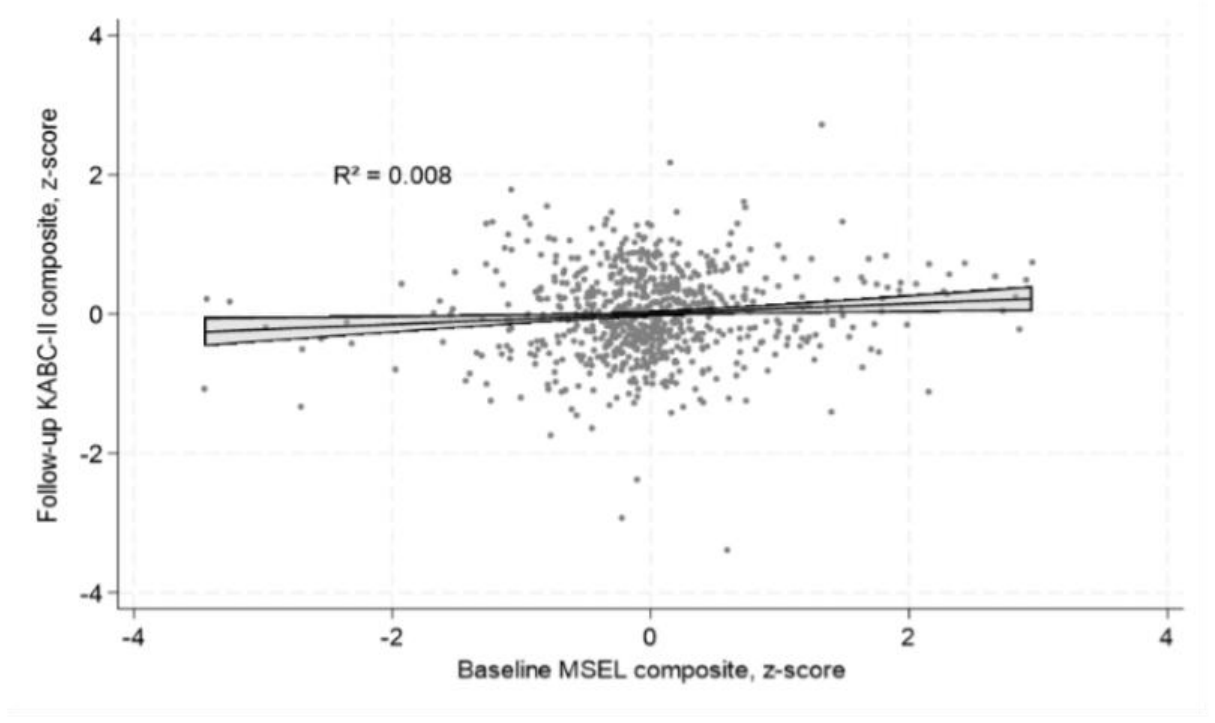
Figure 2.
Distribution of developmental trajectory deviation by descriptive tertiles (N=742).
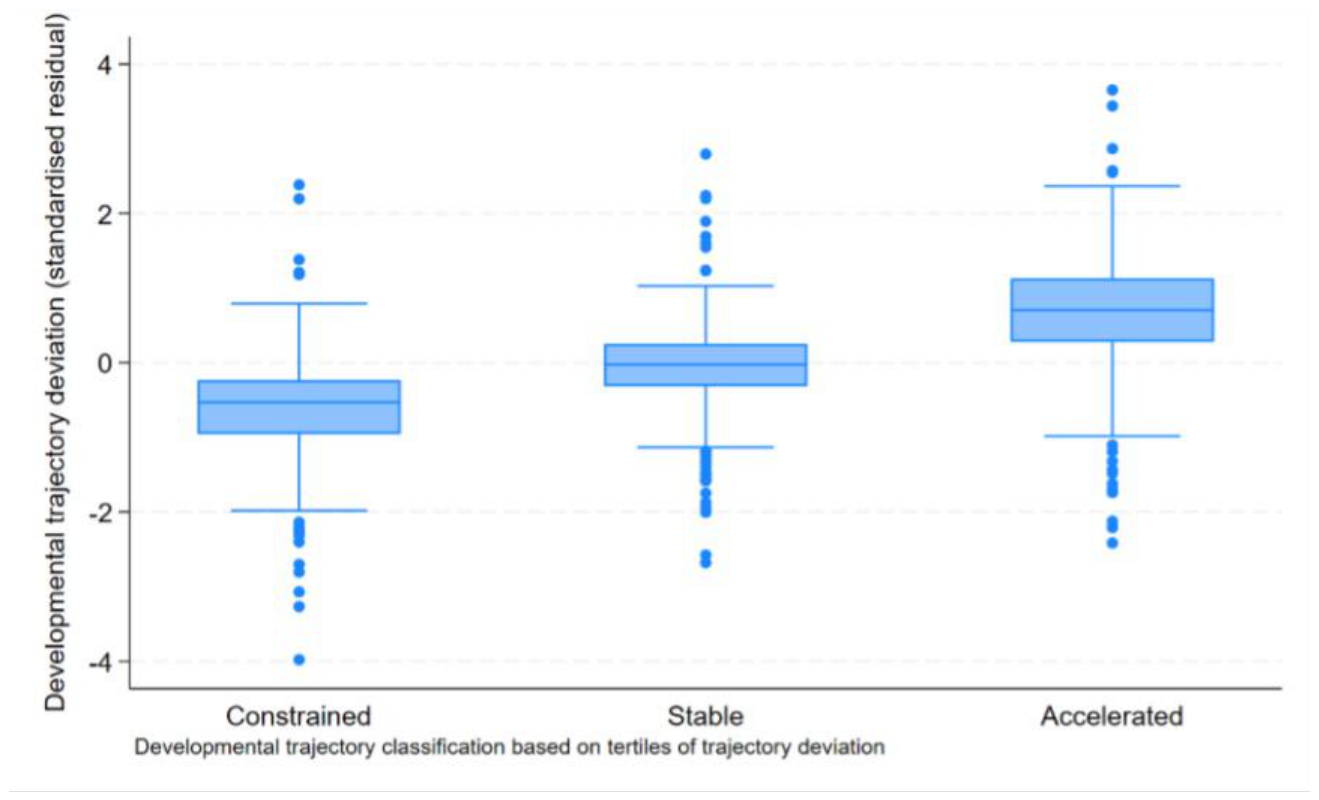
Figure 3.
Predicted developmental trajectory deviation by household material adequacy.
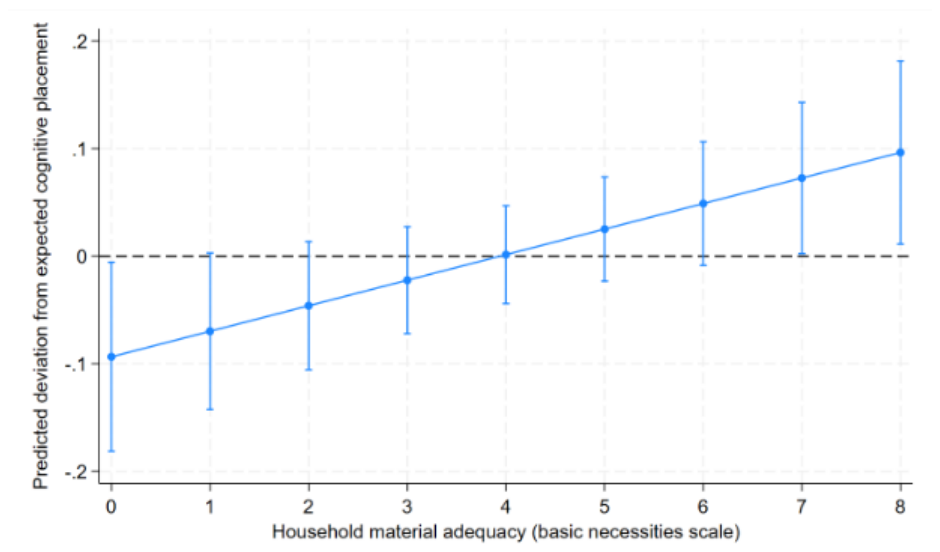
Table 2.
Summary factor loadings of KABC-II subtests when each MSEL domain is entered separately in exploratory factor analyses (principal factors extraction with promax rotation).
Table 2.
Summary factor loadings of KABC-II subtests when each MSEL domain is entered separately in exploratory factor analyses (principal factors extraction with promax rotation).
| MSEL Subtest | Triangles | Block Counting | Number Recall | Pattern Reasoning | Hand Movement | Concept Thinking | Atlantis | Atlantis Delayed |
Unique- ness |
| Visual Reception | 0.662 | 0.555 | 0.488 | 0.740 | 0.504 | 0.638 | 0.077 | 0.005 | 0.618 |
| Fine Motor | 0.666 | 0.558 | 0.482 | 0.731 | 0.501 | 0.633 | 0.075 | 0.007 | 0.613 |
| Receptive Language | 0.660 | 0.562 | 0.483 | 0.734 | 0.498 | 0.634 | 0.075 | 0.006 | 0.604 |
| Expressive Language | 0.654 | 0.561 | 0.494 | 0.733 | 0.506 | 0.636 | 0.081 | 0.006 | 0.623 |
| Gross Motor | 0.638 | 0.487 | 0.555 | 0.678 | 0.442 | 0.659 | 0.580 | 0.499 | 0.705 |
Note. N = 739 (Gross Motor N = 648). Uniqueness values indicate the proportion of variance not explained by the extracted factors.
Table 3.
Maternal structural positioning risks and child development trajectories, multilinear regression.
Table 3.
Maternal structural positioning risks and child development trajectories, multilinear regression.
| Child Trajectory | B | SE | t | p | 95% CI |
| Maternal NEET status (P3) | -0.147 | 0.052 | -2,83 | 0.005 | [-0.248, -0.045] |
| Maternal education level (P3) | -0.074 | 0.024 | -3.05 | 0.002 | [-0.122, -0.026] |
| Constant | 0.099 | 0.042 | 2.37 | 0.018 | [0.017, 0.181] |
Note. N = 733, R2 = .035, Adjusted R2 = .032, F (2, 730) = 13.06, p < .001.
Table 4.
Final Model- Structural positioning, material conditions, confounders controlled.
| Predictor | B | SE | p | 95% CI |
| Structural positioning | ||||
| Maternal NEET status (P3) | -0.139 | 0.053 | .008 | [-0.243, -0.036] |
| Maternal education level (P3) | -0.059 | 0.025 | .020 | [-0.109, -0.009] |
| Material conditions | ||||
| Household material adequacy (P1) | 0.025 | 0.009 | .009 | [0.006, 0.043] |
| Baseline material adequacy | 0.012 | 0.011 | .244 | [-0.009, 0.034] |
| Confounders | ||||
| Child age at baseline (months) | 0.002 | 0.002 | .265 | [-0.001, 0.005] |
| Maternal age at child’s birth | -0.022 | 0.014 | .109 | [-0.049, 0.005] |
| Rural residence (baseline) | -0.060 | 0.051 | .241 | [-0.160, 0.040] |
| Constant | 0.287 | 0.257 | .265 | [-0.218, 0.791] |
Note. N = 672. F(7, 664) = 5.76, p < .001. R2 = 0.057. Adjusted R2 = 0.047.
Disclaimer/Publisher’s Note: The statements, opinions and data contained in all publications are solely those of the individual author(s) and contributor(s) and not of MDPI and/or the editor(s). MDPI and/or the editor(s) disclaim responsibility for any injury to people or property resulting from any ideas, methods, instructions or products referred to in the content. |
© 2026 by the authors. Licensee MDPI, Basel, Switzerland. This article is an open access article distributed under the terms and conditions of the Creative Commons Attribution (CC BY) license (http://creativecommons.org/licenses/by/4.0/).
Copyright: This open access article is published under a Creative Commons CC BY 4.0 license, which permit the free download, distribution, and reuse, provided that the author and preprint are cited in any reuse.