
Submitted:
18 May 2026
Posted:
19 May 2026
You are already at the latest version
Abstract
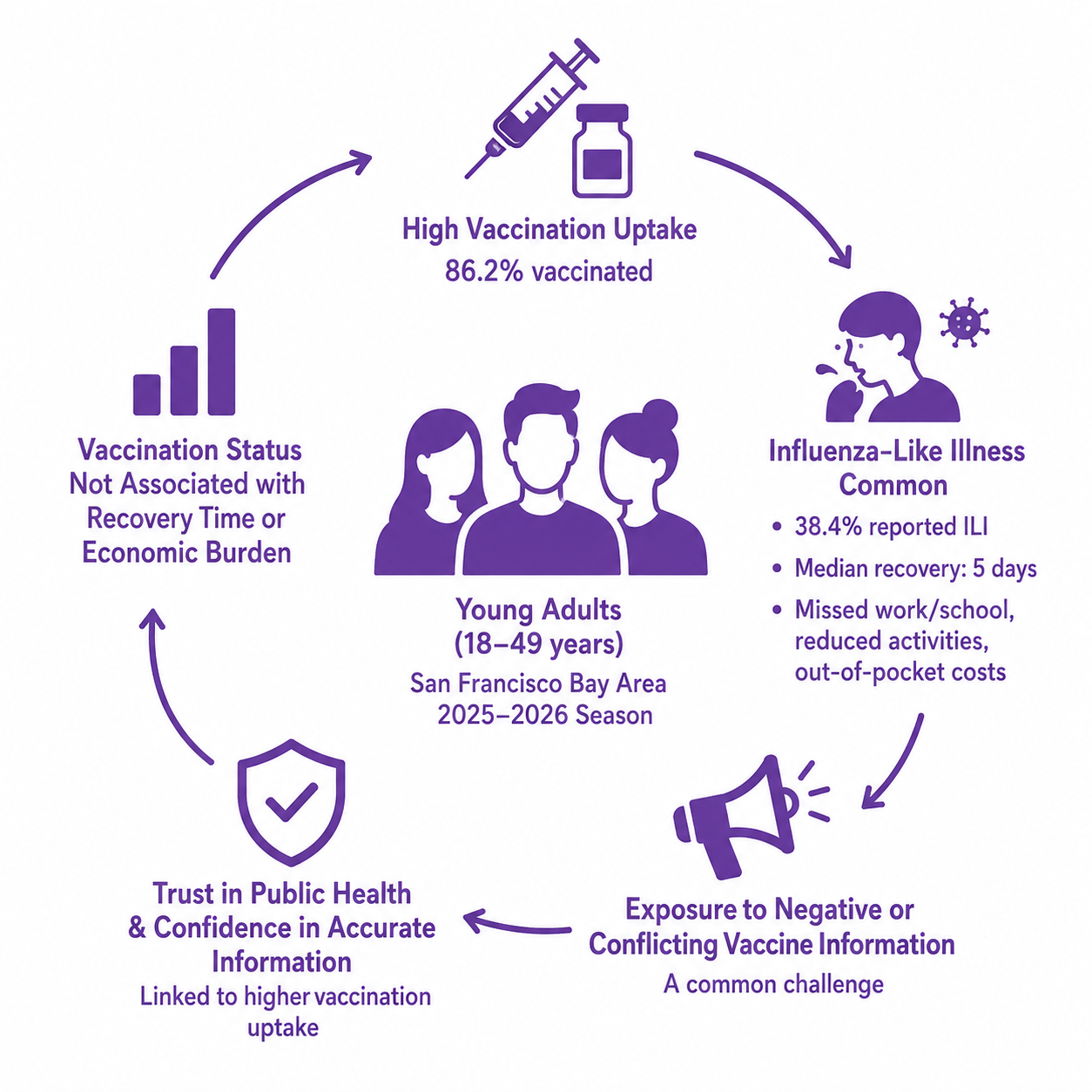
Background: Seasonal influenza prevention in young adults is influenced by access, trust, and vaccine information exposure, but local evidence linking vaccination uptake with illness and economic burden is limited. Methods: We conducted a cross-sectional electronic survey of adults aged 18-49 years who lived, worked, or studied in the San Francisco Bay Area during the 2025 to 2026 influenza season. Measures included vaccination uptake, influenza-like illness, recovery, functional and economic burden, vaccination sites, and vaccine information exposure. Multivariable logistic regression examined factors associated with vaccination uptake; Kaplan-Meier and Cox models examined time to recovery. Results: Of 554 responses, 463 were included. Vaccination uptake was 86.2% (n=399; 95% confidence interval [CI], 82.7%-89.2%), and 38.4% reported influenza-like illness. Among those with illness, median recovery time was 5 days, median missed work or school was 2 days, and median direct out-of-pocket cost was US$20. Prior season vaccination (adjusted odds ratio [aOR], 2.24; 95% CI, 1.15-4.34) and greater trust in Centers for Disease Control and Prevention or public health agencies (aOR, 1.46; 95% CI, 1.05-2.02) were associated with vaccination. Pharmacies were the second most common vaccination site and preferred future site. Conclusion: Influenza prevention for young adults may benefit from pharmacy-inclusive, multichannel access paired with trusted communication.
Keywords:
influenza
; vaccination
; young adults
; flu vaccine
; vaccine hesitancy
; economic burden
; community pharmacy
; San Francisco Bay Area
; cross-sectional survey
Copyright: This open access article is published under a Creative Commons CC BY 4.0 license, which permit the free download, distribution, and reuse, provided that the author and preprint are cited in any reuse.


