
Submitted:
17 May 2026
Posted:
19 May 2026
You are already at the latest version
Abstract
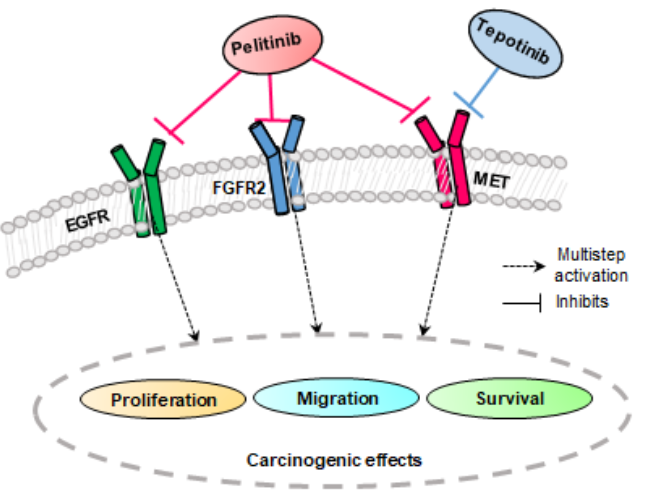
Amplification of the mesenchymal–epithelial transition factor protooncogene (MET), fibroblast growth factor receptor 2 (FGFR2), and epidermal growth factor receptor (EGFR) genes has been identified in 2–24%, 2–9%, and 27–64% of patients with gastric cancer (GC), respectively. This study characterised carcinogenesis-related alterations and copy number variation (CNV) in 286 genes from four human GC cell lines and analysed differences in the susceptibility of these cells to treatment with pelitinib, tepotinib, and docetaxel. Using a targeted DNA sequencing, we evaluated alterations and CNV in 286 genes from four GC cell lines. We assessed the antitumour activity of pelitinib, tepotinib, and docetaxel in these GC cell lines and in a xenograft model. Docetaxel is a drug commonly used to treat gastric cancer and was used as a positive control in this study. The effects of pelitinib, tepotinib, and docetaxel on cell viability (half-maximal inhibitory concentration), apoptotic cell death, tumour volume, and hematoxylin and eosin staining were evaluated using MTS cell proliferation assays and flow cytometry. Antitumour efficacy was assessed in xenograft mice. Compared to tepotinib, pelitinib inhibited the growth of GC cells, showing dose-dependent amplification of EGFR (CNV > 3, without HRAS, KRAS, or NRAS mutations), MET (CNV > 30), and FGFR2 (CNV = 87), with concomitant cell death induction. In the murine xenograft model, tumour volumes were significantly reduced in the pelitinib, tepotinib, and docetaxel-treated groups when administered by daily oral gavage at doses of 10, 10, and 5 mg/kg/day, respectively. Histologically, necrosis was more pronounced in the pelitinib, tepotinib, and docetaxel groups than in the control group. Pelitinib demonstrated anti-tumour activity, with MET and FGFR2 amplified in all tested GCs and EGFR amplified in GCs without HRAS, KRAS, or NRAS mutations.
Keywords:
pelitinib
; tepotinib
; docetaxel
; FGFR2
; EGFR
; MET
Copyright: This open access article is published under a Creative Commons CC BY 4.0 license, which permit the free download, distribution, and reuse, provided that the author and preprint are cited in any reuse.


