
Submitted:
17 May 2026
Posted:
18 May 2026
You are already at the latest version
Abstract
Background/Objectives: There are well-established sex differences in the epidemiology of stroke, but current data does not provide a clear mechanism to explain this phenomenon. This study asked if relationships between circulating sex hormone levels and stroke incidence could explain the sex differences in stroke rates. Methods: 393,158 participants from the UK Biobank aged were followed for a mean duration of 13.2 years. The incidence of ischemic stroke (IS) and intracerebral haemorrhage (ICH) was analysed in relation to baseline and changing levels of testosterone, sex hormone binding globulin (SHBG) and oestradiol. Results: A total of 3,844 participants experienced an IS and/or ICH, with incidence higher in men than women. In both sexes, a U-shaped association between total testosterone and ICH was found, independent of common cerebrovascular disease risk factors (P=0.006). Higher SHBG levels were associated with higher risk of IS (Q4 hazard ratio=1.18; P<0.001) in both men and women, independent of common cerebrovascular risk factors. No significant associations were observed between oestradiol levels and stroke events after making demographic adjustments. Conclusions: These data highlight the nuanced roles that sex hormones play in the epidemiology of stroke between sexes. Whilst sex hormones are implicated in modulating stroke risk, this study demonstrated the complexity of this relationship.
Keywords:
stroke
; testosterone
; oestradiol
; sex hormone binding globulin
1. Introduction
Stroke is the second leading cause of death and disability in the world. In 2019, there were 12.2 million incident strokes globally, with a mortality rate of approximately 50% [1]. Current data demonstrates sex differences in stroke epidemiology. Though there is considerable inter-study variability, stroke incidence appears to be higher in women compared with men, particularly at the extremes of age (<40 years and >75 years) [2,3]. Furthermore, women have more severe strokes than men, have a greater post-stroke deficit and are more likely to be institutionalized following a stroke [4,5]. Current data are insufficient to completely explain the mechanisms underlying these disparities. Given that sex hormones are known to be associated with common stroke risk factors it has been hypothesized that they may, at least in part, explain the sex differences in stroke epidemiology. There is limited data on the direct association between sex hormones and stroke, particularly in large, generalizable cohorts. The major sex hormones are testosterone and oestradiol, which are generally thought to have a beneficial effect on the cardiovascular system at normal physiological levels [6]. Sex hormone binding globulin (SHBG) is a glycoprotein which binds to circulating testosterone and oestradiol, regulating the bioavailability of these hormones [7]. This study aimed to leverage the wealth of data in the UK Biobank to assess the association of testosterone, oestradiol and SHBG with incident stroke in a large, ostensibly healthy population [8].
2. Materials and Methods
2.1. Study Participants
The UK Biobank is a cohort comprising ~500,000 participants from the United Kingdom, recruited between 2006 and 2010. The participants were aged 40 – 69 years at the time of enrolment and were recruited from 22 centers across Scotland, England and Wales. Participants had a lower incidence of clinically significant chronic disease at the time of enrolment, compared to the Health Survey for England, particularly cardiovascular disease (CVD), stroke, diabetes and hypertension [8]. A sub-set of approximately 20,000 participants were recruited for repeat examination between 2010 and 2013. The present study used follow-up data until 28th April 2022. This study was conducted under the UK Biobank Application Number 66377.
Participant flow is depicted in Figure 1. Hormone change over time was calculated for those participants who attended repeat examination with valid sex hormone data at follow-up and who had no primary endpoint event between the two visits. The mean (standard deviation [SD]) duration from baseline to repeat assessment was 4.3 (0.9) years.
2.2. Baseline Covariates
Baseline demographic information and medical history was obtained via a combination of self-reported questionnaires and interview with a study nurse. Anthropometric measurements and blood pressure were recorded in a standardised manner by study staff. Diabetes was defined as meeting any one of the following: self-reported diabetes, use of hypoglycaemic medication and/or HbA1c level ≥48 mmol/mol (6.5%) at baseline. Atrial fibrillation and atrial flutter were defined using the International Classification of Disease, 10th Revision codes, from primary care and hospital databases. Information regarding the processes and procedures of serum assays has been previous published [9].
2.3. Sex Hormone Measurement
Testosterone, SHBG and oestradiol were measured in serum samples by one-step competitive immunoassay, two-step sandwich immunoassay, and two-step competitive immunoassay, respectively, on a Beckman Coulter UniCel Dxl 800 autoanalyser. The detectable ranges were 0.35 – 55.52 nmol/L for testosterone, 0.33 – 242 nmol/L for SHBG and 175 – 17,621 pmol/L for oestradiol [9]. Free testosterone (FT) and calculated bioavailable testosterone (CBAT) were estimated using total testosterone (TT), SHBG and albumin levels, using Vermeulen’s Equation (Supplementary Table 2). Where albumin measurements were not valid, these were imputed with 43 g/L.
2.4. Stroke Outcomes
Details on the algorithms used to identify stroke in the UK Biobank have been previously described and validated [10]. In short, incident stroke was defined as stroke after the day of baseline assessment. Incident strokes were detected using hospital admission and death registry data sorted by the appropriate ICD codes (Supplementary Table 1). Strokes were categorised using the relevant ICD codes as either IS, ICH, subarachnoid haemorrhage or uncategorised. For this study, only IS and ICH were analysed, as their aetiology is atraumatic and therefore potentially biologically related to sex hormones levels.
2.5. Statistical Analysis
Data were examined for normality by assessing skewness and kurtosis. Variables with normal distribution were presented as mean (SD) and those with a skewed distribution were presented as median (interquartile range [IQR]). Binary categorical variables were presented as n (percentage). Comparison of baseline characteristics between participants with and without incident stroke was performed by Chi-square test for categorical variables and independent t-test for continuous variables. For variables with a skewed distribution, data were transformed using natural logarithm (ln) prior to analysis.
Sex hormone values below detectable limits were imputed as the respective lower limit value, including 34,024 (8.65%) testosterone, 6 (0.002%) SHBG and 324,409 (82.5%) oestradiol measurements. TT, FT, CBAT and SHBG levels were categorised into quartiles (Q1-Q4) using sex-specific cut-off values. Oestradiol was categorized into pentiles – with pentile 0 (P0) representing those with an undetectable oestradiol level, and pentile 1-4 (P1-P4) representing oestradiol level Q1-Q4 among those with detectable level. This methodology was in keeping with previous studies analyzing oestradiol levels in the UK Biobank [11]. Chi-squared test was used to compare stroke incidence across quartiles/pentiles of different hormone levels. Cox regression was performed to assess the time-dependent association of sex hormone levels with first-incident stroke. Eligible participants contributed person-years from the date of recruitment until the date of first-incident stroke, date of death or end of follow-up, whichever came first. The reference group for comparison was Q1 for testosterone, FT, CBAT and SHBG, and P0 for oestradiol. In Model 1, data was adjusted for age, sex and TDI. In Model 2 data was further adjusted for cerebrovascular risk factors including BMI, use of lipid-lowering medication, diabetes, smoking status, alcohol consumption, HDL cholesterol, LDL cholesterol, triglycerides, systolic blood pressure, use of anti-hypertensive medication and the use of oral contraceptive pill (OCP) or hormone replacement therapy (HRT). In Model 3, data was further adjusted for atrial fibrillation and/or atrial flutter. There were no violations of the proportional hazards assumption in any analyses, as assessed by checking the Schoenfeld residuals.
A further Cox regression was performed to examine the association of changes in sex hormone levels over time with incident IS. Participants were divided into increased, decreased or no change groups, with no-change being the reference group. Participants who had a primary endpoint event between the two follow-up visits were excluded from this analysis. For TT, FT and CBAT, no change was defined as less than 13% increase or decrease from baseline. No change in SHBG was defined as less than 11% increase or decrease from baseline. These values were based on the serum assay performance characteristics for each hormone [9]. Change over time analysis was not performed for oestradiol given the large number of values below the level of detection. Due to low event numbers, multivariable regression for ICH in the change over time analysis was not performed.
The interaction of sex was estimated by including the interaction term in the regression model in the full sample after adjusting for the main effects of the covariates. Multiple testing correction was performed using false discovery rate with the study-wide false discovery rate at 0.05. A two-tailed P<0.05 was considered as statistically significant. SPSS 28 (IBM, Armonk, NY) and STATA 17 (StataCorp, College Station, TX) were used for statistical analysis.
3. Results
3.1. Baseline Characteristics
Baseline characteristics of study participants are shown in Table 1. Over the mean follow-up period of 13.2 years there were 3,844 primary endpoint events. Among these, 3,183 (82.8%) were IS and 661 (17.2%) were ICH. Men had an overall higher incidence of stroke than women, accounting for 61.9% of IS and 55.2% of ICH. The mean time from baseline to IS was 4.73 (2.35) years and to ICH was 4.84 (2.43) years. Participants with IS were more likely to have higher BMI, have smoked, have higher systolic blood pressure, and have diabetes and atrial fibrillation or atrial flutter. Baseline demographics were similar between those with incident IS and ICH. Baseline characteristics of those participants excluded from the primary analysis (Supplementary Table 3) and from the repeat analysis (Supplementary Table 4) were comparable to those included in the primary analysis. Those with a detectable oestradiol level were more likely to be younger, female and use either OCP or HRT (Supplementary Table 5).
3.2. Testosterone
There was an inverse association between IS and TT, FT and CBAT (all P<0.001, Table 2). However, when divided by sex, the association for IS with FT and CBAT was found to be non-significant in women whereas the inverse association remained significant for men (both P<0.001). For ICH, a U-shaped association with TT was found, and an inverse relationship with FT and CBAT (all P<0.001, Table 2).
After adjustment for baseline demographics and common cerebrovascular disease risk factors, there remained a significant U-shaped association of TT with incident ICH (P=0.006 [Figure 2; Supplementary Table 6]). When compared to Q1 the HR for Q2, Q3 and Q4 was 0.75, 0.76 and 1.03, respectively. This relationship remained significant after further adjustment for SHBG levels (p=0.007; Model 4, Supplementary Table 6). There was no relationship between FT or CBAT and ICH. There was a modest, non-significant U-shaped relationship of TT with IS in Model 1 of the multivariable analysis, though this was attenuated after adjustment for cerebrovascular disease risk factors (Supplementary Table 7). There was no relationship of either FT or CBAT with IS in the final adjustment model. There was no significant interaction of sex in any of these analyses.
In participants with valid repeat data on testosterone (n=13,757), there were 80 incident strokes after repeat assessment (69 IS and 11 ICH). For those in the follow-up population with sufficient data to calculate FT and CBAT, there were 69 incident strokes (59 IS and 10 ICH). Those with incident IS had a greater decline in TT, FT and CBAT over the follow-up period compared to those without incident IS (all P<0.05, Supplementary Table 8). After adjustment for baseline demographic factors and common cerebrovascular risk factors, there was no significant relationship of change in TT, FT or CBAT with incident IS (Table 3). There was no significant interaction of sex in the multivariable analysis. There was no significant relationship of change in TT, FT or CBAT over time with incident ICH, though event numbers in this analysis were low and thus precluded multivariable analysis (Supplementary Table 8).
3.3. Sex Hormone Binding Globulin
In univariable analysis there was a significant association of SHBG with IS (Table 2). In men SHBG level was positively associated with IS (P<0.001), while in women, SHBG was inversely associated with IS (P<0.001). SHBG was positively associated with ICH in men (P=0.002), though no such relationship was found in women (Table 2).
After adjustment for baseline demographics and common cerebrovascular risk factors, there remained a significant positive association of SHBG level with IS (p=0.014; Figure 2). When compared to Q1 the HR for Q2, Q3 and Q4 was 1.02, 1.09 and 1.18, respectively. This relationship remained significant after further adjustment for testosterone level (p=0.021; Supplementary Table 7). There was no relationship of SHBG level with ICH. No significant interaction of sex was detected in the multivariable analysis.
In participants with valid repeat data on SHBG, there were 70 incident strokes (60 IS and 10 ICH). Univariate analysis showed no significant relationship of change in SHBG level with either IS or ICH (Supplementary Table 8). Similarly, there was no significant relationship in the multivariable analysis, nor was there any interaction of sex in these analyses (Table 3).
3.4. Oestradiol
17.5% of participants had an oestradiol level above the lower limit of detection. Accordingly, 89% of all incident strokes occurred in P0 (those with undetectable oestradiol levels). Compared to P0, those in P1-P4 had a lower incidence of IS (P<0.001; Table 2). When stratified by sex, men in P1–P4 had a higher incidence of IS, whereas women in P1-P4 had a lower incidence of IS (both P<0.05). Similarly, women in P1-P4 had a lower incidence of ICH (P<0.001) but not men.
After adjustment for baseline demographics and common cerebrovascular risk factors no statistically significant associations were found between baseline oestradiol level and incident IS or ICH (Figure 2; Supplementary Tables 6 and 7). No significant interaction of sex was detected in the multivariable analysis.
4. Discussion
This study provides a unique insight into the pathobiology of stroke and sex differences in stroke epidemiology. In this cohort at the time of analysis, the incidence of IS and ICH was higher in men than women. Previous studies have shown that between the ages of 40 and 70 years, more men than women have strokes [2,3,12]. As the UK Biobank participants were aged between 40 – 69 years at recruitment, these results are in keeping with previous reports [2,3].
This study had three key findings. First, there was a U-shaped association of TT level with incident ICH that was independent of traditional cerebrovascular disease risk factors and not modified by sex. Generally, testosterone levels are higher in men than women [13], with levels decreasing progressively with increasing age in men, and remaining relatively stable throughout the post-menopausal years in women [14]. Higher testosterone in men has been linked to improved endothelial function, reduced blood pressure and decreased arterial stiffness, which reduces cerebrovascular risk, whereas low testosterone has been linked to poorer outcomes after stroke [15,16]. However, previous studies have shown that supra-normal levels of testosterone achieved via testosterone replacement therapy increases the risk of stroke, CVD and all-cause mortality [17]. The effects of testosterone on cardiovascular health in women has not been well-studied, with some studies showing less events at high levels and another showing increased events at extreme endogenous concentrations [18,19]. Lower ICH incidence in the middle quartiles of both sexes may be explained by the protective effects of testosterone at normative levels, including its impact on blood pressure and vascular stiffness [16]. No studies have reported such a relationship between testosterone and ICH. Previous observational studies have demonstrated a modest U-shaped association of TT with IS, which was observed in the present study but attenuated after adjustment for covariates [20]. The relationship between testosterone and IS was likely confounded by the association of testosterone levels with metabolic syndrome, a well-established risk factor for IS and CVD [21]. Comprehensive adjustment for these metabolic factors associated with IS and testosterone status corroborated previous reports [22]. Interestingly, there was no association of FT or CBAT with ICH in this study, suggesting that bound testosterone may not be completely inert or may be a marker of underlying pathological processes.
The second major finding of this study was a direct relationship between SHBG levels and incident IS. A previous study reported a lower risk of future IS in participants with higher SHBG levels [23]. Whilst our unadjusted analysis agreed with this finding, after adjustment for confounding cardiovascular and cerebrovascular risk factors our data is in agreeance with several other observational reports suggesting a higher risk of CVD (and in-particular IS) with higher SHBG levels [24,25,26]. SHBG mediates the bioavailability of testosterone and oestradiol, while also acting on SHBG-specific G-protein coupled receptors [7]. In men, SHBG levels progressively increase with age, whereas in women, there is a U-shaped pattern of SHBG levels over time, with the nadir being around the age of 65 years [24]. This difference may at least partially contribute the discordance in stroke rates across the age brackets between men and women [2,3].
The third finding was that there was no identifiable relationship between oestradiol and IS or ICH. Endogenous oestradiol is thought to be cardioprotective via beneficial effects on the vascular system, blood pressure and lipid profile [27]. Observational studies have suggested an inverse relationship of endogenous oestradiol levels with atherosclerotic and cardiovascular disease progression [28]. However, randomised controlled trials of exogenous estrogens suggest long-term exposure is associated with a greater risk of hypertension, cardio- and cerebrovascular disease [29,30]. Whilst a large proportion of the study population had an undetectable oestradiol level, biologically relevant relationships which may exist below the detectable limit of current assays cannot be excluded. In line with previous studies, oestradiol values below the detectable range were considered as ‘naturally low’ as opposed to ‘missing’ [11]. In this study the unadjusted stroke rate was almost 50% lower in those with a detectable versus undetectable oestradiol level at baseline.
Sex hormones vary between males and females, across ages and throughout hormonal cycles. This may explain previous reports on the association of sex hormones with stroke having inconsistent findings. Previous reports are limited by low event numbers, short follow-up periods and relatively small sample sizes. The large cohort size, long follow-up period and repeat hormone analysis of the UK Biobank facilitated a well-powered analysis of the relationship of sex hormones with stroke. Calculation of FT and CBAT levels also provided greater functionally relevant information. However, there were relatively few events in the sub-sample with repeat hormone measurement. Utilising immunoassay, rather than mass spectrometry, in the analysis of sex hormones has meant that a significant number of participants had hormone levels below the level of detection, particularly oestradiol. Oestradiol is important to consider, as the age range of this cohort is approximate to the time of menopause and allowing for more validity in the interpretation of testosterone and SHBG. The use of a single sex hormone measurement has also meant that these levels were susceptible to physiological fluctuations. Furthermore, the absolute change in hormone levels over the follow-up period was small, likely due to the short duration between study visits (mean 4.3 years). The UK Biobank does not have data on stroke severity, location or the aetiology of specific stroke subtypes, which limits further analysis.
There is ample existing evidence to demonstrate that sex differences in stroke epidemiology exist. This study describes a U-shaped association between TT levels and ICH and a positive association of SBHG with IS. These data suggest that the mechanisms underlying the disparity between the sexes are complex, the aetiology is likely multifactorial and is not solely explained by difference in sex hormone levels. Further mechanistic studies are required to provide a greater understanding of the difference in stroke pathobiology and risk factors between the sexes.
Supplementary Materials
The following supporting information can be downloaded at the website of this paper posted on Preprints.org. Supplementary Table 1: International Classification of Disease Codes. Supplementary Table 2: Adapted Vermeulen’s Equation to calculate free and calculated bioavailable testosterone. Supplementary Table 3: Baseline characteristics of those excluded from the primary analysis. Supplementary Table 4: Baseline characteristics of those excluded versus included in the change over time analysis. Supplementary Table 5: Baseline characteristics of those with detectable versus undetectable oestradiol level at baseline. Supplementary Table 6: Multivariable analysis of baseline sex hormone levels with incident intracranial haemorrhage. Supplementary Table 7: Multivariable analysis of baseline sex hormone levels with incident ischaemic stroke. Supplementary Table 8: Univariate analysis of average annual change in sex hormones with incident stroke.
Author Contributions
Conceptualization, B.J.C, K.L.O. and B.T.; methodology, M.C., K.L.O. and B.T.; formal analysis, M.C., K.L.O. and B.T.; investigation, M.C., K.L.O. and B.T.; resources, K.A.R., S.P. and B.J.C.; writing—original draft preparation, M.C. and B.T.; writing—review and editing, K.A.R, S.P., B.J.C. and K.L.O.; supervision, K.A.R, S.P., K.L.O and B.T.; project administration, B.J.C.; All authors have read and agreed to the published version of the manuscript.
Funding
This research received no external funding.
Institutional Review Board Statement
The study was conducted in accordance with the Declaration of Helsinki, and approved by the North West Multi-centre Research Ethics Committee (REC reference 11/NW/0382). UK Biobank has ethical approval from, and all participants provided informed consent.
Informed Consent Statement
Informed consent was obtained from all subjects involved in the study.
Data Availability Statement
The raw data supporting the conclusions of this article will be made available by the authors on request.
Conflicts of Interest
The authors declare no conflicts of interest.
Abbreviations
The following abbreviations are used in this manuscript:
| BMI | Body mass index |
| CBAT | Calculated bioavailable testosterone |
| CVD | Cardiovascular disease |
| FT | Free testosterone |
| HRT | Hormone replacement therapy |
| ICH | Intracerebral haemorrhage |
| IS | Ischemic stroke |
| OCP | Oral contraceptive pill |
| SHBG | Sex hormone binding globulin |
| TDI | Townsend deprivation index |
| TT | Total testosterone |
References
- Feigin, V.L.; et al. Global, regional, and national burden of stroke and its risk factors, 1990-2013;2019: a systematic analysis for the Global Burden of Disease Study 2019. Lancet Neurol. 2021, 20(10), 795–820. [Google Scholar] [CrossRef]
- Akyea, R.K.; et al. Sex, Age, and Socioeconomic Differences in Nonfatal Stroke Incidence and Subsequent Major Adverse Outcomes. Stroke 2021, 52(2), 396–405. [Google Scholar] [CrossRef]
- Leppert, M.H.; et al. Systematic Review of Sex Differences in Ischemic Strokes Among Young Adults: Are Young Women Disproportionately at Risk? Stroke 2022, 53(2), 319–327. [Google Scholar] [CrossRef]
- Carcel, C.; et al. Sex matters in stroke: A review of recent evidence on the differences between women and men. Front Neuroendocrinol. 2020, 59, 100870. [Google Scholar] [CrossRef]
- Phan, H.T.; et al. Sex Differences in Severity of Stroke in the INSTRUCT Study: a Meta-Analysis of Individual Participant Data. J. Am. Heart Assoc. 2019, 8(1), e010235. [Google Scholar] [CrossRef] [PubMed]
- Zhu, D.; et al. Age at natural menopause and risk of incident cardiovascular disease: a pooled analysis of individual patient data. Lancet Public Health 2019, 4(11), e553–e564. [Google Scholar] [CrossRef]
- Basualto-Alarcón, C.; et al. Classic and Novel Sex Hormone Binding Globulin Effects on the Cardiovascular System in Men. Int. J. Endocrinol. 2021, 2021, 1–13. [Google Scholar] [CrossRef] [PubMed]
- Fry, A.; et al. Comparison of sociodemographic and health-related characteristics of UK Biobank participants with those of the general population. Am. J. Epidemiol. 2017, 186(9), 1026–1034. [Google Scholar] [CrossRef] [PubMed]
- Fry, D.; Almond, R.; Moffat, S.; Gordon, M.; Singh, P. UK Biobank biomarker project - companion document to accompany serum biomarker data. 2019. [Google Scholar]
- Rannikmäe, K.; et al. Accuracy of identifying incident stroke cases from linked health care data in UK Biobank. Neurology 2020, 95(6), e697. [Google Scholar] [CrossRef]
- Peters, S.A.E.; Woodward, M. Oestradiol and the risk of myocardial infarction in women: a cohort study of UK Biobank participants. Int. J. Epidemiol. 2021, 50(4), 1241–1249. [Google Scholar] [CrossRef] [PubMed]
- Leppert, M.H.; et al. Young women had more strokes than young men in a large, United States claims sample. Stroke 2020, 51(11), 3352–3355. [Google Scholar] [CrossRef] [PubMed]
- Glisic, M.; et al. Associations of endogenous estradiol and testosterone levels with plaque composition and risk of stroke in subjects with carotid atherosclerosis. Circ. Res. 2018, 122(1), 97–105. [Google Scholar] [CrossRef] [PubMed]
- Travison, T.G.; et al. Harmonized reference ranges for circulating testosterone levels in men of four cohort studies in the United States and Europe. J. Clin. Endocrinol. Metab. 2017, 102(4), 1161–1173. [Google Scholar] [CrossRef]
- Cai, J.; et al. Early post-haemorrhagic stroke testosterone and oestradiol levels and long-term risk of death. Brain Inj. 2017, 31(3), 401–405. [Google Scholar] [CrossRef]
- DuPont, J.J.; et al. Sex differences in mechanisms of arterial stiffness. Br. J. Pharmacol. 2019, 176(21), 4208–4225. [Google Scholar] [CrossRef]
- Anderson, J.L.; et al. Impact of testosterone replacement therapy on myocardial infarction, stroke, and death in men with low testosterone concentrations in an integrated health care system. Am. J. Cardiol. 2016, 117(5), 794–799. [Google Scholar] [CrossRef]
- Holmegard, H.N.; et al. Sex Hormones and Ischemic Stroke: A Prospective Cohort Study and Meta-Analyses. J. Clin. Endocrinol. Metab. 2016, 101(1), 69–78. [Google Scholar] [CrossRef]
- Islam, R.M.; et al. Associations between blood sex steroid concentrations and risk of major adverse cardiovascular events in healthy older women in Australia: a prospective cohort substudy of the ASPREE trial. Lancet Healthy Longev. 2022, 3(2), e109–e118. [Google Scholar] [CrossRef]
- Shores, M.M.; et al. Testosterone and dihydrotestosterone and incident ischaemic stroke in men in the Cardiovascular Health Study. Clin. Endocrinol. (Oxf) 2014, 81(5), 746–53. [Google Scholar] [CrossRef]
- Ahn, H.-J.; et al. Metabolic syndrome and ischaemic stroke in non-anticoagulated atrial fibrillation with low CHA2DS2-VASc scores. Heart 2023. [Google Scholar] [CrossRef]
- Srinath, R.; et al. Association Between Endogenous Testosterone and Cerebrovascular Disease in the ARIC Study (Atherosclerosis Risk in Communities). Stroke 2016, 47(11), 2682–2688. [Google Scholar] [CrossRef]
- Madsen, T.E.; et al. Circulating SHBG (Sex Hormone-Binding Globulin) and Risk of Ischemic Stroke: Findings From the WHI. Stroke 2020, 51(4), 1257–1264. [Google Scholar] [CrossRef]
- Aribas, E.; et al. Aging, Cardiovascular Risk, and SHBG Levels in Men and Women From the General Population. J. Clin. Endocrinol. Metab. 2021, 106(10), 2890–2900. [Google Scholar] [CrossRef]
- Wang, A.; et al. Testosterone, sex hormone-binding globulin and risk of cardiovascular events: A report from the Outcome Reduction with an Initial Glargine Intervention trial. Eur. J. Prev. Cardiol. 2019, 26(8), 847–854. [Google Scholar] [CrossRef]
- Yeap, B.B.; et al. Associations of serum testosterone and sex hormone–binding globulin with incident cardiovascular events in middle-aged to older men. Ann. Intern. Med. 2022, 175(2), 159–170. [Google Scholar] [CrossRef] [PubMed]
- Iorga, A.; et al. The protective role of estrogen and estrogen receptors in cardiovascular disease and the controversial use of estrogen therapy. Biol. Sex. Differ. 2017, 8(1), 33. [Google Scholar] [CrossRef]
- Appiah, D.; et al. Low endogenous estradiol levels are associated with elevated risk of cardiovascular disease mortality in young and middle-aged men in the United States. Atherosclerosis 2022, 361, 34–40. [Google Scholar] [CrossRef] [PubMed]
- Colafella, K.M.M.; Denton, K.M. Sex-specific differences in hypertension and associated cardiovascular disease. Nat. Rev. Nephrol. 2018, 14(3), 185–201. [Google Scholar] [CrossRef] [PubMed]
- Demel, S.L.; et al. Stroke Risk Factors Unique to Women. Stroke 2018, 49(3), 518–523. [Google Scholar] [CrossRef]
- Vermeulen, A.; et al. A critical evaluation of simple methods for the estimation of free testosterone in serum. J. Clin. Endocrinol. Metab. 1999, 84(10), 3666–3672. [Google Scholar] [CrossRef] [PubMed]
Figure 1.
Participant Flow.
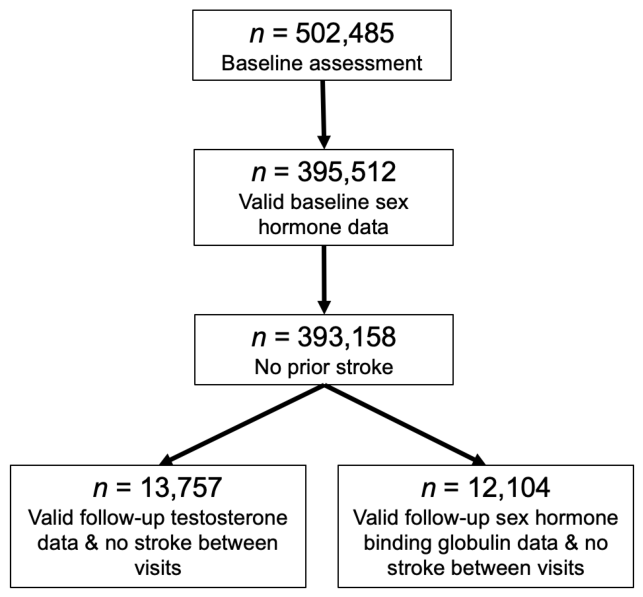
Figure 2.
Association of baseline sex hormone levels with incident stroke. Data presented as HR and 95% CI. Data are adjusted for age, sex, TDI, BMI, lipid-lowering medication, smoker status, alcohol drinking status, HDL cholesterol, LDL cholesterol, triglycerides, systolic blood pressure, use of anti-hypertensive medications, use of OCP, use of HRT and atrial fibrillation/flutter. *Overall p-value p<0.05 after correction for multiple testing.
Figure 2.
Association of baseline sex hormone levels with incident stroke. Data presented as HR and 95% CI. Data are adjusted for age, sex, TDI, BMI, lipid-lowering medication, smoker status, alcohol drinking status, HDL cholesterol, LDL cholesterol, triglycerides, systolic blood pressure, use of anti-hypertensive medications, use of OCP, use of HRT and atrial fibrillation/flutter. *Overall p-value p<0.05 after correction for multiple testing.
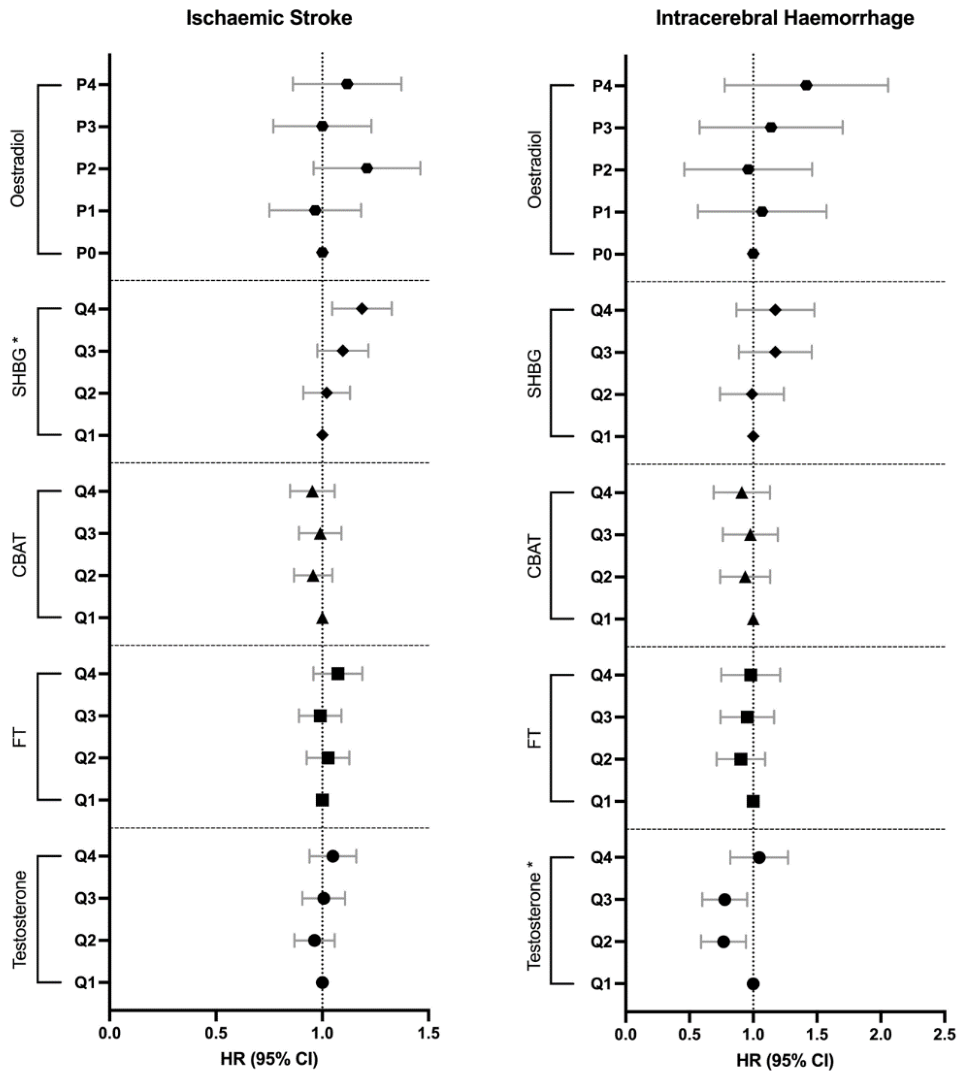

Table 1.
Baseline Characteristics of Study Participants.
| Characteristic | No Incident Stroke | Incident IS | p-value | Incident ICH | p-value | |||
| n | Estimate | n | Estimate | n | Estimate | |||
| Age at recruitment (years) | 389,314 | 56.5 (8.10) | 3,183 | 61.6 (6.60) | <0.001 | 661 | 61.6 (6.60) | <0.001 |
| Male sex | 389,314 | 179,024 (46.0%) | 3,183 | 1969 (61.9%) | <0.001 | 661 | 365 (55.2%) | <0.001 |
| TDI | 388,834 | -1.32 (3.08) | 3,178 | -0.80 (3.32) | <0.001 | 661 | -1.11 (3.18) | 0.089 |
| BMI (kg/m2) | 387,787 | 27.4 (4.77) | 3,160 | 28.6 (5.23) | <0.001 | 655 | 27.6 (5.21) | 0.331 |
| Smoking status | 387,351 | 3,161 | <0.001 | 653 | <0.001 | |||
| Never | 212,482 (54.9%) | 1,366 (43.2%) | 300 (45.9%) | |||||
| Former | 134,190 (34.6%) | 1,238 (39.2%) | 274 (42.0%) | |||||
| Current | 40,679 (10.5%) | 557 (17.6%) | 79 (12.1%) | |||||
| Alcohol drinker status | 388,345 | 3,176 | <0.001 | 658 | <0.001 | |||
| Never | 17,225 (4.4%) | 171 (5.4%) | 31 (4.7%) | |||||
| Former | 13,850 (3.6%) | 161 (5.1%) | 43 (6.5%) | |||||
| Current | 357,270 (92.0%) | 2,844 (89.5%) | 584 (88.8%) | |||||
| LDL cholesterol (mmol/L) | 388,433 | 3.56 (0.87) | 3,172 | 3.46 (0.93) | <0.001 | 658 | 3.40 (0.84) | <0.001 |
| HDL cholesterol (mmol/L) | 388,824 | 1.45 (0.38) | 3,179 | 1.35 (0.38) | <0.001 | 660 | 1.42 (0.40) | 0.028 |
| Triglycerides (mmol/L) | 388,936 | 1.75 (1.03) | 3,180 | 1.90 (1.05) | <0.001 | 660 | 1.79 (1.02) | 0.223 |
| Use of lipid-lowering medication | 389,314 | 66,506 (17.1%) | 3,183 | 1,040 (32.7%) | <0.001 | 661 | 171 (25.9%) | <0.001 |
| Systolic blood pressure (mmHg) | 388,870 | 139.8 (19.6) | 3,176 | 148.2 (21.6) | <0.001 | 660 | 148.6 (21.59) | <0.001 |
| Use of anti-hypertensive medication | 389,314 | 39,233 (10.1%) | 3,183 | 489 (15.4%) | <0.001 | 661 | 114 (17.2%) | <0.001 |
| Diabetes | 389,314 | 22,668 (5.8%) | 3,183 | 492 (15.5%) | <0.001 | 661 | 76 (11.5%) | <0.001 |
| Atrial fibrillation / flutter | 389,314 | 6,018 (1.5%) | 3,183 | 243 (7.6%) | <0.001 | 661 | 56 (8.5%) | <0.001 |
| OCP use at baseline (Yes) | 372,132 | 3,779 (1.0%) | 3,062 | 6 (0.2%) | <0.001 | 628 | 0 (0%) | 0.011 |
| HRT use at baseline (Yes) | 381,589 | 12,613 (3.3%) | 3,094 | 90 (2.9%) | 0.219 | 644 | 16 (2.5%) | 0.244 |
| TT (nmol/L) | ||||||||
| Male | 179,024 | 11.63 (9.43-14.14) | 1,969 | 11.46 (9.25-13.95) | 0.035 | 365 | 11.49 (8.84-14.40) | 0.440 |
| Female | 210,290 | 0.90 (0.54-1.29) | 1,214 | 0.85 (0.44-1.26) | 0.166 | 296 | 0.84 (0.35-1.31) | 0.427 |
| FT (nmol/L) | ||||||||
| Male | 179,024 | 0.207 (0.172-0.246) | 1,969 | 0.194 (0.162-0.234) | <0.001 | 365 | 0.193 (0.161-0.231) | <0.001 |
| Female | 210,290 | 0.011 (0.006-0.017) | 1,214 | 0.010 (0.006-0.017) | 0.726 | 296 | 0.010 (0.005-0.017) | 0.221 |
| CBAT (nmol/L) | ||||||||
| Male | 179,024 | 5.10 (4.24-6.11) | 1,969 | 4.76 (3.93-5.72) | <0.001 | 365 | 4.77 (3.87-5.70) | <0.001 |
| Female | 210,290 | 0.26 (0.15-0.41) | 1,214 | 0.25 (0.14-0.41) | 0.809 | 296 | 0.24 (0.12-0.40) | 0.163 |
| SHBG (nmol/L) | ||||||||
| Male | 179,024 | 36.9 (27.9-48.1) | 1,969 | 40.0 (30.7-51.7) | <0.001 | 365 | 40.5 (30.2-53.6) | <0.001 |
| Female | 210,290 | 56.6 (40.1-77.6) | 1,214 | 53.0 (37.2-73.4) | 0.002 | 296 | 60.4 (41.7-81.1) | 0.165 |
| Oestradiol (pmol/L)* | ||||||||
| Male* | 179,024 | 204 (189-231) | 212 | 203 (190-222) | 0.175 | 41 | 209 (190-237) | 0.805 |
| Female* | 210,290 | 396 (265-633) | 139 | 361 (251-645) | 0.377 | 29 | 369 (250-764) | 0.446 |
Data are expressed as number (%), mean (SD) or median (IQR) where appropriate. Abbreviations: BMI, body mass index; CBAT, calculated bioavailable testosterone; F, female; FT, free testosterone; HbA1c, glycated haemoglobin; HDL, high-density lipoprotein; ICH, intracerebral haemorrhage; IS, ischaemic stroke; LDL, low-density lipoprotein; M, male; n, number; SHBG, sex hormone binding globin; TDI, Townsend deprivation index; TT, total testosterone. *For oestradiol level, median (IQR) was calculated among those with a reading within the detectable range (n=68,740).
Table 2.
Univariable Analysis of Baseline Sex Hormone Levels with Incident Stroke.
| Total Testosterone | |||||||
| Stroke Subtype | Overall |
Quartile 1 M: <9.43 nmol/L; F: <0.54 nmol/L |
Quartile 2 M: 9.43-11.63 nmol/L; F: 0.54-0.90 nmol/L |
Quartile 3 M: 11.63-14.14 nmol/L; F: 0.90-1.29 nmol/L |
Quartile 4 M: >14.14 nmol/L; F: >1.29 nmol/L |
p-value for trend | |
| n | 393,158 | 98,193 | 98,262 | 98,355 | 98,348 | ||
| IS | 3,183 | 909 (0.93%) | 772 (0.79%) | 759 (0.77%) | 743 (0.76%) | <0.001 | |
| Male | 1,969 | 544 (1.20%) | 485 (1.07%) | 483 (1.06%) | 457 (1.01%) | 0.019 | |
| Female | 1,214 | 365 (0.69%) | 287 (0.54%) | 276 (0.52%) | 286 (0.54%) | <0.001 | |
| ICH | 661 | 208 (0.21%) | 137 (0.14%) | 141 (0.14%) | 175 (0.18%) | <0.001 | |
| Male | 365 | 110 (0.24%) | 76 (0.17%) | 81 (0.18%) | 98 (0.22%) | 0.021 | |
| Female | 296 | 98 (0.19%) | 61 (0.12%) | 60 (0.11%) | 77 (0.15%) | 0.003 | |
| Free Testosterone | |||||||
| Stroke Subtype | Overall |
Quartile 1 M: <0.172 nmol/L; F: <0.006 nmol/L |
Quartile 2 M: 0.172-0.206 nmol/L; F: 0.006-0.011 nmol/L |
Quartile 3 M: 0.206-0.246 nmol/L; F: 0.011-0.017 nmol/L |
Quartile 4 M: >0.246 nmol/L; F: >0.017 nmol/L |
p-value for trend | |
| n | 393,158 | 97,749 | 99,113 | 97,758 | 98,192 | ||
| IS | 3,183 | 941 (0.96%) | 833 (0.84%) | 717 (0.73%) | 692 (0.70%) | <0.001 | |
| Male | 1,969 | 624 (1.38%) | 522 (1.15%) | 441 (0.97%) | 382 (0.84%) | <0.001 | |
| Female | 1,214 | 317 (0.60%) | 311 (0.58%) | 276 (0.52%) | 310 (0.59%) | 0.201 | |
| ICH | 661 | 209 (0.21%) | 164 (0.17%) | 156 (0.16%) | 132 (0.13%) | <0.001 | |
| Male | 365 | 116 (0.26%) | 101 (0.22%) | 86 (0.19%) | 62 (0.14%) | <0.001 | |
| Female | 296 | 93 (0.18%) | 63 (0.12%) | 70 (0.13%) | 70 (0.13%) | 0.041 | |
| Calculated Bioavailable Testosterone | |||||||
| Stroke Subtype | Overall |
Quartile 1 M: <4.24 nmol/L; F: <0.15 nmol/L |
Quartile 2 M: 4.24-5.10 nmol/L; F: 0.15-0.26 nmol/L |
Quartile 3 M: 5.10-6.10 nmol/L; F: 0.26-0.41 nmol/L |
Quartile 4 M: >6.10 nmol/L; F: >0.41 nmol/L |
p-value for trend | |
| n | 393,158 | 98,286 | 98,312 | 98,256 | 98,304 | ||
| IS | 3,183 | 998 (1.02%) | 815 (0.83%) | 742 (0.76%) | 628 (0.64%) | <0.001 | |
| Male | 1,969 | 669 (1.48%) | 510 (1.12%) | 462 (1.02%) | 328 (0.72%) | <0.001 | |
| Female | 1,214 | 329 (0.62%) | 305 (0.58%) | 280 (0.53%) | 300 (0.57%) | 0.131 | |
| ICH | 661 | 214 (0.22%) | 168 (0.17%) | 159 (0.16%) | 120 (0.12%) | <0.001 | |
| Male | 365 | 120 (0.26%) | 102 (0.22%) | 87 (0.19%) | 56 (0.12%) | <0.001 | |
| Female | 296 | 94 (0.18%) | 66 (0.12%) | 72 (0.14%) | 64 (0.12%) | 0.040 | |
| Sex Hormone Binding Globulin | |||||||
| Stroke Subtype | Overall |
Quartile 1 M: <27.9 nmol/L; F: <40.1 nmol/L |
Quartile 2 M: 27.9-36.9 nmol/L; F: 40.1-56.5 nmol/L |
Quartile 3 M: 36.9-48.2 nmol/L; F: 56.5-77.6 nmol/L |
Quartile 4 M: >48.2 nmol/L; F: >77.6 nmol/L |
p-value for trend | |
| n | 393,158 | 98,235 | 98,268 | 98,350 | 98,304 | ||
| IS | 3,183 | 733 (0.75%) | 761 (0.77%) | 806 (0.82%) | 883 (0.90%) | <0.001 | |
| Male | 1,969 | 366 (0.81%) | 465 (1.03%) | 519 (1.14%) | 619 (1.37%) | <0.001 | |
| Female | 1,214 | 367 (0.69%) | 296 (0.60%) | 287 (0.54%) | 264 (0.50%) | <0.001 | |
| ICH | 661 | 138 (0.14%) | 144 (0.15%) | 182 (0.19%) | 197 (0.20%) | <0.001 | |
| Male | 365 | 69 (0.15%) | 82 (0.18%) | 100 (0.22%) | 114 (0.25%) | 0.002 | |
| Female | 296 | 69 (0.13%) | 62 (0.12%) | 82 (0.15%) | 83 (0.16%) | 0.263 | |
| Oestradiol | |||||||
| Stroke Subtype | Overall |
Pentile 0 M: <175 pmol/L; F: <175 pmol/L |
Pentile 1 M: 175-189 pmol/L; F: 175-265 pmol/L |
Pentile 2 M: 189-204 pmol/L; F: 265-396 pmol/L |
Pentile 3 M: 204-231 pmol/L; F: 396-633 pmol/L |
Pentile 4 M: >231 pmol/L; F: >633 pmol/L |
p-value for trend |
| n | 393,158 | 324,409 | 17,154 | 17,204 | 17,203 | 17,188 | |
| IS | 3,183 | 2,832 (0.87%) | 91 (0.53%) | 100 (0.58%) | 79 (0.46%) | 81 (0.47%) | <0.001 |
| Male | 1,969 | 1,757 (1.07%) | 47 (1.12%) | 63 (1.49%) | 57 (1.34%) | 45 (1.07%) | 0.045 |
| Female | 1,214 | 1,075 (0.67%) | 44 (0.34%) | 37 (0.29%) | 22 (0.17%) | 36 (0.28%) | <0.001 |
| ICH | 661 | 591 (0.18%) | 18 (0.10%) | 14 (0.08%) | 17 (0.09%) | 21 (0.12%) | <0.001 |
| Male | 365 | 324 (0.20%) | 10 (0.24%) | 7 (0.17%) | 13 (0.31%) | 11 (0.26%) | 0.611 |
| Female | 296 | 267 (0.17%) | 8 (0.06%) | 7 (0.05%) | 4 (0.03%) | 10 (0.08%) | <0.001 |
Data are expressed as number (%). P for trend calculated using logistic regression with stroke as the dependent variable. For stroke subtype, overall percentage values were estimated among people with ischaemic stroke or intracerebral haemorrhage.
Table 3.
Multivariable analysis of change in sex hormones over time with incident ischaemic stroke.
| Outcome | Model 1 | Model 2 | Model 3 | p-value for sex interaction | |||
| HR (95% CI) | p | HR (95% CI) | p | HR (95% CI) | p | ||
| Total Testosterone Change | |||||||
| No Change | 1.00 (reference) | - | 1.00 (reference) | - | 1.00 (reference) | - | |
| Decrease | 1.24 (0.71-2.15) | 0.449 | 1.21 (0.70-2.10) | 0.500 | 1.21 (0.76-2.11) | 0.495 | |
| Increase | 0.78 (0.43-1.43) | 0.428 | 0.60 (0.31-1.17) | 0.133 | 0.61 (0.31-1.17) | 0.137 | |
| Overall p | 0.361 | 0.133 | 0.135 | 0.161 | |||
| Free Testosterone Change | |||||||
| No Change | 1.00 (reference) | - | 1.00 (reference) | - | 1.00 (reference) | - | |
| Decrease | 1.35 (0.76-2.39) | 0.309 | 1.48 (0.82-2.67) | 0.196 | 1.48 (0.82-2.68) | 0.194 | |
| Increase | 0.78 (0.37-1.64) | 0.517 | 0.74 (0.33-1.66) | 0.469 | 0.75 (0.34-1.68) | 0.489 | |
| Overall p | 0.277 | 0.153 | 0.159 | 0.382 | |||
| CBAT Change | |||||||
| No Change | 1.00 (reference) | - | 1.00 (reference) | - | 1.00 (reference) | - | |
| Decrease | 1.55 (0.86-2.80) | 0.144 | 1.61 (0.88-2.93) | 0.124 | 1.60 (0.88-2.93) | 0.126 | |
| Increase | 0.99 (0.49-2.03) | 0.986 | 0.83 (0.38-1.81) | 0.637 | 0.84 (0.38-1.83) | 0.655 | |
| Overall p | 0.238 | 0.123 | 0.130 | 0.673 | |||
| SHBG Change | |||||||
| No Change | 1.00 (reference) | - | 1.00 (reference) | - | 1.00 (reference) | - | |
| Decrease | 1.00 (0.51-1.97) | 0.997 | 1.06 (0.53-2.11) | 0.871 | 1.05 (0.52-2.09) | 0.898 | |
| Increase | 0.63 (0.36-1.13) | 0.120 | 0.61 (0.33-1.12) | 0.110 | 0.61 (0.33-1.11) | 0.104 | |
| Overall p | 0.253 | 0.206 | 0.200 | 0.707 | |||
Data are expressed hazard ratio (95% confidence interval). Abbreviations: F, female; M, male. Model 1 adjusted for age, sex and TDI. Model 2 further adjusted for BMI, lipid-lowering medication, diabetes, smoker status, alcohol drinking status, HDL cholesterol, LDL cholesterol, triglycerides, systolic blood pressure, use of anti-hypertensive medications, use of OCP and HRT. Model 3 further adjusted for atrial fibrillation or atrial flutter. Sex interaction test performed on Model 3.
Disclaimer/Publisher’s Note: The statements, opinions and data contained in all publications are solely those of the individual author(s) and contributor(s) and not of MDPI and/or the editor(s). MDPI and/or the editor(s) disclaim responsibility for any injury to people or property resulting from any ideas, methods, instructions or products referred to in the content. |
© 2026 by the authors. Licensee MDPI, Basel, Switzerland. This article is an open access article distributed under the terms and conditions of the Creative Commons Attribution (CC BY) license (http://creativecommons.org/licenses/by/4.0/).
Copyright: This open access article is published under a Creative Commons CC BY 4.0 license, which permit the free download, distribution, and reuse, provided that the author and preprint are cited in any reuse.


