

Submitted:
14 May 2026
Posted:
15 May 2026
You are already at the latest version
Abstract
The unprecedented rate of technological advances, accelerated industry disruptions and social and environmental sustainability crises are requiring very different business organizations from the traditional paradigm. The main research question for this paper is: What change (paradigm shift) is needed for organizations to be future-fit? The aim is to contribute an integrated, transdisciplinary paradigmatic model of an emerging, progressive future business organization, and an understanding of the paradigm shift required in our socially constructed reality for organizations to be future-fit. A methodology based on complexity theory and a transdisciplinary approach was developed and applied. The researcher’s transdisciplinary conceptualization of a ‘paradigm’, focusing on language-based representations, serves as the foundation. Textual analyses, including corpus linguistics, of practitioner-focused literature were used to elicit concept maps (or domain models) of the shared, societal mental models of a business organization for two periods: (1) the Traditional Business Organization, and (2) a Progressive Future Business Organization. The outcomes were compared using a novel qualitative method, resulting in a set of societal level ontological shifts required for progressive future business organizations. The study shows a paradigm shift to complexity and social responsibility, and the need for transdisciplinarity to reflect complex, integrated organizational realities.
Keywords:
organizational paradigms
; the organization of the future
; complex systems
; transdisciplinarity
; social construction
; shared mental models
; concept maps comparison
; domain models
; corpus linguistics
1. Introduction
Context: In the past few decades, we have witnessed an unprecedented rate of technological advances, accelerated industry disruptions, and growing societal demands for businesses to actively pursue sustainable and regenerative socio-ecological ends [1,2,3,4]. These factors are putting increasing pressure on business organizations to function differently from and, possibly, to become something significantly unlike, the mainstream bureaucratic and managerialist organizational entities that prevailed in the previous century [5]. Such an unpredictable and turbulent future in a VUCA (Volatile, Uncertain, Complex and Ambiguous) [6,7] context creates daunting prospects for businesses wanting to survive (and thrive) well into the 21st century. This makes the definition of a future-fit organization, and the capability to transition successfully to such organizational forms, an elusive endeavor.
In my own 25-year professional career as a systems/enterprise engineer and an organizational development coach and consultant, I have witnessed first-hand how the dissonance between ‘agile organization’ concepts, such as purpose-driven leadership, self-organizing, flat organizational structures and team-based performance management, and the ingrained hierarchical, manager-led paradigm leave business leaders and staff confused and stuck [8,9]. Embracing and implementing a radically new organizational paradigm demands of people, especially leaders, to overhaul their personal belief systems of what it takes for people to work well together, do good work and deliver excellent results. Completely new constructs, and their relationships with each other, must be understood for individuals and teams to envision a successful alternative organizational reality. This experience was a main driver in formulating the research questions for this study. There was also an inherent desire to add value to both theory and practice in the process, heeding recent calls for organizational theory to have more impact on organizational practice [10,11,12].
The unpredictable and emerging nature of the problem-domain, together with the researcher’s historical roles and ongoing embeddedness in business organizations in South Africa, lend the study to be approached from a complexity theory perspective using a transdisciplinary approach [13,14].
Gaps: A paradigm shift is described as occurring when belief systems (that which constitute the socially constructed shared paradigm) change significantly and incommensurably from the originally held paradigm [15]. This can be related to change in socially shared mental models [16]. Practical examples relating visualized mental models over time to Kuhnian-type paradigm shifts were not found in the academic literature, although descriptions of organizational change as Kuhnian-type paradigm shifts have been published [17,18,19,20,21].
Academic literature further lacks visualized archetypal mental models of business organizations at a societal level. Shared mental models have typically been elicited and explored for teams within organizations [22,23] and for stakeholder groups in socio-environmental applications [24,25,26,27]. Garrity [28] visually depicted what he deemed to be the prevailing citizen mental models in the United States applicable to sustainability, including a “corporate profit model”. These models were not based on any data analysis but assumed from observed political campaigns. Relating enterprise modeling techniques to the representation of shared mental models as concept maps have been considered [29], but were situated in enterprise- and systems engineering contexts.
Concept maps in this paper are based on textual analyses. Studies that elicit societally shared mental models of organization via analyses of discourse and language in texts are also absent in scholarly literature. In laying out an agenda for future research involving language in organizational sensemaking in 2023, Whittle et al. [30] highlight the use of “intertextual analysis … toward historical analysis of shifts in dominant discourses across epochs” (p.1832), especially using corpus linguistics, as a potential novel research avenue. Corpus linguistics have been used to study political discourse and its embedded ideologies [31,32], and ideologies of corporations based on their mission statements [33]. Shared mental model representations were not part of these inquiries. Further, although content analysis is an acknowledged method for the elicitation of shared mental models with representations as concept maps, comparative analysis of concept maps tends to have a quantitative element of some kind (e.g. “distance” between concepts, weighted causal relationships, and number of concepts and relationships) [23,34,35]. For this study a novel qualitative, interpretive comparison method, aligned to the purpose of the study as is typical of transdisciplinary research [36,37], was performed.
Aim: The aim of this paper is to contribute an integrated, transdisciplinary paradigmatic model of an emerging, progressive future business organization, and an understanding of ontological shifts required in our socially constructed reality for organizations to be future-fit.
Research Questions: The main research question (MRQ) for the study was: What change (paradigm shift) is needed for organizations to be future-fit? In approaching this question with transdisciplinary openness to emergence and evolution during the research process [13,37], the following sub-questions emerged over the course of the study:
- SRQ1: How can the difference between organizational paradigms be determined?
- SRQ2: What can serve as comparable paradigm representations?
- SRQ3: Can archetypal societal paradigms be mapped as shared mental model representations? How?
- SRQ4: How can these maps be compared to answer the main research question?
- SRQ5: What are the underlying ontological shifts that can be inferred from a comparison?
- SRQ6: What implications do the study outcomes have for theory and practice of organizational change?
The development of the theoretical conceptualization for the study is explicated in Section 2, demonstrating the self-reflective approach of the researcher in interaction with existing theory [13,36]. This section provides answers to SRQ1, SRQ2 and SRQ3. Section 3 describes the methodology which employed mixed qualitative and quantitative methods. The results are provided in Section 4 with the discussion following in Section 5.
2. Conceptual Development for the Study
2.1. Complexity Theory Perspective and Organizational Change
Research questions posed for the study are approached from a complexity science perspective, both in terms of a research mindset and considering an organization (or organizing) as a complex system. Key aspects of organizations from this perspective include: (1) relationships being key to the overall functioning of the organization; (2) the interactions between organizational members giving rise to unpredictable emergent qualities; (3) an organization only being understandable in its specific context; (4) organizations being capable of self-organizing to survive in their contexts; (5) any state of organizing being path-dependent; and (6) non-linear cause-effect relationships [38,39,40].
Working from a complexity research perspective has further implications. Given that a complex system can never be completely represented by any one perspective or model, and unanticipated emergent qualities can manifest at any time, it is imperative that “modest claims” (i.e. provisional and conditional positions) are made, as opposed to confident assertions [41,42]. “Scientific humility” should be embraced to circumvent our human tendency to believe that our specific understanding incorporates all there is to know [43]. Furthermore, given the incompressibility (i.e. impossibility of a single paradigmatic perspective) of complex systems, theorists call for concurrently approaching research from multiple diverse perspectives and research paradigms [38,43,44]. Complexity theorists also emphasize the importance of inter- and trans-disciplinary approaches to organizations as complex phenomena [38,39,45]. This paper reports research approached from such an integrative stance.
A complexity science approach promises to play a vital role in the urgently needed evolution of humanity. When considering the significant ‘wicked problems’ of our time, such as sustainability and inequality, authors have recently been promoting a complex systems approach [46,47,48].
The interest in this paper is in organizational change (or change in the collective social reality we call “organization”). It is therefore relevant to elaborate a complexity perspective on organizational change. From this viewpoint, change emerges from the characteristic of self-organization of complex systems, where the truly novel arises from interactions between diverse, yet constrained, entities. This points to the relationships between heterogenous individuals being the source of the construction of new organizational realities [39,40]. Interaction in the form of dialogue, using the unique human symbol system of language, is considered essential in the concurrent and paradoxical social construction of continuity and change. The possibilities of novel emergence in relationships are enabled by individual difference and identity, whilst simultaneously being limited by power differentials and sanctioned language within such relationships [40]. Individual identity, which is seen as closely related to a person’s specific, experience-based worldview, also constrains interpersonal actions, as a person’s responsive behavior will be limited by their interpretation of the reality they experience [40,49].
From a complexity perspective, change in organizational contexts can therefore be construed as perpetual, emergent and unpredictable, aligning with Morgan’s metaphor of an organization as “flux and transformation” [50,51]. Such an organizational construct leads to considering organizational change as continuous “organizational becoming”, as Tsoukas and Chia [52] does, referring to complexity characteristics such as emergence, surprise and non-linear change effects. They argue for the ever-present, undividable nature of change and that, rather than change occurring within a given organization, the phenomenon of organization has the potential of emerging from a continuous stream of change. Brown [17] also considers organizations being “continuing processes of organizing” rather than “preexisting instrumental entities producing various products” (p.370).
Language and discourse have been highlighted by scholars to be of critical importance in both the application of complexity theory to organizations and the rhetoric we develop about complex phenomena as academics [40,53,54]. Within organizations, the capacity of members to interpret reality creates the landscape of possibilities for perspectives on the organizational reality playing out, and this is constrained by the socially constructed language, metaphors and vocabulary available to members [53].
2.2. Social Constructionism and the Role of Language
In the application of complexity science to organizations, organizational reality is therefore constructed socially, i.e. in interaction between its members and within an organization’s societal context [40]. In 1966, Berger & Luckmann [55] introduced their comprehensive theory of social construction, which formed the basis for the adoption of social constructionism across multiple disciplines over subsequent decades, mostly preceding the complexity turn at the start of the millennium. In Berger & Luckmann’s exposition, humans interactively create an intersubjective world, which is experienced as an objective reality by new arrival infants in society. As children grow and develop, they are socialized into the world and what was originally experienced as an objective reality also becomes a person’s subjective reality.
Social constructionist theories also emerged in the fields of Organization Studies and Business Management. Searle [56] found corporations of particular interest in that an entity is created and given deontic powers without any physical object being assigned to it. It is declared into existence from nothing and then has the power to contract, transact, incur debts, make profit, and the like. According to Searle, socially constructed entities holding deontic powers “are the glue that holds society together” (p.19). In his quest to distil a social ontology of the business organization and basing his work on Lawson’s concept of scientific social ontology [57] and complex systems principles, Chassagnon [58] emphasizes the emergent, autopoietic, dynamically reconstitutive, irreducible and internally and externally interactive nature of the business organization. He designates a firm to be “both an organization and an institution” (p.199) with a mutually constitutive dynamic between individuals and the emerging organization. Individuals bring new organizational characteristics into existence, which, in turn, directs the actions of individuals [58].
Berger and Luckmann [55] also highlight the indispensable role of language as the symbolic representational system that initially externalizes and typifies subjective experiences, becomes the carrier of understandings amongst society members and across generations, and ultimately serves as the medium to validate and preserve social institutions.
Around the start of the millennium, the linguistic turn in social sciences ushered in enthusiasm among scholars to focus on language in social studies, including organizational research. It specifically focused on the essential role of language and discourse in constructing and representing reality [59,60,61]. Phillips and colleagues [62] argue for the primacy of language and discourse in the social construction of social institutions and highlights the complimentary role that discourse analysis can play in the study of organizations. Phillips and Oswick [60] emphasize how organizational discourse creates, transforms and eliminates the components of an organizational reality. Studying organizational discourse therefore involves comprehending how organizational realities are socially and dynamically constructed [60]. In this study, the interest is however not just in how language is used to construct organizations, but also how intrenched societal discourses create structures that constrain organizational discourse and organize organizational sensemaking [63]. In a theory of organizations as discursive constructs, the ontological perspective is therefore more aligned to the “grounded in action orientation” than the sole “becoming orientation” as conceptualized by Fairhurst and Putnam [64].
Tsoukas [61] motivates for the use of discursive perspectives in addition to cognitive perspectives in organizational change research. According to him, mental constructs of individuals are situated in societal contexts with language as the primary representational system. In organizational change, language is both a medium of change and undergoes change itself. Change and stability occur through discourse, making language a key concern for researchers in organizational change. [61]
Language is therefore a primary focus in the co-construction of reality between humans. The existence of socially constructed concepts (and formal institutions) is considered impossible without language. What ‘realities’ language and its words refer to is therefore socially or intersubjectively defined.
The use of metaphor in human language has also held a fascination for scholars across multiple disciplines [65,66,67,68,69]. Especially in early stages of an innovation, whether social or technological, metaphor is deemed to play a crucial role in establishing an initial shared understanding of a new concept based on something that is known [70,71,72]. The metaphor provides a language-source for shared characteristics between the known concept and the new, still ‘unnamed’, concept [70,71,73]. Language is in fact fundamentally and implicitly metaphorical, which also points to certain characteristics of human thought, e.g. understanding abstract entities as substances and time as movement in space [71,73]. Morgan [72] considers the metaphor used within a specific research paradigm as indicative of the assumptions, often unquestioned, made within it. According to him, implicit and explicit metaphors used in this way “constitute the nature of organizations in fundamentally different ways” (p.620) and reveals insightful aspects of the subject whilst also obscuring others.
Human understanding of how ‘things’ in socially constructed realities relate to each other thus relies on the language and metaphors used for such ‘things’.
2.3. Cognition and Mental Models
From a cognitive perspective, many scholars acknowledge the existence of mental constructs in human thinking [74,75,76,77,78]. Humans have some way of representing concepts in their minds which they use for reasoning about what should and could be happening in their world. This also relates to the language that gives socially constructed ‘things’ existence. To communicate and collaborate somewhat successfully with others, mental understandings must be sufficiently shared amongst parties living and working together. One way of thinking about these socially shared understandings within a society is shared mental models as conceptualized by Denzau and North [16]. According to these authors, people in a society share mental models intersubjectively, which produces “ideologies” (“the shared framework of mental models” (p.4) for shared understanding of the world and how it must work) and “institutions” (the rules and formal structures by which a society interrelates). These societal levels of shared mental models are of specific interest in this study.
Each individual member of society is considered to hold their own mental models. In any community to which an individual belongs, mental models are largely shared and an individual typically belongs to multiple communities in their life. According to Denzau & North, change in an individual’s mental models occurs through learning, either by developing new mental models from “categories” that structure a novel experiential domain, or by adapting details and application of existing knowledge structures. “Representational redescription” can however occur when an ideology undergoes a rapid, dramatic change similar to a Kuhnian paradigm shift [16].
According to Denzau and North, a shared mental model (SMM) “provides those who share the SMM … with a set of concepts and language which makes communication easier” (p.10). Communication using shared language allows mental models to be shared and in a co-constitutive fashion, SMMs are fashioned within the same interactions.
Parallel to model-based cognition, theories on narrative cognition and cognitive representations also developed [79]. Research approaches involving narratives in some way proliferated as part of the linguistic turn, also in management and organization theory [80]. Narratives seem to play a critical role in organizational sensemaking and sensegiving [30,81] as well as human decision-making under radical uncertainty [82,83]. Tsoukas & Hatch [84] explicitly motivate for the use of narrative thinking and narrative approaches to organizations as complex social constructions, since “our understanding of complex systems and their properties will always be grounded in the narratives we construct about them” (p.1007).
2.4. Social Construction of Organizational Kuhnian-type Paradigms
Specific language, indicative of shared understanding (SMMs), will therefore be used in a community to talk about the ‘things’ that are relevant and the logic of how things relate to each other to construct a coherent narrative of reality. Language is consequently a useful lens into people’s shared beliefs about reality, both in an ontological sense (what exists and what is the nature of things) and an epistemological sense (how does one come to know things). This set of shared beliefs about reality can be considered a paradigm and the language used by people sharing a paradigm is therefore an important indicator of their paradigm.
Thomas Kuhn introduced the concept of a paradigm in 1962 [15] pertaining to how science evolves. As Masterman explains, Kuhn refers to multiple aspects of scientists’ experiential realm at different levels with the term ‘paradigm’, including: (1) an all-encompassing perspective of their reality (a worldview); (2) different schools of thought within fundamental worldviews; and (3) practical problem-solving templates (puzzle solving “exemplars”) [15,85]. According to Kuhn, a significant change in shared beliefs in one or more of the senses of ‘paradigm’, can be considered a “paradigm shift”. Of much controversy around Kuhn’s initial theory formulation was his idea of “incommensurability” between paradigms, which Kuhn likened to the visual gestalt switching people experience when looking at pictures such as the bird/antelope or duck/rabbit illusions. When you see the one image, you cannot concurrently see the other and vice versa. He goes as far as to describe scientists practicing in different paradigms as experiencing “different worlds” (p. 196).
Kuhn’s concepts of paradigms and paradigm shifts have been applied in organizational studies by numerous scholars. Some describe organizations as the operationalization of Kuhnian-type organizational paradigms and organizational change as a paradigm shift [17,18,19,20,21]. E.g. Brown [17] describes an organization as a paradigm being “those sets of assumptions, usually implicit, about what sorts of things make up the world, how they act, how they hang together, and how they may be known” (p.373). He considers organizational paradigms to have both cognitive and discursive prescripts. Others apply Kuhn’s paradigms to the evolution in specific areas of organizational studies, such as business management [86,87,88,89], and sustainability in organizational contexts [86,87,90,91].
In response to the controversy sparked by his original work, Kuhn later approached his incommensurability concept from a more linguistic angle. In the 1969 postscript to his original book, he states that individuals “who hold incommensurable viewpoints be thought of as members of different language communities and that their communication problems be analyzed as problems of translation.” [15]. In one of his last publications, Kuhn develops this idea further, describing scientific community members as sharing a distinct “lexicon” within their specialty [92]. He also sees members having individual “mental representations” (p.11) or “mental modules” (p.5) and a niche community comprising of individuals with “mutually congruent (lexicons)” which implies a shared “lexical structure” (p.11). These explications by Kuhn link his thinking about the nature of paradigms directly to concepts of shared mental models [16] and the critical role of language in the evolution of paradigms.
A significant shift in the sets of beliefs (paradigm) of an organizational community should therefore be evidenced in some way in the language used in the community sharing a paradigm. In essence, a different language, or use of language, constructs and is constructed by a different social reality of “organization”. If we see over time that there is a significant shift in language (vocabulary) and/or how words are being used, this could be evidence of a paradigm shift. The paradigm shift will also indicate a change in cognitive representations and point to significant change in shared mental models that goes along with the shift in beliefs and language.
2.5. Mental Model Representations (Cognitive/Concept Maps and Domain Ontologies)
Especially in business research contexts, shared mental models have been documented in the form of cognitive or concept maps, which are language-based diagrams showing concepts and their relationships (typically causal) to each other [34,35,93,94,95]. From the world of enterprise engineering and business analysis, there is a close relative to the idea of a cognitive map – the “domain model” or “domain ontology”. Domain models in the format of concepts as blocks and relationships as arrows between the blocks are typically negotiated, shared models in systems development and process engineering projects. In business analysis work, language in the form of conversations, interviews, communication artifacts, business documents, etc. is the primary input in the construction of domain models. Domain ontologies are very similar to domain models in their diagrammatic representation but typically involve formal definition of concepts with more attributes. They are often described in a structured, system interpretable language such as SysML [29]. A domain model/ontology typically aims to represent a domain sufficiently for further collaborative work or aligned system development within the application domain and to create a shared vocabulary for all stakeholders of a system development project.
A formal general enterprise ontology has been developed and published [96] as a collaborative effort between academia and partnering businesses. The intent was “to provide a method and a computer toolset for enterprise modelling”. Other domain-specific ontologies in academic literature include ontologies for strongly sustainable business models [97], international business [98], and e-business [99]. Although representations of these models may include entity-relationship diagrams, the purpose of these models and their content elicitation differed significantly from the shared societal concept maps produced in this study.
According to Guarino et al. [100] conceptual models, such as domain models, “are models of conceptual mental representations that cognitive agents build, use and manipulate during cognition” and therefore “are not models of a given domain, but rather models of how we conceive of that domain” (p.2). They indicate that conceptual models unavoidably make a commitment to a worldview of what exists in the domain, i.e. an “ontological commitment”.
Coming from a background in creating shared domain models for organizations, I became interested in using a conceptual diagramming method to map out what can be understood as shared mental models of a business organization and what these representations might imply for the paradigms society holds of business organizations over time.
2.6. Researcher Meta-Paradigm
As described, complexity science acknowledges a multitude of perspectives, or lenses, through which a complex reality can be viewed and described. It therefore seems pertinent to illuminate the author’s own perspective, or chosen lens, to demonstrate awareness of the chosen point of view for this study. This process of self-reflecting on my own perspective also aligns with a transdisciplinary approach requiring researchers to be reflective on their own outlook and be able to explicate their epistemology [13,37]. Therefore, the author’s concept map (or domain model) of a paradigm, specifically focused on language-based representations, is shown in Figure 1. This perspective integrates social constructionism, Kuhnian paradigms, mental model theories, cognitive mapping methods, and the role of language and discourse in paradigm construction and maintenance. The general model in the top section of the diagram designates the full scope of a paradigm for the purpose of this study. The bottom row of concepts shows how the general model is made more specific to the domain of organizations.
The language-based constructs that are part of the Observable Paradigm Representations are the focal elements for the methodology and the presentation of the study results reported in this paper.
3. Methodology
The methodology, and its process of development, aligns with the following key tenets from a complexity and transdisciplinary perspective [13,36,45]:
- Embracing the subjectivity of the researcher in an unavoidable embedded research context
- As the researcher, navigating an ongoing interaction between my own lived experiences, academic theory and the context of my inquiry
- Applying a balance between rigor and creativity
- Being open to emergence and evolving the approach and myself through the process
Based on the conceptualization of my evolved, integrated perspective on the concept of a paradigm shown in Figure 1, textual analyses, including a linguistic analysis, were chosen as primary methods. Concept maps (or domain models, hereafter referred to as concept maps), which could be considered representations of shared, societal mental models of a business organization, were created for two periods. The first was for a Traditional Business Organization (TBO), and the second for an emerging Progressive Future Business Organization (PFBO). For each concept map, a corresponding narrative was also created. The PFBO concept map and narrative were compared to the TBO artefacts. The result was an understanding of the type of shifts in organizational reality that might be needed for business organizations to be fit for an emerging, progressive future.
Figure 2 shows the methodology that was used (Steps 1-5) and the outcomes (artefacts A-D) that were produced in the study.
3.1. STEP 1: Compiling a Set of Fundamental (Ontological) Questions
To guide the textual analyses towards the mapping of comparable, fundamental understandings of what organizations are, a set of 23 questions were drafted. These included questions such as: What is the purpose of an organization? Who must it serve? What does it consist of? How does it function? How does one know it works? How do people in the organization know what to do? What motivates people to do good work? These questions were used as a reference framework to analyze the sets of texts. The complete list of questions is available as supplementary material.
3.2. STEP 2: Creating a Shared Concept Map for the Traditional Business Organization (TBO)
3.2.1. Step 2.1: Corpus Linguistics Analysis
For a corpus that could serve as a representation of a widely held traditional perspective on business organizations (also in South Africa), and that straddled the practitioner and academic settings, Harvard Business Review was selected as the journal to work with. In September 2021, the 50 most cited articles within the Business Source Premier database hosted by EBSCO in the categories of Organizational Effectiveness, Organizational Behavior and Corporate Culture published from 1985 to 2010 were selected as the corpus. A comparison with the number of citations in Google Scholar was also performed for these articles (see Figure 3). The 2010 cut-off point for this corpus was based on observations of when the trends of transformations to ‘agile organizations’ and ‘corporate sustainability’ started appearing in practitioner periodicals, specifically McKinsey Quarterly, Harvard Business Review, and Strategy & Leadership [101,102,103,104,105,106]. PDF documents of the articles were processed in the Sketch Engine online lexical analysis tool [107,108]. The resulting list of nouns occurring in the corpus and the document frequency of each noun (i.e. the number of articles in which it appears) were of primary interest. The noun list, ranked by document frequency, was used for cross-correlation with the results from the content analysis (see Step 2.2).
3.2.2. Step 2.2: Content Analysis
The 10 most cited articles of the corpus used in Step 2.1 were also analysed in depth using the set of fundamental questions from Step 1 as a framework. Excerpts and summary statements providing potential answers to any of the fundamental questions about an organization were collected. For each question, the extracted content from the 10 articles was analysed for shared themes and concepts and grouped together in summarized thematic statements or concepts. The number of articles represented in each theme was also tracked and used as an indicator of ‘sharedness’ across the analysed articles. Only themes with two or more article occurrences were considered ‘shared’ and used as candidates to map against the ranked noun list obtained in Step 2.1 (See Step 2.3).
3.2.3. Step 2.3: Integrating the Results from Steps 2.1 and 2.2 and Creating a Concept Map and Narrative
To identify the most prominent (that is most represented across the corpus) concepts to include on a concept map, the shared themes and concepts that resulted from the content analysis (from Step 2.2) were allocated to relevant nouns in the ranked corpus noun list (from Step 2.1). To confirm whether the meaning(s) of the candidate nouns was the same as the meaning ascribed to the themes and concepts from the content analysis, the Sketch Engine Concordance and/or Word Sketch results for each noun of interest were consulted. A noun’s Concordance provided the preceding and succeeding text from the source (typically 250 characters each) for every occurrence of the noun in the corpus. The noun’s Word Sketch provided a series of co-occurring words with the noun across categories of other linguistic elements such as: words modifying the noun, the words modified by the noun, verbs with the noun as object, verbs with the noun as subject, and possessors of the noun. For each collocated word in any of the categories, an occurrence frequency was also given, and it was possible to draw a concordance of a collocated word with the noun of interest to see the textual contexts of all the occurrences.
Use of these tools were usually sufficient to determine which meaning(s) a noun had in its textual contexts. When needed, the original texts were also consulted. A corpus noun with more than one distinct, shared meaning across multiple texts were sub-divided into the distinct concepts. Document frequencies for each of the more specific concepts were also obtained. In addition, corporate linguistic nouns with similar meanings as themes from the content analysis were grouped together. The result was a mapping of a noun (or a group of similar nouns) to all the shared themes and concepts from the content analysis. Shared themes could have come from content relating to multiple fundamental questions. Table 1 shows examples of the integrated results.
In addition to the overlapping concepts between the outcomes of Step 2.1 and Step 2.2, there were some shared themes/concepts from the content analysis that could not be mapped to nouns of singular meaning. These were also included for creation of the concept map. Similarly, there were a few nouns of interest in the ranked noun list with document frequencies higher than 25%, which were not associated with any themes or concepts from the content analysis. These were also included as input for the concept map. Figure 4 shows a graphical depiction of the full scope of concepts that were included in the TBO concept map.
The concept map was drafted by first placing blocks on the diagram representing all nouns/concepts and then using meanings garnered from the analyses to decide on the most appropriate relationships to show with arrows and text. It is important to note that the drafting of the concept map included both an attempt to closely represent the qualitative results of the analyses and a design component to make the model visually readable. It is therefore not considered the only concept map representation that would be possible to draw from the results of the analyses. As per the irreducibility tenet of complexity theory, there remains a bias in the model and any model will always be one of multiple perspectives on a complex reality [39,42].
Each concept on the concept map was given a unique reference number and a narrative referencing all concepts through their numbers was also compiled. This was intended to be read alongside the concept map to allow for both a model and narrative interpretation of what could be considered the underlying shared mental model.
3.3. STEP 3: Creating a Shared Concept Map and narrative for an emerging Progressive Future Business Organization (PFBO)
3.3.1. Step 3.1: Content Analysis
Like the texts used for the TBO, texts about a progressive future of business organizations that were targeted at the practitioner domain and had some academic affiliation, were needed. It was also important that the selected literature was at hand and being consumed in South Africa. For this purpose, the author, being embedded in the practitioner context, perused popular bookstore chains used by the business community in South Africa – Exclusive Books, Wordsworth, Bargain Books – over the course of 2021 and 2022 in person and looked for any texts proclaiming an informed view about the future of the business world and organizations. Chosen texts had to be written by respected futurists and/or academically associated individuals/researchers. Table 2 shows the list of books used in the analysis.
As the set of 13 texts in this case comprised of hard-copy books and often covered wider topics than those related to business organizations, performing a similar corpus linguistic analysis than was done for the TBO was: (1) not easily possible as PDF versions of relevant content would need to be created or obtained; (2) of lesser value given a much smaller corpus. Therefore, only content analysis was performed. Using the fundamental questions as a guide, subject matter relating to organizations of the future was identified and excerpts from books were captured against relevant questions. Excerpts with related themes or concepts were grouped together. For each group to which three or more references contributed, another analysis was done to collate and summarize the content. This group summary was used to identify key concepts to use in a PFBO concept map. Examples of analyses summaries mapped to source literature are shown in Table 3.
3.3.2. Step 3.2: Themes and Concepts Verification
Once excerpts were captured and summaries drafted, a set of eight further books were perused in an inductive manner, looking for any additional themes and concepts that were not already included in the analysis results. From this exercise no additional topics/themes were identified.
3.3.3. Step 3.3: Creating a Concept Map with Its Corresponding Narrative
From the summaries of the grouped excerpts, sufficiently representative concepts were identified to place on a concept map diagram as the blocks. Overlaps between ideas from different excerpt groups were merged to be represented by one concept on the map. The final concepts after this normalization were recorded against the original groups to check sufficient coverage of each group on the concept map (see examples in Table 3). Relationships between concepts were inferred from the group summaries. Again, the resulting concept map was not considered the singular possibility of such a representation but deemed sufficiently characteristic of the input texts for the purpose of the study [109].
As in the case of the TBO, all concepts on the concept map were numbered and a PFBO narrative was created that corresponded with the PFBO concept map. Both artefacts could therefore also be perused together. The PFBO narrative created is available as supplementary material.
3.4. STEP 4: Concept Maps (and Narratives) Qualitative Comparison
Given that the concept maps that were produced were not specifically causal maps, causal map comparison methods such as introduced by Langfield-Smith and Wirth [110] were not applicable. The quantitative approaches based on the number of concepts and connections introduced by Carley and Palmquist [111] were also not appropriate. A complexity comparison, such as reported by Calori, Johnson and Sarnin [112] was also not feasible and not appropriate for determining qualitative differences that relate to the nature of social realities. For this study a novel method was developed. As a first step, to have potentially comparable ‘sections’ of the concept maps, a set of five categories were introduced which could be applied to concepts on both maps, and colors were used to designate a concept’s allocated category. As a second step, the ‘sub-maps’ created by each of the categories were compared and comparable statements (or assumptions) were extracted. For each statement pair it was possible to designate an aspect of a business organization that is described by both statements, but in contrasting ways. This process resulted in 41 comparable statements (or assumptions) across the five categories.
3.5. STEP 5: Ontological Differentiation Between Comparable Statements
From the Step 4 result, the statements in each pair were compared in terms of the nature of the reality each statement described, e.g. is it more static or dynamic, is it more individual or collective, is it more discreet or integrated, etc.? Statement pairs were then grouped according to these descriptor pairs, which indicated ontological differences (i.e. the differences in the nature of ‘things’ in the social reality) between the organizational concept maps and, consequently, the paradigm each represents.
4. Results
4.1. Concept Maps and Narratives
The created TBO and PFBO concept maps were large and detailed. Figure 5 shows thumbnail versions of the full diagrams. The high-resolution images are available as supplementary material to this article. The colors of the blocks in the diagrams denote the category in which the concept was placed. The five categories that were introduced are shown in Figure 6. Where appropriate, this color coding was also used for other study artefacts.
The concept maps were also converted into condensed formats for ease of concepts comparison per category and simplification for publishing. The simplified concept map for the TBO is shown in Figure 7 and Figure 8 depicts the diagram for the PFBO. The diagram format was adapted from a publication of rich concept maps where circular shapes were used [111]. For this paper, a five-sided polygon shape was used with each side representing a category as per Figure 6. Concepts in each category were listed along the edge of the relevant side of the polygon. For the PFBO, two voluminous categories prompted further graphical elaboration to accommodate all the concepts in one diagram. On both maps, concepts in larger bold text had the highest representation in the source corpus. For the TBO, these concepts appeared in 7 or more of the 10 articles manually analyzed. For the PFBO, such concepts were represented in at least 7 of the 13 books. In addition to the concepts, relationships appearing on the full concept maps were indicated by connecting lines across the polygon. The descriptive text for each relationship was omitted in this compressed version. Colors hold to the designations provided in Figure 6.
Using each concept map as a starting point, a corresponding narrative was created referencing the concepts on the concept map. These narratives are available as supplementary material to this article.
4.1.1. Methodology-Related Observations for Interpretation
For the purposes of concise publication, all similarities and differences between the two concept maps will not be elaborated here. Some notable observations do however warrant clarification:
The PFBO concept map contains more information, both in number of concepts and their relationships, than the TBO. Interpretations of this difference should take the following into account:
- The differences in types of texts used as input data (periodical articles vs books).
- Potential differences in the intent of authors between the two literature sets. The HBR articles used for the TBO were typically attempting to convince their audience of a specific new useful development, which was contained within a specific aspect of a business organization, i.e. the articles had an enhancement focus. The PFBO literature aimed at describing significant all-encompassing changes for organizations and their contexts, which could be deemed transformation focused.
- A significant increase in emphasis on context in the literature used for the PFBO.
- An inherent increase in complexity of the domain as is clear from the PFBO concept map content (See Section 5.1.2 for the discussion of this aspect).
- Concepts in the PFBO concept map often have more descriptive information than concepts on the TBO map. This is due to the comparison purpose for drafting the concept maps. For the PFBO concept map, an emphasis was inevitably placed on how the concept might differ from something similar appearing on the TBO concept map. For example, Industries appear on the TBO map and Fused/Integrated Markets & Industries appear on the PFBO map. In the TBO reality, an industry will simply be what the shared understanding is. In the PFBO it becomes pertinent that an industry will not be the same anymore. We don’t have a different word for it (maybe not yet), so some more description is needed to highlight the differences. Another example is Economies on the TBO map versus Equitable, Profitable, Sustainable Economy on the PFBO map, or Teams (TBO) compared to Distributed, Self-organizing, Multi-disciplinary Teams (PFBO).
4.2. Comparable Statements (Assumptions) and Ontological Shifts
Figure 9 shows the results from the process of extracting comparable statements (or assumptions) from the two concept maps (from Step 4 of methodology). These are placed in the themes of ontological shifts that resulted from Step 5 of the methodology. Table 4 lists the ontological shift themes as a summary of the outcome.
5. Discussion
Comparing the concept map and narrative of the TBO with that of the PFBO, these language-based artifacts differ significantly. Given the conceptualization of ‘paradigm’ portrayed in Figure 1, the conclusion can be reached that the underlying shared mental models, the experienced social realities, and, consequently, the paradigms, of these two worlds also differ significantly. In Kuhn’s terminology [15], the type of change required to move from one to the other is a paradigm shift. In terms of Denzau and North’s work [16], our shared mental models of business organizations need to be drastically different from the traditional organizational thinking for our societal perspectives and organizational realities to be progressively future-fit.
5.1. Interpretation of Ontological Shifts
5.1.1. Social Responsibility and Participation
A progressive future does not seem to simply hold the solutions to the significant, real-world problems, including climate change, poverty and inequality, we are starting to face at present. Even in this rose-colored future, these problems co-exist with their solutions. This places a continued responsibility on business organizations and the larger society to deal with the consequences of these problems and to solve them. Examples from the PFBO concept map of these co-existences are: (1) Climate Change and Sustainable Business Practices; (2) Inequality and ESG Standards (ESG including a social component) with Income-/Capital-sharing States; (3) Technological Unemployment and Re- & Up-skilling; (4) Anticompetitive Practices and Effective Regulatory Systems. The shift in responsibility is also clear. Historical business externalities are internalized, and not in a transactional way. Ontological shifts from Financial, Individual and Transactional to Social, Shared and Meaningful points to business organizations having an authentic compassion with humans and the environment, locally and globally, as integrated, interdependent and responsible ‘persons’ in society.
5.1.2. An Explicit Shift to Complexity
Complexity theorists called for organizations to be viewed from a complexity perspective in organizational research. This appeal required researchers to apply the dynamics of complexity to organizations and organizing, including the concepts of unpredictability, nonlinearity, irreducibility, self-organization, emergence and relationality [38,39,40]. It is clear from the PFBO concept map, in comparison to the TBO, that the domain lexicon of business organizations is unfolding towards the language of complexity, with concepts such as: Crises & Disruptions; Emerging Opportunities; Adaptability, Agility & Resilience; Flat, Flexible Structures; Dynamic Collectives / Networks (Ecosystems); Distributed, Self-organizing, Multi-disciplinary Teams; Complexity, Ambiguity & Diversity; Agile Methods/Practices; and Dynamic Complex & Novel Situations. The ontological shifts from Defined, Directed, Contained and Discreet to Fluid, Emergent, Limitless and Integrated encapsulate this transformation to complexity. In considering this emerging development, a more direct correlation between the expressed nature of the object being studied (organizations in its full context) and a complexity-based research ontology seems appropriate. Complexity science houses multiple approaches, which share certain tenets, but can differ significantly in teleology. According to Stacey et al. [40], this matters in the application of complexity theory to organizations. They highlight the importance of applying a Transformative Teleology for this purpose, which implies:
Unpredictability of how organizational processes evolve, especially over the long-term, and the limits this condition places on plan-driven and controlled change.
Interactive self-organization being the source of emerging transformative changes, which centralizes relationships and cooperation in the creative process.
Stability in the organization, i.e. limits on the propagation of destructive effects, emerging from relationships in which power limits the full range of individual behavior.
The importance of diversity amongst individuals for the organization to develop.
The expression of identity and difference, individually and collectively, being essential to change and stability in organizations.
5.2. Implications for Theory
5.2.1. An Integrated, Transdisciplinary Paradigm Shift
Across different fields related to organizations, many calls for paradigm shifts have resounded over the past decades. Although often calling for interdisciplinary and transdisciplinary approaches [86,113,114], descriptions of what needs to change for organizations to survive and play a responsible part in the future are typically from a specific discipline’s viewpoint or in response to a particular contextual pressure. An integrated paradigmatic view, such as presented in this paper, was not found. To illuminate this literature landscape, eight aspirational paradigms or frameworks, published in different fields of study, were compared with the PFBO concept map. Table 5 identifies the publications, and indicates for each: the field of study, its relevant contribution, and the paradigm or framework in the article that was compared with the PFBO concept map. Table 6 lists aspects of the PFBO (not comprehensive) and where each of the articles correlated with these in a matrix format.
Studying the TBO and PFBO concept maps, it seems that an integrated perspective of all aspects of a business organization in its full context is key for gaining an irreducible, holistic understanding of the associated paradigm. For example, in the TBO paradigm, the incremental nature of change, discreteness of industries and markets, single-party accountability (i.e. shareholders), focus on financial performance, defined products and services, and geo-location (in-person) bounded work environment, together create conditions for the evolution of a business organization with: (1) a primary profit motive; (2) a focus on efficiency, process and work standardization; (3) defined structures and locations; (4) hierarchical positions with centralized decision-making; (5) top-down direction giving; (6)and planned change initiatives. If, for example, change in technology and customer expectations were continuous and disruptive, focusing on efficiency, standardizing processes and centralized decision-making would not have given a business enough agility to adapt fast enough to survive in the market. The paradigm would have looked different. Similarly, if the business organization was equally accountable to a range of stakeholders, e.g. shareholders, employees, communities and the planet, a profit-motive might not have been primary. Making central, top-down decisions, aligned to shareholder-defined board expectations, might not have been the best structure, and subordinating employees and their opinions in a management hierarchy might not have been considered an appropriate distribution of power.
In the PFBO paradigm, the exponential technological advances, continuous disruptive change, overwhelming crises of climate change, poverty and inequality, multi-stakeholder accountability, market power abuse and anticompetitive practices, personalized experience expectation from customers, and fused/integrated industries together require organizations to become very conscious of the impact they are making on people and the planet, as well as giving attention to profit. It requires organizational forms and functioning that are: (1) very adaptable and agile; (2) have self-organizing collectives that are creative and innovative, working towards a collective purpose to be in service of society; and (3) actively creating trust with all its stakeholders. If, for example, the societal crises were not as significant, multi-stakeholder accountability might not be particularly pertinent and business practices and decision-making would not be under such scrutiny and pressure. This would make transparency and actively building trust with multiple parties less important. This would also make the independence and autonomy of individuals and teams less important, and thus complete self-organization not as desirable. If technological change was more incremental, agility, innovation and self-organization would be less critical. Technological unemployment would also play out over generations and not contribute as rapidly to further income inequality and thus the societal crises of inequality. This might put less pressure on business to be accountable to more stakeholders and contribute to solving these societal crises.
The whole ‘reality’ of each of the paradigms therefore hangs together in an integrated, and not just interconnected, manner. A progressive future includes all dimensions of an organization in an integrated paradigm. To study and meaningfully contribute to such an integrated reality, academic paradigms also need to evolve. Only having discipline-centered views, such as those shown in Table 6, makes academic contributions to the future of organizations like a quilt – separate fields collaborating at their borders. This maps to an understanding (mental model) that the reality studied exists in a type of reductionist fashion, chopped into pieces that are separate in nature and connect over external interfaces in some way. However, as scholars, we need not just be connected but integrated into a whole to address the fullness of an integrated reality. Maybe we need to be more like a chemical reaction where substances combine in ways that create something completely new and unlike any of the starting substances yet could not exist without the original substances. We can perhaps imagine being part of a cake being baked. The mixture transforms into a whole, which is impossible to divide back into the flower, milk, eggs and salt that existed separately at the start.
Kuhn thought that the only way science can evolve is by proliferating more specialties, each with their own lexicons, owned locally and only understood within its scientific community [92]. Maybe science does advance in this way, but not exclusively. Maybe as our ability to zoom into micro-pieces of our realities develops, we must also, in equal measure, if not more, expand our ability to integrate our collective knowledge to meet our integrated reality. This paper therefore amplifies the calls for transdisciplinary, and not just interdisciplinary, efforts from multiple directions [46,119,120,121]. Complexity science is one potential home for such transdisciplinarity [14,44].
5.2.2. Connecting Across Discourse Levels and the Practice-Theory Divide
This macro-level (societal discursive level) language-based study connects with micro-level (local interactional level) sensemaking and further to individual cognition. As depicted in Figure 1, it reflects an integrative view across levels of how language plays a role in organizational sensemaking as described by Whittle et al. [30]. It acknowledges that organization emerges from local interactions which are constrained and enabled by larger contextual and historical discourses [64].
In using practitioner-targeted literature as data for this study and drawing reflectively from personal life experiences, a strong practice-theory connection is inherently present in this work. The intent is to further the integration with practice by obtaining validation and usability feedback from practitioners on the artefacts produced as study outcomes. This will further the theory-practice collaboration dimension from a transdisciplinary perspective and align the work with the Action Design Research (ADR) approach introduced by Sein et al. [122].
5.3. Implications for Organizational Practice
5.3.1. Constructing and Recognizing a Paradigm by the Language being Used
Considering that the future in complex realities cannot ever be accurately predicted or designed, relying on a view where the ‘things’ that should exist for a progressive future are defined (i.e. the PFBO concept map or any similar definition), might seem counterproductive. This specific view might prove to be irrelevant very quickly as the future unfolds, even a progressive one. This is an important reason to emphasize the nature of ‘things’ that need to exist to know what headway we are making towards a progressive future instead. If we are experiencing an organizational reality mostly described by the first column in Table 4, we might be stuck in an unsustainable paradigm. Conversely, striving for understandings and language that creates a reality aligned with the second column in Table 4 probably places our organizations and world in better stead to survive, even thrive, in what lies ahead.
From a language perspective, for a progressive future paradigm, one would therefore anticipate discourse that creates organizational realities that are experienced as social, shared, meaningful, fluid, emergent, limitless and integrated. Verbs are considered our most inherently metaphorical language element [73]. To demonstrate, consider the verbs used in fictional organization A versus those in fictional Organization B as shown in Figure 10. The first creates a reality more aligned with the TBO and the second with the PFBO.
Our conceptual metaphors, in practice and research, will also need to capture the nature of the paradigm we need or want to create. Often occurring adversarial and competitive metaphors found within the TBO paradigm literature and talk, such as running a race to win, playing a game by outwitting other players, and combatting a war to be the victor will probably have to be replaced by language that animates collaboration, shared interest and integrated perspectives. An example might be for business organizations to be part of the consciously embroidered tapestry of all of society, or to be a key substance in the multi-reaction catalyst needed to activate our children and their children’s future. Mechanistic and physics metaphors that emphasize a clinical, objective, reductionist nature of things, may need conscious substitution with metaphors that bring a humane, shared, complex and emerging reality to mind, e.g. instead of the pressures and forces exercised on the organization by societal demands, there could be an unavoidable, yet unknown, shared destiny we must all partake in and we will have to use our collective navigating capabilities to find the way. Existing physical construction or vertical movement in space metaphors in business, such as levels of management and work, building an organization by design, moving up in the hierarchy and sitting at the top (or the bottom), also require alternative speech that highlights sharedness, interdependence and self-organizing in the progressive future paradigm. Perhaps considering everyone in the company being stem cells that can become what is needed for a well-adapted and functioning organism to develop at any point in time is one possibility. There is clearly much language that must still evolve to truly make the underlying paradigm a reality in all aspects of organization.
5.4. Methodological Contributions
For this study methods have been applied in novel ways and new techniques were employed. Specifically, corpus linguistics in combination with content analysis were used to elicit archetypal concept maps of organizations, and a new purely qualitative technique was developed to compare concept maps.
5. Conclusions
Adopting complexity theory as a research perspective and transdisciplinarity as a guiding framework enables the construction of archetypal mental model visualizations of business organizations across historical and prospective contexts. By combining corpus linguistics with systematic content analysis of representative textual bodies, this study developed and compared archetypal concept maps, corresponding to shared domain models, of a Traditional Business Organization (TBO) and a Progressive Future Business Organization (PFBO). Using a novel qualitative comparison method, the analysis identified a set of paradigmatic (ontological) shifts required to transition from the TBO to the PFBO.
The findings highlight two central transformations. First, business organizations are progressively regarded as eco-socio collaborators with responsibilities extending beyond economic performance to active participation in addressing the complex systemic challenges of society. Second, the discourse surrounding future-oriented organizations reflects an explicit embrace of complexity as defined academically.
For scholars of organizational paradigms, these results underscore the value of integrated, transdisciplinary approaches that bridge theory and practice while connecting micro-level organizational discourse with broader societal narratives. From a practical perspective, a shift toward a progressive organizational future is likely to manifest through observable changes in the shared language, narratives, and metaphors that intersubjectively shape, and are shaped by, social and organizational realities.
Supplementary Materials
The following supporting information can be downloaded at: Preprints.org; Figure S1: Shared Concept map of the TBO; Figure S2: Shared Concept map of the PFBO; Text S1: Narrative for the TBO; Text S2: Narrative for the PFBO; Text S3: Fundamental questions used as a framework for analyses.
Author Contributions
Conceptualization, L.G.; methodology, L.G.; software, L.G.; validation, L.G..; formal analysis, L.G.; investigation, L.G.; resources, L.G.; data curation, L.G.; writing—original draft preparation, L.G.; writing—review and editing, C.S.; visualization, L.G.; supervision, C.S..; project administration, L.G. All authors have read and agreed to the published version of the manuscript.
Funding
This research received no external funding.
Data Availability Statement
The raw data supporting the conclusions of this article will be made available by the authors on request.
Acknowledgements
During the preparation of this manuscript, the authors used ChatGPT, Version 5.2, for the purposes of language editing and flow of the Conclusions section (Section 5) only. The authors have reviewed and edited the output and take full responsibility for the content of this publication.
Conflicts of Interest
The author declares no conflicts of interest.
Abbreviations
The following abbreviations are used in this manuscript:
| DOCF | Document Frequency |
| HBR | Harvard Business Review |
| PFBO | Progressive Future Business Organization |
| SMM | Shared Mental Model |
| TBO | Traditional Business Organization |
References
- Schwab, K. The Fourth Industrial Revolution; Portfolio Penguin: London, 2017. [Google Scholar]
- Melnyk, L.Hr.; Dehtyarova, I.B.; Kubatko, O. V.; Kharchenko, M.O. Economic and Social Challenges of Disruptive Technologies in Conditions of Industries 4.0 and 5.0: The EU Experience. Mech. An. Econ. Regul. 2020, 32–42. [Google Scholar] [CrossRef]
- Dhanda, U.; Shrotryia, V.K. Corporate Sustainability: The New Organizational Reality. Qual. Res. Organ. Manag. 2021, 16, 464–487. [Google Scholar] [CrossRef]
- Delbridge, R.; Helfen, M.; Pekarek, A.; Schuessler, E.; Zietsma, C. Organizing Sustainably: Introduction to the Special Issue. Organ. Stud. 2024, 45, 7–29. [Google Scholar] [CrossRef]
- Dasgupta, S.; Sanyal, D. The March towards Infinity – the Impending Era of Deep Thinking. Foresight 2020, 22, 129–143. [Google Scholar] [CrossRef]
- Horney, N.; Pasmore, B.; O’Shea, T. Leadership Agility: A Business Imperative for a VUCA World. People Strategy 2010, 33, 32–38. [Google Scholar]
- Kaivo-oja, J.R.L.; Lauraeus, I.T. The VUCA Approach as a Solution Concept to Corporate Foresight Challenges and Global Technological Disruption. Foresight 2018, 20, 27–49. [Google Scholar] [CrossRef]
- Denning, S. Agile’s Ten Implementation Challenges. Strategy Leadersh. 2016, 44, 15–20. [Google Scholar] [CrossRef]
- Denning, S. Ten Agile Axioms That Make Conventional Managers Anxious. Strategy Leadersh. 2018, 46, 10–16. [Google Scholar] [CrossRef]
- Hambrick, D.C. What If the Academy Actually Mattered? Acad. Manag. Rev. 1994, 19, 11–16. [Google Scholar] [CrossRef]
- Davis, G.F. Celebrating Organization Theory: The After-Party. J. Manag. Stud. 2015, 52. [Google Scholar] [CrossRef]
- Reinecke, J.; Boxenbaum, E.; Gehman, J. Impactful Theory: Pathways to Mattering. Organ. Theory 2022, 3. [Google Scholar] [CrossRef]
- Maguire, K. Transdisciplinarity: Towards an Epistemology of What Matters. In Transdisciplinary Theory, Practice and Education; Fam, D., Neuhauser, L., Gibbs, P., Eds.; Springer: Cham, 2018; pp. 103–115. [Google Scholar]
- Cilliers, P.; Nicolescu, B. Complexity and Transdisciplinarity - Discontinuity, Levels of Reality and the Hidden Third. Futures 2012, 44, 711–718. [Google Scholar] [CrossRef]
- Kuhn, T.S. The Structure of Scientific Revolutions: 50th Anniversary Edition, 4th ed.; University of Chicago Press: Chicago, 2012; ISBN 9780226458144. [Google Scholar]
- Denzau, A.T.; North, D.C. Shared Mental Models: Ideologies and Institutions. Kyklos 1994, 47, 3–31. [Google Scholar] [CrossRef]
- Brown, R.H. Bureaucracy as Praxis: Toward a Political Phenomenology of Formal Organizations. Adm. Sci. Q. 1978, 23, 365–382. [Google Scholar] [CrossRef]
- Imershein, A.W. Organizational Change as a Paradigm Shift. Sociol. Q. 1977, 18, 33–43. [Google Scholar] [CrossRef]
- Miller, D.; Friesen, P.H. Momentum and Revolution in Organizational Adaptation. Acad. Manag. J. 1980, 23, 591–614. [Google Scholar] [CrossRef]
- Sheldon, A. Organizational Paradigms: A Theory of Organizational Change. Organ. Dyn. 1980, 8, 61–80. [Google Scholar] [CrossRef]
- Simsek, H.; Louis, K.S. Organizational Change as Paradigm Shift: Analysis of the Change Process in a Large. Public Univ. J. High. Educ. 1994, 65, 670–695. [Google Scholar] [CrossRef]
- Mohammed, S.; Ferzandi, L.; Hamilton, K. Metaphor No More: A 15-Year Review of the Team Mental Model Construct. J. Manag. 2010, 36, 876–910. [Google Scholar] [CrossRef]
- Dechurch, L.A.; Mesmer-Magnus, J.R. Measuring Shared Team Mental Models: A Meta-Analysis. Group Dyn. 2010, 14, 1–14. [Google Scholar] [CrossRef]
- Kearney, A.R.; Bradley, G.; Kaplan, R.; Kaplan, S. Stakeholder Perspectives on Appropriate Forest Management in the Pacific Northwest. For. Sci. 1999, 45, 62–73. [Google Scholar] [CrossRef]
- Tikkanen, J.; Isokääntä, T.; Pykäläinen, J.; Leskinen, P. Applying Cognitive Mapping Approach to Explore the Objective–Structure of Forest Owners in a Northern Finnish Case Area. For. Policy Econ. 2006, 9, 139–152. [Google Scholar] [CrossRef]
- Aminpour, P.; Gray, S.A.; Jetter, A.J.; Introne, J.E.; Singer, A.; Arlinghaus, R. Wisdom of Stakeholder Crowds in Complex Social-Ecological Systems. Nat. Sustain. 2020, 3, 191–199. [Google Scholar] [CrossRef]
- Blacketer, M.P.; Brownlee, M.T.J.; Baldwin, E.D.; Bowen, B.B. Fuzzy Cognitive Maps of Social-Ecological Complexity: Applying Mental Modeler to the Bonneville Salt Flats. Ecol. Complex. 2021, 47, 100950. [Google Scholar] [CrossRef]
- Garrity, E.J. Using Systems Thinking to Understand and Enlarge Mental Models: Helping the Transition to a Sustainable World. Systems 2018, 6, 15. [Google Scholar] [CrossRef]
- Thomas, L.D.; Patterson, E. Systems Modeling Language Viewpoint Utilization to Facilitate Shared Mental Models among System Stakeholders. Syst. Res. Behav. Sci. 2020, 37, 128–140. [Google Scholar] [CrossRef]
- Whittle, A.; Vaara, E.; Maitlis, S. The Role of Language in Organizational Sensemaking: An Integrative Theoretical Framework and an Agenda for Future Research. J. Manag. 2023, 49, 1807–1840. [Google Scholar] [CrossRef]
- Stefanowitsch, A. Corpus Linguistics: A Guide to the Methodology; Language Science Press: Berlin, 2020; ISBN 9783961102242. [Google Scholar]
- Rayson, P. From Key Words to Key Semantic Domains. Int. J. Corpus Linguist. 2008, 13, 519–549. [Google Scholar] [CrossRef]
- Fox, R. Using Corpus Linguistics to Describe Corporations’ Ideologies. Tour. Hosp. Manag. 2006, 12, 15–24. [Google Scholar] [CrossRef]
- Harper, S.; Dorton, S. Towards a Context-Dependent Framework for Visualizing Mental Models. Proceedings of the Proceedings of the 2020 Human Factors and Ergonomics Society 64th International Annual Meeting 2020, Vol. 64, 308–312. [Google Scholar] [CrossRef]
- Langan-Fox, J.; Code, S.; Langfield-Smith, K. Team Mental Models: Techniques, Methods, and Analytic Approaches. Hum. Factors 2000, 42, 242–271. [Google Scholar] [CrossRef] [PubMed]
- Montuori, A. Gregory Bateson and the Promise of Transdisciplinarity. Cybern. Hum. Knowing 2005, 12, 147–158. [Google Scholar]
- Wickson, F.; Carew, A.L.; Russell, A.W. Transdisciplinary Research: Characteristics, Quandaries and Quality. Futures 2006, 38, 1046–1059. [Google Scholar] [CrossRef]
- Cilliers, P. Boundaries, Hierarchies and Networks in Complex Systems. Int. J. Innov. Manag. 2001, 5, 135–147. [Google Scholar] [CrossRef]
- Cilliers, P. What Can We Learn from a Theory of Complexity? Emerg. Complex. Organ. 2000, 2, 23–33. [Google Scholar] [CrossRef] [PubMed]
- Stacey, R.D.; Griffin, D.; Shaw, P. Complexity and Management - Fad or Radical Challenge to Systems Thinking? Routledge: London, 2000; ISBN 0-203-18468-8. [Google Scholar]
- Cilliers, P. Complexity, Deconstruction and Relativism. Theory Cult. Soc. 2005, 22, 255–267. [Google Scholar] [CrossRef]
- Woermann, M.; Cilliers, P. The Ethics of Complexity and the Complexity of Ethics. South Afr. J. Philos. 2012, 31, 447–463. [Google Scholar] [CrossRef]
- Richardson, K.A.; Cilliers, P.; Lissack, M. Complexity Science: A “Gray” Science for the “Stuff in Between.”. Emerg. Complex. Organ. 2001, 3, 6–18. [Google Scholar] [CrossRef]
- Allen, P.; Maguire, S.; McKelvey, B. Complexity and Management: Introducing the SAGE Handbook. In The SAGE Handbook of Complexity and Management; Allen, P., Maguire, S., McKelvey, B., Eds.; SAGE: Los Angeles, 2011; ISBN 9781847875693. [Google Scholar]
- Preiser, R.; Cilliers, P. Unpacking the Ethics of Complexity: Concluding Reflections. In Complexity, Difference and Identity - An Ethical Perspective; Preiser, R., Cilliers, P., Eds.; Springer: Dordrecht, 2010; pp. 265–287. ISBN 9789048191871. [Google Scholar]
- Capra, F.; Jakobsen, O.D. A Conceptual Framework for Ecological Economics Based on Systemic Principles of Life. Int. J. Soc. Econ. 2017, 44, 831–844. [Google Scholar] [CrossRef]
- Davelaar, D. Transformation for Sustainability: A Deep Leverage Points Approach. Sustain. Sci. 2021, 16, 727–747. [Google Scholar] [CrossRef]
- Voulvoulis, N.; Giakoumis, T.; Hunt, C.; Kioupi, V.; Petrou, N.; Souliotis, I.; Vaghela, C.; Binti Wan Rosely, W.I.H. Systems Thinking as a Paradigm Shift for Sustainability Transformation. Glob. Environ. Change 2022, 75, 102544. [Google Scholar] [CrossRef]
- Allen, P.M.; Strathern, M.; Varga, L. Complexity: The Evolution of Identity and Diversity. In Complexity, Difference and Identity - An Ethical Perspective; Cilliers, P., Preiser, R., Eds.; Springer, 2010; Vol. 26, pp. 41–60. ISBN 9789048191864. [Google Scholar]
- Cameron, E.; Green, M. Making Sense of Change Management - A Complete Guide to the Models, Tools & Techniques of Organizational Change, 2nd ed.; Kogan Page: London, 2009; ISBN 9780749453107. [Google Scholar]
- Morgan, G. Reflections on Images of Organization and Its Implications for Organization and Environment. Organ. Environ. 2011, 24, 459–478. [Google Scholar] [CrossRef]
- Tsoukas, H.; Chia, R. On Organizational Becoming: Rethinking Organizational Change. Organ. Sci. 2002, 13, 567–582. [Google Scholar] [CrossRef]
- Lissack, M.R. Complexity: The Science, Its Vocabulary, and Its Relation to Organizations. Emerg. Complex. Organ. 1999, 1, 110–126. [Google Scholar] [CrossRef]
- Luhman, J.T.; Boje, D.M. What Is Complexity Science? A Possible Answer from Narrative Research. Emerg. Complex. Organ. 2001, 3, 158–168. [Google Scholar] [CrossRef] [PubMed]
- Berger, P.L.; Luckmann, T. The Social Construction of Reality: A Treatise in the Sociology of Knowledge; Open Road Media, 2011; ISBN 9781453215463. [Google Scholar]
- Searle, J.R. What Is an Institution? J. Institutional Econ. 2005, 1, 1–22. [Google Scholar] [CrossRef]
- Lawson, T. A Conception of Ontology; Cambridge, 2004. [Google Scholar]
- Chassagnon, V. Toward a Social Ontology of the Firm: Reconstitution, Organizing Entity, Institution, Social Emergence and Power. J. Bus. Ethics 2014, 124, 197–208. [Google Scholar] [CrossRef]
- Alvesson, M.; Kärreman, D. Taking the Linguistic Turn in Organizational Research: Challenges, Responses, Consequences. J. Appl. Behav. Sci. 2000, 36, 136–158. [Google Scholar] [CrossRef]
- Phillips, N.; Oswick, C. Organizational Discourse: Domains, Debates, and Directions. Acad. Manag. Ann. 2012, 6, 435–481. [Google Scholar] [CrossRef]
- Tsoukas, H. Afterword: Why Language Matters in the Analysis of Organizational Change. J. Organ. Change Manag. 2005, 18, 96–104. [Google Scholar] [CrossRef]
- Phillips, N.; Lawrence, T.B.; Hardy, C. Discourse and Institutions. Acad. Manag. Rev. 2004, 29, 635–652. [Google Scholar] [CrossRef]
- O’Leary, M.; Chia, R. Epistemes and Structures of Sensemaking in Organizational Life. J. Manag. Inq. 2007, 16, 392–406. [Google Scholar] [CrossRef]
- Fairhurst, G.T.; Putnam, L.L. Organizations as Discursive Constructions. Commun. Theory 2004, 14, 5–26. [Google Scholar] [CrossRef]
- Harrison, K. Ontological Commitments of Ethics and Economics. Econ. Thought 2013, 2, 1–19. [Google Scholar]
- Höllerer, M.A.; Jancsary, D.; Grafström, M. ‘A Picture Is Worth a Thousand Words’: Multimodal Sensemaking of the Global Financial Crisis. Organ. Stud. 2018, 39, 617–644. [Google Scholar] [CrossRef]
- Johnson, M.I.; Hudson, M.; Ryan, C.G. Perspectives on the Insidious Nature of Pain Metaphor: We Literally Need to Change Our Metaphors. Front. Pain Res. 2023, 4, 1224139. [Google Scholar] [CrossRef]
- Forseth, U.; Røyrvik, E.A.; Clegg, S. Naturalizing, Normalizing and Neutralizing: Metaphors Framing the Global Financial Crisis in Nordic Banks. Cult. Organ. 2023, 29, 157–174. [Google Scholar] [CrossRef]
- Flusberg, S.J.; Thibodeau, P.H. Why Is Mother Earth on Life Support? Metaphors in Environmental Discourse. Top. Cogn. Sci. 2023, 15, 522–545. [Google Scholar] [CrossRef] [PubMed]
- Hill, R.C.; Levenhagen, M. Metaphors and Mental Models: Sensemaking and Sensegiving in Innovative and Entrepreneurial Activities. J. Manag. 1995, 21, 1057–1074. [Google Scholar] [CrossRef]
- Lakoff, George.; Johnson, M. Metaphors We Live By; The University of Chicago Press: Chicago, 2003; ISBN 9780226470993. [Google Scholar]
- Morgan, G. Paradigms, Metaphors, and Puzzle Solving in Organization Theory. Adm. Sci. Q. 1980, 25, 605–622. [Google Scholar] [CrossRef]
- Pinker, S. The Stuff of Thought - Language as a Window into Human Nature; Penguin Books: London, 2007; ISBN 9780141015477. [Google Scholar]
- Moray, N. A Taxonomy and Theory of Mental Models. Proc. Hum. Factors Ergon. Soc. 40th Annu. Meet. 1996, Vol. 40, 164–168. [Google Scholar] [CrossRef]
- Jones, N.A.; Ross, H.; Lynam, T.; Perez, P.; Leitch, A. Mental Models: An Interdisciplinary Synthesis of Theory and Methods. Ecol. Soc. 2011, 16, 46. [Google Scholar] [CrossRef]
- Nersessian, N.J. The Cognitive Basis of Model-Based Reasoning in Science. In The Cognitive Basis of Science; Carruthers, P., Stitch, S., Siegal, M., Eds.; Cambridge University Press: Cambridge, 2002; pp. 133–153. [Google Scholar]
- Johnson-Laird, P.N. Mental Models in Cognitive Science. Cogn. Sci. 1980, 4, 71–115. [Google Scholar] [CrossRef]
- Senge, P.M. Mental Models. Plan. Rev. 1992, 20, 4–44. [Google Scholar] [CrossRef]
- Bruner, J. The Narrative Construction of Reality. Crit. Inq. 1991, 18, 1–21. [Google Scholar] [CrossRef]
- Rhodes, C.; Brown, A.D. Narrative, Organizations and Research. Int. J. Manag. Rev. 2005, 7, 167–188. [Google Scholar] [CrossRef]
- Weick, K.E.; Sutcliffe, K.M.; Obstfeld, D. Organizing and the Process of Sensemaking. Organ. Sci. 2005, 16, 409–421. [Google Scholar] [CrossRef]
- Tuckett, D.; Nikolic, M. The Role of Conviction and Narrative in Decision-Making under Radical Uncertainty. Theory Psychol. 2017, 27, 501–523. [Google Scholar] [CrossRef]
- Kay, J.A.; King, M.A. Radical Uncertainty: Decision-Making for an Unknowable Future; The Bridge Street Press: London, 2021; ISBN 9780349143996. [Google Scholar]
- Tsoukas, H.; Hatch, M.J. Complex Thinking, Complex Practice: The Case for a Narrative Approach to Organizational Complexity. Hum. Relat. 2001, 54, 979–1013. [Google Scholar] [CrossRef]
- Masterman, M. The Nature of a Paradigm. In Criticism and the Growth of Knowledge. Proceedings of the International Colloquium in the Philosophy of Science; Lakatos, I., Musgrave, A., Eds.; Cambridge University Press: London, 1970; pp. 59–89. ISSN ISBN 521078261. [Google Scholar]
- Gladwin, T.N.; Kennelly, J.J.; Krause, T.-S. Shifting Paradigms for Sustainable Development: Implications for Management Theory and Research. Acad. Manag. Rev. 1995, 20, 874–907. [Google Scholar] [CrossRef]
- Güner, S. Evaluation of the Evolution of Green Management with a Kuhnian Perspective. Bus. Res. 2018, 11, 309–328. [Google Scholar] [CrossRef]
- Khorasani, S.T.; Almasifard, M. Evolution of Management Theory within 20 Century: A Systemic Overview of Paradigm Shifts in Management. Int. Rev. Manag. Mark. 2017, 7, 134–137. [Google Scholar]
- Anand, G.; Larson, E.C.; Mahoney, J.T. Thomas Kuhn on Paradigms. Prod. Oper. Manag. 2020, 29, 1650–1657. [Google Scholar] [CrossRef]
- Ehrenfeld, J.R. Industrial Ecology: Paradigm Shift or Normal Science? Am. Behav. Sci. 2000, 44, 229–244. [Google Scholar] [CrossRef]
- Maia, A.G.; Zucatto, L.C.; Ferreira, E.; Neto, J. de Pietro; Silva, G.G.W.M. da A Theoretical Essay on the Influences of Social Science Paradigms on Organizational Decisions for Sustainability. In Seven Editora; 2023. [Google Scholar] [CrossRef]
- Kuhn, T.S. The Road since Structure. PSA Bienn. Meet. Philos. Sci. Assoc. 1990, 3–13. [Google Scholar] [CrossRef]
- O’Connor, D.L.; Johnson, T.E.; Khalil, M.K. Measuring Team Cognition: Concept Mapping Elicitation as a Means of Constructing Team Shared Mental Models in an Applied Setting. In Proceedings of the First International Conference on Concept Mapping, Pamplona, Spain, 2004; pp. 487–494. [Google Scholar]
- Lee, S.; Courtney, J.F.; O’Keefe, R.M. A System for Organizational Learning Using Cognitive Maps. Omega . 1992, 20, 23–36. [Google Scholar] [CrossRef]
- Eden, C. Cognitive Mapping. Eur. J. Oper. Res. 1988, 36, 1–13. [Google Scholar] [CrossRef]
- Uschold, M.; King, M.; Moralee, S.; Zorgios, Y. The Enterprise Ontology. Knowl. Eng. Rev. 1998, 13, 31–89. [Google Scholar] [CrossRef]
- Upward, A.; Jones, P. An Ontology for Strongly Sustainable Business Models: Defining an Enterprise Framework Compatible with Natural and Social Science. Organ. Environ. 2016, 29, 97–123. [Google Scholar] [CrossRef]
- Norder, K.A.; Sullivan, D.P.; Emich, K.J.; Sawhney, A. Reanchoring the Ontology of International Business. Acad. Manag. Perspect. 2021, 35, 314–323. [Google Scholar] [CrossRef]
- Salem, A.B.M.; Parusheva, S. Developing a Web-Based Ontology for E-Business. Int. J. Electron. Commer. Stud. 2018, 9, 119–132. [Google Scholar] [CrossRef]
- Guarino, N.; Guizzardi, G.; Mylopoulos, J. On the Philosophical Foundations of Conceptual Models. Inf. Model. Knowl. Bases XXXI 2020, Vol. 321, 1–14. [Google Scholar]
- Aghina, W.; De Smet, A.; Weerda, K. Agility: It Rhymes with Stability. In McKinsey Quarterly; 2015. [Google Scholar]
- Avery, G.C.; Bergsteiner, H. Sustainable Leadership Practices for Enhancing Business Resilience and Performance. Strategy Leadersh. 2011, 39, 5–15. [Google Scholar] [CrossRef]
- Bonini, S.; Görner, S. The Business of Sustainability. In McKinsey & Company; 2011. [Google Scholar]
- Denning, S. How to Make the Whole Organization Agile. Strategy Leadersh. 2015, 43, 10–17. [Google Scholar] [CrossRef]
- Lubin, D. A.; Esty, D.C. The Sustainability Imperative. Harv. Bus. Rev. 2010, 88, 42–50. [Google Scholar]
- Rigby, D.K.; Sutherland, J.; Takeuchi, H. Embracing Agile. Harv. Bus. Rev. 2016, 94, 40–50. [Google Scholar]
- Kilgarriff, A.; Baisa, V.; Bušta, J.; Jakubíček, M.; Kovář, V.; Michelfeit, J.; Rychlý, P.; Suchomel, V. The Sketch Engine: Ten Years On. Lexicography 2014, 1, 7–36. [Google Scholar] [CrossRef]
- Sketch Engine. Available online: https://www.sketchengine.eu/ (accessed on 30 November 2025).
- Parker, W.S. Model Evaluation: An Adequacy-for-Purpose View. Philos. Sci. 2020, 87, 457–477. [Google Scholar] [CrossRef]
- Langfield-Smith, K.; Wirth, A. Measuring Differences Between Cognitive Maps. J. Oper. Res. Soc. 1992, 43, 1135–1150. [Google Scholar] [CrossRef]
- Carley, K.; Palmquist, M. Extracting, Representing, and Analyzing Mental Models. Soc. Forces 1992, 70, 601–636. [Google Scholar] [CrossRef]
- Calori, R.; Johnson, G.; Sarnin, P. CEOs’ Cognitive Maps and the Scope of the Organization. Strateg. Manag. J. 1994, 15, 437–457. [Google Scholar] [CrossRef]
- Temesgen, A.K.; Storsletten, V.M.; Jakobsen, O.D. Circular Economy - Reducing Symptoms or Radical Change? Philos. Manag. 2021, 20, 37–56. [Google Scholar] [CrossRef]
- Kar, S.; Yadav, M.; Kumar Panda, T. Inclusive Organizational Behaviour - the Dynamic Rules of Building New Workplaces. VINE J. Inf. Knowl. Manag. Syst. 2025, 55, 492–510. [Google Scholar] [CrossRef]
- Kriger, M.P.; Hanson, B.J. A Value-Based Paradigm for Creating Truly Healthy Organizations. J. Organ. Change Manag. 1999, 12, 302–317. [Google Scholar] [CrossRef]
- Jordaan, B. Leading Organisations in Turbulent Times: Towards a Different Mental Model. In Leading in a VUCA World; Kok, J., Van den Heuvel, S.C., Eds.; Springer, 2019; pp. 59–75. [Google Scholar]
- Aust (Ehnert), I.; Matthews, B.; Muller-Camen, M. Common Good HRM: A Paradigm Shift in Sustainable HRM? Hum. Resour. Manag. Rev. 2020, 30, 100705. [Google Scholar] [CrossRef]
- Zizic, M.C.; Mladineo, M.; Gjeldum, N.; Celent, L. From Industry 4.0 towards Industry 5.0: A Review and Analysis of Paradigm Shift for the People, Organization and Technology. Energies . 2022, 15, 5221. [Google Scholar] [CrossRef]
- Bernstein, J.H. Transdisciplinarity: A Review of Its Origins, Development, and Current Issues. J. Res. Pract. 2015, 11, R1. [Google Scholar]
- Fairclough, N. Discourse Analysis in Organization Studies: The Case for Critical Realism. Organ. Stud. 2005, 26, 915–939. [Google Scholar] [CrossRef]
- Rupp, D.E.; Aguinis, H.; Siegel, D.; Glavas, A.; Aguilera, R. V. Corporate Social Responsibility Research: An Ongoing and Worthwhile Journey. Acad. Manag. Collect. 2024, 3, 1–16. [Google Scholar] [CrossRef]
- Sein, M.K.; Henfridsson, O.; Purao, S.; Rossi, M.; Lindgren, R. Action Design Research. MIS Q. 2011, 35, 37–56. [Google Scholar] [CrossRef]
Figure 1.
A concept map (or domain model) of the author’s integrated conceptualization of a paradigm, its language-based representations and its organizational equivalents.
Figure 1.
A concept map (or domain model) of the author’s integrated conceptualization of a paradigm, its language-based representations and its organizational equivalents.
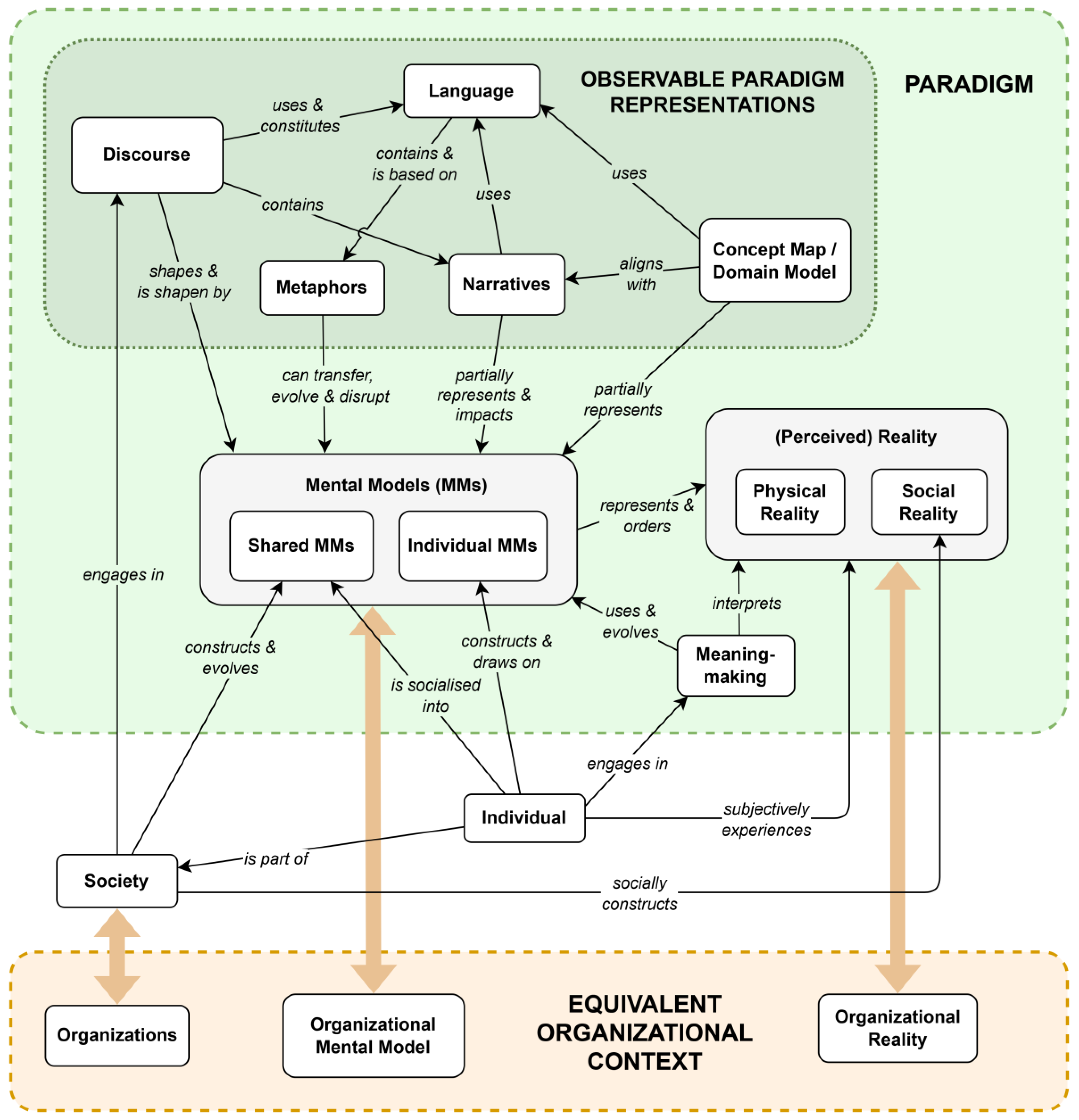
Figure 2.
Graphical representation of the methodology (Steps 1-5) of the study and the outcomes produced (Artefacts A-D).
Figure 2.
Graphical representation of the methodology (Steps 1-5) of the study and the outcomes produced (Artefacts A-D).
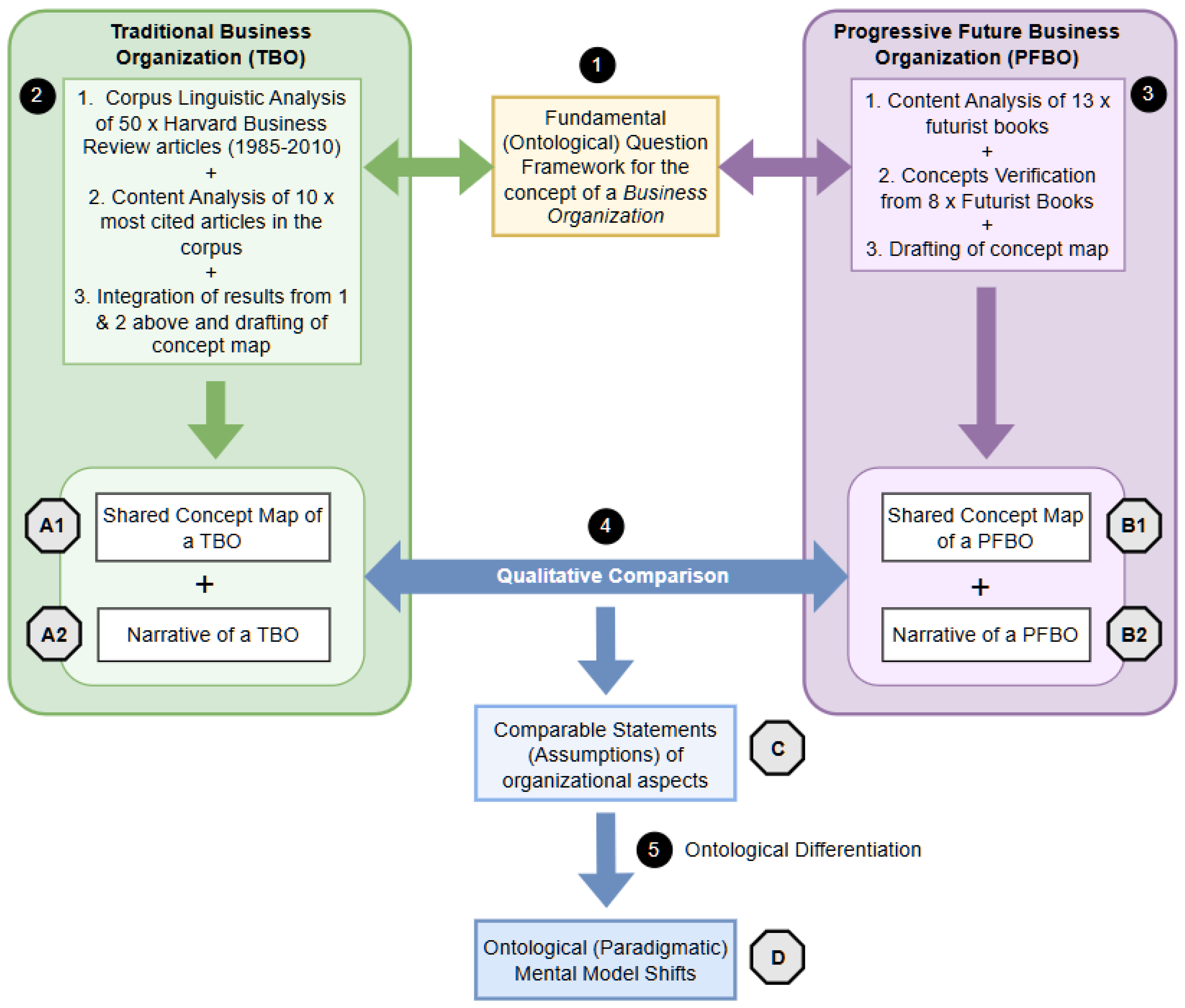
Figure 3.
Graph of the number of citations of the 50 most cited Harvard Business Review articles in the selected theme categories from 1985 to 2010.
Figure 3.
Graph of the number of citations of the 50 most cited Harvard Business Review articles in the selected theme categories from 1985 to 2010.
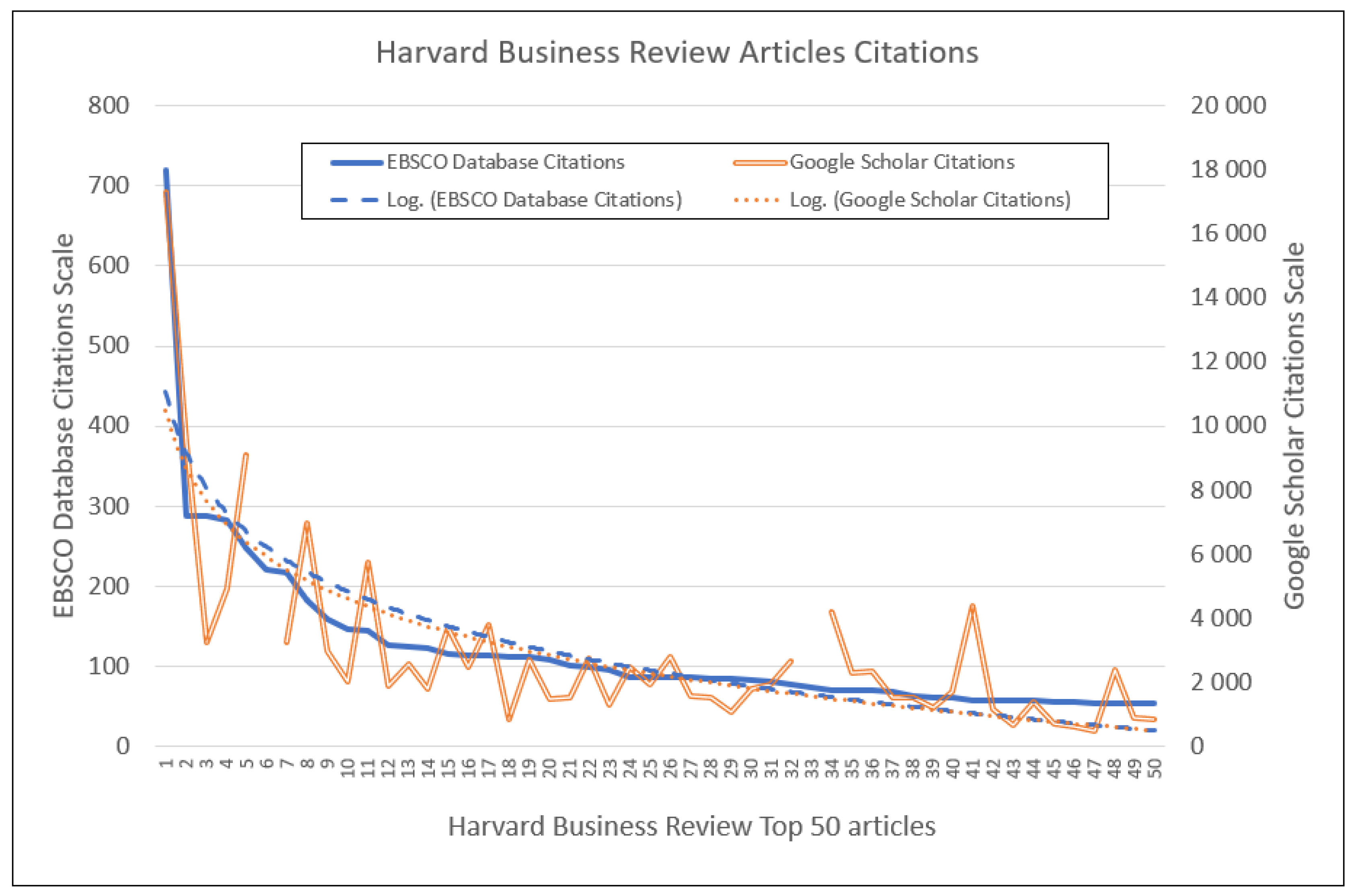
Figure 4.
Full scope of concepts included in the TBO concept map; HBR = Harvard Business Review.
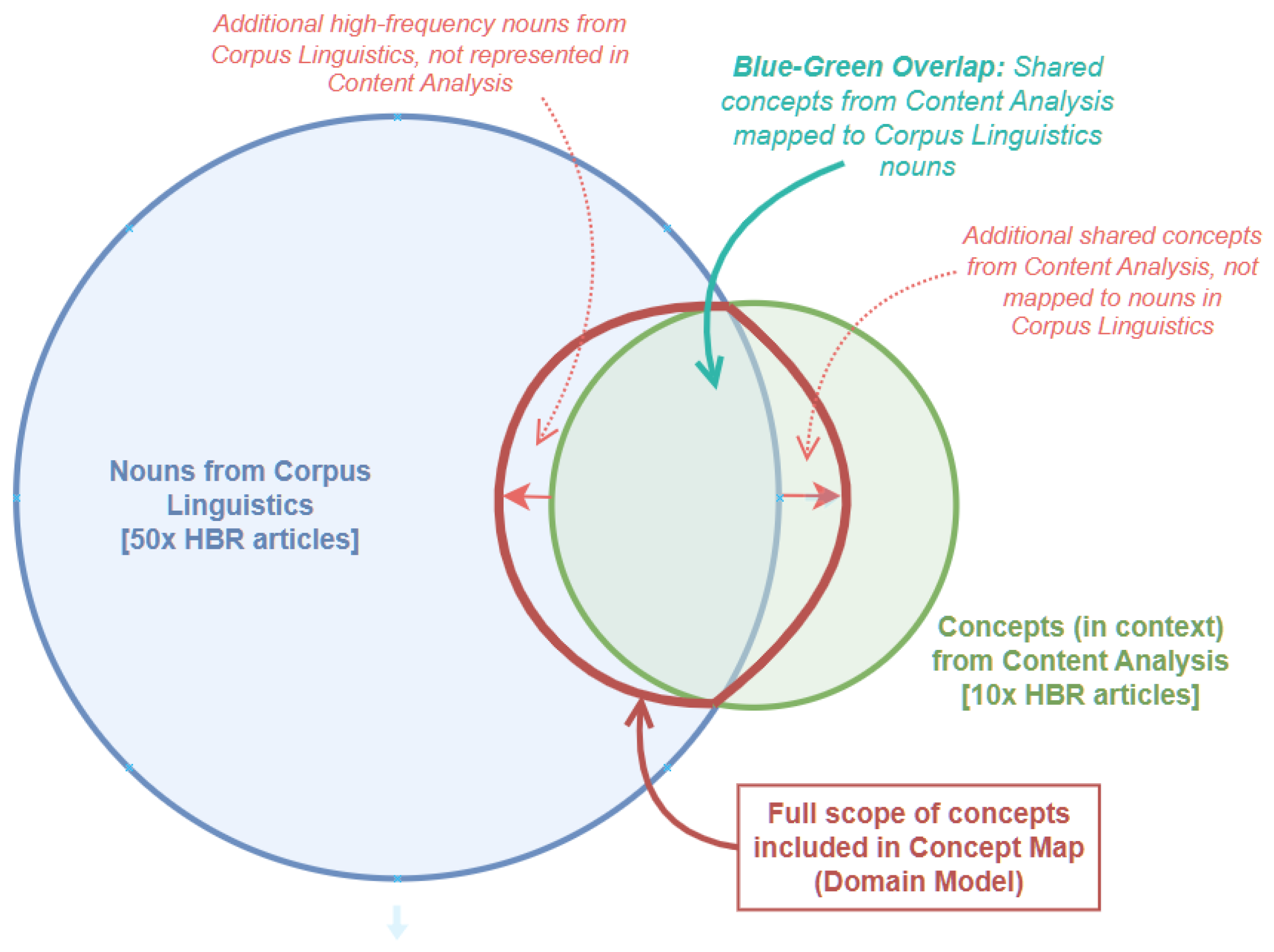
Figure 5.
Thumbnail images of the concept maps produced in the study with color coding as per Figure 6. (a) Shared societal concept map of the TBO; (b) Shared societal concept map of the PFBO. Full resolution images are available in supplementary materials.
Figure 5.
Thumbnail images of the concept maps produced in the study with color coding as per Figure 6. (a) Shared societal concept map of the TBO; (b) Shared societal concept map of the PFBO. Full resolution images are available in supplementary materials.
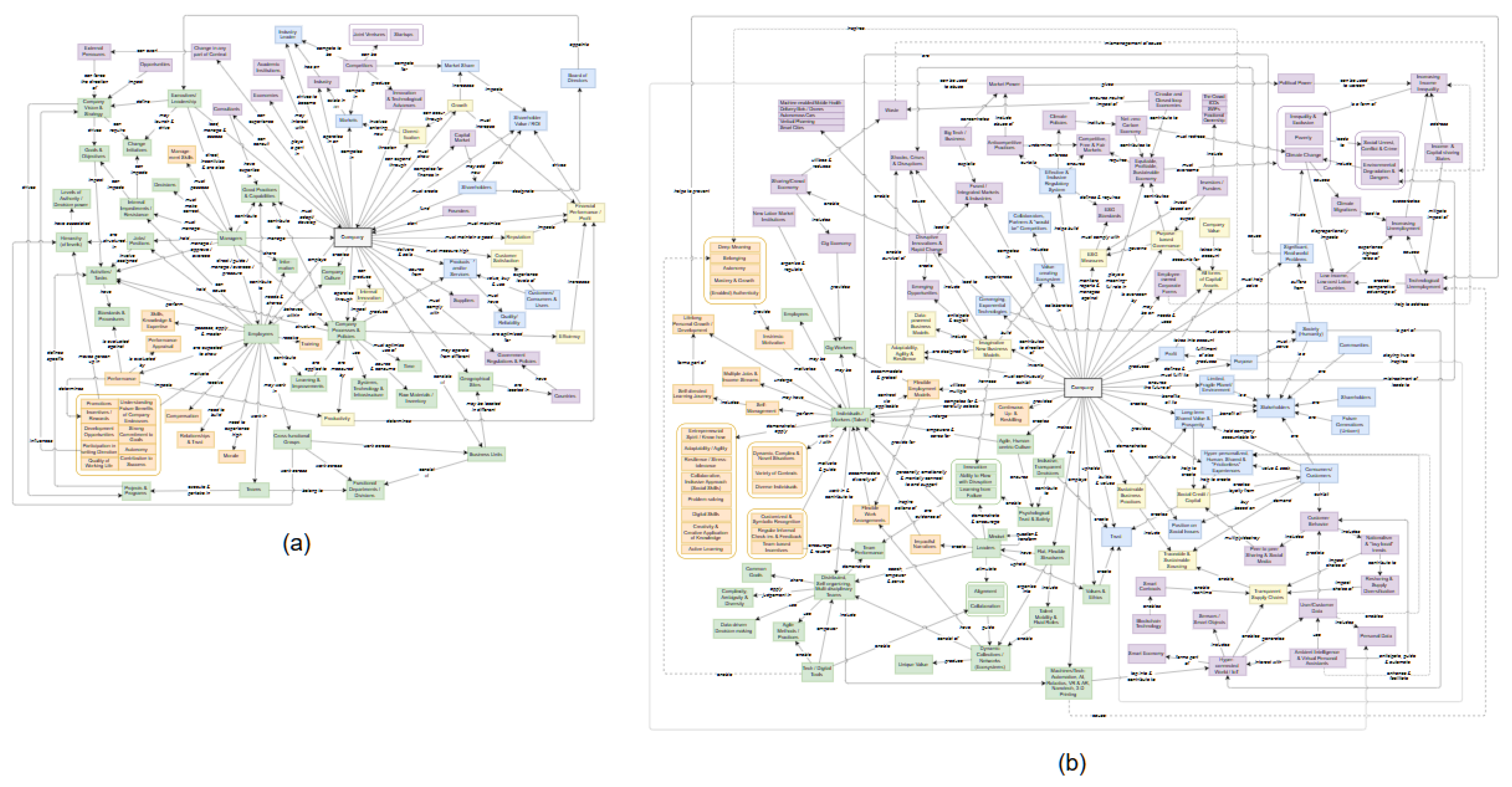
Figure 6.
The five categories used to group concepts on the concept maps and each category’s assigned color.
Figure 6.
The five categories used to group concepts on the concept maps and each category’s assigned color.

Figure 7.
Simplified societal concept map of the TBO.
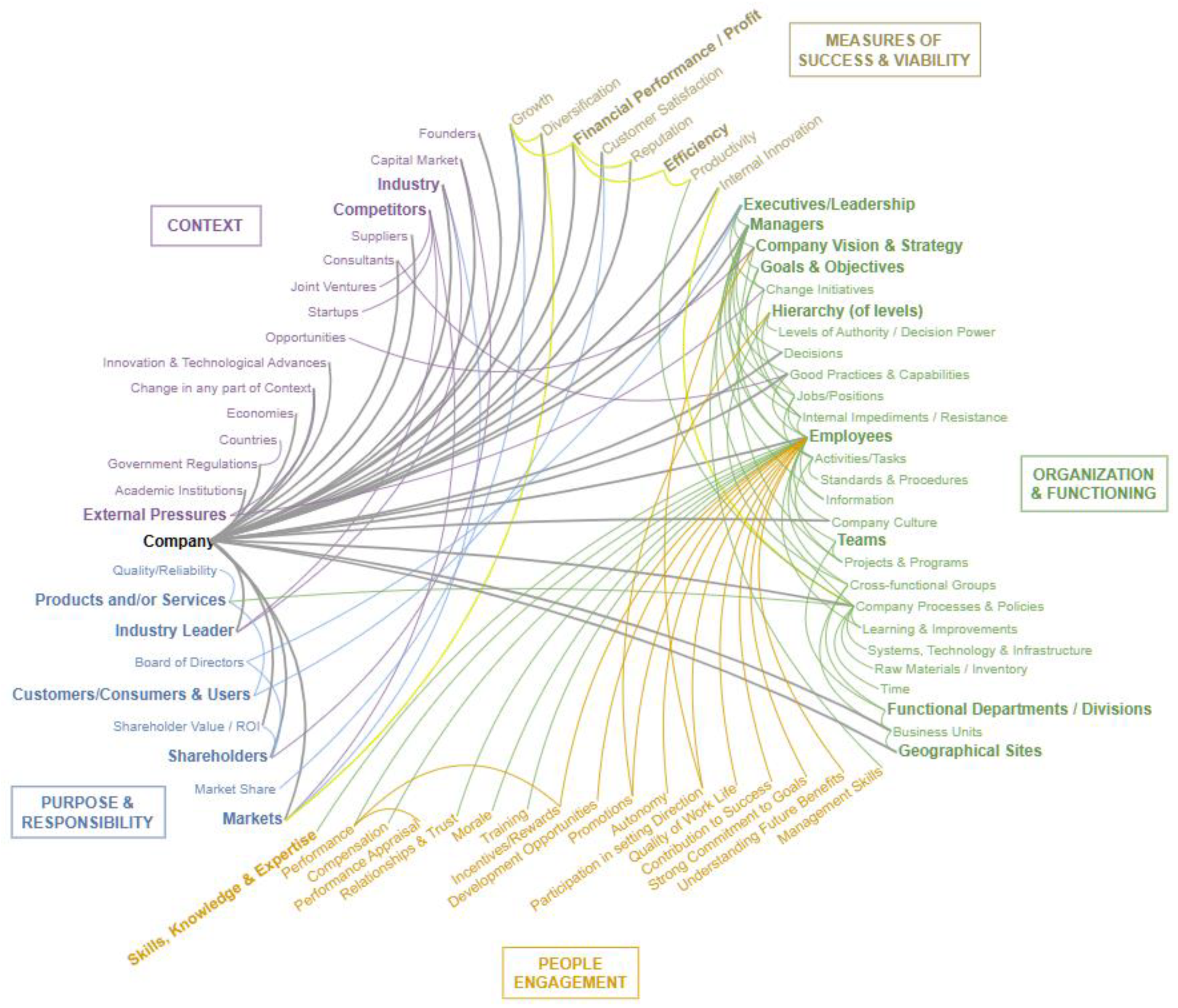
Figure 8.
Simplified societal concept map of the PFBO.
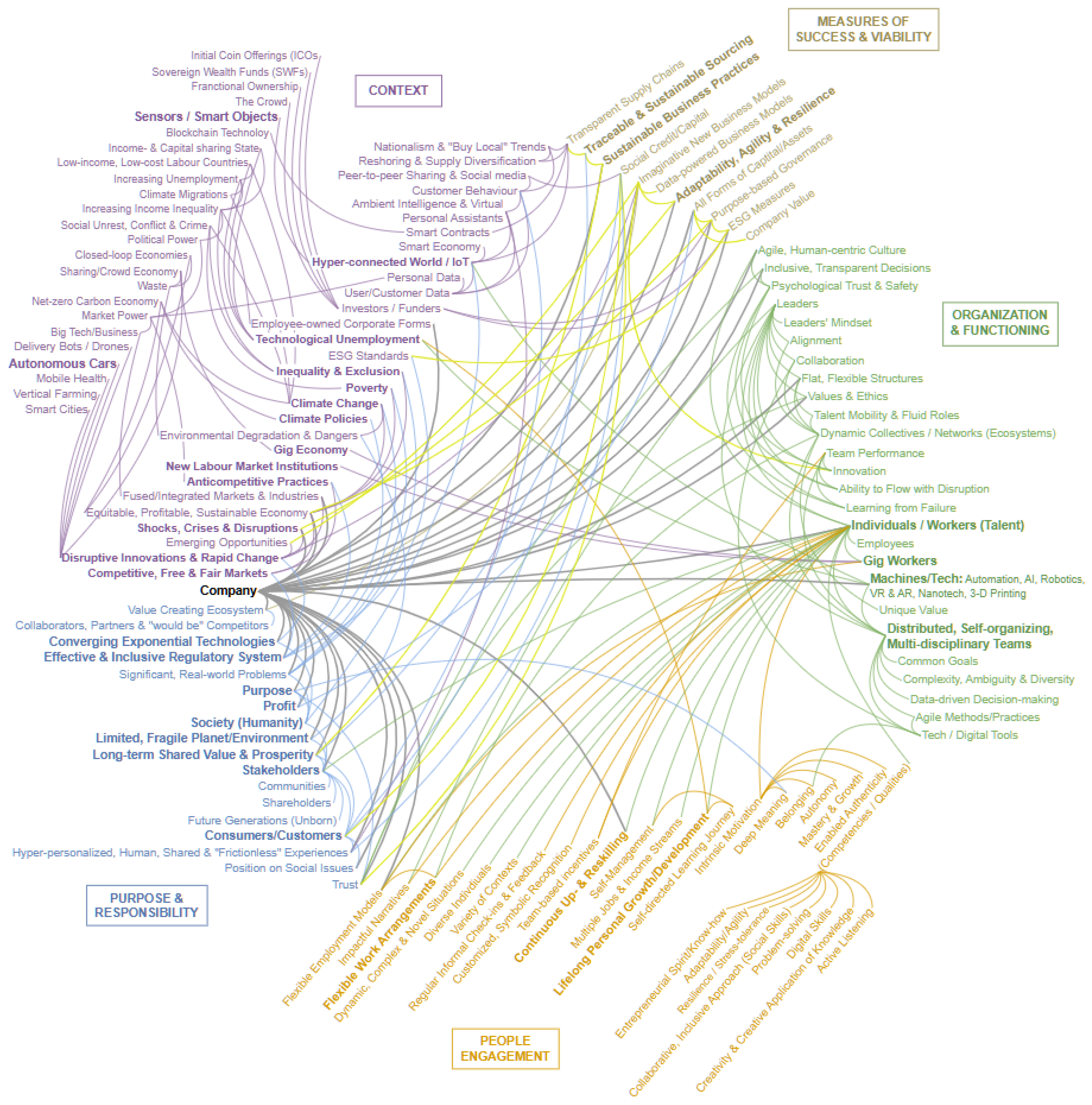
Figure 9.
Comparable statements/assumptions between the TBO and the PFBO concept maps, grouped in ontological shift themes.
Figure 9.
Comparable statements/assumptions between the TBO and the PFBO concept maps, grouped in ontological shift themes.
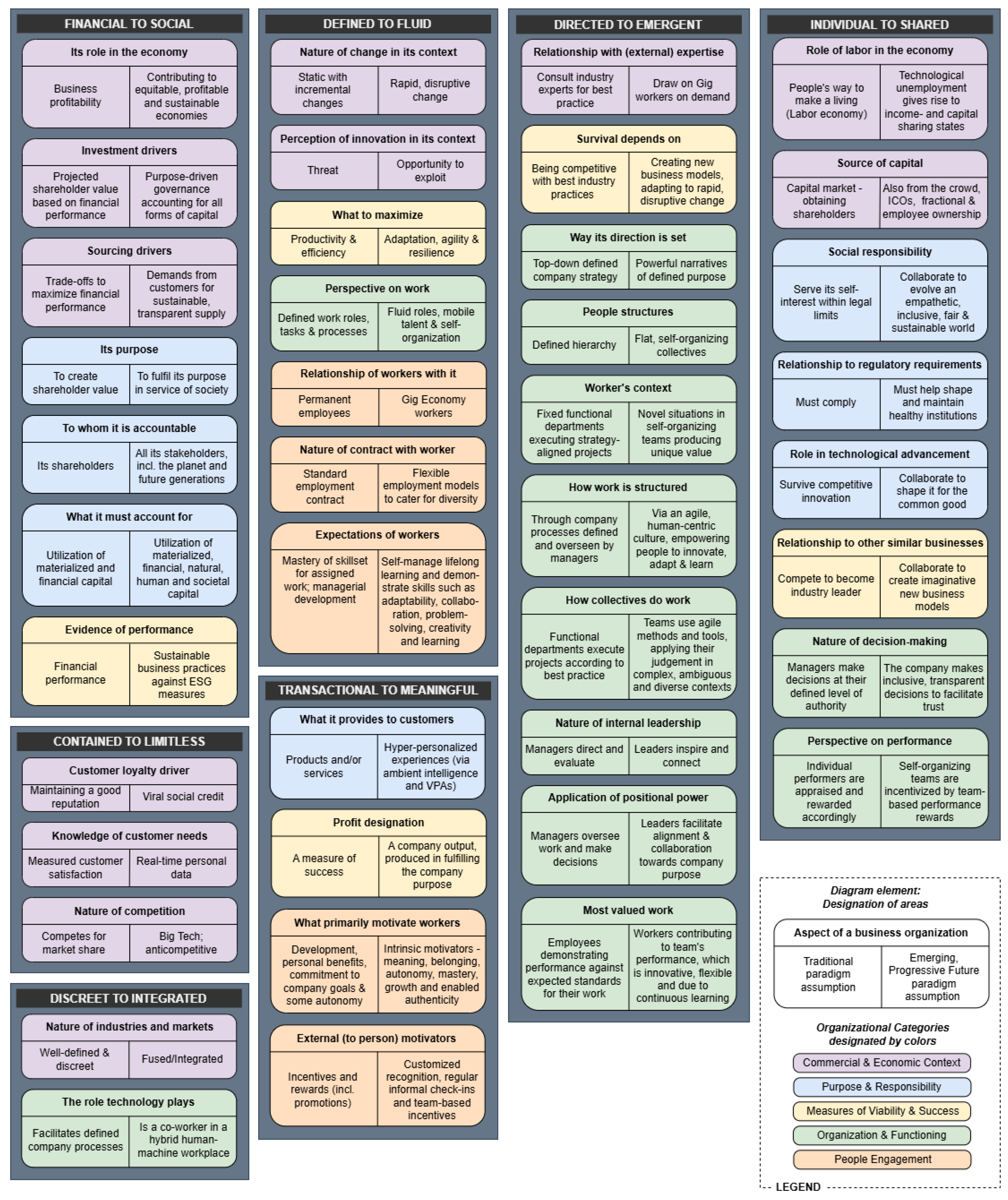
Figure 10.
Fictional Organization A and B, and language hypothetically heard in each.
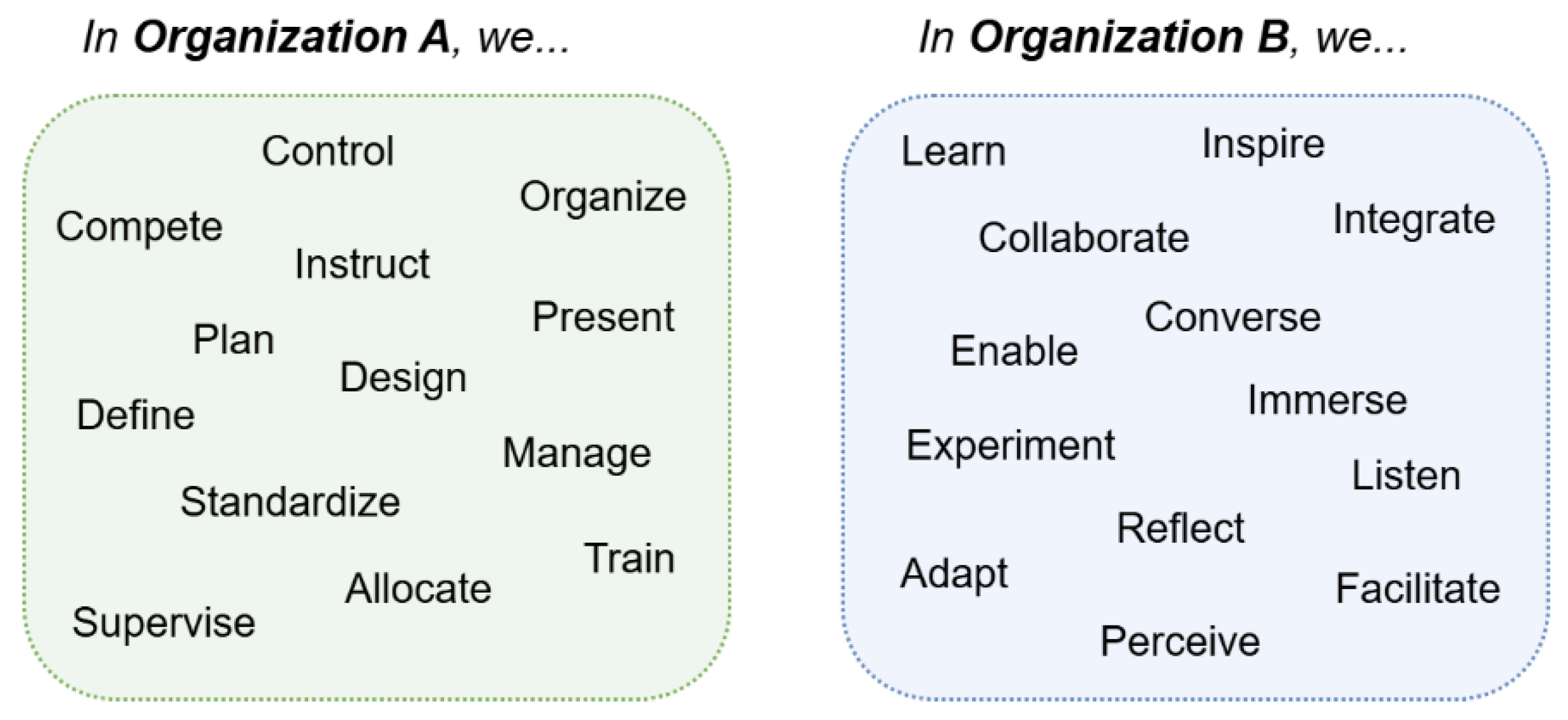

Table 1.
Examples of the association of themes and concepts from the content analysis with the nouns from the corpus linguistics analysis for the TBO; DOCF = Document Frequency.
Table 1.
Examples of the association of themes and concepts from the content analysis with the nouns from the corpus linguistics analysis for the TBO; DOCF = Document Frequency.
|
Noun {DOCF} |
Associated Themes / Concepts from Content Analysis of top 10 articles {DOCF} | Grouped nouns {DOCF} | Concept(s) on Concept Map |
| manager {50} |
Direction: Managers have authority and make decisions top down {3} Direction: Company/managers define incentive scheme for certain results/behaviors {3} Direction: Managers choose operational elements (e.g. operating framework, approach, technologies, capabilities) {3} Structure: Hierarchical Management (Levels) {10} Roles: Managers/Management {10} Roles: Heads {6} Roles: Supervisors {4} Work: Managers know, decide and direct the work/activities that must be done {4} Work: Managers drive new norms and changes {3} Work: Managers put policies, programs, processes / operating frameworks in place {2} Individual Performance: Manager oversees work and determines who performs well {6} Motivation: Managers make people perform {2} |
head {28} management style/approach {17} supervisor {11} boss {10} |
- Managers - Hierarcy (of levels) |
| customer {47} |
Purpose: Create value for customer {7} Beneficiaries: Customers {10} Environment: Customers/clients {9} Environment: Buyers {2} Performance: Customer service/satisfaction {4} Performance: Value to customers {3} |
consumer {33} client {22} buyer {17} customer value {20} value chain {10} |
- Customers/ Consumers & Users |
| employee {46} |
Beneficiaries: Employees {7} Performance: Management/People capability {6} Performance: Retaining talent / Low people turnover {3} Performance: People development {2} Performance: Rewarding people {2} Threats: Resignations of valued staff {3} Threats: Employee/Team non-performance {2} Inputs: People {9} Roles: Employees {8} Roles: People {7} Roles: Staff {5} Roles: Workers {3} Roles: Personnel {2} Work: Workers are trained and equipped for what they must do {2} |
staff {26} talent {21} professional {18} worker {18} personnel {13} subordinate {13} |
- Employees |
| share {44} |
<concepts: market share [23]; company shares {7}> <company shares grouped with "stock"> Purpose: Secure market share {3} Performance: Market share {5} Threats: Declining competitive position / market share {3} |
<stock> | - Market Share |
| efficiency {28} |
<consistently refers to efficiency of aspects of a company's functioning> Performance: Efficiency / Lower costs {8} Inputs: Time {5} |
economies of scale {14} | - Efficiency - Time |
Table 2.
List of literature used for content analysis for an emerging Progressive Future Organization.
Table 2.
List of literature used for content analysis for an emerging Progressive Future Organization.
| Nr. | Author(s) | Title | Year |
| Literature analysed to construct model and narrative (Step 3.1) | |||
| 2 | Peter H. Diamandis & Steven Kotler | The Future is Faster than you Think | 2020 |
| 3 | Rebecca Henderson | Reimagining Capitalism in a World on Fire | 2020 |
| 4 | Philip Kotler | Confronting Capitalism - Real Solutions for a Troubled Economic System | 2015 |
| 5 | Colin Mayer | Prosperity - Better Business Makes the Greater Good | 2021 |
| 6 | Paul Norman (Editor) | HR - The New Agenda | 2022 |
| 7 | John Sanei | Foresight | 2019 |
| 8 | John Sanei & Iraj Abedian | Future Next - Reimagining our World & Conquering Uncertainty | 2020 |
| 9 | Klaus Schwab | The Fourth Industrial Revolution | 2016 |
| 10 | Joseph E. Stiglitz | People, Power and Profits - Progressive Capitalism for and Age of Discontent | 2019 |
| 11 | Daniel Susskind | A World without Work - Technology Automation and How We Should Respond | 2019 |
| 12 | Sandra van der Merwe & David Erixon | Distinguishers - Winning Customers at Speed, Scale & Lower Costs | 2021 |
| 13 | Abdullah Verachia | Disruption Amplified - Reset, Rewire, Reimagine Everything | 2020 |
| Other Literature used for Verification (Step 3.2) | |||
| 14 | Scott Galloway | Post Corona - Winners and Losers in a World Turned Upside Down | 2020 |
| 15 | Kevin Govender | The Rise of the Sharing Economy - Access is the New Ownership | 2021 |
| 16 | Ranjay Gulati | Deep Purpose - The Heart and Soul of High-Performance Companies | 2022 |
| 17 | Johan Kay & Mervyn King | Radical Uncertainty - Decision-making for an Unknowable Future | 2021 |
| 18 | William Macaskill | What We Owe the Future - A Million Year View | 2022 |
| 19 | Christian Madsbjerg | Sensemaking - What Makes Human Intelligence Essential in the Age of the Algorithm | 2017 |
| 20 | Greg Mills, Mcebisi Jonas, Haroon Bhorat & Ray Hartley (Editors) | Better Choices - Ensuring South Africa's Future | 2022 |
| 21 | David Pilling | The Growth Delusion - The Wealth and Well-being of Nations | 2019 |
Table 3.
Examples of excerpt group summaries, its reference sources and mappings to concepts on the PFBO concept map; NOTE: All content appearing from authors in the Norman (2022) source was counted as one document occurrence.
Table 3.
Examples of excerpt group summaries, its reference sources and mappings to concepts on the PFBO concept map; NOTE: All content appearing from authors in the Norman (2022) source was counted as one document occurrence.
| Question & Reference Count | Group Summary | Book References | Concepts on Concept Map |
| Why do business organizations exist (purpose)? TOTAL Count: 8 |
- To serve a purpose in society - Society that is sustainable, equitable, healthy; About wellbeing, improving our lives - being forces for good - Doing good for all stakeholders - Creating shared long-term value and prosperity - Creating an economy (a capitalism) that is conscious, profitable and equitable - Being grounded in genuine humanity, being distinctly human and preserving human life and livelihoods |
- Verachia (2020) p. 157-158 - Henderson (2021) p. 4; 9 - Sanei & Abedian (2020) p. 82; 135 - Van der Merwe & Erixon (2021) p. 16; 59-60; 294 - Stiglitz (2019) p. 24 - Kotler (2015) p. 15; 223 - Carney (2021) p. 9; 278; 337; 340; 358; 454 - Norman (2022) p. 4 - Millson in Norman (2022) p. 23; 33 - Bussin & Christos in Norman (2022) p. 75; 77 - Crous in Norman (2022) p. 216 |
- Purpose - Society (Humanity) - Stakeholders - Equitable, Profitable, Sustainable Economy - Long-term Shared Value & Prosperity |
| What must an organization do to survive / continue existing? TOTAL Count: 7 |
- Workforce retraining for a "New Normal" (job-retraining; developing new skills; reskilling; upskilling; development investment) - About preventing technological unemployment, coping with continuous technological disruption and some jobs being in chronic short supply - Retraining part of Employee Value Proposition (EPV) |
- Diamandis & Kotler (2020) p. 229-230 - Schwab (2016) p. 26; 149-154 - Susskind (2021) p.158, 159 - Van der Merwe & Erixon (2021) p. 138 - Kotler (2015) p. 88; 92 - Carney (2021) p. 415 - Norman (2022) p. 4; 7; 21 - Govender in Norman (2022) p. 41 - Balgobind in Norman (2022) p. 50-51; 53; 54 - Bussin & Christos in Norman (2022) p. 75; 76; 79 - Crous in Norman (2022) p. 204; 206 |
- Individuals / Workers (Talent) - Continuous Up- & Reskilling - Technological Unemployment |
| What must an organization do to survive / continue existing? TOTAL Count: 5 |
Supply Chains: - Adoption of IoT, digitization, automation, AI and analytics - Blockchain / Smart contracts to provide real-time, simultaneous knowledge of upstream origins and downstream destination - Trusted, real-time transparency |
- Diamandis & Kotler (2020) p. 106 - Schwab (2016) p. 18 - Verachia (2020) p. 89 - Van der Merwe & Erixon (2021) p. 71, 72, 78 - Carney (2021) p. 92 |
- Hyper-connected world / IoT - Machines/Tech: Automation, AI, - Robotics, VR & AR, Nanotech, 3-D Printing - Smart Contracts - Blockchain Technology - Transparent Supply Chains - Traceable Sourcing |
| What can be a threat/detrimental to an organization? TOTAL Count: 8 |
Accelerating pace of change driven by converging exponential technological developments | - Diamandis & Kotler (2020) p. 69 - Schwab (2016) p. 1; 3; 8; 9; 50-51 - Sanei (2019) p. 27; 33; 93 - Verachia (2020) p. xiv - Susskind (2021) p. 201 - Kotler (2015) p. 115; 120-134 - Carney (2021) p. 90; 321; 402-404 - Norman (2022) p. 4; 20 - Balgobind in Norman (2022) p. 50 |
- Converging, Exponential Technologies - Disruptive Innovations & Rapid Change |
Table 4.
Ontological shifts between the TBO and the PFBO
| From (TBO) | To (PFBO) |
| FINANCIAL | SOCIAL |
| INDIVIDUAL | SHARED |
| TRANSACTIONAL | MEANINGFUL |
| DEFINED | FLUID |
| DIRECTED | EMERGENT |
| CONTAINED | LIMITLESS |
| DISCREET | INTEGRATED |
Table 5.
List of academic articles covering aspirational paradigms or frameworks related to organizations with numbering for further reference in this article.
Table 5.
List of academic articles covering aspirational paradigms or frameworks related to organizations with numbering for further reference in this article.
| Article No. | Article Title and Author(s) | Field of Study & Contribution | Paradigm/Framework compared to PFBO |
| 1 | “Shifting Paradigms for Sustainable Development: Implications for Management Theory and Research” by Gladwin et al. [86] | Management Theory: Introduces “sustaincentrism” as a paradigm between the extremes of “technocentrism” and “ecocentrism”. | “Sustaincentrism” and some areas of “ecocentrism” paradigms |
| 2 | “A value-based paradigm for creating truly healthy organizations” by Kriger and Hanson [115] | Organizational Behavior & Change: Introduction of an aspirational set of organizational culture values and associated activities based on “the world’s major religions” | The described aspirational culture |
| 3 | “Industrial Ecology: Paradigm Shift or Normal Science?” by Ehrenfeld [90] | Social & Behavioral Sciences: Ponders whether Industrial Ecology should be considered change within “normal science” within the paradigm of “Western Modernity” or a social “paradigm shift” as per Kuhn’s definition of scientific paradigms. | Industrial Ecology as paradigm shift |
| 4 | “Leading organizations in turbulent times: Towards a different mental model” by Jordaan [116] | Leadership: Introduces a leadership “mindset” required for “agile” and “collaborative” leadership needed in times of increased “complexity, turbulence and uncertainty”. | The introduced leadership “mindset” |
| 5 | “Common Good HRM: A paradigm shift in Sustainable HRM?” by Aust (Ehnert) et al. [117] | Human Resource Management: Introduces “Common Good HRM” as a new type of “sustainable HRM” applying “ideas from a common good economy perspective”. | “Common Good HRM” |
| 6 | “Circular Economy - Reducing Symptoms or Radical Change?” by Temesgen et al. [113] | Economics: Discusses the concept of a “circular economy” from the perspective of change within “Neoclassical Economics (NE)”, or a “paradigm change” to “Ecological Economics (EE)”. | “Circular Economy” as a “paradigm change” to “Ecological Economics (EE)” |
| 7 | “From Industry 4.0 towards Industry 5.0: A Review and Analysis of Paradigm Shift for the People, Organization and Technology” by Zizic et al. [118] |
Engineering/Industry: Highlights “Industry 5.0” as extension of “Industry 4.0” with a “social and environmental dimension”. | “Industry 5.0” |
| 8 | “Inclusive organizational behaviour - the dynamic rules of building new workplaces” by Kar et al. [114] | Organizational Behavior: Reflects on the new concept of “inclusive organizational behaviour (IOB)” for “the future of work” | “Inclusive Organizational Behaviour (IOB)” |
Table 6.
Alignment of academic articles, covering aspirational paradigms or frameworks, with aspects of the PFBO concept map [Refer to Table 5 for article number allocation].
Table 6.
Alignment of academic articles, covering aspirational paradigms or frameworks, with aspects of the PFBO concept map [Refer to Table 5 for article number allocation].
|
Comparable aspect of PFBO concept map (Capitalized concepts in italic text appear as concepts on the PFBO concept map) |
Academic Article (by No.) | |||||||
| 1 | 2 | 3 | 4 | 5 | 6 | 7 | 8 | |
| A Company having a Purpose in service of Society (Humanity) | x | x | x | x | x | x | ||
| A Company creating Long-term Shared Value & Prosperity | x | x | x | |||||
| A Company being accountable for All Forms of Capital/Assets and to all its Stakeholders, incl. Society, the Planet and Future Generations | x | x | x | |||||
| Investors/ Funders expecting Purpose-based Governance against ESG Metrics | x | |||||||
| A Company contributing to Equitable, Profitable, Sustainable Economies, incl. Closed-loop Economies and a Net-Zero Carbon Economy | x | x | ||||||
| A Company helping to address Significant Real-World Problems, incl. Climate Change, Poverty and Inequality & Exclusion | x | x | x | |||||
| Mistreatment of a Limited, Fragile Planet leading to Environmental Degradation & Dangers | x | x | ||||||
| A Company implementing Sustainable Business Practices | x | x | x | x | ||||
| Effective, Inclusive Regulatory Systems ensuring Competitive, Free & Fair Markets and curtailing Anticompetitive Practices | x | |||||||
| Regulators requiring Companies to meet ESG Standards and Climate Policies | x | |||||||
| Customers/Consumers holding a Company accountable for creating Long-term Shared Value & Prosperity | x | |||||||
| Converging, Exponential Technologies leading to Disruptive Innovations & Rapid Change | x | x | ||||||
| A Company experiencing Shocks, Crises & Disruptions | x | x | x | |||||
| Companies ensuring that Technologies serve Society (Humanity) | x | |||||||
| A Company needing to exhibit Adaptability, Agility & Resilience | x | x | x | |||||
| Companies collaborating in Value-creating Ecosystems | x | x | ||||||
| Companies inventing Imaginative New Business Models, incl. Data-powered Models | x | |||||||
| The impact of the Smart Economy and a Hyper-connected World / IoT | x | x | ||||||
| Companies having Transparent Supply Chains enabling Traceable & Sustainable Sourcing | x | x | ||||||
| Customers seeking Hyper-personalized, Human, Shared & “Frictionless” Experiences | x | |||||||
| The Sharing/Crowd Economy reducing Waste | x | |||||||
| The Gig Economy (part of the Sharing Economy) providing Gig Workers | x | |||||||
| Workers having Flexible Work Arrangements | x | |||||||
| A Company being structured for Distributed, Self-organizing, Multi-disciplinary Teams | x | |||||||
| Teams performing through Innovation, the Ability to Flow with Disruption, and Learning from Failure | x | |||||||
| Teams using Agile Methods/Practices enabled by Digital Tools | x | |||||||
| Teams applying Data-driven Decision-making | x | x | ||||||
| Machines/Tech, incl. Automation, AI, Robotics, and VR & AR being part of work Teams | x | x | x | |||||
| Machines/Tech causing Technological Unemployment | x | x | ||||||
| A Company having an Agile, Human-centric Culture that ensures Psychological Trust & Safety | x | x | x | x | ||||
| Transparent Decisions and Values & Ethics of Leaders creating Trust | x | x | x | |||||
| Leaders needing to facilitate Alignment and Collaboration | x | x | ||||||
| Leaders coaching, empowering and serving Teams | x | |||||||
| Leaders inspiring Workers through Impactful Narratives | x | |||||||
| Leaders needing to change their Mindsets | x | |||||||
| Leaders needing to personally, emotionally and mentally connect with Workers | x | x | ||||||
| Workers working with Diverse Individuals | x | |||||||
| Workers being motivated by Customized & Symbolic Recognition | x | |||||||
| Workers applying Self-management, incl. Self-directed Learning | x | |||||||
| Workers requiring Lifelong Personal Growth/Development | x | x | ||||||
| A Company providing Continuous Up- and Reskilling | x | x | ||||||
| The need to enable a Worker’s Entrepreneurial Spirit/Knowhow; Adaptation/Agility; Collaborative Approach; and Creativity | x | |||||||
| Workers being motivated by Intrinsic Motivators, incl. Deep Meaning; Belonging; Autonomy; Mastery & Growth; and Authenticity | x | x | x | |||||
| Valued qualities of Workers being: Entrepreneurial Spirit/Knowhow; Adaptability/Agility; Resilience / Stress Tolerance; Problem-solving; Digital Skills; Collaborative Approach (Social Skills) and Creativity | x | x | ||||||
Disclaimer/Publisher’s Note: The statements, opinions and data contained in all publications are solely those of the individual author(s) and contributor(s) and not of MDPI and/or the editor(s). MDPI and/or the editor(s) disclaim responsibility for any injury to people or property resulting from any ideas, methods, instructions or products referred to in the content. |
© 2026 by the authors. Licensee MDPI, Basel, Switzerland. This article is an open access article distributed under the terms and conditions of the Creative Commons Attribution (CC BY) license.
Copyright: This open access article is published under a Creative Commons CC BY 4.0 license, which permit the free download, distribution, and reuse, provided that the author and preprint are cited in any reuse.


