
Submitted:
14 May 2026
Posted:
15 May 2026
You are already at the latest version
Abstract
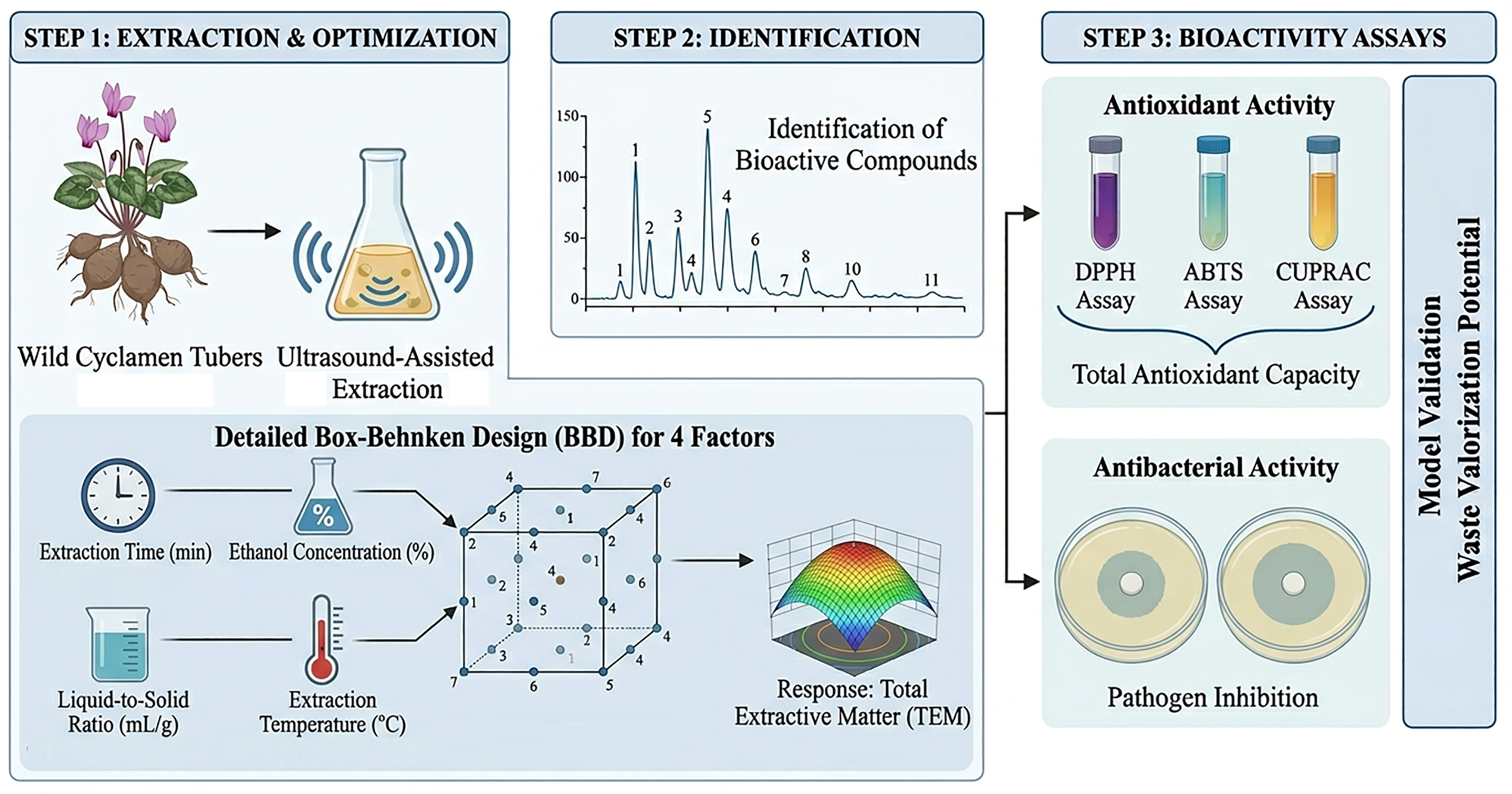
In contemporary research on natural bioactive compounds, increasing emphasis is placed on the development of efficient and sustainable extraction technologies. This study aimed to develop and optimize an innovative extraction process for wild cyclamen (Cyclamen purpurascens Mill.) tubers to maximize the yield of total extractives using a Box-Behnken design. The effects of four extraction parameters were evaluated on the system response. A second-order polynomial model accurately described the extraction process, yielding a coefficient of determination of 0.919. The liquid-to-solid ratio was identified as the dominant factor affecting the extraction efficiency compared to the other factors investigated. The optimal extraction conditions were as follows: extraction time of 15.5 min, 13% (v/v) ethanol, liquid-to-solid ratio of 13.5 mL/g, and extraction temperature of 34 °C, resulting in a yield of 53.44%. The optimized process yielded a significant saponin content of 16.19 g/100 g, while the levels of phenolic compounds (132.52 mg GAE/100 g) and flavonoids (12.04 mg QE/100 g) were also quantified. UHPLC–ESI–MS/MS analysis confirmed the presence of triterpene saponins, flavonoids, and terpenoids. DPPH, ABTS⁺, and CUPRAC assays indicated the antioxidant potential of the extract, while the minimum inhibitory concentration assay showed antibacterial activity against Staphylococcus aureus and Escherichia coli. The established chemical profile and observed biological activities provide the basis for further evaluation of wild cyclamen tubers as a source of bioactive secondary metabolites.
Keywords:
Cyclamen purpurascens
; ultrasound-assisted extraction
; optimization
; Box-Behnken design
; antioxidant activity
; antimicrobial activity
; UHPLC–ESI–MS/MS analysis
Copyright: This open access article is published under a Creative Commons CC BY 4.0 license, which permit the free download, distribution, and reuse, provided that the author and preprint are cited in any reuse.


