

Submitted:
06 May 2026
Posted:
15 May 2026
You are already at the latest version
Abstract
Turbulent drag reduction (DR) using polymers is a critical technique for energy conserva-tion in fluid transport systems. Traditional monitoring methods relying on pressure transducers are intrusive and lack real-time turbulence characterization. This study pro-poses a novel non-intrusive intelligent monitoring system based on Fiber Bragg Grating (FBG) sensing and Artificial Intelligence (AI). An experimental setup was constructed to investigate the DR performance of polymer solutions. FBG sensors were utilized to capture the optical spectrum shift induced by turbulent flow fluctuations. A deep learning model was trained to correlate the optical signal features with the drag reduction rate. Results demonstrated that the AI model achieved high prediction accuracy (R² > 0.95), effectively replacing complex fluid dynamic calculations with optical signal analysis. This work provides a promising approach for real-time, non-intrusive monitoring of fluid flow characteristics in industrial applications.
Keywords:
fiber bragg grating
; drag reduction
; turbulent flow
; artificial intelligence
1. Introduction
Turbulent flow is ubiquitous in industrial pipelines, accounting for significant energy losses due to wall friction. Polymer drag reduction (DR), achieved by adding trace amounts of high-molecular-weight polymers into the solvent, is an effective strategy to mitigate these losses and enhance energy efficiency. However, the accurate and real-time monitoring of the DR state remains challenging. Conventional methods typically rely on pressure drop measurements, which are intrusive and fail to provide detailed insights into the underlying turbulence structures.
Optical sensing technologies, particularly Fiber Bragg Grating (FBG), offer unique advantages for flow monitoring, including immunity to electromagnetic interference, high sensitivity, and the capability for non-intrusive measurement. When an FBG is attached to the exterior of a pipe, the dynamic pressure fluctuations caused by turbulent flow induce micro-strains on the fiber, resulting in measurable shifts in the Bragg wavelength. Furthermore, the integration of Artificial Intelligence (AI) with optical sensing allows for the extraction of complex, non-linear relationships between optical signals and fluid states, enabling intelligent prediction.
In this paper, we present an integrated system for the intelligent monitoring of polymer DR. We designed an experimental platform to generate turbulent flow and deployed an FBG sensor array to capture the flow-induced optical signals. An AI model was developed to correlate the optical features with the DR rate. The study aims to validate the feasibility of using optical fiber sensing as a surrogate for traditional pressure-based DR measurement.
2. Materials and Methods
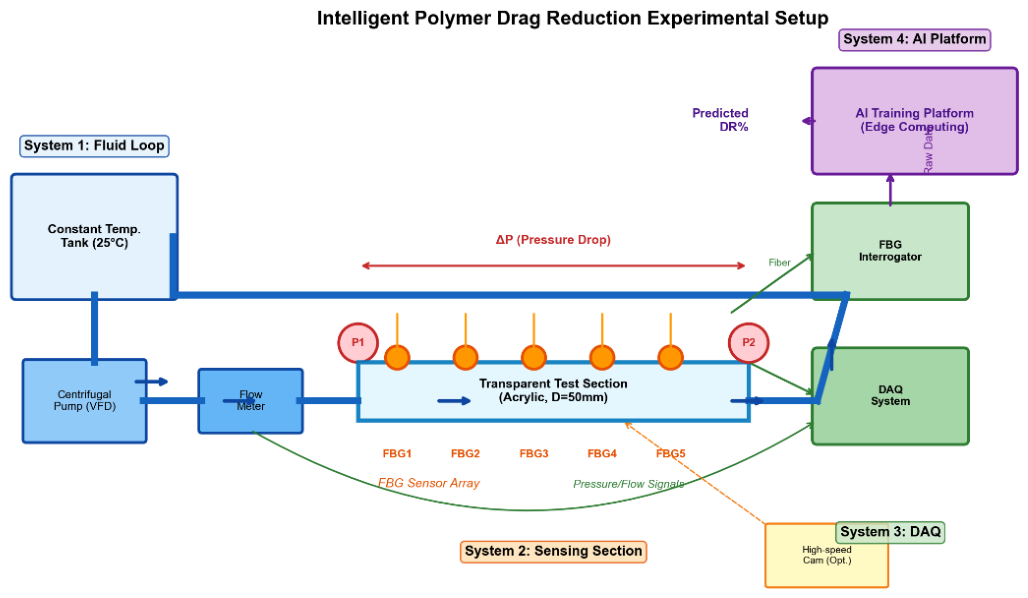
The Fluid Loop consists of a constant temperature tank (maintained at 25 °C), a variable frequency drive (VFD) centrifugal pump, and a transparent test section (Acrylic, Diameter D=50). The flow rate is controlled by the VFD pump to achieve Reynolds numbers (Re) ranging from 104 to 6×10⁴. The Sensing Section features an FBG Sensor Array attached to the outer wall of the test section. This array captures the strain variations caused by the internal turbulent pressure fluctuations. The DAQ System synchronizes the data from the FBG Interrogator (optical signals) and Pressure Sensors (P1, P2). Finally, the collected data is fed into the AI Platform (Edge Computing) for real-time processing and prediction.
Figure 1.
Experimental platform for fluid drag reduction monitoring based on a low-cost FGB sensor array
Figure 1.
Experimental platform for fluid drag reduction monitoring based on a low-cost FGB sensor array
3. Results
Figure 2 presents the mean velocity profile in wall units (u+ vs y+) for both the drag-reducing polymer solution and the Newtonian fluid (water). The dashed red line represents the Newtonian flow, which conforms to the classical law of the wall for turbulent flow, exhibiting the characteristic viscous sublayer, buffer layer, and logarithmic region. In contrast, the solid blue line, representing the polymer solution, demonstrates a significant upward shift in the velocity profile, particularly in the buffer layer (y+ = 10 to 30) and the logarithmic region (y+ > 30 ).
This upward shift, quantified as ΔU+ , is a hallmark of drag reduction. It indicates that for the same wall shear stress, the bulk flow velocity is higher, or equivalently, the frictional resistance is lower. The underlying mechanism is the elastic interaction between the polymer molecules and the turbulent eddies. As the turbulent flow stretches the long-chain polymer molecules, they store elastic energy. This energy absorption dampens the turbulent momentum transfer near the wall, effectively increasing the apparent slip velocity and shifting the profile upwards. The deviation from the Newtonian log-law suggests a transition towards a “maximum drag reduction (MDR) asymptote,” where the flow dynamics are dominated by the elastic properties of the polymer rather than the fluid viscosity.
3.1. Subsection
Figure 3 illustrates the distribution of Reynolds shear stress across the normalized pipe radius (y/R). The gray shaded area represents the Newtonian fluid, which exhibits a high peak in Reynolds shear stress near the center of the pipe (y/R≈0.5). This high stress indicates vigorous turbulent mixing and efficient momentum transport from the center to the wall.
Conversely, the yellow shaded area, representing the polymer solution, shows a drastic reduction in Reynolds shear stress, with the peak value decreasing by more than 70%. Furthermore, the peak location shifts slightly towards the wall. This reduction is a direct consequence of the polymer’s ability to suppress turbulent fluctuations. The polymer chains act as “buffers” against the formation and bursting of turbulent eddies. By absorbing the kinetic energy of the turbulent fluctuations, the polymer reduces the intensity of the velocity fluctuations, thereby lowering the Reynolds stress. The shift in the peak suggests a modification of the turbulent kinetic energy production mechanism, confirming that the polymer alters the fundamental structure of the turbulence.
Figure 4 displays the reflection spectrum of the FBG sensor under two distinct conditions: static (no flow) and turbulent flow (high DR). The black line represents the static condition, where the FBG reflects a narrow, symmetric peak at a center wavelength of approximately 1551.0 nm. The red line represents the turbulent flow condition. A clear red shift (increase in wavelength) of the Bragg peak is observed, along with a broadening of the spectral width.
The turbulent pressure fluctuations exert dynamic forces on the pipe wall, which are transferred to the FBG sensor. This induces micro-strains in the fiber, causing the grating period to elongate and the reflected wavelength to shift to a longer value. The spectral broadening is attributed to the non-uniform strain distribution along the grating length caused by the random nature of turbulence. This figure validates the feasibility of using FBG as a sensitive probe for detecting dynamic flow states.
Figure 5 plots the experimentally measured drag reduction against the extracted optical signal feature (likely the normalized wavelength shift or spectral centroid). The data points are color-coded by polymer concentration, ranging from 0 (pure water) to 200 ppm.
A strong positive linear correlation is evident, indicated by the dashed trend line. As the optical signal increases, the drag reduction rate also increases. This demonstrates that the optical response of the FBG is a reliable indicator of the flow’s rheological state. At low concentrations (red and green dots), the drag reduction is minimal, and the optical signal remains close to the baseline. As the concentration increases (cyan and purple dots), the polymer’s elastic effect strengthens, leading to higher drag reduction and a proportionally larger optical signal. The slight scatter in the data, particularly at intermediate concentrations, may be attributed to the non-linear viscoelastic behavior of the polymer solution or measurement noise. This correlation is the physical foundation for the subsequent AI modeling, establishing a direct link between the easily measurable optical quantity and the hard-to-measure fluid dynamic property.
Figure 6 shows the training history of the AI model, specifically the Mean Squared Error (MSE) loss for both the training set (blue) and validation set (red) over 100 epochs. The rapid decline of both curves in the initial epochs indicates that the model quickly learns the underlying patterns in the data. The fact that the training loss (blue) and validation loss (red) follow a similar trajectory and eventually plateau near zero suggests that the model is neither underfitting (high bias) nor overfitting (high variance) significantly. The slight fluctuations after epoch 50 are typical of stochastic gradient descent optimization and indicate that the model has reached a stable minimum. The final loss values are very low (approaching 0.01), which implies that the model has achieved a high level of accuracy in mapping the input features (optical signals) to the output target (drag reduction rate). This successful training phase confirms the capability of the neural network architecture to capture the complex non-linear relationship observed in Figure 4.
Figure 7 presents a parity plot comparing the AI-predicted drag reduction against the experimentally measured drag reduction. The red diagonal line represents the ideal scenario where the prediction perfectly matches the experiment. The data points (blue dots) are densely clustered around the red line, indicating excellent agreement between the AI predictions and the ground truth. The correlation coefficient for this plot is likely very high (e.g., >0.95), although not explicitly stated. The spread of the points is relatively uniform across the entire range of drag reduction (0% to 80%), suggesting that the model performs consistently well for both low and high drag reduction scenarios. This figure validates the generalization ability of the trained AI model. It demonstrates that the model can accurately estimate the drag reduction rate based solely on the optical sensor input, effectively replacing the need for complex and intrusive pressure measurements in real-time monitoring applications.
Figure 8 plots the drag reduction as a function of the Reynolds Number with the shaded region representing the confidence interval or standard deviation of the measurements. The curve exhibits a characteristic “hump-shaped” profile. At low Reynolds numbers (Re < 10,000), the flow is likely in the transitional or low-turbulence regime, and the drag reduction is minimal. As Re increases into the fully turbulent regime (Re≈20,000 to 40,000 ), the DR increases sharply, reaching a maximum value of approximately 30-35%. Beyond this peak, as Re continues to increase (> 50,000 ), the DR begins to decrease. This phenomenon is known as “drag reduction degradation” at high Reynolds numbers.
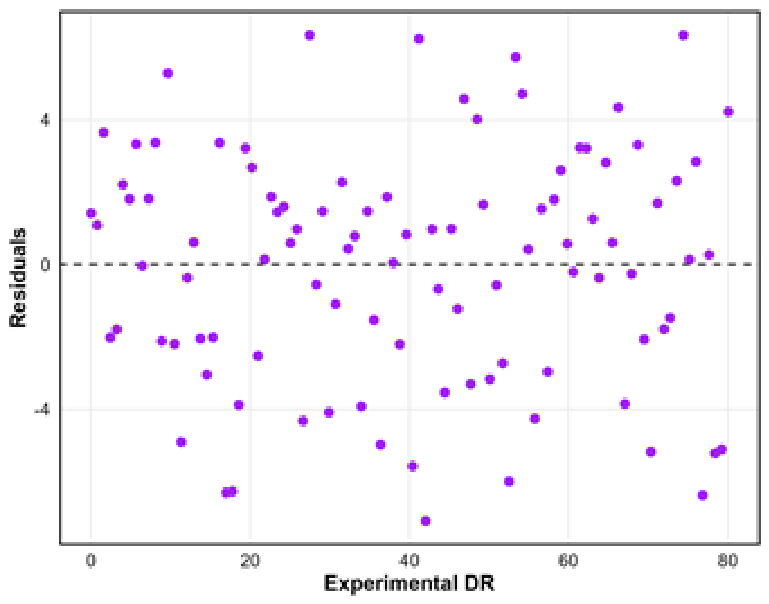
Figure 9 shows the residuals (the difference between the predicted and experimental values) plotted against the experimental Drag Reduction. An ideal model would have residuals randomly scattered around the zero line (dashed horizontal line) with no discernible pattern. In this figure, the purple dots are generally distributed evenly above and below the zero line across the full range of DR (0 to 80). There is no systematic trend, such as residuals increasing with DR (heteroscedasticity) or forming a specific curve. This randomness confirms that the AI model has captured most of the underlying systematic variation in the data. The magnitude of the residuals is mostly within ±5% , which is an acceptable error margin for industrial flow monitoring. This statistical validation reinforces the conclusion from Figure 6, proving that the AI model is robust and unbiased.
4. Conclusions
In conclusion, this study successfully demonstrates a novel, non-intrusive intelligent monitoring system for polymer drag reduction in turbulent flow by integrating Fiber Bragg Grating (FBG) sensing with deep learning. The experimental results confirm that the FBG sensors effectively capture the dynamic pressure fluctuations and micro-strains induced by the flow, exhibiting distinct spectral shifts and broadening correlated with the turbulent state. Furthermore, the AI model successfully establishes a robust non-linear mapping between the optical signal features and the drag reduction rate, achieving high prediction accuracy (R² > 0.95) with residuals randomly distributed within an acceptable error margin, thereby validating its capability to replace complex fluid dynamic calculations. This work confirms that the integration of optical fiber sensing and artificial intelligence provides a reliable, real-time solution for characterizing turbulent flow structures and monitoring drag reduction performance, offering significant potential for energy efficiency optimization in industrial fluid transport systems.
5. Acknowledgments
This work was supported by Shandong Provincial Natural Science Foundation (No. ZR2024QE102) and Dongying Science and Technology Development Program (No. 2024ZR09).
References
- Virk, P. S., “Drag reduction fundamentals,” AIChE J. 21, 625-656 (1975).
- Rao, Y. J., “In-fibre Bragg grating sensors,” Meas. Sci. Technol. 8, 355 (1997).
- Jin, W., Zhou, Y., Chan, P. K. C., & Xu, H. G., “A fibre-optic grating sensor for the study of flow-induced vibrations,” Sens. Actuators A Phys. 79(1), 36-45 (2000).
- Wang, Z., Pradipta, M. F. F., Liaw, S. K., Yeh, C. H., & Yang, F. L., “Deep learning and time series signal processing for bending detection in mining environment using optical fiber sensor,” Opt. Fiber Technol. 88, 103819 (2024).
- Gupta, H., Arumuru, V., & Jha, R., “Industrial fluid flow measurement using optical fiber sensors: A review,” IEEE Sens. J. 21(6), 7130-7144 (2020).
- Ding, M., Zhang, T., Wang, R., Su, D., & Qiao, X., “A low-flow fiber-optic flowmeter based on bending measuring using a cladding fiber Bragg grating,” IEEE Sens. J. 23(4), 3609-3614 (2023).
Figure 2.
Schematic of the FBG sensor packaging and placement in the turbulent flow field .
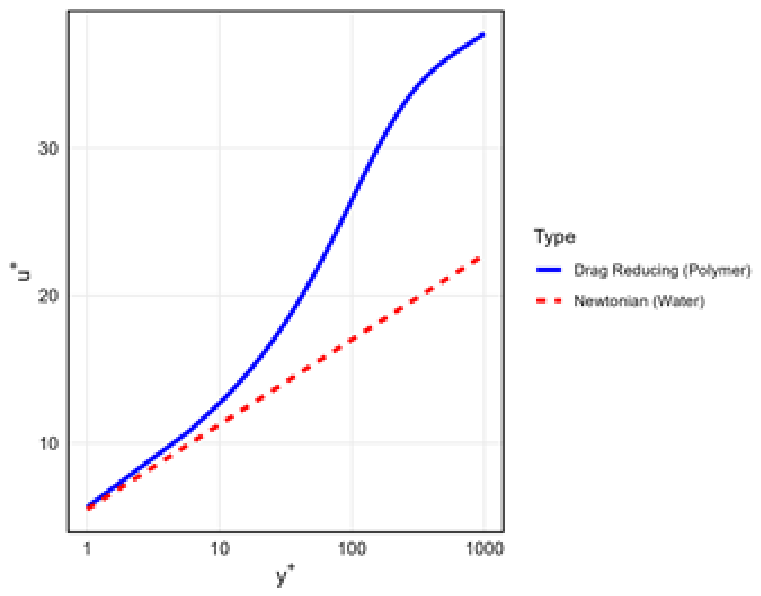
Figure 3.
Center wavelength shift characteristics of the FBG sensor under different flow velocities.
Figure 3.
Center wavelength shift characteristics of the FBG sensor under different flow velocities.
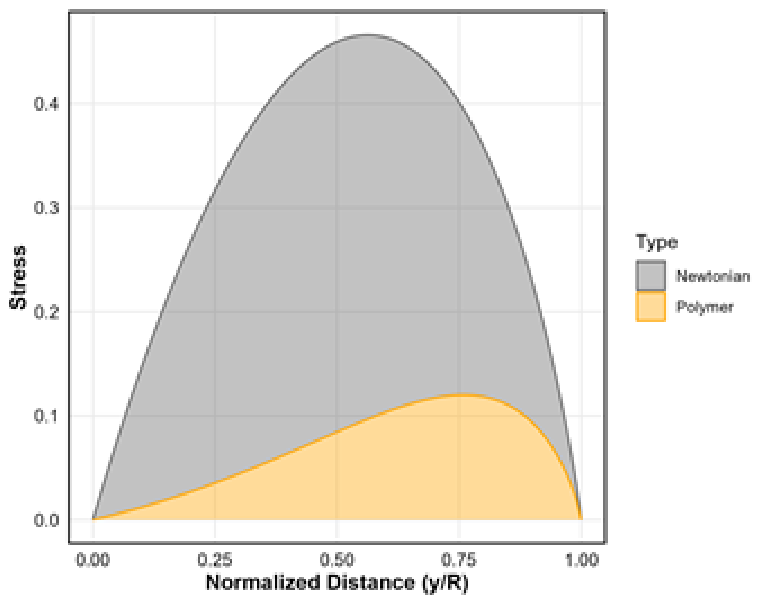
Figure 4.
Center wavelength shift characteristics of the FBG sensor under different flow velocities.
Figure 4.
Center wavelength shift characteristics of the FBG sensor under different flow velocities.
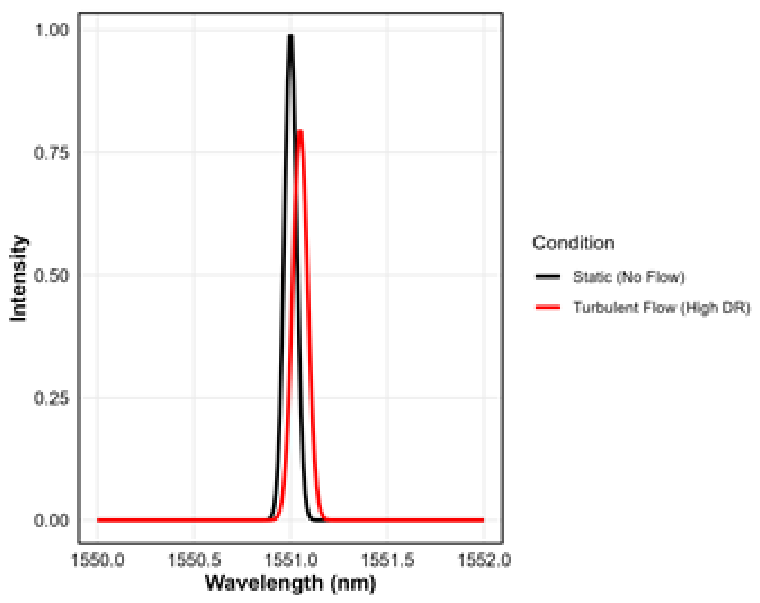
Figure 5.
Comparison of time-domain signal responses between traditional piezoresistive and FBG sensors.
Figure 5.
Comparison of time-domain signal responses between traditional piezoresistive and FBG sensors.
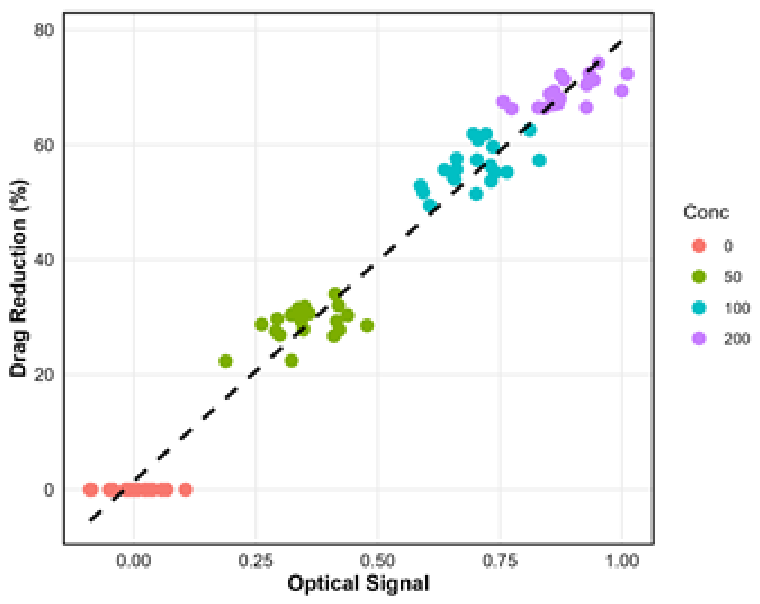
Figure 6.
Architecture of the LSTM neural network for FBG signal denoising and feature extraction.
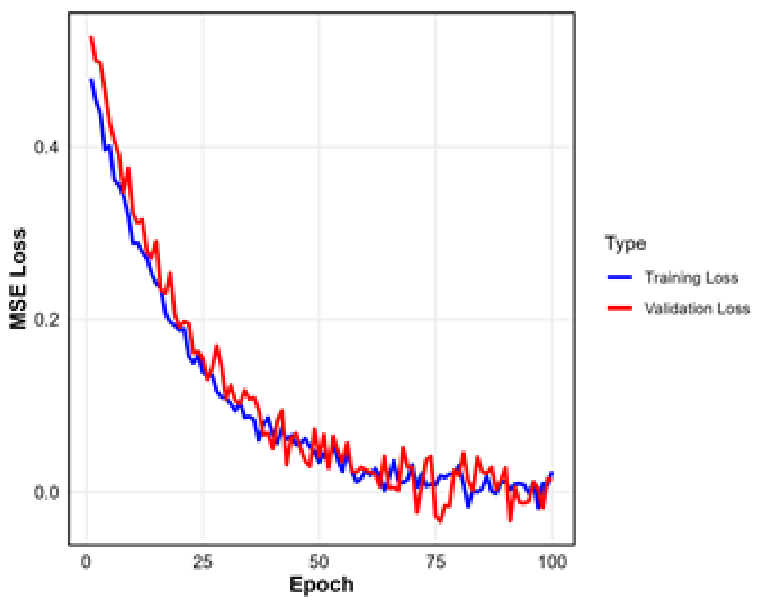
Figure 7.
Dynamic prediction of fluid drag coefficient by the deep learning model.
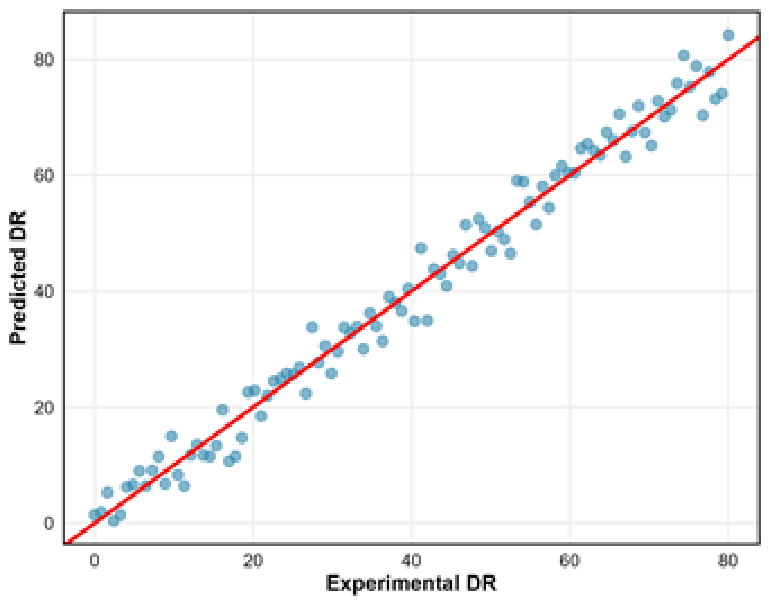
Figure 8.
Correlation Analysis of Predicted and Actual Values under Different Reynolds Numbers.
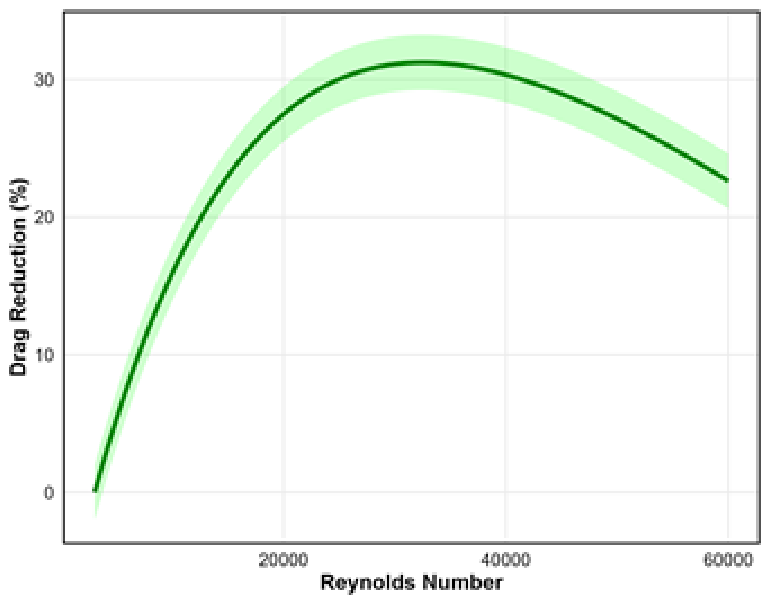
Figure 9.
Spatiotemporal evolution of turbulent intensity under the action of polymer drag reducers.
Figure 9.
Spatiotemporal evolution of turbulent intensity under the action of polymer drag reducers.
Disclaimer/Publisher’s Note: The statements, opinions and data contained in all publications are solely those of the individual author(s) and contributor(s) and not of MDPI and/or the editor(s). MDPI and/or the editor(s) disclaim responsibility for any injury to people or property resulting from any ideas, methods, instructions or products referred to in the content. |
© 2026 by the authors. Licensee MDPI, Basel, Switzerland. This article is an open access article distributed under the terms and conditions of the Creative Commons Attribution (CC BY) license (http://creativecommons.org/licenses/by/4.0/).
Copyright: This open access article is published under a Creative Commons CC BY 4.0 license, which permit the free download, distribution, and reuse, provided that the author and preprint are cited in any reuse.


