

Submitted:
13 May 2026
Posted:
15 May 2026
You are already at the latest version
Abstract
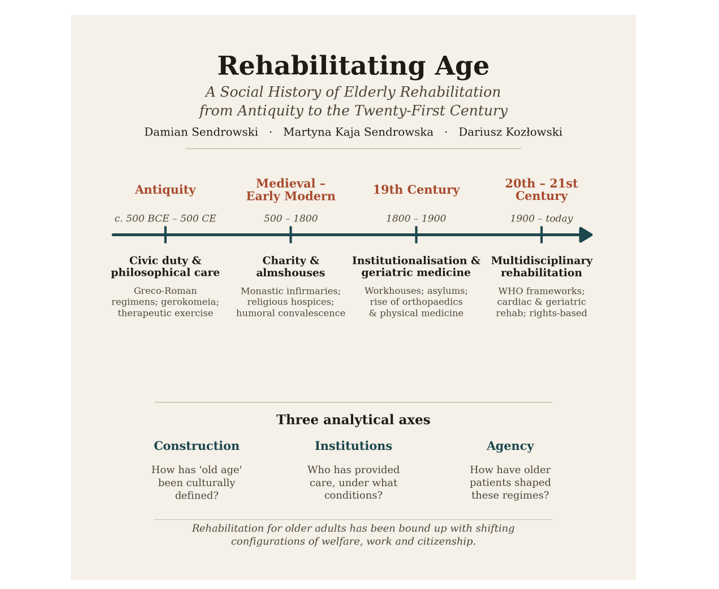
Summary. Rehabilitation for older people has a history that mirrors changing understandings of ageing, disability, work and citizenship. This article offers a longue durée analysis of rehabilitative practices directed at older adults, from Greco-Roman antiquity and non-European medical traditions to contemporary geriatric rehabilitation. It asks how societies constructed old age in ways that affected eligibility for rehabilitative care, which institutions provided such care, and how older patients shaped rehabilitative regimes. The article argues that the social value accorded to older adults consistently determined who qualified for intervention, what such intervention sought to achieve, and under what economic, religious and political conditions it became available. Tracing these developments into the nineteenth and twentieth centuries, it shows how geriatric rehabilitation emerged at the intersection of welfare-state formation, demographic transition and disability rights activism, bringing the histories of ageing and rehabilitation into sustained dialogue within modern historiography today across regions and periods globally alike.The article argues that the social value accorded to older adults has consistently determined who qualifies for rehabilitative intervention, what such intervention aims to achieve and under what economic, religious and political conditions it becomes available. Practices recognisable as rehabilitative, including therapeutic exercise, training in activities of daily living, prosthetic adaptation and social reintegration, appear across many pre-modern traditions, from Ayurvedic Jara Chikitsa and Chinese tonification regimens to the Islamic bimaristan and the medieval European almshouse. In each setting access was stratified by status, gender and institutional priority, with productive utility and civic or spiritual standing frequently determining whether older bodies were deemed worth rehabilitating.Tracing these genealogies into the nineteenth and twentieth centuries, the article shows how geriatric rehabilitation emerged from the intersection of welfare-state formation, demographic transition and disability rights activism. It concludes that contemporary practice requires a rights-based framework capable of addressing the enduring ageism that continues to structure access to rehabilitative care globally.
Keywords:
ageing
; rehabilitation
; disability
; geriatrics
; social history of medicine
; social policy
; comprehensive geriatric assessment
; frailty
Copyright: This open access article is published under a Creative Commons CC BY 4.0 license, which permit the free download, distribution, and reuse, provided that the author and preprint are cited in any reuse.


