

Submitted:
07 May 2026
Posted:
14 May 2026
You are already at the latest version
Abstract
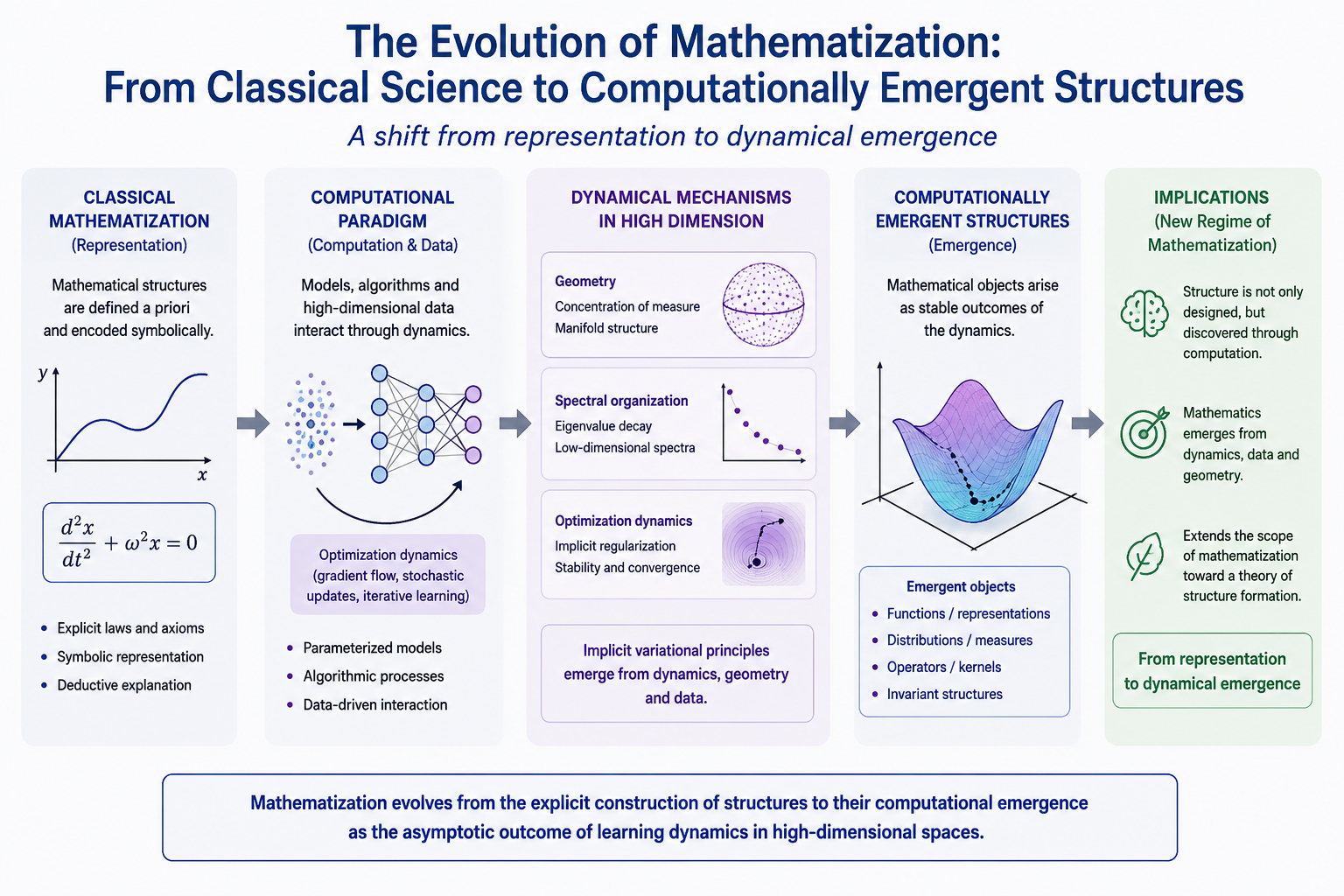
The mathematization of science is undergoing a structural transformation driven by the rise of computation and data-intensive methods. While classical mathematization relied on explicitly defined laws and formal structures, contemporary scientific practice increasingly encounters mathematical objects that arise as outcomes of dynamical and algorithmic processes. This paper introduces the notion of computationally emergent structures to describe entities generated and stabilized through the interaction of parameterized models, optimization dynamics, and data. We develop a minimal formal framework in which such structures are characterized as asymptotic outcomes of learning dynamics and show that, in over parameterized regimes, they are selected by implicit variational principles not specified a priori. This framework provides a unified account of implicit regularization, kernel regimes, and stability phenomena in modern learning systems. These results show that contemporary learning systems operate according to implicit variational principles in which geometry, dynamics, and data jointly determine effective mathematical structure. They thereby identify a shift from representation to dynamical emergence, extending the scope of mathematization toward a theory of structure formation grounded in computation.
Keywords:
mathematization
; computational emergence
; emergent structures
; learning dynamics
; implicit variational principles
; high-dimensional geometry
; epistemology of science
; artificial intelligence
Copyright: This open access article is published under a Creative Commons CC BY 4.0 license, which permit the free download, distribution, and reuse, provided that the author and preprint are cited in any reuse.


