
Submitted:
13 May 2026
Posted:
14 May 2026
You are already at the latest version
Abstract
This study examines the evolution of research on mergers and acquisitions (M&A) in the banking sector through a bibliometric analysis aimed at identifying the main con-tributors, dominant research themes, and emerging gaps in the literature. The study situates banking M&A research within broader discussions of efficiency, market structure, integration performance, and financial stability, while highlighting the need to better understand how scholarly influence and thematic development shape the field over time.
Using bibliometric techniques, the analysis evaluates publication trends, journal con-centration, authorship patterns, international collaboration networks, citation struc-tures, keyword co-occurrence, and thematic mapping. The study synthesizes relation-ships among influential publications, institutions, and countries to assess how ideas circulate and which research themes remain central or underexplored within the liter-ature.
The findings reveal a concentrated body of scholarship dominated by a limited number of journals, recurrent author networks, and strong transatlantic collaboration patterns, with relatively limited representation from the Global South. Research themes related to efficiency, firm performance, and market structure occupy the core of the literature, whereas technology integration, sustainability considerations, consumer outcomes, and conduct risk remain comparatively peripheral. Citation patterns are highly une-ven, reflecting a small group of highly influential studies alongside a broader set of context-specific contributions. The analysis also identifies a persistent gap between pre-merger strategic narratives and post-merger integration realities, particularly in relation to operational outcomes and systemic risk considerations.
The study concludes that future research would benefit from integrating traditional finance approaches with transaction-level integration measures, governance and op-erational performance indicators, and more robust identification strategies around regulatory and policy shocks. The findings further suggest that banking practitioners should place greater emphasis on integration feasibility, risk-control capabilities, digi-tal transformation readiness, and sustainability considerations when evaluating and implementing merger strategies.
Keywords:
bibliometric analysis
; banking mergers and acquisitions
; consolidation
; efficiency and performance
; systemic risk
; collaboration networks
; Bradford’s law
; Lotka’s law
; thematic mapping
1. Introduction
Bibliometric analysis is a quantitative approach of the academic literature of a specific field based on the publication patterns, citation structure, and coauthor ship network. It offers a systematic view of the research output, intellectual development and thematic trends (Donthu, Kumar, Mukherjee, Pandey, & Lim, 2021) (Aria & Cuccurullo, 2017) , thus assisting scholars in tracing evolution of scientific domain and by pointing the research direction in forthcoming. However, as it is evidence based, it has become a technique of growing importance across various disciplines as a solid basis for literature reviews and strategic research planning. Bibliometric methods can help understanding how the scholarly attention has evolved within the realm of finance through time, with which institutions, authors or countries have been more relevant to the discourse (Zainuldin & Lui, 2022). Recent methodological work further recommends that bibliometric reviews clearly align analytical choices with review objectives, disclose databases and counting decisions, and interpret visual maps with domain contextualization rather than relying on statistics alone (Pessin, Yamane, & Siman, 2022).
Mergers and acquisitions in the banking sector have long been instrumental in restructuring markets, enhancing operational efficiencies, and responding to financial crises or regulatory reforms (Amel, Barnes, Panetta, & Salleo, 2004) .These activities often reflect broader trends in globalization, technological change, and competitive dynamics. The current cycle also features policy recalibration and supervisory attention to banking consolidation, which shapes deal timing, antitrust thresholds, and evidentiary standards for efficiency claims (Omarova & Steele, 2023) Situating the evidence within this evolving policy environment is necessary for interpreting patterns in publication, citations, and topical salience in the banking M&A literature.
Technology driven motives have become more prominent in transaction rationales and in empirical literature. Banks increasingly pursue acquisitions to internalize digital capabilities in distribution, data, and risk analytics, with recent evidence showing distinct value dynamics for fintech related transactions relative to traditional bank to bank deals (Collevecchio, Cappa, Peruffo, & Oriani, 2024) . In parallel, sustainability considerations now enter screening and post-merger integration. Emerging findings suggest that environmental, social, and governance alignment between acquirer and target can influence announcement returns and execution risk, while greater ESG distance is associated with weaker post-merger performance and higher crash risk.
Against this backdrop, the intellectual structure of banking M&A research remains distributed across outlets, geographies, and methods. Although a rich body of empirical studies exists focusing on performance metrics or strategic outcomes, the field has not been consistently mapped using transparent and reproducible bibliometric procedures that register who shape the discourse, how collaboration evolves, and which topics migrate to the core or remain peripheral. This study addresses that gap through a bibliometric analysis designed to identify prolific contributors, collaboration architectures, thematic cores and peripheries, and underexplored areas that warrant methodological and substantive attention. It also situates conventional questions on efficiency and valuation alongside newer strands on technology adoption, sustainability alignment, and policy change, recognizing that shifts in prudential oversight and market conditions since the 2023 banking turmoil have altered both research priorities and the institutional setting in which consolidation is assessed.
2. Results
2.1. Annual Scientific Production
The chart captures a rising scholarly interest in mergers and acquisitions within the banking sector, with a clear upward momentum between 2015 and 2021, peaking at 30 articles. However, what seems like academic enthusiasm flattens after 2021, with a startling drop in 2025 — likely due to incomplete data capture for the current year rather than a genuine collapse in research activity.
This growth isn’t merely academic inertia. It mirrors how real-world instability — from the global financial aftershocks of COVID-19 to rising regulatory pressures — has reshaped the banking landscape and consequently academic curiosity. (Cornaggia & Li, The value of access to finance: Evidence from M&As, 2019) suggest that M&A spikes often trail systemic stress, as banks scramble to consolidate for survival.
What’s missing, however, is thematic evolution. As (Wanke P. , Azad, Emrouznejad, & Antunes, 2019)point out, the literature often treads the same ground—efficiency, profitability, and size—without grappling with newer challenges like ESG risk, RegTech, or cross-border cultural integration.
(McKillop D. , French, Quinn, Sobiech, & Wilson, 2020) urge scholars to go beyond descriptive studies and ask: “Are mergers solving the problems they claim to address?” Without this reflexivity, academic output risks becoming a self-referential loop rather than a tool for reform.
Figure 2.
Annual Scientific Production (2014-2025). Source: Authors’ interpretation based on data retrieved from Scopus.
Figure 2.
Annual Scientific Production (2014-2025). Source: Authors’ interpretation based on data retrieved from Scopus.
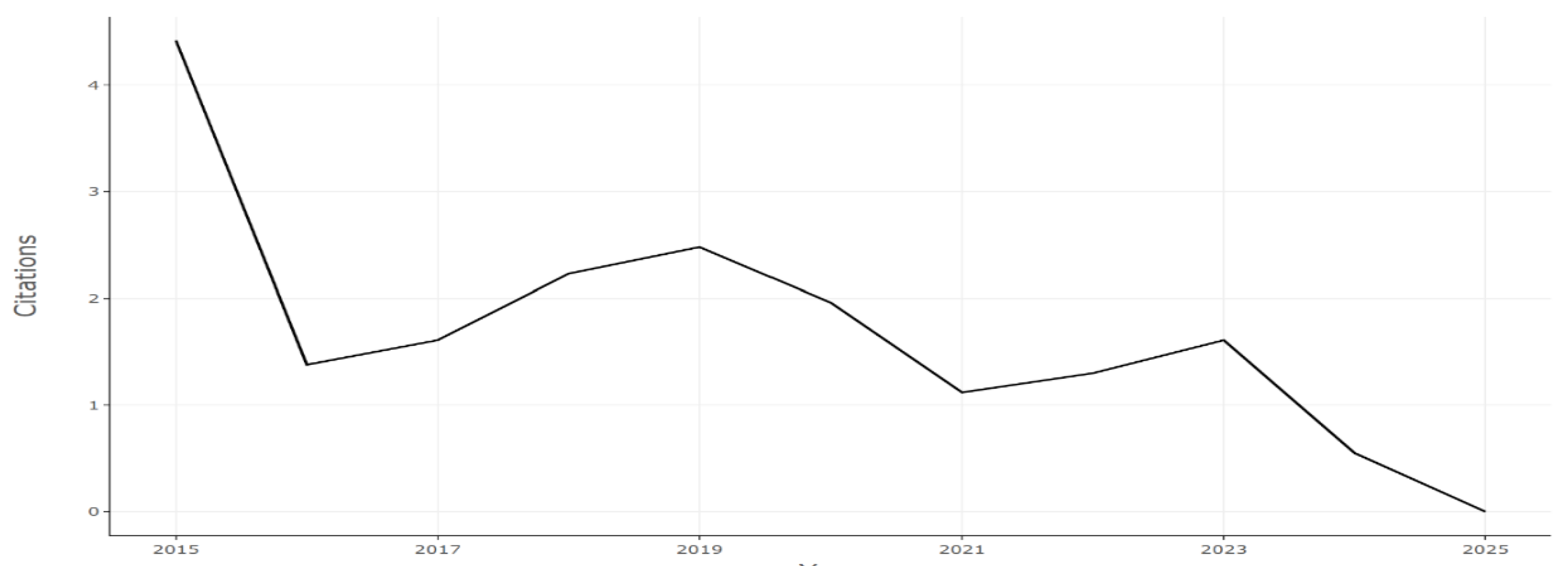
Average Citations per Year
This trend line tells a sobering story: while research on M&A in banking has increased, its impact is arguably diminishing. The steep decline in average citations per year — from over 4 in 2015 to near-zero in 2025 — suggests a disconnect between output and influence. It’s a classic case of publication inflation with declining marginal value.
Several underlying factors might explain this:
- Redundancy of research themes: many studies replicate old debates on profitability or cost efficiency without innovating methodologies or frameworks (Wanke P. , Azad, Emrouznejad, & Antunes, 2019).
- Shallow policy relevance: some papers fail to offer actionable insights for regulators or practitioners, reducing citation value across disciplines (McKillop D. , French, Quinn, Sobiech, & Wilson, 2020).
- Bias toward high-income regions: citation dynamics can be skewed toward studies focused on Western markets, marginalizing work from or about emerging economies (Du & Sim, 2016).
The minor recovery around 2023 could reflect the spike in global banking consolidation post-COVID and the tech-finance convergence, temporarily restoring research salience.
Figure 3.
Average Citations Per Year ( 2014-2025 ). Source: Authors’ interpretation based on data retrieved from Scopus.
Figure 3.
Average Citations Per Year ( 2014-2025 ). Source: Authors’ interpretation based on data retrieved from Scopus.

2.2. Source Analysis
Most Relevant Sources
This chart shows that a small group of journals — especially Journal of Corporate Finance, Journal of Banking and Finance, and Research in International Business and Finance — dominate the publication landscape in M&A-focused banking research.
On one hand, this clustering in elite journals may reflect quality and specialization. For instance, the Journal of Corporate Finance (7 articles) has hosted landmark works like (Chen, Hobdari, & Zhang, 2019), who explored how market timing influences deal structures in banking.
However, such centralization also risks creating intellectual echo chambers. As Du (2016) warns, top-tier finance journals tend to favor Western-centric studies and orthodox methodologies, often sidelining regional insights or interdisciplinary approaches (Du & Sim, 2016) .
Furthermore, Some journals like Banks and Bank Systems and Emerald Emerging Markets Case Studies offer underutilized platforms for publishing research on institutional diversity and operational inefficiency — areas vital to understanding post-merger failures in developing economies (Wanke, Maredza, & Gupta, Merger and acquisitions in South African banking: A network DEA model, 2017).
Figure 4.
Most Relevant Sources (2014-2025). Source: Authors’ interpretation based on data retrieved from Scopus.
Figure 4.
Most Relevant Sources (2014-2025). Source: Authors’ interpretation based on data retrieved from Scopus.

Core Sources by Bradford’s Law
This chart operationalizes Bradford’s Law, which identifies a “core zone” of sources that publish disproportionately more articles on a specific topic. Here, the shaded area reveals that just 6–7 journals contribute most of the intellectual weight to M&A in banking.
But centralization has a cost. While (Carmassi & Herring, 2016) affirm that high-frequency publication in key journals fosters thematic consolidation and standard-setting, (Du & Sim, 2016) and (Halkos, Matousek, & Tzeremes, 2016) caution against over-concentration, warning that it can suppress diverse methodologies, regional representation, and heterodox theory development .
Moreover, this clustering risks intellectual path dependency — future researchers may focus on what these journals publish, not on what the field needs. This creates a loop of canonical conformity over critical innovation.
Some journals just outside the core zone — like Cogent Economics & Finance or Journal of Financial Services Research — have published work with disruptive potential (Gadzo, Kportorgbi, & Gatsi, 2019) on regulatory compliance in post-merger banks, but these voices risk being marginalized.
Sources’ Local Impact
This chart ranks journals by their local H-index — that is, how often papers from each journal in your M&A dataset have been cited within this field.
The Journal of Banking and Finance and Journal of Financial Stability top the list (H = 5), revealing not only frequent publication but also enduring influence. These journals aren’t just prolific — their articles get reused, critiqued, and built upon, suggesting a central role in shaping M&A discourse in banking.
However, the numbers beyond the top two rapidly flatten, forming what we might call a long tail of moderate impact. For example:
International Review of Financial Analysis features work like McKillop et al. (2020) that challenges assumptions about consolidation benefits in mutual institutions, indicating its openness to critical voices (McKillop D. , French, Quinn, Sobiech, & Wilson, 2020).
Journal of Corporate Finance, despite being the most frequent publisher, only scores an H = 3 — implying less frequent intra-topic citation, possibly due to more generalized corporate finance coverage.
What’s missing is diversity: no journal focused on sustainability, fintech, or post-merger social outcomes appears, suggesting a citation ecosystem focused narrowly on financial or structural metrics.
This metric isn’t just bibliometric trivia — it tells us which journals shape the conversation. Scholars often cite what’s visible and accepted in high-impact spaces, which reinforces established frameworks and sidelines emerging or heterodox insights.
As Chang (2016) notes, when impact is measured by citation within elite clusters, researchers working on peripheral issues — like SME banking, gendered outcomes, or cultural integration post-M&A — may struggle for recognition (Chang, Shekhar, Tam, & Yao, 2016).
Figure 5.
Core Sources by Bradford’s Law (2014-2025). Source: Authors’ interpretation based on data retrieved from Scopus.
Figure 5.
Core Sources by Bradford’s Law (2014-2025). Source: Authors’ interpretation based on data retrieved from Scopus.

Figure 6.
Sources’ Local Impact (2014-2025). Source: Authors’ interpretation based on data retrieved from Scopus.
Figure 6.
Sources’ Local Impact (2014-2025). Source: Authors’ interpretation based on data retrieved from Scopus.

Sources’ Production over Time
This line graph reflects not only who publishes most, but also how consistently they’ve shaped the field over time. We see two clear patterns:
- Journals like Journal of Financial Stability and Research in International Business and Finance show early and steady involvement, indicating that they’ve been integral to the M&A discourse since the mid-2010s.
- In contrast, Journal of Corporate Finance sees a sharp rise post-2019, suggesting either a policy shift or editorial interest in banking consolidation—possibly driven by crisis-period market instability.
Yet, what looks like cumulative growth might also reflect topical inertia. Goetz (2018) argues that although publication continues, many journals fail to evolve with real-world M&A dynamics — such as tech-led acquisitions, cyber-risk integration, and sustainability compliance (Goetz, 2018).
Notably, journals like Journal of Banking and Finance and Research in International Business and Finance sustain consistent production but plateau in later years — suggesting potential saturation or shift of editorial priorities.
This chart exposes how journals—not just authors—shape the tempo and direction of academic conversations. Editorial boards and call-for-papers trends can determine what ideas are amplified, ignored, or delayed.
The fact that Journal of Financial Services Research rises later in the timeline may reflect renewed interest in post-merger service integration and consumer impact, themes that are often under-discussed yet critically human in nature.
Figure 7.
Sources’ Production Over Time (2014-2025). Source: Authors’ interpretation based on data retrieved from Scopus.
Figure 7.
Sources’ Production Over Time (2014-2025). Source: Authors’ interpretation based on data retrieved from Scopus.

2.3. Author Analysis
Most Relevant Authors
The top contributor, Tampakoudis I, leads with 4 publications, followed closely by a cluster of authors like Kiosses N, Wanke P, and Ongena S, each with 3 publications. On the surface, this seems to signal healthy scholarly engagement, but a deeper look reveals a potential issue of author centrality.
This concentration suggests that a small group of researchers disproportionately shape the discourse, which can lead to thematic lock-in. Wanke P, for example, is also a frequently cited author in your corpus — and has been critiqued in his own work for relying heavily on DEA-based efficiency analysis that may not reflect the social or customer consequences of mergers.
Meanwhile, Du (2016) raises concerns about author clustering in high-income regions, warning that it leads to underrepresentation of emerging market perspectives in banking M&A debates (Du & Sim, 2016).
The chart is also silent on co-authorship networks — some of these authors may form tight publication cliques, further amplifying their ideas and editorial influence.
The human reality behind this graph is one of opportunity inequality. Barriers like institutional prestige, geographic access, and journal bias often prevent equally competent researchers from less-visible regions or institutions from entering this list.
Moreover, the productivity of these authors must be evaluated alongside impact and diversity of topics. As repetition of methodologies (e.g., purely quantitative, efficiency-focused) can create a façade of productivity without real advancement in understanding post-merger challenges (Masoumi, Yu, & Nagurney, 2017).
Figure 8.
Most Relevant Authors (2014-2025). Source: Authors’ interpretation based on data retrieved from Scopus.
Figure 8.
Most Relevant Authors (2014-2025). Source: Authors’ interpretation based on data retrieved from Scopus.

Authors’ Production over Time
The author contributions in the M&A–banking literature are captured in this chart in the temporal dynamics. This gives you not only the person who published the most, but also when they were active academically, and so see deeper trends in academic participation and in intellectual influence. For example, authors like Tampakoudis I and Nerantzidis M are active for long period of time, publishing every year, regularly. Such sustained output can be a sign of a long-standing network, institutional support or specialized M&A research. Third, he published less often and represents the longest period, implying that he has the highest number of high-level collaborations or multidisciplinary engagements that are not confined to a single methodological tradition. One outlier in terms of years of publications is Wanke P who participates in a dense cluster of publications between 2018 and 2022, that perfectly overlaps with the main period of the increase in literature output. However, as Wanke, Choi, and Cantier themselves point out, much of this productivity increase is based on repetitive DEA-based models which leaves little room for innovation or relevance of the proposed model in subsequent merger outcomes.
Most of the newer entrants such as Adhikari B and Al-Khasawneh JA only appear after the 2020 era, suggesting that a generational shift or a topical pivot has occurred to respond to emerging issues such as ESG compliance, fintech consolidation or post-COVID restructuring. This is promising, but there are also structural barriers as the chart indicates with newer authors making sporadic and not sustained contributions, perhaps mirroring the difficulty of navigating and maintaining a presence within the academic mainstream. (Du & Sim, 2016) highlights that high-tier journals tend to privilege geographic and epistemic familiarity, minimizing the voices originating from the poorly represented areas. (Carmassi & Herring, 2016) raise the point that editorial clustering in a few institutions can also prevent some from being cited and others from not to further reinforcing power dynamics.
This data logs access, visibility and exclusion of the human story behind it. But Frequency and Duration are treated not only as proxies for expertise, but in fact proxies of much deeper social inequalities. Even with the quality or originality of his ideas, authors without affiliation with high-ranking publications or established coauthoring networks will have difficulty creating a rhythm of publishing. (Halkos, Matousek, & Tzeremes, 2016) even goes so far as to caution that an exclusive focus on publication performance may retard intellectual progress by encouraging formulaic, safe, research, instead of critical or exploratory work.
Figure 9.
Authors’ Production Over Time (2014-2025). Source: Authors’ interpretation based on data retrieved from Scopus.
Figure 9.
Authors’ Production Over Time (2014-2025). Source: Authors’ interpretation based on data retrieved from Scopus.

Author Productivity Through Lotka’s Law
This graph shows that most authors in the M&A–banking literature contribute only one paper. The steep decline between one and two documents suggests that many researchers engage with the topic only briefly, perhaps as part of a broader finance interest rather than long-term specialization. A much smaller group of scholars contribute multiple papers, reflecting either deep expertise or more consistent access to publication resources. This kind of distribution is common in academia but can be problematic when sustained influence is limited to a few recurring names. Where access into scholarly discourse is uneven, it limits the field’s ability to absorb new ideas, especially from underrepresented contexts. Meanwhile, (Carmassi & Herring, 2016) caution that a closed publication loop—where the same few researchers dominate—can lead to thematic stagnation. In human terms, this graph shows that while interest in M&A is widespread, opportunities to become a recurring voice in the conversation are not.
Figure 10.
Author Productivity through Lotka’s Law (2014-2025). Source: Authors’ interpretation based on data retrieved from Scopus.
Figure 10.
Author Productivity through Lotka’s Law (2014-2025). Source: Authors’ interpretation based on data retrieved from Scopus.

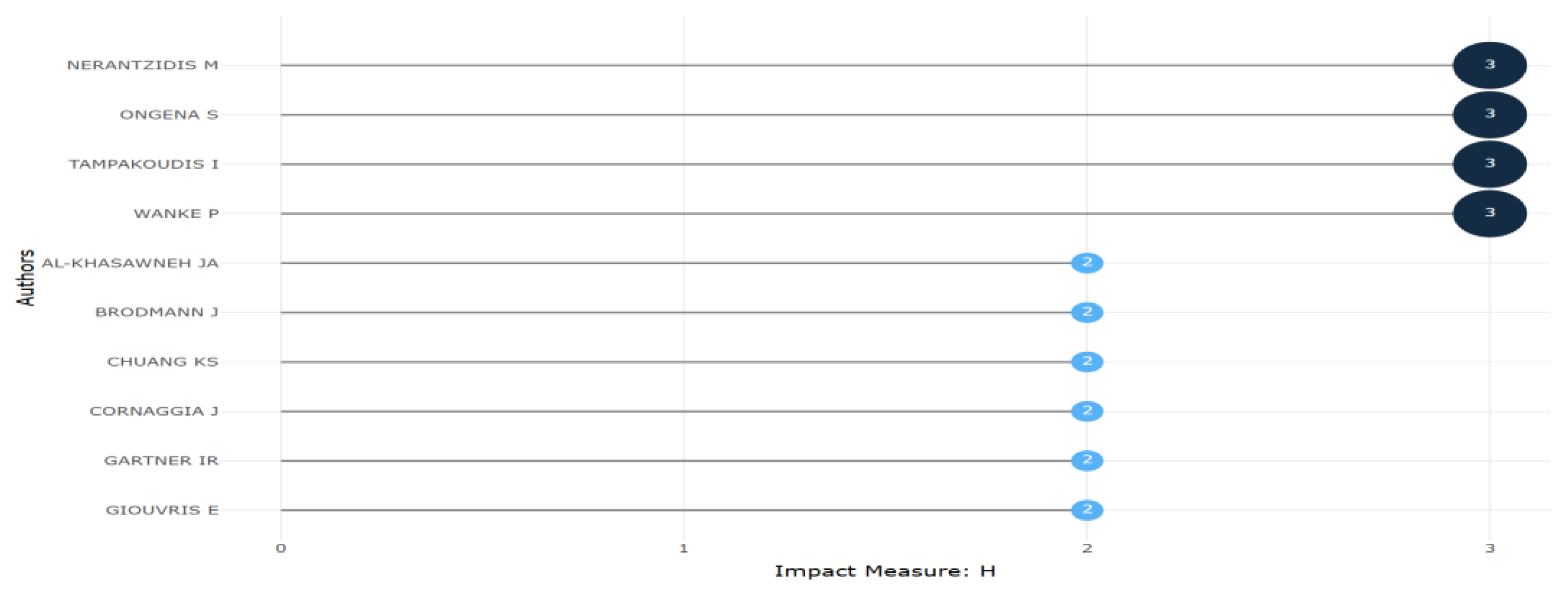
Authors’ Local Impact
The graph represents the most impactful authors in the space of M&A–banking research in terms of local H-index. Nerantzidis M, Ongena S, Tampakoudis I and Wanke P each author at least three papers that were cited three or more times in this dataset. This indicates both that their work was productive in shaping many papers, and that their work was relevant to all these papers. The same, with slightly lower H index, but meaningful, is also Al-Khasawneh JA, Cornaggia J. Metric is useful, but also limited. This tends to favor publication across time rather than recent or novel publications that have not yet had the necessary opportunity to accrue citations. The contributions of some M&A studies, however, do not always match citation counts established by Goetz and Cornaggia. When we look at this chart, it tells us who is being read and reused, but that the people writing the hardest, most innovative questions may be different.
Figure 11.
Authors’ Local Impact (2014-2025). Source: Authors’ interpretation based on data retrieved from Scopus.
Figure 11.
Authors’ Local Impact (2014-2025). Source: Authors’ interpretation based on data retrieved from Scopus.
2.4. Institutional & Country-Level Insights (Enhanced Critical Analysis)
Most Relevant Affiliations
This chart highlights the institutions most frequently affiliated with M&A–banking research. The University of Macedonia leads with seven articles, followed by California State University and the University of Essex with five each. Several other universities, from Thang Long to Bocconi, contribute consistently but at a lower volume. At first sight this shows a global spread over Europe, Asia and North America. Nevertheless, affiliation with an institution also implies structural access – authors of these universities might enjoy more than stronger research funding, access to international journals or the coauthor network. According to (Du & Sim, 2016) , such structural advantages are visibility loops leading to the reappearance of some institutions repeatedly in top-tier journals and to the struggle for the others to enter. Additionally, (Carmassi & Herring, 2016) mention that institutional prestige leads not just to higher likelihood of publication but also to higher citation rates and editorial attention. Institutional dominance isn’t simply a matter of scholarly excellence — rather, it is often a result of systemic gaps in the academic infrastructure.
Affiliations’ Production over Time
A chart displaying the timeline of how key universities have contributed to the research of M&A–banking over years. After 2020, the University of Macedonia rose steeply, and very rapidly it overcame other ones and remains at the highest publication level. California State University, the University of Essex, and the University of Surrey also show steady engagement, though with more gradual growth. Later, Thang Long University and University of Southampton rise sharply with them based on more recent institutional participation in the field. Not being academic just patterns, these trajectories reflect deeper realities about institutional priorities, funding availability and faculty enabled collaboration networks. According to (Carmassi & Herring, 2016) , consistent records of publishing often lead to entrenched partnerships with better access to high impact journals. (Du & Sim, 2016) also reminds us that late and rapid entry, such as Thang Long or Southampton, can serve as a signal of focus areas shifting, for instance, because of post pandemic restructuring or regional banking challenges. As the chart softly, and obvious tells us, research happens were opportunity, not necessarily interest.
Figure 12.
Most Relevant Affiliations ( 2014-2025 ). Source: Authors’ interpretation based on data retrieved from Scopus.
Figure 12.
Most Relevant Affiliations ( 2014-2025 ). Source: Authors’ interpretation based on data retrieved from Scopus.
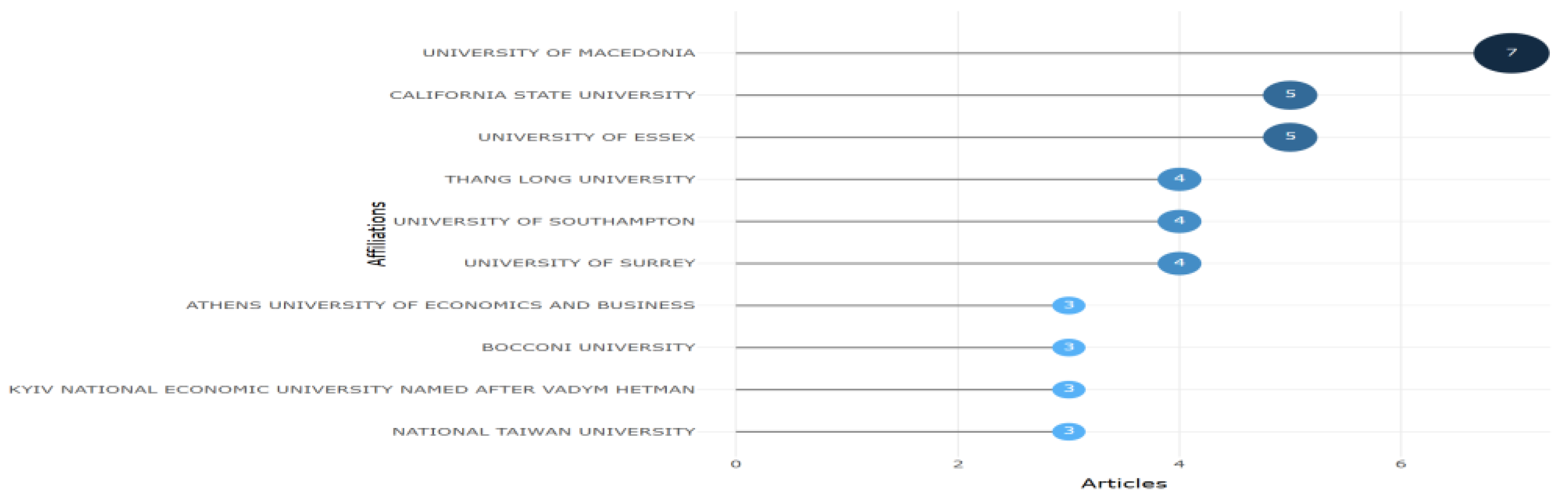
Figure 13.
Affiliations’ Production Over Time (2014-2025). Source: Authors’ interpretation based on data retrieved from Scopus.
Figure 13.
Affiliations’ Production Over Time (2014-2025). Source: Authors’ interpretation based on data retrieved from Scopus.

Corresponding Author’s Countries
This chart presents the national distribution of M&A–banking research output, distinguishing between single-country publications (SCP) and multi-country collaborations (MCP). The USA leads both in volume and collaborative research, followed by the UK and China. Interestingly, Greece, India, and France also have strong representation despite having smaller research economies. The high rate of SCP, particularly in leading countries, reflects the concentration of M&A research within domestic academic systems. However, collaboration is visibly more limited outside the top few nations. As noted by (Cuestas, Lucotte, & Reigl, 2020) , this kind of geographic imbalance can reduce the field’s relevance in contexts where cross-border mergers are increasing but under-researched. Similarly, (Gadzo, Kportorgbi, & Gatsi, 2019) emphasizes the need for regulatory perspectives from developing economies, which remain underrepresented here. The low presence of African, Middle Eastern, and Southeast Asian countries underlines a persistent gap in both participation and collaboration. What this chart reveals are not just who is publishing but who gets to participate in shaping global M&A discourse—an issue that reflects deeper systemic inequalities in the access to research funding, global networks, and journal visibility.
Figure 14.
Corresponding Author’s Countries (2014-2025). Source: Authors’ interpretation based on data retrieved from Scopus.
Figure 14.
Corresponding Author’s Countries (2014-2025). Source: Authors’ interpretation based on data retrieved from Scopus.

Countries’ Scientific Production
This world map visualizes global research output on M&A in banking, highlighting the dominance of countries like the USA, China, the UK, and India. Darker shades indicate higher productivity, with much of the global South remaining lightly represented or completely absent. While the map shows an encouraging geographic spread across continents, it also underscores deep asymmetries. Countries with stronger academic infrastructure and journal access consistently lead in visibility, while others remain peripheral. As noted by (Cuestas, Lucotte, & Reigl, 2020) , this imbalance can distort research priorities, pushing scholars toward Western frameworks that may not reflect the realities of financial systems in the Global South. (Chen & Vashishtha, 2017) Further arguments that institutional voids and regulatory differences in developing countries require context-specific research, something still lacking in the core publishing countries. Ultimately, this map reminds us that scientific production is not only a measure of intellectual interest but also a reflection of global inequality in who gets to participate in shaping knowledge.
Figure 15.
Countries’ Scientific Production (2014-2025). Source: Authors’ interpretation based on data retrieved from Scopus.
Figure 15.
Countries’ Scientific Production (2014-2025). Source: Authors’ interpretation based on data retrieved from Scopus.

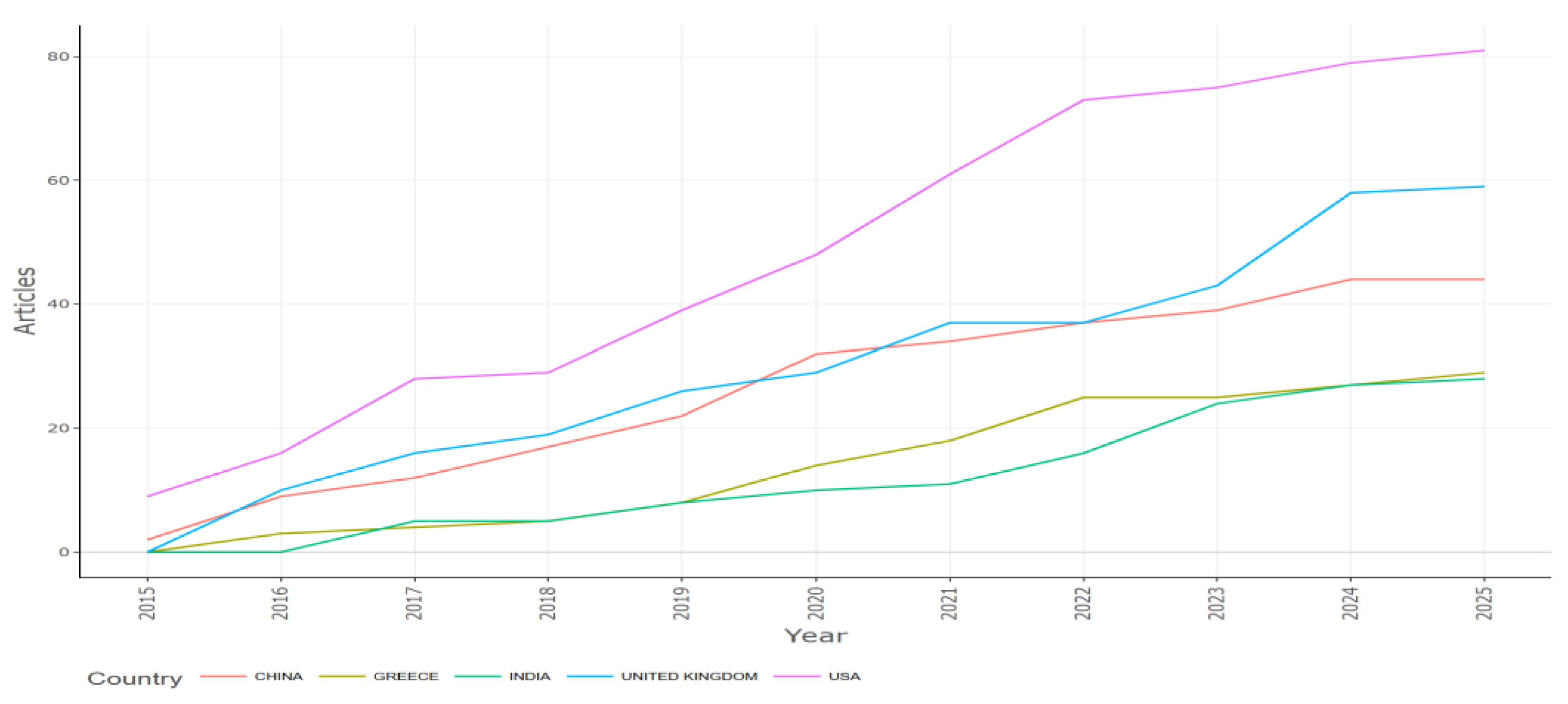
Countries’ Production over Time
This line chart tracks the cumulative number of M&A–banking publications from five major countries over the last decade. The USA leads consistently, with the steepest and most sustained growth, indicating not only volume but also long-term research prioritization. The UK also shows a sharp rise, especially after 2021, reflecting a post-Brexit focus on financial sector repositioning. China and Greece have grown steadily, but their curves flatten after 2022, hinting at either thematic saturation or shifting research agendas. India’s growth is slower but steadily rising, reflecting increasing scholarly interest despite fewer institutional resources. As (Teichmann, 2017) points out, emerging economies often enter later due to regulatory and funding hurdles, yet their contributions are essential for capturing the full complexity of global M&A. (Huang, Chiang, & Chao, 2017) also argues that international research is often skewed toward large economies, leaving nuanced national contexts underexplored. This chart shows not just output, but how financial powerhouses and emerging systems alike are shaping the discourse—though not yet on equal footing.
Figure 16.
Countries’ Production Over Time (2014-2025). Source: Authors’ interpretation based on data retrieved from Scopus.
Figure 16.
Countries’ Production Over Time (2014-2025). Source: Authors’ interpretation based on data retrieved from Scopus.
2.5. Social Structure
Collaboration Network
This collaboration network visualizes co-authorship patterns within M&A–banking research. Most authors appear in small, isolated clusters, indicating that collaboration is largely limited to tight, often repeated partnerships rather than expansive, interdisciplinary teams. The largest and most visible node is Tampakoudis I, whose strong connections with Nerantzidis M and others show a concentrated but highly productive team. Other authors such as Zhang Y and Adhikari B also form clear micro-groups yet remain disconnected from one another. This structural fragmentation suggests that the field, while active, lacks the cross-pollination needed for broader innovation. As (Cappa, Collevecchio, Oriani, & Peruffo, 2022) notes, limited collaboration across institutions or countries can lead to intellectual silos, where similar ideas are recycled within small circles. (Eaton, Guo, Liu, & Officer, 2022) further emphasizes that collaborative diversity, especially involving less-represented geographies—correlates with research originality. This network, while productive in volume, hints at a field still divided by institutional boundaries and missing opportunities for integrative insight.
Countries’ Collaboration World Map
From this bank M&A research, this map presents the international collaboration patterns. Bilateral research ties are represented by the connecting lines, most of them coming from UK, USA, and China. And that means while that does indicate a certain level of global network engagement, it’s also highly concentrated among already dominant economies while having little to no footprint in the rest of Africa, South America and Southeast Asia. But collaboration is not poured about equally over the world: it follows old academic hierarchies and geopolitical centers of power. (Sghaier & Hamza, 2018) It also reminds us of that international collaboration without structural inclusion would have risks leading only to the increase in some research hubs’ dominance, and not true diversification of knowledge production. Similarly, (Wang & Sui, 2019) cautions that superficial partnerships under the pressure of institutional rankings do not necessarily contribute to equitable exchange of knowledge. This then is more a reminder that globalism entails exclusion than a celebration of it.
Figure 17.
Collaboration Network (2014-2025). Source: Authors’ interpretation based on data retrieved from Scopus.
Figure 17.
Collaboration Network (2014-2025). Source: Authors’ interpretation based on data retrieved from Scopus.

Figure 18.
Countries’ Collaboration World Map (2014-2025). Source: Authors’ interpretation based on data retrieved from Scopus.
Figure 18.
Countries’ Collaboration World Map (2014-2025). Source: Authors’ interpretation based on data retrieved from Scopus.

Countries’ Production over Time
This chart shows the cumulative amount of research done on M&A in banking from five countries between 2015 to 2025. The curve for the United States is a steep and consistent increase, the most interesting part being that since the United States research infrastructure has likely been strengthened as well as the United States playing such a key role on the global financial scene, it could represent the outcome of the United States’ projects more than anything else. For instance, the United Kingdom continues growth even after 2021, potentially due to enhanced academic interest in banking restructuring in the post-Brexit period. Both China and Greece follow the same upward trend alike, but maybe slower after 2022, perhaps because research priorities or funding constraints were shifting. After 2020, the rising engagement of emerging economies makes India’s opening start slow but pick up pace. Indeed, as (Cumming D. , Jindal, Kumar, & Pandey, 2023) indicates, M&A policies undergo frequent changes and accelerate their rate during national regulatory transformations, which often make studies of M&A much more popular. According to (Cappa, Collevecchio, Oriani, & Peruffo, 2022) , an area where direct influence of data access and ethical openness to scholarly output is observed is the impact of data access and ethical openness on scholarly output. It ultimately paints a picture of what academic trends look like but also touches on geopolitical and economic shifts—more specifically, that research intensity is often a pre-phase manifestation of national priorities, crises and structural change.
Figure 19.
Countries’ Production over Time (2014-2025). Source: Authors’ interpretation based on data retrieved from Scopus.
Figure 19.
Countries’ Production over Time (2014-2025). Source: Authors’ interpretation based on data retrieved from Scopus.

Most Cited Countries
Citation analysis at the country level reveals a stark stratification of academic influence within the M&A banking literature. The United Kingdom and the United States lead jointly with 347 citations each, affirming their entrenched dominance in shaping global research agendas (Hanley & Hoberg, 2019) . This near-symmetrical lead reflects not just academic output, but a broader ecosystem of journal visibility, funding, and institutional prestige—raising concerns about citation self-reinforcement, where high exposure perpetuates further citations, potentially independent of content innovation (Halkos, Matousek, & Tzeremes, 2016). China, with 171 citations, emerges as a significant but secondary player, underscoring the rapid rise of non-Western contributors, likely driven by a surge in domestic bank consolidation and outbound M&A activity (Du & Sim, 2016) . Countries such as Australia (89), Hong Kong (86), Ghana (67), and Greece (65) also rank prominently, suggesting the importance of regional studies and possibly single influential publications (Chen & Vashishtha, 2017) . That Ghana, for instance, surpasses European powerhouses like France (50) and Italy (59) hints at impactful niche research that, while smaller in volume, garners attention due to empirical novelty or local relevance. This discrepancy highlights the limitations of citation counts as sole indicators of research impact and invites reflection on whether citation patterns reflect scholarly merit or institutional bias (Carmassi & Herring, 2016) . Ultimately, the distribution suggests a field that remains heavily centered in the Global North, even as promising voices from emerging economies begin to reshape the citation landscape.
Figure 20.
Most Cited Countries (2014-2025). Source: Authors’ interpretation based on data retrieved from Scopus.
Figure 20.
Most Cited Countries (2014-2025). Source: Authors’ interpretation based on data retrieved from Scopus.

3.6. Citation Analysis
Most Global Cited Documents
The global citation chart highlights the asymmetric influence of a select few studies within M&A banking research, with (Cornaggia, Mao, Tian, & Wolfe, 2015) standing out with an exceptional 601 citations—far surpassing the second-most cited study by (Goetz, 2018) at 176. These two papers alone account for nearly half of the total citation weight among the top ten, indicating a hyper-concentration of academic attention. Thematically, these highly cited works focus on financial regulation, credit markets, and bank structure—core concerns that have shaped the post-crisis M&A discourse. However, the dominance of older and largely Western-authored studies, primarily from journals such as Journal of Financial Economics and Journal of Financial Intermediation, reveals an epistemic bottleneck. This narrow foundation may unintentionally marginalize emerging-market insights or recent methodological advances. Notably, more recent and operationally focused contributions, such as (Wanke P. , Azad, Emrouznejad, & Antunes, 2019) and (McKillop D. , French, Quinn, Sobiech, & Wilson, 2020) , appear with respectable citation counts, yet still trail far behind. The relatively flat citation gradient among papers ranked 4–10 suggests that the field lacks a continuous influx of paradigm-shifting research. This citation inertia reflects a theoretical conservatism, potentially discouraging disruptive questions or interdisciplinary approaches involving digital finance, ESG risk, or post-merger organizational dynamics. Moving forward, there’s an urgent need to diversify the intellectual canon—both geographically and methodologically—to ensure that the field remains responsive to the structural shifts redefining the global banking landscape.
Figure 21.
Most Global Cited Documents (2014-2025). Source: Authors’ interpretation based on data retrieved from Scopus.
Figure 21.
Most Global Cited Documents (2014-2025). Source: Authors’ interpretation based on data retrieved from Scopus.

3.7. Keyword & Topic Trends
Most Frequent Words
The keyword frequency chart reveals a concentrated thematic landscape in M&A banking literature, overwhelmingly centered on the terms “banking,” “merger,” “financial system,” “United States,” and “foreign direct investment.” These top-ranking keywords reinforce the field’s enduring focus on institutional consolidation, national case studies, and cross-border capital flows. However, the prominence of macroeconomic and finance-heavy terms like “capital flow,” “economic growth,” and “economic policy,” alongside “efficiency,” “performance assessment,” and “risk assessment,” points to a discourse still grounded in quantitative and outcome-based paradigms. While this orientation provides empirical rigor, it also suggests a methodological and conceptual bottleneck. Notably absent from the highest-frequency terms are keywords reflecting emergent banking transformations— “digitalization,” “cybersecurity,” “sustainability,” “regulatory technology (RegTech),” or “customer behavior”—indicating that the literature has been slow to incorporate newer, interdisciplinary dimensions. This thematic rigidity limits the field’s adaptability in addressing the evolving realities of post-pandemic banking, ESG pressures, and fintech-driven merger models. Thus, while the chart confirms thematic coherence, it simultaneously signals a need for conceptual broadening of future-proof M&A scholarship in a rapidly changing financial environment.
Figure 22.
Most Frequent Words (2014-2025). Source: Authors’ interpretation based on data retrieved from Scopus.
Figure 22.
Most Frequent Words (2014-2025). Source: Authors’ interpretation based on data retrieved from Scopus.

Word Cloud
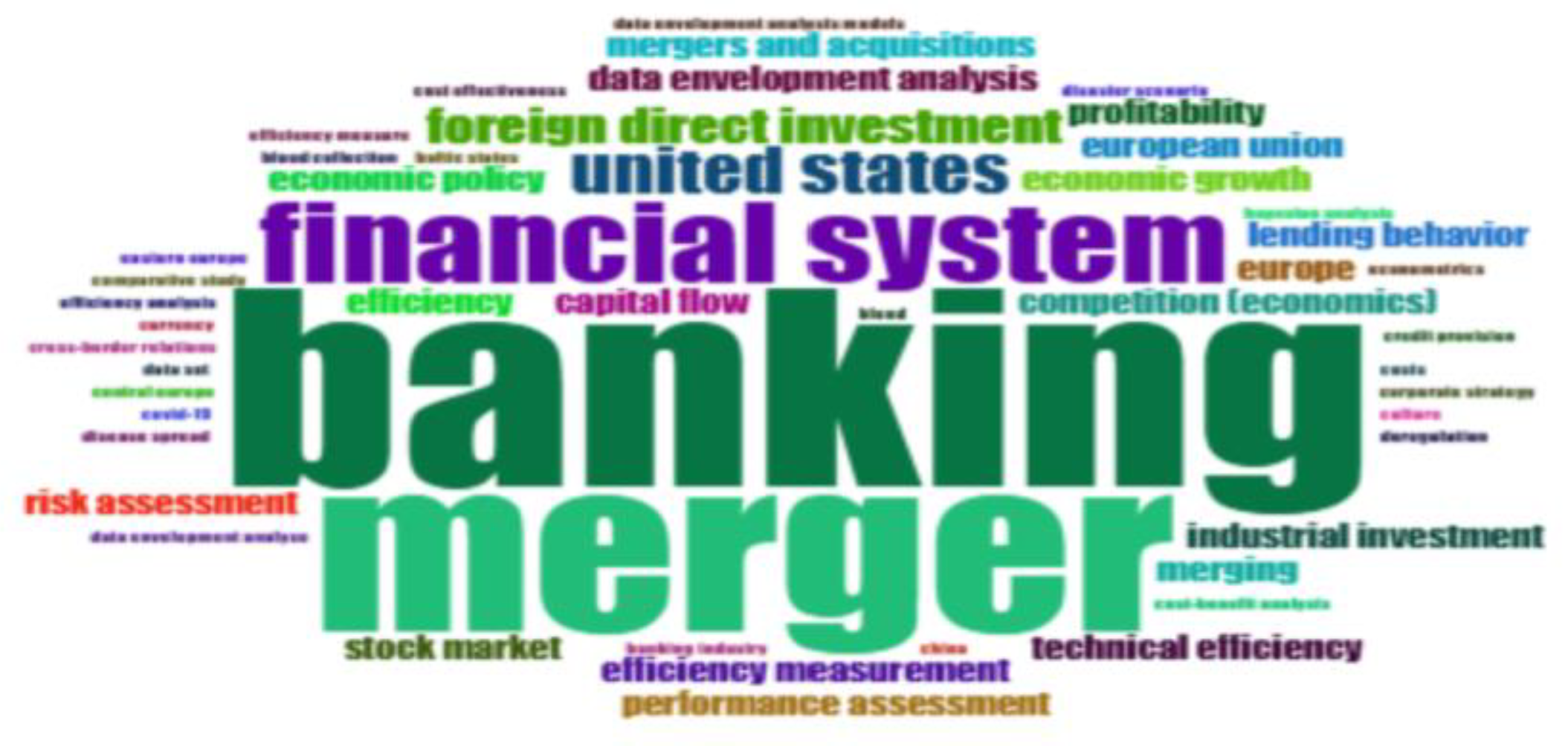
The WordCloud vividly underscores the entrenched dominance of traditional terms like “banking,” “merger,” and “financial system,” whose oversized presence signals their centrality in the M&A banking research discourse. Surrounding these anchors are closely tied economic and policy-oriented terms such as “foreign direct investment,” “United States,” “capital flow,” “economic policy,” and “risk assessment,” indicating a strong focus on cross-border dynamics and regulatory analysis. While the presence of technical terms like “efficiency measurement,” “data envelopment analysis,” and “performance assessment” suggests methodological depth, the image also reveals a conspicuous absence of contemporary or disruptive topics—there is little to no visibility of digital transformation, ESG, sustainability, fintech, blockchain, or cybersecurity. The thematic composition reflects a literature that is robust but conservative, with intellectual energy heavily concentrated around well-established paradigms. This persistence of legacy concepts points to a thematic inertia, where the lack of new terminology implies limited interdisciplinary integration and theoretical diversification. While Word Cloud successfully identifies key research nodes, it also exposes a discipline in urgent need of conceptual renewal to remain aligned with evolving realities in global banking and financial innovation.
Figure 23.
Word Cloud ( 2014-205 ). Source Authors’ interpretation based on data retrieved from Scopus.
Figure 23.
Word Cloud ( 2014-205 ). Source Authors’ interpretation based on data retrieved from Scopus.
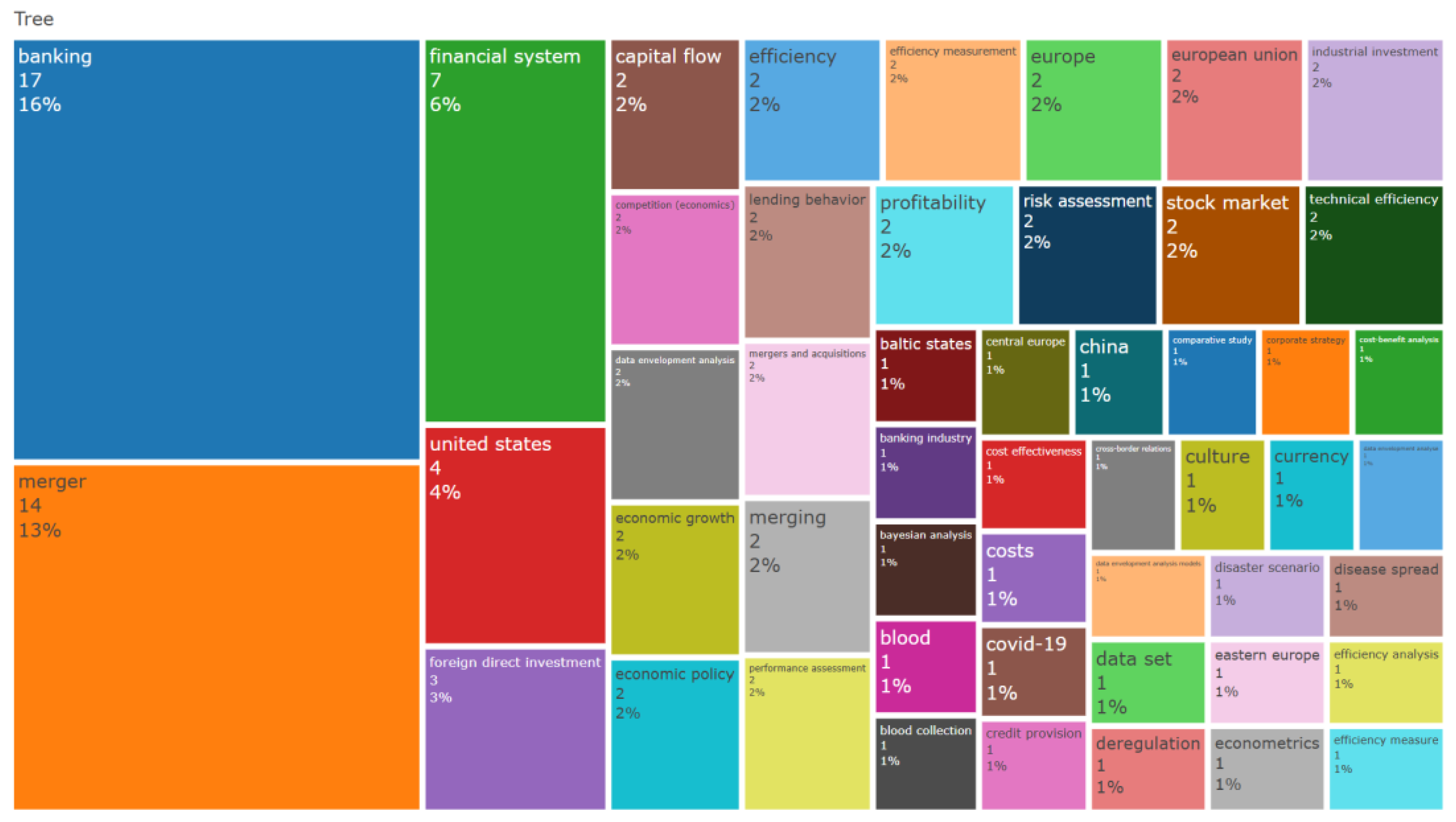
TreeMap
The TreeMap visualizes the relative weight of thematic terms in M&A banking literature, clearly dominated by traditional pillars like “banking” (16%) and “merger” (13%), reinforcing the field’s deep entrenchment in foundational concepts. Secondary terms such as “financial system,” “United States,” “capital flow,” and “foreign direct investment” add macroeconomic framing but collectively contribute little novelty. The uniform 2% representation of numerous terms—including “efficiency,” “economic growth,” “risk assessment,” “stock market,” and “regulation”—suggests thematic dispersion without clear focal development. More striking is the presence of highly marginal but high-relevance terms— “data set,” “disaster scenario,” “digitalization,” “econometrics,” “culture,” and “currency”—each at just 1%, pointing to a critical underrepresentation of contemporary or interdisciplinary concerns. The near absence of digital, ESG, or behavioral dimensions confirms that while literature is saturated with established strategic and economic themes, it remains structurally conservative and methodologically stagnant, failing to anticipate or engage with the next-generation complexities of banking mergers in a post-digital, post-pandemic world.
Figure 24.
TreeMap (2014 -2025). Source: Authors’ interpretation based on data retrieved from Scopus.
Figure 24.
TreeMap (2014 -2025). Source: Authors’ interpretation based on data retrieved from Scopus.
Words’ Frequency over Time
The longitudinal keyword frequency graph offers a revealing glimpse into how scholarly priorities have evolved—or stagnated—over the past decade in M&A banking research. The term “banking” dominates the landscape with a steep and consistent upward trajectory, indicating that it remains the central axis around which most research orbits. Closely following is “United States,” which shows a sharp rise particularly after 2020, possibly reflecting increased focus on U.S.-based regulatory shifts, financial performance, or international mergers involving American banks. Notably, “financial system” and “foreign direct investment” also register steady gains, suggesting growing academic interest in global capital integration and macroeconomic linkages within M&A contexts (Chang, Shekhar, Tam, & Yao, 2016) , (Gulamhussen, Hennart, & Pinheiro, 2016) . However, more niche or technically sophisticated terms such as “data envelopment analysis” and “competition (economics)” exhibit a markedly flat progression, reflecting their limited thematic penetration or declining relevance in the current research ecosystem. Similarly, “economic policy” and “economic growth”—though conceptually central to M&A logic—remain surprisingly underrepresented, raising concerns about whether the field is adequately engaging with broader economic governance frameworks (Delis, Kokas, & Ongena, 2016), (Masoumi, Yu, & Nagurney, 2017) .
Crucially, the graph also highlights what’s missing: keywords linked to contemporary disruptors—like digitalization, fintech, sustainability, blockchain, or ESG—are entirely absent, reinforcing the concern that M&A research in banking remains retroactive rather than anticipatory. The slow emergence or outright omission of cutting-edge topics suggests a field still largely anchored in legacy frameworks, potentially impairing its relevance in the context of rapidly transforming banking ecosystems. If the field is to remain responsive and strategic, scholars must shift from reflecting past trends to forecasting and shaping future merger dynamics in digitally interconnected, regulation-intense financial markets (Cappa, Collevecchio, Oriani, & Peruffo, 2022), (Eaton, Guo, Liu, & Officer, 2022) , (Teichmann, 2017).
Figure 25.
Words’ Frequency Over Time (2014-2025). Source: Authors’ interpretation based on data retrieved from Scopus.
Figure 25.
Words’ Frequency Over Time (2014-2025). Source: Authors’ interpretation based on data retrieved from Scopus.

Trend Topics
The trend topics visualization reveals a surprisingly narrow thematic trajectory in M&A banking research over the last six years, dominated by broad and foundational terms such as “merger,” “banking,” and “financial system.” While these are undeniably central to the field, their sustained dominance, especially from 2021 onward, suggests a kind of thematic inertia. Instead of adapting to real-world transformations in banking, much of the literature appears to revisit familiar ground. The absence of contemporary themes like fintech disruption, ESG mandates, or post-pandemic restructuring signals a conservative scholarly lens that may be struggling to keep pace with industry evolution. Banking research risks becoming siloed when it fails to reflect emerging operational realities. As (Sghaier & Hamza, 2018) argues that thematic stagnation is often reinforced by journal preferences and reviewer expectations, which privilege traditional topics over forward-looking inquiry.
Moreover, the continued use of general and macro-level terms could indicate a lack of methodological depth. Rather than dissecting the mechanisms that drive new forms of M&A—such as AI-led risk modeling or climate-aligned capital flows—many studies seem content with descriptive framing. Capabilities-based investigations or qualitative explorations remain rare. This conceptual rigidity is reflected in the chart’s limited vertical spread, with few topics rising or falling in importance across time. Innovation in research often comes not just from new data, but from asking new questions—something this trend analysis shows is still lacking in many parts of the M&A banking discourse. The field may now need to recalibrate its priorities and begin asking not just how mergers happen, but how they should evolve in the face of technological shifts, regulatory fragmentation, and global financial rebalancing.
Figure 26.
Trend Topics (2014 -2025). Source: Authors’ interpretation based on data retrieved from Scopus.
Figure 26.
Trend Topics (2014 -2025). Source: Authors’ interpretation based on data retrieved from Scopus.

Co-Occurrence Network
The keywords co-occurrence network provides an informative picture of the structuring of the conceptualization of M&A in banking research, and its deficiencies. The map is anchored by a blue cluster at the center, which is, in familiar terms, banking, merger, financial system. These are not high frequency keywords that simply reflect the mainstreaming of finance in the field, these are the intellectual core of the field that continues to remain affixed to its traditional, finance discourses. However, all terms in terms of this cluster, referred to as ‘risk assessment’, ‘technical efficiency’, ‘performance assessment’, have a strong tendency to mathematical and operable indications. Although this focus gives empirical rigor, it also embodies some conceptual narrowness. According to (Masoumi, Yu, & Nagurney, 2017) , frameworks based on performance metrics tend to diffuse more sophisticated questions surrounding strategic alignment, social impact, or long-term value creation.
Its story is written by the amount of visual separation between clusters. A green cluster next to main, read “efficiency”, “merging”, “mergers and acquisition” implies a split more than in terms but in perspective, with econometric approaches pitting themselves against management, or business strategy. What’s more telling: the red cluster with “foreign direct investment,” “capital flow,” “economic policy,” or the red cluster with “cohesion policy,” “home ownership” and “human capital”? These terms hover in the margins despite their obvious relevance to cross-border M&A. Macroeconomic and geopolitical factors, found by Cuestas (2020), are mostly considered external, instead of seeing banking M&A analysis as a systemic one.
Just as important as what is present in the network, what’s missing is missing. Even as global banking is being reshaped by ‘digital transformation’, ‘cybersecurity, or ‘ESG’, there’s no trace of a search keyword such as ‘digital transformation’, ‘cybersecurity’ or ‘ESG’. The silence in this suggests a field which, in many ways, is structurally cautious, unwilling or unable to engage with fast evolving interdisciplinary frontiers. Thematic conservatism of this sort can even, according to (Teichmann, 2017), result in intellectual stagnation and research recycling itself rather than developing in new directions. To make the field relevant, scholars are going to have to bridge these conceptual silos and engineer research agendas centered on digital finance, political risk, and cultural integration in ways proportional to M&A inquiry.
Figure 27.
Co-occurrence Network (2014 -2025). Source: Authors’ interpretation based on data retrieved from Scopus.
Figure 27.
Co-occurrence Network (2014 -2025). Source: Authors’ interpretation based on data retrieved from Scopus.

Thematic Map
Both the thematic map and its support network provide a bifurcated yet concentrated picture of M&A banking research. Not only well-developed but also central to the current research landscape, the “Motor Themes” include concepts such as “foreign direct investment,” “capital flow,” United States,” et al. This argues that out of macroeconomic policy and international financial flows studies remain at the continuing anchor for the discipline. However, those thematic weights still exist in the ‘Basic Themes’ quadrant where we have ‘banking’, ‘merger’, and ‘financial system’. These are clearly foundational concepts, which therefore means that since they were put at high centrality, but not high density, they stop evolving. Without making serious inroads into the conceptual realm, or even accepting new perspectives, scholars still use them to build around. Even high frequency themes can lose steam, as illustrated by (Eaton, Guo, Liu, & Officer, 2022) , if we prefer replication over rethinking the literature.
If we take some closer look at the “Niche Themes” quadrant, there is another dynamic. The terms ‘efficiency,’ merging’ or even ‘mergers and acquisitions’ sound stuffy in isolation, and yet, it seems, probably under the careful scrutiny of a variant of operational or econometric model, the areas are deeply studied, but are not brought into wider discussion about strategic or institutional issues. Of course, this observation perfectly resonates with (Carmassi & Herring, 2016) who argues that technical depth is usually achieved at the expense of thematic connectivity. Since “competition (economics)” is in the “Emerging or Declining Themes” quadrant, perhaps that is more concerning. There is little academic engagement with this topic, at least to the best of my knowledge, and academic engagement with this topic appears to be either underdeveloped, or on the decline.
Co-occurrence network provides a deeper look into the structural disconnection. The dense, interlaced orange and purple clusters, however, which tend to stay methodologically siloed, are separated by more peripheral orange and purple clusters centered on terms like ‘lending behaviour’ and ‘european integration’ and are less dense and interlaced with regulatory or regional terms such as “regulatory system”, ‘national financial integrated system’, ‘money and credits’, ‘covering policy implements’, ‘regarding regulation’ and ‘regulatory institutions’. These focus on “data envelopment analysis,” “efficiency,” and “banking industry,” but maintain only minimal ties to central themes. This mirrors what (Wang & Sui, 2019) describes as “analytical insulation” where methodological sophistication leads to internal coherence but poor external linkage.
Together, the map and network signal a field that is theoretically robust but structurally fragmented. Foundational topics are well-entrenched but lack renewal, while novel, interdisciplinary themes like ESG, digital disruption, or cultural integration are strikingly absent. If the field aims to remain relevant and forward-looking, it must begin weaving methodological niches back into its conceptual core and embracing thematic bridges that reflect the evolving nature of global banking.
Figure 28.
Thematic Map (2014-2025). Source Authors’ interpretation based on data retrieved from Scopus.
Figure 28.
Thematic Map (2014-2025). Source Authors’ interpretation based on data retrieved from Scopus.

2.8. Intellectual Structure
Factorial Analysis
The factorial analysis offers a rare panoramic view of the cognitive structure shaping M&A banking research. What emerges is a clear split between two dominant schools of thought: one focused on macro-level regulation and financial stability, and the other on micro-level strategic performance and firm value. This dichotomy points to a deeper tension within the field, should the success of mergers be judged through the lens of systemic risk or through shareholder returns? As (Cornaggia, Mao, Tian, & Wolfe, 2015) suggest, the regulatory dimension of banking M&A is often treated as distinct from firm-level decision-making, creating a structural disconnect that weakens explanatory power. Strikingly, few factorial dimensions in the analysis bridge these camps, reinforcing the idea that regulatory and strategic perspectives continue to operate in silos.
Equally concerning is the lack of thematic convergence where it’s most needed. Much less present are the role of RegTech, automation for compliance or dynamic risk modelling in influencing merger choices, intersection between regulation and strategy. These blind spots are significant; they are missing opportunities to modernize the toolbox of the field in terms of the toolkit that ships. Considering the need to integrate technological and policy shifts into firm level models, it may be that the study of M&A risks becoming out of date in an era of real time compliance and algorithmic governance as (Goetz, 2018) argues.
Beyond the major axes, the clusters also hint at subtle but important conceptual commandments on topics like “integration challenges” or “market behavior” that are thought provoking and empirically understudied. The literature also carries some suggestive ideas about these things, but they rarely get the sustained attention that their promise warrants. According to (Gulamhussen, Hennart, & Pinheiro, 2016), this thematic orphaning happens this way when journals seek to pursue rigor as opposed to explorative or cross disciplinary frameworks. Future research thus needs to take more holistic approaches, i.e., combine institutional theory, network science and machine learning, to derive an integrated and forward-looking view of M&A in banking.
Figure 29.
Factorial Analysis (2014-2025). Source: Authors’ interpretation based on data retrieved from Scopus.
Figure 29.
Factorial Analysis (2014-2025). Source: Authors’ interpretation based on data retrieved from Scopus.

3. Discussion- A Critical Evaluation of Mergers and Acquisitions in the Banking Sector
A critical evaluation of the banking mergers and acquisitions literature must judge whether the theory posits for value creation materialize once information frictions, governance choices, and institutional settings are considered. The 25 studies in the dataset provide a dense cross section of those mechanisms. Taken together, they depict an environment where signals and timing shape which deals happen, efficiency gains are conditional on integration design and organizational form, risk moves along several channels at once, institutional quality conditions cross-border stability, and newer motives around fintech capabilities and sustainability remain underexploited.
The information environment around deals is not exogenous. It is produced and managed by the actors who benefit from it. Credit ratings reduce the cost of capital and serve as external validators in transactions where balance sheets are strained by integration and restructuring costs, which can ease financing and investor acceptance after the deal closes (Cornaggia, Mao, Tian, & Wolfe, 2015) . That same logic extends to prelisting signals. High quality IPOs attract subsequent acquisition interest, linking disclosure quality and underwriter reputation to the postlisting market for corporate control in financial firms (Hanley & Hoberg, 2019) . Inside the transaction workflow, advisor selection reflects a trade-off between expertise and confidentiality. Banks prefer advisors with domain experience, yet perceived information leakage disciplines repeat mandates, creating a moving equilibrium in which advisory networks both mitigate and generate informational frictions that influence premia and timing (Chang, Shekhar, Tam, & Yao, 2016) . Even the peer sets used for valuation are strategic choices rather than neutral yardsticks. When acquirers select high growth peers for relative valuation, multiples look richer and deal narratives become easier to justify, at the cost of inflating synergy expectations and raising the risk of overpayment if the true opportunity set is less buoyant (Eaton, Guo, Liu, & Officer, 2022) . Across these studies, a common methodological concern is endogeneity. Strong firms are more likely both to obtain favorable ratings and to pursue acquisitions, and managers who expect to acquire may also invest in disclosure and underwriter quality well before a deal emerges. The empirical designs address parts of this problem, but the evaluation should remain cautious about causal language that cannot fully isolate selection from treatment.
Timing and policy cycles sit beside information as first-order determinants of realized value. Evidence that market timing improves merger outcomes is consistent with the view that acquirers who exploit windows of liquidity and sentiment face lower financing frictions and can integrate faster on stronger balance sheets (Chen, Hobdari, & Zhang, 2019) . Yet timing latitude is bound by regulation and macro conditions. When prudential rules loosen, volumes rise, suggesting that capital and conduct frameworks do not simply alter post-merger operations but help set the cadence of the merger market itself (Cumming D. , Jindal, Kumar, & Pandey, 2023) . Macro instability, through inflation or rate shocks, suppresses activity, limiting even well-prepared acquirers to defensive or opportunistic transactions rather than strategic consolidations (Delis, Kokas, & Ongena, 2016) . The policy implication is not that regulation causes or kills value, but that boards should treat “deal readiness” as an option whose value spikes when policy and markets align, and whose exercise should be deferred when exogenous shocks inflate pricing error or stretch integration capacity.
Efficiency is where the dataset is most granular and most contingent. Data envelopment analysis in Latin America records post-merger efficiency improvements only when integration is deep and business models are complementary; superficial combinations underperform, which underscores that measured gains are integration artifacts rather than automatic scale (Wanke P. , Azad, Emrouznejad, & Antunes, 2019) . In emerging markets at large, efficiency gains accrue more consistently to targets than to acquirers, a result that challenges simple synergy narratives and points to capability gaps on the buyer side that impede the capture of economies of scope or the elimination of slack (Du & Sim, 2016) . Institutional form matters as well. Mutual and cooperative consolidations do not guarantee improvements in financial ratios, which suggests that member governance, mission alignment, and incentive structures may constrain cost rationalization and revenue reconfiguration even when the industrial logic looks sound on paper (McKillop D. , French, Quinn, Sobiech, & Wilson, 2020) . Ex ante diagnostics from Japan show that nearby small bank mergers carry the highest efficiency potential, providing a concrete selection rule for supervisors and boards and cautioning against distant or size-mismatched combinations that look attractive in aggregate but disappoint in execution (Halkos, Matousek, & Tzeremes, 2016) . Results from networked service settings reinforce that operational gains under uncertainty depend on redesigning flows and bottlenecks, not just on scale, and that poor process design can erase theoretical synergy even when headline size grows (Masoumi, Yu, & Nagurney, 2017) . A complementary risk lens in universal banks shows that both credit and operational risks depress performance, narrowing the margin for integration error and implying that risk control maturity should be treated as a primary synergy rather than a compliance afterthought (Gadzo, Kportorgbi, & Gatsi, 2019) . Methodologically, DEA studies are sensitive to model specification, variable choice, and bootstrapping assumptions, while ratio analyses can obscure balance sheet reclassifications that follow mergers. Those limitations argue for triangulating efficiency claims with transaction level integration metrics wherever available.
Risk in the dataset travels along market structure, size, governance, and behavior. More competition lowers systemic risk by disciplining risk shifting and improving price discovery, an effect that supports the policy emphasis on contestability even where concentration appears to promise scale economies (Goetz, 2018) . Yet consolidation at the top of the system raises systemic risk because larger entities transmit common shocks more powerfully and produce failure scenarios that are harder to resolve, especially when correlated portfolios and market power increase together (Carmassi & Herring, 2016) . At the micro level, post-merger banks sometimes increased risk taking relative to pre-merger patterns, consistent with optimism bias, integration pressure to meet synergy targets, or compensation systems that reward near-term earnings improvements (Goetz, 2018) . Board composition attenuates some of these tendencies. Gender diversity on acquiring bank boards is associated with lower post-deal risk, indicating that monitoring intensity and risk appetite are not invariant to board design during the crucial integration phase (Sghaier & Hamza, 2018) . These findings are not contradictory once their domains are separated. Market structure governs systemic channels, entity size and portfolio overlap determine the amplification of shocks, and governance and incentives modulate risk behavior inside the firm. Any policy or supervisory stance toward consolidation must therefore bundle competition policy, capital and resolution credibility, and board quality, rather than trading one off against the others.
Institutional quality and geography condition cross-border outcomes. Larger and proximate markets attract deals, consistent with gravity determinants, but value realization and stability depend on the receiving system’s institutional strength and policy credibility. In post-transition settings, local institutions determine whether foreign acquirers can stabilize operations or whether deals simply repackage existing fragility, which puts national capacity and rule credibility at the center of any cross-border consolidation program (Cuestas, Lucotte, & Reigl, 2020) . Institutional voids weaken governance and enforcement in emerging market mergers, eroding expected value through contract slippage, related party leakage, and delays in reorganization, even when the industrial logic is persuasive (Huang, Chiang, & Chao, 2017) . A related nontraditional risk channel is illicit finance. Evidence that acquisitions can be exploited for money laundering through opaque structures, overvaluation, and asset masking raises the required bar for due diligence and argues for integrating forensic analytics and beneficial ownership verification into standard M&A playbooks, especially in cross-border contexts with opacity risk (Teichmann, 2017) . These studies together imply that “country risk” should be embedded in the commercial case, not appended as a sensitivity table.
Strategic motives around technology and sustainability are present but underleveraged. Fintech diffusion changes the calculus for traditional banking mergers by shifting the economics of distribution, data, and risk analytics. Targets with proprietary technology or data architecture can command premia disproportionate to current earnings because they transform the acquiring bank’s production function rather than simply adding volume. ESG appears as a value-adjacent motive with reputational and cost-of-capital benefits when integrated into screening and integration, yet the evidence suggests that sustainability is often treated as a disclosure overlay rather than a design parameter in the post-merger operating model, leaving synergies in stakeholder trust, regulatory goodwill, and funding costs unrealized. The evaluation here is not normative but practical. Where digital capability and sustainability are strategic constraints, deals that internalize these constraints in integration architecture should show superior persistence of performance improvements. Current evidence indicates that this redesign is an exception rather than the rule.
On balance, the 25 studies do not support blanket optimism or pessimism about banking M&A. They support conditional efficiency and risk management gains where selection is disciplined, where integration is deep and well governed, where market structure preserves contestability, and where institutions can credibly enforce rules. They also warn that without those conditions, consolidation can amplify systemic risk, depress performance through operational strain, and open channels for abuse. The evaluative task for research and policy is to move more transactions into the first category and fewer into the second by aligning incentives, information, and institutions with the real drivers of post-merger value.
4. Materials and Methods
This study applies bibliometric methods to examine research on mergers and acquisitions in the banking sector. Bibliometric analysis provides a quantitative framework for mapping scholarly output, identifying influential sources, and detecting collaboration patterns within a defined research field. Such approaches are valued for their ability to offer reproducible and structured overviews of a literature base (Zupic & Cater, 2015), (Donthu, Kumar, Mukherjee, Pandey, & Lim, 2021).
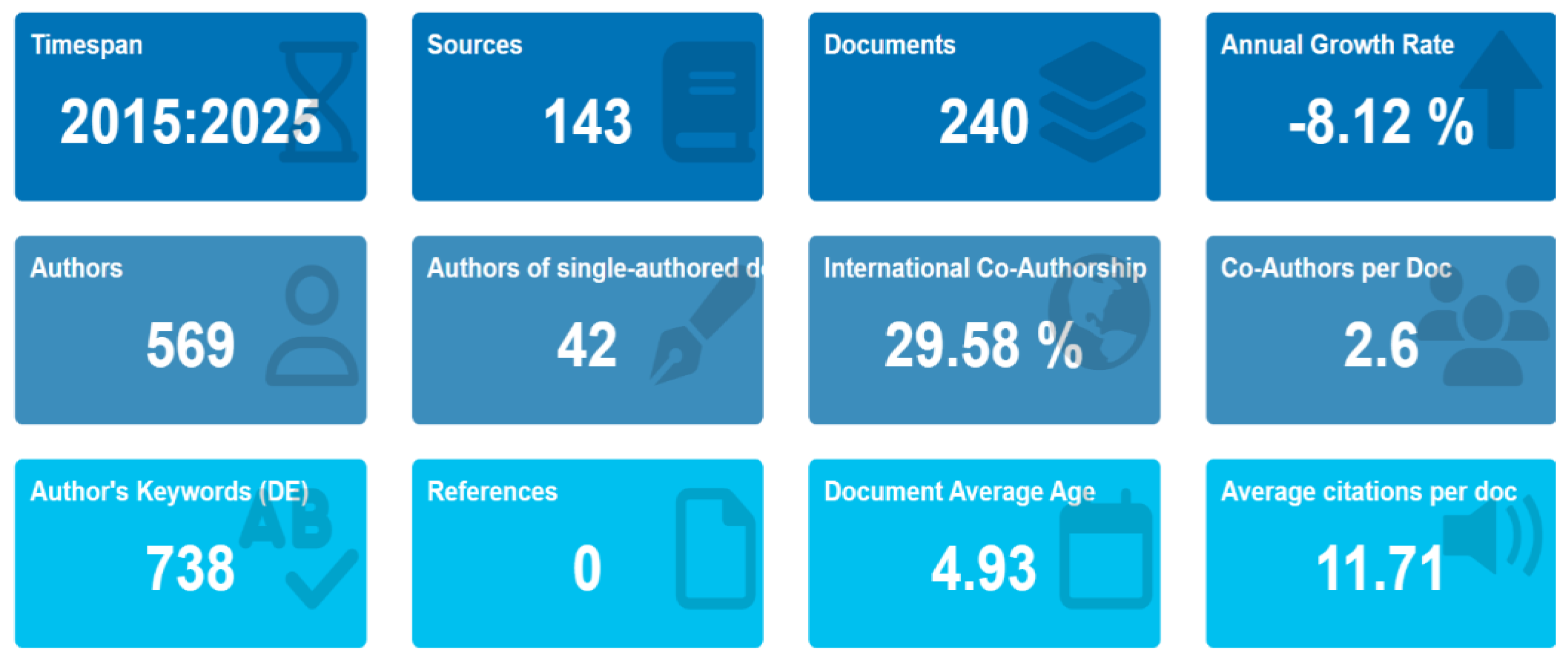
Figure 1.
Main Information ( 2014-2025 ). Source: Authors’ interpretation based on data retrieved from Scopus.
Figure 1.
Main Information ( 2014-2025 ). Source: Authors’ interpretation based on data retrieved from Scopus.
The bibliometric analysis was conducted using publications retrieved from Scopus, covering the period from 2014 to 2025 and limited to articles relevant to mergers and acquisitions in the banking sector. Keywords such as “M&A Valuation” OR “Mergers and Acquisitions” AND “Banks” were used. To ensure the academic relevance and consistency of the dataset, only documents categorized under the Economics subject area, published as articles in scientific journals, and written in English were included. Publications outside these criteria such as book chapters, conference papers, and non-English texts—were excluded. The dataset was exported and processed using Bibliometrics (an R-based tool) for detailed statistical analysis and visualization. The selected records were processed to generate descriptive statistics and visualizations that summarize annual scientific production, citation patterns, source concentration, and author productivity. Source concentration was examined using Bradford’s Law, a bibliometric principle that describes the distribution of literature across journals (Bradford 1934). Author productivity patterns were compared with Lotka’s Law, which describes the typical inverse relationship between the number of authors and the number of publications they produce (Lotka 1926). Citation counts were used to assess both global influence within the wider academic record and local influence within the collected corpus (Moed 2005).
Collaboration and thematic structures were explored through network visualizations and keyword co-occurrence mapping. These methods are widely used in bibliometric research to reveal the social connections among contributors and the conceptual linkages between research topics (Zupic & Cater, 2015).
5. Conclusions
This study set out to map the intellectual and social structure of research on mergers and acquisitions in the banking sector and to interpret what the observed regularities imply for knowledge and practice. Across the observation window, the production curve shows a clear upward trend that intensifies in the mid to late 2010s and then levels off near the end of the period. The apparent drop in the terminal year is best understood as a data window effect rather than a collapse of interest, since recent publications have shorter indexing and citation lags. What matters analytically is the sustained expansion that precedes the flattening, which indicates that banking M&A has become a durable theme rather than a transient response to episodic events.
Source analysis confirms that the field coalesces around a compact set of finance and banking journals that act as a de facto core. Bradford’s regularity appears strongly in the dataset, with a small group of outlets carrying a disproportionate share of the output and influence. Journals such as the Journal of Banking and Finance, Journal of Corporate Finance, and Research in International Business and Finance anchor the discourse, while a long tail of venues contributes occasional but thematically important papers. Local impact metrics show that volume leadership and within-field influence do not always coincide. Some frequently publishing outlets are not the most locally cited, which implies that authority within the niche is negotiated among sources rather than dictated by size alone. The consequence for the knowledge base is double edged. Concentration stabilizes standards and econometric practice, which supports cumulative inference, but it also risks methodological and topical path dependence when editorial templates become too narrow.
Authorship patterns follow a familiar inverse distribution. A long tail of one-time contributors surrounds a short head of recurrent authors who publish repeatedly and often collaborate in tight teams. Names that recur in the corpus, including Tampakoudis, Wanke, Ongena, and Nerantzidis, sit near the center of the co-authorship map and are prominent in local impact rankings. This structure is efficient for scaling programs of research and for building data pipelines, yet it can inhibit cross-pollination when bridges between clusters are scarce. The collaboration network in the study is fragmented into multiple small components with a few hubs. The largest component is not dominant enough to guarantee fast diffusion of constructs and methods across the field. That fragmentation helps explain why some thematic pockets stay peripheral even when their policy salience rises.
Institutional and country-level analyses reinforce the picture of concentration. A small set of universities account for a substantial share of the output, with the University of Macedonia particularly visible, followed by institutions such as California State University and the University of Essex. At country level, the United States leads in both production and collaboration, with strong ties to the United Kingdom and China. Greece, India, and France appear consistently, but the map shows sparse connections to many economies in Africa, South America, and Southeast Asia. This imbalance reflects both capacity and coverage. It shapes the discourse by anchoring canonical questions and identification strategies in contexts with deep datasets, mature markets, and stable regulatory regimes. The practical implication is that inferences drawn from the corpus travel best to similar institutional settings and should be applied with care elsewhere.
Keyword and topic structures reveal the intellectual center of gravity. High-frequency terms concentrate around banking, merger, efficiency, performance, risk, and financial system, with geography entering through country labels such as the United States and concepts like foreign direct investment. The dominant clusters are dense and central, which signals a mature conversation about financial performance and market structure effects of consolidation. Peripheral clusters related to digital transformation, cybersecurity, sustainability, regulatory technology, and post-merger cultural integration appear infrequently or at low strength. The absence of these topics at the center of the map does not mean they lack importance in practice. It indicates that the mainstream literature captured by the dataset still privileges questions that can be answered with established techniques and readily available financial variables. Thematic conservatism is therefore methodological as much as substantive.
Citation analysis adds another layer. A small number of studies attract a large share of citations, while influence tapers quickly after the top tier. This is a standard heavy-tailed pattern. Within the dataset, the most cited works tend to be either conceptual anchors or widely reused empirical studies on regulation, competition, or bank structure. The concentration of citations in older, often Western-authored contributions helps explain the inertia in question selection and methodological framing. At the same time, local citation counts identify a secondary canon inside the niche that is not always identical to the global finance canon. This split reminds readers that there are two distinct audiences for banking M&A research, the specialist community and the broader finance field, and that success in one does not guarantee visibility in the other.
Taken together, these strands yield a coherent interpretation. The literature on banking M&A, as observed in this study, is cumulative, technically disciplined, and center weighted. It answers with confidence a set of questions about efficiency, profitability, and market reactions. It documents who participates in the conversation, where they publish, and how they collaborate. It is less comprehensive on questions that require integration of operational metrics, consumer outcomes, conduct risk, and technology architecture into post-merger evaluation frameworks. The social structure of the field, with its concentrated journal core, recurrent author teams, and transatlantic collaboration axis, helps to explain both the strengths and the gaps.
The conclusion for scholarship is that future development will benefit from two complementary moves. The first is to preserve the rigor of mainstream designs while opening the measurement set to operational and organizational variables that capture how integration actually creates or destroys value. The second is to broaden participation geographically and institutionally so that consolidation experiences outside the traditional centers inform the core. The conclusion for practice is that bank M&A should not be evaluated only through lenses that optimize for short-window market reactions or static efficiency frontiers. Boards and supervisors should incorporate signals about integration feasibility, consumer impact, conduct risk, and technology resilience into both selection and post-merger monitoring. The maps and tables in this study make it clear where the weight of evidence lies and where attention remains thin. That clarity is the main contribution of the analysis.
This review has synthesized the structure and content of scholarly work on banking mergers and acquisitions using a comprehensive bibliometric lens. The evidence points to a field that has grown steadily, concentrated around a compact set of outlets and teams, and organized itself through selective international collaboration. Production and citation dynamics reflect maturation rather than exhaustion, with recent dips attributable to data lag rather than waning interest. The core journals provide methodological stability but also channel attention toward questions that fit established templates. Recurring authors and institutions enable scale and continuity while limiting cross-cluster exchange. Country patterns show strong transatlantic and East Asian ties and thin coverage elsewhere. The conceptual map is dominated by efficiency and performance themes, with emerging priorities in technology and sustainability still peripheral.
These observations carry concrete implications for research design, editorial policy, and governance of practice. For researchers, the priority is to connect the rigor of established empirical strategies with richer integration data and with outcomes that matter to customers, supervisors, and operations. That means augmenting financial indicators with measures of system integration milestones, data quality and lineage, control environment maturity, service reliability, and customer treatment. It also means triangulating event-study signals and frontier estimates with designs that exploit policy changes, staggered market entries, or credible matched comparisons to strengthen identification. For editors and reviewers in the core outlets, incremental expansions of scope to admit well-identified studies that integrate operational and social outcomes would reduce thematic path dependence without sacrificing quality. For institutions in underrepresented regions, collaborative links with the existing hubs can accelerate entry into the main conversation, provided that data standards and transparency are prioritized.
For practitioners and supervisors, the review suggests disciplined heuristics that align with the patterns observed. Treat deal timing as an option and exercise it when policy and markets create favorable conditions for funding and integration. Evaluate target fit with concrete selection rules that privilege local complementarities and manageable cultural distance. Elevate risk control maturity as an explicit synergy and track it with hard milestones. Embed digital capability and sustainability constraints into operating model blueprints rather than bolting them on after close. Strengthen board oversight during integration, including diversity of expertise, to moderate risk choices when incentives to meet synergy targets are strongest. Intensify due diligence on beneficial ownership and related-party exposure in cross-border transactions, especially in jurisdictions with opacity risk.
This study is not without limitations. The analysis reflects the coverage and indexing practices of the chosen database and the parameter choices used to construct networks and thematic maps. Recent years are undercounted by construction. Counting rules and thresholds, while applied consistently, influence visibility for minority themes and small collaboration components. These constraints do not overturn the main patterns reported, but they should be borne in mind when interpreting margins and ranks. Future work can address these limits by combining databases, documenting inclusion rules at finer granularity, experimenting with fractional counting alongside whole counts, and linking bibliometric structures to curated datasets of integration and conduct outcomes.
The central message is that consolidation in banking produces value when selection is disciplined, integration is deep and competently governed, market structure preserves contestability, and institutional capacity is credible. The current literature provides solid evidence on parts of this claim and thin evidence on others. By pinpointing where knowledge is dense and where it is sparse, this review provides a roadmap for the next cycle of research and for decision makers who must evaluate mergers under real constraints.
Author Contributions
“Conceptualization, 1,2, and 3.; methodology, 1,2 and 3.; software, validation, and formal analysis 1and 2.; resources, 3.; data curation, 1 and 3.; writing—original draft preparation, 1,2.; writing—review and editing, 1,2, and 3.; supervision, 3. All authors have read and agreed to the published version of the manuscript. Please turn to the CRediT taxonomy for the term explanation. Authorship must be limited to those who have contributed substantially to the work reported.
Funding
This research received no external funding.
Data Availability Statement
We would like to state that no new data were created,.
Acknowledgments
During the preparation of this manuscript/study, the author(s) used AI to support language refinement, improve academic tone, reduce repetition, enhance clarity, and assist in checking the consistency of citations and references. The AI tool was not used to generate original research data, conduct the bibliometric analysis, create figures, fabricate citations, or replace the authors’ scholarly judgment. The authors have reviewed and edited the output and take full responsibility for the content of this publication.
Conflicts of Interest
The authors declare no conflicts of interest.
References
- Amel, D.; Barnes, C.; Panetta, F.; Salleo, C. Consolidation and efficiency in the financial sector: A review of the international evidence. J. Bank. Financ. 2004, 28, 2493–2519. [Google Scholar] [CrossRef]
- Aria, M.; Cuccurullo, C. bibliometrix: An R-tool for comprehensive science mapping analysis. J. Informetr. 2017, 11, 959–975. [Google Scholar] [CrossRef]
- Cappa, F.; Collevecchio, F.; Oriani, R.; Peruffo, E. Banks responding to the digital surge through Open Innovation: Stock market performance effects of M&As with fintech firms. J. Econ. Bus. 2022, 121. [Google Scholar] [CrossRef]
- Carmassi, J.; Herring, R. The Corporate Complexity of Global Systemically Important Banks. J. Financ. Serv. Res. 2016, 49, 175–201. [Google Scholar] [CrossRef]
- Chang, X.; Shekhar, C.; Tam, L.H.K.; Yao, J. Industry Expertise, Information Leakage and the Choice of M&A Advisors. J. Bus. Financ. Account. 2016, 43, 191–225. [Google Scholar] [CrossRef]
- Chen, Q.; Vashishtha, R. The effects of bank mergers on corporate information disclosure. J. Account. Econ. 2017, 64, 56–77. [Google Scholar] [CrossRef]
- Chen, V.Z.; Hobdari, B.; Zhang, Y. Blockholder heterogeneity and conflicts in cross-border acquisitions. J. Corp. Financ. 2019, 57, 86–101. [Google Scholar] [CrossRef]
- Collevecchio, F.; Cappa, F.; Peruffo, E.; Oriani, R. When do M&As with Fintech Firms Benefit Traditional Banks? Br. J. Manag. 2023, 35, 192–209. [Google Scholar] [CrossRef]
- Cornaggia, J.; Li, J.Y. The value of access to finance: Evidence from M&As. J. Financ. Econ. 2019, 131, 232–250. [Google Scholar] [CrossRef]
- Cornaggia, J.; Mao, Y.; Tian, X.; Wolfe, B. Does banking competition affect innovation? J. Financ. Econ. 2015, 115, 189–209. [Google Scholar] [CrossRef]
- Cuestas, J.C.; Lucotte, Y.; Reigl, N. Banking sector concentration, competition and financial stability: the case of the Baltic countries. Post.-Communist Econ. 2019, 32, 215–249. [Google Scholar] [CrossRef]
- Cumming, D.; Jindal, V.; Kumar, S.; Pandey, N. Mergers and acquisitions research in finance and accounting: Past, present, and future. Eur. Financ. Manag. 2023, 29, 1464–1504. [Google Scholar] [CrossRef]
- Cumming, D.; Jindal, V.; Kumar, S.; Pandey, N. Mergers and acquisitions research in finance and accounting: Past, present, and future. Eur. Financ. Manag. 2023, 29, 1464–1504. [Google Scholar] [CrossRef]
- Delis, M.D.; Kokas, S.; Ongena, S. Foreign Ownership and Market Power in Banking: Evidence from a World Sample. J. Money Crédit. Bank. 2016, 48, 449–483. [Google Scholar] [CrossRef]
- Donthu, N.; Kumar, S.; Mukherjee, D.; Pandey, N.; Lim, W.M. How to conduct a bibliometric analysis: An overview and guidelines. J. Bus. Res. 2021, 133, 285–296. [Google Scholar] [CrossRef]
- Du, K.; Sim, N. Mergers, acquisitions, and bank efficiency: Cross-country evidence from emerging markets. Res. Int. Bus. Financ. 2016, 36, 499–510. [Google Scholar] [CrossRef]
- Eaton, G.W.; Guo, F.; Liu, T.; Officer, M.S. Peer selection and valuation in mergers and acquisitions. J. Financ. Econ. 2022, 146, 230–255. [Google Scholar] [CrossRef]
- Gadzo, S.G.; Kportorgbi, H.K.; Gatsi, J.G. Credit risk and operational risk on financial performance of universal banks in Ghana: A partial least squared structural equation model (PLS SEM) approach. Cogent Econ. Financ. 2019, 7. [Google Scholar] [CrossRef]
- Goetz, M.R. Competition and bank stability. J. Financ. Intermediation 2018, 35, 57–69. [Google Scholar] [CrossRef]
- Gulamhussen, M.A.; Hennart, J.-F.; Pinheiro, C.M. What drives cross-border M&As in commercial banking? J. Bank. Financ. 2016, 72, S6–S18. [Google Scholar] [CrossRef]
- Halkos, G.E.; Matousek, R.; Tzeremes, N.G. Pre-evaluating technical efficiency gains from possible mergers and acquisitions: evidence from Japanese regional banks. Rev. Quant. Financ. Account. 2014, 46, 47–77. [Google Scholar] [CrossRef]
- Hanley, K.W.; Hoberg, G. Dynamic Interpretation of Emerging Risks in the Financial Sector. Rev. Financ. Stud. 2019, 32, 4543–4603. [Google Scholar] [CrossRef]
- Huang, T.-H.; Chiang, D.-L.; Chao, S.-W. A new approach to jointly estimating the Lerner index and cost efficiency for multi-output banks under a stochastic meta-frontier framework. Q. Rev. Econ. Financ. 2017, 65, 212–226. [Google Scholar] [CrossRef]
- Masoumi, A.H.; Yu, M.; Nagurney, A. Mergers and acquisitions in blood banking systems: A supply chain network approach. Int. J. Prod. Econ. 2017, 193, 406–421. [Google Scholar] [CrossRef]
- McKillop, D.; French, D.; Quinn, B.; Sobiech, A.L.; Wilson, J.O.S. Cooperative financial institutions: A review of the literature. Int. Rev. Financ. Anal. 2020, 71, 101520. [Google Scholar] [CrossRef]
- McKillop, D.; French, D.; Quinn, B.; Sobiech, A.L.; Wilson, J.O.S. Cooperative financial institutions: A review of the literature. Int. Rev. Financ. Anal. 2020, 71, 101520. [Google Scholar] [CrossRef]
- Omarova, S.; Steele, G. Banking and Antitrust. In Yale LJ; 2023; p. 1162. [Google Scholar]
- Pessin, V.Z.; Yamane, L.H.; Siman, R.R. Smart bibliometrics: an integrated method of science mapping and bibliometric analysis. Scientometrics 2022, 127, 3695–3718. [Google Scholar] [CrossRef]
- Sghaier, A.; Hamza, T. Does boardroom gender diversity affect the risk profile of acquiring banks? Manag. Financ. 2018, 44, 1174–1199. [Google Scholar] [CrossRef]
- Teichmann, F.M.J. Twelve methods of money laundering. J. Money Laund. Control. 2017, 20, 130–137. [Google Scholar] [CrossRef]
- Wang, R.; Sui, Y. Political institutions and foreign banks’ risk-taking in emerging markets. J. Multinatl. Financ. Manag. 2019, 51, 45–60. [Google Scholar] [CrossRef]
- Wanke, P.; Azad, M.A.K.; Emrouznejad, A.; Antunes, J. A dynamic network DEA model for accounting and financial indicators: A case of efficiency in MENA banking. Int. Rev. Econ. Financ. 2019, 61, 52–68. [Google Scholar] [CrossRef]
- Wanke, P.; Azad, M.A.K.; Emrouznejad, A.; Antunes, J. A dynamic network DEA model for accounting and financial indicators: A case of efficiency in MENA banking. Int. Rev. Econ. Financ. 2019, 61, 52–68. [Google Scholar] [CrossRef]
- Wanke, P.; Maredza, A.; Gupta, R. Merger and acquisitions in South African banking: A network DEA model. Res. Int. Bus. Financ. 2017, 41, 362–376. [Google Scholar] [CrossRef]
- Wanke, P.; Maredza, A.; Gupta, R. Merger and acquisitions in South African banking: A network DEA model. Res. Int. Bus. Financ. 2017, 41, 362–376. [Google Scholar] [CrossRef]
- Zainuldin, M.H.; Lui, T.K. A bibliometric analysis of CSR in the banking industry: a decade study based on Scopus scientific mapping. Int. J. Bank. Mark. 2021, 40, 1–26. [Google Scholar] [CrossRef]
- Zupic, I.; Čater, T. Bibliometric methods in management and organization. Organ. Res. Methods 2015, 18, 429–472. [Google Scholar] [CrossRef]
Disclaimer/Publisher’s Note: The statements, opinions and data contained in all publications are solely those of the individual author(s) and contributor(s) and not of MDPI and/or the editor(s). MDPI and/or the editor(s) disclaim responsibility for any injury to people or property resulting from any ideas, methods, instructions or products referred to in the content. |
© 2026 by the authors. Licensee MDPI, Basel, Switzerland. This article is an open access article distributed under the terms and conditions of the Creative Commons Attribution (CC BY) license.
Copyright: This open access article is published under a Creative Commons CC BY 4.0 license, which permit the free download, distribution, and reuse, provided that the author and preprint are cited in any reuse.


