Submitted:
12 May 2026
Posted:
13 May 2026
You are already at the latest version
Abstract
Keywords:
MSC: 94A55
1. Introduction
- 1.
- merit factor, and
- 2.
- peak sidelobe level.
1.1. Contributions of the Paper
- The obtained resulting binary sequences with the best-known peak sidelobe levels have merit factor . It appears to be close to a whole number.
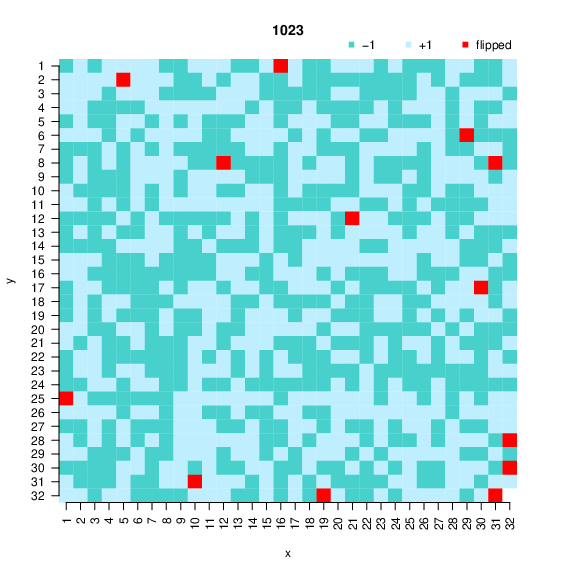
- The number of elements that differ between the resulting binary sequences and the initial Legendre sequences follows a linear dependence on the sequence length (n), namely .
1.2. Structure of the Paper
2. Preliminary
- (i)
- For any fixed , the proportion of sequences such that approaches 1 as .
- (ii)
- If is any function of n such that , then the proportion of sequences for which approaches 1 as .
3. Related Works
4. Methodology
5. Experiments
5.1. Results on Rudin-Shapiro Sequences
5.2. Results on Legendre Sequences
5.3. Two Conjectures
6. Discussion
- 1.
- An optimization algorithm can take into account Conjecture 5 as heuristic knowledge. Let (integer) value . Then the number of possible choices of q elements within a binary sequence of length n is equal to . Suppose , then the number of possible choices is approximately . It becomes a huge value when n is increased.
- 2.
- Since the search space for finding (optimal) binary sequences is huge, the obtained PSLs in Table 3 are not necessarily optimal. Binary sequences with even better PSLs may be found in the future, but this will likely require considerable computational effort.
- 3.
- Conjectures 2 and 3 proposed by Dmitriev and Jedwab [13] show the excellent grow rate of m-sequences. These sequences may also be good candidates to be used as seed/initial sequences in our heuristic algorithm. This can be a great challenge for further work.
7. Conclusions
Author Contributions
Funding
Data Availability Statement
Acknowledgments
Conflicts of Interest
References
- Schmidt, K.U. Sequences with small correlation. Des. Codes Cryptogr. 2016, 78, 237–267. [Google Scholar] [CrossRef]
- Golay, M. A class of finite binary sequences with alternate auto-correlation values equal to zero (corresp.). IEEE Trans. Inf. Theory 1972, 18, 449–450. [Google Scholar] [CrossRef]
- Golay, M. The merit factor of Legendre sequences (corresp.). IEEE Trans. Inf. Theory 1983, 29, 934–936. [Google Scholar] [CrossRef]
- Zhang, M.; Adhikary, A.R.; Yang, Y.; Zhou, Z.; Fan, P. Designing Unimodular Arrays With Low Correlation Sidelobes for Omnidirectional Transmission in Massive MIMO Systems. IEEE Trans. Commun. 2026, 74, 5670–5683. [Google Scholar] [CrossRef]
- Brest, J.; Bošković, B. Low Autocorrelation Binary Sequences: Best-Known Peak Sidelobe Level Values. IEEE Access 2021, 9, 67713–67723. [Google Scholar] [CrossRef]
- Brest, J.; Brest, A.; Pšeničnik, B.; Popič, J.; Borko, B. Oddaljenost neperiodičnih binarnih zaporedij glede na dve meri avtokorelacijskih lastnosti. Elektrotehniski Vestn. 2025, 92, 97–103. (In Slovene). Available online: https://ev.fe.uni-lj.si/3-2025/Brest.pdf.
- Zhang, Z.; Shen, J.; Kumar, N.; Pistoia, M. New Improvements in Solving Large LABS Instances Using Massively Parallelizable Memetic Tabu Search. arXiv 2025, arXiv:2504.00987. [Google Scholar] [CrossRef]
- Shaydulin, R.; Li, C.; Chakrabarti, S.; DeCross, M.; Herman, D.; Kumar, N.; Larson, J.; Lykov, D.; Minssen, P.; Sun, Y.; et al. Evidence of scaling advantage for the quantum approximate optimization algorithm on a classically intractable problem. Sci. Adv. 2024, 10, eadm6761. [Google Scholar] [CrossRef]
- Cadavid, A.G.; Chandarana, P.; Romero, S.V.; Trautmann, J.; Solano, E.; Patti, T.L.; Hegade, N.N. Scaling advantage with quantum-enhanced memetic tabu search for LABS. arXiv 2025, arXiv:2511.04553. [Google Scholar] [CrossRef]
- Chen, Y.; Lin, R. Computationally Efficient Long Binary Sequence Designs with Low Autocorrelation Sidelobes. IEEE Trans. Aerosp. Electron. Syst. 2022, 58, 1966–1980. [Google Scholar] [CrossRef]
- Pšeničnik, B.; Mlinarič, R.; Brest, J.; Bošković, B. Dual-step optimization for binary sequences with high merit factors. Digit. Signal Process. 2025, 165, 105316. [Google Scholar] [CrossRef]
- Coxson, G.; Russo, J. Efficient exhaustive search for optimal-peak-sidelobe binary codes. IEEE Trans. Aerosp. Electron. Syst. 2005, 41, 302–308. [Google Scholar] [CrossRef]
- Dmitriev, D.; Jedwab, J. Bounds on the growth rate of the peak sidelobe level of binary sequences. Adv. Math. Commun. 2007, 1, 461–475. [Google Scholar] [CrossRef]
- Nunn, C.J.; Coxson, G.E. Best-known autocorrelation peak sidelobe levels for binary codes of length 71 to 105. IEEE Trans. Aerosp. Electron. Syst. 2008, 44, 392–395. [Google Scholar] [CrossRef]
- Dimitrov, M.; Baitcheva, T.; Nikolov, N. On the Generation of Long Binary Sequences With Record-Breaking PSL Values. IEEE Signal Process. Lett. 2020, 27, 1904–1908. [Google Scholar] [CrossRef]
- Dimitrov, M.; Baicheva, T.; Nikolov, N. Hybrid Constructions of Binary Sequences With Low Autocorrelation Sideobes. IEEE Access 2021, 9, 112400–112410. [Google Scholar] [CrossRef]
- Brest, J.; Popič, J.; Herzog, J.; Bošković, B. An efficient algorithm for designing long aperiodic binary sequences with low auto-correlation sidelobes. IEEE Access 2024, 12, 108921–108927. [Google Scholar] [CrossRef]
- Bose, A. Waveform Synthesis for Active Sensing with Emerging Applications. PhD thesis, University of Illinois at Chicago, 2021. [Google Scholar]
- Bose, A.; Soltanalian, M. Constructing binary sequences with good correlation properties: An efficient analytical-computational interplay. IEEE Trans. Signal Process. 2018, 66, 2998–3007. [Google Scholar] [CrossRef]
- Lin, R.; Soltanalian, M.; Tang, B.; Li, J. Efficient Design of Binary Sequences With Low Autocorrelation Sidelobes. IEEE Trans. Signal Process. 2019, 67, 6397–6410. [Google Scholar] [CrossRef]
- Dimitrov, M. On the aperiodic autocorrelations of rotated binary sequences. IEEE Commun. Lett. 2021, 25, 1427–1430. [Google Scholar] [CrossRef]
- Lin, R.; Chen, Y.; So, H.C.; Li, J. On Binary Sequence Design via PSL Minimization. IEEE Signal Process. Lett. 2024, 31, 151–155. [Google Scholar] [CrossRef]
- Ximenes, J.J.; Pires, M.A.; Villas-Bôas, J.M. Enhanced spreading in continuous-time quantum walks using aperiodic temporal modulation of defects. Phys. Rev. A 2026, 113, 022410. [Google Scholar] [CrossRef]
- Katz, D.J.; van der Linden, C.M. Peak Sidelobe Level and Peak Crosscorrelation of Golay–Rudin–Shapiro Sequences. IEEE Trans. Inf. Theory 2022, 68, 3455–3473. [Google Scholar] [CrossRef]
- Ein-Dor, L.; Kanter, I.; Kinzel, W. Low autocorrelated multiphase sequences. Phys. Rev. E 2002, 65, 020102. [Google Scholar] [CrossRef]
- Moon, J.; Moser, L. On the correlation function of random binary sequences. SIAM J. Appl. Math. 1968, 16, 340–343. [Google Scholar] [CrossRef]
- Jedwab, J.; et al. A Survey of the Merit Factor Problem for Binary Sequences. In Proceedings of the SETA; Springer, 2004; pp. 30–55. [Google Scholar] [CrossRef]
- Baden, J. Efficient Optimization of the Merit Factor of Long Binary Sequences. IEEE Trans. Inf. Theory 2011, 57, 8084–8094. [Google Scholar] [CrossRef]
- Golomb, S.W. Shift Register Sequences Holden-Day; San Francisco, 1967. [Google Scholar]
- Golomb, S.W. Periodic binary sequences: solved and unsolved problems. In Proceedings of the Sequences, Subsequences, and Consequences: International Workshop, SSC 2007, Los Angeles, CA, USA, May 31-June 2, 2007; Springer, 2007; pp. 1–8. Available online: https://link.springer.com/chapter/10.1007/978-3-540-77404-4_1.
- Jedwab, J. What can be used instead of a Barker sequence? Contemp. Math. 2008, 461, 153–178. Available online: https://www.sfu.ca/~jed/Papers/Jedwab.%20Barker%20Sequence%20Alternatives.%202008.pdf.
- Mow, W.H.; Du, K.L.; Wu, W.H. New evolutionary search for long low autocorrelation binary sequences. IEEE Trans. Aerosp. Electron. Syst. 2015, 51, 290–303. [Google Scholar] [CrossRef]
- Coxson, G.E.; Russo, J.C.; Luther, A. Long Low-PSL Binary Codes by Multi-Thread Evolutionary Search. In Proceedings of the 2020 IEEE International Radar Conference (RADAR); IEEE, 2020; pp. 256–261. [Google Scholar] [CrossRef]
- Bošković, B.; Brest, J. Two-phase optimization of binary sequences with low peak sidelobe level value. Expert Syst. With Appl. 2024, 251, 124032. [Google Scholar] [CrossRef]
- Jedwab, J.; Yoshida, K. The peak sidelobe level of families of binary sequences. IEEE Trans. Inf. Theory 2006, 52, 2247–2254. [Google Scholar] [CrossRef]
- R Core Team. R: A Language and Environment for Statistical Computing. R Foundation for Statistical Computing, Vienna, Austria, 2021; Available online: https://www.R-project.org/.
- Zhang, M.; Zhou, Z.; Yang, M.; Liu, Z.; Yang, Y. A hybrid algorithm for the search of long binary sequences with low aperiodic autocorrelations. Soft Comput. 2021, 25, 12725–12744. [Google Scholar] [CrossRef]


| m | LB | UB | PSL | |
|---|---|---|---|---|
| 10 | 1024 | 60 | 104 | 85 |
| 11 | 2048 | 100 | 172 | 153 |
| 12 | 4096 | 166 | 286 | 217 |
| 13 | 8192 | 275 | 475 | 373 |
| 14 | 16384 | 457 | 789 | 557 |
| 15 | 32768 | 768 | 1309 | 961 |
| 16 | 65536 | 1257 | 2172 | 1717 |
| 17 | 131072 | 2086 | 3604 | 2445 |
| 18 | 262144 | 3461 | 5779 | 4285 |
| 19 | 524288 | 5743 | 9920 | 6257 |
| 20 | 1048576 | 9527 | 16457 | 11153 |
| m | PSL | F | d | [%] | ||
|---|---|---|---|---|---|---|
| 10 | 1024 | 24 | 0.7500 | 3.84815 | 519 | 50.68 |
| 11 | 2048 | 34 | 0.7513 | 4.26986 | 1002 | 49.93 |
| 12 | 4096 | 49 | 0.7656 | 4.13834 | 1952 | 47.66 |
| 13 | 8192 | 69 | 0.7623 | 4.29800 | 3590 | 43.82 |
| 14 | 16384 | 101 | 0.7891 | 4.11236 | 5535 | 33.78 |
| 15 | 32768 | 146 | 0.8065 | 3.95976 | 10872 | 33.18 |
| 16 | 65536 | 209 | 0.8164 | 3.94681 | 21477 | 32.77 |
| m | PSL | F | d | [%] | ||
|---|---|---|---|---|---|---|
| 10 | 1023 | 22 | 0.6878 | 4.78203 | 13 | 1.27 |
| 11 | 2047 | 32 | 0.7073 | 4.82918 | 31 | 1.51 |
| 12 | 4095 | 45 | 0.7032 | 5.09739 | 40 | 0.98 |
| 13 | 8191 | 66 | 0.7292 | 5.02281 | 86 | 1.05 |
| 14 | 16383 | 93 | 0.7266 | 5.03535 | 165 | 1.01 |
| 15 | 32767 | 133 | 0.7347 | 4.99564 | 353 | 1.08 |
| 16 | 65535 | 189 | 0.7383 | 5.06485 | 700 | 1.07 |
| 17 | 131071 | 269 | 0.7430 | 5.00051 | 1394 | 1.06 |
| 18 | 262143 | 380 | 0.7422 | 4.99135 | 2855 | 1.09 |
| 19 | 524287 | 540 | 0.7457 | 5.02356 | 5319 | 1.01 |
| 20 | 1048575 | 766 | 0.7480 | 4.99350 | 10873 | 1.04 |
Disclaimer/Publisher’s Note: The statements, opinions and data contained in all publications are solely those of the individual author(s) and contributor(s) and not of MDPI and/or the editor(s). MDPI and/or the editor(s) disclaim responsibility for any injury to people or property resulting from any ideas, methods, instructions or products referred to in the content. |
© 2026 by the authors. Licensee MDPI, Basel, Switzerland. This article is an open access article distributed under the terms and conditions of the Creative Commons Attribution (CC BY) license (http://creativecommons.org/licenses/by/4.0/).