
Preprint
Article

This version is not peer-reviewed.

Biomonitoring of Minnesota Firefighters Exposed to Prolonged Metal Recycling Yard Fire

Submitted:

13 May 2026

Posted:

13 May 2026

You are already at the latest version

Abstract
A metal recycling facility scrapyard fire that burned for four days continuously in February 2020 in rural Minnesota resulted in firefighters from around Minnesota to mobilize and aid. Combusted material included cars, refrigerators, metals, glass, foam, insulation. Urine, blood and serum specimens were collected one day later. Parameters collected included: CBC with differential, BMP, blood heavy metals, urine heavy metals, and serum heavy metals. This massive and prolonged industrial fire provided an opportunity for biomonitoring of hazardous, and unique, exposures acutely, in concordance with concerns raised by the employees at risk. Initial analysis of these results did not find evidence of acute concern regarding the biomonitoring results. However, some of these results may portend the potential for long-term consequences such as the development of occupational cancers, especially if there was recurrent exposure in prior or proceeding fires.
Keywords: 
;  ;  ;  ;  ;  

1. Introduction

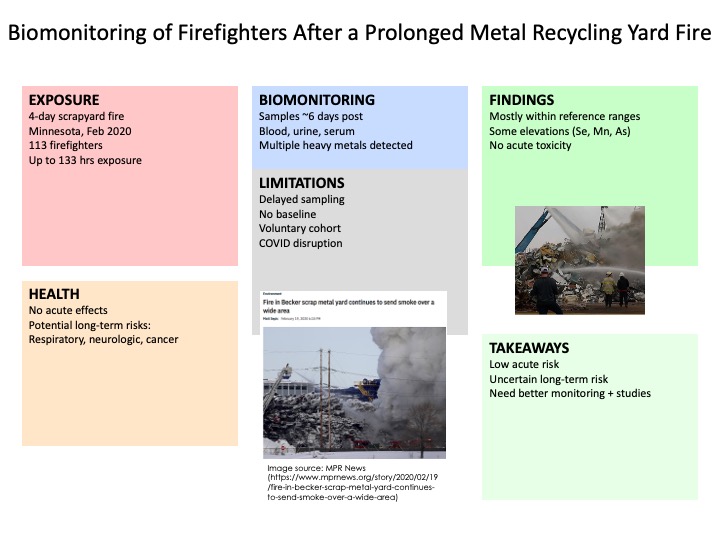
A metal recycling facility scrapyard fire that burned for four days continuously in February 18th – 22nd, 2020 in rural Minnesota resulted in firefighters from around Minnesota to mobilize and aid in the suppression and management of this industrial fire. Combusted material included cars, refrigerators, metals, glass, foam, insulation, and was in the context of below freezing temperatures. Firefighter leadership expressed a concern regarding their exposure to heavy metals soon after these collaborative firefighting efforts began, and reached out to occupational and environmental medicine for guidance regarding possible biomonitoring. Specimens were collected one day later.
Biomonitoring for chemical exposures in firefighters includes (1) exposure, (2) effect, and (3) susceptibility. The exposure reflects that the chemical or compound is absorbed by the body and may be detected in the urine or blood with concentrations of the chemical or metabolite. The effect may cause biological or physiological alteration that may lead to health impairment [1], which includes DNA mutation or cytogenetic changes. The susceptibility can be inherent or acquired sensitivity or resistance to a specific exposure, such as genetic polymorphism in metabolic activation or deactivation enzymes [2].
Occupational exposure in firefighters is primarily through inhalation or through the skin absorption and less so by ingestion.
The National Institute of Occupational Safety and Health (NIOSH) classifies heavy metals as cancer-causing carcinogens [3]. However, limited biomonitoring data exists regarding firefighters’ hazardous exposures [4,5], and particularly as it pertains to a prolonged and significant industrial fire exposure. The goal of this effort is to broadly assess Minnesota firefighters’ blood and urine concentrations of selected heavy metals following a prolonged and unique industrial fire.

2. Methods

Fire chiefs of fire departments that were part of the firefighting of this large industrial fire were provided information to disseminate amongst their firefighters to allow them to present for biomonitoring to a clinic nearby to the fire location. Demographic characteristics, including employee’s fire department, years in the fire service, time spent at the fire of concern, and types of firefighter duties performed during fire were collected via survey at the time of laboratory collection, in addition to biomonitoring data.
Biomonitoring samples were performed without the requirement of fasting, and included basic clinical laboratory results (complete blood count with differential, basic metabolic panel), spot serum and 24-hour urine measurements of several heavy metals (with reflex fractionated arsenic, if non-fractionated level was abnormal). Less than level of detection was set to zero, while any greater value was interpreted as positive. Individual letters were sent to participating firefighters with their results and interpretation of the results.
The following parameters were determined for all exposed individuals: CBC with differential, BMP, blood heavy metals (arsenic, cadmium, lead, mercury), heavy metals urine (arsenic, lead, mercury, cadmium, copper, zinc), serum (copper, chromium, manganese, selenium, cobalt, nickel, tin, silver) and urine (copper, chromium, manganese, selenium, cobalt, nickel, thallium, silver), and blood (antimony, thallium, bismuth). No air was collected using personal samplers.
Statistical analysis was performed using SAS 9.4 software (SAS Institute Inc. 2022 Cary, NC). Mean and standard deviation (SD) or median (minimum, maximum) are given for continuous variable. Number and percentage are given for categorical variables. A p-value of 0.05 is considered statistically significant. Non-parametric Spearman’s rank for exposure (or exposure type) by each analyte concentration was analyzed
General and occupational demographic information about the firefighters involved.

3. Results

A total of 113 firefighters from 21 fire departments in Minnesota presented for biomonitoring following this industrial fire exposure [Figure 1]. Included firehouses encompassed a 60+ mile radius [Figure 2]. Of these, four firefighters opted out of providing survey data and were excluded from aggregate analysis. Of the 109 firefighters included in the final analysis, 99 provided 24-hour urine samples. Demographic information showed a mean age of 39.9, with 57% of firefighters aged 40 or under at the time of sampling. Sampled participants were overwhelmingly male, and the majority had fire suppression and/or driver-engineer roles [Figure 3]. Furthermore, 66% of firefighters had 10 years of less of firefighting experience. At the time of the fire, 80% of responders spent less than 24 hours total on-site, over the course of the 5 days the recycling yard fire took place. Of special interest, the average time from exposure until lab collection was greater than 6 days [Figure 4].
Measurements were performed by Minnesota Department of Health (MDH), specifically Public Health Laboratory Division and Environmental Laboratory Section. Clinical laboratory data were within reference ranges for all firefighters, except for a small proportion of firefighters with slightly high mean corpuscular hemoglobin concentration, slightly low red cell distribution width, and mildly high non-fasting glucose levels, none of which were of clinical concern. Firefighters reported exposure time at the industrial fire site ranged from 4 – 133 hours (mean: 16.23 hours; median 8 hours) [Figure 4], and time from the end of their time at the industrial fire ranged from 0 – 19.5 days (mean: 6.32 days; median 6.08 days).
Despite a general delay in exposure monitoring, blood and serum samples demonstrated qualitative presence of all of the metals tested for. This included Antimony, Arsenic, Bismuth, Cadmium, Chromium, Cobalt, Copper, Manganese, Mercury, Nickel, Selenium, Silver, Thallium,, Tin, and Zinc. While less sensitive, urine qualitative urine sampling demonstrated all of the previously mentioned heavy metals, with the exception of Antimony, Bismuth, and Tin ([Figure 5].
Heavy metal biomonitoring data were within reference ranges except for elevated urine levels of arsenic (n=5), copper (n=1), zinc (n=2), chromium (n=5), selenium (n=67), cobalt (n=1), and antimony (n=1); elevated blood levels of red blood cell manganese (n=26) and elevated whole blood bismuth (n=1) [Figure 6].
Fire chiefs were particularly concerned about Arsenic levels, due to the potential for physiologic harm. Further quantitative urine analysis showed elevations in 6 (volume), 6 (24 hour urine collection) and 5 (ratio) samples respectively. This suggests that general urine sampling with other heavy metals on panel was accurate, when isolated [Figure 7].
In all cases, elevated heavy metal levels were not found to be clinically significant based on occupational exposure limits and medical literature. Interpretation letters were sent to firefighters quickly after laboratory results were returned, with reassurance that the results were without acute concern, and firefighters were offered the opportunity for follow-up biomonitoring or clinical evaluation if desired. No firefighters presented for recurrent testing nor for clinical evaluation.

4. Discussion

The metal yard fire in this article was an acute and intense exposure to the firefighters involved. Biomonitoring highlighted a variety of heavy metals these workers were potentially exposed to. The greatest exposure seen, per capita, was selenium. Selenium is known to cause airway irritation, coughing, bronchitis and pneumonitis. Even acute exposure can lead to decreased blood pressure to the level of shock, and GI upset has been observed depending on route of exposure [6].
Similarly, manganese can cause respiratory tract inflammation and lowered blood pressure, but most famously may cause Parkinson-like syndrome or “manganism”, though this is exclusively a chronic, progressive phenomenon [7].
In a similarly notorious fashion, arsenic is known to cause death through downstream cardiac arrythmias, though this is usually chronic and via ingestion. To stay pertinent to our population, more likely inhalational disease conditions might include laryngitis, anemia, Raynaud’s phenomenon, and a dermatitis that can include hyperpigmentation [8].
Acute inhalational chromium exposure is perhaps the most clearly concerning for respiratory disease, including asthma with confirmed FEV1 decrease, cough, post-nasal drip and a choking sensation (described in some studies), as well as perforations of both the nasal septum and the skin, sometimes known as ‘chrome holes [9].
In regard to zinc, metal fume fever, as it is known can occur in 1-4 days after acute exposure. This syndrome includes fever accompanied by cough, substernal chest pain, and dyspnea, and is usually self-limited post-exposure [10].
To round out the list of pertinent exposures in our sample: cobalt is known to have inhalational effects such as asthma, polycythemia and potentially impaired thyroid function [11]. Copper has been noted to cause coughing, sneezing and thoracic pain, as well as decreased hemoglobin, and GI symptoms such as abdominal pain and, rarely, melena [12]. Antimony has been observed to cause interstitial pulmonary fibrosis, myocardial damage with EKG changes, as well as hypoglycemia [13]. Finally, bismuth has been seen to have nephrotoxicity [14].
Arsenic exposure summary, confirming previous, full panel heavy metal exposure.

5. Conclusions

Firefighters generally have significant hazardous toxic exposures to products of complete and incomplete combustion, as well as to heavy metals. This massive and prolonged industrial fire provided an opportunity for biomonitoring of hazardous, and unique, exposures acutely, in concordance with concerns raised by the employees at risk.
Initial analysis of these results did not find evidence of acute concern regarding the biomonitoring results. However, some of these results may portend the potential for long-term consequences such as the development of occupational cancers, especially if there was recurrent exposure in prior or proceeding fires.
A significant limitation of this study is that the selection of biomarkers, and the process for recruitment and collection of data all occurred within a 1-2 day period, nearly 1 week after the fire, because of the acuity of the raised concern. Pre- and post-exposure levels were not obtained, which is problematic in the context of heavy metal with short measurable half lives. Although it is presumed there were no acute clinical concerns for these firefighters as none sought evaluation, it is possible that they sought evaluation independent of occupational and environmental medicine.
An additional significant limitation of this study is that the COVID-19 global pandemic occurred within one month of this incident, likely distracting attention from acute or ongoing concerns regarding this particular industrial exposure.
Additional analysis is needed in context of each individual hazard’s half-life and the duration from exposure to sample collection to better determine whether more significant risk is conveyed as a function of these acute exposures.
Future work in this domain can help to provide population-level biomonitoring of firefighters to determine divergences from population means as well as variations in biomonitoring relative to specific firefighting exposures or time away from exposures. Cohort studies with pre and post-fire biomonitoring would be ideal for such research, if compared to the general population.
Additionally, this is a valuable opportunity to collaborate with firefighters for community-based participatory research (CBPR), as firefighters undertake exceptional risk and their engagement would be valuable. Similarly, as occupational and environmental medicine physicians frequently concern themselves with hazard communications, this would be an opportunity to educate firefighters nationally.
Although our research group found null results in this case. It is a valuable learning lesson in how an acute biomonitoring program might proceed. While our study demonstrated significant mistakes in collection time and follow up, our general outline maybe helpful for those wishing to implement such a program. Furthermore, our team stands by our efforts, as there was considerable appreciation by the responders sampled, as it helped ease their concerns about a potentially harmful exposure, which as clinicians should always be addressed with patients.

Author Contributions

Conceptualization, AN and ZM; methodology, ZM.; software, ZM; validation, DD., AN. and ZM; formal analysis, AN and ZM; investigation, DD resources, DD, AN and ZM.; data curation, AN.; writing—original draft preparation, DD; writing—review and editing, DD and AN; visualization, ZM.; supervision, ZM.; project administration, ZM.; funding acquisition, none. All authors have read and agreed to the published version of the manuscript.

Funding

This research received no external funding.

Institutional Review Board Statement

Ethical review and approval were waived for this study due to REASON (please provide a detailed justification).”.

Data Availability Statement

We encourage all authors of articles published in MDPI journals to share their research data. In this section, please provide details regarding where data supporting reported results can be found, including links to publicly archived datasets analyzed or generated during the study. Where no new data were created, or where data is unavailable due to privacy or ethical restrictions, a statement is still required. Suggested Data Availability Statements are available in section “MDPI Research Data Policies” at https://www.mdpi.com/ethics.

Acknowledgments

No acknowledgements.

Conflicts of Interest

The authors declare no conflicts of interest.

Abbreviations

The following abbreviations are used in this manuscript:
CBC Complete Blood Count
BMP Basic Metabolic Panel
MDH Minnesota Department of Health

References

  1. Human Biomonitoring: Basics: educational course. World Health Organization. June 15, 2023. Accessed: 01/01/2026. https://www.who.int/europe/publications/i/item/9789289060097.
  2. Hengstler, Jan G.; Bolm-Audorff, Ulrich; Faldum, Andreas; Janssen, Kai; Reifenrath, Michael; Götte, Walter; Jung, Detlev; Mayer-Popken, Otfried; Fuchs, Jürgen; Gebhard, Susanne; Bienfait, Heinz Günter; Schlink, Kirsten; Dietrich, Cornelia; Faust, Dagmar; Epe, Bernd; Oesch, Franz. Occupational exposure to heavy metals: DNA damage induction and DNA repair inhibition prove co-exposures to cadmium, cobalt and lead as more dangerous than hitherto expected. Carcinogenesis 2003, 24, 63–73. [Google Scholar] [CrossRef] [PubMed]
  3. NIOSH 5th edition metals. Available online: https://www.cdc.gov/niosh/nmam/chapters.html.
  4. Dobraca, D.; Israel, L.; McNeel, S.; Voss, R.; Wang, M.; Gajek, R.; Park, J.S.; Harwani, S.; Barley, F.; She, J.; Das, R. Biomonitoring in California firefighters: metals and perfluorinated chemicals. J. Occup. Env. Med. 2015, 57(1), 88–97. [Google Scholar] [CrossRef] [PubMed]
  5. De Perio, M.A.; Durgam, S.; Caldwell, K.L.; Eisenberg, J. A health hazard evaluation of antimony exposure in fire fighters. J. Occup. Env. Med. 2010, 52(1), 81–4. [Google Scholar] [CrossRef] [PubMed]
  6. Agency for Toxic Substances and Disease Registry (ATSDR): Toxicological Profile for Selenium. Atlanta, GA: Agency for Toxic Substances and Disease Registry; 2003. Accessed Jan 2, 2026.
  7. Agency for Toxic Substances and Disease Registry (ATSDR): Toxicological Profile for Manganese. Atlanta, GA: Agency for Toxic Substances and Disease Registry; 2012. Accessed Jan 2, 2026.
  8. Agency for Toxic Substances and Disease Registry (ATSDR): Toxicological Profile for Arsenic. Atlanta, GA: Agency for Toxic Substances and Disease Registry; 2007. Accessed Jan 2, 2026.
  9. Agency for Toxic Substances and Disease Registry (ATSDR): Toxicological Profile for Chromium. Atlanta, GA: Agency for Toxic Substances and Disease Registry; 2012. Accessed Jan 2, 2026.
  10. Agency for Toxic Substances and Disease Registry (ATSDR): Toxicological Profile for Zinc. Atlanta, GA: Agency for Toxic Substances and Disease Registry; 2005. Accessed Jan 2, 2026.
  11. Agency for Toxic Substances and Disease Registry (ATSDR): Toxicological Profile for Cobalt: Draft for Public Comment. Atlanta, GA: Agency for Toxic Substances and Disease Registry; 2023. Accessed Jan 2, 2026.
  12. Agency for Toxic Substances and Disease Registry (ATSDR): Toxicological Profile for Copper. Atlanta, GA: Agency for Toxic Substances and Disease Registry; 2022. Accessed Jan 2, 2026.
  13. Agency for Toxic Substances and Disease Registry (ATSDR): Toxicological Profile for Antimony. Atlanta, GA: Agency for Toxic Substances and Disease Registry; 2019. Accessed Jan 2, 2026.
  14. Pelepenko, L.E.; Janini, A.C.P.; Gomes, B.P.F.A.; de-Jesus-Soares, A.; Marciano, M.A. Effects of Bismuth Exposure on the Human Kidney-A Systematic Review. Antibiotics 2022, 11(12), 1741. [Google Scholar] [CrossRef] [PubMed]
Figure 1. * Some firefighters opted out of survey, 2 respectively.
Preprints 213378 g001
Figure 2. A map of southeastern Minnesota with all the firefighters providing mutual aid.
Preprints 213378 g002
Figure 3.
Figure 3.
Preprints 213378 g003
Figure 4.
Figure 4.
Preprints 213378 g004
Figure 5. Qualitative heavy metal exposure summary from the Becker, MN fire.
Preprints 213378 g005
Figure 6. Quantitative heavy metal exposure summary.
Preprints 213378 g006aPreprints 213378 g006b
Figure 7.
Figure 7.
Preprints 213378 g007
Disclaimer/Publisher’s Note: The statements, opinions and data contained in all publications are solely those of the individual author(s) and contributor(s) and not of MDPI and/or the editor(s). MDPI and/or the editor(s) disclaim responsibility for any injury to people or property resulting from any ideas, methods, instructions or products referred to in the content.
Copyright: This open access article is published under a Creative Commons CC BY 4.0 license, which permit the free download, distribution, and reuse, provided that the author and preprint are cited in any reuse.
Prerpints.org logo

Preprints.org is a free preprint server supported by MDPI in Basel, Switzerland.

Subscribe

Disclaimer

Terms of Use

Privacy Policy

Privacy Settings

© 2026 MDPI (Basel, Switzerland) unless otherwise stated