

Submitted:
12 May 2026
Posted:
13 May 2026
You are already at the latest version
Abstract
We propose a mechanically programmable nanoscale Chern valve based on an altermagnet–topologicalinsulator (AM–TI) heterostructure, where thin altermagnetic electrodes impose an anisotropic exchange mass on the surface states of a few-quintuple-layer topological-insulator channel. Periodic strain, delivered for example by integrated piezoelectric or surface-acoustic-wave actuators, modulates the inplane crystalline phase of the altermagnetic order and renormalizes the twofold and fourfold interfacial exchange harmonics through zeroth-order Bessel functions. This amplitude-selective renormalization produces re-entrant Chern plateaus, Hall and thermoelectric polarity inversions, and quantized adiabatic charge pumping with winding number changing from 0 to 2. For representative RuO2/Bi2Se3 parameters, the induced gaps remain in the meV range, while MHz mechanical driving places the system deeply within the adiabatic regime. The predicted signatures are directly accessible in nanoscale Hall-bar geometries through the strain-amplitude dependence of transverse Hall response, gate-tracked thermoelectric Hall response, and the collapse of topological sectors near Bessel zeros. The proposed mechanism therefore provides a low-frequency, on-chip route to mechanically controlled topological transport in nano-spintronic AM–TI devices, without optical Floquet driving or net magnetization reversal.
Keywords:
altermagnetism
; topological insulators
; Floquet engineering
; Chern transport
; Berry curvature
; anomalous Hall effect
; thermoelectric Hall effect
; adiabatic charge pumping
; strain control
; Bessel-function renormalization
1. Introduction
Altermagnets (AMs) [1,2] provide a route to spin-split electronic structure and Berry-curvature control without net magnetization. This property is particularly attractive for nanoscale spintronic devices, where stray magnetic fields, Joule heating, and optical Floquet excitation are undesirable. In an AM/topological-insulator (AM–TI) heterostructure, the interfacial exchange field generated by a thin altermagnetic layer can act as an anisotropic Dirac mass for the TI surface states. If this mass is controlled mechanically, a nanoscale Hall-bar device can in principle switch between distinct Chern sectors using strain rather than magnetic-field reversal. The relevant experimental observable is the transverse Hall response , defined by , together with its thermoelectric counterpart . In altermagnets, the momentum-dependent spin splitting, constrained by crystal symmetry, generates Berry-curvature multipoles that can be reoriented by strain. Materials such as , MnTe, and exhibit strain-tunable anomalous Hall responses at frequencies far below conventional THz optical drives [3,4,5,6]. Mechanical control therefore offers a low-dissipation route to topological transport modulation without optical pumping or global magnetization reversal.
We consider a mechanically driven AM–TI nanoscale heterostructure in which the crystalline phase of two altermagnetic electrodes is periodically modulated. Piezoelectric or surface-acoustic-wave actuation induces a controlled time dependence in the interfacial exchange field acting on the TI surface states. The resulting structure operates as a Chern valve, where the sign structure of the Dirac mass is tuned in momentum space by independently controlling the crystalline phases of the left and right electrodes. A concrete device geometry and driving protocol are shown in Figure 1a.
At low energies, the TI surface states are described by the Dirac Hamiltonian
where is the Fermi velocity, are Pauli matrices in spin space, and denotes the polar angle in momentum space. The parameter represents the in-plane crystalline phase of the altermagnetic electrode, setting the orientation of the interfacial exchange anisotropy relative to the TI momentum coordinates.
We model the interfacial exchange field as
where and are effective second- and fourth-order angular harmonics generated by interface symmetry reduction and strain-induced anisotropy. These coefficients characterize interfacial symmetry rather than a bulk spin-group classification.
Chiral edge channels appear when the masses induced by the two electrodes satisfy for some . In this case the occupied Dirac band acquires a nonzero Chern number leading to quantized Hall conductance. Independent control of and therefore enables topological switching without reversing a global magnetization. Time dependence is introduced via
with modulation amplitude and drive frequency . In the experimentally relevant regime of slow mechanical driving, the dynamics are governed by an adiabatic Floquet Hamiltonian obtained by cycle averaging. This produces a Bessel-function renormalization of each angular harmonic, , allowing selective suppression of individual components at the zeros of .
Unlike static phase control considered previously, the amplitude dependence of the Bessel factors enables controlled suppression of specific altermagnetic harmonics, producing re-entrant transitions between distinct Chern sectors (e.g., ) within a single device geometry.
Finally, cyclic modulation of the relative phase generates quantized adiabatic pumping characterized by a winding number defined over one driving period [16,23]. The resulting topology arises from cyclic evolution in parameter space rather than quasienergy band inversions, establishing AM/TI interfaces as a mechanically driven Floquet platform for Hall and thermoelectric switching.
2. Theory and Methods
2.1. Theory
2.1.1. Floquet Formalism in Extended Hilbert Space
For a time-periodic Hamiltonian with , the dynamics can be formulated in the extended Floquet (Sambe) space [7,8]. The corresponding Floquet Hamiltonian reads
which, in Fourier representation, couples photon sectors separated by integer multiples of .
In the regime relevant here, the mechanical frequency satisfies , where the minimum instantaneous gap is defined as
The minimum occurs near in proximity to mass sign changes. For representative parameters [3,28], we obtain –3 meV. With MHz, eV, yielding –. In this limit, inter-sector hybridization in Sambe space is perturbatively small and does not induce quasienergy gap closings. The effective Hamiltonian reduces to the cycle average
with corrections of order .
2.1.2. Cycle-Averaged Mass Renormalization
For the phase modulation , time averaging of each angular harmonic gives
where is the zeroth-order Bessel function [16,17]. The effective Dirac mass becomes
Under , both harmonics are invariant. Under , the fourth-order harmonic remains invariant whereas the second-order term changes sign. The coexistence of and therefore signals reduced interfacial symmetry rather than a bulk spin-group classification.
2.1.3. Adiabatic Pumping
For a fixed momentum angle , the complex mass product traces a closed trajectory in the complex plane over one driving period. The winding number [16,23]
counts the number of encirclements of the origin. Here time parametrizes cyclic evolution of while is fixed; the topological invariant is therefore defined in parameter space rather than momentum space.
2.2. Methods
2.2.1. Model and Parameters
2.2.2. Momentum-Space Discretization
Berry-curvature and transport integrals are evaluated on a polar grid with radial points up to and angular points. All integrals use composite trapezoidal quadrature [31]. Doubling and changes and by less than for representative parameter sets.
2.2.3. Berry Curvature
For the two-band model the Berry curvature of the lower band is
The Chern number is calculated as
Numerically, Berry curvature and Chern-sector diagnostics were obtained using two complementary procedures. For the transport calculations we used the continuum two-band expression above, with analytic derivatives of and a small norm regularization near gap closings. For the Floquet Chern phase diagrams we also used a gauge-invariant Fukui–Hatsugai–Suzuki link-variable discretization of the occupied-band spinors, which avoids gauge ambiguities in the numerical evaluation of . Since the mass depends on , derivatives and are evaluated via together with and . To avoid numerical instabilities near gap closings, is regularized as with .
2.2.4. Hall and Thermoelectric Response
The anomalous Hall conductivity follows from Berry-curvature integration weighted by the Fermi–Dirac occupation [32,33],
with and . Angular averaging yields .
The thermoelectric Hall coefficient is obtained from the Mott relation,
where is evaluated by central finite differences with meV. The plotted dimensionless Hall response is .
2.2.5. Chern-Valve Criterion
For electrode phases and , sign-change sectors are defined by . Each connected sector corresponds to a domain wall in the effective Dirac mass and therefore to one chiral edge channel (Jackiw–Rebbi mechanism [29,30]). Connected components on the periodic grid determine the channel number . To suppress numerical noise, a minimum angular width and a small threshold with eV are imposed.
2.2.6. Phase Modulation and Diagrams
Periodic modulation is implemented at the level of the cycle-averaged Hamiltonian, . Phase diagrams are obtained by scanning with points and over meV or meV with points. Contours of are overlaid on maps.
3. Results
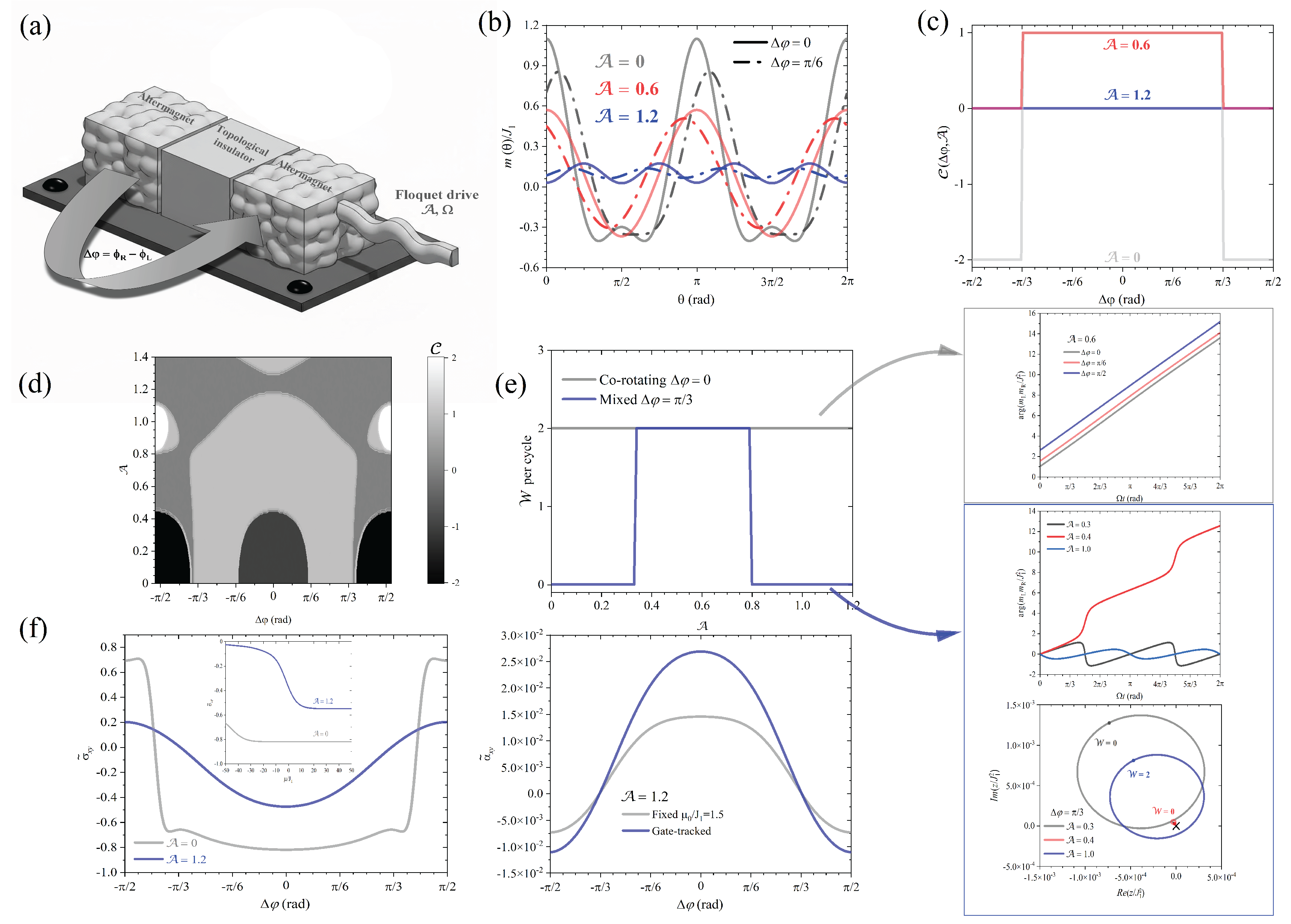
Figure 1b shows (scaled by the magneto-elastic coupling meV [28]) for (black), (red), and (blue), at phase offsets (solid) and (dashed). For the mass exhibits a symmetric double-well angular structure. A finite phase offset shifts the extrema but preserves the overall nodal pattern. Increasing suppresses the and harmonics through the Bessel renormalization, progressively flattening the angular mass profile and reducing the number of sign-change sectors.
Figure 1c displays the Chern number for the same amplitudes. In the undriven case (), a broad plateau with extends over , with sharp transitions at the phase boundaries. At , close to the first zero of , the region narrows significantly. For , near the first zero of , the response becomes predominantly trivial (), consistent with strong suppression of the leading harmonic. The sequence illustrates re-entrant topological switching controlled by the drive amplitude at fixed phase offset. The global structure is summarized in Figure 1d, which maps over and . Topological sectors with dominate at small , while intermediate amplitudes stabilize regions. As approaches the Bessel zeros, these sectors contract and eventually give way to an extended trivial phase. The resulting “eye”-shaped structure reflects the coexistence of symmetry-inequivalent and harmonics: tuning renormalizes each component differently and enables transitions such as within the same device.
Panel (e) shows the winding number for two representative driving protocols. For co-rotating phases (), throughout the explored amplitude range. For mixed-phase driving (), develops a quantized plateau at over a finite interval of , and returns to zero outside this window. The right subpanels provide complementary diagnostics: inside the plateau, exhibits a net phase accumulation per cycle and the complex trajectory forms a closed loop encircling the origin twice; outside the plateau no net encirclement occurs.
Figure 1f presents the anomalous Hall conductance and the thermoelectric Hall coefficient . The suppression of at large follows the collapse of the corresponding Chern sectors near Bessel zeros. The thermoelectric response, obtained from the Mott relation , is enhanced when the chemical potential is gate-tracked to remain near energies where is maximal. This optimization sharpens the response without altering the underlying topological structure.
The parameter range used in Figure 1(b)–(f) is compatible with strained AM/TI nanoscale heterostructures. A realistic implementation could consist of a few-quintuple-layer or channel (∼5–10 QL) contacted by thin or MnTe altermagnetic electrodes with thicknesses in the ∼5–30 nm range.[19,28] The layer thicknesses play distinct physical roles. The TI should be thick enough to suppress hybridization between the top and bottom surface states, while remaining sufficiently thin for electrostatic gating and interfacial transport to dominate over bulk leakage channels; this motivates the few-quintuple-layer regime. If the TI becomes too thin, hybridization opens an additional finite-size gap competing with the altermagnet-induced Dirac mass, whereas excessively thick or bulk-conducting films progressively shunt the surface Hall response through trivial bulk transport. The altermagnetic layer, in turn, must be thick enough to stabilize the compensated ordered phase and maintain a robust exchange coupling at the interface, while remaining thin enough for strain to be transferred coherently from the piezoelectric or surface-acoustic-wave actuator. In this sense, the effective mass should be understood primarily as an interfacial exchange mass controlled by the first few atomic layers adjacent to the TI rather than as a bulk volume-averaged magnetic parameter.
Independent strain control of has been demonstrated in -based and MnTe-based platforms,[5,6,26] while integrated piezoelectric or surface-acoustic-wave (SAW) actuators can generate the angular excursions required to reach –1.0.[24,25] Such actuation can be implemented on chip using thin-film AlN, ScAlN, or platforms compatible with nanoscale Hall-bar geometries and MHz operation.[36,37,38,39] Operating at MHz frequencies places the system deep in the adiabatic regime (–), which is particularly advantageous for thin-film nanoscale devices because it minimizes heating, reduces photon-assisted interband processes, and avoids the strong dissipation typically associated with THz Floquet platforms.[34,35]
Experimentally, the proposed mechanism could be identified through the strain-amplitude dependence of the anomalous Hall plateau structure, the collapse of topological sectors near Bessel zeros, and the gate dependence of the thermoelectric Hall response. Since the effect originates from interfacial Berry-curvature engineering, the signal is also expected to scale with TI-film thickness and to weaken as bulk transport progressively dominates.
4. Conclusions
These results establish AM/TI interfaces as a realistic platform for mechanically programmable Hall and thermoelectric switching at MHz frequencies, with control windows accessible through piezoelectric strain and electrostatic gating in nanoscale thin-film heterostructures. The present bilayer geometry enables programmable topological control through independent tuning of the two altermagnetic phases combined with Bessel-function amplitude renormalization. Because the mechanism relies on interfacial Berry-curvature engineering rather than global magnetization reversal or optical pumping, it is naturally suited to low-dissipation nano-spintronic architectures operating in the adiabatic regime.
Several extensions of the present framework remain open. Multilayer AM–TI heterostructures with repeated interfaces could enable spatially selective Berry-curvature engineering and coupled chiral transport channels. Likewise, multifrequency driving protocols may provide a route toward synthetic topological band structures controlled entirely by mechanical phase modulation.[16] Finally, combining the present mechanism with proximitized superconducting interfaces could offer a platform for studying strain-controlled topological superconducting boundaries and related emergent edge states.[40]
Author Contributions
For research articles with several authors, a short paragraph specifying their individual contributions must be provided. The following statements should be used “Conceptualization, C.C. and F.G.; methodology, and F.G; software, C.C. and F.G; validation, C.C. and F.G; formal analysis, C.C. and F.G; investigation, C.C. and F.G; resources, C.C. and F.G; data curation, C.C. and F.G; writing—original draft preparation, C.C. and F.G; writing—review and editing, C.C. and F.G. All authors have read and agreed to the published version of the manuscript.”
Data Availability Statement
Data are avalaible from authors upon request.
Conflicts of Interest
The authors declare no conflicts of interest.
References
- Šmejkal, L.; Sinova, J.; Jungwirth, T. Beyond Conventional Ferromagnetism and Antiferromagnetism: A Phase with Nonrelativistic Spin and Crystal Rotation Symmetry. Phys. Rev. X 2022, 12, 031042. [Google Scholar] [CrossRef]
- Šmejkal, L.; Sinova, J.; Jungwirth, T. Emerging Research Landscape of Altermagnetism. Phys. Rev. X 2022, 12, 040501. [Google Scholar] [CrossRef]
- Guo, Y.; Zhang, J.; Zhu, Z.; Jiang, Y.; Jiang, L.; Wu, C.; Dong, J.; Xu, X.; He, W.; He, B.; Huang, Z.; Du, L.; Zhang, G.; Wu, K.; Han, X.; Shao, D.; Yu, G.; Wu, H. Direct and Inverse Spin Splitting Effects in Altermagnetic RuO2. Adv. Sci. 2024, 11, 2400967. [Google Scholar] [CrossRef] [PubMed]
- Zhang, C.-P.; Gao, X.-J.; Xie, Y.-M.; Po, H. C.; Law, K. T. Higher-order nonlinear anomalous Hall effects induced by Berry curvature multipoles. Phys. Rev. B 2023, 107, 115142. [Google Scholar] [CrossRef]
- Fu, Z.; Hu, M.; Li, A.; Duan, H.; Liu, J.; Ouyang, F. Multiple Topological Phases Controlled via Strain in Two-Dimensional Altermagnets. arXiv 2025, arXiv:2507.22474. [Google Scholar] [CrossRef]
- Smolenski, S.; Mao, N.; Zhang, D.; Guo, Y.; Shawon, A. K. M. A.; Xu, M.; Downey, E.; Musall, T.; Yi, M.; Xie, W.; Jozwiak, C.; Bostwick, A.; Tamura, N.; Rotenberg, E.; Li, L.; Sun, K.; Zhang, Y.; Jo, N. H. Strain-Tunability of the Multipolar Berry Curvature in Layered Altermagnets. arXiv 2025, arXiv:2509.21481. [Google Scholar]
- Rudner, M. S.; Lindner, N. H. The Floquet Engineer’s Handbook. arXiv 2020, arXiv:2003.08252. [Google Scholar]
- Eckardt, A.; Anisimovas, E. High-frequency approximation for periodically driven quantum systems from a Floquet-space perspective. New J. Phys. 2015, 17, 093039. [Google Scholar] [CrossRef]
- González-Hernández, I.; Kounta, I.; Schlitz, R. Creation and manipulation of higher-order topological states by altermagnets. Phys. Rev. B 2024, 109, L201109. [Google Scholar] [CrossRef]
- Asmar, H. Z.; Ulloa, S. E. Interface symmetry and spin control in topological-insulator heterostructures. Phys. Rev. B 2017, 95, 241115. [Google Scholar] [CrossRef]
- Yi, H.; Zhao, Y.-F.; Chan, Y.-T.; Hu, L.-H.; Zhang, Z.; Shibayev, P. P.; Richardella, A. R.; Lee, I.; Li, P.; Chan, M. H. W.; Law, K. T.; Samarth, N.; Chang, C.-Z. Interface-induced superconductivity in magnetic topological insulators. Science 2024, 383, 634. [Google Scholar] [CrossRef]
- Zhang, Z.; Li, Y.; Ji, W. Strain modulation of second harmonic generation in new tetrahedral transition metal dichalcogenide monolayers. Chin. Phys. B 2025, 34, 084206. [Google Scholar] [CrossRef]
- Li, P.; Koo, J.; Ning, W.; Li, J.; Miao, L.; Min, L.; Zhu, Y.; Wang, Y.; Alem, N.; Liu, C.-X.; Mao, Z.; Yan, B. Three-dimensional hidden phase probed by in-plane Hall responses. Nat. Commun. 2024, 15, 4897. [Google Scholar]
- Wadehra, N.; Tomar, R.; Varma, R. M.; Gopal, R. K.; Singh, Y.; Dattagupta, S.; Chakraverty, S. Planar Hall effect and anisotropic magnetoresistance in a polar-polar interface of LaVO3-KTaO3 with strong spin-orbit coupling. Nat. Commun. 2020, 11, 874. [Google Scholar] [CrossRef]
- Caro, C.; Gámez, F. Phase-Rotated Altermagnets as Chern Valves for Topological Transport. Nano Lett. 2026. [Google Scholar] [CrossRef] [PubMed]
- Kitagawa, T.; Berg, E.; Rudner, M.; Demler, E. Topological characterization of periodically driven quantum systems. Phys. Rev. B 2010, 82, 235114. [Google Scholar] [CrossRef]
- Lindner, N. H.; Refael, G.; Galitski, V. Floquet topological insulator in semiconductor quantum wells. Nat. Phys. 2011, 7, 490. [Google Scholar] [CrossRef]
- Chang, Q.; Zhao, Y.-L.; Zhou, Y. Chern Number Tunable Quantum Anomalous Hall Effect in Monolayer Transition Metal Oxides via Magnetization Orientation. Phys. Rev. Lett. 2022, 129, 036801. [Google Scholar] [CrossRef]
- Liu, C.; Wang, Y.; Li, H.; Wu, Y.; Li, Y.; Li, J.; He, K.; Xu, Y.; Zhang, J.; Wang, Y. Robust axion insulator and Chern insulator phases in a two-dimensional antiferromagnetic topological insulator. Nat. Mater. 2020, 19, 522. [Google Scholar] [CrossRef]
- Wadley, P.; Howells, B.; Železný, J.; Andrews, C.; Hills, V.; Campion, R. P.; Novák, V.; Olejník, K.; Maccherozzi, F.; Dhesi, S. S.; Martin, S. Y.; Wagner, T.; Wunderlich, J.; Freimuth, F.; Mokrousov, Y.; Kuneš, J.; Chauhan, J. S.; Grzybowski, M. J.; Rushforth, A. W.; Edmonds, K. W.; Gallagher, B. L.; Jungwirth, T. Electrical switching of an antiferromagnet. Science 2016, 351, 587. [Google Scholar] [CrossRef]
- Väyrynen, J. I.; Goldstein, M.; Glazman, L. I. Tuning surface Dirac valleys by strain in topological crystalline insulators. Phys. Rev. B 2015, 91, 195320. [Google Scholar] [CrossRef]
- Guinea, F.; Katsnelson, M. I.; Geim, A. K. Energy gaps and a zero-field quantum Hall effect in graphene by strain engineering. Nat. Phys. 2010, 6, 30. [Google Scholar]
- Thouless, D. J. Quantization of particle transport. Phys. Rev. B 1983, 27, 6083. [Google Scholar] [CrossRef]
- Cheng, C.; Lu, Z.; Yang, J.; Gong, X.; Ke, Q. Modulating the Performance of the SAW Strain Sensor Based on Dual-Port Resonator Using Finite Element Method. Micromachines 2023, 14, 906. [Google Scholar]
- Zhou, T.; Reinhardt, A.; Bousquet, M.; Eymery, J.; Leake, S.; Holt, M. V.; Evans, P. G.; Schüli, T. High-Resolution High-Throughput Spatiotemporal Strain Mapping with Surface Acoustic Wave Resonators. Nat. Commun. 2025, 16, 2554. [Google Scholar]
- Takahashi, T.; Yanase, Y. Elasto-Hall Conductivity and the Anomalous Hall Effect in Strained Altermagnetic Materials. Phys. Rev. B 2025, 111, 184408. [Google Scholar] [CrossRef]
- Wickramaratne, D.; Currie, M.; Fields, S. S.; Cress, C. D.; Bennett, S. P. Effects of Altermagnetic Order, Strain and Doping in RuO2. arXiv 2025, arXiv:2502.08872. [Google Scholar] [CrossRef]
- Grutter, A. J.; He, Q. L. Magnetic proximity effects in topological insulator heterostructures: Implementation and characterization. Phys. Rev. Mater. 2021, 5, 090301. [Google Scholar] [CrossRef]
- Jackiw, R.; Rebbi, C. Solitons with fermion number 1/2. Phys. Rev. D. 1976, 13, 3398. [Google Scholar] [CrossRef]
- Semenoff, G. W. Condensed-Matter Simulation of a Three-Dimensional Anomaly. Phys. Rev. Lett. 1984, 53, 2449. [Google Scholar] [CrossRef]
- Datta, S. Electronic Transport in Mesoscopic Systems; Cambridge University Press: Cambridge, 1995. [Google Scholar]
- Haldane, F. D. M. Berry Curvature on the Fermi Surface: Anomalous Hall Effect as a Topological Fermi-Liquid Property. Phys. Rev. Lett. 2004, 93, 206602. [Google Scholar] [CrossRef]
- Nagaosa, N.; Sinova, J.; Onoda, S.; MacDonald, A. H.; Ong, N. P. Anomalous Hall Effect. Rev. Mod. Phys. 2010, 82, 1539. [Google Scholar] [CrossRef]
- Rechtsman, M. C.; Zeuner, J. M.; Plotnik, Y.; Lumer, Y.; Podolsky, D.; Dreisow, F.; Nolte, S.; Segev, M.; Szameit, A. Photonic Floquet Topological Insulators. Nature 2013, 496, 196. [Google Scholar] [CrossRef]
- McIver, J. W.; Schulte, B.; Stein, F. U.; Matsuyama, T.; Jotzu, G.; Meier, G.; Cavalleri, A. Light-Induced Anomalous Hall Effect in Graphene. Nat. Phys. 2020, 16, 38. [Google Scholar] [CrossRef] [PubMed]
- Liu, J.; Tan, H.; Zhou, Z.; Ma, W.; Wang, C.; Tran, N.-M.-A.; Lu, W.; Chen, F.; Wang, J.; Zhang, H. Piezoelectric Thin Films and Their Applications in MEMS: A Review. J. Appl. Phys. 2025, 137, 020702. [Google Scholar] [CrossRef]
- Piazza, G.; Felmetsger, V.; Muralt, p.; Olsson, R. H., III; Ruby, R. Piezoelectric Aluminum Nitride Thin Films for Microelectromechanical Systems. MRS Bull. 2012, 37, 1051. [Google Scholar] [CrossRef]
- Zhu, D.; Shao, L.; Yu, M.; Cheng, R.; Desiatov, B.; Xin, C. J.; Hu, Y.; Holzgrafe, J.; Ghosh, S.; Shams-Ansari, A.; Puma, E.; Sinclair, N.; Reimer, C.; Zhang, M.; Lončar, M. Integrated Photonics on Thin-Film Lithium Niobate. Adv. Opt. Photon. 2021, 13, 242. [Google Scholar] [CrossRef]
- Luschmann, T.; Jung, A.; Geprägs, S. Surface Acoustic Wave Resonators on Thin Film Piezoelectric Substrates in the Quantum Regime. arXiv 2023, arXiv:2301.11213. [Google Scholar] [CrossRef]
- Fu, L.; Kane, C. L. Superconducting Proximity Effect and Majorana Fermions at the Surface of a Topological Insulator. Phys. Rev. Lett. 2008, 100, 096407. [Google Scholar] [CrossRef] [PubMed]
Figure 1.
Floquet Chern valve: Bessel-driven topological switching. (a) Device schematic: TI film contacted by altermagnetic electrodes with independent phases and , driven periodically at angular frequency . (b) Angular mass profile (normalized by coupling ) for three drive amplitudes (black), 0.6 (red), 1.2 (blue) at two phase offsets (co-phase, solid) and (phase-offset, dashed). Increasing progressively suppresses harmonics via Bessel renormalization, flattening the mass landscape. (c) Chern number at three drive amplitudes showing quantized plateaus that confirm chiral edge channels. Plateau widths shrink as approaches Bessel zeros, demonstrating amplitude-tunable topological switching. (d) Full two-parameter phase diagram spanning drive amplitude and relative phase . White regions (high ) indicate trivial phases (); colored regions show topological sectors (). Black contours separate sector boundaries, revealing characteristic phase-amplitude structure. (e) Winding number per cycle: co-rotating phases (, gray) remain trivial with ; mixed-phase rotation (, blue) exhibits a quantized plateau for , corresponding to quantized charge pumped per cycle. Right subpanels: time evolution of for a co-rotating case (top) and a mixed-phase case (middle), and complex-plane trajectories of (bottom) illustrating the winding mechanism. Trajectories outside the plateau (e.g., , gray) do not encircle the origin and yield , whereas trajectories inside the plateau (e.g., , blue and , red) form closed loops that encircle the origin twice, giving . (f) Left: Anomalous Hall conductance (dimensionless) at (gray, robust plateau) and (blue, suppressed by Bessel-zero tuning). Right: Thermoelectric Hall coefficient at comparing fixed (gray) and gate-tracked (blue), showing 80% peak enhancement via chemical potential optimization.
Figure 1.
Floquet Chern valve: Bessel-driven topological switching. (a) Device schematic: TI film contacted by altermagnetic electrodes with independent phases and , driven periodically at angular frequency . (b) Angular mass profile (normalized by coupling ) for three drive amplitudes (black), 0.6 (red), 1.2 (blue) at two phase offsets (co-phase, solid) and (phase-offset, dashed). Increasing progressively suppresses harmonics via Bessel renormalization, flattening the mass landscape. (c) Chern number at three drive amplitudes showing quantized plateaus that confirm chiral edge channels. Plateau widths shrink as approaches Bessel zeros, demonstrating amplitude-tunable topological switching. (d) Full two-parameter phase diagram spanning drive amplitude and relative phase . White regions (high ) indicate trivial phases (); colored regions show topological sectors (). Black contours separate sector boundaries, revealing characteristic phase-amplitude structure. (e) Winding number per cycle: co-rotating phases (, gray) remain trivial with ; mixed-phase rotation (, blue) exhibits a quantized plateau for , corresponding to quantized charge pumped per cycle. Right subpanels: time evolution of for a co-rotating case (top) and a mixed-phase case (middle), and complex-plane trajectories of (bottom) illustrating the winding mechanism. Trajectories outside the plateau (e.g., , gray) do not encircle the origin and yield , whereas trajectories inside the plateau (e.g., , blue and , red) form closed loops that encircle the origin twice, giving . (f) Left: Anomalous Hall conductance (dimensionless) at (gray, robust plateau) and (blue, suppressed by Bessel-zero tuning). Right: Thermoelectric Hall coefficient at comparing fixed (gray) and gate-tracked (blue), showing 80% peak enhancement via chemical potential optimization.
Disclaimer/Publisher’s Note: The statements, opinions and data contained in all publications are solely those of the individual author(s) and contributor(s) and not of MDPI and/or the editor(s). MDPI and/or the editor(s) disclaim responsibility for any injury to people or property resulting from any ideas, methods, instructions or products referred to in the content. |
© 2026 by the authors. Licensee MDPI, Basel, Switzerland. This article is an open access article distributed under the terms and conditions of the Creative Commons Attribution (CC BY) license (http://creativecommons.org/licenses/by/4.0/).
Copyright: This open access article is published under a Creative Commons CC BY 4.0 license, which permit the free download, distribution, and reuse, provided that the author and preprint are cited in any reuse.


