

Submitted:
12 May 2026
Posted:
13 May 2026
You are already at the latest version
Abstract
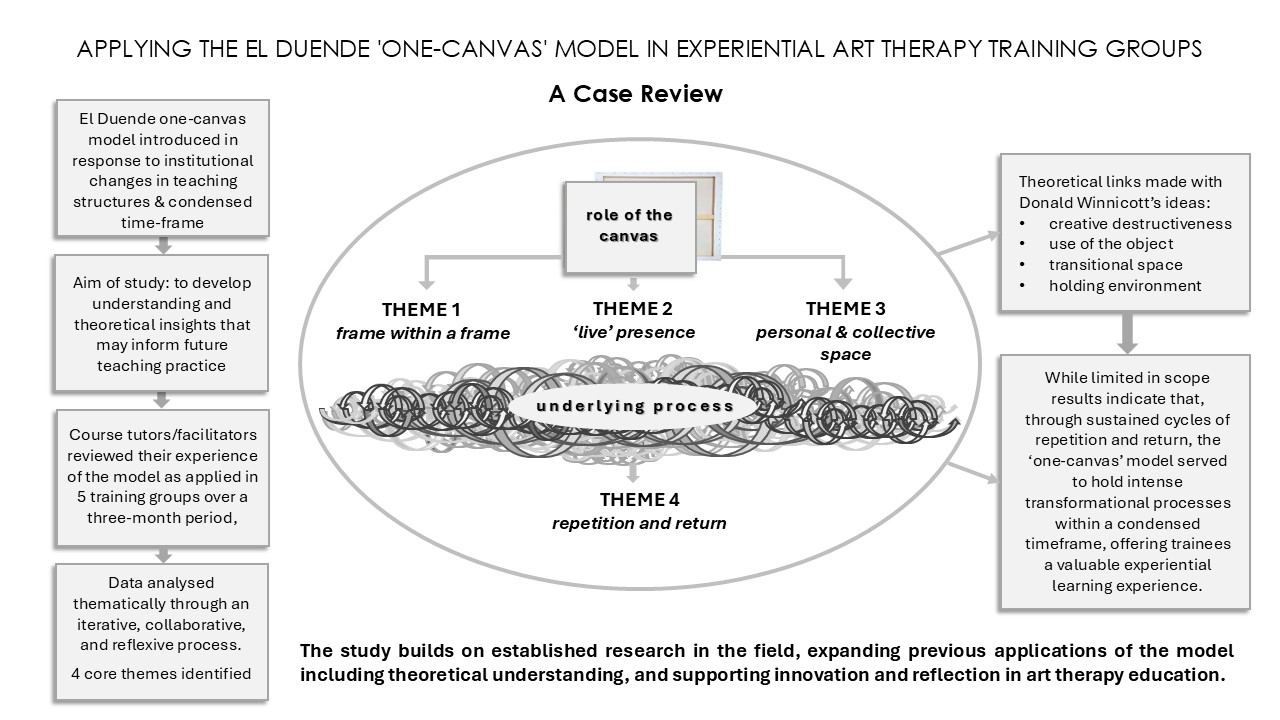
The El Duende ‘one-canvas’ model was developed as an arts-based practice for supervision in art therapy training. Responding to changes in institutional teaching structures, this case review reflects on its use in experiential training groups on one UK-based course, with the aim of developing understanding and theoretical insights that may inform future teaching practice. Eight training group facilitators retrospectively reviewed their experience of the model as applied in five experiential training groups over a three-month period. Data were analysed thematically through an iterative, collaborative, and reflexive process and four core themes were identified. Results are discussed with links made to Donald Winnicott’s ideas of creative destructiveness, use of the object, transitional space, and the holding environment. While limited in scope, results indicate that, through sustained cycles of repetition and return, the ‘one-canvas’ model served to hold intense transformational processes within a condensed timeframe, offering trainees a valuable experiential learning experience. The study builds on established research in the field, expanding previous applications of the model including theoretical understanding, and supporting innovation and reflection in art therapy education. Future research may consider further adaptations to the model, student perspectives, and its influence on personal and professional development.
Keywords:
art therapy education
; El duende one-canvas model
; experiential training groups
; Donald Winnicott
; creative destruction
; use of the object
; repetition and return
; transitional space
; holding environment
Copyright: This open access article is published under a Creative Commons CC BY 4.0 license, which permit the free download, distribution, and reuse, provided that the author and preprint are cited in any reuse.


